
Showing 17 items matching "families of military personnel - australia"
-
 National Vietnam Veterans Museum (NVVM)
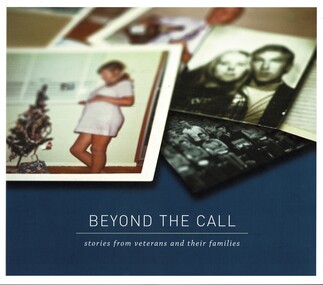
Book, Sayer-Jones, Moya, Beyond The Call: Stories From Veterans And Their Families (Copy 2)
... Families of Military personnel - Australia...Post-traumatic stress disorder Families of Military personnel - Australia Vietnam The stories celebrate the way in which partners and famiies have supported veteran family members, many of whom are challenged with mental illness and some with substance use. ...The stories celebrate the way in which partners and famiies have supported veteran family members, many of whom are challenged with mental illness and some with substance use.The stories celebrate the way in which partners and famiies have supported veteran family members, many of whom are challenged with mental illness and some with substance use.post-traumatic stress disorder, families of military personnel - australia, vietnam -
 National Vietnam Veterans Museum (NVVM)
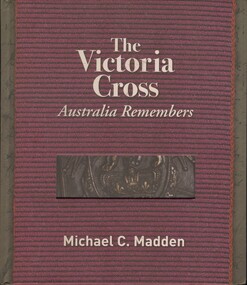
Book, Madden, Michael C, The Victoria Cross: Australia Remembers, 2018
... Families of Military personnel - Australia...Victoria Cross - Biography Victoria Cross - History Families of Military personnel - Australia Wheatley Kevin VC Badcoe Peter VC Simpson Ray VC DCM Payne Keith VC AM KSJ this book tells the stories of Australia's 100 Victoria Cross recipients in a uniquely intimate way: in most cases with insight from the men's families themselves. ...this book tells the stories of Australia's 100 Victoria Cross recipients in a uniquely intimate way: in most cases with insight from the men's families themselves.this book tells the stories of Australia's 100 Victoria Cross recipients in a uniquely intimate way: in most cases with insight from the men's families themselves.victoria cross - biography, victoria cross - history, families of military personnel - australia, wheatley, kevin vc, badcoe, peter vc, simpson, ray vc dcm, payne, keith vc am ksj -
 National Vietnam Veterans Museum (NVVM)
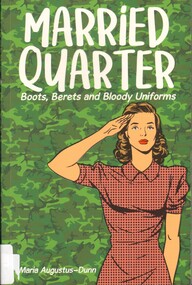
Book, Augustus-Dunn, Maria, Married Quarter: Boots, Berets and Bloody Uniforms, 2017
... Families of military personnel -- Australia -- Biography...Military spouses -- Australia -- Biography Families of military personnel -- Australia -- Biography Serving the nation in uniform is a career choice. ...Serving the nation in uniform is a career choice. But have you ever wondered about the life of a partner of these brave men andwomen?Serving the nation in uniform is a career choice. But have you ever wondered about the life of a partner of these brave men andwomen?military spouses -- australia -- biography, families of military personnel -- australia -- biography -
 Bendigo Military Museum
Photograph - Army Survey Regiment – Corps Day Parade Set 1, Fortuna Villa, Bendigo, 1991
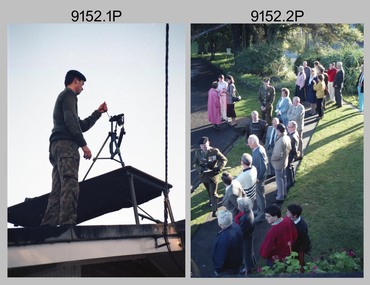
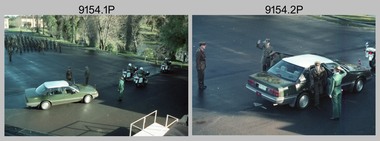
... Australian Survey Corps. The Reviewing officer was the Commander of the 3rd Military District BRIG P. Davies AM ADC and the Parade Host was D-SVY COL Simon Lemon. Refer to items 9154.37P for more photographs taken during the parade; and 9155.27P for photographs taken afterwards during the tour of the unit and the family BBQ. Royal Australian Survey Corps RASvy Army Survey Regiment Army Svy Regt Fortuna There are no personnel ...This set of 31 photographs was taken at the Corps Day Parade held at the Army Survey Regiment, Bendigo on the 26th of June 1991.The Corps Day Parade was held to commemorate the 76th anniversary of the formation of the Royal Australian Survey Corps. The Reviewing officer was the Commander of the 3rd Military District BRIG P. Davies AM ADC and the Parade Host was D-SVY COL Simon Lemon. Refer to items 9154.37P for more photographs taken during the parade; and 9155.27P for photographs taken afterwards during the tour of the unit and the family BBQ.This is a set of 31 photographs of the Corps Day Parade held at the Army Survey Regiment, Fortuna, Bendigo on the 26th of June 1991. The colour photographs are on 35mm negative film and scanned at 2400 dpi. They are part of the Army Survey Regiment’s Collection. .1) - Photo, colour, 1991. Photographer on the roof of the SGTS Mess Accommodation building. .2) - Photo, colour, 1991. Guests gather at the edge of the parade ground. The RSM in the foreground and the WO1 in the background are unidentified. .3) & .4) - Photo, colour, 1991. SGT Chris ‘Charlie’ Brown stands at one corner of the parade ground behind a Wild T2 theodolite mounted with a RED2L Electric Distance Measurement (EDM) instrument. .5) & .6) - Photo, colour, 1991. CPL Steve Wegener stands at one corner of the parade ground behind a Wild T2 theodolite. .7) & .8) - Photo, colour, 1991. The right markers of each squadron take their positions under RSM WO1 Graham Ragless’s commands. .9) - Photo, colour, 1991. The Officers move to the edge of the parade ground before taking posts. SGT Chris ‘Charlie’ Brown is in the foreground behind a Wild T2 theodolite .10) to .15) - Photo, colour, 1991. Army Survey Regiment follows the 3rd MD marches onto the parade ground. RSM WO1 Graham Ragless is in the foreground. .16) - Photo, colour, 1991. Army Survey Regiment at the halt. RSM WO1 Graham Ragless is in the foreground. .17) - Photo, colour, 1991. Headquarters Squadron performs the ‘Right Dress’. .18) - Photo, colour, 1991. Cartographic Squadron performs the ‘Right Dress’. RSM WO1 Graham Ragless is in the foreground. .19) to .21) - Photo, colour, 1991. Army Survey Regiment stands at ease during RSM WO1 Graham Ragless’s handover to ADJT CAPT Geoff Ford. .22) to .24) - Photo, colour, 1991. Army Survey Regiment fixes bayonets under ADJT CAPT Geoff Ford’s commands. .25) - Photo, colour, 1991. Army Survey Regiment stands at ease during ADJT CAPT Geoff Ford’s handover to 2IC MAJ Ray Redman .26) & .27) - Photo, colour, 1991. Army Survey Regiment Officers take posts under 2IC MAJ Ray Redman’s commands. .28) & .29) - Photo, colour, 1991. Army Survey Regiment stands at attention during 2IC MAJ Ray Redman’s handover to CO LTCOL Rene van den Tol. .30) & .31) - Photo, colour, 1991. Army Survey Regiment under CO LTCOL Rene van den Tol’s command awaits arrival of the official guests.There are no personnel identified. ‘Corps Day 26 Jun 1991’ annotated on negative sleeves.royal australian survey corps, rasvy, army survey regiment, army svy regt, fortuna -
 Bendigo Military Museum
Photograph - Army Survey Regiment – Corps Day Parade Set 2, Fortuna Villa, Bendigo, 1991
... Australian Survey Corps. The Reviewing officer was the Commander of the 3rd Military District BRIG P. Davies AM ADC and the Parade Host was D-SVY COL Simon Lemon. Refer to items 9152.31P for more photographs taken during the parade; and 9155.27P for photographs taken afterwards during the tour of the unit and the family BBQ. Royal Australian Survey Corps RASvy Army Survey Regiment Army Svy Regt Fortuna There are no personnel ...This set of 37 photographs was taken at the Corps Day Parade held at the Army Survey Regiment, Bendigo on the 26th of June 1991.The Corps Day Parade was held to commemorate the 76th anniversary of the formation of the Royal Australian Survey Corps. The Reviewing officer was the Commander of the 3rd Military District BRIG P. Davies AM ADC and the Parade Host was D-SVY COL Simon Lemon. Refer to items 9152.31P for more photographs taken during the parade; and 9155.27P for photographs taken afterwards during the tour of the unit and the family BBQ.This is a set of 37 photographs of the Corps Day Parade held at the Army Survey Regiment, Fortuna, Bendigo on the 26th of June 1991. The colour photographs are on 35mm negative film and scanned at 2400 dpi. They are part of the Army Survey Regiment’s Collection. .1) - Photo, colour, 1991. Arrival of COMD 3MD. L to R: D-SVY - COL Simon Lemon, unidentified personnel, unidentified Aide-de-camp. .2) to .4) - Photo, colour, 1991. Arrival of COMD 3MD. L to R: D-SVY - COL Simon Lemon, COMD 3MD - BRIG P. Davies AM ADC, unidentified Aide-de-camp, unidentified personnel. .5) - Photo, colour, 1991. Cartographic Squadron stands at attention, under command of OC MAJ Graeme Wastell. .6) - Photo, colour, 1991. Headquarters Squadron stands at attention, under command of OC MAJ Peter Jensen. 2IC MAJ Ray Redman at left. .7) - Photo, colour, 1991. Air Survey Squadron stands at attention. L to R: LT Simon Buckpitt, WO1 Brett ‘Dutchy’ Van Leeuwen, unidentified (x2), CPL Perry Burt, SGT Sandy Craig, SGT Graeme Reany, SPR Stuart Bowd, LT Michelle Breen in foreground, unidentified, SGT Wolfgang Thun, SSGT Bruce Hammond, unidentified, SGT Paul Hopes, WO1 Russell ‘Rusty’ Williams. .8) - Photo, colour, 1991. Air Survey Squadron at attention under command of OC MAJ Peter Clark - at far left during the inspection. L to R: LT Simon Buckpitt, CO LTCOL Rene van den Tol, unidentified Aide-de-camp, LT Michelle Breen in foreground. At her right L to R: COMD 3MD - BRIG P. Davies AM ADC, SGT Graeme Reany, SPR Stuart Bowd, unidentified, SGT Wolfgang Thun, SSGT Bruce Hammond, unidentified, SGT Paul Hopes, WO1 Russell ‘Rusty’ Williams. .9) - Photo, colour, 1991. Air Survey Squadron inspection. L to R: D-SVY - COL Simon Lemon, COMD 3MD - BRIG P. Davies AM ADC, SPR Steve Linane, SPR Derek Percival. .10) & .11) - Photo, colour, 1991. Air Survey Squadron inspection. SSGT Graham Johnston at far left. L to R: CO LTCOL Rene van den Tol, unidentified Aide-de-camp, D-SVY - COL Simon Lemon, COMD 3MD - BRIG P. Davies AM ADC, SPR John ‘Docc’ Commons, unidentified (x4), SPR Jo (Innes) Thun, SGT Peter Tuddenham, SSGT Bob Garritty, SGT Martin Evans. .12) - Photo, colour, 1991. Air Survey Squadron inspection. L to R: CO LTCOL Rene van den Tol, unidentified Aide-de-camp, D-SVY - COL Simon Lemon, COMD 3MD - BRIG P. Davies AM ADC, SPR John ‘Docc’ Commons, unidentified (x4), SPR Jo (Innes) Thun, SGT Peter Tuddenham, SSGT Bob Garritty, SGT Martin Evans. Unidentified WO2 in right background. .13) & .14) - Photo, colour, 1991. SPR Peter Smyth stands on the corner of the parade ground behind an MRA-7 Tellurometer mounted on a tripod. .15) & .16) - Photo, colour, 1991. SPR Damian Nolan stands on the corner of the parade ground behind a Plane Table Board with an alidade mounted 3MD Band stands at attention during the inspection. L to R: unidentified Aide-de-camp, unidentified 3MD Band Master, D-SVY - COL Simon Lemon, COMD 3MD - BRIG P. Davies AM ADC, unidentified members of 3MD Band.on a tripod. .17) - Photo, colour, 1991. The unidentified 3MD Band Master salutes COMD 3MD - BRIG P. Davies AM ADC before the 3MD Band inspection. .18) - Photo, colour, 1991. 3MD Band stands at attention during the inspection. L to R: unidentified Aide-de-camp, unidentified 3MD Band Master, D-SVY - COL Simon Lemon, COMD 3MD - BRIG P. Davies AM ADC, unidentified members of 3MD Band. .19) - Photo, colour, 1991. Army Survey Regiment at ‘Shoulder Arms’ position in readiness for the Present Arms’ salute. CO LTCOL Rene van den Tol at front. .20) - Photo, colour, 1991. Cartographic and Air Survey Squadrons at ‘Shoulder Arms’ position in readiness for the Present Arms’ salute. CO LTCOL Rene van den Tol at front. .21) - Photo, colour, 1991. Headquarters Squadron at ‘Shoulder Arms’ position in readiness for the Present Arms’ salute. L to R: 2IC MAJ Ray Redman, MAJ Bob Williams, OC MAJ Peter Jensen. CAPT Colin Cuskelly. .22) & .23) - Photo, colour, 1991. Army Survey Regiment under CO LTCOL Rene van den Tol’s command salutes the COMD 3MD with ‘Present Arms’. .24) - Photo, colour, 1991. L to R: COMD 3MD - BRIG P. Davies AM ADC, D-SVY - COL Simon Lemon, unidentified Aide-de-camp. .25) - Photo, colour, 1991. The squadrons remove their hats in readiness for ‘Three cheers for Her Majesty the Queen’. .26) & .27) - Photo, colour, 1991. The squadrons cheer in unison to the command ‘Three cheers for Her Majesty the Queen’. .28) - Photo, colour, 1991. The unidentified padre addresses the Parade. .29) - Photo, colour, 1991. COMD 3MD - BRIG P. Davies AM ADC, addresses the Parade. .30) - Photo, colour, 1991. D-SVY - COL Simon Lemon addresses the Parade. .31) & .32) - Photo, colour, 1991. COMD 3MD - BRIG P. Davies AM ADC presents the Defence Force Service Medal with clasp to WO1 Brett ‘Dutchy’ Van Leeuwen for 20 years of efficient remunerated service. .33) - Photo, colour, 1991. The 3MD Band marches towards the front steps of Fortuna Villa. .34) - Photo, colour, 1991. The 3MD Band salutes as it marches past the official guests on the front steps of Fortuna Villa. .35) - Photo, colour, 1991. Lithographic Squadron led by OC MAJ Bob Coote marches towards the front steps of Fortuna Villa. .36) - Photo, colour, 1991. Lithographic Squadron led by OC MAJ Bob Coote salutes as it marches past the official guests on the front steps of Fortuna Villa. .37) - Photo, colour, 1991. COMD 3MD - BRIG P. Davies AM ADC salutes the passing troops. L to R: D-SVY - COL Simon Lemon, unidentified UK Liaison Officer, BRIG P. Davies AM ADC, unidentified Aide-de-camp.There are no personnel identified. ‘Corps Day 26 Jun 1991’ annotated on negative sleeves.royal australian survey corps, rasvy, army survey regiment, army svy regt, fortuna -
 Bendigo Military Museum
Uniform - SLIDE SHOULDER BOARD
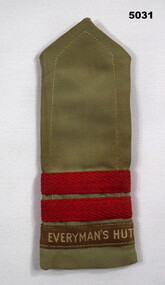
... personnel. An 'Everywoman's Hut' was established at Bandianna and was staffed by women. The hut's were also staffed by ministers of religion who had returned to Australia due to war plus volunteers. Everyman's staff wore a military cut uniform and, where appropriate, were given officer status by local commanders. Today, Everyman's Welfare Service caters for the well being of members of the ADF and their families...personnel. An 'Everywoman's Hut' was established at Bandianna and was staffed by women. The hut's were also staffed by ministers of religion who had returned to Australia due to war plus volunteers. Everyman's staff wore a military cut uniform and, where appropriate, were given officer status by local commanders. Today, Everyman's Welfare Service caters for the well being of members of the ADF and their families ...Established during world War Two, the first 'Everyman's Hut' was built at Bonegilla camp to serve army personnel. An 'Everywoman's Hut' was established at Bandianna and was staffed by women. The hut's were also staffed by ministers of religion who had returned to Australia due to war plus volunteers. Everyman's staff wore a military cut uniform and, where appropriate, were given officer status by local commanders. Today, Everyman's Welfare Service caters for the well being of members of the ADF and their families. Part of the Reverend Chaplain Major Thomas Bruce Williams, No556101, Collection.Khaki coloured slide should backgrounder board in poly ester fabric. A label with fawn lettering on a brown background is sewn to the straight end of the board. Above the label are two horizontal red bands in cotton braid.Embroidered on a brown label: 'EVERYMAN'S HUT'.everyman's hut, major thomas b. williams -
 Emerald Museum & Nobelius Heritage Park
Accessory - Military Belt, 1950s, Lion Metal Goods, 1950s
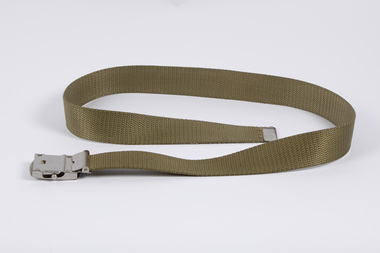
... military personnel and was donated by Robert (Bob) Baguley. Item is in good condition. The Baguley family are long term residents of the Emerald District. Robert Baguley served with the Royal Australian ...The belt was made c 1950s and 1960s for military personnel and was donated by Robert (Bob) Baguley.Item is in good condition. The Baguley family are long term residents of the Emerald District. Robert Baguley served with the Royal Australian Engineers in Malaysia and this belt may date from that time and may have been used by him.Green fabric belt. Metal buckle and strap.On underside of buckle: "AF 68 / LION METAL GOODS / P/L"1950s, royal australian engineers, malaysia, baguley -
 National Vietnam Veterans Museum (NVVM)
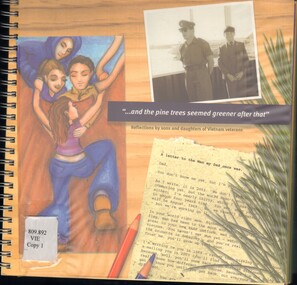
Book, Australia. Vietnam Veterans Counselling Service, And The Pine Trees Seemed Greener After That: Reflections by Sons and Daughters of Vietnam veterans. (Copy 1)
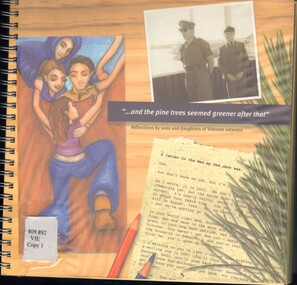
... Literature Australian poetry Children of military personnel This book is for sons and daughters of Vietnam veterans. It contains reflections by them, in words and images, of their experiences of growing up in a family with a Vietnam Veteran And The Pine Trees Seemed Greener After That: Reflections by Sons and Daughters of Vietnam veterans. ...This book is for sons and daughters of Vietnam veterans. It contains reflections by them, in words and images, of their experiences of growing up in a family with a Vietnam VeteranThis book is for sons and daughters of Vietnam veterans. It contains reflections by them, in words and images, of their experiences of growing up in a family with a Vietnam Veteranliterature, australian poetry, children of military personnel -
 National Vietnam Veterans Museum (NVVM)
Book, Australia. Vietnam Veterans Counselling Service, And The Pine Trees Seemed Greener After That: Reflections by sons and daughters of Vietnam Veterans. (Copy 2)
... Literature Australian poetry Children of military personnel This book is for sons and daughters of Vietnam veterans. It contains reflections by them, in words and images, of their experiences of growing up in a family with a Vietnam Veteran And The Pine Trees Seemed Greener After That: Reflections by sons and daughters of Vietnam Veterans. ...This book is for sons and daughters of Vietnam veterans. It contains reflections by them, in words and images, of their experiences of growing up in a family with a Vietnam VeteranThis book is for sons and daughters of Vietnam veterans. It contains reflections by them, in words and images, of their experiences of growing up in a family with a Vietnam Veteranliterature, australian poetry, children of military personnel -
 National Vietnam Veterans Museum (NVVM)
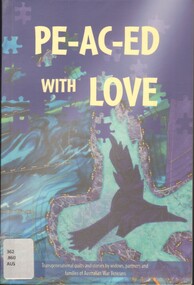
Book, Australian Partners and Families of Veterans, Pe-ac-ed with Love: transgenerational quilts and by widows, partners, and families of Australian War Veterans
... Family relationships...War widows - Australia...Veterans - Care - Australia...Children of military personnel...Veterans - Australia - Family relationships War widows - Australia Veterans - Care - Australia Children of military personnel - Australia The special theme of the Australian Partners and Families of Veterans National Quilt Project, this worthiest of enterprises, is Unity - Love - Peace. ...The special theme of the Australian Partners and Families of Veterans National Quilt Project, this worthiest of enterprises, is Unity - Love - Peace.The special theme of the Australian Partners and Families of Veterans National Quilt Project, this worthiest of enterprises, is Unity - Love - Peace.veterans - australia - family relationships, war widows - australia, veterans - care - australia, children of military personnel - australia -
 Warrnambool and District Historical Society Inc.
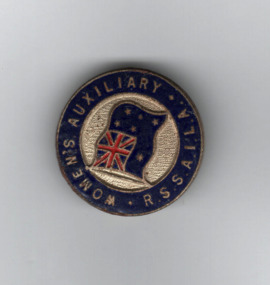
Badge, Women's Auxillary
... The Returned Soldiers, Sailors and Airmen Imperial League of Australia was formed in 1916 as welfare group to assist military personnel returning from the overseas active service. In 1965 the organization was renamed the Returned Services League of Australia and assists military personnel, and their families, both past and present. ...The Returned Soldiers, Sailors and Airmen Imperial League of Australia was formed in 1916 as welfare group to assist military personnel returning from the overseas active service. In 1965 the organization was renamed the Returned Services League of Australia and assists military personnel, and their families, both past and present. ...The Returned Soldiers, Sailors and Airmen Imperial League of Australia was formed in 1916 as welfare group to assist military personnel returning from the overseas active service. In 1965 the organization was renamed the Returned Services League of Australia and assists military personnel, and their families, both past and present. The Women's Auxiliaries assisted in the past with the work of the R.S.S.A.I.L.A. and today assist with the work of the Returned Services League. (The K.G.Luke company was founded in 1925 and continued until the 1980s.)This badge is of interest as one issued by the Women's Auxiliary of the R.S.S.A.I.L.A. It is not known if it has any connection to a local branch of the Women's Auxiliary. Small circular metal badge with dark blue circle around the edge and an Australian flag surrounded by a cream section. Pin on the reverse. Women's Auxiliary RSSAILA. ( Returned soldiers and sailors Imperial league of Australia)women's auxiliaries, returned services league of australia, returned soldiers, warrnambool history -
 Woodend RSL
Uniform - Shirt, 1981
... family members. The item is also represenantive of a type of military shirt that was issued to Army personnel during the late 20th century. The item is also in very good condition. matthew calvitto calvitto woodend 56th battalion 6th royal australian army regiment d company timor marksman yellow D company 6th royal australian regiment. red a collectors item infantry or military police or 4th battalion, blue 1 royal victorian regiment. ...This shirt was owned by Matthew Calvitto. Matthew moved to Woodend with his family at the age of one. He commenced his career in the 56th Battalion Army Reserve unit. In 1999 or early 2000 he volunteered to join the regular Army. He was posted to the 6th Royal Australian Army Regiment, D company. His initial training was at either Shaulwater Bay or Conundra. After his training he served for 6 months in Timor, in either the second or third rotation. Matthew and the other members of the D Company received battle honours. Matthew was their forward scout, as well as a marksman, which you need to qualify for every year.As an item that belonged to Matthew Calvitto, a local Woodend veteran who received battle honour for his service in Timor, this shirt has social and historic significance. The provenance of the item is know as it was donated by family members. The item is also represenantive of a type of military shirt that was issued to Army personnel during the late 20th century. The item is also in very good condition. Khaki short sleeved shirt with a short pointed collar and two front chest pockets. Each pocket is fastened with one semi opaque beige plastic button. There are seven identical buttons that fasten the front of the shirt. Each shoulder has an epoulette that fastens with one of these plastic buttons near the neck. yellow D company 6th royal australian regiment. red a collectors item infantry or military police or 4th battalion, blue 1 royal victorian regiment.matthew calvitto, calvitto, woodend, 56th battalion, 6th royal australian army regiment, d company, timor, marksman -
 Woodend RSL
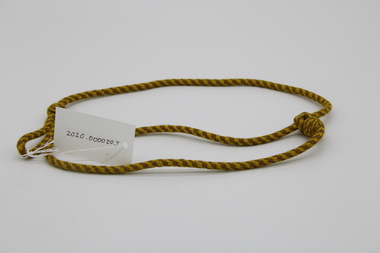
Lanyard, Late 20th Century
... family members. The item is also represenantive of a type of military lanyard that was issued to Army personnel during the late 20th century. The item is also in good condition. matthew calvitto calvitto woodend rsl woodend 56th battalion army reserve unit 6th royal australian army regiment d company timor forward scout marksman Yellow and brown patterned lanyard. ...This lanyard was owned by Matthew Calvitto. Matthew moved to Woodend with his family at the age of one. He commenced his career in the 56th Battalion Army Reserve unit. In 1999 or early 2000 he volunteered to join the regular Army. He was posted to the 6th Royal Australian Army Regiment, D company. His initial training was at either Shaulwater Bay or Conundra. After his training he served for 6 months in Timor, in either the second or third rotation. Matthew and the other members of the D Company received battle honours. Matthew was their forward scout, as well as a marksman, which you need to qualify for every year.As an item that belonged to Matthew Calvitto, a local Woodend veteran who received battle honours for his service in Timor, this lanyard has social and historic significance. The provenance of the item is know as it was donated by family members. The item is also represenantive of a type of military lanyard that was issued to Army personnel during the late 20th century. The item is also in good condition. Yellow and brown patterned lanyard. There is a loop at one end which is tied with a large knot, at approximately one third of the length of the item. Another small loop at the other end which is tied with a smaller knot. matthew calvitto, calvitto, woodend rsl, woodend, 56th battalion army reserve unit, 6th royal australian army regiment, d company, timor, forward scout, marksman -
Woodend RSL
Shirt, 1982
... family members. The item is also represenantive of a type of military shirt that was issued to Army personnel during the late 20th century. The item is also in very good condition. matthew calvitto calvitto woodend 56th battalion 6th royal australian army regiment d company timor marksman yellow D company 6th royal australian regiment. red a collectors item infantry or military police or 4th battalion, blue 1 royal victorian regiment. ...This shirt was owned by Matthew Calvitto. Matthew moved to Woodend with his family at the age of one. He commenced his career in the 56th Battalion Army Reserve unit. In 1999 or early 2000 he volunteered to join the regular Army. He was posted to the 6th Royal Australian Army Regiment, D company. His initial training was at either Shaulwater Bay or Conundra. After his training he served for 6 months in Timor, in either the second or third rotation. Matthew and the other members of the D Company received battle honours. Matthew was their forward scout, as well as a marksman, which you need to qualify for every year.As an item that belonged to Matthew Calvitto, a local Woodend veteran who received battle honour for his service in Timor, this shirt has social and historic significance. The provenance of the item is know as it was donated by family members. The item is also represenantive of a type of military shirt that was issued to Army personnel during the late 20th century. The item is also in very good condition. Khaki short sleeved shirt with a short pointed collar and two front chest pockets. Each pocket is fastened with one semi opaque beige plastic button. There are seven identical buttons that fasten the front of the shirt. Each shoulder has an epoulette that fastens with one of these plastic buttons near the neck. yellow D company 6th royal australian regiment. red a collectors item infantry or military police or 4th battalion, blue 1 royal victorian regiment.matthew calvitto, calvitto, woodend, 56th battalion, 6th royal australian army regiment, d company, timor, marksman -
Woodend RSL
Trousers
... family members. The item is also represenantive of a type of military shirt that was issued to Army personnel during the late 20th century. The item is also in very good condition. matthew calvitto calvitto woodend 56th battalion 6th royal australian army regiment d company timor marksman Trousers Australian Government Clothing Factory ...These trousers were owned by Matthew Calvitto. Matthew moved to Woodend with his family at the age of one. He commenced his career in the 56th Battalion Army Reserve unit. In 1999 or early 2000 he volunteered to join the regular Army. He was posted to the 6th Royal Australian Army Regiment, D company. His initial training was at either Shaulwater Bay or Conundra. After his training he served for 6 months in Timor, in either the second or third rotation. Matthew and the other members of the D Company received battle honours. Matthew was their forward scout, as well as a marksman, which you need to qualify for every year.As an item that belonged to Matthew Calvitto, a local Woodend veteran who received battle honour for his service in Timor, these trousers have social and historic significance. The provenance of the item is know as it was donated by family members. The item is also represenantive of a type of military shirt that was issued to Army personnel during the late 20th century. The item is also in very good condition. matthew calvitto, calvitto, woodend, 56th battalion, 6th royal australian army regiment, d company, timor, marksman -
 City of Melbourne Libraries
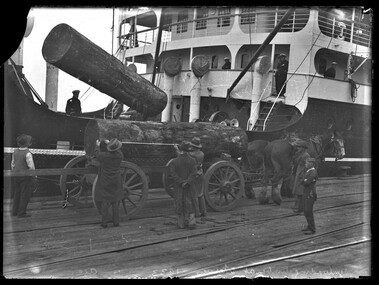
Photograph (item), Bull, Hugh Jones, 1897-1993, Unloading timber at Victoria Dock, 1933
... Australian Oriental Line in 1947, she underwent refitting and by mid-1948 was chartered to the Shanghai Shipping Company, and modified for greater passenger accommodation – approximately 500 passengers. In 1948/49 the Chinese Civil War took place. The Taiping departed Shanghai on 26 January 1949 as one of the final vessels evacuating civilians from to Keelung Harbour in Taiwan. Reports indicate that the Taiping carried double the rated capacity of passengers i.e. 1000. The ship carried families, military personnel...Australian Oriental Line in 1947, she underwent refitting and by mid-1948 was chartered to the Shanghai Shipping Company, and modified for greater passenger accommodation – approximately 500 passengers. In 1948/49 the Chinese Civil War took place. The Taiping departed Shanghai on 26 January 1949 as one of the final vessels evacuating civilians from to Keelung Harbour in Taiwan. Reports indicate that the Taiping carried double the rated capacity of passengers i.e. 1000. The ship carried families, military personnel ...Photographer notations on slide: "Unloading Timber at Wharves 1933 Age B5" Published: Age (Melbourne, Vic.: 1854- ), Tuesday 15 August 1933 MAHOGANY FROM MANILA. (1933, August 15). The Age (Melbourne, Vic. : 1854 - 1954), p. 11. Retrieved January 16, 2026, from http://nla.gov.au/nla.news-article204377024 Published title: MAHOGANY FROM MANILA Published Caption: Age Tue 15 Aug 1933 Caption: Unloading Mahogany Logs brought from Manila, Philippine Islands, by the steamer Taiping, which berthed yesterday at Victoria Dock. The vessel discharged twenty logs, each weighing three tons, the first shipment of this type of timber landed in Melbourne. Research by Project Volunteer, Louise McKenzie: This photograph in many ways epitomises Melbourne in the 1930s. It is a time of enormous growth, development and change. But before delving into that, the photo itself is very powerful. The huge mahogany logs being unloaded appear to be so heavy that the ship itself seems to list to port as they are craned over the side. They are being levered into a cart to which two large and sturdy Clydesdale horses are hitched. In contrast to the traditional horses, the wharf is crisscrossed with modern railway tracks. Unloading is both mechanical and manual, and the scene is one of intense interest to a young boy bystander. The ship appears to be squat and solid, but the whole image also gives a feeling of movement and intensity. The mahogany being delivered to Melbourne would be intended for high quality furniture. In the 1930s Australia actually had a growing timber industry, but much of the eucalyptus wood was being utilised for mass produced furniture, and much of this furniture would then have had a veneer applied to it. The fact that it was economic to import this timber from the “Philippine Islands” – not a traditional trading market for Australia – reflects a Victorian economy that was strong enough to support a growing demand for good quality furniture Mahogany was described as a classic, strong hardwood, often used for dark opulent furniture. In the 1930s the importation of timber from Manila (Philippines) to Australia was a notable trade, particularly in Philippine Lauan (often referred to as Philippine Mahogany), which was used as a cheaper alternative to other hardwoods. 1930s furniture, dominated by the art deco style, used a mix of luxurious exotic woods like mahogany, macassar and ebony for high-end pieces, often veneered over less expensive woods such as walnut, birch and poplar, and with plywood, chrome and lacquer also popular for more practical, streamlined designs during the Depression era. By the mid 1930s timber mills were being relocated away from the immediate dock area, but the fact that these logs were being transported by horse-drawn cart implies that the load would not have had to be taken too far for milling. 1885 the Melbourne Harbour Trust Commissioners had decided that land in or near the city was far too valuable to be used as timber yards. Furthermore, large stacks of timber posed a fire risk. The Trust asked the Victorian Government to reserve a site on the east side of the Yarra River opposite Yarraville and Spotswood. Here, in 1889, the Trust began building six jetties and a wharf specifically for the landing of timber. Clydesdale horses were initially brought to Victoria from Tasmania in the 1830s, and with the 1850s gold rush they were imported direct from Scotland. Melbourne was from its earliest years an important centre of horse-breeding from both imported and colonial-bred stock, providing the well-built draught horse for pulling heavily loaded wagons, the harness horse for delivery work and drawing coaches, and the saddle-horse used for riding. Stud breeding facilities were advertised from the early 1840s. By the 1870s the horse export trade was thriving, and the Port of Melbourne was the country's busiest exporter of horses to Indian, Asian and New Zealand markets. Kirk's Melbourne Horse and Carriage Bazaar in Bourke Street first advertised for business in 1840, and by the 1850s Bourke Street West was famed for its horse bazaars and saleyards. The Victorian Clydesdale Horse Society reports that Clydesdale working horses were a vital part of Melbourne's infrastructure and agricultural industry in the 1930s, when they reached the peak of their popularity despite the increasing competition from mechanization. Their main roles and usage at this time were: • City Delivery: Clydesdales were a common sight for metropolitan deliveries, particularly for breweries (such as Carlton & United Breweries), milk runs, and bread deliveries. • Industrial Work: They were heavily used for hauling cargo at the docks, in construction, and at specialized sites like the Truganina Explosives Reserve, where they pulled wagons. • Agriculture: In surrounding rural areas, they were the primary power source for ploughing and agricultural machinery. • Specialization: By the 1930s, the Clydesdale was smaller and more compact than the Shire or Percheron breeds, making them ideal for navigation in urban environments. After the 1930s their numbers decreased due to the onset of WWI and mechanisation. Wartime petrol rationing led to a brief revival for the working horse, as suburban tradesmen, now used to motor delivery, took their old jinkers out of mothballs. By 1947, however, only 1.5% of city traffic was horse-drawn. In 1952 the large horse cartage company A. Kellet Pty Ltd sold its 250 horses and converted its Richmond stables to storage. In the 1950s at Station and Princes piers, wharf labourers refused to work with the six draught horses still being used to haul trolleys and which were soon superseded by the fork lift, semi-trailer and mobile crane. Where carefully trained horses had once shunted trains in city goods yards, a few hundred a week were now being killed at the abattoirs for pet and human consumption. The last MCC dray horse was withdrawn from service in 1958, but some of the few remaining working animals are used by the mounted police for crowd control at demonstrations and football games. The death knell had also sounded for the associated trades of farrier, saddler and blacksmith. Our photo, therefore, showing the wharf with both the haulage Clydesdales and the rail lines, is a strong visual summary of the social and economic changes experienced in Victoria in the 1930s and on towards the 1950s. Our photo is located at Victoria Dock (also known as Victoria Harbour) which is still an active component of Melbourne’s port system. In 1892 the West Melbourne Dock (later Victoria Dock) was opened, downstream and immediately west of the Spencer Street railway shunting yards. It contained a swing basin for ships, replacing the one which had been provided on the south side of the river, later to be the Duke and Orr dry dock, west of the Charles Grimes Bridge. Further west was the South Wharf along the river bank. The history of Victoria Dock is extremely well described by Ashley Smith in his 2 March 2022 article in Docklands News, and its accompanying aerial photo of the Dock taken in 1934. He writes: "In the early 1930s Victoria Dock was one of the biggest sites for trade and export in Melbourne. A constant queue of ships sailed in, unloaded their cargo, recharged and reloaded, then left for the next port. Around the time this photo was taken (found in a 1934 photo book), the trapezium-shaped basin had been through some changes since its construction in the 1890s. The 497-metre-long Central Pier, finished in 1919, now featured six sheds to house the ever-increasing volume of cargo. The entrance had also been widened in the 1920s to allow better access. Some of the berths featured three-ton jib electric cranes to help with loading cargo and a rail network connected to the State Railway service. By the time construction was completed, the dock was 39 hectares and hailed as the second-largest dock in the world (behind Cavendish Dock, Barrow-in-Furness). To further save costs, excavations were dug to a more reasonable seven metres below low water, instead of British engineer Sir John Coode’s recommended 8.3 metres. Even then, the costs were still around £900,000. It was envisaged, with the extra wharfage, that around thirty 90-metre ships could berth inside. On March 22, 1892, Victoria Dock was opened by Victoria’s Governor, the Earl of Hopetoun (later Australia’s first Governor-General) who opened the sluice to let the Yarra in. It took six days to fill the basin with The Leader newspaper estimating that it would take another six months to completely fill (March 26, 1892). In the end, it took nearly a year before the first ship was allowed to enter on February 20, 1893, when the steamer Hubbuck sailed in to unload 1200 tonnes of cargo in 15 hours. The Argus (February 23, 1893) reported that the ship’s captain, J. R. Brodie, called the Yarra “better than the Thames”, and compared Victoria Dock favourably to the Albert Dock (Liverpool)." This would be a good time to move our focus on to the Taiping, which is the transporter of these giant mahogany logs. The Taiping was a steel-hulled, single-screw passenger-cargo Chinese steamer, which today has the dubious legacy of being involved in a collision headlined as “The Chinese Titanic”. It was constructed by the Hong Kong and Shampoa Dock Company at its facility in Hong Kong, with completion in 1926 for service under the Australia Oriental Line. Her gross register tonnage measured 4,324 tons, reflecting her design for inter-island and coastal trade routes, accommodating both passengers and freight. She operated routes connecting Australian ports with East Asian destinations. As World War II approached, Taiping continued predominantly working the trade routes between China and Australia, until December 1941, when she evacuated women and children from Hong Kong to Manila just before Japanese forces overran the region. She then safely reached Australia despite enemy air raids. Taiping was then requisitioned by the Royal Navy and repurposed as a victualling stores issuing ship for the Eastern Fleet, supporting logistical needs in the Pacific and Indian oceans. Returned to the Australian Oriental Line in 1947, she underwent refitting and by mid-1948 was chartered to the Shanghai Shipping Company, and modified for greater passenger accommodation – approximately 500 passengers. In 1948/49 the Chinese Civil War took place. The Taiping departed Shanghai on 26 January 1949 as one of the final vessels evacuating civilians from to Keelung Harbour in Taiwan. Reports indicate that the Taiping carried double the rated capacity of passengers i.e. 1000. The ship carried families, military personnel, civilians, carrying personal belongings, gold and valuables in hope of resettlement in Nationalist Taiwan. It also held heavy cargo in the form of silver and gold bullion loaded by the Central Bank of China. Because of the risk of patrols, and to conserve fuel, the Captain took the ship away from the usual open-sea passage, and instead navigated along the coast. He also extinguished navigation lights to avoid detection. Shortly after midnight on 27 January 1949 the Taiping collided with the smaller cargo steamer Chien Yuan in the East China Sea near the Zhoushan Archipelago. The Chien Yuan was also operating in darkness. The subsequent collision was catastrophic. The Chien Yuan sank with in 5 minutes, with the loss of 72 of its 74 crew. The Taiping sustained severe structural compromise from the broadside strike and initially remained afloat, then made a swift descent into the freezing water, with no attempt at an organised evacuation. No formal recovery process was instigated, however a distress signal went out. 32 survivors were picked up by the Australian destroyer HMAS Warramunga (on patrol nearby), a passing US vessel found 2 more, and local Zhoushan fishermen retrieved others. In the end, only 37 people survived. The event is remembered as a poignant moment in the mass migration to Taiwan, with families tragically separated. A memorial to the disaster exists at the Keelung Harbour naval base on Taiwan. With its total of over 1,500 deaths, it constituted one of the worst peacetime maritime losses. It is sometimes referred to as the “Oriental Titanic” because of the similarly large loss of life and speed of demise with the RMS Titanic in 1912. A fictional depiction of this event appears in the John Woo movies “The Crossing (Part 1) (2014), and The Crossing II (2015), known in Chinese as “Taiping Wheel”. The narrative weaves a story around pre-disaster romances and wartime turmoil among passengers, culminating in the ship’s rapid sinking. “The production, a high-budget Sino-Taiwanese-Hong Kong co-effort, portrays the event as a microcosm of the 1940s Sino-Japanese and civil war legacies, though critics noted the melodramatic style prioritizing spectacle over historical precision.” In conclusion, it is nice to return to our photo, and observe the people involved in this moment. The dockworkers are, so typical of the 1930s, dressed in what looks to us like formal clothing – dark suits or coats, white shirts, and black hats. I am particularly drawn to the young boy, bare-headed, arms crossed, and so intent on the unloading process. He too is wearing a white shirt, black trousers and jacket, and black shoes. This is 1933 Melbourne – but the haircut he is sporting is now very “hipster” and modern in 2026 Melbourne. References: MAHOGANY FROM MANILA. (1933, August 15). The Age (Melbourne, Vic. : 1854 - 1954), p. 11. Retrieved January 30, 2026, from http://nla.gov.au/nla.news-article204377024 Wikipedia, Taiping steamer, https://en.wikipedia.org/wiki/Taiping_(steamer) Wikipedia, Victoria Dock, https://en.wikipedia.org/wiki/Victoria_Dock_(Melbourne) Docklands News, Ashley Smith, 2 Mar 2022, https://www.docklandsnews.com.au/victoria-dock/ Living Histories: Heritage Council of Victoria, Jill Barnard, 2008, Jetties and Piers, https://livinghistories.net.au/wp-content/uploads/2015/11/Jetties-ONL-intro_Part-1.pdf eMelbourne, Wharves and Docks, https://www.emelbourne.net.au/biogs/EM01612b.htm Australian Academy of Technological Sciences – Harvesting Wood, https://www.austehc.unimelb.edu.au/tia/225.html Old Treasury Building, On the Water – The Docks, https://tinyurl.com/3wkbk66m Old Treasury Building, On The Road, https://tinyurl.com/dw44yr3t Port of Melbourne, Victorian Places, https://www.victorianplaces.com.au/port-of-melbourne Docklands Heritage Study - Environmental History, https://mvga-prod-files.s3.ap-southeast-4.amazonaws.com/public/2024-05/docklands-heritage-review-thematic-environmental-history-1991.pdf eMelbourne, Horses, https://www.emelbourne.net.au/biogs/EM00723b.htm Victorian Clydesdale Horse Society, https://www.clydesdalesvic.org.au/history The Crossing, https://letterboxd.com/film/the-crossing-i/Photographer notations on slide: "Unloading Timber at Wharves 1933 Age B5"ships, shipping, timber industry, shipwrecks, horses, docks, wharves, 1930-1939, wars, docklands -
 Mont De Lancey
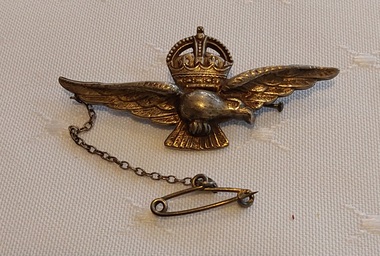
Badge - RAF WW2 Sweetheart Badge, 1940's
... family members of Royal Air Force personnel, not by the servicemen themselves on their uniforms. These badges were sentimental keepsakes given to loved ones by service members as a token of affection and a connection to their loved ones serving in the air force. Military medals Pins Badges WW11 badge A rare sterling silver Royal Australian ...RAF sweetheart badges in WW2 were worn by the wives, girlfriends, and family members of Royal Air Force personnel, not by the servicemen themselves on their uniforms. These badges were sentimental keepsakes given to loved ones by service members as a token of affection and a connection to their loved ones serving in the air force. A rare sterling silver Royal Australian Air Force - Sweetheart badge (World War 2). Complete with a single pin attached to a fine safety chain. While family members wore them, they were often purchased by the servicemen themselves to give to their loved ones.It has the eagle wings with a crown on the top.military medals, pins, badges, ww11 badge
