
Showing 34 items matching "ferntree gully to gembrook railway"
-
 Narre Warren and District Family History Group
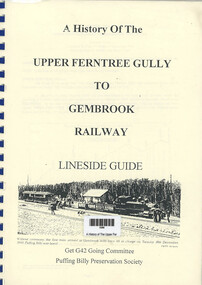
Book, Peter Medlin, A History of the Upper Ferntree Gully to Gembrook Railway, 1998
... A History of the Upper Ferntree Gully to Gembrook Railway...Lakeside and Paradise Valley stations Nobelius Siding Lineside Guide showing where all the lines were put in Puffing Billy railway line A History of the Upper Ferntree Gully to Gembrook Railway Book Peter Medlin Get G42 Going Committee Puffing Billy Preservation Society ...Lineside Guide showing where all the lines were put in Puffing Billy railway linenon-fictionLineside Guide showing where all the lines were put in Puffing Billy railway linelakeside and paradise valley stations, nobelius siding -
 Emerald Museum & Nobelius Heritage Park
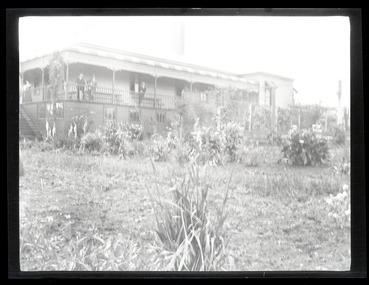
Negative - Image of Ranges Hotel, Baker & Rouse, Early 20th century
... ...Ferntree Gully to Gembrook Railway...The Ranges Hotel was built in 1902 following the completion of the Ferntree Gully to Gembrook railway line in 1900. It was an important social institution and tourist destination in Gembrook for over 100 years before its destruction by fire in 2018....The Ranges Hotel was built in 1902 following the completion of the Ferntree Gully to Gembrook railway line in 1900. It was an important social institution and tourist destination in Gembrook for over 100 years before its destruction by fire in 2018. ...This negative is one of a batch of ten images taken apparently around the same time at Gembrook c. early 20th century. This negative is of a side and back view of the Ranges Hotel showing three formally dressed men and one woman standing on the balcony. The Ranges Hotel was built in 1902 following the completion of the Ferntree Gully to Gembrook railway line in 1900. It was an important social institution and tourist destination in Gembrook for over 100 years before its destruction by fire in 2018.This negative features an iconic and historical building in Gembrook which has since been burnt down.Black and white negative - landscape view - showing a side and back view of the Ranges Hotel, Gembrook. This negative has been kept inside a packet which is not original.Handwritten on (not original) packet containing negative: 'House Gembrook'gembrook, ranges hotel, ferntree gully to gembrook railway, early 20th century -
 Emerald Museum & Nobelius Heritage Park
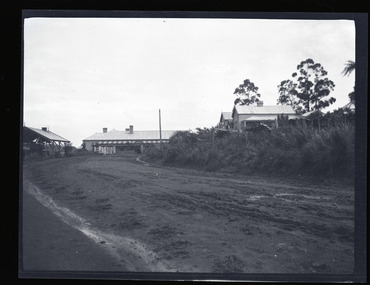
Negative - Image of Road Leading Towards Ranges Hotel and General Store, Baker & Rouse, Early 20th century
... ...Ferntree Gully to Gembrook Railway...Gembrook c. early 20th century. This negative is of a muddy unmade road (now Station Rd) running alongside the Railway Station leading towards the Ranges Hotel, with the double-gabled General Store to the right. The hotel was built in 1902, two years after the Ferntree Gully...Gembrook c. early 20th century. This negative is of a muddy unmade road (now Station Rd) running alongside the Railway Station leading towards the Ranges Hotel, with the double-gabled General Store to the right. The hotel was built in 1902, two years after the Ferntree Gully ...This negative is one of a batch of ten images taken apparently around the same time at Gembrook c. early 20th century. This negative is of a muddy unmade road (now Station Rd) running alongside the Railway Station leading towards the Ranges Hotel, with the double-gabled General Store to the right. The hotel was built in 1902, two years after the Ferntree Gully to Gembrook railway was completed. It was an important social institution and tourist destination in Gembrook for over one hundred years until its destruction by fire in 2018. This negative shows two former iconic and historical buildings in Gembrook c. early 20th century.Black and white negative - landscape view - showing a road running alongside the railway station towards the Ranges Hotel, Gembrook c. early 20th century with the General Store visible on the right and railway gates in front of the hotel. This negative has been kept inside a packet which is not original.Handwritten on (not original) packet containing negative: 'Gembrook house & road'gembrook, ranges hotel, ferntree gully to gembrook railway, 1902, early 20th century, station rd, general store -
 Puffing Billy Railway
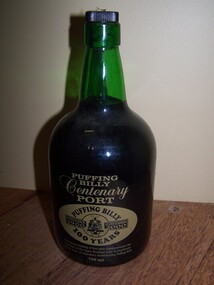
Puffing Billy Centenary Port - 100 Years - PBPS Fund raiser item, 2000
... Puffing Billy Centenary Port - 100 Years - PBPS Fund raiser item Puffing Billy Centenary Port Puffing Billy 18 December 1900 - 18 December 2000 - 100 Years - This special bottling of fine port commemorates the Centenary of the Upper Ferntree Gully to Gembrook railway , home of Australia's world famous Puffing Billy 750 ml...Puffing Billy Centenary Port Puffing Billy 18 December 1900 - 18 December 2000 - 100 Years - This special bottling of fine port commemorates the Centenary of the Upper Ferntree Gully to Gembrook railway , home of Australia's world famous Puffing Billy 750 ml...Puffing Billy Centenary Port - 100 Years - PBPS Fund raiser item Puffing Billy Centenary Port Puffing Billy 18 December 1900 - 18 December 2000 - 100 Years - This special bottling of fine port commemorates the Centenary of the Upper Ferntree Gully to Gembrook railway , home of Australia's world famous Puffing Billy 750 ml Historic - Puffing Billy Railway - Puffing Billy Preservation Society Fund raising item - Centenary Port - 100 Years puffing billy centenary port pbps fund raiser Puffing Billy Centenary Port Puffing Billy 18 December 1900 - 18 December 2000 - 100 Years - This special bottling of fine port commemorates the Centenary of the Upper Ferntree Gully to Gembrook railway , home of Australia's world famous Puffing Billy 750 ml Puffing Billy Centenary Port - 100 Years - Puffing Billy Preservation Society Fund raising item Green Glass Bottle Yellow painted on Writing and logo Cork with black plastic top Puffing Billy Centenary Port - 100 Years - PBPS Fund raiser item ...Puffing Billy Centenary Port - 100 Years - PBPS Fund raiser item Puffing Billy Centenary Port Puffing Billy 18 December 1900 - 18 December 2000 - 100 Years - This special bottling of fine port commemorates the Centenary of the Upper Ferntree Gully to Gembrook railway , home of Australia's world famous Puffing Billy 750 mlHistoric - Puffing Billy Railway - Puffing Billy Preservation Society Fund raising item - Centenary Port - 100 Years Puffing Billy Centenary Port - 100 Years - Puffing Billy Preservation Society Fund raising item Green Glass Bottle Yellow painted on Writing and logo Cork with black plastic top Puffing Billy Centenary Port Puffing Billy 18 December 1900 - 18 December 2000 - 100 Years - This special bottling of fine port commemorates the Centenary of the Upper Ferntree Gully to Gembrook railway , home of Australia's world famous Puffing Billy 750 mlpuffing billy, centenary port, pbps fund raiser -
 Narre Warren and District Family History Group
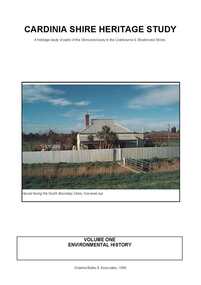
Book, Graeme Butler & Associates, Cardinia Shire Heritage Study : a heritage study of parts of the Shire previously in the Cranbourne & Sherbrooke Shires. Vol 1 : Key Findings and Recommendations Vol 2 : Heritage Place and Precinct Citations, 1998
... Upper Ferntree Gully to Gembrook Railway...Cardinia Shire (Vic.) heritage studies Tivoli Berry Farm (Clematis) Carramar (Emerald) Nobelius Heritage Park Dalmore Public Hall Horace Hardy Farm Complex Emerald Lake Park The Grange (Koo Wee Rup) Glen Afton (Yannathan) Myrtlewood (Yannathan) Vay View Farm (Lang Lang) Emerald Railway Station Timber Bridges (Yallock Creek) Emerald County Clud Oak Lee (Emerald) Sycamore Lodge (Emerald) Cambden Wollybutt Row (Emerald) Silver Birches (Emerald) Lang Lang Cemetery Old Monomeith Homestead sites Monomeith Park (Monomeith) Dustings Garage (Koo Wee Rup) Koo Wee Rup Public Hall Koo Wee Rup Lockup Wattle Theatre (Koo Wee Rup) Harewood (Koo Wee Rup) Warook Homestead (Monomeith) Old Yallock St John's Roman Catholic Church (Koo Wee Rup) Royal Hotel (Koo Wee Rup) Budgeree (Yannathan) Cascades Guest House (Clematis) Rutter Farm (Tooradin) Koo Wee Rup Swamp Drains Upper Ferntree Gully to Gembrook Railway Great Southern Railway Misson's Butchers Shop & Residence (Lang Lang) English Scottish & Australian Bank (Lang Lang) Clematis Park Row Houses (Lang Lang) This Environmental History of the Cardinia Shire incorporates the Environmental History of the former Shire of Pakenham, compiled by Carlotta Kellaway for Graeme Butler & Associates and the Environmental History of those areas of the Shire formerly in the Shires of Cranbourne and Sherbrooke, compiled by Jill Barnard for Graeme Butler and Associates. ...This Environmental History of the Cardinia Shire incorporates the Environmental History of the former Shire of Pakenham, compiled by Carlotta Kellaway for Graeme Butler & Associates and the Environmental History of those areas of the Shire formerly in the Shires of Cranbourne and Sherbrooke, compiled by Jill Barnard for Graeme Butler and Associates. An environmental history, which is meant as a guide to the identification of sites of significance within a shire, cannot be a complete social history of that shire. Rather, it is meant to be a summary of the various ways in which people have used and reacted to the natural environment, altering it so as to create economic, social, cultural and educational uses for themselves and their neighbours. [from the introduction]non-fictionThis Environmental History of the Cardinia Shire incorporates the Environmental History of the former Shire of Pakenham, compiled by Carlotta Kellaway for Graeme Butler & Associates and the Environmental History of those areas of the Shire formerly in the Shires of Cranbourne and Sherbrooke, compiled by Jill Barnard for Graeme Butler and Associates. An environmental history, which is meant as a guide to the identification of sites of significance within a shire, cannot be a complete social history of that shire. Rather, it is meant to be a summary of the various ways in which people have used and reacted to the natural environment, altering it so as to create economic, social, cultural and educational uses for themselves and their neighbours. [from the introduction] cardinia shire (vic.), heritage studies, tivoli berry farm (clematis), carramar (emerald), nobelius heritage park, dalmore public hall, horace hardy farm complex, emerald lake park, the grange (koo wee rup), glen afton (yannathan), myrtlewood (yannathan), vay view farm (lang lang), emerald railway station, timber bridges (yallock creek), emerald county clud, oak lee (emerald), sycamore lodge (emerald), cambden wollybutt row (emerald), silver birches (emerald), lang lang cemetery, old monomeith homestead sites, monomeith park (monomeith), dustings garage (koo wee rup), koo wee rup public hall, koo wee rup lockup, wattle theatre (koo wee rup), harewood (koo wee rup), warook homestead (monomeith), old yallock, st john's roman catholic church (koo wee rup), royal hotel (koo wee rup), budgeree (yannathan), cascades guest house (clematis), rutter farm (tooradin), koo wee rup swamp drains, upper ferntree gully to gembrook railway, great southern railway, misson's butchers shop & residence (lang lang), english scottish & australian bank (lang lang), clematis park, row houses (lang lang) -
 Emerald Museum & Nobelius Heritage Park
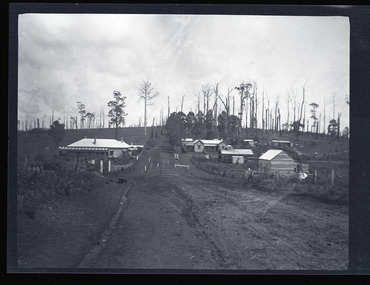
Negative - Image of Main Road, Gembrook, Baker & Rouse, Early 20th century
... ...Ferntree Gully to Gembrook Railway...Gembrook c. early 20th century. This negative of the main road features two historic buildings, the Ranges Hotel and the General Store as well as a few houses and the railway station. The General Store was built in front of the railway station. This negative shows former iconic and historical buildings in Gembrook. Gembrook Ranges Hotel Ferntree Gully ...This negative is one of a batch of ten images taken apparently around the same time at Gembrook c. early 20th century. This negative of the main road features two historic buildings, the Ranges Hotel and the General Store as well as a few houses and the railway station. The General Store was built in front of the railway station.This negative shows former iconic and historical buildings in Gembrook.Black and white negative - landscape view - showing the main road in Gembrook heading west. The last building on the left is the Ranges Hotel and the second last building on the right is the double-gabled General Store which fronts the railway station. This negative has been kept inside a packet which is not original.Handwritten on (not original) packet containing negative: 'Gembrook township'gembrook, ranges hotel, ferntree gully to gembrook railway, general store, main road, early 20th century -
 Puffing Billy Railway
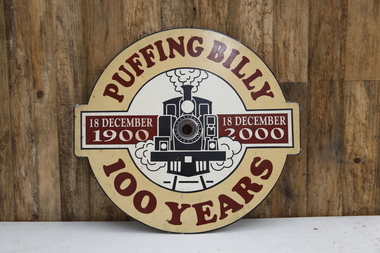
Locomotive Head Board - Puffing Billy 100 Years Celebration, 2000
... Historic - Puffing Billy Railway Locomotive Head Board - used in the Celebrating 100 years of the Upper Ferntree Gully to Gembrook railway. ...Historic - Puffing Billy Railway Locomotive Head Board - used in the Celebrating 100 years of the Upper Ferntree Gully to Gembrook railway. Historic - Puffing Billy Railway Locomotive Head Board - used in the Celebrating 100 years of the Upper Ferntree Gully to Gembrook railway. puffing billy head board 100 years Puffing Billy 18 December 1900 - 18 December 2000 100 Years Locomotive Head Board - Puffing Billy 100 Years Celebration Tin head board with cream, red, white and black vinyl. ...Historic - Puffing Billy Railway Locomotive Head Board - used in the Celebrating 100 years of the Upper Ferntree Gully to Gembrook railway. Historic - Puffing Billy Railway Locomotive Head Board - used in the Celebrating 100 years of the Upper Ferntree Gully to Gembrook railway. Locomotive Head Board - Puffing Billy 100 Years Celebration Tin head board with cream, red, white and black vinyl.Puffing Billy 18 December 1900 - 18 December 2000 100 Yearspuffing billy, head board, 100 years -
 Emerald Museum & Nobelius Heritage Park
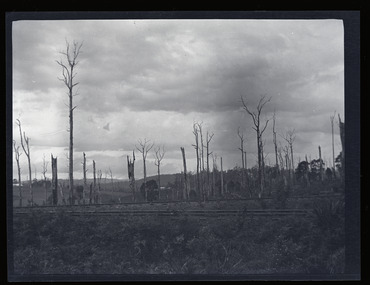
Negative - Image of The Railway Line, Baker & Rouse, Early 20th century
... This one is of the Ferntree Gully to Gembrook railway line, which was completed in December 1900. ...This one is of the Ferntree Gully to Gembrook railway line, which was completed in December 1900. ...This negative is one of a batch of ten images taken apparently around the same time at Gembrook c. early 20th century. This one is of the Ferntree Gully to Gembrook railway line, which was completed in December 1900. The view looks northwards to the hills from probably present-day Station Road. This stark image of bare landscape with dead trees recalls both the early timber industry in Gembrook and the practice of wide-spread clearing of land for farming use.Black and white negative - landscape view - of the railway line at Gembrook. The railway is in the foreground. The landscape is bare apart from dead and ringbarked trees. Negative has been kept inside a packet which is not original.Handwritten on (not original) packet containing negative: 'Railway line & dead trees /Gembrook'gembrook, timber industry, railway, 1900, early 20th century, station rd -
 Emerald Museum & Nobelius Heritage Park
Document - Documents, Clematis Miscellaneous Items, 1950s
... There are two letters from the Gembrook Railway League directed to the Clematis Progress Association, copies of petitions and 33 copies of various parts of a proposed roundabout at Belgrave-Gembrook Road and Wellington Rd opposite Paradise Hotel. There are lso 5 laminated copies of "What,When,Where,Who" by Gus Ryberg, there are also 3 un-laminated copies of the same. There is also a circular headed "Conversion of the Ferntree Gully...There are two letters from the Gembrook Railway League directed to the Clematis Progress Association, copies of petitions and 33 copies of various parts of a proposed roundabout at Belgrave-Gembrook Road and Wellington Rd opposite Paradise Hotel. There are lso 5 laminated copies of "What,When,Where,Who" by Gus Ryberg, there are also 3 un-laminated copies of the same. There is also a circular headed "Conversion of the Ferntree Gully ...Accession contained several newspaper clippings covering a range of topics. There are two letters from the Gembrook Railway League directed to the Clematis Progress Association, copies of petitions and 33 copies of various parts of a proposed roundabout at Belgrave-Gembrook Road and Wellington Rd opposite Paradise Hotel. There are lso 5 laminated copies of "What,When,Where,Who" by Gus Ryberg, there are also 3 un-laminated copies of the same. There is also a circular headed "Conversion of the Ferntree Gully to Gembrook Railway" complied and issued by the Dandenong Ranges Combined Progress Association. Date Range of items 1936-1984. Currently only two letters from the Gembrook Railway League directed to the Clematis Progress Association can be located, the location rest of the bulk accession is currently unknown.Various items that all have some relevance to Clematis and Surrounding areas Date Range of items 1936-1984. Currently only two letters from the Gembrook Railway League directed to the Clematis Progress Association can be located, the location rest of the bulk accession is currently unknown.1956 letter contains inscription: 'Read too late for April meeting'emerald, victoria, australia, documents, gembrook railway league, clematis, clematis progress association -
 Greensborough Historical Society
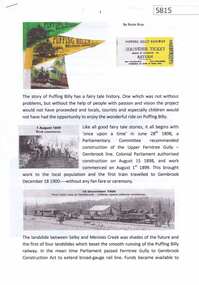
Article, Rosie Bray, Puffing Billy, by Rosie Bray, 18/10/2018
... Short history of the Puffing Billy Railway, from the 1900 Upper Ferntree Gully - Gembrook railway line to its rebirth in 1955, operating between Belgrave and Menzies Creek, later extended to Gembrook. ...Short history of the Puffing Billy Railway, from the 1900 Upper Ferntree Gully - Gembrook railway line to its rebirth in 1955, operating between Belgrave and Menzies Creek, later extended to Gembrook. ...Short history of the Puffing Billy Railway, from the 1900 Upper Ferntree Gully - Gembrook railway line to its rebirth in 1955, operating between Belgrave and Menzies Creek, later extended to Gembrook. Written to commemorate the 20th anniversary and the official re-opening of the Lakeside to Gembrook line on October 18, 2018.4 p. typescript with col. photographspuffing billy railway -
Emerald Museum & Nobelius Heritage Park
Map - Tourist Map, Lands Department Melbourne, Photocopy 26/5/1926
... Map of Dandenong Ranges, Ferntree Gully to Gembrook. Shows walking tracks, railway, guest houses, picnic grounds, hotels etc....Map of Dandenong Ranges, Ferntree Gully to Gembrook. Shows walking tracks, railway, guest houses, picnic grounds, hotels etc. ...Map of Dandenong Ranges, Ferntree Gully to Gembrook. Shows walking tracks, railway, guest houses, picnic grounds, hotels etc.Tourist map of Dandenong Ranges, Ferntree Gully and Gembrook district - paper on cloth.T298dandenong ranges, victoria, australia, tourism, maps, guest houses -
 Puffing Billy Railway
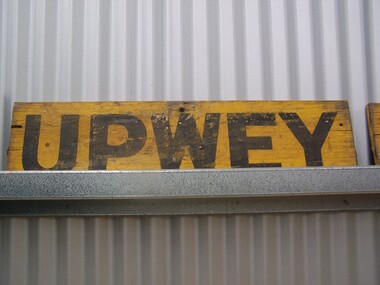
Station Sign - Upwey
... The Upper Ferntree Gully to Gembrook Narrow Gauge railway line officially closed on the 30th of April 1954. ...The Upper Ferntree Gully to Gembrook Narrow Gauge railway line officially closed on the 30th of April 1954. ...Upwey Station Sign; Upwey Railway Station is located on the Belgrave line in Victoria, Australia. This railway serves the Eastern region of Melbourne. Upwey Railway Station opened on the 3rd of June 1901. Upwey Railway Station has a crossing loop in the middle of a six kilometre section of single railway track between Ferntree Gully Railway Station and Belgrave Railway Station. The station was originally on the Upper Ferntree Gully to Gembrook narrow gauge line. The Upper Ferntree Gully to Gembrook Narrow Gauge railway line officially closed on the 30th of April 1954. It saw further use between 1955 and early 1958, when trains were operated by the Puffing Billy Preservation Society in co-operation with the Victorian Railways. The Upper Ferntree Gully to Belgrave section was converted to Broad Guage and re-opened on the 19th of February 1962. This station sign shown here was one of a number used on the Upwey Railway Station while it was Narrow Gauge. Historic - Victorian Railways Station sign used at Upwey StationUpwey wooden rectangle Station name sign pained yellow background with black font.Upweypuffing billy, station sign, upwey station, victorian railways -
 Otway Districts Historical Society
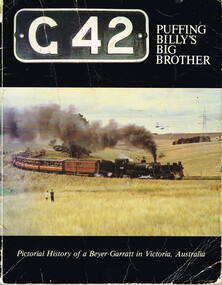
Book, Puffing Billy Preservation Society, G42: Puffing Billy's Big Brother, 1981
... Victoria's narrow gauge railways were from Wangaratta to Whitfield (covering 30.5 miles/49 km) opening in 1899, Colac to Beech Forest (29 miles/46.7 km) opening in 1902 with an addition to Crowes (14.1 miles/22.7 km) opening in 1910, Upper Ferntree Gully to Gembrook (18.2 miles/29.3 km) opening in 1900, and Moe to Walhalla (26 miles/41.3 km) opening in 1910. ...From 1978 G42 continues its operation on the Upper Ferntree Gully-Gembrook line as part of the Puffing Billy Preservation Society. Victorian Railways; narrow gauge; Moe; Walhalla; Colac; Beech Forest; Crowes; Upper Ferntree Gully; Gembrook; Beyer-Garratt; G42: Puffing Billy's Big Brother. ...Victoria's narrow gauge railways were from Wangaratta to Whitfield (covering 30.5 miles/49 km) opening in 1899, Colac to Beech Forest (29 miles/46.7 km) opening in 1902 with an addition to Crowes (14.1 miles/22.7 km) opening in 1910, Upper Ferntree Gully to Gembrook (18.2 miles/29.3 km) opening in 1900, and Moe to Walhalla (26 miles/41.3 km) opening in 1910. From the outset these narrow gauge lines proved very uneconomical in operation and were plagued with continuing financial losses. The lines most difficult to work were those carrying the most business, and in particular the trains from Colac and Moe with their 1 in 30 grades and countless curves precluded having engines with large coupled driving wheels operating. Having examined the possible use of articulated locomotives to reduce operating costs on the narrow gauge lines the Victorian Railways decided upon the Beyer-Garratt type of locomotive in 1925 and an order was placed in England for two engines of the 2-6-0 plus 0-6-2 wheel arrangements. These arrived in April 1926. Assembly of the new Garratts was duly completed and steaming trials carried out at Newport, Victoria, the engines being classed as "G" and given the running numbers "41" and "42". G41 was taken to Colac where, on 5 June 1926, it was put to work on the Colac-Beech Forest-Crowes line. G42 soon followed and duly began work on the equally steep and tortuous but shorter Moe-Walhalla line. Following the closure of the Moe line in 1955 G42 was refurbished and went to Colac. G41 was overhauled, but not as thoroughly as G42, at then returned to Colac where both Garratts shared regular work on the line until its closure in 1962. From 1978 G42 continues its operation on the Upper Ferntree Gully-Gembrook line as part of the Puffing Billy Preservation Society.G42: Puffing Billy's Big Brother. Pictorial history of a Beyer-Garratt in Victoria, Australia. Phil A'Vard, Larry James, Ron Peach (concept). Puffing Billy Preservation Society; Belgrave (Vic); 1980. 64 p.; illus; map. Soft cover. ISBN 0 9598392 7 5victorian railways; narrow gauge; moe; walhalla; colac; beech forest; crowes; upper ferntree gully; gembrook; beyer-garratt; -
 Otway Districts Historical Society
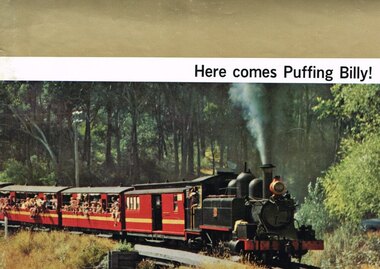
Book, Puffing Billy Preservation Society, Here comes Puffing Billy!
... The Puffing Billy Preservation Society came into existence by a popular desire to retain something of our narrow gauge railway past, leisurely in this age but a boon to the sparsely settled areas it served in the past. It served the Wangaratta-Whitefield line, the Upper Ferntree Gully-Gembrook line, the Colac-Beech Forest-Crowes line, and the Moe-Walhalla line, the last railway line served being the Colac-Beech Forest line. ...None of these railways were a paying proposition but they played an important part in the areas they served. Nowadays, the last bit of line is a portion of the Upper Ferntree Gully-Gembrook line, from Belgrave to Lakeside, run by the Society. ...The Puffing Billy Preservation Society came into existence by a popular desire to retain something of our narrow gauge railway past, leisurely in this age but a boon to the sparsely settled areas it served in the past. It served the Wangaratta-Whitefield line, the Upper Ferntree Gully-Gembrook line, the Colac-Beech Forest-Crowes line, and the Moe-Walhalla line, the last railway line served being the Colac-Beech Forest line. None of these railways were a paying proposition but they played an important part in the areas they served. Nowadays, the last bit of line is a portion of the Upper Ferntree Gully-Gembrook line, from Belgrave to Lakeside, run by the Society. The Engine Shed has several small NA-class locomotives with NBH excursion carriages, and at the moment the Garratt G class in pieces. Here comes Puffing Billy! Puffing Billy Preservation Society; Belgrave (Vic); nd (after Aug. 1962). 18 p.; illus., maps. Soft cover.puffing billy preservation society; railways; wangaratta; whitefield; upper frentree gully; gembrook; colac; beech forest; crowes; moe; walhalla; -
 Narre Warren and District Family History Group
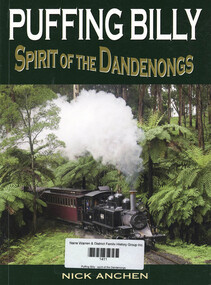
Book, Nick Anchen, Puffing Billy : spirit of the Dandenongs, 2017
... Puffing Billy Railway Dandenongs The Puffing Billy Railway is a genuine living museum, part of the original Victorian Railways branch line which operated for fifty three years between Upper Ferntree Gully and Gembrook. ...The Puffing Billy Railway is a genuine living museum, part of the original Victorian Railways branch line which operated for fifty three years between Upper Ferntree Gully and Gembrook. The quaint little train became in institution of the Dandenongs, and the closure of the line in 1954 caused a public outcry. The salvation and continuing operation of Australia’s best-loved steam train is one of the great Australian stories. The history, preservation and current operation of the Puffing Billy Railway. A detailed description of the Puffing Billy train journey, including information on local history, fauna and flora. Technical details of locomotives, rolling stock and other associated equipment. An extensive photographic gallery featuring over 200 b&w and colour images.108 p.; 24 cmnon-fictionThe Puffing Billy Railway is a genuine living museum, part of the original Victorian Railways branch line which operated for fifty three years between Upper Ferntree Gully and Gembrook. The quaint little train became in institution of the Dandenongs, and the closure of the line in 1954 caused a public outcry. The salvation and continuing operation of Australia’s best-loved steam train is one of the great Australian stories. The history, preservation and current operation of the Puffing Billy Railway. A detailed description of the Puffing Billy train journey, including information on local history, fauna and flora. Technical details of locomotives, rolling stock and other associated equipment. An extensive photographic gallery featuring over 200 b&w and colour images. puffing billy railway, dandenongs -
 Puffing Billy Railway
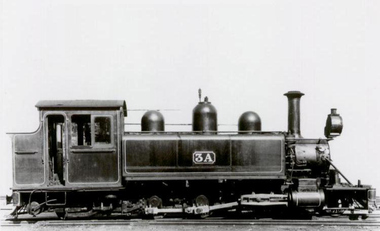
3A, Victorian Railways NA Class Steam Locomotive, 1900
... Painted in the then standard Victorian Railways two-tone green, this locomotive was issued to the Upper Ferntree Gully to Gembrook line and was used on the line’s construction. ...Number 3A Entered service 6th april 1900 Livery two-tone green Gauge 762mm / 2' 6" Service History : Apr 1900 UFTG. - initial allocation Apr 1900 - Jul 1901 Upper ferntree gully Feb 1902 - Jan 1906 Colac Feb 1906 - Jul 1906 Upper ferntree gully Sep 1907 - Mar 1908 Colac Oct 1908 - Oct 1909 Upper ferntree gully Nov 1909 - Apr 1910 Other Oct 1910 - Nov 1911 Upper ferntree gully Feb 1912 - Oct 1914 Colac Dec 1914 - Oct 1917 Moe Dec 1917 - Jul 1920 Colac Sep 1920 - Jun 1922 Moe Jul 1922 - Jun 1925 Upper ferntree gully Aug 1925 - Mar 1928 Other May 1928 - Nov 1929 Moe Jan 1930 - Apr 1935 Wangaratta Jun 1935 - Sep 1936 Workshops Oct 1936 - May 1949 Upper ferntree gully Nov 1949 - Mar 1950 Workshops Apr 1950 - Jun 1955 Upper ferntree gully Nov 1955 - Mar 1959 Workshops Nov 1960 - Aug 1973 Lord Mayor’s Camp at Portsea Apr 1977 - salvaged from Lord Mayors camp and delivered to Menzies creek station. Victorian Railways - Narrow Gauge NA class steam locomotive number 3A Victorian Heritage Register (VHR) Number H2187 Dates that 3A worked on the Upper ferntree gully to Gembrook ...3A Built in 1900. This is the second locomotive to be built at the Victorian Railways Newport Workshops. Painted in the then standard Victorian Railways two-tone green, this locomotive was issued to the Upper Ferntree Gully to Gembrook line and was used on the line’s construction. Over the years, it saw service on the Colac to Crowes and Moe to Walhalla lines, but it saw more service on the Gembrook line than any other. It was withdrawn from service in 1955 at Upper Fern Tree Gully and sold in 1960 to the Lord Mayor’s Camp at Portsea where it remained on static display until obtained by the Puffing Billy Presservation Society in 1977. Number 3A Entered service 6th april 1900 Livery two-tone green Gauge 762mm / 2' 6" Service History : Apr 1900 UFTG. - initial allocation Apr 1900 - Jul 1901 Upper ferntree gully Feb 1902 - Jan 1906 Colac Feb 1906 - Jul 1906 Upper ferntree gully Sep 1907 - Mar 1908 Colac Oct 1908 - Oct 1909 Upper ferntree gully Nov 1909 - Apr 1910 Other Oct 1910 - Nov 1911 Upper ferntree gully Feb 1912 - Oct 1914 Colac Dec 1914 - Oct 1917 Moe Dec 1917 - Jul 1920 Colac Sep 1920 - Jun 1922 Moe Jul 1922 - Jun 1925 Upper ferntree gully Aug 1925 - Mar 1928 Other May 1928 - Nov 1929 Moe Jan 1930 - Apr 1935 Wangaratta Jun 1935 - Sep 1936 Workshops Oct 1936 - May 1949 Upper ferntree gully Nov 1949 - Mar 1950 Workshops Apr 1950 - Jun 1955 Upper ferntree gully Nov 1955 - Mar 1959 Workshops Nov 1960 - Aug 1973 Lord Mayor’s Camp at Portsea Apr 1977 - salvaged from Lord Mayors camp and delivered to Menzies creek station.Victorian Railways - Narrow Gauge NA class steam locomotive number 3A Victorian Heritage Register (VHR) Number H2187 Dates that 3A worked on the Upper ferntree gully to Gembrook Line. Apr 1900 - initial allocation of a new locomotive Apr 1900 to Jul 1901 Feb 1906 to Jul 1906 Oct 1908 to Oct 1909 Oct 1910 to Nov 1911 Oct 1936 to May 1949 Apr 1950 to Jun 1955 Apr 1977 to Belgrave Steam Locomotive3Apuffing billy, victorian railways, 3a, narrow gauge, steam locomotive -
 Puffing Billy Railway
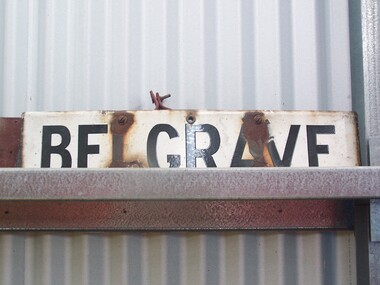
Station Sign - Belgrave
... railway station is the terminus of the electrified line from Melbourne in Victoria, Australia, serving the eastern Melbourne suburb of Belgrave. Opened as Monbulk on 18 December 1900, it was renamed Belgrave on 21 November 1904. It was upgraded to a Premium station on 2 July 1996. The station was originally on the Upper Ferntree Gully – Gembrook...railway station is the terminus of the electrified line from Melbourne in Victoria, Australia, serving the eastern Melbourne suburb of Belgrave. Opened as Monbulk on 18 December 1900, it was renamed Belgrave on 21 November 1904. It was upgraded to a Premium station on 2 July 1996. The station was originally on the Upper Ferntree Gully – Gembrook ...Belgrave railway station is the terminus of the electrified line from Melbourne in Victoria, Australia, serving the eastern Melbourne suburb of Belgrave. Opened as Monbulk on 18 December 1900, it was renamed Belgrave on 21 November 1904. It was upgraded to a Premium station on 2 July 1996. The station was originally on the Upper Ferntree Gully – Gembrook narrow gauge line. It, along with the rest of the line, officially closed on 30 April 1954. However it saw further use between 1955 and early 1958, when trains were operated by the Puffing Billy Preservation Society in co-operation with the Victorian Railways. The station area re-opened on 19 February 1962 when the line as far as Belgrave was converted to broad gauge and used electric traction as part of the suburban network.[1] It has one island platform with two faces. It is serviced by Metro Trains' Belgrave line services The Puffing Billy Railway Belgrave station is located 100 metres north of the station and is accessible via a short footpath. It was required to be located further down the line than the original narrow-gauge station (which was approximately where the current suburban station car park is located). ref: https://en.wikipedia.org/wiki/Belgrave_railway_station photos at http://www.vicrailstations.com/Gembrook/Belgrave/Belgrave.htmlHistoric - Victorian Railways Station sign used at Belgrave StationStation Sign - Belgrave Metal sign - white enamel back ground with black letters Belgravepuffing billy, victorian railways, belgrave station -
 Puffing Billy Railway
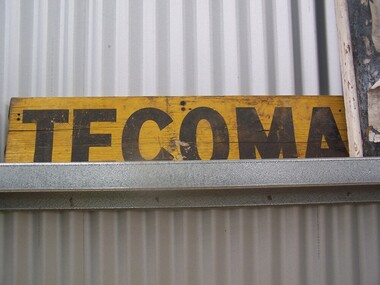
Tecoma Station Sign
... railway station is located on the Belgrave line in Victoria, Australia. It serves the eastern Melbourne suburb of Tecoma opening on 1st December 1924. The station was originally on the Upper Ferntree Gully - Gembrook...railway station is located on the Belgrave line in Victoria, Australia. It serves the eastern Melbourne suburb of Tecoma opening on 1st December 1924. The station was originally on the Upper Ferntree Gully - Gembrook ...Station Sign - Tecoma Tecoma railway station is located on the Belgrave line in Victoria, Australia. It serves the eastern Melbourne suburb of Tecoma opening on 1st December 1924. The station was originally on the Upper Ferntree Gully - Gembrook narrow gauge line. It along with the rest of the line closed on 30 April 1954, reopening on 19 February 1962 when the line as far as Belgrave was converted to broad gauge. ref: https://en.wikipedia.org/wiki/Tecoma_railway_stationHistoric - Victorian Railways Station sign used at Tecoma StationStation Sign - Tecoma wooden rectangle Station name sign pained yellow background with black letters Tecomapuffing billy, station sign, tecoma station, narrow gauge, puffing billy museum -
 Southern Sherbrooke Historical Society Inc.
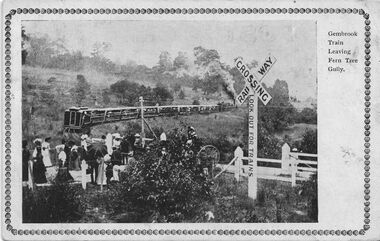
Postcard - Gembrook Train Leaving Fern Tree Gully
... Gembrook Train Leaving Fern Tree Gully'. The postcard has a photo of a level crossing at Ferntree Gully. The down train has just cleared the crossing and a large group have either just crossed the line or are about to. One woman is carrying an umbrella. A horse-drawn carriage is in the process of crossing the track, obscured by a large shrub. There is a warning sign at the crossing saying 'Railway...Gembrook Train Leaving Fern Tree Gully'. The postcard has a photo of a level crossing at Ferntree Gully. The down train has just cleared the crossing and a large group have either just crossed the line or are about to. One woman is carrying an umbrella. A horse-drawn carriage is in the process of crossing the track, obscured by a large shrub. There is a warning sign at the crossing saying 'Railway ...B&W postcard, 'Gembrook Train Leaving Fern Tree Gully'. The postcard has a photo of a level crossing at Ferntree Gully. The down train has just cleared the crossing and a large group have either just crossed the line or are about to. One woman is carrying an umbrella. A horse-drawn carriage is in the process of crossing the track, obscured by a large shrub. There is a warning sign at the crossing saying 'Railway Crossing, Look out for trains'. Behind the train is a hill with scattered trees. The photo has a patterned, printed frame around it. On the back of the postcard is a written message. 'Am sending ad/vanced birthday/ cards to the/ little girls with/ love. Had a letter from Addie last/ week. A.S. Hunt' and in the address panel, 'Mrs W. Upton/ Wyndham/ Werribee.' A postage stamp has been removed from the card, obscuring the date stamp. -
Emerald Museum & Nobelius Heritage Park
Photograph - Nobelius Packing Shed, Unknown photographer, 2000s
... The Gembrook Nurseries, informally known as the Nobelius Nurseries after the founder Carl Axel Nobelius, began with the purchase of sixty-three acres in 1886 and boomed in the 1890s due to opportunities provided by employment-promoting schemes to develop public parks and gardens and street shade by local and State Governments around Australia. Trees were sold to more than forty councils and Government organisations in the 1890s, including the Department of Agriculture, Lands Department and Victorian Railways. The need to transport nursery products by train via Ferntree Gully...The Gembrook Nurseries, informally known as the Nobelius Nurseries after the founder Carl Axel Nobelius, began with the purchase of sixty-three acres in 1886 and boomed in the 1890s due to opportunities provided by employment-promoting schemes to develop public parks and gardens and street shade by local and State Governments around Australia. Trees were sold to more than forty councils and Government organisations in the 1890s, including the Department of Agriculture, Lands Department and Victorian Railways. The need to transport nursery products by train via Ferntree Gully ...The Gembrook Nurseries, informally known as the Nobelius Nurseries after the founder Carl Axel Nobelius, began with the purchase of sixty-three acres in 1886 and boomed in the 1890s due to opportunities provided by employment-promoting schemes to develop public parks and gardens and street shade by local and State Governments around Australia. Trees were sold to more than forty councils and Government organisations in the 1890s, including the Department of Agriculture, Lands Department and Victorian Railways. The need to transport nursery products by train via Ferntree Gully rather than by bullock dray to Narre Warren was a factor in the successful petition to develop what is now known as the Puffing Billy Railway. Railway developments in 1900 included the creation of a siding and Packing Shed, known as Nobelius Station, which is featured in this photograph. The Packing Shed was able to handle 250,000 cases of fruit each year at the height of the nurseries' activities. The image shows the Packing Shed with boarded-up windows, suggesting it was taken prior to the purchase of the facility for use in the Puffing Billy Railway service. Gembrook Nurseries had an indirect influence on the development of other farms and industries in the region. As a wholesale nursery with high sales volumes it was an important employer of local people. Peak season for employees was during the cooler months, during most farmers' off-season. This provided local farmers with a source of income while their own farms were becoming established.The photograph is significant because it depicts infrastructure associated with the Gembrook or Nobelius Nurseries, a business which was instrumental to the development of Emerald as a settlement in the 19th and 20th Centuries and also influenced the development of public and private gardens and the farming of several species in Australia and internationally. The Nobelius Nursery is listed on the Victorian Heritage Register.A coloured rectangular photograph of the Nobelius Nurseries Packing Shed. The photograph was taken in the grounds looking up towards the packing shed. There are various trees and vegetation throughout the grounds and surrounding the packing shed. The Nobelius Nurseries Packing Shed was used to sort and pack trees to be sent overseas during the 1900s-1940s.No inscriptions/marksnobelius nursery, packing shed, 2000s, puffing billy railway, nobelius heritage park -
 Emerald Museum & Nobelius Heritage Park
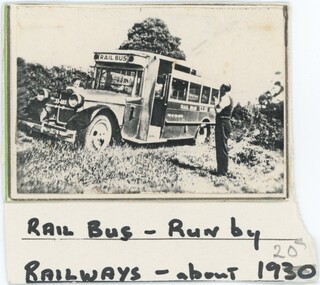
Photograph, Rail Bus, 1930s
... Railway...Transport...Cockatoo...Gembrook...Upper Ferntree Gully...Victorian Railways began offering several petrol bus services in the late 1920s, including in services to tourist destinations around Melbourne such as Queenscliff, Portsea, Monbulk and Warburton. This bus, running from Upper Ferntree Gully to Gembrook...Obverse: Annotation: "Rail Bus - Run by / Railways - about 19[30 crossed out]20s" Bus, Front: "RAIL BUS / 35-485" Bus, Side: "RAIL BUS U.S. [illegible] / PAY AS YOU [illegible]" Reverse, Annotation: "Rail bus from Ferntree Gully to Gembrook 1920s"...Railway Transport Cockatoo Gembrook Upper Ferntree Gully 1930s Obverse: Annotation: "Rail Bus - Run by / Railways - about 19[30 crossed out]20s" Bus, Front: "RAIL BUS / 35-485" Bus, Side: "RAIL BUS U.S. ...Victorian Railways began offering several petrol bus services in the late 1920s, including in services to tourist destinations around Melbourne such as Queenscliff, Portsea, Monbulk and Warburton. This bus, running from Upper Ferntree Gully to Gembrook, is interesting given this route was already serviced by rail. It opened on July 7th 1930, but by 1931 was cut back to Cockatoo; it ceased operation entirely on February 14th 1941. This bus may be built on a 1929 Thornycroft chassis, which this line used two of by the time it ceased operation. Even by 1934, the line mostly only ran as far as Belgrave, with limited Cockatoo services on weekdays, one on Saturdays and none on Sundays.While relatively short-lived, the Victorian Railways motor service is part of the complex tapestry of the region's transport history.This item includes a printed black and white photograph mounted on card. The photograph is framed by green and black lines, and accompanied by annotation in marker below it. The reverse of the card has further annotation handwritten in pencil, alongside an accession number. The photograph shows a stationary bus parked on grass, with trees and a hedge behind it. In from of the bus, a man stands facing the open door.Obverse: Annotation: "Rail Bus - Run by / Railways - about 19[30 crossed out]20s" Bus, Front: "RAIL BUS / 35-485" Bus, Side: "RAIL BUS U.S. [illegible] / PAY AS YOU [illegible]" Reverse, Annotation: "Rail bus from Ferntree Gully to Gembrook 1920s"railway, transport, cockatoo, gembrook, upper ferntree gully, 1930s -
Emerald Museum & Nobelius Heritage Park
Domestic object - Writing equipment, 1900s
... The Gembrook Nurseries, informally known as the Nobelius Nurseries after the founder Carl Axel Nobelius, began with the purchase of sixty-three acres in 1886 and boomed in the 1890s due to opportunities provided by employment-promoting schemes to develop public parks and gardens and street shade by local and State Governments around Australia. Trees were sold to more than forty councils and Government organisations in the 1890s, including the Department of Agriculture, Lands Department and Victorian Railways. The need to transport nursery products by train via Ferntree Gully...The Gembrook Nurseries, informally known as the Nobelius Nurseries after the founder Carl Axel Nobelius, began with the purchase of sixty-three acres in 1886 and boomed in the 1890s due to opportunities provided by employment-promoting schemes to develop public parks and gardens and street shade by local and State Governments around Australia. Trees were sold to more than forty councils and Government organisations in the 1890s, including the Department of Agriculture, Lands Department and Victorian Railways. The need to transport nursery products by train via Ferntree Gully ...The item is a glass writing desk set used at Carramar, the family home of Carl Axel Nobelius, who founded the Gembrook Nurseries. Gembrook Nurseries were a major employer in the area, shipping fruit and decorative tree species around Australia and internationally. Carramar was the largest private residence in the area with sixteen rooms in addition to staff accommodations. The Nobelus family entertained several famous or important guests there, including Dame Nellie Melba and the Governor of Victoria, Sir Reginald Talbot. The desk set is thought to have been a gift to Carl Axel Nobelius and his wife Emily on the anniversary of their wedding. The Gembrook Nurseries, informally known as the Nobelius Nurseries after the founder Carl Axel Nobelius, began with the purchase of sixty-three acres in 1886 and boomed in the 1890s due to opportunities provided by employment-promoting schemes to develop public parks and gardens and street shade by local and State Governments around Australia. Trees were sold to more than forty councils and Government organisations in the 1890s, including the Department of Agriculture, Lands Department and Victorian Railways. The need to transport nursery products by train via Ferntree Gully rather than by bullock dray to Narre Warren was a factor in the successful petition to develop what is now known as the Puffing Billy Railway. Gembrook Nurseries had an indirect influence on the development of other farms and industries in the region. As a wholesale nursery with high sales volumes it was an important employer of local people. Peak season for employees was during the cooler months, during most farmers' off-season. This provided local farmers with a source of income while their own farms were becoming established. The desk set appears to be in Art Deco style, which suggests that it was in use at Carramar later in Carl Axel Nobelius' life, prior to his death in 1921, as the style became most popular in the years after the First World War. Carramar was the largest private residence in the area with sixteen rooms in addition to staff accommodations. A real estate listing from the sale of Carramar in 1941 indicates that it had five bedrooms, three reception areas, a large billiards room, two bathrooms, rooms for staff use and a separate six-room gardener's cottage as the home sat within extensive gardens. The Nobelus family entertained several famous or important guests there, including Dame Nellie Melba and the Governor of Victoria, Sir Reginald Talbot.The item is significant due to its association with the estate of Carl Axel Nobelius, a horticulturist whose business activities at the Gembrook Nurseries contributed to both the social and infrastructure development of Emerald and surrounds and the distribution of several plant species internationally.The item is a glass plate on small metal legs. Arranged across the surface of the glass plate are a metal rack suitable for holding letters, a square glass bottle with a metal lid sitting in a square metal receptacle which may have been used for ink and two metal brackets suitable for holding a pen. The metal used is silver-toned.carramar, carl axel nobelius, carl axel nobelius, gembrook nurseries, nobelius nursery, writing equipment, desk set, art deco -
Emerald Museum & Nobelius Heritage Park
Memorabilia - Ship voyage souvenir, Unknown maker, 1900s
... Locally, Gembrook Nurseries were an important industry and major employer in Emerald and the surrounding area and had a profound influence on the development of the township, including in the development of infrastructure such as the narrow-gauge railway used to transport stock to the main line in Ferntree Gully, which is now known as the Puffing Billy railway. ...Locally, Gembrook Nurseries were an important industry and major employer in Emerald and the surrounding area and had a profound influence on the development of the township, including in the development of infrastructure such as the narrow-gauge railway used to transport stock to the main line in Ferntree Gully, which is now known as the Puffing Billy railway. ...The lifebuoy postcard frame was given to Ethel Ruby Nobelius to commemorate her nineteenth birthday on board the S.S. Mongolia during a trip to Ceylon with her parents, Carl and Emily Nobelius. Ethel Ruby Nobelius was born on 27 October 1887 in Emerald and died on 2 August 1965 in Mildura at the age of 77. She was the Nobelius family's second oldest daughter. In total there were eleven children, including three girls, though three sons died in infancy. Ruby's father, Carl Axel Nobelius, was born in Finland in 1851 to a Swedish horticulturalist family and emigrated to Melbourne from Sweden in 1871. He worked at nurseries in Toorak and South Yarra before purchasing sixty-three acres of land in the new settlement of Emerald where he grew plant stock including fruit and ornamental trees which were sold to Australian and international clients for public parks, municipal landscaping projects and private gardens. These included the Fitzroy Gardens and Royal Botanic Gardens in Melbourne and buyers in Europe, the Americas, Asia and New Zealand. Nobelius sourced plants from many countries, and in some instances was the first nurseryman in Australia to do so. Locally, Gembrook Nurseries were an important industry and major employer in Emerald and the surrounding area and had a profound influence on the development of the township, including in the development of infrastructure such as the narrow-gauge railway used to transport stock to the main line in Ferntree Gully, which is now known as the Puffing Billy railway. It is not known where the lifebuoy postcard frame was made. It appears to be official merchandise for the ship S.S. Mongolia, operated as part of the Peninsular and Oriental Steam Navigation Company ("P&O"). P&O were one of the first passenger voyage companies, incorporating in 1840 by Royal Charter and beginning passenger services in 1844. P&O were successful initially because they obtained contracts to carry official mail, which is indicated on the designation 'R.M.S.' or Royal Mail Ship on the lifebuoy. The line was originally formed to operate between England, Spain and Portugal; the colours of the Portuguese and Spanish flags were used to form the P&O company or house flag which can be seen on the item. Services to and from Australia directly did not begin until 1932, indicating that the Nobelius family may have travelled to board the ship at an international port prior to their journey to Ceylon. On the 23rd of June, 1917, the S.S. Mongolia struck a mine laid by a German ship entitled 'Wolf', eighty kilometres from the port of Bombay, India, en route to Australia. Twenty-one people died in the initial explosion or from wounds sustained in the blast and two crew members drowned during the evacuation, but more than 450 people were successfully evacuated in the thirteen minutes it took the ship to sink.The item is significant as it provides evidence of a trip to Ceylon made by Carl Axel Nobelius in 1906 which may have influenced stock available in the Gembrook nurseries, commonly known as the Nobelius nurseries. The Nobelius nurseries exported stock to many parks and municipalities and private buyers throughout the world in the early 20th Century so an international trip made by the proprietor potentially influenced the distribution of plant species during this period. In addition, the item commemorates the ship S.S. Mongolia which was sunk by Germany in 1917, during World War 1.The item is a wooden photo frame in the shape of a lifebuoy with attached cord. It is painted a cream colour, with decoration featuring two flags and the names of the ship and shipping line, one in each of four sections around the edges. On the item's left is a version of the Australian flag without the Federation Star or Southern Cross elements. On the item's right is the white, blue, red and yellow company flag of the P&O shipping line. Both flags are paired with an additional anchor design element. The top section contains the initials P.&O. R.M.S. and the lower section the word Mongolia. The frame contains a black and white postcard depicting the S.S. Mongolia.Obverse: P.&O. R.M.S. / S S ong ." P O / MONGOLIA Reverse: THE BOAT Ruby Carl & Emily / Travelled to Ceylon / 1906 / Given to Ruby / on her 19th birthday / 24/10/06 /1906, p&o, peninsular and oriental steam navigation company, carl axel nobelius, ruby nobelius, ethel ruby nobelius, gembrook nurseries, nobelius nurseries, lifebuoy, memorabilia, souvenir, ship, ceylon, s.s. mongolia, royal mail ship, world war 1, ww1, first world war -
Emerald Museum & Nobelius Heritage Park
Book - Victorian railway book, Victorian Railways Print, 1900s
... railway lines. Probably published circa 1910 given the inclusion of the line from Upper Ferntree Gully to Gembrook which opened in 1900....railway line from Upper Fern Tree Gully to Gembrook in 1900. It therefore includes the profile of that line in terms of gradient and curves. 1910s Puffing Billy Railway Gembrook Emerald Avonsleigh Menzies Creek Clematis Black rectangular book bound to resemble leather. Published by the Victorian Railways, it provides over one hundred thorough diagrams of gradients and curves on Victorian country and suburban railway lines. Probably published circa 1910 given the inclusion of the line from Upper Ferntree ...The book was published after the opening of the railway line from Upper Fern Tree Gully to Gembrook in 1900. It therefore includes the profile of that line in terms of gradient and curves.Black rectangular book bound to resemble leather. Published by the Victorian Railways, it provides over one hundred thorough diagrams of gradients and curves on Victorian country and suburban railway lines. Probably published circa 1910 given the inclusion of the line from Upper Ferntree Gully to Gembrook which opened in 1900.1910s, puffing billy railway, gembrook, emerald, avonsleigh, menzies creek, clematis -
Emerald Museum & Nobelius Heritage Park
Album - Photograph album, 1904
... Guest houses in the Dandenongs flourished after the opening of the narrow-gauge railway line from Ferntree Gully to Gembrook in 1900.. Brookdale was a well-known guest house in Emerald operating 1901 - 1920. ...Guest houses in the Dandenongs flourished after the opening of the narrow-gauge railway line from Ferntree Gully to Gembrook in 1900.. Brookdale was a well-known guest house in Emerald operating 1901 - 1920. ...Guest houses in the Dandenongs flourished after the opening of the narrow-gauge railway line from Ferntree Gully to Gembrook in 1900.. Brookdale was a well-known guest house in Emerald operating 1901 - 1920. These photographs show how the guests spent their time there.This album is indicative of the era of guesthouses in the Emerald area which reached their peak in the early 20th century.A small photograph album containing six black and white photographs of a holiday at Brookvale guest house. This was given to Mrs Charman (proprietor) in 1904. Also, five loose photos at the back of the album unrelated to the actual album but related to Brookdale and/or the Charman family.On front cover of Album: 'Photographs' Handwritten inside front cover: 'To / Mrs Charman / From W. L. & F. D. Lawson / 1904 / A Memento of Days Spent in Emerald' Inside blank page before photos handwritten: 'Brookdale'charman, brookdale guest house, 1904, emerald, victoria, australia, picnic, rose charman, lily charman, rose edebolls -
Emerald Museum & Nobelius Heritage Park
Photograph - Packing Shed, Gembrook Nurseries, Unknown maker, 1900-1920
... The Gembrook Nurseries, informally known as the Nobelius Nurseries after the founder Carl Axel Nobelius, began with the purchase of sixty-three acres in 1886 and boomed in the 1890s due to opportunities provided by employment-promoting schemes to develop public parks and gardens and street shade by local and State Governments around Australia. Trees were sold to more than forty councils and Government organisations in the 1890s, including the Department of Agriculture, Lands Department and Victorian Railways. The need to transport nursery products by train via Ferntree Gully...The Gembrook Nurseries, informally known as the Nobelius Nurseries after the founder Carl Axel Nobelius, began with the purchase of sixty-three acres in 1886 and boomed in the 1890s due to opportunities provided by employment-promoting schemes to develop public parks and gardens and street shade by local and State Governments around Australia. Trees were sold to more than forty councils and Government organisations in the 1890s, including the Department of Agriculture, Lands Department and Victorian Railways. The need to transport nursery products by train via Ferntree Gully ...The Gembrook Nurseries, informally known as the Nobelius Nurseries after the founder Carl Axel Nobelius, began with the purchase of sixty-three acres in 1886 and boomed in the 1890s due to opportunities provided by employment-promoting schemes to develop public parks and gardens and street shade by local and State Governments around Australia. Trees were sold to more than forty councils and Government organisations in the 1890s, including the Department of Agriculture, Lands Department and Victorian Railways. The need to transport nursery products by train via Ferntree Gully rather than by bullock dray to Narre Warren was a factor in the successful petition to develop what is now known as the Puffing Billy Railway. Railway developments in 1900 included the creation of a siding and Packing Shed, known as Nobelius Station, which is featured in this photograph. The Packing Shed was able to handle 250,000 cases of fruit each year. Gembrook Nurseries had an indirect influence on the development of other farms and industries in the region. As a wholesale nursery with high sales volumes it was an important employer of local people. Peak season for employees was during the cooler months, during most farmers' off-season. This provided local farmers with a source of income while their own farms were becoming established.The photograph is significant because it depicts personnel and infrastructure associated with the Gembrook or Nobelius Nurseries, a business which was instrumental to the development of Emerald as a settlement in the 19th and 20th Centuries and also influenced the development of public and private gardens and the farming of several species in Australia and internationally. The Nobelius Nursery is listed on the Victorian Heritage Register.Black and white rectangular photograph printed on print media paper. The image is captioned 'Lunch Hour at the Packing Shed, Gembrook Nurseries.' It depicts thirty-one men (including one adolescent) and one woman posing for a group photograph behind approximately five large product bales resting in a rectangular metal rail cargo carriage. One of the men has a bandage across one eye. The people depicted are wearing clothing indicating the image may have been taken in the early 20th century. The Packing Shed building (built in 1900) and several stacked wooden storage crates are visible behind the group.Obverse: 59 NOR (?) 10 (?) + / LUNCH HOUR AT THE PACKING SHED, GEMBROOK NURSERIES. /1900s, gembrook nurseries, nobelius nurseries, carl axel nobelius, packing shed, railway, puffing billy railway, nursery employees, farming, agriculture, government initiatives -
Emerald Museum & Nobelius Heritage Park
Photograph - Budding at Gembrook Nurseries, Unknown photographer, 1910s
... Nobelius was one of thirteen witnesses to the Parliamentary Standing Committee on Railways in 1898 debating a rail connection between Gembrook and Ferntree Gully, which became today's Puffing Billy tourist service. ...Nobelius was one of thirteen witnesses to the Parliamentary Standing Committee on Railways in 1898 debating a rail connection between Gembrook and Ferntree Gully, which became today's Puffing Billy tourist service. ...Carl Axel Nobelius established the Gembrook Nurseries in 1886 on sixty-three acres purchased from an original selector after the area's gold rush started to diminish. It was called the Gembrook Nurseries as it was located in the Parish of Gembrook, but it was commonly referred to as the Nobelius nurseries after its founder; especially as control of the remaining portions of the nurseries remained with the Nobelius family until 1955. The Nobelius Nurseries had a substantial impact on the development of the township of Emerald, as local farmers were able to earn funds during the winter by working at the nursery which gave them financial resources while waiting for their own farms to become productive. The need to transport plants and trees to port quickly also contributed to the development of rail infrastructure in the region; C.A. Nobelius was one of thirteen witnesses to the Parliamentary Standing Committee on Railways in 1898 debating a rail connection between Gembrook and Ferntree Gully, which became today's Puffing Billy tourist service. The nurseries occupied 280 acres at their peak in 1905, with more than one million trees available for sale at that time. The nursery focused on exotic fruit and ornamental species which were supplied to public parks and gardens all over the world. In several cases the nurseries were the first suppliers of the trees in Australia. Sales records show that trees were supplied to clients in Europe, Asia, the United States, Africa and New Zealand, as well as to many Councils and Government organisations around Australia, such as Melbourne's Fitzroy Gardens and Royal Botanic Gardens. Portions of the Gembrook Nurseries were sold at different times throughout the Twentieth Century, with the Emerald Country Club and Emerald Lake Park both occupying portions of the original land. In 1981 the final twelve acres were purchased by the Shire of Sherbrooke in recognition to be used as a heritage landmark in recognition of the site's significance.The photograph is significant because it depicts work processes at the Gembrook Nurseries during the early decades of the Twentieth Century; a period in which the nurseries were the leading Southern-hemisphere supplier of plants and trees to public gardens around the world. The photograph may also depict Carl Axel Nobelius overseeing his workers, which gives insights into work practices and social dynamics of the time.Black and white rectangular photograph printed on photographic paper. The photograph of a postcard or newspaper clipping depicts twelve men in clothes associated with the first decades of the Twentieth Century undertaking planting or other field work under the gaze of a man in a suit and top hat. The item is captioned 'Budding at Gembrook Nurseries.'Obverse: BUDDING AT GEMBROOK NURSERIES. /1910s, 1900s, 1890s, 1880s, 1886, 1905, carl axel nobelius, nobelius nursery, gembrook nurseries, emerald country club, emerald lake park, fruit growing, trees, farming -
Emerald Museum & Nobelius Heritage Park
Photograph - Gembrook Nurseries, 1908-1912, Unknown photographer, 1908-1912
... Nobelius was one of thirteen witnesses to the Parliamentary Standing Committee on Railways in 1898 debating a rail connection between Gembrook and Ferntree Gully, which became today's Puffing Billy tourist service. ...Nobelius was one of thirteen witnesses to the Parliamentary Standing Committee on Railways in 1898 debating a rail connection between Gembrook and Ferntree Gully, which became today's Puffing Billy tourist service. ...Carl Axel Nobelius established the Gembrook Nurseries in 1886 on sixty-three acres purchased from an original selector after the area's gold rush started to diminish. It was called the Gembrook Nurseries as it was located in the Parish of Gembrook, but it was commonly referred to as the Nobelius nurseries after its founder; especially as control of the remaining portions of the nurseries remained with the Nobelius family until 1955. The Nobelius Nurseries had a substantial impact on the development of the township of Emerald, as local farmers were able to earn funds during the winter by working at the nursery which gave them financial resources while waiting for their own farms to become productive. The need to transport plants and trees to port quickly also contributed to the development of rail infrastructure in the region; C.A. Nobelius was one of thirteen witnesses to the Parliamentary Standing Committee on Railways in 1898 debating a rail connection between Gembrook and Ferntree Gully, which became today's Puffing Billy tourist service. The nurseries occupied 280 acres at their peak in 1905, with more than one million trees available for sale at that time. The nursery focused on exotic fruit and ornamental species which were supplied to public parks and gardens all over the world. In several cases the nurseries were the first suppliers of the trees in Australia. Sales records show that trees were supplied to clients in Europe, Asia, the United States, Africa and New Zealand, as well as to many Councils and Government organisations around Australia, such as Melbourne's Fitzroy Gardens and Royal Botanic Gardens. Portions of the Gembrook Nurseries were sold at different times throughout the Twentieth Century, with the Emerald Country Club and Emerald Lake Park both occupying portions of the original land. In 1981 the final twelve acres were purchased by the Shire of Sherbrooke in recognition to be used as a heritage landmark in recognition of the site's significance.The photograph is significant because it demonstrates the extent of stock cultivation at the Gembrook Nurseries during the early decades of the Twentieth Century; a period in which the nurseries were the leading Southern-hemisphere supplier of plants and trees to public gardens around the world. Museum acquisition records indicate this photograph was taken in the period 1908-1912.Black and white rectangular photograph printed on photographic paper. The photograph depicts a central view of cultivated fields and trees along the skyline at the Gembrook Nurseries in approximately 1908-1912.Obverse: Gembrook Nurseries - Central View /1900s, 1910s, farming, agriculture, trees, gembrook nurseries, carl axel nobelius, emerald park lake, emerald country club, parish of gembrook, fitzroy gardens, royal botanic gardens, melbourne, shire of sherbrooke -
Emerald Museum & Nobelius Heritage Park
Photograph - Nobelius Nursery Packing Shed, Unknown photographer, 1970s
... The Gembrook Nurseries, informally known as the Nobelius Nurseries after the founder Carl Axel Nobelius, began with the purchase of sixty-three acres in 1886 and boomed in the 1890s due to opportunities provided by employment-promoting schemes to develop public parks and gardens and street shade by local and State Governments around Australia. Trees were sold to more than forty councils and Government organisations in the 1890s, including the Department of Agriculture, Lands Department and Victorian Railways. The need to transport nursery products by train via Ferntree Gully...The Gembrook Nurseries, informally known as the Nobelius Nurseries after the founder Carl Axel Nobelius, began with the purchase of sixty-three acres in 1886 and boomed in the 1890s due to opportunities provided by employment-promoting schemes to develop public parks and gardens and street shade by local and State Governments around Australia. Trees were sold to more than forty councils and Government organisations in the 1890s, including the Department of Agriculture, Lands Department and Victorian Railways. The need to transport nursery products by train via Ferntree Gully ...The Gembrook Nurseries, informally known as the Nobelius Nurseries after the founder Carl Axel Nobelius, began with the purchase of sixty-three acres in 1886 and boomed in the 1890s due to opportunities provided by employment-promoting schemes to develop public parks and gardens and street shade by local and State Governments around Australia. Trees were sold to more than forty councils and Government organisations in the 1890s, including the Department of Agriculture, Lands Department and Victorian Railways. The need to transport nursery products by train via Ferntree Gully rather than by bullock dray to Narre Warren was a factor in the successful petition to develop what is now known as the Puffing Billy Railway. Railway developments in 1900 included the creation of a siding and Packing Shed, known as Nobelius Station, which is featured in this photograph. The Packing Shed was able to handle 250,000 cases of fruit each year at the height of the nurseries' activities. The image shows the Packing Shed with boarded-up windows, suggesting it was taken prior to the purchase of the facility for use in the Puffing Billy Railway service. Gembrook Nurseries had an indirect influence on the development of other farms and industries in the region. As a wholesale nursery with high sales volumes it was an important employer of local people. Peak season for employees was during the cooler months, during most farmers' off-season. This provided local farmers with a source of income while their own farms were becoming established.The photograph is significant because it depicts infrastructure associated with the Gembrook or Nobelius Nurseries, a business which was instrumental to the development of Emerald as a settlement in the 19th and 20th Centuries and also influenced the development of public and private gardens and the farming of several species in Australia and internationally. The Nobelius Nursery is listed on the Victorian Heritage Register. The image appears to show the Packing Shed building prior to its restoration as a tourist facility.Black and white rectangular photograph printed on print media paper. The image depicts the Gembrook Nurseries Packing Shed building with boarded up windows.Obverse: NOBELIUS NURSERIES / . WEEKEND TRADING . /1970s, gembrook nurseries, puffing billy railway, carl axel nobelius, packing shed, railway stations, farming, agriculture -
Emerald Museum & Nobelius Heritage Park
Photograph - Nobelius Packing Shed, Unknown photographer
... The Gembrook Nurseries, informally known as the Nobelius Nurseries after the founder Carl Axel Nobelius, began with the purchase of sixty-three acres in 1886 and boomed in the 1890s due to opportunities provided by employment-promoting schemes to develop public parks and gardens and street shade by local and State Governments around Australia. Trees were sold to more than forty councils and Government organisations in the 1890s, including the Department of Agriculture, Lands Department and Victorian Railways. The need to transport nursery products by train via Ferntree Gully...The Gembrook Nurseries, informally known as the Nobelius Nurseries after the founder Carl Axel Nobelius, began with the purchase of sixty-three acres in 1886 and boomed in the 1890s due to opportunities provided by employment-promoting schemes to develop public parks and gardens and street shade by local and State Governments around Australia. Trees were sold to more than forty councils and Government organisations in the 1890s, including the Department of Agriculture, Lands Department and Victorian Railways. The need to transport nursery products by train via Ferntree Gully ...The Gembrook Nurseries, informally known as the Nobelius Nurseries after the founder Carl Axel Nobelius, began with the purchase of sixty-three acres in 1886 and boomed in the 1890s due to opportunities provided by employment-promoting schemes to develop public parks and gardens and street shade by local and State Governments around Australia. Trees were sold to more than forty councils and Government organisations in the 1890s, including the Department of Agriculture, Lands Department and Victorian Railways. The need to transport nursery products by train via Ferntree Gully rather than by bullock dray to Narre Warren was a factor in the successful petition to develop what is now known as the Puffing Billy Railway. Railway developments in 1900 included the creation of a siding and Packing Shed, known as Nobelius Station, which is featured in this photograph. The Packing Shed was able to handle 250,000 cases of fruit each year at the height of the nurseries' activities. The image shows the Packing Shed prior to the purchase of the facility for use in the Puffing Billy Railway service. Gembrook Nurseries had an indirect influence on the development of other farms and industries in the region. As a wholesale nursery with high sales volumes it was an important employer of local people. Peak season for employees was during the cooler months, during most farmers' off-season. This provided local farmers with a source of income while their own farms were becoming established.The photograph is significant because it depicts infrastructure associated with the Gembrook or Nobelius Nurseries, a business which was instrumental to the development of Emerald as a settlement in the 19th and 20th Centuries and also influenced the development of public and private gardens and the farming of several species in Australia and internationally. The Nobelius Nursery is listed on the Victorian Heritage Register. The image appears to show the Packing Shed building prior to its restoration as a tourist facility.Black and white rectangular photograph printed on print media paper. The image depicts the Gembrook Nurseries Packing Shed building. The building is made from weatherboard and features a brick chimney. There is also a tall tree standing next to the chimney.Obverse: IUS NURSERIES / TRADING ... /gembrook nurseries, puffing billy railway, carl axel nobelius, packing shed, railway stations, farming, agriculture
