
Showing 42 items matching "fire screen"
-
 Wodonga & District Historical Society Inc
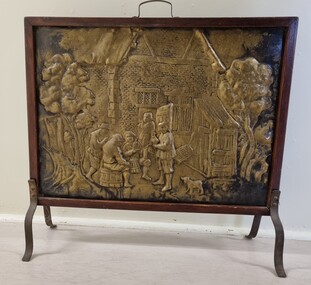
Domestic object - Beaten Copper fire screen
... Beaten Copper fire screen...Beaten Copper fire screen...Fire screens were developed early in the 19th century to prevent sparks from flying into the room or logs rolling out when a fire was left unattended. ...A fire screen made from beaten copper with a wooden frame. ...Forged copper fire screens decorative household items A fire screen made from beaten copper with a wooden frame. ...Fire screens were developed early in the 19th century to prevent sparks from flying into the room or logs rolling out when a fire was left unattended. They also served as ornamental or decorative items, particularly ones such as this fire screen made from beaten or forged copper. Their decorations often depicted rural scenes.This item is representative of fire screens used in Australian homes to protect them from fire during the 19th and early 20th century when open fires were the main form of household heating.A fire screen made from beaten copper with a wooden frame. The screen design depicts a group of people sitting outside an Elizabethan building with a dog in the foreground and trees either side. The building is possibly a tavern as the people are seated on barrels. The frame is made from wood and has wrought iron legs screwed in place on either side and a handle attached at the centre top edge.forged copper, fire screens, decorative household items -
 Ballarat Clarendon College
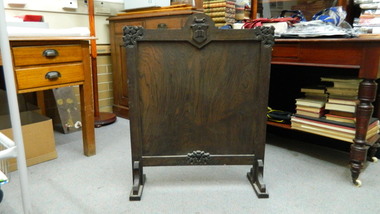
Furniture, Fire screen
... Fire screen......fire-screen...The fire screen was gifted to Mr J J Watson at his retirement in 1952. ...Wood fire screen with school crest at top of front. ...The fire screen was gifted to Mr J J Watson at his retirement in 1952. ...The fire screen was gifted to Mr J J Watson at his retirement in 1952. The assembly hall at the Mair Street property was named in his honour. Mr J J watson was a member of the school council from its inception in 1919 when he was elected as a representative of Scots' Church. He succeeded Rev J T Riddle as secretary to council in 1920. In 1954 the assembly hall at the Mair Street property was officially named Watson Hall in his honour. In 1957 the constitution of the Council was amended to enable Mr Watson to be elected its first life member. The fire screen was returned to the school by the family after his death. In a tribute in 1952 at the time of Mr watson's retirement from secretarial position on council, Principal Kerr said, 'Mr watson's family was friendly with the Kennedy(founder) family in Ireland, so that his interest in Clarendon was almost hereditary. His breadth of vision, generosity, devotion to the advancement of the school in every way, and meticulous care of the property and ikts interests, have given him a unique place in the hostory of the school. Wood fire screen with school crest at top of front. Carved details at top corners and base of front feature scottish thistle and leaves. Solid wood frame and stand; veneer insert. Small bronze plaque fixed to top of back. Plaque: Presented to / Mr J J WATSON / in appreciation of his devoted service / as secretary of the council of / CLARENDON PRESBYTERIAN LADIES / COLLEGE / FROM 1920 - 1952.j-j-watson, clarendon-presbyterian-ladies-college, mair-street-campus, school-council, watson-hall, life-member, fire-screen, furniture, -
 Flagstaff Hill Maritime Museum and Village
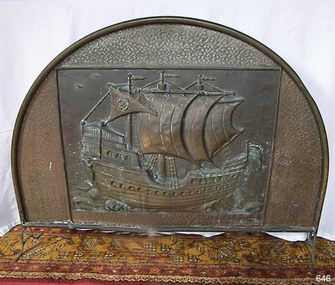
Domestic object - Fire screen
... Fire screen......fire screen...This decorative fire screen is placed in front of an open fireplace to prevent hot sparks and ash from causing damage. ...Fire screen, crescent shaped, brass pressed sheet, with a ship motif within a rectangular area. ...Domestic object Fire screen ...This decorative fire screen is placed in front of an open fireplace to prevent hot sparks and ash from causing damage. Open fires were common in Australia in the 19th and early 20th century, for both cooking and heating.Fire screen, crescent shaped, brass pressed sheet, with a ship motif within a rectangular area. Ship is a 3 masted sailing vessel, a Spanish galleon. Made in England, c. 1930.flagstaff hill, warrnambool, shipwrecked-coast, flagstaff-hill, flagstaff-hill-maritime-museum, maritime-museum, shipwreck-coast, flagstaff-hill-maritime-village, fire screen, fire guard, domestic item, heating, cooking -
 Flagstaff Hill Maritime Museum and Village
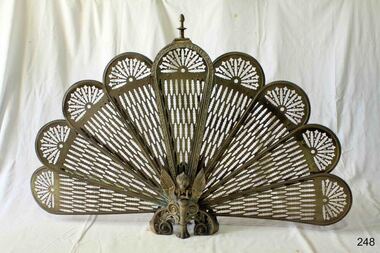
Domestic object - Fire screen
... Fire screen......fire screen...Fire screen, gold plated meta,l fan shaped. Centre stem has sculptured head of loon (?)...flagstaff hill warrnambool shipwrecked coast flagstaff hill maritime museum maritime museum shipwreck coast flagstaff hill maritime village great ocean road fire screen fan shaped fire screen fire guard fireplace fire place tool Fire screen, gold plated meta,l fan shaped. ...Fire screen, gold plated meta,l fan shaped. Centre stem has sculptured head of loon (?)-type animal with wings. Main fan area has fold away leaves that fold to centre stem.flagstaff hill, warrnambool, shipwrecked coast, flagstaff hill maritime museum, maritime museum, shipwreck coast, flagstaff hill maritime village, great ocean road, fire screen, fan shaped fire screen, fire guard, fireplace, fire place tool -
 Bendigo Historical Society Inc.
Domestic Object - METAL FIRE SCREEN
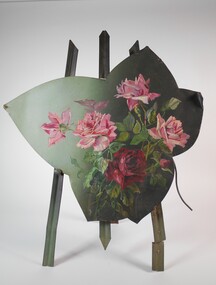
... METAL FIRE SCREEN......fire screen...Metal fire screen shaped as a leaf. Painted pcture on the screen of pink roses and green leaves on a green background. ...DOMESTIC EQUIPMENT Heating fire screen Metal fire screen shaped as a leaf. ...Metal fire screen shaped as a leaf. Painted pcture on the screen of pink roses and green leaves on a green background. Back has three metal vertical supports attached. Two outside supports serve as legs. A fourth metal support is attached as a hinged adjustable third leg.domestic equipment, heating, fire screen -
 Embroiderers Guild, Victoria
Textile - Jacobean Crewel Work Fire Screen, Mrs Eglantine Gill, 1936
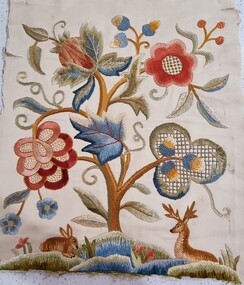
... Jacobean Crewel Work Fire Screen...Eglantine Gill was a member of the British Embroiderers Guild. The fire screen was made as a wedding gift to the donor's parents in 1936. ...Jacobean design "Tree of Life" embroidered fire screen worked in silks. Design from Weldon's Period Needlework-Art Series 5 1936....Textile Jacobean Crewel Work Fire Screen Mrs Eglantine Gill Mrs Eglantine Gill ...Mrs. Eglantine Gill was a member of the British Embroiderers Guild. The fire screen was made as a wedding gift to the donor's parents in 1936. Jacobean design "Tree of Life" embroidered fire screen worked in silks. Design from Weldon's Period Needlework-Art Series 5 1936.jacobean, crewel embroidery -
 Vision Australia
Domestic object - Object, Royal Victorian Institute for the Blind metal fire screen
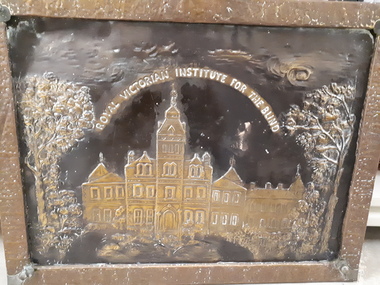
... Royal Victorian Institute for the Blind metal fire screen...Metal fire screen with etched image and attached plate...Moylan Life Member Brighton Auxiliary Metal fire screen with etched image and attached plate Royal Victorian Institute for the Blind metal fire screen Domestic object Object ...On the front (rear) face of this metal firescreen is an image of the RVIB St Kilda Road building and front gardens, with the words 'Royal Victorian Institute for the Blind' in curved lettering above the building. A name plate is attached by cord to the firescreen, which reads "In Memory Of M.N. Moylan Life Member Brighton Auxiliary". It is unknown whether the firescreen was made by blind metal workers, however it shows signs of use, quite possibly at the St Kilda Road building itself.Metal fire screen with etched image and attached plateRoyal Victorian Institute for the Blind In Memory of M.N. Moylan Life Member Brighton Auxiliaryroyal victorian institute for the blind, m.n. moylan -
 Embroiderers Guild, Victoria
Textile - Embroidered Fire Screen Panel, Florence Lishman (1884-1956), 1930's-1940's
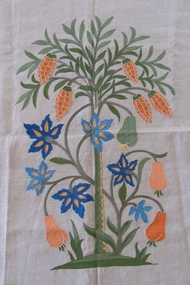
... Embroidered Fire Screen Panel...Rectangular panel (possibly a fire screen). Natural linen with central motif of plant and fruit growing out of a mound. ...Textile Embroidered Fire Screen Panel Florence Lishman (1884-1956) ...The panel was embroidered by the donor's father's cousin, Florence Lishman (1884-1956) of Northumberland, England in the late 1930's or early 1940's.Rectangular panel (possibly a fire screen). Natural linen with central motif of plant and fruit growing out of a mound. The embroidery is in silk in shades of green, orange and blue using a variety of stitches.embroidery, panels, 1920-40, england, surface stitchery -
 Warrnambool and District Historical Society Inc.
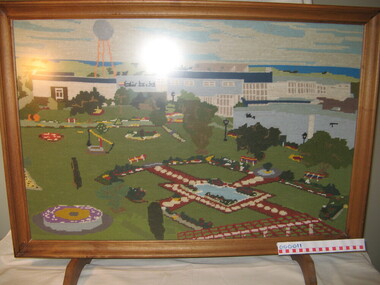
Textile - Fire screen, Tapestry, Post 1967
... Fire screen...Tapestry fire screen in a rectangular light timber frame depicting the Fletcher Jones Factory Gardens. ...Tapestry Textile Fire screen ...David Fletcher Jones (1895-1977) was a travelling hawker who opened a business in Liebig Street, Warrnambool in 1924. In 1931 he opened The Man's Shop at the corner of Liebig Street and Koroit Street. He sold suits and overcoats tailored in the work rooms upstairs. In 1948 his factory known as Pleasant Hill was opened in Flaxman Street in Warrnambool, the site of an old quarry. In 1951 the company Fletcher Jones and Staff was formed with the staff owning 51% of the shares, By the 1970s Fletcher Jones and Staff had become one of the largest clothing companies in Australia with 55 shops and 3000 employees. In 1992 the Warrnambool City Council bought the factory and gardens with the site now a tourist attraction. Although the name is retained today for trading purposes the original Fletcher Jones company has been dissolved. The screen is a representation of the Fletcher Jones factory post 1967. It a wool tapestry by Martin Prider who was a painter and caretaker what the Fletcher Jones factory. He lived in one of the Fletcher Jones cottages on site. (Robin Boyd Age Small Homes Scheme, today Heritage listed.)This is an interesting memento of the Fletcher Jones company and the factory. It was done by a local resident and features the famous Fletcher Jones gardensTapestry fire screen in a rectangular light timber frame depicting the Fletcher Jones Factory Gardens. The screen has two timber feet, non relective glass and appears to be a wool tapestry. The image of the gardens is after 1967 as the silver ball is included and that was erected in 1967. Nilfletcher jones company and warrnambool factory, pleasant hill warrnambool, martin prider, fletcher jones, tapestry of fletcher jones factory -
 Kew Historical Society Inc
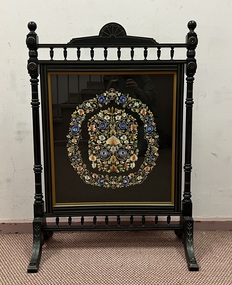
Furniture - Hand embroidered fire screen, 1900-1910
... Hand embroidered fire screen...This hand embroidered fire screen was embroidered by Winifred Caroline Henty Hindson (1887–1967), Elsie May Eliza Hindson (1880–1968) and Louisa (Louie) Charlotte Frances Hindson (1885–1963) three of the daughters of Alice Henty and John Hindson. ...Furniture Hand embroidered fire screen ...This hand embroidered fire screen was embroidered by Winifred Caroline Henty Hindson (1887–1967), Elsie May Eliza Hindson (1880–1968) and Louisa (Louie) Charlotte Frances Hindson (1885–1963) three of the daughters of Alice Henty and John Hindson. Their grandfather, Francis Henty, was the youngest son of Thomas Henty, who with his family, their retainers and property moved to the Australian colonies between 1829 and 1832. In 1834, Francis’ older brother, Edward, sailed from Launceston in Van Diemen’s Land to what was to become Portland in the western part of Port Phillip District [Victoria]. Francis, together with the first flock of Merino sheep [in Victoria], followed some months later. The first and second generations of the Henty family established vast pastoral properties in the Western part of the Port Phillip District. Francis Henty managed ‘Merino Downs’ near Casterton, while also living in his retirement at ‘Field Place' in Kew.The Henty Collection of nineteenth and twentieth century clothing, including outerwear and underwear, was collected, stored and exhibited over time by female family members descended from Francis and Mary Ann Henty. During the twentieth century, items from the collection were modelled in two fashion parades by various descendants [1937, 1959]. The items in the collection are historically and aesthetically significant, with provenance provided by oral and written tradition within or held by the family. A number of the items in the collection are very rare survivors, and provide researchers with the evidence needed to reconstruct the lives of notable women in the Port Phillip District [later Victoria] during the nineteenth and early twentieth century. Multicoloured silk embroidered floral composition on a black fabric background created by Louisa, Elsie and Winifred Hindson. The embroidery is held behind glass and is protected by blackened wood at the back. The screen is suspended in an ebonized and gilded frame with two rows of spindle decoration. fire screens, women's work, embroidery - 20th century, elsie hindson, louisa hindson, winifred hindson -
 Flagstaff Hill Maritime Museum and Village
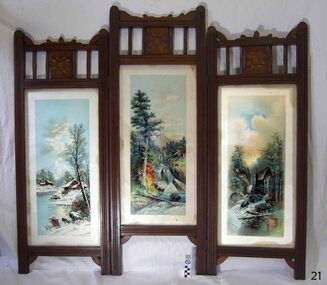
Furniture - Screen, Thomas Hope, 1905-1913
... ...fire screen...The fire screen was part of the original furnishings of the Lighthouse Keeper's Quarters in Merri Street, Warrnambool. ...Fire screen comprising three black wood framed panels hinged together. ...The fire screen was part of the original furnishings of the Lighthouse Keeper's Quarters in Merri Street, Warrnambool. ...The fire screen was part of the original furnishings of the Lighthouse Keeper's Quarters in Merri Street, Warrnambool. It was made by Lighthouse Keeper, Thomas Hope. Thomas served two terms as an assistant lighthouse keeper in Warrnambool. His first term was from 1905 to 1907. He later returned from 1910 to 1913, when he was appointed as Keeper five months after the untimely death of his predecessor Peter Quinn. Woodworking was one of Thomas Hope’s hobbies, and the three-panel fire screen he made as a lighthouse keeper is now in the Flagstaff collection and is displayed in the Lighthouse Keeper’s Cottage. Thomas Hope 1857 - 1928 Thomas James Hope was born in Camden, Surrey, England in 1857. His father, also called Thomas, was reputed to be a member of the Royal Family, and Thomas Hope Junior his illegitimate son. Thomas was subsequently brought up on the estate of the Earl of Hopetoun in Somerset and it was thought that Thomas was the Earl’s grandson. Against the wishes of those in charge of Thomas, he joined the navy at an early age, seeing much of the world until he settled in New Zealand at the age of twenty-four. After some years in New Zealand, he came to Australia to live. One of the jobs Thomas Hope had prior to becoming an assistant lighthouse keeper in 1896 was as a cook in the Lunatic Asylum at Sunbury, Victoria. He served as an assistant keeper at Shortlands Bluff, Gabo Island, Split Point and Warrnambool, retiring in 1918. He bought a house in Nicholson St, Warrnambool and died in March 1928. He is buried in the Warrnambool cemetery. Thomas Hope is recorded in family history as being of short stature and, not surprisingly given his alleged aristocratic connections, possessed a beautiful speaking voice. He and his wife Elizabeth nee Waters, whom he married in New Zealand, had six children (Thomas, killed in World War One), Ellen (Nell), Nora (who was married at the Warrnambool lighthouse keepers cottage), William (who died in Warrnambool), Marion and Alan. Joseph Hoover (Dec 29, 1830, to Aug 7, 1913) Joseph Hoover, the printer of the pictures on the screen, was born in Baltimore, of Swiss-German heritage. He was trained as an architectural woodturner. In 1856 Hoover moved to Philadelphia and began producing elaborate wooden frames in his wood-turning and framing business. By 1865 Hoover had started to produce popular prints for publishers and artists, which included noted Philadelphia artist James F. Queen. In the 1880s Hoover set up a complete plant specialising in chromatography, the process of producing colour prints from lithographic plates. The coloured prints he produced were affordable to business and private customers. In 1893 his son Henry L., a trained lithographer, joined the company as overseer and it was called J. Hoover & Son. It became one of the largest in America by the turn of the century. Hoover won a medal for Excellence for his Chromolithographs of James Queen’s works. In 1904 Joseph’s other son, Joseph W, joined the business as a partner and the company was called Jos. Hoover & Sons. Hoover died of a heart attack in 1913. He was survived by his wife and six children: two sons who were also his business partners, and four daughters. The firm continued in production until around 1985. Hoover’s prints included scenes, still life and landscapes of America and other locations. They were sold in America and overseas to countries including Canada, Germany, Mexico and England. The three-panelled screen in the Lighthouse Keeper’s Cottage was made by the Assistant Lighthouse Keeper, Thomas Hope during one of his two terms at the Lighthouse Keepers' Quarters. It is the only object in the collection known to be connected to Hope. The Lighthouse Keeper's Cottage is part of the Lady Bay Lighthouse Complex, which is listed on the Victorian Heritage Register for being of historical, scientific (technological) and architectural significance to the State of Victoria.Fire screen comprising three black wood framed panels hinged together. Each panel contains a glass-encased print depicting a rural landscape. Ornate stencil cut wood edging and quilt-inspired parquetry sits above each panel. The central panel is taller than those either side. Screen is lined in black-painted cardboard.Printed at the base of each of the three prints “COPYRIGHT 1896 BY J. HOOVER & SON, PHILAD’’A.”flagstaff hill, warrnambool, shipwrecked coast, flagstaff hill maritime museum, firescreen, thomas hope junior, ellen (nell) hope, nora hope, william hope, marion hope, alan hope, jos. hoover & sons of philadelphia, lighthouse keeper, assistant lighthouse keeper, carved screen, merri street, lighthouse keeper's cottage, lighthouse residence, lighthouse, wood carving, lighthouse complex, lady bay lighthouse, fire screen -
 Embroiderers Guild, Victoria
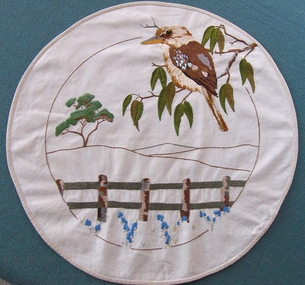
Textile - Kookaburra Embroidered Doyley, 1920's
... It was originally part of a fire screen....It was originally part of a fire screen. Textile Kookaburra Embroidered Doyley ...Surface stitchery depicting a kookaburra on a branch over looking the countryside. It was originally part of a fire screen.embroidery, surface stitchery, australia -
 Embroiderers Guild, Victoria
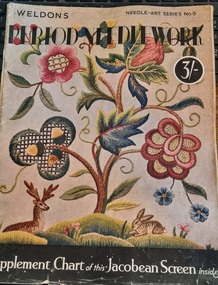
Textile - Weldon's Period Needlework-Art Series 5 Magazine, Mrs Eglantine Gill, 1936
... Contains Jacobean design "Tree of Life" for embroidered fire screen....Contains Jacobean design "Tree of Life" for embroidered fire screen. Textile Weldon's Period Needlework-Art Series 5 Magazine Mrs Eglantine Gill Mrs Eglantine Gill ...Mrs Gill was a member of the British Embroiderers Guild.Weldon's Period Needlework-Art Series 5 1936. Contains Jacobean design "Tree of Life" for embroidered fire screen.pattern, crewel, jacobean -
 Embroiderers Guild, Victoria
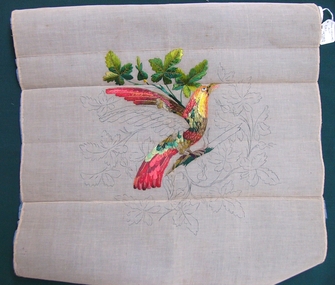
Textile - Silk Embroidery Kit, Bird in a Tree, 1900-20
... Probably meant for fire screen....Probably meant for fire screen. Bird in a Tree Textile Silk Embroidery Kit ...Design is on fine light brown canvas and depicts a bird sitting on a branch. Part of the bird and foliage is embroidered in brightly coloured silks. The bird has an unusual bead as an eye. (No threads with kit.) Probably meant for fire screen.embroidery, silk embroidery, kits -
 Kew RSL
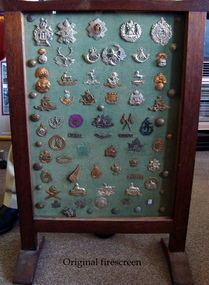
framed badges
... Originally a fire screen. Frame lost during 2017 renovations. ...Originally a fire screen. Frame lost during 2017 renovations. ...Originally a fire screen. Frame lost during 2017 renovations. Board reframed by J Torpey March 2019wood frame, badges & buttons mounted on cloth base. Regimental badges & uniform buttons from England, Australia, Canada & New Zealand -
 Bendigo Historical Society Inc.
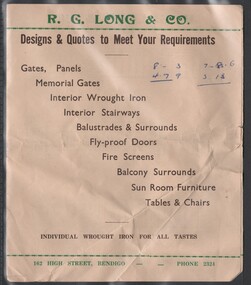
Flyer - William 'Bill' Theodore - Flyer for R.G. Long & Co. makers of a range of wrought iron goods, k
... Designers and Makers of a wide range of wrought iron goods (gates, Panels, memorial gates, interior wrought iron, balustrades & surrounds, fly-proof doors, fire screens, balcony surrounds, sunroom furniture, tables and chairs, and individual wrought iron for all tastes.). ...Designers and Makers of a wide range of wrought iron goods (gates, Panels, memorial gates, interior wrought iron, balustrades & surrounds, fly-proof doors, fire screens, balcony surrounds, sunroom furniture, tables and chairs, and individual wrought iron for all tastes.). ...William Anthony Theodore (19.3.1917 - 5.1.2007).Flyer for R.G. Long & Co. Designers and Makers of a wide range of wrought iron goods (gates, Panels, memorial gates, interior wrought iron, balustrades & surrounds, fly-proof doors, fire screens, balcony surrounds, sunroom furniture, tables and chairs, and individual wrought iron for all tastes.). Company at 162 High Street, Bendigo. Flyer has six gate designs on the internal pages of the sheet R.G. Long & Co. 162 High Street, Bendigo.bill theodore, william theodore -
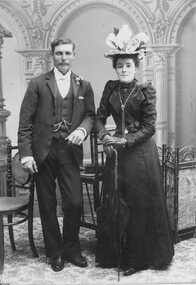 Stawell Historical Society Inc
Photograph, Mr Chaming & Mrs Eliza Chamings nee Harris from Great Western
... B/W photo Studio Ornate arches and pillars background chairs and fire screen. Left Mr Chamings Wearing a three piece suit. ...B/W photo Studio Ornate arches and pillars background chairs and fire screen. Left Mr Chamings Wearing a three piece suit. ...Mr and Mrs Chamings nee Eliza Harris Great Western B/W photo Studio Ornate arches and pillars background chairs and fire screen. Left Mr Chamings Wearing a three piece suit. Corsage in lapel. Fob watch chain across waistcoat. Mrs Camings wearing dark travelling dress. flat beribboned hat. drop necklace. belt. Heart bar brooch. hold folded umbrella in gloved hand both posing in front of chair.Front: Stawell Photographic Co., Main Street, Close Railway. C. Hewitt, Manager. Reverse: Mr and Mrs. Chamings nee Eliza Harris. Stamp Stwell Photographic Co. Close Railway Station C. Hewitt, Manager.stawell -
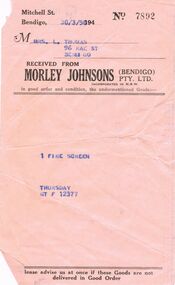 Bendigo Historical Society Inc.
Document - MORLEY JOHNSONS RECEIPT, 30/03/1950
... Incorporated in N.S.W. in good order and condition, the undermentioned Goods:- 1 Fire Screen. Thursday GT F 12377. Please advise us at once if these goods are not delivered in Good order. ...Incorporated in N.S.W. in good order and condition, the undermentioned Goods:- 1 Fire Screen. Thursday GT F 12377. Please advise us at once if these goods are not delivered in Good order. ...William Morley Johnson established a stock and general auctioneers business in Kyneton in 1886 before opening a furniture store in Bendigo in 1897. The initial business operated from Pall Mall opposite the Post Office and then moved to 23 Mitchell Street in 1898. In 1906 the business moved to Sydney. It became a public company in 1952 and ceased business in 1964.Morley Johnsons Receipt: Pink paper with black print and blue ink. Mitchell St. Bendigo. No. 7892. Dated 30/03/1950. To: Mrs Thomas, 95 Rae St, Bendigo Received from Morley Johnsons (Bendigo) Pty Ltd. Incorporated in N.S.W. in good order and condition, the undermentioned Goods:- 1 Fire Screen. Thursday GT F 12377. Please advise us at once if these goods are not delivered in Good order. Small tear left top. Box 625business, retail, house furnishings -
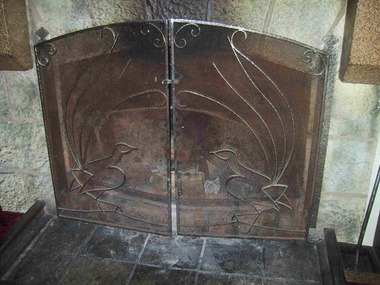 Parks Victoria - Mount Buffalo Chalet
Firescreen and poker
... It is not known whether the lyrebird fire screen in the Chalet Lounge was dedicated to Alice Manfield and her study into local lyrebirds, but this popular feature is a most appropriate tribute." ...It is not known whether the lyrebird fire screen in the Chalet Lounge was dedicated to Alice Manfield and her study into local lyrebirds, but this popular feature is a most appropriate tribute." ...'The distinctive lyrebird firescreen has become a popular feature of the lounge. It is not known how long it has stood in this position, but it appears to have been custom-made for the fireplace. Firescreens are not clearly shown in early photographs. It is popularly believed that the fenders on the floor..came from the Victorian Railways workshops and were made from railway line metal..' (Pg 72 Historica. 2011) "In 1924 amateur naturalist and mountain-guide, Alice Manfield (18-78 -1960) popularly known as Guide Alice, released 'The Lyre-birds of Mount Buffalo', a 23 page booklet detailing her studies into the lyre-birds on Mount Buffalo, the first pictorial record of lyre-birds to be published.... It is not known whether the lyrebird fire screen in the Chalet Lounge was dedicated to Alice Manfield and her study into local lyrebirds, but this popular feature is a most appropriate tribute." (Pg 132 Historica,2011) Listed in Draft Inventory of Significant Collection Items . 1. Forged and beaten steel firescreen. opens in the centre and is closed with two latches. One lyre bird design on each side. Heavy mesh with scrolling work. Attached to fireplace. 2. Poker is forged steel with a knob on one end and a hook on the other. -
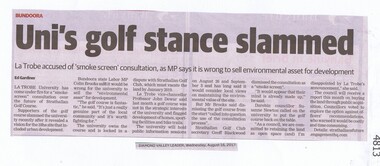 Greensborough Historical Society
Newspaper Clipping, Diamond Valley Leader, Uni's golf stance slammed, 16/08/2017
... La Trobe University has come under fire for a "smoke-screen" consultation over the future of Strathallan Golf Course...La Trobe University has come under fire for a "smoke-screen" consultation over the future of Strathallan Golf Course la trobe university strathallan golf course darebin council News article 1 page, black text. ...La Trobe University has come under fire for a "smoke-screen" consultation over the future of Strathallan Golf CourseNews article 1 page, black text.la trobe university, strathallan golf course, darebin council -
 4th/19th Prince of Wales's Light Horse Regiment Unit History Room
Booklet, Modern Printing Co Pty Ltd, Royal Artillery Training Memorandum (Field, Tank Attack, Anti-Aircraft Branches) No 8, July 1943
... Paper booklet covering up coming amendments to Artillery publications and fire orders for smoke screens and immediate registered or predicted battery Smoke screen...Artilllery smoke World War 2 Paper booklet covering up coming amendments to Artillery publications and fire orders for smoke screens and immediate registered or predicted battery Smoke screen Royal Artillery Training Memorandum (Field, Tank Attack, Anti-Aircraft Branches) No 8 Booklet Modern Printing Co Pty Ltd ...Paper booklet covering up coming amendments to Artillery publications and fire orders for smoke screens and immediate registered or predicted battery Smoke screenartilllery, smoke, world war 2 -
Bendigo Historical Society Inc.
Photograph - FORTUNA COLLECTION: FORTUNA, c1920s
... On the right of that is a cabinet is what appears to be a kerosene lantern then a Fire place screen. Markings/Inscriptions: Bartlett Bros. ...On the right of that is a cabinet is what appears to be a kerosene lantern then a Fire place screen. Markings/Inscriptions: Bartlett Bros. ...Black and white photo. The hall at Fortuna Villa. Bottom left of a fire place with plants and deer sitting in it, on either end of the mantle are statues of ladies sitting reading, in the centre is a man holding up a disc shaped object. Along the wall there are a number of paintings one is of Sir George Lansell, others are landscapes. Also along the wall standing on the floor is a collectors cabinet on beautifully carved legs. A lady crouched down with an elbow on her knee, she is sitting on a pedestal. On the right of that is a cabinet is what appears to be a kerosene lantern then a Fire place screen. Markings/Inscriptions: Bartlett Bros. Bendigo. Sticky label on front centre bottom; 338 ST 83buildings, residential, fortuna villa, bartlett bros. bendigo -
 Flagstaff Hill Maritime Museum and Village
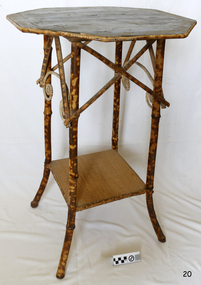
Furniture - Plant Stand, 1880
... While most produced standard tables, stands and fire-screens, the more adventurous offered for sale items such as corner shelve units, charcoal barbecue grills and musical tea tables. ...While most produced standard tables, stands and fire-screens, the more adventurous offered for sale items such as corner shelve units, charcoal barbecue grills and musical tea tables. ...During the years 1869-1935, there were well over 250 registered bamboo furniture producers in Britain. The earliest recorded firm was Hubert Bill of 14 Little Camden St, London N.W., who claimed to have been established in 1869, while Daniel Jacobs & Sons of Hackney Road, London, were still in business in 1915, after 45 years of production. Design, quality, price and methods of construction were fairly consistent throughout the whole period, but it was the imaginative and often eccentric choice of subject matter that marked differentiation between the various firms. While most produced standard tables, stands and fire-screens, the more adventurous offered for sale items such as corner shelve units, charcoal barbecue grills and musical tea tables. Shelves were often covered with embossed leather paper designs, at first imported from Japan and then later produced in England. Some firms incorporated the knobbly roots of the bamboo stems into their designs, generally to form feet. Occasionally, handles to drawers and cupboards were made with these roots, although they were more commonly carved as imitations. Handles were mostly of cheap metal or brass. The ends of the bamboo canes were capped with stamped metal or turned bone, ivory or wooden discs. Methods of construction fell into three categories. First and most common is that of pegging. Bamboo stems being hollow, thick dowels can easily be glued into the joints. Some firms farmed out this work of `plugging' the ends of the canes to part-time workers at home. The second method, that of pinning, was far less satisfactory as bamboo tends to split lengthwise and therefore the jointed pieces eventually disintegrated. The most efficient method was that patented in 1888 (patent No. 2383) by the firm of W. F. Needham in Birmingham. It consisted of metal shoes and covers for all joints, which were made by wrapping a metal strip around the stems and soldering the overlapping ends. Some joints were further strengthened by a small pin or screw. Needham was by far the largest and most successful manufacturer, and their individual and superior method of construction undoubtedly gained them their reputation. A. Englander & Searle of 34 Gt Eastern St and 31 Mare St, Hackney, London, were a firm particularly concerned with methods of construction. Although they seem to have entered the bamboo furniture market at a comparatively late date, about 1898, they produced inexpensive' bamboo, aimed particularly at the export trade. Stating in their catalogue that bamboo furniture “can be exported in one piece or it can be exported in pieces and put together again. The fixing up is much facilitated by a system of marking and numbering. Further, no glue is required for putting together as the screw system is applied”. This method of construction best fits the Etagere and this item in the Flagstaff collection, and it is believed to have been made by A Englander & Searle, exported in a knock-down form to Australia, purchased in kit form from a dealer here and put together by the purchaser. The bamboo plant stand is a significant item as it highlight furniture fashion of the late Victorian era. This item was highly sort after in its time and although mass produced, not many examples remain because the item is so fragile so this example is a valuable addition to the Flagstaff collection. It is believed,the construction method used is by a notable and respected maker in England of bamboo furniture that was aimed specifically at the export market and probably came to Australia in kit form to be assembled by the purchaser.Plant stand: a bamboo plant stand with a hexagonal pine timber top edged with tortoise shell bamboo. The top is supported on four tortoise shell bamboo legs joined at the base by a square cane-covered shelf. The tortoise shell appearance is brown lacquer. This stand is part of the Giles Collection. flagstaff hill, warrnambool, shipwrecked coast, flagstaff hill maritime museum, shipwreck coast, furniture, plant stand, bamboo furniture, etagere, victorian furniture, simulated bamboo, tortise shell, a englander & searle, domestic furniture, giles collection, henry giles, cooramook, mailor’s flat, wangoom, 19th century household goods -
 Flagstaff Hill Maritime Museum and Village
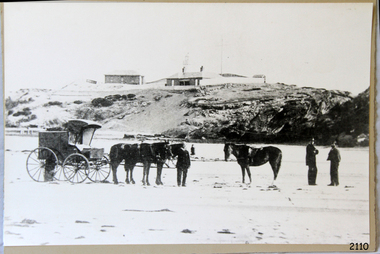
Photograph - Scene - Warrnambool, C. 1854-1871
... An example of a keeper’s skills is the carved fire screen made by /assistant Keeper Thomas Hope in the late 19th century and displayed in the Lighthouse Keeper’s cottage at Flagstaff Hill. ...An example of a keeper’s skills is the carved fire screen made by /assistant Keeper Thomas Hope in the late 19th century and displayed in the Lighthouse Keeper’s cottage at Flagstaff Hill. ...This is an image of the Warrnambool Lighthouse Complex on Middle Island in 1854. The Store, Lighthouse Keeper's Quarters, Lighthouse and Flagstaff are in the background. The foreground shows a covered buggy drawn by two horses and a person in attendance, and another wheeled vehicle behind it with a figure nearby. There is a saddled horse to the right with two males in conversation nearby. The ground is soft, perhaps the riverbed or sandy shore. THE LIGHTHOUSE KEEPERS Lighthouse Keepers were responsible for keeping their Lighthouse’s lights shining at night. They kept a lookout for passing vessels and changes in weather. They were expected to clean, polish and maintain the equipment and buildings. They kept regular and detailed records of who was on watch, and the time the light was lit, trimmed and extinguished. They kept a journal about other events that occurred. They keep regular, accurate Meteorological Logs. It was expected that they were competent in Morse code signalling. They would be called to help in times of disasters and shipwrecks and to give official statements about these events. Many Lighthouse Keepers also volunteered as members of the lifeboat crew. The Lady Bay lighthouses were officially classified as small, so the Keepers had the official titles of Senior Assistant Lighthouse Keeper and Assistant Lighthouse Keeper. They were employed by the Public Service and paid rent to live in the Lighthouse Quarters. They were compulsorily retired at the age of 60, with most receiving a superannuation payment. Despite their time-consuming duties, there was time to follow hobbies and crafts such as growing vegetables, playing musical instruments, making models of buildings including lighthouses, and crafting furniture pieces. An example of a keeper’s skills is the carved fire screen made by /assistant Keeper Thomas Hope in the late 19th century and displayed in the Lighthouse Keeper’s cottage at Flagstaff Hill. Both Alexander and Farncombe had served under Senior Keeper Robert Deverell, who was the first and only Senior Lighthouse Keeper at the Middle Island Complex. John Alexander was the Assistant Keeper in the 1850s. Andrew Farncombe was the last Assistant Keeper at Middle Island, serving there with his family from 1864 to 1871. During 1871 and 1872 the Lighthouse Complex was moved to Flagstaff Hill on Merri Street. Farncombe and Deverell then became the first Keepers and occupants of the Lady Bay Lighthouse Complex at Flagstaff Hill. They continued their service together; overall, Deverell served from 1859 to 1885 and Farncombe from 1864 to 1974. WARRNAMBOOL'S LADY BAY LIGHTHOUSE COMPLEX - The original Lighthouse Complex was built on Middle Island in 1858-1859 then transferred stone-by-stone to Flagstaff Hill in 1871. The Complex comprised the Lighthouse, the Lighthouse Keepers’ Quarters and a Privy. The bluestone Keeper’s Quarters was a cottage divided into two compartments, one for the Senior Keeper and his family, the other for the Assistant Keeper and his family. The bluestone Store was divided into three; a store, a workshop, and an oil store (or office). The Privy comprised a small building also divided into two separate, back-to-back toilets, one for each Keeper and his family. In the 1970s the Flagstaff Hill Planning Board was set up under the chairmanship of John Lindsay. The Board was to make recommendations to the Warrnambool City Council regarding the use of the buildings and the rest of the Crown Land on the site. The Flagstaff Hill Maritime Village opened in 1975 and began renovating the Cottage in stages, during which time evidence of a 1920s fire was found in the eastern section of the cottage. Additions of a porch on the west and a washroom on the east were made in the 1980s. The western part of the building is now a Shipwreck Museum and the east has returned to a late 19th-century Lighthouse Keeper’s cottage and includes the screen made by Assistant Lighthouse Keeper Thomas Hope in the late 19th century. Hope served two periods of time at the Lighthouse. This photograph is significant as a visual record of the original Warrnambool Lighthouse Complex on Middle Island, the origin of what is now the Lady Bay Lighthouse Complex. The photograph is significant for its connection to the Complex, which is now listed on the Victorian Heritage Register, H1520, for being of historical, scientific (technological) and architectural significance to the State of Victoria. The Complex is significant as an example of early colonial development. The photograph is significant for its connection with the important navigational function of the Lighthouses, a function still being performed to this day. The photograph is also significant as it shows an example of buildings organised by the Public Works Department in Victoria in the mid-to-late 19th century. The structures tare still stand strong. Photograph of horses, a buggy and three gentlemen in the foreground and the background shows a lighthouse and accompanying buildings. Printed in black and white. (Another two horse-drawn vehicles are partially visible). The subject is the Lighthouse Complex on Middle Island, Warrnambool, dated between 1854 and 1871.An inscription is handwritten in black pen on the back of the mounting board."The lighthouse and accompanying buildings were / established on Middle Island in 1854, as this / picture shows. In 1871 they were moved to their / present site on Flagstaff Hill."flagstaff hill, flagstaff hill maritime museum, flagstaff hill maritime village, warrnambool, maritime museum, shipwreck coast, lighthouse keeper's cottage, lighthouse residence, lighthouse, chart room, quarters, privy, middle island, beach lighthouse, obelisk, lighthouse complex, lady bay complex, warrnambool port, warrnambool harbour, lady bay, keepers, lighthouse keeper, upper lighthouse, lower lighthouse, assistant keeper, ports and harbours, cottage, meteorological record, 1854, 1871, light keeper -
 Flagstaff Hill Maritime Museum and Village
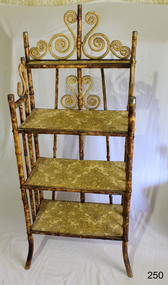
Furniture - Shelves, A. Englander & Searle, Late 19th Century (1898)
... While most produced standard tables, stands and fire-screens, the more adventurous offered for sale items such as Corner shelve units, charcoal barbecue grills and musical tea tables. ...While most produced standard tables, stands and fire-screens, the more adventurous offered for sale items such as Corner shelve units, charcoal barbecue grills and musical tea tables. ...This music stand set of shelves is one of many 19th century items of furniture, linen and crockery donated to Flagstaff Hill Maritime Village by, Vera and Aurelin Giles. The items are associated with the Giles Family and are known as the “Giles Collection”. Many of the items of furniture, linen and crockery in the Lighthouse Keeper’s Cottage were donated by Vera and Aurelin Giles and mostly came from the simple home of Vera’s parents-in-law, Henry Giles and his wife Mary Jane (nee Freckleton) whose photos are in the parlour. They married in 1880. Henry, born at Tower Hill in 1858, was a labourer on the construction of the Breakwater before leaving in 1895 to build bridges in N.S.W. for about seven years. Mary Jane was born in 1860 at Cooramook. She attended Mailor’s Flat State School where she was also a student teacher before, as family legend has it, she became a governess at “Injemiara” where her grandfather, Francis Freckleton, once owned land. Henry and Mary’s family of six, some of whom were born at Mailor’s Flat and later children at Wangoom, lived with their parents at Wangoom and Purnim west, where Henry died in 1933 and Mary Jane in 1940. THE SHELVES During the years 1869-1935 there were well over 250 registered bamboo furniture producers in Britain. The earliest recorded firm was Hubert Bill of 14 Little Camden St, London N.W., who claimed to have been established in (1869 the first bamboo furniture maker), while Daniel Jacobs & Sons of Hackney Road, London, were still in business in 1915, after 45 years of production. Design, quality, price and methods of construction were fairly consistent throughout the whole period, but it was the imaginative and often eccentric choice of subject matter that marked the differentiation between the various firms. While most produced standard tables, stands and fire-screens, the more adventurous offered for sale items such as Corner shelve units, charcoal barbecue grills and musical tea tables. Shelves were often covered with embossed leather paper designs, at first imported from Japan and then later produced in England. Some firms incorporated the knobbly roots of the bamboo stems into their designs, generally to form feet. Occasionally handles to drawers and cupboards were made with these roots although they were more commonly carved as imitations. Handles were mostly of cheap metal or brass. The ends of the bamboo canes were capped with stamped metal or turned bone, ivory or wooden discs. Methods of construction fell into three categories. First and most common is that of pegging. Bamboo stems being hollow, thick dowels can easily be glued into the joints. Some firms farmed out this work of `plugging' the ends of the canes to part-time workers at home. The second method, that of pinning, was far less satisfactory as bamboo tends to split lengthwise and therefore the jointed pieces eventually disintegrated. The most efficient method was that patented in 1888 (patent No 2383) by the firm of W. F. Needham in Birmingham. It consisted of metal shoes and covers for all joints which were made by wrapping a metal strip around the stems and soldering the overlapping ends. Some joints were further strengthened by a small pin or screw. Needham was by far the largest and most successful manufacturer and their individual and superior method of construction undoubtedly gained them their reputation. A. Englander & Searle of 34 Gt Eastern St and 31 Mare St, Hackney, London, were a firm particularly concerned with methods of construction. Although they seem to have entered the bamboo furniture market at a comparatively late date, about 1898, they produced inexpensive bamboo, aimed particularly at the export trade. The company stated in their catalogue that bamboo furniture “can be exported in one piece or it can be exported in pieces and put together again. The fixing up is much facilitated by a system of marking and numbering. Further, no glue is required for putting together as the screw system only is applied”. This method of construction best fits the Etagere in the Flagstaff collection and it is believed to have been made by A Englander & Searle, exported in a knock down form to Australia, purchased in kit form from a dealer hear and put together by the owner. The Etagere is a significant item as it highlight furniture fashion of the late Victorian era. This item was highly sort after in its time and although mass produced, not many examples remain, so this example is a valuable addition to the Flagstaff collection. It is believed that the construction method used is by a notable and respected maker of bamboo furniture and that its production was aimed at the export market and probably came to Australia in kit form.Bamboo shelves: decorative free standing Etagere comprising three large shelves and one small shelf. Shelves are made of wood used to store either orange or bacon boxes (as there are no knots in the wood, imported from South America and cheap to recycle). Shelves are covered with embossed leather paper. Frame is made from tortoise shell bamboo (brown lacquer applied to simulate tortoise shell appearance). Ends of bamboo canes are covered with metal shoes and fixed with a pin. Other bamboo joints are fixed with round head steel screws. This item is part of the Giles Collection.Noneflagstaff hill, warrnambool, shipwrecked-coast, flagstaff-hill, flagstaff-hill-maritime-museum, maritime-museum, shipwreck-coast, flagstaff-hill-maritime-village, bamboo shelves, bamboo etagere, victorian furniture, furniture, bamboo furniture, embossed leather paper, simulated bamboo, tortise shell, a englander & searle, giles collection, henry giles, tower hill, cooramook, warrnambool breakwater, mailor’s flat, wangoom, 19th century furniture -
 Ringwood and District Historical Society
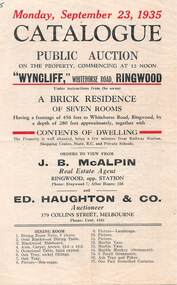
Flyer - Catalogue, Public Auction - Brick Residence and Contents of Dwelling, "Wyncliff", Whitehorse Road, Ringwood. 1935
... FIRST BEDROOM - Arm Chair (Leather); English Oak Dressing Table; English Oak Wash Stand Marble Top; Toilet Set (Four pieces); Silk Fire Screen; Blackwood Occasional Table; Black and Gold Vase; Pair China Vases; Pair Glass Vases; Single Glass Vase; One Kewpie Lavender Bag; Bedroom Lino 15.6 x 13.6. ...FIRST BEDROOM - Arm Chair (Leather); English Oak Dressing Table; English Oak Wash Stand Marble Top; Toilet Set (Four pieces); Silk Fire Screen; Blackwood Occasional Table; Black and Gold Vase; Pair China Vases; Pair Glass Vases; Single Glass Vase; One Kewpie Lavender Bag; Bedroom Lino 15.6 x 13.6. ...Double-sided A5 size advertisement for public auction under instructions from the owner on Monday, September 23, 1935 on the property - seven room brick residence with frontage 456 feet by approximately 280 feet and contentents of dwelling fully listed over 4 pages. Agent - J.B. McAlpin, Ringwood, opp. station. Phone Ringwood 7; after houres 236. Auctioneer - ED. Haughton & Co., 379 Collins Street, Melbourne. Phone Central 4101.Contents of Dwelling List - includes: DINING ROOM - Dining Room Suite - 6 pieces; Oval Blackwood Dining Table; Blackwood Sideboard; Axminster Carpet, Occasional Table hand carved; Oak Trays; Seascape, Landscape and other Pictures; 2 Marble Vases; Marble Monkey and 3 other Small Ornaments; Ash Tray and Poker; One Pair Stencilled Curtains. Two Large Vases, 1 with floral design; Salad Bowl and Servers; One Dozen Dessert Knives; Nine Stainless Teaspoons (new); Plated Vases; Plated Jam Dishes; Plated Cream Bowl; Silver Plated Cake Dish; One Pair Plated Shell Butter Dishes; Lino Border. LOUNGE ROOM - 2 Pictures and 1 pair with Circular Frames; Floral Jardinere and Pot Plant; Cabinet Gramophone "Singola"; Records; Player Piano "Cable"; Piano Stool; 31 Rolls; Roll Cabinet; Quantity of Music; Music Case, Leather; Portable Gramophone "Decca"; Floral Design Jardinere; Wicker Occasional Table; 2 Wicker Chairs; Cane Lounge Settee; Blackwood Bookcase; 9 Volumes Universal Encyclopedia; 10 Vols Children's Encyclopedia; Floral Vase; Black and Gold Vase; One pair Plated Vases; Ash Pan; Lino Border (Lounge Room); One Carpet, green 13.6 x 10.6; One Cushion; Hall Stand; Pedestal; Floral Design Jardinere; Painting on Canvas (Landscape); Hall Runner Carpet 25 feet; Hall Lino 29ft 5 in.; Five Door Mats (small). FIRST BEDROOM - Arm Chair (Leather); English Oak Dressing Table; English Oak Wash Stand Marble Top; Toilet Set (Four pieces); Silk Fire Screen; Blackwood Occasional Table; Black and Gold Vase; Pair China Vases; Pair Glass Vases; Single Glass Vase; One Kewpie Lavender Bag; Bedroom Lino 15.6 x 13.6. SECOND BEDROOM - Arm Chair (Leather); Dressing Table; Wash Stand; 3 Piece Toilet Set; One Vase (Pink Cameo Design); Two Ornaments (one round); Bedroom Lino 13.5 x 12.10; 3 Pictures; 2 Pairs Curtains (applique, stenc'ld); Pair Curtain Poles. THIRD BEDROOM - Lino approx 14ft x 10ft; Two Green Mohair Mats; Pair Pictures (White frames); One Picture ("The Mourners"); Picture ("The Wanderer Found"); Small Picture; Wicker Chair. FOURTH BEDROOM - Duchess Chest 5 drawers; Corner Wardrobe and Curtains; One Single Bed & Wire Mattress; Single Bedding; Lino on floor 14ft x 6ft 6in.; Occasional Table; 3 Pictures; Two Door Mats; Hall Runner (Carpet) 21ft. BREAKFAST ROOM - Two Wicker Chairs; Cushion; Brown Cushion; Four Vienna Chairs; Jardinere; Kerb (Wooden). 3 Pictures; Oil Painting (Canvas); 2 Pictures; Lino 14ft x 14ft; Brown Table Cover; Fruit Set; Robur Tea Pot; Plaque; China Biscuit Barrel; Glass Fruit Bowl; Pair Pickle Jars and Stand; Wooden Inkstand; Pair Ash Trays; Two Marble Vases; Glass Vase; Electric Jug and Electric Toaster (practically new); Picture; Cushion; Pair Lace Curtains; Curtain Rod; Three Lace Curtains; Brass Curtain Rods (3); Lino in Vestibule 10ft x 8 ft; Lino in Kitchen 12.6 x8.6; Coal Scuttle; Two Small Tables (1 Baize Cover). STORE ROOM - Briquette Grate; Three Coir Mats (one new); Three Small Door Mats (new); Glass Fire Screen; 2 Alm Pot Stands; Steel Pot Stand; Lady's Bicycle; 2 Electric Radiators (one large); White Cabinet; Stretcher Bed; Large Cot with Wire Mattress; Kerb; Fender and Irons; Lino on floor 12ft x 12ft; Lino in Storeroom 6ft x 6ft; Three Large Window Blinds; Clothes Horse; Dressmaker's Fitting Stand; Dressmaker's Bust; Window Display Bust; Blouse Stand; Small Display Stand; Meat Cover (Metal); Leather Portmantau; Leather Kit Bag; Four Large Wooden Drawers; Picnic Basket; Mattress, Bolster and Pillow; Cot Quilt; One Long-handled Feather Duster; Feather Duster; Wicker Lounge; Cane Soiled Linen Basket; One New Washing Tub; Copper Preserving Pan; Lino in Laundry 8 x 6 approx; Carpet Sweeper; Small Jardinere; 2 Shopping Baskets; Kitchen Safe; Kitchen Table; Three Buckets; 1 Horse Rub patent (prac new); Wooden Pot Plant Stand; Bird Cage and Stand; Pair Steps; Pair Small Steps; Metal Meat Safe; Wooden Safe; Hand worked Table Cover; Pair Poplin Silk Curtains (new); Leather Table Centre. VERANDAH - 12ft Shelving with doors; 35ft Shelving; Wooden Stand; Axe Stand (wooden); Nine feet Wooden Shop Fittings; Small Filing Cabinet; Three Window Frames & Glass; 38 Pot Plants Fernery; 9 Hanging Baskets Fernery; Electric Shop Sgn Storeroom; 2 Small Electric Shop Signs Storeroom; 2 Garden Sprays; Doll's Pram and Doll; Two Boxes Paint and Slate; Crystal Radio Set; New Canvas Blind & Roller 6ft.; Electric Light Reflectors (two); Two pieces of Painted Baize; Small Vice; Sprinkler; One Gallon Tin of Spray Oil; 2 Packets of "Aresto"; Two Hurricane Lamps; One Pair Spring Balance Scales; Small Pair Spring Balance Scales. WASH HOUSE - Pair Heavy Tracers (2); Pair Reins; Back Band; One Tug; Pair Hames; One Pair Neck Bands (2); Four Manger Balls; Pair Knee Pads; Kicking Strap complete; Leather Head Stall; Collar Pad; Knife Board and Tin Polish; Fork Cleaner; Foot Spray Pump. TOOL SHED - One Stewart Horse Clipper; Approx 120ft Ribbed Hose; 100ft ½in Hose; Child's Scooter; Tin Box; Ferret Box; One Tool Box; Tomato Hoe; Sprinkler; Two Large Augers; Large Watering Can; Medium Watering Can; Small Watering Can; Wooden Tool Chest; Rope, Tackle and two Pulleys; Six pieces of Lino; Three Small Canvas Blinds; Lawn Mower 14in.; Lawn Mower 12in.; Grass Catcher; 8 Pieces Garden Tools; Barrow; Quantity of Timber; Quantity of Flower Pots; Quantity of Wire; 4 Egg & 1 Fowl Crates Feed Room; 1 Gallon Demijohn Feed Room; Quantity of Shelving Feed Room; Quantity of Cement, Lime; Six Small Doors; Roll of Perforated Cardboard; Boot Rack; Coat Rack; 3 Automatic Sanitary Disinfectant; Pair Neck Straps and Rope; One Chimney Top & 3 Vent Bks.; Desk; Large Pump; Large Safe; Pair Sliding Door Rollers & Fittings; Two Wooden Doors; Box Sundries; Wooden Frame and Glass; 2 Vienna Chairs; Delivery Cart; Five Boxes Tiles; Quantity Agricultural Pipes; Wooden Bench; Wood Horse; Earthenware Drain Pipe; Wooden Tool Box; New Brass Spray "Rego"; Two Wood Planes. YARD - Pair Hedge Clippers; Box Containing 2 prs Secateurs & Punch; Box Tools seven pieces; Box Sundries; Lawn Weeder and Seed Sower; Box Tools 6 pieces; Two Saws; Bundle Files; Three Braces; Box of 13 pieces Gimlets etc.; Five Spanners; Box Tools 4 pieces; Four Coal Chisels; Box 7 pieces of Tools; Box of 5 pieces of Tools; Box of Docket Books; One Printing set; Large Figure Printing Set; Small Figure Printing set; Price Ticket Box; Air Brush Writing Set Complete; Six Shelves & Brackets, one Hat Rack, in store room; Box of Three Hammers; Two Boot Lasts; Tin of Polishing Oil; Box of Gardening Sundries; 2 Bicycle Pumps Saddle & Clips; One Covered Baking Dish; 200 c.p. Globe (Vestibule); Two "Dimolite" Fittings; Set of Five Canisters; Earthernware Jar; Two shopping Cases; Dinner Set 11 pieces; Box of Sundry Tins; Alm Fish Pan and Drainer; Two Ventilators; Knife Board & 3 Bread Saws; Soap Box and Jewel Case; Three Glass Articles. OFFICE FURNITURE - Steel Safe (Office Safe); Office Table five drawers; Cabinet 8 drawers; Cupboard three shelves; Selves 2ft3in x 1ft6in; Cheque Protector; Remington Typewriter; Typewriter Adjustable Table; Burroughs Bookkeeping Machine and Stand Complete; Small Office Table; Glass Show Case3ft9 x 2ft.; Four Sheets M. Glass; Five Sheets P. Glass; Gent's Overcoat new; Boy's Pullover New; Small Show Case; Duplicator (complete); Webster's Dictionary; Family doctor's Book. Two Dictionaries; Bundle of Three Books; Art Decorating Book; Bundle of Three Books; Bundle of Three Books; Two Books (Children's); (Multiple) Bundles each containing Three Books; Leather Riding Whip; Tort-shell Inkstand & Calendar; Tort-shell Folding Letter Rack; Water Filter; Thermos Flask and Case; Two Waste Paper Baskets. -
 Flagstaff Hill Maritime Museum and Village
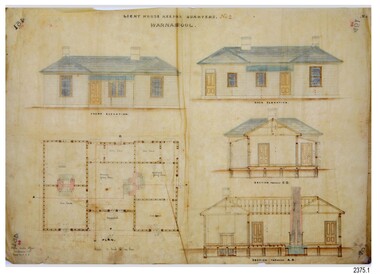
Document - Plans, Lighthouse Keeper's Quarters Warrnambool, 1858-1909
... An example of a keeper’s skills is the carved fire screen made by /assistant Keeper Thomas Hope in the early 20th century and displayed in the Lighthouse Keeper’s cottage at Flagstaff Hill. ...An example of a keeper’s skills is the carved fire screen made by /assistant Keeper Thomas Hope in the early 20th century and displayed in the Lighthouse Keeper’s cottage at Flagstaff Hill. ...The set of seven 1858 plans shows proposed plans for the original Lighthouse Complex that was built on Middle Island in 1858-1859. The whole complex was then transferred to Flagstaff Hill in 1871. The plan, dated 1909, is for proposed additions and repairs to the Quarters at Flagstaff Hill. The plan 'Alterations and Additions' shows alternate plans for changes to the quarters at the Flagstaff Hill location. This plan has no date. The Complex comprised the Lighthouse, the Lighthouse Keepers’ Quarters, the Store (now called the Chart Room) and a Privy, which was not included in these plans. The Keeper’s bluestone Quarters was a cottage divided into two compartments, one for each keeper and his family. The bluestone Store was divided into three; a store, a workshop an oil store (or office). The Privy comprised of a small building also divided into two separate, back-to-back toilets, one for each Keeper and his family. The Flagstaff Hill Keeper's Quarters have had extensions and additions at various times, and these have also been removed at various other times. THE PLANS - *Dec. 1858 (12/58) ‘Lighthouse Keepers Quarters No.2 Warrnambool’ (2375.01)* Public Works Office Melbourne – Front and Back elevations, sections, and floor plan. The drawing shows timber walls. [The floor plan is the closest plan to the current building, however, the walls are timber in this plan.] *Nov. 1858 – No.3 ‘Lighthouse Keepers Quarters Warrnambool’ (2375.02)* Office of Public Works, Melbourne – Back and End elevations and section through. The drawing shows stone walls. One side; Senior Keeper’s bedroom, living room and kitchen with storeroom. Another side; is the Assistant’s bedroom, living room and storeroom. *Nov. 1858 - No.4 ‘Lighthouse Stores Warrnambool’ (2375.03)* Office of Public Works – Front, Side and end elevations, centre section. The drawing shows stone walls. *Nov. 1858 – No.4, ‘Lighthouse Stores No. 2 Warrnambool’ (2375.04)* Office of Public Works – Front, side and end elevations, centre section. The drawing shows timber walls. *Nov. 1858 – ‘Details Lighthouse Keepers Quarters No. 2 Warrnambool’ (2375.05)* Public Works Office Melbourne. The plan shows the foundations, joists and eaves. The drawing shows timber walls. (Nov. 1858 – ‘No.4 ‘Lighthouse No. 2 – Warrnambool’ (2375.06)* Public Works Melbourne (Part of the paper is missing). This plan shows an octagonal tower, internal stairs, a balcony landing, and a weather vane on top. *November 1858 – No. 1, ‘Lighthouse – Warrnambool’ (2375.07)* Office of Public Works Melbourne. This plan shows a round tower, including the stairs, windows on the tower and the weather vane on the top. *4/3/9 [1909] – ‘Additions and Repairs, Lighthouse Quarters, Warrnambool, General Plan’ (2375.8)* Department of Public Works Melbourne’s official stamp is signed by Croft. It shows the floor plans of the Store, Upper Lighthouse and the Quarters. The Store building has three sections; a Store, Work-Shop and Office, with an internal wall between them and separate entries. The Quarters are divided into two dwellings. The Senior Keeper’s side on the left has fireplaces in two of the three bedrooms and there is a pantry and wash house. The Assistant’s side has no fireplaces in the bedrooms and there’s no pantry or washhouse. These plans include proposed changes to the buildings. The Senior Keeper’s Quarters would have a partition on bedroom 2, a bath with plumbing and drainage, a wall moved and a built-in side porch. The Store would also have a built-in porch. The undated plan 'Additions and Alterations' (2375.9) shows alternative arrangements for water tanks, plumbing and such. WARRNAMBOOL'S LADY BAY LIGHTHOUSES- In the 1800s ships sailing from England to Australia began to use Bass Strait as a faster route to Melbourne. Small navigation errors led to many tragic shipwrecks. From 1848 lighthouses were operating along Victoria’s southern coast as a guide for sailors. Coastal towns such as Warrnambool grew and the exchange of trade and passengers were of great benefit. However, the uncertain weather changes, relatively shallow waters and treacherous, hidden rocky reefs were not suitable for a Harbour and in the 1840s and 1850s there were many shipwrecks in the area, with some even stranded in its Lady Bay harbour. A jetty was built in 1850 and a flagstaff to guide seafarers was placed up high on what became known now as Flagstaff Hill. In November 1857 the Victorian Government recommended that Warrnambool Harbour had beacons and two lighthouses to guide vessels into and out of the Harbour safely. The white light of the Middle Island lighthouse was to be used for the first time on September 1, 1859. The red light of the Beach Lighthouse, a wooden obelisk structure, was first operated on March 25, 1860, but in 1868 this light was ‘discontinued’ due to it being too low. Melbourne’s Department of Public Works decided to relocate the Middle Island Lighthouse Complex - Lighthouse, Keeper’s Quarters, Privy, Store Room and even water tanks - to Flagstaff Hill. The lower obelisk was shortened, and a protruding gallery, railing, and external ladder were added, as well as the light from the Beach Lighthouse. A green guiding light was erected on the end of the jetty. The transfer of the Complex began in March 1871. Each shaped stone of the lighthouse was carefully numbered, removed then reassembled on Flagstaff Hill. In 1872 the well was sunk behind the Lighthouse Keeper’s Cottage. The Keepers and families had left Middle Island in April and moved to Flagstaff Hill in October 1871. Vessels entering Lady Bay align the Upper and Lower Lighthouse towers during the day and the lights at night. The Upper Lighthouse is a round tower, the Lower Light is square. The Lighthouses were categorised as harbour lights rather than coastal lights, so they remain under the control of the Victorian Government’s Ports and Harbours section. The lights were originally powered by oil, then acetylene gas, later by electricity, and then converted to solar power in 1988. In 1993 the solar panel was replaced by a battery charger. A decision was made in 1936 to replace the lighthouses’ lights with unattended lights that no longer required Keepers and Assistants. At least 29 Keepers had attended to the lighthouse from its opening in 1859 to when the last official Lightkeepers left In April 1916. The Warrnambool Harbour Board rented out the Quarters from 1916 to 1936. The Board closed down but the rentals continued with other unknown landlords. In the 1970s the Flagstaff Hill Planning Board was set up under the chairmanship of John Lindsay. The Board was to make recommendations to the Warrnambool City Council regarding the use of the buildings and the rest of the Crown Land on the site. The Flagstaff Hill Maritime Village opened in 1975 and began renovating the Cottage in stages, during which time evidence of a 1920s fire was found in the eastern section of the cottage. Additions of a porch on the west and a washroom on the east were made in the 1980s. The western part of the building is now a Shipwreck Museum and the east has returned to a late 19th-century Lighthouse Keeper’s cottage and includes the screen made by Assistant Lighthouse Keeper Thomas Hope during one of his two periods of service there. THE LIGHTHOUSE KEEPERS Lighthouse Keepers were responsible for keeping their Lighthouse’s lights shining at night. They kept a lookout for passing vessels and changes in weather. They were expected to clean, polish and maintain the equipment and buildings. They kept regular and detailed records of who was on watch, and the time the light was lit, trimmed and extinguished. They kept a journal about other events that occurred. They keep regular, accurate Meteorological Logs. It was expected that they were competent in Morse code signalling. They would be called to help in times of disasters and shipwrecks, and to give official statements about these events. Many Lighthouse Keepers also volunteered as members of the lifeboat crew. The Lady Bay lighthouses were officially classified as small, so the Keepers had the official titles of Senior Assistant Lighthouse Keeper and Assistant Lighthouse Keeper. They were employed by the Public Service and paid rent to live in the Lighthouse Quarters. They were compulsorily retired at the age of 60, with most receiving a superannuation payment. Despite their time-consuming duties, there was time to follow hobbies and crafts such as growing vegetables, playing musical instruments, making models of buildings including lighthouses, and crafting furniture pieces. An example of a keeper’s skills is the carved fire screen made by /assistant Keeper Thomas Hope in the early 20th century and displayed in the Lighthouse Keeper’s cottage at Flagstaff Hill. The last occupants of the Middle Island Complex were Senior Keeper Robert Deverell, his Assistant Keeper, Andrew Farncombe, and their families. They all became the first occupants at the Lady Bay Lighthouse Keepers’ Quarters on Merri Street. The Warrnambool Lighthouse Complex plans are the origin of what is now the Lady Bay Lighthouse Complex. They are a record of the people, process and departments involved in bringing the complex into fruition. The plans are significant to the Complex, which is now listed on the Victorian Heritage Register, H1520, for being of historical, scientific (technological) and architectural significance to the State of Victoria. The Complex is significant as an example of early colonial development. The plan are significant for their connection with the important navigational function of the Lighthouses, a function still being performed to this day. The plans are also significant as an example of a product from the Public Works Department in Victoria in the mid-to-late 19th century. The structures built to these plans still stand strong. Plans for the Lighthouse Complex in Warrnambool, including Lighthouses, Keeper's Quarters and Stores. Seven of the plans are on thin fragile paper, one is on thicker, stronger paper. The drawings have been made in pens coloured red and black. They originate from Public Works in Melbourne. Seven were drawn in 1858, one in 1904, the other is not dated.Dec. 1858 - Lighthouse Keepers Quarters No.2 Warrnambool. Public Works Office Melbourne. Nov. 1858 - No.3 ‘Lighthouse Keepers Quarters Warrnambool. Public Works Office Melbourne. Nov. 1858 - No.4 ‘Lighthouse Stores Warrnambool. Office of Public Works. Nov. 1858 - No.4, ‘Lighthouse Stores No. 2 Warrnambool. Office of Public Works. Nov. 1858 - Details Lighthouse Keepers Quarters No. 2 Warrnambool. Public Works Office Melbourne. Nov. 1858 - No.4 ‘Lighthouse No. 2 – Warrnambool. Public Works Melbourne. Nov. 1858 - No. 1, Lighthouse - Warrnambool. Office of Public Works Melbourne. 4/3/9 [1909] - Additions and Repairs, Lighthouse Quarters, Warrnambool, General Plan. Department of Public Works Melbourne. SIGNED "Croft" "15A" on reverse [no date] - Lighthouse Quarters Warrnambool, Additions and Alterations. "9A" on reverseflagstaff hill, warrnambool, lighthouse keeper's cottage, lighthouse residence, lighthouse, plans, public works, melbourne, flagstaff hill maritime museum, maritime museum, shipwreck coast, flagstaff hill maritime village, chart room, quarters, privy, middle island, beach lighthouse, obelisk, lighthouse keeper, assistant keeper, lighthouse complex, lady bay, lady bay complex, keepers, upper lighthouse, lower lighthouse, ports and harbours, cottage, harbour board, flagstaff hill planning board, meteorological record, robert deverell, andrew farncombe, warrnambool port, warrnambool harbour, residence, alterations, repairs, department of works, light keeper -
Stawell Historical Society Inc
Archive, Historical Film Footage of Stawell Technical School 1932 & 1966
... Music Stool, having a Drawer for Music. 34.43 “A Fire-screen….. with Painted Panel. 35.01 “A sitting down job.” ...Music Stool, having a Drawer for Music. 34.43 “A Fire-screen….. with Painted Panel. 35.01 “A sitting down job.” ...Historical Film FootageTwo Film Reels Larger one Green Plastic Smaller one Red Plastic Sport at the Stawell Technical School 0.00 “Cricket Practice” 0.33 “The Bowler ..t it” 1.10 “Our Football Team 1932” 1.33 “Have a Closer look at them” (Football at Central Park ) 2.20 “Some of the Younger Fry” (school boys at Central Park) 2.33 “Start of the 220 Yards” 2.57 “High jump Events” 3.30 “See how it is done” 4.27 “See how to jump” 5.44 “The Sack Race” 6.15 “Boot Scram How carefully …. The boots …” 6.25 “The rush of the bootless brigade” 7.02 “Start of the Apple in Tub……. Race” 7.12 “An apple a day, keeps the doctor away…. They want their apple” 7.32 “See – The Art of Getting….The apple. 7.59 Putting the Weight” 8.14 “Notice the graceful movements” Skene (Street site) 9.31 “ The Long Jump” Stawell Technical School Activities at Skene Street 10.10 “ Marching practice for Inter- Technical sports….. 1932 10.33 “Some practice starts. ( Tech school building Skene Street ) 11.54 Technical school building in Skene St 12.07 “The Fall in” 12.48 “Drill exercise” 13.40 “Drill Exercise Juniors” 15.09 “Dismiss” 15.24 “Classes Leaving School Room- Sorry to part” 15.52 “Bat Tennis” 16.23 “Ball passing” 16.50 “Over-head Ball Passing” 17.21 fancy dress on stage. Similar to Can Can 18.21 possible Egyptian dance Stawell Technical School Swimming 19.00 “Receiving Instructions-The Lull before the storm!” 19.09 “All ready in their gowns.—They’re off!!! (No, not the gowns.) 19.19 “Hey! Would you believe he’d do this on purpose?” 1st method of release and rescue 19.54 “Another patient “callin” for help- Life-saving is mostly ups and downs” 20.17 “Towing the patient in, so that he can’t struggle with the rescuer” 20.52 “Who’s drowning now? It’s either Sir Walter Dally or Frantic Drake getting ducked” 21.38 Swimming club room at Cato Lake 21.44 Diving tower Cato Lake Views of Stawell from Big Hill and from a Plane 23.18 Views from Big Hill 23.48 ? lettered title by Stawell Technical School 23.53 “Now, off we go in the Texas plane”(biplane) 24.07 “Stawell looks like a Doll’s Garden” 24.36 “Main Street Winds … beneath us” 24.55 “Lake Cato, Central Park, War Memorial” 25.16 “State School 502 with the “ants” out at play…. 25.53 “The North Western Woollen Mills” 26.05 “And now from the West side” 26.33 “Above the clouds at 7000ft.”(and landing the biplane) Technical School Trade Skill-- Carpentry 27.16 “Woodwork Department” “Model Dairy” – Built on walk-in walk-out principle with bails for 6 cows; also separator, cream, and feed room; Length 52 Ft Width 18ft. Scale 27.44 “Framing for Lean-to shed Many uses can be found for this type on the farm 28.08 “Putting the finishing touches to a Twi-roomed Settler’s House….” 28.42 “A good sturdy type of hand gate….. half full size.. 28.57 “This Double-batten gate costs the farmer13/-, can be made in 3 hours, and is good for a Century…. 29.20 “ A stand for…… 1.000 Gallon tank. 1/3rd Full size….. 29.45 “ Form for moulding Concrete fence posts…. These posts are fire-proof, white-ant-proof, and will not rot…. 30.11 “No 2. Carpentry.” Sinking Mortices in Styles of a pair of Gates….. 30.29 “Cutting Tenons on the Rails” 30.42 “Fitting Tenon into Mortice.” 30.53 ‘Marking and cutting for Brace” 31.46 “Turret Roofs. 1. Bell-shaped… 2. Ogee……… 32.03 “Cutting a Mitre such as is used for corner of Picture Frame. 32.51 “Testing Mitre for Square” 32.59 “No 3. Joinery.” Box-framed Window with Double-hung sashes 33.24 “Louvre Ventilators 1. Circular. 2. Triangular. 33.46 “Front Entrance Door and Frame, with Fanlight and Sidelights. 34.04 “Half Size Model of a Gothic Door 34.21 No 4. Cabinet-Making. Fitting shaped rail to turned leg of….. Music Stool, having a Drawer for Music. 34.43 “A Fire-screen….. with Painted Panel. 35.01 “A sitting down job.” Junior Technical Boys on Chair construction 35.22 “A modeling class at work. ------- Technical School Trade Skill—Plastering 36.09 “ A process of … casting in Plaster. Of parts…… 36.14 “Building the walls around the clay….. model. ------ 36.34 “Mixing the Plaster of Paris to pour for the mould….. 36.39 “Modelling Section. The running of Mouldings…. 36.43 “Building up…. The rough shape of the mould…” 36.55 “Moving thr template slowly along,….. in order to perfect the shape…… 37.30 “Moving the template along……. For the second time. 37.49 “The finished mould.” 37.55 “An end view showing …. The exact shape. Technical School Speech Day 38.40 Speech day 39.40 Display of art work, plaster models and carpentry 41.44 Science experiments Exploring the Grampians/Halls Gap 40.30 Exploring the Grampians Views from Mt William 45.54 Picnic Halls Gap 46.36 Swimming carnival Halls Gap pool Athletics at Central Park Stawell 43.56 Athletic events at Central Park including sack race and tandem racing Lake Lonsdale Picnic 49.41 Leaving for …. The School Picnic held at …Lake Lonsdale….. December 13th 1932 50.00 By the Lakeside 50.22 The boys take to the water. 50.46 One in, All in. 51.22 Hunger….. approaching, On with..the billy.. 51.34 The workers Partake of Nourishment. 51.47 Silent workers.(mothers picnic lunch) Wash up and Dry up. 52.20 General view at Lunch time. 52.53 One swallow does not make a summer… 53.10 Great Australian Bites. 53.28 Good-bye Sandwiches.. 53.57 Note the more than full expressions… 54.06 The last parade 54.16 Swim for the shore boys Under 14 years 54.43 Swim for the shore boys. Under 16 Years. 55.06 Swim for the shore boys, all in… 55.28 Ladies Race. Use your weight. 55.45 After the fall. 55.47 The winner Mrs Taylor. 55.06 Boys Races 56.20 How NOT to run.(backwards) 57.10 Try this one yourself….(backwards) 57.26 The Staff Spirit? 57.39 The Winner Mr Henderson.. Snow in Stawell 1949 58.01 1949 snow in Stawell Tech school, 502, Tech snow fight , Patrick St with courthouse 59.31 Big Hill scenery 1.00.06 Speech at Tech school quadrangle Street Parade down Main Street 1.00.22 c. 1945 Parade main St (possibly Peace celebrations) Sporting event Central Park 1.02.04 Central Park sporting event after the Parade, including Scouts erecting a tent. Historical Film Footage Stawell Tech 1932education -
 Flagstaff Hill Maritime Museum and Village
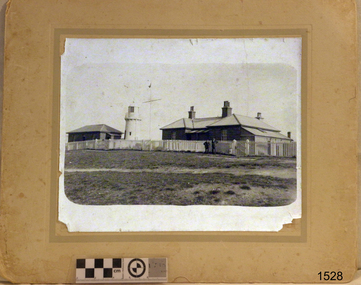
Photograph - Historical, building, Late 19th to early 20th century
... fire was found in the eastern section of the cottage. Additions of a porch on the west and a washroom on the east were made in the 1980s. The western part of the building is now a Shipwreck Museum and the east has returned to a late 19th-century Lighthouse Keeper’s cottage and includes the screen made by Assistant Lighthouse Keeper Thomas Hope in the late 19th century. ...fire was found in the eastern section of the cottage. Additions of a porch on the west and a washroom on the east were made in the 1980s. The western part of the building is now a Shipwreck Museum and the east has returned to a late 19th-century Lighthouse Keeper’s cottage and includes the screen made by Assistant Lighthouse Keeper Thomas Hope in the late 19th century. ...The black and white photograph depicts the Lady Bay Lighthouse Complex at Flagstaff Hill, Warrnambool. It was opened on this site in 1871. From left to right, the Chartroom (previously named the Store), Upper Lighthouse, Flagstaff, Lighthouse Keeper's Quarters. The bluestone buildings are facing North on Merri Street. The Harbour Pilot's Lodgings were on the east of the Complex. There are two unknown male figures standing in front of the light-coloured picket fence that encompasses the Complex. The photograph is mounted on card. WARRNAMBOOL'S LADY BAY LIGHTHOUSES In the 1800s ships sailing from England to Australia began to use Bass Strait as a faster route to Melbourne. Small navigation errors led to many tragic shipwrecks. From 1848 lighthouses were operating along Victoria’s southern coast as a guide for sailors. Coastal towns such as Warrnambool grew and the exchange of trade and passengers was of great benefit. However, the uncertain weather changes, relatively shallow waters and treacherous, hidden rocky reefs were not really suitable for a Harbour and in the 1840s and 1850s, there were many shipwrecks in the area, with some even stranded in its Lady Bay harbour. A jetty was built in 1850 and a flagstaff to guide seafarers was placed up high on what became known now as Flagstaff Hill. In November 1857 the Victorian Government recommended that Warrnambool Harbour had beacons and two lighthouses to guide vessels into and out of the Harbour safely. The white light of the Middle Island lighthouse was to be used for the first time on September 1, 1859. The red light of the Beach Lighthouse, a wooden obelisk structure, was first operated on March 25, 1860, but in 1868 this light was ‘discontinued’ due to it being too low. Melbourne’s Department of Public Works decided to relocate the Middle Island Lighthouse Complex - Lighthouse, Keeper’s Quarters, Privy, Store Room and even water tanks - to Flagstaff Hill. The lower obelisk was shortened, and a protruding gallery, railing, and external ladder were added, and the light from the Beach Lighthouse. A green guiding light was erected on the end of the jetty. The transfer of the Complex began in March 1871. Each shaped stone of the lighthouse was carefully numbered, removed then reassembled on Flagstaff Hill. In 1872 the well was sunk behind the Lighthouse Keeper’s Cottage. The Keepers and families had left Middle Island in April and moved to Flagstaff Hill in October 1871. Vessels entering Lady Bay align the Upper and Lower Lighthouse towers during the day and the lights at night. The Upper Lighthouse is a round tower, and the Lower Light is square. The Lighthouses were categorised as harbour lights rather than coastal lights, so they remain under the control of the Victorian Government’s Ports and Harbours section. The lights were originally powered by oil, then acetylene gas, later by electricity, and then converted to solar power in 1988. In 1993 the solar panel was replaced by a battery charger. A decision was made in 1936 to replace the lighthouses’ lights with unattended lights that no longer required Keepers and Assistants. At least 29 Keepers had attended to the lighthouse from its opening in 1859 to when the last official Lightkeepers left In April 1916. The Warrnambool Harbour Board rented out the Quarters from 1916 to 1936. The Board closed down but the rentals continued with other unknown landlords. In the 1970s the Flagstaff Hill Planning Board was set up under the chairmanship of John Lindsay. The Board was to make recommendations to the Warrnambool City Council regarding using the buildings and the rest of the Crown Land on the site. The Flagstaff Hill Maritime Village opened in 1975 and began renovating the Cottage in stages, during which time evidence of a 1920s fire was found in the eastern section of the cottage. Additions of a porch on the west and a washroom on the east were made in the 1980s. The western part of the building is now a Shipwreck Museum and the east has returned to a late 19th-century Lighthouse Keeper’s cottage and includes the screen made by Assistant Lighthouse Keeper Thomas Hope in the late 19th century. He served as Assistant Keeper in Warrnambool for two periods.The Warrnambool Lighthouse Complex is now listed on the Victorian Heritage Register, H1520, for being of historical, scientific (technological) and architectural significance to the State of Victoria. The Complex is significant as an example of early colonial development. The buildings are significant for their connection with the important navigational function of the Lighthouses, a function still being performed to this day. The buildings are also significant as an example of structures designed and works carried out by the Public Works Department in Victoria in the mid-to-late 19th century. The structures still stand strong. Photograph; Warrnambool Lighthouse Keeper's cottage, lighthouse, flagstaff and chartroom at Flagstaff Hill, and a light-coloured picket fence with gate. Two male figures are in front of the fence. Black and white print glued to a yellow card. The inscription is indecipherable. The right side of the cottage has a built-in, enclosed addition.Ink stamped in lower right hand corner, too faded to be legible.flagstaff hill, flagstaff hill maritime museum, flagstaff hill maritime village, warrnambool, maritime museum, shipwreck coast, lighthouse keeper's cottage, lighthouse residence, lighthouse, chart room, quarters, privy, middle island, beach lighthouse, obelisk, lighthouse complex, lady bay complex, warrnambool port, warrnambool harbour, lady bay, keepers, lighthouse keeper, upper lighthouse, lower lighthouse, assistant keeper, ports and harbours, cottage, light keeper -
Marysville & District Historical Society
THE TRIANGLE NEWS-VOL 22 NO 4-27 JANUARY 1995
... fire telephone numbers...important dates february 1995...toy library...marysville & district lions club project...community health services...steavenson restaurant...women's health information day...oregon woodgrain timber...marysville video...christ church ladies' guild...stolen-property christ church...church news...community council meetings...public notice shire of murrindindi...kooringa conference centre...breast screen...marysville victoria australia narbethong theatre group thanks to emergency services happy birthday emergency fire telephone numbers important dates february 1995 toy library marysville & district lions club project community health services steavenson restaurant women's health information day oregon woodgrain timber marysville video christ church ladies' guild stolen-property christ church church news community council meetings public notice shire of murrindindi kooringa conference centre breast screen mobile van walking benefits acupuncture narbethong fire brigade bushfire readiness check list rubicon pokie mobile for sale to rent wanted to buy golf news bowls news junior golf clinic colonial horse races buxton wombat cottage singles lions club members notice reflections on history marysville & district historical society marysville saddle tramps marysville primary school 125th anniversary marysville crafts & gifts poem trades directory THE TRIANGLE NEWS-VOL 22 NO 4-27 JANUARY 1995 ...marysville, victoria, australia, narbethong theatre group, thanks to emergency services, happy birthday, emergency fire telephone numbers, important dates february 1995, toy library, marysville & district lions club project, community health services, steavenson restaurant, women's health information day, oregon woodgrain timber, marysville video, christ church ladies' guild, stolen-property christ church, church news, community council meetings, public notice shire of murrindindi, kooringa conference centre, breast screen mobile van, walking benefits, acupuncture, narbethong fire brigade, bushfire readiness check list, rubicon pokie mobile, for sale, to rent, wanted to buy, golf news, bowls news, junior golf clinic, colonial horse races buxton, wombat cottage, singles, lions club members notice, reflections on history, marysville & district historical society, marysville saddle tramps, marysville primary school 125th anniversary, marysville crafts & gifts, poem, trades directory
