
Showing 149 items matching "first leg"
-
 Moorabbin Air Museum
Book - General aviation, Earlybird The Story of Phil Lightband
... ...First leg...General aviation The child bird Air born The helmet speaks Solo Old enough Dancing Discipline Crossroads War bird Grounded Sea gulls The silver blue bird First leg Bogged Foreign skies Winged Jail birds Wings clipped Bikes & prams Phoenix Between two worids Amphibians Rainmakers Biography of NZ pilot Phil Lightbrand & his involvement in NZ general aviation, circa 1996 Earlybird The Story of Phil Lightband Book General aviation ...Biography of NZ pilot Phil Lightbrand & his involvement in NZ general aviation, circa 1996non-fictionBiography of NZ pilot Phil Lightbrand & his involvement in NZ general aviation, circa 1996the child bird, air born, the helmet speaks, solo, old enough, dancing, discipline, crossroads, war bird, grounded, sea gulls, the silver blue bird, first leg, bogged, foreign skies, winged, jail birds, wings clipped, bikes & prams, phoenix, between two worids, amphibians, rainmakers -
 Bendigo Military Museum
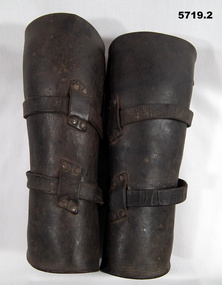
Uniform - LEGGINGS, LIGHT HORSE
... Dark brown leather leggings with 2 leather straps to tighten around legs. Two straps - first one wrapping around leg 3 times to tighten. ...Dark brown leather leggings with 2 leather straps to tighten around legs. Two straps - first one wrapping around leg 3 times to tighten. ...leggings or gaitors were part of the uniform issued to soldiers to help protect their legs and uniform. The idea is to wrap around lower legs. It is believed the original owner was called "Pitt".Dark brown leather leggings with 2 leather straps to tighten around legs. Two straps - first one wrapping around leg 3 times to tighten. Second strap - small one at the top of the leg to hold it firm. Two metal studded loops at back to loop straps through.Stamped "Pitt 1941" also "15" and "H" on both leggings.leggings, uniform, ww1 -
 Flagstaff Hill Maritime Museum and Village
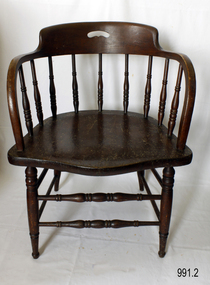
Furniture - Chair, Late 19th to early 20th century
... first appeared in the 1820’s. Although it lacked the high back found on any Windsor Chair of the time, it maintained a heavier, sturdier appearance. The main feature was a hoop or bow which was fashioned from steamed wood. This was then curved to make both the back support and arms. The chair also consisted of a wide seat, supported by 4 splayed, spindle legs...first appeared in the 1820’s. Although it lacked the high back found on any Windsor Chair of the time, it maintained a heavier, sturdier appearance. The main feature was a hoop or bow which was fashioned from steamed wood. This was then curved to make both the back support and arms. The chair also consisted of a wide seat, supported by 4 splayed, spindle legs ...Originally the Bow Chair started off life with the name of the ‘Smoker’s Bow Chair’ where originally, it wasn’t designed for grandeur like many chairs of the time, but instead was designed for practicality and comfort. The original Smoker’s Bow Chair was a simple chunkier version of the Windsor Chair design which first appeared in the 1820’s. Although it lacked the high back found on any Windsor Chair of the time, it maintained a heavier, sturdier appearance. The main feature was a hoop or bow which was fashioned from steamed wood. This was then curved to make both the back support and arms. The chair also consisted of a wide seat, supported by 4 splayed, spindle legs. In its original form it was found in many country kitchens of the day as well as in many inns and public houses throughout the United Kingdom. Its name of the "Smoker’s Bow Chair" because the sweeping armrests were the perfect height to support a smokers arm when smoking a pipe.A significant piece of furniture from the late 19th century designed for a specific purpose, smoking. These chairs are now highly collectable and valuable today and avidly sought by collectors of antique furniture.Chair wooden dark brown "Smoker's Bow" chair, with wide and deep seat with broad arms, turned spindles and thick turned legs joined by a double stretcher.Noneflagstaff hill, warrnambool, shipwrecked-coast, flagstaff-hill-maritime-museum, maritime-museum, shipwreck-coast, flagstaff-hill-maritime-village, chair, furniture, captains chair -
 Flagstaff Hill Maritime Museum and Village
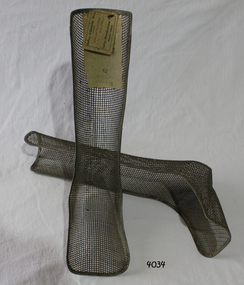
Splint, c. 1910-1920
... leg while the bone mended. The design was in use before and during WWI. It replaced the wooden splints previously used to reset bones in the late nineteenth to early 20th century. This new splint was invented by a traveling pharmaceutical salesman, Revra DePuy. He began manufacturing in his Warsaw, Indiana in 1895; the first...leg while the bone mended. The design was in use before and during WWI. It replaced the wooden splints previously used to reset bones in the late nineteenth to early 20th century. This new splint was invented by a traveling pharmaceutical salesman, Revra DePuy. He began manufacturing in his Warsaw, Indiana in 1895; the first ...This is a pair of vintage DePuy wire mesh splints made to support a broken leg while the bone mended. The design was in use before and during WWI. It replaced the wooden splints previously used to reset bones in the late nineteenth to early 20th century. This new splint was invented by a traveling pharmaceutical salesman, Revra DePuy. He began manufacturing in his Warsaw, Indiana in 1895; the first commercial manufacture of orthopaedic equipment in the world . The company eventually became Johnson & Johnson. This pair of splints was donated to Flagstaff Hill Maritime Village by the family of Doctor William Roy Angus, Surgeon and Oculist. It is part of the “W.R. Angus Collection” that includes historical medical equipment, surgical instruments and material once belonging to Dr Edward Ryan and Dr Thomas Francis Ryan, (both of Nhill, Victoria) as well as Dr Angus’ own belongings. The Collection’s history spans the medical practices of the two Doctors Ryan, from 1885-1926 plus that of Dr Angus, up until 1969. These splints would have belonged to Dr Tom Ryan before being passed onto Dr. W.R. Angus. ABOUT THE “W.R.ANGUS COLLECTION” Doctor William Roy Angus M.B., B.S., Adel., 1923, F.R.C.S. Edin.,1928 (also known as Dr Roy Angus) was born in Murrumbeena, Victoria in 1901 and lived until 1970. He qualified as a doctor in 1923 at University of Adelaide, was Resident Medical Officer at the Royal Adelaide Hospital in 1924 and for a period was house surgeon to Sir (then Mr.) Henry Simpson Newland. Dr Angus was briefly an Assistant to Dr Riddell of Kapunda, then commenced private practice at Curramulka, Yorke Peninsula, SA, where he was physician, surgeon and chemist. In 1926, he was appointed as new Medical Assistant to Dr Thomas Francis Ryan (T.F. Ryan, or Tom), in Nhill, Victoria, where his experiences included radiology and pharmacy. In 1927 he was Acting House Surgeon in Dr Tom Ryan’s absence. Dr Angus had become engaged to Gladys Forsyth and they decided he would take time to further his studies overseas in the UK in 1927. He studied at London University College Hospital and at Edinburgh Royal Infirmary and in 1928, was awarded FRCS (Fellow from the Royal College of Surgeons), Edinburgh. He worked his passage back to Australia as a Ship’s Surgeon on the on the Australian Commonwealth Line’s T.S.S. Largs Bay. Dr Angus married Gladys in 1929, in Ballarat. (They went on to have one son (Graham 1932, born in SA) and two daughters (Helen (died 12/07/1996) and Berenice (Berry), both born at Mira, Nhill ) Dr Angus was a ‘flying doctor’ for the A.I.M. (Australian Inland Ministry) Aerial Medical Service in 1928 . The organisation began in South Australia through the Presbyterian Church in that year, with its first station being in the remote town of Oodnadatta, where Dr Angus was stationed. He was locum tenens there on North-South Railway at 21 Mile Camp. He took up this ‘flying doctor’ position in response to a call from Dr John Flynn; the organisation was later known as the Flying Doctor Service, then the Royal Flying Doctor Service. A lot of his work during this time involved dental surgery also. Between 1928-1932 he was surgeon at the Curramulka Hospital, Yorke Peninsula, South Australia. In 1933 Dr Angus returned to Nhill where he’d previously worked as Medical Assistant and purchased a share of the Nelson Street practice and Mira hospital from Dr Les Middleton one of the Middleton Brothers, the current owners of what was once Dr Tom Ryan’s practice. Dr L Middleton was House Surgeon to the Nhill Hospital 1926-1933, when he resigned. [Dr Tom Ryan’s practice had originally belonged to his older brother Dr Edward Ryan, who came to Nhill in 1885. Dr Edward saw patients at his rooms, firstly in Victoria Street and in 1886 in Nelson Street, until 1901. The Nelson Street practice also had a 2 bed ward, called Mira Private Hospital ). Dr Edward Ryan was House Surgeon at the Nhill Hospital 1884-1902 . He also had occasions where he successfully performed veterinary surgery for the local farmers too. Dr Tom Ryan then purchased the practice from his brother in 1901. Both Dr Edward and Dr Tom Ryan work as surgeons included eye surgery. Dr Tom Ryan performed many of his operations in the Mira private hospital on his premises. He too was House Surgeon at the Nhill Hospital 1902-1926. Dr Tom Ryan had one of the only two pieces of radiology equipment in Victoria during his practicing years – The Royal Melbourne Hospital had the other one. Over the years Dr Tom Ryan gradually set up what was effectively a training school for country general-practitioner-surgeons. Each patient was carefully examined, including using the X-ray machine, and any surgery was discussed and planned with Dr Ryan’s assistants several days in advance. Dr Angus gained experience in using the X-ray machine there during his time as assistant to Dr Ryan. Dr Tom Ryan moved from Nhill in 1926. He became a Fellow of the Royal Australasian College of Surgeons in 1927, soon after its formation, a rare accolade for a doctor outside any of the major cities. He remained a bachelor and died suddenly on 7th Dec 1955, aged 91, at his home in Ararat. Scholarships and prizes are still awarded to medical students in the honour of Dr T.F. Ryan and his father, Dr Michael Ryan, and brother, John Patrick Ryan. ] When Dr Angus bought into the Nelson Street premises in Nhill he was also appointed as the Nhill Hospital’s Honorary House Surgeon 1933-1938. His practitioner’s plate from his Nhill surgery states “HOURS Daily, except Tuesdays, Fridays and Saturday afternoons, 9-10am, 2-4pm, 7-8pm. Sundays by appointment”. This plate is now mounted on the doorway to the Port Medical Office at Flagstaff Hill Maritime Village, Warrnambool. Dr Edward Ryan and Dr Tom Ryan had an extensive collection of historical medical equipment and materials spanning 1884-1926 and when Dr Angus took up practice in their old premises he obtained this collection, a large part of which is now on display at the Port Medical Office at Flagstaff Hill Maritime Village in Warrnambool. During his time in Nhill Dr Angus was involved in the merging of the Mira Hospital and Nhill Public Hospital into one public hospital and the property titles passed on to Nhill Hospital in 1939. In 1939 Dr Angus and his family moved to Warrnambool where he purchased “Birchwood,” the 1852 home and medical practice of Dr John Hunter Henderson, at 214 Koroit Street. (This property was sold in1965 to the State Government and is now the site of the Warrnambool Police Station. ). The Angus family was able to afford gardeners, cooks and maids; their home was a popular place for visiting dignitaries to stay whilst visiting Warrnambool. Dr Angus had his own silk worm farm at home in a Mulberry tree. His young daughter used his centrifuge for spinning the silk. Dr Angus was appointed on a part-time basis as Port Medical Officer (Health Officer) in Warrnambool and held this position until the 1940’s when the government no longer required the service of a Port Medical Officer in Warrnambool; he was thus Warrnambool’s last serving Port Medical Officer. (The duties of a Port Medical Officer were outlined by the Colonial Secretary on 21st June, 1839 under the terms of the Quarantine Act. Masters of immigrant ships arriving in port reported incidents of diseases, illness and death and the Port Medical Officer made a decision on whether the ship required Quarantine and for how long, in this way preventing contagious illness from spreading from new immigrants to the residents already in the colony.) Dr Angus was a member of the Australian Medical Association, for 35 years and surgeon at the Warrnambool Base Hospital 1939-1942, He served as a Surgeon Captain during WWII1942-45, in Ballarat, Victoria, and in Bonegilla, N.S.W., completing his service just before the end of the war due to suffering from a heart attack. During his convalescence he carved an intricate and ‘most artistic’ chess set from the material that dentures were made from. He then studied ophthalmology at the Royal Melbourne Eye and Ear Hospital and created cosmetically superior artificial eyes by pioneering using the intrascleral cartilage. Angus received accolades from the Ophthalmological Society of Australasia for this work. He returned to Warrnambool to commence practice as an ophthalmologist, pioneering in artificial eye improvements. He was Honorary Consultant Ophthalmologist to Warrnambool Base Hospital for 31 years. He made monthly visits to Portland as a visiting surgeon, to perform eye surgery. He represented the Victorian South-West subdivision of the Australian Medical Association as its secretary between 1949 and 1956 and as chairman from 1956 to 1958. In 1968 Dr Angus was elected member of Spain’s Barraquer Institute of Barcelona after his research work in Intrasclearal cartilage grafting, becoming one of the few Australian ophthalmologists to receive this honour, and in the following year presented his final paper on Living Intrasclearal Cartilage Implants at the Inaugural Meeting of the Australian College of Ophthalmologists in Melbourne In his personal life Dr Angus was a Presbyterian and treated Sunday as a Sabbath, a day of rest. He would visit 3 or 4 country patients on a Sunday, taking his children along ‘for the ride’ and to visit with him. Sunday evenings he would play the pianola and sing Scottish songs to his family. One of Dr Angus’ patients was Margaret MacKenzie, author of a book on local shipwrecks that she’d seen as an eye witness from the late 1880’s in Peterborough, Victoria. In the early 1950’s Dr Angus, painted a picture of a shipwreck for the cover jacket of Margaret’s book, Shipwrecks and More Shipwrecks. She was blind in later life and her daughter wrote the actual book for her. Dr Angus and his wife Gladys were very involved in Warrnambool’s society with a strong interest in civic affairs. Their interests included organisations such as Red Cross, Rostrum, Warrnambool and District Historical Society (founding members), Wine and Food Society, Steering Committee for Tertiary Education in Warrnambool, Local National Trust, Good Neighbour Council, Housing Commission Advisory Board, United Services Institute, Legion of Ex-Servicemen, Olympic Pool Committee, Food for Britain Organisation, Warrnambool Hospital, Anti-Cancer Council, Boys’ Club, Charitable Council, National Fitness Council and Air Raid Precautions Group. He was also a member of the Steam Preservation Society and derived much pleasure from a steam traction engine on his farm. He had an interest in people and the community He and his wife Gladys were both involved in the creation of Flagstaff Hill, including the layout of the gardens. After his death (28th March 1970) his family requested his practitioner’s plate, medical instruments and some personal belongings be displayed in the Port Medical Office surgery at Flagstaff Hill Maritime Village, and be called the “W. R. Angus Collection”. The pair of splints was made by the world’s oldest orthopedic company, founded in 1895. The splint was a part of Dr. Tom Ryan’s equipment that was passed onto Dr W.R. Angus. It is part of the collection of historical medical equipment used in Western Victoria in the late 19th and early 20th century. The W.R. Angus Collection is significant for still being located at the site it is connected with, Doctor Angus being the last Port Medical Officer in Warrnambool. The collection of medical instruments and other equipment is culturally significant, being an historical example of medicine from late 19th to mid-20th century. Dr Angus assisted Dr Tom Ryan, a pioneer in the use of X-rays and in ocular surgery. Splint, (pair of 2) from the W.R. Angus Collection. Stiff wire mesh with a hard metal border around the edges, shaped as a food and half leg, with printed paper labels attached to the top. Labels show manufacturer and instructions. Made for supporting Tibia and Fibula bones. Label attached to one split reads "DePuy Adjustable Wire / PATENTED / Tibia and Fibula Splint / No. 32 Medium Posterior / DePuy Manufacturing Co. / Warsaw, Indiana""DePuy Adjustable Wire / PATENTED / Tibia and Fibula Splint / No. 32 Medium Posterior / DePuy Manufacturing Co. / Warsaw, Indiana"flagstaff hill, warrnambool, shipwrecked coast, flagstaff hill maritime museum, maritime museum, shipwreck coast, flagstaff hill maritime village, great ocean road, dr w r angus, dr ryan, surgical instrument, t.s.s. largs bay, warrnambool base hospital, nhill base hospital, mira hospital, flying doctor, medical treatment, medical history, medical education, medical text book, wire mesh splint, wire mesh cast, orthopaedic medical equipment, bone setting equipment, 1910’s medical equipment, medical artefact -
 Flagstaff Hill Maritime Museum and Village
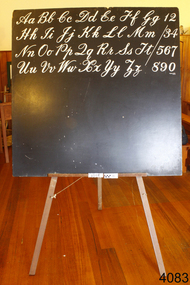
Functional object - Blackboard & Easel, Probably first half of 20th century
... first used in 1930, and as this type of board became popular, the word "chalkboard" appeared. Various types of easel have been in use since ancient times, in particular for supporting paintings and other artwork. However, the schoolroom easel would have been introduced around the same time as when the blackboard started to be used in educational establishments. flagstaff hill warrnambool shipwrecked-coast flagstaff-hill flagstaff-hill-maritime-museum maritime-museum shipwreck-coast flagstaff-hill-maritime-village None Wooden board painted black, resting on wooden easel with rope supporting the three easel legs. ...The first classroom uses of large blackboards are difficult to date, but they were used for music education and composition in Europe as far back as the 16th century.The term "blackboard" is attested in English from the mid-18th century; the Oxford English Dictionary provides a citation from 1739, to write "with Chalk on a black-Board". The first attested use of chalk on blackboard in the United States dates to 1801, in a lecture course in mathematics given by George Baron. James Pillans has been credited with the invention of coloured chalk (1814); he had a recipe with ground chalk, dyes and porridge! The use of blackboards did change methods of education. Manufacturing of slate blackboards began by the 1840s. A green porcelain enamel surface was first used in 1930, and as this type of board became popular, the word "chalkboard" appeared. Various types of easel have been in use since ancient times, in particular for supporting paintings and other artwork. However, the schoolroom easel would have been introduced around the same time as when the blackboard started to be used in educational establishments. Wooden board painted black, resting on wooden easel with rope supporting the three easel legs.Noneflagstaff hill, warrnambool, shipwrecked-coast, flagstaff-hill, flagstaff-hill-maritime-museum, maritime-museum, shipwreck-coast, flagstaff-hill-maritime-village -
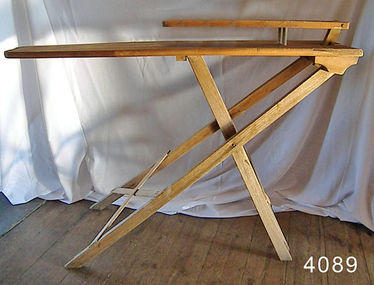 Flagstaff Hill Maritime Museum and Village
Furniture - Ironing board, 1910-1930
... first known use of the iron for removing wrinkles in clothes is known to have occurred in China, and the electric iron was invented in 1882, by Henry W. Seeley. Seeley patented his "electric flat iron" on June 6, 1882 (U.S. Patent no. 259,054). On 15 February 1858 W. Vandenburg and J. Harvey patented an ironing table that facilitated pressing sleeves and pants legs...first known use of the iron for removing wrinkles in clothes is known to have occurred in China, and the electric iron was invented in 1882, by Henry W. Seeley. Seeley patented his "electric flat iron" on June 6, 1882 (U.S. Patent no. 259,054). On 15 February 1858 W. Vandenburg and J. Harvey patented an ironing table that facilitated pressing sleeves and pants legs ...Ironing is the use of a machine, usually a heated tool (an iron), to remove wrinkles from fabric. The heating is around 180–220 °Celsius, depending on the fabric type. Ironing works by loosening the bonds between the long-chain polymer molecules in the fibres of the material. While the molecules are hot, the fibres are straightened by the weight of the iron, and they hold their new shape as they cool. Some fabrics, such as cotton, require the addition of water to loosen the intermolecular bonds. Many modern fabrics developed in or after the mid-twentieth century require little or no ironing. Permanent press clothing was developed to reduce the ironing necessary by combining Wrinkle resistant polymers with cotton. The first known use of the iron for removing wrinkles in clothes is known to have occurred in China, and the electric iron was invented in 1882, by Henry W. Seeley. Seeley patented his "electric flat iron" on June 6, 1882 (U.S. Patent no. 259,054). On 15 February 1858 W. Vandenburg and J. Harvey patented an ironing table that facilitated pressing sleeves and pants legs. A truly portable folding ironing board was first patented in Canada in 1875 by John B. Porter. The invention also included a removable press board used for sleeves. In 1892 Sarah Boone obtained a patent in the United States for improvements to the ironing board, allowing for better quality ironing of shirt sleeves.A domestic item with an interesting history of development, significant as it shows the progress and the evolution of a domestic item designed to make housework more efficient.Wooden Ironing board with press board for sleeves, board is folding.Noneflagstaff hill, warrnambool, shipwrecked-coast, flagstaff-hill-maritime-museum, flagstaff-hill-maritime-village, domestic item, ironing board, ironing, clothes, wrinkles in clothes, henry w. seeley, w. vandenburg and j. harvey -
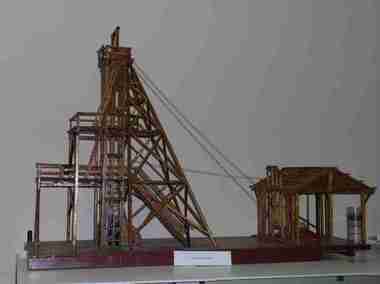 Federation University Historical Collection
Unknown - Model, Poppet Head Model
... legs), were all of timber construction and, when erected, straddled the main shaft. This scale model allows for steel construction, and is set over the shaft to permit an unobstructed view of the operations. The Bad level is where the workmen enter and leave the shaft. The staging platform on the first...The old style plant (or as commonly known poppet legs), were all of timber construction and, when erected, straddled the main shaft. this scale model allows for steel construction, ans is set over the shaft to permit an unobstructed view of the operations. The bad level is where the workmen enter and leave the shaft. The staging platform on the first...legs), were all of timber construction and, when erected, straddled the main shaft. This scale model allows for steel construction, and is set over the shaft to permit an unobstructed view of the operations. The Bad level is where the workmen enter and leave the shaft. The staging platform on the first ...This scale model of a mining plant was made by Donald Douglas Mather of Talbot. The engine shed houses the winches, which raise and lower the cages carrying the workmen. The winches also control the water-Baling tanks, which are lowered into the pump shaft to clean the water. The Pump Shaft is part of the main shaft partitioned off for keeping the water down. The old style plant (or cas commonly known poppet legs), were all of timber construction and, when erected, straddled the main shaft. This scale model allows for steel construction, and is set over the shaft to permit an unobstructed view of the operations. The Bad level is where the workmen enter and leave the shaft. The staging platform on the first level is where the trucks and mullock or other material are wheeled out on rails and then tipped to form the mine dump. The top level is to allow for maintenance of plant. Donald Douglas Mather of Talbot worked in mines in Ballarat, and made the model of the poppet head. The poppet head is a replica of those used at many mines in Ballarat. Back in the 1850s Ballarat was a god rush town and many mining claims were made and poppet heads built this is a replica of those poppet heads which are a part of Ballarat's Heritage and a full size poppet head is erected at Sovereign Hill Theme Park in Ballarat. Mining is a huge part of Ballarat's history.A timber poppet head and engine room model. "This scale model - the modern construction of a mining plant - was made by Mr Donald Douglas Mather* of Bonnie Doon, Talbot, Victoria. The engine shed houses the winches, which raise and lower the cages carrying the workmen. The winches also control the water-baling tanks, which are lowered into the pump shaft to clean the water. The pump shaft is part of the main shaft partitioned off for keeping the water down. The old style plant (or as commonly known poppet legs), were all of timber construction and, when erected, straddled the main shaft. this scale model allows for steel construction, ans is set over the shaft to permit an unobstructed view of the operations. The bad level is where the workmen enter and leave the shaft. The staging platform on the first level is where trucks ad mullock or other material are wheeled out on rails and then tipped to form the mine dump. The top level is to allow for maintenance of plant. * Mr Mater, previously of Ballarat, worked for many years as a miner and plant erector" (Old interpretive panel)mining, mather, mining plant, poppet head, engine house, model, donald douglas mather -
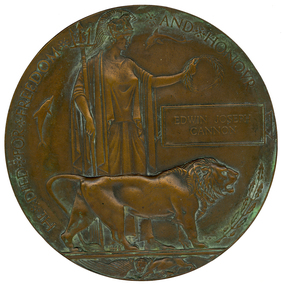 Federation University Historical Collection
Medal - Numismatics, 'Dead Man's Penny' for Edwin Joseph 'Ted' Cannon, c1919
... first place prize of £250.[http://en.wikipedia.org/wiki/Memorial_Plaque_(medallion)] They were initially made at the Memorial Plaque Factory, 54/56 Church Road, Acton, W3, London from 1919. Early plaques did not have a number stamped on them but later ones have a number stamped behind the lion's back leg. ...first place prize of £250.[http://en.wikipedia.org/wiki/Memorial_Plaque_(medallion)] They were initially made at the Memorial Plaque Factory, 54/56 Church Road, Acton, W3, London from 1919. Early plaques did not have a number stamped on them but later ones have a number stamped behind the lion's back leg. ...The Dead Man’s Penny is a commemorative medallion which was presented to the next-of-kin of the men and women from England and the Empire who died during World War One. The Dead Man’s Penny was accompanied by a letter from King George V, stating ‘I join with my grateful people in sending you this memorial of a brave life given for others in the Great War’.[http://nma.gov.au/blogs/education/2010/11/14/dead-mans-penny/] Popularly known as the "Dead Man’s Penny", because of the similarity in appearance to the somewhat smaller penny coin. 1,355,000 plaques were issued, which used a total of 450 tonnes of bronze, and continued to be issued into the 1930s to commemorate people who died as a consequence of the war. [http://en.wikipedia.org/wiki/Memorial_Plaque_(medallion)] It was decided that the design of the plaque was to be picked from submissions made in a public competition. Over 800 designs were submitted and the competition was won by the sculptor and medallist Edward Carter Preston with his design called Pyramus, receiving a first place prize of £250.[http://en.wikipedia.org/wiki/Memorial_Plaque_(medallion)] They were initially made at the Memorial Plaque Factory, 54/56 Church Road, Acton, W3, London from 1919. Early plaques did not have a number stamped on them but later ones have a number stamped behind the lion's back leg. [http://en.wikipedia.org/wiki/Memorial_Plaque_(medallion)] Ted Cannon's plaquette does not have a stamped number. Ted Cannon was a gifted artist and cartoonist who studied at the Ballarat School of Mines Technical Art School. During the Battle of Pozieres on the Western Front Ted Cannon worked with the Scout Platoon sketching the enemy's gun emplacements. Ted proved invaluable to the Brigade and brought he came under the attention of the Australian High Command. On 13 September 1916 Ted was given a special assignment for General C.B.B. White. Ted was sent out forward of the Old Mill at Verbrandenmolen (in the Ypres Salient) to draw a panorama of the German lines in the area from Hill 60 to The Bluff. It was a hazardous task and Ted was warned to be careful. Tragically he was sniped by an enemy machine-gunner and sustained severe abdominal wounds. Stretcher-bearers rushed him to the 17th Casualty Clearing Station where he was operated on by the doctors at 8.30 that night. With little chance of success, but ever resilient, Ted remained conscious almost to the end. He died early in the morning of the 14 September 1916. His body was buried in the large Military Cemetery at Lijssenthoek. The effects of the late Ted Cannon were returned to his parents. These were an autograph book, three brushes, prayer book, housewife, whistle, book, hymn book, curios. Another listing gives his effects as "identity disc, letters, photos, wallet, 2 books, Mexican Dollar, 1 cent (Ceylon), 3 German Straps, Fountain Pen, Cigarette-holder, Franc Note, 50 centimes Note, devotional book, mirror, rosary, scapula, metal ring, two combs, book of views, nail clippers, badges, tie clip, Egyptian stamp.[http://recordsearch.naa.gov.au/scripts/Imagine.asp?B=3202589] Ted Cannon was an only child. It is not known how the 'Dead Man's Penny' came into the ownership of the donor, but it is thought that it may have been left in a house owned by the donor's mother. Further information on Ted Cannon can be found at http://bih.ballarat.edu.au/index.php/Edwin_J._Cannon and http://www.ballarat.edu.au/about-ub/history/art-and-historical-collection/ub-honour-roll/c/edwin-joseph-ted-cannon-1895-1916Large bronze medallion or plaquette featuring an image of Lady Britannia surrounded by two dolphins (representing Britain’s sea power) and a lion (representing Britain) standing over a defeated eagle (symbolising Germany). Around the outer edge of the medallion are the words ‘He died for freedom and honour’. Next to Lady Britannia is the deceased solider’s name, with no rank provided to show equality in their sacrifice. (http://nma.gov.au/blogs/education/2010/11/14/dead-mans-penny) The plaque was distributed throughout the British Empire, and the first plaques were distributed in Australia in 1922 "Returned home" by W. & O. Mayne, 2013. ted cannon, edwin joseph cannon, cannon, world war 1, world war -
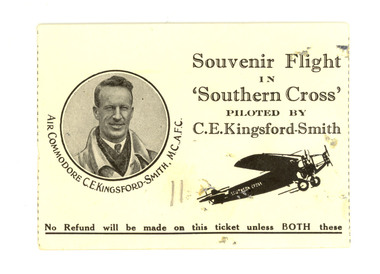 Federation University Historical Collection
Souvenir - Ticket Stub, Ticket for a souvenir Flight with Charles Kingsford-Smith, c1932
... first west–east trans-Pacific flight in 1934. In 1932 was selling joy-flights at ten shillings a trip. Most of his flights, including the joy flights, were made in the three-engine Fokker plane known as the 'Southern Cross', now preserved in a special display area at Brisbane Airport. In late 1935 Kingsford Smith took off on the second leg...first west–east trans-Pacific flight in 1934. In 1932 was selling joy-flights at ten shillings a trip. Most of his flights, including the joy flights, were made in the three-engine Fokker plane known as the 'Southern Cross', now preserved in a special display area at Brisbane Airport. In late 1935 Kingsford Smith took off on the second leg ...Sir Charles Edward Kingsford Smith (1897-1935) is one of Australia's most known Australia’s fliers. Born in 1897 at Hamilton, Qld. He spent his early life in Sydney enlisting in the AIF in 1915. He served at Gallipoli before transferring to the Royal Flying Corps in 1916. He was shot down and wounded in the foot in 1917. In 1929, Kingsford-Smith flew from Australia to England in the record-breaking time of 12 days, 18 hours. The following year he completed an east–west crossing of the Atlantic Ocean in 31 hours, followed by a record-breaking solo flight from England to Darwin in 10 days. He was knighted for services to aviation in 1932. He made the first west–east trans-Pacific flight in 1934. In 1932 was selling joy-flights at ten shillings a trip. Most of his flights, including the joy flights, were made in the three-engine Fokker plane known as the 'Southern Cross', now preserved in a special display area at Brisbane Airport. In late 1935 Kingsford Smith took off on the second leg of a flight from England to Australia with John ‘JT’ Pethybridge. The plane and pilots were never seen again, believed to have crashed into the sea at night somewhere off the coast of Burma. White ticket stub with black ink. It includes a photographic portrait of Charles Kingsford-Smith, and a drawing of the Southern Cross aeroplane. Gift of the Chatham-Holmes family.Printed on ticket 'Souvenir Flight in 'Southern Cross' piloted by C.E. Kingsford-Smith. No refund will be made on this ticket unless BOTH these"chatham, chatham family collection, kingsford-smith, charles kingsford-smith, smithy, southern cross, aeroplane, flight, joy ride, entertainment, airport, charles kingsford smith -
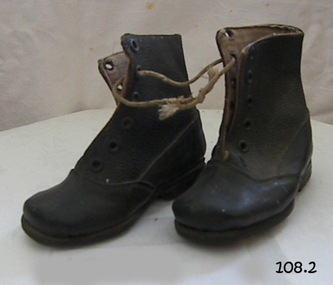 Flagstaff Hill Maritime Museum and Village
Footwear - Boots, 1900s
... These baglike boots were simple in design and then leashed to the leg by just a thong of leather. A mass produced pair of children's boots from the first quarter of the 20th century no significance other than the items age giving a snapshot into footwear of the period. ...Boots are believed to be one of the earliest shoes created when the evolution of footwear had begun. Boots form the building blocks of modern footwear which were merely a two-piece unit covering the foot and lower leg, a century ago. Throughout history, the importance of boots has been about fulfilling the needs of the wearer to be in sync with the prevailing culture. Boots were initially made of various materials like cotton, wool, silk, fur, felt, and leather (including caribou hide and sealskin. Around1000 B.C.E., men wore simple boots made of untanned leather with the fur turned in against the leg to keep it warm. These baglike boots were simple in design and then leashed to the leg by just a thong of leather. A mass produced pair of children's boots from the first quarter of the 20th century no significance other than the items age giving a snapshot into footwear of the period. Boots are unable to be linked to a significant person, family or event.One pair of Antique Victorian/Edwardian young boys-young girls shoes / boots. The boots are a black leather which lace up the front, laces missing bottom soles are leatherNoneflagstaff hill, warrnambool, shipwrecked coast, flagstaff hill maritime museum, shipwreck coast, flagstaff hill maritime village, great ocean road, boots, children's boots, footware -
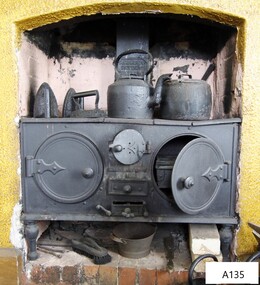 Flagstaff Hill Maritime Museum and Village
Domestic object - Stove, First quarter of the 20th Century
... The name Andrews Nonpareil in stamped on the flue however the doors on the stove front are wrong and indicate the item is a copy by an unknown manufacturer probably made in the first quarter of the 20th century. flagstaff hill warrnambool shipwrecked coast flagstaff hill maritime museum maritime museum shipwreck coast flagstaff hill maritime village great ocean road stove iron stove andrew patent nonpareil cooking appliance oven combustion oven cooker On flue "Andrew Patent Nonpareil" Stove cast iron on 4 legs, two oven spaces with round doors. ...The first Australian cast iron stove was made by Charles Andrews in 1877 he patented his design and called it the “Andrews Nonpareil stove.” That for many years was the only Australian made kitchen stove on the market. When his patent expired numerous imitations were manufactured by other firms but the Nonpareil continued to earn a reputation for quality, economy and excellent cooking. The company operated at 47-10 Gheringhap Street Geelong, Victoria, they also specialised in hot water generating services.The subject item is significant as a copy of the well known design for the original Nonpareil stove by Charles Andrews. The name Andrews Nonpareil in stamped on the flue however the doors on the stove front are wrong and indicate the item is a copy by an unknown manufacturer probably made in the first quarter of the 20th century. Stove cast iron on 4 legs, two oven spaces with round doors. On flue "Andrews Patent Nonpareil".On flue "Andrew Patent Nonpareil"flagstaff hill, warrnambool, shipwrecked coast, flagstaff hill maritime museum, maritime museum, shipwreck coast, flagstaff hill maritime village, great ocean road, stove, iron stove, andrew patent nonpareil, cooking appliance, oven, combustion oven, cooker -
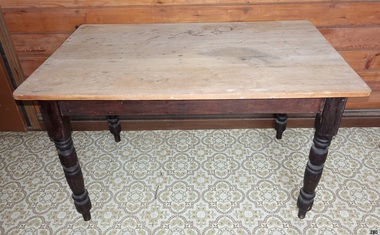 Flagstaff Hill Maritime Museum and Village
Furniture - Table
... first appeared at least as early as the 17th century, as an advancement of the trestle table; these tables were typically quite long and wide and capable of supporting a sizeable banquet in the great hall or other reception room of a castle. https://en.wikipedia.org/wiki/Table_(furniture) The table is one of the most important items of furniture used in the home, including the kitchen. flagstaff hill warrnambool shipwrecked-coast flagstaff-hill flagstaff-hill-maritime-museum maritime-museum shipwreck-coast flagstaff-hill-maritime-village Table Kitchen furniture None Table wooden with 4 wooden turned legs and unvarnished raw wood top Furniture Table ...Some very early tables were made and used by the Ancient Egyptians around 2500 BC, using wood and alabaster. They were often little more than stone platforms used to keep objects off the floor, though a few examples of wooden tables have been found in tombs. Food and drinks were usually put on large plates deposed on a pedestal for eating. The Egyptians made use of various small tables and elevated playing boards. The Chinese also created very early tables in order to pursue the arts of writing and painting, as did people in Mesopotamia, where various metals were used. The Greeks and Romans made more frequent use of tables, notably for eating, although Greek tables were pushed under a bed after use. The Greeks invented a piece of furniture very similar to the guéridon. Tables were made of marble or wood and metal (typically bronze or silver alloys), sometimes with richly ornate legs. Later, the larger rectangular tables were made of separate platforms and pillars. The Romans also introduced a large, semicircular table to Italy, the mensa lunata. Plutarch mentions use of "tables" by Persians. Furniture during the Middle Ages is not as well known as that of earlier or later periods, and most sources show the types used by the nobility. In the Eastern Roman Empire, tables were made of metal or wood, usually with four feet and frequently linked by x-shaped stretchers. Tables for eating were large and often round or semicircular. A combination of a small round table and a lectern seemed very popular as a writing table. In western Europe, the invasions and internecine wars caused most of the knowledge inherited from the classical era to be lost. As a result of the necessary movability, most tables were simple trestle tables, although small round tables made from joinery reappeared during the 15th century and onward. In the Gothic era, the chest became widespread and was often used as a table. Refectory tables first appeared at least as early as the 17th century, as an advancement of the trestle table; these tables were typically quite long and wide and capable of supporting a sizeable banquet in the great hall or other reception room of a castle. https://en.wikipedia.org/wiki/Table_(furniture)The table is one of the most important items of furniture used in the home, including the kitchen.Table wooden with 4 wooden turned legs and unvarnished raw wood topNone flagstaff hill, warrnambool, shipwrecked-coast, flagstaff-hill, flagstaff-hill-maritime-museum, maritime-museum, shipwreck-coast, flagstaff-hill-maritime-village, table, kitchen furniture -
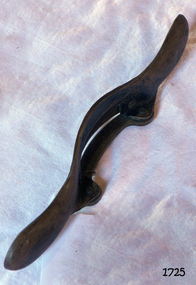 Flagstaff Hill Maritime Museum and Village
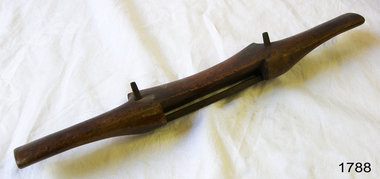
Tool - Spokeshave, Sides & Skinner, First half of the 20th century
... legs, paddles, bows, and arrows. The tool consists of a blade fixed into the body of the tool, which has a handle for each hand. Historically, a spokeshave was made with a wooden body and metal cutting blade. With industrialization metal bodies displaced wood in mass-produced tools. Being a small tool, spokeshaves are not suited to working large surfaces. The name spokeshave dates back to at least the 16th century, though the early history of the tool is not well documented. The name spokeshave reflects the early use of the tool by wheelwrights. The first...legs, paddles, bows, and arrows. The tool consists of a blade fixed into the body of the tool, which has a handle for each hand. Historically, a spokeshave was made with a wooden body and metal cutting blade. With industrialization metal bodies displaced wood in mass-produced tools. Being a small tool, spokeshaves are not suited to working large surfaces. The name spokeshave dates back to at least the 16th century, though the early history of the tool is not well documented. The name spokeshave reflects the early use of the tool by wheelwrights. The first ...A spokeshave is a hand tool used to shape and smooth woods in woodworking jobs such as making cart wheel spokes, chair legs, paddles, bows, and arrows. The tool consists of a blade fixed into the body of the tool, which has a handle for each hand. Historically, a spokeshave was made with a wooden body and metal cutting blade. With industrialization metal bodies displaced wood in mass-produced tools. Being a small tool, spokeshaves are not suited to working large surfaces. The name spokeshave dates back to at least the 16th century, though the early history of the tool is not well documented. The name spokeshave reflects the early use of the tool by wheelwrights. The first spokeshaves were made of wood usually beech with steel blades, before being largely superseded by the development of metal-bodied spokeshaves in the latter half of the 19th century, though many woodworkers still use wooden spokeshaves. Due to their widespread use and versatility vintage wooden spokeshaves remain commonly available and relatively low in price. Spokeshaves consist of a blade or iron secured to the body or stock of the tool, which has two handles one for each hand. The bottom surface of the tool is called the sole. The blade can be removed for sharpening, and adjusted to vary the depth of the cut. An early design consisted of a metal blade with a pair of tangs to which the wooden handles were attached, as with a draw knife. Unlike a draw knife, but like a plane, spokeshaves typically have a sole plate that fixes the angle of the blade relative to the surface being worked. There are a wide variety of different types of spokeshave, suited to different trades and applications. A now vintage tool made by an Australian manufacture in NSW who specialised in making pruning shears, hacksaw frames and heel shaves under the Erskin brand name. This tool is now sought after by collectors even though it was probably made in the first quarter of the 20th century. It gives a snapshot of how carpenters work with wood by hand showcasing their craftsmanship. Hollow face Spokeshave, metal body with black enamel finish. Erskin stamped on frontflagstaff hill, warrnambool, flagstaff-hill, flagstaff-hill-maritime-museum, maritime-museum, shipwreck-coast, flagstaff-hill-maritime-village, spokeshave, cabinet makers tools, wood working, cutting tool, shaping tool -
 Flagstaff Hill Maritime Museum and Village
Tool - Spokeshave, Mathieson and Son, 1860 to 1910
... legs, paddles, bows, and arrows. The tool consists of a blade fixed into the body of the tool, which has a handle for each hand. Historically, a spokeshave was made with a wooden body and metal cutting blade. With industrialization metal bodies displaced wood in mass-produced tools. Being a small tool, spokeshaves are not suited to working large surfaces. The name spokeshave dates back to at least the 16th century, though the early history of the tool is not well documented. The name spokeshave reflects the early use of the tool by wheel wrights. The first...legs, paddles, bows, and arrows. The tool consists of a blade fixed into the body of the tool, which has a handle for each hand. Historically, a spokeshave was made with a wooden body and metal cutting blade. With industrialization metal bodies displaced wood in mass-produced tools. Being a small tool, spokeshaves are not suited to working large surfaces. The name spokeshave dates back to at least the 16th century, though the early history of the tool is not well documented. The name spokeshave reflects the early use of the tool by wheel wrights. The first ...A spokeshave is a hand tool used to shape and smooth woods in woodworking jobs such as making cart wheel spokes, chair legs, paddles, bows, and arrows. The tool consists of a blade fixed into the body of the tool, which has a handle for each hand. Historically, a spokeshave was made with a wooden body and metal cutting blade. With industrialization metal bodies displaced wood in mass-produced tools. Being a small tool, spokeshaves are not suited to working large surfaces. The name spokeshave dates back to at least the 16th century, though the early history of the tool is not well documented. The name spokeshave reflects the early use of the tool by wheel wrights. The first spokeshaves were made of wood usually beech with steel blades, before being largely superseded by the development of metal-bodied spokeshaves in the latter half of the 19th century, though many woodworkers still use wooden spokeshaves. Due to their widespread use and versatility vintage wooden spokeshaves remain commonly available and relatively low in price. Spokeshaves consist of a blade or iron secured to the body or stock of the tool, which has two handles – one for each hand. The bottom surface of the tool is called the sole. The blade can be removed for sharpening, and adjusted to vary the depth of the cut. An early design consisted of a metal blade with a pair of tangs to which the wooden handles were attached, as with a draw knife. Unlike a draw knife, but like a plane, spokeshaves typically have a sole plate that fixes the angle of the blade relative to the surface being worked. There are a wide variety of different types of spokeshave, suited to different trades and applications. Company History: The firm of Alexander Mathieson & Sons was one of the leading makers of hand tools in Scotland. Its success went hand in hand with the growth of the shipbuilding industries on the Firth of Clyde in the nineteenth century and the emergence of Glasgow regarded as the "second city of the Empire". It also reflected the firm's skill in responding to an unprecedented demand for quality tools by shipyards, cooperage's and other industries, both locally and far and wide. The year 1792 was deemed by the firm to be that of its foundation it was in all likelihood the year in which John Manners had set up his plane-making workshop on Saracen Lane off the Gallowgate in the heart of Glasgow, not far from the Saracen's Head Inn, where Dr Johnson and James Boswell had stayed on their tour of Scotland in 1773. Alexander Mathieson (1797–1851) is recorded in 1822 as a plane-maker at 25 Gallowgate, but in the following year at 14 Saracen's Lane, presumably having taken over the premises of John Manners. The 1841 national census described Alexander Mathieson as a master plane-maker at 38 Saracen Lane with his son Thomas Adam working as a journeyman plane-maker. In 1849 the firm of James & William Stewart at 65 Nicolson Street, Edinburgh was taken over and Thomas was put in charge of the business, trading under the name Thomas A. Mathieson & Co. as plane and edge-tool makers. Thomas's company acquired the Edinburgh edge-tool makers Charles & Hugh McPherson and took over their premises in Gilmore Street. The Edinburgh directory of 1856/7 the business is recorded as being Alexander Mathieson & Son, plane and edge-tool makers at 48 Nicolson Street and Paul's Work, Gilmore Street. The 1851 census records indicate that Alexander was working as a tool and plane-maker employing eight men. Later that year Alexander died and his son Thomas took over the business. Under the heading of an edge-tool maker in the 1852/3 (Post-Office Glasgow Annual Directory) the firm is now listed as Alexander Mathieson & Son. By the early 1850s, the business had moved to 24 Saracen Lane. The directory for 1857/8 records that the firm had moved again only a few years later to East Campbell Street, also off the Gallowgate, and that through further diversification was also manufacturing coopers' and tin men's tools. The ten-yearly censuses log the firm's growth and in 1861 Thomas was a tool manufacturer employing 95 men and 30 boys; in 1871 he had 200 men working for him and in 1881 300 men. By 1899 the firm had been incorporated as Alexander Mathieson & Sons Ltd, even though only Alexander's son Thomas appears ever to have joined the firm.A vintage tool made by a well-known firm made for other firms and individuals that worked in wood. The tool was used to shape various items mainly in use by wheel wrights. A significant vintage item from the mid to late 19th century that today is quite sought after by collectors. It gives us a snapshot of how trade people predominately worked materials such as wood by hand and with tools that were themselves hand made shows the craftsman's art of the time. Spokeshave with blade 4 inches wide.Mathieson and Son Glasgow. flagstaff hill, warrnambool, shipwrecked-coast, flagstaff-hill, flagstaff-hill-maritime-museum, maritime-museum, shipwreck-coast, flagstaff-hill-maritime-village, spokeshave, mathieson and son, carpentry tools, wheel wright tools -
 The Beechworth Burke Museum
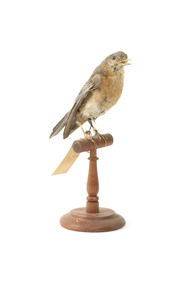
Animal specimen - Bluebird
... leg. The bird's plumage has faded since it was first preserved; females generally have duller colouring than their male counterparts but the colour of this particular specimen is paler than it would have been....leg. The bird's plumage has faded since it was first preserved; females generally have duller colouring than their male counterparts but the colour of this particular specimen is paler than it would have been. ...Eastern bluebirds are well-known song birds that live in eastern North America. They are sexually dimorphic, easily recognised by the male's bright royal blue upper plumage, chest of reddish brown and white abdomen. The females is duller in colour than the male, with greyer upperparts and blue tinges to her wings. These Bluebirds, the European variety, are the most common of the three Bluebird species. When not nesting, these birds fly in small flocks around the countryside. Bluebirds feed on small insects including moths, termites and mosquitoes. They also eat grasshoppers, crickets and caterpillars. The Bluebird can spot caterpillars and other insects in tall grass from a distance of over 45 meters. The Bluebird is commonly identified in numerous cultures as being symbolic as a harbinger of happiness. Often in Russian fairytales, the Bluebird is used as a symbol of hope. This specimen is part of a collection of almost 200 animal specimens that were originally acquired as skins from various institutions across Australia, including the Australian Museum in Sydney and the National Museum of Victoria (known as Museums Victoria since 1983), as well as individuals such as amateur anthropologist Reynell Eveleigh Johns between 1860-1880. These skins were then mounted by members of the Burke Museum Committee and put-on display in the formal space of the Museum’s original exhibition hall where they continue to be on display. This display of taxidermy mounts initially served to instruct visitors to the Burke Museum of the natural world around them, today it serves as an insight into the collecting habits of the 19th century.This specimen is part of a significant and rare taxidermy mount collection in the Burke Museum. This collection is scientifically and culturally important for reminding us of how science continues to shape our understanding of the modern world. They demonstrate a capacity to hold evidence of how Australia’s fauna history existed in the past and are potentially important for future environmental research. This collection continues to be on display in the Museum and has become a key part to interpreting the collecting habits of the 19th century.This female bluebird (likely Eastern) has a medium brown head and back, a rufous breast, and a cream belly. The bird has blue-tinged wing and tail feathers. The bill is short and has been stylized with the bill partly open to provide the illusion that the bird is making a call. This specimen stands upon a wooden mount and has an identification tag tied around its leg. The bird's plumage has faded since it was first preserved; females generally have duller colouring than their male counterparts but the colour of this particular specimen is paler than it would have been.Label: 122a. Blue-Bird / Catalogue Page 29. / Metal tag: 107taxidermy mount, taxidermy, animalia, burke museum, beechworth, australian museum, skin, reynell eveleigh johns, bird, american birds, bluebird -
 Shepparton RSL Sub Branch
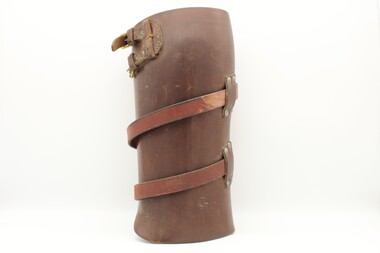
Legging, 1939
... According to the Australian War Memorial, artillery were known to have used such leggings during the First World War, as were more well known units such as the Australian Light Horse. legging uniform world war ii second world war world war 2 Manufacturer's stamp "J OAKMAN/1939" on side "[broad arrow]/NB", the size "15" is also stamped. ...According to the Australian War Memorial, artillery were known to have used such leggings during the First World War, as were more well known units such as the Australian Light Horse.Brown leather cylindrical shaped legging with two leather straps for fastening. One strap is attached to the lower edge of the interior with a press stud. This crosses over the lower exterior and passes through a leather loop at the front. The strap then wraps around the legging and passes through a second leather loop at the front. This strap, along with a shorter strap that is sewn into the top of the gaiter, passes through a buckle and is tucked under two final leather loops. Interior length of gaiter is stamped with manufacturer's name. Top of gaiter also carries a small metal hook, presumably to hold layers together firmly.Manufacturer's stamp "J OAKMAN/1939" on side "[broad arrow]/NB", the size "15" is also stamped.legging, uniform, world war ii, second world war, world war 2 -
 Shepparton RSL Sub Branch
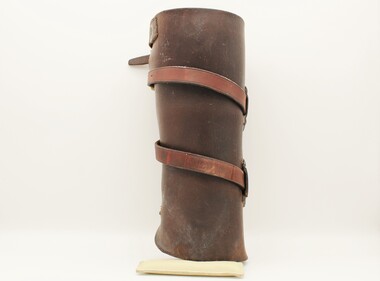
Legging, 1939
... According to the Australian War Memorial, artillery were known to have used such leggings during the First World War, as were more well known units such as the Australian Light Horse. legging uniform world war ii second world war world war 2 Manufacturer's stamp "J OAKMAN/1939" on side "[broad arrow]/AG", the size "15" is also stamped. ...According to the Australian War Memorial, artillery were known to have used such leggings during the First World War, as were more well known units such as the Australian Light Horse.Brown leather cylindrical shaped legging with two leather straps for fastening. One strap is attached to the lower edge of the interior with a press stud. This crosses over the lower exterior and passes through a leather loop at the front. The strap then wraps around the legging and passes through a second leather loop at the front. This strap, along with a shorter strap that is sewn into the top of the gaiter, passes through a buckle and is tucked under two final leather loops. Interior length of gaiter is stamped with manufacturer's name. Top of gaiter also carries a small metal hook, presumably to hold layers together firmly.Manufacturer's stamp "J OAKMAN/1939" on side "[broad arrow]/AG", the size "15" is also stamped.legging, uniform, world war ii, second world war, world war 2 -
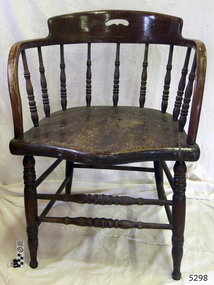 Flagstaff Hill Maritime Museum and Village
Furniture - Chair, Late 19th to early 20th century
... first appeared in the 1820’s. Although it lacked the high back found on any Windsor Chair of the time, it maintained a heavier, sturdier appearance. The main feature was a hoop or bow which was fashioned from steamed wood. This was then curved to make both the back support and arms. The chair also consisted of a wide seat, supported by 4 splayed, spindle legs...first appeared in the 1820’s. Although it lacked the high back found on any Windsor Chair of the time, it maintained a heavier, sturdier appearance. The main feature was a hoop or bow which was fashioned from steamed wood. This was then curved to make both the back support and arms. The chair also consisted of a wide seat, supported by 4 splayed, spindle legs ...Originally the Bow Chair started off life with the name of the ‘Smoker’s Bow Chair’ where originally, it wasn’t designed for grandeur like many chairs of the time, but instead was designed for practicality and comfort. The original Smoker’s Bow Chair was a simple chunkier version of the Windsor Chair design which first appeared in the 1820’s. Although it lacked the high back found on any Windsor Chair of the time, it maintained a heavier, sturdier appearance. The main feature was a hoop or bow which was fashioned from steamed wood. This was then curved to make both the back support and arms. The chair also consisted of a wide seat, supported by 4 splayed, spindle legs. In its original form it was found in many country kitchens of the day as well as in many inns and public houses throughout the United Kingdom. Its name of the "Smoker’s Bow Chair" because the sweeping armrests were the perfect height to support a smokers arm when smoking a pipe.A significant piece of furniture from the late 19th century designed for a specific purpose, smoking. These chairs are now highly collectable and valuable today and avidly sought by collectors of antique furniture.Chair wooden dark brown "Smoker's Bow" chair, with wide and deep seat with broad arms, turned spindles and thick turned legs joined by a double stretcher.Noneflagstaff hill, warrnambool, shipwrecked-coast, flagstaff-hill-maritime-museum, maritime-museum, shipwreck-coast, flagstaff-hill-maritime-village, chair, furniture, smokers chair, bow chair -
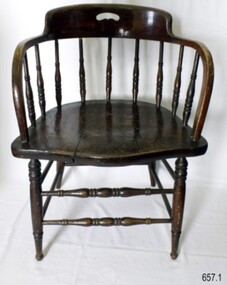 Flagstaff Hill Maritime Museum and Village
Furniture - Chair, Late 19th to early 20th century
... first appeared in the 1820’s. Although it lacked the high back found on any Windsor Chair of the time, it maintained a heavier, sturdier appearance. The main feature was a hoop or bow which was fashioned from steamed wood. This was then curved to make both the back support and arms. The chair also consisted of a wide seat, supported by 4 splayed, spindle legs...first appeared in the 1820’s. Although it lacked the high back found on any Windsor Chair of the time, it maintained a heavier, sturdier appearance. The main feature was a hoop or bow which was fashioned from steamed wood. This was then curved to make both the back support and arms. The chair also consisted of a wide seat, supported by 4 splayed, spindle legs ...Originally the Bow Chair started off life with the name of the ‘Smoker’s Bow Chair’ where originally, it wasn’t designed for grandeur like many chairs of the time, but instead was designed for practicality and comfort. The original Smoker’s Bow Chair was a simple chunkier version of the Windsor Chair design which first appeared in the 1820’s. Although it lacked the high back found on any Windsor Chair of the time, it maintained a heavier, sturdier appearance. The main feature was a hoop or bow which was fashioned from steamed wood. This was then curved to make both the back support and arms. The chair also consisted of a wide seat, supported by 4 splayed, spindle legs. In its original form it was found in many country kitchens of the day as well as in many inns and public houses throughout the United Kingdom. Its name of the "Smoker’s Bow Chair" because the sweeping armrests were the perfect height to support a smokers arm when smoking a pipe.A significant piece of furniture from the late 19th century designed for a specific purpose, smoking. These chairs are now highly collectable and valuable today and avidly sought by collectors of antique furniture.Chair wooden dark brown "Smoker's Bow" chair, with wide and deep seat with broad arms, turned spindles and thick turned legs joined by a double stretcher.Noneflagstaff hill, warrnambool, shipwrecked-coast, flagstaff-hill-maritime-museum, maritime-museum, shipwreck-coast, flagstaff-hill-maritime-village, chair, furniture, smokers chair, bow chair -
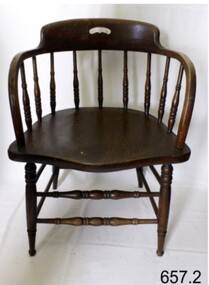 Flagstaff Hill Maritime Museum and Village
Furniture - Chair, Late 19th to early 20th century
... first appeared in the 1820’s. Although it lacked the high back found on any Windsor Chair of the time, it maintained a heavier, sturdier appearance. The main feature was a hoop or bow which was fashioned from steamed wood. This was then curved to make both the back support and arms. The chair also consisted of a wide seat, supported by 4 splayed, spindle legs...first appeared in the 1820’s. Although it lacked the high back found on any Windsor Chair of the time, it maintained a heavier, sturdier appearance. The main feature was a hoop or bow which was fashioned from steamed wood. This was then curved to make both the back support and arms. The chair also consisted of a wide seat, supported by 4 splayed, spindle legs ...Originally the Bow Chair started off life with the name of the ‘Smoker’s Bow Chair’ where originally, it wasn’t designed for grandeur like many chairs of the time, but instead was designed for practicality and comfort. The original Smoker’s Bow Chair was a simple chunkier version of the Windsor Chair design which first appeared in the 1820’s. Although it lacked the high back found on any Windsor Chair of the time, it maintained a heavier, sturdier appearance. The main feature was a hoop or bow which was fashioned from steamed wood. This was then curved to make both the back support and arms. The chair also consisted of a wide seat, supported by 4 splayed, spindle legs. In its original form it was found in many country kitchens of the day as well as in many inns and public houses throughout the United Kingdom. Its name of the "Smoker’s Bow Chair" because the sweeping armrests were the perfect height to support a smokers arm when smoking a pipe.A significant piece of furniture from the late 19th century designed for a specific purpose, smoking. These chairs are now highly collectable and valuable today and avidly sought by collectors of antique furniture.Chair wooden dark brown "Smoker's Bow" chair, with wide and deep seat with broad arms, turned spindles and thick turned legs joined by a double stretcher.Noneflagstaff hill, warrnambool, shipwrecked-coast, flagstaff-hill-maritime-museum, maritime-museum, shipwreck-coast, flagstaff-hill-maritime-village, chair, furniture, smokers chair, bow chair -
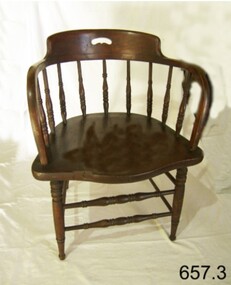 Flagstaff Hill Maritime Museum and Village
Furniture - Chair, Late 19th to early 20th century
... first appeared in the 1820’s. Although it lacked the high back found on any Windsor Chair of the time, it maintained a heavier, sturdier appearance. The main feature was a hoop or bow which was fashioned from steamed wood. This was then curved to make both the back support and arms. The chair also consisted of a wide seat, supported by 4 splayed, spindle legs...first appeared in the 1820’s. Although it lacked the high back found on any Windsor Chair of the time, it maintained a heavier, sturdier appearance. The main feature was a hoop or bow which was fashioned from steamed wood. This was then curved to make both the back support and arms. The chair also consisted of a wide seat, supported by 4 splayed, spindle legs ...Originally the Bow Chair started off life with the name of the ‘Smoker’s Bow Chair’ where originally, it wasn’t designed for grandeur like many chairs of the time, but instead was designed for practicality and comfort. The original Smoker’s Bow Chair was a simple chunkier version of the Windsor Chair design which first appeared in the 1820’s. Although it lacked the high back found on any Windsor Chair of the time, it maintained a heavier, sturdier appearance. The main feature was a hoop or bow which was fashioned from steamed wood. This was then curved to make both the back support and arms. The chair also consisted of a wide seat, supported by 4 splayed, spindle legs. In its original form it was found in many country kitchens of the day as well as in many inns and public houses throughout the United Kingdom. Its name of the "Smoker’s Bow Chair" because the sweeping armrests were the perfect height to support a smokers arm when smoking a pipe.A significant piece of furniture from the late 19th century designed for a specific purpose, smoking. These chairs are now highly collectable and valuable today and avidly sought by collectors of antique furniture.Chair wooden dark brown "Smoker's Bow" chair, with wide and deep seat with broad arms, turned spindles and thick turned legs joined by a double stretcher.Noneflagstaff hill, warrnambool, shipwrecked-coast, flagstaff-hill-maritime-museum, maritime-museum, shipwreck-coast, flagstaff-hill-maritime-village, chair, furniture, smokers chair, bow chair -
 Flagstaff Hill Maritime Museum and Village
Furniture - Chair, Late 19th to early 20th century
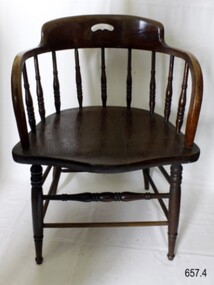
... first appeared in the 1820’s. Although it lacked the high back found on any Windsor Chair of the time, it maintained a heavier, sturdier appearance. The main feature was a hoop or bow which was fashioned from steamed wood. This was then curved to make both the back support and arms. The chair also consisted of a wide seat, supported by 4 splayed, spindle legs...first appeared in the 1820’s. Although it lacked the high back found on any Windsor Chair of the time, it maintained a heavier, sturdier appearance. The main feature was a hoop or bow which was fashioned from steamed wood. This was then curved to make both the back support and arms. The chair also consisted of a wide seat, supported by 4 splayed, spindle legs ...Originally the Bow Chair started off life with the name of the ‘Smoker’s Bow Chair’ where originally, it wasn’t designed for grandeur like many chairs of the time, but instead was designed for practicality and comfort. The original Smoker’s Bow Chair was a simple chunkier version of the Windsor Chair design which first appeared in the 1820’s. Although it lacked the high back found on any Windsor Chair of the time, it maintained a heavier, sturdier appearance. The main feature was a hoop or bow which was fashioned from steamed wood. This was then curved to make both the back support and arms. The chair also consisted of a wide seat, supported by 4 splayed, spindle legs. In its original form it was found in many country kitchens of the day as well as in many inns and public houses throughout the United Kingdom. Its name of the "Smoker’s Bow Chair" because the sweeping armrests were the perfect height to support a smokers arm when smoking a pipe.A significant piece of furniture from the late 19th century designed for a specific purpose, smoking. These chairs are now highly collectable and valuable today and avidly sought by collectors of antique furniture.Chair wooden dark brown "Smoker's Bow" chair, with wide and deep seat with broad arms, turned spindles and thick turned legs joined by a double stretcher.Noneflagstaff hill, warrnambool, shipwrecked-coast, flagstaff-hill-maritime-museum, maritime-museum, shipwreck-coast, flagstaff-hill-maritime-village, chair, furniture, smokers chair, bow chair -
 Flagstaff Hill Maritime Museum and Village
Clothing - Leather Leggings, 1899 to 1920
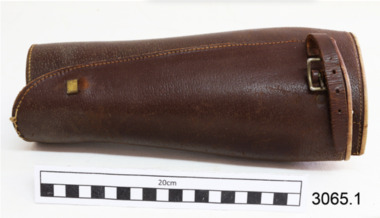
... first world war. The leggings are dark tan in colour with stitching to attach buckles and fastener straps. The strap buckles are made of brass and the leather legging straps are of same leather as leggings. ...first world war. The leggings are dark tan in colour with stitching to attach buckles and fastener straps. The strap buckles are made of brass and the leather legging straps are of same leather as leggings. ...The subject leather leggings are associated with mounted troops known as the Australian Light Horse that served in the South African War from 1899 to 1902. After the war, Britain wanted to use fewer mounted troops and restructured its force around a style of combat that needed more infantry. But the defence of Australia still relied upon mounted military units as these were more mobile than infantry and could travel faster over long distances. Light Horse brigades in the Australian Imperial Force (AIF) mostly contained recruits who served in the Light Horse regiments of the Citizen Forces. Many young men from rural areas of Australia volunteered for the Light Horse regiments. They had to pass a riding test to join, this test was easier for men from the bush because horses were still the main method of transport on farms and in country towns. The army did not officially accept First Australians into the AIF until May 1917 when enlistment standards were relaxed to include 'half-castes' with a parent of European origin. Indigenous soldiers served as valuable members of the Light Horse and many possessed excellent horse handling skills and specialist tracking knowledge.The subject items are part of the uniform for the Light Horse Units that served in the Australian army from 1899 until 1918. These leggings were worn by soldiers on horseback and are significant as they represent a noteworthy time in Australia's early military history. It was a time when many young men gave their lives during the South African and First World Wars in the defence of the then British Empire as part of the Imperial Forces that were gathered from many British-controlled Colonial countries.A pair of two Leather Leggings used by Mounted Australian soldiers during the first world war. The leggings are dark tan in colour with stitching to attach buckles and fastener straps. The strap buckles are made of brass and the leather legging straps are of same leather as leggings. Noneflagstaff hill, warrnambool, flagstaff hill maritime museum, shipwreck coast, flagstaff hill maritime village, great ocean road, leggings, leather leggings, protective leggings, protective clothing, australian mounted light horse units, military equipment -
 Flagstaff Hill Maritime Museum and Village
Decorative object - Minton Majolica model of a White Stork, 2001
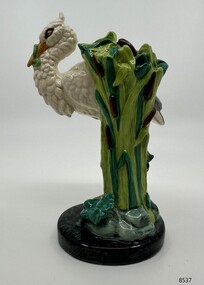
... first produced by John Henk, c. 1870, as a walking stick and umbrella stand. A rare miniature stork demonstrates the artistry and skill required to produce Majolica ware during the 19th century and the present. Minton & Co. Majolica miniature model Flagstaff Hill Maritime Museum Stoke Upon Trent John Henk Staffordshire Inscribed at the base Minton founded 1793, artist mark: 6, made in England A miniature white stork standing on one leg atop a rocky mound, an eel clasped in its beak, a frog beneath its foot, the stand formed by tall bullrushes & water-lily pads. ...Royal Doulton as part of the Minton Miniature series produced this stork model in 2001. A limited edition of 1,793 pieces were made, and this stork is number 118. The stork is a scaled down model of the original life-size piece first produced by John Henk, c. 1870, as a walking stick and umbrella stand. A rare miniature stork demonstrates the artistry and skill required to produce Majolica ware during the 19th century and the present.A miniature white stork standing on one leg atop a rocky mound, an eel clasped in its beak, a frog beneath its foot, the stand formed by tall bullrushes & water-lily pads.Inscribed at the base Minton founded 1793, artist mark: 6, made in Englandminton & co., majolica, miniature model, flagstaff hill maritime museum, stoke upon trent, john henk, staffordshire -
 City of Moorabbin Historical Society (Operating the Box Cottage Museum)
Clothing - Clothing, boy's first underpants, 1907
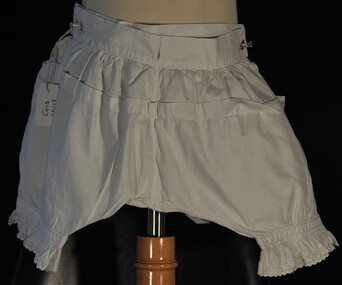
... first underwear at age 2 years old. The Maggs family were early settlers in the Moorabbin Shire The pioneer settlers and market gardeners of Moorabbin Shire had to be self reliant and made their own clothing and utensils. This is one of many items that exhibit the skill and craftsmanship of the women in these families. clothing brighton moorabbin pioneers dendy henry dressmakers market gardners early settlers maggs geoff White, cotton underwear for a 2 year old boy. Made at home on a sewing machine with hand feather stitching and factory-made guipure lace on leg ...These white cotton underpants were made for Mr Geoff Maggs by his mother in 1907 as his first underwear at age 2 years old. The Maggs family were early settlers in the Moorabbin ShireThe pioneer settlers and market gardeners of Moorabbin Shire had to be self reliant and made their own clothing and utensils. This is one of many items that exhibit the skill and craftsmanship of the women in these families. White, cotton underwear for a 2 year old boy. Made at home on a sewing machine with hand feather stitching and factory-made guipure lace on leg-bands. Buttons at waist, and a tuck pleat to let down as child grows.clothing, brighton, moorabbin, pioneers, dendy henry, dressmakers, market gardners, early settlers, maggs geoff -
 The Beechworth Burke Museum
Photograph
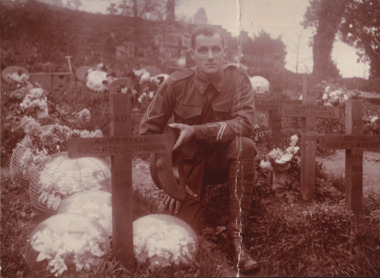
... legs. From Boulogne, France, he traveled to the United Kingdom aboard the Hospital Ship 'St. Denis' for medical care. Upon arrival, he was admitted to 2nd Southern General Hospital, Bristol, England on 27 July, 1916. John James Simpson passed away from his wounds on 1 August, 1916. He was 33 years old. The record is historically significant due to its connection to World War I. This conflict is integral to Australian culture as it was the single greatest loss of life and the greatest repatriation of casualties in the country's history. Australia’s involvement in the First ...Taken on an unknown date, depicted is a portrait of a young, unidentified male soldier kneeling beside a grave in a cemetery. He is dressed in an Australian military uniform. The cemetery pictured is the Arnos Vale Cemetery in Bristol, United Kingdom. There are multiple crosses marking graves in this photograph, all marked in memory of different soldiers who fought with the Australian Imperial Force (AIF) during World War I. It is believed that the soldier who is kneeling was also part of the Australian Imperial Force. This can be inferred by the chevron rank insignia visible on the uniform. The placement of this insignia on the sleeve of the right arm suggests that this soldier was either a Warrant Officer or a Non-Commissioned Officer (NCO). Another signifier of the Australian Imperial Force uniform are the three inverted chevron stripes positioned on the lower part of the left sleeve, near the wrist. These are called Good Conduct Stripes and were worn by Warrant Officers and NCOs. This patch consisted of a single chevron stripe for each year of military service meeting certain requirements of good conduct. Additionally, the man in this photograph is also wearing a 'Rising Sun' collar badge on his coat. Australia, unlike most other Commonwealth countries, did not adopt metal regimental badges during the First World War. All units were issued with the Australian Army General Service Badge, better known as the 'Rising Sun’ badge. This insignia is almost always identified with the Australian Imperial Force. Furthermore, the grave that this unidentified soldier is kneeling next to is the resting place of Private John James (J. J.) Simpson. He was born in Stanley, Victoria in 1883. He enlisted in the Australian Imperial Force in Melbourne, Victoria on 12 July, 1915, with the service number 4909. John James Simpson was then posted to the 60th Company Depot at Seymour for military recruit training. John James Simpson was reported wounded in action in France on 19 July, 1916. He was admitted to 13th General Hospital, France with gunshot wounds to his legs. From Boulogne, France, he traveled to the United Kingdom aboard the Hospital Ship 'St. Denis' for medical care. Upon arrival, he was admitted to 2nd Southern General Hospital, Bristol, England on 27 July, 1916. John James Simpson passed away from his wounds on 1 August, 1916. He was 33 years old.The record is historically significant due to its connection to World War I. This conflict is integral to Australian culture as it was the single greatest loss of life and the greatest repatriation of casualties in the country's history. Australia’s involvement in the First World War began when the Australian government established the Australian Imperial Force (AIF) in August 1914. Immediately, men were recruited to serve the British Empire in the Middle East and on the Western Front. The first significant Australian action of the war was the Australian Naval and Military Expeditionary Force’s (ANMEF) landing on Rabaul on 11 September 1914. The ANMEF took possession of German New Guinea at Toma on 17 September 1914 and of the neighbouring islands of the Bismarck Archipelago in October 1914. On 25 April 1915, members of the AIF landed on Gallipoli in Turkey with troops from New Zealand, Britain, and France. This specific event holds very strong significance within Australian history. The record has strong research potential. This is due to the ongoing public and scholarly interest in war, history, and especially the ANZAC legend, which is commemorated annually on 25 April, known as ANZAC Day.Sepia rectangular photograph printed on matte photographic paper mounted on card.Obverse: A.I.F. / AUSTRALIA / 441, PTE.T. / T (?) / 26B (?) / 6.1.17 / (?) / LANGTON RD. / ST. ANNES PK. / BRISTOL / A.I.F. / AUSTRALIA. / 708, GNR B.L.CRAWFORD. / FR / 5 D.A.C. / 13.2.17 / A.I.F. / AUSTRALIA. / 4481, P (?) D.MORRIS. / (?) / 31.12.(?) / A.I.F. / AUSTRALIA. / 4909, PTE J.J.SIMPSON. / 608(?) / 1.8.16 / Winchester / LANGTON RD. / ST. ANNES PK / BRISTOL / Reverse: 2641 /military album, military, war, world war i, wwi, australian imperial force, aif, j. j. simpson, uniform, cemetery -
 Orbost & District Historical Society
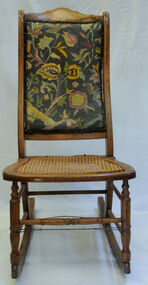
rocking chair, mid 19th century
... first land on the Snowy River flats. The McLeods and Camerons were early Orbost pioneers. This chair has aesthetic significance and reflects the needlework skill of Grace Cameron. chair rocking-chair mcleod-malcolm cameron-grace tapestry Wooden rocking chair with chair cane It has a tapestry back with a floral design. Wire has been placed around the legs ...Brought from Skye, Scotland, in 1850's by Malcolm McLeod, an early Orbost pioneer, and donated by his granddaughter, Margaret McLeod. The tapestry was worked by Miss Grace Cameron. This was possibly a repair job done when acquired by the donor. Grace Cameron was the daughter of John Cameron who selected the first land on the Snowy River flats. The McLeods and Camerons were early Orbost pioneers. This chair has aesthetic significance and reflects the needlework skill of Grace Cameron.Wooden rocking chair with chair cane It has a tapestry back with a floral design. Wire has been placed around the legs for support.chair rocking-chair mcleod-malcolm cameron-grace tapestry -
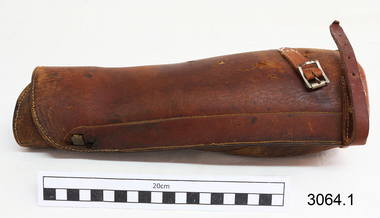 Flagstaff Hill Maritime Museum and Village
Clothing - Leather Leggings, 1899 to 1918
... first world war. The leggings are dark tan in colour with stitching to attach buckles and fastener straps. The strap buckles are made of brass and the leather legging straps are of same leather as leggings. ...first world war. The leggings are dark tan in colour with stitching to attach buckles and fastener straps. The strap buckles are made of brass and the leather legging straps are of same leather as leggings. ...The subject leather leggings are associated with mounted troops known as the Australian Light Horse that served in the South African War from 1899 to 1902. After the war, Britain wanted to use fewer mounted troops and restructured its force around a style of combat that needed more infantry. But the defence of Australia still relied upon mounted military units as these were more mobile than infantry and could travel faster over long distances. Light Horse brigades in the Australian Imperial Force (AIF) mostly contained recruits who served in the Light Horse regiments of the Citizen Forces. Many young men from rural areas of Australia volunteered for the Light Horse regiments. They had to pass a riding test to join, this test was easier for men from the bush because horses were still the main method of transport on farms and in country towns. The army did not officially accept First Australians into the AIF until May 1917 when enlistment standards were relaxed to include 'half-castes' with a parent of European origin. Indigenous soldiers served as valuable members of the Light Horse and many possessed excellent horse handling skills and specialist tracking knowledge.The subject items are part of the uniform for the Light Horse Units that served in the Australian army from 1899 until 1918. These leggings were worn by soldiers on horseback and are significant as they represent a noteworthy time in Australia's early military history. It was a time when many young men gave their lives during the South African and First World Wars in the defence of the then British Empire as part of the Imperial Forces that were gathered from many British-controlled Colonial countries.A pair of two Leather Leggings used by Mounted Australian soldiers during the first world war. The leggings are dark tan in colour with stitching to attach buckles and fastener straps. The strap buckles are made of brass and the leather legging straps are of same leather as leggings. Noneflagstaff hill, warrnambool, flagstaff hill maritime museum, shipwreck coast, flagstaff hill maritime village, great ocean road, leggings, leather leggings, protective leggings, protective clothing, australian mounted light horse units, military equipment -
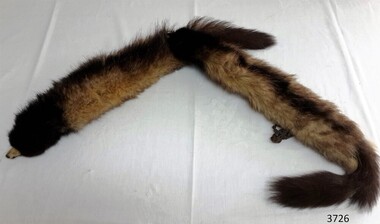 Flagstaff Hill Maritime Museum and Village
Fur Stole, 1940-s - 1950s
... legs, stitched together to form a stole. The fur is believed to be the winter fur of animals from the mustel family and is not as soft as rabbit fur. The first...legs, stitched together to form a stole. The fur is believed to be the winter fur of animals from the mustel family and is not as soft as rabbit fur. The first ...The donors of the fur stole come from a local family in the Warrnambool area. They believe the fur stole is around 60 years old. The stole belonged to the donor’s mother, now deceased, who wore it to local balls and dances as an accessories and maybe for warmth too! The donors believe the fur could have been purchased in Melbourne or Toorak. The fur is likely to be from the Mustelidae family, which is the largest family of carnivorous mammals. They inhabit all continents except Australia and Antarctica. This species includes the weasel, badger, otter, marten, ferret, sable, mink, stoat (ermine) and wolverine. The fur is thick and dense close to the skin, indicating that it is the winter coat of the animal. This fur collar is representative of fashion accessories in Warrnambool and District in the 1940's - 1950'sFur stole, ladies; comprising two animals with heads and legs, stitched together to form a stole. The fur is believed to be the winter fur of animals from the mustel family and is not as soft as rabbit fur. The first head has only the nose, the second head has nose and eyes. The heads are dark brown, each animal has a dark brown stripe the length of its fawn coloured back. Tails are dark but not as dark as the head. The stole can be clasped together using a decorative knotted brown tie and hook, or by using the clip attached to the snout of the front animal. 1940-s - 1950s.flagstaff hill, warrnambool, shipwrecked coast, flagstaff hill maritime museum, maritime museum, shipwreck coast, flagstaff hill maritime village, great ocean road, mustelidae fur stole, mustel fur, fur stole with body head and legs, fur stole made with animals, ladies clothing, fashion accessory of 1950’s, fashion of south west victoria -
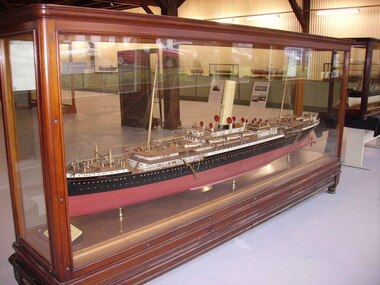 Seaworks Maritime Museum
Shipbuilders Model, SS Omrah
... The ship carried the first Australian troops from Brisbane to WWI in September 1914. 2 Plaques at foot of model: "MODEL/ OF TWIN SCREW STEAMER/ "OMRAH"/ BUILT FOR/ ORIENT STEAM NAVIGATION CO LTD/ BY/ THE FAIRFIELD SHIPBUILDING & engineering CO LTD/ DIMENSIONS/ 507-0X56-9X37-6MLD/ GROSS TONNAGE 8291 TONS SPEED 18 1/2 KNOTS on boat: "OMRAH" A large ship builder's model of the 'SS Omrah' an Orient Line one funnel passenger steamer of 1899. The model is displayed in a large glass and polished timber case on legs ...The original ship was built in Glasgow in 1899 by Fairfield Shipbuilding and Engineering Co for the Orient Line. It was the largest Orient Line passenger ship completed in the nineteenth century and was the third vessel of the Line to bear the famous “O” prefix, which was traditional through to the last ship, the mighty 'Oriana'. Her dimensions were 8,130 gross tons, length 490.6ft x beam 56.6ft (149.50 x 17.22m). She had one funnel, two masts, twin screw and a speed of 18½ knots. Her maiden voyage from London, via Suez, to Melbourne and Sydney commenced on 3rd February 1899. She was the largest British flag ship sailing to Australia at the time and continued to regularly sail between London, Melbourne and Sydney throughout her life. She last sailed as a passenger ship between Melbourne and Sydney on the 3rd November 1916. During World War I, she was converted to a troopship and was used to transport soldiers and assist with military operations. She was torpedoed and sunk by German submarine UB-52, 40 nautical miles (74km) off the coast of Sardinia in the 12 May 1918. She was on her return journey from Alexandria to Marseilles with six other transports, carrying troops of the 52nd and 74th divisions when she was lost, resulting in one casualty. Her maiden voyage brought her to Melbourne in 1899. The ship carried the first Australian troops from Brisbane to WWI in September 1914.A large ship builder's model of the 'SS Omrah' an Orient Line one funnel passenger steamer of 1899. The model is displayed in a large glass and polished timber case on legs.2 Plaques at foot of model: "MODEL/ OF TWIN SCREW STEAMER/ "OMRAH"/ BUILT FOR/ ORIENT STEAM NAVIGATION CO LTD/ BY/ THE FAIRFIELD SHIPBUILDING & engineering CO LTD/ DIMENSIONS/ 507-0X56-9X37-6MLD/ GROSS TONNAGE 8291 TONS SPEED 18 1/2 KNOTS on boat: "OMRAH"
