
Showing 55 items matching "first passenger train"
-
 Wodonga & District Historical Society Inc
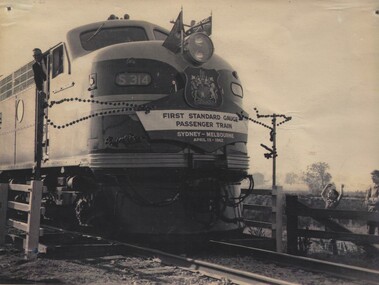
Photograph - Fred Rochow Railways Collection - First standard gauge passenger train from Sydney to Melbourne, 13 April 1962
... Fred Rochow Railways Collection - First standard gauge passenger train from Sydney to Melbourne...Fred Rochow Railways Collection - First standard gauge passenger train from Sydney to Melbourne...The first standard gauge passenger train from Sydney to Melbourne pulled by Locomotive S314. ...On front of locomotive "S314" On banner below Coat of Arms "FIRST STANDARD GAUGE PASSENGER TRAIN / SYDNEY - MELBOURNE/ APRIL 13 - 1962"...The S314 pulled the first passenger train to travel straight through from Sydney to Melbourne on 13 April 1962. ...The Fred Rochow Railways Collection incorporates photos related to the operation of the Wodonga Railway Station including different types of trains and railways staff C. 1930 – 1990. It was donated to the Wodonga Historical Society by Fred Rochow, a railwayman who spent many years based in Wodonga. He joined the Victorian Railways on 17th June l947 and retired in 1988. For some time, he was a member of the Australian Federated Union of Locomotive Enginemen and served a term as a member of the Trades Hall Council. He had an extensive knowledge of the struggles that took place to achieve better conditions for railway workers. Fred worked for many years as a fireman and then worked his way up the ranks to driver, experiencing many changes from the days of steam locomotives through to diesel trains, locomotives and even the modern XPT train. He worked throughout Victoria at different stages of his career, with his final working years focused on the northeast of Victoria and the Albury to Melbourne line. After his retirement, Fred continued to share his love of steam miniature trains with the community. S Class Locomotives - The eighteen members of the S Class were ordered in two batches by the Victorian Railways from Clyde Engineering for express passenger and freight workings, with the final eight locomotives ordered specifically to work the North-East standard gauge line. Many were named after prominent Victorians.This collection has local and statewide significance as it captures images of trains, locomotives and personnel who operated the railway services in Wodonga and throughout Northeast Victoria. The railways played a critical role in opening up Victoria and connecting Australia for trade, business, social communication and transport.The first standard gauge passenger train from Sydney to Melbourne pulled by Locomotive S314. This was made possible when part of Australia's gauge problem was solved with the construction of a new standard gauge line. The new line was a 317 km long line running from Albury, NSW, parallel to the existing broad gauge line to Melbourne, connecting Australia's two largest cities by standard gauge. S314 entered service on 24 April 1961 and was named after Sir John O'Shannassy who was the second Premier of Victoria. The S314 pulled the first passenger train to travel straight through from Sydney to Melbourne on 13 April 1962. On the morning of 7th February 1969, the southbound Southern Aurora collided head-on with a northbound goods train near Violet Town, Victoria. The Locomotive S314 was hauling the goods train and was destroyed by the impact of the collision. On front of locomotive "S314" On banner below Coat of Arms "FIRST STANDARD GAUGE PASSENGER TRAIN / SYDNEY - MELBOURNE/ APRIL 13 - 1962"railways wodonga, fred rochow, walker rail motor vehicles, wodonga to tallangatta rail service -
 Orbost & District Historical Society
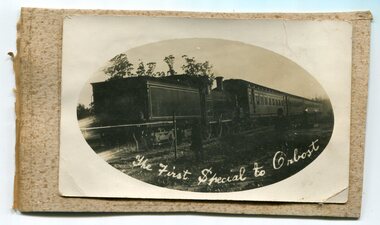
Photograph - Photographs- Orbost Railway, 1916
... ...First passenger train...Both photos have been pasted onto a rough cardboard background. 2696.1 is a rectangular photograph showing a steam train and wagons in a cutting, and a number of workmen in the foreground, along with a railway line. 2696.2 is an oval shaped photograph of a steam engine in a turned around position and attached to several passenger carriages. The words The First...first trains ever to come to Orbost. This happened in early 1916. The construction and opening of the Orbost railway was a major event in the development of Orbost and East Gippsland, resulting in huge development of farming and timber industries. This railway functioned between 1916 until 1987. These photographs are significant because they relate to the construction of the Orbost Railway. railways Orbost Railways First passenger ...These two photos relate to the very early days of the Bairnsdale-Orbost railway, constructed 2012-2016. One photograph (2696.1) shows a train and construction gang at a ballast quarry, possibly at Newmerella), dated c.1915. The other photograph (2696.2) is of one of the first trains ever to come to Orbost. This happened in early 1916. The construction and opening of the Orbost railway was a major event in the development of Orbost and East Gippsland, resulting in huge development of farming and timber industries. This railway functioned between 1916 until 1987.These photographs are significant because they relate to the construction of the Orbost Railway. Two b/w postcards. Both photos have been pasted onto a rough cardboard background. 2696.1 is a rectangular photograph showing a steam train and wagons in a cutting, and a number of workmen in the foreground, along with a railway line. 2696.2 is an oval shaped photograph of a steam engine in a turned around position and attached to several passenger carriages. The words The First Special to Orbost is written in white ink on the bottom of the photo.2696.2 The First Special to Orbostrailways, orbost railways, first passenger train -
 Port Melbourne Historical & Preservation Society
Domestic object - Mug, 150 years of railway and pier, c. 2004
... Front pic of 1st loco and "Melb & Hobson's Bay Railways / Australia's First Steam Hauled 'Passenger Train". On back M&HB and a RHS logo. ...Front pic of 1st loco and "Melb & Hobson's Bay Railways / Australia's First Steam Hauled 'Passenger Train". On back M&HB and a RHS logo. ...Purchased from Aust Railway Historical Society (VIC) members who spoke at PMH&PS meeting 27-09-2004..01 - Mug celebrating 150 years of railway & pier. White with gold rim. Front pic of 1st loco and "Melb & Hobson's Bay Railways / Australia's First Steam Hauled 'Passenger Train". On back M&HB and a RHS logo. On bottom of mug: "Designed & Decorated in Australia by CR Hose Glassware Pty Ltd. Glass & Ceramic Decorators est 1949. Made in Australia.transport - railways, australian railway historical society (victorian division inc.), melbourne & hobsons bay railways -
 Flagstaff Hill Maritime Museum and Village
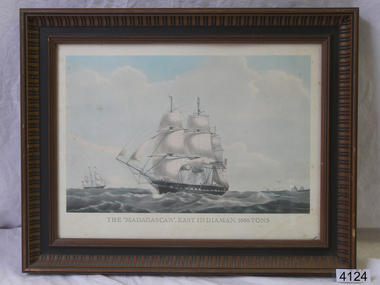
Print - Lithograph Picture, Madagascar Indiaman, Unknown
... first master Captain William Harrison Walker Walker. Madagascar carried freight, passengers, and troops between England and India until the end of 1852. In addition to her normal crew, she also carried many boys being trained...first master Captain William Harrison Walker Walker. Madagascar carried freight, passengers, and troops between England and India until the end of 1852. In addition to her normal crew, she also carried many boys being trained ...Madagascar was a large British merchant ship built for the trade to India and China in 1837 that disappeared on a voyage from Melbourne to London in 1853. The disappearance of Madagascar was one of the great maritime mysteries of the 19th century and has probably been the subject of more speculation than any other 19th-century maritime puzzle, except for the Mary Celeste. Madagascar, the second Blackwall Frigate, was built for George and Henry Green at the Blackwall Yard, London, a shipyard that they co-owned with the Wigram family. A one-eighth share in the vessel was held throughout her 16-year career by her first master Captain William Harrison Walker Walker. Madagascar carried freight, passengers, and troops between England and India until the end of 1852. In addition to her normal crew, she also carried many boys being trained as officers for the merchant marine. Known as midshipmen from naval practice, their parents or guardians paid for their training, and they only received a nominal wage of usually a shilling a month. Due to the Victorian Gold Rush, Madagascar, under the command of Captain Fortescue William Harris, was sent to Melbourne with emigrants. She left Plymouth on 11 March 1853 and, after an uneventful passage of 87 days, reached Melbourne on 10 June. Fourteen of her 60 crew jumped ship for the diggings, and it is believed only about three replacements were signed on. She then loaded a cargo that included wool, rice, and about two tonnes of gold valued at £240,000, and took on board about 110 passengers for London. On Wednesday 10 August, just as she was preparing to sail, police went on board and arrested a bushranger John Francis, who was later found to have been one of those responsible for robbing on 20th July the Melbourne Private Escort between the McIvor goldfield at Heathcote, Victoria and Kyneton. On the following day, the police arrested two others, one on board the ship and the other as he was preparing to board. As a result of these arrests, Madagascar did not leave Melbourne until Friday 12 August 1853. After she left Port Phillip Heads Madagascar was never seen again. When the ship became overdue many theories were floated, including spontaneous combustion of the wool cargo, hitting an iceberg and, most controversially, being seized by criminal elements of the passengers and/or crew and scuttled, with the gold being stolen and the remaining passengers and crew murdered. There have been many rumors as to what happened to Madagascar over the years but what really happened is still a mystery. The lithograph was made around 1950 from an original painting of Madagascar a Vessel with a notorious past and is interesting and a significant item for the ships part in early Victorian history. The picture is it’s self not valuable or can be associated with a significant person in history. The interest lies in the events that are linked to the ship in the mid 19th century.Lithograph of the ship Madagascar, in a wooden frameThe Madagascar East Indiaman 1000 tonsflagstaff hill, warrnambool, shipwrecked-coast, flagstaff-hill, flagstaff-hill-maritime-museum, maritime-museum, shipwreck-coast, flagstaff-hill-maritime-village, lithograph, the madagascar, east indiaman -
 Flagstaff Hill Maritime Museum and Village
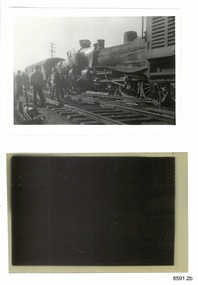
Photograph - Photograph and Negative, 1952
... passenger trains collided. A Melbourne-bound train collided with a Warrnambool-bound train, which was still shunting into siding at the station to allow the Melbourne-bound train to pass it on the single track. Both engines were derailed. The victim was in the first...passenger trains collided. A Melbourne-bound train collided with a Warrnambool-bound train, which was still shunting into siding at the station to allow the Melbourne-bound train to pass it on the single track. Both engines were derailed. The victim was in the first ...'Moriac, 1952 On 13 April 1952, a woman was killed and seven people were seriously injured when two passenger trains collided. A Melbourne-bound train collided with a Warrnambool-bound train, which was still shunting into siding at the station to allow the Melbourne-bound train to pass it on the single track. Both engines were derailed. The victim was in the first carriage of the Melbourne-bound train, which was telescoped after being forced into the tender of the locomotive. https://en.wikipedia.org/wiki/Railway_accidents_in_Victoria' 'April 12th 1952 7.52 p.m. Two passenger trains collided head on, on Warrnambool line near Moriac just out of Geelong. One killed four injured.' https://trove.nla.gov.au/newspaper/article/244373869?searchTerm=1952%20rail%20accident%20warrnambool ONE DEAD, MANY INJURED IN VIC. RAIL CRASH MELBOURNE, Saturday. — A woman was killed and seven persons were seriously injured when two passenger trains collided head-on at Moriac (59 miles south of Melbourne), near Geelong, at 8.15 tonight. Both engines were derailed, and the first carriage of the Geelong-bound train was telescoped by the coal tender. The dead woman was in this carriage. The trains involved were the 3.25 p.m. passenger train from Port Fairy to Geelong, and the 5.50 p.m. train from Melbourne to Warrnambool, which passed through Geelong at 7.05 p.m. ONE SHUNTING The Warrnambool-bound train had stopped at Moriac and was shunting into a siding to allow the other train to pass along the single track when the crash occurred. The impact hurled the Warrnambool-bound train backwards and the two engines, badly wrecked, came to rest 30ft apart. One engine hung at an acute angle on its side and the crew« were badly scalded by escaping steam. The crash was heard several miles away and hundreds of people rushed to the scene. Two ambulances were called from Geelong, and ambulance men joined railwaymen and volunteers in freeing the injured from badly damaged carriages. MANY SHOCKED Many other passengers were slightly hurt or badly affected by shock. They were treated on the spot. Mr. T. Mather, newsagent and postmaster at Moriac, said the noise of the crash startled him and he was on the scene in a matter of minutes. "There was great confusion," he said. "People on the trains were calling out for help. Many feared a fire would break out. However, we soon got relief gangs together and set to work to free those trapped in the wrecked carriage. One woman was dead, and a man seemed to be dead or dying." Special buses were chartered by the Railway Department to convey the passengers to their destinations. The line was blocked, but repair gangs were soon at work clearing the debris. https://trove.nla.gov.au/newspaper/article/18490332# This photograph and negative belonged to Dr. William Roy Angus. It was donated to Flagstaff Hill Maritime Village by his daughter, Bernice McDade. It is part of the “W.R. Angus Collection” includes historical medical equipment, surgical instruments and material once belonging to Dr Edward Ryan and Dr Thomas Francis Ryan, (both of Nhill, Victoria) as well as Dr Angus’ own belongings. The Collection’s history spans the medical practices of the two Doctors Ryan, from 1885-1926 plus that of Dr Angus, up until 1969. ABOUT THE “W.R.ANGUS COLLECTION” Doctor William Roy Angus M.B., B.S., Adel., 1923, F.R.C.S. Edin.,1928 (also known as Dr Roy Angus) was born in Murrumbeena, Victoria in 1901 and lived until 1970. He qualified as a doctor in 1923 at University of Adelaide, was Resident Medical Officer at the Royal Adelaide Hospital in 1924 and for a period was house surgeon to Sir (then Mr.) Henry Simpson Newland. Dr Angus was briefly an Assistant to Dr Riddell of Kapunda, then commenced private practice at Curramulka, Yorke Peninsula, SA, where he was physician, surgeon and chemist. In 1926, he was appointed as new Medical Assistant to Dr Thomas Francis Ryan (T.F. Ryan, or Tom), in Nhill, Victoria, where his experiences included radiology and pharmacy. In 1927 he was Acting House Surgeon in Dr Tom Ryan’s absence. Dr Angus had become engaged to Gladys Forsyth and they decided he further his studies overseas in the UK in 1927. He studied at London University College Hospital and at Edinburgh Royal Infirmary and in 1928, was awarded FRCS (Fellow from the Royal College of Surgeons), Edinburgh. He worked his passage back to Australia as a Ship’s Surgeon on the on the Australian Commonwealth Line’s T.S.S. Largs Bay. Dr Angus married Gladys in 1929, in Ballarat. (They went on to have one son (Graham 1932, born in SA) and two daughters (Helen (died 12/07/1996) and Berenice (Berry), both born at Mira, Nhill ) According to Berry, her mother Gladys made a lot of their clothes. She was very talented and did some lovely embroidery including lingerie for her trousseau and beautifully handmade baby clothes. Dr Angus was a ‘flying doctor’ for the A.I.M. (Australian Inland Ministry) Aerial Medical Service in 1928 . Its first station was in the remote town of Oodnadatta, where Dr Angus was stationed. He was locum tenens there on North-South Railway at 21 Mile Camp. He took up this ‘flying doctor’ position in response to a call from Dr John Flynn; the organisation was later known as the Flying Doctor Service, then the Royal Flying Doctor Service. A lot of his work during this time involved dental surgery also. Between 1928-1932 he was surgeon at the Curramulka Hospital, Yorke Peninsula, South Australia. In 1933 Dr Angus returned to Nhill and purchased a share of the Nelson Street practice and Mira hospital (a 2 bed ward at the Nelson Street Practice) from Dr Les Middleton one of the Middleton Brothers, the current owners of what previously once Dr Tom Ryan’s practice. Dr Tom and his brother had worked as surgeons included eye surgery. Dr Tom Ryan performed many of his operations in the Mira private hospital on his premises. He had been House Surgeon at the Nhill Hospital 1902-1926. Dr Tom Ryan had one of the only two pieces of radiology equipment in Victoria during his practicing years – The Royal Melbourne Hospital had the other one. Over the years Dr Tom Ryan had gradually set up what was effectively a training school for country general-practitioner-surgeons. Each patient was carefully examined, including using the X-ray machine, and any surgery was discussed and planned with Dr Ryan’s assistants several days in advance. Dr Angus gained experience in using the X-ray machine there during his time as assistant to Dr Ryan. When Dr Angus bought into the Nelson Street premises in Nhill he was also appointed as the Nhill Hospital’s Honorary House Surgeon 1933-1938. His practitioner’s plate from his Nhill surgery is now mounted on the doorway to the Port Medical Office at Flagstaff Hill Maritime Village, Warrnambool. When Dr Angus took up practice in the Dr Edward and Dr Tom Ryan’s old premises he obtained their extensive collection of historical medical equipment and materials spanning 1884-1926. A large part of this collection is now on display at the Port Medical Office at Flagstaff Hill Maritime Village in Warrnambool. In 1939 Dr Angus and his family moved to Warrnambool where he purchased “Birchwood,” the 1852 home and medical practice of Dr John Hunter Henderson, at 214 Koroit Street. (This property was sold in1965 to the State Government and is now the site of the Warrnambool Police Station. and an ALDI sore is on the land that was once their tennis court). The Angus family was able to afford gardeners, cooks and maids; their home was a popular place for visiting dignitaries to stay whilst visiting Warrnambool. Dr Angus had his own silk worm farm at home in a Mulberry tree. His young daughter used his centrifuge for spinning the silk. Dr Angus was appointed on a part-time basis as Port Medical Officer (Health Officer) in Warrnambool and held this position until the 1940’s when the government no longer required the service of a Port Medical Officer in Warrnambool; he was thus Warrnambool’s last serving Port Medical Officer. (Masters of immigrant ships arriving in port reported incidents of diseases, illness and death and the Port Medical Officer made a decision on whether the ship required Quarantine and for how long, in this way preventing contagious illness from spreading from new immigrants to the residents already in the colony.) Dr Angus was a member of the Australian Medical Association, for 35 years and surgeon at the Warrnambool Base Hospital 1939-1942, He served as a Surgeon Captain during WWII1942-45, in Ballarat, Victoria, and in Bonegilla, N.S.W., completing his service just before the end of the war due to suffering from a heart attack. During his convalescence he carved an intricate and ‘most artistic’ chess set from the material that dentures were made from. He then studied ophthalmology at the Royal Melbourne Eye and Ear Hospital and created cosmetically superior artificial eyes by pioneering using the intrascleral cartilage. Angus received accolades from the Ophthalmological Society of Australasia for this work. He returned to Warrnambool to commence practice as an ophthalmologist, pioneering in artificial eye improvements. He was Honorary Consultant Ophthalmologist to Warrnambool Base Hospital for 31 years. He made monthly visits to Portland as a visiting surgeon, to perform eye surgery. He represented the Victorian South-West subdivision of the Australian Medical Association as its secretary between 1949 and 1956 and as chairman from 1956 to 1958. In 1968 Dr Angus was elected member of Spain’s Barraquer Institute of Barcelona after his research work in Intrasclearal cartilage grafting, becoming one of the few Australian ophthalmologists to receive this honour, and in the following year presented his final paper on Living Intrasclearal Cartilage Implants at the Inaugural Meeting of the Australian College of Ophthalmologists in Melbourne In his personal life Dr Angus was a Presbyterian and treated Sunday as a Sabbath, a day of rest. He would visit 3 or 4 country patients on a Sunday, taking his children along ‘for the ride’ and to visit with him. Sunday evenings he would play the pianola and sing Scottish songs to his family. One of Dr Angus’ patients was Margaret MacKenzie, author of a book on local shipwrecks that she’d seen as an eye witness from the late 1880’s in Peterborough, Victoria. In the early 1950’s Dr Angus, painted a picture of a shipwreck for the cover jacket of Margaret’s book, Shipwrecks and More Shipwrecks. She was blind in later life and her daughter wrote the actual book for her. Dr Angus and his wife Gladys were very involved in Warrnambool’s society with a strong interest in civic affairs. He had an interest in people and the community They were both involved in the creation of Flagstaff Hill, including the layout of the gardens. After his death (28th March 1970) his family requested his practitioner’s plate, medical instruments and some personal belongings be displayed in the Port Medical Office surgery at Flagstaff Hill Maritime Village, and be called the “W. R. Angus Collection”. All rail accidents are serious, especially those involving fatalities.Photograph and negative showing two steam locomotives that appear to have collided head on. Also a newspaper article about the collision. From the W.R. Angus Collection.1139 on the back of the photograph together with multiple 'Ilford' brand marks.flagstaff hill maritime museum and village, great ocean road, shipwreck coast, rail accident, moriac, 1952, fatality, dr w r angus -
 City of Moorabbin Historical Society (Operating the Box Cottage Museum)
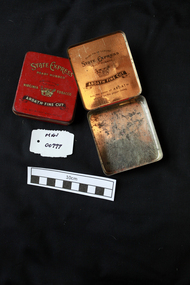
Containers, Tobacco, ‘State Express x2 tins, 20th C
... He visited the United States and while in New York State, he was a passenger on the Empire State Express train. . The word trademark was first registered in Ireland on 10 March 1896. ...He visited the United States and while in New York State, he was a passenger on the Empire State Express train. . The word trademark was first registered in Ireland on 10 March 1896. ...State Express 555, simply known as 555, is a brand of cigarette originally manufactured in the United Kingdom by the Ardath Tobacco Company. The overseas rights to the brand, excluding the United Kingdom, were acquired by British American Tobacco (B.A.T.) in 1925. It was sold widely throughout the world. Sir Albert Levy (1864 – 1937), born in England became a successful tobacco trader, cigarette manufacturer and exporter. On 31 July 1895 Sir Albert Levy registered the trademark ARDATH in the Republic of Ireland.. He visited the United States and while in New York State, he was a passenger on the Empire State Express train. . The word trademark was first registered in Ireland on 10 March 1896. In the United Kingdom, Ardath's brands endured, to the point where they were granted a Royal Warrant by King George VI in 1946 and again later by H.M Queen Elizabeth II. In 1961, British American Tobacco bought out Imperial Tobacco's share of Ardath, thus gaining full control of Ardath's trademarks2x Tins with hinged lids to contain State Express Ready Rubbed Virginia Tobacco . Outside: STATE EXPRESS / READY RUBBED / Absolutely Unique in its quality / VIRGINIA TOBACCO / ARDATH FINE CUT Inside lid : EVERY TIN OF GENUINE / STATE EXPRESS / READY RUBBED / ARDATH FINE CUT / has the name of ARDATH / printed on the paper liningtobacco, cigarettes, moorabbin, bentleigh, cheltenham, early settlers, ardath tobacco company ltd, levy sir albert, state express cigarettes, lucky strike, cigarettes, british american tobacco company ltd, imperial tobacco company ltd, -
 Orbost & District Historical Society
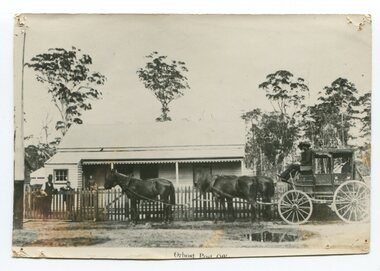
black and white photograph, 1896 / 1896
... trained telegraphist. This was the first time the telegraph line had reached Orbost, and was about the year 1895 or 1896. (more info. from Newsletter Npovember 2008) This is a pictorial record of the an early Orbost Post Office. Post Offices are a vital necessity in any town or community playing a very important part in the progress and development of the town and district. Farrell-Post-Office-Orbost on front - "Orbost Post office" A black / white photograph of a one - storey wooden building with a passenger ...This is a photograph of the Orbost Post Office on the site of the Commonwealth Hotel. The horse -drawn vehicle is a Cunninghame (Lakes Entrance) Coacht. The Post Mistress was Miss Farrell, who was a trained telegraphist. This was the first time the telegraph line had reached Orbost, and was about the year 1895 or 1896. (more info. from Newsletter Npovember 2008) This is a pictorial record of the an early Orbost Post Office. Post Offices are a vital necessity in any town or community playing a very important part in the progress and development of the town and district. A black / white photograph of a one - storey wooden building with a passenger coach drawn by a team of four horses outside the wooden picket fence. There are a man holding a flat basket, a young boy and a woman (on the verandah) standing nearby.on front - "Orbost Post office"farrell-post-office-orbost -
 Eltham District Historical Society Inc
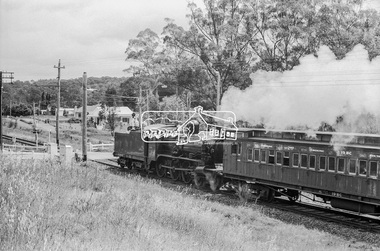
Photograph, Steam locomotive D-639 Vintage train excursion bound for Eltham at the Wattletree Road level crossing, Eltham, c.1970, 1970
... train would conduct trips between Eltham and Hurstbridge Railway stations. As there is no turning table at Hurstbridge, the locomotive would simply shunt from one end of the carriages to the other to reverse direction, hence the locomotive is running in reverse as it approaches Eltham Station. The first house in the background on Railway Parade, Number 97, remains as of 2019. The next house, Number 95 has been demolised since April 2018 and new construction in place. d-639, eltham festival, george coop collection, hurstbridge wattle festival, level crossing, passenger ...Possibly run in conjunction with the Eltham Community Festival or the Hurstbridge Wattle Festival; the steam train would conduct trips between Eltham and Hurstbridge Railway stations. As there is no turning table at Hurstbridge, the locomotive would simply shunt from one end of the carriages to the other to reverse direction, hence the locomotive is running in reverse as it approaches Eltham Station. The first house in the background on Railway Parade, Number 97, remains as of 2019. The next house, Number 95 has been demolised since April 2018 and new construction in place.Digital TIFF file Scan of 35mm Ilford HP4 black and white transparencyd-639, eltham festival, george coop collection, hurstbridge wattle festival, level crossing, passenger carriage 19bc, railway parade, steam engine, vintage train excursion, wattletree road -
 Eltham District Historical Society Inc
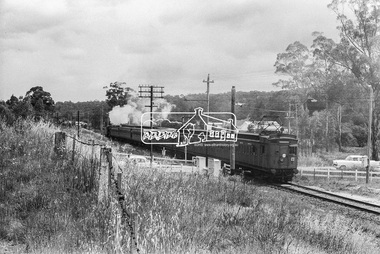
Photograph, Steam locomotive D-639 Vintage train excursion bound for Eltham at the Wattletree Road level crossing, Eltham, c.1970, 1970
... train would conduct trips between Eltham and Hurstbridge Railway stations. As there is no turning table at Hurstbridge, the locomotive would simply shunt from one end of the carriages to the other to reverse direction, hence the locomotive is running in reverse as it approaches Eltham Station. The first house in the background on Railway Parade, Number 97, remains as of 2019. The next house, Number 95 has been demolised since April 2018 and new construction in place. d-639, eltham festival, george coop collection, hurstbridge wattle festival, level crossing, passenger ...Possibly run in conjunction with the Eltham Community Festival or the Hurstbridge Wattle Festival; the steam train would conduct trips between Eltham and Hurstbridge Railway stations. As there is no turning table at Hurstbridge, the locomotive would simply shunt from one end of the carriages to the other to reverse direction, hence the locomotive is running in reverse as it approaches Eltham Station. The first house in the background on Railway Parade, Number 97, remains as of 2019. The next house, Number 95 has been demolised since April 2018 and new construction in place.Digital TIFF file Scan of 35mm Ilford HP4 black and white transparencyd-639, eltham festival, george coop collection, hurstbridge wattle festival, level crossing, passenger carriage 19bc, railway parade, steam engine, vintage train excursion, wattletree road -
 Eltham District Historical Society Inc
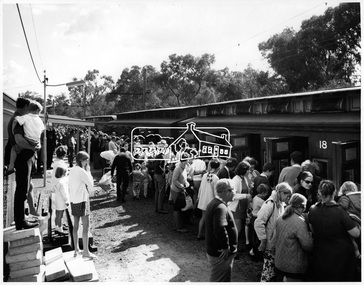
Photograph, Vintage Steam Train Excursion. View of train and passengers at Montmorency Station, 18 April 1971
... It is significant in being the first community sourced collection representing the places and people of the Shire's first one hundred years. sepp shire of eltham pioneers photograph collection shire of eltham shire of eltham centenary centenary celebrations montmorency railway station steam train Digital image Vintage Steam Train Excursion. View of train and passengers ...Passengers boarding the vintage steam train at Montmorency Train Station. Regular trips travelled from Montmorency to Hurstbridge and return as part of the Shire of Eltham centenary program. The train also stopped at Eltham, Diamond Creek and Wattle Glen stations on the afternoon of Sunday 18th April 1971. This photo forms part of a collection of photographs gathered by the Shire of Eltham for their centenary project book, "Pioneers and Painters: 100 years of the Shire of Eltham" by Alan Marshall (1971). The collection of over 500 images is held in partnership between Eltham District Historical Society and Yarra Plenty Regional Library (Eltham Library) and is now formally known as 'The Shire of Eltham Pioneers Photograph Collection.' It is significant in being the first community sourced collection representing the places and people of the Shire's first one hundred years.Digital imagesepp, shire of eltham pioneers photograph collection, shire of eltham, shire of eltham centenary, centenary celebrations, montmorency railway station, steam train -
 Bendigo Historical Society Inc.
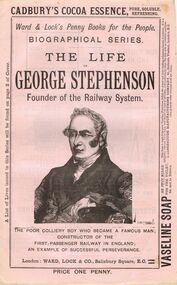
Book - LYDIA CHANCELLOR COLLECTION: THE LIFE OF GEORGE STEPHENSON
... BOOKS Biography george stephenson Lydia Chancellor collection George Stephenson The Life of George Stephenson British railway system railways trains person individual male famous people Ward & Lock's Penny Books for the People Biographical Series passsenger trains penny books advertisements A book titled ' The Life of George Stephenson founder of the railway system. The poor colliery boy who became a famous man; constructor of the first passenger railway in England; an example of successful perseverance.' ...A book titled ' The Life of George Stephenson founder of the railway system. The poor colliery boy who became a famous man; constructor of the first passenger railway in England; an example of successful perseverance.' London : Ward, Lock & Co., Salisbury Square, E.C., 449 - 464 pgs.This booklet is one of a series of 53 ' Ward & Lock's Penny Books for the People.' 'Biographical Series. Price one penny. There are also advertisements of note.books, biography, george stephenson, lydia chancellor, collection, george stephenson, the life of george stephenson, british railway system, railways, trains, person, individual, male, famous people, ward & lock's penny books for the people, biographical series, passsenger trains, penny books, advertisements -
 Otway Districts Historical Society
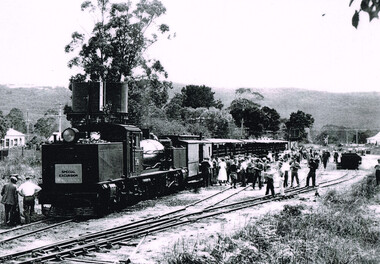
Photograph, Doug McLean, Gellibrand: Kanyana Special to Beech Forest, 1 March 1959
... first special train was organized by the Australian Railways Historical Society in conjunction with the Kanyana Festival Committee of Colac, Victoria. It proved so popular that additional trains were later organized. Temporarily in storage at Newport railway yards eight NBH excursion carriages were transferred to Colac which ran on the special trains until early-1962. gellibrand; railways; kanyana special; colac; beech forest; loco g41; A A.R.H.S. "Kanyana" special excursion locomotive G41, an NC guard's van and NBH excursion carriages at halts at Gellibrand while the fireman attends to the engine requirements (or 'ER' in railways' parlance). The passengers ...On the 1st March, 1959, the first special train was organized by the Australian Railways Historical Society in conjunction with the Kanyana Festival Committee of Colac, Victoria. It proved so popular that additional trains were later organized. Temporarily in storage at Newport railway yards eight NBH excursion carriages were transferred to Colac which ran on the special trains until early-1962. A A.R.H.S. "Kanyana" special excursion locomotive G41, an NC guard's van and NBH excursion carriages at halts at Gellibrand while the fireman attends to the engine requirements (or 'ER' in railways' parlance). The passengers are milling outside the excursion carriages while two are talking to the driver. Houses are in the background. B/W.gellibrand; railways; kanyana special; colac; beech forest; loco g41; -
 Otway Districts Historical Society
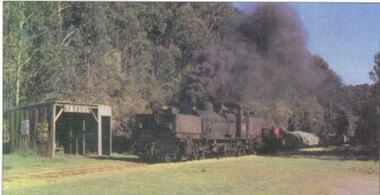
Photograph, R. Preston, Banool: Locomotive G42 and goods, c.1960, c.1960
... At first facilities consisted of a passenger shelter, a loop siding for 11 trucks, plus a residence for the ganger of the track gang based there. By 1912 with the extension of the line to Crowes increased train services on the line required a crossing station in this section of the track, and therefore Banool became a staff and ticket station with a crossing loop and home signals. ...At first facilities consisted of a passenger shelter, a loop siding for 11 trucks, plus a residence for the ganger of the track gang based there. By 1912 with the extension of the line to Crowes increased train services on the line required a crossing station in this section of the track, and therefore Banool became a staff and ticket station with a crossing loop and home signals. ...This original station on the Colac-Beech Forest line was first known as "Moorbanool" after the local parish, and then shortened to "Banool" on 1 November 1904. At first facilities consisted of a passenger shelter, a loop siding for 11 trucks, plus a residence for the ganger of the track gang based there. By 1912 with the extension of the line to Crowes increased train services on the line required a crossing station in this section of the track, and therefore Banool became a staff and ticket station with a crossing loop and home signals. However, this only lasted for two years and was abolished as an economy measure in 1916. Loading figures show that in most years the outwards tonnage at Banool was less than 150 tonnes. The station was reduced to a passenger shelter and goods loop only by 1929, and by the time of closure in 1962 most trains were steaming through.Colour. Locomotive G42 and its NQR goods wagons, loaded and unloaded, steaming past Banool station passenger shelter. 143mm x 274mm print.banool; moorbanool; railways; locomotive g42; -
 Otway Districts Historical Society
Photograph, Banool Station, c.1940, c.1940
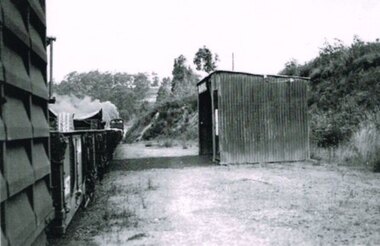
... At first facilities consisted of a loop siding for eleven trucks and a passenger shelter, plus a residence for the ganger for the track gang based there. Increasing train...At first facilities consisted of a loop siding for eleven trucks and a passenger shelter, plus a residence for the ganger for the track gang based there. Increasing train ...Originally known as "Moorbanool" after the local parish, the name was shortened to Banool on 1 November 1904. At first facilities consisted of a loop siding for eleven trucks and a passenger shelter, plus a residence for the ganger for the track gang based there. Increasing train services on the line required a crossing station in this section of track, so in 1913 Banool became a 'Staff & Ticket' station with a crossing loop, home signals, and a station office, although this only lasted two years. Loading statistics showed that in most years the outwards tonnage at Banool was less than 150 tonnes. From 1924 the amount of timber despatched began a slow rise, but apart from a few years activity was generally slack. The crossing loop, the usually empty goods loop being used if necessary, the home signals and its status as a staff station being removed over the period 1923-27. The track ganger shelter was removed around 1929 and the station reduced to a passenger shelter and goods loop only.B/W. A goods train passing Banool Station, c.1940. -
 Port Melbourne Historical & Preservation Society
Photograph, Windsor train, c. 1888
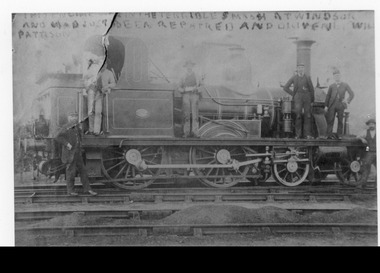
... first train at Sandridge, 1854. Digital image scanned from copy photograph & donated to the society by Keith PATTISON, great grandson of first Sandridge train driver then reclaimed for reproduction. The "terrible smash at Windsor" is almost certainly the crash near Windsor station on 11 May 1887 killing engine driver, William MASKELL and fireman, James McNab and and several passengers with additionally over 150 people injured....first train at Sandridge, 1854. Digital image scanned from copy photograph & donated to the society by Keith PATTISON, great grandson of first Sandridge train driver then reclaimed for reproduction. The "terrible smash at Windsor" is almost certainly the crash near Windsor station on 11 May 1887 killing engine driver, William MASKELL and fireman, James McNab and and several passengers with additionally over 150 people injured. ...William PATTISON (1823-1895) was great grandfather of donor and driver of the first train at Sandridge, 1854. Digital image scanned from copy photograph & donated to the society by Keith PATTISON, great grandson of first Sandridge train driver then reclaimed for reproduction. The "terrible smash at Windsor" is almost certainly the crash near Windsor station on 11 May 1887 killing engine driver, William MASKELL and fireman, James McNab and and several passengers with additionally over 150 people injured.Train from Windsor smash, repaired and with William PATTISON at the footplate.Details on back of copied photos. "This engine was in a terrible smash at Windsor and had just been repaired and driven by Will Pattison".william pattison, transport - railways, frederick william maskell, james mcnab, windsor railway accident -
 Robin Boyd Foundation
Slide, Robin Boyd, 1950
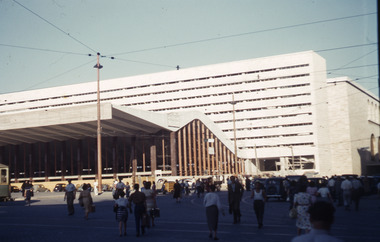
... first overseas trip. Robin and Patricia were passengers on the Greek ship “Cyrenia” departing in May 1950, passing through the Suez Canal and landing in Genoa five weeks later. For six months, they travelled extensively throughout Europe (predominantly driving themselves) - France, Italy, United Kingdom, Sweden, Denmark, Germany, Austria, Switzerland and Spain. Haddon Travelling Scholarship Haddon robin boyd slide Rome / Rly. Stat'n / 440 Trains ...Penleigh Boyd, Robin and Patricia Boyd's son, writes “Prior to 1950 Robin, like most other amateur or hobby photographers, took black and white printed photographs. The oldest slides date from 1950 when Robin and Patricia travelled to Europe on Robin’s Robert Haddon Travelling Scholarship.” In 1948 Robin Boyd was awarded ‘joint first place’ in the Robert Haddon competition for his design of Mildura art gallery. The scholarship helped fund their first overseas trip. Robin and Patricia were passengers on the Greek ship “Cyrenia” departing in May 1950, passing through the Suez Canal and landing in Genoa five weeks later. For six months, they travelled extensively throughout Europe (predominantly driving themselves) - France, Italy, United Kingdom, Sweden, Denmark, Germany, Austria, Switzerland and Spain.Colour slide in a mount. Stazione Termini, Rome, Italy, 1937-47, 1948-51. (Architects: Eugenio Montuori et al.)Rome / Rly. Stat'n / 440 Trains / 120,000 People Day / 1950 (All Handwritten)haddon travelling scholarship, haddon, robin boyd, slide -
 Ballarat Tramway Museum
Slide - 35mm slide/s, Campbell Duncan, 5/09/1971 12:00:00 AM
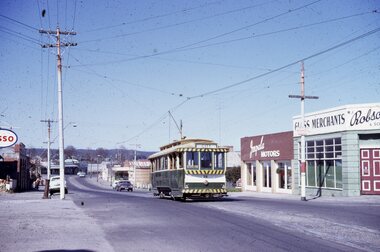
... This car provided, with preceding car No. 27, supplementary service to cater for Vintage train passengers who went to Sovereign Hill. They left City c1250, returned c1.05pm before first usual car. ...This car provided, with preceding car No. 27, supplementary service to cater for Vintage train passengers who went to Sovereign Hill. They left City c1250, returned c1.05pm before first usual car. ...Yields information about the operations of the Ballarat Tramway system prior to closure and some of the tours that were operated. Kodak - Kodachrome slide - cardboard mounts Tram 26, with destination of City, inbound in Main Road, with Impala Motors and Robson Glass merchants in the background - 5/9/1971 - last day of Mt Pleasant line. See notesIn ink on slide: "Sunday 5 Sept. 1971, Approaching Bridge St from Mt. Pleasant, last day of Mt Pl. operation. This car provided, with preceding car No. 27, supplementary service to cater for Vintage train passengers who went to Sovereign Hill. They left City c1250, returned c1.05pm before first usual car. They ran as service cars b/c no specials allowed on last day."tramways, trams, main road, mt pleasant, sovereign hill, tram 26 -
 Stawell Historical Society Inc
Photograph, Steam Trains at Stawell Station -- 6 photos -- Coloured
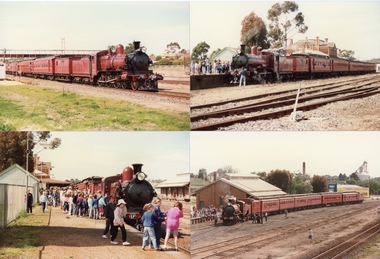
... Series of 6 photos, Steam train "D", 3 class and passenger carriages at Stawell Station. c 1990 Railways "D" 3, ?39 unsure of first number. ...Series of 6 photos, Steam train "D", 3 class and passenger carriages at Stawell Station. c 1990Series of 6 colour photographs of Steam Trains & passenger carriages at Stawell Station "D" 3, ?39 unsure of first number.railways -
 Ballarat Tramway Museum
Ephemera - Christmas Card, Australian Railway Historical Society (ARHS)
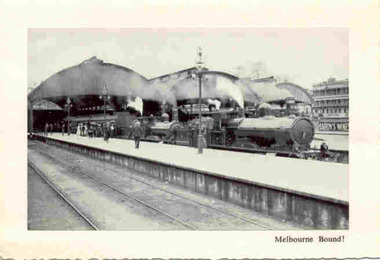
... Tramways trams Adelaide Passenger Trains Christmas Cards SAR ARHS Christmas card made from white stippled cardboard with a serrated edge, folded centrally with a photo of Rx and R class locomotives on the front of the Adelaide to Melbourne Express at Adelaide Railway Station c1900. The train later became known as The Overland. The first ...Christmas card made from white stippled cardboard with a serrated edge, folded centrally with a photo of Rx and R class locomotives on the front of the Adelaide to Melbourne Express at Adelaide Railway Station c1900. The train later became known as The Overland. The first two carriages are Mansard Roofed Carriages. The photo has been printed as an illustration and then glued to the front of the card. On the inside of the card is a Greetings message from the Council and Members of the South Australian Division of the Australian Railway Historical Society. See December 1999 issue of Newsrail for some information about the locomotives and carriages. Year not known, probably late 1960's. Would have been sent to Les Denmead by someone in the ARHS SA Division. See Newsrail Dec. 1999tramways, trams, adelaide, passenger trains, christmas cards, sar, arhs -
 Puffing Billy Railway
Equipment - Victorian Railways Carriage Foot Warmer
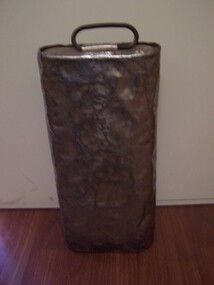
... first trial of carriage air-conditioning in 1936, steam heating from 1948 ad LP gas heating from 1961. By the early 1960s the main services using foot warmers were the overnight mail trains. info from : http://www.powerhousemuseum.com/collection/database/?irn=67564#ixzz4UBNzVf6t Under Creative Commons License: Attribution Non-Commercial There was a whole infrastructure set up at stations for the daily heating of foot warmers in special furnaces. In Victoria alone in 1935 there were 33 heating works. Historic - Victorian Railways - Carriage Heater - Foot warmer puffing billy victorian railways carriage haeter foot warmer passenger ...During prestige, long distance train journeys some carriages had air-conditioning, and the majority of passengers had to brave unheated carriages. To offer some comfort during the winter months, the non-air-conditioned carriages were provided with footwarmers. These were metal containers roughly 100 mm thick and 300 mm wide, and about 750 mm long, which were filled with salt crystals (concentrated crystalline hydrated sodium acetate). The footwarmers were covered by sleeves of thick canvas, and two footwarmers were usually placed in each compartment of non-air-conditioned carriages. To activate the chemicals, the footwarmers were heated almost to boiling point. This was done by removing the canvas sleeves and placing the footwarmers in a large bath of very hot water. After they had been heated, they were removed from the bath and the sleeves refitted. They were then ready to be placed in the carriages. The McLaren patent foot warmer was used on railways in New South Wales, Queensland, Victoria and South Australia as well as South Africa and New Zealand. It was during the 1901 royal visit by the Duke and Duchess of Cornwall that these foot warmers were first used in New Zealand in the royal carriage. Before railway carriage heating was introduced, McLaren patent foot warmers were placed on the floor of New South Wales government railway carriages from 1891 to provide a little passenger comfort. The rectangular steel container worked a bit like a hot water bottle but instead of water contained six and a half kilograms of loosely-packed salt crystals, (concentrated crystalline hydrated sodium acetate). This was permanently sealed inside the container with a soldered cap. After the foot warmer was heated in vat of boiling water for about one and a quarter hours the crystals became a hot liquid. (The melting point for sodium acetate is 58 degrees). There was a whole infrastructure of special furnaces set up at stations for the daily heating of foot warmers. By 1914 the Victorian railways had 4,000 foot warmers in service and by 1935 there were 33 furnaces at principal stations to heat them. After about 10 hours the container was picked up by the handle and given a good vertical shake which helped the cooled liquid reform into a solid mass of hot crystals. Staff or sometimes passengers shook them en route when the foot warmers began to get cold. However, as they were heavy this was only possible by fit and agile passengers. At the end of the journey the containers were boiled again for reuse on the next trip. Sodium acetate railway foot warmers were introduced in Victoria in 1889, Adelaide to Melbourne express in 1899. "Shaking up" on this service took place at Murray Bridge and Stawell on the tip to Melbourne and at Ballarat and Serviceton on the trip to Adelaide. The use of foot warmers began to decline in New South Wales from the 1930s with the first trial of carriage air-conditioning in 1936, steam heating from 1948 ad LP gas heating from 1961. By the early 1960s the main services using foot warmers were the overnight mail trains. info from : http://www.powerhousemuseum.com/collection/database/?irn=67564#ixzz4UBNzVf6t Under Creative Commons License: Attribution Non-Commercial There was a whole infrastructure set up at stations for the daily heating of foot warmers in special furnaces. In Victoria alone in 1935 there were 33 heating works.Historic - Victorian Railways - Carriage Heater - Foot warmerA rectangular-shaped stainless steel casing with a welded seam down the back and welded ends. There is a handle at one end for carrying and shaking. Inside the foot warmer are two baffle plates and three trays to contain the sodium acetate. There was a cast-iron ball in each internal compartment. puffing billy, victorian railways, carriage haeter, foot warmer, passenger comfort, station furnace, railway ephemera, early heating methods -
 Puffing Billy Railway
1 NBC - Combined Second-Class Passenger Car And Guard's Van, 4/ 2/1899
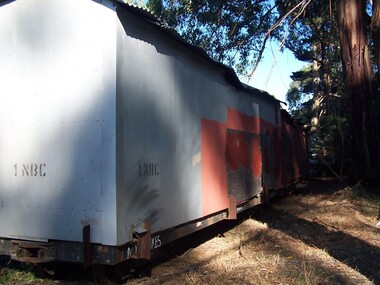
... Van 1 NBC - 1 compartment and van (7 & 4 ton capacity) - awaiting Restoration Vehicle Length 25 feet 2 inches ( 7671 mm) Coupled Length 27 feet 4 inches (8330 mm) Width 6 feet 3 inches (1905 mm) Weight 10 tons Capacity 7 passengers, 4 tons of goods Built 1898 - 1910 Number Built 7 In use NBC 2 To be restored NBC 1 & 6 VR Service History NBDBD 1.VA - 4/ 2/1899 NWS Built new - circa 1910 - To NBC 1.VA - *NBC 1.VA - / 4/1926 - Modified AC Malco 5/ 7/1937 NWS Into Workshops - 16/ 7/1937 NWS Out of Workshops (12 days) 13/ 3/1941 NWS Into Workshops - 5/ 4/1941 NWS Out of Workshops 24 days / 1/1954 - Sold (to) - circa 1955 CAC Body (v) / /1995 EME Note in Workshops Historic - Victorian Railways Narrow Gauge - Passenger Rolling Stock: Passenger and Guard's Van carriage. Used on first official train between Wangaratta and Whitfield in 1899. puffing billy 1nbc 1nbc - combined second-class passenger car and guard's van victorian railways narrow gauge passenger and guard's van rolling stock 2'6" guage 1 NBC 1NBC - Combined Second-Class Passenger Car And Guard's Van. - Made of Timber on a Wrought iron frame 1NBC - 1 compartment and van (7 & 4 ton capacity) - awaiting Restoration 1 NBC - Combined Second-Class Passenger Car And Guard's Van. ...Van 1 NBC - 1 compartment and van (7 & 4 ton capacity) - awaiting Restoration Vehicle Length 25 feet 2 inches ( 7671 mm) Coupled Length 27 feet 4 inches (8330 mm) Width 6 feet 3 inches (1905 mm) Weight 10 tons Capacity 7 passengers, 4 tons of goods Built 1898 - 1910 Number Built 7 In use NBC 2 To be restored NBC 1 & 6 VR Service History NBDBD 1.VA - 4/ 2/1899 NWS Built new - circa 1910 - To NBC 1.VA - *NBC 1.VA - / 4/1926 - Modified AC Malco 5/ 7/1937 NWS Into Workshops - 16/ 7/1937 NWS Out of Workshops (12 days) 13/ 3/1941 NWS Into Workshops - 5/ 4/1941 NWS Out of Workshops 24 days / 1/1954 - Sold (to) - circa 1955 CAC Body (v) / /1995 EME Note in Workshops Historic - Victorian Railways Narrow Gauge - Passenger Rolling Stock: Passenger and Guard's Van carriage. Used on first official train between Wangaratta and Whitfield in 1899.1NBC - Combined Second-Class Passenger Car And Guard's Van. - Made of Timber on a Wrought iron frame 1NBC - 1 compartment and van (7 & 4 ton capacity) - awaiting Restoration1 NBC puffing billy, 1nbc, 1nbc - combined second-class passenger car and guard's van, victorian railways, narrow gauge passenger and guard's van rolling stock, 2'6" guage -
 Puffing Billy Railway
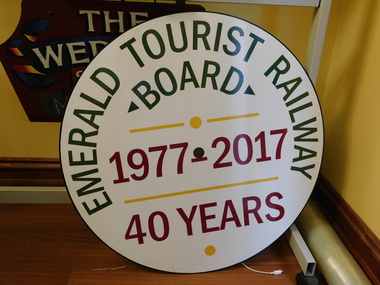
Emerald Tourist Railway Board 1977 - 2017 40 Years - Locomotive Head Board, 2017
... first of many passengers were just starting to arrive. Photo & Info : Robert Smith : Past 2 Present A gleaming NA locomotive 14A had the honour of hauling the first E.T.R.B. train while 7A had the last train by the Victorian Railways, both on the 1st October 1977. 7A left Belgrave at 11.10am for Lakeside and 14A left Belgrave at 2.10pm.This train also to Lakeside included the ex Mt Lyell carriage NBL1 for the conveyance of the official party. ...first of many passengers were just starting to arrive. Photo & Info : Robert Smith : Past 2 Present A gleaming NA locomotive 14A had the honour of hauling the first E.T.R.B. train while 7A had the last train by the Victorian Railways, both on the 1st October 1977. 7A left Belgrave at 11.10am for Lakeside and 14A left Belgrave at 2.10pm.This train also to Lakeside included the ex Mt Lyell carriage NBL1 for the conveyance of the official party. ...Locomotive Head Board - Emerald Tourist Railway Board 1977 - 2017 40 Years Historic - Puffing Billy Railway Locomotive Head Board used in the Celebration of Emerald Tourist Railway Board 1977 - 2017 40 Years EMERALD TOURIST RAILWAY BOARD 1st October 1977 - 1st October 2017 Today marks the 40th anniversary of when the Emerald Tourist Railway Board took over the ownership of Puffing Billy from the Victorian Railways. Since then Puffing Billy has gone from strength to strength with the last few years seeing a huge increase in passenger numbers. A major investment over the next ten years will see a number of infrastructure projects being completed. A new (restored) locomotive and extra carriages will come into play and hopefully soon, the reopening of Puffing Billy's museum at Menzies Creek. Puffing Billy has been around since 1900. With a minor hiccup in the 1950s and the rebuilding of the railway from Belgrave from the late 1950s to the early 1960s and onwards, the preserved heritage steam railway will hopefully continue to operate for many generations to come. This photo was taken early this morning. The required loco's for the day were still being prepared and all shunting movements had been completed. The first of many passengers were just starting to arrive. Photo & Info : Robert Smith : Past 2 Present A gleaming NA locomotive 14A had the honour of hauling the first E.T.R.B. train while 7A had the last train by the Victorian Railways, both on the 1st October 1977. 7A left Belgrave at 11.10am for Lakeside and 14A left Belgrave at 2.10pm.This train also to Lakeside included the ex Mt Lyell carriage NBL1 for the conveyance of the official party. Both loco's are still operating today. Photo: John E. Thompson (NG #67) Historic - Puffing Billy Railway Locomotive Head Board used in the Celebration of Emerald Tourist Railway Board 1977 - 2017 40 YearsLocomotive Head Board - Emerald Tourist Railway Board 1977 - 2017 40 Years Circular steel sheet with vinyl stickers.Emerald Tourist Railway Board 1977 - 2017 40 Yearspuffing billy, head board, emerald tourist railway board, emerald, 40 years -
 Melbourne Tram Museum
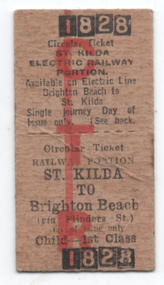
Ephemera, Victorian Railways (VR), "Circular ticket", c1925
... Ticket issued by the Victorian Railways that allowed the passenger to do a round trip from Brighton Beach to St Kilda via the Electric Street railway or tramway and then return using a train via Flinders St station. Child first...Ticket issued by the Victorian Railways that allowed the passenger to do a round trip from Brighton Beach to St Kilda via the Electric Street railway or tramway and then return using a train via Flinders St station. Child first ...Ticket issued by the Victorian Railways that allowed the passenger to do a round trip from Brighton Beach to St Kilda via the Electric Street railway or tramway and then return using a train via Flinders St station. Child first class. Appears to have been in album or adhered to a board - shows paper damage on the rear. See reference page 120 and for a related image, figure 6-14. The reference notes that for the rail travel, tickets were issued for first-class travel only.Demonstrates a VR Round trip ticket to Brighton Beach.Edmondson ticket - pasteboard, fawn, black printing with red overprinting - No. 1828tramways, trams, vr trams, round trip, st kilda brighton tramway, railways, brighton beach -
 Surrey Hills Historical Society Collection
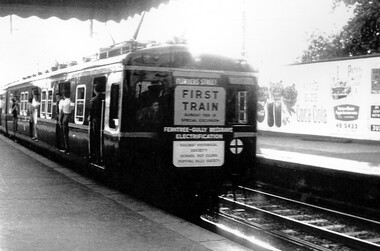
Photograph, Leaving Surrey Hills - the rear of first electric surburban train to Belgrave, 1962, 18/02/1962
... This was a special run for rail enthusiasts and marked the official opening of the first train from Ferntree Gully to Belgrave after the line from Upper Ferntree Gully was converted to broad gauge and electrified. surrey hills transport trains railways rail electrification special rail excursions official opening A sign at the rear of the train states: "First train / Sunday February 18 / Special Excursion / Ferntree Gully Belgrave / Electrification" A black and white photograph of the rear of a train with passengers alighting at Surrey Hills station. ...This was a special run for rail enthusiasts and marked the official opening of the first train from Ferntree Gully to Belgrave after the line from Upper Ferntree Gully was converted to broad gauge and electrified.A black and white photograph of the rear of a train with passengers alighting at Surrey Hills station. Signage on the rear indicates that the train was a special excursion marking the electrification of the rail from Ferntree Gully to Belgrave.A sign at the rear of the train states: "First train / Sunday February 18 / Special Excursion / Ferntree Gully Belgrave / Electrification"surrey hills, transport, trains, railways, rail electrification, special rail excursions, official opening -
 Wodonga & District Historical Society Inc
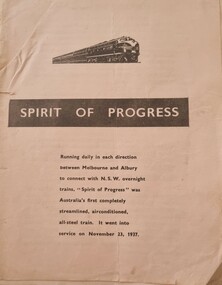
Booklet - Spirit of Progress, Victorian Railways, 1958
... first completely streamlined, airconditioned, all steel train in the Southern Hemisphere. It travelled non-stop daily in both directions between Melbourne and Albury. On its daily run a speed of one mile a minute was averaged for much of the 1,904 mile journey. Eighty m.p.h. was exceeded in tests, but in normal running a 70 m.p.h. restriction was imposed. The average load of the "Spirit of Progress" was 499 tons, and it could carry 240 first-class and 192 second-class passengers...first completely streamlined, airconditioned, all steel train in the Southern Hemisphere. It travelled non-stop daily in both directions between Melbourne and Albury. On its daily run a speed of one mile a minute was averaged for much of the 1,904 mile journey. Eighty m.p.h. was exceeded in tests, but in normal running a 70 m.p.h. restriction was imposed. The average load of the "Spirit of Progress" was 499 tons, and it could carry 240 first-class and 192 second-class passengers ...The "Spirit of Progress' was constructed at the Railway Workshops, Newport, Victoria, and placed into service between Melbourne and Albury on 23rd November, 1937. It was the first completely streamlined, airconditioned, all steel train in the Southern Hemisphere. It travelled non-stop daily in both directions between Melbourne and Albury. On its daily run a speed of one mile a minute was averaged for much of the 1,904 mile journey. Eighty m.p.h. was exceeded in tests, but in normal running a 70 m.p.h. restriction was imposed. The average load of the "Spirit of Progress" was 499 tons, and it could carry 240 first-class and 192 second-class passengers. A luxurious dining car was a feature of the “Spirit of Progress” with Queensland beech walls and leather upholstered seats. It had a well-equipped kitchen with walls of stainless steel, a slow combustion coke-burning range and a modern air circulation system. The "Spirit of Progress" was hauled by one of the four giant "S" class steam locomotives. Each was named after a man famous in Australian History: Matthew Flinders, Edward Henty, Sir Thomas Mitchell and C.J. Latrobe. After World War II the locomotives were converted to oil burners and were hauled by “S” class diesel-electric locomotives. In a normal year, the "Spirit of Progress" travelled about 146, 000 miles and carried over 300,000 passengers, while approximately 126,000 meals and 45, 000 serves of light refreshments would be provided in the dining car. The Spirit of Progress ran for the last time on 2nd August 1986.This item is significant because it provides a description and information about an important locomotive which served the Wodonga DistrictA small leaflet of six pages plus cover outlining information about the Spirit of Progress. The cover features a picture of the Spirit of Progress. Printed on buff coloured paper in black ink.SPIRIT OF PROGRESS"spirit of progress", victorian railways, locomotives -- victoria -- history -
 Wodonga & District Historical Society Inc
Photograph - Albury Railway Station, Thomas Bonsema, 1910
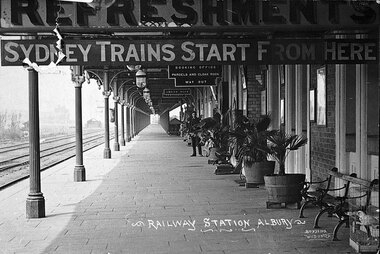
... first large transit stop to be built on the border of Victoria and New South Wales. The two states still used different gauge train tracks, so the longest undercover platform in the southern hemisphere at the time was built at Albury, to allow passengers to quickly transition between lines. ...first large transit stop to be built on the border of Victoria and New South Wales. The two states still used different gauge train tracks, so the longest undercover platform in the southern hemisphere at the time was built at Albury, to allow passengers to quickly transition between lines. ...The Albury Railway Station was opened on February 26 1882. It was the first large transit stop to be built on the border of Victoria and New South Wales. The two states still used different gauge train tracks, so the longest undercover platform in the southern hemisphere at the time was built at Albury, to allow passengers to quickly transition between lines. A new covered platform and new goods shed were added in 1884. Our Collection includes several photographs signed BONSEMA WODONGA or sometimes simply TBW. Later images taken in Chiltern were signed Bonsema Chiltern or TBC. Thomas Peter John Bonsema was born in Wodonga in 1876 to Peter John Bonsema and Mary Ann nee Nash. His name first appears on the Electoral Roll for Wodonga in 1909 and on the Electoral Roll in 1912 he is listed as a photographer. His photographs capture many scenes and events around Wodonga and surrounding areas. Thomas Bonsema married Minna Louisa Jones in 1912. By 1914 he had moved to Chiltern, Victoria where he established Bonsema’s Photographic Studio. From this time onward many of his works bore the signature “BONSEMA CHILTERN”. As well as continuing to photograph landscapes and important buildings, Mr Bonsema was often the official photographer at school and community celebrations. He also sold many framed photographs and postcards from his premises at 68 -70 Conness Street, Chiltern. By 1943 Thomas John Bonsema had relocated to New South Wales and died in Beecroft, NSW on 14th July 1944. Some of his photographs are held in the Victorian State Library and Mitchell Library Sydney Collections.These images are significant because they are the work of a recognised photographer Thomas Bonsema who was born in Wodonga in 1876. The Albury Railway Station was a critical link in transport between Victoria and New South Wales.A black and white image of the platform at Albury StationRailway Station Albury. Bonsema Wodongabonsema photography, thomas peter john bonsema, albury railway station -
 Wodonga & District Historical Society Inc
Photograph - The Melbourne Express in Wodonga and Chiltern, Thomas Bonsema, c1916
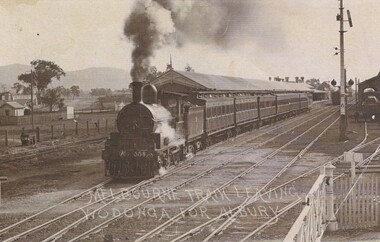
... passenger and goods trains. They were critical in opening up the Wodonga district to further development and trade and contributed to the demise of the paddle steamers which plied the Murray River. For many years, the Victorian Railways were one of the key employers in the Wodonga area. Our Collection includes several photographs signed BONSEMA WODONGA or sometimes simply TBW. Thomas Peter John Bonsema was born in Wodonga in 1876 to Peter John Bonsema and Mary Ann nee Nash. His name first...passenger and goods trains. They were critical in opening up the Wodonga district to further development and trade and contributed to the demise of the paddle steamers which plied the Murray River. For many years, the Victorian Railways were one of the key employers in the Wodonga area. Our Collection includes several photographs signed BONSEMA WODONGA or sometimes simply TBW. Thomas Peter John Bonsema was born in Wodonga in 1876 to Peter John Bonsema and Mary Ann nee Nash. His name first ...Steam locomotives operated regularly between Wodonga and Melbourne from the opening of the line in November 1873 until the mid-1950s, hauling both passenger and goods trains. They were critical in opening up the Wodonga district to further development and trade and contributed to the demise of the paddle steamers which plied the Murray River. For many years, the Victorian Railways were one of the key employers in the Wodonga area. Our Collection includes several photographs signed BONSEMA WODONGA or sometimes simply TBW. Thomas Peter John Bonsema was born in Wodonga in 1876 to Peter John Bonsema and Mary Ann nee Nash. His name first appears on the Electoral Roll for Wodonga in 1909 and on the Electoral Roll in 1912 he is listed as a photographer. His photographs capture many scenes and events around Wodonga and surrounding areas. Thomas Bonsema married Minna Louisa Jones in 1912. By 1914 he had moved to Chiltern, Victoria where he established Bonsema’s Photographic Studio. From this time onward many of his works bore the signature “BONSEMA CHILTERN”. As well as continuing to photograph landscapes and important buildings, Mr Bonsema was often the official photographer at school and community celebrations. He also sold many framed photographs and postcards from his premises at 68 -70 Conness Street, Chiltern. By 1943 Thomas John Bonsema had relocated to New South Wales and died in Beecroft, NSW on 14th July 1944. Some of his photographs are held in the Victorian State Library and Mitchell Library Sydney Collections.These images are significant because they are the work of a recognised photographer Thomas Bonsema who was born in Wodonga in 1876. Black and white images of the Melbourne Express locomotive departing Wodonga and passing through Chiltern.1. Melbourne train leaving Wodonga for Albury 2. Melbourne Express Chilternbonsema photography, thomas peter john bonsema, steam locomotives, railways victoria -
 Wodonga & District Historical Society Inc
Book - The Royal Tour of Australia and New Zealand in Pictures, Kenneth Bourne, 1954
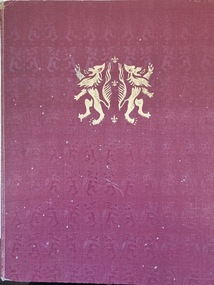
... first reigning British monarch to visit Australia. Her Majesty Queen Elizabeth and H.R.H. Duke of Edinburgh arrived in Sydney on 3rd February 1954 aboard the SS Gothic, a passenger liner converted into a royal yacht. Their arrival attracted an estimated 1 million onlookers in a city with a population of 1,863,161 people. The royal couple visited 57 towns and cities during the 58 days they spent in Australia. They travelled the country by plane, train ...Queen Elizabeth II was the first reigning British monarch to visit Australia. Her Majesty Queen Elizabeth and H.R.H. Duke of Edinburgh arrived in Sydney on 3rd February 1954 aboard the SS Gothic, a passenger liner converted into a royal yacht. Their arrival attracted an estimated 1 million onlookers in a city with a population of 1,863,161 people. The royal couple visited 57 towns and cities during the 58 days they spent in Australia. They travelled the country by plane, train, ship and car from Cairns in the north, Broken Hill in the west to Hobart in the south. The tour ended on April 1, 1954, departing from Fremantle, Western Australia.A publication including photographs and text documenting the Royal Tour. Maroon endboards featuring the Royal insignia.Queen Elizabeth II was the first reigning British monarch to visit Australia. Her Majesty Queen Elizabeth and H.R.H. Duke of Edinburgh arrived in Sydney on 3rd February 1954 aboard the SS Gothic, a passenger liner converted into a royal yacht. Their arrival attracted an estimated 1 million onlookers in a city with a population of 1,863,161 people. The royal couple visited 57 towns and cities during the 58 days they spent in Australia. They travelled the country by plane, train, ship and car from Cairns in the north, Broken Hill in the west to Hobart in the south. The tour ended on April 1, 1954, departing from Fremantle, Western Australia. royal tour of australia 1954, royal visit 1954, queen elizabeth ii -
Whitehorse Historical Society Inc.
Article, Station facelift, 15/09/1992 12:00:00 AM
... passenger information systems. The number of police employed to secure safe travel on public transport will increase from 130 to nearly 300. Trains Nunawading Railway Station Spyker Peter Harrowfield John Safety Pescott Roger Nunawading Station will be one of the first to be converted into a Travel safe Station under A.L.P. policy. ...Nunawading Station will be one of the first to be converted into a Travel safe Station under A.L.P. policy.Nunawading Station will be one of the first to be converted into a Travel safe Station under A.L.P. policy. Details were released by minister for Transport Spyker and Member for Mitcham, Harrowfield launched at Mitcham Station the $630,000 facility would be monitored by closed circuit T.V., have an open looking counter and air conditioned waiting room. Security car parking and improved passenger information systems. The number of police employed to secure safe travel on public transport will increase from 130 to nearly 300.Nunawading Station will be one of the first to be converted into a Travel safe Station under A.L.P. policy. trains, nunawading railway station, spyker, peter, harrowfield, john, safety, pescott, roger -
 Kew Historical Society Inc
Functional object, Victorian Railways, Mr F.H. Noble : First Class Railway Ticket, Melbourne-Kew, 1951
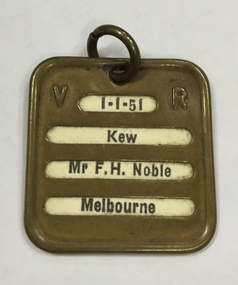
... train ticket was issued to Frederick Noble to travel from the Kew Railway Station to Melbourne. The Kew Branch Line ceased operations as a passenger service in 1952, the year after the ticket was issued. The Kew Railway Station was demolished in 1957. The ticket was donated to the Society by the City of Kew in 1989. kew railway station frederick noble --molesworth street -- kew (vic.) 1-1-51 / Kew / Mr F.H. Noble / Melbourne 1-1-51 / Kew / First ...This yearly train ticket was issued to Frederick Noble to travel from the Kew Railway Station to Melbourne. The Kew Branch Line ceased operations as a passenger service in 1952, the year after the ticket was issued. The Kew Railway Station was demolished in 1957. The ticket was donated to the Society by the City of Kew in 1989.Brass VR First Class Rail ticket issued to Frederick Noble. The token is dated 1.1.51. It names the owner as Mr F.H. Noble. Frederick Noble lived in Molesworth Street at this time and worked as a sports journalist on The Age.1-1-51 / Kew / Mr F.H. Noble / Melbourne 1-1-51 / Kew / First Class / Melbournekew railway station, frederick noble --molesworth street -- kew (vic.)
