
Showing 24 items matching "first world war - palestine"
-
 Returned Nurses RSL Sub-branch
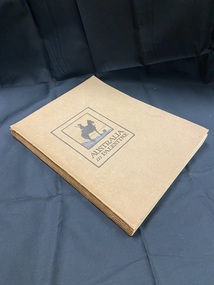
Book - Hardcover book, Angus & Robertson Limited et al, Australia in Palestine, 1919
... Palestine...Middle East...World War One...WW1...WWI...First...Australian Light Horse Regiment Palestine Middle East World War One WW1 WWI First World War - Palestine Produced by soldiers on active service to send back to Australia, and edited by H.S. ...Produced by soldiers on active service to send back to Australia, and edited by H.S. Gullett and Chas. Barrett. With illustrations, portraits and maps. [Trove]Brown cardboard cover. Black rectangle outline just off centre on the cover, inside it is a black square border containing a silhouette of a soldier on horseback, beneath this the title is printed in black.non-fictionProduced by soldiers on active service to send back to Australia, and edited by H.S. Gullett and Chas. Barrett. With illustrations, portraits and maps. [Trove]australian light horse regiment, palestine, middle east, world war one, ww1, wwi, first world war - palestine -
 Lara RSL Sub Branch
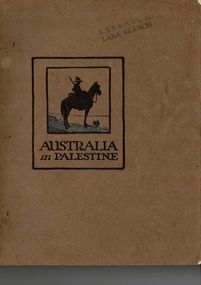
Book, Australia in Palestine, 1919
... World War 1 Australian Army To the memory of fallen comrades. Pen mark inside W. Mathews Lara Brown front and back hardcover with dark brown text 'Australia in Palestine' with a light horseman framed in centre of front cover. The spine is green with text Australia in Palestine, Angus and Robertson bottom of spine. Evidence of water on front cover. Silverfish have eaten top right hand corner of first ...A soldier's book produced almost entirely by soldiers in the field under active service conditions to send to their friends in Australia and abroad. Australian Lighthorse men is a type peculiar his own and has no counterpart in h is NZ brother. His fearlessness, initiative and endurance, and his adaptability to almost any task, are due to the adventurous life he leads in his own country where he has been accustomed to long hours in the saddle, day and night, and to facing danger of all sorts from his earliest youth.Brown front and back hardcover with dark brown text 'Australia in Palestine' with a light horseman framed in centre of front cover. The spine is green with text Australia in Palestine, Angus and Robertson bottom of spine. Evidence of water on front cover. Silverfish have eaten top right hand corner of first two pages. Farm scene in four boxes with AR in the lower corner of each square. Inside front and back covers are illustrations of a camel train and came corps in the desert with the rising sun in the background with a mountain. There is a grave and white cross in their foreground right lower corner Illustrations, photographs, poems, short stories, Centre foldout of the Battle for Richon Le Zion and Battle of Beersheba and after the Battle of Bir El Abed To the memory of fallen comrades. Pen mark inside W. Mathews Larabattle of beersheba, battle of richon ze zion, battle of bir er abd, camel corps, lighthorse, slush light, sir h.g. chauvel, mounted division at kantara, medical services, signal engineers, katia oasis, new zealand mounted troops, sir edmund h allenby, walers story, 5th lighthorse, romani, ww1, world war 1, australian army -
 Geelong RSL Sub Branch
Photograph - Jenin Palestine 21 September 18, Early 20th Century
... The Capture of Jenin occurred on 20 September 1918 during the last months of the Sinai and Palestine Campaign of the First World War. This photograph portrays a scene the day after the Battle 21 September 1918. ...The Capture of Jenin occurred on 20 September 1918 during the last months of the Sinai and Palestine Campaign of the First World War. This photograph portrays a scene the day after the Battle 21 September 1918. ...The Capture of Jenin occurred on 20 September 1918 during the last months of the Sinai and Palestine Campaign of the First World War. This photograph portrays a scene the day after the Battle 21 September 1918. Australian Commanders and Units were involved.This is a photograph of the Jenin area the day after the Capture, 21 September 1918. Australian Commanders and Units were involved in the Capture of Jenin.A black and white photograph on a cardboard backing.On the front of the backing - Jenin, Palestine. 21.9.18. On the bottom right corner of the photograph the figures 259. On the back of the backing - B259 Australian War Musuem, Wool Exchange, King Street, Melbourne. Copyright. Prosecution will follow Infringement.ww1, capture of jenin. september 1918. palestine. -
 Red Cliffs Military Museum
Cushion Cover, Cushion Cover from WW1, (estimated); 1914-1919
... ."// Service number: 3044 Rank: Lance Sergeant Unit: 2nd Pnr Bn Service: Army Conflict: First World War, 1914-1918 Award: Military Medal Date of London Gazette: 22 January 1917 Location in London Gazette: Page 836, position 34 Date of Commonwealth of Australia Gazette: 29 June 1917 Location in Commonwealth of Australia Gazette: Page 1395, position 37 belgium france ww1 lt mm jack hughes 1.Cushion cover: from the top down- Egypt.... 1914/ Rising Sun/ scrolls with Australian Commonwealth/ Military Forces/ Aust Div Train/ Palestine Sinai Syria/1919. 2.Newpaper clipping with photo: John Hughes (left) 81, and Hugh Mont/gomery, 87, are the two oldest veterans who/ will be taking part in the Frankston ANZAC/ Day March on Tuesday. ...John Hughes was Awarded the Military Medal: "for conspicuous good work during operations at/ GIRD TRENCH, near LE SARS, on 14.11.1916./ This N.C.O. was in charge of a party of men engaged in digging a communication trench from/ our jumping off trench to the newly captured GIRD TRENCH. He displayed great courage and coolness under very heavy fire, and his personal efforts were mainly responsible for the completion of the task allotted to his party."// Service number: 3044 Rank: Lance Sergeant Unit: 2nd Pnr Bn Service: Army Conflict: First World War, 1914-1918 Award: Military Medal Date of London Gazette: 22 January 1917 Location in London Gazette: Page 836, position 34 Date of Commonwealth of Australia Gazette: 29 June 1917 Location in Commonwealth of Australia Gazette: Page 1395, position 37A framed embroidered cushion cover from WW1. Sent or brought home by Lt. Jack Hughes. Contained within the same frame is a paper clipping and a photo.1.Cushion cover: from the top down- Egypt.... 1914/ Rising Sun/ scrolls with Australian Commonwealth/ Military Forces/ Aust Div Train/ Palestine Sinai Syria/1919. 2.Newpaper clipping with photo: John Hughes (left) 81, and Hugh Mont/gomery, 87, are the two oldest veterans who/ will be taking part in the Frankston ANZAC/ Day March on Tuesday. Mr Hughes served/ in France and Belgium in WW1 and/ in Darwin in the Second World War. He is a/ holder of the Military Medal./ Mr. Montgomery served with the 29th Bat/talion AIF in France during WW1/ Both men have been residents of the RSL park War Veterans Home for the past eight years.// 3. Photo: Mr. John Hughes.belgium, france, ww1, lt, mm, jack, hughes -
 Eltham District Historical Society Inc
Greeting Card, Christmas greetings to Lily Howard from Dev(?), Palestine, 1917, 1917
... AIF, First World War, Letters, Lew Howard Collection, Lily Howard, Palestine, WW1...AIF, First World War, Letters, Lew Howard Collection, Lily Howard, Palestine, WW1 Digital file only - scanned by EDHS from item on loan Christmas greetings to Lily Howard from Dev(?) ...Digital file only - scanned by EDHS from item on loan aif, first world war, letters, lew howard collection, lily howard, palestine, ww1 -
 Monbulk RSL Sub Branch
Book, Roland Perry et al, The Australian light horse, 2010
... world war 1914-1918 - campaigns - palestine australian light horse - history The Australian Light Horse was a unique force, first raised during the Boer War, and then reformed for World War I. most of the men were from the outback, had a special bond with their horses (which were all brought from Australia) and they knew how to survive and fight in the desert. index, bibliography, notes, ill, p.512 The Australian light horse Book Roland Perry Hachette ...The Australian Light Horse was a unique force, first raised during the Boer War, and then reformed for World War I. most of the men were from the outback, had a special bond with their horses (which were all brought from Australia) and they knew how to survive and fight in the desert.index, bibliography, notes, ill, p.512non-fictionThe Australian Light Horse was a unique force, first raised during the Boer War, and then reformed for World War I. most of the men were from the outback, had a special bond with their horses (which were all brought from Australia) and they knew how to survive and fight in the desert. world war 1914-1918 - campaigns - palestine, australian light horse - history -
 Victorian Interpretive Projects Inc.
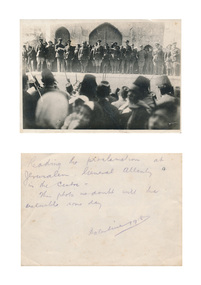
Photograph - Black and White, General Allanby Reading the Proclamation in Jerusalem, 1918, 1918
... Palestine Campaign of World War I. (Wikipedia) On 11 December, General Edmund Allenby humbly entered the Old City on foot through the Jaffa Gate instead of horse or vehicles to show respect for the holy city. He was the first...Palestine Campaign of World War I. (Wikipedia) On 11 December, General Edmund Allenby humbly entered the Old City on foot through the Jaffa Gate instead of horse or vehicles to show respect for the holy city. He was the first ...The Battle of Jerusalem occurred during the British Empire's "Jerusalem Operations" against the Ottoman Empire, when fighting for the city developed from 17 November, continuing after the surrender until 30 December 1917, to secure the final objective of the Southern Palestine Offensive during the Sinai and Palestine Campaign of World War I. (Wikipedia) On 11 December, General Edmund Allenby humbly entered the Old City on foot through the Jaffa Gate instead of horse or vehicles to show respect for the holy city. He was the first Christian in many centuries to control Jerusalem, which is a very important site for many faiths. The Prime Minister of the United Kingdom, David Lloyd George described the capture as "a Christmas present for the British people". The battle was a great morale boost for the British Empire.(wikipedia)Photograph showing a number of soldiers on a raised platform, including General Allanby. Locals look on from below, some wearing fez hats.Verso: Reading the proclamation at Jerusalem. General Allenby in centre. This photo no doubt will be valuable one day. Palestine, 1918world war one, jerusalem, palestine, allenby, general allenby -
 Warrnambool and District Historical Society Inc.
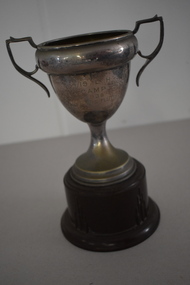
Trophy, 4/19 L H Camp 1938, 1930s
... During the First World War the 4th Light Horse served with distinction in France, Gallipoli and Palestine. ...During the First World War the 4th Light Horse served with distinction in France, Gallipoli and Palestine. ...This is a trophy awarded at a camp of the 4/19 Light Horse Regiment. This regiment appeared to have been based in the Corangamite region of the Western District and included regiment members from Warrnambool. It is not known exactly what type of competition was an ‘Officers Flutter’. Light Horse regiments were cavalry regiments that were established at the time of the Crimean War in the 1860s. During the First World War the 4th Light Horse served with distinction in France, Gallipoli and Palestine. In 1948 the 17th Prince of Wales Light Horse, the 19th Yarrowee Light Horse and the 4th (ex 20th ) Corangamite Light Horse amalgamated to form a revived 4/19 Light Horse. This regiment kept alive the tradition of the original Light Horse units, becoming part of the Australian Army Reserve and members served in Vietnam and East Timor. This cup is of interest as an example of the trophies awarded for competition at a Light Horse regiment camp in the 1930s. This is a metal cup (silver amalgam)) with two side handles and a narrow stem attached to a silver base. The cup is attached to a brown Bakelite stand. The inside of the cup has some white paint streaks and the cup itself is much stained and pock-marked. ‘Westminster’ 4/19 L.H. Camp 1938 Officers Flutter light horse regiments. warrnambool district, history of warrnambool -
 Wangaratta RSL Sub Branch
Souvenir - Framed embroidered cloth
... A related souvenir from the Second Word War is the colourful 'Souvenir of Palestine'. Like the First World War Egyptian embroideries, they used cotton sateen in a range of bright colours (although sometimes velveteen was used instead) and bear the words 'Souvenir of Palestine', a year date, and sometimes a personal message, as well as images of specific mosques or landmarks, camels, goats and date palms. ...A related souvenir from the Second Word War is the colourful 'Souvenir of Palestine'. Like the First World War Egyptian embroideries, they used cotton sateen in a range of bright colours (although sometimes velveteen was used instead) and bear the words 'Souvenir of Palestine', a year date, and sometimes a personal message, as well as images of specific mosques or landmarks, camels, goats and date palms. ...A related souvenir from the Second Word War is the colourful 'Souvenir of Palestine'. Like the First World War Egyptian embroideries, they used cotton sateen in a range of bright colours (although sometimes velveteen was used instead) and bear the words 'Souvenir of Palestine', a year date, and sometimes a personal message, as well as images of specific mosques or landmarks, camels, goats and date palms. The Palestinian souvenirs were often seen displayed for sale outside houses in country villages These types of souvenirs were very popular with Australian troops; they were easy to send home and were colourful. The vendors would have a number of designs for sale already machine embroidered, from which the soldier could select and then personalise with a date or message. Brown timber frame containing dark green square silk cloth edged with gold fringe, embroidered with two flap poles either side of rising sun crest/badge above two red heartsSouvenir Of Palestine 1941 Australia Commonwealth Military Forcespalestine, 1941, souvenir, embroidered cloth -
 Chiltern Athenaeum Trust
The Wells of Beersheba - book publication by Dalby Davison and Mahony, 1933
... The Wells of Beersheba is a short romanticized account of the Battle of Beersheba, which took place on 31 October 1917 in Ottoman Palestine during the First World War between the attacking mounted infantry of Australia and New Zealand and the defending Ottoman garrison. ...The Wells of Beersheba is a short romanticized account of the Battle of Beersheba, which took place on 31 October 1917 in Ottoman Palestine during the First World War between the attacking mounted infantry of Australia and New Zealand and the defending Ottoman garrison. ...The Wells of Beersheba is a short romanticized account of the Battle of Beersheba, which took place on 31 October 1917 in Ottoman Palestine during the First World War between the attacking mounted infantry of Australia and New Zealand and the defending Ottoman garrison. It was written by the Australian author Frank Dalby Davison who was not present at the battle, but had been in the British cavalry during the war. Much of the book, which is more fictionalized reportage than novella, and in which no single character is drawn, reflects the codependency of horse and rider and the shock of battle. This booklet was first published in 1933. It was originally published in Sydney in 1933 by Angus & Robertson under the title The Wells of Beersheba. An Epic of the Australian Light Horse 1914-1918, with illustrations by Will Mahoney. WW1 semi-fictional association with the Battle of Beersheba - 4th Light Horse Brigade Australian Infantry Forces. October 1917. Ottoman Empire Palestine. Booklet titled "The Wells of Beersheba" by Frank Dalby Davison and illustrated by Will Mahony. Semi Cardboard Cover with parchment paper internally. The cover has a light rose colored pattern surrounding the title, author and illustrator details. Front cover has title "The Wells of Beersheba" and author Frank Dalby Davison with illustrator Will Mahony. There is a light rose colored pattern on the front cover. the wells of beersheba - charge of the 4th light horse brigade., book - the wells of beersheba, ww1 battle of beersheba october 1917. -
 Wangaratta RSL Sub Branch
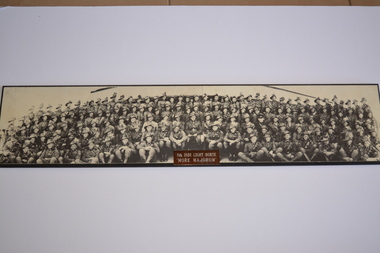
Photograph, 8th Indi Light Horse, c1918
... First World War. The regiment was raised in September 1914, and assigned to the 3rd Light Horse Brigade. The regiment fought against the forces of the Ottoman Empire, in Egypt, at Gallipoli, on the Sinai Peninsula, and in Palestine and Jordan. ...First World War. The regiment was raised in September 1914, and assigned to the 3rd Light Horse Brigade. The regiment fought against the forces of the Ottoman Empire, in Egypt, at Gallipoli, on the Sinai Peninsula, and in Palestine and Jordan. ...This black and white mage depicts large group of men dressed in military uniform of the Light Horse - with most wearing leather leggings, bandolier and slouch hat with emu plumes. "More Majorum" is engraved on the attached plaque which means "after the custom (or manner) of our ancestors" The 8th Light Horse Regiment was a mounted rifles regiment of the Australian Army during the First World War. The regiment was raised in September 1914, and assigned to the 3rd Light Horse Brigade. The regiment fought against the forces of the Ottoman Empire, in Egypt, at Gallipoli, on the Sinai Peninsula, and in Palestine and Jordan. After the armistice the regiment eventually returned to Australia in March 1919. For its role in the war the regiment was awarded fifteen battle honours. During the inter-war years, the 8th Light Horse was re-raised as a part-time unit based in the Indi region of northern Victoria. It was later converted to a divisional cavalry regiment during the Second World War but was disbanded in 1944 without having been deployed overseas.During WWI three light horse regiments were raised in Victoria for the AIF, the 4th ALH, the 8th ALH and the 13th ALH. These regiments served with distinction at Gallipoli, in the Middle East and on the Western Front.Wide and narrow rectangle shaped black and white reproduction photograph mounted on plyboard. A small metal plaque is attached in the centre of lower edge.Plaque -8th Indi Light Horse "More Majorum"8th indi light horse, victoria -
 8th/13th Victorian Mounted Rifles Regimental Collection
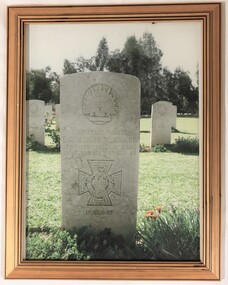
Photograph - Maygar grave
... He later served with the 4th Australian Light Horse at Gallipoli during the First World War, and died of wounds after being strafed during the Battle of Beersheba as part of the Sinai and Palestine campaign while commanding the 8th Australian Light Horse.....He later served with the 4th Australian Light Horse at Gallipoli during the First World War, and died of wounds after being strafed during the Battle of Beersheba as part of the Sinai and Palestine campaign while commanding the 8th Australian Light Horse.. ...Lieutenant Colonel Leslie Cecil Maygar, VC, DSO, VD (27 May 1868 – 1 November 1917) was an Australian recipient of the Victoria Cross, the highest award for gallantry in the face of the enemy that can be awarded to British and Commonwealth forces. He was awarded the VC for facilitating the rescue of a dismounted man while under severe rifle fire in 1902 during the Second Boer War. He later served with the 4th Australian Light Horse at Gallipoli during the First World War, and died of wounds after being strafed during the Battle of Beersheba as part of the Sinai and Palestine campaign while commanding the 8th Australian Light Horse..Framed colour photograph of headstone at the grave of Lieutenant Colonel Leslie Maygar VC.maygar, grave, world war, wwi -
 8th/13th Victorian Mounted Rifles Regimental Collection
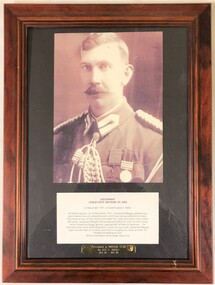
Photograph - Magyar portrait
... He later served at Gallipoli during the First World War, and died of wounds after being strafed during the Battle of Beersheba as part of the Sinai and Palestine campaign. ...He later served at Gallipoli during the First World War, and died of wounds after being strafed during the Battle of Beersheba as part of the Sinai and Palestine campaign. ...Lieutenant Colonel Leslie Cecil Maygar, VC, DSO, VD (27 May 1868 – 1 November 1917) was an Australian recipient of the Victoria Cross, the highest award for gallantry in the face of the enemy that can be awarded to British and Commonwealth forces. He was awarded the VC for facilitating the rescue of a dismounted man while under severe rifle fire in 1902 during the Second Boer War. He later served at Gallipoli during the First World War, and died of wounds after being strafed during the Battle of Beersheba as part of the Sinai and Palestine campaign. The Maygar Club was the Other Ranks club at firstly Buna Barracks Albury, later at North Bandiana and currently at Latchford Barracks Bonegilla. The framed artwork was removed from the Club at Buna Barracks when the regiment relocated to Bandiana and placed in the Heritage Collection.Framed black and white reproduction of a photograph of Lieutenant Colonel Leslie Magyar together with a interpretive panel and a donor's plaque.Presented to Maygar Club by Sgt C Bruce Dec 97-Dec 99maygar, wwi, world war one, boer war, victoria cross -
 Dandenong/Cranbourne RSL Sub Branch
Artwork, other - Souvenir of Palestine, 1939-1945
... palestine...rising sun badge...australian commonwealth military forces...embroidery...screen-printed...AIF...WW1...World War 1...First...World War Two that were easy to fold and post home to Australia. Like the First World War Egyptian embroideries, they used cotton sateen in a range of bright colours (although sometimes velveteen was used instead) and bear the words 'Souvenir of Palestine', a year date, and sometimes a personal message, as well as images of specific mosques or landmarks, camels, goats and date palms. ...The Palestinian souvenirs were often seen displayed for sale outside houses in country villages. souvenir of palestine rising sun badge australian commonwealth military forces embroidery screen-printed AIF WW1 World War 1 First World War "Souvenir of Palestine" "Australian Commonwealth Military Forces" Colourful cotton sateen Souvenir of Palestine. ...Popular souvenirs during World War Two that were easy to fold and post home to Australia. Like the First World War Egyptian embroideries, they used cotton sateen in a range of bright colours (although sometimes velveteen was used instead) and bear the words 'Souvenir of Palestine', a year date, and sometimes a personal message, as well as images of specific mosques or landmarks, camels, goats and date palms. The Palestinian souvenirs were often seen displayed for sale outside houses in country villages.Colourful cotton sateen Souvenir of Palestine. Beige background with painted images, probably screen-printed, with machine embroidered outlines. Pink fringe. Objects depicted are two brown/yellow camels and one donkey with rider; two date palms with orange trunks and green leaves; the Union Jack and the Australian Flag; and the Australian Commonwealth Military Forces Rising Sun badge."Souvenir of Palestine" "Australian Commonwealth Military Forces"souvenir of palestine, rising sun badge, australian commonwealth military forces, embroidery, screen-printed, aif, ww1, world war 1, first world war -
 Dandenong/Cranbourne RSL Sub Branch
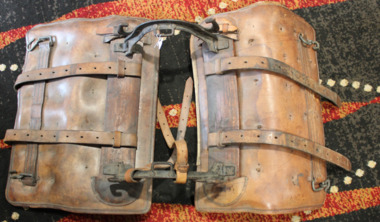
Memorabilia - Pack Saddle
... world wars by both the British and Australian armies. The use of pack saddles was especially important in the campaign in Palestine during the First World War where wheeled transport was often not an option. ...world wars by both the British and Australian armies. The use of pack saddles was especially important in the campaign in Palestine during the First World War where wheeled transport was often not an option. ...Believed to have been made 1939/43. In 1904 the British Army adopted a new General Service (GS) pack saddle with an adjustable tree, known as the Mark V pack saddle. The main innovation was the adjustable tree created by having the front and back steel arches jointed to the wooden sidebars, which allowed them to turn to adjust to the size of the back of whatever animal carried the saddle, from the largest horse to the smallest donkey, and eliminated the need to manufacture saddles in different sizes. The saddle could be adapted, by the addition of hanging bars, or universal slats, to carry a wide variety of stores, tools and equipment, and also wounded men. The GS pack saddle was used in both world wars by both the British and Australian armies. The use of pack saddles was especially important in the campaign in Palestine during the First World War where wheeled transport was often not an option. Each machine gun carried by light horse units was transported on a pack saddle, and was accompanied by a second pack animal carrying spare ammunition. During the Second World War pack animals were routinely used by patrols, and larger units such as Norforce, in remote areas of northern Australia. The saddle shown here has two separate girths, which crossed under the animal's belly. Most later versions of the saddle used a shorter single girth buckled to a 'V' attachment, which was in turn buckled to the sidebars. Use of the 'V' attachment gave greater strength and stability to the saddle, and decreased 'rocking' of the load. -
 Ballarat RSL Sub-Branch Inc.
Medallion - ANZAC Day 1918
... First World War (WW1) 1914 - 1918 Collectables Ballarat RSL Ballarat Engraved - Honor The A.I.F. and on reverse - EVD "ANZAC DAY 1918" "GALLIPOLI FRANCE PALESTINE" Medallion - ANZAC Day 1918 ...Engraved - Honor The A.I.F. and on reverse - EVD "ANZAC DAY 1918" "GALLIPOLI FRANCE PALESTINE"first world war (ww1), 1914 - 1918, collectables, ballarat rsl, ballarat -
 Returned Nurses RSL Sub-branch
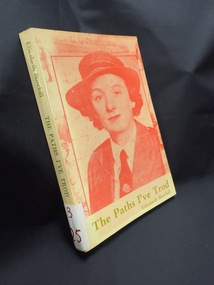
Book, Elizabeth Burchill, The paths I've trod, 1981
... world. Cherishing the ideals of Florence Nightingale in peace and war, Sister Burchill volunteered to serve in Ethiopia during the Italian-Abyssinian War in 1936, nursed refugee children during the Spanish Civil War in 1937 and served with the 2nd AIF in Palestine and Egypt in 1940. Following six years as a member of the Australian Army Nursing Service, she took another challenging path, becoming involved in radio broadcasting [Working for 3SR Radio Station, Shepparton p185], writing and lecturing for the Commonwealth Institute in England. Six years later she returned to nursing and started the first ...'Dora Elizabeth Burchill was born in Hawthorn, Victoria and trained as a triple certificate nurse in Melbourne and London. Proving that nursing is the best passport for travel she subsequently travelled widely and became registered as a nurse in seven countries of the world. Cherishing the ideals of Florence Nightingale in peace and war, Sister Burchill volunteered to serve in Ethiopia during the Italian-Abyssinian War in 1936, nursed refugee children during the Spanish Civil War in 1937 and served with the 2nd AIF in Palestine and Egypt in 1940. Following six years as a member of the Australian Army Nursing Service, she took another challenging path, becoming involved in radio broadcasting [Working for 3SR Radio Station, Shepparton p185], writing and lecturing for the Commonwealth Institute in England. Six years later she returned to nursing and started the first full-time infant welfare clinic in Darwin for the Northern Territory Department of Health and remained in this important post of increasing development in post-war Darwin for five years. Sister Burchill continued this work in Thursday Island and the Sepik District of New Guinea into the 1960s. Many published articles in magazines and newspapers and five published books testify to her skill and determination as a factual writer. ?Innamincka?, is her best-known book. Seeking further worthwhile challenges in the 1970s, Sister Burchill studied for the Higher School Certificate which resulted in her earning a place in the Faculty of Arts, Monash University. She graduated as Bachelor of Arts in 1981. In 1986, she graduated as Bachelor of Letters at the University of Melbourne. Includes index. Bibliography: p. [249]-250. Medicine. Nursing. Burchill, Elizabeth, 1908-. Australia. Biographies (ANB/PRECIS SIN 0516392). Includes bibliographical references (pages 249-250) and index.' From TroveBook with green text on cover and spine and red image on coverfiction'Dora Elizabeth Burchill was born in Hawthorn, Victoria and trained as a triple certificate nurse in Melbourne and London. Proving that nursing is the best passport for travel she subsequently travelled widely and became registered as a nurse in seven countries of the world. Cherishing the ideals of Florence Nightingale in peace and war, Sister Burchill volunteered to serve in Ethiopia during the Italian-Abyssinian War in 1936, nursed refugee children during the Spanish Civil War in 1937 and served with the 2nd AIF in Palestine and Egypt in 1940. Following six years as a member of the Australian Army Nursing Service, she took another challenging path, becoming involved in radio broadcasting [Working for 3SR Radio Station, Shepparton p185], writing and lecturing for the Commonwealth Institute in England. Six years later she returned to nursing and started the first full-time infant welfare clinic in Darwin for the Northern Territory Department of Health and remained in this important post of increasing development in post-war Darwin for five years. Sister Burchill continued this work in Thursday Island and the Sepik District of New Guinea into the 1960s. Many published articles in magazines and newspapers and five published books testify to her skill and determination as a factual writer. ?Innamincka?, is her best-known book. Seeking further worthwhile challenges in the 1970s, Sister Burchill studied for the Higher School Certificate which resulted in her earning a place in the Faculty of Arts, Monash University. She graduated as Bachelor of Arts in 1981. In 1986, she graduated as Bachelor of Letters at the University of Melbourne. Includes index. Bibliography: p. [249]-250. Medicine. Nursing. Burchill, Elizabeth, 1908-. Australia. Biographies (ANB/PRECIS SIN 0516392). Includes bibliographical references (pages 249-250) and index.' From Trovenursing in warfare, elizabeth burchill, world war two, wwii, ww2, china-ethiopian war, spanish civil war, australian army nursing service -
 Returned Nurses RSL Sub-branch
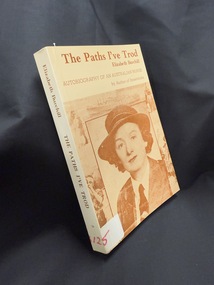
Book, Elizabeth Burchill, The paths I've trod, 1981
... world. Cherishing the ideals of Florence Nightingale in peace and war, Sister Burchill volunteered to serve in Ethiopia during the Italian-Abyssinian War in 1936, nursed refugee children during the Spanish Civil War in 1937 and served with the 2nd AIF in Palestine and Egypt in 1940. Following six years as a member of the Australian Army Nursing Service, she took another challenging path, becoming involved in radio broadcasting [Working for 3SR Radio Station, Shepparton p185], writing and lecturing for the Commonwealth Institute in England. Six years later she returned to nursing and started the first ...'Dora Elizabeth Burchill was born in Hawthorn, Victoria and trained as a triple certificate nurse in Melbourne and London. Proving that nursing is the best passport for travel she subsequently travelled widely and became registered as a nurse in seven countries of the world. Cherishing the ideals of Florence Nightingale in peace and war, Sister Burchill volunteered to serve in Ethiopia during the Italian-Abyssinian War in 1936, nursed refugee children during the Spanish Civil War in 1937 and served with the 2nd AIF in Palestine and Egypt in 1940. Following six years as a member of the Australian Army Nursing Service, she took another challenging path, becoming involved in radio broadcasting [Working for 3SR Radio Station, Shepparton p185], writing and lecturing for the Commonwealth Institute in England. Six years later she returned to nursing and started the first full-time infant welfare clinic in Darwin for the Northern Territory Department of Health and remained in this important post of increasing development in post-war Darwin for five years. Sister Burchill continued this work in Thursday Island and the Sepik District of New Guinea into the 1960s. Many published articles in magazines and newspapers and five published books testify to her skill and determination as a factual writer. ?Innamincka?, is her best-known book. Seeking further worthwhile challenges in the 1970s, Sister Burchill studied for the Higher School Certificate which resulted in her earning a place in the Faculty of Arts, Monash University. She graduated as Bachelor of Arts in 1981. In 1986, she graduated as Bachelor of Letters at the University of Melbourne. Includes index. Bibliography: p. [249]-250. Medicine. Nursing. Burchill, Elizabeth, 1908-. Australia. Biographies (ANB/PRECIS SIN 0516392). Includes bibliographical references (pages 249-250) and index.' From TroveBook with brown text on cover and spine and brown image on coverfiction'Dora Elizabeth Burchill was born in Hawthorn, Victoria and trained as a triple certificate nurse in Melbourne and London. Proving that nursing is the best passport for travel she subsequently travelled widely and became registered as a nurse in seven countries of the world. Cherishing the ideals of Florence Nightingale in peace and war, Sister Burchill volunteered to serve in Ethiopia during the Italian-Abyssinian War in 1936, nursed refugee children during the Spanish Civil War in 1937 and served with the 2nd AIF in Palestine and Egypt in 1940. Following six years as a member of the Australian Army Nursing Service, she took another challenging path, becoming involved in radio broadcasting [Working for 3SR Radio Station, Shepparton p185], writing and lecturing for the Commonwealth Institute in England. Six years later she returned to nursing and started the first full-time infant welfare clinic in Darwin for the Northern Territory Department of Health and remained in this important post of increasing development in post-war Darwin for five years. Sister Burchill continued this work in Thursday Island and the Sepik District of New Guinea into the 1960s. Many published articles in magazines and newspapers and five published books testify to her skill and determination as a factual writer. ?Innamincka?, is her best-known book. Seeking further worthwhile challenges in the 1970s, Sister Burchill studied for the Higher School Certificate which resulted in her earning a place in the Faculty of Arts, Monash University. She graduated as Bachelor of Arts in 1981. In 1986, she graduated as Bachelor of Letters at the University of Melbourne. Includes index. Bibliography: p. [249]-250. Medicine. Nursing. Burchill, Elizabeth, 1908-. Australia. Biographies (ANB/PRECIS SIN 0516392). Includes bibliographical references (pages 249-250) and index.' From Trovenursing in warfare, elizabeth burchill, world war two, wwii, ww2, china-ethiopian war, spanish civil war, australian army nursing service -
 Returned Nurses RSL Sub-branch
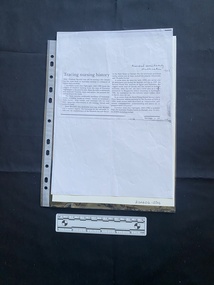
Newspaper - Photocopy of newspaper clipping, Monash University, Tracing nursing history, [1992]
... Sister Burchill started her caeer in the early 1930's, nursing in outback Australian towns such as Innaminka, served with an ambulance unit during the Spanish civil war in 1937, served in the Second World War in Egypt and Palestine and established the first full-time infant welfare clinic in Darwin since the war. ...Sister Burchill started her caeer in the early 1930's, nursing in outback Australian towns such as Innaminka, served with an ambulance unit during the Spanish civil war in 1937, served in the Second World War in Egypt and Palestine and established the first full-time infant welfare clinic in Darwin since the war. ...Sister Elizabeth Burchill's latest book on Australian nursing is a revelation of history and anecdotes. 'Australian nurses since Nightingale:1860 -1990' traces the origins of modern nursing to the present time. Sister Burchill, who graduates next year from Monash with a masters degree, was honoured by the university in 1986 with the establishment of the Elizabeth Burchill Room in the Main library at Clayton. Sister Burchill started her caeer in the early 1930's, nursing in outback Australian towns such as Innaminka, served with an ambulance unit during the Spanish civil war in 1937, served in the Second World War in Egypt and Palestine and established the first full-time infant welfare clinic in Darwin since the war. A photocopy of a small newspaper clipping consisting of a title and two columns of text'Monash university / publication / 1992' [ink, photocopied, top right of clipping]wwii, ww2, world war two, world war 2, florence, florence nightingale, the paths i've trod, canada, shepparton, royal flying doctorservice, john flynn memorial address, duchess of york, australian studies centre -
 Returned Nurses RSL Sub-branch
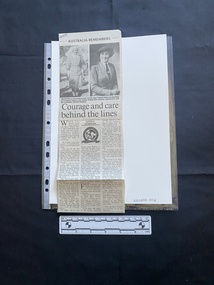
Newspaper - Newspaper clipping, Natalia Cuthbertson, Courage and care behind the lines, [24/8/95]
... war service starting her in Puckapunyal then on to the Middle East. After a several months on Ceylon she was back in Australia before sailing to the Pacific, where she was among the first medical staff into Changi Prison. Prisoners of War Army Nurses WW2 WWII World War Two Stonnington Moratai TobrukRats Palestine ...When talking about World War II, Sisters Gay Mole and Jean Crameri both recall tent hospitals, epidemics, bombs and nursing without hot water and electricity. They also recall hard work, comradeship and bravery. The two women were among the3000 nurses who formed the Australian General Hospital (AGH) during the war. Sister Jean Crameri was working at the Royal Women's Hospital when she volunteered and joined the 2/9th unit of the AGH. She served in the Middle East, nursed survivors of the Kokoda Trail and saw the Commander-in-Chief if the Australian Army, Field Marshall Blamey declare peace in the South West Pacific. Sister Gay Mole was in the Nurses Army Reserve in 1939 in the 2/9th unit, with her war service starting her in Puckapunyal then on to the Middle East. After a several months on Ceylon she was back in Australia before sailing to the Pacific, where she was among the first medical staff into Changi Prison. A newspaper clipping with three columns of text and a title underneath two black and white photos, both of young women in nurse's uniforms.'24/8/95.' [black ink, top left corner]prisoners of war, army nurses, ww2, wwii, world war two, stonnington, moratai, tobrukrats, palestine, german, jerusalem, syrian, queensland, new guinea, borneo, labuan island, japan, singapore, alexandria, nazareth, india, 3uz baby health centre -
 Returned Nurses RSL Sub-branch
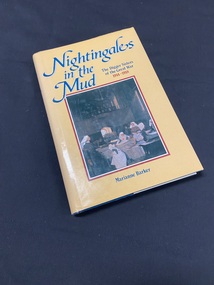
Book - Hardcover book, Marianne Barker, Nightingales in the mud : the Digger Sisters of the Great War 1914-1918, 1989
... History of Nursing World War One 1914-1918 WW1 WWI Nurses Australia Great War Nurses 'Draws on many first-hand and previously unpublished accounts of the work of Australian nurses in the Great War to tell an extraordinary story of courage and companionship under conditions of great hardship - in the mud of Flanders, among the cholera cases in India, on the hospital ships during the Gallipoli campaign, on Afghanistan border, in Vladivostok, in mosquito infested Macedonia, and in the Sinai Desert. - from inside dustjacket. Contents note: pt. 1. The Middle East -- 1. Enlistment -- 2. Egypt -- 3. Hospital ships -- 4. Lemnos -- 5. Malta -- 6. Palestine ...'Draws on many first-hand and previously unpublished accounts of the work of Australian nurses in the Great War to tell an extraordinary story of courage and companionship under conditions of great hardship - in the mud of Flanders, among the cholera cases in India, on the hospital ships during the Gallipoli campaign, on Afghanistan border, in Vladivostok, in mosquito infested Macedonia, and in the Sinai Desert. - from inside dustjacket. Contents note: pt. 1. The Middle East -- 1. Enlistment -- 2. Egypt -- 3. Hospital ships -- 4. Lemnos -- 5. Malta -- 6. Palestine -- 7. Mesopotamia -- 8. India -- 9. Serbia and Salonika -- pt. 2. The Western Front -- 10. The Australian base hospitals in France -- 11. The casualty clearing stations -- 12. Transport in France -- 13. Home hospitals in England -- 14. Repatriation -- Epilogue -- Appendix: Roll of Nurses. - from Trove record.Blue hardcover book with a yellow dustjacket. The title is printed down the spine in blue text. The front cover shows an image of an oil painting of nurses tending the beds of the wounded, it is surrounded by a dark red border. Above the image the title is printed in blue, with 1914-1918 printed in smaller red print.non-fiction'Draws on many first-hand and previously unpublished accounts of the work of Australian nurses in the Great War to tell an extraordinary story of courage and companionship under conditions of great hardship - in the mud of Flanders, among the cholera cases in India, on the hospital ships during the Gallipoli campaign, on Afghanistan border, in Vladivostok, in mosquito infested Macedonia, and in the Sinai Desert. - from inside dustjacket. Contents note: pt. 1. The Middle East -- 1. Enlistment -- 2. Egypt -- 3. Hospital ships -- 4. Lemnos -- 5. Malta -- 6. Palestine -- 7. Mesopotamia -- 8. India -- 9. Serbia and Salonika -- pt. 2. The Western Front -- 10. The Australian base hospitals in France -- 11. The casualty clearing stations -- 12. Transport in France -- 13. Home hospitals in England -- 14. Repatriation -- Epilogue -- Appendix: Roll of Nurses. - from Trove record.history of nursing, world war one 1914-1918, ww1, wwi, nurses australia, great war nurses -
 Returned Nurses RSL Sub-branch
Document - Typed poem, Private "X", Blitz-worn Angel, circa 1942-1946
... 'Blitz-worn angel' is a poem written by Private "X" who was a patient at 2/5 Australian General Hospital (A.G.H.).It was first printed in "Guinea Gold", a daily newspaper published for Allied troops in the South Pacific during WWII, the newspaper was made in Port Moresby, New Guinea between 1942-1946. The poem was dedicated to 'the Nursing Sisters of 2/5 A.G.H., veterans of Palestine, Greece, Crete, and New Guinea'. World War ...'Blitz-worn angel' is a poem written by Private "X" who was a patient at 2/5 Australian General Hospital (A.G.H.).It was first printed in "Guinea Gold", a daily newspaper published for Allied troops in the South Pacific during WWII, the newspaper was made in Port Moresby, New Guinea between 1942-1946. The poem was dedicated to 'the Nursing Sisters of 2/5 A.G.H., veterans of Palestine, Greece, Crete, and New Guinea'.Poem typed in black ink on an A4 page with some small annotations in blue biro ink. There are crease marks where the page has been folded in four and a small tear on the centre right side edge.'H89' [Handwritten in blue ink towards the top right corner of the front side and at the top of the reverse side] [Four small handwritten ink marks correcting errors in the type and three words whited out and retyped over] 'from Helen / McCallum / for P.Wilson' [Handwritten in black ink on the back of the paper]world war 1939-1945, ww2, wwii, australian nurses, war poetry, 2/5 australian general hospital, guinea gold newspaper -
 Returned Nurses RSL Sub-branch
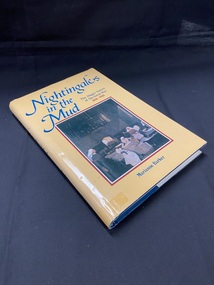
Book - Hardcover book, Marianne Barker, Nightingale in the mud : the Digger Sisters of the Great War 1914-1918, 1989
... History of Nursing World War One 1914-1918 WW1 WWI Nurses Australia Great War Nurses 'Draws on many first-hand and previously unpublished accounts of the work of Australian nurses in the Great War to tell an extraordinary story of courage and companionship under conditions of great hardship - in the mud of Flanders, among the cholera cases in India, on the hospital ships during the Gallipoli campaign, on Afghanistan border, in Vladivostok, in mosquito infested Macedonia, and in the Sinai Desert. - from inside dustjacket. Contents note: pt. 1. The Middle East -- 1. Enlistment -- 2. Egypt -- 3. Hospital ships -- 4. Lemnos -- 5. Malta -- 6. Palestine ...'Draws on many first-hand and previously unpublished accounts of the work of Australian nurses in the Great War to tell an extraordinary story of courage and companionship under conditions of great hardship - in the mud of Flanders, among the cholera cases in India, on the hospital ships during the Gallipoli campaign, on Afghanistan border, in Vladivostok, in mosquito infested Macedonia, and in the Sinai Desert. - from inside dustjacket. Contents note: pt. 1. The Middle East -- 1. Enlistment -- 2. Egypt -- 3. Hospital ships -- 4. Lemnos -- 5. Malta -- 6. Palestine -- 7. Mesopotamia -- 8. India -- 9. Serbia and Salonika -- pt. 2. The Western Front -- 10. The Australian base hospitals in France -- 11. The casualty clearing stations -- 12. Transport in France -- 13. Home hospitals in England -- 14. Repatriation -- Epilogue -- Appendix: Roll of Nurses. - from Trove record.Blue hardcover book with a yellow dustjacket. The title is printed down the spine in blue text. The front cover shows an image of an oil painting of nurses tending the beds of the wounded, it is surrounded by a dark red border. Above the image the title is printed in blue, with 1914-1918 printed in smaller red print.non-fiction'Draws on many first-hand and previously unpublished accounts of the work of Australian nurses in the Great War to tell an extraordinary story of courage and companionship under conditions of great hardship - in the mud of Flanders, among the cholera cases in India, on the hospital ships during the Gallipoli campaign, on Afghanistan border, in Vladivostok, in mosquito infested Macedonia, and in the Sinai Desert. - from inside dustjacket. Contents note: pt. 1. The Middle East -- 1. Enlistment -- 2. Egypt -- 3. Hospital ships -- 4. Lemnos -- 5. Malta -- 6. Palestine -- 7. Mesopotamia -- 8. India -- 9. Serbia and Salonika -- pt. 2. The Western Front -- 10. The Australian base hospitals in France -- 11. The casualty clearing stations -- 12. Transport in France -- 13. Home hospitals in England -- 14. Repatriation -- Epilogue -- Appendix: Roll of Nurses. - from Trove record.history of nursing, world war one 1914-1918, ww1, wwi, nurses australia, great war nurses -
 Returned Nurses RSL Sub-branch
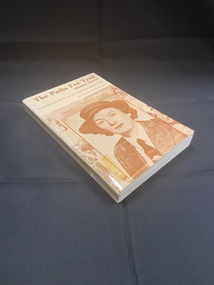
Book, Elizabeth Burchill, The paths I've trod: autobigraphy of an Australian nurse, 1981
... world. Cherishing the ideals of Florence Nightingale in peace and war, Sister Burchill volunteered to serve in Ethiopia during the Italian-Abyssinian War in 1936, nursed refugee children during the Spanish Civil War in 1937 and served with the 2nd AIF in Palestine and Egypt in 1940. Following six years as a member of the Australian Army Nursing Service, she took another challenging path, becoming involved in radio broadcasting [Working for 3SR Radio Station, Shepparton p185], writing and lecturing for the Commonwealth Institute in England. Six years later she returned to nursing and started the first ...'Dora Elizabeth Burchill was born in Hawthorn, Victoria and trained as a triple certificate nurse in Melbourne and London. Proving that nursing is the best passport for travel she subsequently travelled widely and became registered as a nurse in seven countries of the world. Cherishing the ideals of Florence Nightingale in peace and war, Sister Burchill volunteered to serve in Ethiopia during the Italian-Abyssinian War in 1936, nursed refugee children during the Spanish Civil War in 1937 and served with the 2nd AIF in Palestine and Egypt in 1940. Following six years as a member of the Australian Army Nursing Service, she took another challenging path, becoming involved in radio broadcasting [Working for 3SR Radio Station, Shepparton p185], writing and lecturing for the Commonwealth Institute in England. Six years later she returned to nursing and started the first full-time infant welfare clinic in Darwin for the Northern Territory Department of Health and remained in this important post of increasing development in post-war Darwin for five years. Sister Burchill continued this work in Thursday Island and the Sepik District of New Guinea into the 1960s. Many published articles in magazines and newspapers and five published books testify to her skill and determination as a factual writer. ?Innamincka?, is her best-known book. Seeking further worthwhile challenges in the 1970s, Sister Burchill studied for the Higher School Certificate which resulted in her earning a place in the Faculty of Arts, Monash University. She graduated as Bachelor of Arts in 1981. In 1986, she graduated as Bachelor of Letters at the University of Melbourne. Includes index. Bibliography: p. [249]-250. Medicine. Nursing. Burchill, Elizabeth, 1908-. Australia. Biographies (ANB/PRECIS SIN 0516392). Includes bibliographical references (pages 249-250) and index.' From TroveSepia toned paperback book with title and author details printed in brown text along spine and cover. Front cover shows a sepia photo of an Army Nurse overlaying an image of soldiers, camels and a ship.non-fiction'Dora Elizabeth Burchill was born in Hawthorn, Victoria and trained as a triple certificate nurse in Melbourne and London. Proving that nursing is the best passport for travel she subsequently travelled widely and became registered as a nurse in seven countries of the world. Cherishing the ideals of Florence Nightingale in peace and war, Sister Burchill volunteered to serve in Ethiopia during the Italian-Abyssinian War in 1936, nursed refugee children during the Spanish Civil War in 1937 and served with the 2nd AIF in Palestine and Egypt in 1940. Following six years as a member of the Australian Army Nursing Service, she took another challenging path, becoming involved in radio broadcasting [Working for 3SR Radio Station, Shepparton p185], writing and lecturing for the Commonwealth Institute in England. Six years later she returned to nursing and started the first full-time infant welfare clinic in Darwin for the Northern Territory Department of Health and remained in this important post of increasing development in post-war Darwin for five years. Sister Burchill continued this work in Thursday Island and the Sepik District of New Guinea into the 1960s. Many published articles in magazines and newspapers and five published books testify to her skill and determination as a factual writer. ?Innamincka?, is her best-known book. Seeking further worthwhile challenges in the 1970s, Sister Burchill studied for the Higher School Certificate which resulted in her earning a place in the Faculty of Arts, Monash University. She graduated as Bachelor of Arts in 1981. In 1986, she graduated as Bachelor of Letters at the University of Melbourne. Includes index. Bibliography: p. [249]-250. Medicine. Nursing. Burchill, Elizabeth, 1908-. Australia. Biographies (ANB/PRECIS SIN 0516392). Includes bibliographical references (pages 249-250) and index.' From Trovenursing in warfare, elizabeth burchill, world war two, wwii, ww2, china-ethiopian war, spanish civil war, australian army nursing service
