
Showing 25 items matching "floor polish"
-
 Mont De Lancey
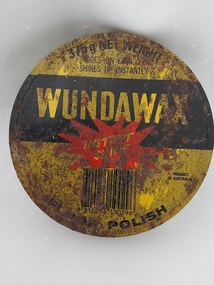
Functional object - Wundawax Polish Tin, Nabisco Pty Ltd, c1950's
... ...Floor polish...This vintage 375g Nabisco Pty Ltd Wundawax Floor Polish was used to shine wooden floors...A flat round vintage Wundawax Floor Polish tin with a removable lid and polish contents inside. ...The yellow and black lid has a red star in the middle with 'Instant Shine' in yellow letters. 'WUNDAWAX Floor Polish' is also on the top. Around the edge of the lid 'WUNDAWAX' is printed in yellow lettering as well as '375g Net Weight' 'Goes on easily Shines up instantly' is on the lid at the top. ...This vintage 375g Nabisco Pty Ltd Wundawax Floor Polish was used to shine wooden floors Cleaning equipment Cleaning products Floor polish The yellow and black lid has a red star in the middle with 'Instant Shine' in yellow letters. ...c1950's. This vintage 375g Nabisco Pty Ltd Wundawax Floor Polish was used to shine wooden floorsA flat round vintage Wundawax Floor Polish tin with a removable lid and polish contents inside. The top of the yellow and black lid has a red star in the middle with 'Instant Shine' in yellow letters. Around the edge of the lid 'WUNDAWAX' is printed in red lettering as well as '375g Net Weight'. 'Product of Australia' is in small black print on the right side of the top of the lid.' The lid cannot be opened.The yellow and black lid has a red star in the middle with 'Instant Shine' in yellow letters. 'WUNDAWAX Floor Polish' is also on the top. Around the edge of the lid 'WUNDAWAX' is printed in yellow lettering as well as '375g Net Weight' 'Goes on easily Shines up instantly' is on the lid at the top. A black barcode is printed at the bottom on the top of the lid - numbers 9 310034 100296. As the lid is rusted it is not very clear to see.cleaning equipment, cleaning products, floor polish -
 Flagstaff Hill Maritime Museum and Village
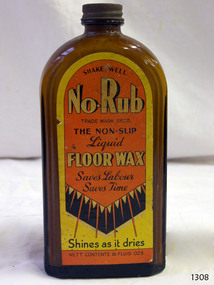
Container - Bottle, J R Alexander & Sons Ltd, c. 1936
... ...floor polish...The firm made a range of household cleaning products such as floor wax, shoe polish and fabric starch. The J R Alexander & Sons Ltd. ...The firm made a range of household cleaning products such as floor wax, shoe polish and fabric starch. The J R Alexander & Sons Ltd. ...This bottle labelled No Rub liquid wax proclaims the wonders of No-Rub, no-slip, and shines as it dries. The bottle still contains some of the liquid floor wax, made by J R Alexander & Sons Limited. The company was registered as a limited company from 1924 to 1975. However, the firm's advertisement and referrals from satisfied Melbourne customers, printed in The Argus, Melbourne, on Mach 19th, 1954, states that it made the first shoe polish, Supreme, in Australia as long ago as 1900. The firm made a range of household cleaning products such as floor wax, shoe polish and fabric starch. The J R Alexander & Sons Ltd. No-Rub liquid wax was advertised in various states of Australia from around 1936 until the 1950s. Later advertisements show sketches of the wax containers, which were round bottles or metal cans. The bottle in our collection is likely to be made around the 1960s.Bottle; brown glass with metal cap and yellow, orange and black label on the front. Flat rectangular-shaped bottle with a short neck and rounded shoulders The bottle has a black metal screw top lid and contents inside. There are inscriptions on the label. The bottle contains No Rub Floor Wax. Made by J R Alexander and Sons, of Adelaide, Melbourne, Sydney and BrisbanePrinted on the label: "SHAKE WELL" "No-Rub" TRADE MARK REGD." "THE NON-SLIP / Liquid / FLOOR WAX / Saves Labour / Saves Time" "Shines as it dries" "NETT CONTENTS 15 FLUID OZS"flagstaff hill, flagstaff hill maritime museum and village, warrnambool, maritime museum, maritime village, great ocean road, shipwreck coast, glass technology, bottle, glass bottle, brown glass, cleaning product, floor cleaner, floor polish, domestic cleaner, no-rub, floor wax, non-slip, flat bottle, bottle contents, liquid wax, j r alexander & sons, household cleaning, cleaning products, zippy starch, zippy window cleaner, liquid floor wax, no rub floor wax, supreme shoe polish, rectangular bottle -
 Kiewa Valley Historical Society
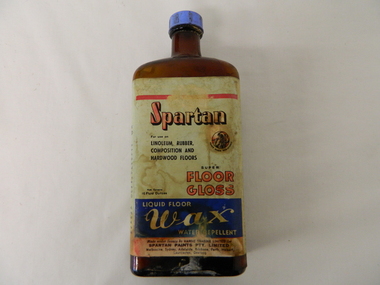
Bottle - Liquid Wax, mid 1900's
... floor cleaners...liquid polish...This bottle of liquid floor polish was manufactured before 1960(taken over by Wattyl) in a period when most of the floors in high traffic areas were covered in linoleum. ...This bottle of liquid floor polish was manufactured before 1960(taken over by Wattyl) in a period when most of the floors in high traffic areas were covered in linoleum. ...This bottle of liquid floor polish was manufactured before 1960(taken over by Wattyl) in a period when most of the floors in high traffic areas were covered in linoleum. Most of the floors using this product during this period would have been kitchens and laundries. During this period the cleanliness of the kitchen, hallways and eateries had to appear clean (cleanliness was a sign of a bacteria free area). This was a priority for kitchens, mess areas(SEC Hydro Scheme facilities) and connecting walkways. The cleanliness attitude was enhanced in the rural areas due to the "dirty" farm work not impinging upon the residential home.When Mount Beauty was first inhabited all the residential and worker's facilities were a prime area for linoleum floor surfaces. The liquid floor polish was in great demand, "a polished floor is a clean floor".This bottle of liquid floor polish is very significant to the Kiewa Valley, not only that it covers the floors of every home and residential barracks of the first major development of a "town" now known as Mount Beauty but also it demonstrates that the "cleanliness" approach of early Australians living areas in the rural regions was "on par" with its city cousins. It is the smaller types of mores that underlie the "mushrooming" cultural and psyche "wholeness" of an ever expanding Australian culture.This brown opaque glass bottle with an oblong shape has a blue coloured "screw on" cap. It has a "wrap around" label glued firmly on the bottle and covers the front and sides.On the front main label under a red line, "SPARTAN" underneath in smaller print "For use on" below this, "LINOLEUM, RUBBER, COMPOSITION AND HARDWOOD FLOORS" besides this is an encircled Trade Mark of a "Spartan Warrior holding a spear and shield" these word follow the curviture of the circle and are below it "TRADE MARK REGISTERED" Below this are "SUPER FLOOR GLOSS" to the left in very small print "Nett Contents 16 Fluid Ounces". Below this on a blue background and in white print"LIQUID FLOOR WAX WATER REPELLENT". On the bottom of the label "Made under licence by HARDIE TRADING LIMITED for SPARTAN PAINTS PTY, LIMITED" below this in small print "Melbourne, Sydney, Adelaide, Brisbane, Perth, Hobart, Launceston, Geelong. Embossed on the bootm of the glass is" G/Mfloor cleaners, liquid polish, "hygienic" clean floors. -
 Mont De Lancey
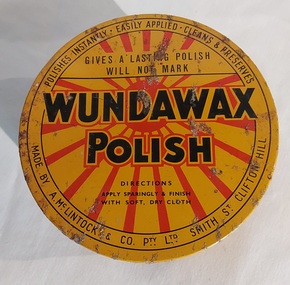
Functional object - Wundawax Furniture Polish Tin, A. McClintock & Co. Pty. Ltd, c1950's
... The lid has red sun rays in the middle with 'Gives a Lasting Polish Will Not Mark' at the top in black letters. 'WUNDAWAX Floor Polish' is also on the top as well as 'Directions Apply Sparingly & Finish with a Soft Cloth'. ...Cleaning equipment Cleaning products Furniture polish The lid has red sun rays in the middle with 'Gives a Lasting Polish Will Not Mark' at the top in black letters. 'WUNDAWAX Floor Polish' is also on the top as well as 'Directions Apply Sparingly & Finish with a Soft Cloth'. ...c1950's. This vintage 12 oz Nabisco Pty Ltd Wundawax Furniture Polish was used to shine wooden furniture.A flat round vintage Wundawax Furniture Polish tin with a removable lid and polish contents inside. The top of the yellow and black lid has red sun rays in the middle with 'WUNDAWAX POLISH' in black lettering outlined in yellow and red. There are directions included. Around the edge of the top lid is the manufacturer's details. On the base of the tin is printed in black bold lettering WUNDAWAX POLISH 'Net Weight 12 oz when packed'. The lid can be opened to show wax in the tin.The lid has red sun rays in the middle with 'Gives a Lasting Polish Will Not Mark' at the top in black letters. 'WUNDAWAX Floor Polish' is also on the top as well as 'Directions Apply Sparingly & Finish with a Soft Cloth'. Around the edge of the lid 'WUNDAWAX' is printed in yellow lettering as well as '' Around the edge of the lid inside black lines is printed ' Polishes Instantly. Easily applied. Cleans and Preserves Made by A. McClintock & Co. Pty. Ltd. Smith Street Clifton Hill' 'Net Weight 12 oz when packed'.cleaning equipment, cleaning products, furniture polish -
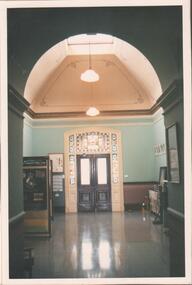 Bendigo Historical Society Inc.
Photograph - FORTUNA COLLECTION: PHOTOGRAPH
... Photo shows an entrance doorway with double doors, leadlight above and both sides of doors, domed ceiling, polished floor...Photo shows an entrance doorway with double doors, leadlight above and both sides of doors, domed ceiling, polished floor Photograph FORTUNA COLLECTION: PHOTOGRAPH ...Photograph, colour on backing board. Photo shows an entrance doorway with double doors, leadlight above and both sides of doors, domed ceiling, polished floorfortuna villa, photograph -
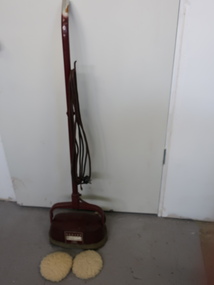 Kiewa Valley Historical Society
Floor Polisher
... Model 0212 enabled Hoover to diversify their floor care range as they turned their attention to non carpeted floors. It came with polishing brushes, lambs wool polishing pads for furniture, and with optional scrubbing brushes. ...Model 0212 enabled Hoover to diversify their floor care range as they turned their attention to non carpeted floors. It came with polishing brushes, lambs wool polishing pads for furniture, and with optional scrubbing brushes. ...Hoover Model 0212 was advertised in Australia 1951 - 1956. Model 0212 enabled Hoover to diversify their floor care range as they turned their attention to non carpeted floors. It came with polishing brushes, lambs wool polishing pads for furniture, and with optional scrubbing brushes. Used over wood, lino, tiles, rubber and cork.Used by a resident of the Kiewa ValleyMaroon long steel handle missing a cover at the top end. There is a long electric cord attached as the cord is wound onto the handle. The handle is fixed to a barrel which moves along the surface of the floor being cleaned. The motor rotates 2 round rotary brushes which clean the floor. There is a strip of rubber around the base. "The Hoover Electric Polisher - Model 0212 ..""Hoover Ltd. Great Britain"hoover floor polisher, electric polisher -
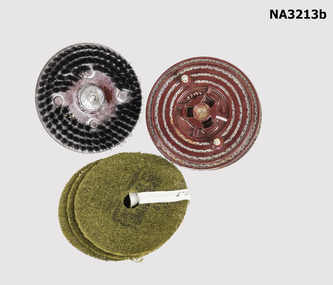 Whitehorse Historical Society Inc.
Equipment - Floor Polisher, c1954
... Used by donors for polishing wooden and lino floor in the 1950s and 1960s in their home at 16 McDowall Street, Mitcham....Three brush 'Electrolux' floor Polisher/ Scrubber with polish container and three scrubber brushes, and a remotely operated polish container. ...Three brush 'Electrolux' floor Polisher/ Scrubber with polish container and three scrubber brushes, and a remotely operated polish container. ...Used by donors for polishing wooden and lino floor in the 1950s and 1960s in their home at 16 McDowall Street, Mitcham.Three brush 'Electrolux' floor Polisher/ Scrubber with polish container and three scrubber brushes, and a remotely operated polish container. It has a 'tee' shape handle which is adjustable in height to polish under tables etc. There is provision for attaching a polish container to the polisher. Flow of polish ie regulated by a chain attached to handle. Handle also has clips for holding the power cord when stored. Body of polisher is squat triangular- shape finished in red and gunmetal grey. There is a heavy rubber skirt surrounding the area where the brushes rotate.|Model B9 Serial CME 6005498 on plate at back.Electrolux Made in Australia - plate at front|Electrolux insignia on front|Plate at back gives power details and serial number.domestic items, cleaning -
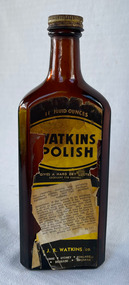 City of Moorabbin Historical Society (Operating the Box Cottage Museum)
Domestic object - Watkins Polish, J. R. Watkins Co (USA), 20thC
... PRINTED ON LABEL: 11 Fluid ounces - WATKINS POLISH - Gives a hard dry lustre excellent for Dusting For cleaning, dusting and polishing furniture, pianos, woodwork, linoleum, hardwood floors and all polished surfaces. ...Watkins Co Highett Polish PRINTED ON LABEL: 11 Fluid ounces - WATKINS POLISH - Gives a hard dry lustre excellent for Dusting For cleaning, dusting and polishing furniture, pianos, woodwork, linoleum, hardwood floors and all polished surfaces. ...The J. R. Watkins Co. opened its first overseas branch in Australia in 1935. The J. R. Watkins built a large factory at Highett on a six acres on the east side of Nepean Highway (no. 1123) in 1954. The J. R. Watkins company was founded in 1868 in Plainview, Minnesota USA, moving to Winona in 1885, by J. R. Watkins.Example of industry in the City of Moorabbin.Amber glass bottle with a metal screw on lid. A paper label is on the front of the bottle 'Watkins Polish" printed in yellow, black and white.PRINTED ON LABEL: 11 Fluid ounces - WATKINS POLISH - Gives a hard dry lustre excellent for Dusting For cleaning, dusting and polishing furniture, pianos, woodwork, linoleum, hardwood floors and all polished surfaces. Directions: If the article to be polished is dirty or gummy, clean it by washing with mild soap and warm water. Apply Watkins Polish with a damp, soft cloth (Dampened with water and wrung almost dry). The Polish may be poured on the damp cloth or on the surface to be polished. In either case rub it all with a dry cloth to obtain a high polish. When dusting, dampen the cloth with Watkins Polish - it keeps down the dust and gives a lustre which is neither greasy not gummy. The J. R. Watkins Co. Melbourne - Sydney - Adelaide - Kogarah EMBOSED ON BOTTLE: "The J.R.Watkins co. Made in Australia" the j. r. watkins co, highett, polish -
 National Wool Museum
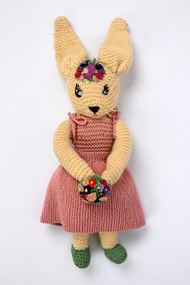
Craft - Toy Rabbit, 1959
... One and sometimes two prisoners did the heavy cleaning of floors, windows and furniture polishing. I remember one prisoner down on his hands and knees polishing the lino in the long hallway to a bright gleam, and when a prisoner was helping in the residence, ‘Aunty’ Elsie, the prisoner and I would always have morning tea together in the kitchen. ...One and sometimes two prisoners did the heavy cleaning of floors, windows and furniture polishing. I remember one prisoner down on his hands and knees polishing the lino in the long hallway to a bright gleam, and when a prisoner was helping in the residence, ‘Aunty’ Elsie, the prisoner and I would always have morning tea together in the kitchen. ...This knitted toy rabbit was given to the donor as a child, made by a prisoner at the Geelong Gaol. The donor spent Christmas holidays at the gaol, below are some of her memories of these times: Eric Stafford was the Governor of Geelong Gaol and he and Elsie Stafford lived in the Governor’s residence at the front of the gaol where I stayed during Christmas holidays from about 1959 to 1962. ‘Aunty’ Elsie had the help of prisoners with the housework. One and sometimes two prisoners did the heavy cleaning of floors, windows and furniture polishing. I remember one prisoner down on his hands and knees polishing the lino in the long hallway to a bright gleam, and when a prisoner was helping in the residence, ‘Aunty’ Elsie, the prisoner and I would always have morning tea together in the kitchen. The backyard of the Governor’s residence was divided in two. The kitchen window overlooked the front part of the yard and I was allowed to play there with the dogs as ‘Aunty’ Elsie could keep an eye on me. The back part of the yard was behind a gated wall and I was not allowed in there as prisoners worked on the back garden, the chook pen and doing general maintenance – although I sometimes sneaked in with the dogs to see the chooks and have a chat but was called back. In the back there was a large padlocked iron bound door in the large bluestone wall which ‘Uncle’ Eric could open. A couple of times he took me through this door which opened into the gaol’s large vegetable garden. I only went twice as a didn’t like going there because all the prisoners working there would stop doing what they were doing, stand and silently stare at me. Of course holidaying in Geelong there was always the great beach and carnival rides. ‘Aunty’ Elsie and I would walk to and from the beach and on the way home would stop and buy an ice cream at the nearby shop. Sometimes we would buy an ice cream for ‘Uncle’ Eric and if there weren’t any vans, prisoners or visitors in the gaol entrance courtyard I was allowed to take the ice cream to ‘Uncle’ Eric in his office after ‘Aunty’ Elsie phoned him from the residence. ‘Uncle’ Eric had a sheep farm in Meredith and sometimes he took a prisoner with him to do some work on the farm. I can remember on the way to the farm sitting in the front seat of the vehicle squeezed in between ‘Uncle’ Eric and a prisoner with the dogs and equipment in the back tray. - Donor, 2025Woollen cream knitted toy rabbit in a knitted pink dress with a knitted green petticoat, knitted green panties and a little knitted cream rabbit tail. Holding a bouquet of felt flowers and a coronet of felt jewels on the forehead. Wool embroidered eyes, nose and mouth, and whiskers of silk cord.geelong gaol, craft, prison, prisoner, governor geelong gaol, holidays, childhood, working life, eric stafford, elsie stafford, geelong, meredith, rabbit, toy, knitting, hand made -
 City of Melbourne Libraries
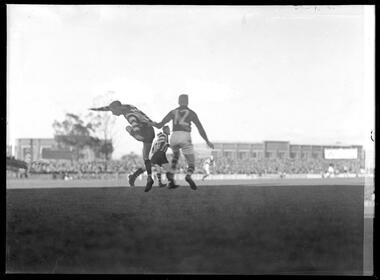
Photograph, Bull, Hugh Jones, 1897-1993, Collingwood v Richmond at Victoria Park 9 May 1936 (1/3)
... After the game, the new rooms were to host a soirée on a polished dance floor larger than the one at Collingwood Town Hall (by invitation - members only). ...After the game, the new rooms were to host a soirée on a polished dance floor larger than the one at Collingwood Town Hall (by invitation - members only). ...If ya don’t mind, umpire?? The ball and the umpire are nowhere in sight as Richmond FC’s greatest goal scorer (and champion ballroom dancer), the always chatty publican, JACK “SKINNY” TITUS (970 goals, 294 games), reaches into his bottomless bag of sneaky tricks, and appears to be infringing Collingwood FC fullback, JACK “SNOZZLE” REGAN! It was a bad day at the office for the Tigers, and for the talkative “Skinny”. He scored six of the Tigers’ 10 goals, but Regan was mentioned in every post-game wrap-up as one of the outstanding players afield. “Snozzle” went on to win the Magpies’ 1936 Best and Fairest trophy by the narrowest of margins, no doubt helped by the votes he received in this game. I’m tipping this is one thing you wouldn’t have heard Skinny yapping about! Featured in "Newsworthy: Melbourne in photographs 1933-1936" exhibition at East Melbourne Library, October to December 2023. Exhibition caption by project volunteer, Ernie Ward. Photographer notations on slide: "Richmond v Collingwood football B107" Collingwood v Richmond at Victoria Park 9 May 1936 Attendance: 25,000-30,000 (capacity); Weather: fine with a light breeze from north to south Collingwood had unfurled their 10th Premiership Flag before the game, and also officially opened their fancy new members only club rooms. After the game, the new rooms were to host a soirée on a polished dance floor larger than the one at Collingwood Town Hall (by invitation - members only). Collingwood had beaten Richmond easily in the previous year’s Preliminary Final. Both teams had come off a good Round One victory. The Sporting Press – and, since betting on football was illegal, the SP Bookies – had Richmond as slight favourites. The scene was set for one of the “games of the season”. But, alas, it was not to be. The Magpies ambushed the Tigers from the very first bounce. The Tigers won most of the aerial battles, but the ‘Pies’ small men dominated all over the ground. Collingwood had kicked eight goals straight by quarter-time. By half-time, they had 14 goals and only two behinds. In his 17th season, legendary full forward GORDON “NUTS” COVENTRY (1901-1968) had bagged seven majors by the long break, scoring an eight before the full-time bell. The contest was over by half-time. The Tigers reportedly battled out the second half as the travelling Tiger Army and the Sporting Press had come to expect! But that’s easy to say when a six-goal flogging is also a 36-point drubbing – especially when it’s the hated Collingwood FC handing out the punishment. After the game, Richmond FC were in for a “good hard look at themselves” (this is known as a “rebuild” in 2023), and missed out playing Finals for the first time since 1926. Collingwood were right on their usual track and would go on to win the 1936 Premiership. The normal order of things was restored! Collingwood 16.12.108 defeated Richmond 10.12.72. EPW Featured in "Newsworthy: Melbourne in photographs 1933-1936" exhibition at East Melbourne Library, October to December 2023. Exhibition caption by project volunteer, Ernie Ward.Photographer notations on slide: "Richmond v Collingwood football B107".football, 1930-1939 -
 City of Melbourne Libraries
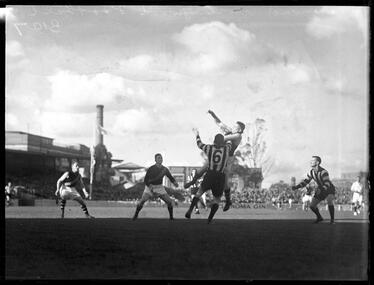
Photograph, Bull, Hugh Jones, 1897-1993, Collingwood v Richmond at Victoria Park 9 May 1936 (2/3)
... After the game, the new rooms were to host a soirée on a polished dance floor larger than the one at Collingwood Town Hall (by invitation - members only). ...After the game, the new rooms were to host a soirée on a polished dance floor larger than the one at Collingwood Town Hall (by invitation - members only). ...GO THE PUNCH, SHEAHAN, YA LEGEND!!! MAURIE SHEAHAN, 121-game Tiger fullback and member of the “Three Musketeers” Defensive Line, tries to punch the ball, preventing Gordon “Nuts” Coventry from marking and scoring another of his eight goals for the afternoon! In his 17th season, “Nuts” was giving a by now familiar hands-on demonstration of why, 87 years later, the Coventry name should be forever emblazoned behind the Northern goal of Docklands Stadium. Another Musketeer, Richmond’s 12-season, 209-game Life Member, tough KEVIN O’NEILL (left), waits hopefully for any crumbs. DANNY GUINAINE, a rugged Tigers utility player who played 10 seasons and 110 games, is also on the scene. Maurie’s son John played 17 games, and Danny’s son Paddy played 146 games at Punt Road in the 1960s, proving again that Tiger blood will always be thicker than water. Featured in "Newsworthy: Melbourne in photographs 1933-1936" exhibition at East Melbourne Library, October to December 2023. Exhibition caption by project volunteer, Ernie Ward. Photographer notations on slide: "Richmond v Collingwood football B107" Collingwood v Richmond at Victoria Park 9 May 1936 Attendance: 25,000-30,000 (capacity); Weather: fine with a light breeze from north to south Collingwood had unfurled their 10th Premiership Flag before the game, and also officially opened their fancy new members only club rooms. After the game, the new rooms were to host a soirée on a polished dance floor larger than the one at Collingwood Town Hall (by invitation - members only). Collingwood had beaten Richmond easily in the previous year’s Preliminary Final. Both teams had come off a good Round One victory. The Sporting Press – and, since betting on football was illegal, the SP Bookies – had Richmond as slight favourites. The scene was set for one of the “games of the season”. But, alas, it was not to be. The Magpies ambushed the Tigers from the very first bounce. The Tigers won most of the aerial battles, but the ‘Pies’ small men dominated all over the ground. Collingwood had kicked eight goals straight by quarter-time. By half-time, they had 14 goals and only two behinds. In his 17th season, legendary full forward GORDON “NUTS” COVENTRY (1901-1968) had bagged seven majors by the long break, scoring an eight before the full-time bell. The contest was over by half-time. The Tigers reportedly battled out the second half as the travelling Tiger Army and the Sporting Press had come to expect! But that’s easy to say when a six-goal flogging is also a 36-point drubbing – especially when it’s the hated Collingwood FC handing out the punishment. After the game, Richmond FC were in for a “good hard look at themselves” (this is known as a “rebuild” in 2023), and missed out playing Finals for the first time since 1926. Collingwood were right on their usual track and would go on to win the 1936 Premiership. The normal order of things was restored! Collingwood 16.12.108 defeated Richmond 10.12.72.Photographer notations on slide: "Richmond v Collingwood football B107".football, 1930-1939 -
 City of Melbourne Libraries
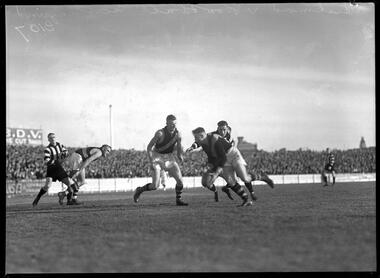
Photograph, Bull, Hugh Jones, 1897-1993, Richmond v Collingwood at Victoria Park 9 May 1936 (3/3)
... After the game, the new rooms were to host a soirée on a polished dance floor larger than the one at Collingwood Town Hall (by invitation - members only). ...After the game, the new rooms were to host a soirée on a polished dance floor larger than the one at Collingwood Town Hall (by invitation - members only). ...Tiger Goal-Sneak snags third major DICK HARRIS (548 goals, 5th highest Richmond FC of all time, 196 games) scores a trademark goal from the forward pocket, despite the attentions of JACK REGAN (future fullback on Collingwood Team of the Century). A future Richmond FC Hall of Famer, Harris, described by teammate Jack “Captain Blood” Dyer as the “toughest little player I have ever seen”, is ably assisted by Tiger followers, baker DAVE BASSETT (46 games in 3 seasons until forced to retire with a back injury), and fireman BERT FOSTER (133 games,12 seasons, died on duty in 1941). Accompanying our photograph is a series of five sequential images taken by The Globe High Speed Camera of the same on-field action from the same location. These images appeared four days later on the front page of the midweek Melbourne Sporting Globe (photographer unknown). Featured in "Newsworthy: Melbourne in photographs 1933-1936" exhibition at East Melbourne Library, October to December 2023. Exhibition caption by project volunteer, Ernie Ward. Photographer notations on slide: "Richmond v Collingwood football B107" Collingwood v Richmond at Victoria Park 9 May 1936 Attendance: 25,000-30,000 (capacity); Weather: fine with a light breeze from north to south Collingwood had unfurled their 10th Premiership Flag before the game, and also officially opened their fancy new members only club rooms. After the game, the new rooms were to host a soirée on a polished dance floor larger than the one at Collingwood Town Hall (by invitation - members only). Collingwood had beaten Richmond easily in the previous year’s Preliminary Final. Both teams had come off a good Round One victory. The Sporting Press – and, since betting on football was illegal, the SP Bookies – had Richmond as slight favourites. The scene was set for one of the “games of the season”. But, alas, it was not to be. The Magpies ambushed the Tigers from the very first bounce. The Tigers won most of the aerial battles, but the ‘Pies’ small men dominated all over the ground. Collingwood had kicked eight goals straight by quarter-time. By half-time, they had 14 goals and only two behinds. In his 17th season, legendary full forward GORDON “NUTS” COVENTRY (1901-1968) had bagged seven majors by the long break, scoring an eight before the full-time bell. The contest was over by half-time. The Tigers reportedly battled out the second half as the travelling Tiger Army and the Sporting Press had come to expect! But that’s easy to say when a six-goal flogging is also a 36-point drubbing – especially when it’s the hated Collingwood FC handing out the punishment. After the game, Richmond FC were in for a “good hard look at themselves” (this is known as a “rebuild” in 2023), and missed out playing Finals for the first time since 1926. Collingwood were right on their usual track and would go on to win the 1936 Premiership. The normal order of things was restored! Collingwood 16.12.108 defeated Richmond 10.12.72. EPW Featured in "Newsworthy: Melbourne in photographs 1933-1936" exhibition at East Melbourne Library, October to December 2023. Exhibition caption by project volunteer, Ernie Ward.Photographer notations on slide: "Richmond v Collingwood football B107".football, 1930-1939 -
 Ringwood and District Historical Society
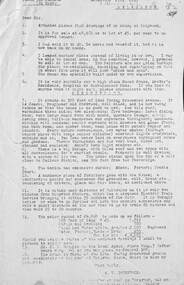
Letter, Property for sale - Ringwood Shop and Dwelling Estate, Ringwood, Victoria - circa 1925
... Floors throughout are the very best, close set, stained and polished; dainty lead light windows etc. 8. ...Floors throughout are the very best, close set, stained and polished; dainty lead light windows etc. 8. ...ID 5225 note: Further information relating to allotments marked on the hand-drawn plan are included in ID 5224 - Ringwood Station Estate.Typewritten letter from A.V. Greenwood with hand drawn plan of Ringwood Shop and Dwelling Estate, detailed description of property for sale, and top and side elevation views of house. (7 pages)(Transcript of first page - to unknown recipient) Phone 988 Central, 331 Canty Greenwood Pty. Ltd. 5 Flinders Street Melbourne. Dear Sir, 1. Attached please find drawings of my house at Ringwood. 2. It is for sale at £4,865 or to let at £5 per week to an approved tenant. 3. I sold it to Mr. De Garis and vacated it, but it is now back on my hands. 4. I leased another place instead of living in my own. I may be able to cancel same; in the meantime, however, I propose to sell or let my own. The painters are now going through the place; re-varnishing, re-oiling and re-polishing so that in about five days it will look "spick and span". 5. The house was specially built under my own supervision. 6. It is very suitable for a high class Guest House, Doctor's residence, Hospital or Convalescent Home. If you know of anyone whom it might suit, please communicate with them. DESCRIPTION 7. It stands on 305 feet of land facing Greenwood Avenue. It is cement, roughcast and hardwood, well oiled, and is now being redone so that the house is as good as new; red tile roof; verandahs three sides; two sleep-outs; five bedrooms; large dining room; very large music room with nooks, upstairs lounge, study; sewing room; built-in wardrobes and cupboards throughout; handsome kitchen with handsome pantry cupboard with drawers and glass front; one bath room; one shower room; wash house with patent copper and laundry. Every modern convenience, hot water system (through copper pipes with large copper cylinder) electric lights everywhere, outside and in, Yan Yean water laid on everwhere throughout house and gardens. Floors throughout are the very best, close set, stained and polished; dainty lead light windows etc. 8. There is a big garage, with tiled roof and two rooms with all conveniences for a married couple. Property is well drained with a system of its own. The house stands upon the top of a hill close to Railway Station, say 500 feet from the Footbridge. 9. The garden has expansive shrubs; sheds; fernery; tennis court. 10. A handsome piece of furniture goes with the house; a combination pantry and storeroom for groceries, milk, bread etc., consisting of drawers, glass and wire doors, as mentioned above. 11. It is within easy distance of Melbourne as it is only two minutes from Ringwood Station, which is a frequent electric train service bringing it within 39 minutes of the City. It is thought better by some to go further out into the country atmosphere and walk a short distance at the end than to go by train 20 minutes then walk 15 to 20 minutes. 12. The price quoted of £4,865 is made up as follows - 305 feet of land @ £5 ... £1,515 Garage and dwelling ... £300 House hot water system, American cupboard ... £2,600 Water, fencing, sheds & drain ... £250 For the lot ... £4,865 Should you require copies of the enclosed drawings I shall be pleased to supply same. 13. Mr. J.B. McAlpin is the local agent, Phone Ring. 7 (after hours Ring. 44) or you may phone me Central 988. 14. The house is south of the line, facing Greenwood Avenue and immediately at the back of Ringwood House, which is also my property. Yours sincerely, A.V. Greenwood (illegible) ..... (Transcript of second page) RINGWOOD SHOP AND DWELLING ESTATE See these letters on plan attached (H.) Ringwood House and Shops on 100 by 150 feet of land fronting Bedford Road 100 feet @ £10 per foot - £1,000 House and shops - £2,400 ... £3,400 Ringwood House consists of Boarding House, (Phone 101) and two shops, mainly brick; 9 inch walls. Will carry another story. Has music room, dining room, entrance halls, 10 bedrooms, large verandahs, all conveniences, hot and cold water, and stands on what will become a most valuable business corner. (F.)(G.) Mr. Greenwood's house, garage and sheds, stands on 307 feet of land fronting Greenwood Avenue. See detailed description attached ... £4,865 (J.) Cottage on Block 81 in William Street ... £750 (K.) Cottage in Pitt Street ... £650 (Total) £9,665 ..... (Description of third page - Subdivision Plan) Drawn by Edyth Greenwood, phone 988 Central. Subdivision includes Station Street, Pitt Street, Bedford Road, Wantirna Road, James Street, William Street (later Kendall Street), Greenwood Avenue, Ellison Street, and Haig Street. Circles denote blocks for sale. Squares denote house properties for sale. Other features marked include location of businesses along Main Street (Maroondah Highway), cool store, railway station, shop and police station on Bedford Road, church on Station Street, site of schoolmaster's residence and State School, and location of proposed public baths -
 Mission to Seafarers Victoria
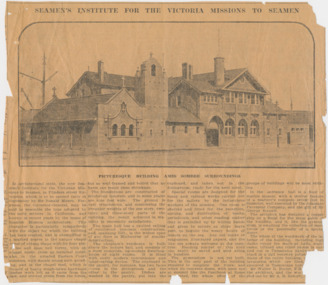
Article, Herald, Seamen's Institute for the Victoria Missions to Seamen, 30 August 1917
... The whole of the woodwork of the in terior of the building, including high dados round the walls of halls, stair cases, billiard and other rooms is car ried out in Tasmanian hardwood, fin ished in a dull beeswax polish, and the floors of the entire building, except the lavatories, which are tiled, are also executed in Tasmanian hardwood. ...The whole of the woodwork of the in terior of the building, including high dados round the walls of halls, stair cases, billiard and other rooms is car ried out in Tasmanian hardwood, fin ished in a dull beeswax polish, and the floors of the entire building, except the lavatories, which are tiled, are also executed in Tasmanian hardwood. ...SEAMEN'S INSTITUTE FOR THE VICTORIA MISSIONS TO SEAMEN In architectural style, the new Seamen's Institute for the Victorian Missions to Seamen, in Flinders street Extension which is to be opened early in September by Sir Ronald Munro Ferguson, the Governor-General, may be said to resemble the type adopted by the early settlers in California, and known in recent years by the name of Spanish Mission architecture. This character is particularly sympathetic with the object for which the building has been erected, and is exemplified in a marked degree in the unique chapel tower of oblong shape with its four pinnacles and open bell turret, with an almost rustic cross as terminal point: also in the arcaded Eastern Court cloisters, with simple round arch arcading, and in the chapel roof, which is framed of heavy rough-hewn hardwood timber work left as it came from the saw, and erected green from the forest. but so well framed and bolted that no harm can result from shrinkage. The foundations are constructed of reinforced concrete, and in some places are nine feet wide. The ground is very treacherous, and considering the irregular weights of the one story, two-story, and three-story parts of the building, the result achieved in sta bility is eminently satisfactory. The main hall has a vaulted ceiling of reinforced concrete construction, and, spanning 35f., is the widest span of any floor in Melbourne of similar construction. The chaplain's residence is built above the lecture hall, and consists of a most complete, up-to-date dwelling-house of eight rooms. It is fitted with every modern convenience and labor-saving device. The cupboard in the pantry, for instance, has two faces — one in the diningroom and the other in the pantry. Dishes are washed in the pantry, put into the cupboard, and taken out in the diningroom, ready for the next meal. Special rooms are designed for the many and various works carried out for the sailors by the industrious workers of the mission. One room is shelved and fitted for the reception, sorting, and distribution of books, periodicals, and other reading matter that is parcelled up by willing hands and given to sailors as ships leave port, to beguile the weary hours of leisure on the sea. Any old books or magazines, illustrated papers, and the like are always welcome at the insti tute. Reading matter of this kind can easily be saved and sent along in bundles. The gymnasium is not yet built. This is the only part of the building required to complete the block; and when its concrete dome, with open eye at summit like the Pantheon at Rome is erected, the whole effect of the groups of buildings will be most striking. In the entrance hall is a floor of marble mosaic, with a central feature of a mariner's compass seven foot in diameter, well executed by the Adamant Pavement Company, and the gift of Mr George Russell. The architect has designed a copper ship as a finial for the main gable of the building, and it, like the gymnasium, is awaiting the collection of more funds or the generosity of a special donor. The whole of the woodwork of the in terior of the building, including high dados round the walls of halls, stair cases, billiard and other rooms is car ried out in Tasmanian hardwood, fin ished in a dull beeswax polish, and the floors of the entire building, except the lavatories, which are tiled, are also executed in Tasmanian hardwood. Mr Walter R. Butler, F.R.I.B.A., was the architect, and the work was carried out by Mr A. B. Robertson, builder. PICTURESQUE BUILDING AMID SOMBRE SURROUNDINGSThe article gives a valuable description of the Mission at the end of its construction and before its opening.4 columns article with photograph of the front of the Missionlady fraser, walter richmond butler (1864–1949), architecture, spanish mission, california, reinforced concrete, tasmanian hardwood, gymnasium, norla dome, pantheon, adamant pavement company, george russell, compass, finail, weathervane, chaplain's residence, manse, chapel, courtyard, cloisters, main hall, spannig -
 Kiewa Valley Historical Society
Polisher Floor, Hoover Appliances, Meadowbank
... This hoover electric floor scrubber and polisher has a main base containing two brushes (can be replaced with polishing pads). ...On the front of the blue coloured plastic dome covering the electric motor is (on a raised domed shaped plaque (on a red background) Hoover in slanted print from left to right(in a diagonal level) This hoover electric floor scrubber and polisher has a main base containing two brushes (can be replaced with polishing pads). ...This appliance was a time saving method of cleaning floors. It appeared at a time (after World War II) when the domestic pressures faced by mothers and domestic staff was on the increase. The necessary "working parents" was through necessity becoming part of the "typical" family environment. It was the start of the ever increasing demand, from an economical reason, for both parents to work outside their property. Historically the period of the 1950s was one of extreme changes. It was an era where established role models were under pressure from an ever increasing demand for new and advancing consumerism. Communication levels via radio, newspapers and television was expanding at an ever increasing rate. Relatively isolated rural areas were opening up (post war) to foreign ideologies of consumerism. The basic restraints of "this will be alright mate, she'll do" was under a slow but effective take over. "I can get this done faster by this new whiz bang gadget that I saw on the TV last night!" was the new way to live by.This item is very significant in that it demonstrates the new consumerism at its infant stage of the social changes occurring due to greater communication levels between the rural Australian communities and other advancing communities world wide. The Kiewa Valley residents (mainly from the intermingling of rural and post World War II refugees working at the construction of the Victorian Hydro electricity installations, resulted in this rural area becoming integrated to new ways of living (both socially and economically). Once the attitude of "we have always done it this way mate!" was challenged and overcome, the acceptance of new time saving "gadgets" which started to pour in from foreign markets, the relative isolation of the Kiewa Valley (being mainly psychological entrenched), was over.This hoover electric floor scrubber and polisher has a main base containing two brushes (can be replaced with polishing pads). The two brushes/pads are fastened or removed from the base unit by pulling/pushing the heads from the small hexagonal shaft on the bottom of the machine motor. A pressure sensitive wire is inlaid at the brush/pad end to hold the brush/pad unit onto the shaft. The discs body and main body covering the electric motor are made from sturdy plastic. The rest of the appliance materials i.e. upright handle and the u framed attaching arm are made from lightweight powder coated steel. A small (350mm) red coloured foot switch protrudes from the back of the motor to release the the upright handle from the storage position to the action position.There are two fork shaped brackets on the rear of the handle, for securing the 6.5 metre long electrical cord and plug. There is no on/off switch on the appliance. A small stainless steel "u" framed clip (for hanging the appliance in the vertical position) for cupboard storage. Within the circle of the cleaning brush is stamped "1 above S.A.B.351" and on the opposite side P/No: 5023792". On the main plastic head of the brush discs are "TO CLEAN" and under this "USE ONLY WARM(underlined) WATER AND SOAP" on the opposite side, and within a circle is the Hoover Trademark. On the front of the blue coloured plastic dome covering the electric motor is (on a raised domed shaped plaque (on a red background) Hoover in slanted print from left to right(in a diagonal level)domestic appliances, floor cleaning, electric floor scrubbers and polishers -
 Bendigo Historical Society Inc.
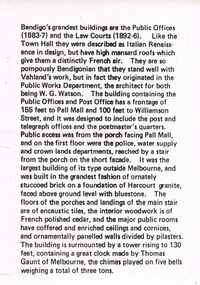
Document - LETTER DESCRIBING BENDIGO'S GRANDEST BUILDINGS
... The floors of the porches and landings of the main stair are of encaustic tiles, the interior woodwork is of French polished cedar, and the major public rooms have coffered and enriched ceilings and cornices, and ornamentally panelled walls divided by pilasters. ...The floors of the porches and landings of the main stair are of encaustic tiles, the interior woodwork is of French polished cedar, and the major public rooms have coffered and enriched ceilings and cornices, and ornamentally panelled walls divided by pilasters. ...Bendigo's Grandest Buildings are the Public Offices (1883-7) and the Law Courts (1892-6). Like the Town Hall they were described as Italian Renaissance in Design, but have high mansard roofs which give them a distinctly French air. They are so pompously Bendigonian that they stand well with Vahland's work, but in fact they originated in the Public Works Department, the architect for both being W.G. Watson. The building containing the Public Offices and Post Office has a frontage of 155 feet to Pall Mall and 100 feet to Williamson Street, and it was designed to include the post and telegraph offices and the postmaster's quarters. Public access was from the porch facing Pall Mall, and on the first floor were the police, water supply and crown lands departments, reached by a stair from the porch on the short façade. It was the largest building of its type outside of Melbourne, and was built in the grandest fashion of ornately stuccoed brick on a foundation of Harcourt granite, faced above ground level with bluestone. The floors of the porches and landings of the main stair are of encaustic tiles, the interior woodwork is of French polished cedar, and the major public rooms have coffered and enriched ceilings and cornices, and ornamentally panelled walls divided by pilasters. The building is surmounted by a tower rising to 130 feet, containing a great clock made by Thomas Gaunt of Melbourne, the chimes played on five bells weighing a total of three tons.bendigo, buildings, state offices -
 Bendigo Historical Society Inc.
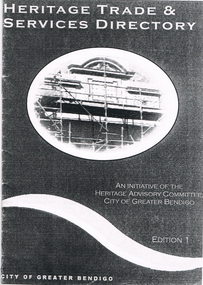
Book - LONG GULLY HISTORY GROUP COLLECTION:HERITAGE TRADE & SERVICES DIRECTORY
... Listed are: Architectural Hardware; Architects; Blacksmiths; Brickwork - General; Builders; Castings - Iron and Non Ferrous Metals; Cement Decoration and Rendering; Chimney Pots; Chimney Restoration; Chimney Sweeps; Colour Consultant; Concrete - Pre-cast; Damp Control; Drafting Service; Fabric; Fencing; Fire Mantels and Inserts; Floor Coverings; Furniture Restoration and French Polishing; Garden Renovations; Glass - Etching; Glass - Leadlighting; Guttering, Galvanised Iron and Sheet Metal Work; Interior Decorating; Joinery and Carpentry; Light Fittings; Masonry Cleaning; Paint; Painters and Decorators; Paint Stripping; Plasters and Associated Products; Resurfacing - Enameling; Resurfacing - Powder Coating; Restumping and Underpinning; Roof Restoration - Iron; Roof Restoration - Slate; Roof Restoration - Terracotta; Second Hand Materials; Stone - Quarries and Cutting; Stonemasons; Tile Layers; Tiles; Turning and Verandah Roofing....Listed are: Architectural Hardware; Architects; Blacksmiths; Brickwork - General; Builders; Castings - Iron and Non Ferrous Metals; Cement Decoration and Rendering; Chimney Pots; Chimney Restoration; Chimney Sweeps; Colour Consultant; Concrete - Pre-cast; Damp Control; Drafting Service; Fabric; Fencing; Fire Mantels and Inserts; Floor Coverings; Furniture Restoration and French Polishing; Garden Renovations; Glass - Etching; Glass - Leadlighting; Guttering, Galvanised Iron and Sheet Metal Work; Interior Decorating; Joinery and Carpentry; Light Fittings; Masonry Cleaning; Paint; Painters and Decorators; Paint Stripping; Plasters and Associated Products; Resurfacing - Enameling; Resurfacing - Powder Coating; Restumping and Underpinning; Roof Restoration - Iron; Roof Restoration - Slate; Roof Restoration - Terracotta; Second Hand Materials; Stone - Quarries and Cutting; Stonemasons; Tile Layers; Tiles; Turning and Verandah Roofing. ...Copy of a Heritage Trade & Services Directory Edition 1, dated April 2001. Compiled by City of Greater Bendigo Heritage Advisory Committee. Front cover has an oval picture of part of a building with scaffolding in front of it. Listed are: Architectural Hardware; Architects; Blacksmiths; Brickwork - General; Builders; Castings - Iron and Non Ferrous Metals; Cement Decoration and Rendering; Chimney Pots; Chimney Restoration; Chimney Sweeps; Colour Consultant; Concrete - Pre-cast; Damp Control; Drafting Service; Fabric; Fencing; Fire Mantels and Inserts; Floor Coverings; Furniture Restoration and French Polishing; Garden Renovations; Glass - Etching; Glass - Leadlighting; Guttering, Galvanised Iron and Sheet Metal Work; Interior Decorating; Joinery and Carpentry; Light Fittings; Masonry Cleaning; Paint; Painters and Decorators; Paint Stripping; Plasters and Associated Products; Resurfacing - Enameling; Resurfacing - Powder Coating; Restumping and Underpinning; Roof Restoration - Iron; Roof Restoration - Slate; Roof Restoration - Terracotta; Second Hand Materials; Stone - Quarries and Cutting; Stonemasons; Tile Layers; Tiles; Turning and Verandah Roofing.bendigo, history, long gully history group, the long gully history group - heritage trade & services directory, heritage advisory committee, city of greater bendigo -
Coal Creek Community Park & Museum
Tin, polish, c. 1928
... Polimop Hyginic Polish Mop Cylindrical shaped metal container with push on lid, Yellow base colour with a black dotted border, red and black text and depicting a lady mopping the floor. ...Cylindrical shaped metal container with push on lid, Yellow base colour with a black dotted border, red and black text and depicting a lady mopping the floor.Polimop Hyginic Polish Mop -
 RMIT Design Archives
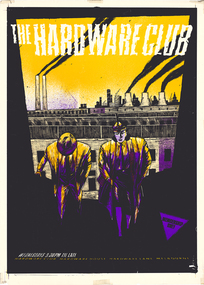
Posters, The Hardware Club, 1983
... Hardware Houses rooms were perfectly suited for the purpose, its polished wooden floorboards ideal for a dance floor,mezzanine floor for spectators, and crucially the Club had two bars and a 24 hour licence. ...Hardware Houses rooms were perfectly suited for the purpose, its polished wooden floorboards ideal for a dance floor,mezzanine floor for spectators, and crucially the Club had two bars and a 24 hour licence. ...The Hardware Club was established in the 1980s in Hardware House, Hardware Lane Melbourne by Andrew Maine, Jules Taylor and Paul Jackson, who all worked together at 3RRR. Artists, fashion designers, and musicians all flocked to the Club in the 1980s. It was the place to experiment with fashion and dance to dawn at a time when may venues closed early. Hardware Houses rooms were perfectly suited for the purpose, its polished wooden floorboards ideal for a dance floor,mezzanine floor for spectators, and crucially the Club had two bars and a 24 hour licence. Initially the trio from 3RRR took over the club on Friday nights only , and then other nights followed. In 1983 graphic Designer Robert Pearce was commissioned to design this poster for The Hardware Club. According to Jules Taylor it was inspired by "subways of New York with a touch of Berlin and Film Noir ..." Ann Carewdesign, graphic design, australian fashion -
Clunes Museum
Container, J. KITCHEN & SONS PTY. LTD
... FLOOR SMOOTH AND FAST. FIRST SWEEP IT WELL THEN SPRINKLE IT WITH FLOORFAST TOGETHER WITH A QUANTITY OF SAW DUST. AFTER FLOORFAST HAS BEEN WORKED IN, EITHER BY POLISHING SLAB OR DANCERS FEET, THE SAW DUST MAY BE SWEPT OFF. ...FLOOR SMOOTH AND FAST. FIRST SWEEP IT WELL THEN SPRINKLE IT WITH FLOORFAST TOGETHER WITH A QUANTITY OF SAW DUST. AFTER FLOORFAST HAS BEEN WORKED IN, EITHER BY POLISHING SLAB OR DANCERS FEET, THE SAW DUST MAY BE SWEPT OFF. ...FLOORFAST USED ON CLUNES TOWN HALL FLOOR. CONTENTS SPREAD ON DANCE FLOOR TO MAKE FLOOR SMOOTH AND FAST. FIRST SWEEP IT WELL THEN SPRINKLE IT WITH FLOORFAST TOGETHER WITH A QUANTITY OF SAW DUST. AFTER FLOORFAST HAS BEEN WORKED IN, EITHER BY POLISHING SLAB OR DANCERS FEET, THE SAW DUST MAY BE SWEPT OFF. GIVES SPLENDID RESULTS. SPECIALLY PREPARED BY J. KITCHEN & SONS PTY. LTD.CONTAINER - FLOORFAST FOR BALLROOM FLOORS. CONTENTS TO MAKE BALLROOM FLOORS FAST.local history, commercial, container, entertainment -
 Brighton Historical Society
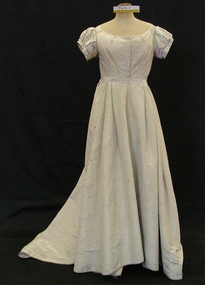
Clothing - Dress, Wedding dress, 1868
... Polish descent) at the Melbourne Hebrew Congregation in Bourke Street, Melbourne on 5 September 1868. Julia was the daughter of Joseph Benjamin and Hannah Soloman. Records suggest it may have been converted into her 'calling' gown for the three month 'bridal' period following her marriage. The gown would have been worn with accompanying accessories of a cape and gloves. An early example of a wedding dress of the Melbourne Jewish community. julia benjamin abraham smith joseph benjamin hannah soloman melbourne hebrew congregation wedding dress One piece floor ...This dress was worn by Julia Benjamin (1850-1927) for her marriage to Abraham Smith (of Polish descent) at the Melbourne Hebrew Congregation in Bourke Street, Melbourne on 5 September 1868. Julia was the daughter of Joseph Benjamin and Hannah Soloman. Records suggest it may have been converted into her 'calling' gown for the three month 'bridal' period following her marriage. The gown would have been worn with accompanying accessories of a cape and gloves.An early example of a wedding dress of the Melbourne Jewish community.One piece floor length dress of (originally) lavender, watered (moiré) silk taffeta with short sleeves and train that is controlled by interior tapes to create bustle effect. The bodice fastens down the centre front to the waist where the opening below the waist is concealed by side pleats. The bodice appears to have originally featured a piece of lace at the neckline and a textile ruched belt. The dress is backed with a cream cotton.julia benjamin, abraham smith, joseph benjamin, hannah soloman, melbourne hebrew congregation, wedding dress -
 Wodonga & District Historical Society Inc
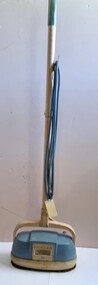
Domestic object - Floor Polisher, Hoover Ltd. Great Britain, 1950
... Floor Polisher”. It came complete with Scrubbers, Felt Pads, Lambswool Pads and Built - in Head Light and in 1952 sold for £32/8/-, or could be purchased with a deposit of £8 and weekly payments of 15/-. They claimed that the Hoover Polisher would take the drudgery out a woman’s work and appealed to men by saying the lambswool pads could be used to perfectly polish the headlights and duco of cars....Floor Polisher”. It came complete with Scrubbers, Felt Pads, Lambswool Pads and Built - in Head Light and in 1952 sold for £32/8/-, or could be purchased with a deposit of £8 and weekly payments of 15/-. They claimed that the Hoover Polisher would take the drudgery out a woman’s work and appealed to men by saying the lambswool pads could be used to perfectly polish the headlights and duco of cars. ...The history of Hoover dates back to the early 1900s and directly to Mr. James M. Spangler, an American janitor who invented the first vacuum cleaner to assist in dealing with his asthma. Originally founded in Ohio in 1908, Hoover Limited became a registered company in the United Kingdom in 1919. The first factory, in Perivale, Middlesex, England, opened in 1932. Hoover became the undisputed leader in the floor-cleaning market, so much so that in USA vacuuming became referred to as “hoovering”. This model was widely advertised in Australia from 1952 to 1958. Advertisements referred to it as “The Wonderful Hoover Floor Polisher”. It came complete with Scrubbers, Felt Pads, Lambswool Pads and Built - in Head Light and in 1952 sold for £32/8/-, or could be purchased with a deposit of £8 and weekly payments of 15/-. They claimed that the Hoover Polisher would take the drudgery out a woman’s work and appealed to men by saying the lambswool pads could be used to perfectly polish the headlights and duco of cars.This item is represented of domestic appliances used throughout Australia in the 1950s and 1960sAn upright Hoover electric polisher made from die-cast aluminium with Bakelite outer casing and electrical components.On plate attached to back: THE HOOVER ELECTRIC POLISHER MODEL 0212A./TRADE MARK D.C. OR A.C. 0-60) CYCLES VOLTS / 300 WATTS RATING SERIAL NOPF 533695 PROTECTED BY PATENTS, REGISTERED DESIGNS AND TRADE MARKS IN GREAT BRITAIN AND THE PRINCIPAL COUNTRIES OF THE WORLD MADE BY HOOVER LTD. GREAT BRITAINhoover appliances, domestic appliances -
 Kew Historical Society Inc
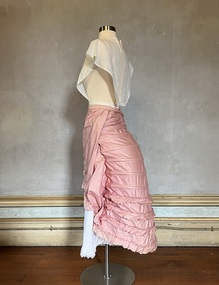
Clothing - Pink lobster-tail bustle, c. 1875
... An exceptionally rare and fine, floor length, 'lobster tail' bustle that belonged to Alice Henty possibly worn with her two-piece pink silk gown but also with other dresses that she owned that required a bustle of this shape. The structure of the bustle includes an outer layer of polished...A number of the items in the collection are very rare survivors, and provide researchers with the evidence needed to reconstruct the lives of notable women in the Port Phillip District [later Victoria] during the nineteenth and early twentieth century. fashion -- 1870s Alice Frances (Henty) Hindson Women's clothing bustles underwear An exceptionally rare and fine, floor length, 'lobster tail' bustle that belonged to Alice Henty possibly worn with her two-piece pink silk gown but also with other dresses that she owned that required a bustle of this shape. The structure of the bustle includes an outer layer of polished ...This full length lobster tail bustle was owned and worn by Alice Frances Henty, the daughter of Francis Henty and Mary Ann (Lawrence) Henty. Bustles of this form date from the mid-1860s however this example probably dates from the mid 1870s, and perhaps from before her marriage to John Hindson in 1876. Alice's father, Francis Henty, was the youngest son of Thomas Henty, who with his family, their retainers and property moved to the Australian colonies between 1829 and 1832. In 1834, Francis’ older brother, Edward, sailed from Launceston in Van Diemen’s Land to what was to become Portland in the western part of Port Phillip District [Victoria]. Francis, together with the first flock of Merino sheep [in Victoria], followed some months later. The first and second generations of the Henty family established vast pastoral properties in the Western part of the Port Phillip District. Francis Henty managed ‘Merino Downs’ near Casterton, while also living in his retirement at ‘Field Place' in Kew.The Henty Collection of nineteenth and twentieth century clothing, including outerwear and underwear, was collected, stored and exhibited over time by female family members descended from Francis and Mary Ann Henty. During the twentieth century, items from the collection were modelled in two fashion parades by various descendants [1937, 1959]. The items in the collection are historically and aesthetically significant, with provenance provided by oral and written tradition within or held by the family. A number of the items in the collection are very rare survivors, and provide researchers with the evidence needed to reconstruct the lives of notable women in the Port Phillip District [later Victoria] during the nineteenth and early twentieth century.An exceptionally rare and fine, floor length, 'lobster tail' bustle that belonged to Alice Henty possibly worn with her two-piece pink silk gown but also with other dresses that she owned that required a bustle of this shape. The structure of the bustle includes an outer layer of polished cotton with inserted steel hoops and ties at the front. The lower four hoops have flounces of the same fabric. Overall, the bustle contains 12 hoops, crossed nearer the waist and semi-circular for the remainder of the undergarment. [One of the tapes of the bustle is imprinted with the word lockstitch. Elias Howe invented the lockstitch sewing machine in 1846.] Measurements (mm): BUSTLE: Girth - Waist 660 Vertical - Front waist to hem 914, Back waist to hem 965.fashion -- 1870s, alice frances (henty) hindson, women's clothing, bustles, underwear -
 City of Melbourne Libraries
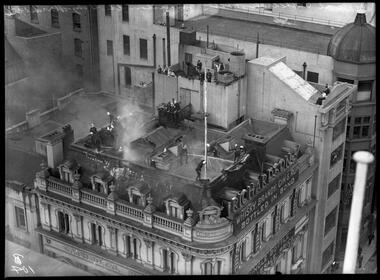
Photograph, Bull, Hugh Jones, 1897-1993, Fire at Cathedral Hotel, Swanston Street, Melbourne
... The crowd were enthralled by “a thrilling spectacle when three firemen walked along the stone coping on the top floor of the building and, despite the clouds of smoke and sheets of flame which shot through the roof, they ripped off the hot slate tiles and provided an outlet for the flames”. The firemen are noteworthy for their highly polished...The crowd were enthralled by “a thrilling spectacle when three firemen walked along the stone coping on the top floor of the building and, despite the clouds of smoke and sheets of flame which shot through the roof, they ripped off the hot slate tiles and provided an outlet for the flames”. The firemen are noteworthy for their highly polished ...Fire at the Cathedral Hotel! Bird’s eye view These firemen on the roof of the Cathedral Hotel are very bold in their approach to firefighting! One heroically aims a firehose at the roof while another holds onto the flagpole with one hand as he walks around the narrow edge, three storeys up! Onlookers from adjacent buildings make the most of their front row view, and The Age reported that on street level, hundreds of people gathered to watch, enthralled by “a thrilling spectacle when three firemen walked along the stone coping on the top floor of the building and, despite the clouds of smoke and sheets of flame which shot through the roof they ripped off the hot slate tiles and provided an outlet for the flames”. The Cathedral Hotel was built in 1883 and demolished in 1966 to make way for the City Square. Featured in "Newsworthy: Melbourne in photographs 1933-1936" exhibition at East Melbourne Library, October to December 2023. Exhibition caption by project volunteer, Louise McKenzie. Photographer notations on slide: "Fire at Cathedral Hotel Swanston St City March 1936 B104" Description: View looking down on roof of the Cathedral Hotel showing 16 firefighters battling a fire. There is smoke coming through the roof. Onlookers watch from adjoining buildings, not perturbed by the proximity of the fire. The firemen look bold and impressive in their brass helmets. Research by project volunteer, Louise McKenzie: The Age reported on 4 March 1936 that the fire broke out in rubbish between the roof space and wooden ceiling of the Cathedral Hotel at 4.30 pm. “The Eastern Hill fire brigade was notified by telephone, and an almost simultaneous call was also received at fire brigade headquarters from a street alarm.” These red fire alarm call boxes were typically installed on street corners, and when the knob was turned, a pulsed electric signal corresponding to the box’s number was received at fire headquarters. A large detachment of firemen with full fire-fighting equipment, including two large extension ladders, were quickly on the scene, pouring vast quantities of water into the hotel, causing several hundred pounds of damage to hotel and guest property, but quickly bringing the fire under control. Lengths of hose had to be carried through the front entrance and up several flights of stairs. On street level hundreds of people gathered to watch, but were controlled by police in order to keep them at a safe distance and ensure that tram and motor traffic was not seriously disorganised. The crowd were enthralled by “a thrilling spectacle when three firemen walked along the stone coping on the top floor of the building and, despite the clouds of smoke and sheets of flame which shot through the roof, they ripped off the hot slate tiles and provided an outlet for the flames”. The firemen are noteworthy for their highly polished brass helmets, known as Merryweather helmets, based on those of French sapeurs-pompiers and introduced to the British Metropolitan Fire Brigade in London in 1868. Metal helmets are conductive, a safety issue as the use of electricity became widespread, so a composite cork and rubber helmet was introduced in London from 1936. In Queensland, traditional brass helmets remained in service until 1970. The firemen are very bold in their actions – one heroically aiming a fire hose at the roof of the building, another holding onto the flagpole with one hand as he walks around the narrow top edge of the roof, three storeys up! The onlookers from adjoining buildings are interested in the spectacle, rather than dismayed by the fire. Lettering around the building exterior reads "Cathedral Hotel - Erected 1883". Prominent signage for “Richardson’s whisky, brandy, gin & rum" sits along the edge of the roof. The Cathedral Hotel was located on the corner of Swanston Street and Flinders Lane. It was built in 1883, and its name derived from St Paul’s Cathedral on the south side of Flinders Lane. It was demolished in 1966 as Melbourne City Council wished to create a City Square. Robyn Annear notes that at the time, the development was referred to as “Whelan’s Square” due to the large number of buildings which needed to be demolished to create the Square. Ironically the Hotel had been the victim of a previous fire in 1917, when its then licensee, also named Whelan, was charged with two failed arson attempts. References: No title (1936, March 4). The Age (Melbourne, Vic. : 1854 - 1954), p. 13. Retrieved February 5, 2024, from http://nla.gov.au/nla.news-article205256255 FIRE AT A CITY HOTEL. (1936, March 4). The Age (Melbourne, Vic. : 1854 - 1954), p. 12. Retrieved February 5, 2024, from http://nla.gov.au/nla.news-article205256231 FIRE IN ROOF OF CITY HOTEL (1936, March 4). The Argus (Melbourne, Vic. : 1848 - 1957), p. 8. Retrieved February 5, 2024, from http://nla.gov.au/nla.news-article11018696 Hotel Roof Fire Draws Crowd (1936, March 4). Examiner (Launceston, Tas. : 1900 - 1954), p. 8 (DAILY). Retrieved February 5, 2024, from http://nla.gov.au/nla.news-article52000751 'Flinders Lane Melbourne 1966', Peter Andrew Barrett, Facebook, 12 June 2020, https://www.facebook.com/120943481324886/photos/a.512123662206864/3025002490918956/?type=3 Fire Alarm Call Box, Wikipedia, https://en.wikipedia.org/wiki/Fire_alarm_call_box Research notes, 'A city lost and found', Robyn Annear, https://robynannear.com/docs/whelan-the-wrecker-notes.pdfPhotographer notations on slide: "Fire at Cathedral Hotel Swanston St City March 1936 B104".fires, hotels, 1930-1939 -
 City of Melbourne Libraries
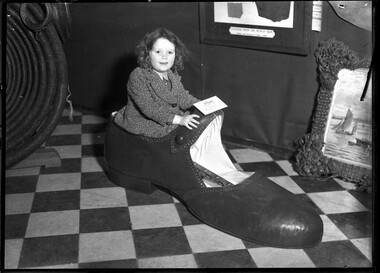
Photograph, Bull, Hugh Jones, 1897-1993, Leather Exhibition, Melbourne Town Hall
... floor space of the main Town Hall, and is subdivided by partitions running most of the length of the hall. A bewildering variety, of leather goods presses for close and leisured inspection. Here and there operatives in charge of working machinery give practical demonstrations of factory processes in the production of footwear. Polishing...floor space of the main Town Hall, and is subdivided by partitions running most of the length of the hall. A bewildering variety, of leather goods presses for close and leisured inspection. Here and there operatives in charge of working machinery give practical demonstrations of factory processes in the production of footwear. Polishing ...Photographer notations on slide: At the Leather Exhib. at T. Hall Melb 1933 Age Published: Age (Melbourne, Vic.: 1854- ), 1933 THE EXHIBITS. (1933, September 20). The Age (Melbourne, Vic. : 1854 - 1954), p. 16. Retrieved January 25, 2026, from http://nla.gov.au/nla.news-article205109730 Published title: THE EXHIBITS. A COMPREHENSIVE RANGE. Curios, Novelties, Working Displays Published Caption: ONE OF THE NOVELTIES – AN OUTSIZE IN SHOES Research by Project Volunteer, Louise McKenzie: Our photo is dated 20 September 1933, and shows a happy, chubby-faced young girl sitting in a very over-sized girl’s shoe. It is labelled – “Shoe, An Out Size, loaned by Messrs Blackman & Rose”. (1) It is an effective way to capture the attention of the readership and alert them to the Melbourne Leather Show 1933. This show was designed to be a drawcard of extraordinary proportion, and there is no doubt that this leather exhibition was a really big deal for Melbourne. It completely took over the Melbourne Town Hall, and was open from 10.30 am until 10.30 pm. It seemed to contain something for everyone – the military, the man about town, the home handyman, the housewife, the child, the sporting types, the domestic workers, the outdoor enthusiasts, the horseracing fans, car enthusiasts, those wishing to show off the latest fashion – both men and women - and those just intrigued by a lot of fascinating and wide ranging exhibits. One of the most comprehensive descriptions of the Exhibition accompanies the photograph, and is worth quoting in full: “PROMINENT among exhibits which first attract attention in the foyer of the Town Hall is a comprehensive display of leather articles used by the defence forces. A conspicuous legend states that leather plays an important part in national defence, being used for saddlery, tool containers, holdalls, range-finding, surveying and signalling equipment, explosives factories, harness accoutrement, bandsmen's equipment and clothing. Three models of horses and several figures of soldiers wearing leather equipment illustrate the lesson, and a great range of leather goods used in military training and work variegate the display. Nearby are Texas cowboy, buckjumping and breaking-in saddles; whips, a walking stick, made of leather and numerous other curios. The general exhibition occupies the whole floor space of the main Town Hall, and is subdivided by partitions running most of the length of the hall. A bewildering variety, of leather goods presses for close and leisured inspection. Here and there operatives in charge of working machinery give practical demonstrations of factory processes in the production of footwear. Polishing materials are well represented. One attractive exhibit includes two bush huts constructed of leather, with wattle bark for roofing. Opossums, rosellas and a kookaburra add touches of bush realism. Adjacent exhibits include bags, fishing boots, leggings, leather covers in all colours. Factory Processes. One exhibitor has installed an automatic cinema apparatus and screen, which projects various factory processes in making a shoe, the operator being shown at work. Elsewhere an interesting exhibit depicts the five stages in the manufacture of sole leather, and the tanning materials employed. "Very handsome effects are achieved in the interior appointments of motor cars, which are attended by figures of smart chauffeurs in leather coats. Motor-trimming leather is said to be more durable and hygienic than fabric materials, and cheaper. The neat finish of the material, its excellent appearance, certainly make a very favourable impression. It takes the hides of three beasts to cover the cushions, squabs and door panels of a full-sized sedan, while to finish the entire interior, including quarter-panels and head linings would take four or even five. Special Exhibits. Amongst the special sections the display arranged by the handicrafts and home industries- committee of the Country Women's Association of Victoria is a notable one. In all there are about 130 entries which are in four classifications, viz., hand-tooled or embossed leathers, suede, hand-made gloves and undecorated leather. The glove section attracted the most numerous entries, a number being the work of members and craft subscribers of the Country Women's Association. In the leathercraft competition, organised by the Country Women's Association, the judges yesterday awarded the first prize for bookbinding (the only prize given in this division) to Miss M. Alston, of South Yarra. There is also a creditable display of exhibits submitted by boys of the orthopaedic section of the Children's Hospital at Frankston. Amongst the novelties on view in other portions of the exhibition were the following: — Leather coats worn by Sir C. Kingsford Smith on his Atlantic flight. Model Wellington boot, Phar Lap's saddle. Melbourne Cup winner's saddle. Longest whip in world, 108 feet long. (33 metres) [See our photo, to left of Girl in Shoe] Diminutive shoes. Pair of shoes 65 years old. Pair of men's working boots 75 years old. Larwood's, Tate’s and Pataudi’s cricket boots. [Three internationally revered cricketers of the day] (2) Picture frame made of leather bought 63 years ago. [See our photo, to right of Girl in Shoe] Leather frame, powder bowl, &c. Saddle used by world's champion buckjumper in U.S.A. Mexican cowboy outfit. Miniature saddle and bridle. A fireman's helmet made of sole leather. (3) Sample of the leather hat worn by porters at the Billingsgate Fish Market, London. (4) From South Australia there have been obtained sets of harness for donkeys, goats and camels, the equipment being displayed to good advantage on stuffed representations of the animals mentioned. Close to the platform is a glass case containing snow shoes and coats which have been used in Antarctic exploration work. Trade Display. Amongst the trade exhibits may be seen in operation a slipper turn shoe sewing machine, with heeling and channelling facilities, and the various stages in the production of ladies' sandals are shown. There is a wide contrast between sole leather of varying degrees of thickness on view in one stall and the choice samples of ladies' footwear in another — footwear, by the way, which could almost be used as ornaments, so dainty in colour and production are they. Again, there are displays of upholstering leathers of such soft texture that they could he readily mistaken for some of the finest cloth. Those who may be particularly interested in the production of chamois leather may gain an insight into the materials and chemicals used in the "working up” of this variety of leather. Supplies of glace kid (5) are tastefully arranged, and there may also be seen bags of all shapes and sizes, including satchels, suit cases and "sporting" cases, and bags for tennis players and golfers. Further variety is given to the exhibition by the display of antique hides, brightly coloured, with punching balls, boxing gloves and batsman's pads. There are crocodile skins and snake skins so cleverly "Worked up" that one could be almost pardoned for betraying an affection for such unpopular creatures.” “ Another wonderful article on this Exhibition, published the same day in one of the opposition daily newspapers, The Argus, is in the weekly article “Women to Women”, entitled “A Great Victorian Industry: Many Uses for Leather”. This weekly column was penned by Vesta, and she writes, with much purpose: “Yesterday afternoon I paid a hurried visit to the Leather Exhibition now being held in the Melbourne Town Hall and I was disappointed to find that the early visitors to the main exhibition were almost all men. Women, I think, should make a point of seeing every exhibition of our great industries, for women are the buyers of household requisites and goods for their own use and their tastes, and opinion influence also, to a large extent, the purchases of men. So, the welfare of industries is more or less in their hands and it becomes a duty for them to inform themselves fully of the extent and the quality of the manufacturing that is done here. The value of the output of the Australian boot and shoe factories alone was in 1930-31, the latest year for which the figures are given, Stg 3,750,000. Fully two thirds of that amount must have been spent by women on boots and shoes for themselves and their children. In a host of other directions, in the purchase of handbags, travelling bags, belts and straps, cushions, furniture coverings, purses, notebooks, spectacle cases, their annual expenditure must be very high. Their interest, therefore, in this industry is practical, and their support of it should be governed by knowledge of comparable values and qualities of the goods they buy. From the point of view of women, however, the exhibition itself is rather disappointing. There is an amazing collection of good stuff on show, but most of it is not displayed in a fashion that attracts attention. I was surprised, for example, at the range and quality of the leathers displayed, the suppleness of the finer qualities, and the varied range of colours and designs. But they are shown in such a fashion that if one set out deliberately to look for them it would be quite easy to miss most of them.” …It was surprising, too, that no one seemed to have taken advantage of the present fashion of wearing coloured gloves, or the cult of glove making, which the Country Women’s Association has fostered so successfully. Outside the collection of chamois leathers I saw no skins which were suitable to glove making. (6) However, it is perhaps a little unfair to be highly critical of the exhibition, inasmuch as it is the first of its kind. The material is there, undoubtedly, for a splendid show of every phase of this enterprising industry, and I am confident that experience will prove to those concerned that it will be worth while next time to devote a great deal of attention of the method of display.” With further research, it transpires that “Vera” is in fact NZ born Stella May Allen (nee Henderson) (1871-1962), a journalist, the first woman in NZ to begin a law course, in 1890-91). She later worked at a law firm while she completed her degree. Study of the law had always been open to women in NZ, but its practice was still barred to them. Her case “…led to amending legislation in 1896 allowing women to practise as barristers or solicitors. However, on gaining her LL.B. in November 1897 she did not apply for admission to the Bar. Instead, she became the Wellington-based correspondent and leader-writer for the Lyttelton Times. Her appointment, the first for a woman, was not welcomed by the all-male Press Gallery, and special permission had to be obtained from a subcommittee of the House before her presence was accepted. In 1900 she married Edwin Allen, a senior leader-writer for the Wellington Evening Post, and they moved to Australia in 1903 when Edwin Allen took up the post of foreign affairs leader-writer and parliamentary man for the Melbourne Argus. As Patricia Keep notes in her excellent entry of Stella Allan in the Australian Dictionary of Biography: “In 1907 The Argus commissioned her to write a series of articles on the first Australian Women's Work Exhibition held in October. They aroused much interest and next year The Argus invited her to join its full-time staff and begin a weekly section on the particular interests of women. She adopted the nom de plume 'Vesta' and called the column 'Women to Women'. Her work was unique in an Australian daily paper at that time. Her pages extended to cover every aspect of women's affairs, children's interests and community welfare, and 'Vesta' became a household word for authoritative information and advice on such matters. An excellent needlewoman and first-rate cook herself, she thoroughly tutored her staff in the work and needs of women in both country and city, as well as providing the usual training for cadet journalists. She conducted interviews and also visited the country to see at first hand the results of bushfires, mouse plagues, droughts and floods. In 1910 she was one of three women foundation members of the Australian Journalists' Association. “…she found time to become deeply involved in community affairs. She was an original committee-member of the Victorian Association of Crèches and of the Free Kindergarten Union of Victoria, and had much to do with the early days of the Victorian Bush Nursing Association, the Baby Health Centres Association and the Queen Victoria Hospital. She was a member of the National Council of Women, first in New Zealand and then in Melbourne, and of the Country Women's Association from its inception. … in 1924 she was appointed substitute delegate for Australia to the fifth assembly of the League of Nations at Geneva and was a delegate to the second Pan Pacific Women's Conference in Hawaii in 1930. A meeting held in the Melbourne Town Hall in 1938 by representatives of all the main Victorian women's organizations paid special tribute to her work and influence. She retired next year to England where she continued to write for the Argus, contributing articles on the experiences of women and children in wartime.” It is little wonder that “Vesta” was unafraid to take to task both the women of Victoria, and those who created the exhibition! One item which appears to have gone unnoticed, or at least unreported, is a framed article in the background of the photo of the chubby girl in the shoe. The display frame is labelled “Leather from the Human Skin, Tanned and Dressed by French artists.” The exhibition was certainly a cabinet of curiosities! A charming article in The Argus is a nice note on which to end. It gives a quick history and overview of the Australian leather industry and its unprecedented, and possibly unexpected, development and success, and states with pride: “Though Victoria is the largest leather producer in the Commonwealth all tanners in the Commonwealth can look back with pride on the long march of progress.” Footnotes: (1) “Blackman and Rose”. Messrs Blackman and Rose were shoe manufacturers, from 1927 located at 200 Noone Street, Clifton Hill. The Melbourne Circle describes their building as a “fine-looking building in the Federation ‘blood and bandage’ style.” It was built around 1912 for Puttifoot and Bloom, boot manufacturers, and today the building is apartments. (2) These cricketers were household names in the day: Tate: Maurice Tate, “English cricketer of the 1920s and 1930s, and leader of England’s Test bowling attack for a long time during this period. The founder of modern seam bowling. “ Larwood: Harold Larwood, “English right-arm fast bowler and the main exponent of the bowling style known as “bodyline”. Used to considerable effect in the 1932-33 Test series in Australia. Pataudi: Iftikhar A K Pataudi, “an Indian prince who in the 1930s played Test cricket for England, and in the 1940s played Test cricket for India (as Captain) – the only test cricketer to have played for both India and England. (3) “sole” leather “… is the thickest and most resistant material existing in the tanning industry … made from vegetable tanned leathers, usually bovine butts, processed in a special way to make them the hardest type of leather in existence.” (4) The hats worn by porters at Billingsgate Fish Market were also known as a “Bobbin” and look quite squat and rather unsophisticated. They were made of wood and tarred leather, with a “flat, hardened top designed to support large rectangular boxes of fish. The upturned brim protected the porter’s head against fish juice draining from the boxes of fish which would be carried on top of the hat. Some hats featured a small drain hole at the rear to allow this collected juice to drain down the back of the carrier. The hats were made using the ‘cuir bouilli’ technique. The leather was immersed in water which was heated until the leather began to shrink. It was then removed and put on a wooden former. The leather was stitched together to make the hat while still wet, and then held in place until dry.” (See article and photo on the London Museum website) (5) Glace kid – described on the Boston Museum of Fine Arts’ Cameo database as “A smooth glossy leather originally prepared from goat or sheepskin. Early glace kid had a shiny surface that was originally prepared by tawing the skin in a mixture of alum, table salt, flour, and egg yolk. Today, glace kid is prepared from many types of vegetable or chrome tanned leathers. The smooth polished surface is obtained mechanically by shaving, glazing, ironing, and/or rolling the dry leather.” (6) In the 1930s, Melbourne’s glovemaking industry was characterised by local manufacturing, with key producers like Simpson’s Gloves Pty Ltd in Richmond and the Stagg Glove Company in Clifton Hill leading the market. These factories produced high-quality leather gloves, handbags, and specialty gear, often employing a clear gendered division of labour and training young, local women. Museum Victoria holds the Simpson’s Gloves Collection, comprising over 1200 items, and the University of Melbourne Archives holds the company’s business records. References: THE EXHIBITS. (1933, September 20). The Age (Melbourne, Vic. : 1854 - 1954), p. 16. Retrieved January 25, 2026, from http://nla.gov.au/nla.news-article205109730 EXPORT LEATHER. (1929, September 17). The Argus (Melbourne, Vic. : 1848 - 1957), p. 17. Retrieved January 19, 2026, from http://nla.gov.au/nla.news-article4037647 LEATHER EXHIBITION (1933, September 18). The Argus (Melbourne, Vic. : 1848 - 1957), p. 10. Retrieved January 19, 2026, from http://nla.gov.au/nla.news-article11693362 (1933, September 23). The Argus (Melbourne, Vic. : 1848 - 1957), p. 21. Retrieved January 19, 2026, from http://nla.gov.au/nla.news-page522766 WOMEN TO WOMEN (1933, September 20). The Argus (Melbourne, Vic. : 1848 - 1957), p. 13. Retrieved January 19, 2026, from http://nla.gov.au/nla.news-article11694034 Australian Dictionary of Biography, Stella May Allan (1871–1962) https://adb.anu.edu.au/biography/allan-stella-may-4998 WOMEN TO WOMEN (1930, January 22). The Argus (Melbourne, Vic. : 1848 - 1957), p. 13. Retrieved January 19, 2026, from http://nla.gov.au/nla.news-article4063888 Museums Victoria, Simpson’s Gloves, 486-496 Victoria Street, North Richmond, VIC, Australia https://collections.museumsvictoria.com.au/articles/2702 The Argus. (1927, October 31). The Argus (Melbourne, Vic. : 1848 - 1957), p. 20. Retrieved February 7, 2026, from http://nla.gov.au/nla.news-article3888451 Melbourne Circle: stories from the suburbs: “Boots and all in Clifton Hill” https://melbournecircle.net/2015/11/20/bootmakers-of-clifton-hill/ Wikipedia, Maurice Tate, https://en.wikipedia.org/wiki/Maurice_Tate Wikipedia, Harold Larwood, https://en.wikipedia.org/wiki/Harold_Larwood Wikipedia, Iftikhar Ali Khan Pataudi, https://en.wikipedia.org/wiki/Iftikhar_Ali_Khan_Pataudi Buy Leather Online Italy, Sole leather: https://buyleatheronline.com/en/blog/outsole-and-insole-leather-n7 London Museum, Porters hats, https://www.londonmuseum.org.uk/collections/v/object-731122/hat-porters-hat/ Cameo Database, Museum of Fine Arts, Boston, Glace Kid, https://cameo.mfa.org/wiki/Glac%C3%A9_kid VICTORIAN LEATHER HAS WON RENOWN (1937, September 22). The Argus (Melbourne, Vic. : 1848 - 1957), p. 31 (March of Progress Supplement). Retrieved February 7, 2026, from http://nla.gov.au/nla.news-article1108704 Photographer notations on slide: "At the Leather Exhib. at T. Hall Melb 1933 Age B5".displays, melbourne town hall, leather, children, shoes, 1930-1939, industry, hats, gloves
