
Showing 3 items matching "folle-farine"
-
 Flagstaff Hill Maritime Museum and Village
Book - Fictional Novel, Ouida/Marie Louise de la Ramée, Folle-Farine, 1873
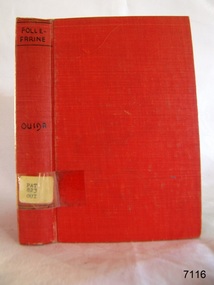
... Folle-Farine......folle-farine...Hard cover book. Folle-Farine Author: Ouida/Marie Louise de la Ramée Publisher: George Robertson Date: 1873 Further Information: Red Cloth hardcover with lettering and patterning to spine in black. ...The spine has a Library label with an inscription. Folle-Farine Book Fictional Novel Ouida/Marie Louise de la Ramée George Robertson & Co. ...Folle-Farine is the child of Reine, who fled her father, Claudis, to live among Gypsies and died giving birth. Claudis, a miller, resents the child and makes her a slave at his mill. The townspeople treat her with the same contempt, but she resists. She then meets a starving painter living in a tower, helps him and falls in love with him, but he cares only about his art. In the novel, she sells her body so that her beloved can become famous. He is so egotistical that he barely notices what it costs her, and the story ends tragically.Hard cover book. Folle-Farine Author: Ouida/Marie Louise de la Ramée Publisher: George Robertson Date: 1873 Further Information: Red Cloth hardcover with lettering and patterning to spine in black. The spine has a Library label with an inscription.fictionFolle-Farine is the child of Reine, who fled her father, Claudis, to live among Gypsies and died giving birth. Claudis, a miller, resents the child and makes her a slave at his mill. The townspeople treat her with the same contempt, but she resists. She then meets a starving painter living in a tower, helps him and falls in love with him, but he cares only about his art. In the novel, she sells her body so that her beloved can become famous. He is so egotistical that he barely notices what it costs her, and the story ends tragically.book, folle-farine, ouida, maria louise ramé, marie louise de la ramée, shipwrecked-coast, flagstaff-hill, flagstaff-hill-maritime-museum, warrnambool, maritime-museum, shipwreck-coast, flagstaff-hill-maritime-village, shipwrecked-artefact, pattison collection, warrnambool library, warrnambool mechanics’ institute, ralph eric pattison, corangamite regional library service, warrnambool city librarian, mechanics’ institute library, victorian library board, warrnambool books and records, warrnambool children’s library, great ocean road -
 The Royal Women's Hospital
Tool - Packaging, Faliere's Phosphatine container
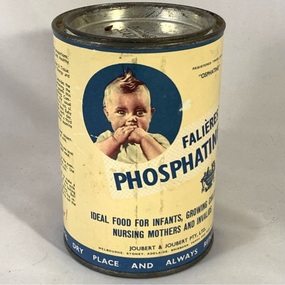
... Phosphatine Falieres was invented by pharmacist Émile Falières in the 1880s and marketed as a fortifying cereal or "farine" [flour] for infants, enriched with calcium. ...Phosphatine Falieres was invented by pharmacist Émile Falières in the 1880s and marketed as a fortifying cereal or "farine" [flour] for infants, enriched with calcium. ...Phosphatine Falieres was invented by pharmacist Émile Falières in the 1880s and marketed as a fortifying cereal or "farine" [flour] for infants, enriched with calcium. Said to be easily mixed and easily digestible, the cereal was added to an infant’s milk. It was made in Australia and distributed by a number of pharmaceutical companies, in the 1950s by Joubert & Joubert. The Phosphatine Falieres company advertised extensively, marketing to doctors, nurses, and mothers always using pictures of rosy-cheeked children. Falières created charming three-dimensional chromolithography pop-up/pop-out/moveable images many of which had a little tab. When the tab was pulled, these colourful sales props showed happy and healthy children opening a tureen of food that was fortified with Falieres cereal. The collection of Nurse Florence Green RWHA_2018_069 contains one such item of ephemera. Green was a graduate of the Women’s Hospital’s midwifery nurse training scheme in 1914. She lived at Hawthorn. The container is a cardboard cylinder with a printed label (stained) covering the entire surface. It has a metal (rusted) lid. The word "BORAX" has been written on the side. -
 Wodonga & District Historical Society Inc
Domestic object - Haeusler Collection Lactogen baby formula measuring spoon c.1920s
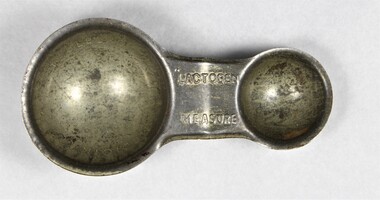
... Nestlé was formed in 1905 by the merger of the Anglo-Swiss Milk Company, established in 1866 by brothers George and Charles Page, and Farine Lactée Henri Nestlé, founded in 1866 by Henri Nestlé. ...Nestlé was formed in 1905 by the merger of the Anglo-Swiss Milk Company, established in 1866 by brothers George and Charles Page, and Farine Lactée Henri Nestlé, founded in 1866 by Henri Nestlé. ...The Wodonga Historical Society Haeusler Collection provides invaluable insight into life in late nineteenth and early twentieth century north east Victoria. The collection comprises manuscripts, personal artefacts used by the Haeusler family on their farm in Wodonga, and a set of glass negatives which offer a unique visual snapshot of the domestic and social lives of the Haeusler family and local Wodonga community. The Haeusler family migrated from Prussia (Germany) to South Australia in the 1840s and 1850s, before purchasing 100 acres of Crown Land made available under the Victorian Lands Act 1862 (also known as ‘Duffy’s Land Act’) in 1866 in what is now Wodonga West. The Haeusler family were one of several German families to migrate from South Australia to Wodonga in the 1860s. This item is a Nestlé Lactogen baby formula measuring scoop used in the preparation of formula for bottle feeding. It was used by Ilma Margaret Ernestine Haeusler (née Tasker, b.1900 in Tallangatta) to feed her son Alfred who was born in 1922. Ilma died in childbirth in 1928. This measuring spoon is one of several objects in the Haeusler Collection concerning early childhood that provide insight into family and home life in early twentieth century Wodonga. The first fully artificial infant milk formula, Farine Lactee, was developed in the 1860s. Companies continued to attempt to develop synthetic formulas which nutritionally replicated human breast milk in the decades that followed. Nestlé began producing Lactogen in 1921. It was marketed to women as a nutritionally superior substitute for breast milk, and as a nutritional supplement for breast feeding mothers. From the 1920s, when the Haeusler Collection measure was produced and used, Nestlé employed nurses in major Australian cities to promote Lactogen and its supposed health benefits to new mothers. They also used print advertisements to offer free product samples and instruction booklets advising on pregnancy and infant care for the same purpose. Nestlé was formed in 1905 by the merger of the Anglo-Swiss Milk Company, established in 1866 by brothers George and Charles Page, and Farine Lactée Henri Nestlé, founded in 1866 by Henri Nestlé. The company grew significantly during the First World War and again following the Second World War, expanding its offerings beyond its early condensed milk and infant formula products. In the twenty-first century, Nestlé has faced criticism and boycotts over its decision to market baby formula as an alternative to breastfeeding in developing countries. The adoption of bottle feeding in countries without access to clean water and sanitation infrastructure has contributed to high infant mortality rates. This item has well documented provenance and a known owner. It forms part of a significant and representative historical collection which reflects the local history of Wodonga. It contributes to our understanding of domestic and family life in early twentieth century Wodonga, as well as providing interpretative capacity for themes including local history, social history, and women’s history.Silver toned alloy measuring spoon for Lactogen infant formula, produced by food and drink manufacturing company Nestlé. Embossed with the Lactogen brand name, and teaspoon and tablespoon measurements. "LACTOGEN MEASURE" on central handle/"TABLESPOON" on large inner scoop/"TEASPOON" on small inner scoopchildren, babies, household, domestic, motherhood, family, kitchen
