
Showing 51 items matching "foot rest"
-
 Kiewa Valley Historical Society
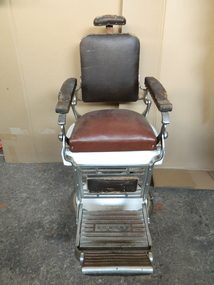
Barber's Chair
... The first factory manufactured chairs date to c1850. With a foot rest in 1878 and with a mechanically raised and lowered chair. ...The chair has a steel frame and foot rest. There is a large white enamel disc under the seat and a white enamel stand with a steel perimeter. ...Embossed on foot rest: "Raynor"...The first factory manufactured chairs date to c1850. With a foot rest in 1878 and with a mechanically raised and lowered chair. ...The first factory manufactured chairs date to c1850. With a foot rest in 1878 and with a mechanically raised and lowered chair. Chairs have an adjustable height with foot operated jack or hand operated lever on the side. The chair can also rotate, or lean backwards (for hair washing and shaving) and has a head rest .Old Barber's chairs are made from metal and leather and are heavy. Mt Beauty township had a Barber's business during the construction of the Kiewa Hydro Electric Scheme and beyond. ""Sam The Barber" was an original Kiewa character. Probably for 45 years cut the hair of thousands of Kiewa workers with his scissors, hand clippers and cut throat razor." Ref. online: "The Mt Beauty & Murray connection"Brown leather padded seat, back rest, headrest and armrest. At the front of the arm rest is a wooden section (maybe for a cuppa?). The chair has a steel frame and foot rest. There is a large white enamel disc under the seat and a white enamel stand with a steel perimeter. A metal lever joins from the back of the footrest to the base enabling the chair to be tilted back.Embossed on foot rest: "Raynor"barber's chair, hair dressing, mt beauty shops, shaving -
 Clunes Museum
Furniture - CHAIR, Howard Dunn, c1918
... Wooden chair, with arms and foot rest...James Alexander James Troup died in an accident in April 1918 chair kindergarten presbyterian church james alexander troup "To the Glory of God James Alexander Troup Clunes Presbyterian Sunday School" Wooden chair, with arms and foot rest Furniture CHAIR Howard Dunn ...Made in memory of James Alexander Troup and donated to the Presbyterian Sunday School, used by the kindergarten children when celebrating their birthday. James Alexander James Troup died in an accident in April 1918Wooden chair, with arms and foot rest"To the Glory of God James Alexander Troup Clunes Presbyterian Sunday School"chair, kindergarten, presbyterian church, james alexander troup -
 Flagstaff Hill Maritime Museum and Village
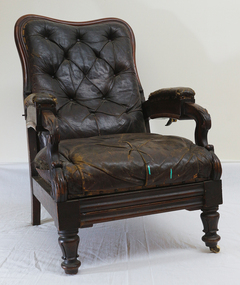
Furniture - Chair, Haberfield Chair, Michael Bradshaw, Circa 1860s-1890s
... ...foot rest...Flagstaff Hill Maritime Museum and Village Great Ocean Road Shipwreck Coast armchair reclining armchair reading board Mahogany chair Haberfield Chair furniture living room furniture domestic furniture 19th century luxury Morroco leather book stand book rest side table music stand reading stand reading rest foot rest reading table In pen and ink: “Made from Mahogany Ship wrecked near Tower Hill, July 3, 1835: made by Michael Bradshaw 18-2-“ [originally thought to read 1842] The Haberfield Chair is a reclining armchair that includes a footrest and a detachable book rest. ...This elegant reclining armchair is generously on loan from the local Haberfield family. Mrs Haberfield is a member of the Anderson family from the Tower Hill region, and the chair was handed down to her from them. When it arrived at Flagstaff Hill in 2009, it was at least 100 years old. The maker, Michael Bradshaw, is currently unknown. The origin of the chair's timber has been lost through the generations, but some have named the armchair the 'Mahogany Chair' after the legendary Mahogany Ship. In August 2009, the wood was expertly examined. The structure of the wood specimens was found to be consistent with: • Pale coloured carcass timber - Fagus sylvatica – Beech (European) • Pale coloured frame timber - Agathis sp – NZ Kauri • Dark coloured timber chair legs (solid) - Swietenia sp. – True Mahogany • Dark coloured timber veneer - Swietenia sp. – True Mahogany • Repair fill-in piece – Quercus sp. – White Oak ( Northern hemisphere) • Repair fill-in piece (fine textured) – Populus sp. – Poplar • Runner wood - Eucalyptus sp – Pale coloured ash group, or messmate The chair is significant for its local origin and history, being connected to generations of the Anderson and Haberfield families. It is also significant for its elaborate and unusual design, the quality of its workmanship and materials. It is a fine example of good quality furniture of the late 19th century.The Haberfield Chair is a reclining armchair that includes a footrest and a detachable book rest. The chair features a dark timber frame and dark burgundy (now dark brown), Morocco goat skin leather upholstery. The backrest is finished with button detailing, and its frame is distinguished by gracefully curved corners, lending the chair an elegant appearance. The chair’s padded leather armrests have attractive, crafted carvings at each end. A lever located below the armrest operates the recliner’s ratchet mechanism, which also causes a footrest to slide forward for greater comfort. The turned and carved front legs are equipped with wheels, allowing for easy movement. The removable book rest is mounted on a brass pedestal. Its angle can be conveniently adjusted using a screw to move the ball and socket joint, ensuring personalised reading comfort. There is a handwritten inscription on the underside of the back rail. The chair is kindly on loan from the local Haberfield family. In pen and ink: “Made from Mahogany Ship wrecked near Tower Hill, July 3, 1835: made by Michael Bradshaw 18-2-“ [originally thought to read 1842]flagstaff hill maritime museum and village, great ocean road, shipwreck coast, armchair, reclining armchair, reading board, mahogany chair, haberfield chair, furniture, living room furniture, domestic furniture, 19th century, luxury, morroco leather, book stand, book rest, side table, music stand, reading stand, reading rest, foot rest, reading table -
Coal Creek Community Park & Museum
Furniture - Chair, Barber's
... Large leather barber's chair on swivel base, with adjustable metal foot rest and tilting mechanism....On footrest: KIMJORD Large leather barber's chair on swivel base, with adjustable metal foot rest and tilting mechanism. Furniture Chair, Barber's ...Large leather barber's chair on swivel base, with adjustable metal foot rest and tilting mechanism.On footrest: KIMJORD -
 Flagstaff Hill Maritime Museum and Village
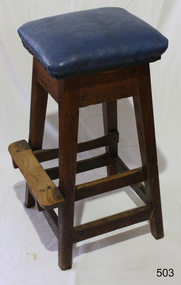
Furniture - Stool, 20th century
... Medical stool, strong wooden construction, with four legs and wooden foot rest. Seat is padded. Stool is handmade....Flagstaff Hill Warrnambool Maritime Museum Maritime Village medical furniture office furniture stool Medical stool, strong wooden construction, with four legs and wooden foot rest. Seat is padded. Stool is handmade. ...Medical stool, strong wooden construction, with four legs and wooden foot rest. Seat is padded. Stool is handmade.flagstaff hill, warrnambool, maritime museum, maritime village, medical furniture, office furniture, stool -
 Orbost & District Historical Society
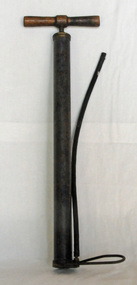
pump, first half 20th century
... It has a steel tube, a wooden handle and a metal foot rest....It has a steel tube, a wooden handle and a metal foot rest. pump ...This is an example of a once common motoring accessory no longer used.A hand-operated car tyre pump with brass fittings. It has a steel tube, a wooden handle and a metal foot rest.pump tyre-pump car-accessories -
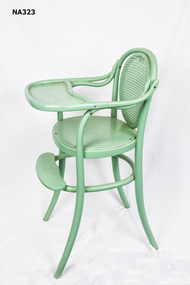 Whitehorse Historical Society Inc.
Furniture - Child's High Chair
... Bentwood style high chair painted green, oval Rattan cane insert for back rest, lift up tray, foot rest...furniture domestic-nursery Bentwood style high chair painted green, oval Rattan cane insert for back rest, lift up tray, foot rest Furniture Child's High Chair ...Bentwood style high chair painted green, oval Rattan cane insert for back rest, lift up tray, foot restfurniture, domestic-nursery -
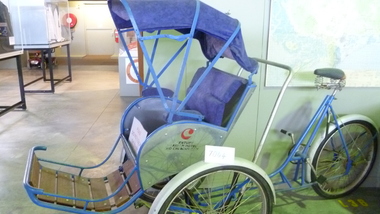 National Vietnam Veterans Museum (NVVM)
Vehicle - Rickshaw
... Predominantly blue in colour material covering the soft-top hood & padded passenger seat is timber with a slatted foot rest. It is powered by a bicycle at the rear of the rickshaw. ...Predominantly blue in colour material covering the soft-top hood & padded passenger seat is timber with a slatted foot rest. It is powered by a bicycle at the rear of the rickshaw. ...Vietnamese rickshaw. Predominantly blue in colour material covering the soft-top hood & padded passenger seat is timber with a slatted foot rest. It is powered by a bicycle at the rear of the rickshaw. All metal frames.C Century Saigon Hotel, Ho Chi Minh City.rickshaw -
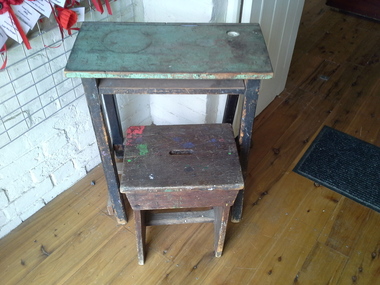 Rutherglen Historical Society
Desk, 1920 (Approximate)
... Hole for ink well RH side, pencil slot, foot rest (central), black legs, extra narrow ledge at back...Hole for ink well RH side, pencil slot, foot rest (central), black legs, extra narrow ledge at back Desk ...Used at Common School, Rutherglen around 1920s, particularly at examination time. See also 62.1Wooden desk, green top, book shelf under top, on four legs, front ones vertical, back ones sloped. Hole for ink well RH side, pencil slot, foot rest (central), black legs, extra narrow ledge at backschool, common school, education -
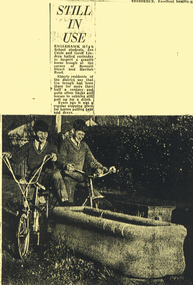 Bendigo Historical Society Inc.
Document - LONG GULLY HISTORY GROUP COLLECTION: STILL IN USE
... The boys are sitting on their bikes, one with his foot resting on the end of the trough....The boys are sitting on their bikes, one with his foot resting on the end of the trough. Document LONG GULLY HISTORY GROUP COLLECTION: STILL IN USE ...Photocopy of a newspaper article titled Still in Use. Photo shows two Eaglehawk High School students, Ian Coyle and Geoff Lindrea inspecting a granite horse trough at the corner of Bennett Street and Havilah Road. The boys are sitting on their bikes, one with his foot resting on the end of the trough.bendigo, history, long gully history group, the long gully history group - still in use, eaglehawk high school, ian coyle, geoff lindrea, granite horse trough -
 Kiewa Valley Historical Society
Splint
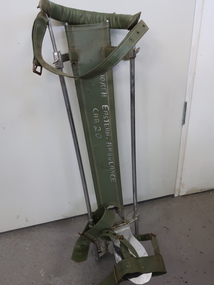
... At the bottom it has 1 moveable stand at the back and 1 solid steel foot rest at the front. These have hinges to enable up and down movement.there is green vinyl around the curve at the top and as support for the back of the leg. ...At the bottom it has 1 moveable stand at the back and 1 solid steel foot rest at the front. These have hinges to enable up and down movement.there is green vinyl around the curve at the top and as support for the back of the leg. ...The ambulance officers would use this splint to restrict further movement of a leg. It supports and protects a broken bone or injured tissue and reduces pain and promotes healing by keeping the injured part of the body still. Splints are now designed for specific parts of the body and leg. New materials are available eg. plastic moulds and velcro to fasten straps.Used by ambulance officers in the Kiewa ValleyThe splint is made with 4 shiny upright rods. At the bottom it has 1 moveable stand at the back and 1 solid steel foot rest at the front. These have hinges to enable up and down movement.there is green vinyl around the curve at the top and as support for the back of the leg. There are 3 green leather straps attached - on the top, middle and the foot."North Eastern Ambulance / Car 20" in white on green vinyl.leg splint, ambulance equipment, first aid -
 Bendigo Military Museum
Photograph - PORTRAIT PHOTOGRAPH, WW1 SOLDIERS, Wykeham Studios, c.1919
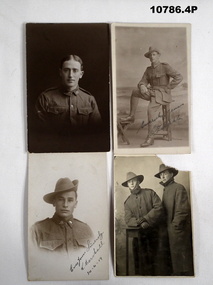
... Soldier is sitting on a stool with right foot resting on small wooden stand. 3. Black and white portrait photograph of an Australian WW1 soldier in uniform. 4. ...Soldier is sitting on a stool with right foot resting on small wooden stand. 3. Black and white portrait photograph of an Australian WW1 soldier in uniform. 4. ...1. Junior Arthur Joseph NATHAN, No. 33159. Born Sydney, enlisted Melbourne on 31 Oct 1916, aged 25. In Field Artillery Brigade, 25th Reinforcements, embarked ex Melbourne on HMAT A9 "Shropshire" on 11 May 1917. Served on Western Front. Last posting 1st Divisional Ammunition Column as Bombadier. R.T.A. 28 February 1919. Discharged 3rd M.D. 29 June 1919. 2. Unable to identify soldier from writing on photograph. 3. Unable to identify exactly which soldier named Marshall due to illegible initial - K(?). 4. Unable to accurately identify ? R. Collins. Clarence Amber Edhouse (No. 25808), Born Echuca, enlisted Prahran, 25 March 1916, aged 19 in Field Artillery Brigade, 18th Reinforcement. Embarked 1 August 1916 from Melbourne aboard HMAT A67 "Orsova". KIA 1 August 1918. Unable to determine which of the two in the photograph is C.A. EDHOUSE. Part of the Meade Collection. See Catalogue No. 10785P for details of Ernest James Meade's (No. 2112) service. 1. Black and white portrait photograph of a WW1 soldier in uniform. Soldier is bare headed. 2. Black and white photograph of an Australian WW1 soldier in uniform. Soldier is sitting on a stool with right foot resting on small wooden stand. 3. Black and white portrait photograph of an Australian WW1 soldier in uniform. 4. Black and white photograph of two Australian WW1 soldiers both wearing great coats. Soldier on left is leaning on a wooden stand.1. Handwritten in black ink: “To Vicky so Tricky, Hoping we have as many a happy run with the ball in Aussie as when we proved S.A.A. were invincible, from Bob Nathan. Belgium 1919, 45 Spencer St. St Kilda, Vic. From the slip on 1 Aust D.A.C.” 2. Handwritten on front in black ink: “Sincerely yours?” 3. Handwritten in black ink on front: “Ever Yours Sincerely, K (?) Marshall 24.4.19’ Handwritten in black ink on back: “With all best wishes from Yours Very Sincerely on the other side, 24.4.19” Stamped on back in purple ink: 'TAYLOR BROS., 1 Lancashire Hill, Stockport” 4. Handwritten on back in black ink: “From Your Old Cobber T (?) R. Collins, C.A. Edhouse” meade collection, ww1, photograph, ernest james meade -
 Bendigo Historical Society Inc.
Photograph - HANRO COLLECTION: PHOTO OF JOAN SARTORIE
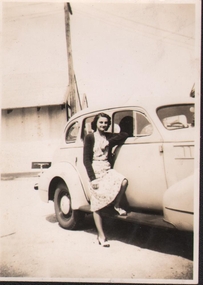
... Photo of Joan Sartori: Black and white photo of Joan leaning against the drivers side of a car with her left foot resting on the running board. She is wearing a dark cardigan and floral dress, she is wearing two toned shoes. ...Estelle Dole Printed by Oliver's Bendigo Photo of Joan Sartori: Black and white photo of Joan leaning against the drivers side of a car with her left foot resting on the running board. She is wearing a dark cardigan and floral dress, she is wearing two toned shoes. ...BHS CollectionPhoto of Joan Sartori: Black and white photo of Joan leaning against the drivers side of a car with her left foot resting on the running board. She is wearing a dark cardigan and floral dress, she is wearing two toned shoes. On the back is hand written in blue ink is *Joan Sartori * *Estelle Dole 1 Farrell St. Bendigo*. The number 41 is hand written in pencil. A green triangle with green print inside is *Printed by Oliver's Bendigo* and black *Velox*.Printed by Oliver's Bendigophotograph, person, hanro, bendigo. estelle dole -
 Ballarat Tramway Museum
Photograph - Black & White Photograph/s, The Courier Ballarat, 20/09/1966 12:00:00 AM
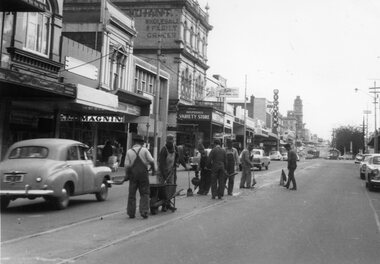
... In the background are the buildings on the south side of Bridge St, including Magnin, a Disposal Variety store, Faull's Foot rest, and Dickins. In the far distance are two trams parked in the loop. ...In the background are the buildings on the south side of Bridge St, including Magnin, a Disposal Variety store, Faull's Foot rest, and Dickins. In the far distance are two trams parked in the loop. ...Demonstrates nature and size of gang undertaking road repairs during 1966 in Bridge St and the buildings on the south side of the street.Black and White copy photograph of a newspaper photograph taken by The Courier, taken 20/9/1966, published 21/9/1966 of track repairs in Bridge St. Shows the nature of the work, and the level of the traffic in the streets at the time. Eight men working in the view. In the background are the buildings on the south side of Bridge St, including Magnin, a Disposal Variety store, Faull's Foot rest, and Dickins. In the far distance are two trams parked in the loop. Collected by Alan Bradley from the Ballarat Courier early 1980's. See Excel file "Record of Ballarat Courier Photos SEC era" (Archive Documents) for source of details.On rear stamped "Copyright, The Ballarat Courier Proprietary Limited." and "85%" in ink.tramways, trams, bridge st, road works -
 Albert Park-South Melbourne Rowing Club
Moore Sculling Machine
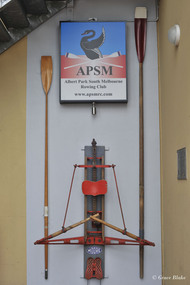
... The machine carries a maker’s plate with the single word ‘Moore’ in an oval design, using white letters against a navy background, fastened to the base board and close to the foot-rests." 2014 Significance Assessment, p38...The AP-SMRC machine is almost intact, appearing to lack only the leather straps for fastening the rower’s feet to the foot-rests. Spalding manufactured the design in the USA in the early decades of the 20th century, but the metal elements in its models are traditionally black. ..."Grace Blake’s conversations with older members of the Club have elicited the following information during July 2014: • Don Christie recalls the machine being acquired by (or donated to) SMRC in the 1960s. SMRC later donated it to APRC. • Bob Duncan remembers it being at APRC. • Max Shaw joined the club in 1946 but doesn’t recall it at all. • Peter Watson recalls collecting the rowing machine from the old APRC club house before its demolition (c. 1995). The AP-SMRC machine carries a ‘maker’s plate’ with the name Moore... Moore Crane and Engineering Company Pty Ltd was a subsidiary of Malcolm Moore Industries Ltd whose manufacturing engineering works were located on Williamstown Road, Port Melbourne from 1927. The founder established the main business in 1921 and retired in 1953.21 The business was delisted from the Australian Stock Exchange in 1976. Grace Blake advises that some of the earlier SMRC members were plumbers and therefore worked in trades connected with engineering. She reports that Peter Watson recalls some of his contemporaries completing their engineering apprenticeships at Malcolm Moore Industries Ltd in the 1970s. There are still many unanswered questions concerning the history and provenance of the rowing machine at the time of writing this report, but the connection with a local engineering works is certainly fascinating. Questions to explore in the future include: Did Moore manufacture the machine, or import it (and perhaps assemble it) under licence? Was this machine a ‘one-off’ or did Moore make / distribute others within Australia? When, why and how did SMRC acquire the machine? Why did SMRC decide not to retain it, but to pass it over to APRC? And how did APRC use it?" 2014 Significance Assessment, pp38-40. "The ‘Moore’ Rowing Machine at the Albert Park – South Melbourne Rowing Club (AP- SMRC) is a rare example in Australia of the Kerns patent design from 1900. This machine may not, however, be that old in construction or use. The AP-SMRC machine is almost intact, appearing to lack only the leather straps for fastening the rower’s feet to the foot-rests. Spalding manufactured the design in the USA in the early decades of the 20th century, but the metal elements in its models are traditionally black. The bright red paint on the AP-SMRC machine suggests something different. The AP-SMRC machine carries a maker’s plate that associates it directly with a local engineering business, Malcolm Moore Industries Ltd of Williamstown Road, Port Melbourne. Club members recall the machine being at the South Melbourne Rowing Club in the 1960s, and being transferred at a later date to the Albert Park Rowing Club. The machine has not been used since the founding of the amalgamated AP-SMRC and requires careful conservation. The ‘Moore’ rowing machine is of national research significance as a rare survivor, in Australia, of the well-regarded Kerns patent design that was popularised by Spalding in the northern hemisphere. The English River and Rowing Museum website quotes a testimonial from an AG Spalding & Bros’ Mail Order Catalogue: ‘This machine was described by ‘an experienced oarsman’ ... “to be the most perfect rowing machine ever produced”. A feature was the adjustment of the resistance so “the weaker sex can use the machine”’. Its historic significance lies in its rarity (and perhaps uniqueness) as an aid to the training of rowers at two successful clubs on Albert Park Lake. Additional historic significance lies in the connection that the rowing machine represents between local rowing clubs and a major local manufacturing engineer. The ‘Moore’ rowing machine bridges the realms of innovation and application, of industry and recreation, of land-based and aquatic sports, and of two neighbouring rowing clubs on the Albert Park Lake." 2014 Significance Assessment, p43"A rowing machine that appears to be built to the Kerns patent design from 1900 but may not be that old in construction or use. The machine is heavy and includes parts made from cast iron. The cast iron components are painted in a distinctive bright red. The wooden seat moves on timber slides. Resistance is created by spring mechanisms at the ends of two frame elements that connect with two wooden ‘oars’, and by the central chain-driven system that co-ordinates with the rower’s movements. The machine carries a maker’s plate with the single word ‘Moore’ in an oval design, using white letters against a navy background, fastened to the base board and close to the foot-rests." 2014 Significance Assessment, p38Moorerowing, apsm rowing club, significance assessment, malcolm moore industries ltd, kerns, 1900, sculling machine, albert park rowing club, south melbourne rowing club, albert park lake, rowing machine, ergo -
 Streatham and District Historical Society
Picture Post Card, Oman Family
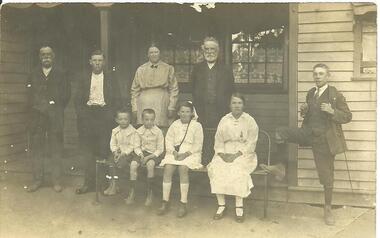
... A youth is standing leaning on the house with his thumbs in his vest holding a whip. He has on foot resting on the seat and is wearing short pants and boots. ...A youth is standing leaning on the house with his thumbs in his vest holding a whip. He has on foot resting on the seat and is wearing short pants and boots. ...This picture shows a group of people outside of a weatherboard house. There are four persons sitting on a metal seat. Two male and two female. Both boys have a boat neck collar on their shirts and button up boots on. One girl has a light coloured dress with a money purse across one shoulder, her hair tied up with a ribbon. The older girl has white uniform on with watch hanging from the bolice, her hair is up. A youth is standing leaning on the house with his thumbs in his vest holding a whip. He has on foot resting on the seat and is wearing short pants and boots. Standing behind the seat is a large framed women wearing a dress with her hair up and a man wearing a suit with facial hair, hands behind his back. To the side another youth with his hands in his pants. Next to him another man with his hands behind his back, dressed in a suit with facial hair. Lace can be seen on the windows.Shows a typical family and housing of the period.Black and white rectangular picture post card.In black ink, stamped on back "Post Card, Correspondence, Address. Written in black ink " Robert Oman, Clifton, Jack, Roy, Jean, Gladys, Evelyn, Father John, Mother. R Oman 5 Locjhart Ter Edwardstown SA". In blue pen "Dos Dunn". -
 Ballarat Tramway Museum
Negative - SECV Geelong 40 at Belmont, Hugh Ballment, 25/5/1954
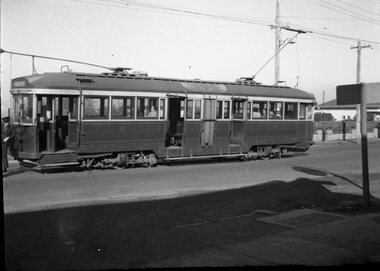
... Photo shows Geelong tram 40 at the Belmont terminus with the driver resting his foot on the bumper bar. Passengers have boarded for the return journey. ...Photo shows Geelong tram 40 at the Belmont terminus with the driver resting his foot on the bumper bar. Passengers have boarded for the return journey. ...Photo shows Geelong tram 40 at the Belmont terminus with the driver resting his foot on the bumper bar. Passengers have boarded for the return journey. See also item 10315 for a similar colour photo. Based on the date of a series of colour slides and a sleeve date of 1954 photo taken 25/5/1954. Yields information about the North terminus and tram 33.Negative - 127 film black and whitetramways, tramcars, geelong, tram 33, north, melbourne road -
 Royal District Nursing Service (now known as Bolton Clarke)
Photograph - Digital image, 1937
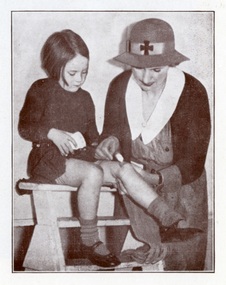
... Her right leg is bent and her foot is resting on the lower step. Her left leg is extended and she is looking down at a Melbourne District Nursing Society (MDNS) Sister who is on her right, as she is swabbing a wound on the girls left knee. ...Her right leg is bent and her foot is resting on the lower step. Her left leg is extended and she is looking down at a Melbourne District Nursing Society (MDNS) Sister who is on her right, as she is swabbing a wound on the girls left knee. ...This digital image appeared in the MDNS 1937 Annual Report and depicts one of the aspects of nursing care carried out by the District Sisters of the Melbourne District Nursing Society (MDNS) in a home in the suburbs of Melbourne.The Trained nurses (Nurses) of the Melbourne District Nursing Society (MDNS), from its inception in 1885, provided wound care to their patients who ranged in age from the very young to the elderly. As research developed better products and dressing materials, the methods and medication applied to wounds changed. MDNS received Royal patronage in 1966 and as Royal District Nursing Service (RDNS), the Education department developed wound care programs, such as the Leg Ulcer Management Program to provide their Trained nurses (Sisters) with methods of best quality care. They instructed RDNS Wound Care Specialists who made assessments and provided advice and support to the District Sisters working in the field as needed. The Sisters liaised with the patient’s Doctors and Hospitals to provide information on the progress of patient’s wounds and to receive any change of wound care from the Doctors. On the left of this black and white digital image is a little girl who is sitting on the top step of a wooden stool which is against a light coloured wall. The little girl has short dark straight hair; is wearing a dark jumper and skirt and is holding a light coloured bandage in her right hand. Her long grey socks are pushed down and she is wearing black sandals. Her right leg is bent and her foot is resting on the lower step. Her left leg is extended and she is looking down at a Melbourne District Nursing Society (MDNS) Sister who is on her right, as she is swabbing a wound on the girls left knee. The Sister is wearing her uniform dark cardigan over her grey dress which has a white collar, and her grey brimmed hat, with central Maltese cross on the hatband, is worn over her short hair. She is looking down at the child's wound and in her right hand she has a pair of forceps holding a white swab against the wound on the girl's knee. Her left hand is under, and supporting, the girl's knee.mdns uniform, melbourne district nursing society, rdns, royal district nursing service, mdns wound care -
 City of Melbourne Libraries
Photograph, Bull, Hugh Jones, 1897-1993, Commercial Travellers' Association, Victoria, Board Room
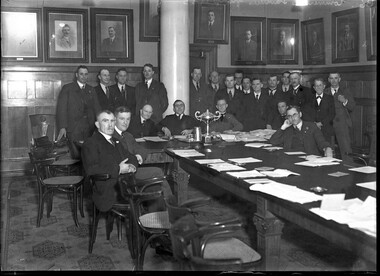
... The blackwood panelled room was furnished with Queen Anne style tables and chairs and green leather armchairs with inviting rocker foot rests allowing weary travellers to relax after traversing the railways and dusty roads of Victoria while planning their next sales trip. ...The blackwood panelled room was furnished with Queen Anne style tables and chairs and green leather armchairs with inviting rocker foot rests allowing weary travellers to relax after traversing the railways and dusty roads of Victoria while planning their next sales trip. ...Seven seated and fifteen standing men dressed in suits around a long table in a panelled room hung with formal portraits of men. A trophy sits on the long table amongst loose paper sheets. Research by project volunteer, Fiona Collyer: The Commercial Travellers’ Association of Victoria (CTA) was formed at a meeting of 40 commercial travellers held at the Duke of Rothesay Hotel, 24 Elizabeth Street on 1 December 1880. Their charter was to advocate for better working conditions for commercial travelling salesmen, including improved accommodation at discounted rates and travel concession fares. At first by locomotive, horse and buggy, steamers and horseback, later also by motor car and motorcycle, “The Man on the Road” went into the back-blocks of the country to extend the interests of commerce to the stores and households of Australian regional towns and isolated settlements. Affiliated organisations existed in all states and New Zealand and in 1895 they integrated to form the United Commercial Travellers’ Association of Australasia (UCTAA). By the turn of the 20th century, the Victorian branch of the CTA had 421 Association Members and 520 Club members. The CTA continued to hold meetings in leased rooms in hotels and offices until 1898 when they commissioned purpose-built premises at 190-192 Flinders Street (extant, now the Macstore, next to former Metropolitan Gas Company Buildings). Designed by leading architectural firm of brothers H.W. & F.B.Tompkins (Dimmey’s Model Store, Swan Street, London Stores, Herald and Weekly Times, Myer building, Diamond House, Centreway Arcade, Manton’s Store) in the Queen Anne Revival style at the cost of £20,000, the four storey building had a facade of red Northcote bricks and an entrance of Pyrmont stone. It was very modern for the time, featuring elevators, offices, bars, kitchen, dining, card and billiard rooms and 31 bedrooms with shared bathrooms for the footsore travellers. However, despite adding two storeys in 1901, and another storey and a basement in 1905, they soon outgrew their premises, and in 1912 the CTA commissioned a new building at 328 Flinders Street. At this time, buildings in Melbourne were constrained by the city height limit of 132 feet (40 metres)- the maximum height of firefighting ladders. The new CTA building was the tallest building in Melbourne until 1932 when regulations changed allowing the Manchester Unity Building to be built. The new CTA headquarters was the epitome of comfort and luxury with cutting edge facilities to ease the fatigued salesman and prepare him for another stint on the road. General Secretary, James Davies travelled to Britain and America to acquire the very best and latest innovations. After visiting the new premises, Punch magazine 11 June 1914 reported “furnishings, appliances, and labour-saving conveniences which were more than up to date- they were up to-morrow.” The Edwardian Baroque style building was again designed by architects H.W. & F.B. Tompkins at the cost of £100,000 and built by contractors F.E. Shillabeer and Sons (Nicholas Building, Kellow-Falkiner Pty Ltd car showroom). The nine storey plus basement building is of steel frame construction with concrete floors. The ground floor facade is of grey granite and above that it is faced with cream glazed bricks chosen to combat discolouration from the pollution emitted by Flinders Street Station trains across the road. The facade is decorated with mascarons, gum leaf trim and balconies with classical style balustrade. The club was entered through revolving doors into a two storey high, circular, domed lobby with white columns, American oak panelled walls and intricate mosaic flooring. The ceiling is festooned with plaster gum leaf and gum nut detail, a theme that is repeated throughout the building. The basement kitchen had modern, labour saving appliances that would be the envy of any Edwardian housewife, including an electric toaster, a potato peeling machine, heated dumb waiter, dishwashing machine and electric refrigeration and cooking. It serviced the commodious second floor dining room which seated 200 people and the cafe/breakfast room, 80 people. Members were permitted to entertain their lady friends there for afternoon tea between the hours of 3 and 5 pm every day, except Sunday. The members’ facilities included a barbershop, clothes pressing machine, boot cleaning chair, pipe and cigar stall with electric humidor, public telephones, lockers and safe deposit. The building was serviced with five elevators, a built in vacuum cleaning plant, hot water radiators and linen and postal chutes. The first floor was devoted to business and relaxing, containing the Board, Writing, Reading and four Business Rooms. The board room had Queensland maple panelling with huge blackwood tables topped with blue morocco and golden tortoise-shell trim and cane bottomed chairs. Large framed photographs of past presidents since 1884 lined the walls. The Reading Room ran the whole width of the building. Arthur Streeton’s painting “Between the Lights, Princes Bridge 1888” and Frederick McCubbin’s “Looking North from Mount Macedon” were hung there, as well as paintings by renowned Australian artists Hans Heysen, Walter Withers, John Mather, Jan Hendrik Scheltema. The Argus 30 May 1914 quipped “Around the walls hang evidences that the commercial traveller's soul has not been killed in his pursuit of commerce”. The blackwood panelled room was furnished with Queen Anne style tables and chairs and green leather armchairs with inviting rocker foot rests allowing weary travellers to relax after traversing the railways and dusty roads of Victoria while planning their next sales trip. “The Australasia Traveller” Volume 10, Number 2, April 1914 page 35 noted “An attendant will be constantly employed on this floor to take care of the stationary supply, to tidy up newspapers, and generally study the convenience of members.” The third floor was for amusements with billiards, a bar and four rooms for playing cards, dominoes and chess. The huge billiard room had seven Alcock billiard tables including a table in a partitioned match-room for tournaments, exhibitions and matches. The walls were lined with members’ cues and for spectators, comfortable lounges with marble topped tables and electric bell pushes for drinks service. There were 150 bedrooms over five floors, each with their own telephone and wash basin and five suites with a private sitting room attached. There were four bathrooms per bedroom floor and capacious, well-lighted shaving rooms. Top rate club tariff for bed and breakfast - 6 shillings, if called for a country train leaving Melbourne before 8am - 4 shillings, suite and breakfast- 9 shillings, sixpence. “The Australasia Traveller” Volume 10, Number 2, April 1914 page 35 reported “All “early calls” will be made from the Club Office to Bedrooms by means of the Telephone, so that instead of waking everybody else up on the corridor, only the member concerned will know that it is his unpleasant duty to get up.” The new CTA premises was widely regarded as the finest club in the Southern Hemisphere. The CTA also built the adjacent six storey Commerce House with 52 sample rooms for travellers to display their wares with the remainder rented to retail businesses and a post and telegraph office. After the CTA moved into their new, larger premises in 1914, neighbouring department store Ball & Welch expanded into the former CTA. The CTA saw themselves in a nation building role and were an influential lobby group to the Government. They advocated for inter city trunk telephone lines, standard gauge railway lines between NSW and Victoria, improved roads and highways, the Murray River water scheme and maintaining the White Australia Policy. They were very active in fund raising for the war efforts. The CTA offered its members support in other ways with benevolent funds for widows and orphans, mortuary, accident, sickness and an annuities fund for members over 65 years. There were scholarships for members’ children and home purchase scheme to assist with home ownership. A secondary membership scheme provided access to non commercial travellers (men only) to its exclusive club premises. They also organised social events and activities such as billiard tourneys, golf tournaments, dances and an annual “Smoke Social” which was a social event where men gathered for a formal dinner, community singing, lectures, speeches and of course, to smoke! Daylesford born James Davies OBE, (1865-1931) worked at the CTA for 50 years, starting as an office boy and working his way up to General Secretary and editor of the monthly trade journal for UCTAA members, “The Traveller” (1890-1905, later “The Australasian Traveller” 1905-1924 and then “The Australian Traveller” 1925-1976) and the annual colour supplement magazine “Australia To-Day” (1904-1973). “The Australasia Traveller” featured commentary on the issues of the day like wars, tariffs and trade, articles on new products and hotel recommendations and their rates and lots of advertising, especially alcohol, tobacco and accommodation in regional hotels. There were regular columns, each illustrated with a line drawing and these included “Our Immigration Record” a state by state summary of arrivals of “desirable immigrants” to Australia, while bemoaning the declining (white) birth rate. The column followed the arrival of British boys sent to Australia as agricultural apprentices to work on rural properties which were short of labour. Between 1913-1928, 1750 “Barwell Boys”, some as young as 14 years of age arrived in South Australia to work. NSW had a similar program known as the Dreadnaught Boys Scheme where 5595 boys immigrated between 1911-1939. The boys were considered of “good British stock”. There was a “Home Page For The Ladies” showcasing the latest fashions in women’s clothing, millinery and hairstyles and tips and trends in home furnishings.“Children’s Corner for Dear Little Folks” which featured puzzles, jokes and stories and members could send in photographs of their children. “Road Echoes” devoted to “The Man On The Road” and his doings. “Face Massage, Smiling is the Best Face Massage”, the humour page full of jokes and funny stories. “Railway Rumbles” news of innovations, timetables, tickets and grumbles about lavatories, food and drinking water on trains and at railway stations. And in case we forget that members had a home away from their CTA home, gardening tips with “The C.T. as Gardener”column. The annual magazine “Australia To-Day” was a vehicle to promote Australia here and overseas as a modern, prosperous country with abundant opportunities and pleasant climate. It sought to showcase its manufacturing, agriculture and tourism and encourage British immigration to Australia. The magazine featured articles about recently arrived migrants at work, quirky native flora and fauna, beach culture, recreation and the Australian way of life in the settler nation. Many of the articles were written by politicians of the day, including Robert Menzies. The UCTAA commissioned original artwork for the front covers and feature articles of “Australia To-day” from leading Australian artists. These included Norman Lindsay, Frederick McCubbin, Napier Waller, Lionel Lindsay, Hans Heysen, C Dudley Wood, Louis McCubbin, Penleigh Boyd, Louis Buvelot, Christian Waller and Ellis Rowan and her Australian wildflowers. Some of the photographs in “Australia To-Day” were provided by state and federal government departments as well as manufacturers, newspapers and mining companies. Amongst of the credited photographers was Helmut Newton who later earned world acclaim as a fashion photographer and architectural and industrial photographer Wolfgang Sievers (unfortunately their photographs remain in copyright and aren’t available online). Also featured was Richard C. Strangman, a professional photographer from Canberra, William Howieson of Melbourne, who has 22 photographs in the collection of NGV, Tasmanian wilderness photographer Frederick Smithies, Athol Shmith, portrait photographer and educator from Melbourne, Gordon de Lisle, a Melbourne commercial, industrial, aerial and society portrait photographer. (One of Gordon’s assignments was as the stills photographer for the 1959 movie “On The Beach” filmed in Melbourne). Photographs taken by acclaimed Antarctic and official war photographer Captain Frank Hurley OBE for Adelaide’s Centenary were also featured. The Australian Government was keenly aware of the influence and quality of the UCTAA publications. On 1 June 1914 The Age reported that to advertise Australia in Great Britain and elsewhere, the Department of External Affairs purchased 6500 copies of “Australia To-Day” magazine for £515 to distribute free to “places where they are most likely to come under the notice of a desirable class of immigrants.” In 1950, the office of Prime Minister Robert Menzies ordered 2550 copies of that year’s issue of “Australia To-Day” for the Department of Commerce and Information to distribute. The CTA donated their archives to University of Melbourne Archives which includes original artworks and photos used in “Australia To-Day” (Melbourne University has digitised 1114 photos) and sundry items including trophies, ashtrays, commemorative souvenirs, menus, a rare “Safechek” sovereign changer, a bust of James Davies and even a CTA embossed wash bowl and chamber pot. After the death of General Secretary James Davies in 1931, the CTA held the annual “James Davies Memorial Cup” golf tournament at various Melbourne golf courses, the winner receiving a splendid silver cup. “Table Talk” magazine photographs from 29 June 1933 depict the travellers beautifully (and I would say correctly) attired in tweedy plus fours, Fair Isle knitwear, flat caps and of course fringed brogues. I have been unable to ascertain whether the trophy in our photo is for golf or another CTA social activity. The CTA Victoria membership peaked in 1951 with 4,672 Aassociation members and 3,693 Club members. In 1959, Hollywood came to Melbourne when film stars Gregory Peck, Ava Gardner, Anthony Perkins and Fred Astaire descended to film ‘On the Beach,’ directed by Stanley Kramer. The film is based on the bestselling Neville Shute novel about the aftermath of World War Three, a nuclear war that has obliterated most of the Northern Hemisphere. Radioactive dust is heading toward Australia and everyone is preparing for death. Scenes with Anthony Perkins were filmed in the CTA billiards room as the exclusive Pastoral Club. Anthony Perkins’ character, Lieutenant Commander Peter Holmes of RAN tells Gregory Peck’s character, Commander Dwight Lionel, that The Pastoral Club is…”A mahogany and polished brass sort of place-some people claim it was the stuffiest club in the Commonwealth” before assuring him that despite shortages, the club is likely to have some Scotch left. In a scene at the Pastoral Club two, old (probably red faced) codgers discuss the challenge of drinking all of the 400 bottles of Gould Campbell vintage port in the club wine cellar before they succumb to radiation sickness in five months time. The NGV has 12 photographs in their collection of wardrobe stills of Ava Gardner modelling costumes designed by the Fontana Sisters of Rome for “On The Beach”, taken by Italian photographer G.B.Poletto. During the filming, Gregory Peck and his family stayed at “Kurneh” 206 Domain Road, South Yarra, the former home of three times Grand Slam winner Norman Brookes. Through the decades, Australian society was changing and in order to stay relevant, the CTA had to change too. In 1971, two women were elected for club membership, although they were only granted limited access to the club’s facilities and in 1972, women were invited for the first time to participate in the previously men only annual “Smoke Social”. In 1975, dwindling membership forced the closure of The Commercial Travellers’ Association building and in 1977, the building was sold, with the CTA ceasing to operate in 2014. It was the end of the road for the “Knights of the Road”. In 1992, the CTA building at 328 Flinders Street was placed on the Victorian Heritage Register in recognition of its architectural and cultural significance. The building has been meticulously restored with many of the original fittings, decorative plasterwork, mosaic flooring, stained glass windows, columns, chandeliers and the panelling made from Australian timbers retained. After renovations the building became first the Euro Asia Hotel, then the Duxton Hotel and in 2005 The Rendezvous Hotel, Melbourne. In tribute to the history of the building and the film “On The Beach”, the Rendezvous Hotel has the Ms Ava Bar, Perkins room, Mr Tompkins restaurant, Commerce Room and the Davies Room. References: COMMERCIAL TRAVELLERS' ASSOCIATION OF VICTORIA. (1899, May 27). The Australasian (Melbourne, Vic. : 1864 - 1946), p. 25. Retrieved February 21, 2025, from http://nla.gov.au/nla.news-article138615498 COMMERCIAL TRAVELLERS. (1914, May 30). The Argus (Melbourne, Vic. : 1848 - 1957), p. 8. Retrieved February 13, 2025, from http://nla.gov.au/nla.news-article7272511 NEWS OF THE DAY. (1914, June 1). The Age (Melbourne, Vic. : 1854 - 1954), p. 8. Retrieved February 19, 2025, from http://nla.gov.au/nla.news-article189414314 COMMERCIAL TRAVELLERS' "AT HOME." (1914, June 11). Punch (Melbourne, Vic. : 1900 - 1918; 1925), p. 32. Retrieved March 19, 2025, from http://nla.gov.au/nla.news-article129699692 https://archives.library.unimelb.edu.au/nodes/view/69669 https://vhd.heritagecouncil.vic.gov.au/places/757 http://www.pikitiapress.com/blog/2015/1/26/australia-today Commercial Travellers at Yarra Yarra (1933, June 29). Table Talk (Melbourne, Vic. : 1885 - 1939), p. 6. Retrieved February 28, 2025, from http://nla.gov.au/nla.news-article149547845 https://archives.library.unimelb.edu.au/nodes/view/537460 https://viewer.slv.vic.gov.au/?entity=IE7420895&file=FL19171568&mode=browse https://www.history.sa.gov.au/wp-content/uploads/2021/03/Barwell_Boys_Catalogue-compressed-compressed-compressed.pdf Australia Today," 1927 (1926, December 11). Weekly Times (Melbourne, Vic. : 1869 - 1954), p. 15. Retrieved March 17, 2025, from http://nla.gov.au/nla.news-article223844810 https://blogs.unimelb.edu.au/librarycollections/2020/12/19/an-inhabited-space-helmut-newtons-lovers/ https://www.ngv.vic.gov.au/explore/collection/artist/2075/ https://www.ngv.vic.gov.au/?s=Poletto+&type=collection https://rendezvousmelbourne.com.au/digital-history-tour/Photographer notations on slide: "Commercial Travellers Group B6".clubs, department stores, 1930-1939, commerce, manufacturing, federation/edwardian style architecture, railways, tourism, games, agriculture -
 Flagstaff Hill Maritime Museum and Village
Mirror
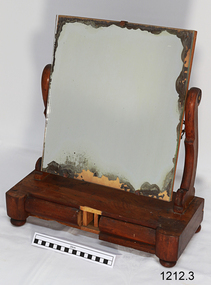
... Base has 4 round, turned wooded feet (5th foot now detached, was located in centre front between drawers). Mirror has lost its reflective coating around edges. It rests...Base has 4 round, turned wooded feet (5th foot now detached, was located in centre front between drawers). Mirror has lost its reflective coating around edges. It rests ...Swivel mirror mounted medium brown, wooden mantle stand with 2 drawers in base, Drawers are lined with green and yellow floral paper. Drawer fronts are rounded wood; one drawer has a front piece missing. Wooden uprights are a decorative, curved shape. Base has 4 round, turned wooded feet (5th foot now detached, was located in centre front between drawers). Mirror has lost its reflective coating around edges. It rests, at about 70 degree angle, on metal bracket. Marking on base in black crayon “6 2”, and pencil letters on 1 drawer “& &”, and “S S” (or “”S 8”). flagstaff hill, warrnambool, shipwrecked-coast, flagstaff-hill, flagstaff-hill-maritime-museum, maritime-museum, shipwreck-coast, flagstaff-hill-maritime-village, mirror, dresser mirror, furniture, 19th century, bedroom furniture -
 Flagstaff Hill Maritime Museum and Village
Domestic object - Sewing machine in cabinet, Ward Brothers (G & S Ward), ca. 1933
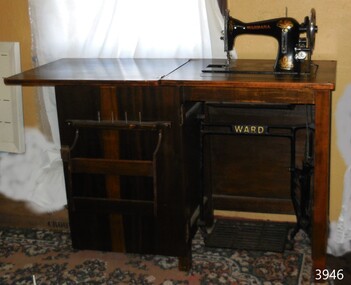
... foot-operated cast iron treadle mechanism. The hinged cabinet top opens out to form a worktop. The sewing machine lifts out of the cabinet to sit level with the worktop, resting on two supports within the cabinet. ...foot-operated cast iron treadle mechanism. The hinged cabinet top opens out to form a worktop. The sewing machine lifts out of the cabinet to sit level with the worktop, resting on two supports within the cabinet. ...The donor inherited this Wardana machine from her mother, who bought it in about 1933 and used it to sew garments for her sister's dressmaking business in Frankston, Victoria. The donor often used this machine until she purchased an updated model. There were originally three Ward Brothers who owned the North Melbourne sewing machine business but they had a falling out. This machine's decals on the map of Australia only include the two remaining brothers. The Ward Brothers, G & S Ward, established their sewing machine business in North Melbourne in 1888. The cabinets and ironwork of the machines were made in Australia and the Ward Bros. imported their machines from overseas manufacturers in England, America and Germany. The assembled machines were sold under brand names that included Ward, A.N.A. the patriotic-sounding Australian Sewing Machine Company. The "Wardana" was one of their brands.This sewing machine was fabricated in Australia from imported parts from England, giving a snapshot into the early manufacturing industries that were operating at the time just after Federation.Sewing machine in a wooden cabinet with iron foot-operated cast iron treadle mechanism. The hinged cabinet top opens out to form a worktop. The sewing machine lifts out of the cabinet to sit level with the worktop, resting on two supports within the cabinet. The lockable cabinet door opens from right to left revealing fitted shelves and spikes for spools and bobbins. The gold-painted maker's name is cast into the black treadle. The machine has its original instruction book, oil can, and eighteen accessories in an enclosed cardboard box. The round shallow oil bottle has a rubber dispensing tube. Colourful decals decorate the black body of the machine. Inscriptions include a Serial Number stamped on the bed of the machine. The Wardarna Central Bobbin machine was made in England for the Ward Brothers of North Melbourne.TREADLE: cast into metal ACROSS THE TOPE AND ON THE FOOTPLATE "WARD", "WARD" SERIAL NUMBER stamped into oval plate "28383" DECAL: (Map of Australia ) with images of [two brothers] , "WARDANA" above (logo of the rising sun) DECAL: (Decorative floral design with heraldic-like emblems) above "MADE IN ENGLAND" ARM: "WARDANA" PEDESTAL: "C.B." (representing Central Bobbin) "MADE IN ENGLAND" "MADE IN ENGLAND / FOR / WARD BROS / NORTH MELBOURNE" BOOK TITLE: "Instructions for Treadle Machine" ACCESSORIES: some have indecipherable embossed stamps OIL BOTTLE base: (image of log and short lines radiating from a central inscription (indecipherable)sewing machine, domestic, wardana, ward bros., central bobbin, made in england, north melbourne, c.b., flagstaff hill, warrnambool, shipwrecked coast, flagstaff hill maritime museum, maritime museum, shipwreck coast, flagstaff hill maritime village, great ocean road, treadle sewing machine, home industry, clothing, dressmaking, clothing manufacturer -
 Ringwood and District Historical Society
Map, Subdivision Plan, Loughnans Road, Ringwood - circa 1922
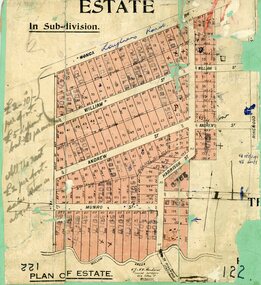
... Handwritten notations - (northern section) {£2-10/- per foot. £5 deposit bal £1 per month} All the rest £2 per foot, value same as above. ...Handwritten notations - (northern section) {£2-10/- per foot. £5 deposit bal £1 per month} All the rest £2 per foot, value same as above. ...Green card with cut-out map of residential allotments, some marked "sold". "Plan of Estate" includes Wonga Road, Loughnans Road, William Street, Andrew Street, Harrison Street, and Munro Street, Ringwood. (Surrounding area is part of Ringwood Park Estate featured in seperate 1922 auction flyer).Handwritten notations - (northern section) {£2-10/- per foot. £5 deposit bal £1 per month} All the rest £2 per foot, value same as above. Licensed Surveyors - W.J. & A.W. Kenhardt, 352 Collins Street, Melbourne. -
 Supreme Court of Victoria Library
Portrait, John Schutt, Supreme Court Librarian, 1916/1917
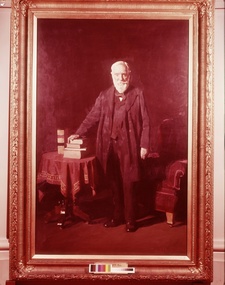
... rests on a small pile of books. He is dressed soberly in a three piece black suit. His white beard and hair all meticulously trimmed and realised. The props used in this painting provide the main colour as the background has become dark over the years. The books sit atop of a red and gold draped table. Behind Schutt is what appears to be a crimson velvet chair and he gives every appearence of having just arisen from the chair to engage with the viewer. The painting has an unusual light source at the foot...rests on a small pile of books. He is dressed soberly in a three piece black suit. His white beard and hair all meticulously trimmed and realised. The props used in this painting provide the main colour as the background has become dark over the years. The books sit atop of a red and gold draped table. Behind Schutt is what appears to be a crimson velvet chair and he gives every appearence of having just arisen from the chair to engage with the viewer. The painting has an unusual light source at the foot ...This portrait was presented by the Victorian Bar to the Library in 1917 to commemorate Schutt’s fifty years as the Supreme Court Librarian. The portrait was presented at a ceremony presided over by Mr Mitchell KC who noted the “unanimity with which the members of the profession had adopted the suggestion that the eminent services of Mr Schutt should be recognised in this way.” Chief Justice Madden also spoke on this occasion and there were a number of judges and members of the legal profession present. John Schutt had been born in England in 1831 and migrated to Victoria as a young man, initially working as a school teacher he was appointed librarian, during Redmond Barry’s time in 1866. He started work in the Old Court in Russell street and would have supervised the move of the library to its new and greatly expanded premises in William Street in 1884. As well as secretary to the Library committee, he also acted as the Secretary of the Board of Examiners on occasion. After his death in 1919 in its obituary, the Williamstown Chronicle noted that Schutt was regarded as a Solon, an ancient greek law giver who gave wise advice. Away from the Court he was a councillor of many years standing in Williamstown, representing the Victoria Ward, what is now the suburb of Newport, it would appear Schutt street in Newport was named after him. His eldest son William Schutt was appointed a Supreme Court judge in 1919. The portrait of Schutt is a companion piece to the Sir Thomas a’Beckett picture painted shortly before the Schutt portrait and for the same client, they share the same frame design with gum leaf motif. This portrait was undertaken early in Meldrum’s career and before he had fully developed his theory of painting. Duncan Max Meldrum (1875-1955) was a controversial figure in his later years as he strongly opposed modernism and non-figurative art. His works are found in most of the state galleries, including a wide selection at the National Gallery of Victoria. This portrait is of interest for whom it portrays and as the work of a well known artistFull length portrait in oils of John Schutt. Schutt is standing up looking out the to the viewer. His hand rests on a small pile of books. He is dressed soberly in a three piece black suit. His white beard and hair all meticulously trimmed and realised. The props used in this painting provide the main colour as the background has become dark over the years. The books sit atop of a red and gold draped table. Behind Schutt is what appears to be a crimson velvet chair and he gives every appearence of having just arisen from the chair to engage with the viewer. The painting has an unusual light source at the foot of the painting with Schutt's legs providing shadows. Signed Meldrum lower right hand corner. Plaque inscription is John Schutt, Esq. Supreme Court Librarian -
 Flagstaff Hill Maritime Museum and Village
Instrument - Barometer, 1867
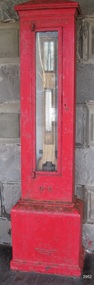
... Their sole machine tool, when they commenced as a business, was a small slide rest lathe turned by foot. In about 1865 they moved to the south side of the Yarra River, to the Yarra bank near the Spencer Street Bridge and then in about 1886 they moved to Grant Street, South Melbourne. ...Their sole machine tool, when they commenced as a business, was a small slide rest lathe turned by foot. In about 1865 they moved to the south side of the Yarra River, to the Yarra bank near the Spencer Street Bridge and then in about 1886 they moved to Grant Street, South Melbourne. ...Langlands Company History: Langlands foundry was Melbourne's first foundry and iron shipbuilder established in 1842, only 8 years after the founding of the Victorian colony by two Scottish immigrants, Robert Langlands and Thomas Fulton, who had formed a partnership before emigrating (1813–1859). The business was known as the 'Langlands Foundry Co'. Henry Langlands (1794-1863), left Scotland in 1846 with his wife Christian, née Thoms, and five surviving children to join his brother Robert. By the time he arrived in early January of 1847 the partnership of Robert Langlands and Fulton had dissolved as Fulton had gone off to establish his own works. It was at this time that the two brothers took over ownership of Langlands foundry. Several years later Robert retired and Henry became sole the proprietor. The foundry was originally located on Flinders Lane between King and Spencer streets. Their sole machine tool, when they commenced as a business, was a small slide rest lathe turned by foot. In about 1865 they moved to the south side of the Yarra River, to the Yarra bank near the Spencer Street Bridge and then in about 1886 they moved to Grant Street, South Melbourne. The works employed as many as 350 workers manufacturing a wide range of marine, mining, civil engineering, railway and general manufacturing components including engines and boilers. The foundry prospered despite high wages and the lack of raw materials. It became known for high-quality products that competed successfully with any imported articles. By the time Henry retired, the foundry was one of the largest employers in Victoria and was responsible for casting the first bell and lamp-posts in the colony. The business was carried on by his sons after Henry's death. The company was responsible for fabricating the boiler for the first railway locomotive to operate in Australia, built-in 1854 by Robertson, Martin & Smith for the Melbourne and Hobson's Bay Railway Company. Also in the 1860s, they commenced manufacture of cast iron pipes for the Board of Works, which was then laying the first reticulated water supply system in Melbourne. Langlands was well known for its gold mining equipment, being the first company in Victoria to take up the manufacture of mining machinery, and it played an important role in equipping Victoria's and Australia's first mineral boom in the 1850s and 1860s. Langlands Foundry was an incubator for several engineers including Herbert Austin (1866–1941) who worked as a fitter at Langlands and went on to work on the Wolesely Shearing machine. He also founded the Austin Motor Company in 1905. Around the 1890s Langlands Foundry Co. declined and was bought up by the Austral Otis Co. in about 1893. History for Grimoldi: John Baptist Grimoldi was born in London UK. His Father was Domeneck Grimoldi, who was born in Amsterdam with an Italian Father and Dutch mother. Domeneck was also a scientific instrument maker. John B Grimoldi had served his apprenticeship to his older brother Henry Grimoldi in Brooke Street, Holburn, London and had emigrated from England to Australia to start his own meteorological and scientific instrument makers business at 81 Queens St Melbourne. He operated his business in 1862 until 1883 when it was brought by William Samuel and Charles Frederick, also well known scientific instrument makers who had emigrated to Melbourne in 1875. John Grimoldi became successful and made a number of high quality measuring instruments for the Meteorological Observatory in Melbourne. The barometer was installed at Warrnambool's old jetty and then the Breakwater as part of the Victorian Government's insistence that barometers be placed at all major Victorian ports. This coastal barometer is representative of barometers that were installed through this government scheme that began in 1866. The collecting of meteorological data was an important aspect of the Melbourne Observatory's work from its inception. Just as astronomy had an important practical role to play in navigation, timekeeping and surveying, so the meteorological service provided up to date weather information and forecasts that were essential for shipping and agriculture. As a result, instruments made by the early instrument makers of Australia was of significant importance to the development and safe trading of companies operating during the Victorian colonies early days. The provenance of this artefact is well documented and demonstrates, in particular, the importance of the barometer to the local fishermen and mariners of Warrnambool. This barometer is historically significant for its association with Langlands’ Foundry which pioneered technology in the developing colony by establishing the first ironworks in Melbourne founded in 1842. Also, it is significant for its connection to John B Grimoldi who made the barometer and thermometer housed in the cast iron case. Grimoldi, a successful meteorological and scientific instrument maker, arrived in the colony from England and established his business in 1862 becoming an instrument maker to the Melbourne Observatory. Additional significance is its completeness and for its rarity, as it is believed to be one of only two extant barometers of this type and in 1986 it was moved to Flagstaff Hill Maritime Village as part of its museum collection. Coast Barometer No. 8 is a tall, red painted cast iron pillar containing a vertical combined barometer and thermometer. Half way down in the cast iron framed glass door is a keyhole. Inside is a wooden case containing a mercury barometer at the top with a thermometer attached underneath, each with a separate glass window and a silver coloured metal backing plate. Just below the barometer, on the right-hand side, is a brass disc with a hole for a gauge key in the centre. The barometer has a silvered tin backing plate with a scale, in inches, of "27 to 31" on the right side and includes a Vernier with finer markings, which is set by turning the gauge key. The thermometer has a silvered tin backing plate with a scale on the left side of "30 to 140". Each of the scales has markings showing the units between the numbers.Inscription at the top front of the pillar reads "COAST BAROMETER" Inscribed on the bottom of the pillar is "No 8". and "LANGLANDS BROS & CO ENGINEERS MELBOURNE " The barometer backing plate is inscribed "COAST BAROMETER NO. 8, VICTORIA" and printed on the left of the scale, has "J GRIMOLDI" on the top and left of the scale, inscribed "Maker, MELBOURNE". There is an inscription on the bottom right-hand side of the thermometer scale, just above the 30 mark "FREEZING" Etched into the timber inside the case are the Roman numerals "VIII" (the number 8)flagstaff hill, warrnambool, maritime village, maritime museum, flagstaff hill maritime museum & village, shipwreck coast, great ocean road, warrnambool breakwater, coast barometer, coastal barometer, barometer, weather warning, ports and harbours, fishery barometer, sea coast barometer, austral otis co, coast barometer no. 8, henry grimoldi, henry langlands, john baptist grimoldi, langlands foundry co, meteorological instrument maker, robert langlands, scientific instrument maker, thermometer, thomas fulton -
 Kiewa Valley Historical Society
Wheelchair
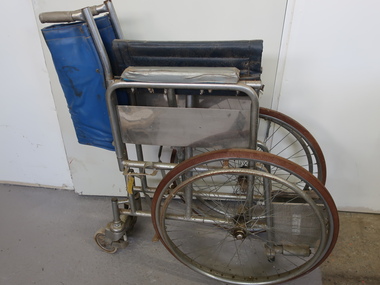
... foot plates are of ribbed steel. The ribbed seat is blue made of thick canvas as is the back of the chair. Some plastic has been glued on the back. The arm rests...foot plates are of ribbed steel. The ribbed seat is blue made of thick canvas as is the back of the chair. Some plastic has been glued on the back. The arm rests ...After WWII demand for wheelchairs increased. The original wheelchairs were driven by the patient's hands pushing the wheels. Later a motor was added. Then the motor and battery were built into the chair under the seat. This was followed by developments in ergonomics (comfort), controls, comfort and performance.See KVHS 1796, KVHS 1797Used by Wilma Davies, a Kiewa Valley resident, who suffered from polio from the early 1950s.2 large wheels - The outer wheel is steel and the inner is rubber with metal spokes attached. The foot plates are of ribbed steel. The ribbed seat is blue made of thick canvas as is the back of the chair. Some plastic has been glued on the back. The arm rests are also covered with old torn plastic. There is a metal stick on the side used to brake the chair by being pulled enabling it to touch the wheel and slow it down or stop it from turning."Sibbing / Melbourne" on the foot platespolio, wheelchair, pandemic -
Kiewa Valley Historical Society
Polisher Floor, Hoover Appliances, Meadowbank
... The rest of the appliance materials i.e. upright handle and the u framed attaching arm are made from lightweight powder coated steel. A small (350mm) red coloured foot...The rest of the appliance materials i.e. upright handle and the u framed attaching arm are made from lightweight powder coated steel. A small (350mm) red coloured foot ...This appliance was a time saving method of cleaning floors. It appeared at a time (after World War II) when the domestic pressures faced by mothers and domestic staff was on the increase. The necessary "working parents" was through necessity becoming part of the "typical" family environment. It was the start of the ever increasing demand, from an economical reason, for both parents to work outside their property. Historically the period of the 1950s was one of extreme changes. It was an era where established role models were under pressure from an ever increasing demand for new and advancing consumerism. Communication levels via radio, newspapers and television was expanding at an ever increasing rate. Relatively isolated rural areas were opening up (post war) to foreign ideologies of consumerism. The basic restraints of "this will be alright mate, she'll do" was under a slow but effective take over. "I can get this done faster by this new whiz bang gadget that I saw on the TV last night!" was the new way to live by.This item is very significant in that it demonstrates the new consumerism at its infant stage of the social changes occurring due to greater communication levels between the rural Australian communities and other advancing communities world wide. The Kiewa Valley residents (mainly from the intermingling of rural and post World War II refugees working at the construction of the Victorian Hydro electricity installations, resulted in this rural area becoming integrated to new ways of living (both socially and economically). Once the attitude of "we have always done it this way mate!" was challenged and overcome, the acceptance of new time saving "gadgets" which started to pour in from foreign markets, the relative isolation of the Kiewa Valley (being mainly psychological entrenched), was over.This hoover electric floor scrubber and polisher has a main base containing two brushes (can be replaced with polishing pads). The two brushes/pads are fastened or removed from the base unit by pulling/pushing the heads from the small hexagonal shaft on the bottom of the machine motor. A pressure sensitive wire is inlaid at the brush/pad end to hold the brush/pad unit onto the shaft. The discs body and main body covering the electric motor are made from sturdy plastic. The rest of the appliance materials i.e. upright handle and the u framed attaching arm are made from lightweight powder coated steel. A small (350mm) red coloured foot switch protrudes from the back of the motor to release the the upright handle from the storage position to the action position.There are two fork shaped brackets on the rear of the handle, for securing the 6.5 metre long electrical cord and plug. There is no on/off switch on the appliance. A small stainless steel "u" framed clip (for hanging the appliance in the vertical position) for cupboard storage. Within the circle of the cleaning brush is stamped "1 above S.A.B.351" and on the opposite side P/No: 5023792". On the main plastic head of the brush discs are "TO CLEAN" and under this "USE ONLY WARM(underlined) WATER AND SOAP" on the opposite side, and within a circle is the Hoover Trademark. On the front of the blue coloured plastic dome covering the electric motor is (on a raised domed shaped plaque (on a red background) Hoover in slanted print from left to right(in a diagonal level)domestic appliances, floor cleaning, electric floor scrubbers and polishers -
 Yarra City Council
Sculpture - Figurative, William Eicholtz, Courage, 2014
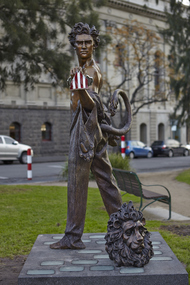
... Bronze statue of a male figure half dressed in a lion costume holding a medal of bravery with a lions head/mask resting on his foot. ...LGTBQIA+ Wizard Oz Ralph McLean Eicholtz Accompanying plaque Bronze statue of a male figure half dressed in a lion costume holding a medal of bravery with a lions head/mask resting on his foot. Courage Sculpture Figurative William Eicholtz ...'Inspired by the iconic character of the Cowardly Lion in the story 'The Wonderful Wizard of Oz' and his contemplation of what it means to possess the courage to be yourself, no matter who you are.''Courage' honours the contribution, culture and diversity of the Gay, Lesbian, Bisexual, Transgender, Intersex and Queer (GLBTIQ) community, and is dedicated to the legacy of Ralph McLean (1957–2010), Australia’s first openly gay elected official (City of Fitzroy, 1982) and Mayor (1984), an advocate for gay rights and social justice, and a champion of the arts.Bronze statue of a male figure half dressed in a lion costume holding a medal of bravery with a lions head/mask resting on his foot. Accompanying plaquelgtbqia+, wizard oz, ralph mclean, eicholtz -
 Monbulk RSL Sub Branch
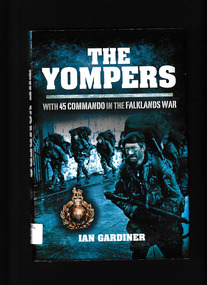
Book, Barnsley Pen & Sword Military, The Yompers : with 45 Commando in the Falklands War, 2012
... foot. Given the intense public interest in the dramatic events then unfolding in the South Atlantic, it caught on and is now in common usage.The Yompers is the first account to be written by a company commander who fought in the Falklands War. Called to action from their beds early on 2 April 1982, the author along with the rest ...Yomping was revealed by the journalist Charles Laurence in 1982 as the word which the Royal Marines used to describe carrying heavy loads long distances on foot. Given the intense public interest in the dramatic events then unfolding in the South Atlantic, it caught on and is now in common usage.The Yompers is the first account to be written by a company commander who fought in the Falklands War. Called to action from their beds early on 2 April 1982, the author along with the rest of 45 Commando Royal Marines, sailed 8,000 miles to play a key role in the recovery of the Falkland Islands from Argentine occupation. Lacking helicopters and short of food, they yomped in appalling weather carrying overloaded rucksacks, across ground which threatened to break legs and ankles at every step. Despite extreme hardship, their morale and training ensured they remained a cohesive fighting-fit body of men.Ill, maps, p.208.non-fictionYomping was revealed by the journalist Charles Laurence in 1982 as the word which the Royal Marines used to describe carrying heavy loads long distances on foot. Given the intense public interest in the dramatic events then unfolding in the South Atlantic, it caught on and is now in common usage.The Yompers is the first account to be written by a company commander who fought in the Falklands War. Called to action from their beds early on 2 April 1982, the author along with the rest of 45 Commando Royal Marines, sailed 8,000 miles to play a key role in the recovery of the Falkland Islands from Argentine occupation. Lacking helicopters and short of food, they yomped in appalling weather carrying overloaded rucksacks, across ground which threatened to break legs and ankles at every step. Despite extreme hardship, their morale and training ensured they remained a cohesive fighting-fit body of men.falklands war 1982, great britain - royal marines - commando 45 -
 Royal Australian and New Zealand College of Obstetricians & Gynaecologists (RANZCOG)
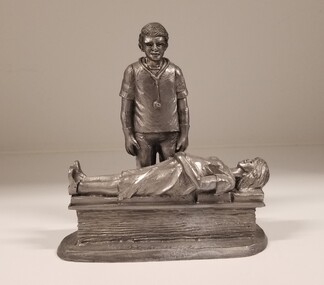
Sculpture - Pewter vignette of an obstetrician observing an antenatal patient, Michael Ricker Pewter
... foot miniature town depicting life at the turn of the 19th century. It was completed in 1986 and presented to former President Gerald Ford. Ford graciously accepted the "key" to Park City and promised a home for the masterpiece in the Smithsonian Institute. (foundantique.com) Obstetrics Pewter sculpture featuring an obstetrician and an antenatal patient. A pregnant woman is lying on a low bench, with her left hand resting ...Michael Ricker was a renowned American pewter artist. His most famous piece, entitled 'Park City', was a 30 foot by 10 foot miniature town depicting life at the turn of the 19th century. It was completed in 1986 and presented to former President Gerald Ford. Ford graciously accepted the "key" to Park City and promised a home for the masterpiece in the Smithsonian Institute. (foundantique.com)Pewter sculpture featuring an obstetrician and an antenatal patient. A pregnant woman is lying on a low bench, with her left hand resting on her stomach, and her right arm by her side. She is wearing a dress and shoes, and has her eyes closed. To her right stands the figure of on obstetrician, wearing trousers, a short sleeved shirt, stethoscope and gloves. He is standing straight with his arms at his sides. The entire sculpture is silver in colour.obstetrics -
 Bendigo Historical Society Inc.
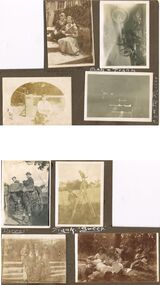
Photograph - HILDA HILL COLLECTION: BLACK AND WHITE PHOTOS, 1917-1918
... Jack & Frank, both dressed in dark suits white shirts and dark ties, man standing outside of vehicle with right arm resting on the car and one foot on the running board, with the family car, dark colour with wooden spoke wheels. ...Jack & Frank, both dressed in dark suits white shirts and dark ties, man standing outside of vehicle with right arm resting on the car and one foot on the running board, with the family car, dark colour with wooden spoke wheels. ...Series of Black & White Photos Hill Family & Friends Life During The Final Years of The First World War. Hilda Hill and another, seated on steps , background building weatherboard construction and glass windows,girl at rear wearing dark dress with check scarf around her neck, girl at front wearing a lighter colour dress and white blouse, and medal on ribbon around her neck, S.H.L.C. November 1917. Jack & Frank, both dressed in dark suits white shirts and dark ties, man standing outside of vehicle with right arm resting on the car and one foot on the running board, with the family car, dark colour with wooden spoke wheels. Francie, wearing dark skirt and white blouse & the dog, kneeling in front of a netting fence with top rail, background is corrugated iron shed wall. Easter 1918. Man in dark suit white shirt and dark tie holding a tennis racquet over his head, brick wall to left and doorway, on the verandah of 'The Ranche' property. Horse & Gig, man and boy seated on the gig and boy standing behind all dressed dark clothing, man wearing a hat, boy at rear wearing shorts and long socks with boots, to right gable roof shed, 'Durvol' property Kyneton Victoria Australia. Frank & Sweep the dog up a ladder, high paling fence in right background. Six young ladies , three standing and three seated on a white wooden railing fence, all dressed in lightly coloured outer wear, some showing white blouses Kyneton Mineral Springs 27th September 1918. Group of four young ladies all dressed in white and wearing broad brimmed hats, two men one sitting and one lying on the ground, man at rear white shirt and dark tie with broad brimmed hat, man at front, dark trousers and white shirt with dark waistcoat, no person has been identified in this photo, In the shade Hanging Rock?Hilda Hill Personal Colllectionaustralia, history, post war life
