
Showing 43 items matching "football team colours"
-
 Emerald Museum & Nobelius Heritage Park
Photograph - Emerald Football Club, 1985 Reserves, Unknown photographer, 1985
... ...Football team colours...The coloured photograph shows a group of 25 unidentified males from the Emerald Reserves Football Team dressed in their team colours in 1985. Cars and trees can be seen in the background....Australian Rules Football Football team colours sports Reverse: RESERVES 1985 / Coloured rectangular photograph printed on gloss photographic paper. ...The Emerald Football Club, also known as the Bombers, first formed in 1905. It was one of the earlier clubs in the Mountain District Football Association, which later merged to become the Yarra Valley Mountain District Football League. Initially, their colours were blue and white, followed by green and gold, until they changed to the red and black we see here—which are still used today. The Bombers have claimed many premierships at numerous levels over the years.This item shows connection to a sport played and well loved by members of the Emerald community. It displays style and colour of the team uniform worn at that time. There is also potential for research in the area of genealogy.Coloured rectangular photograph printed on gloss photographic paper. The coloured photograph shows a group of 25 unidentified males from the Emerald Reserves Football Team dressed in their team colours in 1985. Cars and trees can be seen in the background.Reverse: RESERVES 1985 /australian rules football, football team colours, sports -
Emerald Museum & Nobelius Heritage Park
Photograph - Emerald Football Club, 1985, U17, Unknown photographer
... Football team colours...Emerald Football Club was formed in 1905, one of the first teams in the Mountain District Football Association (renamed the Yarra Valley Mountain District Football League in 1967). The club has changed its official colours...colours shown in the photograph and still used today. The club has also been known variously as the 'Emites', the 'Redlegs' and the current 'Bombers.' The photograph is significant for its insights into the history of sports and recreation in the Emerald region. It shows the involvement of young men in a team sport and the style of uniforms they wore. Football ...Emerald Football Club was formed in 1905, one of the first teams in the Mountain District Football Association (renamed the Yarra Valley Mountain District Football League in 1967). The club has changed its official colours three times, playing firstly under blue and white colours, then green and gold before adopting the red and black colours shown in the photograph and still used today. The club has also been known variously as the 'Emites', the 'Redlegs' and the current 'Bombers.'The photograph is significant for its insights into the history of sports and recreation in the Emerald region. It shows the involvement of young men in a team sport and the style of uniforms they wore.Rectangular, coloured photograph printed on gloss paper. This photograph depicts a group of 26, mainly young men, dressed in black and red football uniforms. They are on a grass field. In the background are goal posts, bare trees and cars.football team colours, australian rules football -
 Ballarat Heritage Services
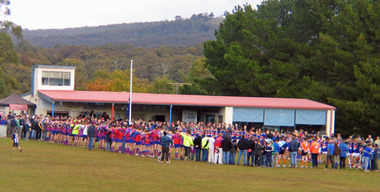
Digital photographs, L.J. Gervasoni, Laurie Sullivan Guard of Honour at Laurie Sullivan Oval, c2006, c2006
... Photographs of a group of people, many wearing the Hepburn Football Team colours, on th eLauire Sullivan Oval....hepburn laurie sullivan laurie sullivan reserve hepburn burras commemoration guard of honour footy local legend Hepburn Football club Photographs of a group of people, many wearing the Hepburn Football Team colours, on th eLauire Sullivan Oval. ...Photographs of a group of people, many wearing the Hepburn Football Team colours, on th eLauire Sullivan Oval.hepburn, laurie sullivan, laurie sullivan reserve, hepburn burras, commemoration, guard of honour, footy, local legend, hepburn football club -
Port Melbourne Historical & Preservation Society
Photograph - Port Melbourne Third Eighteen football team, Lagoon Reserve, Port Melbourne, 1939
... Colour lasercopy of black and white, colourised photo of Port Melbourne Third Eighteen football team 1939 (team colours have been added on jumpers and socks). ...Sport - Australian Rules Football Lagoon Reserve Port Melbourne Football Club PMFC H S KING George FISHER J FODEN A BROWN B ROSEWARNE R BANKS D GLEESON H EASON Mrs O KING Colour lasercopy of black and white, colourised photo of Port Melbourne Third Eighteen football team 1939 (team colours have been added on jumpers and socks). ...Colour lasercopy of black and white, colourised photo of Port Melbourne Third Eighteen football team 1939 (team colours have been added on jumpers and socks). Taken outside rooms at Lagoon Reserve. BACK ROW L - R Mr. H S King (President), George Fisher, J Foden, A Brown, B Rosewarne, R Banks, D Gleeson, H Eason, Mrs. O King (Secretary) MIDDLE ROW L - R C Edland (Assistant Secretary), J Erridge, Albert "Digger" Cosham, H Barnes (Captain & Coach), G Upton (Vice Captain), A Ambler, Jack "Splinter" Lowrie (Boundary Umpire) FRONT ROW L - R P Howard, C Nuttall, R Marshall, A "Bertie" Maskell. E Johnstonsport - australian rules football, lagoon reserve, port melbourne football club, pmfc, h s king, george fisher, j foden, a brown, b rosewarne, r banks, d gleeson, h eason, mrs o king -
 Federation University Historical Collection
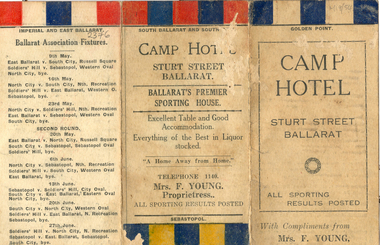
Card, Berry, Anderson & Co, Ballarat Football League Fixtures, 1925, 1925
... Football League fixture from Mrs F. Young of Camp Hotel, Sturt Street, Ballarat. The colours relate to the following football teams: Golden Point, South Ballarat, Imperial and East Ballarat, Ararat, Maryborough and North City, Ballarat and Soldiers' Hill...Football League fixture from Mrs F. Young of Camp Hotel, Sturt Street, Ballarat. The colours relate to the following football teams: Golden Point, South Ballarat, Imperial and East Ballarat, Ararat, Maryborough and North City, Ballarat and Soldiers' Hill Ballarat Football League Fixtures, 1925 Card Card Berry, Anderson & Co. ...The Football Fixture relates to the Ballarat Association of Australian Rules Football.Double sided card with black and white printing and coloured borders. It is a Ballarat Football League fixture from Mrs F. Young of Camp Hotel, Sturt Street, Ballarat. The colours relate to the following football teams: Golden Point, South Ballarat, Imperial and East Ballarat, Ararat, Maryborough and North City, Ballarat and Soldiers' Hillfootball, ballarat, australian rules football, young, camp hotel, football fixture, vfl, bfl, afl -
 Federation University Historical Collection
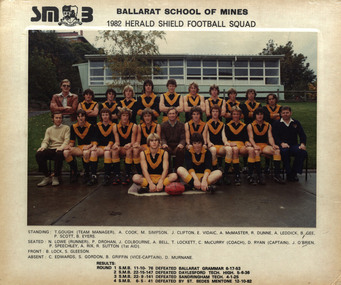
Photograph - Photograph - Colour, Ballarat School of Mines Herald Shield Football Squad, 1982, 1982
... Photograph of the Ballarat School of Mines Australian Rules Football team taken at the Ballarat School of Mines. The football team wears the gold and green colours of the school team. ...Griffin Damien Murnane. afl vfl Photograph of the Ballarat School of Mines Australian Rules Football team taken at the Ballarat School of Mines. The football team wears the gold and green colours of the school team. ...The Ballarat School of Mines traditionally had a strong Australian Rules Football team. The 1982 team included Tony Lockett who went on to play at the highest level becoming the highest goal scorer in the history of the VFL/AFL with 1,360 goals in a career of 281 games, that commenced in 1983 with the St Kilda Football Club, and finished in 2002 with the Sydney Swans. Lockett is the only full-forward ever to win the coveted Brownlow Medal, in 1987, a season in which he was decorated with several honours. He is a four-time Coleman Medallist, kicked more than 100 goals in a season on six occasions (an AFL record), and is a member of the Australian Football Hall of Fame. (Wikipedia) In 2015 Tony Lockett was elevated to the state of Legend in the Australian Football League Hall of Fame.Photograph of the Ballarat School of Mines Australian Rules Football team taken at the Ballarat School of Mines. The football team wears the gold and green colours of the school team. Standing left to right: T. Gough (Team Manager), Anthony Cook, Mark Simpson, John Clifton, E. Vidaic, Andrew McMaster, R. Dunne, A. Leddick, Bruce Gee, P. Scott, B. Eyers. Sitting left to right: N. Rowe (Runner), Paul Drohan, Jeff Colbourne, A. Bell, Tony Lockett, Colin McCurry (Coach), Damian Ryan (Captain), J. O'Brien. Front left to right: Barrie Lock, S. Gleeson. Absent: C. Edwards, S. Gordon, B. Griffin (Vice-Captain), Damien Murnane. ballarat school of mines, football, australian rules footballl, herald shield, mccurry, lockett, tony lockett, t. gough, anthony cook, mark simpson, john clifton, e. vidaic, andrew mcmaster, r. dunne, a. leddick, bruce gee, p. scott, b. eyers., n. rowe, paul drohan, jeff colbourne, a. bell, colin mccurry, damian ryan, j. o'brien., barrie lock, s. gleeson., c. edwards, s. gordon, b. griffin, damien murnane., afl, vfl -
 Federation University Historical Collection
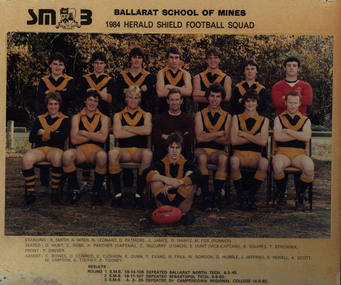
Photograph - Photograph - Colour, Ballarat School of Mines Herald Shield Football Squad, 1984, 1984
... The Ballarat School of Mines (SMB) Australian Rules Football team pose with their coach. They were the green and gold colours of the School. ...Roohey. d. hunt c. bowes k. dunn t. evans n. frika t. stownix p. drever The Ballarat School of Mines (SMB) Australian Rules Football team pose with their coach. They were the green and gold colours of the School. ...The Ballarat School of Mines is the oldest school of mines in AustralasiaThe Ballarat School of Mines (SMB) Australian Rules Football team pose with their coach. They were the green and gold colours of the School. The photograph appears to be taken at the White Flat Oval. Standing left to right: R. Smith, A. Wren, N. Leonard, D. Patmore, G. James, D. Haintz, M. Fox (Runner) Seated left to right: D. Hunt, C. Robe, A. Panther, (Captain), Colin McCurry (Coach), S. Hunt (Vice-Captain, B. Squires, T. Stownix. Front: P. Drever Absent: C. Bowes, D. Conroy, C. Cushion, K. Dunn. T. Evans, N. Frka, W. Gordon, D. Hubble, J. Jeffries, S. Rewell, A Scott, M. Simpson, G. Toohey, R. Roohey. The 1984 results were: SMB 19-14-128 defeated Ballarat North Tech 6-3-45 SMB 16-11-107 defeated Sebastopol Tech 6-8-50 SMB 4-2-26 defeated by Camperdown Regional college 14-9-93 ballarat school of mines, football, australian rules footballl, herald shield, mccurry, colin mccurry, r. smith, a. wren, n. leonard, d. patmore, g. james, d. haintz, m. fox (runner), c. robe, a. panther, (captain), colin mccurry (coach), s. hunt (vice-captain, b. squires, d. conroy, c. cushion, n. frka, w. gordon, d. hubble, j. jeffries, s. rewell, a scott, m. simpson, g. toohey, r. roohey., d. hunt, c. bowes, k. dunn, t. evans, n. frika, t. stownix, p. drever -
 Federation University Historical Collection
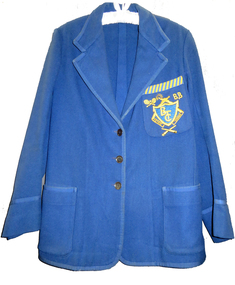
Costume, Ballarat Teachers' College Blazer, c1950
... teams, to take to Paterson & Powell for embroidery on our blazer pockets. On my pocket, the hockey sticks, the BB for basketball, as netball was then called, all mine. The tennis racquet is David's [van Leeuwen], as is the braid topping the pocket denoting the College colours. College colours were authorised for excellence in a chosen sport, and in our year, 1950, only two men's colours were awarded - David's for basketball and Neil Trezise's for football...football embroidery as well, but Joyce Murphy didn’t want that on her blazer because it was too boyish. Gift of Joyce van Leeuwen nee Joyce Murphy, 2014 ballarat teachers' college blazer joyce murphy joyce van leeuwen paterson powell colours embroidery david van leeuwen van leeuwen costume uniform textiles A blue woollen blazer with pocket featuring the Ballarat Teachers' College logo, sports colours, and representation in tennis, basketball and hockey. The pocket is a dual one. Joyce van Leeuwen remembers: 'Towards the end of our College year, were were given written authorisation denoting our sporting teams ...This blazer was worn by Joyce Murphy at the Ballarat Teacher's College. David van Leeuwen decided not to have a blazer as he was older, and thought it too much like school days. He attended the Ballarat Teachers' College when 27 years, after serving in the army. Because he didn’t have a blazer he didn’t have anywhere to put the colours so he offered them to Joyce Murphy as they were going out together. There should have been a football embroidery as well, but Joyce Murphy didn’t want that on her blazer because it was too boyish. Gift of Joyce van Leeuwen nee Joyce Murphy, 2014A blue woollen blazer with pocket featuring the Ballarat Teachers' College logo, sports colours, and representation in tennis, basketball and hockey. The pocket is a dual one. Joyce van Leeuwen remembers: 'Towards the end of our College year, were were given written authorisation denoting our sporting teams, to take to Paterson & Powell for embroidery on our blazer pockets. On my pocket, the hockey sticks, the BB for basketball, as netball was then called, all mine. The tennis racquet is David's [van Leeuwen], as is the braid topping the pocket denoting the College colours. College colours were authorised for excellence in a chosen sport, and in our year, 1950, only two men's colours were awarded - David's for basketball and Neil Trezise's for football. Neil went on to play for the Geelong Cats [AFL football] and later was Victorian minister for Sport for some time.'ballarat teachers' college, blazer, joyce murphy, joyce van leeuwen, paterson powell, colours, embroidery, david van leeuwen, van leeuwen, costume, uniform, textiles -
 Ballarat Clarendon College
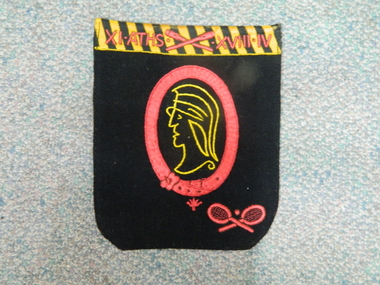
Blazer pocket
... Pocket was worn by Alan McDonald in 1947 and bears the colours for cricket, athletics, rowing, football and tennis. Alan was member of Elliott House, Prefect and member of the top 5 sports teams in 1947. ...Pocket was worn by Alan McDonald in 1947 and bears the colours for cricket, athletics, rowing, football and tennis. Alan was member of Elliott House, Prefect and member of the top 5 sports teams in 1947. ...Pocket was worn by Alan McDonald in 1947 and bears the colours for cricket, athletics, rowing, football and tennis. Alan was member of Elliott House, Prefect and member of the top 5 sports teams in 1947. He went on to study at Duntroon and spent 38 years in the Army. Black wool blazer pocket with embroidered braid across top, Minerva Head embroidered in yellow and surrounded with red embroidered belt; crossed tennis rackets embroidered at bottom right corner. Embroidered on ribbon: XI. ATHS.(crossed oars). XVIII. IValan-mcdonald, sports, blazer-pocket, ballarat-college -
 Federation University Historical Collection
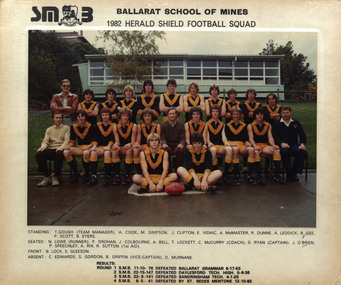
Photograph - Photograph - Colour, Ballarat School of Mines Herald Shield Football Squad, 1982, 1982
... Photograph of the Ballarat School of Mines Australian Rules Football team taken at the Ballarat School of Mines. The football team wears the gold and green colours of the school team. ...(Wikipedia) In 2015 Tony Lockett was elevated to the state of Legend in the Australian Football League Hall of Fame. ballarat school of mines football australian rules footballl herald shield mccurry lockett. tony lockett vfl afl Photograph of the Ballarat School of Mines Australian Rules Football team taken at the Ballarat School of Mines. The football team wears the gold and green colours of the school team. ...The Ballarat School of Mines traditionally had a strong Australian Rules Football team. The 1982 team included Tony Lockett who went on to play at the highest level becoming the highest goal scorer in the history of the VFL/AFL with 1,360 goals in a career of 281 games, that commenced in 1983 with the St Kilda Football Club, and finished in 2002 with the Sydney Swans. Lockett is the only full-forward ever to win the coveted Brownlow Medal, in 1987, a season in which he was decorated with several honours. He is a four-time Coleman Medallist, kicked more than 100 goals in a season on six occasions (an AFL record), and is a member of the Australian Football Hall of Fame. (Wikipedia) In 2015 Tony Lockett was elevated to the state of Legend in the Australian Football League Hall of Fame.Photograph of the Ballarat School of Mines Australian Rules Football team taken at the Ballarat School of Mines. The football team wears the gold and green colours of the school team. Standing left to right: T. Gough (Team Manager), Anthony Cook, Mark Simpson, John Clifton, E. Vidaic, Andrew McMaster, R. Dunne, A. Leddick, Bruce Gee, P. Scott, B. Eyers. Sitting left to right: N. Rowe (Runner), Paul Drohan, Jeff Colbourne, A. Bell, Tony Lockett, Colin McCurry (Coach), Damian Ryan (Captain), J. O'Brien. Front left to right: Barrie Lock, S. Gleeson. Absent: C. Edwards, S. Gordon, B. Griffin (Vice-Captain), Damien Murnane. ballarat school of mines, football, australian rules footballl, herald shield, mccurry, lockett. tony lockett, vfl, afl -
 Ringwood and District Historical Society
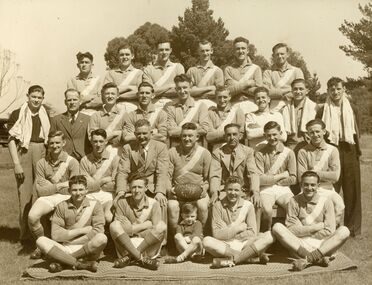
Photograph, East Ringwood Football Club (ERFC) 1947 Reserves team (finalists)
... Football Club. Names are on the back of the photo. Odd that the jumpers are not club colours/design. East Ringwood Football Club (ERFC) 1947 Reserves team (finalists) Photograph ...Originally framed and shown up the stairs at the former Maroondah Sporting Club, the home of the East Ringwood Football Club. Names are on the back of the photo. Odd that the jumpers are not club colours/design.Contains names of players, trainers, umpire and officials -
 Bendigo Historical Society Inc.
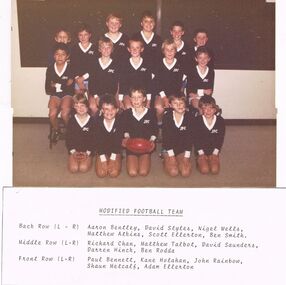
Photograph - GOLDEN SQUARE LAUREL STREET P.S. COLLECTION: PHOTOGRAPH MODIFIED FOOTBALL TEAM 1987
... Coloured photograph of the 1987 Modified Football Team. Photo taken indoors and colours are not good. The boys are weraing dark jumpers with white cuffs and neck bands and dark blue shorts. ...Collection - Photograph Modified Football Team 1987 Aaron Bentley David Styles Nigel Wells Matthew Atkins Scott Ellerton Ben Smith Richard Chan Matthew Talbot David Saunders Darren Hinck Ben Rodda Paul Bennett Kane Holahan John Rainbow Shaun Metcalf Adam Ellerton Coloured photograph of the 1987 Modified Football Team. Photo taken indoors and colours ...Coloured photograph of the 1987 Modified Football Team. Photo taken indoors and colours are not good. The boys are weraing dark jumpers with white cuffs and neck bands and dark blue shorts. The boy in the middle of the front row is holding a football. The names of the boys are:- Back Row (L - R) Aaron Bentley, David Styles, Nigel Wells, Matthew Atkins, Scott Ellerton, Ben Smith. Middle Row (L - R) Richard Chan, Matthew Talbot, David Saunders, Darren Hinck, Ben Rodda. Front Row (L - R) Paul Bennett, Kane Holahan, John Rainbow, Shaun Metcalf, Adam Ellerton.education, primary, golden square laurel st p.s., golden square laurel street p.s. collection - photograph modified football team 1987, aaron bentley, david styles, nigel wells, matthew atkins, scott ellerton, ben smith, richard chan, matthew talbot, david saunders, darren hinck, ben rodda, paul bennett, kane holahan, john rainbow, shaun metcalf, adam ellerton -
 Bendigo Historical Society Inc.
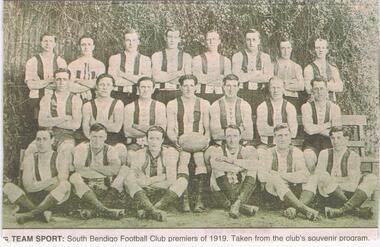
Newspaper - JENNY FOLEY COLLECTION: TEAM SPORT
... Formed in 1893, the South Bendigo Football Club chose the red and white colours of South Melbourne who were the leading VFL club at the time. NEWSPAPER Bendigo advertiser the way we were Bendigo Advertiser '' the way we were'' from 2002. Team ...Formed in 1893, the South Bendigo Football Club chose the red and white colours of South Melbourne who were the leading VFL club at the time.Bendigo Advertiser '' the way we were'' from 2002. Team sport: South Bendigo Football Club premiers of 1919. Taken from the club's souvenir program. The clip is in a folder.newspaper, bendigo advertiser, the way we were -
 Bendigo Historical Society Inc.
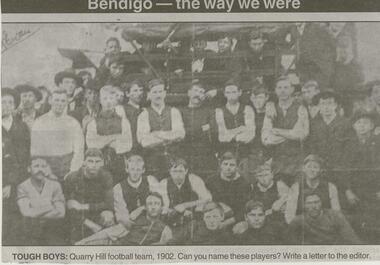
Newspaper - JENNY FOLEY COLLECTION: TOUGH BOYS
... football club is first mentioned in the "Bendigo Advertiser" in April 1887, when the annual meeting attracted 30 members. Subscriptions were set at 2 shillings and the club colours were to be red and white. NEWSPAPER Bendigo advertiser the way we were Bendigo Advertiser ''The way we were'' from 2003. Tough boys: Quarry Hill football team ...The Quarry Hill football club is first mentioned in the "Bendigo Advertiser" in April 1887, when the annual meeting attracted 30 members. Subscriptions were set at 2 shillings and the club colours were to be red and white.Bendigo Advertiser ''The way we were'' from 2003. Tough boys: Quarry Hill football team, 1902. The clip is in a folder.newspaper, bendigo advertiser, the way we were -
 Bendigo Historical Society Inc.
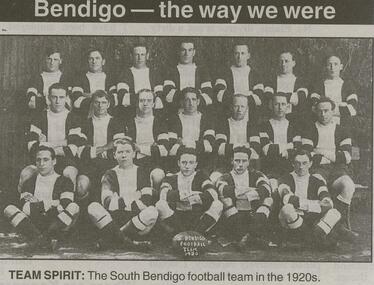
Newspaper - JENNY FOLEY COLLECTION: TEAM SPIRIT
... football Club was formed in 1893. Their red and white colours were chosen in homage to the South Melbourne Football club who were leading the VFL at the time. NEWSPAPER Bendigo advertiser the way we were Bendigo Advertiser ''The way we were'' from Monday, February 2, 2004. Team ...The South Bendigo football Club was formed in 1893. Their red and white colours were chosen in homage to the South Melbourne Football club who were leading the VFL at the time.Bendigo Advertiser ''The way we were'' from Monday, February 2, 2004. Team spirit: the South Bendigo football team in the 1920's. The clip is in a folder.newspaper, bendigo advertiser, the way we were -
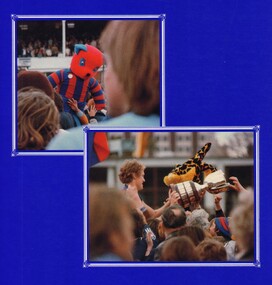 Port Melbourne Historical & Preservation Society
Photograph - Port Melbourne Football Club, premiers, 1980
... Gary BRICE Sport - Australian Rules Football Port Melbourne Football Club PMFC PMFC Premiers 1980: digital image of two colour photos, mounted overlapped on a blue background. Top photo shows a mascot teddy bear in Port Melbourne team colours; lower photo shows the trophy being passed over the crowd by Gary BRICE Photograph Port Melbourne Football Club, premiers ...PMFC Premiers 1980: digital image of two colour photos, mounted overlapped on a blue background. Top photo shows a mascot teddy bear in Port Melbourne team colours; lower photo shows the trophy being passed over the crowd by Gary BRICEgary brice, sport - australian rules football, port melbourne football club, pmfc -
Stawell Historical Society Inc
Photograph, Stawell Football Club Premiers 1933
... Sport Stawell & District Football Club 1933 Premiers 1933 Three Rows of Playerser in team Colours Redlegs. ...Names of Players on Back: Premiers 1933 Back: Ray Maddocks, Ray Rowe, Jim May, Carl Rodda, Danny McKay, Charles Fowler, Lawrie Reeves, Bill Warne, Joe Earle, Bill Will...?, 2/: Glen Gilchrist, Howie Arm.?, Hank Neil, Alan Blachford, Steve Hart (Coach) FrankBallard, Bill Earle, Roy Faulkner, Griff Hale. Front: Harold Carr, Harold Tredway, Barry Monaghan, Jack Carr. Three Rows of Playerser in team Colours Redlegs. In Front of Stawell Townhall DoorsStawell & District Football Club 1933 Premiers 1933sport -
Box Hill Historical Society
Book, Lyall, Ken (compiler), Football, 1997
... football gleaned from the pages of The Box Hill Reporter newspaper. It includes competition years, final series finishes, colours of competing clubs, for Reporter District Football Association, East Suburban Football League, Junior football competitions and other eastern teams plus miscellaneous information on football. ...Information on football gleaned from the pages of The Box Hill Reporter newspaper. It includes competition years, final series finishes, colours of competing clubs, for Reporter District Football Association, East Suburban Football League, Junior football competitions and other eastern teams plus miscellaneous information on football.A4: 55 pnon-fictionInformation on football gleaned from the pages of The Box Hill Reporter newspaper. It includes competition years, final series finishes, colours of competing clubs, for Reporter District Football Association, East Suburban Football League, Junior football competitions and other eastern teams plus miscellaneous information on football.reporter district football association, east suburban football league, junior football competitions, australian rules football, lyall> ken, hodges> e f g, reporter district cricket association, tennis association, cricket, tennis -
Dandenong & District Historical Society
The Redlegs History Book V.F.A. 1958-1980, 18 Mar 2026
... History of the Team Players and matches played and to be played Front Cover Printed Red & Blue (club colours) including price 25c Back Cover printed Black advert. for The Gymnastic Internationale Pty Ltd.-Springvale. Loose Leaf Black Cover containing one copy of 1971/72 Redlegs History Book Official Publication of the Dandenong Football ...Loose Leaf Black Cover containing one copy of 1971/72 Redlegs History Book Official Publication of the Dandenong Football Club and one photocopy of the book.non-fiction -
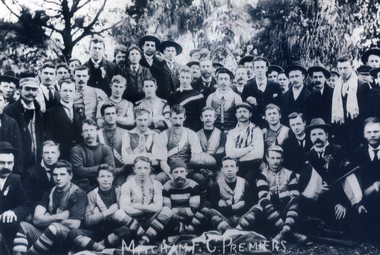 Whitehorse Historical Society Inc.
Photograph, Mitcham Football Club, 1904
... Football Club was established in 1888. Known as the 'Tigers', their colours are black and yellow and their home ground is at Walker Park, Mitcham. Originally the club played on the Reporter and District League where they won premierships in 1904, 1905, 1914, 1915 and 1921, then in the Eastern Suburbs Football League they won a premiership in 1947. At present (2015) they compete in the Eastern Football League and filed senior, reserves, under 19's and 6 junior Teams...Football Club was established in 1888. Known as the 'Tigers', their colours are black and yellow and their home ground is at Walker Park, Mitcham. Originally the club played on the Reporter and District League where they won premierships in 1904, 1905, 1914, 1915 and 1921, then in the Eastern Suburbs Football League they won a premiership in 1947. At present (2015) they compete in the Eastern Football League and filed senior, reserves, under 19's and 6 junior Teams ...The Mitcham Football Club was established in 1888. Known as the 'Tigers', their colours are black and yellow and their home ground is at Walker Park, Mitcham. Originally the club played on the Reporter and District League where they won premierships in 1904, 1905, 1914, 1915 and 1921, then in the Eastern Suburbs Football League they won a premiership in 1947. At present (2015) they compete in the Eastern Football League and filed senior, reserves, under 19's and 6 junior Teams.Black and white photograph of the Mitcham Football team and supporters taken outside in1904.Mitcham F.C Premises is written on the bottom of photographmitcham football club, sporting clubs, football clubs -
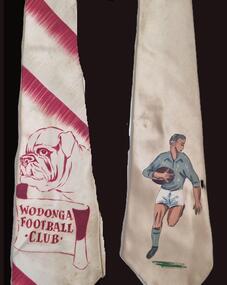 Wodonga & District Historical Society Inc
Clothing - Wodonga Football Club Ties, c1940
... Between 1878 and 1891, Wodonga played many intermittent friendly matches against other local clubs and towns, before organised fixtures and competitions were starting to be arranged from the early 1890s In 1899, the Wodonga Football Club "Starlights" Junior Club was formed and adopted the Club colours of blue, black and a white star. In 1903, 1904 and 1905, the Wodonga Football Club "Shamrocks" entered a team in the local Federal Junior Football Association. ...Between 1878 and 1891, Wodonga played many intermittent friendly matches against other local clubs and towns, before organised fixtures and competitions were starting to be arranged from the early 1890s In 1899, the Wodonga Football Club "Starlights" Junior Club was formed and adopted the Club colours of blue, black and a white star. In 1903, 1904 and 1905, the Wodonga Football Club "Shamrocks" entered a team in the local Federal Junior Football Association. ...Wodonga Football Club’s first recorded match was against the Albury Football Club on Saturday, 6 July 1878 in Wodonga. Between 1878 and 1891, Wodonga played many intermittent friendly matches against other local clubs and towns, before organised fixtures and competitions were starting to be arranged from the early 1890s In 1899, the Wodonga Football Club "Starlights" Junior Club was formed and adopted the Club colours of blue, black and a white star. In 1903, 1904 and 1905, the Wodonga Football Club "Shamrocks" entered a team in the local Federal Junior Football Association. In April 1906, the Wodonga Football Club "Shamrocks" met and decided to become a Senior team and be known as just the Wodonga FC The Club, currently a member of the Ovens and Murray Football League, has participated in a variety of local leagues and competition since then, apart from the years of the First and Second World Wars when they went into recess. The support the club has shown to its members was evidenced around 1949, when the Wodonga FC set up a Provident Fund for injured players to be compensated if they were not able to work for a length of time. In 1981, Wodonga achieved the rare feat of winning football Premierships in the Firsts, Seconds and Thirds. No other team has done this. The club has played in the finals 33 of the 74 years, winning seven senior premiership flags.These items are significant because Wodonga Football Club has played an important role in the community since 1878.Two sport memorabilia ties, one featuring the Bulldog logo of the Wodonga Football Club. The second tie features a footballer in green uniform.Brand names inside ties Tie 1 - Wodonga Football Tie Individually Hand Painted by Gilden Tie 2 - Footballer - Hand Made Neckwear - Cardinal Rockfeller Centre. 5th Ave, New York wodonga football club, community sport, sport memorabilia -
Rutherglen Historical Society
Image, Thalma Studios, 1912 (Approximate)
... Photograph of Rutherglen Football team, circa 1912, mounted & framed, glass cracked down centre. Group with cup, members of team in club colours. ...football team Football Rutherglen Premiers On bottom of mount: "Thalmas / Opp. P.O. /Rutherglen". On cup in photo: "Rutherglen Premiers". Photograph of Rutherglen Football team, circa 1912, mounted & framed, glass cracked down centre. Group with cup, members of team in club colours ...Associated with Rutherglen Premiers football teamPhotograph of Rutherglen Football team, circa 1912, mounted & framed, glass cracked down centre. Group with cup, members of team in club colours. Black & white photograph on dark green card mount, carved timber frame, painted green.On bottom of mount: "Thalmas / Opp. P.O. /Rutherglen". On cup in photo: "Rutherglen Premiers".football, rutherglen premiers -
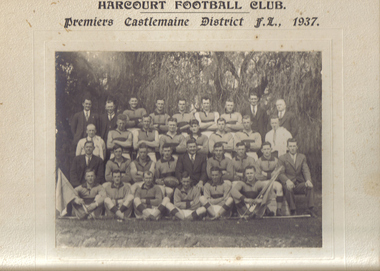 Harcourt Valley Heritage & Tourist Centre
Football Club Photograph, Harcourt Football Club Premiers Castlemaine District F L 1937, 1937
... Football association with reasonable success until it moved to the Maryborough Castlemaine League in 1970. The original guernsey worn by the players was maroon with maroon stockings and blue shorts. The colours were later changed to royal blue with a gold stripe. Originally called the Apple eaters, the club has adopted the name "lions" and continues to function successflly with the added spect of fielding a highly successful netball team...Football association with reasonable success until it moved to the Maryborough Castlemaine League in 1970. The original guernsey worn by the players was maroon with maroon stockings and blue shorts. The colours were later changed to royal blue with a gold stripe. Originally called the Apple eaters, the club has adopted the name "lions" and continues to function successflly with the added spect of fielding a highly successful netball team ...Harcourt Football Club was formed in 188 and for the first two years played social games until joining the Castlemaine District League in 1891. However the club had to wait until 1937 for its first triumph.In 1951 the club joined the Bendigo Football association with reasonable success until it moved to the Maryborough Castlemaine League in 1970. The original guernsey worn by the players was maroon with maroon stockings and blue shorts. The colours were later changed to royal blue with a gold stripe. Originally called the Apple eaters, the club has adopted the name "lions" and continues to function successflly with the added spect of fielding a highly successful netball team.Harcourt's first ever Australian Rules Football Premiership team.A group photograph of team and officials. names of players, president, vice president, secretary, trainers, coach, steward are all recorded on the mounting of the photographHarcourt Football Club Premiers Castlemaine District F L 1937 -
 Carlton Football Club
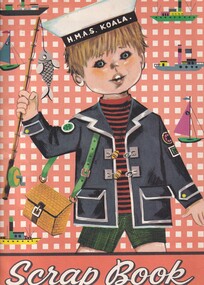
Scrap Book, Dedicated to Carlton Player John Goold
... colours. Testament to his improvement, he finished third behind John Nicholls and Sergio Silvagni in Carlton’s 1965 Best and Fairest award, and followed up by being selected in the Victorian team for the 1966 Hobart Carnival. There, he had a superb series in which he was runner-up to West Australian Barry Cable in voting for the Tassie Medal, and capped it off by being named on a half-back flank in the All Australian team. Barassi’s influence at Carlton bore fruit in his third year, when the Blues returned to finals football ...John Goold double Premiership PlayerA scrap Book dedicated to twice Premiership Player 1968 - 1970 John Goold Career : 1963 - 1970 Debut : Round 7, 1963 vs Footscray, aged 21 years, 338 days Carlton Player No. 754 Games : 108 Goals : 3 Last Game : Grand Final, 1970 vs Collingwood, aged 29 years, 90 days Guernsey No. 11 Height : 184 cm (6 ft ½ in.) Weight : 76 kg (12 stone, 0 lbs.) DOB : June 27, 1941 Premiership Player 1968, 1970 Carlton Hall of Fame All Australian 1966 A brilliant, flamboyant, two-time Premiership player for Carlton during the Barassi years in the ‘swingin’ sixties,’ John William Crosbie Goold became almost as famous for his dapper appearance off the field, as for his exploits on it. At the height of his football career, he was also a prominent ladies fashion designer – which led to him being dubbed ‘Mr Elegance’ by leading football commentator Lou Richards. Supporters and team-mates however, called him ‘Rags’ or ‘Ragsy,’ because of his involvement in the clothing, or ‘rag’ trade. Goold first came under notice as an outstanding junior athlete at Melbourne Grammar School. A true all-round sportsman, he shone at tennis, athletics, football and cricket. He was also a keen horseman who loved the game of polo and the rough and tumble of fox hunting. While at school he was a fervent Melbourne supporter, but strangely, never had much confidence in his football ability. “If I thought I was good enough, I would certainly have gone to Melbourne,” he said many years later. “But I honestly didn’t think I would ever amount to anything in this game. Cricket and tennis were the games that really interested me.’ However, after graduating from MGS, Goold went home to Healesville to star in the Bloods’ 1962 Yarra Valley Football Association Premiership team – an achievement that brought tempting offers from more than one VFL club. “Incentives were offered elsewhere,” he recalled, “but I gravitated to Carlton – partly because the deep blue of their guernsey attracted me, but mostly because of the good advice I got from people who even then were longsighted enough to predict that big things were ahead for this club.” The Blues were confident enough in Goold’s potential to offer him the guernsey number 11 previously worn with distinction by the likes of Jack Hale, Jim Knight, Ron Hines and Laurie Kerr, and his first senior game came in round 7, 1963 against Footscray at the Western Oval. He played on a half-forward flank alongside Brownlow Medallists Gordon Collis and John James on that Saturday afternoon, and kicked his first career goal in an 8-point win. Little did he know though, that it would be another six seasons before he would again experience the thrill of sending a football spinning between the big posts, because his future lay in defence. By his own admission, Goold struggled to find his feet in VFL football during his first two seasons, until the shock appointment of Ron Barassi as captain-coach of Carlton in 1965 began steering his career back on track. “I think you could say that 1965 was my first year of League football,” he said, “That’s the way I felt - that’s the way I reacted to Barassi.” Under Barassi, Goold rapidly developed into a superb running half-back flanker. Tenacious, and an often freakish high mark, he was unmistakable on the field thanks to his mane of dark hair, his loping running style and somewhat awkward kicking action. Furthermore, he had boundless courage. There is no doubt that he would have played many more games had he not been regularly pole-axed under the high ball – a fact he later freely admitted. “I was always getting knocked out,” he said, “and spent half my bloody time in hospital.” In the second half of 1965, an injury to centre half-back Gordon Collis forced Barassi to use Goold in the key defensive post. While it curtailed his rebounding instincts somewhat, ‘Ragsy’ rose to the challenge and rarely lowered his colours. Testament to his improvement, he finished third behind John Nicholls and Sergio Silvagni in Carlton’s 1965 Best and Fairest award, and followed up by being selected in the Victorian team for the 1966 Hobart Carnival. There, he had a superb series in which he was runner-up to West Australian Barry Cable in voting for the Tassie Medal, and capped it off by being named on a half-back flank in the All Australian team. Barassi’s influence at Carlton bore fruit in his third year, when the Blues returned to finals football at last. Richmond, Carlton, Geelong and Collingwood fought out the 1967 Premiership, and Ragsy Goold won the hearts of the Carlton faithful with two lion-hearted performances. Although Carlton was knocked out of contention by successive losses to Richmond and Geelong, Goold was tireless throughout both games, and it was obvious that he thrived on the added pressure of finals football. Precisely twelve months later, the bitter taste of those defeats was washed away when Barassi’s Blues edged out Essendon by 3 points in the 1968 Grand Final, and ended 21 years of despair at Princes Park. To win Carlton’s ninth VFL flag, the Blues had had to defeat the minor premier Bombers twice during the finals – and did so, thanks to a watertight defence led by Goold, and a dominant ruck division headed by John Nicholls. In round 5, 1969, Carlton hosted South Melbourne at Princes Park in a match significant for a number of reasons. As he regularly did, Ron Barassi swung his team around prior to the opening bounce, and Goold found himself in the unaccustomed role of ruck-rover. While the Blues set about establishing a good break on the scoreboard, Ragsy relished the freedom to kick two first half goals - his first majors for 78 games. Just before half-time however, he was flattened in a pack, concussed again, and replaced during the long break by Barry Gill. Alex Jesaulenko was substituted at the same time – by a shy, ambitious youngster named Bruce Doull, making his senior debut for Carlton in guernsey number 4. In September, 1969 the Navy Blues began their third straight finals campaign with an impressive 6-goal Semi Final win over Collingwood in front of more than 108,000 fans at the MCG. A fortnight later, Richmond stunned the flag favourites with a withering last quarter in the Grand Final, and knocked Carlton out of the Premiership race again at the last hurdle. Half-way through the year, Carlton's club doctor discovered that Goold had been playing with shin splints in both of his lower legs. The pain they caused was considerable, but Ragsy soldiered on and held down centre half-back throughout the season. John Goold’s VFL career at Carlton culminated in the fabled 1970 Grand Final triumph over Collingwood. What is not so well known is that Ragsy was only cleared to play in that game on the morning of the match. After narrowly losing to Collingwood in the second Semi Final, the Navy Blues destroyed St Kilda by 62 points in the Preliminary Final, and earned another shot at the Magpies in the decider. But one of Carlton’s problems was that Goold had been kicked on a shin against St Kilda, causing a burst blood vessel and serious swelling. Despite the best efforts of the club medical staff, Ragsy had only a slim chance of playing in the Grand Final right up until game day, when his worried coach reluctantly allowed him to take his place in the side. Later, Barassi justified his decision by saying that in his opinion, a less than fully fit Goold was still worth his place in the team. By half time in the Grand Final however, he was probably questioning that judgement - because Carlton had been totally outplayed, and trailed an impressive, cohesive Collingwood by 44 points. Therefore, Carlton’s magnificent comeback – orchestrated by Barassi, and sparked by the fairytale exploits of 19th man Ted Hopkins – is one of the greatest of all football stories. Against enormous odds, the Navy Blues fought their way back into the contest, and eventually, rolled over the top of the frantic Magpies to snatch victory by 10 points in the last few minutes of the match. Hopkins ended up with four goals, Barassi was hailed a genius, and Ragsy Goold was carted off to hospital immediately after the game to have further urgent treatment. While there, he decided that there was no better time to end his VFL career – especially because his burgeoning business interests were demanding more and more of his time. In the years after his football career ended, John Goold created a remarkably successful business empire. In 1971 he sold his fashion label and took up farming at Mortlake in western Victoria, where he coached the local football team for three seasons. Later, he formed a diversified pastoral company, and purchased a magnificent complex called Ballangeich Run at nearby Ellerslie. While his passion for farming and livestock grew, he began breeding top quality polo ponies, and represented Australia in international competition. During the 1997 and 1998 seasons, John's son Ed Goold played reserve grade football for Carlton. MEMORIES.... Ragsy Goold; the name stirs memories form my long ago childhood. Ragsy, with his unique kicking style, where he'd hold the ball (always a drop punt - in a time when the drop kick and the torpedo punt still reigned supreme) at the point of the ball, elbows bent and he'd lavishly drop the ball, his right arm then flinging back and up dramatically. That was the thing about Ragsy (so named because he worked in the clothing, or 'rag' trade), he was always dramatic. He always ensured his ankle guards and wrist guard were glowing white to match the great white CFC monogram he wore proudly on his chest, and with his long flowing locks, cut a dynamic figure through a young boy's mind. Ragsy was my idol. I loved his dashes from half back, his long accurate drop punts, most of all I loved his flair for the game. Ragsy played the game as an entertainer as well as a sportsman - he leapt high to punch or mark, and always seemed to have a bit of the thoroughbred about him - which is probably why after he retired, he took up fox chasing, polo, and riding his beloved thoroughbreds across the paddocks and over the fences of his property, I think he may have even represented Australia at the sport – really, that’s sort of how he played as a footballer. All sinewy muscle, long legs and famous leaps for the saving punch. Ragsy was part of the great backline that helped revive Carlton's fortunes. Legendary players Wes Lofts, Ian Collins, Kevin 'Racehorse' Hall, Vinnie Waite among them. All great teams have a great defence and the defence that Ragsy was an integral part of was no different. Where others provided the biffo, the muscle or the defensive pressure, Ragsy provided the dash, the flair, the sense of adventure that all great backlines must have. AND MORE.... I have had many favourite players while following the Blues, but there will always be a special spot for Ragsy Goold - running the lines, all long hair and flashing white guards. As a young man I moved to Carlton and began acting in a place called one-c-one. One night after a play, I was walking home. It was winter, and I was wearing my favouritte overcoat, a genuine ankle length tweed affair I had picked up in an Op Shop in Oakleigh for three dollars. As I strutted across Lygon Street, a deep male voice behind me called, 'hey laddie, how much for the overcoat?' I turned, and there was my childhood idol, Ragsy Goold, two beautiful women in tow, smiling and waiting for my answer. I loved that coat too much to part with it, even to Ragsy, so I shook my head - and he smiled, then walked off. I stood for a moment in the middle of the street shaking my head in disbelief. Ragsy bloody Goold had just offered to buy my overcoat! I knew at that point, as a young man of about twenty three, that life was going to be full of surprises and very entertaining - a bit like John ‘Ragsy’ Goold. ONE MORE.... A cold, wet day in the mid 1960's at the MCG and Victoria were playing South Australia (?) The ball that day was like a piece of soap, with players finding it impossible to mark. Just before half time a long kick sailed toward the mud heap that was the centre of the ground, and the pack rose to meet it. From this group of players an arm shot straight up, and the ball instantly came to a dead stop. The footy stuck in the player's palm as if the hand was coated in Tarzan's Grip. After all these years, it's the only recollection I have of that match, and that player was 'Mr. Elegance' John Goold. HUMOROUS HUNGRY.... Former opponent Richmond's Kevin Bartlett on Radio SEN in 2012 received a phone call from John. After the call Kevin told his listeners how "Mr Elegance" would always be dressed in a nice suit, shirt-tie and highly polished shoes. He then cracked a joke saying something like; "You know, John was so 'posh' that he used to play football wearing a cravat!" Milestones 50 Games: Round 15, 1967 vs Melbourne 100 Games: Round 13, 1970 vs Geelong Career Highlights 1965 - Percy Bentley Trophy - 3rd Best & Fairest 1966 - 5th Best & Fairest 1967 - Maurie Sankey Memorial Trophy - 4th Best & Fairest (on count back) 1968 - Premiership Player 1970 - 7th Best & Fairest 1970 - Premiership PlayerFoolscap Scrap Book -
Linton and District Historical Society Inc
Football Jumper, Loco Sportswear, Football Jumper - Commemorative, Carngham Linton Football Netball Club, 2018, 2018
... A heritage jumper worn by the Cargnham Linton Football Netball Club senior football team in the 2018 match against Skipton commemorating the 50th year of the amalgamated Cargnham Linton club. The jumper features the club's red, white and black colours on the front with logos and all football premierships of the Cargnham, Linton and Cargnham Linton football teams. ...A heritage jumper worn by the Cargnham Linton Football Netball Club senior football team in the 2018 match against Skipton commemorating the 50th year of the amalgamated Cargnham Linton club. The jumper features the club's red, white and black colours on the front with logos and all football premierships of the Cargnham, Linton and Cargnham Linton football teams. ...A heritage jumper worn by the Cargnham Linton Football Netball Club senior football team in the 2018 match against Skipton commemorating the 50th year of the amalgamated Cargnham Linton club. The jumper features the club's red, white and black colours on the front with logos and all football premierships of the Cargnham, Linton and Cargnham Linton football teams. The back of the jumper features a combination of the royal blue and gold sash of the former Linton Football Club and the royal blue and red sash of the former Cargnham Football Club. This jumper was donated to the Linton and District Historical Society has player number 22 on the back. This appropriately recognises 100 years since the Linton Football Club premiership year of 1922. Donated to the Society 100 years later in 2022.Football jumper made from synthetic material to commemorate 100 years of when Linton Football Club won the premiership in 1922. Front of jumper is made up of black, white and red stripes. Across centre front of jumper are three shields representing Carngham, Carngham Linton and Linton football clubs prior to and since amalgamation to one club. Below the shields are lists of when the above teams won significant premierships. Reverse of the jumper has a large number 22 which signifies winning a premiership in 1922 and the centenary year 2022.carngham linton football netball club, linton football club, carngham football club, michael o'beirne -
 Linton and District Historical Society Inc
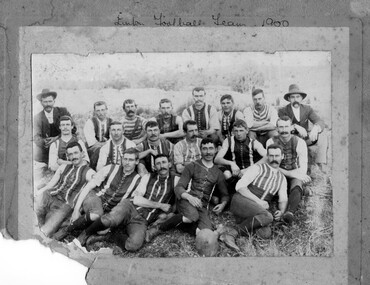
Photograph, Vice Regal Photographer, Ballarat, Linton Football team c.1900
... football team in about 1900. Mrs Surman also identified names of players, which are inscribed on the back of the photograph. Guernseys were apparently hand-knitted at this time, mostly by the players' mothers. They were all in team colours...football team in about 1900. Mrs Surman also identified names of players, which are inscribed on the back of the photograph. Guernseys were apparently hand-knitted at this time, mostly by the players' mothers. They were all in team colours ...Identified by Mrs Surman as the Linton football team in about 1900. Mrs Surman also identified names of players, which are inscribed on the back of the photograph. Guernseys were apparently hand-knitted at this time, mostly by the players' mothers. They were all in team colours, blue and white, but had different patterns. (This information given by Mrs Stella Surman in a 1991 interview. Interview recorded on CD - see Registration no. 2019-212.)Original sepia photograph of a group of men wearing football guernseys. Guernseys have different patterns (mostly variations on vertical stripes) and most are laced at the front."Jack Brown / about 1900 / L to R / H Roberts, R Nicol, Ben Cornish, Catton, Jack Hogan, Pearly Power, J Mitchell, H Catton /Jim Hogan, A Nicol, P Crane, B Angus, W McMillan, Tony Cunningham / Mick Cunningham, -?- , Whitecross, Jack Cunningham, J Brown".linton football club, jack brown, h. roberts, r. nicol, a. nicol, ben cornish, h. catton, jack hogan, jim hogan, "pearey" power, j. mitchell, p. crane (craine), b. angus, w. mcmillan, tony cunningham, mick cunningham, jack cunningham, whitecross -
 Wodonga & District Historical Society Inc
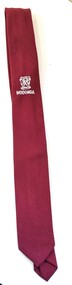
Memorabilia - Wodonga Football Club Tie
... Between 1878 and 1891, Wodonga played many intermittent friendly matches against other local clubs and towns, before organised fixtures and competitions were starting to be arranged from the early 1890s In 1899, the Wodonga Football Club "Starlights" Junior Club was formed and adopted the Club colours of blue, black and a white star. In 1903, 1904 and 1905, the Wodonga Football Club "Shamrocks" entered a team in the local Federal Junior Football Association. ...Between 1878 and 1891, Wodonga played many intermittent friendly matches against other local clubs and towns, before organised fixtures and competitions were starting to be arranged from the early 1890s In 1899, the Wodonga Football Club "Starlights" Junior Club was formed and adopted the Club colours of blue, black and a white star. In 1903, 1904 and 1905, the Wodonga Football Club "Shamrocks" entered a team in the local Federal Junior Football Association. ...Wodonga Football Club’s first recorded match was against the Albury Football Club on Saturday, 6 July 1878 in Wodonga. Between 1878 and 1891, Wodonga played many intermittent friendly matches against other local clubs and towns, before organised fixtures and competitions were starting to be arranged from the early 1890s In 1899, the Wodonga Football Club "Starlights" Junior Club was formed and adopted the Club colours of blue, black and a white star. In 1903, 1904 and 1905, the Wodonga Football Club "Shamrocks" entered a team in the local Federal Junior Football Association. In April 1906, the Wodonga Football Club "Shamrocks" met and decided to become a Senior team and be known as just the Wodonga FC The Club, currently a member of the Ovens and Murray Football League, has participated in a variety of local leagues and competition since then, apart from the years of the First and Second World Wars when they went into recess. The support the club has shown to its members was evidenced around 1949, when the Wodonga FC set up a Provident Fund for injured players to be compensated if they were not able to work for a length of time. In 1981, Wodonga achieved the rare feat of winning football Premierships in the Firsts, Seconds and Thirds. No other team has done this. The club has played in the finals 33 of the 74 years, winning seven senior premiership flags. Austico Apparel began as the Australian Tie Company in 1915; a specialty manufacturer of men's ties and accessories.Wodonga Football Club was first established in 1878 and has played an important role in the community since that time. It has been successful not only on the sporting field, but has provided support and social connection to its members and their families. Several of its players have gone on to perform to at an elite standard in higher levels of competition.Maroon tie with white embroidered bulldog in the centre.Beneath bulldog logo: WODONGAwodonga football club, sport and recreation, football wodonga -
 Wodonga & District Historical Society Inc
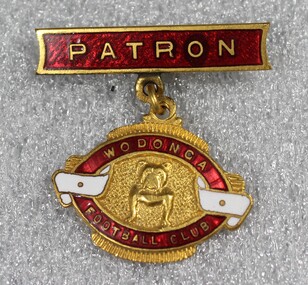
Badge - Patron Wodonga Football Club
... Between 1878 and 1891, Wodonga played many intermittent friendly matches against other local clubs and towns, before organised fixtures and competitions were starting to be arranged from the early 1890s In 1899, the Wodonga Football Club "Starlights" Junior Club was formed and adopted the Club colours of blue, black and a white star. In 1903, 1904 and 1905, the Wodonga Football Club "Shamrocks" entered a team in the local Federal Junior Football Association. ...Between 1878 and 1891, Wodonga played many intermittent friendly matches against other local clubs and towns, before organised fixtures and competitions were starting to be arranged from the early 1890s In 1899, the Wodonga Football Club "Starlights" Junior Club was formed and adopted the Club colours of blue, black and a white star. In 1903, 1904 and 1905, the Wodonga Football Club "Shamrocks" entered a team in the local Federal Junior Football Association. ...Wodonga Football Club’s first recorded match was against the Albury Football Club on Saturday, 6 July 1878 in Wodonga. Between 1878 and 1891, Wodonga played many intermittent friendly matches against other local clubs and towns, before organised fixtures and competitions were starting to be arranged from the early 1890s In 1899, the Wodonga Football Club "Starlights" Junior Club was formed and adopted the Club colours of blue, black and a white star. In 1903, 1904 and 1905, the Wodonga Football Club "Shamrocks" entered a team in the local Federal Junior Football Association. In April 1906, the Wodonga Football Club "Shamrocks" met and decided to become a Senior team and be known as just the Wodonga FC The Club, currently a member of the Ovens and Murray Football League, has participated in a variety of local leagues and competition since then, apart from the years of the First and Second World Wars when they went into recess. The support the club has shown to its members was evidenced around 1949, when the Wodonga FC set up a Provident Fund for injured players to be compensated if they were not able to work for a length of time. In 1981, Wodonga achieved the rare feat of winning football Premierships in the Firsts, Seconds and Thirds. No other team has done this. The club has played in the finals 33 of the 74 years, winning seven senior premiership flags. Wodonga Football Club was first established in 1878 and has played an important role in the community since that time. It has been successful not only on the sporting field, but has provided support and social connection to its members and their families. Several of its players have gone on to perform to at an elite standard in higher levels of competition.A Patron's pin and badge in maroon, white and gold colours. The main badge features a bulldog, the symbol of the Wodonga Football Club in the centre.On the pin "PATRON". Around the edge of the oval "WODONGA/ FOOTBALL CLUB"wodonga bulldogs, wodonga football club, country football, sport, wodonga -
 City of Greater Bendigo - Civic Collection
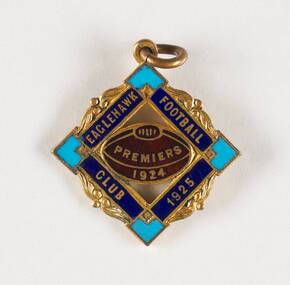
Medal, Stokes and Son, Eaglehawk Football Club, 1925
... Established in 1880, the Eaglehawk Football Club was one of the first teams to join the Bendigo Football League and to date the senior team has won twenty eight premierships, the most of any team in the league. The Eaglehawk colours...Established in 1880, the Eaglehawk Football Club was one of the first teams to join the Bendigo Football League and to date the senior team has won twenty eight premierships, the most of any team in the league. The Eaglehawk colours ...Established in 1880, the Eaglehawk Football Club was one of the first teams to join the Bendigo Football League and to date the senior team has won twenty eight premierships, the most of any team in the league. The Eaglehawk colours are represented by two blues, the light blue of Oxford University and dark blue of Cambridge University which is represented on this pin in the coloured enamel. This pin issued in 1925 commemorates Eaglehawk Football Club's 1924 win which was played at Kennington Oval against Rochester. Final scores were 14.17.101 to 8.9.57. The Bendigo Football League formally known as the Sandhurst Football Association was formed in 1881 and over the decades has grown to include some of the longest established teams in Australia including Castlemaine (formed 1859 - joined 1925) and Kyenton (formed1875 - joined 1947). The local municipal councils worked with the League to provide playing fields for the competition and the Upper Reserve now known as the Queen Elizabeth Oval continues to host many League games. In 1928 at the annual dinner it was noted by the Bendigo Football League that the 'grounds were not all that could be desired, but that they were getting along well with the councils'. Mayor Batchelder responded saying that the council realised that 'the League was a major tenant and was out to do its best for them'. (1) (FN The Riverine Herald, Fri 19 Oct 1928 Page 1). The City of Greater Bendigo continues to work with the various leagues to provide playing fields for competitions as well as supporting the emerging of football and netball clubs and the introduction of women's football teams which has seen great changes to traditionally male dominated football clubs. Diamond shaped commemorative medal with circular scroll. Football sits inside inner diamond shape. front; Eaglehawk Football Cub 1925 / Premiers / 1924 verso; Stokes & Sons / Melbbendigo football league, city of greater bendigo community groups, borough of eaglehawk, making a nation exhibition, city of greater bendigo sport -
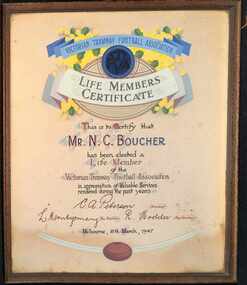 Melbourne Tram Museum
Certificate, Victorian Tramway Football Association (VTFA), Life Members Certificate - Mr N C Boucher, March 1947
... Football Association to Mr Norman Charles Boucher, Victorian Railways, Tramway Motorman for his long service to the Association. Dated 18 March 1947. Hand made with ink and water colours, with VTFA logo. Signed by C A Peterson as President, L Montgomery as Hon. Treasurer and R Hodder as Secretary. See item 7056i3.pdf for his story prepared by Noelle Jones. See item 7057 for a football team...Football Association to Mr Norman Charles Boucher, Victorian Railways, Tramway Motorman for his long service to the Association. Dated 18 March 1947. Hand made with ink and water colours, with VTFA logo. Signed by C A Peterson as President, L Montgomery as Hon. Treasurer and R Hodder as Secretary. See item 7056i3.pdf for his story prepared by Noelle Jones. See item 7057 for a football team ...Presented by the Victorian Tramway Football Association to Mr Norman Charles Boucher, Victorian Railways, Tramway Motorman for his long service to the Association. Dated 18 March 1947. Hand made with ink and water colours, with VTFA logo. Signed by C A Peterson as President, L Montgomery as Hon. Treasurer and R Hodder as Secretary. See item 7056i3.pdf for his story prepared by Noelle Jones. See item 7057 for a football team photograph which included Mr Boucher.Demonstrates a hand made illustrated Life Membership certificate.Wooden framed illustrated certificate glazed secured with nails on rear. Hand made with ink and colour wash. Has two screws in the top corners and a section of string for hanging. The wood frame is machined carved.sports, football, certificates, vr trams, motormen, n c boucher, vtfa
