
Showing 263 items matching "for male use"
-
 Whitehorse Historical Society Inc.
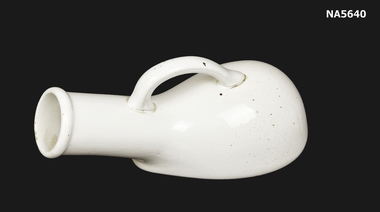
Equipment - Urinal, Unknown
... ...For male use...Used by male - urine relief hospital, home, portable...- Male use - Urinal bottle - porcelain - Fowler Ware - Handle ...Used by male - urine relief hospital, home, portable Hospital Medical Equipment For male use Fowler Ware Limited - Australia - Male use - Urinal bottle - porcelain - Fowler Ware - Handle Equipment Urinal Fowler Ware ...Used by male - urine relief hospital, home, portable- Male use - Urinal bottle - porcelain - Fowler Ware - Handle Fowler Ware Limited - Australiahospital, medical equipment, for male use -
 Vision Australia
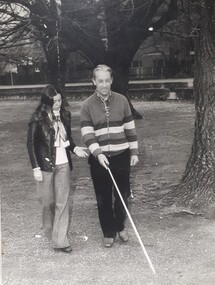
Photograph - Image, Man using white cane with mobility instructor
... Digital image of a male using a white cane with a woman along side to assist...Royal Victorian Institute for the Blind Orientation and mobility Digital image of a male using a white cane with a woman along side to assist Man using white cane with mobility instructor Photograph Image ...Two people are walking in the front garden of RVIB. The man holds a white cane in front of him, whilst the woman raises her arm as she helps advise in use of the cane.Digital image of a male using a white cane with a woman along side to assistroyal victorian institute for the blind, orientation and mobility -
 University of Melbourne, Burnley Campus Archives
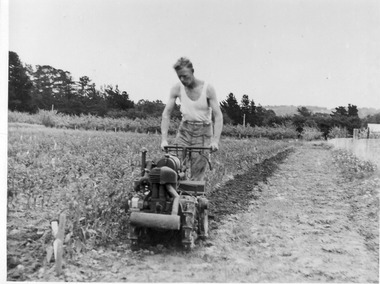
Photograph - Black and white print, E.M. Gibson, Student Using Rotary Hoe, Late 1940s
... Black and white photograph of a male student using a Howard Rotary Hoe in the Orchard...students howard rotary hoe e. m. gibson collection students working outside orchard 572/14 26 Black and white photograph of a male student using a Howard Rotary Hoe in the Orchard Student Using Rotary Hoe Photograph Black and white print E.M. ...Black and white photograph of a male student using a Howard Rotary Hoe in the Orchard572/14 26students, howard rotary hoe, e. m. gibson collection, students working outside, orchard -
 Vision Australia
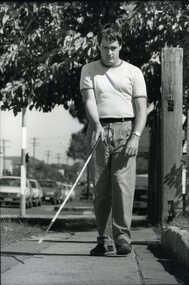
Photograph - Image, Man using white cane on the footpath, 1988
... A mid-twenties male uses a white cane to navigate a footpath on a busy road....A mid-twenties male uses a white cane to navigate a footpath on a busy road. ...A mid-twenties male uses a white cane to navigate a footpath on a busy road.1 x B/W photograph of man using white caneFile: Skills Training - O&M A white cane provides blind people with early warning of obstacles. Using a white cane for mobility.royal blind society of new south wales, white cane day, orientation and mobility -
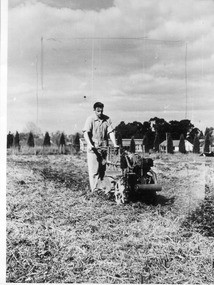 University of Melbourne, Burnley Campus Archives
Photograph - Black and white print, E.M. Gibson, Student Working Outside, 1950-1951
... Black and white photograph of male student using Howard Rotary Hoe in the Pasture Brtanch area....students howard rotary hoe e. m. gibson collection pasture branch students working outside 491A/3 Black and white photograph of male student using Howard Rotary Hoe in the Pasture Brtanch area. ...Black and white photograph of male student using Howard Rotary Hoe in the Pasture Brtanch area.491A/3students, howard rotary hoe, e. m. gibson collection, pasture branch, students working outside -
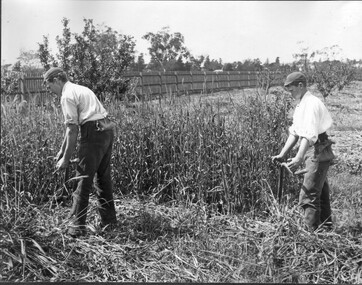 University of Melbourne, Burnley Campus Archives
Photograph - Black and white print, Students Using Scythes, Unknown
... Black and white photograph. 2 male students using scythes cutting wheat ? in the East Orchard....Kneen 5 February 1992, "Note caps worn by the young men and the sharpening tools (whetstones) in carrier on hips of the operators." and on 26 February 1992, "Location is probably in the east orchard looking in the direction of Hawthorn." wheat sharpening tools whetstones students working outside east orchard caps Black and white photograph. 2 male students using scythes cutting wheat ? in the East Orchard. ...Note by T.H. Kneen 5 February 1992, "Note caps worn by the young men and the sharpening tools (whetstones) in carrier on hips of the operators." and on 26 February 1992, "Location is probably in the east orchard looking in the direction of Hawthorn." Black and white photograph. 2 male students using scythes cutting wheat ? in the East Orchard.wheat, sharpening tools, whetstones, students working outside, east orchard, caps -
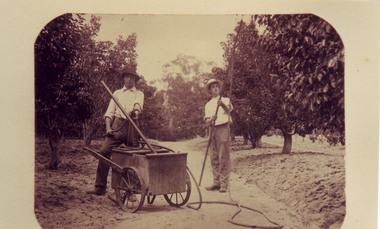 University of Melbourne, Burnley Campus Archives
Photograph - Black and white print, A.E. Bennett, The Orchard Area at Burnley Gardens 1891-4, 1891-1894
... Bennett's book, "Prize Essays," published 1894. 2 male students using spraying equipment from a wheeled cart in the Orchard....Bennett's book, "Prize Essays," published 1894. 2 male students using spraying equipment from a wheeled cart in the Orchard. ...Photograph made by A.P. Winzenried as a possible illustration for, "Green Grows Our Garden." Note by T.H. Kneen 18 March 1992, "Note the very early form of spray equipment - hand pump and hand delivered." Also see B91.440.2 copies black and white print. Copy of a photograph in A.E. Bennett's book, "Prize Essays," published 1894. 2 male students using spraying equipment from a wheeled cart in the Orchard.On reverse, "The Orchard area at Burnley Gardens 1891-4 from A.E. Bennett's book 1894.a.e. bennett, prize essays, a.p. winzenried, green grows our garden, orchard, spray equipment, students working outside, hand pump spray -
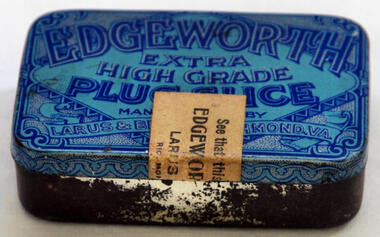 Orbost & District Historical Society
tin, From 1920's
... There were mechanical "roll you own" gadgets on the market but most rural users, especially males used their palms. ...There were mechanical "roll you own" gadgets on the market but most rural users, especially males used their palms. This item reflects the first half of the 20th century when smoking was acceptable. tin tobacco larus smoking container Tobacco by LARUS & BRO. ...The ready rubbed tobacco held within the tin was mainly used by those smokers who rolled their own cigarettes. These smokers would have mainly used their palm and formed a cup then placing their choice of the amount of tobacco to be rolled. This would then be placed on the fine cigarette paper and rolled and sealed (using saliva in the mouth) into the required shape. There were mechanical "roll you own" gadgets on the market but most rural users, especially males used their palms. This item reflects the first half of the 20th century when smoking was acceptable.Small blue, rectangular tin with hinged lid. Match striker on base. Edgeworth Extra High Grade Plug Slice. Paper seal remains on lid. Tobacco by LARUS & BRO. CO Richmond Va Tin by American Can Co 50Atin tobacco larus smoking container -
 Orbost & District Historical Society
tin, The British Australasian Tobacco Company Pty Ltd, 1895-1900
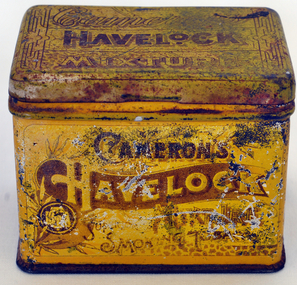
... There were mechanical "roll you own" gadgets on the market but most rural users, especially males used their palms. ...There were mechanical "roll you own" gadgets on the market but most rural users, especially males used their palms. This item is reflective of the first half of the 20th century when smoking was acceptable. container tobacco smoking Printed in black over a yellow base: front side: 'Cameron's / HAVELOCK / SUPERIOR MIXTURE / SMOKING TOBACCO'; back side: 'Cameron's / HAVELOCK / SMOKING / MIXTURE / MANUFACTURED BY / THE BRITISH AUSTRALASIAN TOBACCO Co PROPRIETARY LIMITED / MELBOURNE AUSTRALIA'; Left side: 'Guaranteed / MANUFACTURED FROM / FINEST GROWTH / FRAGRANT TOBACCO / 4oz WEIGHT' A rectangular tin with hinged lid. ...The ready rubbed tobacco held within the tin was mainly used by those smokers who rolled their own cigarettes. These smokers would have mainly used their palm and formed a cup then placing their choice of the amount of tobacco to be rolled. This would then be placed on the fine cigarette paper and rolled and sealed (using saliva in the mouth) into the required shape. There were mechanical "roll you own" gadgets on the market but most rural users, especially males used their palms. This item is reflective of the first half of the 20th century when smoking was acceptable.A rectangular tin with hinged lid. Cameron's Havelock Superior Mixture Smoking Tobacco.Printed in black over a yellow base: front side: 'Cameron's / HAVELOCK / SUPERIOR MIXTURE / SMOKING TOBACCO'; back side: 'Cameron's / HAVELOCK / SMOKING / MIXTURE / MANUFACTURED BY / THE BRITISH AUSTRALASIAN TOBACCO Co PROPRIETARY LIMITED / MELBOURNE AUSTRALIA'; Left side: 'Guaranteed / MANUFACTURED FROM / FINEST GROWTH / FRAGRANT TOBACCO / 4oz WEIGHT'container tobacco smoking -
 Orbost & District Historical Society
tobacco tin, The British Australasian Tobacco Company Pty Ltd, mid - late 20th century
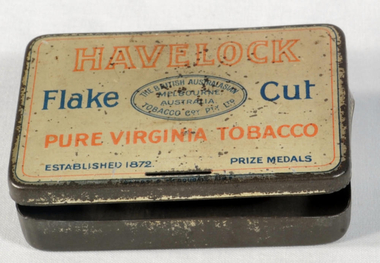
... There were mechanical "roll you own" gadgets on the market but most rural users, especially males used their palms...There were mechanical "roll you own" gadgets on the market but most rural users, especially males used their palms The post war depression (financially) resulted in more smokers turning away from expensive machine (tailor) made cigarettes to the roll your own, using ready rubbed tobacco. ...The ready rubbed tobacco held within the tin was mainly used by those smokers who rolled their own cigarettes. These smokers would have mainly used their palm and formed a cup then placing their choice of the amount of tobacco to be rolled. This would then be placed on the fine cigarette paper and rolled and sealed (using saliva in the mouth) into the required shape. There were mechanical "roll you own" gadgets on the market but most rural users, especially males used their palmsThe post war depression (financially) resulted in more smokers turning away from expensive machine (tailor) made cigarettes to the roll your own, using ready rubbed tobacco. This item is an example from a time when smoking was readily accepted.Rectangular shaped tobacco tin with hinged lid.On lid -HAVELOCK Flake Cut Pure Virginia Tobaccotin tobacco smoking -
 Orbost & District Historical Society
tobacco tin, first half 20th century
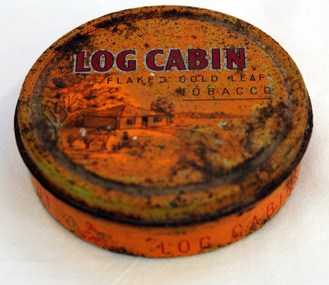
... There were mechanical "roll you own" gadgets on the market but most rural users, especially males used their palms. ...There were mechanical "roll you own" gadgets on the market but most rural users, especially males used their palms. Roll your own cigarettes were popularly used in rural areas, especially when "tailor made" cigarettes were more expensive. ...The ready rubbed tobacco held within the tin was mainly used by those smokers who rolled their own cigarettes. These smokers would have mainly used their palm and formed a cup then placing their choice of the amount of tobacco to be rolled. This would then be placed on the fine cigarette paper and rolled and sealed (using saliva in the mouth) into the required shape. There were mechanical "roll you own" gadgets on the market but most rural users, especially males used their palms. Roll your own cigarettes were popularly used in rural areas, especially when "tailor made" cigarettes were more expensive. Tobacco consumption in Australia is decreasing and fewer smokers are "rolling their own" cigarettes. this item is reflective of the time when smoking was acceptable,A round tobacco tin . It is bright orange with darker orange print. LOG CABIN Flake Gold Leaf Tobacco. It is a vacuum sealed tin - 2oz NET WEIGHT. Pat. No. 106.226/38 -
 Orbost & District Historical Society
tin, Mid to late 1900s
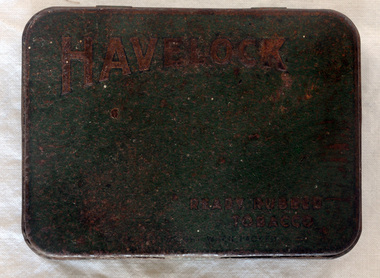
... There were mechanical "roll your own" gadgets on the market but most rural users, especially males used their palms. (Ref Victorian Collections)...There were mechanical "roll your own" gadgets on the market but most rural users, especially males used their palms. (Ref Victorian Collections) Roll your own cigarettes were popularly used in rural areas, especially when "tailor made" cigarettes were more expensive. ...The British Australasian Tobacco Co. was based in Melbourne and Sydney. The parent company was founded in England, circa 1902. This item "HAVELOCK" is one of many ready rubbed tobacco tins produced by the British Australasian Tobacco Company.The ready rubbed tobacco held within the tin was mainly used by those smokers who rolled their own cigarettes. These smokers would have mainly used their palm and formed a cup then placing their choice of the amount of tobacco to be rolled. This would then be placed on the fine cigarette paper and rolled and sealed (using saliva in the mouth) into the required shape. There were mechanical "roll your own" gadgets on the market but most rural users, especially males used their palms. (Ref Victorian Collections)Roll your own cigarettes were popularly used in rural areas, especially when "tailor made" cigarettes were more expensive. Tobacco consumption in Australia is decreasing and fewer smokers are "rolling their own" cigarettes.A dark green rectangular shaped metal Havelock tobacco tin with a weave pattern. It is made from tin plated thin rolled steel. The lid is attached by two hinges.Lid - top left in gold coloured letters "HAVELOCK". bottom -"READY RUBBED TOBACCO" "2oz NET WEIGHT WHEN PACKED". Rim - "THE BRITISH AUSTRALASIAN TOBACCO CO. PTY. LTD." Inside lid -black print on gold background - "Every tin of genuine HAVELOCK Ready Rubbed Tobacco has the mane Havelock printed on the paper lining, and also on the band or wrapping sealing the tin. On the hinge side of the lid is "HAVELOCK READY RUBBED"tobacco cigarettes tin -
 Kiewa Valley Historical Society
Knife for Ladies Purse, circa mid to late 1900's
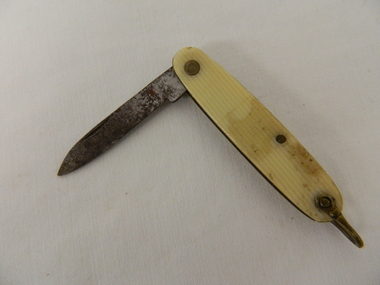
... The use of such a small compact knife could also have been used by male cigar smokers (docking the end of the cigar)...This small knife could also have been used by male cigar smokers....The use of such a small compact knife could also have been used by male cigar smokers (docking the end of the cigar). ...This "ladies" pocket knife was used up to the late 1900's by influential and "well off" ladies, not only as a fashion statement but as a practical tool when away from the kitchen/home to peel fruit and provide a cutting instrument for small items. It was a method to show the growing independence of women to skillfully process food away from the home and kitchen. The use of such a small compact knife could also have been used by male cigar smokers (docking the end of the cigar)This "lady's "purse" knife was a demonstration of the growing independence of women in Australia and especially in rural areas up to the 1940's. The two World Wars provided the opportunity for women to take over what was traditionally "men's work". This evolution of women's equality in society brought changes to what the traditional role of rural women had been entrenched from first colonisation of Australia. The use of such a small compact knife could also have been used by male cigar smokers (docking the end of the cigar). This method of preparation of a good cigar would have been used by wealthy property owners or men of "class"This small one blade knife (lady's) has an "ivory" body containing one small blade. Horizontal lines in "off white" appearance run from one end to the other. One end has a "U" fitting(to provide an anchorage for a chain). This small knife could also have been used by male cigar smokers.ladies pocket knife, small knives, traveller's cutting implements -
 Lakes Entrance Historical Society
Photograph - Tambo River punt, Tambo Upper Victoria 1920
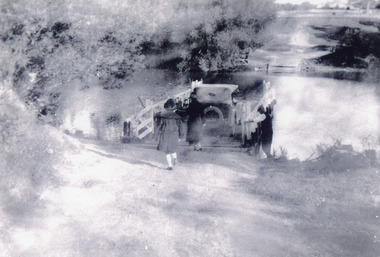
... Black and white photograph showing two females and one male and car using punt to cross river, Punt man loosening guide chains in preparation for crossing. ...Waterways Transport Black and white photograph showing two females and one male and car using punt to cross river, Punt man loosening guide chains in preparation for crossing. ...Black and white photograph showing two females and one male and car using punt to cross river, Punt man loosening guide chains in preparation for crossing. Shows both banks of Tambo River at Tambo Upper Victoria waterways, transport -
 Kiewa Valley Historical Society
Urinal Bottle
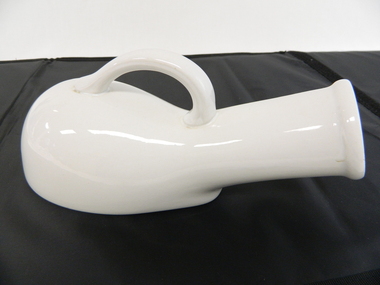
... Sits on a flat base with a hollow sphere above it reaching out to a hollow cylinder with a handle on top. Used by male patients who were unable to use the toilet facilities, following surgery or a severe illness....Sits on a flat base with a hollow sphere above it reaching out to a hollow cylinder with a handle on top. Used by male patients who were unable to use the toilet facilities, following surgery or a severe illness. ...This hospital equipment was used in the Tawonga District General Hospital which was built in the 1950s specifically for the increase in population due to the Kiewa Hydro Scheme.Historical: Shows the development of scientific hospital equipment. Provenance: Used in the Tawonga District General Hospital which was remote.White ceramic urinal bottle. Sits on a flat base with a hollow sphere above it reaching out to a hollow cylinder with a handle on top. Used by male patients who were unable to use the toilet facilities, following surgery or a severe illness.Under the base: R. FOWLER LIMITED / FOWLER WARE / AUSTRALIA and UKV 269 sticker Is chipped at the openinghospital equipment, tawonga district hospital, mt beauty hospital -
 Emerald Museum & Nobelius Heritage Park
Photograph - Collection of photographs of Dr Ian Murphy during his time at Geelong College
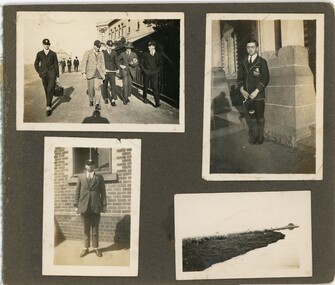
... Photograph six shows a male figure using an outdoor grill. Photograph seven shows Murphy posed on a beach in swimming clothes. ...Photograph six shows a male figure using an outdoor grill. Photograph seven shows Murphy posed on a beach in swimming clothes. ...This is a collection of photographs of Dr Ian 'Spud' MacLeod Murphy c1918 - 1922 during youth, including his time at Geelong College (1918-1922). The photographs show Murphy doing various out-of-class activities alongside friends.Dr Murphy was Emerald's first and much-loved GP. His work for the community over 34 years was of immense benefit. He was awarded the British Empire Medal in 1977 for his service to the health of the community. Collection of black and white photographs of Dr Ian Murphy in Geelong College c1918-1922. Photograph one shows Murphy walking along side classmates and faculty. Photograph two and three shows Murphy wearing school uniform in front of a college building. Photograph four depicts Geelong seascape Photograph five shows a classmate or friend of Murphy holding tools. Photograph six shows a male figure using an outdoor grill. Photograph seven shows Murphy posed on a beach in swimming clothes. Photograph eight shows Murphy and a classmate posing. Photograph nine shows a figure relaxing face down on a beach.dr ian macleod murphy, spud murphy, doctor, emerald, geelong college -
 Kiewa Valley Historical Society
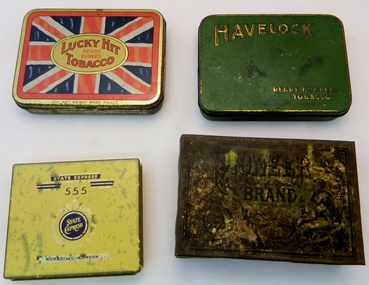
Tins - Tobacco (Lucky Hit) x4, Mid to late 1900s Possibly c1910
... There were mechanical "roll you own" gadgets on the market but most rural users, especially males used their palms. The quantity of tobacco used to make up the cigarette was up to the individual user. ...There were mechanical "roll you own" gadgets on the market but most rural users, especially males used their palms. The quantity of tobacco used to make up the cigarette was up to the individual user. ...The British Australasian Tobacco Co. (based in Melbourne and Sydney. The parent company was founded in England, circa 1902). This item "Lucky Hit" was the fore runner of the "Lucky Strike" brand name. The ready rubbed tobacco held within the tin was mainly used by those smokers who rolled their own cigarettes. These smokers would have mainly used their palm and formed a cup then placing their choice of the amount of tobacco to be rolled. This would then be placed on the fine cigarette paper and rolled and sealed (using saliva in the mouth) into the required shape. There were mechanical "roll you own" gadgets on the market but most rural users, especially males used their palms. The quantity of tobacco used to make up the cigarette was up to the individual user. The thinner that the cigarette was rolled the longer and more economical did the supply last. The by -products of this method were nicotine stained fingers and hands. "Chain" smokers were easily identified and could therefore be discriminated against obtaining smoke sensitive employment. The two world wars (1914-18 and1939-45) produced a significant rise in the consumption of cigarette use by men and the eventual overflow to women. Cigarette smoking before the 1900s was seen as rough and uncouth (socially frowned upon), however after the introduction of overseas films (U.K. and U.S.A.) and film stars presenting smoking as socially acceptable the rise of smoking cigarettes, especially roll you own (American western movies) in rural areas was an accepted way of life. Things however started to change in the mid 1900s when medical evidence pointed to the health problems of regular smokers. Governments were now implementing non smoking education material. Restrictions on where and when smoking was permitted and acceptable started to creep into all areas of society whether city or rural. This was the era that highlighted the use of roll your own cigarettes, especially when the costs of "tailor made" cigarettes were taxed at an increasing amount. Roll your own cigarettes also provided an avenue for the consumption of illicit drug use.The significance of this ready rubbed tobacco tin to this rural region is, stems from how much influence that the Western novels and overseas films (portraying rural lifestyles) played in shaping the rural social and working mores of the Kiewa Valley. The post war depression (financially) resulted in more smokers turning away from expensive machine (tailor) made cigarettes to the roll your own, using ready rubbed tobacco. This tobacco tin relays a long ago era, when personal contact, and not something that has been written down by some "unknown", was valued as the true appraisal of a member of the community. This was especially relevant in a small regional area such as the Kiewa Valley. Although social networking was not as fast then as the internet provides now, appearances, manners, fashion and etiquette with first impressions high on the order of evaluating someone in the community. Pointer such as the brand of tobacco smoked was part of the rural assessment method. Up until the demise of the Australian Tobacco Industry, circa 2004, the Kiewa Valley and surrounding district was part of a vibrant producer of tobacco leaves. The remnants of this industry still remain today but the drying sheds (for tobacco leaves) are now used to store hay for the valley's dairy and beef cattle industries. Tins 2,3 and 4 were found (in 2009) at Wallace's Hut on the Bogong High Plains. This tobacco tin is constructed from tin plated thin rolled steel. The lid is attached by two pressed and formed (from the main frame) hinges using the nip and tuck construction method. The lid and outside frame have been gold & silver anodised. Tins 2,3 and 4 have the Union Jack on the front lid. One is too rusty to read. The other two have "A blend containing choice selected Australian grown leaf" in white across the bottom on the red border and above the "2oz net weight when packed". In the centre and on the outside of the lid and surrounded by a reproduction of the "Union Jack" is stamped, "Lucky Hit Tobacco" within these words are also stamped "Ready Rubbed". The bottom of the lid is stamped (in smaller script) "2oz NET WEIGHT WHEN PACKED" and underneath this and on the rim of the lid is "THE BRITISH AUSTRALASIAN TOBACCO CO. PTY. LTD. MELBOURNE" on the inside of the lid and stamped in black print on a gold anodised lid is " NOTICE "(underlined) "Every tin of genuine "Lucky Hit has the name of the Manufacturing Company printed on wax paper lining; also on the band or wrapper with which the tin is sealed. THE BRITISH-AUSTRALIAN TOBACCO CO. PTY. LTD., MELBOURNE" and underneath this and underlined is " None genuine without the band or wrapper" On the hinge side of the lid is "LUCKY HIT READY RUBBED TOBACCO" Tins 2,3 and 4 Vary to the above inscription.roll your own, cigarette tins, smoking accessories, personal effects, tobacco containers, tobacco -
 Kiewa Valley Historical Society
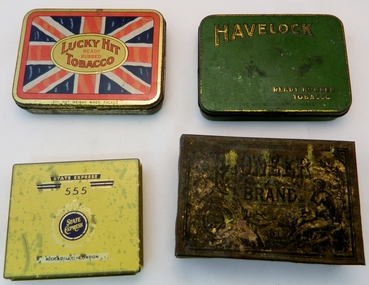
Tin Tobacco, Mid to late 1900s
... There were mechanical "roll you own" gadgets on the market but most rural users, especially males used their palms. The quantity of tobacco used to make up the cigarette was up to the individual user. ...There were mechanical "roll you own" gadgets on the market but most rural users, especially males used their palms. The quantity of tobacco used to make up the cigarette was up to the individual user. ...The British Australasian Tobacco Co. (based in Melbourne and Sydney. The parent company was founded in England, circa 1902). This item "HAVELOCK" is one of many ready rubbed tobacco tins produced by the British Australasian Tobacco Company.The ready rubbed tobacco held within the tin was mainly used by those smokers who rolled their own cigarettes. These smokers would have mainly used their palm and formed a cup then placing their choice of the amount of tobacco to be rolled. This would then be placed on the fine cigarette paper and rolled and sealed (using saliva in the mouth) into the required shape. There were mechanical "roll you own" gadgets on the market but most rural users, especially males used their palms. The quantity of tobacco used to make up the cigarette was up to the individual user. The thinner that the cigarette was rolled the longer and more economical did the supply last. The by -products of this method were nicotine stained fingers and hands. "Chain" smokers were easily identified and could therefore be discriminated against obtaining smoke sensitive employment. The two world wars (1914-18 and1939-45) produced a significant rise in the consumption of cigarette use by men and the eventual overflow to women. Cigarette smoking before the 1900s was seen as rough and uncouth (socially frowned upon), however after the introduction of overseas films (U.K. and U.S.A.) and film stars presenting smoking as socially acceptable, the rise of smoking cigarettes, especially roll you own (American western movies) in rural areas was an accepted way of life. Things however started to change in the mid 1900s when medical evidence pointed to the health problems of regular smokers. Governments were now implementing non smoking education material. Restrictions on where and when smoking was permitted and acceptable started to creep into all areas of society whether city or rural. This was the era that highlighted the use of roll your own cigarettes, especially when the costs of "tailor made" cigarettes were taxed at an increasing amount. Roll your own cigarettes also provided an avenue for the consumption of illicit drug use.The significance of this ready rubbed tobacco tin to this rural region is, stems from how much influence that the Western novels and overseas films (portraying rural lifestyles) played in shaping the rural social and working mores of the Kiewa Valley. The post war depression (financially) resulted in more smokers turning away from expensive machine (tailor) made cigarettes to the roll your own, using ready rubbed tobacco. This tobacco tin relays a long ago era, when personal contact, and not something that has been written down by some "unknown", was valued as the true appraisal of a member of the community. This was especially relevant in a small regional area such as the Kiewa Valley. Although social networking was not as fast then as the internet provides now, appearances, manners, fashion and etiquette with first impressions high on the order of evaluating someone in the community. Pointer such as the brand of tobacco smoked was part of the rural assessment method. Up until the demise of the Australian Tobacco Industry, circa 2004, the Kiewa Valley and surrounding district was part of a vibrant producer of tobacco leaves. The remnants of this industry still remain today but the drying sheds (for tobacco leaves) are now used to store hay for the valley's dairy and beef cattle industries.This tobacco tin is constructed from tin plated thin rolled steel. The lid is attached by two pressed and formed (from the main frame) hinges using the nip and tuck construction method.The lid and outside frame have had a green "weave" pattern anodised to the metal.On the outside of the lid and at the top left is stamped, in gold coloured letters "HAVELOCK". The bottom of the lid is stamped (in smaller script) "READY RUBBED TOBACCO" and below this in smaller lettering "2oz NET WEIGHT WHEN PACKED". On the rim of the lid is "THE BRITISH AUSTRALASIAN TOBACCO CO. PTY. LTD." Inside of the lid and stamped in black print on a gold anodised lid is "Every tin of genuine HAVELOCK Ready Rubbed Tobacco has the mane Havelock printed on the paper lining, and also on the band or wrapping sealing the tin. On the hinge side of the lid is "HAVELOCK READY RUBBED"roll your own, cigarette tins, smoking accessories, personal effects, tobacco containers -
 Great Stupa of Universal Compassion
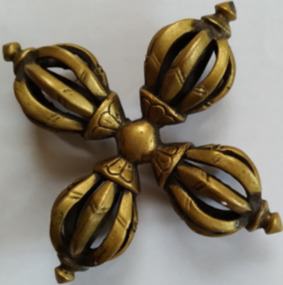
Ceremonial object - Double dorje
... In Tibetan Buddhism a "dorje" (also known as "vajra" in Sanskrit) symbolizes the indestructible nature of reality, spiritual power, and enlightenment, often depicted as a thunderbolt or diamond scepter, representing the ability to cut through illusion and achieve ultimate wisdom; it is a key ritual object in the Vajrayana school of Tibetan Buddhism, signifying the union of compassion and wisdom through its male principle association when used with a bell (female principle). ...In Tibetan Buddhism a "dorje" (also known as "vajra" in Sanskrit) symbolizes the indestructible nature of reality, spiritual power, and enlightenment, often depicted as a thunderbolt or diamond scepter, representing the ability to cut through illusion and achieve ultimate wisdom; it is a key ritual object in the Vajrayana school of Tibetan Buddhism, signifying the union of compassion and wisdom through its male principle association when used with a bell (female principle). ...In Tibetan Buddhism a "dorje" (also known as "vajra" in Sanskrit) symbolizes the indestructible nature of reality, spiritual power, and enlightenment, often depicted as a thunderbolt or diamond scepter, representing the ability to cut through illusion and achieve ultimate wisdom; it is a key ritual object in the Vajrayana school of Tibetan Buddhism, signifying the union of compassion and wisdom through its male principle association when used with a bell (female principle). The Double Dorje (Vishvavajra), is a powerful Buddhist symbol. It consists of two crossed vajras (dorjes) and represents the foundation of the physical world. The Double Dorje is often associated with stability and protection, symbolizing the indestructible nature of the universe. This double dorje is a cross of two dorjes, which look like a small scepter with multiple prongs at each end.tibetan buddhism, holy objects, worship devices -
 Flagstaff Hill Maritime Museum and Village
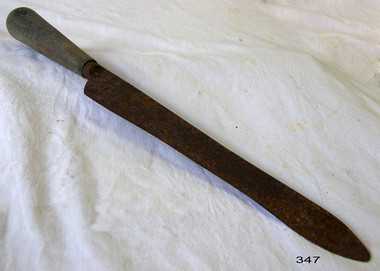
Domestic object - Knife
... During those times the host were not obliged to provide their guest with any kind of eating utensil in addition to plates, so wealthy males used their eating knives for cutting their own meals, and the meals of nearby female guests. ...During those times the host were not obliged to provide their guest with any kind of eating utensil in addition to plates, so wealthy males used their eating knives for cutting their own meals, and the meals of nearby female guests. ...From the early days of our race, the knife represented one of the first and most important tools that enabled rise of our technology, military, culture, science and all other things that brought us to this point of modern civilisation. As a vital tool for survival, combat, construction and food preparation, the knife quickly became the most basic tool from which all others were born. In those ancient times, 500,000 years ago, sharpened stones started slowly evolving, becoming more and more like their modern counterpart. Before the time when fire enabled the melting of the various metals, and forging them into modern knives, their stone counterparts received several visual upgrades. Double bladed knives were most popular, and their wooden or stone hilts were decorated with animal skins and feathers. Those knives represented a great deal of pride for the warriors and elders who owned them, and that tradition continued to be practised with the arrival of the Bronze Age. The appearance of metallurgy brought the ability to create knives from softer types of metal. Even though knives from bronze did not provide durability over longer periods of time [easily dulled, and susceptible to corrosion), their sharpness and slim designed proved to be superior to any stone knife tool. As the centuries went on, iron and then steel became commonplace across the entire world. Knives created from those materials were much more durable and easier to maintain their sharpness after prolonged use. During medieval times in Europe, steel metallurgy managed to evolve knives from small single or double-bladed edges to larger sizes - swords, spears and axes. Even with all those advancements, the use of knives as an eating utensil continued to be used in some small circles. Even as early as the 15th century, wealthy circles of people started carrying personal knives, intended for double use - both eating and defending against threats. During those times the host were not obliged to provide their guest with any kind of eating utensil in addition to plates, so wealthy males used their eating knives for cutting their own meals, and the meals of nearby female guests. Slim double-bladed knives were good for cutting and piercing foods. As the use of forks became widespread in the whole of Europe by the late 17th century, most people used this kind of small knife on a regular basis (a combination of two knives, one for stabilising and other for cutting the meal). http://www.eatingutensils.net/history-of-cutlery/knife-history/The knife is one of the most important items that has enabled the development of civilisation over thousands of years.Carving knife with wooden handle and rusted slender metal blade.None.flagstaff hill, warrnambool, shipwrecked-coast, flagstaff-hill, flagstaff-hill-maritime-museum, maritime-museum, shipwreck-coast, flagstaff-hill-maritime-village, knife, kitchen equipment, dining -
 Ballarat Heritage Services
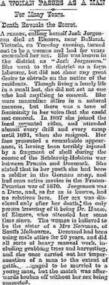
Document - Newspaper article, Death Reveals Secret, 1880s
... Deceased had been using male attire for 20 years, and did all sorts of heavy manual work, including grubbing trees and harvesting and she once ......Deceased had been using male attire for 20 years, and did all sorts of heavy manual work, including grubbing trees and harvesting and she once ... ...A person calling herself Jack Jorgenson died at Elmore near Ballarat, Victoria on Tuesday evening, turned out to be a woman and had for years concealed her sex. She was known in the district as "Jack Jorgenson". she went to the district as a farm labourer but did not show any great desire to obtrude on the notice of the residents. Though living a lonely life in a small hut, she did not act as one who had anything to conceal. She wore masculine attire in a natural manner, but thee was a tone of femininity in her voice that she could not conceal. In 1887 she joined the local mounted rifles, and attended almost every drill and every camp until 1891, when she resigned. Her face presented a remarkable appearance, it having been terribly injured by a fragment of shell during the course of the Schlewig-Holstein war between Prussia and Denmark. She stated that in her youth she had been a soldier in the german army, and had seen active service in the Franco-Prussian war of 1870. Jorgensen was a Dane and so far as is known had no relative here. Her sex was disclosed only after her death, the only person knowing of it being Dr H..se of Elmore, who attended her some time since. The woman is believed to be the sister of a Mrs Newman of South Melbourne. Deceased had been using male attire for 20 years, and did all sorts of heavy manual work, including grubbing trees and harvesting and she once ...Newspaper clippingjack jorgenson, elmore, dane, cross dressing -
 Surrey Hills Historical Society Collection
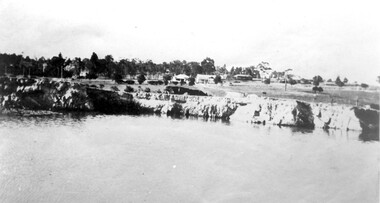
Photograph, Grovedale Road Quarry in the 1920s - looking north, c1920
... to make the bricks used in the construction of his home, known as 'Ancyra'. This is still extant at the corner of Weybridge and James Streets. Maling... to make the bricks used in the construction of his home, known as 'Ancyra'. This is still extant at the corner of Weybridge and James Streets. Maling ...The quarry was part of John Butler Maling's property. He was one of the original settlers of the area and farmed the area between Weybridge Street and Whitehorse Road. Clay was quarried from part of this area and used to make the bricks used in the construction of his home, known as 'Ancyra'. This is still extant at the corner of Weybridge and James Streets. Maling grazed cows and used the quarry as a water source. He was the uncle of John Butler Maling, Mayor of Camberwell. He was married to Kate Conlon in 1882. They had 3 children: Silas Young, Alick and Zillah. Maling was born in c1829 in Shepreth, Cambridgeshire; he died in Surrey Hills on 9 October 1912 and is buried in Box Hill Cemetery - CE-*-0586. Mrs Kate Maling (born c1859 in Co Meath, Ireland) died at the property on 8 March 1921. She is buried in Brighton General Cemetery. Probate was valued at over 10,000 pounds and included other properties in Sandringham, Hawthorn and Macedon. At the time of her death the Surrey Hills property was described as being 23 cres with 2 brick houses, 1 cow, 2 heifers and 40 fowls or chickens. The property was subdivided after her death. The quarry was filled in after several drownings or near drownings and the land is now occupied by a park and playground maintained by the City of Boroondara. Beckett Park is sited on horizon to the left beyond the trees. This documents the landscape prior to close settlement and is material to early building and farming in the Surrey Hills area.Black and white photo of the quarry between Grovedale Road and James Street taken in the 1920s and looking north. In the foreground is an area of water with high banks dividing the horizontal centre. Beyond are paddocks and trees behind which is a row of at least 3 single-storey houses. Light poles can be seen along a distant street. There are many mature trees in the background. The houses and trees are positioned along Whitehorse Road in the vicinity of Westminster Street. Shadows indicate the photo was taken in early morning or evening.quarries, grovedale road, james street, surrey hills, balwyn, clay quarries, ancyra, kate conlon, kate maling, john butler maling, farming -
 Lauriston Girls’ School (incorporating Lauriston Museum and Gallery)
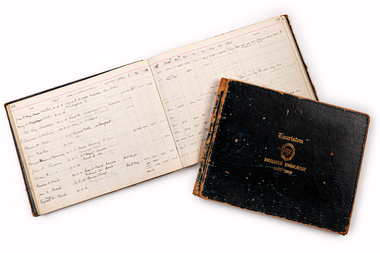
Administrative record (item) - Enrolment Books
... Enrolment Books comprises two enrolment registers and lose pages (for males), that were used to record the details of each new student starting at Lauriston. ...Enrolment Books comprises two enrolment registers and lose pages (for males), that were used to record the details of each new student starting at Lauriston. ...Record Series 13. Enrolment Books comprises two enrolment registers and lose pages (for males), that were used to record the details of each new student starting at Lauriston. These volumes date back to the inception of our school and are Lauriston’s first system of documentation used to record student information. Both the enrolment entries and alphabetical index at the start of each book are handwritten into a hard bound volume that was commercially produced at the time as school stationery to record student enrolments. The first volume dates from 1901 to 1919, and the second from 1920 to 1930, but holds further details of the academic results of the students already enrolled up to 1933. The two registers are arranged in a double page column format. The column headings are as follows: • Name • Date of Birth • Name and Address of Parent • Occupation [sometimes empty] • Elementary [First year level for students] • I. • IIA. • IIB. • IIIIA. • IIIB. [annotated to become IVa] • IV. [annotated to become IVb] • VA. • VB. • VI. • Date of Leaving. • Remarks [includes such details as: academic results for student’s last couple of years such as Matric or Leaving and their individual subject results; where they went to if another school; reason for departure if no further education; also some accolades such as “Head of School”. The first column that held the student’s name was annotated with the year date and term. Below the student’s name in some of the early enrolment entries, extra information was added such as “died” and the date, or the student’s married name. The details of male students who went to Lauriston’s kindergarten from 1911 are also in the registers. There are details of male students also recorded separately in loose pages that detail the enrolments from 1922 to 1930. Up until 1944, Lauriston used school year level titles used within English Public Schools. In the registers the first year is “Elementary” (Prep) and the final year is “VI” (Year 12). The first girls who wanted to go to university sat their Senior Public Exam in their fifth year of secondary school. Students could take an extra year of study called Leaving Honours. In 1944 university entrance requirements were raised and this sixth year of secondary school became the Matriculation exam. In 1970 it was renamed High School Certificate and since 1991, the Victorian Certificate of Education. -
 Surrey Hills Historical Society Collection
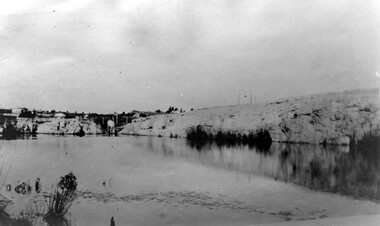
Photograph, Grovedale Road Quarry in the 1920s - looking south, c1920
... to make the bricks used in the construction of his home, known as 'Ancyra'. This is still extant at the corner of Weybridge and James Streets. Maling... to make the bricks used in the construction of his home, known as 'Ancyra'. This is still extant at the corner of Weybridge and James Streets. Maling ...The quarry was part of John Butler Maling's property. He was one of the original settlers of the area and farmed the area between Weybridge Street and Whitehorse Road. Clay was quarried from part of this area and used to make the bricks used in the construction of his home, known as 'Ancyra'. This is still extant at the corner of Weybridge and James Streets. Maling grazed cows and used the quarry as a water source. He was the uncle of John Butler Maling, Mayor of Camberwell. He was married to Kate Conlon in 1882. They had 3 children: Silas Young, Alick and Zillah. Maling was born in c1829 in Shepreth, Cambridgeshire; he died in Surrey Hills on 9 October 1912 and is buried in Box Hill Cemetery - CE-*-0586. Mrs Kate Maling (born c1859 in Co Meath, Ireland) died at the property on 8 March 1921. She is buried in Brighton General Cemetery. Probate was valued at over 10,000 pounds and included other properties in Sandringham, Hawthorn and Macedon. At the time of her death the Surrey Hills property was described as being 23 acres with 2 brick houses, 1 cow, 2 heifers and 40 fowls or chickens. The property was subdivided after her death. The property was subdivided into 110 house blocks in c1923 - see Maling's Estate subdivision flyer on the State Library of Victoria's website. This shows that the Grovedale Park site had been acquired by Camberwell Council by this time. An attached newspaper clipping documents prices realised for a cross-section of blocks. The MMBW map of 1925, also on the SLV website, shows the outline of the clayhole / quarry. The quarry was filled in after several drownings or near drownings and the land is now occupied by a park and playground, known as Grovedale Road Park, maintained by the City of Boroondara. Beckett Park is sited on horizon to the left beyond the trees. This documents the landscape prior to close settlement and is material to early building and farming in the Surrey Hills area.Black and white photo of the quarry between Grovedale Road and James Street taken in the 1920s and looking south. In the foreground is an area of water with reeds in the LH corner. Beyond on the high banks there are single storey houses in the background and (?) some light poles. An object that looks like a tank on posts is in a cutting on the far bank.quarries, grovedale road, james street, clay quarries, farming, kate conlon, kate maling, john butler maling, ancyra -
 Flagstaff Hill Maritime Museum and Village
Tool - Wood moulding Plane, Auburn Tool Company, 1870 to 1893
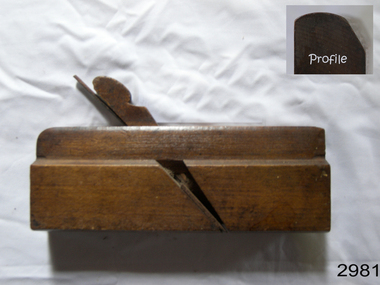
... males, producing annual products valued at us$70, 000. After A. Howland and Company was dissolved in 1874, the Auburn Tool Company again resumed using contract labour at the State Prison until 1877. ...males, producing annual products valued at us$70, 000. After A. Howland and Company was dissolved in 1874, the Auburn Tool Company again resumed using contract labour at the State Prison until 1877. ...Moulding Plane: A moulding plane is a specialised plane used for making the complex shapes found in wooden mouldings that are used to decorate furniture or other wooden object. Traditionally, moulding planes were blocks of wear resistant hardwood, often beech or maple, which were worked to the shape of the intended moulding. The blade, or iron was likewise formed to the intended moulding profile and secured in the body of the plane with a wooden wedge. A traditional cabinetmakers shop might have many, perhaps hundreds, of moulding planes for the full range of work to be performed. Large crown mouldings required planes of six or more inches in width, which demanded great strength to push and often had additional peg handles on the sides, allowing the craftsman's apprentice or other worker to pull the plane ahead of the master who guided it. Auburn Tool Company: The Auburn Tool Company is known to exist from 1864 to 1893. George Casey reorganized the firm of Casey, Clark and Company as a joint-stock company in 1864, under the company name of Auburn Tool Company. The 1865 New York State Census noted the firm as a manufacturer of the plane, plane irons, and skates. The production that year was listed as 30,000 pairs of skates and 35,000 planes along with 25,000 dozen plane irons. The plane irons carried the trademark "Thistle". Both skates and plane irons were made from welded wrought iron and cast steel. The Auburn Tool Company was among the five leading plane manufacturing firms existing in the mid to late 19th century USA. Others were: H. Chapin's Son; Greenfield Tool Company; and Sandusky Tool Company. Auburn Tool Company, with these others, was also a founding member of the Plane Makers Association, organized around 1858 to fix prices. Most of the companies tools were manufactured by prisoners and in 1866 the firm was outbid for prison labour by J M Easterly and Co. After losing the contract with the prison authority they constructed a new building and continued in the plane manufacturing business with private labour. The 1870 US Census reported the firm had 21 machines, driven by water power, employing 66 males, producing annual products valued at us$70, 000. After A. Howland and Company was dissolved in 1874, the Auburn Tool Company again resumed using contract labour at the State Prison until 1877. The Auburn Tool Company merged with the Ohio Tool Company of Columbus, Ohio, on Nov 14, 1893. Although plane manufacturing was continued at Auburn until after 1907, after this merger the firm went under the name of the Ohio Tool Company. A significant item from the mid to late 19th century that today is quite rare and sought after by collectors. It gives us a snapshot of how furniture was made predominately by hand and with tools that were themselves hand made shows the craftsmanship used to make such a unique item. It also gives an insight into how many manufacturing companies bid for the rights to use prison labour to make their products at this time in our history. Decorative wood Moulding, plane Round type Auburn New York. Owner A Neudt Size 14 flagstaff hill, warrnambool, shipwrecked-coast, flagstaff-hill, flagstaff-hill-maritime-museum, maritime-museum, shipwreck-coast, flagstaff-hill-maritime-village -
 Flagstaff Hill Maritime Museum and Village
Nail, circa 1810
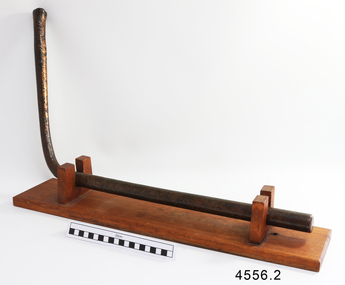
... used for ships such as the “George III” that sailed on long voyages. The three masted sailing ship “George III” was a convict transport ship built in Deptford, England, in 1810. On 14th December 1834 she left Woolwich, England, bound for Hobart Town, Van Diemen’s Land (Tasmania), under Captain William Hall Moxey. She was carrying 220 male...used for ships such as the “George III” that sailed on long voyages. The three masted sailing ship “George III” was a convict transport ship built in Deptford, England, in 1810. On 14th December 1834 she left Woolwich, England, bound for Hobart Town, Van Diemen’s Land (Tasmania), under Captain William Hall Moxey. She was carrying 220 male ...This copper nail, sometimes known as a ‘Dumpy Bolt’ or spike, was salvaged from the hull of the wreck of the “George III”. It dates back to at least 1810. It was found by an abalone diver on the south east coast of Tasmania. The nail would have been used to hold the layers of the ship’s keel frame and the planking together. The nail has been passed from the abalone diver to an interested business man on a trip to the south of Hobart, on again to the business man’s close friend who then donated it to Flagstaff Hill Maritime Village. The metal of nails such as this one, after being in the sea for a long time, become affected by the natural reaction of the sea water, causing it to degenerate and thin, and the stress from the force of the sea over the years alters its shape. Iron nails had been used on ships previously, but they quickly corroded in the salt; ships needed regular, costly and time-consuming maintenance to replace the iron nails. Towards the end of the 18th century the British Navy trialled the use of copper nails, finding them to be very successful. Merchant ships began to adopt this process in the early 19th century, although it made ship building very expensive and was more often used for ships such as the “George III” that sailed on long voyages. The three masted sailing ship “George III” was a convict transport ship built in Deptford, England, in 1810. On 14th December 1834 she left Woolwich, England, bound for Hobart Town, Van Diemen’s Land (Tasmania), under Captain William Hall Moxey. She was carrying 220 male convicts plus crew, guards and their families, totalling 294 persons (another 2 were during the voyage). Amongst the cargo were military stores including several copper drums of gun powder. On 27th January 1835 the “George III” was near the Equator, about half way into her journey. A fire broke out and the gun powder was in danger of explosion, threatening the whole ship. Two convicts braved the heat and smoke, entered the store and seized the gun powder drums, suffering burns for their efforts but saving a probable disaster. The fire destroyed some of the provisions and food was scarce. Many became ill with scurvy and some died during the journey. Nearing the end of their journey on 10th April 1835 the “George III” was headed through the D'Entrecasteaux Channel, south east Tasmania, between the mainland and Bruny Island. She was sailing in the moonlit night to hasten her arrival in port due to the great number of sick on board. She struck uncharted rocks, known only to the local whalers, between Actaeon Reef and Southport Lagoon and within hours began to break up. The ship’s boats were used to first rescue the women and children. Firearms were used to help quell the panic of the convicts below decks and some were killed by the shots. Many convicts, including the sick, were drowned. In all, 133 lives were lost including 5 of the crew, guards and their families. It was the third worst shipping disaster in Tasmanian waters. A monument in honour of the prisoners who perished in the “George III” has been erected, noting the date of the wreck as “Friday 10th April 1835.” (NOTE: there are a few differences between sources regarding dates of the shipwreck, some saying March and others April 1835. There are also differences in the figures of those on board and the number of lives lost.) The copper nail is significant as an example of sailing ship construction; fasteners used in the early 19th century on ships carrying convicts to Australia. The nail is also significant for its association with the ship “George III”. The “George III” is registered on the Australian National Shipwreck Database, ID 7195 as an Historic Shipwreck. She is the third worst shipwreck in Tasmanian waters. She is also associated with Early Australian History and the transportation of convicts to Australia. The incident of the fire on board and the bravery of the convicts in making the gun powder safe is an example of the social character of the people in early Tasmanian colonisation. Copper nail (also called a Dumpy bolt or spike) from the convict ship George III, wrecked in 1835. Nail is long, bent in an ‘L’ shape about 3/5ths along, tapering from both ends to the bend. Both ends are flat and do not taper to a point, nor have a thread. The shorter end has been polished, showing bright copper. There is pitting along the nail and virdigris is evident on the longer, unpolished end. The nail is displayed with the longer section resting on a wooden board between two ‘U’ shaped uprights, the shorter section upright. flagstaff hill, warrnambool, shipwrecked coast, flagstaff hill maritime museum, maritime museum, shipwreck coast, flagstaff hill maritime village, great ocean road, george iii, ship construction, ship nail, 1835 shipwreck, 19th century shipwreck, william moxey, d'entrecasteaux channel, convict transportation, copper nail, dumpy bolt, spike, keel nail -
 Federation University Historical Collection
Photograph - Lantern Slides, Boxed Lantern Slides, c1920
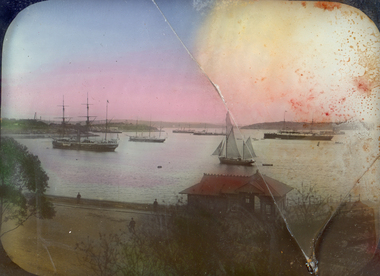
... used at the Ballarat School of Mines. The image of Rome from St Peter's (Vatican) was taken before 1929. The "Via Conciliazione", built by Mussolini in 1929 is not present in the image. lantern slides entertainment ballarat school of mines boer war richard seddon sydney harbour coogee beach legislative assembly rome roma vatican vaticono fairyland lake wendouree glass slide lantern slide Hinged timber box designed to hold glass lantern slides. The box contains 50 lantern slides including: * male ...The lantern slides were most probably used at the Ballarat School of Mines. The image of Rome from St Peter's (Vatican) was taken before 1929. The "Via Conciliazione", built by Mussolini in 1929 is not present in the image. Hinged timber box designed to hold glass lantern slides. The box contains 50 lantern slides including: * male Turk in turbin *interior of a cathedral * Cavalry Scene, Boer War (c1900) * Richard Seddon portrait * Fishermen at Sea * Turkish domed building * Eddystone Lighthouse, England * image of early printing * Cloister Court, Trinity College, Cambridge * Farm Cove, Sydney Harbour (by I.F.E) * National Park, Sydney * Customs House, Sydney * View from the Dome of St Peter's, Rome (Pre 1929) * Botanical Gardens, Sydney * Coogee Bay, NSW * Keeble College Chapel, Oxford * Holy Land - The Village of Endor * Sydney Cove * Interior portrait of members of the Victorian Legislative Assembly, Parliament House, Melbourne * Palace Dela Concord, Italylantern slides, entertainment, ballarat school of mines, boer war, richard seddon, sydney harbour, coogee beach, legislative assembly, rome, roma, vatican, vaticono, fairyland, lake wendouree, glass slide, lantern slide -
 Federation University Historical Collection
Photograph - Photograph - Black and White, Mount Helen Library, c1972, pre 1973
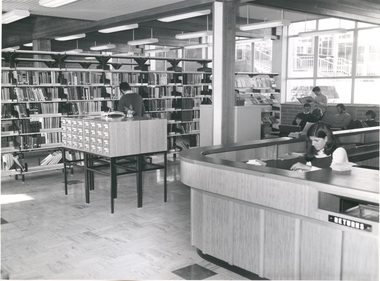
... used before a library building was built on the Mt Helen Campus. The temporary library was in the ground floor of F building, near the 2009 office number 212. ballarat institute of advanced education library mt helen dunn cochrane librarian Two photographs relating to the first library at the Mt Helen Campus (Ballarat Institute of Advanced Education). .1) A female and males stands at a bookcase - as of 18/06/2019 this photo is unavailable. .2) The library loans desk Mount Helen Library, c1972 Photograph Photograph - Black and White ...The library depicted in the photograph was the temporary library used before a library building was built on the Mt Helen Campus. The temporary library was in the ground floor of F building, near the 2009 office number 212. Two photographs relating to the first library at the Mt Helen Campus (Ballarat Institute of Advanced Education). .1) A female and males stands at a bookcase - as of 18/06/2019 this photo is unavailable. .2) The library loans deskballarat institute of advanced education, library, mt helen, dunn, cochrane, librarian -
 Federation University Historical Collection
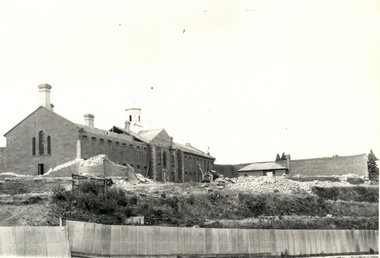
Photograph - Photograph - Digital, Geoff Little, Ballarat Gaol Under Demolition, 1968, 1968
... It provided accommodation for 74 prisoners - male and female. The materials use to build the gaol were locally quarried basalt combined with local bricks. ...It provided accommodation for 74 prisoners - male and female. The materials use to build the gaol were locally quarried basalt combined with local bricks. ...The Ballarat Gaol was one of the earliest gaols. Building commenced in 1856 and was completed in 1862. It provided accommodation for 74 prisoners - male and female. The materials use to build the gaol were locally quarried basalt combined with local bricks. At that time there were about 14 brick making plants in Ballarat. 1870 saw the opening of the School of Mines, Australia's third oldest tertiary institution. The purpose of the school was "to impart instruction in the various branches of science relating to mining engineering. It is proposed, as soon as practicable, to extend the operation of the school so as to impart instruction in those branches of technical science which may be considered most likely to exert a beneficial influence on the prosperity of Victoria." School was in a disused Circuit Court House in Lydiard Street South. Sir Redmond Barry was first President of the School of Mines Council.Seven black and white and sepia photographs of the Ballarat Gaol under demolition. Progressive demolition showing rubble and machinery used. Gift of photographer. ballarat gaol, ballarat school of mines, gaol, basalt, local bricks, prisoners, circuit court house, mining engineering, sir redmond barry, lydiard street, tertiary institution, geoff little -
 Federation University Historical Collection
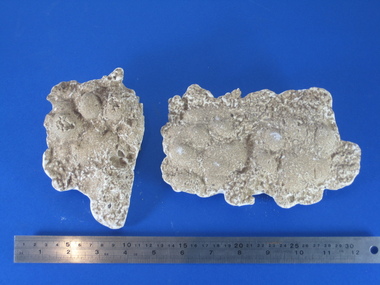
Plaster cast, David Pepper-Edwards, Plaster cast of a Clouded Leopard Footprint, 03/2004
... Two plaster casts of a male Clouded Leopard. These casts were used in the identification of photographs and sightings of large cats in the Australian Bush. ...David Pepper-Edwards used a number of plaster cast footprints for comparison of unidentified field casts. australian animal folklore collection david pepper edwards pepper edwards big cat cat clouded leopard plaster cast footprint mythical myth folklore Verso: TZ, 3/04/male/Clouded Leopard Two plaster casts of a male Clouded Leopard. ...The cast of a captive Clouded Leopard was made by David Pepper-Edwards at Taronga Zoo, Sydney, NSW. David Pepper-Edwards used a number of plaster cast footprints for comparison of unidentified field casts.Two plaster casts of a male Clouded Leopard. These casts were used in the identification of photographs and sightings of large cats in the Australian Bush. Australian Animal Folklore CollectionVerso: TZ, 3/04/male/Clouded Leopardaustralian animal folklore collection, david pepper edwards, pepper edwards, big cat, cat, clouded leopard, plaster cast, footprint, mythical, myth, folklore
