
Showing 331 items matching "for sale horse"
-
 Tarnagulla History Archive
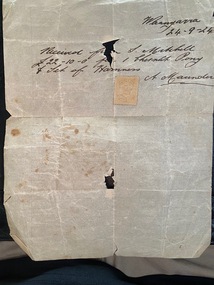
Receipt from A. Maunder to Stan Mitchell, 1924, for sale of a horse
... Maunder to Stan Mitchell, 1924, for sale of a horse....Maunder to Stan Mitchell, 1924, for sale of a horse. ... -
 Marysville & District Historical Society
THE TRIANGLE NEWS-VOL 5 NO 3-FEBRUARY 22 1980
... ...for sale horse...marysville victoria australia jack haycroft injured junior cricketers in grand final n.t. weinderg signs form 4 with st kilda thanks from swimming club carnival senior citizens letter to editor marysville uniting church kindergarten duty bingo community care centre tupperware party rodeo tshirts pot belly stoves for sale horse marysville golf club meeting toddler group THE TRIANGLE NEWS-VOL 5 NO 3-FEBRUARY 22 1980 ...marysville, victoria, australia, jack haycroft injured, junior cricketers in grand final, n.t. weinderg signs form 4 with st kilda, thanks from swimming club carnival, senior citizens, letter to editor, marysville uniting church, kindergarten duty, bingo, community care centre, tupperware party, rodeo tshirts, pot belly stoves, for sale horse, marysville golf club meeting, toddler group -
 Wodonga & District Historical Society Inc
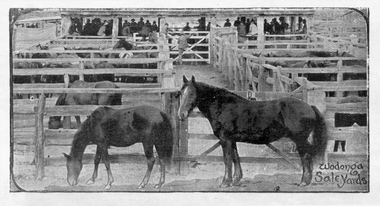
Photograph - Horse Sales at Wodonga Saleyards
... After World War II, large numbers of mainly Clydesdale working horse teams were driven to Wodonga for sale. The March horse sale was the biggest and most important event of the year with overall yardings of 1,000 horses sold over two or even three days. ...Photographic images of horses on sale at Wodonga Saleyards....After World War II, large numbers of mainly Clydesdale working horse teams were driven to Wodonga for sale. The March horse sale was the biggest and most important event of the year with overall yardings of 1,000 horses sold over two or even three days. ...The sale of stock in Wodonga goes back to its earliest history with yards being operated on the site now occupied by Elgin's Hotel and the Centro Shopping Centre, located close to the railways. Horse sales were an important part of the history of the Wodonga Saleyards. Horses were bred in north-east Victoria for the Indian Market, and records show that a truck load of horses left Wodonga Station in 1875. Campbell & Sons commenced selling horses at the Elgin Street site in 1895 and they conducted regular sales in association with Younghusband Ltd. Campbell & Sons was a Melbourne-based company, which eventually merged with Wright Stephenson & Co. Wodonga and Towong Sentinel of Friday 3rd March 1899 reported “Buyers attended from Bendigo, Ballarat, Calcutta, Madras, Singapore, The Islands, Gippsland, Dandenong, and Melbourne. Indian remounts brought up to £32 10s, draughts to £25, medium draughts to £18, town hacks and harness horses to £32, buggy pairs to £65, and light weedy sorts to £5.” After World War II, large numbers of mainly Clydesdale working horse teams were driven to Wodonga for sale. The March horse sale was the biggest and most important event of the year with overall yardings of 1,000 horses sold over two or even three days. It was a very busy period. All the horses were put through the ring singly, usually by Felix Grundy and generally caught and mouthed by Harold Boon, Andy Elliot or Toy Mulqueeney. The majority of the horses sold were trucked by rail from Wodonga. With developments in technology and the changing role of the horse in modern society, the sale of horses dwindled although horse sales at Wodonga continued until the early 1980s.These items are significant because they represent an important industry in Wodonga's past as a major centre of livestock sales in Victoria.Photographic images of horses on sale at Wodonga Saleyards.wodonga saleyards, horse sales wodonga -
 Halls Gap & Grampians Historical Society
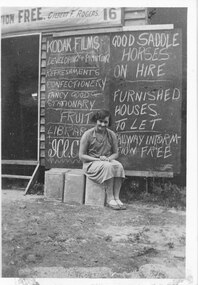
Photograph - B/W, C 1930s
... behind her are blackboards with chalk writing advertising Kodak films developing and printing, various items for sale, Horses for hire, houses to let and railway information....PEOPLE Eltze BUILDINGS Shops The photo shows a young woman sitting on kerosine tins outside a building (shop). behind her are blackboards with chalk writing advertising Kodak films developing and printing, various items for sale, Horses for hire, houses to let and railway information. ...The young woman is Clare Eltze. The building is the shop and home of Gilbert Rogers, a resident guide and photographer. The back of the photo records that it was an "everything place". The third copy of the photo is on display under the glass on the table in the History Room.The photo shows a young woman sitting on kerosine tins outside a building (shop). behind her are blackboards with chalk writing advertising Kodak films developing and printing, various items for sale, Horses for hire, houses to let and railway information.people, eltze, buildings, shops -
 Melbourne Tram Museum
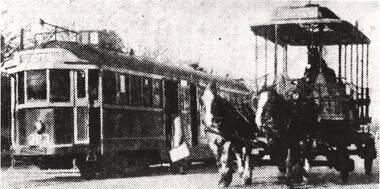
Photograph - W2 with a grip car alongside, 1930s?
... Black-and-white reproduction of a newspaper cutting of a W2 class tram, possibly No. 323, alongside a former grip or dummy following its sale on a horse-drawn wagon. Possibly 1930's as the W appears to have been converted to a W2....Black-and-white reproduction of a newspaper cutting of a W2 class tram, possibly No. 323, alongside a former grip or dummy following its sale on a horse-drawn wagon. Possibly 1930's as the W appears to have been converted to a W2. ...Black-and-white reproduction of a newspaper cutting of a W2 class tram, possibly No. 323, alongside a former grip or dummy following its sale on a horse-drawn wagon. Possibly 1930's as the W appears to have been converted to a W2.Yields information about the transport of a former dummy or a grip car following its sale by a horse drawn wagon.Mounted photograph onto a heavy cardboard backing.tramways, tram 323, grip tram, w2 class, sale of trams, cable trams -
Tatura Irrigation & Wartime Camps Museum
Book, The Perpetual (income tax) Recorder. No. 5. Agricultural and Pastoral. M Lowry, 1917
... Entries of sale of cattle, horses, wool, grain and sheep. Includes receipt to M. ...Entries of sale of cattle, horses, wool, grain and sheep. Includes receipt to M. ...Entries of sale of cattle, horses, wool, grain and sheep. Includes receipt to M. Lowry from Vic Producers Co op and final dist. Liquidators payment of wool shares and personal letter to M. Lowry from R. Charles. 1919Cream and red leather linen like hard cover with brass studs on spine. Title on red label, gold letters on front.m. lowry, vic producers coop, r. charles -
 Bendigo Historical Society Inc.
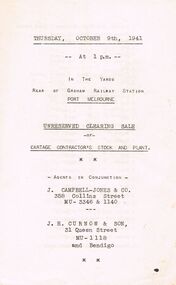
Document - IAN DYETT COLLECTION: AUCTION CATALOGUE - CARTAGE CONTRACTOR'S STOCK AND PLANT
... Auction catalogue for a sale of Cartage Contractor's Stock and Plant at the rear of Graham Railway Station, Port Melbourne on 9th October, 1941. Sale consisted of horses of various ages and descriptions, horse drawn vehicles and harness. ...BUSINESS Auctioneers j h curnow & son pty ltd Ian Dyett Collection - Auction Catalogue - Cartage Contractor's Stock and Plant Graham Railway Station - Port Melbourne J Campbell-Jones & Co J H Curnow & Son Auction catalogue for a sale of Cartage Contractor's Stock and Plant at the rear of Graham Railway Station, Port Melbourne on 9th October, 1941. Sale consisted of horses of various ages and descriptions, horse drawn vehicles and harness. ...Auction catalogue for a sale of Cartage Contractor's Stock and Plant at the rear of Graham Railway Station, Port Melbourne on 9th October, 1941. Sale consisted of horses of various ages and descriptions, horse drawn vehicles and harness. Agents in Conjunction were J. Campbell-Jones & Co. and J. H. Curnow & Son.business, auctioneers, j h curnow & son pty ltd, ian dyett collection - auction catalogue - cartage contractor's stock and plant, graham railway station - port melbourne, j campbell-jones & co, j h curnow & son -
 Wodonga & District Historical Society Inc
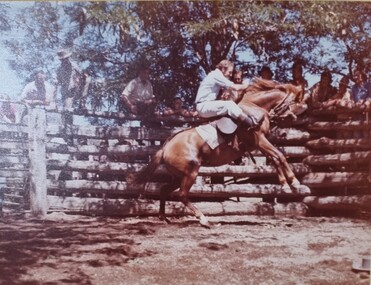
Album - Ringer's River by Des Martin - Plate 22 - Clarrie Rickards at the Camoola horse sale
... Ringer's River by Des Martin - Plate 22 - Clarrie Rickards at the Camoola horse sale...Ringer's River by Des Martin - Plate 22 - Clarrie Rickards at the Camoola horse sale...Sometime later Clarrie Rickards rides the noted outlaw, Brin Bandit, to a standstill at the annual Camoola horse sale. Keiran O'Hara spots a horse that is the living image of Deakin's imported stallion Grapeshot, now spelling in Barmagulla's back paddock, and buys him. ...Des Martin Many A Mile RInger's RIver Northeast Victoria Stories Ringer's River Album Coloured photo Plate 22 Ringer's River by Des Martin - Plate 22 - Clarrie Rickards at the Camoola horse sale Album Ringer's River by Des Martin - Plate 22 - Clarrie Rickards at the Camoola horse sale ...Sometime later Clarrie Rickards rides the noted outlaw, Brin Bandit, to a standstill at the annual Camoola horse sale. Keiran O'Hara spots a horse that is the living image of Deakin's imported stallion Grapeshot, now spelling in Barmagulla's back paddock, and buys him. Naming this horse Smokey he enters him for the coming miner's meeting at Nuggety Flat goldfield. Les Mann as Rickards.The album and images are significant because they document literature written by a prominent member of the Wodonga community. The presentation of this precis was supported by several significant district families and individuals.Ringer's River Album Coloured photo Plate 22des martin, many a mile, ringer's river, northeast victoria stories -
Port Melbourne Historical & Preservation Society
Document - Agreement to purchase 426 Graham Street, Port Melbourne, 26 Feb 1940
... For the sum of 400 pounds and 8 pounds a month the Purchaser agreed to buy the retail milk business carried on at 426 Bay Street, Port Melbourne. The sale included one horse, one cart, one set of harness, all cans, measures and other utensils plus the stock at hand on the 26 February 1940. ...For the sum of 400 pounds and 8 pounds a month the Purchaser agreed to buy the retail milk business carried on at 426 Bay Street, Port Melbourne. The sale included one horse, one cart, one set of harness, all cans, measures and other utensils plus the stock at hand on the 26 February 1940. ...Claude BUTCHER was the last milkman to home deliver milk in Port Melbourne.This photocopy of a handwritten Agreement to Purchase for 426 Graham Street was made between Arthur Albert Walter BUTCHER (the vendor) and Claude Singer Fletcher BUTCHER (the Purchaser) in February 1940. For the sum of 400 pounds and 8 pounds a month the Purchaser agreed to buy the retail milk business carried on at 426 Bay Street, Port Melbourne. The sale included one horse, one cart, one set of harness, all cans, measures and other utensils plus the stock at hand on the 26 February 1940. It was signed by both parties and has a Stamp showing that Stamp Duty had been paid. The agreement was to serve as retail mile vendor within a radius of ten miles for ten years. Claude BUTCHER was the last milkman to home deliver milk in Port Melbourne.purchase agreement, arthur albert walter butcher, claude singer fletcher, ? stivey, business and traders - dairies -
 Ballarat Tramway Museum
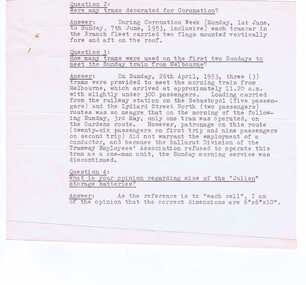
Document - Letter/s, State Electricity Commission of Victoria (SECV), c1953
... Q & A concern trams decorated for the Coronation, tram services provided on Sunday morning in 1953 that met the train from Melbourne, the size of the Julien storage batteries, date of sale of the Horse tram company to ESCo, the scrapping of trams, tram tickets older than 1934 but did have a folder of old sample ESCo tickets at the office and the address for the Mt Beauty Railway, The paper has a "Invicta Bond" watermark. ...Q & A concern trams decorated for the Coronation, tram services provided on Sunday morning in 1953 that met the train from Melbourne, the size of the Julien storage batteries, date of sale of the Horse tram company to ESCo, the scrapping of trams, tram tickets older than 1934 but did have a folder of old sample ESCo tickets at the office and the address for the Mt Beauty Railway, The paper has a "Invicta Bond" watermark. ...Yields information about Ballarat tramcars in 1950's.Letter, typed two pages, signed H. W. Linaker as Manager answering questions for Wal Jack. Letter date etc not known as it appears the top half of the first page has been cut off, includes the response to the first question. From question 2, noting the Coronation week, the letter is post mid 1953. Q & A concern trams decorated for the Coronation, tram services provided on Sunday morning in 1953 that met the train from Melbourne, the size of the Julien storage batteries, date of sale of the Horse tram company to ESCo, the scrapping of trams, tram tickets older than 1934 but did have a folder of old sample ESCo tickets at the office and the address for the Mt Beauty Railway, The paper has a "Invicta Bond" watermark. trams, tramways, tramcars, ballarat, decorated trams, sunday services, julien system, battery tram, scrapped trams, tickets, esco, sec -
 Glen Eira Historical Society
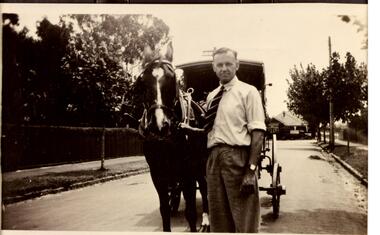
Document - Dairies
... Gives the items included in contract of sale, including 2 horses. 6/Caulfield Glen Eira Leader newspaper article dated is May, 2014, showing upcoming sale of 43 Woornack Road, Carnegie. ...Gives the items included in contract of sale, including 2 horses. 6/Caulfield Glen Eira Leader newspaper article dated is May, 2014, showing upcoming sale of 43 Woornack Road, Carnegie. ...This file contains six items: 1/Handwritten information from 1874 Sands & McDougalls sent to Mr. P Murray in 26/05/1977 from Miss IV Anderson/ 2/Typed pages from Sands & McDougalls, 1911, 1913, 1942 editions dairy entries. 3/Four separate receipts, one photocopied of local dairies, various dates. 4/Two black-and-white photographs of Archibald Short, proprietor of Shorts Dairy in Carlingford Street, and resided in College Street, Elsternwick. 5/Printed document taken from Purchase Agreement between Clara Benzley and Thomas Jenner, on the purchase of a dairy at 43 Woornack Road. Carnegie 13/08/1926. Gives the items included in contract of sale, including 2 horses. 6/Caulfield Glen Eira Leader newspaper article dated is May, 2014, showing upcoming sale of 43 Woornack Road, Carnegie. The property was Clara Benzley’s (granddaughter Claire Barton) dairy in 1926.burlington model dairy, glen huntly road, caulfield, hall mr., carinya dairy, orrong crescent, bradin, rice l. i., dairyman, green r., queens ave., carnegie, neerim road, parton’s dairy, hawthorn road, short archibald, carlingford street, south caulfield, college street, elsternwick, milk cart, dairying, dairies, land sales, real estate, architectural, woornack road, auctions -
 Federation University Historical Collection
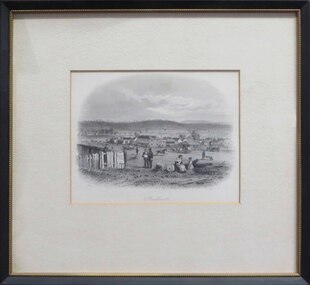
Artwork, other - Artwork (framed), Sandhurst by S.T. Gill, 1857
... Sale Land'. In the mid ground a fledgling townscape is evident whole a man rides a horse along a thoroughfare, along with a small bullock team, and a man pushing a wheelbarrow. ...horse and rider Balck and white steel engraving of a work by Samuel Thomas Gill showing a scene in early Bendigo. In the foreground a woman sits on a fallen tree holding a baby and talking to a small girl, while two men stand nearby discussing words on a paper. A sign on the fence declares 'Gov Sale ...Sandhurst is the early name for the Victorian goldfield town of Bendigo. The original was published by Melbourne's Sands and Kenny Melbourne in 1857, and the plate from "Victoria Illustrated" by S.T. Gill. Balck and white steel engraving of a work by Samuel Thomas Gill showing a scene in early Bendigo. In the foreground a woman sits on a fallen tree holding a baby and talking to a small girl, while two men stand nearby discussing words on a paper. A sign on the fence declares 'Gov Sale Land'. In the mid ground a fledgling townscape is evident whole a man rides a horse along a thoroughfare, along with a small bullock team, and a man pushing a wheelbarrow. The scenefeatures a large number of flagpoles, and tents are visible along the horizon line. The image is engraved "S.T.Gill, del." in the lower left; "J. Tingle sc" in the lower right, and the title is engraved below image. bendigo, sandhurst, samuel thomas gill, s.t. gill, j. tingle, goldfield, bullock team, horse and rider -
Marysville & District Historical Society
THE TRIANGLE NEWS-VOL 39 NO 40-OCTOBER 19 2012
... horse...country touch news...australia day awards...sample wines...marysville marathon...narbethong community garage sale...marysville victoria australia open gardens in buxton taggerty and acheron what's on when in october advertisements triangle community dinner marysville golf club marysville district cricket club annual duck race marysville art show church notices parish luncheon saladin lodge fire season-slashing program marysville golf report maryton beer & platter garden reopening maryton park b & b following the legend of archer the race horse country touch news australia day awards sample wines marysville marathon narbethong community garage sale cartwheels festival alexandra secondary college dalton fiske foundation triangle community dancers taggerty hall real estate steavenson falls flood lighting returns completion of recovery project gallipoli park marysville primary school parents club trivia night black spur hotel victorian concert orchestra narbethong community hall narbethong progress association buxton hotel carboot sale cathedral ward candidates murrindindi shire council elections memorial designs to engage community healing journey marysville saddle tramps celebrating 30 years gallipoli park community centre THE TRIANGLE NEWS-VOL 39 NO 40-OCTOBER 19 2012 ...marysville, victoria, australia, open gardens in buxton taggerty and acheron, what's on when in october, advertisements, triangle community dinner, marysville golf club, marysville district cricket club, annual duck race, marysville art show, church notices, parish luncheon, saladin lodge, fire season-slashing program, marysville golf report, maryton beer & platter garden reopening, maryton park b & b, following the legend of archer the race horse, country touch news, australia day awards, sample wines, marysville marathon, narbethong community garage sale, cartwheels festival alexandra secondary college, dalton fiske foundation, triangle community dancers, taggerty hall, real estate, steavenson falls flood lighting returns, completion of recovery project, gallipoli park, marysville primary school, parents club trivia night, black spur hotel, victorian concert orchestra, narbethong community hall, narbethong progress association, buxton hotel, carboot sale, cathedral ward candidates, murrindindi shire council elections, memorial designs to engage community healing journey, marysville saddle tramps celebrating 30 years, gallipoli park community centre -
Marysville & District Historical Society
THE TRIANGLE NEWS-VOL 22 NO 4-27 JANUARY 1995
... sale...to rent...wanted to buy...golf news...bowls news...junior golf clinic...colonial horse...marysville victoria australia narbethong theatre group thanks to emergency services happy birthday emergency fire telephone numbers important dates february 1995 toy library marysville & district lions club project community health services steavenson restaurant women's health information day oregon woodgrain timber marysville video christ church ladies' guild stolen-property christ church church news community council meetings public notice shire of murrindindi kooringa conference centre breast screen mobile van walking benefits acupuncture narbethong fire brigade bushfire readiness check list rubicon pokie mobile for sale to rent wanted to buy golf news bowls news junior golf clinic colonial horse races buxton wombat cottage singles lions club members notice reflections on history marysville & district historical society marysville saddle tramps marysville primary school 125th anniversary marysville crafts & gifts poem trades directory THE TRIANGLE NEWS-VOL 22 NO 4-27 JANUARY 1995 ...marysville, victoria, australia, narbethong theatre group, thanks to emergency services, happy birthday, emergency fire telephone numbers, important dates february 1995, toy library, marysville & district lions club project, community health services, steavenson restaurant, women's health information day, oregon woodgrain timber, marysville video, christ church ladies' guild, stolen-property christ church, church news, community council meetings, public notice shire of murrindindi, kooringa conference centre, breast screen mobile van, walking benefits, acupuncture, narbethong fire brigade, bushfire readiness check list, rubicon pokie mobile, for sale, to rent, wanted to buy, golf news, bowls news, junior golf clinic, colonial horse races buxton, wombat cottage, singles, lions club members notice, reflections on history, marysville & district historical society, marysville saddle tramps, marysville primary school 125th anniversary, marysville crafts & gifts, poem, trades directory -
 Lara RSL Sub Branch
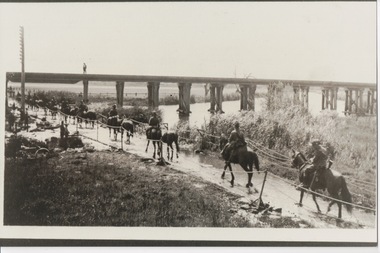
Photograph, Set 4 photographs. and others for Torquay Light Horse camp, 1940
... Horses, men and equipment came on special trains from all over Victoria and NSW, and as you would expect horseman came from areas such as Omeo and Sale, the Wimmera and the Western District. ...Horses, men and equipment came on special trains from all over Victoria and NSW, and as you would expect horseman came from areas such as Omeo and Sale, the Wimmera and the Western District. ...These images capture for all time Light Horsemen travelling through Geelong on their way to camp at Torquay for the last Group meeting in Australia . information following - details obtained from .........https://torquayhistory.com/light-horse-brigade/ On Australia Day, 1997, Sir John Young unveiled this plaque on Point Danger, Torquay. Torquay history, Light Horse Training Camp, WW2 Plaque at Pt. Danger Note----- (See images to view plaque) The plaque identifies a significant event in Torquay’s history and the sentiments of ‘change’ for the Light Horse Brigade – from horses to machines. In 1940 the four Light Horse Regiments (4th, 8th, 13th and 20th), some 5000 Light Horse and 2000 horses camped and trained at Torquay. Three other regiments, formerly mounted on horses, were also at Torquay ‘mounted’ on privately owned trucks and cars. Division troops included Artillery, Engineers, Signals, Field Ambulance and other branches of the Army necessary to enable a Division to function. It wasn’t just the sheer numbers of men coming to this little town that made the event significant, it was also the fact that the men of the Light Horse were dramatic, almost glamorous figures and it is easy to see their exploits as some splendid adventure. Horses have played a special role in the story of Australia. They were the only means of transport across this huge country, so it was necessary for everyone to have the ability to ride a horse. When war broke out in 1899 between Britain and the Boers of South Africa (“Boer” was Dutch for “farmer”) Australia sent troops to fight. At first Britain was wary of using untried, unprofessional colonial cavalrymen but soon saw that the slouch-hatted Australian “bushmen” were a match for the fast-moving and unconventional mounted commandos of the Boers. The Australians proved themselves to be expert rough-riding horsemen and good shots. Bush life had hardened them to go for long periods with little food and water. They also showed remarkable ability to find their way in a strange country and use its features for cover, in both attack and defence. By 1914, when Australia joined the war against Germany, there were 23 Light Horse regiments of militia volunteers. Many men from these units joined the Light Horse regiments of the Australian Imperial Force (AIF). Men were given remounts (if not using their own horses) – army horses bought by Commonwealth purchasing officers from graziers and breeders. These were called “walers” because they were a New South Wales stockhorse type – strong, great-hearted animals with the strains of the thoroughbred and semi-draught to give them speed, strength and stamina. On 1st November, 1914, Australia’s First Infantry Division and the first four Light Horse regiments sailed for England in a fleet of transport ships. The first of the Light Horse arrived at Gallipoli in May without their horses. Back with their horses after Gallipoli, they were formidable combatants across the Sinai and Palestine. Some British commanders observed that the light horseman moved with a “lazy, slouching gait, like that of a sleepy tiger” but described how the promise of battle “changes that careless gait, into a live athletic swing that takes him over the ground much quicker than other troops”. They had Light Horse, Torquay, training campdeveloped a reputation as formidable infantrymen. The Turks called them “the White Ghurkas” – a reference to their deadly skill with the bayonet. The Arabs called them “The Kings of the Feathers”. The plume had originally been a battle honour of the Queensland Mounted Infantry for their work in the shearer’s strike of 1891. During WW1 it was adopted by almost all the Light Horse Regiments. It was the proud badge of the light horseman. The most famous of their battles was the attack on Beersheba- the charge of the 4th Light Horse Brigade. Mounted infantrymen and their superb walers had carried out one of the most successful cavalry charges in history – against what seemed impossible odds. They surprised the Turks by charging cavalry-style, when they would normally have ridden close to an objective then dismounted to fight. The fall of Beersheba swung the battle tide against the Turks in Palestine; and changed the history of the Middle East. While 19 men from the Surf Coast Shire served with the 4th Light Horse over the course of WW1, only four were involved in the charge of Beersheba- John GAYLARD, Philip QUINN.(Winchelsea); Wallace FINDLAY (Anglesea); Harry TRIGG (Bambra). After the war, Light Horse units played a key role in the Australian Government’s compulsory military training programme. The Citizen Military Forces (C.M.F.) thrived on the glamour of the wartime Light Horse tradition, ignoring the possibility that motor vehicles would soon replace the horses. When training was no longer compulsory, the C.M.F. regiments declined and horses became more of a luxury during the 1930s depression years of poverty and unemployment. Some regiments were motorised. Then, in 1939, Australia joined Britain in another world war. Training was increased for the militia at both home bases and regional training camps. The camp at Torquay in 1940, commanded by Major General Rankin, was at Divisional strength. By the end of the camp some felt that the Division was ready for active service. Gradually, over the next four years, the Australian Light Horse units were mounted on wheels and tracks and the horses were retired. Six men enlisted at the Torquay camp and another 57 men and women enlisted at Torquay for service in WW2. Those who served in the Militia provided valuable Officers and NCOs and men for the armed services during the war. Each infantry division of the 2nd AIF had a Light Horse regiment attached to it. But the day of the Australian mounted soldier hadn’t quite passed. During World War II, Australia’s 6th Cavalry Regiment formed a mounted unit they called “The Kelly Gang” which did valuable scouting work. In New Guinea, a mounted Light Horse Troop did patrol duty and helped carry supplies. Some fully equipped walers were flown into Borneo for reconnaissance in rugged mountain country. But by the end of the war, in 1945, the horse had disappeared from the Australian Army. References: Australian Light Horse Association www.lighthorse.org.au National Australia Archives Australian War Memorial Surf Coast Shire WW1 memorials www.togethertheyserved.com The Light horse- a Cavalry under Canvas Light Horse, Training Camp, Torquay, WW2 Late in 1939 it was decided to set up a Lighthorse training camp in Torquay to train both men and horses for the battles of the Second World War. Horses, men and equipment came on special trains from all over Victoria and NSW, and as you would expect horseman came from areas such as Omeo and Sale, the Wimmera and the Western District. They arrived at the Geelong racecourse for watering in the Barwon River and then were ridden across the ford at the breakwater and began their 11 mile trek to Torquay. Light Horse, Training Camp, Torquay, WW2 Tent city By the end of January 1940 the camp at Torquay accommodated some 5000 men and 2500 horses of the Second Cavalry Division. The rows of horses, tents and huts near Blackgate Road were quite a sight. While the cavalrymen engaged in exercises on the land and on the beaches, many of the troops took over the Torquay School for special training of men and officers. Mr Bob Pettit local farmer and Councillor for the Barrabool Shire, wrote about the Light horse in the Surf Coast Community News in 1985 saying “They used to travel about the district riding four abreast in one long convoy. To my annoyance they went through my property and shut all the gates behind them. I had certain gates open to let stock in to the water holes and it would take me three -quarters of an hour to follow the horsemen up and put all the gates right again” he continued “the men from the Light Horse were here when the fire went through in March 1940. He recalled an incident when early one morning, as some one blew the bugle, a soldier putting a white sheet on the line frightened the horses. They panicked and ran off in all directions. Six went over the cliff near Bird Rock, five were never found, and the rest were gathered up after nearly a fortnight in the bush around Addiscott and Anglesea" Light Horse, Training Camp, Torquay, WW2, Geelong Parade Geelong parade The training camp culminated in a parade through the streets of Geelong on March 12th 1940. The salute was given at the Town Hall and the troops continued on a route to the You Yang’s for a training exercise. Note-----(see media section for photograph) The Camp was abandoned in mid 1940 as it was deemed unsuitable for training during winter and the cost of a permanent camp could not be justified if it could not be used all year. Historic.......Rare,,,Interpretive.Sepia photographs.set of four ....post card size ....Horses &LighthorsemenNo 1, Lighthorsemen Regiment Geelong 1940......No 2 Light Horse at Breakwater Geelong 1938 to 1940....No 3 Light Horse at Breakwater Geelong 1938 to 1940.....No 4 Light Horse crossing Breakwater camped at Geelong Showgrounds. These markings are on reverse of photographs.light horsemengeelong 1940., world war 2 -
 City of Moorabbin Historical Society (Operating the Box Cottage Museum)
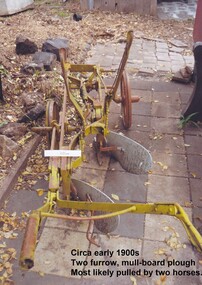
Tool - Farm Machinery, Horse-drawn Furrow Plough, Early 20th Century
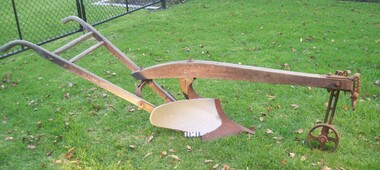
... Late 1800s-early 1900s A horse-drawn furrow plough is an example of the type of farm implement widely used by pioneer market gardeners in the Moorabbin Shire following 'Dendy's Special Survey' of 1841 and the Crown Land Sale in 1852. ...Late 1800s-early 1900s A horse-drawn furrow plough is an example of the type of farm implement widely used by pioneer market gardeners in the Moorabbin Shire following 'Dendy's Special Survey' of 1841 and the Crown Land Sale in 1852. ...Late 1800s-early 1900s A horse-drawn furrow plough is an example of the type of farm implement widely used by pioneer market gardeners in the Moorabbin Shire following 'Dendy's Special Survey' of 1841 and the Crown Land Sale in 1852. Land allotments were bought by pioneer settlers who established or rented allotments for market gardens in the area. They supplied produce to the markets in St Kilda and Melbourne. During the gold-rush of the 1850s the rapidly increasing population of Melbourne saw a huge demand and a rise in prices for all foodstuffs, including the vegetables and fruit grown in the Shire of Moorabbin. This heralded a time of prosperity for market gardeners, and an equally rapid expansion of the numbers of vegetable and produce growers in the area. The 'knock-on effect" resulted in an increased interest and development of the community in the Shire of Moorabbin.Following 'Dendy's Special Survey' of 1841 and the Crown Land Sale in 1852, land allotments were bought by pioneer settlers who established or rented allotments for market gardens in the area and they supplied produce to the markets in St Kilda and Melbourne. During the gold-rush of the 1850s the rapidly increasing population of Melbourne saw a huge demand and a rise in prices for all foodstuffs, including the vegetables and fruit grown in the Shire of Moorabbin. Circa late 1800's to early 1900s. A horse-drawn furrow plough was the most common type of agricultural implement used by the pioneers of the 1800s and continued on into the 1940s when motorised tractors came into use. This plough is an example of a two furrow, mullboard plough which would most likely have been pulled by two horses. The long handle was used to lower the silver plates, (mullboards), to the chosen depth of soil. Painted yellow. Although this Box Cottage museum plough is unbranded, the most widely used plough in the Shire of Moorabbin was made by Oliver. This plough appears to be identical to that brand. brighton, moorabbin, pioneers, fruit, bentleigh, vineyards, vegetables, plough, market gardens, plow -
 City of Moorabbin Historical Society (Operating the Box Cottage Museum)
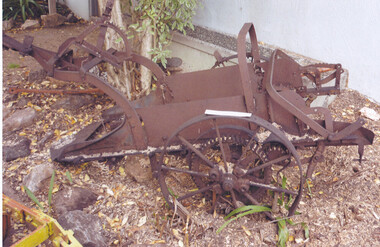
Tool - Farm Machinery, Horse-drawn Plough Potato Digger, c1900
... Sale of 1852, land allotments were sold to pioneer settlers who established market gardens in the area of Moorabbin Shire. During the 1850s gold-rush population boom the number of market gardeners increased significantly spreading throughout the Moorabbin Shire. Potatoes were considered a staple foodstuff, so crops were regularly sown throughout the whole Moorabbin area. melbourne sydney markets vegetables potato dendy henry st kilda market gardeners gold rush moorabin chinese gardeners ploughs Circa late 1800s early 1900s. A horse ...Circa late 1800s early 1900s a horse-drawn plough, potato digger, is one example of the implements that were widely used by early market gardeners in the Shire of Moorabbin. The flat plate, seen to the right of the photo, dug down into the ground below the potatoes and "scooped" them up. Behind the plate, two driving chains on cogs, (these chains are missing from our exhibit), then "rocked' the dug potatoes to loosen the soil from the "spuds". The potatoes were then harvested by hand. Very large tracts of land in the Shire of Moorabbin were planted with potatoes. Harvesting commenced in October, into November and on into December. Potatoes were a necessary food staple. The market gardeners were always in a rush to be first to get their potatoes to market, and hence the best price. Some market gardeners were so keen to be the first to market, (and get the most money), that they dug their potatoes "green" (or new). The only downside of this practice was that these early potatoes had to be handled with extreme care as their skins were very loose, and came off easily - so decreasing their profits.As well as taking their produce to the Melbourne and St Kilda markets, they also sent produce off to Sydney markets. It is interesting to note that a group of Chinese market gardeners were the first to access the Sydney market. .Following the 'Dendy's Special Survey' 1841 and the Crown Land Sale of 1852, land allotments were sold to pioneer settlers who established market gardens in the area of Moorabbin Shire. During the 1850s gold-rush population boom the number of market gardeners increased significantly spreading throughout the Moorabbin Shire. Potatoes were considered a staple foodstuff, so crops were regularly sown throughout the whole Moorabbin area. Circa late 1800s early 1900s. A horse-drawn plough potato digger is an example of the machines used by early market gardeners in Moorabbin Shiremelbourne, sydney, markets, vegetables, potato, dendy henry, st kilda, market gardeners, gold rush, moorabin, chinese gardeners, ploughs -
 City of Moorabbin Historical Society (Operating the Box Cottage Museum)
Machine - Farm Machinery, Plough, single mull-board, c1900
... horse. The long handle was used to lower the silver plate, (mullboard), to the chosen depth of soil. Following 'Dendy's Special Survey' of 1841 and the Crown Land Sale in 1852, land allotments were bought by pioneer settlers who established or rented allotments for market gardens in the area and they supplied produce to the markets in St Kilda and Melbourne. ...Circa late 1800's to early 1900s. A horse-drawn furrow plough was the most common type of agricultural implement used by the pioneer market gardeners, in Moorabbin Shire, of the 1800s and continued on into the 1940s when motorised tractors came into use. This plough is an example of a single-mullboard plough which would have been pulled by horse. The long handle was used to lower the silver plate, (mullboard), to the chosen depth of soil. Following 'Dendy's Special Survey' of 1841 and the Crown Land Sale in 1852, land allotments were bought by pioneer settlers who established or rented allotments for market gardens in the area and they supplied produce to the markets in St Kilda and Melbourne. During the gold-rush of the 1850s the rapidly increasing population of Melbourne saw a huge demand and a rise in prices for all foodstuffs, including the vegetables and fruit grown in the Shire of Moorabbin. An "Oliver" single mull-board plough in good condition with faded manufactures markings on shaftsPainted on shaft "MANF'D BY/OLIVER CHILLED PLOW WORKS/Southend Ind. USA/" Engraved on blade " 13 OLIVER"brighton, moorabbin, plough, dendy henry, east bentleigh, market gardens, horse drawn plough, plow, mullboard -
 Orbost & District Historical Society
Poster - Royal Agricultural Show of Victoria 1929, THE AUSTRALASIAN, 1929
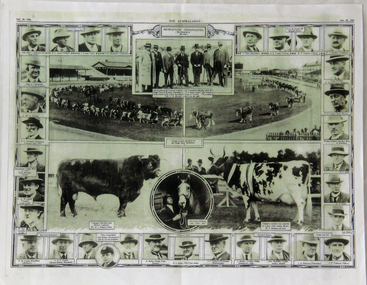
... Sale), A E Trewin (Orbost), and H P Cameron (Orbost). This poster is significant because it represents a poster/promotion from 1929 of the Royal Agricultural Show of Victoria, and also shows images of representatives from throughout the State, including from the Orbost/Bairnsdale areas. agriculture Royal Agricultural show of Victoria Trewin Cameron Nixon Multiple captions to photos. Sept. 29, 1929 is printed on top left and top right corners of poster. THE AUSTRALASIAN is printed at the centre top. A rectangular sheet of paper with multiple photographs which show people and cows and horses ...This poster was printed by THE AUSTRALASIAN newspaper in 1929 as a promotion for the Royal Agricultural Show of Victoria. With its many photos and captions, it is an excellent reference document. It depicts Showground Personalities from all over Victoria, and members of the Council of the Royal Agricultural Society of Victoria, Melbourne Show Promotion of 1929. Local Gippsland people shown and identified in captions are: P C Nixon (Orbost), J Trewin (Sale), A E Trewin (Orbost), and H P Cameron (Orbost).This poster is significant because it represents a poster/promotion from 1929 of the Royal Agricultural Show of Victoria, and also shows images of representatives from throughout the State, including from the Orbost/Bairnsdale areas.A rectangular sheet of paper with multiple photographs which show people and cows and horses associated with Royal Agricultural Show of Victoria. All of the photos have captions, and the date Sept. 29, 1929 is printed at the top left and top right corners of the poster. In the top centre is THE AUSTRALASIAN. Multiple captions to photos. Sept. 29, 1929 is printed on top left and top right corners of poster. THE AUSTRALASIAN is printed at the centre top. agriculture, royal agricultural show of victoria, trewin, cameron, nixon -
 Ringwood and District Historical Society
Photograph - Newspaper Clipping, Early View of Club Hotel, Ringwood East
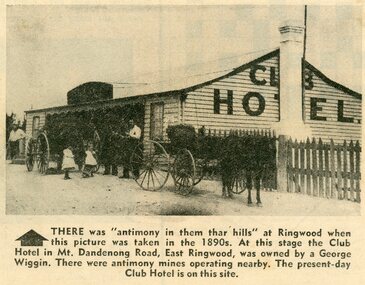
... sale and demolition in 2020 to make way for a retirement village. (See PDF attached - "SS0067 Vic Collections 3754b - Club Hotel Fire 1890"). Caption: There was 'antimony in them thar hills' at Ringwood when this picture was taken in the 1890s. At that time the Club Hotel in Mt Dandenong Road, East Ringwood was owned by a George Wiggin. There were antimony mines operating nearby. The present-day Club Hotel is on this site. Early View of Club Hotel, Ringwood East. Weatherboard with iron roof. Single chimney on one end. Picket fence on RHS. Two horse ...The newspaper clipping caption is incorrect. The Club Hotel featured in the article was located on the north side of Mount Dandenong Road. It was destroyed by fire in 1890 prior to re-opening later on the south side where it operated until sale and demolition in 2020 to make way for a retirement village. (See PDF attached - "SS0067 Vic Collections 3754b - Club Hotel Fire 1890").Early View of Club Hotel, Ringwood East. Weatherboard with iron roof. Single chimney on one end. Picket fence on RHS. Two horse-drawn vehicles standing out front including three adults and two children. Source/date of newspaper unknown. Later newspaper item also attached reporting hotel being destroyed by fire in 1890.Caption: There was 'antimony in them thar hills' at Ringwood when this picture was taken in the 1890s. At that time the Club Hotel in Mt Dandenong Road, East Ringwood was owned by a George Wiggin. There were antimony mines operating nearby. The present-day Club Hotel is on this site. -
 Orbost & District Historical Society
black and white photographs, Ward Bros, late 19th century - early 20th century
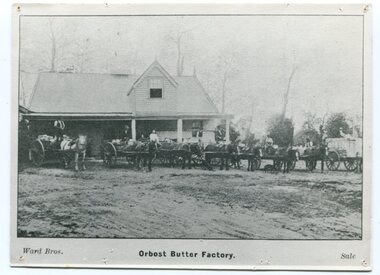
... horse and dray.Most people would take the whey home for their pigs,which were abundant on the farms in the Orbost district. Mr John Gilbert is the man second from the left in 1250.1. Postcards form a vital part of social and historical records for researchers. These cards are photographs of the Orbost Butter Factory. The Orbost Butter and Produce Co. Ltd was registered on June 1st 1893 and was an important source of income to the Orbost district. dairy-orbost orbost-butter-factory 1250.1 - on front - Orbost Butter Factory Ward Bros Sale ...The photographs show the Butter Factory at Orbost in 1892 and 1906. The postcard is addressed to Miss N. Cameron C/- Mrs H. Nixon of Picnic Point Bairnsdale. The Orbost Butter and Produce Co. Ltd was registered on June 1st 1893 and was an important source of income to the Orbost district. The first shipment in about 1893 to England went rank and was only good for axle grease on wagons and carts.The milk was brought to the factory by horse and dray.Most people would take the whey home for their pigs,which were abundant on the farms in the Orbost district. Mr John Gilbert is the man second from the left in 1250.1.Postcards form a vital part of social and historical records for researchers. These cards are photographs of the Orbost Butter Factory. The Orbost Butter and Produce Co. Ltd was registered on June 1st 1893 and was an important source of income to the Orbost district. Two photographs / postcards of the Orbost Butter Factory. 1250.1 is a a photograph of several horse-drawn wagons outside a large wooden building.There are several men on top of the wagons, seated and standing. 1250.2 is a postcard with a photograph of the butter factory taken from the north side showing the two storeys with a person standing at a door on each level. There are horse drawn carts behind a wooden fence and several men standing on the front verandah with one man at a top window. On the back of this postcard is a hand-written letter.1250.1 - on front - Orbost Butter Factory Ward Bros Sale 1250.2 - on front - Butter Factory Orbost on back - " 27/11/06 Dear Girls Yours to hand you should have had a letter from me yesterday. Glad you wrote to Miss Alexander. Hope ypou have a good time out there. ??? meeting a success, Mother"dairy-orbost orbost-butter-factory -
 Ringwood and District Historical Society
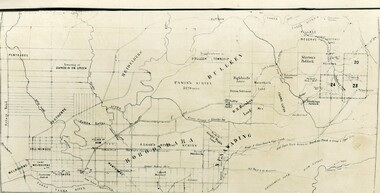
Map - Public Land Sale by Thomas Ham, 2000 Acres for Sale - Crown Sections 20, 23, 24 - Ringwood, Victoria - 1855
... When at the "Woodman Inn", take the Cotham Road to the right, bearing due east, keep this Road, passing Trainor's "White Horse" Inn, and before you leave the fences, you will see calico bills (see margin) nailed to the Trees on the bush track leading to the Upper Yarra country, follow the Bills till you come to the SOUTH boundary line of the Property, which bears East and West (see Plan) where you will see Bills nailed up "THIS PROPERTY FOR SALE, etc." ...When at the "Woodman Inn", take the Cotham Road to the right, bearing due east, keep this Road, passing Trainor's "White Horse" Inn, and before you leave the fences, you will see calico bills (see margin) nailed to the Trees on the bush track leading to the Upper Yarra country, follow the Bills till you come to the SOUTH boundary line of the Property, which bears East and West (see Plan) where you will see Bills nailed up "THIS PROPERTY FOR SALE, etc." ...Two 1850s surveyor's maps on cardboard backing showing area from Melbourne extending East beyond Bulleen and Nunawading. Detailed description of lots for sale and navigational directions to the property from Richmond by Thomas Ham, Victorian public servant, map maker, publisher, lithographer and original Ringwood land owner. Inset map enlarging area between Yarra River and Dandenong Creek, with southern boundary of allotments later forming part of Oban Road, North Ringwood.TRANSCRIPT: "This really valuable Property is now offered to the public for sale, in lots to suit purchasers at the Iow rate of £1 per Acre for 80 acres and upwards, and £1.10s per Acre for any smaller portion. Terms of payment Half Cash, Balance in 6 and 12 months, bearing 8 per cent interest. The Estate is well wooded with Gum, Cherry Tree and Stringy Bark, with Wattle in the valleys of the several creeks. Every lot is Staked and Trenched at the corners marked on the Plan thus - The Surveyor has carefully sub-divided the Property, in order to give every Farm a Creek for Water, Valley for Cultivation, and Hills for House and Grass Paddock. The ROADS have been very carefully laid out so as to give a firm, well drained, and nearly level road to each Homestead. Intending purchasers can readily find the property by the following directions, viz: Start from Richmond Bridge, at Hawthorne, then take the left-hand road to KEW. When at the "Woodman Inn", take the Cotham Road to the right, bearing due east, keep this Road, passing Trainor's "White Horse" Inn, and before you leave the fences, you will see calico bills (see margin) nailed to the Trees on the bush track leading to the Upper Yarra country, follow the Bills till you come to the SOUTH boundary line of the Property, which bears East and West (see Plan) where you will see Bills nailed up "THIS PROPERTY FOR SALE, etc." The Bills from Town lead direct to where Mr. Jull is erecting his Store, and arrangements have been made with him to show the lots to intending purchasers free of charge. At the respective corners of the lots the Bills are nailed up double, with numbers to denote the lot, and that the corner stake is adjacent. Any parties wishing to proceed to the property by way of BULLEEN will find Bills nailed on the Trees, commencing at the NEW INN, at "Wilson's Slip Rail." Keep this Track till you come to the Log Bridge, over the Deep Creek at Bloxhome's Paddock; go through the land now being cleared; keep the track over the hill till you come to an Iron House, you will then be on the property, which Iies to the North and East as per Plan. Follow the Bills till you come to Mr. Jull's Store, etc. etc. Further particulars can be had from the Agent for the Property. THOMAS HAM. " -
 Ringwood and District Historical Society
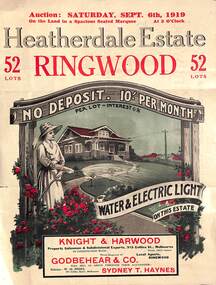
Pamphlet - Land Auction Brochure, Heatherdale Estate, Ringwood, Victoria - 1919
... Horse Road, Witt Street, Mitcham, Station Street (later Victory Street, Mitcham). (Railway Avenue marked on the map did not eventuate). Agents - Knight & Harwood, 315 Collins Street, Melbourne in conjunction with Godbehear & Co, Phone Ringwood 49, selling through their auctioneer - Sydney T. Haynes. Solicitor W.H. Peers, 395 Collins Street, Melbourne. Double sided leaflet advertising subdivision site, layout of streets and allotments, summary of local features and services and terms of sale ...Double sided leaflet advertising subdivision site, layout of streets and allotments, summary of local features and services and terms of sale. Inset photographs of local views and residence of F.W. Purches on the Estate.Auction Saturday September 6th, 1919. 52 Lots. Subdivision includes White Horse Road, Witt Street, Mitcham, Station Street (later Victory Street, Mitcham). (Railway Avenue marked on the map did not eventuate). Agents - Knight & Harwood, 315 Collins Street, Melbourne in conjunction with Godbehear & Co, Phone Ringwood 49, selling through their auctioneer - Sydney T. Haynes. Solicitor W.H. Peers, 395 Collins Street, Melbourne. -
 Ringwood and District Historical Society
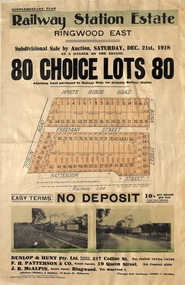
Flyer, Subdivisional Auction Sale Brochure, Railway Station Estate, Ringwood East, Vic. - 1918
... Subdivision includes Mount Dandenong Road (incorrectly shown as White Horse Road), Dublin Road, Freeman Street, Bona Street, and Patterson Street. Local Agent - J.B. McAlpin, Telephone Ringwood 7. Advertisement for subdivisional auction sale ...Advertisement for subdivisional auction sale of 80 residential allotments on Saturday, 21st December, 1918, including terms of sale, subdivision layout, and nearby location photographs.Subdivision includes Mount Dandenong Road (incorrectly shown as White Horse Road), Dublin Road, Freeman Street, Bona Street, and Patterson Street. Local Agent - J.B. McAlpin, Telephone Ringwood 7. -
 Ringwood and District Historical Society
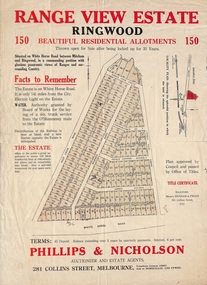
Flyer, Land Sale Advertisement and auction notice - Range View Estate, Ringwood, Victoria - 1920
... Horse Road, Mitcham. Agents - Phillips & Nicholson, 281 Collins Street, Melbourne, Telephone Central 10907. Advertisement for sale ...Advertisement for sale of 150 residential allotments with terms of sale, summary of local features and services, and map showing location and layout of subdivision within the boundary of Mitcham to the west of Ringwood, Victoria. Copy of newspaper advertisement (The Herald, Melbourne, Wednesday 3 March, 1920) refers to public auction date for Range View Estate Ringwood - Saturday, 27th March, 1920.Subdivision includes Deep Creek Road, Range View Grove, Warnes Road, Tarrangower Avenue, Prince Edward Avenue, James Avenue, and White Horse Road, Mitcham. Agents - Phillips & Nicholson, 281 Collins Street, Melbourne, Telephone Central 10907. -
 Ringwood and District Historical Society
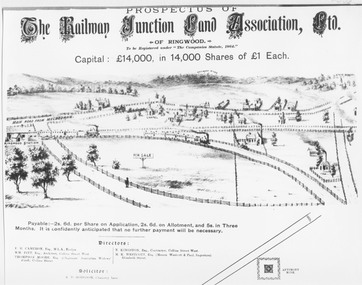
Document, Land sale prospectus - Railway Junction Land Association Ltd., Ringwood - circa 1890
... Maroondah Highway not shown but would approximate a line drawn from just to left of horse and cart near Chapel - North to pass around Antimony Mine and to the left to pass behind Cass's School.' Black and white copy of Prospectus document Land sale prospectus - Railway Junction Land Association Ltd., Ringwood - circa 1890. ...Black and white copy of Prospectus documentEarly Sketch of Ringwood Layout (part). Not to scale but largely true to life of approximately 1890. Many local landmarks shown e.g. Wesleyan Chapel, Duncans Antimony Mine Hotel, Cass's School, Herry's Store. Maroondah Highway not shown but would approximate a line drawn from just to left of horse and cart near Chapel - North to pass around Antimony Mine and to the left to pass behind Cass's School.' -
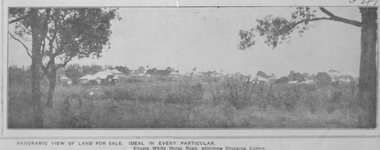 Ringwood and District Historical Society
Photograph, Extract from Land Sale Brochure of Pratt's Junction Estate, Ringwood - 24/11/1923
... sale. Ideal in every particular. Situated white Horse Road, adjoining Shopping Centre." ...sale. Ideal in every particular. Situated white Horse Road, adjoining Shopping Centre." ...Black and white photographPrinted under photograph: "Panoramic view of land sale. Ideal in every particular. Situated white Horse Road, adjoining Shopping Centre." For additional details of Pratt's Junction Estate see VC5175b. -
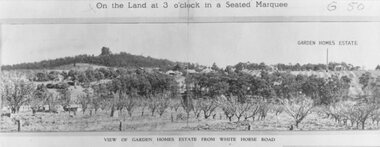 Ringwood and District Historical Society
Photograph, Extract from Land Sale Brochure of Garden Homes Estate between Mullum Mullum Road, Ringwood and Mullum Mullum Creek, Ringwood. 20/10/1923
... Horse Road." For additional details of Garden Homes Estate see VC5143d. Black and white photograph Extract from Land Sale Brochure of Garden Homes Estate between Mullum Mullum Road, Ringwood and Mullum Mullum Creek, Ringwood. 20/10/1923. ...Black and white photograph Printed below Photograph: "View of Garden Homes Estate from White Horse Road." For additional details of Garden Homes Estate see VC5143d. -
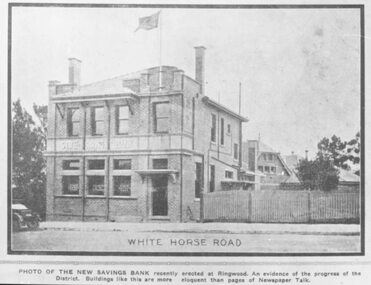 Ringwood and District Historical Society
Photograph, Maroondah Highway Central, Ringwood. Land sale brochure image of the State Savings Bank of Victoria branch and manager's residence, 1923
... Horse Road" and statement underneath reads, "Photo of the new Savings Bank recently erected at Ringwood. An evidence of the progress of the District. Buildings like this are more eloquent than pages of Newspaper Talk." Black and white copy of photograph Maroondah Highway Central, Ringwood. Land sale ...Black and white copy of photographTyped below photograph: "White Horse Road" and statement underneath reads, "Photo of the new Savings Bank recently erected at Ringwood. An evidence of the progress of the District. Buildings like this are more eloquent than pages of Newspaper Talk." -
 Ringwood and District Historical Society
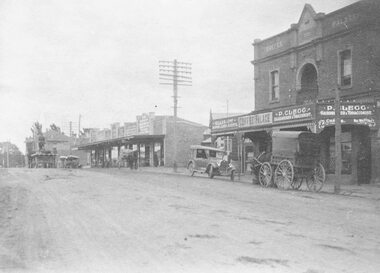
Photograph, Maroondah Highway Central, Ringwood. Coffee Palace and shops along Main Street between Adelaide Street and Melbourne Street. c1920's
... Image is taken from a land sale brochure and shows cars and horse drawn vehicles parked in front of buildings....Image is taken from a land sale brochure and shows cars and horse drawn vehicles parked in front of buildings. ...Black and white photographWritten on back of photograph: "Land values - Main Street, Ringwood - land worth £50 pounds a foot." Image is taken from a land sale brochure and shows cars and horse drawn vehicles parked in front of buildings.
