
Showing 143 items matching "forged tool"
-
 Clunes Museum
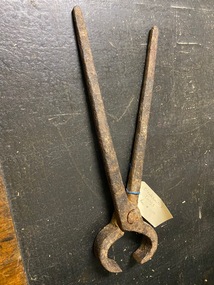
Tool - BLACKSMITH TONGS
... ...FORGED TOOL...BLACKSMITH TOOLS FORGED TOOL CAST IRON BLACKSMITH TONGS Tool BLACKSMITH TONGS ...CAST IRON BLACKSMITH TONGS blacksmith tools, forged tool -
 Federation University Historical Collection
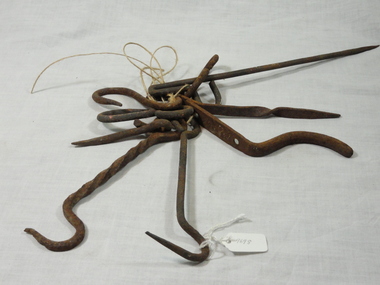
Object, Forged hooks and pegs
... A number of hand forged steel tools....These items were probably made at the Ballarat School of Mines. ballarat school of mines blacksmith forged forge A number of hand forged steel tools. Forged hooks and pegs Object ...The Ballarat School of Mines offered a course in blacksmithing. These items were probably made at the Ballarat School of Mines.A number of hand forged steel tools.ballarat school of mines, blacksmith, forged, forge -
 Melbourne Tram Museum
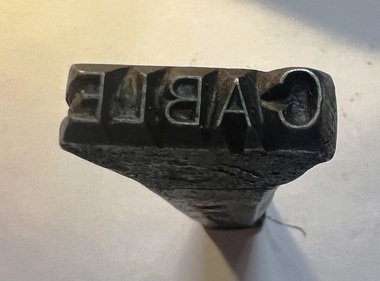
Tool - Name stamp or punch - "Cable", W Willis & Co
... Tool - forged steel and hardened to stamp the word "CABLE". ...Demonstrates a steel tool to stamp markings onto leather or other objects tools MTOCo stamps metal stamp tramways cable trams "Makers W Willis & Co, Collins St West Melbourne" stamped in on the sides. Tool - forged steel and hardened to stamp the word "CABLE". ...Manufactured tool for use by one of the Melbourne cable tram operators, most likely the Melbourne Tramway and Omnibus Co, to stamp leather satchels and other items that had to be marked. See item 7678 for a "RICHMOND" stamp. Was extensively used given the deformation at the top of the punch.Demonstrates a steel tool to stamp markings onto leather or other objectsTool - forged steel and hardened to stamp the word "CABLE". Has manufacturer's name and location on the sides stamped in,"Makers W Willis & Co, Collins St West Melbourne" stamped in on the sides.tools, mtoco, stamps, metal stamp, tramways, cable trams -
 Melbourne Tram Museum
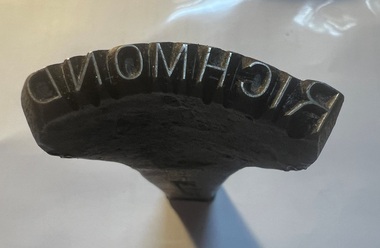
Tool - Name stamp or punch - "RICHMOND", W Willis & Co
... Tool - forged steel and hardened to stamp the word "RICHMOND". ...Demonstrates a steel tool to stamp markings onto leather or other objects tools MTOCo stamps metal stamp tramways cable trams "W Willis & Co, Melbourne" stamped in on the sides. Tool - forged steel and hardened to stamp the word "RICHMOND". ...Manufactured tool for use by one of the Melbourne cable tram operators, most likely the Melbourne Tramway and Omnibus Co, to stamp leather satchels and other items that had to be marked. See item 7677 for a "CABLE" stamp. Was extensively used given the deformation at the top of the punch.Demonstrates a steel tool to stamp markings onto leather or other objectsTool - forged steel and hardened to stamp the word "RICHMOND". Has manufacturer's name and location on the sides stamped in."W Willis & Co, Melbourne" stamped in on the sides.tools, mtoco, stamps, metal stamp, tramways, cable trams -
 Flagstaff Hill Maritime Museum and Village
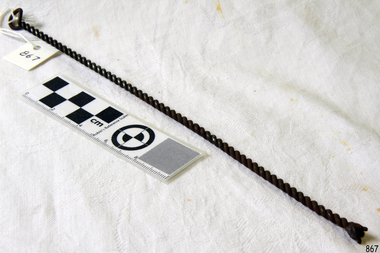
Tool - Stretching Hook
... Hand forged metal tool, possibly a sailmaker's hook with the hook broken. ...Hand forged metal tool, possibly a sailmaker's hook with the hook broken. ...Hand forged metal tool, possibly a sailmaker's hook with the hook broken. It may be a fire iron. The twisted metal is a skill learned by a blacksmith.The item is a handmade tool, an example of the work of a blacksmith. Smiths were sought after in colonial Australia. Their trade allowed them to custom make work for the different industries necessary for survival in a new land.Sailmaker's stretching tool; long thin metal rod bent in half, with centre forming a handle or loop, and long ends twisted together to form a stem. The loose ends are formed together but appear broken.warrnambool, shipwreck coast, flagstaff hill, flagstaff hill maritime museum, flagstaff hill maritime village, tool, sailmaker's tool, fire iron, blacksmith, twisted rod, twisted wire, sailmaker's hook -
 Phillip Island and District Historical Society Inc.
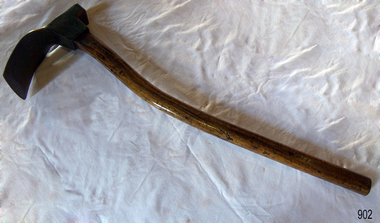
Chicory Devil, 1870's approximate
... Hand forged Iron Tool for chicory harvesting by hand. 1050mm long with a blade 370mm x 50mm sharpened at the end. ...Chicory Devil made by Dinny Justice who was a Blacksmith on Phillip Island. local history rural industry horticulture chicory devil Hand forged Iron Tool for chicory harvesting by hand. 1050mm long with a blade 370mm x 50mm sharpened at the end. ...Chicory Devil made by Dinny Justice who was a Blacksmith on Phillip Island.Hand forged Iron Tool for chicory harvesting by hand. 1050mm long with a blade 370mm x 50mm sharpened at the end. Footrest protruding 90mm - 100mm each side of the shaft at the top of the blade. Handle loop at top of shaft 130mm x 77mm.local history, rural industry, horticulture, chicory devil -
 Flagstaff Hill Maritime Museum and Village
Tool - Adze, Ward & Payne Ltd, Between 1843 to Mid 20th Century
... The subject item was made by Ward & Payne of the Limbrick Works at Hillsborough, Sheffield England manufacturers of hand-forged tools. Their trademark registered in 1850 was a Letter "W" & "P" stamped into the steel. ...The subject item was made by Ward & Payne of the Limbrick Works at Hillsborough, Sheffield England manufacturers of hand-forged tools. Their trademark registered in 1850 was a Letter "W" & "P" stamped into the steel. ...An adze is an ancient and versatile cutting tool and has been in use for thousands of years. Adze are similar to an axe but with the cutting edge perpendicular to the handle rather than parallel. They have been used since the Stone Age. Adzes are hand tools used for smoothing or carving wood. The subject item was made by Ward & Payne of the Limbrick Works at Hillsborough, Sheffield England manufacturers of hand-forged tools. Their trademark registered in 1850 was a Letter "W" & "P" stamped into the steel. The firm was established by David Ward (1767-1822) in 1803 the company became David Ward & Sons, in 1837 after Ward's son Edward joined the firm. In 1845 Henry Payne the founder's son-in-law became a partner but died in 1850 after which the company reverted to the Ward family. The business then concentrated on making carving tools, chisels and gouges. In 1882 David Ward's grandson David Ward Jr. (1835-1889) purchased land and built a factory at Sheffield North known as the "Limerick Wheel". For a time Wards operated from both 106-114 West Street Sheffield and at Limbrick Road, Hillsborough on the river Loxley. By 1911 they had expanded into making spades, forks, sheep shears and many other types of edged tools including drills and wood planes. In 1967 Wilkinson Sword purchased all the company's share capital and continued to sell Ward & Payne tools until 1970 when a fire burned the factory down and housing development was built on the site.The subject item is significant as it gives a snapshot of the technological development of sailing ships and their operation before steam-powered vessels took over around the world. Tools such as the subject item demonstrate the traditional craftsmanship and skill of the shipwright and the aesthetic quality of the timber ships designs of the time. Adze with wooden handle curved painted green with patent number and maker's name inscribed on inside curve of blade. Inscribed "Patd 561 Ward" "2w". flagstaff hill, warrnambool, flagstaff-hill, flagstaff-hill-maritime-museum, maritime-museum, shipwreck-coast, flagstaff-hill-maritime-village, smoothing tool, hand tool, carpenders tool, adze, coopers tool, woodworking tools -
City of Moorabbin Historical Society (Operating the Box Cottage Museum)
Tools, spanner, Garrington 'Magpie' c1950, c1950
... tools, pistols, coach parts, military harness, nuts and bolts . In 1879 the business moved to Albert Works in Willenhall Road. 1912 the business was sold to F.W.Cotterill, a local nut and bolt manufacturer. F.W.Cotterill and consequently Garrington's was purchased in 1919 by G.K.N. (originally Guest, Keen and Nettlefolds). 1926 they were producing drop forged...tools, pistols, coach parts, military harness, nuts and bolts . In 1879 the business moved to Albert Works in Willenhall Road. 1912 the business was sold to F.W.Cotterill, a local nut and bolt manufacturer. F.W.Cotterill and consequently Garrington's was purchased in 1919 by G.K.N. (originally Guest, Keen and Nettlefolds). 1926 they were producing drop forged ...John Garrington & Sons was founded 1837 in London as a company producing iron and steel tools, pistols, coach parts, military harness, nuts and bolts . In 1879 the business moved to Albert Works in Willenhall Road. 1912 the business was sold to F.W.Cotterill, a local nut and bolt manufacturer. F.W.Cotterill and consequently Garrington's was purchased in 1919 by G.K.N. (originally Guest, Keen and Nettlefolds). 1926 they were producing drop forged automobile tools, spanners and in 1947 'lightweight high tensile carbon steel' 'Magpie" automobile spanner. They had a lot of products named after birds. Early settlers were reliant on the draught horse and wagon but by the 1930's Vulcan trucks transported the produce to market and post war settlers in the Moorabbin Estates gradually purchased cars (automobiles) for transport and pleasure.This Garrington Tools Pty Ltd automobile spanner is typical of the type used by automobile mechanics in Moorabbin c1950A large high tensile carbon steel spanner c1950 for use in automobile repair and manufacture.GARRINGTON 'MAGPIE' tools, garrington tool company england, post world war 11 estates, moorabbin , automobile tools, automotive parts, jaguar cars pty ltd, early settlers, market gardeners, blacksmiths, tools, building equipment, moorabbin shire, bentleigh, mckinnon, highett, cheltenham,mcewan james pty ltd, melbourne, bunnings pty ltd, -
 Mont De Lancey
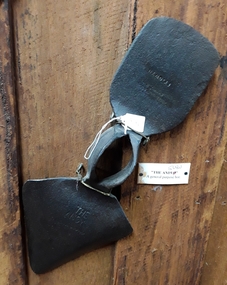
Tool - Hoe, Cornelius Whitehouse & Sons, Unknown
... 'THE ANDYO' registered Hedgehog Tool. A forged steel head of a general purpose hoe with one side of the blade used as a hoe and the other pointed side possibly used to dig small furrows. ...'THE ANDYO' registered Hedgehog Tool. A forged steel head of a general purpose hoe with one side of the blade used as a hoe and the other pointed side possibly used to dig small furrows. ...Used in the 19th Century'THE ANDYO' registered Hedgehog Tool. A forged steel head of a general purpose hoe with one side of the blade used as a hoe and the other pointed side possibly used to dig small furrows. It was made by Cornelius Whitehouse & Sons at Cannock Edge Tool Works - Branded Whitehouse & Sons. It was used in the 19th century.'THE ANDYO' is stamped on the pointed blade. On the hoe blade is stamped - Whitehouse & Sons CANNOCK. 'TY GWYN. agricultural tools, hoes, gardening tools, gardening hoes, steel -
 Flagstaff Hill Maritime Museum and Village
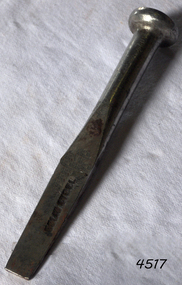
Tool - Caulking Tool, Ward & Payne Ltd, Late 19th century
... The subject item was made by Ward & Payne of the Limbrick Works at Hillsborough, Sheffield England manufacturers of hand-forged tools. Their trademark registered in 1850 was a Letter "W" & "P" stamped into the steel. ...The subject item was made by Ward & Payne of the Limbrick Works at Hillsborough, Sheffield England manufacturers of hand-forged tools. Their trademark registered in 1850 was a Letter "W" & "P" stamped into the steel. ...Caulking is the traditional technique used on wooden vessels built with butted or clinker-built planks to fill the gaps between these planks while still allowing the wood to flex and move. This involved driving the irons, hammered in with the mallet, deep into the seams to open them up. After this, spun yarn, oakum (hemp) or cotton was driven deep into the gaps. The hemp or cotton was soaked in creosote or pine tar to make the joins watertight. Caulking also played a structural role in tightening up the hull or deck by reducing the longitudinal movement of the neighbouring planks. The subject item was made by Ward & Payne of the Limbrick Works at Hillsborough, Sheffield England manufacturers of hand-forged tools. Their trademark registered in 1850 was a Letter "W" & "P" stamped into the steel. The firm was established by David Ward (1767-1822) in 1803 the company became David Ward & Sons, in 1837 after Ward's son Edward joined the firm. In 1845 Henry Payne the founder's son-in-law became a partner but died in 1850 after which the company reverted to the Ward family. The business then concentrated on making carving tools, chisels and gouges. In 1882 David Ward's grandson David Ward Jr. (1835-1889) purchased land and built a factory at Sheffield North known as the "Limerick Wheel". For a time Wards operated from both 106-114 West Street Sheffield and at Limbrick Road, Hillsborough on the river Loxley. By 1911 they had expanded into making spades, forks, sheep shears and many other types of edged tools including drills and wood planes. In 1967 Wilkinson Sword purchased all the company's share capital and continued to sell Ward & Payne tools until 1970 when a fire burned the factory down and housing development was built on the site. The subject item is significant as it gives a snapshot of the technological development of sailing ships and their operation before steam-powered vessels took over around the world. Tools such as the subject item demonstrate the traditional craftsmanship and skill of the shipwright and the aesthetic quality of the timber ships designs of the time. Caulking tool with square end"WARD Sheffield"flagstaff hill, warrnambool, flagstaff hill maritime museum, shipwreck coast, flagstaff hill maritime village, james s steele, caulking iron, caulking tool, shipwright tools, ward & payne sheffield, forged tools -
 Bendigo Historical Society Inc.
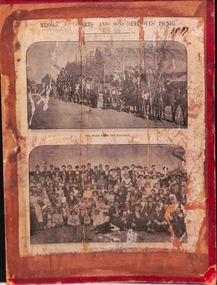
Photograph - Messrs A. Roberts and Sons Employees Picnic 1897, 1897
... Roberts arrived on Bendigo in 1853 with his family and engaged in gold-prospecting, then about 1861 opened the United Iron Works, a small engineering shop in Williamson Street, making forge and hand tools. With expansion the business moved to Mitchell Street, until by 1880 it absorbed an entire block covering three acres (1.2 ha) in the heart of the town and employed nearly two hundred men. ...Roberts arrived on Bendigo in 1853 with his family and engaged in gold-prospecting, then about 1861 opened the United Iron Works, a small engineering shop in Williamson Street, making forge and hand tools. With expansion the business moved to Mitchell Street, until by 1880 it absorbed an entire block covering three acres (1.2 ha) in the heart of the town and employed nearly two hundred men. ...Abraham Roberts (1819-1897), ironfounder, was born on 13 July 1819 in Cornwall, England, son of Abraham Roberts, blacksmith, and his wife Mary, née Pentreath. Nothing is known of his education and early training but it is likely that he served an engineering apprenticeship and worked in engineering workshops in Cornwall. Undoubtedly he observed much machinery among the tin mines of Cornwall and absorbed the principles of sound engineering design and high-grade workmanship, which bore fruit in his later years in Sandhurst (Bendigo). On 19 August 1841 he married Elizabeth Tonkin at the parish church at Paul, Cornwall. Roberts arrived on Bendigo in 1853 with his family and engaged in gold-prospecting, then about 1861 opened the United Iron Works, a small engineering shop in Williamson Street, making forge and hand tools. With expansion the business moved to Mitchell Street, until by 1880 it absorbed an entire block covering three acres (1.2 ha) in the heart of the town and employed nearly two hundred men. Three of his sons, William, Abraham and Arthur, helped to run A. Roberts & Sons. As well as being a skilful and enterprising engineer, Roberts was a shrewd businessman, who anticipated that the market for machinery on the local goldfields would diminish, and widened the sphere of his activities accordingly. Though the requirements of the mining industry maintained the firm, no class of foundry work was ignored. Roberts secured orders for machinery for the two major Broken Hill mines and built steam winding engines for several Western Australian mines, as well as undertaking orders for machinery in South Africa and New Zealand. He introduced poppet-heads constructed of steel to the Bendigo goldfield and the 105-head stamp battery for Lansell's Big Blue mine was the largest quartz-crushing battery in Australia at that time. The pair of steam winding engines built by his works for the Hustler's Royal Reserve Co. were the largest on the Bendigo field. The company also carried out steamship repairs, bridgework and many important railway contracts and in 1891 supplied the largest outlet valves in Victoria at Laanecoorie weir.Two photographs in black and white of the picnic for employees of Messrs A. Roberts and Sons in 1897. Photographs are mounted on piece of red cardboard. A. Roberts and Sons owned a foundry that was established in 1865. The event was noted in the Bendigo Advertiser on 18 March 1901.'1897' in ink top right hand corner.bendigo, foundry, roberts and sons, picnic, 1897 -
 Flagstaff Hill Maritime Museum and Village
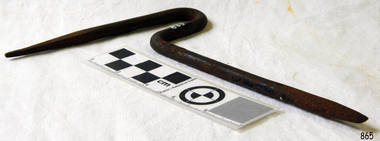
Tool - Spliceing Tool
... This splicing tool is handmade on a forge. It is used for splicing in fibre and wire rope work to form a semi-permanent joint between two ropes, or parts of the same rope or steel cable. ...This splicing tool is handmade on a forge. It is used for splicing in fibre and wire rope work to form a semi-permanent joint between two ropes, or parts of the same rope or steel cable. ...This splicing tool is handmade on a forge. It is used for splicing in fibre and wire rope work to form a semi-permanent joint between two ropes, or parts of the same rope or steel cable. The rope is partly untwisted and then the strands are interwoven. Splices can be used to form a stopper at the end of a line, to form a loop or an eye in a rope, or to join two ropes together. Splices are preferred to knotted rope; a knot typically can reduce the strength by 20–40%, but a splice is capable of attaining a rope's full strength. This homemade, handmade splicer is an example of a tool used to splice a cable or rope, a craft that was in much need onboard a sailing ship. Splicing tool; a spike on one end and a flat blade on the other, with goose-neck centre for leverage. Handmade.warrnambool, shipwreck coast, flagstaff hill, flagstaff hill maritime museum, flagstaff hill maritime village, splicing tool, rope work, rope strands, knot making, netting, net making, sailmaker's tool -
 Flagstaff Hill Maritime Museum and Village
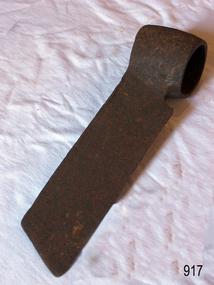
Tool - Froe, Late 19th to Early 20th century
... forged, but they were also available in many catalogues. The 1873 D.R. Barton American catalogue offered straight froes at 12 1/2 cents per inch. You can still buy new froes from many tool...forged, but they were also available in many catalogues. The 1873 D.R. Barton American catalogue offered straight froes at 12 1/2 cents per inch. You can still buy new froes from many tool ...A froe was used for splitting, or riving, wood in the early days and was a skill practiced by craftsmen who made boards, shingles, c lapboards, fences, basket splints, chair parts, wagon spokes, lath, and more. Our ancestors used axes, gluts or wedges, froes, draw knives and spelk planes for splitting wood. The froe was designed in many sizes and designs for splitting timber. It is typically an L-shaped tool made up of a wedge-shaped blade with a dull, but not blunt, knife edge and a wood handle. Blades were usually straight with a socket forged at one end for a handle, but curved blades were also made. Most handles were round and tapered and were inserted up through this socket. But some froes had eyes similar to those on axes for handles that were wedged. The froe handle is held in an upright position in one hand while the other hand drives the top of the blade downward with a wood froe club or mallet. After a split is started, the froe is wiggled downward to lengthen it until the split is complete. Most old froes were hand forged, but they were also available in many catalogues. The 1873 D.R. Barton American catalogue offered straight froes at 12 1/2 cents per inch. You can still buy new froes from many tool manufacturers today.A tool that has not changed in design or use since its inception several hundred years ago to split timber for various uses.Froe, also called cooper's froe or stave froe, without handle.Noneflagstaff hill, warrnambool, flagstaff-hill, flagstaff-hill-maritime-museum, maritime-museum, shipwreck-coast, flagstaff-hill-maritime-village, froe, cooper's froe, stave froe, wood splitter, carpenders tools, coopers tool, splitting timber -
 Flagstaff Hill Maritime Museum and Village
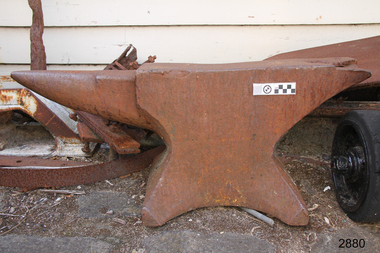
Anvil, early to mid-1900s
... forge and shape his work pieces. The conical horn is used for hammering curved work pieces. The anvil is a common tool of the blacksmiths (‘smithies’) and other metalworkers. ...forge and shape his work pieces. The conical horn is used for hammering curved work pieces. The anvil is a common tool of the blacksmiths (‘smithies’) and other metalworkers. ...This anvil once belonged to Goodall and Sons, who were blacksmiths in Terang. The smith was called upon to do a variety of work. In the early 1900s he was often the nearest person to be able to perform an engineer’s services for many miles around. An anvil is used by blacksmiths to forge and shape his work pieces. The conical horn is used for hammering curved work pieces. The anvil is a common tool of the blacksmiths (‘smithies’) and other metalworkers. There has been very little change in the basic design of the anvil since Greek and Roman times. Henry Goodall (1870-1936) Henry Goodall was proprietor of garages as H. Goodall & Sons Pty. Ltd., at both Terang (McKinnon and High Streets) and Mortlake (Dunlop Street). His business was in operation in at least in 1916 and perhaps well before, considering the date of the tyre bender and its use for wagons with wooden wheels. It was still in operation in 1953, chasing up debtors in Mount Gambier Court. Amongst the employees of H. Goodall & Sons Pty. Ltd. was Ernie Entwistle, a blacksmith (a soldier who died in 1916 ) and Alfred Hodgetts, radio expert (killed in a fatal accident in 1943, when he was in his early 30s ). Henry Goodall was involved in the community as a Justice of Peace, a deputy coroner, President of the Mortlake Hospital, trustee of the Soldiers’ Memorial Hall, and as a prominent Freemason. He and his wife had two sons (Charles and John) and one daughter (Mrs. Chas. Newton, of Skipton). The anvil is locally significant as it was used by a local company in Terang and Mortlake in their blacksmith, wheelwright and garage business. It is an example of the tools of the blacksmiths’ trade in Victoria in the early to mid-1900s. Anvil, single horn, used as a tool by blacksmiths and metalworkers. Large block of metal with a flat top face, a conical horn on one side and a ‘v’ shape on the other. The anvil’s base has a squat stand and sides that are a variety of shapes. This anvil once belonged to Harry Goodall & Sons, blacksmiths of Terang. C. early to mid-1900s.flagstaff hill, warrnambool, shipwrecked-coast, flagstaff-hill, flagstaff-hill-maritime-museum, maritime-museum, shipwreck-coast, flagstaff-hill-maritime-village, h. goodall & sons of terang, terang blacksmith, h. goodall & sons pty ltd, mortlake, ernie entwistle blacksmith, alfred hodgetts radio expert, charles goodall, john goodall, mrs. chas. newton nee goodall, trade tools, blacksmith tools, metalworking tool, forging tool, terang 1900s, warrnambool district 1900s, anvil, blacksmith’s anvil, single horn anvil -
 Flagstaff Hill Maritime Museum and Village
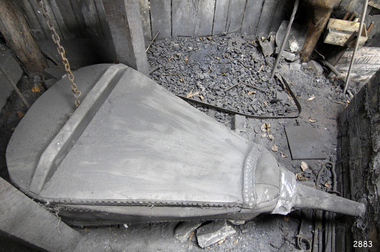
Functional object - Bellows, 1862-1875
... forges. In 1871 there were eight employees. John C. Onions Limited became a registered company in 1875. In 1876 an advertisements included that the company were smiths for hearths and tools in general and showed a row of six medallions including one with “Napoleon III, Emperor” and his portrait, and another “ _ _ _ 1862 MEDAL”. ...forges. In 1871 there were eight employees. John C. Onions Limited became a registered company in 1875. In 1876 an advertisements included that the company were smiths for hearths and tools in general and showed a row of six medallions including one with “Napoleon III, Emperor” and his portrait, and another “ _ _ _ 1862 MEDAL”. ...This bellows was used at the Warrnambool Racecourse by Master Farrier, Brian Chapman (1931-2017), during the 1970s but its history before then is still being investigated. The bellows have continued to be used from 1978 at Flagstaff Hill's blacksmith's workshop. Even today, in 2021, this same bellows are used by a volunteer blacksmith as he demonstrate the skills and tells of the importance of the blacksmith trade to colonial Australia. This 1860s double-action bellows is a typical form of blacksmith's or shipsmith's bellows. The end is forge-fitted with an iron nozzle or tube, called a tuyere or Tue iron, which concentrates the air to fan the fire or furnace. Tuyeres were traditionally made of cow horn. The double-action design of this bellows efficiently moves air both in and out of the chambers in the one movement of the long handle. The bellows was manufactured by John C. Onions of Birmingham, England, between 1862 and 1875. The stamp with the text, Gold Medal 1862, was also used on the business’ advertising. In 1875 the company was registered and began using the name John C. Onions Limited. JOHN C. ONIONS - John C. (Collingwood) Onions (1841-1904) was the son of a bellows maker of the same name. Onions (born 1841) and his wife Helen married in 1867 and they named one of their children John Collingwood Onions (1868-1913), as was the family tradition. He was well known as a Birmingham manufacturer of patented bellows and other forge-related equipment. He sold to the wholesale and retail markets for both local and overseas customers, including the British colonies. An 1862 advertisement points out that John C. Onions was a “Bellows manufacturer and contractor to Her Majesty’s Honourable Board of Ordinance” and His Imperial Majesty the Emperor of the French [Napoleon Bonaparte]”. The advertisement includes a sketched portrait of the Emperor Napoleon III, and an Imperial Autograph Letter dated May 23, 1854, from Napoleon, Palace of the Tulleries to Mr J C Onions of Bradford Street, Birmingham. In 1863 the company registered a patent on portable forges. In 1871 there were eight employees. John C. Onions Limited became a registered company in 1875. In 1876 an advertisements included that the company were smiths for hearths and tools in general and showed a row of six medallions including one with “Napoleon III, Emperor” and his portrait, and another “ _ _ _ 1862 MEDAL”. Their advertising motto was “For Excellence of Quality”. In 1885 the company merged with William Allday and Sons to become Allday and Onions. This mid-19th century bellows has local historical significance as it were once used by blacksmiths at the Warrnambool Racecourse in the annual racing event that continues today. This bellows is significant as a working example of equipment used in the 1800 and 1900s in the trace of blacksmiths and other metal working smiths. The bellows is technologically significant as it shows the progress from simple bellows to the double-action bellows, a time saving and efficient improvement. The manufacturer John C. Onions is historically significant as a family business that began in the 1600s and continued up until the 1980s.Bellows; large, oval, mechanical double-action smith’s bellows, manually operated, in working condition. The paddles of wood that form the top, middle sections and base of the bellows have flexible leather pieces attached firmly between them, forming airtight double lungs. Cut-outs in the panels allow the bellows to fill with air then force it out. A long handle is connected to pump the bellows and control the quantity and force of the air. The blasts of air are forced through the metal nozzle or tuyere at the end of the bellows and into the forge’s fire. Inscriptions are impressed into the wood on the upper paddle or board of the bellows. There are three circular stamps containing text. Text impressed in the wooden upper paddle of the bellows has been assumed to read “JOHN C. ONIONS, PATENTEES & MANUFACTURERS, BIRMINGHAM””?” “EXTRA” “AWARDED FOR EXCELLENCE OF QUALITY”, made from the following readable text :- “JOHN C ONIONS“ “PATENT - - - & MAN - - - - - - - - -“, “BIR - - - - HAM“, “ _ ERA - - - - “- XTRA-“, “- - - - - - - FOR EXCELL-“ “OF - - - - ITY” Text in the stamp “ - - ECE - - “, “ - - - - - / 1862 / MEDAL”, “- ITY” flagstaff hill, warrnambool, shipwrecked-coast, flagstaff-hill, flagstaff-hill-maritime-museum, maritime-museum, shipwreck-coast, flagstaff-hill-maritime-village, john collingwood onions, john c onions, allday and onions, bellows, smith’s bellows, 19th century bellows, double-action bellows, double-acting bellows, double lung bellows, double chamber bellows, blacksmith tools, blacksmith trade, blacksmith craft, blacksmith equipment, forging equipment, john c onions patented double-action bellows, brian chapman, warrnambool racecourse, blacksmith, shipsmith, iron smith, mechanical bellows -
 Flagstaff Hill Maritime Museum and Village
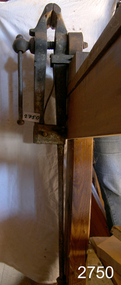
Tool - Leg Vice, Mid 19th Century
... tool that can take decades of heavy use and abuse. Most in use is one to two hundred years old.Some of these vises were made by specialists such as Atwood of Stourbridge England, Steel City and Columbian in the U.S. and others were made in anvil manufacturing plants such as "Mousehole Forge" and "Peter Wright" in England and "Fisher-Norris" and others in North America. ...tool that can take decades of heavy use and abuse. Most in use is one to two hundred years old.Some of these vises were made by specialists such as Atwood of Stourbridge England, Steel City and Columbian in the U.S. and others were made in anvil manufacturing plants such as "Mousehole Forge" and "Peter Wright" in England and "Fisher-Norris" and others in North America. ...The blacksmith leg vise is also called the "solid box vise" and is one of the most important tools in the blacksmith's shop. It firmly holds hot iron while it is hammered, chiseled, or twisted. These are the only vises that are designed to take this kind of use day in and day out. A small 30-pound blacksmith's vise can survive pounding that would wreck a much heavier cast iron bench model. Three things make a blacksmith's vice special. One is that they are forgings, not cast iron or ductile iron. The second is the leg that provides support to the floor or from a sunken post. The last is the hinge, while not a perfect way to construct a vice the pin joint is durable and can take a considerable beating. If sheared it is easy to replace. These things all combine into a tool that can take decades of heavy use and abuse. Most in use is one to two hundred years old.Some of these vises were made by specialists such as Atwood of Stourbridge England, Steel City and Columbian in the U.S. and others were made in anvil manufacturing plants such as "Mousehole Forge" and "Peter Wright" in England and "Fisher-Norris" and others in North America. The design of these vises right down to the last chamfer seems to have been perfected in the 1600s and remained more or less the same until the 20th century. The bodies are forged wrought iron or mild steel and they have hard steel surfaces welded into the jaws. The jaws have little or very shallow serrations which are generally worn off.Around the turn of the 20th Century during the hey-day of the blacksmith shop in North America, these tools were considered so standard a commodity that they were sold without reference to the manufacturer. Very few were even marked with the maker's name. Size is best defined by weight as there is some variation in jaw size from manufacturer to manufacturer. They were sold by the pound and are still best judged by the pound.A vintage tool used in a Blacksmiths shop during the early 19th century to the beginning of the 20th century. Regarded as a significant into social history of the time.Leg Vice attached with screws to bench via a block of wood. Has large metal pole which practically reaches the floor. Also has a metal device to either tighten or slacken vice.flagstaff hill, warrnambool, shipwrecked-coast, flagstaff-hill, flagstaff-hill-maritime-museum, maritime-museum, shipwreck-coast, flagstaff-hill-maritime-village -
 Flagstaff Hill Maritime Museum and Village
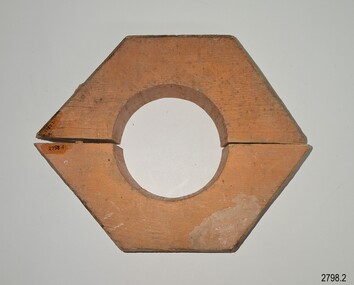
Equipment - Pattern, Briggs Brass Foundry, Early 20th century
... forged strong connections with fishermen and businesses. This not only reinforced their reputation as skilled manufacturers but also highlighted their commitment to community engagement and support. Flagstaff Hill Flagstaff Hill Maritime Museum and Village Warrnambool Maritime Museum Maritime Village Great Ocean Road Shipwreck Coast Briggs' Bronze trade sand cast cast brass alloy copper alloy pattern mould foundry brass foundry metal foundry casting sand mould sand casting marine equipment Marine Tools marine fittings copper tin zinc lead non-ferrous non-corrosive brassware metalware foundering metalwork maritime bell founders Ship chandlers marine products Briggs family Herbert Harrison Briggs H H Briggs George Edward Briggs Cyril Falkiner McKinnon Briggs Cyril Briggs Briggs & Son Brass Foundry H H Briggs & Sons Foundry Briggs Marine Alliance Casting & Engineering Solutions Grassmere Cheese Factory Cornish chimney curved bricks Collingwood Moorabbin Collingwood Foundry Moorabbin Foundry 1912 Briggs Briggs Brass Foundry Briggs Marine Foundry Briggs Marine Products Frank Lee Les Lee Eva Lee Briggs Marine Warrnambool non-ferrous founders bell specialists ship bell specialists founders traditional send casting Pattern; hexagonal wooden shape painted orange. ...The wooden pattern forms part of a larger collection, securely stored within a durable wooden crate. This pattern was an essential tool at Briggs’ Brass Foundry, specifically designed for creating sand casts. Sand casting is a time-honoured technique, with a history exceeding 2,000 years. The handcrafted nature of this process results in the production of brass and copper alloy items, which are particularly suitable for maritime applications. Typical products include bells, boat hooks, cowls, propellers, handles, lids, rowlocks, hooks, letters, bolts, rail holders, brackets, deck plates, flanges, rudder guides, portholes and covers. The distinctive bronze mixture used at Briggs’ Foundry is copper-based, composed of local ingots of copper, tin, zinc and lead, blended in precisely measured quantities. The resulting alloy is non-ferrous, known for its exceptional durability and longevity. In the early years of Flagstaff Hill, the Briggs family generously donated the crate of patterns along with other related items such as brassware, tools and machinery. These items were prominently displayed in a simulated Brass Foundry within the Village, alongside other working crafts, trades and services typical of a maritime town. From the completion of the building in 1986 until its repurposing in 1994, visitors could view these items and gain insight into the foundering and metalwork trades that supported maritime industries, including shipwrights and boatbuilders. The castings produced at the foundry were also vital for farmers, manufacturers and other local industries. The Brass Foundry display featured a historic Cornish chimney, constructed as a working model to illustrate the process of smelting metal in furnaces and pouring it into sand moulds. The chimney, crafted from specially curved bricks, currently stands at approximately two-thirds of its original height, having previously been located at the Grassmere Cheese factory. The craft of sand-casting, which utilises intricately carved wooden patterns to create metal objects, stands as a testament to the enduring value of traditional skills. This age-old technique remains relevant today, linking past craftsmanship to ongoing industrial practices. The foundry pattern set holds particular significance due to its strong associations with brass foundries, both locally and in coastal regions across Victoria. In these areas, marine industries such as ship and boat building have long depended on high-quality metal castings for the machinery, equipment, and fittings essential to their operations. The alloys formulated by Briggs Brass Foundry, crafted from non-ferrous metals, were specifically designed to provide superior longevity and durability in maritime environments. These patterns are closely tied to the history of the Briggs Brass Foundry, a respected and long-running company that specialised in producing cast goods for the marine sector. The foundry was equipped to supply both unique, one-off items and mass-produced components, ensuring that its products found their way onto a variety of sail and steam vessels along the Victorian coast, including in Warrnambool. In addition to its broader marine applications, Briggs Brass Foundry established itself as a bell-founder specialist. The company’s expertise is notably linked to the historic Schomberg Bell at Flagstaff Hill, which they restored to its original splendour as a fine example of a bell from a luxury migrant ship of the mid-19th century. The significance of the pattern set is further heightened by its association with Briggs Brass Founders, a firm established in the early 20th century and widely recognised for its proficiency in producing, repairing, and restoring ship bells and other marine equipment. Renowned for their non-ferrous metal casting, Briggs Brass Founders consistently supplied high-quality fittings and equipment vital to maritime pursuits. Moreover, the company expanded its influence by opening a branch in Warrnambool. Through this local presence, Briggs Brass Founders supported the regional marine industry and forged strong connections with fishermen and businesses. This not only reinforced their reputation as skilled manufacturers but also highlighted their commitment to community engagement and support. Pattern; hexagonal wooden shape painted orange. The thick carved wooden shape is in halves forming a hole when locked together with the dowel pegs and opposing drilled holes. The pattern is part of a set of foundry patterns from Briggs Brass Foundry.flagstaff hill, flagstaff hill maritime museum and village, warrnambool, maritime museum, maritime village, great ocean road, shipwreck coast, briggs' bronze, trade, sand cast, cast, brass alloy, copper alloy, pattern, mould, foundry, brass foundry, metal foundry, casting, sand mould, sand casting, marine equipment, marine tools, marine fittings, copper tin zinc lead, non-ferrous, non-corrosive, brassware, metalware, foundering, metalwork, maritime, bell founders, ship chandlers, marine products, briggs family, herbert harrison briggs, h h briggs, george edward briggs, cyril falkiner mckinnon briggs, cyril briggs, briggs & son brass foundry, h h briggs & sons foundry, briggs marine, alliance casting & engineering solutions, grassmere cheese factory, cornish chimney, curved bricks, collingwood, moorabbin, collingwood foundry, moorabbin foundry, 1912, briggs, briggs brass foundry, briggs marine foundry, briggs marine products, frank lee, les lee, eva lee, briggs marine warrnambool, non-ferrous founders, bell specialists, ship bell specialists, founders, traditional send casting -
 Federation University Historical Collection
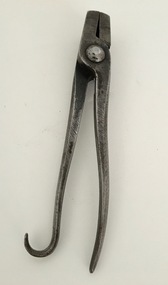
Tool, Blacksmith Tongs
... forge Metal stricker's Forging and Blacksmith tongs. Strong metal jaws to hold and move metal during processing. Hook at end on one handle to assist control. Blacksmith Tongs Tool ...Probably used in Ballarat School of Mines blacksmithing classesMetal stricker's Forging and Blacksmith tongs. Strong metal jaws to hold and move metal during processing. Hook at end on one handle to assist control. ballarat school of mines, blacksmith, forge -
 Flagstaff Hill Maritime Museum and Village
Tool - Broad Axe, Mid-20th century
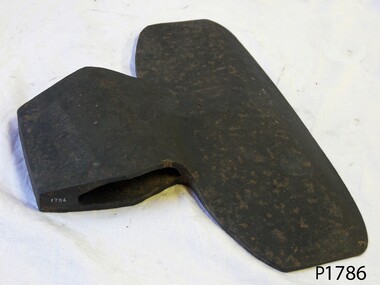
... Warrnambool Shipwreck Coast Flagstaff Hill Flagstaff Hill Maritime Museum Flagstaff Hill Maritime Village hewing axe timber working tool forestry axe head braod axe lumber building handmade forged iron steel Broad axe head; handmade. ...A double-bevelled broad axe can be used for chopping or notching and hewing. When used for hewing, a notch is chopped in the side of the log down to a marked line, called scoring. The pieces of wood between these notches are removed with an axe, called juggling, and then the remaining wood is chopped away to the line. Broad axe head; handmade. A metal, T-shaped axe head, double-bevelled, with a formed slot for adding a wooden handle. The shape is common; a Canadian pattern. warrnambool, shipwreck coast, flagstaff hill, flagstaff hill maritime museum, flagstaff hill maritime village, hewing axe, timber working tool, forestry, axe head, braod axe, lumber, building, handmade, forged, iron, steel -
 Flagstaff Hill Maritime Museum and Village
Tool - Wrench, Late 19th Century
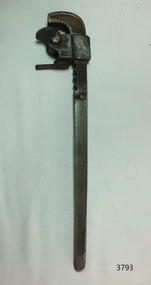
... The item is giving a snapshot of early colonial and European trades persons tools and gives an interesting insight into the development and progression of European tool and steel development and innervation prior to the First World War. manufactures tools engineering blacksmith workshop tool dropforged handmade wrench adjustable wrench phoenix steel j e bleckmann solingen murzzuschlag steel mill cutlery steel foundery Machine stamped on handle of wrench LOTUS L R GEBRAUCHS under has MUNSTER, J E BLECKMANN, SOLINGEN Germany. [ Translated: LR Gebrauchs= use,usage, or custom application] [Lotos] Translated: Lotus ie flower] [Solingen =town in Rhine valley] Drop hand forged steel wrench with unusual locking mechanism to size jaw opening made by J E Bleckmann, Solingen Germany. ...Johann Elias Bleckmann (1784-1856) founded a steel goods shop in Ronsdorf near Dusseldorf Germany. After completing a business education in his father's business, his son Johann Heinrich August Bleckmann (1826-1891) gained further experience through travel in North and South America. When his father died, he took over the steel goods store and moved it to Solingen. He bought a hammer mill in Mürzzuschlag Styria (Austria) in 1862 and converted it into a modern crucible casting steel smelter. His "Phoenix Steel", which he produced himself, achieved worldwide renown. He then went on to establish a file and tool factory and later founded a steel and plate rolling mill. Apart from cutlery blades, the company's self-produced steel was also processed into tools, scythes, rifle parts, etc. His sons Eugen and Walter continued after his death in 1891 at the Phoenix steelworks. However, by the end of the First World War, the two brothers fell into economic difficulties as a result of eliminating a large part of their foreign trade. In 1921, the company was converted into a public limited company and merged three years later with the company Schoeller & Stahlwerke. Made by Bleckmanns a significant Austrian manufacture of cutlery and tools in a recognized area of Germany famous for the production of steel items. The item is giving a snapshot of early colonial and European trades persons tools and gives an interesting insight into the development and progression of European tool and steel development and innervation prior to the First World War.Drop hand forged steel wrench with unusual locking mechanism to size jaw opening made by J E Bleckmann, Solingen Germany.Machine stamped on handle of wrench LOTUS L R GEBRAUCHS under has MUNSTER, J E BLECKMANN, SOLINGEN Germany. [ Translated: LR Gebrauchs= use,usage, or custom application] [Lotos] Translated: Lotus ie flower] [Solingen =town in Rhine valley]manufactures, tools, engineering, blacksmith, workshop tool, dropforged, handmade, wrench, adjustable wrench, phoenix steel, j e bleckmann, solingen, murzzuschlag, steel mill, cutlery, steel foundery -
 City of Moorabbin Historical Society (Operating the Box Cottage Museum)
Tool - Gold-miner's Pick, Ballarat c 1920, c1920
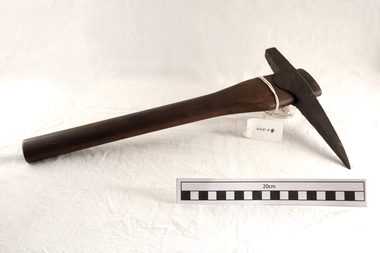
... Some were successful , most were not and retuned again to the hard life of farming. gold mining ballarat bendigo early settlers market gardeners moorabbin bentleigh mining equipment gold rush immigrants blacksmiths forges tools A forged steel pick with a wooden handle. ...This gold miner's pick from the Ballarat Goldfields c 1920 was donated by Mr David Hopcraft, a dealer at the Arkuna Market Berwick, Victoria in December 2010. When Gold was discovered in Victoria c1853 most of the labourers and some landowners left the market gardens and farms to try their luck on the goldfields. Local Blacksmiths made picks similar to this one for them. There was a great shortage of labour in Melbourne and at the same time, due to the huge influx of people lured by the Gold, there was an increased demand for food. The market gardeners were getting very good prices for their produce and many increased their wealth considerably and many of these tenant farmers were able to purchase their blocks of land and live a profitable life. There was such a shortage of labour that J.B.Were applied for Irish immigrants to work the farms. This pick is an example of the hand made tools many pioneers took with them when they abandoned their farms and market gardens in the District of Brighton to try their luck at prospecting when gold was discovered in Ballarat and Bendigo c1853. Some were successful , most were not and retuned again to the hard life of farming. A forged steel pick with a wooden handle. The steel pick-head was hand-forged by a blacksmith. This miner's pick was used on the Ballarat gold-fields c1920gold mining, ballarat, bendigo, early settlers, market gardeners, moorabbin, bentleigh, mining equipment, gold rush, immigrants, blacksmiths, forges, tools -
 City of Moorabbin Historical Society (Operating the Box Cottage Museum)
Tool - Tools, Blacksmith's leg vice, c1900
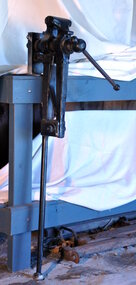
... A Blacksmith was an essential person for the maintenance and making of farm and household equipment, and shoeing horses, in the pioneer settlements of Brighton, Moorabbin, Cheltenham c1900 blacksmith vise moorabbin bentleigh brighton market gardeners forges tools early settlers pioneers ploughs carts horse-drawn anvils Blacksmith's 'leg' vice. ...The Blacksmith could take this portable 'leg vice' and make repairs away from his forge.He could mend wheel bands, tools, farm equipment and also fine tune generic sized horseshoes on site. He would build a fire and secure his leg vice to a stable point thus allowing him to work on any heated metal as required. A Blacksmith was an essential person for the maintenance and making of farm and household equipment, and shoeing horses, in the pioneer settlements of Brighton, Moorabbin, Cheltenham c1900Blacksmith's 'leg' vice. Sturdy blacksmith leg, post (vice). 15cm jawsblacksmith, vise, moorabbin, bentleigh, brighton, market gardeners, forges, tools, early settlers, pioneers, ploughs, carts horse-drawn, anvils -
 City of Moorabbin Historical Society (Operating the Box Cottage Museum)
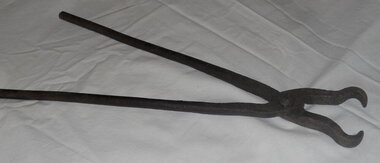
Tool - Tools, blacksmith's tongs, c1900
... Whilst each town's blacksmiths played an essential part in the colony of Victoria, the early settlers frequently had their own small forge and a few blacksmith's tools to attend to smaller day to day repairs. ...Large pair of forge-made blacksmith's tongs. Tool Tools, blacksmith's tongs Hand-made in forge by unknown blacksmith. ...Whilst each town's blacksmiths played an essential part in the colony of Victoria, the early settlers frequently had their own small forge and a few blacksmith's tools to attend to smaller day to day repairs. A long-handled pair of blacksmith tongs were essential for handling red-hot metal that was being repaired.As only a handful of settlers were present in the Moorabbin district from the 1840s. These early colonists were required to use their ingenuity and skill to undertake the "running repairs", including some basic blacksmithing, required around their property or leasehold.Circa 19th century. Large pair of forge-made blacksmith's tongs. Nilblacksmiths, forges, metalwork, craftwork, fireplaces, early settlers, pioneers, moorabbin, bentleigh, cheltenham, market gardeners colonists, 1840s -
Glenelg Shire Council Cultural Collection
Tool - Blacksmith Tongs, n.d
... Port of Portland Collection Port of Portland Blacksmith's tongs - hand forged, steel. Tool Blacksmith Tongs ...Port of Portland CollectionBlacksmith's tongs - hand forged, steel.port of portland -
Glenelg Shire Council Cultural Collection
Tool - Blacksmith Tongs, n.d
... forged, steel. Large tongs. Rusted. Tong ends - one side is wider than the other with curved sides. There is scratching and indents on the inside of this end. The other end has straight sides and is narrower. Tool ...Port of Portland CollectionBlacksmith's tongs, hand forged, steel. Large tongs. Rusted. Tong ends - one side is wider than the other with curved sides. There is scratching and indents on the inside of this end. The other end has straight sides and is narrower. port of portland -
Glenelg Shire Council Cultural Collection
Tool - Whaling Hook, n.d
... Whaling implement, iron hook painted black gloss, short section of replicated handle painted white. Cast / forged Tool Whaling Hook ...Whaling implement, iron hook painted black gloss, short section of replicated handle painted white. Cast / forged -
Glenelg Shire Council Cultural Collection
Tool - Blacksmith Tongs, n.d
... PORT OF PORTLAND COLLECTION Port of Portland trade industry blacksmith Blacksmith's tongs - hand forged Tool Blacksmith Tongs ...PORT OF PORTLAND COLLECTIONBlacksmith's tongs - hand forgedport of portland, trade, industry, blacksmith -
Glenelg Shire Council Cultural Collection
Tool - Blacksmith's Tongs, n.d
... Port of Portland Collection Blacksmith's tongs - forged, steel Tool Blacksmith's Tongs ...Port of Portland CollectionBlacksmith's tongs - forged, steel -
Glenelg Shire Council Cultural Collection
Tool - Blacksmith Tongs, n.d
... forged. Tong ends are curved away from eachother to create a circle with two flat curved clamp ends. Rusted. Tool ...PORT OF PORTLAND COLLECTIONBlacksmith's tongs, hand forged. Tong ends are curved away from eachother to create a circle with two flat curved clamp ends. Rusted.port of portland, blacksmith, tongs, trade, industry, metalwork -
Glenelg Shire Council Cultural Collection
Tool - Blacksmith's Tongs, n.d
... PORT OF PORTLAND COLLECTION Port of Portland blacksmith trade industry Blacksmith's tongs, hand forged, steel Tool Blacksmith's Tongs ...PORT OF PORTLAND COLLECTIONBlacksmith's tongs, hand forged, steelport of portland, blacksmith, trade, industry
