
Showing 28 items matching "free methodist church"
-
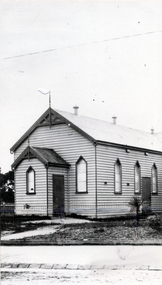 Whitehorse Historical Society Inc.
Photograph - Black & white photo, United Free Methodist Church
... United Free Methodist Church...united free methodist church...Black & white photo of United Free Methodist Church built in 1888 in Chapel Street. ...Used by donor in 'Blackburn - a picturesque history' united free methodist church chapel street blackburn blackburn methodists freehold investment and banking company of australia ltd Black & white photo of United Free Methodist Church built in 1888 in Chapel Street. ...Used by donor in 'Blackburn - a picturesque history'Black & white photo of United Free Methodist Church built in 1888 in Chapel Street. Re-sited in 1902 to cnr. Whitehorse Road and Melvin Street, Ringwood.|The United Free Methodist began working in Blackburn in Sept 1888, when an allotment was presented to church by Blackburn Company. (Freehold Investment and Banking Company).|Original Church built by Mr. Williams - cost 200 pounds.|First service held in 1890. Page 65 of De Costa Book.united free methodist church, chapel street blackburn, blackburn methodists, freehold investment and banking company of australia ltd -
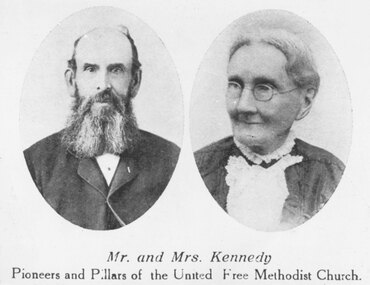 Ringwood and District Historical Society
Photograph, Mr. & Mrs. Kennedy - Pioneers and Pillars of the United Free Methodist Church. c1880's
... Kennedy - Pioneers and Pillars of the United Free Methodist Church. c1880's....Kennedy- Pioneers and Pillars of the United Free Methodist Church." ...Kennedy- Pioneers and Pillars of the United Free Methodist Church." Black and white photograph (2 copies). ...Black and white photograph (2 copies). Two oval portraits of man and woman. Appears to be taken from newspaper. Caption beneath portrait reads: "Mr. and Mrs. Kennedy- Pioneers and Pillars of the United Free Methodist Church." -
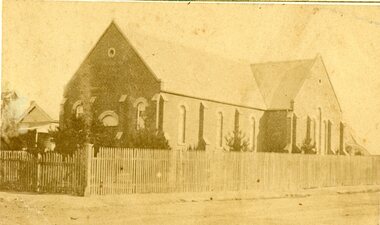 Stawell Historical Society Inc
Photograph, United Free Methodist Church (Band Room) Cnr Sloane & Wakeham Streets -- Built 1870
... United Free Methodist Church (Band Room) Cnr Sloane & Wakeham Streets -- Built 1870...United Free Methodist Church (Band Room) Cnr Sloane Street and Wakeham Streets Built 1870...United Free Methodist Church (Band Room) Cnr Sloane Street and Wakeham Streets Built 1870 Stawell United Free Methodist Church (Band Room) Cnr Sloane & Wakeham Streets -- Built 1870 Photograph ...United Free Methodist Church (Band Room) Cnr Sloane Street and Wakeham Streets Built 1870stawell -
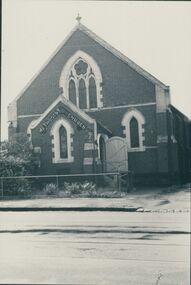 Uniting Church Archives - Synod of Victoria
Photograph, undated
... united free methodist church, church street richmond, bluestone, g.r. cox, john wright....B & W photograph of the exterior of the Richmond United Free Methodist Church....Before construction of the 1868 church, services were held in a weatherboard building which subsequently served as the Sunday School. united free methodist church, church street richmond, bluestone, g.r. cox, john wright. ...The memorial stone of the UMFC in Church St. Richmond was laid in December 1868. The bluestone church, which seated 308 people, was designed by G.R. Cox and built by John Wright. It was opened in May 1869. By 1890 subsidence in the foundations of the building had caused the bluestone façade to bulge dangerously outwards and a new façade of red and white brick was constructed. The memorial stone of the new façade was laid on 7th June 1890. Before construction of the 1868 church, services were held in a weatherboard building which subsequently served as the Sunday School.B & W photograph of the exterior of the Richmond United Free Methodist Church.united free methodist church, church street richmond, bluestone, g.r. cox, john wright. -
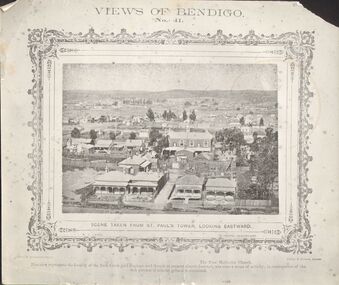 Bendigo Historical Society Inc.
Photograph - DILLON-SHALLARD COLLECTION: VIEWS OF BENDIGO
... ...Free Methodist Church...Scene Taken from St Paul's Tower Looking Eastward. The Free Methodist church. This view represents the locality of the Back Creek gold diggings, and tough at present almost deserted, was once a scene of activity; in consequences of the rich patches of alluvial ground it contained. ...Views of Bendigo Free Methodist Church N.J. Cairne Views of Bendigo No.41. ...Views of Bendigo No.41. Scene Taken from St Paul's Tower Looking Eastward. The Free Methodist church. This view represents the locality of the Back Creek gold diggings, and tough at present almost deserted, was once a scene of activity; in consequences of the rich patches of alluvial ground it contained. Photo by N.J. Caire Sandhurst. Casey & Wenborn's Print. On the back a stamp of Ray Dalton BendigoN.J. Cairneviews of bendigo, free methodist church -
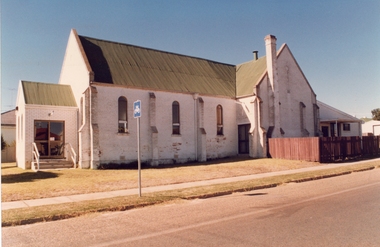 Stawell Historical Society Inc
Photograph, Free Methodist Chapel Church in Wakeham Street 1870 -- Coloured
... Free Methodist Chapel Church in Wakeham Street 1870 -- Coloured...Coloured photograph of Church built in Wakeham Street Stawell in 1870 and used as a Free Methodist Chapel. ...Colour photograph depicting a Church (brick) building with a timber fence around the back section of the church. Free Methodist Chapel Church in Wakeham Street 1870 -- Coloured Photograph ...Coloured photograph of Church built in Wakeham Street Stawell in 1870 and used as a Free Methodist Chapel. After the various branches of the Methodist Church united about 1900 the building was used by the Free Masons until their building in Skene Street was erected in 1926. It's now the home of the Stawell Municipal Band.Colour photograph depicting a Church (brick) building with a timber fence around the back section of the church. -
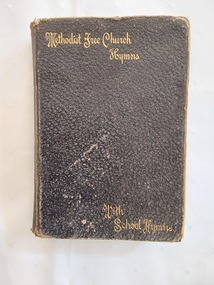 Mont De Lancey
Book, Andrew Crombie, Methodist Free Church Hymns with School Hymns, c. 1889
... Methodist Free Church Hymns with School Hymns...A badly damaged black miniature leatherette softcover book, Methodist free Church Hymns with School Hymns. On the front cover printed in gold lettering is the title. ...Religious books Hymn books Prayer books A miniature Methodist Free Church Hymns with School Hymns book. ...A miniature Methodist Free Church Hymns with School Hymns book. It is a new and enlarged edition of the hymn book which was used by the Uniting Methodist Free Churches since 1860. This was necessary because 'in recent years after the first publication, many hymns have been published, whose fervour and poetic power have won the approval and acceptance of nearly all sections of the Christian Church. Other reasons were, the imperfect classification of the hymns in the book hitherto in use, and the fact that a considerable number of them had become obsolete, owing to their want of adaptation for public worship'.A badly damaged black miniature leatherette softcover book, Methodist free Church Hymns with School Hymns. On the front cover printed in gold lettering is the title. The spine is blank. At the back there is an Index of First Lines. The pages have gilt edges. 312p. Following the first section are the School Hymns. On the front end papers there is a name handwritten in blue ink - D.H Gaudion Wandin Yallock May 24th 1896. There are pencil written arithmetic addition notes all over the end papers front and back. The back cover is broken away from the spine.non-fictionA miniature Methodist Free Church Hymns with School Hymns book. It is a new and enlarged edition of the hymn book which was used by the Uniting Methodist Free Churches since 1860. This was necessary because 'in recent years after the first publication, many hymns have been published, whose fervour and poetic power have won the approval and acceptance of nearly all sections of the Christian Church. Other reasons were, the imperfect classification of the hymns in the book hitherto in use, and the fact that a considerable number of them had become obsolete, owing to their want of adaptation for public worship'.religious books, hymn books, prayer books -
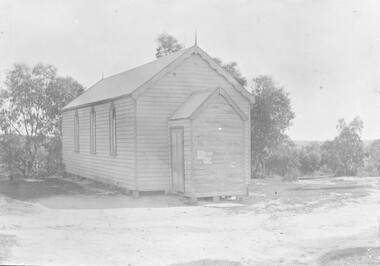 Ringwood and District Historical Society
Photograph, United Methodist Free Church Ringwood- 1904
... United Methodist Free Church Ringwood- 1904...Methodist Church 1904 - Cnr. Mt. Dandenong Rd. & Whitehorse Road." Black and white photograph (2 copies- 1 original mounted on lightly embossed cardboard, 1 larger copy) United Methodist Free Church Ringwood- 1904 Photograph ...Black and white photograph (2 copies- 1 original mounted on lightly embossed cardboard, 1 larger copy)Typed below large copy: "United Methodist Church 1904 - Cnr. Mt. Dandenong Rd. & Whitehorse Road." -
 Uniting Church Archives - Synod of Victoria
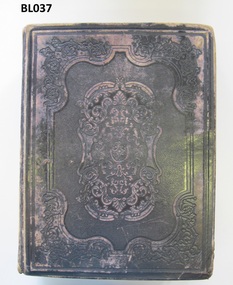
Book - Bible, British and Foreign Bible Society, Holy Bible containing the Old and New Testaments, 1754
... United Methodist Free Church Windsor...On first and title pages: "United Methodist Free Church Windsor Pulpit Bible 17th Oct 1858"...United Methodist Free Church Windsor On first and title pages: "United Methodist Free Church Windsor Pulpit Bible 17th Oct 1858" Pulpit bible with a tooled leather cover. ...Pulpit bible with a tooled leather cover. On spine: "HOLY BIBLE"united methodist free church windsor -
 Uniting Church Archives - Synod of Victoria
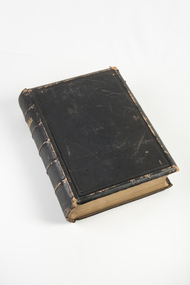
Book - Bible, William Collins Sons & Company, The Practical and Devotional Family Bible. The Holy Bible."
... Church...United Methodist Free Church Peel Street Ballarat...church 5th Feb 1879" BL011 "Presented by the trustees to Mr and Mrs F. Fletcher on their wedding day Wednesday July 14 1875 being the first marriage solemnized in the United Methodist Free Church Peel Street Ballarat with best wishes for their temporal welfare and everlasting happiness"...[Source: Trove - The Age, 21 Feb 1879, pg 1] Hotham Hill Wesleyan Church United Methodist Free Church Peel Street Ballarat BL006 "Presented to Mr and Mrs Rogers by the Trustees of the Hotham Hill Wesleyan Church on the occasion of their marriage being the first celebrated in the church 5th Feb 1879" BL011 "Presented by the trustees to Mr and Mrs F. ...B006 ROGERS—CORBEN.— On the 5th February, at the Wesleyan Church, Hotham-hill, by the Rev. J. F. Horsley, John J. Rogers, of Hotham, to Kate, second daughter of Isaac Corben, Esq., of Lonsdale-street, Melbourne, stone merchant. [Source: Trove - The Age, 21 Feb 1879, pg 1]BL006 and BL011 Heavy black board covered book with gilt border and text on the spine. The pages are gilt edged. The bible includes commentaries of Henry and Scott, colour plates and maps. BL006 The family register has some entries for the Royal Family. The bible has a printed label inside the front cover. BL011 has a printed label inside the front cover. BL006 "Presented to Mr and Mrs Rogers by the Trustees of the Hotham Hill Wesleyan Church on the occasion of their marriage being the first celebrated in the church 5th Feb 1879" BL011 "Presented by the trustees to Mr and Mrs F. Fletcher on their wedding day Wednesday July 14 1875 being the first marriage solemnized in the United Methodist Free Church Peel Street Ballarat with best wishes for their temporal welfare and everlasting happiness"hotham hill wesleyan church, united methodist free church peel street ballarat -
 Bendigo Historical Society Inc.
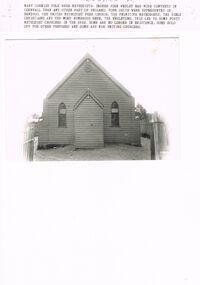
Photograph - CORNISH COLLECTION: PHOTOGRAPHS OF CHURCH BUILDINGS WITH CORNISH CONNECTIONS, 1900
... church...John Wesley. United Methodist Free Church. Wesleyan Mission Hall. ...PHOTOGRAPH Building church John Wesley. United Methodist Free Church. Wesleyan Mission Hall. ...Collection of photographs of various Bendigo church buildings with Cornish connections: a. front of simple (Methodist) wooden church with handwritten annotation of ''Webster St'' together with typewritten attachment to photo giving some of history of Methodism and the Cornish (and the four sects represented in Bendigo); b. Photo of interior of Chapel Street Gospel Hall (Mission Hall) decorated for Sunday School Anniversary (no date); c. three photos - Former Wesleyan Church, Kangaroo Flat; the former Primitive Methodist Church, Eaglehawk; former Bible Christian Church , California Gully (''now St Judes Anglican'' - typewritten attachment to photo).photograph, building, church, john wesley. united methodist free church. wesleyan mission hall. bible christian church. uniting church. -
 Clunes Museum
Souvenir - SOUVENIR TEASPOON
... ON THE SPOON ARE CLUNES BUILDINGS - POST OFFICE, TOWNHALL, FREE LIBRARY, METHODIST CHURCH .2 SILVERPLATED TEASPOON, TOP ORNATE, YELLOW IN THE MIDDLE CLUNES 150 YEARS...ON THE SPOON ARE CLUNES BUILDINGS - POST OFFICE, TOWNHALL, FREE LIBRARY, METHODIST CHURCH .2 SILVERPLATED TEASPOON, TOP ORNATE, YELLOW IN THE MIDDLE CLUNES 150 YEARS Souvenir SOUVENIR TEASPOON ....1 SIVERPLATED TEASPOON, ON TOP OF SPOON IS THE GOLD MONUMENT ON ORANGE BACKGROUND, UNDER IT ON RED IS WRITEN "GOLD MONUMENT". ON THE SPOON ARE CLUNES BUILDINGS - POST OFFICE, TOWNHALL, FREE LIBRARY, METHODIST CHURCH .2 SILVERPLATED TEASPOON, TOP ORNATE, YELLOW IN THE MIDDLE CLUNES 150 YEARSsouvenir teaspoon, souvenir -
 Mont De Lancey
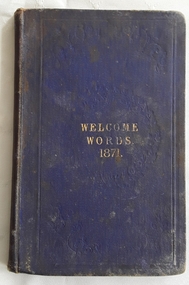
Book, T. Barlow, Welcome Words: A Magazine of Religious Instruction and Missionary Information. Vol.V, 1871
... Henry Sebire for collecting for the Colonial missions of the United Methodist Free Churches August 1873....Vol.V Book T. Barlow Methodist Free Churches' Book Room ...A set of ten magazines for Religious Instruction and Missionary Information bound into a small hardcover book Volume V. 1871.A small blue cloth hardcover copy of Welcome Words: 10 Magazines of Religious Instruction and Missionary Information dated January 1871 to November 1871. The covers are badly marked and stained with the title, Welcome Words. 1871. printed in gold lettering on the front. There is a presentation inscription on the front right hand endpaper. Black and white illustrations are throughout. Some tears, foxing and tanning noted. Poems and stories of strong religious content throughout.non-fictionA set of ten magazines for Religious Instruction and Missionary Information bound into a small hardcover book Volume V. 1871.religious instruction, religious stories, bible stories -
 Chelsea & District Historical Society Inc
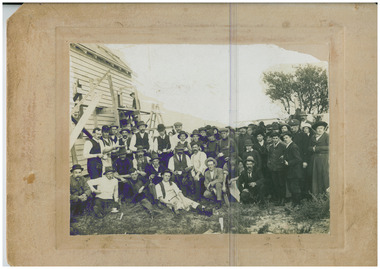
Photograph - Methodist Church, Sherwood Ave, Chelsea, Church built in a day, 26 June 1915
... On June 26th an army of workmen gave their services for free, built the Methodist Church in Sherwood Avenue, Chelsea. ...On June 26th an army of workmen gave their services for free, built the Methodist Church in Sherwood Avenue, Chelsea. ...On June 26th an army of workmen gave their services for free, built the Methodist Church in Sherwood Avenue, Chelsea. A weatherboard building, 35 x 20 feet, with Gothic style amber white glass windows. The first service was held in the Church at 6:00pm the same day.Black and white photo of men taking a break from their work, building the Methodist Church in Sherwood Ave, Chelseareligion, methodist, building, chelsea, community -
 Stawell Historical Society Inc
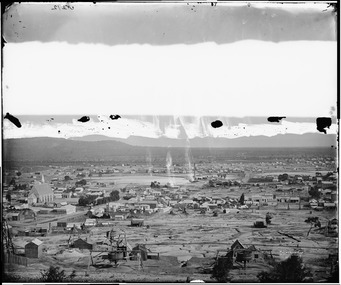
Photograph, View of Stawell from Big Hill April 1874 showing mines centered on St Georges Crushing Mill -- 5 Photos
... Hepburn Carolina Hotel, Pleasant Creek Hotel, St George Stamping Battery, Free Methodist Chapel Church, Ballarat Hotel, Woodcock Produce Grocer, Stawell Brewery in far distance, L. ...Hepburn Carolina Hotel, Pleasant Creek Hotel, St George Stamping Battery, Free Methodist Chapel Church, Ballarat Hotel, Woodcock Produce Grocer, Stawell Brewery in far distance, L. ...From left Reefs Restaurant, T. Hogan & Co Tea Wine Spirits Merchant, R. Hepburn Carolina Hotel, Pleasant Creek Hotel, St George Stamping Battery, Free Methodist Chapel Church, Ballarat Hotel, Woodcock Produce Grocer, Stawell Brewery in far distance, L. Thomas Wheelwright Farrier & General Blacksmith, Australian Hotel, G. Laing Bootmaker, Brierly & Wilson Greengrocer, P. Corkeron Bootmaker, P. Corkeron Wholesale Retail General Grocer, Globe Hotel in distance, Christ Church.Part of Holtermann Collection. Black and White photograph of Stawell from Big Hill with mining in foreground. April 1874. View covers from St Patrick's Church to current location of Police Station along Patrick Street. St George Crushing Mill near Centre of Photograph. Includes Carolina Hotelmining, panorama -
 Glenelg Shire Council Cultural Collection
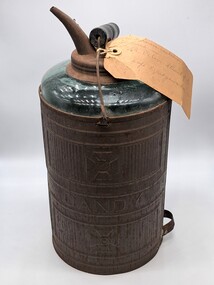
Functional object - Kerosene Container, Dandy, 1900s
... Church in the area. The area was predominately Presbyterian and Methodist, so such a fine church was somewhat unusual. There was obviously much community support for the establishment of the church; the land was donated by Kennedy, a nearby landholder, and the stone was quarried for free at Mount Pleasant, owned by the Kittson family. ...Church in the area. The area was predominately Presbyterian and Methodist, so such a fine church was somewhat unusual. There was obviously much community support for the establishment of the church; the land was donated by Kennedy, a nearby landholder, and the stone was quarried for free at Mount Pleasant, owned by the Kittson family. ...This glass kerosene lamp was used at St Peter's Church of England at Cape Bridgewater. From Victorian Heritage Database - St. Peter's Anglican Church (former) is a small sandstone church, located at the end of Bridgewater Fire Station Road. The church was constructed between 1883-1884, as a result of lobbying by the congregation and the Reverend Allnutt to establish an Anglican Church in the area. The area was predominately Presbyterian and Methodist, so such a fine church was somewhat unusual. There was obviously much community support for the establishment of the church; the land was donated by Kennedy, a nearby landholder, and the stone was quarried for free at Mount Pleasant, owned by the Kittson family. The church was designed gratis by the ecclesiastical architect, Mr. Casselli of Ballarat, who designed many significant buildings throughout Victoria in the nineteenth century. The building contractors were a local firm, Messrs. Benson and Hardie. The church retains a high degree of integrity externally, and is in good condition. This item is significant because it demonstrates early methods of storing fuel. It is also connected to St Peter's Anglican Church in cape Bridgewater which is now a visitor accommodationA glass container with a metal sleeve. The top of the glass container has a metal opening and screw top as well as a spout for pouring. There is a metal carry handle with a wooden cylinder in the middle for carrying. This is only fixed to the container on one side as the metal eyelet on one side has broken off. The metal sleeve on the glass container has embossed pattering above and below the word - Dandy. There is an old carboard label attached to the top with string.Metal sleeve - DANDY Label -This kerosene container was used in / St Peter's Church of E / Cape Bridgewaterreligion, church, place of worship, cape bridgewater, st peters church, anglican, glenelg shire, glenelg, portland, fuel, kero, kerosene, light -
 Flagstaff Hill Maritime Museum and Village
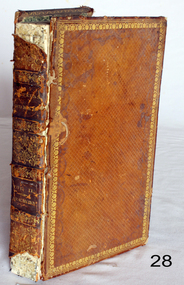
Literary work - Book, G. Sidney, Book of sermons by The Right Reverend Beilby Porteus Vol 2. Additional notes on authors life by Rev. Robert Hodgson, A.M.F.R.S, 1811 Published
... freed slaves in England. In 1769 Beilby Porteus was appointed as chaplain to King George III. He was also Rector of Lambeth (a living shared between the Archbishop of Canterbury and the Crown) from 1767 to 1777, and later Master of St Cross, Winchester (1776–77). He was concerned about trends within the Church of England towards what he regarded as the watering-down of the truth of Scripture and stood for doctrinal purity. He was, however, happy to work with Methodists...freed slaves in England. In 1769 Beilby Porteus was appointed as chaplain to King George III. He was also Rector of Lambeth (a living shared between the Archbishop of Canterbury and the Crown) from 1767 to 1777, and later Master of St Cross, Winchester (1776–77). He was concerned about trends within the Church of England towards what he regarded as the watering-down of the truth of Scripture and stood for doctrinal purity. He was, however, happy to work with Methodists ...Rev Robert Hodgson: His father was Robert Hodgson Snr, of Congleton, and Mildred (née Porteus) in early 1773. He was baptised on 22 September 1773 at St Peter's Church, Congleton. Hodgson was a close relative (by marriage on his father's side and by blood on his mother's side) of Beilby Porteus, Bishop of London of whom Hodgson wrote a biography of Porteus. On his mother's side, he was a descendant of Augustine Warner Jnr., who presided as the Speaker of the Virginia House of Burgesses during the time of Bacon's Rebellion (Warner served before the Rebellion in 1676, and after the Rebellion in 1677.) Hodgson was educated at Macclesfield School and Peterhouse, Cambridge, where he graduated with a BA as 14th Wrangler in 1795. He was appointed rector of St George's, Hanover Square for over forty years, from 1803 until his death in 1844. Bishop Beilby Porteus: Beilby Porteus 8 May 1731 – 13 May 1809), successively Bishop of Chester and London was a Church of England reformer and a leading abolitionist in England. He was the first Anglican in a position of authority to seriously challenge the Church's position on slavery. Porteus was born in York on 8 May 1731, the youngest of the 19 children of Elizabeth Jennings and Robert Porteus ( 1758/9), a planter. Although the family was of Scottish ancestry, his parents were Virginian planters who had returned to England in 1720 as a result of the economic difficulties in the province and for the sake of his father's health. Educated at York and Ripon Grammar School, he was a classics scholar at Christ's College, Cambridge, becoming a fellow in 1752. In 1759 he won the Seatonian Prize for his poem Death: A Poetical Essay, a work for which he is still remembered. He was ordained as a priest in 1757, and in 1762 was appointed as domestic chaplain to Thomas Secker, Archbishop of Canterbury, acting as his assistant at Lambeth Palace for six years. It was during these years that it is thought he became more aware of the conditions of the enslaved Africans in the American colonies and the British West Indies. He corresponded with clergy and missionaries, receiving reports on the appalling conditions facing the slaves from Rev James Ramsay in the West Indies and from Granville Sharp, the English lawyer who had supported the cases of freed slaves in England. In 1769 Beilby Porteus was appointed as chaplain to King George III. He was also Rector of Lambeth (a living shared between the Archbishop of Canterbury and the Crown) from 1767 to 1777, and later Master of St Cross, Winchester (1776–77). He was concerned about trends within the Church of England towards what he regarded as the watering-down of the truth of Scripture and stood for doctrinal purity. He was, however, happy to work with Methodists and dissenters and recognised their major contributions in evangelism and education. In 1776, Porteus was nominated as Bishop of Chester, taking up the appointment in 1777. He was Renowned as a scholar and a popular preacher, it was in 1783 that the young bishop was to first come to national attention by preaching his most famous and influential sermon. In 1787, Porteus was translated to the bishopric of London on the advice of Prime Minister William Pitt, a position he held until his death in 1809. As is customary, he was also appointed to the Privy Council, and Dean of the Chapel Royal. In 1788, he supported Sir William Dolben's Slave Trade Bill from the bench of bishops, and over the next quarter-century, he became the leading advocate within the Church of England for the abolition of slavery, lending support to such men as Wilberforce, Granville Sharp, Henry Thornton, and Zachary Macaulay to secure the eventual passage of the Slave Trade Act in 1807.Beilby Porteus was one of the most significant, albeit under-rated church figures of the 18th century. His sermons continued to be read by many, and his legacy as a foremost abolitionist was such that his name was almost as well known in the early 19th century as those of Wilberforce and Thomas Clarkson but 100 years later he had become one of the 'forgotten abolitionists', and today his role has largely been ignored and his name has been consigned to the footnotes of history. His primary claim to fame in the 21st century is for his poem on Death and, possibly unfairly, as the supposed prototype for the pompous Mr. Collins in Jane Austen's novel ”Pride and Prejudice”. But, ironically, Porteus' most lasting contribution was one for which he is little-known, the Sunday Observance Act of 1781 (a response to what he saw as the moral decay of England), which legislated how the public were allowed to spend their recreation time at weekends these laws continued for the following 200 years until the passing of the Sunday Trading Act of 1994.Book of sermons cover is brown with gold border and decoration Beilby Porteus (or Porteous; 8 May 1731 – 13 May 1809), successively Bishop of Chester and of London, was a Church of England reformer and a leading abolitionist in England. He was the first Anglican in a position of authority to seriously challenge the Church's position on slavery. The Works of The Right Reverend Beilby Porteus Vol 2” . Spine has “Porteus’ Works, Vol. II Sermons”. The works of the Right Reverend Beilby Porteus, D.D., late Bishop of London; with his life, by the Rev. Robert Hodgson, A.M.F.R.S. and one of the Chaplains in Ordinary to His Majesty. A New Edition in Six Volumes. Vol. II – Sermons. Published in 1811 for T. Cadell and W., Davies, in The Strand, London. Printed by G. Sidney, Northumberland-street. flagstaff hill, warrnambool, shipwrecked coast, flagstaff hill maritime museum, maritime museum, shipwreck coast, flagstaff hill maritime village, great ocean road, right reverend beilby porteous, sermons, london reverend -
 Eltham District Historical Society Inc
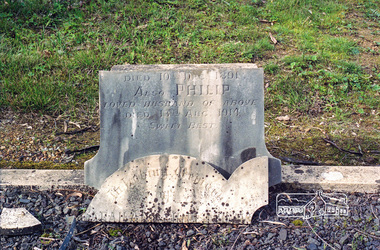
Negative - Photograph, Harry Gilham, Grave of Sarah and Phillip Shillinglaw, Eltham Cemetery, Victoria, Sep 2009
... Methodist Church as preacher, Church Steward and Sunday School teacher. A Sunday School picnic and a sports carnival were held on his paddock. Eight of his children attended Eltham Primary School. In 1908 he ploughed part of the schoolyard (possibly for use as a garden) free...Methodist Church as preacher, Church Steward and Sunday School teacher. A Sunday School picnic and a sports carnival were held on his paddock. Eight of his children attended Eltham Primary School. In 1908 he ploughed part of the schoolyard (possibly for use as a garden) free ...Philip Shillinglaw and his wife Sarah came to Eltham in 1882. Their property "Wattle Brae" originally encompassed present-day Eltham Central Park and part of Eltham Library, extending north to include Andrew Park and the site of the railway station. An early photo shows that much of it was planted for crops. They also had cows; in 1913 Philip wrote to the local paper complaining about an earlier report that one of them had been killed on the railway line. "I give an emphatic denial to the report. It is not true." Their house Shillinglaw Cottage (built by George Stebbings) still exists, though it was moved with funding from local residents in 1963-64 when faced with demolition to make room for new Council Offices. Philip was actively involved with the Methodist Church as preacher, Church Steward and Sunday School teacher. A Sunday School picnic and a sports carnival were held on his paddock. Eight of his children attended Eltham Primary School. In 1908 he ploughed part of the schoolyard (possibly for use as a garden) free of charge. When Philip died in 1914, his funeral was described as one of the largest ever seen in Eltham. He and Sarah are buried in Eltham Cemetery. In Loving Memory of Sarah Ann Shillinglaw Died 10th Dec. 1891 Also Phillip Loved husband of above Died 18th Aug. 1914 Sweet BestRoll of 35mm colour negative film, 6 stripsKodak GC 400-9eltham cemetery, gravestones, phillip shillinglaw, sarah ann shillinglaw -
 Eltham District Historical Society Inc
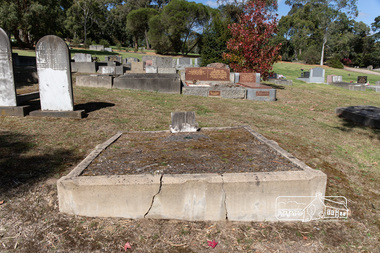
Photograph, Peter Pidgeon, Grave of Sarah and Phillip Shillinglaw, Eltham Cemetery, Victoria, 5 April 2021
... Methodist Church as preacher, Church Steward and Sunday School teacher. A Sunday School picnic and a sports carnival were held on his paddock. Eight of his children attended Eltham Primary School. In 1908 he ploughed part of the schoolyard (possibly for use as a garden) free...Methodist Church as preacher, Church Steward and Sunday School teacher. A Sunday School picnic and a sports carnival were held on his paddock. Eight of his children attended Eltham Primary School. In 1908 he ploughed part of the schoolyard (possibly for use as a garden) free ...Philip Shillinglaw and his wife Sarah came to Eltham in 1882. Their property "Wattle Brae" originally encompassed present-day Eltham Central Park and part of Eltham Library, extending north to include Andrew Park and the site of the railway station. An early photo shows that much of it was planted for crops. They also had cows; in 1913 Philip wrote to the local paper complaining about an earlier report that one of them had been killed on the railway line. "I give an emphatic denial to the report. It is not true." Their house Shillinglaw Cottage (built by George Stebbings) still exists, though it was moved with funding from local residents in 1963-64 when faced with demolition to make room for new Council Offices. Philip was actively involved with the Methodist Church as preacher, Church Steward and Sunday School teacher. A Sunday School picnic and a sports carnival were held on his paddock. Eight of his children attended Eltham Primary School. In 1908 he ploughed part of the schoolyard (possibly for use as a garden) free of charge. When Philip died in 1914, his funeral was described as one of the largest ever seen in Eltham. He and Sarah are buried in Eltham Cemetery. In Loving Memory of Sarah Ann Shillinglaw Died 10th Dec. 1891 Also Phillip Loved husband of above Died 18th Aug. 1914 Sweet BestBorn Digitaleltham cemetery, gravestones, phillip shillinglaw, sara ann shillinglaw -
 Eltham District Historical Society Inc
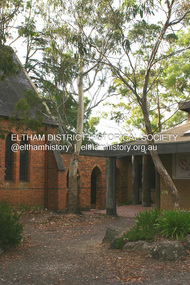
Photograph - Digital Photograph, Alan King, St Margaret's Anglican Church, Pitt Street, Eltham, 30 January 2008
... Methodist, later Uniting, Church at John Street and the Shillinglaw Cottage near Eltham’s Central Park. It is believed the first Anglican Bishop of Melbourne, Bishop Perry, dedicated the church. After the ceremony he joined in the festivities at the nearby pub and a bill was sent to the parish for teas taken there by the bishop with other participants. The first vicar was the Reverend Robert Mackie from 1864 to1866. St Margaret’s Church was originally called Christ Church until its consecration in 1871, when it was completely free...Methodist, later Uniting, Church at John Street and the Shillinglaw Cottage near Eltham’s Central Park. It is believed the first Anglican Bishop of Melbourne, Bishop Perry, dedicated the church. After the ceremony he joined in the festivities at the nearby pub and a bill was sent to the parish for teas taken there by the bishop with other participants. The first vicar was the Reverend Robert Mackie from 1864 to1866. St Margaret’s Church was originally called Christ Church until its consecration in 1871, when it was completely free ...St Margaret’s Church of England was officially opened on December 12, 1861. It is the oldest intact church building in Eltham. At the time it was known as Christ Church until its consecration in 1871, when it was completely free of debt (£1,700 for the church and parsonage) despite the district’s poverty. This was largely due to the free labour and materials, including locally made bricks donated by local artisans and others. The church is historically significant because it is the oldest church in the former Shire of Eltham and has associations with the philanthropist and founder of Brighton, Henry Dendy (who donated the land on which the church is built), the architect Nathaniel Billing and the prominent local builder, George Stebbing. The church is architecturally and aesthetically significant because it is constructed in the Gothic Revival style with several stained-glass windows of various dates and is also a very early use of polychromatic brickwork in Victoria. Billing was one of the first Melbourne architects to employ polychromatic brickwork and an important early architect. The rear wall was intended to be temporary. A major feature of the design is the large buttresses with long, steeply graded upper faces. The overall design is well proportioned with the surface brick patterns relieving an otherwise austere design. The church is spiritually and socially significant because it has been an important place of worship for the people of Eltham for almost 150 years. The land on which the buildings stand was donated by Henry Dendy. Dendy arrived in Melbourne in 1841 after purchasing in England eight square miles at Brighton under the system of "special surveys". After this land passed out of his hands, Dendy moved about Victoria, visited England, then returned to settle in Eltham where he purchased a flour mill. Dendy chaired the meeting held in 1860 “for the purpose of devising such means as may be expedient for the establishment of a Church of England in the township of Eltham”. He became chairman and treasurer of the church committee. Unlike the establishment of many early churches in Victoria where a vicar was appointed to a parish and later a permanent church was constructed, the population at Eltham initiated action to build a church. The nearest church at that time was at Heidelberg and the Eltham settlement was part of the parish of St Johns Heidelberg. Isolation and the tedious, time consuming journey between Heidelberg and Eltham resulted in the Eltham community taking its own action. The original vicarage (Dendy House) at the rear of the church is also an important part of the cultural significance of this place because it is connected to the church and the development of the Eltham area. Together, the church and the vicarage are aesthetically significant because they form a significant streetscape feature. The mud-brick community hall designed by Robert Marshall was added in 1978. In 2014 the original temporary rear wall was removed as part of a modern extension designed by Architects Atelier Wagner and constructed by Conrad Construction and Management. Covered under Heritage Overlay, Nillumbik Planning Scheme. National Trust of Australia (Victoria) State significance Victorian Heritage Published: Nillumbik Now and Then / Marguerite Marshall 2008; photographs Alan King with Marguerite Marshall.; p67 St Margaret’s Anglican Church in Pitt Street, Eltham, which officially opened on December 12, 1861, is the oldest intact church building in Eltham.1 With the nearby courthouse and police station, it was one of the first permanent community buildings in the district. The church and vicarage are on the Register of the Heritage Council of Victoria and the National Trust of Australia – Victoria. The church is important as an early example of polychrome brickwork by the notable architect Nathaniel Billings. It is also notable for its historic associations with the early settlement of the Shire of Eltham and its connection with Henry Dendy, Brighton’s founder.2 Henry Dendy, who lived in Eltham much longer than at Brighton, chaired the original meeting which planned the church, and he donated the half-acre (0.2ha) site. Dendy had arrived in Melbourne in 1841 after buying eight square miles (20.7sq km) at Brighton while in England. After this land passed out of his hands, he eventually settled in Eltham where he bought a flour mill, west from the corner of Main Road and Pitt Street (then called Brewery Lane). The vicarage was named Dendy House after him. The Eltham settlers were unusual in initiating the establishment of a church. Usually in Victoria a vicar was appointed to a parish and then a permanent church was constructed. But then, the nearest church was at Heidelberg, which was a tedious and time-consuming journey. St Margaret’s builder was a local, George Stebbing, who also constructed the former Methodist, later Uniting, Church at John Street and the Shillinglaw Cottage near Eltham’s Central Park. It is believed the first Anglican Bishop of Melbourne, Bishop Perry, dedicated the church. After the ceremony he joined in the festivities at the nearby pub and a bill was sent to the parish for teas taken there by the bishop with other participants. The first vicar was the Reverend Robert Mackie from 1864 to1866. St Margaret’s Church was originally called Christ Church until its consecration in 1871, when it was completely free of debt (£1700 pounds for the church and parsonage) despite the district’s poverty. This was largely due to the free labour and materials, including local bricks, donated by local artisans and others. St Margaret’s Church is in the Gothic Revival tradition with a buttressed nave, paired lancet windows, porch and bell-cote. It was the first polychromatic brick church in Australia, using softly contrasting coloured brickwork.3 Billing was one of the first architects to introduce polychrome brickwork into Melbourne. His original drawings for St Margaret’s survive in a folio of his architectural work. However the church’s brickwork is more subdued than in his drawings. About half the windows – those in clear glass with gold borders – are original. The stained glass windows were made much later, but the one behind the altar is thought to be the oldest in the Diamond Valley. It was to be temporary until the congregation could afford to extend the church. In the early 1960s the original cedar pews were replaced by blonde timber pews and the originals were sold to restaurants and to private individuals. Eminent local sculptor Matcham Skipper created a crucifix for the church. A major addition was made in 1978, when the weatherboard hall was replaced by a mud-brick hall. Made of local material, it was designed by local architect and a former shire president Robert Marshall. The mud-brick hall reflects the style of building in Eltham of the late 1970s and for which Eltham is well-known. Perhaps because its earthy tones blend with the surrounding environment, the hall sits well with the church building. St Margaret’s membership has included economist and ABC chairman, Richard Downing; political commentator, diplomat and academic, William Macmahon Ball; Eltham civic leader, Charles Wingrove; artist, Peter Glass; and Eltham’s first postmaster, Frederick Falkiner.This collection of almost 130 photos about places and people within the Shire of Nillumbik, an urban and rural municipality in Melbourne's north, contributes to an understanding of the history of the Shire. Published in 2008 immediately prior to the Black Saturday bushfires of February 7, 2009, it documents sites that were impacted, and in some cases destroyed by the fires. It includes photographs taken especially for the publication, creating a unique time capsule representing the Shire in the early 21st century. It remains the most recent comprehenesive publication devoted to the Shire's history connecting local residents to the past. nillumbik now and then (marshall-king) collection, eltham, st margaret's anglican church, st margaret's church, st margarets church hall, christ church -
Bendigo Historical Society Inc.
Document - GOLDEN SQUARE METHODIST, CHILDREN'S PICNIC TO RAVENSWOOD, 1915
... CHURCH Celebration golden square methodist Bolton Bros, Printers, Bendigo Golden Square Methodist, Children's Picnic to Ravenswood, Saturday, October 23, 1915. Program includes time of train depature from Bendigo and Golden Square to arrive at Ravenswood 2 o'clock. Sports and races 2.20 to 3.30. Ginger Beer (free ...Golden Square Methodist, Children's Picnic to Ravenswood, Saturday, October 23, 1915. Program includes time of train depature from Bendigo and Golden Square to arrive at Ravenswood 2 o'clock. Sports and races 2.20 to 3.30. Ginger Beer (free) - Children and Adults 3.30. Ice Cream (free - Children Only 3.45. Children's Tea (Free) 4 - followed by Lollies. Adults Afternoon Tea (Free) 4.30 followed by Ice Cream. Ginger Beer (Free) - Children and Adults 5.15. Sports and Games 5.30 to ? Train leaves 8.15 Moonlight. Six hours of solid enjoyment! No time to get tired or to wander about! No special invitation to anyone - Open to all! Railway ticket covers everything. Adults, 1/6; Children, 1/- Female Teachers and Senior Scholars, 1/3, obtainable at Mr R Saunder's or Railway Station prior to train leaving. Golden Sq. Meth. S. S. Scholars (Under16) free and will receive Tickets on entering train. Tickets good for trains leaving Bendigo noon and 3.15; Ravenswood 4.20 and 10.30. Teachers will kindly assist in carring out the arrangments. It is desired to strictly adhere to the programme. Bring own cups and pannikins. Hot water and milg provided.Bolton Bros, Printers, Bendigochurch, celebration, golden square methodist -
 Bendigo Historical Society Inc.
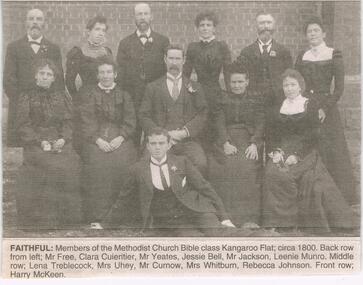
Newspaper - JENNY FOLEY COLLECTION: FAITHFUL
... Faithful: members of the Methodist Church Bible class Kangaroo Flat,circa 1900. Back row from left: Mr. Free, Clara Cuieritier, Mr. ...Faithful: members of the Methodist Church Bible class Kangaroo Flat,circa 1900. Back row from left: Mr. Free, Clara Cuieritier, Mr. ...Bendigo Advertiser "The way we were" from Saturday, July 31, 2004. Faithful: members of the Methodist Church Bible class Kangaroo Flat,circa 1900. Back row from left: Mr. Free, Clara Cuieritier, Mr. Yates, Jessie Bell, Mr. Jackson, Leenie Munro. Middle row: Lena Treblecock, Mrs. Uhey, Mr. Curnow, Mrs. Withburn, Rebecca Johnson. Front row: Harry McKeen.newspaper, bendigo advertiser, the way we were -
 Uniting Church Archives - Synod of Victoria
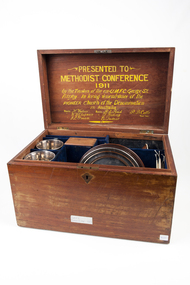
Communion box
... Methodist Conference 1911 United Methodist Free Churches Inside lid: "Presented to Methodist Conference 1911 by the Trustees of the ex U.M.F.C. ...Wooden box with hinged lid. Box contains 2 silver chalices, 1 plate and 4 brown ceramic chalices.Inside lid: "Presented to Methodist Conference 1911 by the Trustees of the ex U.M.F.C. George St, Fitzroy in loving rememberance of the pioneer church of the Denomination of Australia"methodist conference 1911, united methodist free churches -
 St Kilda Historical Society
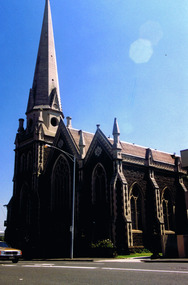
Photograph, St Kilda Presbyterian Church exterior - images collection, c 1970s
... Free Church Synod of Victoria in May 1855, in a building at the corner of High Street and Alma Road. In October 1855 the congregation moved to a wooden building in Inkerman Street, purchased from the Independent (Congregational) Church. The present church site was purchased and the first church opened in 1860. The foundation stone for the present church building, the second to be built on the site, was laid by the Governor of Victoria, Sir Henry Brougham Loch, on 27 January 1885. The building was opened on 30 May 1886. Wilson and Beswicke were the architects. Ralph Wilson designed the Methodist...Free Church Synod of Victoria in May 1855, in a building at the corner of High Street and Alma Road. In October 1855 the congregation moved to a wooden building in Inkerman Street, purchased from the Independent (Congregational) Church. The present church site was purchased and the first church opened in 1860. The foundation stone for the present church building, the second to be built on the site, was laid by the Governor of Victoria, Sir Henry Brougham Loch, on 27 January 1885. The building was opened on 30 May 1886. Wilson and Beswicke were the architects. Ralph Wilson designed the Methodist ...The St Kilda Presbyterian Church is now part of the St Kilda & Balaclava Presbyterian Church. Its first service was inaugurated by the Free Church Synod of Victoria in May 1855, in a building at the corner of High Street and Alma Road. In October 1855 the congregation moved to a wooden building in Inkerman Street, purchased from the Independent (Congregational) Church. The present church site was purchased and the first church opened in 1860. The foundation stone for the present church building, the second to be built on the site, was laid by the Governor of Victoria, Sir Henry Brougham Loch, on 27 January 1885. The building was opened on 30 May 1886. Wilson and Beswicke were the architects. Ralph Wilson designed the Methodist church on the corner of Princes and Fitzroy Streets and lived diagonally opposite the Presbyterian church. Charles Beswicke had toured Britain and the Continent in 1886 armed with a camera and returned to Australia with photographs of what he considered the greatest examples of architecture. He was responsible for the town halls in Brighton, Malvern, Hawthorn and Essendon and Wesleyan churches in Camberwell and Dandenong. Thomas Corley was the builder. The lofty spire was ‘a landmark to the mariner’ used by sea captains sailing up Port Phillip Bay. On a prominent position, the highest point in St Kilda, the church attracted wealthy people with legal, merchant and pastoral backgrounds.colour photographst kilda, churches, presbyterian church, balaclava -
 Sunshine and District Historical Society Incorporated
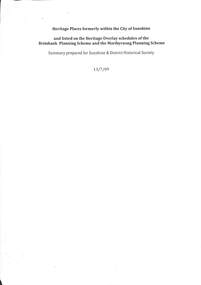
Document - Heritage Places Formerly With the City Of Sunshine 13th July 2009, Sunshine and District Historical Society Inc, 13th July 2009
... Church (Formerly Presbyterian) 24 - 26 East Esplanade St. Albans HO99 St. George's Free Serbian Orthodox Church 6 Kate Street St. Albans HO101 Errington Reserve & Memorial Gardens 309A Main Road East St. Albans HO102 St. Albans Community Hall Youth Club 309A Main Road East St. Albans HO103 Methodist...Church (Formerly Presbyterian) 24 - 26 East Esplanade St. Albans HO99 St. George's Free Serbian Orthodox Church 6 Kate Street St. Albans HO101 Errington Reserve & Memorial Gardens 309A Main Road East St. Albans HO102 St. Albans Community Hall Youth Club 309A Main Road East St. Albans HO103 Methodist ...This list of City of Sunshine heritage‑listed properties is protected because they demonstrate important aspects of the area’s history — industrial innovation, early settlement, worker housing, civic development, and significant Aboriginal cultural landscapes. Heritage Listed Reference Numbers: Sunshine - Deer Park area 6737 - Heritage Places Formerly With the City Of Sunshine 13th July 2009 Page 1.jpg Heritage Precincts Commonwealth Munitions Housing Estate HO H019 Concrete Housing Estate Leith Avenue Sunshine HO H020 ICI Residential Area Deer Park HO H021 Sunshine Commercial Heritage Area HO H022 McKay Housing Estate Durham Road HOC H023 McKay Housing Estate King Edward Avenue HOC H024 Railway Estate Sunshine HO H025 War Service Homes Heritage Area Sunshine HO H026 Heritage Place Massey Ferguson Complex Devonshire Road Sunshine H03 John Darling & Son Flour Mill 74 Sydney Street Albion H04 Rail Bridge (Albion Viaduct) Over Maribyrnong River HO5 Black Powder Mill Parklea Avenue And Grassy Point Road Cairnlea HO6 Foxley Lodge Farm And Its Drystone Walls 472A Boundary Road Derrimut H08 1 Corio Steet Sunshine H09 H.V. McKay Memorial Gardens HO10 H.V. McKay Offices 2 Devonshire Road Sunshine HO11 Main Outfall Sewer Brimbank (Brooklyn) HO13 Mt. Derrimut Homestead, Its Drystone Walls And Associated Buildings Including The Meteorological Centre Mt. Derrimut Road Derrimut H017 H. V. McKay Offices (Eastern portion of the complex) 2 Devonshire Road HO18 Albion VR DC Substation Talmage Street Albion H028 Pig And Calf Market 55 Market Road Brooklyn H029 Monsanto Chemicals Huntsman Chemical Co 455 Somerville Road Brooklyn H030 Deer Park Explosive Factories Complex Off Ballarat Road Deer Park H032 6737 - Heritage Places Formerly With the City Of Sunshine 13th July 2009 Page 2.jpg Heritage Place (Cont) Hume And Hovell Cairn Cnr Station Road And Ballarat Road Deer Park H034 Anderson Farm House 100 Taylors Road St. Albans HO36 Hume And Hovell Cairn East Esplanade St. Albans H038 Sunshine Signal Box Off Hampshire Road H039 Black Arch Rail Bridge Sunshine Road Sunshine H040 Sugar Gum Row Talmage Street Albion H042 Railway Culvert Sydenham Road St. Albans HO43 Sunshine Advocate Office 11 - 15 Sun Crescent Sunshine H051 Keigilo, now Sacred Heart Presbytery 4 Winifred Street St. Albans HO52 H.V. McKay Memorial Gates Anderson Road Sunshine H053 H.V. McKay Memorial Presbyterian Church Anderson Road Sunshine H054 Sam McKay House And Garden 147 Anderson Road Sunshine H055 Former Sunshine Technical School Derby Road Sunshine H056 Former Sunshine Girls Technical School Derby Road Sunshine H057 Pedestrian Footbridge Over Railway 1 Devonshire Road Sunshine H058 House At 48 Station Place Sunshine H061 ANZ Bank Former ES&A Bank 115 Durham Road Sunshine H063 Sunshine Metropolitan Fire Station And Flats 330 Hampshire Road Sunshine H064 Derrimut Hotel 132 Durham Road Sunshine H065 St. Mark's Anglican Church 49 Suns Crescent Sunshine H066 Robinson House 33 Sun Crescent Sunshine H067 St. Theresa Catholic Church & School 26 Adelaide Street Albion H070 Curacloe H071 Former Wunderlich Now West End Market 47 - 49 McIntyre Road Sunshine North H073 Selwyn Park Albion H074 Sunshine Baptist Church 42 Ridley Street & 16 Sydney Street Albion H075 Cameron House & Dairy H076 6737 - Heritage Places Formerly With the City Of Sunshine 13th July 2009 Page 3.jpg Heritage Place (Cont) Houses & Trees 22 - 24 Talmage Street Albion H077 Ford (Solomon Ford) Burke Road To Canning Street Avondale Heights H079 Lions House Of Sunshine 8 Watt Street Sunshine H080 Guiding Star Hotel 700 Geelong Road Brooklyn H081 Hunt Club Hotel 775 Ballarat Road Deer Park H082 Deer Park Hotel 760 Ballarat Road Deer Park H083 Deer Park Primary School No 1434 812 Ballarat Road Deer Park H084 Opie's Dairy 2 - 4 Egan Street Deer Park H086 St. John's Anglican Church & Hall 2 - 4 Miles Street Deer Park H087 Neale Road Ford 192 Neale Road Deer Park H088 Deer Park Hall 50 Station Road Deer Park H089 Sunshine Market 13 - 19 City Place Sunshine H091 House St. Albans Estate 16 Arthur Street St. Albans HO98 St. Albans Uniting Church (Formerly Presbyterian) 24 - 26 East Esplanade St. Albans HO99 St. George's Free Serbian Orthodox Church 6 Kate Street St. Albans HO101 Errington Reserve & Memorial Gardens 309A Main Road East St. Albans HO102 St. Albans Community Hall Youth Club 309A Main Road East St. Albans HO103 Methodist Church & Hall 32 Devonshire Road Sunshine H0105 Macedonian Community Centre 45 Fourth Avenue Sunshine H0106 Hannah McKay House 145 Anderson Road Albion HO107 6737 - Heritage Places Formerly With the City Of Sunshine 13th July 2009 Page 4.jpg Heritage Place (Cont) Chemist Shop 234 Hampshire Road Sunshine H0108 Sunshine Municipal Offices 6 - 18 Alexandra Avenue Sunshine H0109 Sunshine Primary School 3113 111 Derby Road Sunshine H0110 Standard Steel 12 - 16 Market Road Sunshine H0111 Our Lady of the Immaculate Conception Catholic Church 93 Monash Street Sunshine H0113 Parsons House 114 Moris Street Sunshine H0114 Our Lady's School Station Place Monash Street Sunshine H0115 Palmas 2 Tyler Street Sunshine H0116 St. Andrews Greek Orthodox Church (Greek Cypriot) 14 Simmie Street Sunshine West H0119 William McKay House 150 Durham Road Sunshine H0121 Albion Primary School No 4265 61 - 81 Adelaide Street Albion H0122 Ralph's Meatworks 690 Geelong Road Brooklyn H0123 Former Church of Christ 81 - 83 Hampshire Road Sunshine H0125 Former Masonic Lodge No 226 93 Hampshire Road Sunshine H0126 Sunshine Picture Theatre 126 - 128 Hampshire Road Sunshine H0127 Shops 193 - 199 Hampshire Road Sunshine H0130 Ukrainian Catholic Church 2 Holmes Street Ardeer H0132 Shops 207 - 219 Hampshire Road Sunshine H0133 Victorian Row House 25 Benjamin Street Sunshine H0134 Victorian Row House 29 Benjamin Street Sunshine H0135 Victorian Row House 31 Benjamin Street Sunshine H0136 Victorian Row House 33 Benjamin Street Sunshine H0137 Victorian Row House 35 Benjamin Street Sunshine H0138 50 Forrest Street Albion H0139 -
 Wodonga & District Historical Society Inc
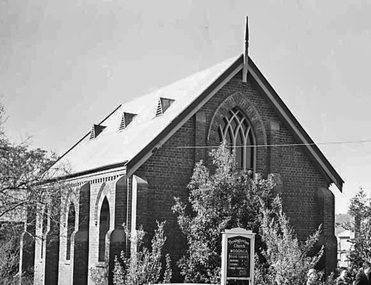
Photograph - First Presbyterian Church, Wodonga
... With the amalgamation of the Presbyterian and Methodist Churches, the new Church became the Uniting Church. The original Presbyterian Church was later sold to the Free Serbian Orthodox Church....With the amalgamation of the Presbyterian and Methodist Churches, the new Church became the Uniting Church. The original Presbyterian Church was later sold to the Free Serbian Orthodox Church. ...Members of the Presbyterian faith were among the first settlers in the North-east of Victoria, and in the year 1842 the Presbytery of Melbourne requested the Rev. Peter Gunn, Minister of the Gaelic Church, Melbourne, to visit Presbyterians along the Murray River. This was the first of a series of annual visits, and was of a missionary nature. In May 1851, the Rev. David Hunter Ballantyne was appointed to the Wodonga district based out of Albury. In 1860 the Presbytery of Beechworth was formed, and from it two large presbyteries have grown - Wagga Wagga and Beechworth. In the early days the services at Wodonga were held in the old court house, which still stands. Wodonga Presbyterian Church continued as part of the Parish of Albury until the end of 1887, when it was placed under the administration of the Session of the Beechworth Church, with a home missionary in charge. Mr William Cooper was placed in charge for the first months, then Mr William Smith, a city missionary who had recently arrived from Scotland, was appointed. Mr Smith conducted a cordage factory at Stonleigh. He remained as missionary in charge for the next 10 years, and in that time the church steadily progressed. Plans were made for the erection of the building which now stands in High Street, Wodonga. Mr John Whan was a Founding Member of the Church and was appointed Sunday School Superintendent, an office which he held for 46 years, rendering extensive and valued service to the church and congregation. With a growing congregation and realising the challenges presented to the Church by changing conditions, land for a new church was sought. In September 1950 property was purchased in Nilmar Avenue in Wodonga and the new Presbyterian Church St Stephens became their new home. With the amalgamation of the Presbyterian and Methodist Churches, the new Church became the Uniting Church. The original Presbyterian Church was later sold to the Free Serbian Orthodox Church.These photographs are significant because they provide evidence of the changing nature of religious worship and groups in Wodonga.A collection of black and white photographic images depicting the first Presbyterian Church at Wodonga. The Church was later taken over by the Free Serbian Orthodox Church.presbyterian church, free serbian orthodox church, wodonga churches -
 Linton and District Historical Society Inc
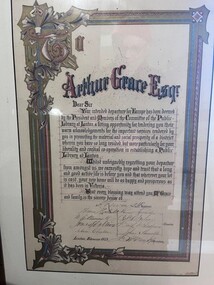
Document - Illuminated Address, Niven, Francis Wilson, Illuminated address presented to Arthur Grace, 1873, 1873
... Free Library...Linton Public Library...Linton Methodist Church...Methodist/Wesleyan congregation at Linton, and instrumental in establishing the Linton Mechanics' Institute and Free Library. (Note: The 'Adress' does not refer to the Linton Mechanics' Institute, but to the 'Committee of the Public Library at Linton'.) The Address was made by Francis Wilson Niven, a lithographer, printer and bookbinder from Ballarat. (See 'Ballarat Star', 10 March 1873.) This may be the first reference to the 'Public Library' at Linton. Arthur Grace Illuminated address Linton Mechanics' Institute and Free Library Linton Public Library Linton Methodist Church ...From the late 1870s to the 1930s, illuminated addresses were a popular way to commemorate special occasions and were given to recognize outstanding service. They featured beautiful calligraphy and ornate designs. Arthur Grace was a draper who ran a business in Linton (at 'Criterion House') from the mid-1860s until he left Linton to return to England in 1873. He later returned to live in Ballarat, where he died in 1905. He was heavily involved with the Methodist/Wesleyan congregation at Linton, and instrumental in establishing the Linton Mechanics' Institute and Free Library. (Note: The 'Adress' does not refer to the Linton Mechanics' Institute, but to the 'Committee of the Public Library at Linton'.) The Address was made by Francis Wilson Niven, a lithographer, printer and bookbinder from Ballarat. (See 'Ballarat Star', 10 March 1873.)This may be the first reference to the 'Public Library' at Linton. Framed document, an 'illuminated address' which was presented to Arthur Grace when he moved back to England from Linton in 1873. The Address was presented in acknowledgement of the "important services rendered by you in promoting the material and social prosperity of a district wherein you have so long resided, but more particularly for you liberality and cordial co-operation in establishing a Public Library at Linton". The address is signed by the President, Secretary and eight members of the 'Committee of the Public Library' at Linton : S. Lewers, S.M. [President], J. Dodds [Secretary], and committee members Thomas Hoskins, Thomas Kennedy, W.G. Bennett, Robert S. Nelson, James Colliver, David McFadzean, Adam Clinton, John Howells.arthur grace, illuminated address, linton mechanics' institute and free library, linton public library, linton methodist church -
Surrey Hills Historical Society Collection
Work on paper - Vertical File, Highfield Road Methodist Church
... METHODIST CHURCH 1. ‘Robert Beckett Memorial Church’ notes, B.H.R., 7.8.1925 (1 page). 2. ‘The Methodist Preachers’ Plan’, Canterbury Circuit, May-July, 1939 (4 pages). 3. ‘A summary of its story 1912-1975’, (11 pages & cover). 4. ‘Highfield Road church extends’, The Free...Methodist Church Robert Beckett The Highfield Story HIGHFIELD ROAD METHODIST CHURCH 1. ‘Robert Beckett Memorial Church’ notes, B.H.R., 7.8.1925 (1 page). 2. ‘The Methodist Preachers’ Plan’, Canterbury Circuit, May-July, 1939 (4 pages). 3. ‘A summary of its story 1912-1975’, (11 pages & cover). 4. ‘Highfield Road church extends’, The Free ...HIGHFIELD ROAD METHODIST CHURCH 1. ‘Robert Beckett Memorial Church’ notes, B.H.R., 7.8.1925 (1 page). 2. ‘The Methodist Preachers’ Plan’, Canterbury Circuit, May-July, 1939 (4 pages). 3. ‘A summary of its story 1912-1975’, (11 pages & cover). 4. ‘Highfield Road church extends’, The Free Press, 4.10.1978 (1 page). 5. ‘The Highfield story 1912-1987’, Anniversary souvenir booklet presented by Highfield Road Uniting Church, November, 1987 (12 pages & covers). 6. Memorial notes by Libby Cavanagh, undated (1 page). highfield road, methodist church, robert beckett, the highfield story
