
Showing 2925 items matching "from the australian front"
-
 Wangaratta RSL Sub Branch
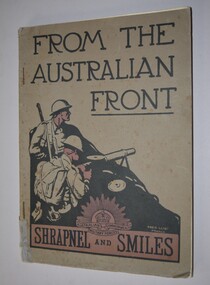
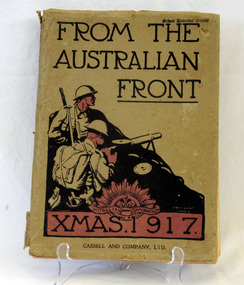
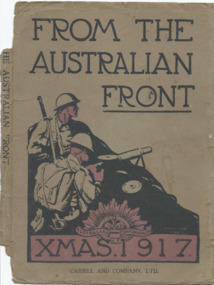
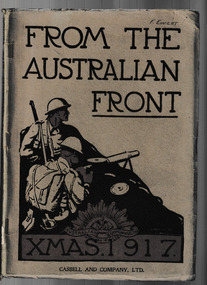
Book, Cassell and Company Ltd, From the Australian Front - Shrapnel and Smiles, 1917
... From the Australian Front - Shrapnel and Smiles......From the Australian Front...Australian Soldier’s Patriotic Fund. The introduction is by William Birdwood dated France 28 September, 1917. It contains 128 pages of black and white sketches and photographs capturing the spirit, humour and hardship of the AIF on the western front. WW1 1917 From ...This book was produced as a Christmas gift with the proceeds going to support the Australian Soldier’s Patriotic Fund. The introduction is by William Birdwood dated France 28 September, 1917. It contains 128 pages of black and white sketches and photographs capturing the spirit, humour and hardship of the AIF on the western front.Soft cardboard covered book depicting two soldiers wearing hard hats on cover above rising sun emblem. It contains 128 pages of black and white sketches and photographs.ww1, 1917, from the australian front, book, shrapnel and smiles -
 Lara RSL Sub Branch
Book, From the Australian Front - Xmas1917
... From the Australian Front - Xmas1917...From the Australian Front - Xmas1917...From the Australian Front - Xmas1917 From the Australian Front - Xmas1917 Book ...From the Australian Front - Xmas1917 -
 Ringwood RSL Sub-Branch
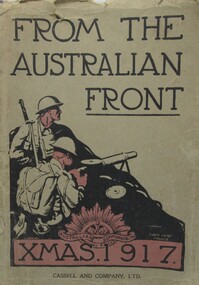
Book - From The Australian Front, Xmas 1917
... From The Australian Front...Xmas 1917 Book From The Australian Front ... -
 Geelong RSL Sub Branch
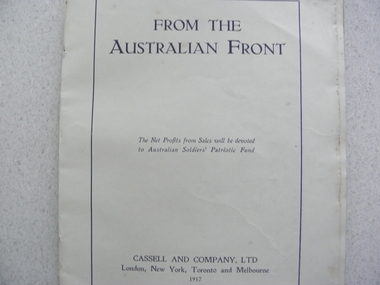
Book, From the Australian Front, 1917
... From the Australian Front...From the Australian Front is a pictorial history of Australians at war in France...From the Australian Front Book Cassell and Company, Ltd ...From the Australian Front is a pictorial history of Australians at war in FranceThis book depicts Australians at War in France during 1917An oblong book, buffy coloured pages, no outer covers.Printed by Cassell and Company, Ltd London, New York, Toronto and Melbourne 1917australia, france ww1 -
 Bendigo Military Museum
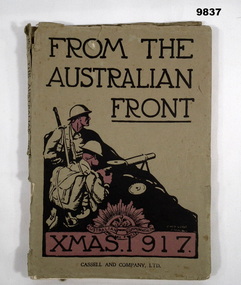
Book - PICTORIAL, WW1, Cassell and Company Ltd/ London, New York, Toronto and Melbourne, "FROM THE AUSTRALIAN FRONT", 1917
... "FROM THE AUSTRALIAN FRONT"...From the front cover; "FROM THE AUSTRALIAN FRONT/ XMAS 1917." ...From the front cover; "FROM THE AUSTRALIAN FRONT/ XMAS 1917." ...From the front cover; "FROM THE AUSTRALIAN FRONT/ XMAS 1917." Soft cover book; Cover - grey colour cardboard. Black colour ink on front, spine and back. Illustrated front - grey, black and pink colour illustration with two soldiers in a trench position, lower edge Rising Sun Badge. Back - Rising Sun Badge in black print. 128 pages - cut, plain, white colour paper. Pictorial book with photographs, sketches and cartoons.publications, books, pictorial, ww1 -
 Orbost & District Historical Society
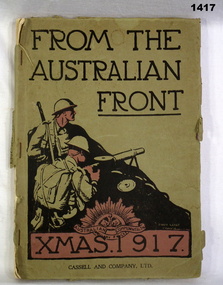
book, Cassell and Company Limited, From The Australian Front, 1917
... From The Australian Front...Grey cardboard covered 128 pp book with black and red writing on cover. the title, "FROM THE AUSTRALIAN FRONT" is in black print at the top above a black drawn sketch of two soldiers behind a mound and holding bayonets. at the foot is XMAS. 1917 inside a red rectangle with the insignia of the Australian Army (the rising sun) at the top. ...It contains cartoons, illustrations and photographs created by the soldiers themselves and put together in the style of an annual. From The Australian Front book Cassell and Company Limited ...This book was produced as a gift for Australian soldiers and their families on the Western Front in 1917. In the introduction General Birdwood, Commander of the ANZACS, explained it was for ‘…those whom we left behind in Australia, and who we know are thinking of us, some idea of our surroundings on the battle fronts…’.This book is a significant contemporary record of life for the Australian soldiers on the Western Front during World War 11.Grey cardboard covered 128 pp book with black and red writing on cover. the title, "FROM THE AUSTRALIAN FRONT" is in black print at the top above a black drawn sketch of two soldiers behind a mound and holding bayonets. at the foot is XMAS. 1917 inside a red rectangle with the insignia of the Australian Army (the rising sun) at the top. It contains cartoons, illustrations and photographs created by the soldiers themselves and put together in the style of an annual. military book-from-the-western-front world-war-11 -
 Bendigo Military Museum
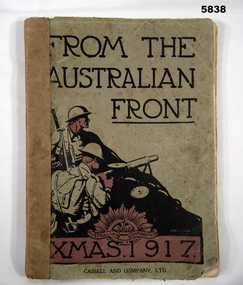
Book, Australian Commonwealth Military Forces, From The Australian Front
... From The Australian Front...Coloured illustration on cover, black & white illustrations, black & white photos. From The Australian Front Book BOOK Australian Commonwealth Military Forces Cassell and Company Ltd ...Green cardboard cover with staples, black print, 128 pages. Coloured illustration on cover, black & white illustrations, black & white photos.books, military history -
 Bendigo Military Museum
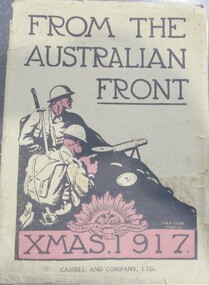
Book - BOOK, WW1, Cassell and Company Ltd/ London, New York, Toronto and Melbourne, "From The Australian Front Xmas 1917", 1917
... "From The Australian Front Xmas 1917"...Pictorial book containing black and white photographs and black and white illustrations and cartoons. "From The Australian Front Xmas 1917" Book BOOK, WW1 Cassell and Company Ltd/ London, New York, Toronto and Melbourne. ...Item in the collection re Ron Bollard VX14150, refer Cat No 5919P for his service details. Soft cover book. Cover - cardboard, black colour print on front and back. Front illustration 3 colour silhouette of two soldiers in a battle scene. Book illustration - Rising Sun Badge. 128 Badges - cut, plain, off white. Pictorial book containing black and white photographs and black and white illustrations and cartoons.Front end papers - owner's name, handwritten blue ink, Kevin Roberts/ 124 Fifth Ave/ Rosebud 3939/ 5986 6663". Next page handwritten - green pencil - child's drawing of 3 circles.books, military history, ww1 -
 Warrnambool RSL Sub Branch
Book, BOOK: From the Australian Front - XMAS 1917 (2 COPIES)
... BOOK: From the Australian Front - XMAS 1917 (2 COPIES)...Publisher: Cassell and Company. 1917 BOOK: From the Australian Front - XMAS 1917 (2 COPIES) Book ... -
 Doncaster RSL Sub Branch
Set of three pamphlets, Cassell and Company Limited, From the Australian Front 1917
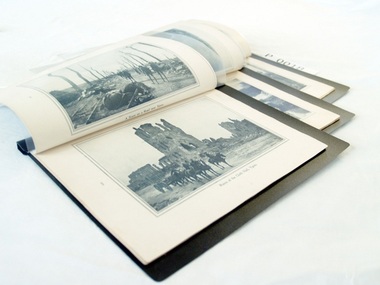
... From the Australian Front 1917...Photographs of scenes on the Western front France where the Australian troops were operating from September 1916 through 1917...Photographs of scenes on the Western front France where the Australian troops were operating from September 1916 through 1917 Three slim pamphlets with white fronts From the Australian Front 1917 Set of three pamphlets Cassell and Company Limited ...Photographs of scenes on the Western front France where the Australian troops were operating from September 1916 through 1917Three slim pamphlets with white fronts -
 Monbulk RSL Sub Branch
Book, Cassell and Company, From the Australian front: Xmas 1917, 1917
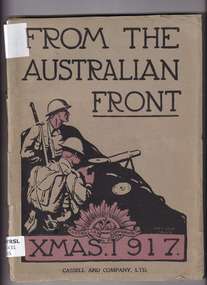
... From the Australian front: Xmas 1917...World War 1914-1918 - Australian involvement World War 1914-1918 - Pictorial works Illustrations (photographs, cartoons and caricatures) of Australian soldiers on the Western front in World War I Ill, p.128. From the Australian front: Xmas 1917 Book Cassell and Company ...Illustrations (photographs, cartoons and caricatures) of Australian soldiers on the Western front in World War IIll, p.128.non-fictionIllustrations (photographs, cartoons and caricatures) of Australian soldiers on the Western front in World War Iworld war 1914-1918 - australian involvement, world war 1914-1918 - pictorial works -
 Ringwood RSL Sub-Branch
Book - WW1, From the Australian Front
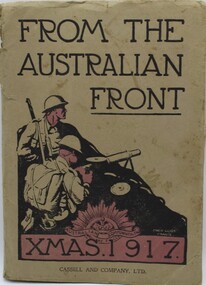
... From the Australian Front...Soft cover, information and black and white photos of Australian Forces on the Western Front in WW1. From the Australian Front Book - WW1 ...Soft cover, information and black and white photos of Australian Forces on the Western Front in WW1. -
Dandenong/Cranbourne RSL Sub Branch
Book, From The Australian Front
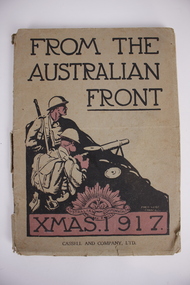
... From The Australian Front...."Xmas 1917 " inscribed under the Rising Sun Badge. From The Australian Front. Book. ...Sepia coloured soft covered book. "Xmas 1917 " inscribed under the Rising Sun Badge.Drawing of 2 soldiers with machine gun. -
 Dandenong/Cranbourne RSL Sub Branch
Book, Cassell and Company, LTD (publisher), From the Australian Front. Xmas 1917, 1917
... From the Australian Front. Xmas 1917...front cover. Australian Commonwealth Military Forces Rising Sun badge printed on rear. Interior is mainly of photos and drawings. Grey cardboard cover with black and red writing on cover. From ...WW1 photos and drawings.Grey cardboard cover with black and red writing on cover.Minnie Dunn of Waldon Hill dated 23/21918 and the name David Kelly is printed in pen inside the front cover. Australian Commonwealth Military Forces Rising Sun badge printed on rear. Interior is mainly of photos and drawings.ww1, photograph, drawing -
Dandenong/Cranbourne RSL Sub Branch
Military Book, "From The Australian Front." Xmas 1917
... "From The Australian Front." Xmas 1917...."From The Australian Front." Xmas 1917. Military Book. ... -
Merbein District Historical Society
Book, From The Australian Front, 1914-1917
... From The Australian Front...General Birdwood From The Australian Front Book ...general birdwood -
 Melbourne Legacy
Book, From the Australian Front. Xmas 1917, 1917
... From the Australian Front. Xmas 1917...from AWM. He spent time with the Australian Field Artillery (Pack Section). At the end of the war he worked for a year at the A.I.F. Headquarters in London before returning to Australia on the 'Ceramic', arriving Portsea in 1920. A record that photos from the trenches were published as a memento of Christmas in 1917, presumably for the troops. world war one souvenir Title page has 'JB McLean / Maffra' handwritten in blue ink. A book of black and white photos and drawings published for the troops in World War 1. From the Australian Front ...A book of drawings and photos published about the trenches in Europe in 1917. Put together by the Australian Commonwealth Military Forces and published by a British publisher. Reproductions of official photographs and cartoons and sketches by members of the A.I.F. Photos show life in the trenches and the war zones, including Ypres, Hill 60, Hindenburg line, Bapaume, Menin Road, Zonnebeke and more. Plus conducting battle operations, Boche prisoners, ruined towns and churches, and the wounded awaiting transport. Most of the drawings are humorous. It is incomplete, the back cover is missing and the pages are only from Page 1 to 24 and 57 to 127. Information from the Australian War Memorial archives says it should have been 157 pages long. Was with other World War 1 memorabilia that has come from Private John Basil McLean, 2nd Reinforcements, 37th Battalion, A.I.F. J.B. McLean (Service No. 13824) was from near Maffra, Victoria and enlisted on 22 January 1916. He embarked on 16 December 1916 for Europe. His full war record is available from AWM. He spent time with the Australian Field Artillery (Pack Section). At the end of the war he worked for a year at the A.I.F. Headquarters in London before returning to Australia on the 'Ceramic', arriving Portsea in 1920.A record that photos from the trenches were published as a memento of Christmas in 1917, presumably for the troops.A book of black and white photos and drawings published for the troops in World War 1.Title page has 'JB McLean / Maffra' handwritten in blue ink.world war one, souvenir -
 Mrs Aeneas Gunn Memorial Library
Book, Cassell, From the Australian front, 1917
... From the Australian front....World War 1914-1918 - Campaigns - Flanders World War 1914-1918 - Pictorial works In illustrated view of the Australian troops in France during World war One Ill, p.127. From the Australian front. Book Cassell Australian Imperial Force 1914-1921 ...In illustrated view of the Australian troops in France during World war OneIll, p.127.non-fictionIn illustrated view of the Australian troops in France during World war Oneworld war 1914-1918 - campaigns - flanders, world war 1914-1918 - pictorial works -
 Flagstaff Hill Maritime Museum and Village
Book - Portfolio, Newcraft Pulicity, The Line of Sail; Magnificent Clipper Ships, 1969
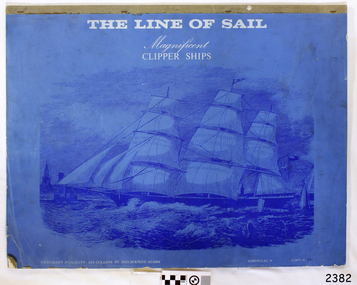
... from being one of a limited edition of books produced. There are copes in both the Victorian State Library and the National Library of Australia. flagstaff hill warrnambool shipwrecked-coast flagstaff-hill flagstaff-hill-maritime-museum maritime-museum shipwreck-coast flagstaff-hill-maritime-village lithographs Newscraft Publicity book The Line of Sail dlipper ships tall shipos sailing ships wood block print newspaper drawings newcraft productions newcraft melbourne portfolio of clipper ships limited edition wooden engravings magnificent clipper ships Stamped on front cover "086" The Line of Sail is a portfolio of sixteen fine line, black and white prints on paper. ...These prints include large sailing ships that were also referred to as Clippers and Tall Ships. These ships were used to transport cargo and passengers across the world in the 19th century. They were powered purely by harnessing the wind. It could take three to four months to sail in this manner from England to Australia. On many occasions the ships were wrecked, often close to their destination, through errors of navigation. The method of production of the original images is over a century old. The Melbourne publisher of this portfolio book, Newcraft Publicity, describes the contents as follows-' Magnificent Clipper Ships: Clipper ships in the line of sail make the most romantic and spectacular pictorial chapter of marine history. This collection depicting early clippers and other types of sailing ships were originally fine engravings on wooden printing blocks used in newspapers a century ago. They were taken directly from the original newspaper prints, and reproduced in enamel inks to provide a choice of fine line prints suitable for framing. LIST OF PRINTS- The New Australian Clipper "BLUE JACKET" The Clipper Ship “CHRYSOLIER” The “GAUNTLET” Clipper Ship The New American Clipper “GREAT REPUBLIC” The Clipper Ship “GUIDING STAR” New Emigrant Ship “HESPERIDES” for the South Australian Line Capt. Beatson’s Expedition in search of Sir John Franklin – the “ISABEL” The Black Ball Line Clipper Ship “JAMES BAINES” The “MERCHANT PRINCE” – Australian Clipper The White Star Line Clipper Ship “MORNING LIGHT” The Aberdeen Clipper Built Barque “PHOENICIAN” New Australian Clipper Ship the “ROYAL FAMILY” The “SOVEREIGN OF THE SEAS” American Clipper The New Iron Clipper Built Ship “TAYLEUR” for Australia H.M. New Frigate “THETIS” The American Clipper Ship “WITCH OF THE WAVE” ABOUT THE PUBLISHER- The Newcraft Publicity was a Melbourne business that operated in the 1960s at 243 Collins Street, Melbourne.This portfolio book of clipper ship prints is historically significant as it shows an important part of Australia's history, It includes some of the shipping lines famous in the 19th century for transporting passengers and goods to Australia. The prints are also significant for their origin in the carved wooden blocks used a century ago for creating images for the newspapers of the time. Book is also significant from being one of a limited edition of books produced. There are copes in both the Victorian State Library and the National Library of Australia.The Line of Sail is a portfolio of sixteen fine line, black and white prints on paper. The subject is clipper ships. The covers are paper-covered card, coloured a strong blue with white line images and text. The image side of the pages has a sheen, the back is matt. Each print has a caption. The top of the book is stapled and bound with grey tape. Produced by Newcraft Publicity, Melbourne. Limited Edition - Copy Number 086. Stamped on front cover "086"flagstaff hill, warrnambool, shipwrecked-coast, flagstaff-hill, flagstaff-hill-maritime-museum, maritime-museum, shipwreck-coast, flagstaff-hill-maritime-village, lithographs, newscraft publicity, book, the line of sail, dlipper ships, tall shipos, sailing ships, wood block print, newspaper drawings, newcraft productions, newcraft melbourne, portfolio of clipper ships, limited edition, wooden engravings, magnificent clipper ships -
 Flagstaff Hill Maritime Museum and Village
Book - Religious Book, Novello and Company Limited, The Australian Psalter, Early 20th century
... London worship music The Australian Psalter Embossed text: "THE / AUSTRALIAN / PSALTER" Emblem: [six stars] around [sun] Stamp: "From the Missions to Seamen Melbourne" The Book, The Australian Psalter, was published by Novello and Company, London. Blue fabric-covered book with gold-embossed text, two bands of seven stars, and an emblem of the sun surrounded by stars on the front cover. ...The Book, The Australian Psalter, was published by Novello and Company, London. Blue fabric-covered book with gold-embossed text, two bands of seven stars, and an emblem of the sun surrounded by stars on the front cover. The book contains the Psalms of David and the Canticles and Proper Psalms Pointed for Chanting. It is stamped with the library stamp Missions and Seamen, Melbourne. The book is now part of the St Nicholas Seamen's Church Collection.flagstaff hill maritime museum and village, flagstaff hill, warrnambool, maritime museum, maritime village, shipwreck coast, great ocean road, religion, religious service, st nicholas seamen’s church, williamstown, missions to seamen victoria, psalter, hymn book, worship service, songs of worship, novello & co. london, worship music, the australian psalter -
 Flagstaff Hill Maritime Museum and Village
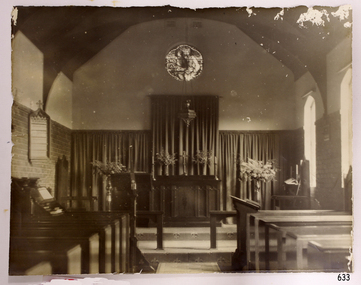
Photograph - Historical, religious, mid-20th century
... from rented premises in Williamstown. In 1878, the Sailors’ Church moved into an old Wesleyan chapel in Ann Street. By the end of that year, they managed to purchase the building, which they had already refurbished. In 1883, they affiliated with the Victorian Seamen’s Mission. A few years later, in 1906, the building had to be demolished because it was no longer safe. While they raised funds for a new building, the Sailors’ Rest temporarily moved to premises in front of Customs House in Nelson Place. Around this time, in 1906, the Ladies Harbour Lights Guild was formed in Australia...from rented premises in Williamstown. In 1878, the Sailors’ Church moved into an old Wesleyan chapel in Ann Street. By the end of that year, they managed to purchase the building, which they had already refurbished. In 1883, they affiliated with the Victorian Seamen’s Mission. A few years later, in 1906, the building had to be demolished because it was no longer safe. While they raised funds for a new building, the Sailors’ Rest temporarily moved to premises in front of Customs House in Nelson Place. Around this time, in 1906, the Ladies Harbour Lights Guild was formed in Australia ...This photograph records the interior of St Nicholas Seamen's Church at 139 Nelson Place, Williamstown, Victoria, which was purchased and furnished around 1943. The furniture and furnishings are now part of the St. Nicholas Seamen's Church collection. HISTORY of the Missions to Seamen: - DETAILED HISTORY of the Missions to Seamen: - The Missions to Seamen is an Anglican (Church of England) charity that has served the world’s seafarers since 1856. It was inspired by the work of Rev. John Ashley, who, 20 years earlier, had pioneered a ministry to seafarers in the Bristol Channel in Great Britain. When Ashley retired, others continued the work, founding the Missions to Seamen. It adopted a Flying Angel as its symbol, inspired by a verse from the Bible in Revelation 14. Today, over 200 world ports have Missions to Seamen centres and chaplains. A Missions to Seamen’s Club warmly welcomes sailors of all colours, creeds and races and provides a wide range of facilities. The Missions to Seamen organisation changed its name to the Mission to Seafarers in 2000, continuing to include Missions to Seamen clubs in Victoria’s cities of Melbourne, Portland, Geelong and Hastings. Flagstaff Hill’s St Nicholas’ Seamen’s Church is named after its namesake from Williamstown, Victoria, which began in 1857. Bishop Perry opened the first Sailors’ Church there, known as ‘Bethel’, on an old hulk floating in Hobson’s Bay, Port of Melbourne. In 1860, a Sailors’ Rest started operating from rented premises in Williamstown. In 1878, the Sailors’ Church moved into an old Wesleyan chapel in Ann Street. By the end of that year, they managed to purchase the building, which they had already refurbished. In 1883, they affiliated with the Victorian Seamen’s Mission. A few years later, in 1906, the building had to be demolished because it was no longer safe. While they raised funds for a new building, the Sailors’ Rest temporarily moved to premises in front of Customs House in Nelson Place. Around this time, in 1906, the Ladies Harbour Lights Guild was formed in Australia to support and raise funds for the Mission to Seamen organisation in Melbourne. Two of the most significant ladies of the Guild were founding members Ethel Godfrey and Alice Sibthorpe. During the Mission's time at Siddeley Street, Melbourne, the activities of the Guild raised funds for the Mission to Seamen's Chapel at their new, and still current, premises in Flinders Street, Melbourne, opened in 1917. The Guild continued its important work until the 1960s. In 1908, the Williamstown Mission had enough money to purchase the former Mascotte skating rink on Thompson Street, Williamstown. In August of that year, they were inaugurated into the Victorian Missions to Seamen. They continued at that venue for a few decades. In 1943, the former ES&A Bank building at 139 Nelson Place, Williamstown, was purchased to become the new Mission to Seamen’s Club. On May 6th, 1944, it was officially opened, described as a ‘distinctive little building’. Funds had previously been raised for the building and furnishing of the chapel at the rear. The chapel was named St Nicholas’ Seamen’s Church, after St Nicholas, fourth-century bishop and patron saint of sailors. Services were held on Wednesdays and Sundays. The church was supported by the Williamstown Lightkeepers’ Auxiliary, newly founded by Mrs Ethel Margaret Musther in 1943, as well as the Harbour Lights Guild and the League of Soldiers’ and Sailors’ Friends. The Williamstown Mission to Seamen’s Church operated until 1966, when large international ships no longer used the Port of Williamstown. The Commonwealth Government then leased the premises. In the formative years of Flagstaff Hill Maritime Village, the Advisory Board decided to include a Missions to Seamen Chapel and Recreation Room in its village. The Missions organisation was a significant feature of ports during the late 1800s and early 1900s, the period that the Village represents. They often erected Missions to house social and worshipful activities for seamen. Flagstaff Hill’s curator, Mr Ken Marshman, approached the Melbourne Board of Management of Missions to Seamen regarding the Williamstown branch. Consequently, the Board permitted the furnishings of the Williamstown chapel to be transferred to Flagstaff Hill Maritime Village. A provision of the transfer was that the Victoria Missions to Seamen be recognised, that the items would remain as a collection, and that the chapel would be called St Nicholas Seamen’s Church and conduct Divine services. The donation was approved on 21st May 1979. Flagstaff Hill's St. Nicholas Seamen's Church: - The idea behind Flagstaff Hill’s Missions to Seamen’s Church was partly driven by the offer of Stained Glass Memorial Windows that originated from the Warrnambool and District Base Hospital, which was undergoing multi-storey expansion in the late 1960s and early 1970s. The hospital’s Manager/Secretary was eager to see the historic window installed in a suitable place. The church, or chapel, was designed by a local architectural draftsman in collaboration with the Flagstaff Hill Planning Board and was constructed by Mr Leon Habel. The designers hoped that the church would be used for formal worship such as weddings, funerals, and multi-denominational special services like war commemorations. The design is inspired by the ‘Missions to Seamen’ buildings in Portland and the Port of Melbourne. The furniture and furnishings were placed as accurately as possible according to photographs of the Williamstown St Nicholas Seamen’s Church and with assistance from local clergy. The Recreation Room was furnished and arranged on advice from experienced members of the Missions to Seamen organisation. A framed document in the building recognises the donor of the furnishings, Victoria Missions to Seamen, and includes the names of some original donors and their donated item/s. The building’s design incorporates local features such as Warrnambool sandstone, which was no longer commercially available but was procured from demolished buildings and uniformly cut to use as a veneer over the stronger Mt. Gambier stone. Also, traditional green American roofing slate was used, sourced from the 1908 local shipwreck “Falls of Halladale” by Flagstaff Hill volunteer divers. The bell tower includes a bell believed to be from a local shipwreck. Additional furnishings were acquired locally, along with several items donated by Warrnambool residents. Light fittings in both rooms were assembled to simulate 19th-century gas light fittings. The stained-glass window at the back of the church is a memorial to Dr Connell, a well-respected member of the Warrnambool community. It was originally installed in 1928 in the main building of Warrnambool Hospital. The St Nicholas’ Seamen’s Church at Flagstaff Hill was officially opened by His Worship the Mayor, Cr. John Lindsay, on Sunday, 11th October 1981. The event included a service of thanksgiving conducted by the Warrnambool Ministers Fraternal. Since then, the Chapel has been the historic venue for many weddings. This photograph is significant through its association with the St Nicholas' Mission to Seamen Church in Williamstown, Melbourne, established in 1857. The building in the photograph is the former English, Scottish and Australian Bank (ES&A bank), also known as the Mission to Seamen. It is listed on the Victorian Heritage Database for having local historic and aesthetic interest. Photograph of St Nicholas Seamen's Church, Williamstown. Sepia photograph. The photograph shows the inside of the Chapel of Mission to Seamen, including organ, pews and other furniture and furnishings. There is a circular stained glass window high on the back wall depicting a sailor at the helm of a ship and a man standing behind him and pointing the way - "Christ Showing The Helmsman The Way". A Sanctuary Light is suspended from the ceiling. The Sanctuary chars are visible. This shows the St Nicholas Seamen's Church in Williamstown, the furnishings and furniture of which is now part of the St Nicholas Seamen's Church Collection’.flagstaff hill, warrnambool, shipwrecked-coast, flagstaff-hill, flagstaff-hill-maritime-museum, maritime-museum, shipwreck-coast, flagstaff-hill-maritime-village, st nicholas mission to seamen's church williamstown, mission to seamen williamstown, mission to seamen victoria, st nicholas mission to seamen, chapel window, christ showing the helmsman the way, stained glass window, st nicholas seamen's church, religion, religious service, sailor's rest, ladies harbour light guild -
 Flagstaff Hill Maritime Museum and Village
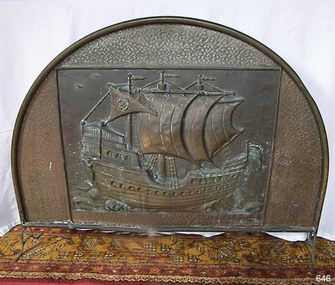
Domestic object - Fire screen
... This decorative fire screen is placed in front of an open fireplace to prevent hot sparks and ash from causing damage. Open fires were common in Australia in the 19th and early 20th century, for both cooking and heating....This decorative fire screen is placed in front of an open fireplace to prevent hot sparks and ash from causing damage. Open fires were common in Australia in the 19th and early 20th century, for both cooking and heating. flagstaff hill warrnambool shipwrecked-coast flagstaff-hill flagstaff-hill-maritime-museum maritime-museum shipwreck-coast flagstaff-hill-maritime-village fire screen fire guard domestic item heating cooking Fire screen, crescent shaped, brass pressed sheet, with a ship motif within a rectangular area. ...This decorative fire screen is placed in front of an open fireplace to prevent hot sparks and ash from causing damage. Open fires were common in Australia in the 19th and early 20th century, for both cooking and heating.Fire screen, crescent shaped, brass pressed sheet, with a ship motif within a rectangular area. Ship is a 3 masted sailing vessel, a Spanish galleon. Made in England, c. 1930.flagstaff hill, warrnambool, shipwrecked-coast, flagstaff-hill, flagstaff-hill-maritime-museum, maritime-museum, shipwreck-coast, flagstaff-hill-maritime-village, fire screen, fire guard, domestic item, heating, cooking -
 Flagstaff Hill Maritime Museum and Village
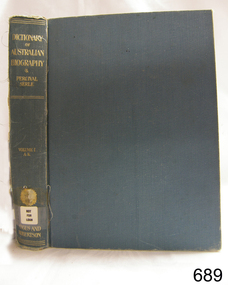
Book, Dictionary of Australian Biography Vol 1
... flagstaff hill warrnambool shipwrecked-coast flagstaff-hill flagstaff-hill-maritime-museum maritime-museum shipwreck-coast flagstaff-hill-maritime-village dictionary of australian biography vol 1 book dictionary biography Warrnambool Public Library Label on spine cover with typed text 929 SER Pastedown front endpaper has sticker from Warrnambool Public Library Dictionary of Australian Biography Vol 1 Author: Percival Serle Publisher: Angus & Robertson Date: 1949 Dictionary of Australian Biography Vol 1 Book ...Dictionary of Australian Biography Vol 1 Author: Percival Serle Publisher: Angus & Robertson Date: 1949Label on spine cover with typed text 929 SER Pastedown front endpaper has sticker from Warrnambool Public Libraryflagstaff hill, warrnambool, shipwrecked-coast, flagstaff-hill, flagstaff-hill-maritime-museum, maritime-museum, shipwreck-coast, flagstaff-hill-maritime-village, dictionary of australian biography vol 1, book, dictionary, biography, warrnambool public library -
 Flagstaff Hill Maritime Museum and Village
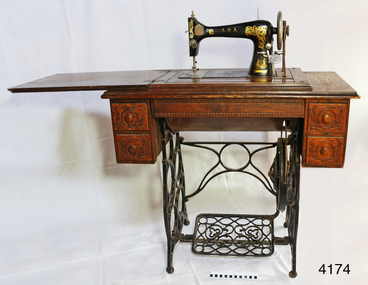
Domestic object - Sewing Machine, Early 20th century
... An item fabricated in Australia from a majority of imported parts from either Germany, America or England giving a snapshot into the early manufacturing industries that were operating at the time of Federation. flagstaff hill warrnambool shipwrecked coast flagstaff hill maritime museum maritime museum shipwreck coast flagstaff hill maritime village great ocean road ward bros. australian sewing machine co. a.n.a. treadle sewing machine rocket shuttle sewing machine home industry clothing wardana australian sewing machine company all native australian dressmaking clothing manufacturer Decal coat of arms on right front of machine: kangaroo on left, man with broad-brim hat, holding pick-axe on right, in centre, top “SEWING MACHINE / THE / A. ...Ward Brothers (George and Samuel) registered a company (Australian Sewing Machines Limited Pty Ltd) with the head office address in Errol St, North Melbourne, and Prahan. The earliest newspaper advertisement for this company was in 1897. Around this time the Ward Brothers first imported sewing machines from England and Wertheim placed their decal on them and mounted them in their own Australian made cabinets. David Ward later imported machines from Beisolt & Locke in Germany and registered name A.N.A. (All Native Australian), his shop was in Collingwood Melbourne. Some of these machines had Ward Brothers decals on them as well. The three brothers sold under the same name as Ward Brothers. The early Ward Brothers logo had a map of Australia with a picture of all three brothers on it. In 1911 all three of the Ward Brothers decided to share a stall in the yearly Melbourne exhibition. The A.N.A was the machine that got rave reviews. It was at this time that the Australian Sewing Machine Company Pty Ltd decided to add the A.N.A logo to their logo to cash in on the new found celebrity status that the A.N.A has gained. To cut a long story short. David Ward took his brothers to court to prevent this from happening. This was a long drawn out affair that took quite a few years. The settlement was decided out of court and nothing was disclosed of the deal that was made. David seemed to have left the scene, then the remaining Ward Brothers and A.N.A. combined and then became “Wardana”. There are many Ward Brothers sewing machines in displays, they originated from Japan, England, America, and Germany. It seems that where ever they got the best deal for sewing machines or parts is the direction they went. This is where the Bendigo sewing machine company came into the picture. All imported sewing machines into Australia drew a government tax. Bendigo Cording's Traction Company was given proposed two-pound tariff protection that gave the company a significant price advantage for its machines. As a result, the Ward Brothers purchased a huge number of Bendigo shares to get cheaper machines for their sewing machine cabinets. Ward Brothers then placed one of their company officials on the Board of “Bendigo Sewing Machines Limited” and the rest is history. Ward Brothers had shops Australian wide and in most of the major country towns. History for “Bendigo Sewing Machines Limited” Cordings Traction Company owners (H. Keck MLC, W. Wallace, and W. Ewing) operated their business out of the former W. Webb & Co. building in Queen St. Bendigo. Around 1923-1924 they decided to switch from traction engines to manufacturing sewing machines. The actual date is not known but that year's financial report made note of both Cordings and Bendigo Sewing Machines Limited. The switch was made with the government of the day agreeing to a tariff of two pounds per head for every machine head made completely in Australia. The change from traction engines to sewing machines went well. Government representatives visited the factory in Bendigo to inspect and ensure that the sewing machines were Australian made as a result they agreed on granting the two-pound tariff to the company. After the first 12 months, they built 30, the following 12 months the company had produced 1500 machines probably due to the involvement of the Ward brothers. However, the government proposed a new condition to the tariff agreement which was that the company must produce 20% of Australia's requirements for sewing machines. In 1924 after having had produced 1500 machines resulting in reaching their financial limit for tariff support. According to the government, the requirement was 15,000 machines for the next year had to be produced to qualify for the tariff. The company had already reached its production limit and unfortunately folded. There were several attempts to regain government assistance to save this new industry but it was to no avail. Even a promise to open another factory in Sydney was offered but unfortunately wasn't accepted. An item fabricated in Australia from a majority of imported parts from either Germany, America or England giving a snapshot into the early manufacturing industries that were operating at the time of Federation. Sewing machine, treadle, in timber cabinet. Branded Ward Bros, A.N.A., Australian Sewing Machine Coy. Decorative carved timber cabinet, hinged, fold-out laminated timber top and five drawers; two small on each side with handles and one long, shallow, between side drawers without handle. Thread is on bobbin in a rocket shuttle (both in good condition) plus spare empty shuttle (rusty). Brass ‘Half Yard’ ruler inlaid across front, measuring scale in inches and centimetres. Two metal shuttle cover plates (or throat plate / slide plate); front one is impressed with a gauge for needle and thread. Gold trim and decals on flatbed and machine front and back, serial number under shuttle cover, brand on decals and on round metal plate on back of machine. Front right of machine has a bobbin winder. Treadle belt shows signs of wear and laminate on timber machine cover is peeling slightly.Decal coat of arms on right front of machine: kangaroo on left, man with broad-brim hat, holding pick-axe on right, in centre, top “SEWING MACHINE / THE / A. N. A.” then below it, the rising sun, then below that is state of Victoria shield with the Southern Cross constellation. Wheat sheaves around edge on left and flowering plant on right. Gold ribbon banner at bottom with script “WARD BROS.“ Decal of map of Australia on flatbed of machine. States and capital cities are marked and named (no northern territory), portrait of two men. In centre of map are interwoven letters “A. N. A.” and written in script “WARD BROS.” Decal across front of machine body has large, decorated gold lettering “A. N. A.” Decal across the top of machine “THE AUSTRALIAN SEWING MACHINE COY. PTY. Ltd.” Steel shuttle cover at front has an impressed gage listing cotton and needle sizes and number of stitches. Brass disc on back of machine “A. N. A.” in centre. Brass ruler across front of machine has carved or pressed words in the timber. In centre “INCHES” above ruler and “CENTIMETRES” below ruler, and on right above ruler is “HALF YARD” Decal across back of machine’s body “A.N. A. / MADE IN U.S.A.” Stamped into metal under shuttle cover is “219415” (2 and 5 are partially there, first 1 could instead be a 7) flagstaff hill, warrnambool, shipwrecked coast, flagstaff hill maritime museum, maritime museum, shipwreck coast, flagstaff hill maritime village, great ocean road, ward bros., australian sewing machine co., a.n.a., treadle sewing machine, rocket shuttle sewing machine, home industry, clothing, wardana, australian sewing machine company, all native australian, dressmaking, clothing manufacturer -
 Flagstaff Hill Maritime Museum and Village
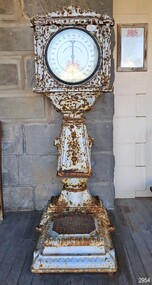
Instrument - Scale, Weighing Machine, G. Salter & Co, 1884-1909
... front top of the stand. The top of the pedestal has a small keyhole. The size of the coin slot fitted a penny coin, and the weight measurements on the face were in Imperial stones and pounds. Quite some time after 1966, when Australia introduced new decimal weights, measurements and currency, the scale was updated; the coin slot size was changed, and a new face with metric measurements was installed. The scale now accepts a $1 coin (one dollar) and the scale measures weight in kilograms and grams, from...front top of the stand. The top of the pedestal has a small keyhole. The size of the coin slot fitted a penny coin, and the weight measurements on the face were in Imperial stones and pounds. Quite some time after 1966, when Australia introduced new decimal weights, measurements and currency, the scale was updated; the coin slot size was changed, and a new face with metric measurements was installed. The scale now accepts a $1 coin (one dollar) and the scale measures weight in kilograms and grams, from ...This ornate, Victorian-era automatic weighing machine was made in England around 1884-1909, by George Salter and Co. of West Bromwich, UK, makers of scales since 1760. It is protected by Queen Victoria’s Royal Letters Patent, signed in 1900. The scale stood outside the Warrnambool Post Office in Timor Street from around 1909 to 1966, as shown on postcards and photographs held at the State Library of Victoria. The scale is identified by the Serial Number '665', and was installed by the distributors, the Australasian Automatic Weighing Machine Co. Ltd.. The scale’s weight measurements were in Imperial stones and pounds up to 20 stone (127 kg). The scale’s face included charts of average weights, for men, women, boys and girls, by various heights, in feet and inches. The coin slot and its face were converted to metric measurements by the Eastern Scale Company Pty. Ltd; that firm was registered on October 2, 1974. The Australasian Automatic Weighing Machine Co. Ltd was a large supplier of weighing scales in Australia and held the Royal Letters patent for their machines, distributing them in prominent locations. In 1902, the firm was listed under the Import Entries Passed at His Majesty’s Customs, importing into Sydney, NSW, eight cases of scales. In 1911, the company asked permission from the Port Pirie Corporation to install a machine in Alexander Street. In 1913, the company applied to the City of Sydney to install machines around the city, including at the tram depot. One application mentions “… three machines in three places for three pounds per year”. In 1923, the firm tendered for the right to place Automatic Weighing Machines on railway and tram premises throughout New South Wales, subsequently for five-year terms, in return for a fixed payment per machine and a portion of the revenue to the NSW Government. In 1928, the Sydney Harbour Trust gave the firm the right to place the weighing machines on various ferry jetties. The firm was still operating in 1941, advertising for two boys aged 14-16 for the workshop and messages, at the Rialto building, 497 Collins St., Melbourne. On December 21, 1946, the Commonwealth government invited offers to tender for the right to place automatic weighing machines on postal premises throughout the six states; the successful company then made arrangements with the federal Postmaster General's Department to place machines outside post offices across the country. A few years later, on September 11, 1950, the firm's Adelaide branch ceased trading. From 11th July 1950, the Australian and Eastern Engineering Company Pty. Ltd took over at the same premises, at 179 Pirie Street, Adelaide. The Perth branch ceased business in WA on July 6th, 1950. Percival Everitt invented and patented the automatic, coin-operated personal scale design. Everitt was a Norfolk-born engineer and regarded as the father of the coin-operated industry. As a young man in 1877, he invented a hay and corn pitcher, a turnip thinner in 1878 and an Automatic Travelling Anchor in 1880. But his fame came in 1883 with the first postcard-vending machine, over a hundred of which he distributed around London. In 1884, he patented one of his many inventions, the coin-operated scales for use in public places; for many people, it was their first exposure to coin-operated machines. His success prompted the formation of the Weighing Machine Company in 1885. Further inventions followed: a blow tester in 1887, the machine for testing a person's grip in 1888, and in 1889, the dispensing machine for hiring out opera glasses, and a device for shutting down the coin entry slot if the machine was empty. In 1890, he invented a fortune-telling machine. Everitt sadly did not make his fortune; he died suddenly in February 1893, in his late forties, with £71 to his name. George Salter & Co., West Bromwich, England, produced automatic weighing scale machines from Everitt’s patented design, and advertised them as suitable for hotels, pleasure gardens, theatres, exhibition halls, clubs, baths and places of public resort. The company was established in 1760 by brothers Richard and William Salter, and manufactured springs and pocket steelyards (spring balances). After several generations, the company was taken over in 1855 by a nephew, George, and renamed George Salter & Co. In 1884, Salter registered the trademark of a Staffordshire knot pierced by an arrow. The company's expanded range of products included the first coin-operated public weighing machines in the 1880s and, in 1895, the first English-made typewriter. In 1915, Salter became a limited company, Geo. Salter & Co. Ltd. When the last George Salter died in 1917, the company passed into the hands of other relatives, but continued to grow before being bought out by Staveley Industries in 1973. Despite several subsequent mergers, the Salter name continues to be seen on household products such as digital scales. This patented, coin-operated weight machine is significant for its association with Percival Everitt, the inventor of the world’s first slot machine, with the renowned maker of scales, G. Salter & Co., which began operating in 1760, and also with the Australasian Automatic Weighing Scale Co., which imported and widely distributed the scales throughout Australia from the early-to-mid 20th century. It is a rare example of an early vending machine used in public places from the late 19th through to the mid-20th century. These machines were the early step in the evolution of coin-in-the-slot machines, which are still used today. The scales give a glimpse into our history; they became quickly popular with the public, which, until then, had little access to weight scales apart from those at medical services. They also provided inexpensive entertainment for families, especially while waiting for trains or visiting the post office. The machines were also attractive and lucrative to the distributors; once installed, they required very little maintenance, and their low cost to customers kept the money coming in. This automatic weighing machine is also significant for its decades of service to the local and regional community of Warrnambool, for personal and commercial purposes. A public coin-operated weighing scale, also called a penny scale. It is a large, silver-painted cast metal stand with a square top on a pedestal that flares outwards to join a rectangular platform base with posts on the side and corners that may have had fitted wheels. The round, white face on top has red and black measurements and inscriptions. A slim indicator with a point at one end and an arc at the other is attached to the face’s centre. The coin slot is above the face, on the left, and the scale’s identification number is engraved on an oval plate on the right. Moulded motifs decorate the pedestal’s front and are repeated on its sides; they depict a tall, narrow urn with a bowl on top and fancy scrolls on either side. There is a decorative panel across the front top of the stand. The top of the pedestal has a small keyhole. The size of the coin slot fitted a penny coin, and the weight measurements on the face were in Imperial stones and pounds. Quite some time after 1966, when Australia introduced new decimal weights, measurements and currency, the scale was updated; the coin slot size was changed, and a new face with metric measurements was installed. The scale now accepts a $1 coin (one dollar) and the scale measures weight in kilograms and grams, from 0 to 125 kg.. The rear of the scale has a small, rectangular metal plate with printed text. The scale was made by G Salter & Co. of West Bromwich, UK, distributed by the Australasian Automatic Weighing Platform Co., and updated to metric measurements by Eastern Scale Co. Pty Ltd. It was previously installed at the Warrnambool Post Office. Engraved on an oval plate on the right: "665" Top centre of the face, in red: "$1 coin" Top of face: "EASTERN SCALE CO. PTY LTD" Base of face, in red: "[Royal Coat of Arms of Britain]" with words, below in red: "BY ROYAL LETTERS PATENT" Around the face, in black: "[numbers 0 to 125, in increments 5, and makes between the numbers for each 500g]" "kg" Below the face, moulded letters within a shield: "AUSTRALASIAN AUTOMATIC WEIGHING MACHINES CO. LTD." At the back of the weighing platform: "G SALTER & CO. / WEST BROMWICH", remnants of logo “[Staffordshire knot pierced by an arrow]” Plate on rear: THIS SCALE REMAINS THE PROPERTY OF EASTERN SCALE CO. PTY. LTD., 8 GEORGE COURT, GREENSBOROUGH, VIC, 3088. PHONE (03 ) _ 34 _ _ 33” (434 9333 ?_flagstaff hill, warrnambool, maritime village, maritime museum, flagstaff hill maritime museum and village, shipwreck coast, great ocean road, scale, weighing scale, salter, australasian, 1 dollar, $1 coin, 1p, 1 penny coin, penny scale, coin in slot scale, eastern scale co. pty. ltd., british royal coat of arms, royal letters patent, letters patent, health, ending machine, coin-operated machine, percival everett, weighing machine co., george salter & co., g salter & co, west bromwich, vending machine, weights & balances, measurements, slot machine, coin operated machine, penny-in-the-slot, coin fed, coin op scale, weights & measures, australasian automatic weighing machine co. ltd., warrnambool post office, machine 665, no. 665, blalnce technology, scales and weights, weights and measures, penny weight scales, vintage, weighing machine, coin in the slot, coin operated, public scale, public weighing machine, penny-weighing machines, penny weighing machines, penny scales, coin operated weighing machine, scale weighing machine -
 Flagstaff Hill Maritime Museum and Village
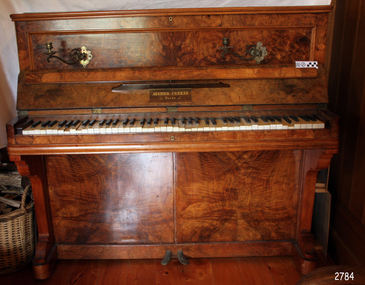
Instrument - Musical, Piano, Aucher Freres, circa 1880-1920
... Australian products, thus going against what the Loyal Liberals own protectionist policy. The writer goes on to state that several pianos made in the Colony compared very favourably at the International Exhibition with those manufactured by the English or French. He then says that “… the secretary … might learn a lesson from his piano ... the name Aucher Freres, Paris emblazoned on its front...Australian products, thus going against what the Loyal Liberals own protectionist policy. The writer goes on to state that several pianos made in the Colony compared very favourably at the International Exhibition with those manufactured by the English or French. He then says that “… the secretary … might learn a lesson from his piano ... the name Aucher Freres, Paris emblazoned on its front ...This piano was made by Aucher Freres of Paris, said to be famous for its pianos in the mid-late 1800s. Aucher Freres (Aucher Brothers) produced a model of piano that was built specifically for use on sailing vessels, the upright yacht-style piano. Pianos were amongst the domestic goods brought to Australia by many colonial immigrants. They were also imported by Australian distributors by the shipload and sought after by settlers. A piano was often found in a Missions to Seamen club room, where visiting seafarers would entertain or be entertained by music and song as part of their relaxation in port. A sarcastically written news article of January 2nd 1869 reported that the Secretary of the Loyal Liberals of Ballarat, Mr Henry Bell, was presented both with a “illuminated address” and a piano. The piano was made by Aucher Freres of Paris and was purchased for sixty guineas (which converts to around $7,500 Au in 2019). The gift was criticised for encouraging foreign industry rather than native Australian products, thus going against what the Loyal Liberals own protectionist policy. The writer goes on to state that several pianos made in the Colony compared very favourably at the International Exhibition with those manufactured by the English or French. He then says that “… the secretary … might learn a lesson from his piano ... the name Aucher Freres, Paris emblazoned on its front should be … a perpetual reminder of the hollowness of that protectionist imposture …” [Refer to Intercolonial News, Victoria, originally published in The Argus, was repeated in the Wallaroo Times and Mining Journal of South Australia 2-1-1869.] Aucher Freres pianos were still around in 1930. A second-hand model was advertised for sale as a good practice piano. The advertisement was placed by the Mount Gambier, SA, agents for Saver’s Pianos Ltd of Adelaide. The piano was described as “a sound little instrument of good tone and appearance”. The asking price in November 1930 was 32 pounds and ten shillings (which converts to about $2,500 Au in 2019). [Refer to Savery’s advertisement, Mt Gambier Border Watch 11-11-1930]This piano is significant for its connection with the time period of chapel and club room at Flagstaff Hill's St Nicholas Seamen's Church. It represents the form of entertainment enjoyed by seafarer's world wide, which is appropriate for a maritime village. The maker of the piano is famous for its quality pianos of the 19th and early 20th century.Piano, upright, polished wood. The wooden hinged keyboard cover lifts up to allow access to the keyboard. The piano also has two brass candlesticks. The top of the piano is hinged and lifts up to allow access to the piano mechanic's inside for tuning and maintenance. The inside flap has a music stand incorporated into it. It also has the usual two hard-soft pedals at the base. There are two brass decorated hooks at each end to allow for ease of movement when the position of the piano is changed. Maker's name inscribed inside keyboard lid in gold lettering. Made in Paris by Aucher Freres (Aucher Brothers)."AUCHER FRERES / Paris" (NOTE: the "C" is sometimes mistaken for a "G")flagstaff hill, warrnambool, shipwrecked-coast, flagstaff-hill, flagstaff-hill-maritime-museum, maritime-museum, shipwreck-coast, flagstaff-hill-maritime-village, piano, music, upright piano, paris, france, aucher freres -
 Flagstaff Hill Maritime Museum and Village
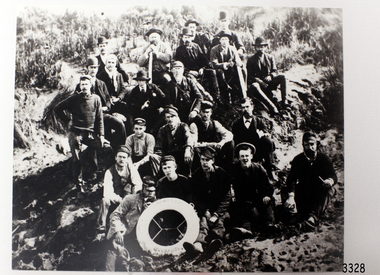
Photograph - Ship Crew, 1889-1892
... from the Newfield, Liverpool, resting on the men in the front row. The men are formally dressed, some with bowler hats, a bow tie and pipe, rather than in their sailing uniforms. ABOUT THE NEWFIELD The Newfield left Sharpness, Scotland, on 28th May 1892 with a crew of 25 under the command of Captain George Scott and on 1st June left Liverpool. She was bound for Brisbane, Australia...from the Newfield, Liverpool, resting on the men in the front row. The men are formally dressed, some with bowler hats, a bow tie and pipe, rather than in their sailing uniforms. ABOUT THE NEWFIELD The Newfield left Sharpness, Scotland, on 28th May 1892 with a crew of 25 under the command of Captain George Scott and on 1st June left Liverpool. She was bound for Brisbane, Australia ...This black and white photograph shows the crew of the barque Newfield. They are pictured seated on a grassy slope and rock, a lifebuoy from the Newfield, Liverpool, resting on the men in the front row. The men are formally dressed, some with bowler hats, a bow tie and pipe, rather than in their sailing uniforms. ABOUT THE NEWFIELD The Newfield left Sharpness, Scotland, on 28th May 1892 with a crew of 25 under the command of Captain George Scott and on 1st June left Liverpool. She was bound for Brisbane, Australia, with a cargo of 1850 tons of fine rock salt, the main export product of Sharpness. At about 9pm on 28th August 1892, in heavy weather, Captain Scott sighted, between heavy squalls, the Cape Otway light on the mainland of Victoria but, due to a navigational error (the ship’s chronometers were wrong), he assumed it to be the Cape Wickham light on King Island, some 40 miles south. He altered his course to the north, expecting to enter Bass Strait. The ship was now heading straight for the south west Victorian coast. At about 1:30am the Newfield ran aground on a reef about 100 yards from shore and one mile east of Curdie’s Inlet, Peterborough. The ship struck heavily three times before grounding on an inner shoal with 6 feet of water in the holds. Rough sea made the job of launching lifeboats very difficult. The first two lifeboats launched by the crew were smashed against the side of the ship and some men were crushed or swept away. The third lifeboat brought eight men to shore. It capsized when the crew tried to return it to the ship for further rescue The rescue was a difficult operation. The Port Campbell Rocket Crew arrived and fired four rocket lines, none of which connected with the ship. Peter Carmody, a local man, volunteered to swim about one mile off shore to the ship with a line to guide the fourth and final lifeboat safely to shore. He was assisted by James McKenzie and Gerard Irvine. Seventeen men survived the shipwreck but the captain and eight of his crew perished. The Newfield remained upright on the reef with sails set for a considerable time as the wind slowly ripped the canvas to shreds and the sea battered the hull to pieces. The Marine Board inquiry found the wreck was caused by a "one man style of navigation" and that the Captain had not heeded the advice of his crew. According to Jack Loney ‘… when the drama was over . . the Newfield was deserted except for the Captain’s dog and two pigs.’ Peter Carmody was awarded the Bramley Moore medal by the Liverpool Shipwreck and Humane Society for Saving Life at Ssea, which he received by mail on January 21st 1893. Flagstaff Hill’s collection of artefacts from the Newfield is significant for its association with the shipwreck Newfield, which is listed on the Victorian Heritage Registry. The collection is significant because of the relationship between the objects. The Newfield collection is archaeologically significant as the remains of an international cargo ship. The Newfield collection is historically significant for representing aspects of Victoria’s shipping history and its association with the shipwreck. The Letter accompanying the Medal for Bravery awarded to Peter Carmody is significant because the attempt to save lives is associated with the shipwreck Newfield. Black and white photograph of the crew of the sailing ship “Newfield”. The men in formal dress are seated on rocky slope with the ship’s lifebuoy showing the name “NEWFIELD, LIVERPOOL”. Photograph taken 1889-1892 flagstaff hill, warrnambool, shipwrecked-coast, flagstaff-hill, flagstaff-hill-maritime-museum, maritime-museum, shipwreck-coast, flagstaff-hill-maritime-village, newfield, photograph, crew of the newfield, 19th century sailing ship, peterborough, cape otway, medal for bravery -
 Federation University Historical Collection
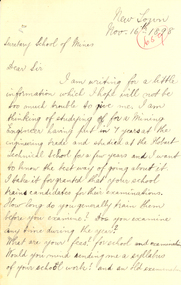
Letter - Correspondence, Edgar McConnon, Letter from Edgar McConnon to Ballarat School of Mines, 1898, 16/11/1898
... The Ballaray School of Mines is a predecessor institution of Federation Univerity Australia, Ballarat School of Mines McConnon Edgar McConnon New Town Mining Engineering Hobart Ballarat Tasmania New Town Front: 659 handwritten in circle on top right hand page Inside on right hand page: "Replied to 6 Dec" in handwriting in middle of right hand page Four cream blue feint lined pages folded with handwriting in black ink on two pages Letter from Edgar McConnon to Ballarat School of Mines, 1898. ...The Ballaray School of Mines is a predecessor institution of Federation Univerity Australia, Four cream blue feint lined pages folded with handwriting in black ink on two pagesFront: 659 handwritten in circle on top right hand page Inside on right hand page: "Replied to 6 Dec" in handwriting in middle of right hand pageballarat school of mines, mcconnon, edgar mcconnon, new town, mining engineering, hobart, ballarat, tasmania, new town -
 Federation University Historical Collection
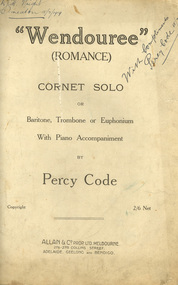
Booklet - Sheet Music, Allan & Company Pty Ltd, "Wendouree", Romance by Percy Code, 1919
... From 1938, as part of Australia's Sesqui Centenary celebrations, Percy Code conducted the Sydney Symphony Orchestra for the ABC orchestral concerts in Sydney Town Hall. His career with the ABC came to an end in late 1951 due to poor health. Percy Code died on 17 October 1953. From 'Legend in Brass' with additions from Bob Pattie of the Ballarat Brass Band. cornet Frank Wright Allan & Co. Allans Music Ballarat South Street Percy Code Code Wright sheet music "Wendouree" (Romance) Wendouree Romance Wendouree .1) Front ...This music was used by Frank Wright who had been tutored by Percy Code. Frank Wright won the Australian Open Cornet Championship using this music, and won the gold medal for the highest mark in the British Colonies. Percy Code was born in Melbourne on 03 July 1888. He started learning the violin and piano at the age of eight. Three years later his father, Edward, started tutoring him on the cornet. His first competition was in October 1902 in Ballarat's South Street Competitions. Percy Code was Musical Director of Ballarat City Brass Band from 1913 until 1921. He was Frank Wright's teacher. Code apparently lived in a large house just west of where St Peter's church (Ballarat) now stands. Percy Code toured the world as principal cornet with the 'Besses o' th' Barn Band.' He returned to Australia in 1912. Frank Wright at one stage rode his pushbike from Smeaton to Ballarat for lessons. Leaving Australia for America in March 1921 Percy Code obtained an appointment as trumpet soloist for the 70 piece San Francisco Symphony Orchestra. He returned home two years later and became bandmaster to the Prahran City Band in 1925. From 1938, as part of Australia's Sesqui Centenary celebrations, Percy Code conducted the Sydney Symphony Orchestra for the ABC orchestral concerts in Sydney Town Hall. His career with the ABC came to an end in late 1951 due to poor health. Percy Code died on 17 October 1953. From 'Legend in Brass' with additions from Bob Pattie of the Ballarat Brass Band.11071.1 Four cream pages containing handwritten title page in front, two sheet music pages inside and blank back cover. 11071.2 Eight cream pages containing front page typed title with handwritten text at top, Six pages of sheet music cream pages, with parts for piano and cornet, with black printed notes. A photograph of the composer Mr Percy Code is glued into the first page at the top left hand corner. The back cover page has advertisements for four music albums from Allan & Co. Prop. Ltd..1) Front page handwritten in blue pen and pencil. Hand written notations in pencil for cornet throughout sheet music pages. Frank Wright Smeaton 15 July 1919 in top right hand corner; Champion Bb cornet solo South Street 1919 in top left hand corner. Under title on front page: Handwritten notes in pencil giving results of competition and judge's comments. 2) Frank H. Wright Smeaton 15/7/1919 handwritten in top left hand corner. "With Compliments Percy Code 15/7/1919 written diagonally in blue pen in at right hand top.cornet, frank wright, allan & co., allans music, ballarat, south street, percy code, code, wright, sheet music, "wendouree", (romance), wendouree, romance, wendouree -
 Federation University Historical Collection
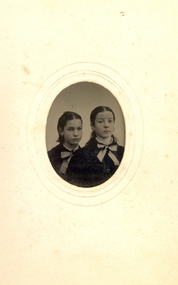
Photograph - Tintype, Portrait of two young girls
... Australia, other studios offered them including: - London, American & Sydney Photo Company, 328 George St, Sydney; - David Edelsten, 55 & 57 Bourke St, Melbourne; - Burman's Portrait Rooms, St. George's Hall, 209 Bourke St, Melbourne; - Bell's Gem Portrait Studio, 57 Bourke St East, Melbourne; - R. H. Kenny, Bridge St, Ballarat; - Marinus W. Bent, Sandhurst (Bendigo); - George Fisher, Victoria; - Anson Brothers, Hobart Town. (Abridged information from http://members.ozemail.com.au/~msafier/photos/tintypes.html) little gem women children photography tintype .2) A tintype portrait of two girls heads, attached to a card. The girls are wearing a cloak with a large bow at the front ...The tintype (or ferrotype or Melainotype) was produced on metallic sheet (not, actually, tin) instead of glass. The plate was coated with collodion and sensitized just before use. It was introduced by Adolphe Alexandre Martin in 1853. The most common size was about the same as the carte-de-visite, 5.5cm x 9.0cm, but both larger and smaller ferrotypes were made. The smallest were "Little Gem" tintypes, about the size of a postage-stamp, made simultaneously on a single plate in a camera with 12 or 16 lenses. They were often produced by travelling photographers, and were cheaper than Ambrotypes so made photography available to working classes, not just to the more well-to-do. The print would come out laterally reversed (as one sees oneself in a mirror). Being quite rugged, tintypes could be sent by post. Tintypes were eventually superseded by gelatin emulsion dry plates in the 1880s, though street photographers in various parts of the world continued with this process until the 1950s. (Above information abridged from http://www.rleggat.com/photohistory/history/tintype.htm) The firm of Gove and Allen opened in Sydney in 1880 and were responsible for the belated popularizing of the gem tintype in Australia. The firm traded as both The American Gem Studio and The American Studio. Others franchises were opened in Melbourne, 6 Sturt St Ballarat and Sandhurst (Bendigo). The Sandhurst branch closed in 1882 and Adelaide in 1884. All Gove and Allen studios had ceased trading by 1885. The studio addresses were: 23 King William St, Adelaide; 324 George St, Sydney; 95 Swanston St, Melbourne; Howard Place, Sandhurst; 7 Queen St, Brisbane; The card mounts used in Gove and Allen studios in Australia are identical to those used in America. They were initially made of plain white card with embossing around the oval image opening in the mount while some also had simple geometric and floral printed designs as well. Although Gove and Allen studios produced the majority of gem tintypes in Australia, other studios offered them including: - London, American & Sydney Photo Company, 328 George St, Sydney; - David Edelsten, 55 & 57 Bourke St, Melbourne; - Burman's Portrait Rooms, St. George's Hall, 209 Bourke St, Melbourne; - Bell's Gem Portrait Studio, 57 Bourke St East, Melbourne; - R. H. Kenny, Bridge St, Ballarat; - Marinus W. Bent, Sandhurst (Bendigo); - George Fisher, Victoria; - Anson Brothers, Hobart Town. (Abridged information from http://members.ozemail.com.au/~msafier/photos/tintypes.html) .2) A tintype portrait of two girls heads, attached to a card. The girls are wearing a cloak with a large bow at the frontlittle gem, women, children, photography, tintype
