
Showing 10 items matching "fuselage forms "
-
 Moorabbin Air Museum
Book - Aerodyamics, Everybody's Aviation Guide
... ...Fuselage forms & landing gears...Aerodynamics Early aeronautic history Forms of aircraft Lighter than air - balloons & dirigibles How an aircraft flies Airplane parts & their function Fuselage forms & landing gears Wing arrangement & construction Power requirements/engine types & engine location Propellers Equilibrium & control Air records Overview of aeronautics & aerodynamics in simple terms, circa 1928 Everybody's Aviation Guide Book Aerodyamics ...Overview of aeronautics & aerodynamics in simple terms, circa 1928non-fictionOverview of aeronautics & aerodynamics in simple terms, circa 1928early aeronautic history, forms of aircraft, lighter than air - balloons & dirigibles, how an aircraft flies, airplane parts & their function, fuselage forms & landing gears, wing arrangement & construction, power requirements/engine types & engine location, propellers, equilibrium & control, air records -
 Australian Gliding Museum
Machine - Glider - Sailplane, 1943
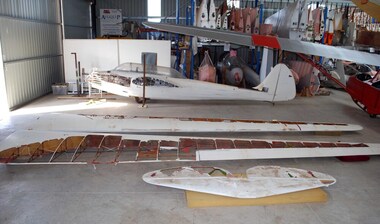
... The top of the fuselage formed a straight ridge from the top of the canopy to the point where the fin – rudder connected. ...The top of the fuselage formed a straight ridge from the top of the canopy to the point where the fin – rudder connected. ...The Laister-Kauffman 10A (LK10A) is a 2 seat a military training glider developed from a successful Jack Laister single seat glider called Yankee Doodle that first flew in 1938 and was exhibited at the Paris Air Show of 1939. The two seater variation was ordered in 1941 by the US Army for training glider pilots of troop carrying gliders. The military designation was XTG-4. The LK 10A glider was a simpler, more robust design than Yankee Doodle. A longer canopy enclosed both seating positions. The top of the fuselage formed a straight ridge from the top of the canopy to the point where the fin – rudder connected. Also, the design was simplified by adopting straight spar wings of 15.2 metres in place of gull wings of 14.170 metres. During the war years 156 LK10As were produced before the contracts to supply the US Army were terminated. Many of these were later sold as surplus. The Museum’s exhibit (serial number 122) was built in 1943. It was imported into Australia in the 1950s by Ric New, a member of the Gliding Club of Western Australia. Ric New modified the glider by “flat topping” the fuselage and making other aerodynamic changes. This kind of modification of the LK10A was a well tried strategy in United States for extracting better performance from the glider. It is understood that the reduction in weight and cleaner aerodynamics from the changes could increase the glide ratio from 1:24 to something like 1:30. The LK10A was located at the Gliding Club of Western Australia for many years. Records reveal that it was kept airworthy until about 1975. The LK10A is an important acquisition in that it allows one to compare the state of two seat glider design in United States and the United Kingdom in the immediate post war period. It is interesting to note that at that time a number of clubs in Australia who acquired a two seat glider for training chose the United Kingdom open cockpit high strutted wing offerings from Slingsby (e.g. T31) instead of more innovative military surplus gliders from America. Modified LK10A glider consisting of tubular steel fuselage with a combination of fabric and metal covering, fabric covered wooden wings and other flying surfaces.australian gliding, glider, sailplane, laister, kauffman, ric new, gliding club of western australia, lk10a, yankee doodle, xtg-4 -
 Australian Gliding Museum
Machine - Glider – Sailplane, Circa 1971
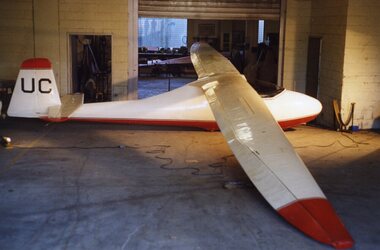
... fuselage of monocoque design. The first of the type to be imported into Australia arrived in late 1955. In January 1956 this aircraft type was used to create a world speed record of just under 75 km/h for speed around a 300 km triangle and went on to win the Australian National Gliding Championships. The Museum’s LO150 (VH-GUC) – serial number EB71 was imported from Germany in 1971 by the late Frank Erdmann and an ownership syndicate formed...fuselage of monocoque design. The first of the type to be imported into Australia arrived in late 1955. In January 1956 this aircraft type was used to create a world speed record of just under 75 km/h for speed around a 300 km triangle and went on to win the Australian National Gliding Championships. The Museum’s LO150 (VH-GUC) – serial number EB71 was imported from Germany in 1971 by the late Frank Erdmann and an ownership syndicate formed ...The Vogt LO150 is a sailplane first produced in 1954. Designed in Germany by Alfred Vogt, the LO150 is of wood construction. It has a two piece wing of 15 metre (49 feet) span and a fuselage of monocoque design. The first of the type to be imported into Australia arrived in late 1955. In January 1956 this aircraft type was used to create a world speed record of just under 75 km/h for speed around a 300 km triangle and went on to win the Australian National Gliding Championships. The Museum’s LO150 (VH-GUC) – serial number EB71 was imported from Germany in 1971 by the late Frank Erdmann and an ownership syndicate formed. Following Erdmann it has had a number of owners. Much of its usage was at Bacchus Marsh and Horsham with excusions elsewhere for competition. This Vogt LO150 was last flown on 3 January 1988. Overall, since arriving in Australia, it has flown 315 hours from 273 launches, which is a commendable average performance of over an hour per flight. VH-GUC was donated to the Museum by Warren Mayfield in 2002. Substantial glue deterioration was discovered in one wing and, as a result, a decision has been made not to restore the glider to an airworthy condition. In due course the glider will be repainted and further prepared for display. This exhibit is an example of the Vogt LO150 semi-aerobatic competition sailplane.Single seat competition sailplane of wood construction.Builder's serial number EB71australian gliding, glider, sailplane, vogt, lo-150, erdmann, mayfield, geelong gliding club -
 Australian Gliding Museum
Machine - Glider, 1974
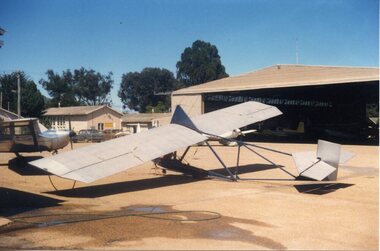
... This exhibit is the type of machine that formed the basis of the sport of gliding from 1929 to about 1945. australian gliding glider northrop zogling davies darbyshire feil gliding club of victoria victorian motorless flight group The glider consists of an open (uncovered) wooden framed fuselage (painted blue) with a brown vinyl covered seat, fabric covered wooden framed wings of constant chord (painted silver) with provision for attachment of semi-circular cane wing skids, and fabric covered wooden framed tailplane, elevators and rudder (painted silver). ...The “Northrop” is an American copy of the “Zogling” which was designed in Germany in the 1920s as a training glider. Apparently, the Northrop primary glider takes its name from a Marvin Northrop of Minneapolis who imported a Zogling from Germany and from that glider had plans drawn and published in a magazine called Modern Mechanics in 1930. The Australia Gliding Museum’s Northrop was built over the period of 1970 to 1974. The project was conceived by a pioneer of Australian gliding, Ken Davies, about 1969, as a hobby project and to experience afresh gliding flight of the early years. By that time, few primary gliders, which performed a fundamental role for gliding clubs in the 1930s and 1940s, remained in Australia. Ken began construction and was helped to finish the project by two old time Gliding Club of Victoria members, Dave Darbyshire and Rudi Feil. The glider was test flown on 8 March 1975 at Benalla. The glider was stored at the Gliding Club of Victoria and flown on special occasions in the 1980s. Later it was damaged at the 1996 vintage glider rally at Ararat as a result of a heavy landing. Storage was then provided for the glider by the Victorian Motorless Flight Group at Bacchus Marsh until it was returned to Dave Darbyshire for restoration in 1998. Fully restored, the glider was donated by Iris Davies and Dave Darbyshire to the Australian Gliding Museum in April 2001. This exhibit is the type of machine that formed the basis of the sport of gliding from 1929 to about 1945. The glider consists of an open (uncovered) wooden framed fuselage (painted blue) with a brown vinyl covered seat, fabric covered wooden framed wings of constant chord (painted silver) with provision for attachment of semi-circular cane wing skids, and fabric covered wooden framed tailplane, elevators and rudder (painted silver). When assembled the airframe is wire braced.australian gliding, glider, northrop, zogling, davies, darbyshire, feil, gliding club of victoria, victorian motorless flight group -
 Australian Gliding Museum
Machine - Glider – Sailplane, 1967 to 1974
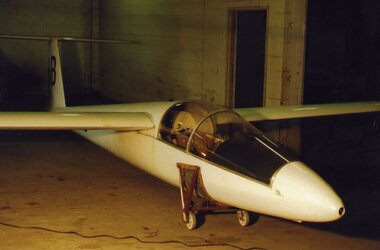
... form. The Museum’s Schreder HP14T (VH-GIB) first flew on 31 August 1974. It has recorded 280 hours in the air from 239 launches to 28 January 1989, the date of its last flight. It is understood that VH-GIB was partly constructed in North America and completed in South Australia by C.G.M. Coxon. Ownership passed to the Georgeson Syndicate of Rockhamption, Queensland and later to Warren Mayfield of Victoria. Warren Mayfield donated the glider to the Museum in April 2002. australian gliding glider sailplane schreder coxon georgeson mayfield slingsby bache waikerie gliding club Registration lettering on rudder and fuselage ...The Schreder HP 14T is a variant of an all metal single seat sailplane designed by Richard Schreder of USA in the 1960s. The HP14T featured a ‘T’ tail in place of ‘V’ tail of the HP14V. The design was marketed to home builders in kit form. The Museum’s Schreder HP14T (VH-GIB) first flew on 31 August 1974. It has recorded 280 hours in the air from 239 launches to 28 January 1989, the date of its last flight. It is understood that VH-GIB was partly constructed in North America and completed in South Australia by C.G.M. Coxon. Ownership passed to the Georgeson Syndicate of Rockhamption, Queensland and later to Warren Mayfield of Victoria. Warren Mayfield donated the glider to the Museum in April 2002. All metal single seat glider sailplaneRegistration lettering on rudder and fuselage sidesaustralian gliding, glider, sailplane, schreder, coxon, georgeson, mayfield, slingsby, bache, waikerie gliding club -
 Australian Gliding Museum
Machine - Glider – Sailplane, 2015
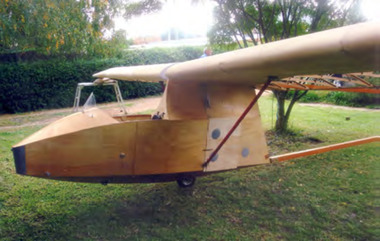
... fuselage woodwork is sealed with varnish. In addition to the finishing work (including painting) and rigging of the main components, the linkages for Ray’s control rod modification may need further engineering to make them operational. The Ray Ash Salamandra is the first of the type to appear in Australia. The Salamandra did not play any role in the development of gliding in Australia in the early years. However, it is an important exhibit in that it shows in tangible form ...The Salamandra is a Polish glider designed by Waclaw Czerwinski at the Military Glider Workshops in Krakow in 1936. This glider, designated “W.W.S.1”, was produced in substantial numbers prior to the second world war and used in Poland and some other eastern European countries for training pilots. Only one example survived the war, hidden away in the village of Goleszow in Silesia. In addition, no technical drawings could be found, so when the glider was discovered, the Gliding Institute being keen to re-establish gliding in Poland, used the glider to draw up new plans for construction. Five were built for the Institute in 1947 before production was resumed of the “Salamandra 48” at the SZD Jezow Workshops. Improvement were made by adding airbrakes and structural changes for the “Salamandra 49” and a windscreen and larger tailplane were changes adopted for the “Salamandra 53”. An export version designated “53A” was sold to and built under licence in China. Production of the Salamandra ceased in the early 1960s. Total production may have been in excess of 500. The glider was well regarded as a light weight trainer capable of soaring performance. The Museum’s replica was built by Ray Ash and may be may be classified as a “Salamandra 53”. However, he has added something of his own to the design by replacing the cable runs in the wings with control rods. The glider is substantially complete. The wings and tail / rudder surfaces have been covered with poly-fibre fabric. The fuselage woodwork is sealed with varnish. In addition to the finishing work (including painting) and rigging of the main components, the linkages for Ray’s control rod modification may need further engineering to make them operational. The Ray Ash Salamandra is the first of the type to appear in Australia. The Salamandra did not play any role in the development of gliding in Australia in the early years. However, it is an important exhibit in that it shows in tangible form a nacelle fuselage training glider in configuration and construction detail. As such it revisits the pioneering era of the 1930s and 1940s in Australia when wood, wire and fabric were the rule and the nacelle primary glider was generally the first step up for pilots who had mastered the basics in an open primary.Nacelled solo training glider of traditional wood and fabric construction. Construction incomplete.Noneaustralian gliding, sailplane, glider, salamandra, czerwinshi, poland, ash -
 Australian Gliding Museum
Machine - Glider - Sailplane, 1967
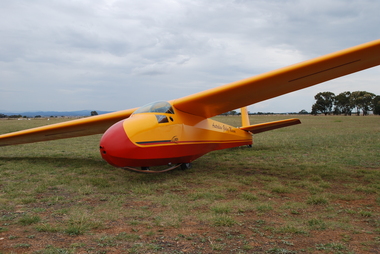
... Single seat sailplane made with a steel tube framed fuselage and wooden wings. A glass plastic moulding has been used to form the top of the fuselage forward of the cockpit. ...Single seat sailplane made with a steel tube framed fuselage and wooden wings. A glass plastic moulding has been used to form the top of the fuselage forward of the cockpit. ...The Ka 8 was designed by Rudolf Kaiser in 1957 and built by Alexander Schleicher. It has been described as the single seat version of the Ka 7 Rhonadler. The Ka 8 proved popular with clubs in its role as a sailplane for early solo flying. Over 1100 were produced. The Museum’s example is a Ka 8B which is the second variant of the design, distinguishable by a larger blown Plexiglas canopy and improved ailerons. The particular glider was built by the RAAF Williamtown Gliding Club from kit supplied by Edmund Schneider Ltd of South Australia as agent for Alexander Schleicher. It was test flown on 8 July 1967. For a period from August 1994 it was owned by a syndicate at the Bendigo Gliding Club. The last entry in the log book is dated January 1995 at which time the glider had accumulated 1148 hours from 2303 flights. From 1967 to 1994, the glider was flown at numerous places including Williamtown, Bellata, Warkworth, Dubbo, Waikerie, Quirindi, Tamworth, Redding, Narromine, Leeton and Keepit. During 1994 and 1995 it was flown a small number of times at Bendigo. A notable flight recorded in the logbook is dated 31 October 1971 when W. Kenny reached 11,000 feet in height during a flight of 5 hours 10 minutes. The last owner prior to the transfer of the glider to the Australian Gliding Museum in 2015 was John Ashford of the Geelong Gliding Club. The glider carries Serial Number 8478-SH and appears to have been registered firstly as VH-GPA and secondly as VH-GMA. The last registration (VH-GMA) was cancelled in 2011.This Kaiser Ka8B sailplane, when fully restored, will be an airworthy example of a popular 1960s German club sailplane type. It is a rarity in Australia as only 4 of the type have been registered and flown here.Single seat sailplane made with a steel tube framed fuselage and wooden wings. A glass plastic moulding has been used to form the top of the fuselage forward of the cockpit. The structure is fabric covered.The glider serial number 8478-SH and the registration VH-GMA.australian gliding, glider, sailplane, schleicher, kaiser, ka 8, schneider, raaf williamtown gliding club, bendigo gliding club, geelong gliding club, ashford -
 Australian Gliding Museum
Machine - Glider – Sailplane, 1972
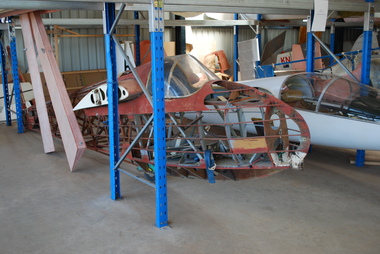
... The fuselage is simple with four main longerons and bulkheads with diagonal bracing. The wing has two identical solid spars which form a geodetic structure, hence the leading edge is non-structural. ...The fuselage is simple with four main longerons and bulkheads with diagonal bracing. The wing has two identical solid spars which form a geodetic structure, hence the leading edge is non-structural. ...The Hall Cherokee II glider is an American design for amateur construction from plans. The designer was Stan Hall (1915-2009), a professional engineer, who gained extensive experience in the United States aviation industry during World War 2 including the programs for military gliders. He continued to work as an engineer for aircraft manufacturers and as a consultant to the industry after the war. He was active in gliding and, in particular, the home built sailplane movement. The Cherokee II was one of about 10 glider designs that he produced: it came out in 1956. It is understood that over 100 Cherokee gliders have been built. In Australia the number is possibly 10 or 11. The Hall Cherokee VH-GVO was built by R.D Meares of Caringbah, New South Wales. The glider was registered as VH-GVO on 11 October 1973 and given serial number “GFA-HB-82” by the Gliding Federation of Australia. The Logbook for VH-GVO appears to be a complete record of the flying history; in aggregate 210 hours 40 minutes in the air from 331 flights. The first test hop occurred on 29 July 1972 at Camden, New South Wales. VH-GVO was last flown on 22 July 1986. Many of the flights recorded are of one or two hours duration. The glider was last inspected and certified as airworthy and in a reasonable condition at the Hunter Valley Gliding Club in July 1986. Since that time, until transferred to the Australian Gliding Museum, the glider was in storage. Structural restoration work has been completed on the fuselage and one wing. However, inspection of the other wing revealed extensive damage to the ribs and spars and consequently a decision was taken to make it a static exhibit. The exhibit is an example of home built construction of a type that has proved popular amongst amateur glider builders.The Hall Cherokee (formerly registered as VH-GVO) is a single seat wooden home built glider. The glider is constructed from wood, plywood, fabric and metal fittings, all commercial grade except for main wing fittings, pulleys, cables and bolts. The fuselage is simple with four main longerons and bulkheads with diagonal bracing. The wing has two identical solid spars which form a geodetic structure, hence the leading edge is non-structural. Registration VH-GVO – serial number GFA-HB-82 australian gliding, glider, sailplane, hall, cherokee, meares, hunter valley gliding club -
 Melton City Libraries
Photograph, The Cairn- Jimmy Melrose's plane crash site, 1988
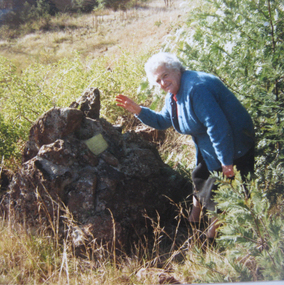
... The most notable feature of the design was the lower stub wing which ran right across the fuselage embodying two box spars, plywood covered it housed the main undercarriage wheels when retracted and provided a substantial anchorage for the Nu form wing struts. ...The most notable feature of the design was the lower stub wing which ran right across the fuselage embodying two box spars, plywood covered it housed the main undercarriage wheels when retracted and provided a substantial anchorage for the Nu form wing struts. ...Edna Barrie at the cairn, photo received from Graeme Minns in 1988. The cairn marks the site of Jimmy Melrose's plane crash in Melton South. The accident which happened on July 5th 1936. In 1934 Melrose made headlines with a series of spectacular flights. In July of that year, he set around Australia record and in that year established a new solo Australia England record when he flew to England to compete in the MacRoberston race with a De Havilland Puss Moth VH- YQO. The only Australian and the only solo pilot to complete the course within the time limit. He was seventh in finishing order and third in the handicap section making news again during the race with a dramatic landing in Darwin with empty fuel tanks. Late in 1935 Melrose imported the Phoenix for his “Adelaide to Anywhere” Charter Service. The previous year the Heston Aircraft Company had taken over the interests of the well known Comper Aircraft Company, and the first production of the new firm was the Phoenix, a single-engined all wooden five seater machine of sesquiplane configuration. The forward half of the fuselage was a streamlined rectangular section and the rear portion was a monocogue shell; the whole was of plywood fabric covered. The wing was built up of spruce box spars and lattice ribs, ply covered from the leading edge to the front spar and the fabric covered over the remainder. The tail surfaces were of similar construction. The most notable feature of the design was the lower stub wing which ran right across the fuselage embodying two box spars, plywood covered it housed the main undercarriage wheels when retracted and provided a substantial anchorage for the Nu form wing struts. The Dowty undercarriage retracted inwards, operated manually by hydraulic packs, Dual control fitted, with side by side seating for the pilots and three passenger seats behind. Power was a 200 h.p. De Havilland Gipsy VI 6 cylinder inverted in-line air-cooled engine. Six Phoenix were built; five of them registered in Great Britain and one of those was later sold abroad the remaining four were impressed into the R.A.F. in 1940. Specifications were: 40 feet 4 inches length 30 ft 2 ins height, 9ft 7ins, wing area 270 sq ft, Tare weight 2,600lbs loaded weight 3,300lbs; cruising speed 360 m.p.h. landing 50mph ceiling 14,000 ft range 700 miles. Melrose’s machine the first production aircraft was built early in 1936 and test flown of the 24th March. Painted green it carries the words “South Australian Centenary 1936” in silver of the fuselage and the name “Billing on the engine cowling in honor of Melrose’s uncle Noel Pemberton Billing, pioneer designer and founder of the Supermarine Aviation Company. The delivery flight was planned as a goodwill mission to publicise the forthcoming South Australian Centenary celebrations. Melrose left Dympne on the 9th April 1936, and flying via Marseilles, Naples, Athens, Baghdad, Basra, Karachi, Jodphur, Calcutta, Akyab, Penang, Singapore, Lombok, Darwin, Newcastle Waters and Alice Springs reached Adelaide on the 25th of April. Continuing the goodwill flight to other States, he visited Melbourne, Sydney, Newcastle, Grafton, Brisbane, Coff’s Harbour, Sydney again, Launceston, Hobart and Mount Gambier before returning to Adelaide on the 13th May. During June Jimmy made some charter flights and early in July was engaged by Mr. A.J. Campbell a director of several mining companies from Melbourne to Darwin to commence at Essendon on the4th July. However on that day low cloud and steady rain caused the postponement. There was little improvement and Melrose was advised to delay the departure again. However he wished to reach Oodnadatta that night, and when he observed the break in the clouds decided to leave. He planned to climb above the cloud and fly to Adelaide at 3,000 feet. The aircraft was airborne about 8.10 a.m. and was last seen from Essendon climbing above the clouds. At 8.45 people at Melton (30 miles West of Melbourne) heard an approaching aircraft. The engine noise increased abnormally and eye witnesses saw the machine fall out of control from the cloud base about 800 feet and then disintegrate, fragments were scattered for 1½ miles and both occupants were killed. Hand written carbon copy by Edna Barrie.Typed by Wendy Barrie March 2014 Last Flight of Jimmy Melrose by John Burke Parade Magazine July 1972 Page 2 –4 This article gives the take off time of 7.50 am from Essendon Airport Eyewitness account at the time Maisie Arthur’s description. Newspaper article. Edna Barrie at the site of the 'Cairn'local identities, local significant events -
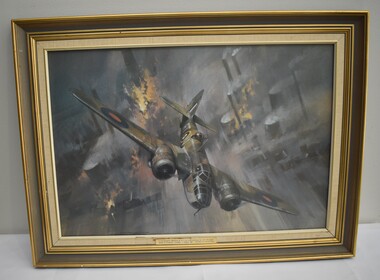 Dandenong/Cranbourne RSL Sub Branch
Painting - Large wooden framed painting
... fuselage. The 114 Squadron was a Squadron of the British Royal Air Force formed in India during the First World War. ...fuselage. The 114 Squadron was a Squadron of the British Royal Air Force formed in India during the First World War. ...Michael Turner born in 1934 is a British painter and illustrator specialising in motoring and aviation paintings. After leaving school he attended Art College followed by National Service with the Royal Electrical and Mechanical Engineers for 2 years. On leaving National Service he worked with a London advertising studio before turning freelance in1957. The Bristol Blenheim depicted in the painting was a British light bomber used extensively for 2 years of the Second World War. It was powered by a pair of Bristol Mercury V111 air cooled radial engines capable of developing 860 bhp. armament was a combination of Vickers, Browning and Lewis machine guns in .303 ( 7.7mm ). A 1000lb (450kg ) could be carried in the internal bomb bay in the centre section of the fuselage. The 114 Squadron was a Squadron of the British Royal Air Force formed in India during the First World War. The Squadron was disbanded in 1971.Large wooden framed painting of an RAF WW2 bomber in flight.Below the painting is the wording " A 114 Squadron Blenheim 1V on a low level bombing run over the power station at Knapsack Cologne, in August 1941 - donated by Laurie Pillar".
