
Showing 16 items matching "gallipoli war graves"
-
 Bendigo Historical Society Inc.
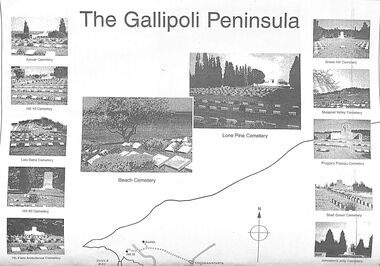
Map - Jack Lockett Collection: The Gallipoli Peninsula
... ...Gallipoli War Graves...Gallipoli Peninsula showing sites of battlefields. Surrounding the map there 33 small black and white photographs of Cemeteries and memorials. On the rear of the map there is an Information Sheet titled Commonwealth War Graves, Under the heading THE GALLIPOLI PENINSULA, TURKEY there is a brief description of the objective and actions of The Gallipoli Campaign 1915. ...In 1963, the couple retired to Bendigo, leaving the farmland (which now covered more than 130,000 acres (53,000 ha), in the care of their children and grandchildren Jack Lockett Mabel Ingwersen Gallipoli War Graves Nanga Gnulle A long map on A3 paper attached to a A4 paper. ...John Henry Lockett OAM (22 January 1891 – 25 May 2002) was the oldest man ever in Australia when he died aged 111 years, 123 days. As one of the last surviving veterans of World War I, he was acclaimed as a national hero during the last decade of his life. Lockett was born in the small Victorian town of Waanyarra, near Bendigo. He left school aged nine to work on a local farm. Later, he worked for his uncles in the Mallee. On 24 March 1916, he travelled to Mildura to enlist in the Australian Imperial Force. He served in France with the 38th Battalion, earning promotion to sergeant and was discharged on 20 September 1919. https://en.wikipedia.org/wiki/Jack_Lockett After the war, Jack returned to The Mallee and selected a 640 acres (260 ha) block of land in Linga, Victoria, deciding to make his living as a farmer. In 1923, he married Maybell Ingwerson and they had four children together. In 1963, the couple retired to Bendigo, leaving the farmland (which now covered more than 130,000 acres (53,000 ha), in the care of their children and grandchildren A long map on A3 paper attached to a A4 paper. Black print map of The Gallipoli Peninsula showing sites of battlefields. Surrounding the map there 33 small black and white photographs of Cemeteries and memorials. On the rear of the map there is an Information Sheet titled Commonwealth War Graves, Under the heading THE GALLIPOLI PENINSULA, TURKEY there is a brief description of the objective and actions of The Gallipoli Campaign 1915. Beneath the heading COMMEMORATION OF THE DEAD Under the terms of the Armistice with Turkey the British Army Re- entered the Peninsula at the end of 1918 and cleared the battlefields of the bodies still unburied. The Construction of the Cemeteries and Memorials was completed in 1926. It also includes a list of 39 Cemeteries with their names, a description of the Battle and the number of burials. jack lockett, mabel ingwersen, gallipoli war graves, nanga gnulle -
 Ballarat Clarendon College
Albert Telfer White (1918) collection
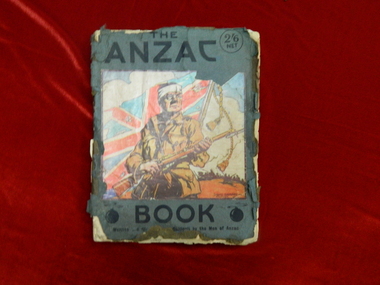
... Collections of items including: Bayonet, Carl Eickhorn, Solingen, (29.A.159 engraved on handle) Trench shovel The ANZAC book 1916 (flyleaf inscribed: No 2012 / Pte A T White / H Quarters / 22nd Battalion / 6th Inf Brigade / France) Gallipoli medal with documentation First World War Mothers’ and Widows’ Badge Next of Kin Memorial Plaque (Death Penny) and accompanying letter from King George V Imperial War Graves Commission documentation and photograph Australia Graves Services In Memory card and photograph Documentation relating to Australian War Memorial Roll of Honour, Learmonth Memorial Wall, Ballarat and Learmonth Avenues of Honours Documentation from the Australian Army Records office Documentation relating to Military Medal, 1914/15 Star, British War Medal and Victory Medal (whereabouts unknown, November 2016) Portraiture of Albert Telfer White as a child, as a young adult (civilian dress), in full kit (A I E F formal), and at camp 1915 Portraiture of sisters Cis, Addie, Bessie, Evelyn (with personal inscriptions) Four postcards (one with letter from Albert ‘at sea’ to his mother - undated) Death notice (unreferenced newspaper clipping) Biographical and family relationship details Photocopy of The White Family 1906 showing (standing) Adeline, Leslie, Harold (father), Muriel (mother), William; (seated) Albert, John (Grandfather), Elizabeth, Allan, Elizabeth (Grandmother), Evelyn (baby) and Benjamin ...Collections of items including: Bayonet, Carl Eickhorn, Solingen, (29.A.159 engraved on handle) Trench shovel The ANZAC book 1916 (flyleaf inscribed: No 2012 / Pte A T White / H Quarters / 22nd Battalion / 6th Inf Brigade / France) Gallipoli medal with documentation First World War Mothers’ and Widows’ Badge Next of Kin Memorial Plaque (Death Penny) and accompanying letter from King George V Imperial War Graves Commission documentation and photograph Australia Graves Services In Memory card and photograph Documentation relating to Australian War Memorial Roll of Honour, Learmonth Memorial Wall, Ballarat and Learmonth Avenues of Honours Documentation from the Australian Army Records office Documentation relating to Military Medal, 1914/15 Star, British War Medal and Victory Medal (whereabouts unknown, November 2016) Portraiture of Albert Telfer White as a child, as a young adult (civilian dress), in full kit (A I E F formal), and at camp 1915 Portraiture of sisters Cis, Addie, Bessie, Evelyn (with personal inscriptions) Four postcards (one with letter from Albert ‘at sea’ to his mother - undated) Death notice (unreferenced newspaper clipping) Biographical and family relationship details Photocopy of The White Family 1906 showing (standing) Adeline, Leslie, Harold (father), Muriel (mother), William; (seated) Albert, John (Grandfather), Elizabeth, Allan, Elizabeth (Grandmother), Evelyn (baby) and Benjamin Albert Telfer White (1918) collection ...Significant items relating to Albert Telfer White who entered Ballarat College April 1912 and left December 1918. Albert was born 29 June 1897 at his home 'Ashford Vale" farm, Cuthbert's Road, Cardigan. Albert, a second generation Australian, was the fourth son and sixth of eleven children born to dairy farmer John White and his wife Elizabeth, nee Douglas. Albert attended Bunker's Hill State School prior to enrolling at Ballarat College. After College he obtained employment with the engineering firm Ronaldson and Tippett in Ballarat. Following his eighteenth birthday Albert enlisted in the AIF in Ballarat with the rank of Private, No 2012. He embarked for the Middle East with 23rd Battalion on 26 August 1915 and was 'taken on strength at the Gallipoli Peninsular 25 October 1915". On 10 January 1916 Albert was posted to Alexandria, Egypt and during this time he was able to meet with his aunt Rose Douglas, an Australian Army Nursing Sister. This was a great comfort to his family. Albert was sent to France 19 March 1916 and transferred to the 22nd Battalion. He was mentioned in dispatches for 'good and gallant conduct' 5 August (1917?). Albert was hospitalised 30 March 1918, rejoined 22nd Battalion 3 June 1918, wounded in action 3 October 1918 but died of wounds at Rouen 10 October 1918. news of his death was received by his family n Australia just prior to the armistice. Albert Telfer White's sacrifice is commemorated at Ballarat College, Avenue of Honour Ballarat (Tree 1214), Ballarat Shire Honour Avenue Learmonth (Tree 163) and the Australian War Memorial Canberra. (These notes provided by family November 2016)Collections of items including: Bayonet, Carl Eickhorn, Solingen, (29.A.159 engraved on handle) Trench shovel The ANZAC book 1916 (flyleaf inscribed: No 2012 / Pte A T White / H Quarters / 22nd Battalion / 6th Inf Brigade / France) Gallipoli medal with documentation First World War Mothers’ and Widows’ Badge Next of Kin Memorial Plaque (Death Penny) and accompanying letter from King George V Imperial War Graves Commission documentation and photograph Australia Graves Services In Memory card and photograph Documentation relating to Australian War Memorial Roll of Honour, Learmonth Memorial Wall, Ballarat and Learmonth Avenues of Honours Documentation from the Australian Army Records office Documentation relating to Military Medal, 1914/15 Star, British War Medal and Victory Medal (whereabouts unknown, November 2016) Portraiture of Albert Telfer White as a child, as a young adult (civilian dress), in full kit (A I E F formal), and at camp 1915 Portraiture of sisters Cis, Addie, Bessie, Evelyn (with personal inscriptions) Four postcards (one with letter from Albert ‘at sea’ to his mother - undated) Death notice (unreferenced newspaper clipping) Biographical and family relationship details Photocopy of The White Family 1906 showing (standing) Adeline, Leslie, Harold (father), Muriel (mother), William; (seated) Albert, John (Grandfather), Elizabeth, Allan, Elizabeth (Grandmother), Evelyn (baby) and Benjamin The ANZAC book 1916 (flyleaf inscribed: No 2012 / Pte A T White / H Quarters / 22nd Battalion / 6th Inf Brigade / France) Gallipoli medal: engraved on reverse: A T WHITE Embossed lettering on death penny: ALBERT TELFER WHITE Handwritten on reverse of portraits: Lovingly yours / Cis / 21/11/17; your / loving sister / Addie; your loving / sister / Evelyn; Yours lovingly / Bessie Handwritten on back of postcard of ship H M A T 'Anchisis' 14.3.16: Dear Mother, I am sending you a card / of the boat we are on. Our deck is right / on the back. I have marked it with an X. / We are not allowed to put the date on or / where we are. I am sitting on the deck now / holding the card in my hand so it is hard / to write. We are together yet haven't been / separated Bill, Matt and myself. Haven't / had anything to do. I will write a couple / of letters now. Albert Handwritten on back of postcard photograph of Albert at camp: 30th September 1915 / Dear Mother / There is a studio at the / camp so Matt and I got our Photos / taken yesterday morning, & got them/ this morning. I am sending / Ciss one of Matt.albert-telfer-white, ballarat college, world-war-one, avenue-of-honour -
![Book, Commonwealth War Graves Commission, Their name liveth: some pictures of Commonwealth war cemeteries, 1914-1918 [and] 1939-1945. Volume VI Part 1, 1965](/media/collectors/4f729f5697f83e03086015b8/items/61f1fee6ff25d250155d267f/item-media/61f792992062ed2a3f229351/item-fit-380x285.jpg?cb=6) Greensborough Historical Society
Greensborough Historical SocietyBook, Commonwealth War Graves Commission, Their name liveth: some pictures of Commonwealth war cemeteries, 1914-1918 [and] 1939-1945. Volume VI Part 1, 1965
... This volume covers descriptions and photographs of cemeteries in Gallipoli and Greece world war I world war II war graves commonwealth war graves commission 50 p paperback, text and black and white photographs, red cover with gold lettering Their name liveth: some pictures of Commonwealth war cemeteries, 1914-1918 [and] 1939-1945. ...This volume covers descriptions and photographs of cemeteries in Gallipoli and Greece50 p paperback, text and black and white photographs, red cover with gold letteringworld war i, world war ii, war graves, commonwealth war graves commission -
 Glen Eira Historical Society
Article - Brighton Cemetery, North Road, Caulfield South
... This file contains two items about war graves. 1/A two-page newspaper article from the "Herald Sun" of 31/07/2011 concerning the neglected state of the graves of some Victoria Cross winners and other war heroes at several cemeteries in Melbourne including Brighton Cemetry. The article notes that the Dept of Veterans' Affairs and other authorities are not adequately maintaining the graves. Includes photographs. 2/A newspaper article from Glen Eira/Port Phillip Leader dated 12/02/2013. The article makes mention that a Gallipoli...This file contains two items about war graves. 1/A two-page newspaper article from the "Herald Sun" of 31/07/2011 concerning the neglected state of the graves of some Victoria Cross winners and other war heroes at several cemeteries in Melbourne including Brighton Cemetry. The article notes that the Dept of Veterans' Affairs and other authorities are not adequately maintaining the graves. Includes photographs. 2/A newspaper article from Glen Eira/Port Phillip Leader dated 12/02/2013. The article makes mention that a Gallipoli ...This file contains two items about war graves. 1/A two-page newspaper article from the "Herald Sun" of 31/07/2011 concerning the neglected state of the graves of some Victoria Cross winners and other war heroes at several cemeteries in Melbourne including Brighton Cemetry. The article notes that the Dept of Veterans' Affairs and other authorities are not adequately maintaining the graves. Includes photographs. 2/A newspaper article from Glen Eira/Port Phillip Leader dated 12/02/2013. The article makes mention that a Gallipoli soldier will finally receive an official war grave and commemorative service in April 2013. Local war historian Carl Johnson stepped in to help and the Australian War Graves will install a grave marker to Pte. Jack Alexander Johnson.brighton cemetery, caulfield south, buckley maurice, joynt william donovan, newland james ernest, peeler walter, graves, cemetries, medals, war veterans, monuments and memorials, war memorials, world war 1914-1918 world war 1939-1945, johnson jack alexander, caulfield military hospital, hospitals, johnson carl, johnson bill, historical markers -
 Bendigo Military Museum
Photograph - GRAVE PHOTOGRAPH, c.1918-19
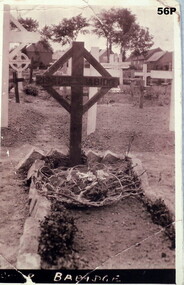
... Gallipoli 5.4.1915. WIA 14.5.1915 GSW to the shoulder. Hospitalised 3.12.1915 with enteritis. Embarked for Australia 9.2.1916 enteric. He embarked for England on 3.7.1916 with the 18th reinforcements 6th Batt. Regt No. changes to 2194. Transferred to the 59th Batt 8.10.1916. WIA 21.12.1916 with GSW to the buttocks but changed legs slight. Hospitalised 21.7.1917 with old GSW (ulcer). WIA 25.6.1918 with GSW chest penetrating. DOW's 25.6.1918. Collection re Mrs May Burns. photography war graves ...Elias Samuel BABIDGE No 1312 (born Heathcote, enlisted Heathcote) in the 2nd reinforcements 6 th Batt AIF on 18.11.1914. Embarked for Egypt 2.2.1915 then Gallipoli 5.4.1915. WIA 14.5.1915 GSW to the shoulder. Hospitalised 3.12.1915 with enteritis. Embarked for Australia 9.2.1916 enteric. He embarked for England on 3.7.1916 with the 18th reinforcements 6th Batt. Regt No. changes to 2194. Transferred to the 59th Batt 8.10.1916. WIA 21.12.1916 with GSW to the buttocks but changed legs slight. Hospitalised 21.7.1917 with old GSW (ulcer). WIA 25.6.1918 with GSW chest penetrating. DOW's 25.6.1918. Collection re Mrs May Burns.Post card photo of the grave of Sam BABIDGE, other graves and buildings in the back ground.On photo “2194 Pte S BABIDGE”. On rear “Sam Babidges grave at Gallipoli” in blue ink.photography, war graves, head stones, military history -
 Monbulk RSL Sub Branch
Book, UWA Pub, On dangerous ground : a Gallipoli story, 2012
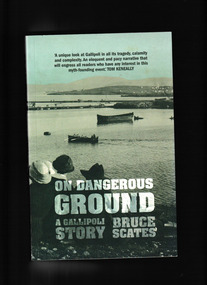
... War I at Gallipoli, and Lt. Roy Irwin is missing. The young woman who loves him, and the men who fought beside him, begin their search for Lt. Irwin. Later, in 1919, historian C.E.W. Bean returns to Anzac Cove with artist George Lambert and soldier Harry Vickers to solve the greatest mystery of the campaign, to discover Gallipoli's secret. Forward to 2015, and Dr. Mark Troy's quest to preserve the peninsula from roadworks is sidetracked by political intervention and diplomatic intrigue. But a flirtation with a dynamic young woman from Army Intelligence uncovers long-forgotten documents protecting Gallipoli's graves ...It is 1915, during World War I at Gallipoli, and Lt. Roy Irwin is missing. The young woman who loves him, and the men who fought beside him, begin their search for Lt. Irwin. Later, in 1919, historian C.E.W. Bean returns to Anzac Cove with artist George Lambert and soldier Harry Vickers to solve the greatest mystery of the campaign, to discover Gallipoli's secret. Forward to 2015, and Dr. Mark Troy's quest to preserve the peninsula from roadworks is sidetracked by political intervention and diplomatic intrigue. But a flirtation with a dynamic young woman from Army Intelligence uncovers long-forgotten documents protecting Gallipoli's graves. In this eagerly awaited book, one of Australia's leading historians uses a playful hybrid of history and fiction - moving between the historical realm and the world of the imagination - to recreate the most dramatic moments of the Gallipoli campaign in World War I.Bibliography, ill, p.223.fictionIt is 1915, during World War I at Gallipoli, and Lt. Roy Irwin is missing. The young woman who loves him, and the men who fought beside him, begin their search for Lt. Irwin. Later, in 1919, historian C.E.W. Bean returns to Anzac Cove with artist George Lambert and soldier Harry Vickers to solve the greatest mystery of the campaign, to discover Gallipoli's secret. Forward to 2015, and Dr. Mark Troy's quest to preserve the peninsula from roadworks is sidetracked by political intervention and diplomatic intrigue. But a flirtation with a dynamic young woman from Army Intelligence uncovers long-forgotten documents protecting Gallipoli's graves. In this eagerly awaited book, one of Australia's leading historians uses a playful hybrid of history and fiction - moving between the historical realm and the world of the imagination - to recreate the most dramatic moments of the Gallipoli campaign in World War I.gallipoli campaign - fiction, war stories -
 Monbulk RSL Sub Branch
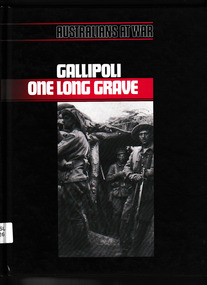
Book, Time Life Books, Gallipoli: One long grave, 1986
... World War 1914-1918 - Australian involvement World War 1914-1918 - Campaigns - Gallipoli Australian involvement in the Gallipoli campaign Index, bib, ill, maps, p.163. Gallipoli: One long grave ...Australian involvement in the Gallipoli campaignIndex, bib, ill, maps, p.163.non-fictionAustralian involvement in the Gallipoli campaignworld war 1914-1918 - australian involvement, world war 1914-1918 - campaigns - gallipoli -
 National Vietnam Veterans Museum (NVVM)
Booklet, Graves, Richard, On Gallipoli: An Epic of ANZAC, 1984
... World War 1914-1918 -- Campaigns -- Turkey -- Gallipoli Peninsula -- Poetry ANZAC A yellow coloured cardboard cover with red information on the front. On the back of the booklet in red is an article about the auther Richard Graves (1898-971) The booklet is held together with two metal staples. ...A yellow coloured cardboard cover with red information on the front. On the back of the booklet in red is an article about the auther Richard Graves (1898-971) The booklet is held together with two metal staples.world war, 1914-1918 -- campaigns -- turkey -- gallipoli peninsula -- poetry, anzac -
 8th/13th Victorian Mounted Rifles Regimental Collection
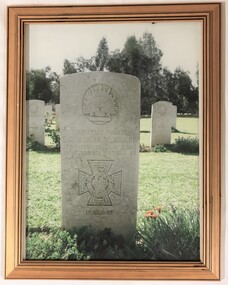
Photograph - Maygar grave
... War. He later served with the 4th Australian Light Horse at Gallipoli during the First World War, and died of wounds after being strafed during the Battle of Beersheba as part of the Sinai and Palestine campaign while commanding the 8th Australian Light Horse.. Maygar grave ...Lieutenant Colonel Leslie Cecil Maygar, VC, DSO, VD (27 May 1868 – 1 November 1917) was an Australian recipient of the Victoria Cross, the highest award for gallantry in the face of the enemy that can be awarded to British and Commonwealth forces. He was awarded the VC for facilitating the rescue of a dismounted man while under severe rifle fire in 1902 during the Second Boer War. He later served with the 4th Australian Light Horse at Gallipoli during the First World War, and died of wounds after being strafed during the Battle of Beersheba as part of the Sinai and Palestine campaign while commanding the 8th Australian Light Horse..Framed colour photograph of headstone at the grave of Lieutenant Colonel Leslie Maygar VC.maygar, grave, world war, wwi -
 8th/13th Victorian Mounted Rifles Regimental Collection
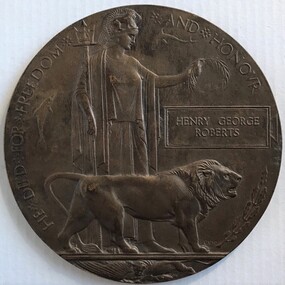
Medal - Death medallion Roberts
... On 16 May 1915 he proceeded to Gallipoli where he was killed in action on 7 August 1915 during the attack on the Nek. He has no known grave and is commemorated at the Lone Pine Memorial for the missing. For his service in The Great War...On 16 May 1915 he proceeded to Gallipoli where he was killed in action on 7 August 1915 during the attack on the Nek. He has no known grave and is commemorated at the Lone Pine Memorial for the missing. For his service in The Great War ...Henry George Roberts was born in Lambeth, Middlesex, The United Kingdom on 17 June 1885. The son of Elizabeth and Corporal Thomas Roberts of 2/3rd Regiment of Foot, The Buffs. Thomas Robert died in 1893 and on 28 September 1894 Henry was admitted to the Royal Military School as an apprentice. He remained there until 7 July 1900 when he enlisted at Aldershot, in the 2nd Dragoon Guards as a boy soldier. The 1901 and 1911 Censuses record him as being a musician with the 2nd Dragoon Guard, (The Queen’s Bays). Roberts married Lily Winterbourne Quinton in early 1912, a son Frederic was born on 1 February 1913. By August 1914 Roberts has travelled to Australia where he was employed as a musician and residing at “Quamby” Royal Park, Melbourne. His wife and child remaining at Mellison Road, Lower Tooting, London. On 8 September 1914 he enlisted in the Australian Imperial Force in Melbourne, allotted Regimental Number 42, the Rank of Trooper and allocated to A Squadron, 8th Australian Light Horse Regiment. His enlistment papers raise a mystery. He stated that he and six years’ service with the Territorial Hampshire Carabiniers but made no mention of his eleven years’ service with the Regular 2nd Dragoon Guards. There is no clear answer as to why this misinformation was provided. Roberts was promoted to Sergeant on 28 October 1914. His occupation and prior experience resulting in Roberts’ appointment to the leadership of the regimental band. After training in Australia, he embarked on the Star of the Sea at Port Melbourne on 25 February 1915 arriving in Egypt on 14 March. On 16 May 1915 he proceeded to Gallipoli where he was killed in action on 7 August 1915 during the attack on the Nek. He has no known grave and is commemorated at the Lone Pine Memorial for the missing. For his service in The Great War, he was awarded the 1914-1915 Star, British War, and Victory, Medals. Circular metal medallion with image of Britannia standing with a lion issued to NOK of No 42 Sergeant Henry Roberts 8th Australian Light Horse Regiment who was killed in action at the Nek 7 August 1915. The plaque about 120 mm in diameter, was cast in bronze, and came to be known as the "Dead Man’s Penny", because of the similarity in appearance to the much smaller penny coin. 1,355,000 plaques were issued, which used a total of 450 tons of bronze,Henry Roberts and continued to be issued into the 1930s to commemorate people who died as a consequence of the war.Henry Robertswwi, world war one, gallipoli, nek, 8th, light horse, roberts -
 Lilydale RSL Sub Branch
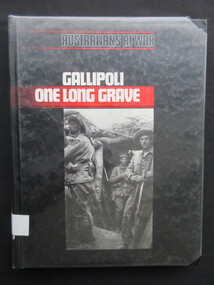
Book, Kit Denton, Australians at War - Gallipoli - One Long Grave, 1987
... Australians at War - Gallipoli - One Long Grave...Book Australians at War - Gallipoli - One Long Grave Book Book Kit Denton Time-Life Books ...Book -
 Magnet Galleries Melbourne Inc
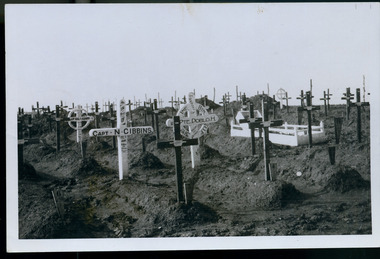
Soldier's cemetery, les chandler_a00171.tif
... graves is that of Captain Norman Gibbins, 55th Battalion, born in Ararat Victoria. A Gallipoli veteran, at Fromelles, Gibbins fought a desperate rear guard bombing action while under heavy German attack. It allowed many Australians including the wounded to get back to the safety of their own lines. When his path was blocked by dead and wounded Gibbins stood up and was fatally shot. His body was recovered and moved seven kilometres behind the lines where his grave was one of 111 Australians initially buried at Sailly-sur-la-lys. ww1 world war ...Rows of graves from the Battle of Fromelles, then called Flerbaix. Among the graves is that of Captain Norman Gibbins, 55th Battalion, born in Ararat Victoria. A Gallipoli veteran, at Fromelles, Gibbins fought a desperate rear guard bombing action while under heavy German attack. It allowed many Australians including the wounded to get back to the safety of their own lines. When his path was blocked by dead and wounded Gibbins stood up and was fatally shot. His body was recovered and moved seven kilometres behind the lines where his grave was one of 111 Australians initially buried at Sailly-sur-la-lys. ww1, world war 1, cemetery, fromelles, flerbaix, norman gibbins, aif, a.i.f -
 Ballarat Heritage Services
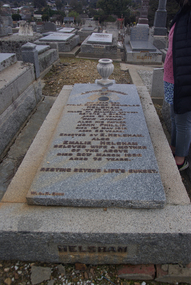
Photograph - Photograph - Colour, Clare Gervasoni, Bendigo Cemetery, 2018, 02/09/2018
... bendigo cemetery graves j. george douglas helsham gallipoli john phillip helsham emalie helsham anzac World War One Dead Man's Penny In loving memory of my dear son Pte. ...Colour photograph of the Helsham Gravestone in Bendigo Cemetery. It includes a memorial for Pte J. George Douglas Helsham who was killed at Gallipoli during World War One. In loving memory of my dear son Pte. J. George Douglas Helsham Late 7th Bn. A.I.F. Killed at Gallipoli between 25-4-'15 & 2-2-'15 aged 21 years. "Our ANZAC" Also his father John Phillip died 1sr May 1918 aged 52 years. Erected by E. Helsham. Also Emalie Helsham beloved wife & mother of the above Died 20th March 1936 aged 75 years. Resting beyond life's sunset. bendigo cemetery, graves, j. george douglas helsham, gallipoli, john phillip helsham, emalie helsham, anzac, world war one, dead man's penny -
 Melbourne Legacy
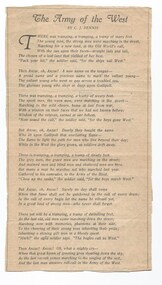
Newspaper - Poem, The Army of the West by C.J. Dennis, 25 April 1929
... war, With a wisdom on their faces that we had not known before: Wisdom of the veteran, earned at our behest, "Now sound the call," the soldier said, "for the boys gone West." But Anzac, oh, Anzac! Dearly they bought the name Who lit upon Gallipoli that everlasting flame — The flame to light the path for men who live beyond their day; While in the West the glory grows, as soldiers drift away. There is tramping, a tramping, a tramp of steady feet. The grey men, the grave...war, With a wisdom on their faces that we had not known before: Wisdom of the veteran, earned at our behest, "Now sound the call," the soldier said, "for the boys gone West." But Anzac, oh, Anzac! Dearly they bought the name Who lit upon Gallipoli that everlasting flame — The flame to light the path for men who live beyond their day; While in the West the glory grows, as soldiers drift away. There is tramping, a tramping, a tramp of steady feet. The grey men, the grave ...A poignant poem by CJ Dennis about Anzac soldiers from World War 1. The date was located from Trove. The Army of the West BY C. J. DENNIS HERE was tramping, a tramping, a tramp of many feet. The young men, the strong men were marching in the street, Marching for a new land, at the Old World's call, With the sun upon their faces — straight lads and tall, The chosen of a leal land that yielded of her best. "Pack your kit," the soldier said, "for the ships sail West," Then Anzac, oh, Anzac! A new name on the tongue — A proud name and a precious name to mark the valiant young — The valiant young who went so gay across a troubled sea, The glorious young who slept so deep upon Gallipoli. There was tramping, a tramping, a tramp of weary feet. The spent men, the worn men, were marching in the street- Marching to the wild cheers, home at last from war, With a wisdom on their faces that we had not known before: Wisdom of the veteran, earned at our behest, "Now sound the call," the soldier said, "for the boys gone West." But Anzac, oh, Anzac! Dearly they bought the name Who lit upon Gallipoli that everlasting flame — The flame to light the path for men who live beyond their day; While in the West the glory grows, as soldiers drift away. There is tramping, a tramping, a tramp of steady feet. The grey men, the grave men are marching in the street; And maimed men and blind men and shattered men are here. But many a man he marches not who marched last year. Gathered to his comrades, to the Army of the Blest. "Close up the ranks," the soldier said, "for the boys march West." But Anzac, oh, Anzac! Surely no day shall come When that fame shall not be quickened in the roll of every drum; In the call of every bugle let the name be vibrant yet, In a great land of strong men — who never shall forget. There yet will be a tramping, a tramp of dwindling feet, As the last old, old men come marching down the street; Marching now with memories, phantoms at their side, To the cheering of their strong sons inheriting their pride; Inheriting a shining gift won in a bloody quest, "Harkl" the aged soldier says. "The bugles call us West." Then Anzac! Anzac! Oh, what a mighty cry- When that great hymn of greeting goes shouting down the sky, As the last recruit comes marching to the singing of the rest, And the last man answers roll-call in the Army of the West. It was in a folder of documents about the history of Legacy. Appears to have been mostly compiled by Legatee Cyril Smith as he has many hand written notes on miscellaneous pieces of paper (some are envelopes addressed to him). Some notes were typed up into a summary of the History of Legacy. Also documents relating to the first time Legacy approached the public for donations in September 1956, including newspaper articles that were reprinted, a schedule of information that was approved to be released to the press, and a list of potential donors that was circulated to Legatees in the hope they could contact the ones they knew personally or professionally. The documents from this folder have been added in seperate records (see 01262 to 01282). The folder was part of an attempt to capture history of Legacy, generally from the 1950s.The documents provide an insight into the working of Legacy, especially in the 1950s. Legatee Cyril Smith and others were detailing their experiences and knowledge for the future. This poem might have been included for its portrayal of Anzacs.A poem by CJ Dennis printed in a newspaper.history, world war one, poems, poetry -
 Wodonga & District Historical Society Inc
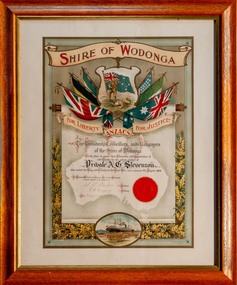
Certificate - WW1 Private A. G. Stevenson
... grave had been located and again querying the date of his death. Later, she completed a form that was sent to next of kin seeking information on deceased soldiers for the Australian War Memorial’s Roll of Honour. Arthur Stevenson’s death is recorded at the Lone Pine Memorial on the Gallipoli...grave had been located and again querying the date of his death. Later, she completed a form that was sent to next of kin seeking information on deceased soldiers for the Australian War Memorial’s Roll of Honour. Arthur Stevenson’s death is recorded at the Lone Pine Memorial on the Gallipoli ...Arthur Edward Stevenson enlisted on 17 September 1914 and served with the 14th Battalion of the AIF. He was killed in action at Gallipoli on 20 August 1915 at age 28. His personal effects of a belt, hairbrush, knife, postcards and photos were returned to his brother John in June 1916. Later that year, John Stevenson wrote to the Officer in Charge of base records, asking for confirmation of his brother’s death, as he had received a letter from Arthur dated 27 August 1915, seven days later than the date on which he was reportedly killed. The Army confirmed that Arthur had in fact died, and concluded that he had likely misdated his letter. In 1920, Arthur’s sister Rachel wrote to the Department of Defence, asking whether her brother’s grave had been located and again querying the date of his death. Later, she completed a form that was sent to next of kin seeking information on deceased soldiers for the Australian War Memorial’s Roll of Honour. Arthur Stevenson’s death is recorded at the Lone Pine Memorial on the Gallipoli Peninsula. Honour Certificates WW1 - From 1915 onwards, recruits in many shires and towns in eastern Australia were honoured by local government authorities. A common form of recognition was the award of honour certificates. The first honour certificates were presented in 1915 and 1916 to men who had yet to leave Australia. The designers and publishing companies solicited business directly from councils. Publishers began to print two different types of certificates: honour certificates to thank soldiers who had survived and memorial certificates to commemorate the dead. D.W. Paterson, a Melbourne publishing firm, claimed they had supplied certificates to over 150 cities and shires in Victoria and New South Wales, including the Shire of Wodonga. Paterson also had the widest range of designs The certificate signified that the officials of the community recognised and shared the family's pride and grief. The certificate was signed by S. T Parker, Shire President and R. H. Murphy, Council Secretary on 4th August 1919.This certificate is significant as it recognises service given to Australia by Arthur Edward Stevenson. Coloured certificate presented to the family of Arthur Ernest Stevenson by Wodonga Shire Council. The certificate is mounted behind glass in a wooden frame.gallipoli, world war 1, arthur edward stevenson -
 Emerald Museum & Nobelius Heritage Park
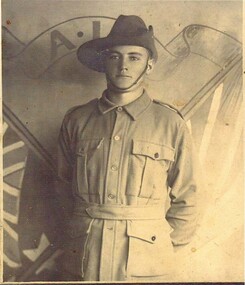
PHOTO, Eric William John Durance
... Gallipoli. Place of enlistment Gembrook West Victoria. Native Place. Macclesfield Victoria War Grave Register notes. ...Gallipoli. Place of enlistment Gembrook West Victoria. Native Place. Macclesfield Victoria War Grave Register notes. ...Eric William John Durance ,Son of William and Margaret Durance of Macclesfield. Rank.Private. Service no. 812. Unit 22 nd Battalion Service Army Conflict 1914-1918 Date of Death 4th October 1915. Cause of Death Died of Wounds. CEMETERY OR MEMORIAL DETAILS. 6 Lone Pine Memorial Gallipoli. Place of enlistment Gembrook West Victoria. Native Place. Macclesfield Victoria War Grave Register notes. DURANCE, PTE. Eric William John, 812.22nd Bn. Died of wounds 4th. Oct. 1915. Son of William John Durance and Margaret Madigan (his ). Native of Macclesfield, Victoria, Australia. 65 Source. AWM145 Roll of Honour cards.1914-1918 War Army. LOCATION on the Roll of Honour. Eric Williams John Durance's name is located at panel 96 in the Commemorative Area at the Australian War Memorial (as indicated by the poppy on the plan).1914-1918 War Age at time of death 21Photo of Eric William Durance in his uniform from the 1914-1918 war.1st world war.
