
Showing 19 items matching "gaunt’s of melbourne"
-
 Flagstaff Hill Maritime Museum and Village
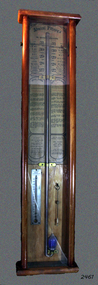
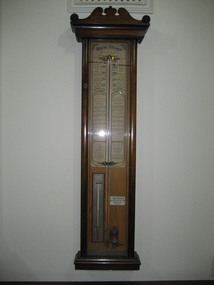
Barometer, 1858-1869
... ...gaunt’s of melbourne...Gaunt arrived in Melbourne in 1852, and by 1858 had established his own business at 14 Little Bourke Street. ...Made by Thomas Gaunt, Melbourne. Manufacturer's details are on back of wooden casing. ..."Manufactured by Thomas Gaunt, 14 Little Bourke Street, Melbourne. "...Gaunt arrived in Melbourne in 1852, and by 1858 had established his own business at 14 Little Bourke Street. ...The barometer was either made or sold by T. Gaunt & Co. of Melbourne, a manufacturer, importer and retailer of a wide variety of goods including jewellery, clocks and watches, navigational and measuring instruments, dinnerware, glassware and ornaments. Thomas Gaunt photograph was included in an album of security identity portraits of members of the Victorian Court, Centennial International Exhibition, Melbourne, 1888. (See below for further details.) Admiral Fitzroy Pattern Barometer History: The stick mercury barometer was named after Admiral Robert Fitzroy of the Royal Navy (1805-1865) for his detailed instructions on how to interpret the weather, which were included with the instrument. Fitzroy was the captain of the HMS Beagle, also a weather forecaster to Charles Darwin and the second Governor of New Zealand. He developed many different types of barometers and was the first person to introduce the science of weather forecasting to the British Isles. A local manufacturer of scientific instruments, Thomas Gaunt, produced the barometer that was adapted for the southern hemisphere by Robert Ellery, the State Astronomer based at the Melbourne Observatory. In the original sale catalogue for Gaunt's, the item is described as "Gaunt's Fitzroy Barometers" and it was priced from 25/- to ₤9.9s. History of Thomas Gaunt: Thomas Gaunt established Melbourne's leading watchmaking, optical and jewellery business during the second half of the 19th century. Gaunt arrived in Melbourne in 1852, and by 1858 had established his own business at 14 Little Bourke Street. Around 1869 he moved to new premises in Bourke Street on the corner of Royal Arcade. Gaunt's shop quickly became a Melbourne institution. Gaunt proudly advertised that he was 'The only watch manufacturer in the Australian colonies'. While many watches and clocks may have had Gaunt's name on the dial, few would have been made locally. Gaunt did make some watches for exhibitions, and perhaps a few expensive watches for wealthy individuals. Gaunt's received a telegraph signal from Melbourne Observatory each day to correct his main clock and used this signal to rate and repair ship's chronometers and good quality watches. His main horological manufacturing was directed at turret clocks for town halls, churches and post offices. These tended to be specific commissions requiring individualised design and construction. He made the clock for the Melbourne Post Office lobby, to a design by Government Astronomer Robert Ellery, and won an award at the 1880-81 Melbourne International Exhibition for his turret clock for the Emerald Hill Town Hall. He became well known for his installation of a chronograph at Flemington Racecourse in 1876, which showed the time for the race, accurate to a quarter of a second. The firm also installed the clockwork and figures for Gog and Magog in the Royal Arcade. Thomas Gaunt also developed a department that focused on scientific instrumentation, making thermometers and barometers (from imported glass tubes), telescopes, surveying instruments and microscopes. Another department specialised in electroplating for trophies, awards and silverware, and the firm manufactured large amounts of ecclesiastical gold ware and silverware, for the church including St Patrick's Cathedral. There are no records that disclose the number of employees in the firm, but it was large enough for Gaunt to hold an annual picnic for the watchmakers and apprentices at Mordialloc from 1876; two years previously they had successfully lobbied Gaunt to win the eight hour day. Gaunt's workforce was reportedly very stable, with many workers remaining in the business for 15 to 30 years. Gaunt's wife Jane died on September 1894, aged 64. They had one son and six daughters, but only three daughters survived to adulthood. Two became nuns at the Abbotsford Convent and one daughter, Cecelia Mary Gaunt (died 28 July 1941), married William Stanislaus Spillane on 22 September 1886 and had a large family. Gaunt died at his home in Coburg, Victoria, leaving an estate valued at ₤41,453. The business continued as T. Gaunt & Co. after his death. The barometer is historically significant as an example of the work of Melbourne’s leading scientific instrument maker, Thomas Gaunt. The barometer has social significance as an example of the type of scientific equipment that Thomas Gaunt expanded his horology business into producing. Further social significance lies in the fact that Robert Ellery, the Government Astronomer who designed the local version of the barometer, had a direct connection with the Melbourne Athenaeum founded in 1839 as the Melbourne Mechanics' Institution. Its purpose was "the diffusion of literary, scientific and other useful information". There are also records of a T Gaunt as a subscription and committee member of this the Athenaeum organisation during the 1870s and 1880s which may be Thomas Gaunt, unfortunately still unverified.Stick mercury barometer known as the Admiral Fitzroy Barometer. It comprises an oblong wooden case with glass front panel, ornate pediment, barometer with bulb cistern (empty of fluid), cleaning brush with printed instructions for interpreting information given by the gauge affixed to left and right face of instrument. Includes a thermometer. The barometer appears to be intact. Adapted to the Southern Hemisphere. Special remarks by Admiral Fitzroy. Made by Thomas Gaunt, Melbourne. Manufacturer's details are on back of wooden casing. Rear has upper and lower brass screw plates for securing to vertical surface."Manufactured by Thomas Gaunt, 14 Little Bourke Street, Melbourne. "flagstaff hill, warrnambool, shipwrecked-coast, flagstaff-hill, flagstaff-hill-maritime-museum, maritime-museum, shipwreck-coast, flagstaff-hill-maritime-village, barometer, admiral fitzroy, thomas gaunt, thomas gaunt of melbourne, clockmaker, admiral fitzroy barometer, barometer instructions, gaunt’s fitzroy barometer, gaunt’s of melbourne, gog and magog designer, horological manufacturer, meteorological instrument, melbourne athenaeum, melbourne mechanics' institution, melbourne observatory time signal, robert ellery government astronomer, scientific instrument, stick mercury barometer, thermometer, weather forecast, t gaunt & co -
 Flagstaff Hill Maritime Museum and Village
Theodolite, Troughton & Simms, Mid 19th Century
... Gaunt arrived in Melbourne in 1852, and by 1858 had established his own business at 14 Little Bourke Street. ...Inscribed on the inner mounting plate,“Specially made in England for T Gaunt & Co Melbourne” and inscribed a little lower “Troughton & Simms London”...Gaunt arrived in Melbourne in 1852, and by 1858 had established his own business at 14 Little Bourke Street. ...The theodolite was sold by T. Gaunt & Co. of Melbourne, a manufacturer, importer and retailer of a wide variety of goods including jewellery, clocks and watches, navigational and measuring instruments, dinnerware, glassware and ornaments. Thomas Gaunt photograph was included in an album of security identity portraits of members of the Victorian Court, Centennial International Exhibition, Melbourne, 1888. (See further details below.) History for Troughton & Simms: Edward Troughton & William Simms established a scientific instrument making business in London in 1826. Edward Troughton (1756-1835) had previously had his own scientific instrument business, inherited from his father. His achievement's included a transit telescope for Greenwich Observatory (1816) and the precision surveying instruments for the Ordnance Survey of Britain, Ireland and India. William Simms (1793-1860) had trained as a goldsmith and began to gain work dividing circles on fine astronomical instruments. When William Simms died in 1860, the business was taken over by his son James and nephew William. Troughton & Simms shop in Fleet Street became the hub of the finest scientific instrument made in London, in a period in which there was an expanding demand for precision instruments, for astronomy, surveying and precision measurement. They made instruments for Greenwich Observatory, for imperial surveys and exploring expeditions. When fire destroyed the Houses of Parliament in 1834, the firm was commissioned to create new standard lengths, this required 10 years of testing against the remaining old measurements. Troughton and Simms made several of the main instruments for Melbourne Observatory, including an 18 inch azimuth used of the Geodetic Survey, portable transit instrument (circa 1850), zenith sector (1860), a 4.5 inch equatorial telescope (1862), an 8 inch equatorial telescope (1874) spectroscope (1877) and an 8 inch transit instrument in (1884). While the firm had an excellent reputation for quality the company exasperated many of its customers with delays of years in delivering some instruments. History for Thomas Gaunt: Thomas Ambrose Gaunt (1829 – 1890) was a jeweller, clock maker, and manufacturer of scientific instruments, whose head office and showroom were at 337–339 Bourke Street, Melbourne, Victoria, Australia. Thomas Gaunt established Melbourne's leading watchmaking, optical and jewellery business during the second half of the 19th century. Gaunt arrived in Melbourne in 1852, and by 1858 had established his own business at 14 Little Bourke Street. Around 1869 he moved to new premises in Bourke Street on the corner of Royal Arcade, Gaunt's shop quickly became a Melbourne institution. Gaunt proudly advertised that he was 'The only watch manufacturer in the Australian colonies'. While many watches and clocks may have had Gaunt's name on the dial, few would have been made locally. Gaunt did make some watches for exhibitions, and perhaps a few expensive watches for wealthy individuals. Gaunt's received a telegraph signal from Melbourne Observatory each day to correct his main clock and used this signal to rate and repair ship's chronometers and good quality watches. Thomas Gaunt also developed a department that focused on scientific instrumentation, making thermometers and barometers (from imported glass tubes), telescopes, surveying instruments and microscopes. Significance: With the rapid urban expansion, one of the most important needs of the new colony was to survey and map the landscape of the Australian Colony’s interior. Theodolites, such as this one, made by Troughton and Simms, who were significant scientific instrument makers of the 19th century were instrumental to the colony's surveyors and would have played an important part in their everyday work. This transit theodolite remains of national significance due to its pioneering role in Australian science and its association with Australia's earliest surveyors and astronomers. It is also significant for its association with nineteenth-century surveying instruments and instrument makers. Theodolite, Vernier repetition theodolite with enclosed horizontal circle (of about 130 mm diameter). Vertical circle exposed and somewhat corroded (diameter about 115 mm). Plate level 20" per division. Altitude bubble 20" per division. Horizontal and vertical circle intervals 20". Original (blue/grey) paint. Altitude bubble setting screw disabled. Tribrach allows movement of theodolite by 15 mm inside tribrach (for centering).Inscribed on the inner mounting plate,“Specially made in England for T Gaunt & Co Melbourne” and inscribed a little lower “Troughton & Simms London”flagstaff hill, warrnambool, shipwrecked-coast, flagstaff-hill, flagstaff-hill-maritime-museum, maritime-museum, shipwreck-coast, flagstaff-hill-maritime-village, theodolite, t. gaunt & co, troughton & simms, scientific instrument, measuring instrument, surveyor's instrument -
 Flagstaff Hill Maritime Museum and Village
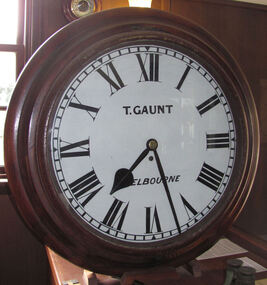
Instrument - Clock, c. 1860s
... Gaunt arrived in Melbourne in 1852, and by 1858 had established his own business at 14 Little Bourke Street. ...The tip of the small hour hand is shaped like a leaf. "T. GAUNT / MELBOURNE" is printed in black on the clock face. ..."T. GAUNT MELBOURNE" is printed on the clock face. “6 1 3” embossed on the back of the fusee mechanism behind the clock. ...Gaunt arrived in Melbourne in 1852, and by 1858 had established his own business at 14 Little Bourke Street. ...The clock was either made or sold by T. Gaunt & Co. of Melbourne, a manufacturer, importer and retailer of a wide variety of goods including jewellery, clocks and watches, navigational and measuring instruments, dinnerware, glassware and ornaments. Thomas Gaunt photograph was included in an album of security identity portraits of members of the Victorian Court, Centennial International Exhibition, Melbourne, 1888. Thomas Gaunt History: Thomas Gaunt established Melbourne's leading watchmaking, optical and jewellery business during the second half of the 19th century. Gaunt arrived in Melbourne in 1852, and by 1858 had established his own business at 14 Little Bourke Street. Around 1869 he moved to new premises in Bourke Street on the corner of Royal Arcade, Gaunt's shop quickly became a Melbourne institution. Gaunt proudly advertised that he was 'The only watch manufacturer in the Australian colonies'. While many watches and clocks may have had Gaunt's name on the dial, few would have been made locally. Gaunt did make some watches for exhibitions, and perhaps a few expensive watches for wealthy individuals. Gaunt's received a telegraph signal from Melbourne Observatory each day to correct his main clock and used this signal to rate and repair ship's chronometers and good quality watches. His main horological manufacturing was directed at turret clocks for town halls, churches and post offices. These tended to be specific commissions requiring individualised design and construction. He made the clock for the Melbourne Post Office lobby, to a design by Government Astronomer Robert Ellery, and won an award at the 1880-81 Melbourne International Exhibition for his turret clock for the Emerald Hill Town Hall. He became well known for his installation of a chronograph at Flemington Racecourse in 1876, which showed the time for the race, accurate to a quarter of a second. The firm also installed the clockwork and figures for Gog and Magog in the Royal Arcade. Thomas Gaunt also developed a department that focused on scientific instrumentation, making thermometers and barometers (from imported glass tubes), telescopes, surveying instruments and microscopes. Another department specialised in electroplating for trophies, awards and silverware, and the firm manufactured large amounts of ecclesiastical gold ware and silverware, for the church including St Patrick's Cathedral. There are no records that disclose the number of employees in the firm, but it was large enough for Gaunt to hold an annual picnic for the watchmakers and apprentices at Mordialloc from 1876; two years previously they had successfully lobbied Gaunt to win the eight hour day. Gaunt's workforce was reportedly very stable, with many workers remaining in the business for 15 to 30 years. Gaunt's wife Jane died on September 1894, aged 64. They had one son and six daughters, but only three daughters survived to adulthood. Two became nuns at the Abbotsford Convent and one daughter, Cecelia Mary Gaunt (died 28 July 1941), married William Stanislaus Spillane on 22 September 1886 and had a large family. Gaunt died at his home in Coburg, Victoria, leaving an estate valued at ₤41,453. The business continued as T. Gaunt & Co. after his death. Post Office and Clock History: Warrnambool’s Post Office has been in existence since 1857, when it was originally situated on the corner of Timor and Gilles Street. In March 1864 the Warrnambool Borough Council purchased this clock from Henry Walsh Jnr. for the sum of £25, “to be put up in front of the Post Office”. Henry Walsh Jnr was the eldest son of Melbourne’s Henry Walsh, maker and retailer of clocks, watches, thermometers and jewellery. In 1854 Henry Walsh Jnr. began business in Warrnambool as a watchmaker and jeweller later becoming a Councillor with now a local street named after him. The Post Office was extensively remodelled in 1875-76. Early photographs of this building show that the clock was installed on the northern outside wall, Timor Street, under the arches and between the 2 centre windows, where it could be seen by passers-by. Although spring loaded clocks date back to the 15th century, and fob and pocket watches evolving from these date to the 17th century, personal pocket watches were only affordable to the very fortunate. Public clocks such as this Post Office clock provided opportunity for all to know the time, and for those in possession of a personal watch to check and set their own timepieces to the correct time. During post office reservations during the 1970s the clock was removed and was eventually donated to the Flagstaff Collection. The Clock’s maker Thomas Gaunt, is historically significant and was an established and well renowned scientific instrument and clock maker in Melbourne during the 1860s. He was at that time the only watchmaker in the Australian colonies. In the 1870’s and 1880’s he won many awards for his clocks and was responsible for sending time signals to other clocks in the city and rural areas, enabling many businesses and organisations to accurate set their clocks each day. Warrnambool Borough Council purchased this clock from Henry Walsh Jnr. for the sum of £25 and the clock used to stand in front of the Warrnambool post office to allow ordinary citizens to set their time pieces as they walked by. The item is not only important because it was made by a significant early colonial clock maker and retailed by a locally known clock maker and jeweler but also that it was installed in the Warrnambool Post Office a significantly historical building in it's own right. Built in 1857 and regarded as one of the oldest postal facilities in Australia, with a listing on the National Heritage Database, (ID 15656). This 1864 hall clock originates from the Warrnambool Post Office. The clock glass is hinged to the top of the clock face and has a catch at the bottom. The metal rim of the glass is painted black. The clock face is metal, painted white, with black Roman numerals and markings for minutes and five minutes. The tip of the small hour hand is shaped like a leaf. "T. GAUNT / MELBOURNE" is printed in black on the clock face. The winding key hole is just below the centre of the clock face. The key winds a fusee chain mechanism, attached to the brass mainspring barrel that powers the pendulum with an 8-day movement. The speed of the clock can be adjusted by changing the position of the weight on the pendulum, lengthening or shortening the swing; raising the pendulum shortens its swing and speeds up the clock. The metal fusee mechanism has an inscription on it. The rectangular wooden casing is with a convex curve at the bottom that has a hinged door with a swivel latch. The original stained surface has been painted over with a matte black. There are two other doors that also allow access to the clock’s workings. The case fits over the pendulum and workings at the rear and attaches to the clock by inserting four wooden pegs into holes in the sides of the case then into the back of the clock. A flat metal plate has been secured by five screws onto the top of the case and a hole has been cut into it for the purpose of hanging up the clock. There is a nail inside the case, possibly used for a place to the key."T. GAUNT MELBOURNE" is printed on the clock face. “6 1 3” embossed on the back of the fusee mechanism behind the clock. warrnambool, shipwrecked coast, flagstaff hill, flagstaff hill maritime museum, maritime museum, shipwreck coast, flagstaff hill maritime village, shipwrecked artefact, clock, warrnambool post office, fusee, henry walsh jnr, thomas gaunt, t gaunt & co, post office clock -
 Bendigo Historical Society Inc.
Document - LETTER DESCRIBING BENDIGO'S GRANDEST BUILDINGS
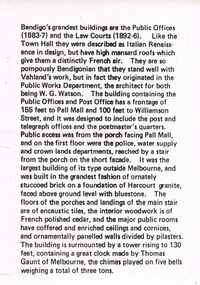
... The building is surmounted by a tower rising to 130 feet, containing a great clock made by Thomas Gaunt of Melbourne, the chimes played on five bells weighing a total of three tons....The building is surmounted by a tower rising to 130 feet, containing a great clock made by Thomas Gaunt of Melbourne, the chimes played on five bells weighing a total of three tons. ...Bendigo's Grandest Buildings are the Public Offices (1883-7) and the Law Courts (1892-6). Like the Town Hall they were described as Italian Renaissance in Design, but have high mansard roofs which give them a distinctly French air. They are so pompously Bendigonian that they stand well with Vahland's work, but in fact they originated in the Public Works Department, the architect for both being W.G. Watson. The building containing the Public Offices and Post Office has a frontage of 155 feet to Pall Mall and 100 feet to Williamson Street, and it was designed to include the post and telegraph offices and the postmaster's quarters. Public access was from the porch facing Pall Mall, and on the first floor were the police, water supply and crown lands departments, reached by a stair from the porch on the short façade. It was the largest building of its type outside of Melbourne, and was built in the grandest fashion of ornately stuccoed brick on a foundation of Harcourt granite, faced above ground level with bluestone. The floors of the porches and landings of the main stair are of encaustic tiles, the interior woodwork is of French polished cedar, and the major public rooms have coffered and enriched ceilings and cornices, and ornamentally panelled walls divided by pilasters. The building is surmounted by a tower rising to 130 feet, containing a great clock made by Thomas Gaunt of Melbourne, the chimes played on five bells weighing a total of three tons.bendigo, buildings, state offices -
 Wodonga & District Historical Society Inc
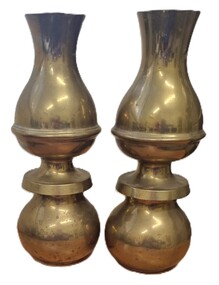
Decorative object - Brassware - St Augustines Church, Wodonga, T. Gaunt & Co, c1900
... Thomas Gaunt arrived in Melbourne in about 1856. He was a trained clockmaker and opened a business in Bourke Street, later moving to The Royal Arcade. ...Thomas Gaunt arrived in Melbourne in about 1856. He was a trained clockmaker and opened a business in Bourke Street, later moving to The Royal Arcade. ...St Augustine’s Church, Wodonga The Roman Catholic religion first came to the Wodonga area with travelling clergymen in about 1843. It was not until 4th October that 1860 Bishop Goold of the Chiltern parish visited Wodonga and consecrated St. Francis Chapel, a small weatherboard building which was erected on the site of the present St Augustine’s Church. Wodonga was officially separated from the Chiltern parish in 1899. Father James Ryan became the first Parish Priest of St Augustine's and oversaw the construction of the new church. The present St. Augustine’s was blessed and opened on 27 April 1902. Between 1918–1919 under Father Francis Flynn, the church was extended, and significant features such as the marble altar and stained-glass windows were added. Major refurbishments were completed in 1927, including further extension of the primary school. T. Gaunt & Co. Thomas Gaunt arrived in Melbourne in about 1856. He was a trained clockmaker and opened a business in Bourke Street, later moving to The Royal Arcade. Although he also made and sold wrist watches, jewellery, silver and brassware, Thomas was possibly most well-known for a chronometer he donated to the Victorian Racing Club for whom he was official timekeeper. It displayed the time of a race to an accuracy of .25 of a second. Gaunt had strong beliefs and connection to the Catholic Church of supplied much of its ecclesiastical silver and brassware such as this item. After Thomas Gaunt died in 1890, his executors continued the business, which was renamed T. Gaunt & Co. in 1893. The company operated for almost a century before closing in 1960. These items are significant because they were used in an important Wodonga church.A set of four brass vases manufactured by T Gaunt & Co.Beneath each vase T. GAUNT & Co.church brassware, st augustine's church wodonga, t gaunt & co -
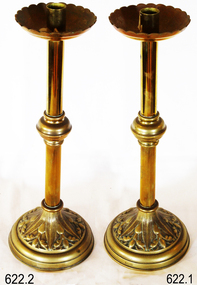 Flagstaff Hill Maritime Museum and Village
Functional object - Candlesticks, T. Gaunt & Co, circa 1944
... The candlesticks were made by T. Gaunt & Co. of Melbourne, a manufacturer, importer and retailer of a wide variety of goods including jewellery, clocks and watches, navigational and measuring instruments, dinnerware, glassware and ornaments. ...The candlesticks were made by T. Gaunt & Co. of Melbourne, a manufacturer, importer and retailer of a wide variety of goods including jewellery, clocks and watches, navigational and measuring instruments, dinnerware, glassware and ornaments. ...This pair of altar lights is from the St. Nicholas Seamen’s Church, 139 Nelson Place, Williamstown, Victoria, and was used during religious services there. The Church was operated by the Mission to Seamen organisation. The par of candlesticks was originally donated by Mrs. R.J. Ewart,as part of the furnishings for the new St Nicholas Seamen's Church in Williamstown, opened in 1944. The candlesticks were made by T. Gaunt & Co. of Melbourne, a manufacturer, importer and retailer of a wide variety of goods including jewellery, clocks and watches, navigational and measuring instruments, dinnerware, glassware and ornaments. Thomas Gaunt photograph was included in an album of security identity portraits of members of the Victorian Court, Centennial International Exhibition, Melbourne, 1888 THE MISSIONS TO SEAMEN (Brief History: for more, see our Reg. No. 611, Set of Pews) The Missions to Seamen, an Anglican charity, has served seafarers of the world since 1856 in Great Britain. It symbol is a Flying Angel, inspired by a Bible verse. Today there are centr4es in over 200 ports world-wide where seamen of all backgrounds are offered a warm welcome and provided with a wide range of facilities. In Victoria the orgainsation began in Williamstown in 1857. It was as a Sailors’ Church, also known as ‘Bethel’ or the ‘Floating Church’. Its location was an old hulk floating in Hobson’s Bay, Port of Melbourne. It soon became part of the Missions to Seamen, Victoria. In the year 2000 the organisation, now named Mission to Seafarers, still operated locally in Melbourne, Portland, Geelong and Hastings. The Ladies’ Harbour Lights Guild was formed in 1906 to support the Missions to Seamen in Melbourne and other centres such as Williamstown. Two of the most significant ladies of the Guild were founder Ethel Augusta Godfrey and foundation member Alice Sibthorpe Tracy (who established a branch of the Guild in Warrnambool in 1920). The Guild continued its work until the 1960s. In 1943 a former Williamstown bank was purchased for the Missions to Seaman Club. The chapel was named St Nicholas’ Seamen’s Church and was supported by the Ladies’ Harbour Lights Guild, the Williamstown Lightkeepers’ Auxiliary and the League of Soldiers’ and Sailors’ Friends. It ceased operation in 1966. A Missions to Seamen Chapel and Recreation Room was a significant feature of ports during the late 1800s and into the 1900s. It seemed appropriate for Flagstaff Hill to include such a representation within the new Maritime Village, so the Melbourne Board of Management of Missions to Seamen Victoria gave its permission on 21st May 1979 for the entire furnishings of the Williamstown chapel to be transferred to Flagstaff Hill. The St Nicholas Seamen’s Church was officially opened on October 11, 1981 and closely resembles the Williamstown chapel. These candlestickrs are significant historically for their origin in the St Nicholas Mission to Seamen's Church in Williamstown, established in 1857 to cater for the physical, social, and spiritual needs of seafarers. It originated in Bristol, England when a Seamen's Mission was formed in 1837. The connection of the candlesticks to the Mission to Seamen highlights the strong community awareness of the life of people at sea, their dangers and hardships, and their need for physical, financial, spiritual and moral support.Candlesticks or altar lights; a pair of two polished brass candlesticks. The wax cup at the top has a scalloped lip, the centre of the stem has a bulbous section, and the base has a cast floral design depicting leaves and grapes. The candlesticks have inscriptions. They were made by T. Gaunt & Co. This pair of Altar Lights is part of the St. Nicholas Seamen's Church Collection. Stamped "T GAUNT & CO."flagstaff hill maritime museum and village, flagstaff hill, warrnambool, maritime museum, maritime village, shipwreck coast, great ocean road, religion, religious service, st nicholas seamen’s church, williamstown, missions to seamen victoria, religious worship, altar light, r j ewart, church furnishing, church lighting, t gaunt & co, candlesticks, altar lights -
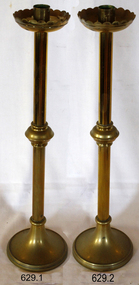 Flagstaff Hill Maritime Museum and Village
Functional object - Candlesticks, T. Gaunt & Co, circa 1944
... The candlesticks were made by T. Gaunt & Co. of Melbourne, a manufacturer, importer and retailer of a wide variety of goods, including jewellery, clocks and watches, navigational and measuring instruments, dinnerware, glassware and ornaments. ...The candlesticks were made by T. Gaunt & Co. of Melbourne, a manufacturer, importer and retailer of a wide variety of goods, including jewellery, clocks and watches, navigational and measuring instruments, dinnerware, glassware and ornaments. ...This pair of altar lights is from the St. Nicholas Seamen’s Church, 139 Nelson Place, Williamstown, Victoria, and was used during religious services there. The Church was operated by the Mission to Seamen organisation. The par of candlesticks was originally donated by Mrs. M. Jackson, as part of the furnishings for the new St Nicholas Seamen's Church in Williamstown, which opened in 1944. The candlesticks were made by T. Gaunt & Co. of Melbourne, a manufacturer, importer and retailer of a wide variety of goods, including jewellery, clocks and watches, navigational and measuring instruments, dinnerware, glassware and ornaments. Thomas Gaunt's photograph was included in an album of security identity portraits of members of the Victorian Court, Centennial International Exhibition, Melbourne, 1888. THE MISSIONS TO SEAMEN (Brief History: for more, see our Reg. No. 611, Set of Pews) The Missions to Seamen, an Anglican charity, has served seafarers of the world since 1856 in Great Britain. It symbol is a Flying Angel, inspired by a Bible verse. Today there are centr4es in over 200 ports world-wide where seamen of all backgrounds are offered a warm welcome and provided with a wide range of facilities. In Victoria the orgainsation began in Williamstown in 1857. It was as a Sailors’ Church, also known as ‘Bethel’ or the ‘Floating Church’. Its location was an old hulk floating in Hobson’s Bay, Port of Melbourne. It soon became part of the Missions to Seamen, Victoria. In the year 2000 the organisation, now named Mission to Seafarers, still operated locally in Melbourne, Portland, Geelong and Hastings. The Ladies’ Harbour Lights Guild was formed in 1906 to support the Missions to Seamen in Melbourne and other centres such as Williamstown. Two of the most significant ladies of the Guild were founder Ethel Augusta Godfrey and foundation member Alice Sibthorpe Tracy (who established a branch of the Guild in Warrnambool in 1920). The Guild continued its work until the 1960s. In 1943 a former Williamstown bank was purchased for the Missions to Seaman Club. The chapel was named St Nicholas’ Seamen’s Church and was supported by the Ladies’ Harbour Lights Guild, the Williamstown Lightkeepers’ Auxiliary and the League of Soldiers’ and Sailors’ Friends. It ceased operation in 1966. A Missions to Seamen Chapel and Recreation Room was a significant feature of ports during the late 1800s and into the 1900s. It seemed appropriate for Flagstaff Hill to include such a representation within the new Maritime Village, so the Melbourne Board of Management of Missions to Seamen Victoria gave its permission on 21st May 1979 for the entire furnishings of the Williamstown chapel to be transferred to Flagstaff Hill. The St Nicholas Seamen’s Church was officially opened on October 11, 1981 and closely resembles the Williamstown chapel. These candlesticks are historically significant for their origin in the St Nicholas Mission to Seamen's Church in Williamstown, established in 1857 to cater to seafarers' physical, social, and spiritual needs. It originated in Bristol, England, when a Seamen's Mission was formed in 1837. The connection of the candlesticks to the Mission to Seamen highlights the strong community awareness of the life of people at sea, their dangers and hardships, and their need for physical, financial, spiritual and moral support. Candlesticks, also known as altar lights; are a pair of two polished brass candlesticks. The wax cup has a scalloped lip, the centre of the stem has a bulbous section, and the base has a floral design depicting leaves and grapes. They are inscribed 'Made by T. Gaunt & Co.' This pair of Altar Lights is in our St Nicholas Seamen's Church Collection.Inscribed "T. GAUNT & CO.."flagstaff hill, warrnambool, shipwrecked-coast, flagstaff-hill, flagstaff-hill-maritime-museum, maritime-museum, shipwreck-coast, flagstaff-hill-maritime-village, altar lights, mrs. m. jackson, t. gaunt & co., religious service, ladies lightkeepers' auxiliary, mission to seamen victoria, st nicholas seaman’s church williamstown, religious worship, m. jackson, candlesticks -
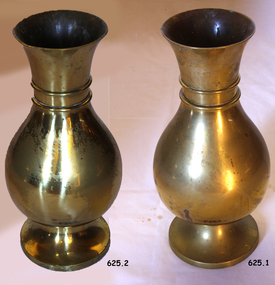 Flagstaff Hill Maritime Museum and Village
Functional object - Vase, T. Gaunt & Co, circa 1944
... Gaunt & Co. engraved on both vases. T. Gaunt & Co. of Melbourne, is a manufacturer, importer and retailer of a wide variety of goods including jewellery, clocks and watches, navigational and measuring instruments, dinnerware, glassware and ornaments. ...Gaunt & Co. engraved on both vases. T. Gaunt & Co. of Melbourne, is a manufacturer, importer and retailer of a wide variety of goods including jewellery, clocks and watches, navigational and measuring instruments, dinnerware, glassware and ornaments. ...This pair of brass altar vases is from the St. Nicholas Seamen’s Church, 139 Nelson Place, Williamstown, Victoria, during religious services there. The Church was operated by the Mission to Seamen organisation. Each vase is inscribed with the donors' names and the year of presentation - Margaret R. Pearson 1944, Mrs B Raybould 1944, - and the maker's name T. Gaunt & Co. The two donors presented the vases to St Nicholas Seamen's Church in Williamstown as part of the furniture and furnishings for the new church that officially opened in 1944. T. Gaunt & Co. engraved on both vases. T. Gaunt & Co. of Melbourne, is a manufacturer, importer and retailer of a wide variety of goods including jewellery, clocks and watches, navigational and measuring instruments, dinnerware, glassware and ornaments. Thomas Gaunt's photograph was included in an album of security identity portraits of members of the Victorian Court, Centennial International Exhibition, Melbourne, 1888. THE MISSIONS TO SEAMEN (Brief History: for more, see our Reg. No. 611, Set of Pews) The Missions to Seamen, an Anglican charity, has served seafarers of the world since 1856 in Great Britain. It symbol is a Flying Angel, inspired by a Bible verse. Today there are centr4es in over 200 ports world-wide where seamen of all backgrounds are offered a warm welcome and provided with a wide range of facilities. In Victoria the orgainsation began in Williamstown in 1857. It was as a Sailors’ Church, also known as ‘Bethel’ or the ‘Floating Church’. Its location was an old hulk floating in Hobson’s Bay, Port of Melbourne. It soon became part of the Missions to Seamen, Victoria. In the year 2000 the organisation, now named Mission to Seafarers, still operated locally in Melbourne, Portland, Geelong and Hastings. The Ladies’ Harbour Lights Guild was formed in 1906 to support the Missions to Seamen in Melbourne and other centres such as Williamstown. Two of the most significant ladies of the Guild were founder Ethel Augusta Godfrey and foundation member Alice Sibthorpe Tracy (who established a branch of the Guild in Warrnambool in 1920). The Guild continued its work until the 1960s. In 1943 a former Williamstown bank was purchased for the Missions to Seaman Club. The chapel was named St Nicholas’ Seamen’s Church and was supported by the Ladies’ Harbour Lights Guild, the Williamstown Lightkeepers’ Auxiliary and the League of Soldiers’ and Sailors’ Friends. It ceased operation in 1966. A Missions to Seamen Chapel and Recreation Room was a significant feature of ports during the late 1800s and into the 1900s. It seemed appropriate for Flagstaff Hill to include such a representation within the new Maritime Village, so the Melbourne Board of Management of Missions to Seamen Victoria gave its permission on 21st May 1979 for the entire furnishings of the Williamstown chapel to be transferred to Flagstaff Hill. The St Nicholas Seamen’s Church was officially opened on October 11, 1981 and closely resembles the Williamstown chapel. This par of vases is significant historically for its origin in the St Nicholas Mission to Seamen's Church in Williamstown, established in 1857 to cater for the physical, social, and spiritual needs of seafarers. It originated in Bristol, England when a Seamen's Mission was formed in 1837. The connection of pair of vases to the original donation to the Mission to Seamen highlights the strong community awareness of the life of people at sea, their dangers and hardships, and their need for physical, financial, spiritual and moral support. Vase: pair of two polished brass altar vases, round, pear-shaped, bulbous body on a round pedestal, two neck rings and flared lips. Inscriptions on both vases in script around the base. Made by T. Gaunt & Co. One was presented to the church by Margaret R Pearson and the other presented by Mrs B. Raybould in 1944 The vases are part of the St Nicholas Seamen's Church Engraved on the 625.1 "Presented By Margaret R. Pearson 1944." Engraved on 625.2 "Presented By Mrs B. Raybould. 1944." Both engraved "T GAUNT & Co"flagstaff hill maritime museum and village, flagstaff hill, warrnambool, maritime museum, maritime village, shipwreck coast, great ocean road, religion, religious service, st nicholas seamen’s church, williamstown, missions to seamen victoria, brass vases, metal craft, brassware, altar vase, church vase, mrs r raybould, margaret r pearson, t gaunt & co, church furnishing -
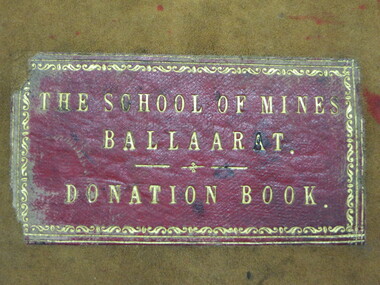 Federation University Historical Collection
Book - Ledger, Ballarat School of Mines Donation Book, 1878 - 1895, 1878-1895
... Baron Ferdinand Von Mueller KCMG, etc, Melbourne
678. E.F.A. Gaunt, Royal Navy, H.M.S. Nelson, per favour Lyde Gaunt - Specimen of manganese ore from the mines - Russell - New Zealand
728. ...Baron Ferdinand Von Mueller KCMG, etc, Melbourne
678. E.F.A. Gaunt, Royal Navy, H.M.S. Nelson, per favour Lyde Gaunt - Specimen of manganese ore from the mines - Russell - New Zealand
728. ...The Donation Book relates to the Ballarat School of Mines Museum which opened in 1872. Very few of these items are still held by Federation University. The Museum was emptied in the 1960s with items being distrubuted to the Ballarat Historical Society, returned to original lenders (ie Pern Collection), of disposed of. Donations to the Ballarat School of Mines include: 34. M. Hamburger, Ballarat - bunsen burner 41. W.H. Shaw, Phoenix Foundry - 81 nos of 'Engineer' 89. Juvenile Industrial Exhibition Association Committee per Joseph Flude - dies used for striking medals awarded to successful exhibits. 165. Ferdinand Von Mueller 172 Ferdinand Von Mueller o hortus siccus 6 197. James Stoddart 203. Edward Gazzard, North Creswick - Model of safety Cage invented and made by donor 218. E. Morey 222. Alfred Lestor 228. J.J. Sleep, Ballarat, patent Lever escarpment Clock (displayed in laboratories) 237. Bernard Smith (Warden) per favor of James M. Bickett - Bust of Mr John Lynch, Smythesdale. (Note: This item is not in the present Federation University Historical Collection) 241. James Oddie, J.P., Ballarat, Copy of 'the Chemist and Druggist' 267. John Lynch Junior, Smythesdale - Cast of "Golden Age" nugget, found at Browns by Co-operative party, 12 men. Weight 75 oz, 12 dwts, 12 grs.(Note: This item is not in the present Federation University Historical Collection) 270. Isaac Davis, Main Road, Ballarat 294. W. H. Shaw, Ballarat - 94 nos of 'The Engineer' 295. Rivett Henry Bland, Clunes - Specimen of water pipe from the Port Phillip Company's mine encrusted with carbonites of lime and magnesium (Note: This item is not in the present Federation University Historical Collection) 299. D.J. Williams, Queenscliff - 1 case shells from Fiji 305. C. Retallack, Ballarat 314. William Henry Shaw, Ballarat - glass case 323. W. Longley, Ballarat - Botanical Specimen (Note: This item is not in the present Federation University Historical Collection) 327. W. H. Angove, Perth 337. J. Cosmo Newbery, B Sc, Melbourne 343. James Hector, M.D., New Zealand 353. R.S. Mitchell, Ballarat - 8 specimens live plants (medicinal) (for the Ballarat School of Mines Garden) 355. W. Magee, Ballarat - Sugar cane plants and seeds (for the Ballarat School of Mines Garden) 363. James Hector, Wellington, new Zealand 371. William Wesley, 28 Essex St, Strand, London - Scientific book circular 380. Jacob Upfold (deceased) per favor of the trustees - bequest of steam engine indicator and belongings (boothe and case) 381. Joseph Mitchell, 22 Macarthur Street, Ballarat - sod of turf cut from Warboy's High Few, County Huntingdon, England, 1872. 394. W.H. Barnard 401. James Orr 418. F. Ratte, Sydney 440. Alfred Mica Smith, Sandhurst (Bendigo), Inaugural Address, delivered to the Bendigo School of Mines Science Society, June 20. 1881 by P.H. Macgillivray, MA, MRCS, FLS, President. (Note: This item is not in the present Federation University Historical Collection) (Note: This item is not in the present Federation University Historical Collection) 446. C. C. Shoppee, Ballarat 462. Dr Bunce, Ballarat 468. James Black, Mining Manager "Kerrit Bureet' 479. J.S. North, Mining Manager No. 2 Queen Co, Black Hill Ballarat. 505. Smith Tibbitts - A block of ancient leaves from the Nigtingbool Estate near Haddon on the Ballarat district from shaft 80 feet deep. (Note: This item is not in the present Federation University Historical Collection) 512. F.W. Niven, Ballarat - "A Handy Book to Tasmania" 522. James Hector, Wellington, New Zealand 549. C.E. Grainger, Manager Ballarat Woollen Mills - samples of dyed and raw wools 600. (4 July 1882) Henry Sutton, Ballarat - 13th annual report of the Aeronautical Society of Great Britain; 2 papers from the Proceedings of the Royal Society, nos 217 and 218- 1882, "One a new electrical storage battery by Henry Sutton, Ballarat, Victoria. 608. H. Glenny J.P., Ballarat - Specimen of Asbestos from Tasmania 610. M.H. Edelmann, Munich, Germany 674. W.H. Shaw, Phoenix Foundry - Steel boring 95 feet long taken from bed-plate of locomotive engine. 675 - H.R. Hancock J.P. pre favour Mr James Pryor, Moonta Mines 676. Baron Ferdinand Von Mueller KCMG, etc, Melbourne 678. E.F.A. Gaunt, Royal Navy, H.M.S. Nelson, per favour Lyde Gaunt - Specimen of manganese ore from the mines - Russell - New Zealand 728. Dr Pinnock, Ballarat 760. Simon Morrison, Ballarat 784. James Shugg, Hamilton - 1 case fossils from Muddy Creek, near Hamilton. (Note: This item is not in the present Federation University Historical Collection) 786. W. Bolam (inspector of Schools), Melbourne - 2 spears and 1 fishing prong Fijian 806. James Oddie, Ballarat 708. Henry G. Hanks, San Francisco 786. W. Bolam (Inspector of Government Schools Melbourne) - 2 spears and one fishing prong Fijian 824. Henrique Gorceixm Onro Preto, Brazil 840. W. Laplau, Ballarat - Gas furnace with a large assortment of fittings, also large gas holder and oil-heating apparatus 854. Robert Borch, Main Road, Ballarat - Improved safety chain (Note: This item is not in the present Federation University Historical Collection) 928. James Oddie 944. James P. Munroe, Registrar, Massachusetts 952. L.E. Cutter per favour of Mr F.J. Martell - Unexploded bomb shell from the Eureka Stockade 957. H. Glenny, Hobart 962. George Hart, Ballarat - eagle 976. Henry Sutton, Ballarat - 1 volume "Plattner on the Blowpipe" 978. J.W. Flatow, 45 Madeline Street, Carlton, Melbourne 984. Charles C Shoppee Ballarat - Copies of ancient coins 989-95 - Specimens from Moonta, South Australia 985. W.H. Wooster BOlwarra - books microscope related 1179. James Oddie - Live hedgehog 1181 C. Crisp, Bacchus Marsh, Portugal Copper Coin, 1785 1248 James Oddie, Solomon Islands - Bow and arrows & Spears 1285. C. Colyer, Smythesdale 1327. John L. McKenna, Smeaton - Fragment of Stone Axe. 1395. Mrs O. Skoglund, Nerrina 1428. Daniel Brophy, Ballarat - Collection of mineral specimen form Silverton (Collected by Mrs James Murray) 1442. Henry Sutton, Ballarat - Specimens of fossil fruits collected at Haddon by Charles Brown. 1444. Mining Department - Underground Mine Workings from Band of Hope and others. 1517. W.H. Wooster, Ballarat 1592. Bishop of Ballarat - Stone Axe and other native items 1669. H. McHaffier, Napoleons - 1 Spanish silver coin 1681. James Oddie, Dunedin 1688. W. Burbridge, Ballarat - Native Tomahawk from Metung 1708. A. Doepel, Ballarat 1712. Marty Guerin, Ballarat 1735. Bella Guerin. M.A., Ballarat - Copy Wide Awake Vol 1 No 7 May 28th 1887 and The Bulletin, March 19th 1887. 1747. Bella Geurin M.A., Ballarat - Copy Wide Awake Vol 1 No 8 June 4 1887 1751. Bella Geurin M.A., Ballarat - Copy Wide Awake Vol 1 No 9 June 11th 1887 1842. Linnean Society, London England - Charter, By Laws, Proceedings, Transactions, Journals 1853. W.J. Corbould, Silverton, NSW - chloride of silver from Pinnacles, Broken Hill, Silverton 1888. W. J. Corbould, Sample of metallic silver from Silverton, NSW 1928. E. Morey, Ballarat - Steam Engine 1937. Henry Sutton A.S.I.E., Ballarat - Plate Electric Machine, chimes and Sportman (number crossed out) 1951. Henry Sutton A.S.I.E., Ballarat - Plate Electric Machine, chimes and Sportman 1981. Harrie Wood (per W.H.B.[Barnard?), Ballarat 1996. W.H. Shaw, Phoenix Foundry - Papers "The Vict Engineer July 1887, May June July August 1888 and others 2014. Harrie Wood, Sydney - Report Department of Mines, 18872027. W.J. Bechervaise - Copy of Book by Baldwin Spencer 2034. A.G. Randall - Native Hatchet 2045. W.H. Corbould, Silverton, Collection of silver ores 2051. Fowler, Tarnagulla - Native Tomahawk 2123-2131. James Oddie, London 2163. Roff. F. Taplier, Sturt Street - Native Tomahawk 2178. Syd. Johnson, Meredith - Native Tomahawk, Greenstone 2184. Mr Tupp for Hall - Native Spear and Club 2292. Emmanuel Steinfeld, Melbourne 2313. A. Atwood, Rowlands Factory, Dana Street 2361. Dr Pinnock, Ballarat - Collection of Living Sponges 2363. P. Curnow, Ballarat - Piece of wood with stone naturally embedded 2364. R. Dowling, Waubra 2875. Mrs C, Flude, Ballarat - Collection of (5) mineral specimens 3460. Joseph Weir, Ballarat - Sample of rolled Annibar 3466. J. Hart, Ballarat - Native Shield - supposed to have been made by King Billy 4784. Mr. O. Woolnaugh, Pleasant Street - Four Native Tomahawks 6469. L. Balhausen, Ballarat 3472. John English, Smeaton - three samples of auriferous wash dirt 3607. Columbia College, New York - Handbook of Information of the Columbia College in the Ciry of New York 1892-3. 3672. L.A. Samuels, Bendigo 3724. P. Paperhagen 3736. The Late Rivett Henry Bland per John Noble Wilson - Collection of mineral specimens and fossils 3752. G.A. Denny, South Africa 3755. J. Carroll, Ballarat - Specimen of Native bread found in Ballarat East. 4765. J. Donnelly, Springs, Bungaree I. Fowler, Coolgardie, Specimen of Gold Bearing Quartz ballarat school of mines, doantions, museum, ballarat school of mines museum, safety cage, botanical garden, materia medica garden, library, bella guerin, james oddie, phoenix foundry, w.h. shaw, john lynch, henry sutton, aboriginal, stone axe, tomahawk, geological specimens, moonta, fedinand krause, oddie collection of minerals, thomas bath, spears, solomon islands, king billy, bows and arrows, ancient coins, birds eggs, snakes -
 Federation University Historical Collection
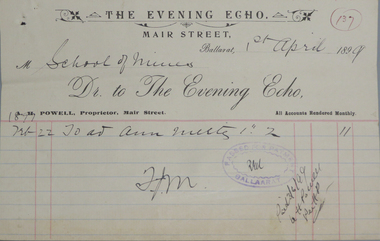
Book - Scrapbook, Ballarat School of Mines Invoices, 01/07/1895 - 05/05/1899
... gaunt...h. wardle and son...turron & mcgavin...e.e. campbell...g.f. hocking...william sutherland...f. vale...victoria insurance company...r. collie & co....walter cornell...john fiscalini...mcvitty & co...j. miller & co...a.g. corbett...ben franklin printing works...middleton & morris...melbourne...The invoices glued into the scrapbook relate to purchases from the Ballarat School of Mines invoices ballarat school of mines tunbridges pringle receipts w. hamer plumber eyres brothers j.h. trotman g. batchelor n. guthridge w. doepel frank fiscalini huddart, barker and co. a. gaunt h. wardle and son turron & mcgavin e.e. campbell g.f. hocking william sutherland f. vale victoria insurance company r. collie & co. walter cornell john fiscalini mcvitty & co j. miller & co a.g. corbett ben franklin printing works middleton & morris melbourne glass bottle works co eldon chambers e.l. stubbs j. jones firewood mrs soderstrom museum ballarat school of mines museum hill & paine h. hebestadt f.w. commons sculptor cherry & robins alex e. monsbourgh alex purdie andrew cant ballarat star frederick martell goodfellows evening echo a.h. powell Phillately A very large dark green hard covered volume with read leather face spine and corners. ...The invoices glued into the scrapbook relate to purchases from the Ballarat School of MinesA very large dark green hard covered volume with read leather face spine and corners. Black ornamental bands across the spine. Leather strap with buckle for securing covers when not in use. Plain pages of brown "wrapping paper". Receipts glued to pages, folded and then numbered consecutively by hand i blue pencil. First receipt No. 996 (01 July 1895), numbering restarts after 1000 (three times). Last receipt is No. 155 (05 May 1899).invoices, ballarat school of mines, tunbridges, pringle, receipts, w. hamer, plumber, eyres brothers, j.h. trotman, g. batchelor, n. guthridge, w. doepel, frank fiscalini, huddart, barker and co., a. gaunt, h. wardle and son, turron & mcgavin, e.e. campbell, g.f. hocking, william sutherland, f. vale, victoria insurance company, r. collie & co., walter cornell, john fiscalini, mcvitty & co, j. miller & co, a.g. corbett, ben franklin printing works, middleton & morris, melbourne glass bottle works co, eldon chambers, e.l. stubbs, j. jones, firewood, mrs soderstrom, museum, ballarat school of mines museum, hill & paine, h. hebestadt, f.w. commons, sculptor, cherry & robins, alex e. monsbourgh, alex purdie, andrew cant, ballarat star, frederick martell, goodfellows, evening echo, a.h. powell, phillately -
 Glenelg Shire Council Cultural Collection
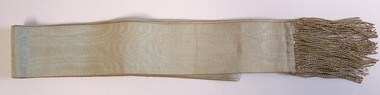
Container - T. Gaunt & Co. box, c. 1900
... Gaunt & Co., Prop. Ltd.,/Ophthalmic Opticians, Watchmakers and Jewellers,/Cnr Royal Arcade and Bourke Street,/MELBOURNE./ SIGHT TESTED GRATIS (printed cover)...Gaunt & Co., Prop. Ltd.,/Ophthalmic Opticians, Watchmakers and Jewellers,/Cnr Royal Arcade and Bourke Street,/MELBOURNE./ SIGHT TESTED GRATIS (printed cover) Cardboard box in two parts, with metal-casing on corners. ...Part of Graham Collection, donated by the family of Misses Mary and Edith Maude Graham, of 4 Blair Street, Portland. Displayed in History House. Box used to store sashes (3770.1 and 3770.2)Cardboard box in two parts, with metal-casing on corners. Box lid has a line drawing of glasses with a diagram, above proprietor's name and business details.Front: Miss Welshman/Convent of Sacred Heart/Burke Rd/East Malvern (ink, cover) T. Gaunt & Co., Prop. Ltd.,/Ophthalmic Opticians, Watchmakers and Jewellers,/Cnr Royal Arcade and Bourke Street,/MELBOURNE./ SIGHT TESTED GRATIS (printed cover) -
 Warrnambool and District Historical Society Inc.
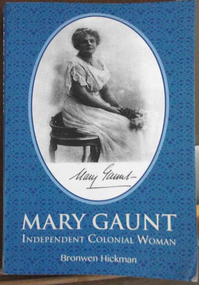
Book, Bronwen Hickman, Mary Gaunt: independent colonial woman, 2014
... Born in Chiltern, Victoria, Mary Gaunt was one of the first female students to study at the University of Melbourne. ...Born in Chiltern, Victoria, Mary Gaunt was one of the first female students to study at the University of Melbourne. ...Biography of novelist and travel writer, Mary Gaunt (1862-1942)This is a soft cover book of 304 pages. It has a blue cover with a black and white photograph of Mary Gaunt in an oval shape on the front cover. There is white lettering on the front cover and black lettering in an oval shape on the back cover. The book has an introduction, 35 chapters, acknowledgements, endnotes, a list of publications and an index. It has several illustrations, sketches, maps and black and white and colour photographs,non-fictionBiography of novelist and travel writer, Mary Gaunt (1862-1942)mary gaunt, australian literature, history of warrnambool -
 Bendigo Historical Society Inc.
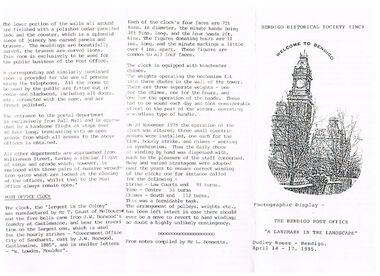
Document - THE BENDIGO POST OFFICE, 14/04/1995
... ... Mr T Gaunt Melbourne...BENDIGO Institutions bendigo post office Document The Bendigo Post Office Bendigo Historical Society (Inc) Dudley House Bendigo Cenotaph Alexandra Fountain Survey Office Sandhurst Trustees Post Office Savings Bank cohn Family Temperance Hall Telegraph Office Railway Station 1882 Directory Sub-Treasury Sandhurst Public Offices State Government Department Offices Postal Department Sir Henry Brougham Lock Mr J Nimmo Bendigo Advertiser 25.9.1971 Keen's Cement Mr T Gaunt Melbourne J W Horwood's Foundry Castlemaine W Lowden Mr L Bennetts Photographic display - The Bendigo Post Office 'A Landmark in the Landscape’ Dudley House - Bendigo. ...Photographic display - The Bendigo Post Office 'A Landmark in the Landscape’ Dudley House - Bendigo. April 14 - 17, 1995. Also includes a Brief History of the Bendigo Post Office, Building Notes, Description, and the Post Office Clock has a small picture of the Post Office Clock on the front. From notes compiled by Mr. L. Bennetts. Bendigo Historical Society (Inc.) at the top of the front page.bendigo, institutions, bendigo post office, document, the bendigo post office, bendigo historical society (inc), dudley house bendigo, cenotaph, alexandra fountain, survey office, sandhurst trustees, post office savings bank, cohn family, temperance hall, telegraph office, railway station, 1882 directory, sub-treasury, sandhurst public offices, state government department offices, postal department, sir henry brougham lock, mr j nimmo, bendigo advertiser 25.9.1971, keen's cement, mr t gaunt melbourne, j w horwood's foundry castlemaine, w lowden, mr l bennetts -
 Warrnambool and District Historical Society Inc.
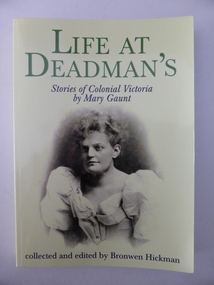
Book, Bronwen Hickman, Life at Deadman's - Stories of Colonial Victoria by Mary Gaunt, 2001
... Gaunt (1861-1942) was a writer of novels, travel books, short stories and other articles. She was known internationally for her writings in the late 19th century and early 20th century. Born in Chiltern, Victoria, she was the first woman to study at Melbourne...Gaunt (1861-1942) was a writer of novels, travel books, short stories and other articles. She was known internationally for her writings in the late 19th century and early 20th century. Born in Chiltern, Victoria, she was the first woman to study at Melbourne ...A collection of short stories by Mary Gaunt, edited and published by Bronwen Hickman.This is a soft cover book of 178 pages. The cover is yellow with an image in sepia tones of Mary Gaunt. The lettering on the front cover and on the spine is green and black. The back cover contains critical comments on Mary Gaunt’s work and information on the editor. The book has a map, an introduction, a list of the sources of the stories, twelve short stories, a list of works by Mary Gaunt and a note on the author by the editor. fictionA collection of short stories by Mary Gaunt, edited and published by Bronwen Hickman.mary gaunt, dr h.l.miller, whiskey stills in the warrnambool district (19th century), history of warrnambool, australian women writers -
 Bendigo Military Museum
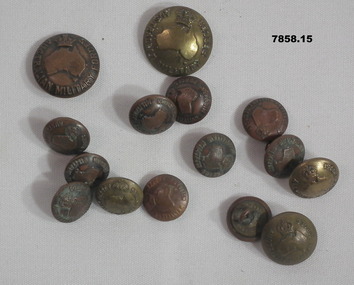
Uniform - BUTTONS, AMF, cWW2
... PARKES, BRISBANE STOKES & SONS, MELBOURNE J.R. GAUNT & SON LD, LONDON P.J. KING PRY LTD, MELBOURNE, K.G. ...PARKES, BRISBANE STOKES & SONS, MELBOURNE J.R. GAUNT & SON LD, LONDON P.J. KING PRY LTD, MELBOURNE, K.G. ...Part of the Cooper Collection.Collection of three large and twelve small copper coloured army uniform buttons. Each features a raised map of 'Australia below a Kings Crown. Word 'Australian Military Forces' written around the edge of each button. metal loop on the back of each for attaching to a ubniform.Various Manufacturers names stamped on back: AJ. PARKES, BRISBANE STOKES & SONS, MELBOURNE J.R. GAUNT & SON LD, LONDON P.J. KING PRY LTD, MELBOURNE, K.G. LUKE PTY LTDcooper collection, buttons, uniform, australian military forces -
 Chiltern Athenaeum Trust
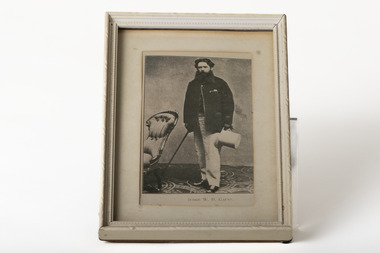
Photograph, JUDGE W. H. GAUNT
... William Henry Gaunt (1830-1905), judge, was born on 27 July 1830 at Leek, Staffordshire, England, son of John Gaunt, banker, and his wife Mary, née Bakewell. Educated at Leek Grammar School and Whitchurch, Salop, he migrated to Melbourne, and entered the Victorian public service and was rapidly promoted. ...William Henry Gaunt (1830-1905), judge, was born on 27 July 1830 at Leek, Staffordshire, England, son of John Gaunt, banker, and his wife Mary, née Bakewell. Educated at Leek Grammar School and Whitchurch, Salop, he migrated to Melbourne, and entered the Victorian public service and was rapidly promoted. ...This photograph is a copy displayed in the Australian Dictionary of Biography. The original photograph is in the La Trobe Collection in the State Library of Victoria. William Henry Gaunt (1830-1905), judge, was born on 27 July 1830 at Leek, Staffordshire, England, son of John Gaunt, banker, and his wife Mary, née Bakewell. Educated at Leek Grammar School and Whitchurch, Salop, he migrated to Melbourne, and entered the Victorian public service and was rapidly promoted. By March 1854 he was chief clerk at Beechworth, the administrative centre of the Ovens goldfield. In July 1855 the resident warden commended Gaunt as 'a highly valuable public servant' with an intimate knowledge of the district and the 'temper and disposition of the miners'. Appointed sub-warden in the Beechworth district in January 1856 and a Chinese protector in August, he was given control of the extensive Woolshed district. When European miners attacked a party of Chinese at the Buckland River diggings in May 1857 Gaunt was sent to restore order. One of his proclamations, issued in Chinese characters, concluded 'W. H. Gaunt, your protector—tremble and obey!' In June he was appointed a police magistrate and next month was sent to take charge at the Buckland where the Chinese had been expelled from the diggings; the police force assisting him was led by Robert O'Hara Burke. In January 1858 Gaunt was appointed a warden, in November was transferred to Chiltern, north of Beechworth, and in August 1859 was made a commissioner of crown lands. In February 1860 Gaunt was appointed a coroner of Victoria, acting at Indigo, near Chiltern. In April 1865 he was transferred to Beechworth, became visiting justice of the gaol and later moved to Sandhurst. In January 1869 he was appointed returning officer for the mining district of Ballarat and visiting justice of the gaol. He was associated with this area for the rest of his life and won high repute for his integrity. In 1874 he chaired the inaugural meeting of the first Australian competitive swimming club. For years he studied law and was called to the Bar in December 1873. He was one of the many public servants dismissed by Graham Berry on 9 January 1878 (Black Wednesday). After petitioning the Queen in vain over his dismissal he began practice in Ballarat as a barrister. He soon became a leading authority on mining laws; one of the cases in which he was involved was the lengthy inquest on the bodies of the twenty-two miners drowned in the New Australasian mine disaster at Creswick in 1882. He was appointed a temporary judge of the Insolvency Court in 1889 and a County Court judge in 1891. In 1900 he was chairman of the royal commission which considered Metropolitan Board of Works matters, and in 1902 was president of the inquiry into the unification of municipalities in Victoria. In 1860 Gaunt married Elizabeth Mary, the youngest daughter of Frederick Palmer; they had nine children. Of the surviving five sons and two daughters, Ernest Frederick Augustus and Guy Reginald Archer both became admirals and were knighted; Cecil Robert became a lieutenant-colonel, Clive Herbert a government advocate in Rangoon and Mary (Mrs H. L. Miller) one of the first women students to enrol at the University of Melbourne (1881), although she did not complete her degree; she became a successful novelist. Gaunt died on 5 October 1905. An anonymous colleague said: 'I don't think he was ever excelled as a police magistrate, and during the many years he was on the County Court bench he earned the highest regard. His capacities were as unquestioned as his integrity, and more could not be said of any judge'. Select Bibliography Votes and Proceedings (Legislative Assembly, Victoria), 1878, 3, (58) Government Gazette (Victoria), 22 Feb, 15 Aug 1856, 30 June 1857, 5 Jan 1858, 16 Aug 1859, 3 Feb 1860, 7 Mar, 11 Oct 1862, 28 Mar, 4 Apr 1865, 17 May 1867, 9 June 1868, 22, 29 Jan 1869 Ovens and Murray Advertiser, 21 May 1857, 11 Mar 1865 Colonial Secretary's in-letters, goldfields, 25 Mar 1854, 21 July, 18 Nov 1855, 22 Aug 1857 (Public Record Office Victoria) scrapbook and newsclippings (privately held). Related Entries in NCB Sitesview family tree Gaunt, Mary Eliza (daughter)go to ADB entryPhotograph of Judge W. H. Gaunt standing beside chair holding top hat and cane, under glass, in cream frame with cream matte.Printed name underneath: JUDGE W. H. GAUNT -
 Sunshine and District Historical Society Incorporated
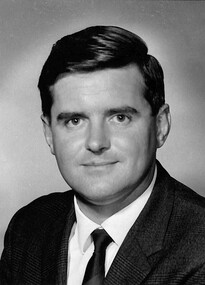
Photograph - Massey Ferguson - Employees Photographs
... McKay Massey Harris 4650.113 - Massey Ferguson Employees - John Vaughan, Noel Clarke Melbourne Branch Manager, Brian Harrod Export Manager 4650.114 - Massey Ferguson Employees - Jack Day, Ivan Leyendekkers, Ken Gaunt, Jack Stokes, Jack Vance, Dick Weir 4650.115 - Massey Ferguson Employees - Jack Vance Director Finance & Ken Gaunt Director Engineering 4650.116 - Massey Ferguson Employees - P. ...McKay Massey Harris 4650.113 - Massey Ferguson Employees - John Vaughan, Noel Clarke Melbourne Branch Manager, Brian Harrod Export Manager 4650.114 - Massey Ferguson Employees - Jack Day, Ivan Leyendekkers, Ken Gaunt, Jack Stokes, Jack Vance, Dick Weir 4650.115 - Massey Ferguson Employees - Jack Vance Director Finance & Ken Gaunt Director Engineering 4650.116 - Massey Ferguson Employees - P. ...Many of these photographs appeared in the Massey Ferguson Review Publication4650.001 - Massey Ferguson Employees - Mr S. R. Makeham Manager Cane Industry Project Massey Ferguson (Australia) Limited 4650.002 - Massey Ferguson Employees - Alex Hamilton 4650.003 - Massey Ferguson Employees - J. Hackett Director Special Projects Massey Ferguson (Australia) Limited 4650.004 - Massey Ferguson Employees - William 'Bill' Geddes 4650.005 - Massey Ferguson Employees - Ken Steel Director 4650.006 - Massey Ferguson Employees - I. H. Salom Director Of Manufacturing Massey Ferguson (Australia) Limited 4650.007 - Massey Ferguson Employees - E. Wendt Perth Sales Manager Massey Ferguson (Australia) Limited 4650.008 - Massey Ferguson Employees - Unknown 4650.009 - Massey Ferguson Employees - John Rogers 4650.010 - Massey Ferguson Employees - George Johnson Marketing Director Massey Ferguson (Australia) Limited 4650.011 - Massey Ferguson Employees - J. Mason Hobart Branch Manager Massey Ferguson (Australia) Limited 4650.012 - Massey Ferguson Employees - J. Masson Hobart Branch Manager Massey Ferguson (Australia) Limited 4650.013 - Massey Ferguson Employees - Noel Unknown 4650.014 - Massey Ferguson Employees - S. V. Bishop Corporate Plastics Control Co-odinator 4650.015 - Massey Ferguson Employees - Jack Baker Foreman MC Shop 4650.016 - Massey Ferguson Employees - Bob Burns 4650.017 - Massey Ferguson Employees - Unknown 4650.018 - Massey Ferguson Employees - George Johnson, Peter Boyd Brisbane Branch Manager & 3 Unknown People 4650.019 - Massey Ferguson Employees - Unknown 4650.020 - Massey Ferguson Employees - Unknown 4650.021 - Massey Ferguson Employees - Unknown 4650.022 - Massey Ferguson Employees - Unknown 4650.023 - Massey Ferguson Employees - Unknown 4650.024 - Massey Ferguson Employees - M. Bishop 4650.025 - Massey Ferguson Employees - Tom Carroll In Sunshine Engineering Drawing Office 4650.026 - Massey Ferguson Employees - Unknown 4650.027 - Massey Ferguson Employees - Unknown 4650.028 - Massey Ferguson Employees - B. Baxter 4650.029 - Massey Ferguson Employees - Jim Bruce 4650.030 - Massey Ferguson Employees - Howard Clemson (Sunshine Resident) 4650.031 - Massey Ferguson Employees - Tom A. Minahan 4650.032 - Massey Ferguson Employees - A. W. Moffat General Marketing Manager Massey Ferguson (Australia) Limited 4650.033 - Massey Ferguson Employees - Jack Unknown Service Manager W. R. Burrer Preston Dealer In Victoria 4650.034 - Massey Ferguson Employees - Doug Retallick Perth Branch 4650.035 - Massey Ferguson Employees - Doug Retallick Perth Branch 4650.036 - Massey Ferguson Employees - John Plunisrtt 4650.037 - Massey Ferguson Employees - Dennis Potter 4650.038 - Massey Ferguson Employees - James 'Jim' Poole 4650.039 - Massey Ferguson Employees - Ray Stone 4650.040 - Massey Ferguson Employees - Unknown 4650.041 - Massey Ferguson Employees - D. Willshire 4650.041 - Massey Ferguson Employees - Unknown 4650.042 - Massey Ferguson Employees - Brian Unknown Adelaide 4650.043 - Massey Ferguson Employees - Mike B. Allen Adelaide Branch Manager Massey Ferguson (Australia) Limited 4650.044 - Massey Ferguson Employees - J. Anderson Brisbane Sales Manager Northern Division Massey Ferguson (Australia) Limited 4650.045 - Massey Ferguson Employees - L To R Mike B, Allen Adelaide Branch Manager, Unknown, Unknown 4650.046 - Massey Ferguson Employees - Unknown 4650.047 - Massey Ferguson Employees - John Anson 4650.048 - Massey Ferguson Employees - Mr Honautavic 4650.049 - Massey Ferguson Employees - Mr Brockman South Australia Minister For Agriculture 4650.051 - Massey Ferguson Employees - W. B. Allen Perth BranchMassey Ferguson (Australia) Limited 4650.052 - Massey Ferguson Employees - L To R Unknown, T. Thornbrough, Unknown 4650.053 - Massey Ferguson Employees - Bob Ashworth Assistant Manager Hunts Farm Equipment Pty Ltd 4650.054 - Massey Ferguson Employees - Unknown 4650.055 - Massey Ferguson Employees - W. M. Alexander Massey Harris 4650.056 - Massey Ferguson Employees - Mike B. Allen Adelaide Branch Manager Massey Ferguson (Australia) Limited 4650.057 - Massey Ferguson Employees - Unknown 4650.058 - Massey Ferguson Employees - L to R Bob Ross Chairman Of Directos, G. R. Johnson Director Of Marketing, Jack Heirman M.L.C. 4650.059 - Massey Ferguson Employees - Mike B. Allen Adelaide Branch Manager Massey Ferguson (Australia) Limited & John Henderson New Dealer 4650.060 - Massey Ferguson Employees - K. D. Steel Massey Ferguson (Australia) Limited 4650.061 - Massey Ferguson Employees - Unknown 4650.062 - Massey Ferguson Employees - Eric F. Smart West Australia Massey Ferguson (Australia) Limited 4650.063 - Massey Ferguson Employees - E. H. Williams Agent 4650.064 - Massey Ferguson Employees - Unknown 4650.065 - Massey Ferguson Employees - Unknown 4650.066 - Massey Ferguson Employees - Unknown 4650.067 - Massey Ferguson Employees - Unknown 4650.068 - Massey Ferguson Employees - Larry Pomeroy Sunshine Director Of Marketing (Ex Toronto Canada) 4650.069 - Massey Ferguson Employees - George Johnson Director Of Marketing Manager Massey Ferguson (Australia) Limited 4650.070 - Massey Ferguson Employees - John 'Jack' Vance Director Of Finance, George Johnson Director Of Marketing, Tom Mindhan 4650.071 - Massey Ferguson Employees - John 'Jack' Vance Director Of Finance & Mary Danaher 4650.072 - Massey Ferguson Employees - Unknown 4650.073 - Massey Ferguson Employees - L To R George Johnson, Ian McIntosh, Les McIntosh, John Shiner 4650.074 - Massey Ferguson Employees - Ken Spicer Director Of Marketing (Canadian) 4650.075 - Massey Ferguson Employees - Herman Weber Managing Director Addressing Conference. Far Right Alex Hamilton Manager ICM 4650.076 - Massey Ferguson Employees - Paecw Motors Family Partnership 4650.077 - Massey Ferguson Employees - Bill Mullolland 4650.078 - Massey Ferguson Employees - L To R Unknown, Graham Brooks 4650.079 - Massey Ferguson Employees - Unknown 4650.080 - Massey Ferguson Employees - Unknown 4650.081 - Massey Ferguson Employees - B. Sloane & Bruce Sloane Dealers 4650.082 - Massey Ferguson Employees - Unknown 4650.083 - Massey Ferguson Employees - R. T. Weir, Rob Ross Chairman Of Directors, Ian Munroe, G. R. Johnson 4650.084 - Massey Ferguson Employees - Miss Sue Barnett Sales Office Oakbank South Australia 4650.085 - Massey Ferguson Employees - L To R J. A. Taylor, J. Mason, G. L. Roberts, T. L. Roberts, H. B. Weher 4650.086 - Massey Ferguson Employees - Mike B. Allen, Mick C. Trest, C. Peter Prest, H. B. Welsh 4650.087 - Massey Ferguson Employees - Alex Hamilton (Middle) 4650.088 - Massey Ferguson Employees - Unknown 4650.089 - Massey Ferguson Employees - Unknown 4650.090 - Massey Ferguson Employees - Bill Benham Sales Manager, Bob Weidenhofa Parts Manager 4650.091 - Massey Ferguson Employees - Syd Williams Cairns Dealer 4650.092 - Massey Ferguson Employees - Bill Banney (Centre) 4650.093 - Massey Ferguson Employees - J. Morris, T. Minahan, J. Vance, H. Weber, J. Johnsone, G. Davey All Directors Massey Ferguson (Australia) Limited At Wyeera 4650.094 - Massey Ferguson Employees - W. barber, A. Collins, P. Couch, D. Leggw, Allan Doust 4650.095 - Massey Ferguson Employees - Unknown 4650.096 - Massey Ferguson Employees - Unknown 4650.097 - Massey Ferguson Employees - Norm Hazelwood Personal Manager Training 4650.098 - Massey Ferguson Employees - Kevin Day 3rd From Right 4650.099 - Massey Ferguson Employees - Unknown 4650.100 - Massey Ferguson Employees - Eric Thomas (Far Left) 4650.101 - Massey Ferguson Employees - Peter Fieder (Instructing) & Norrie Croker (Standing) 4650.102 - Massey Ferguson Employees - James 'Jim' Poole & Malcolm Scott 4650.103 - Massey Ferguson Employees - A. Collins Training Officer & Herman Weber Managing Director 4650.104 - Massey Ferguson Employees - Harry McPherson Instructing On A Baller To A Group Of Sevicemen 4650.105 - Massey Ferguson Employees - L To Right Kehh Ott, Murray David (MD), Unknown, Mike Allan 4650.106 - Massey Ferguson Employees - Allen Murray Product Training Sunshine 4650.107 - Massey Ferguson Employees - Bon Johnson, Avon Collins, Stan Galbraith, Harry Gregory, Lindsay Baggin 4650.108 - Massey Ferguson Employees - L To R Unknown, Unknown, James 'Jim' Poole 4650.109 - Massey Ferguson Employees - L To R Unknown, Tim Pickett, Unknown, James 'Jim' Poole, Dave Cunningham, Unknown, John Vaughan, Unknown 4650.110 - Massey Ferguson Employees - Unknown, Ron White, Unknown 4650.111 - Massey Ferguson Employees - L To R P. Boyd, J. R. Warmer, G. A. Gemmell-Smith, Herman Weber (MD), G. Cannon, M. Bennett 4650.112 - Massey Ferguson Employees - Sir Dallas Brook Victorian Governor (Standing) & Company Executives & VIPS H.V. McKay Massey Harris 4650.113 - Massey Ferguson Employees - John Vaughan, Noel Clarke Melbourne Branch Manager, Brian Harrod Export Manager 4650.114 - Massey Ferguson Employees - Jack Day, Ivan Leyendekkers, Ken Gaunt, Jack Stokes, Jack Vance, Dick Weir 4650.115 - Massey Ferguson Employees - Jack Vance Director Finance & Ken Gaunt Director Engineering 4650.116 - Massey Ferguson Employees - P. Boyd, R. armstrong, Whittaker, L. Wood, J. K. Gaunt, H. P. Weber, G. Mann, Sir Syd Williams 4650.117 - Massey Ferguson Employees - Unknown 4650.118 - Massey Ferguson Employees - Unknown 4650.119 - Massey Ferguson Employees - L To R Jack Hacket, Unknown, George Johnson 4650.120 - Massey Ferguson Employees - H. P. Weber Speaking 4650.121 - Massey Ferguson Employees - L To R J. J. Jaejar Corporate Engineering, Unknown, Brian Harrod Export Marketing, Unknown 4650.122 - Massey Ferguson Employees - Unknown 4650.123 - Massey Ferguson Employees - Ian Forristor Lectoring, Ales Simpson, Stuart McKay H.V. McKay Massey Harris 4650.124 - Massey Ferguson Employees - L To R Russell Cox, Dennis Potter, Stan Paytoh, Lee Street, Harold Harwood, Graham Hardman, Sandy McColl 4650.125 - Massey Ferguson Employees - L To R Eric Thomas, Unknown, Unknown, Mick Allen 4650.126 - Massey Ferguson Employees - L To R Mollison Sunshine Factory Manager, Unknown, Unknown, Brian Harrod 4650.127 - Massey Ferguson Employees - Shirlene Clancy 4650.128 - Massey Ferguson Employees - Unknown 4650.129 - Massey Ferguson Employees - L. H. Thornborough (Toronto Chairman), John Mitchell, Monty Prichard Perksins 4650.130 - Massey Ferguson Employees - Gus Cargen & John Shiner (Toronto) 4650.131 - Massey Ferguson Employees - H. P. Weber Sunshine Managing Director Speaking 4650.132 - Massey Ferguson Employees - Press Conference 4650.133 - Massey Ferguson Employees - Unknown 4650.134 - Massey Ferguson Employees - Unknown & L. T. Richie Managing Director 4650.135 - Massey Ferguson Employees - Unknown 4650.136 - Massey Ferguson Employees - Herman Weber 4650.137 - Massey Ferguson Employees - A Group In The Conference Room At The Sunshine Factory 4650.138 - Massey Ferguson Employees - Cliff Freer Melbourne Training Manager & Ken Guant Director Engineering 4650.139 - Massey Ferguson Employees - L To R Sir Dallas Brooks Victorian Governor General & Tom Rictchie Managing Director 4650.140 - Massey Ferguson Employees - L To R Tom Carroll, A. Thornbrough, The Hon Harry Hayes Toronto Canada Head Office Opening 4650.141 - Massey Ferguson Employees - Thornbrough Speaking At The Toronto Canada Head Office Opening 4650.142 - Massey Ferguson Employees - L To R George Johnson, Unknown John Shiner Canada Director 4650.143 - Massey Ferguson Employees - Bob Prowse, Alex Hamilton Branch Manager, Peter Boys, Aron Collins 4650.144 - Massey Ferguson Employees - Bill Bedsor, A. Thornbrough, H. Weber 4650.145 - Massey Ferguson Employees - L To R G. M. Taylor, Unknown, Unknown, Unknown, John 'Jack' Vance, Mrs T. Ritchie, Tom Ritchie 4650.146 - Massey Ferguson Employees - Centre Herman Weber Managing Director 4650.147 - Massey Ferguson Employees - L To R Unknown, Unknown, Tom Ritchie, Unknown 4650.148 - Massey Ferguson Employees - M. Weber, Jager, Whittaker, R. Armstrong, J. R. Harner 4650.149 - Massey Ferguson Employees - L To R Sir Dalls Brooks, Bill Moeser, Tom Ritchie, Unknown, Unknown, Harold Holt Prime Minister Of Australia 4650.150 - Massey Ferguson Employees - J. Day, E. French, D. Hudson, H. Weber, J. Hooking, P. Holloway, B. Ramage 4650.151 - Massey Ferguson Employees - Unknown 4650.152 - Massey Ferguson Employees - George Johnson Speaking 4650.153 - Massey Ferguson Employees - Ray Carer WA Dealer & John Shiner From Toronto 4650.154 - Massey Ferguson Employees - L To R W. G. Banks, P. Nagle, A. Wood, J. Morrison, E. Elletson 4650.155 - Massey Ferguson Employees - Unknown 4650.156 - Massey Ferguson Employees - Unknown 4650.157 - Massey Ferguson Employees - Unknown 4650.158 - Massey Ferguson Employees - Unknown 4650.159 - Massey Ferguson Employees - G. R. Johnson On Stage With Norm Boddington & Dean Fisher 4650.160 - Massey Ferguson Employees - Unknown 4650.161 - Massey Ferguson Employees - Unknown 4650.162 - Massey Ferguson Employees - L To R Tom Carroll Being Called To The Dais, A. A. Thornborough & John Mictchel At Toronto, Canada 4650.163 - Massey Ferguson Employees - Unknown At St. Leonards, NSW Dealer Entertainment Night 4650.164 - Massey Ferguson Employees - Unknown At St. Leonards, NSW Dealer Entertainment Night 4650.165 - Massey Ferguson Employees - L To R Albert Thornbough, Unknown, Herman Weber 4650.166 - Massey Ferguson Employees - Farewell To J. F. Plunkett At Perth Branch 4650.166 - Massey Ferguson Employees - Farewell To J. F. Plunkett At Perth Branch Names 4650.167 - Massey Ferguson Employees - National Dealer Meeting Sydney, NSW 4650.168 - Massey Ferguson Employees - W. B. Allen Perth Branch 4650.169 - Massey Ferguson Employees - Tom Carroll With An Early H.V. McKay Harvester 4650.170 - Massey Ferguson Employees - Mr. M. Robson Explains The MF542 4650.171 - Massey Ferguson Employees - Stage Performance 4650.172 - Massey Ferguson Employees - Stage Performance 4650.173 - Massey Ferguson Employees - Stage Performance 4650.174 - Massey Ferguson Employees - Stage Performance 4650.175 - Massey Ferguson Employees - Unknown 4650.176 - Massey Ferguson Employees - Stage Performance 4650.177 - Massey Ferguson Employees - Unknown 4650.178 - Massey Ferguson Employees - Unknown 4650.179 - Massey Ferguson Employees - L To R Unknown, Unknown 4650.180 - Massey Ferguson Employees - L To R Unknown, Keith Storey 4650.181 - Massey Ferguson Employees - Unknownmassey ferguson, sunshine harvester works, employee -
 Melbourne Athenaeum Archives
Barometer, Given the plaque affixed to the instrument states Royal Arcade as the premises’ address it is assumed that the barometer was manufactured no sooner than1869
... melbourne athenaeum, barometer, thermometer, admiral fitzroy, thomas gaunt of melbourne, robert ellery...Gaunt's business became an institution in Victorian Melbourne and Gaunt its leading clock maker. ...Front right panel, metal plaque: "Thos Gaunt, Barometer Maker, Royal Arcade, Melbourne"...Gaunt's business became an institution in Victorian Melbourne and Gaunt its leading clock maker. ...Stick mercury barometer, named after Admiral Robert Fitzroy of the Royal Navy (1805 - 1865) for his detailed instructions on interpreting the weather that are included with the instrument. Fitzroy was the captain of the Beagle, a weather forecaster to Charles Darwin and the second Governor of New Zealand. He developed many different types of barometers and was the first person to introduce the science of weather forecasting to the British Isles. A local manufacturer of scientific instruments, Thomas Gaunt, produced the barometer and it was adapted for the southern hemisphere by Robert Ellery, the State Astronomer based at the Melbourne Observatory. Described as "Gaunt's Fitzroy Barometers" in the original sale catalogue, it was priced from 25/- to ₤9.9s. [See Miller, M., Gaunt’s Time, 2014]. Thomas Gaunt's business was originally located at 14 Bourke Street East from 1858. In 1869-1870 he moved to new premises in the Royal Arcade, Collins Street. Gaunt's business became an institution in Victorian Melbourne and Gaunt its leading clock maker. PROVENANCE According to official minutes the barometer was purchased by the Melbourne Athenaeum in 1874. In particular, at the March meeting of the General Committee the House Subcommittee was instructed to "obtain a Fitzroy or other reliable barometer" to be "fixed in the Reading Room". The 1874 Annual Report records the purchase at ₤3.10.0. The barometer is historically significant as an example of the work of Melbourne’s leading scientific instrument maker, Thomas Gaunt. The barometer has social significance as an example of the type of accoutrements provided by the committee of the Melbourne Athenaeum for the comfort of its members. Further social significance lies in the fact that Robert Ellery, the Government Astronomer, who designed the local version of the barometer, has a direct connection with the Athenaeum being a subscription member and committee member of the Athenaeum during the 1870s. There are also records of a T Gaunt as a subscription member of the Athenaeum during the 1870s and 1880s which may be Thomas Gaunt, however, this is yet to be verified. Stick mercury barometer known as the Admiral Fitzroy Barometer. It comprises an oblong wooden case with glass front panel, ornate pediment, barometer with bulb cistern (empty of fluid),printed instructions for interpreting information given by the gauge affixed to left and right face of instrument. Includes a thermometer. The barometer appears to be intact except for the turning knobs which are missing and the mercury in the tube which is not present. Whether the instrument could be restored to working order is unknown. Front right panel, metal plaque: "Thos Gaunt, Barometer Maker, Royal Arcade, Melbourne"melbourne athenaeum, barometer, thermometer, admiral fitzroy, thomas gaunt of melbourne, robert ellery -
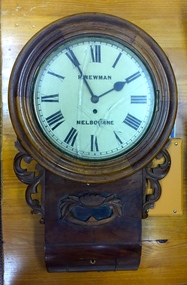 Kew Historical Society Inc
Functional object, H Newman, Boxed Wall Clock, 19th Century
... Melbourne, and began business as a jeweller, on a site in Collins street that is now occupied by Scott's Hotel. A few years later Mr Newman went back to England, where he was married. On his return to Victoria again he resumed his jewellery business in Elizabeth street opposite the General Post-office. An interesting fact in connection with his business is that his first journeyman watchmaker was Mr. Thomas Gaunt...Melbourne, and began business as a jeweller, on a site in Collins street that is now occupied by Scott's Hotel. A few years later Mr Newman went back to England, where he was married. On his return to Victoria again he resumed his jewellery business in Elizabeth street opposite the General Post-office. An interesting fact in connection with his business is that his first journeyman watchmaker was Mr. Thomas Gaunt ...DEATH OF MR. H. NEWMAN. Widespread regret will be felt at the announcement of the death of Mr Henry Newman, an old colonist and a member of firm of Newman and Sons Proprietary Limited, jewellers, which occurred at his residence, "Sadova," William street, on Saturday, at the age of 89 years. Mr Newman who was born at Riga, in Russia, went to England when a lad, became naturalised, and emigrated to Victoria 61 years ago. He tried his fortune at Ballarat but soon afterwards returned to Melbourne, and began business as a jeweller, on a site in Collins street that is now occupied by Scott's Hotel. A few years later Mr Newman went back to England, where he was married. On his return to Victoria again he resumed his jewellery business in Elizabeth street opposite the General Post-office. An interesting fact in connection with his business is that his first journeyman watchmaker was Mr. Thomas Gaunt, the founder of the firm of Messrs. T. Gaunt & Co. Five years ago Mr. Newman retired from the business, which has since been carried on by his two elder sons. Although he took no active part in public affairs, Mr Newman was held in high regard on account of his business integrity, sterling personal worth. and the unostentatious way in which he did good. His vitality, even in his later years, was wonderful. On four occasions he met with accidents, having been twice knocked down by motorcars and twice by trams, without having sustained injury. A widow and grown up family of four sons and four daughters survive him. The Age Monday 27 October 1913, page 9. Roy Cronin 156 High Street Kew Jeweller and watchmaker. East side between Denmark Street and Cotham Road. Wood, enamel, brass and glass wall clock, the movement made by H Newman of Collins Street, Melbourne. A small label on the interior records the name R. Cronin, 156 High St, Kew, 1/7/20. It is unclear whether Cronin, a watchmaker and jeweller may have repaired or sold the clock. The clock (broken) is housed in a steel box.roy cronin - watchmaker - jeweller - kew (vic), h newman - melbourne (vic) - collins street - jeweller - clockmaker
