
Showing 61 items matching "geelong town hall"
-
 Lorne Historical Society
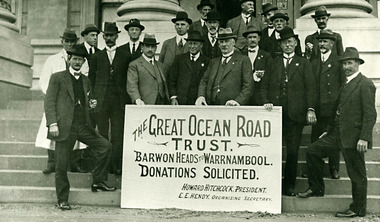
Photograph, Great Ocean Road Trust, taken at Geelong Town Hall 1918
... Great Ocean Road Trust, taken at Geelong Town Hall 1918...Great Ocean Road. Geelong Town Hall...Group photography Great Ocean Road Trust, taken at Geelong Town Hall 1918...Great Ocean Road. Geelong Town Hall Group photography Great Ocean Road Trust, taken at Geelong Town Hall 1918 Great Ocean Road Trust, taken at Geelong Town Hall 1918 Photograph Photograph ...Group photography Great Ocean Road Trust, taken at Geelong Town Hall 1918great ocean road. geelong town hall -
 City of Greater Geelong
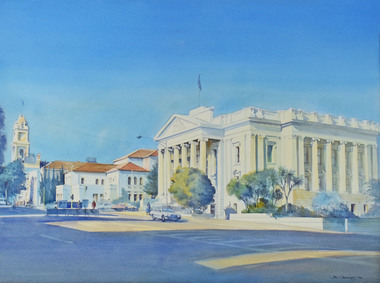
Painting - Watercolour, Joan Crawley, Morning Light Geelong Town Hall, 1992
... Morning Light Geelong Town Hall...Geelong City Hall Morning Light Geelong Town Hall Painting Watercolour Joan Crawley ...geelong, city hall -
 Ballarat Tramway Museum
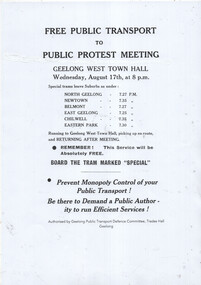
Sign - copy, "Public Protest Meeting - Geelong West Town Hall"
... "Public Protest Meeting - Geelong West Town Hall"...Reset version of a sign (item 10601) titled "Public Protest Meeting - Geelong West Town Hall", giving details of a protest meeting to be held at 8pm on Wednesday 17/8/1955 and times that free trams would leave the respective termini. ..."Public Protest Meeting - Geelong West Town Hall" Sign copy - ...Reset version of a sign (item 10601) titled "Public Protest Meeting - Geelong West Town Hall", giving details of a protest meeting to be held at 8pm on Wednesday 17/8/1955 and times that free trams would leave the respective termini. Yields information about a public meeting in Geelong to protest about the closure of the tramways.Pamphlet or sign - reset - onto A4 paper.geelong, tramways, public meeting, closure, protest -
 Ballarat Tramway Museum
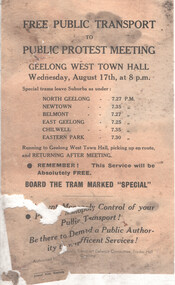
Sign, Geelong Public Transport Defence Committee, "Public Protest Meeting - Geelong West Town Hall", August 1955
... "Public Protest Meeting - Geelong West Town Hall"...Sign titled "Public Protest Meeting - Geelong West Town Hall", giving details of a protest meeting to be held at 8pm on Wednesday 17/8/1955 and times that free trams would leave the respective termini. ...Sign titled "Public Protest Meeting - Geelong West Town Hall", giving details of a protest meeting to be held at 8pm on Wednesday 17/8/1955 and times that free trams would leave the respective termini. ...Sign titled "Public Protest Meeting - Geelong West Town Hall", giving details of a protest meeting to be held at 8pm on Wednesday 17/8/1955 and times that free trams would leave the respective termini. Original pamphlet found under saloon seat in Geelong 28. See item 10602 for a reset version. Published by Geelong Public Transport Defence Committee, who had a Trades Hall Geelong address. Printed by Adams Printers of Geelong.Yields information about a public meeting in Geelong to protest about the closure of the tramways.Sheet of paper - printed on off white paper, in poor order.geelong, tramways, public meeting, closure, protest -
 City of Greater Geelong
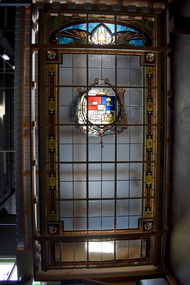
Decorative object - Geelong Crest Stained Glass Window, Arthur S Pittock, 1916
... ...Geelong Town Hall...This stained glass was originally installed at Geelong Town Hall following its expansion in 1917. ...This stained glass was originally installed at Geelong Town Hall following its expansion in 1917. ...This stained glass was originally installed at Geelong Town Hall following its expansion in 1917. The Geelong Council involved the staff and former students of the Gordon Technical College in designing the artwork and aesthetic of the building. Arthur S. Pittock, former student and local glazier, was responsible for the design and construction of the large stained glass window in the stair hall. The window was described as “a special feature” in the new building with the leaded glass work using “the motif throughout in Greek form, of admirable colour”. The window showcases the City of Geelong’s original coat of arms, featuring images of Geelong’s early industries: sailing, wool, wine and wheat production, and a kangaroo as an inescutcheon. During the redevelopment of City Hall in the late 1960's the stained glass window was removed from the building and placed in the basement carpark. The National Wool Museum has taken responsibility of the window and removed it from the car park to be conserved and housed safely. The surviving City Hall window is the most elaborate, known surviving stained glass window by Pittock.Stained glass window featuring the geelong crest with a decorative border, in a wooden frame. stained glass, geelong, history, geelong town hall, geelong council, gordon technical college, glazier, geelong crest, conservation -
 City of Greater Geelong
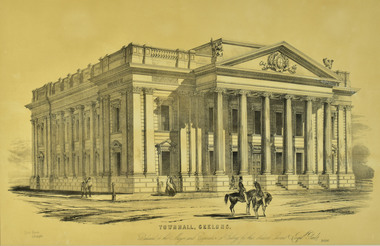
Lithograph by Cyrus Mason, Town Hall, Geelong
... Town Hall, Geelong...Town Hall, Geelong Lithograph by Cyrus Mason Joseph Reed ... -
 Ballarat Tramway Museum
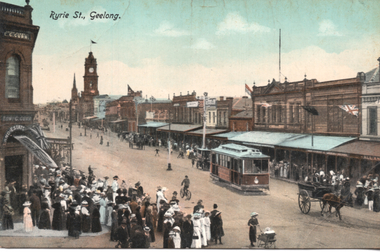
Postcard, R.E.M Series Melbourne, "Ryrie St., Geelong", c1912
... In the view are E Gurr Real Estate, Allans, and the Geelong Town Hall....In the view are E Gurr Real Estate, Allans, and the Geelong Town Hall. Yields information about Ryrie St Geelong c1912. tramways trams Geelong Ryrie St tram 7 Geelong Tramway Has the Ken Magor stamp on the rear. ...Postcard produced by REM Melbourne, printed in Saxony of a view of Ryrie St Geelong looking west. Has tram No. 7 in the view, a horse drawn cart and a large crowd looking on - opening day or a test tram? In the view are E Gurr Real Estate, Allans, and the Geelong Town Hall.Yields information about Ryrie St Geelong c1912.Colour Postcard divided back, unused.Has the Ken Magor stamp on the rear.tramways, trams, geelong, ryrie st, tram 7, geelong tramway -
 Federation University Historical Collection
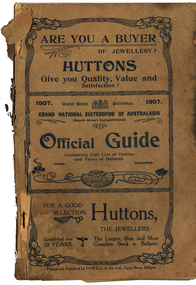
Book - Programme, South Street Eisteddfod Official Guide, 1907, 1907
... town hall and gardens...sunshine shield...hugh victor mckay...w to w shield...w.j. coltman...frank herman...j. hutton-jones...t. downer...j. marks...hutton and co trophy...marks trophy...hugh leschen...john robson...st augustine's band, geelong...Town Hall and Gardens, Lake Wendouree Ferry, W.E. Swenson, S.B. Swenson, J.G.M. Swenson, Rev. T. Flynn, Edwards' Pyrites, Lestor's Hotel, Sunshine Sheild, W to W Shield, Frank Herman, W.F. Coultman, Marks' Trophy, Lighthouse Port Fairy, R. Correll Music Seller, James Smith, Isaac Pitman, Arthur Brumfield, Hugh Leschen, John Robson, St Augustine's Band Geelong...South Street competitions have been held in Ballarat since 1991. south street competitions eisteddfod chinese herbalist south street r.b. lemmon g. bongiorno w.d. thomas john madden lord tennyson w.d. hill frederick bevan j.w. beswick lawrence campbell boer war memorial queen victoria statue curiosity shop m.b. john foundry ballarat east town hall and gardens sunshine shield hugh victor mckay w to w shield w.j. coltman frank herman j. hutton-jones t. downer j. marks hutton and co trophy marks trophy hugh leschen john robson st augustine's band, geelong downer trophy trekardo brothers moorabool falls kirks dam ballarat choral society alfred deakin challenge cup james long grand national eisteddfod of australasia Ballarat East Gardens Ballarat East Town Hall Official guide to the 1907 South Street competitions. ...South Street competitions have been held in Ballarat since 1991.Official guide to the 1907 South Street competitions. Images include: Prince of Wales, Lord Northcote, W.D. Thomas, South Street Competition Executive Committee (W.H. Pearson, W.H. Chandler, A. Prichard, W.H. Richards, W.D. Hill, Col. Williams, W.D. Thomas, F. Besemeres, F.J. Martell, J.T. Morris. F.J. Williams, R. Maddern, R.J. Gribble), Sir John Madden, Lord Tennyson, W.D. Hill, Frederick Bevan, Ballarat (Sturt Street), Lake Wendouree (Yachts), J.W. Beswick, Lawrence Campbell, City of Ballarat Mayor and Councillor (Mayor Brawn, E. Williams, E. Morey. Cr Brokenshire, J. Whykes, J.M. Barker, G. Crocker, W.D. Hill, R. Pearse, T. Hollway), Ballarat East Mayor and Councillors (J. Gent, Cr Glendenning, J.N. Dunn, I. Pearce, C. Bunting, A. Levy, J. Ritchie, J. McNeil, A. McKenzie, Cr Penhalluriak), Sturt Street Looking West, Old Curiosity House, Entrance to the Ballarat Fine Art Gallery, Interior of the Ballarat Fine Art Gallery, Ballarat East Town Hall and Gardens, Lake Wendouree Ferry, W.E. Swenson, S.B. Swenson, J.G.M. Swenson, Rev. T. Flynn, Edwards' Pyrites, Lestor's Hotel, Sunshine Sheild, W to W Shield, Frank Herman, W.F. Coultman, Marks' Trophy, Lighthouse Port Fairy, R. Correll Music Seller, James Smith, Isaac Pitman, Arthur Brumfield, Hugh Leschen, John Robson, St Augustine's Band Geelong, Moorabool Falls, Kirks Dam, Ballarat Choral Society, Alfred Deakin, James Long, Hugh McKay Advertisements include: Huttons the Jewellers, Sam Jamieson, Sun Foundry, City Saw Mills, Blomeley Bros Iron and Brass Founders, G. Bongiorno- Railway Fruit Palace, Henry Brind & Co., Andrew Cant, Harrison's Foundry, Umbrella and Sunshade Emporium, Ballarat City Baths, Ballarat Coffee Palace, Irwin's Provincial Hotel, Victa Studio; D. Lem Chinese Medical Practitioner, Bosisto's Eucalyptus Oil, Ronaldson Bros & Tippett, Unicorn HOtel, Mrs F. Allen Caterer, Coles & Pullum, J.C. Dillon & Co., Surrey Tannery, Coulthard's Ballarat Business College, George Farmer, MrBride's Boots, L.J. Austin, Dyason's, Ballarat Brewing Company, Phoenix Brewery, Royal Standard Brewery, Edwards' Pyrites, Lestor's Hotel, Robson's College of Music, James A. Gear, Williams Shoemen, Tekardo Brothers, Powell & Co.south street competitions, eisteddfod, chinese herbalist, south street, r.b. lemmon, g. bongiorno, w.d. thomas, john madden, lord tennyson, w.d. hill, frederick bevan, j.w. beswick, lawrence campbell, boer war memorial, queen victoria statue, curiosity shop, m.b. john foundry, ballarat east town hall and gardens, sunshine shield, hugh victor mckay, w to w shield, w.j. coltman, frank herman, j. hutton-jones, t. downer, j. marks, hutton and co trophy, marks trophy, hugh leschen, john robson, st augustine's band, geelong, downer trophy, trekardo brothers, moorabool falls, kirks dam, ballarat choral society, alfred deakin, challenge cup, james long, grand national eisteddfod of australasia, ballarat east gardens, ballarat east town hall -
 Lara RSL Sub Branch
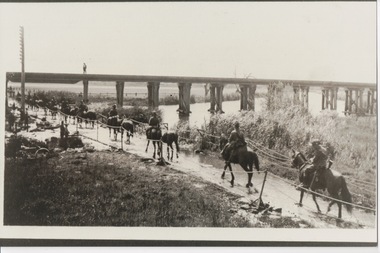
Photograph, Set 4 photographs. and others for Torquay Light Horse camp, 1940
... Six went over the cliff near Bird Rock, five were never found, and the rest were gathered up after nearly a fortnight in the bush around Addiscott and Anglesea" Light Horse, Training Camp, Torquay, WW2, Geelong Parade Geelong parade The training camp culminated in a parade through the streets of Geelong on March 12th 1940. The salute was given at the Town Hall and the troops continued on a route to the You Yang’s for a training exercise. ...Six went over the cliff near Bird Rock, five were never found, and the rest were gathered up after nearly a fortnight in the bush around Addiscott and Anglesea" Light Horse, Training Camp, Torquay, WW2, Geelong Parade Geelong parade The training camp culminated in a parade through the streets of Geelong on March 12th 1940. The salute was given at the Town Hall and the troops continued on a route to the You Yang’s for a training exercise. ...These images capture for all time Light Horsemen travelling through Geelong on their way to camp at Torquay for the last Group meeting in Australia . information following - details obtained from .........https://torquayhistory.com/light-horse-brigade/ On Australia Day, 1997, Sir John Young unveiled this plaque on Point Danger, Torquay. Torquay history, Light Horse Training Camp, WW2 Plaque at Pt. Danger Note----- (See images to view plaque) The plaque identifies a significant event in Torquay’s history and the sentiments of ‘change’ for the Light Horse Brigade – from horses to machines. In 1940 the four Light Horse Regiments (4th, 8th, 13th and 20th), some 5000 Light Horse and 2000 horses camped and trained at Torquay. Three other regiments, formerly mounted on horses, were also at Torquay ‘mounted’ on privately owned trucks and cars. Division troops included Artillery, Engineers, Signals, Field Ambulance and other branches of the Army necessary to enable a Division to function. It wasn’t just the sheer numbers of men coming to this little town that made the event significant, it was also the fact that the men of the Light Horse were dramatic, almost glamorous figures and it is easy to see their exploits as some splendid adventure. Horses have played a special role in the story of Australia. They were the only means of transport across this huge country, so it was necessary for everyone to have the ability to ride a horse. When war broke out in 1899 between Britain and the Boers of South Africa (“Boer” was Dutch for “farmer”) Australia sent troops to fight. At first Britain was wary of using untried, unprofessional colonial cavalrymen but soon saw that the slouch-hatted Australian “bushmen” were a match for the fast-moving and unconventional mounted commandos of the Boers. The Australians proved themselves to be expert rough-riding horsemen and good shots. Bush life had hardened them to go for long periods with little food and water. They also showed remarkable ability to find their way in a strange country and use its features for cover, in both attack and defence. By 1914, when Australia joined the war against Germany, there were 23 Light Horse regiments of militia volunteers. Many men from these units joined the Light Horse regiments of the Australian Imperial Force (AIF). Men were given remounts (if not using their own horses) – army horses bought by Commonwealth purchasing officers from graziers and breeders. These were called “walers” because they were a New South Wales stockhorse type – strong, great-hearted animals with the strains of the thoroughbred and semi-draught to give them speed, strength and stamina. On 1st November, 1914, Australia’s First Infantry Division and the first four Light Horse regiments sailed for England in a fleet of transport ships. The first of the Light Horse arrived at Gallipoli in May without their horses. Back with their horses after Gallipoli, they were formidable combatants across the Sinai and Palestine. Some British commanders observed that the light horseman moved with a “lazy, slouching gait, like that of a sleepy tiger” but described how the promise of battle “changes that careless gait, into a live athletic swing that takes him over the ground much quicker than other troops”. They had Light Horse, Torquay, training campdeveloped a reputation as formidable infantrymen. The Turks called them “the White Ghurkas” – a reference to their deadly skill with the bayonet. The Arabs called them “The Kings of the Feathers”. The plume had originally been a battle honour of the Queensland Mounted Infantry for their work in the shearer’s strike of 1891. During WW1 it was adopted by almost all the Light Horse Regiments. It was the proud badge of the light horseman. The most famous of their battles was the attack on Beersheba- the charge of the 4th Light Horse Brigade. Mounted infantrymen and their superb walers had carried out one of the most successful cavalry charges in history – against what seemed impossible odds. They surprised the Turks by charging cavalry-style, when they would normally have ridden close to an objective then dismounted to fight. The fall of Beersheba swung the battle tide against the Turks in Palestine; and changed the history of the Middle East. While 19 men from the Surf Coast Shire served with the 4th Light Horse over the course of WW1, only four were involved in the charge of Beersheba- John GAYLARD, Philip QUINN.(Winchelsea); Wallace FINDLAY (Anglesea); Harry TRIGG (Bambra). After the war, Light Horse units played a key role in the Australian Government’s compulsory military training programme. The Citizen Military Forces (C.M.F.) thrived on the glamour of the wartime Light Horse tradition, ignoring the possibility that motor vehicles would soon replace the horses. When training was no longer compulsory, the C.M.F. regiments declined and horses became more of a luxury during the 1930s depression years of poverty and unemployment. Some regiments were motorised. Then, in 1939, Australia joined Britain in another world war. Training was increased for the militia at both home bases and regional training camps. The camp at Torquay in 1940, commanded by Major General Rankin, was at Divisional strength. By the end of the camp some felt that the Division was ready for active service. Gradually, over the next four years, the Australian Light Horse units were mounted on wheels and tracks and the horses were retired. Six men enlisted at the Torquay camp and another 57 men and women enlisted at Torquay for service in WW2. Those who served in the Militia provided valuable Officers and NCOs and men for the armed services during the war. Each infantry division of the 2nd AIF had a Light Horse regiment attached to it. But the day of the Australian mounted soldier hadn’t quite passed. During World War II, Australia’s 6th Cavalry Regiment formed a mounted unit they called “The Kelly Gang” which did valuable scouting work. In New Guinea, a mounted Light Horse Troop did patrol duty and helped carry supplies. Some fully equipped walers were flown into Borneo for reconnaissance in rugged mountain country. But by the end of the war, in 1945, the horse had disappeared from the Australian Army. References: Australian Light Horse Association www.lighthorse.org.au National Australia Archives Australian War Memorial Surf Coast Shire WW1 memorials www.togethertheyserved.com The Light horse- a Cavalry under Canvas Light Horse, Training Camp, Torquay, WW2 Late in 1939 it was decided to set up a Lighthorse training camp in Torquay to train both men and horses for the battles of the Second World War. Horses, men and equipment came on special trains from all over Victoria and NSW, and as you would expect horseman came from areas such as Omeo and Sale, the Wimmera and the Western District. They arrived at the Geelong racecourse for watering in the Barwon River and then were ridden across the ford at the breakwater and began their 11 mile trek to Torquay. Light Horse, Training Camp, Torquay, WW2 Tent city By the end of January 1940 the camp at Torquay accommodated some 5000 men and 2500 horses of the Second Cavalry Division. The rows of horses, tents and huts near Blackgate Road were quite a sight. While the cavalrymen engaged in exercises on the land and on the beaches, many of the troops took over the Torquay School for special training of men and officers. Mr Bob Pettit local farmer and Councillor for the Barrabool Shire, wrote about the Light horse in the Surf Coast Community News in 1985 saying “They used to travel about the district riding four abreast in one long convoy. To my annoyance they went through my property and shut all the gates behind them. I had certain gates open to let stock in to the water holes and it would take me three -quarters of an hour to follow the horsemen up and put all the gates right again” he continued “the men from the Light Horse were here when the fire went through in March 1940. He recalled an incident when early one morning, as some one blew the bugle, a soldier putting a white sheet on the line frightened the horses. They panicked and ran off in all directions. Six went over the cliff near Bird Rock, five were never found, and the rest were gathered up after nearly a fortnight in the bush around Addiscott and Anglesea" Light Horse, Training Camp, Torquay, WW2, Geelong Parade Geelong parade The training camp culminated in a parade through the streets of Geelong on March 12th 1940. The salute was given at the Town Hall and the troops continued on a route to the You Yang’s for a training exercise. Note-----(see media section for photograph) The Camp was abandoned in mid 1940 as it was deemed unsuitable for training during winter and the cost of a permanent camp could not be justified if it could not be used all year. Historic.......Rare,,,Interpretive.Sepia photographs.set of four ....post card size ....Horses &LighthorsemenNo 1, Lighthorsemen Regiment Geelong 1940......No 2 Light Horse at Breakwater Geelong 1938 to 1940....No 3 Light Horse at Breakwater Geelong 1938 to 1940.....No 4 Light Horse crossing Breakwater camped at Geelong Showgrounds. These markings are on reverse of photographs.light horsemengeelong 1940., world war 2 -
 Federation University Historical Collection
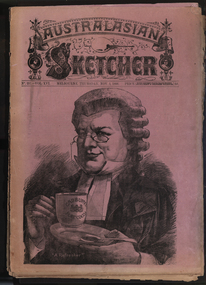
Newspaper, Australasian Sketcher, 30 June 1884 to 01 November 1888, 1883 and 1888
... Nelson Leaving Sydney, New Prince's Bridge, Wilson Hall, Victoria before gold, Fawkner's First Printing Office, Government House Melbourne, Sandridge, Hobson's Bay, Old Supreme Court Melbourne, Melbourne Town Hall, Ballarat in the 50, Geelong in 1840, Ballarat Church of Engand Cathedral, Melbourne Exhibition Building, Flemington Racecourse, the Australian Club, Sir Anthony Musgrave, Fisheries Court at the Centennial Exhibition; Professor Neumayer, Antarctic Exploration, Melbourne Town Hall Organ...Nelson Leaving Sydney, New Prince's Bridge, Wilson Hall, Victoria before gold, Fawkner's First Printing Office, Government House Melbourne, Sandridge, Hobson's Bay, Old Supreme Court Melbourne, Melbourne Town Hall, Ballarat in the 50, Geelong in 1840, Ballarat Church of Engand Cathedral, Melbourne Exhibition Building, Flemington Racecourse, the Australian Club, Sir Anthony Musgrave, Fisheries Court at the Centennial Exhibition; Professor Neumayer, Antarctic Exploration, Melbourne Town Hall Organ Australasian Sketcher, 30 June 1884 to 01 November 1888 Newspaper ...Two copies of the Austakasian Sketcher with Pen and Pencil .1) 30 June 1884 Includes articles on Archbishop Moran, Children's Hospital, Sherbourne Sheppard obituary, the Tichborne case Includes images of the Most Reverand P.F. Moran, Catholic Archbishop of Sydney, New Sandridge Dock, Cricketing news from home, sketches from the Children's Hospital, View of Napier New Zealand, F. Mills New Warehouse Launceston, Grace Park .2) 01 November 1888 Articles include: Australian animals Images include: Cadbury's cocoa advertisement, A Flemington Picture, Railway Surveying Wangaratta to Mansfield, H.M.S. Nelson Leaving Sydney, New Prince's Bridge, Wilson Hall, Victoria before gold, Fawkner's First Printing Office, Government House Melbourne, Sandridge, Hobson's Bay, Old Supreme Court Melbourne, Melbourne Town Hall, Ballarat in the 50, Geelong in 1840, Ballarat Church of Engand Cathedral, Melbourne Exhibition Building, Flemington Racecourse, the Australian Club, Sir Anthony Musgrave, Fisheries Court at the Centennial Exhibition; Professor Neumayer, Antarctic Exploration, Melbourne Town Hall Organmelbourne international exhibition -
 Flagstaff Hill Maritime Museum and Village
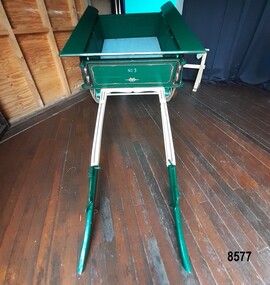
Vehicle - Tip Dray, Prior to 1930s
... towns and cities around Australia from the early days of settlement. In Australia in the early 1900's, carters began to join unions to protect their jobs and pay. N.S.W. had a "Trolley, Draymen and Carters Union", Queensland had a "Tip Dray Men's Association" and in W. A. the "Top Dray Driver's Union" had a "cessation of work" in 1911 when they were fighting for an increase in their day's wages. In 1910 a meeting of Tip Carters was held in Geelong at the Trades Hall...towns and cities around Australia from the early days of settlement. In Australia in the early 1900's, carters began to join unions to protect their jobs and pay. N.S.W. had a "Trolley, Draymen and Carters Union", Queensland had a "Tip Dray Men's Association" and in W. A. the "Top Dray Driver's Union" had a "cessation of work" in 1911 when they were fighting for an increase in their day's wages. In 1910 a meeting of Tip Carters was held in Geelong at the Trades Hall ...A Dray is a type of dead axle wagon that was used to transport heavy loads or objects. They had a flat level floor and while some had no sides, others had box bodies and sides. Tip Drays (also known as Tip Carts, Muck Cart, Scotch Cart, Tumbrel or Putt in different parts of England) were smaller than other drays as their loads were heavy and usually only pulled by one horse. Their basic design included two wheels, a tipping body and shafts. The Tip Dray has a unique mechanism that allows the top to tip backwards to tip the load out of the back of the dray. The tipper was activated by a handle at the front allowing the driver to operate it while still having control over the horse. A Tip Dray was an indispensable piece of equipment in the days before tractors and mechanical trucks. They were used by farmers and carters to transport hay, rocks, bricks, gravel and rubbish etc. and because they were useful for dumping loads, they were favoured for use in road and railway construction. A photo in the collection of the Lorne Historical Society shows a tipping dray being used during the construction of the Great Ocean Road. They were part of the daily street traffic in towns and cities around Australia from the early days of settlement. In Australia in the early 1900's, carters began to join unions to protect their jobs and pay. N.S.W. had a "Trolley, Draymen and Carters Union", Queensland had a "Tip Dray Men's Association" and in W. A. the "Top Dray Driver's Union" had a "cessation of work" in 1911 when they were fighting for an increase in their day's wages. In 1910 a meeting of Tip Carters was held in Geelong at the Trades Hall to discuss the formation of a union (The Geelong Tip Dray Carters) which was a success and a schedule of rates for all carting, whether by contract or day labor, was fixed. By 1912 they had "labelled" more than 50 drays and had representatives on the "Trades Hall and Eight Hours Committee". By the mid 1930's and early 1940's, tip drays were being superseded by mechanical trucks and utes. However tip drays continued to be used in some circumstances. They were a practical solution to the problem of petrol rationing during W. W. 2. It was noted in a letter to the editor in the "Sunshine Advocate" in 1938 that a positive argument for continued use of Tip Drays for rubbish collection related to the idea that a horse drawn vehicle involved with lots of stops and starts at different houses (very like a milkman's delivery route) often involved the horse "driving itself" while the driver picked up the rubbish - something a motor truck was unable to do! Another article written in August 1935 and published in the Age in a parliamentary report into the rubber industry noted "tip drays had almost disappeared and in their place, metal was carted in 5 ton motor trucks" but the report went on to say that as a part of the Government relief work (during the Great Depression) the Government had "to some extent reintroduced the tip drays so that a greater number of men would be employed". This particular tip dray was owned by Mr. Oswald (Jack) Bourke. He used it to deliver dry goods from Sunbury to the Queen Victoria Market in Melbourne several times a week in the 1930's and then (between 1945 and 1962) Mr. Bourke used it on the garbage round in Springvale Victoria for the Springvale Council. The Council owned three drays and the "No. 3" painted on this dray is in recognition of its original number. After the death of Mr. Bourke in 1990, one of Mr. Bourke's sons (Andy) found the dray in a shed and restored it. The sign writing on the back and side panels were added during the restoration. This Tipping Dray is a significant example of a horse drawn vehicle that was used by workers from the early days of white settlement through to the 1940's and even into the early 1960's. It was used in a range of "working class" occupations - road construction, railway construction, carting goods, rubbish collection etc. and would have been found in cities, country towns and on farms.A wooden and metal tipping dray with a box body and four sides. It has two iron and wooden wheels (with 14 spokes), two wooden shafts and a metal tipping mechanism. The back panel folds down to allow loads to be dumped out. It is painted in green and cream with sign writing on one of the sides and on the front and back panels. It features decorative painted lines and designs in burgundy, cream and light blue on most of the wooden parts. The tipping mechanism is on the front of the dray's left side and consists of a metal pin secured with a metal ring, and a lever.Front of dray - "No. 3" Side of dray - "A. & M. BOURKE / Contractors / LONGWARRY" Back of dray - "G.T. ANDREWS / QUEEN VICTORIA MARKET - Stand C23 / Phone DANDENONG 225"flagstaff hill maritime museum and village, warrnambool, shipwreck coast, tipping dray, dray, tip dray, tip cart, vehicles, horse drawn vehicle, springvale council, jack bourke, muck cart, scotch cart, tumbrel, putt, box body, oswald bourke, sunbury, queen victoria market, melbourne, no. 3 -
 Flagstaff Hill Maritime Museum and Village
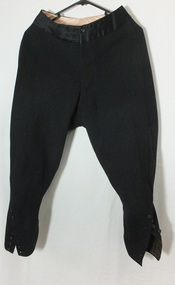
Clothing - Riding Habit, Jodhpurs, 1920s
... Geelong and Melbourne Grammar schools and at Trinity Hall, Cambridge (B.A., 1891). He chose the Danedite portion of land at Purrumbete, and on the death of his bachelor brother Thomas Peter (1863-1895), after a hunting accident, he took over his allocation, Wiridgil. He also owned Boortkoi, near Hexham and on these properties, he ran merino sheep, a Lincoln stud which dated back to 1870, and Shorthorn cattle. 3000 acres were also leased to dairy farmers. Edward was a member of Hampden Shire Council in 1909-31 and three times president at Camperdown. The town...Geelong and Melbourne Grammar schools and at Trinity Hall, Cambridge (B.A., 1891). He chose the Danedite portion of land at Purrumbete, and on the death of his bachelor brother Thomas Peter (1863-1895), after a hunting accident, he took over his allocation, Wiridgil. He also owned Boortkoi, near Hexham and on these properties, he ran merino sheep, a Lincoln stud which dated back to 1870, and Shorthorn cattle. 3000 acres were also leased to dairy farmers. Edward was a member of Hampden Shire Council in 1909-31 and three times president at Camperdown. The town ...The Manifolds were a significant pioneering pastoral family in Western Victoria. The donated riding jodhpurs originally belonged to Mrs Edward Manifold, formally Beatrice Mary Synnot Anderson. Beatrice was Edward Manifold’s cousin once removed whom he married in 1900. Edward, the son of John Manifold, was born on 15 November 1868 and educated at Geelong and Melbourne Grammar schools and at Trinity Hall, Cambridge (B.A., 1891). He chose the Danedite portion of land at Purrumbete, and on the death of his bachelor brother Thomas Peter (1863-1895), after a hunting accident, he took over his allocation, Wiridgil. He also owned Boortkoi, near Hexham and on these properties, he ran merino sheep, a Lincoln stud which dated back to 1870, and Shorthorn cattle. 3000 acres were also leased to dairy farmers. Edward was a member of Hampden Shire Council in 1909-31 and three times president at Camperdown. The town was largely bordered by Manifold land and partly dependent upon the local pastoral dynasties, which benefited the local area from the families’ various business interests. Though an offer to build public baths to commemorate the Queen Victoria Jubilee in 1897 was not proceeded with, the town acquired a hospital, a reserve on Mount Leura, a clock tower and a cricket pavilion, as well as notable donations from the Manifolds to St Paul's Church and the grammar school. Edward was a keen polo player and racing man. He was also a successful owner of steeplechasers and a committeeman of the Victoria Racing Club for many years. He was also a member of many Western District racing clubs. On the 16 July 1900, Edward had married his sixteen-year-old cousin Beatrice Mary Synnot Anderson by whom he had three sons Thomas Peter, Andrew and Robert Edward Manifold. Edwards's estate at his death was valued for probate at nearly £500,000. Edward died following an operation on 14 February 1931 at a private hospital in Yarra Vale Melbourne. Beatrice passed away in 1954, aged 79 in Ballarat where she was born in 1874. Contextual historic Family background: The Manifold brothers Thomas (1809-1875), John (1811-1877) and Peter (1817-1885) were the fourth, fifth and sixth sons of William Manifold and Mary, nee Barnes, of Courthouse Farm, Bromborough, Cheshire, England. The family had decided to emigrate to Van Diemen's Land. Thomas was sent ahead, arriving in Hobart Town on 23rd January 1828 with £1500 and a letter of recommendation from the Colonial Office. Thomas acquired 1280 acres on the west bank of the Tamar River. John and Peter, with their parents and three sisters, arrived on 8th July 1831. Land grants by then had finished but William brought ninety acres next to his son Thomas’ land and on the combined properties the family built Kelso House. The Manifolds’ properties were comparatively poor and when news of the Port Phillip District, in Victoria reached Thomas, he lost no time in coming to see for himself in February 1836. He was impressed with what he saw and hurried back to Tasmania to buy lambs and ewes. With one of his brothers, on July 9th he landed his stores at Point Henry and proceeded to occupy both sides of the Moorabool River. Thomas, at the end of the year, returned to Tasmania and left Peter and John to run the new property. Thomas, however, returned to Victoria for several visits and on one of these visits he, along with his brothers, examined the country near Ballarat. In December 1838 they managed to penetrate the Stony Rises, and Peter and John reached Lake Purrumbete and the Mount Leura country. During this time, on 4th July 1838, Thomas married Jane Elizabeth, eldest daughter of Captain Walter Synnot, formerly of Ballinate, County Armagh, Ireland, and then of Van Diemen's Land. Thomas joined his brothers, and they occupied the Purrumbete run in January 1839. On the journey to Purrumbete they could not take their stock and drays through the Stony Rises, so went north of Lake Corangamite, to the neck of land between it and Lake Gnarpurt. By April the move from Moorabool area was complete. As yet they had no hut and were working day and night, but their delight in their new run was unbounded. John wrote to his mother: “We are at last got to the land we wished for it is a beautiful place, and cannot be surpassed by any I have ever seen”. The three brothers occupied Purrumbete together, breeding both sheep and cattle until Thomas went to Grassmere run on the Merri River near Warrnambool in 1844. John and Peter soon gave up breeding sheep but retained the well-known '3M' brand for the cattle. These were Shorthorns, derived from four bulls originally imported by the Boldon brothers and later improved by further importations, and were renowned for size and quality. By the time of the gold rush in 1851, John and Peter were breeding over 1000 head a year, as well as fattening stores. The diggings at this time had disorganised Grassmere by drawing away Thomas's men, and his wife decided to take her two sons and two daughters to Europe for their education. Thomas gave up the property next year, went to England to join his family, and eventually brought the family back to live in Melbourne. At Purrumbete things were different. The brothers, John and Peter, preferred black stockmen to white, so the discovery of gold upset them very little while providing the very market they required. John was on his second visit to England when the rush started, and Peter went in his turn soon after John returned. On 2 September 1856 John married Marion Thomson, at Cormiston, Van Diemen's Land. They had four daughters and five sons, from three of whom, William Thomson, James Chester and Edward, the later generations of the family descend. Through the years the brothers had to contend with the scab, fluke and footrot, depression, rabbits, bush fires and pleuro-pneumonia. In 1861 they appointed as manager Henry Manifold Matson, their nephew, who had already been with them for five years. Thomas died in Melbourne on 7 November 1875, John at Purrumbete on 3 January 1877 and Peter at Purrumbete on 31 July 1885. Devout members of the Church of England, John and Peter, during their lives, gave generously towards building St Paul's Church, Camperdown, and guaranteed part of the vicar's stipend. Peter was a member of the Hampden and Heytesbury Roads Board from 1859 and carried on into the Hampden Shire Council when it was formed in 1864. However, it was not for public works that they were known, but for their personal example. In a new land where speculators and adventurers were all too common, the Manifold brothers were among those who intended it to be their home and their children's home. Industrious, unpretentious and hospitable, they were respected in their community as men of the highest integrity. This riding habit is a characteristic example of the type and style of riding clothes that well-dressed ladies wore in the 1920s. It highlights the changes that were beginning in society for women. Prior to 1918 ladies still had to ride side-saddle with skirts over Jodhpurs. Society of the time regarded women riding astride as unseemly and just not done. This riding habit is particularly significant on a number of levels, it shows the beginnings of change in society's attitudes through women's fashion after the First World War. A change that was to bring a start to a more liberating societal attitude towards women after the successful establishment of the Representation of People Act 1918 that gave women the right to vote. This garments provenance is linked to one of Victoria's important pioneering families the Manifolds, one of the first families that came from Van Diemen's land to settle the Western District of Victoria in 1844. Originally the garment belonged to the wife of the great-grandson of pioneer William Manifold, Edward Manifold who married Beatrice May Synnot Anderson, Edwards Cousin in 1900. The garment was made by the Mayfair tailors J. Busvine & Co. in the early to mid-1920s (estimate) who at the turn of the century were tailors to the Courts of Europe. Their clothing is highly collectible today and examples can be found in a number of significant museum collections around the world, notably the Metropolitan Museum of Art in New York and the FIDM in Los Angeles. Jodhpurs, part of a three-piece, side saddle riding habit tailored for Mrs Edward Manifold, with four buttons to the front material black woolen twill the legs are cuffed below the knee with 8 buttons holes which are reinforced to the inside with fabric. Cream Satin waistband and removable chamois lining to the seat makers label Busvines Co. tailored for Mrs Edward Manifold.Embroidered in blue on a Satin Cream label to Jodhpurs "Busvine Ltd / 4, Brook St, London. W. No." Hand written in black ink script "523/ Mrs Edward Manifold"flagstaff hill, warrnambool, shipwrecked coast, flagstaff hill maritime museum, maritime museum, side saddle riding habit, side saddle riding outfit, breeches, mrs edward manifold, beatrice manifold, shipwreck coast, flagstaff hill maritime village, great ocean road -
 Flagstaff Hill Maritime Museum and Village
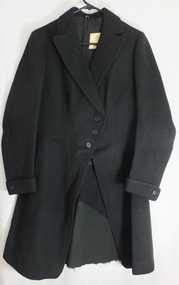
Clothing - Riding Habit, jacket, Early 20th Century
... Geelong and Melbourne Grammar schools and at Trinity Hall, Cambridge (B.A., 1891). He chose the Danedite portion of land at Purrumbete, and on the death of his bachelor brother Thomas Peter (1863-1895), after a hunting accident, he took over his allocation, Wiridgil. He also owned Boortkoi, near Hexham and on these properties, he ran merino sheep, a Lincoln stud which dated back to 1870, and Shorthorn cattle. 3000 acres were also leased to dairy farmers. Edward was a member of Hampden Shire Council in 1909-31 and three times president at Camperdown. The town...Geelong and Melbourne Grammar schools and at Trinity Hall, Cambridge (B.A., 1891). He chose the Danedite portion of land at Purrumbete, and on the death of his bachelor brother Thomas Peter (1863-1895), after a hunting accident, he took over his allocation, Wiridgil. He also owned Boortkoi, near Hexham and on these properties, he ran merino sheep, a Lincoln stud which dated back to 1870, and Shorthorn cattle. 3000 acres were also leased to dairy farmers. Edward was a member of Hampden Shire Council in 1909-31 and three times president at Camperdown. The town ...The Manifolds were a significant pioneering pastoral family in Western Victoria. The donated riding jacket originally belonged to Mrs Edward Manifold, formally Beatrice Mary Synnot Anderson. Beatrice was Edward Manifold’s cousin once removed whom he married in 1900. Edward, the son of John Manifold, was born on 15 November 1868 and educated at Geelong and Melbourne Grammar schools and at Trinity Hall, Cambridge (B.A., 1891). He chose the Danedite portion of land at Purrumbete, and on the death of his bachelor brother Thomas Peter (1863-1895), after a hunting accident, he took over his allocation, Wiridgil. He also owned Boortkoi, near Hexham and on these properties, he ran merino sheep, a Lincoln stud which dated back to 1870, and Shorthorn cattle. 3000 acres were also leased to dairy farmers. Edward was a member of Hampden Shire Council in 1909-31 and three times president at Camperdown. The town was largely bordered by Manifold land and partly dependent upon the local pastoral dynasties, which benefited the local area from the families’ various business interests. Though an offer to build public baths to commemorate the Queen Victoria Jubilee in 1897 was not proceeded with, the town acquired a hospital, a reserve on Mount Leura, a clock tower and a cricket pavilion, as well as notable donations from the Manifolds to St Paul's Church and the grammar school. Edward was a keen polo player and racing man. He was also a successful owner of steeplechasers and a committeeman of the Victoria Racing Club for many years. He was also a member of many Western District racing clubs. On the 16 July 1900, Edward had married his sixteen-year-old cousin Beatrice Mary Synnot Anderson by whom he had three sons Thomas Peter, Andrew and Robert Edward Manifold. Edwards's estate at his death was valued for probate at nearly £500,000. Edward died following an operation on 14 February 1931 at a private hospital in Yarra Vale Melbourne. Beatrice passed away in 1954, aged 79 in Ballarat where she was born in 1874. Contextual historic Family background: The Manifold brothers Thomas (1809-1875), John (1811-1877) and Peter (1817-1885) were the fourth, fifth and sixth sons of William Manifold and Mary, nee Barnes, of Courthouse Farm, Bromborough, Cheshire, England. The family had decided to emigrate to Van Diemen's Land. Thomas was sent ahead, arriving in Hobart Town on 23rd January 1828 with £1500 and a letter of recommendation from the Colonial Office. Thomas acquired 1280 acres on the west bank of the Tamar River. John and Peter, with their parents and three sisters, arrived on 8th July 1831. Land grants by then had finished but William brought ninety acres next to his son Thomas’ land and on the combined properties the family built Kelso House. The Manifolds’ properties were comparatively poor and when news of the Port Phillip District, in Victoria reached Thomas, he lost no time in coming to see for himself in February 1836. He was impressed with what he saw and hurried back to Tasmania to buy lambs and ewes. With one of his brothers, on July 9th he landed his stores at Point Henry and proceeded to occupy both sides of the Moorabool River. Thomas, at the end of the year, returned to Tasmania and left Peter and John to run the new property. Thomas, however, returned to Victoria for several visits and on one of these visits he, along with his brothers, examined the country near Ballarat. In December 1838 they managed to penetrate the Stony Rises, and Peter and John reached Lake Purrumbete and the Mount Leura country. During this time, on 4th July 1838, Thomas married Jane Elizabeth, eldest daughter of Captain Walter Synnot, formerly of Ballinate, County Armagh, Ireland, and then of Van Diemen's Land. Thomas joined his brothers, and they occupied the Purrumbete run in January 1839. On the journey to Purrumbete they could not take their stock and drays through the Stony Rises, so went north of Lake Corangamite, to the neck of land between it and Lake Gnarpurt. By April the move from Moorabool area was complete. As yet they had no hut and were working day and night, but their delight in their new run was unbounded. John wrote to his mother: “We are at last got to the land we wished for it is a beautiful place, and cannot be surpassed by any I have ever seen”. The three brothers occupied Purrumbete together, breeding both sheep and cattle until Thomas went to Grassmere run on the Merri River near Warrnambool in 1844. John and Peter soon gave up breeding sheep but retained the well-known '3M' brand for the cattle. These were Shorthorns, derived from four bulls originally imported by the Boldon brothers and later improved by further importations, and were renowned for size and quality. By the time of the gold rush in 1851, John and Peter were breeding over 1000 head a year, as well as fattening stores. The diggings at this time had disorganised Grassmere by drawing away Thomas's men, and his wife decided to take her two sons and two daughters to Europe for their education. Thomas gave up the property next year, went to England to join his family, and eventually brought the family back to live in Melbourne. At Purrumbete things were different. The brothers, John and Peter, preferred black stockmen to white, so the discovery of gold upset them very little while providing the very market they required. John was on his second visit to England when the rush started, and Peter went in his turn soon after John returned. On 2 September 1856 John married Marion Thomson, at Cormiston, Van Diemen's Land. They had four daughters and five sons, from three of whom, William Thomson, James Chester and Edward, the later generations of the family descend. Through the years the brothers had to contend with the scab, fluke and footrot, depression, rabbits, bush fires and pleuro-pneumonia. In 1861 they appointed as manager Henry Manifold Matson, their nephew, who had already been with them for five years. Thomas died in Melbourne on 7 November 1875, John at Purrumbete on 3 January 1877 and Peter at Purrumbete on 31 July 1885. Devout members of the Church of England, John and Peter, during their lives, gave generously towards building St Paul's Church, Camperdown, and guaranteed part of the vicar's stipend. Peter was a member of the Hampden and Heytesbury Roads Board from 1859 and carried on into the Hampden Shire Council when it was formed in 1864. However, it was not for public works that they were known, but for their personal example. In a new land where speculators and adventurers were all too common, the Manifold brothers were among those who intended it to be their home and their children's home. Industrious, unpretentious and hospitable, they were respected in their community as men of the highest integrity. This riding habit is a characteristic example of the type and style of riding clothes that well-dressed ladies wore in the 1920s. It highlights the changes that were beginning in society for women. Prior to 1918 ladies still had to ride side-saddle with skirts over Jodhpurs. Society of the time regarded women riding astride as unseemly and just not done. This riding habit is particularly significant on a number of levels, it shows the beginnings of change in society's attitudes through women's fashion after the First World War. A change that was to bring a start to a more liberating societal attitude towards women after the successful establishment of the Representation of People Act 1918 that gave women the right to vote. This garments provenance is linked to one of Victoria's important pioneering families the Manifolds, one of the first families that came from Van Diemen's land to settle the Western District of Victoria in 1844. Originally the garment belonged to the wife of the great-grandson of pioneer William Manifold, Edward Manifold who married Beatrice May Synnot Anderson, Edwards Cousin in 1900. The garment was made by the Mayfair tailors J. Busvine & Co. in the early to mid-1920s (estimate) who at the turn of the century were tailors to the Courts of Europe. Their clothing is highly collectible today and examples can be found in a number of significant museum collections around the world, notably the Metropolitan Museum of Art in New York and the FIDM in Los Angeles. A riding jacket, part of a three-piece, side saddle riding habit tailored for Mrs Edward Manifold. Knee length English woolen jacket black in colour, seamed and fitted to the female client's figure, fastening from the waist with three bone buttons to rather high lapels. The sleeves are long with closely fitted cuffs and one button and lined with cream satin. The jacket is fitted to the waist and flared to below the hips with a 35 cm vent to the back. Lower back to the jacket is reinforced with removable fabric and the jacket is lined with black twill cotton, there is a cream satin label, with makers' emblem Busvine. Circa 1920s Label to Jacket Embroidered in gold with a Royal logo on a Cream Satin label “By Special /Appointment” “To Her Majesty/The Queen”, “Busvine / Ltd / London 4 Brook St. W. / No” “hand written in purple ink 315 / Mrs Edward Manifold”flagstaff hill, warrnambool, shipwrecked coast, flagstaff hill maritime museum, maritime museum, side saddle riding habit, mrs edward manifold, edward manifold, busvines, shipwreck coast, flagstaff hill maritime village, great ocean road -
 Flagstaff Hill Maritime Museum and Village
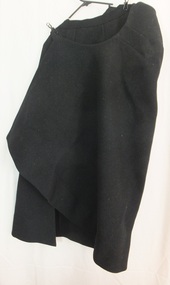
Clothing - Riding Habit, Skirt, 1920s
... Geelong and Melbourne Grammar schools and at Trinity Hall, Cambridge (B.A., 1891). He chose the Danedite portion of land at Purrumbete, and on the death of his bachelor brother Thomas Peter (1863-1895), after a hunting accident, he took over his allocation, Wiridgil. He also owned Boortkoi, near Hexham and on these properties, he ran merino sheep, a Lincoln stud which dated back to 1870, and Shorthorn cattle. 3000 acres were also leased to dairy farmers. Edward was a member of Hampden Shire Council in 1909-31 and three times president at Camperdown. The town...Geelong and Melbourne Grammar schools and at Trinity Hall, Cambridge (B.A., 1891). He chose the Danedite portion of land at Purrumbete, and on the death of his bachelor brother Thomas Peter (1863-1895), after a hunting accident, he took over his allocation, Wiridgil. He also owned Boortkoi, near Hexham and on these properties, he ran merino sheep, a Lincoln stud which dated back to 1870, and Shorthorn cattle. 3000 acres were also leased to dairy farmers. Edward was a member of Hampden Shire Council in 1909-31 and three times president at Camperdown. The town ...The Manifolds were a significant pioneering pastoral family in Western Victoria. The donated riding skirt originally belonged to Mrs Edward Manifold, formally Beatrice Mary Synnot Anderson. Beatrice was Edward Manifold’s cousin once removed whom he married in 1900. Edward, the son of John Manifold, was born on 15 November 1868 and educated at Geelong and Melbourne Grammar schools and at Trinity Hall, Cambridge (B.A., 1891). He chose the Danedite portion of land at Purrumbete, and on the death of his bachelor brother Thomas Peter (1863-1895), after a hunting accident, he took over his allocation, Wiridgil. He also owned Boortkoi, near Hexham and on these properties, he ran merino sheep, a Lincoln stud which dated back to 1870, and Shorthorn cattle. 3000 acres were also leased to dairy farmers. Edward was a member of Hampden Shire Council in 1909-31 and three times president at Camperdown. The town was largely bordered by Manifold land and partly dependent upon the local pastoral dynasties, which benefited the local area from the families’ various business interests. Though an offer to build public baths to commemorate the Queen Victoria Jubilee in 1897 was not proceeded with, the town acquired a hospital, a reserve on Mount Leura, a clock tower and a cricket pavilion, as well as notable donations from the Manifolds to St Paul's Church and the grammar school. Edward was a keen polo player and racing man. He was also a successful owner of steeplechasers and a committeeman of the Victoria Racing Club for many years. He was also a member of many Western District racing clubs. On the 16 July 1900, Edward had married his sixteen-year-old cousin Beatrice Mary Synnot Anderson by whom he had three sons Thomas Peter, Andrew and Robert Edward Manifold. Edwards's estate at his death was valued for probate at nearly £500,000. Edward died following an operation on 14 February 1931 at a private hospital in Yarra Vale Melbourne. Beatrice passed away in 1954, aged 79 in Ballarat where she was born in 1874. Contextual historic Family background: The Manifold brothers Thomas (1809-1875), John (1811-1877) and Peter (1817-1885) were the fourth, fifth and sixth sons of William Manifold and Mary, nee Barnes, of Courthouse Farm, Bromborough, Cheshire, England. The family had decided to emigrate to Van Diemen's Land. Thomas was sent ahead, arriving in Hobart Town on 23rd January 1828 with £1500 and a letter of recommendation from the Colonial Office. Thomas acquired 1280 acres on the west bank of the Tamar River. John and Peter, with their parents and three sisters, arrived on 8th July 1831. Land grants by then had finished but William brought ninety acres next to his son Thomas’ land and on the combined properties the family built Kelso House. The Manifolds’ properties were comparatively poor and when news of the Port Phillip District, in Victoria reached Thomas, he lost no time in coming to see for himself in February 1836. He was impressed with what he saw and hurried back to Tasmania to buy lambs and ewes. With one of his brothers, on July 9th he landed his stores at Point Henry and proceeded to occupy both sides of the Moorabool River. Thomas, at the end of the year, returned to Tasmania and left Peter and John to run the new property. Thomas, however, returned to Victoria for several visits and on one of these visits he, along with his brothers, examined the country near Ballarat. In December 1838 they managed to penetrate the Stony Rises, and Peter and John reached Lake Purrumbete and the Mount Leura country. During this time, on 4th July 1838, Thomas married Jane Elizabeth, eldest daughter of Captain Walter Synnot, formerly of Ballinate, County Armagh, Ireland, and then of Van Diemen's Land. Thomas joined his brothers, and they occupied the Purrumbete run in January 1839. On the journey to Purrumbete they could not take their stock and drays through the Stony Rises, so went north of Lake Corangamite, to the neck of land between it and Lake Gnarpurt. By April the move from Moorabool area was complete. As yet they had no hut and were working day and night, but their delight in their new run was unbounded. John wrote to his mother: “We are at last got to the land we wished for it is a beautiful place, and cannot be surpassed by any I have ever seen”. The three brothers occupied Purrumbete together, breeding both sheep and cattle until Thomas went to Grassmere run on the Merri River near Warrnambool in 1844. John and Peter soon gave up breeding sheep but retained the well-known '3M' brand for the cattle. These were Shorthorns, derived from four bulls originally imported by the Boldon brothers and later improved by further importations, and were renowned for size and quality. By the time of the gold rush in 1851, John and Peter were breeding over 1000 head a year, as well as fattening stores. The diggings at this time had disorganised Grassmere by drawing away Thomas's men, and his wife decided to take her two sons and two daughters to Europe for their education. Thomas gave up the property next year, went to England to join his family, and eventually brought the family back to live in Melbourne. At Purrumbete things were different. The brothers, John and Peter, preferred black stockmen to white, so the discovery of gold upset them very little while providing the very market they required. John was on his second visit to England when the rush started, and Peter went in his turn soon after John returned. On 2 September 1856 John married Marion Thomson, at Cormiston, Van Diemen's Land. They had four daughters and five sons, from three of whom, William Thomson, James Chester and Edward, the later generations of the family descend. Through the years the brothers had to contend with the scab, fluke and footrot, depression, rabbits, bush fires and pleuro-pneumonia. In 1861 they appointed as manager Henry Manifold Matson, their nephew, who had already been with them for five years. Thomas died in Melbourne on 7 November 1875, John at Purrumbete on 3 January 1877 and Peter at Purrumbete on 31 July 1885. Devout members of the Church of England, John and Peter, during their lives, gave generously towards building St Paul's Church, Camperdown, and guaranteed part of the vicar's stipend. Peter was a member of the Hampden and Heytesbury Roads Board from 1859 and carried on into the Hampden Shire Council when it was formed in 1864. However, it was not for public works that they were known, but for their personal example. In a new land where speculators and adventurers were all too common, the Manifold brothers were among those who intended it to be their home and their children's home. Industrious, unpretentious and hospitable, they were respected in their community as men of the highest integrity. This riding habit is a characteristic example of the type and style of riding clothes that well-dressed ladies wore in the 1920s. It highlights the changes that were beginning in society for women. Prior to 1918 ladies still had to ride side-saddle with skirts over Jodhpurs. Society of the time regarded women riding astride as unseemly and just not done. This riding habit is particularly significant on a number of levels, it shows the beginnings of change in society's attitudes through women's fashion after the First World War. A change that was to bring a start to a more liberating societal attitude towards women after the successful establishment of the Representation of People Act 1918 that gave women the right to vote. This garments provenance is linked to one of Victoria's important pioneering families the Manifolds, one of the first families that came from Van Diemen's land to settle the Western District of Victoria in 1844. Originally the garment belonged to the wife of the great-grandson of pioneer William Manifold, Edward Manifold who married Beatrice May Synnot Anderson, Edwards Cousin in 1900. The garment was made by the Mayfair tailors J. Busvine & Co. in the early to mid-1920s (estimate) who at the turn of the century were tailors to the Courts of Europe. Their clothing is highly collectible today and examples can be found in a number of significant museum collections around the world, notably the Metropolitan Museum of Art in New York and the FIDM in Los Angeles. Safety skirt/apron, part of a three-piece, side saddle riding habit tailored for Mrs Edward Manifold. This side saddle skirt is made from black woolen material fixing at the waist with two metal hooks and three buttons to the front opening. One internal concealed pocket lining to the top part of the apron made of cotton the seat is shaped for side saddle riding and the skirt wraps around the body the longer side draped over the leg that is in the stirrup. flagstaff hill, warrnambool, shipwrecked coast, flagstaff hill maritime museum, maritime museum, side saddle riding habit, side saddle safety skirt, side saddle apron, mrs edward manifold, beatrice manifold, female riding habit 1920s, shipwreck coast, flagstaff hill maritime village, great ocean road -
 Glenelg Shire Council Cultural Collection
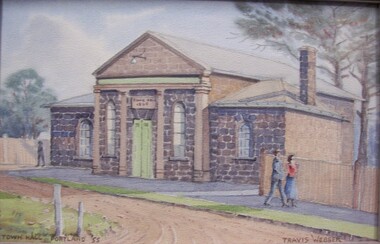
Painting, Travis Webber, Town Hall, Portland, 1955
... Front: Town Hall Portland '55 (brown paint, lower let). Travis Webber (brown paint, lower right). Back: Geelong Picture Framers, 211 Moorabool Street, GEELONG. ...Portland Town Council Portland Town Hall bluestone building Bluestone 1800s Front: Town Hall Portland '55 (brown paint, lower let). Travis Webber (brown paint, lower right). Back: Geelong ...Portland Town CouncilPainting of a bluestone building. There are four columns to the front of the building. One either side of a green front door and the other two either side of each side window. Above the front door is a sign which reads ' Town Hall 1869' A footpath is in front of the building, with a man and woman walking together. The man wears a suit and hat and the woman wears a red shirt and blue skirt. At the other side of the building there is another figure - shadowy. A dirt road curves from foreground centre towards and past the building to the left. Two tall pines are behind the building on right.Front: Town Hall Portland '55 (brown paint, lower let). Travis Webber (brown paint, lower right). Back: Geelong Picture Framers, 211 Moorabool Street, GEELONG. Ph. 97805 (blue ink stamp, lower centre).portland town hall, bluestone building, bluestone, 1800s -
 Ringwood and District Historical Society
Contract, J C Taylor & Sons Proprietary Limited, Gheeringhap St, Geelong, General Conditions of Contract for "The Proposed Concert Hall at Ringwood 13 March 1936 between J C Taylor & Sons Proprietary Limited and The Mayor, Councillors and Burgesses of Ringwood 1936, 13-Mar-36
... Hall at Ringwood 13 March 1936 between J C Taylor & Sons Proprietary Limited and The Mayor, Councillors and Burgesses of Ringwood. +Additional Keywords: McCaskill, J K / Long, A B (Town Clerk) / Taylor, J C General Conditions of Contract for "The Proposed Concert Hall at Ringwood 13 March 1936 between J C Taylor & Sons Proprietary Limited and The Mayor, Councillors and Burgesses of Ringwood 1936. Contract J C Taylor & Sons Proprietary Limited, Gheeringhap St, Geelong ...The hall was never builtBuff coloured three page General Conditions of Contract for "The Proposed Concert Hall at Ringwood 13 March 1936 between J C Taylor & Sons Proprietary Limited and The Mayor, Councillors and Burgesses of Ringwood. +Additional Keywords: McCaskill, J K / Long, A B (Town Clerk) / Taylor, J CAs above -
 Flagstaff Hill Maritime Museum and Village
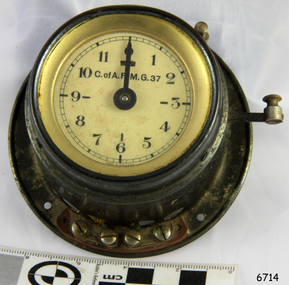
Timer, 1940s
... Town Hall. There were nine subscribers. Australia's first automatic exchange was installed in the GPO in Sydney, in 1911, for internal use. But the first automatic exchange for public use was opened at Geelong in Victoria in the next year July 1912 with 800 subscribers. ...Town Hall. There were nine subscribers. Australia's first automatic exchange was installed in the GPO in Sydney, in 1911, for internal use. But the first automatic exchange for public use was opened at Geelong in Victoria in the next year July 1912 with 800 subscribers. ...Australia's first telephone exchange was opened in Melbourne in August 1880. It was operated by the Melbourne Telephone Exchange Company. Owned by W. H. Masters and T. T. Draper, the Manager of the Company was H. Byron Moore. This was only two years after the world's first exchange in the United States, and just four years after Bell first spoke on a telephone. The exchange was located in the old Stock Exchange building at 367 Collins Street, a site now occupied by the Commonwealth Bank. In 1884, the operations of the Company, by then known as the Victorian Telephone Exchange Company, had grown considerably and were transferred to Wills Street, Melbourne. Private ownership of this company continued until 1887 when it was bought out by the Victorian Colonial Government. Other colonial governments followed this example. By 1910, the growth in telephone services made additional accommodation necessary. This could not be provided in the existing building in Wills Street and arrangements were made for a new exchange in Lonsdale Street. Alexander Graham Bell visited Australia in 1910 to advise the Federal Government's Postal Commission. Telephone exchanges were established in Adelaide with (48 subscribers), Hobart (10 subscribers) and Launceston (35 subscribers). The first exchange in Western Australia was established in 1887 and located in a small three-room cottage in Wellington Street, Perth with 17 subscribers. The year 1888 marked the opening of the Fremantle exchange in a small room at the rear of the Town Hall. There were nine subscribers. Australia's first automatic exchange was installed in the GPO in Sydney, in 1911, for internal use. But the first automatic exchange for public use was opened at Geelong in Victoria in the next year July 1912 with 800 subscribers. Melbourne's first automatic exchange was opened in the suburb of Brighton in 1914; the first public automatic exchange in NSW began operating at Newtown, Sydney in 1915; and Queensland's first was installed at South Brisbane in 1925. 1929 saw the opening of Tasmania's first automatic exchange in Hobart. an automatic telephone service. In June 1977, the manual telephone exchange at Swansea was replaced with an automatic service and made Tasmania the first State in Australia to have a fully automatic net work. The half-century following Federation saw the growth of the automatic operation; a great extension of trunk line services; The automatic telephone contributed greatly to the early popularity of telephones in Australia. It was a quicker and more convenient way of communicating with another person on the same exchange — instead of having to go through tedious processes with the operator. From its introduction, the number of automatic telephones in operation grew to a remarkable extent. In 1886, the first trunk link of 16 km was connected to the exchanges of Adelaide and Port Adelaide in South Australia. Then, in 1907, the first inter-capital telephone trunk line was opened between Sydney and Melbourne. It was followed by a line between Melbourne and Adelaide in 1914. Sydney and Brisbane were linked in 1923, and Perth and Adelaide in 1930. In 1930, the first overseas calls from Australia came possible with the introduction of a radio telephone service to England, and through there to Europe and America. A similar service opened to New Zealand in the same year. Initially, trunk channels linked different manual trunk exchanges. It was necessary for a succession of trunk operators to connect the appropriate channels, one after the other until the connection was made. As trunk traffic grew. the system became increasingly unsuitable. More trunk operators had to be employed and so labour costs increased. It was a tedious and slow way of making a long-distance call, and it was sometimes hard to hear, particularly when several exchanges were linked With technical advances, trunk switching moved from manual operation through a partly automatic phase. Automatic transit switching equipment was used and only a single operator was required to connect a trunk call to a wanted automatic subscriber. Until well beyond the middle of this century, the majority of trunk traffic went through this single telephonist control. In 1953, the number of telephones in use in Australia passed the one million mark. By then, the need for improvement in the automatic exchanges was be coming well recognised. The need was for a telephone switching system which would do a better job more economically than the conventional step-by-step ex-change. This led to the adoption of the Crossbar system as the standard in automatic telephone exchanges in 1960. The introduction of Crossbar switching was a big step forward in the automation of trunk calls. It substituted automatic switching and charging equipment for the originating trunk operator, and improved the quality of the system radically. Before the introduction of the Crossbar system there were often very long delays in obtaining a booked trunk call, and the quality of sound was often very poor. With Crossbar, Subscriber Trunk Dialing (STD) became a reality. A trunk call by STD was as easy to make and almost as fast to connect as a local call.The item was made around the 1940s and used up until the 1970s in manual cord telephone exchanges as a way to time and charge users for trunk calls made over the telecom system of the time. Post Master General dept. - Trunk Call Timer.Inscribed PMG, C. of A, 37. Bell chimes at 3 min increments.flagstaff hill, warrnambool, shipwrecked-coast, flagstaff-hill, flagstaff-hill-maritime-museum, maritime-museum, shipwreck-coast, flagstaff-hill-maritime-village, timer, trunk call, telephone, cord exchange -
 Bendigo Historical Society Inc.
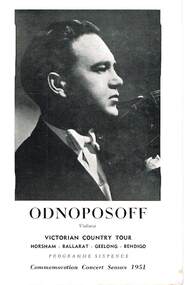
Document - ODNOPOSOFF - VIOLINIST
... Horsham, Town Hall 5th June, Ballarat, Brittania Theatre, Thurs 7th June, Geelong, Plaza Theatre, Thurs 28th June, Bendigo, Town Hall, Sat 30th June at 8.15 p. m. ...Horsham, Town Hall 5th June, Ballarat, Brittania Theatre, Thurs 7th June, Geelong, Plaza Theatre, Thurs 28th June, Bendigo, Town Hall, Sat 30th June at 8.15 p. m. ...The Australian Broadcasting Commission presents: ' Odnoposoff', Violinist, Associate Artist: Daniel Koletz, Pianist. Horsham, Town Hall 5th June, Ballarat, Brittania Theatre, Thurs 7th June, Geelong, Plaza Theatre, Thurs 28th June, Bendigo, Town Hall, Sat 30th June at 8.15 p. m. Commemoration Concert Season 1951.event, entertainment, music, odnoposoff - violinist, daniel koletz -
 Bendigo Historical Society Inc.
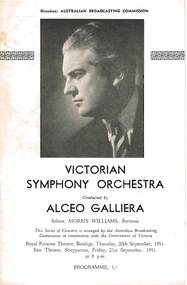
Document - VICTORIAN SYMPHONY ORCHESTRA X 2
... Victorian Symphony Orchestra: 1) Conductor: Kurt Woess, Soloist: Marjorie Conley, Soprano Town Hall, Bendigo, Wednesday 18th April, 8 p. m. Plaza Theatre, Geelong, Thursday, 19th April 8 pm. 2) Conductor: Alceo Galliera, Soloist: Morris Williams, Baritone, Royal Princess Theatre, Bendigo, 20th September 1951. ...EVENT Entertainment music Victorian Symphony Orchestra x 2 Kurt Woes Marjoria Conley Alceo Galliera Morris Williams Australian Broadcasting Commission Victorian Symphony Orchestra: 1) Conductor: Kurt Woess, Soloist: Marjorie Conley, Soprano Town Hall, Bendigo, Wednesday 18th April, 8 p. m. Plaza Theatre, Geelong, Thursday, 19th April 8 pm. 2) Conductor: Alceo Galliera, Soloist: Morris Williams, Baritone, Royal Princess Theatre, Bendigo, 20th September 1951. ...Victorian Symphony Orchestra: 1) Conductor: Kurt Woess, Soloist: Marjorie Conley, Soprano Town Hall, Bendigo, Wednesday 18th April, 8 p. m. Plaza Theatre, Geelong, Thursday, 19th April 8 pm. 2) Conductor: Alceo Galliera, Soloist: Morris Williams, Baritone, Royal Princess Theatre, Bendigo, 20th September 1951. Star Theatre, Shepparton, Friday, 21st September 1951 at 8 pm. Direction: Australian Broadcasting Commission. Programme 1/-.event, entertainment, music, victorian symphony orchestra x 2, kurt woes, marjoria conley, alceo galliera, morris williams, australian broadcasting commission -
 Bendigo Historical Society Inc.
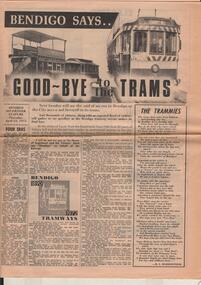
Document - BASIL MILLER COLLECTION: BENDIGO SAYS GOOD-BYE TO THE TRAMS, c1972
... At the stroke of 5 pm from Eaglehawk Town Hall clock 82 years of history will end as the last tram makes its sentimental journey to the city, while at the Bendigo Cemetery - the Quarry Hill line terminus - another tram will be leaving for its last resting place. Other articles include: Four Eras, of trams. The Trammies, covering Ballarat, Geelong...At the stroke of 5 pm from Eaglehawk Town Hall clock 82 years of history will end as the last tram makes its sentimental journey to the city, while at the Bendigo Cemetery - the Quarry Hill line terminus - another tram will be leaving for its last resting place. Other articles include: Four Eras, of trams. The Trammies, covering Ballarat, Geelong ...13 April 1972. Bendigo Says Good-bye to the Trams. A1 sheet - double sided. Tramway history 1890 - 1972, 2 copies. At the stroke of 5 pm from Eaglehawk Town Hall clock 82 years of history will end as the last tram makes its sentimental journey to the city, while at the Bendigo Cemetery - the Quarry Hill line terminus - another tram will be leaving for its last resting place. Other articles include: Four Eras, of trams. The Trammies, covering Ballarat, Geelong in the form of a poem. 1927 and all that, by Basil Miller, remembering his 45 years of service with the trams. How it all started, The twin communities of Sandhurst and Eaglehawk were relatively early in considering the possibility of operating street tramways within their boundaries. Cabs, Battery Cars, Construction, Strikes, Bendigo 1890 to 1972 - Tramways. Man and his Mates, continued from previous page, Explosion, Touchy Task, A Quickey, Horrors. Electric in 1903, There was excitement galore in the City during April, 1903 - and the Advertiser recorded the progress of the new-fangled electric machine. One man's Memories, Tough times, humour, tragedy and comradeship - they all came flooding back as former Bendigo tramway-man Tom Griffiths recently turned the clock back. Keb Sir Keb Sir? 'Keg sir? Tram off the line,' was the call of the cabbies when a train pulled in at the Bendigo railway station. Altered Shopping Trend, With advent of the electric tram in Bendigo came change in shopping habits.bendigo trams -
 Sunshine and District Historical Society Incorporated
Administrative record - City of Sunshine - Commissioner Mr Alexander "Alex" George Gillon Collection 1976 - 1982 - Minutes of the Ordinary Meeting of Council Held on 3rd October 1978, City of Sunshine, 3rd October 1978
... Geelong Road Brooklyn Carrington Drive Gee Street St. Albans Hotel McKechnie Street Hulett Street Pineneedle Court Mitchell Street Navigator Street Marshall Street Kevin Dennis Motors Annersley Street Balfour Avenue Sydney Street Gooding Street Ashley Street South Road Maribyrnong River Warrs Road Maidstone Hall Thomson Street Errington Reserve Robert Bruce Reserve Rosamond Bowling Club Main Road East Devonshire Road Sproul Street Oakwood Road Haven Close Norwood Street Raleigh Road Clarke Street Highpoint City Minutes of the Ordinary Meeting of Council Held on 3rd October 1978 Reports on the Town Clerk's Department Report of the Town Clerk Victorian Beer Alcoholic Content Proposal for Reduction Land Transfer Adjacent to Deer Park Hotel Medway Golf Club Payment in Lieu of Rates Diamond Avenue Infant Welfare Centre Non-Availability of Subsidy Untied Grants Proposed Library Highpoint West Shopping Centre Land Transfer Discontinued Right of Way Rear of Railway Parade Deer Park Supplementary Valuations Community Youth Support Scheme Report of the Chief Health Inspector Nuisance Condition at 403 Ballarat Road Sunshine Removal of Dwelling Outside the Municipality Health Act Registrations Monsanto Application for Approval to Install Septic Tank Recirculating Sand Filter System at the Stansfield Steel Project Fairbairn Road Sunshine West Health (Tent) Regulations 1978 Draft Rubbish In and Around Flats Quarry Hole Commonwealth Land J.L. ...Minutes of the Ordinary Meeting of Council Held on 3rd October 1978 Reports on the Town Clerk's Department Report of the Town Clerk Victorian Beer Alcoholic Content Proposal for Reduction Land Transfer Adjacent to Deer Park Hotel Medway Golf Club Payment in Lieu of Rates Diamond Avenue Infant Welfare Centre Non-Availability of Subsidy Untied Grants Proposed Library Highpoint West Shopping Centre Land Transfer Discontinued Right of Way Rear of Railway Parade Deer Park Supplementary Valuations Community Youth Support Scheme Report of the Chief Health Inspector Nuisance Condition at 403 Ballarat Road Sunshine Removal of Dwelling Outside the Municipality Health Act Registrations Monsanto Application for Approval to Install Septic Tank Recirculating Sand Filter System at the Stansfield Steel Project Fairbairn Road Sunshine West Health (Tent) Regulations 1978 Draft Rubbish In and Around Flats Quarry Hole Commonwealth Land J.L. MacTaggart (Australia) Pty Ltd Noise By-Law Application for Transfer of Proprietorship of Premises Under the Health Act Infectious Diseases Sewerage Overflow 2 Bruce Street Albion Smoking in Public Buildings Immunisation Sunshine North Institute of Weights & Measures Annual National Conference Report of the Chief By-Laws Officer Court Proceedings Parking and Traffic Infringements Prohibited Parking Links Street Prohibited Parking Princess Street Area Prohibited Parking Gould Street Report of the City Librarian Bookmobile sites Municipal library Subsidy 1978/79 Bookmobile Seminar Children's Literature seconds National Seminar September 1st to 5th 1978 Report of the Municipal Recreation Officer Municipal Recreation Service Gound Allocations School Summer Season Holiday Programmes September 1978 Report of the City Engineer Proposed Children's Reception Centre for Erection in the City of Sunshine Planning Permit Application Illuminated Sign Churchill Avenue Planning Permit Application Grazing of Horses Furlong Road Planning Permit Application Offices Main Road West Planning Permit Application Extension to Exising Car Sales Yard Rosamond Road Planning Permit Application Corner of Neale Road and Station Road Deer Park Proposed Amendment No 81 to the Melbourne Metropolitan Planning Scheme Proposed Widening of Station Road Planning Permit Application Motor Repair Station Wright Street Planning Permit Application Sky Sign Hampshire Road Planning Permit Application Extension to Existing Warehouse McIntyre Road Planning Permit Application Consulting Rooms, Pharmacy, Service Premises and Caretaker's Dwelling Corner of Tamar Drive and Billingham Road Planning Permit Application Horse Grazing Judge Street & Norman Street Planning Permit Application Signs Geelong Road Planning Permit Application Factory Extension Carrington Drive Planning Permit Application Sky Sign Ballarat Road Sunshine Planning Permit Application Factory and Office Gee Street Sunshine North Planning Permit Application Drive in Bottle Shop and Extensions to St. Albans Hotel McKechnie Street Planning Permit Application Sky Sign & Fascia Signs Ballarat Road Sunshine Planning Permit Application Store Addition to Existing Office Geelong Road Plan of Subdivision Boral Resources Ballarat Road & Hulett Street Plan of Subdivision R.D.C. Projects Evergreen Avenue and Pineneedle Court Plan of Subdivision McPhersons Mitchell Street Plan of Subdivision Navigator Street Consolidation of Title Marshall Street Consolidation of Title Kevin Dennis Motors Ballarat Road and Annersley Street Consolidation of Title Lots 37 & 38 Balfour Avenue Contract Playground Equipment Various Reserves Contract Reconstruction of Sydney Street Contract Gooding Street 40 Hour Week Victorian Sewerage and Drainage Contractors' Group Declaration of Sewered Properties General Notice Sewerage Facilities M.M.B.W. Allocation of Funds 1978/79 Joint Works Unclassified Roads Telecom Australia Modernisation of Public Telephones St. Albans Area Ashley Street / South Road Proposed Traffic Lights Maribyrnong River Flood Plan Acting Commissioner of Police Sewerage Facilities St. Albans (Albanvale) Warrs Road Northern Section Private Street Scheme Use of C.R.B. land McIntyre Road for Recreation Purposes Garaging of Meals on Wheels Vehicles at Maidstone Hall Thomson Street Maidstone Relocation of Steel Framed Steel Clad Sheds to Errington Reserve and Robert Bruce Reserve Rosamond Bowling Club Report of the Building Surveyor Building Over Easement 135 Devonshire Road Sunshine Building Over Easement 10 Sproul Street Sunshine North Building Over Easement Lot 552 Oakwood Road St. Albans Building Over Easement 6 Haven Close Sunshine West Building Over Easement 75 Norwood Street Albion Building Over Easement182 Wright Street Sunshine West Building Over Easement 176 McIntyre Road Sunshine North Installation of Underground Tanks Corner Raleigh Road and Navigator Street Maribyrnong Ruinous and Dangerous Building Lots 6 & 7 Furlong Road Sunshine North Orders of the Day Accounts for Payment as at 15th September 1978, 26th September 1978 Extraordinary Business Report of the City Engineer Planning Permit Application Medical Consulting Rooms Clarke Street Sunshine Planning Permit Application Take away Food Premises Cafe Amusement Parlour Highpoint City Rosamond Road city of sunshine, alexander "alex" george gillon, deer park hotel, ballarat road, deer park, medway golf club, omar street, maidstone, diamond avenue infant welfare centre, diamond avenue, albanvale, highpoint west shopping centre, rosamond road, maribyrnong, railway parade, sunshine, monsanto, somerville road, footscray west, fairbairn road, sunshine west, j.l. mactaggart (australia) pty ltd, bruce street, albion, links street, princess street, st. albans, gould street, churchill avenue, braybrook, main road west, furlong road, sunshine north, neale road, station road, wright street, hampshire road, mcintyre road, tamar drive, billingham road, judge street, norman street, geelong road, brooklyn, carrington drive, gee street, st. albans hotel, mckechnie street, hulett street, pineneedle court, mitchell street, navigator street, marshall street, kevin dennis motors, annersley street, balfour avenue, sydney street, gooding street, ashley street, south road, maribyrnong river, warrs road, maidstone hall, thomson street, errington reserve, robert bruce reserve, rosamond bowling club, main road east, devonshire road, sproul street, oakwood road, haven close, norwood street, raleigh road, clarke street, highpoint city -
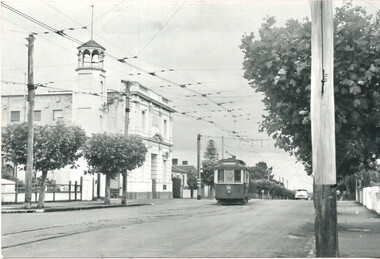 Ballarat Tramway Museum
Photograph - SECV Geelong 18 in Pakington St Newtown, early 1950s early 1950s
... Photo of SECV Geelong No. 18 in Pakington St, outside the City of Newtown Chilwell Town Hall and fire station, with its watchtower. ...Photo of SECV Geelong No. 18 in Pakington St, outside the City of Newtown Chilwell Town Hall and fire station, with its watchtower. ...Photo of SECV Geelong No. 18 in Pakington St, outside the City of Newtown Chilwell Town Hall and fire station, with its watchtower. The tram has the destination of Chilwell, which requires it to swing out to its left. The track design was to avoid collisions with incoming cars from Newtown. Shows the overhead at this junction and the tram stop signs in the background. The tram has been fitted with tail lights, photo early 1950s. Photographer unknown.Yields information about Geelong tram18, Pakington St and the junction between the Chilwell and Newtown tram lines.Black and white photograph with printers dates on the rear. Printed on AGFA paper.geelong, tramways, tram 18, newtown, fire station, chilwell, pakington st -
 St Kilda Historical Society
Souvenir - Booklet, Historic Souvenir of the Visit of His Royal Highness the Prince of Wales to Australia, 1920
... Contains 23 pages of black and white photographs of the visit, covering images of his official party; his arrival at St Kilda; events in Melbourne at the Town Hall, Royal Agricultural Show, MCG; visits to Geelong, Winchelsea, Colac, Camperdown, Cressy, Ballarat, Castlemaine, Bendigo and Sassafras....Contains 23 pages of black and white photographs of the visit, covering images of his official party; his arrival at St Kilda; events in Melbourne at the Town Hall, Royal Agricultural Show, MCG; visits to Geelong, Winchelsea, Colac, Camperdown, Cressy, Ballarat, Castlemaine, Bendigo and Sassafras. ...Souvenir booklet of the visit by the Prince of Wales (later, King Edward VIII) on 26 May - 7 June 1920. Contains 23 pages of black and white photographs of the visit, covering images of his official party; his arrival at St Kilda; events in Melbourne at the Town Hall, Royal Agricultural Show, MCG; visits to Geelong, Winchelsea, Colac, Camperdown, Cressy, Ballarat, Castlemaine, Bendigo and Sassafras.Booklet with a grey card cover embossed with gold and containing 12 pages (printed double-sided) of black and white photographs. Bound with 2 staples. royal visits, prince of wales -
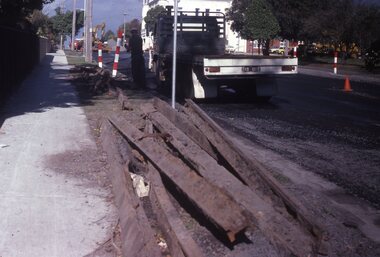 Ballarat Tramway Museum
Slide - 35mm slide/s - set of 11, May 1979c
... Geelong, c May 1979. All in Pakington St., Newtown, ex Newtown route. 2268.1 - slide 29 - look south from the north of Retreat Road. .2 - 30 - No. 276 in background, looking south .3 - 31 - City of Newtown Town Hall in background. .4 - 32 - opposite to that of No. 29. .5 - 33 - Looking south .6 - 34 - looking south with Aphrasia St. in the background. .7 - 35 - as for .2 .8 - 36 - Opposite No. 278, looking south .9 - 1 - opposite No. 276/278. .10 - 2 - ditto .11 - 3 - Outside No. 278, looking south. ...Geelong, c May 1979. All in Pakington St., Newtown, ex Newtown route. 2268.1 - slide 29 - look south from the north of Retreat Road. .2 - 30 - No. 276 in background, looking south .3 - 31 - City of Newtown Town Hall in background. .4 - 32 - opposite to that of No. 29. .5 - 33 - Looking south .6 - 34 - looking south with Aphrasia St. in the background. .7 - 35 - as for .2 .8 - 36 - Opposite No. 278, looking south .9 - 1 - opposite No. 276/278. .10 - 2 - ditto .11 - 3 - Outside No. 278, looking south. ...Set of eleven colour slides (Kodak) showing the removal of tram track in Geelong, c May 1979. All in Pakington St., Newtown, ex Newtown route. 2268.1 - slide 29 - look south from the north of Retreat Road. .2 - 30 - No. 276 in background, looking south .3 - 31 - City of Newtown Town Hall in background. .4 - 32 - opposite to that of No. 29. .5 - 33 - Looking south .6 - 34 - looking south with Aphrasia St. in the background. .7 - 35 - as for .2 .8 - 36 - Opposite No. 278, looking south .9 - 1 - opposite No. 276/278. .10 - 2 - ditto .11 - 3 - Outside No. 278, looking south. Bus stop still in position. See Letter to Dave O'Neil and responses.tramways, trams, geelong, track removal, pakington st, newtown -
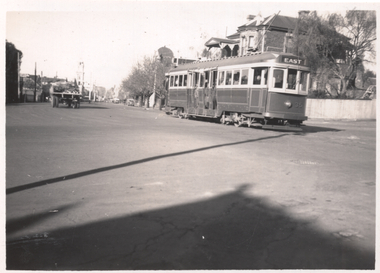 Ballarat Tramway Museum
Photograph - Geelong No. 35, Wal Jack, 23-6-1949
... Geelong bogie 35 turning into Ryrie St from Aberdeen St with the destination of East. Has the Town Hall clock tower in the photo. ...Geelong bogie 35 turning into Ryrie St from Aberdeen St with the destination of East. Has the Town Hall clock tower in the photo. ...Geelong bogie 35 turning into Ryrie St from Aberdeen St with the destination of East. Has the Town Hall clock tower in the photo. See item 7817 for the negative. Dated 23-6-1949.Yields information about Geelong 35 and Ryrie St.Black and white photograph, with hand written details on rear.See rear image. tramways, trams, geelong, ryrie st, tram 35, aberdeen st, geelong tramway -
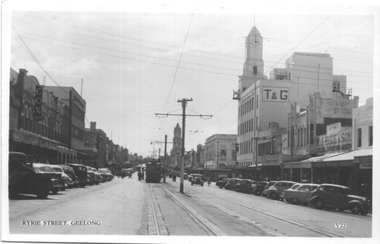 Ballarat Tramway Museum
Postcard, Valentine & Sons Publishing Co, "Ryrie Street Geelong", c1950
... Geelong. A tram is westbound. In the view are the Town Hall, the T&G building, M J Hede & Sons store, and Cox Bros. ...Geelong. A tram is westbound. In the view are the Town Hall, the T&G building, M J Hede & Sons store, and Cox Bros. ...Postcard produced by the Valentine publishing company of Ryrie St Geelong. A tram is westbound. In the view are the Town Hall, the T&G building, M J Hede & Sons store, and Cox Bros. The rear of the card notes it is a genuine photograph. Photo c1950.Yields information about the view of Ryrie St c1950.Black and white Postcard undivided back, unused. Card No. V22.On rear in ink "A couple more for your collection" and an unreadable name.tramways, trams, geelong, ryrie st, geelong tramway -
Ballarat Tramway Museum
Newspaper, The Courier Ballarat, "Ballarat Tramway Girl wins Queen Competition.", 1944
... Newspaper Clipping from The Courier, 1-9-1944 about Sylvia Mitchell of Ballarat wining the Most Popular Competition, Melbourne Town Hall, Miss J. Mc Curdy of Geelong, Mrs. W. Rosewarn of Bendigo and other fund raisers. ...Conductresses Most Popular Conductress Competition SEC Competition Newspaper Clipping from The Courier, 1-9-1944 about Sylvia Mitchell of Ballarat wining the Most Popular Competition, Melbourne Town Hall, Miss J. Mc Curdy of Geelong, Mrs. W. Rosewarn of Bendigo and other fund raisers. ...Has a strong association with the contestants in the Most Popular Conductress Competition and the winner, Ballarat based Mrs. Sylvia Mitchell and the wartime fund raiser.Newspaper Clipping from The Courier, 1-9-1944 about Sylvia Mitchell of Ballarat wining the Most Popular Competition, Melbourne Town Hall, Miss J. Mc Curdy of Geelong, Mrs. W. Rosewarn of Bendigo and other fund raisers. Contained within Reg Item 5507 - Foolscap binder with green covers, black binding edge and metal clips. conductresses, most popular conductress competition, sec, competition -
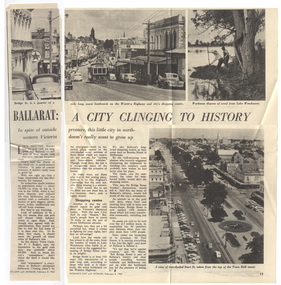 Ballarat Tramway Museum
Magazine, Woman's Day, "Ballarat a City Clinging to History", 8/02/1960 12:00:00 AM
... Geelong. Trams tramways Ballarat Bridge St Bridge St Traders Part page 14 and page 15 of an article titled "Ballarat a City Clinging to History" from the Woman's Day, 8/2/1960, featuring a photograph No. 30, descending Bakery Hill to Bridge St, an aerial view looking west from the Town Hall down and workmen pulling weed from Lake Wendouree. ...Yields information about the viewpoint of The Courier about the future of the Ballarat tramway system with reference to Geelong.Part page 14 and page 15 of an article titled "Ballarat a City Clinging to History" from the Woman's Day, 8/2/1960, featuring a photograph No. 30, descending Bakery Hill to Bridge St, an aerial view looking west from the Town Hall down and workmen pulling weed from Lake Wendouree. Item looks at Ballarat's history, population, future, Bridge St, the bottleneck of bridge St, quotes Deputy Town Clerk, F. Rogers, and whether the city should grow. Interesting views of traffic in Bridge St. Also quotes Paul Simon of the Bridge St Traders Association. Contained originally within Reg Item 5507 at the back of the binder. For items see btm5507 loose items list.pdftrams, tramways, ballarat, bridge st, bridge st traders -
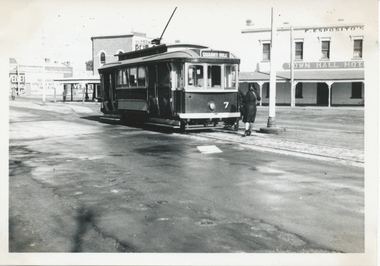 Ballarat Tramway Museum
Photograph - SECV Bendigo No. 7 at Eaglehawk terminus, Wal Jack, 4/08/1943
... Town Hall hotel in the background along with advertisements for Velvet soap. Photo taken 4-8-1943 by Wal Jack. The tram has the destination of Quarry Hill, has white bumpers and white steps. Black and White print contained within the Wal Jack Bendigo and Geelong...Town Hall hotel in the background along with advertisements for Velvet soap. Photo taken 4-8-1943 by Wal Jack. The tram has the destination of Quarry Hill, has white bumpers and white steps. Black and White print contained within the Wal Jack Bendigo and Geelong ...Photo of No. 7 at Eaglehawk terminus with a conductress completing the turning of the trolley pole. The F. Esposito's Town Hall hotel in the background along with advertisements for Velvet soap. Photo taken 4-8-1943 by Wal Jack. The tram has the destination of Quarry Hill, has white bumpers and white steps. Black and White print contained within the Wal Jack Bendigo and Geelong Album, see Reg Item 5003 for more details. i1 - scan of print in the album i2 - rear of image i3 - scan of negative at 3200dpi added 6/6/2020.Yields information about Bendigo No. 7 and use of conductresses during WW2Black and white print with photographer’s notes on the rear.On rear in ink "SEC Bendigo, 2nd No. 7, (ex PMTT), Eaglehawk (heavy snow storms) 4-8-43" with the Wal Jack copyright stamp in the top right hand corner and the number "T208" written in.trams, tramways, eaglehawk, conductresses, tram 7, second world war -
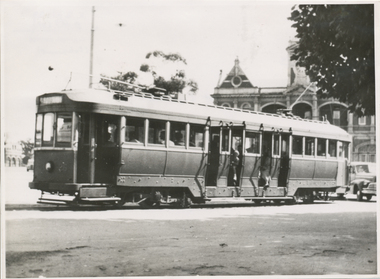 Ballarat Tramway Museum
Photograph - SECV Bendigo tram 26 Eaglehawk, Keith Kings, 8/04/1950
... Town Hall in the background. See item 9463 for a glass plate negative. Yields information about tram 26 and the Eaglehawk Destination. Trams tramways Bendigo Bogie Trams tram 26 In ink on rear "SEC Victoria, Bendigo, Bogie car No.26 at Eaglehawk". Date "8/4/1950" in bottom right hand corner. Keith Kings copyright stamp in top left hand corner with "D(k)(vi)" and "enlargement" written in. Black and White print contained within the Wal Jack Bendigo and Geelong ...Photograph of No. 26 the Eaglehawk terminus, 8-4-1950, photo by Keith Kings. Has the Eaglehawk Town Hall in the background. See item 9463 for a glass plate negative.Yields information about tram 26 and the Eaglehawk Destination.Black and White print contained within the Wal Jack Bendigo and Geelong Album, see Reg Item 5003 for more details.In ink on rear "SEC Victoria, Bendigo, Bogie car No.26 at Eaglehawk". Date "8/4/1950" in bottom right hand corner. Keith Kings copyright stamp in top left hand corner with "D(k)(vi)" and "enlargement" written in.trams, tramways, bendigo, bogie trams, tram 26
