
Showing 560 items matching "geelong victoria australia"
-
 Geelong Gallery
Print - Geelong, Victoria, Australia, NORTHFIELD, James, 1930s
... Geelong, Victoria, Australia....Colour lithograph on canvas lined paper Print Geelong, Victoria, Australia. NORTHFIELD, James ...Colour lithograph on canvas lined paper -
Koorie Heritage Trust
Book, Brown, P. L, Memoirs recorded at Geelong, Victoria, Australia by Captain Foster Fyans : transcribed from his holograph manuscript given by descendants to the State Library Melbourne, 1962, 1986
... Memoirs recorded at Geelong, Victoria, Australia by Captain Foster Fyans : transcribed from his holograph manuscript given by descendants to the State Library Melbourne, 1962...Memoirs recorded at Geelong, Victoria, Australia by Captain Foster Fyans : transcribed from his holograph manuscript given by descendants to the State Library Melbourne, 1962 Book Brown, P. ...287 p. : ill., maps, port. ; 26 cm.fyans, foster, 1790-1870. | australia -- history -- 1788-1851. | norfolk island -- history. -
 National Wool Museum
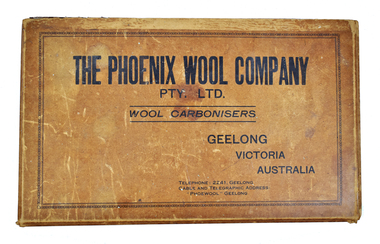
Container - Display Case, Phoenix Wool Company Pty Ltd, 1950-1955
... . / WOOL CARBONISERS / GEELONG / VICTORIA / AUSTRALIA / TELEPHONE: 2241, GEELONG / CABLE AND TELEGRAPHIC ADRESS: / "PHOEWOOL" GEELONG...Barwon River, Marnock Vale, Geelong, Victoria, Australia.... / WOOL CARBONISERS / GEELONG / VICTORIA / AUSTRALIA / TELEPHONE: 2241, GEELONG / CABLE AND TELEGRAPHIC ADRESS: / "PHOEWOOL" GEELONG Display case, brown cardboard printed with text in black on the lid at the top. ...The Phoenix Wool Company was started in 1919 by Brigadier-General Robert Smith. The works were located on the Barwon River, near the end of Shannon Avenue; some remnants of the original buildings can still be seen at the site. Phoenix was one of the first to develop the wool carbonising process (the removal of vegetable matter from wool through the use of chemicals) and during its heyday in the 1930s-50s the company operated 24 hours per day and employed a workforce of over 100. The company closed in 1997. This box of carbonised wool samples may possibly have been used by a salesman promoting the activities of the company.Display case, brown cardboard printed with text in black on the lid at the top. Lined in blue. Interior divided into five sections, each containing samples of carbonised wool. There are five labels attached to the inside of the box lid.THE PHOENIX WOOL COMPANY / PTY. LTD. / WOOL CARBONISERS / GEELONG / VICTORIA / AUSTRALIA / TELEPHONE: 2241, GEELONG / CABLE AND TELEGRAPHIC ADRESS: / "PHOEWOOL" GEELONGphoenix wool company pty ltd, wool industry, wool carbonising, barwon river, geelong, company history, brigadier-general robert smith -
 Beechworth Honey Archive
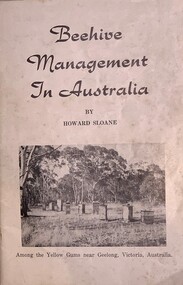
Publication, Beehive Management In Australia (Howard Sloane), 1975
... Soft Cover book, A5 size, white with black & white picture of hives among the Yellow Gums near Geelong, Victoria, Australia...Soft Cover book, A5 size, white with black & white picture of hives among the Yellow Gums near Geelong, Victoria, Australia Beehive Management In Australia (Howard Sloane) Publication ...Soft Cover book, A5 size, white with black & white picture of hives among the Yellow Gums near Geelong, Victoria, Australia -
Emerald Museum & Nobelius Heritage Park
Map - Historical Map
... ...Geelong Victoria Australia...Map shows Geelong Harbour and Port Harwood and Batman's Track. maps Australian history John Batman 1801-1839 Geelong Victoria Australia Melbourne Victoria Australia Specially reproduced for Bonwick's Port Phillip Settlement Batman's Map of Port Phillip, June 1835 [Reproduction] - Photocopy of part of map only.Paper on cardboard. ...Map shows Geelong Harbour and Port Harwood and Batman's Track.Batman's Map of Port Phillip, June 1835 [Reproduction] - Photocopy of part of map only.Paper on cardboard.Specially reproduced for Bonwick's Port Phillip Settlementmaps, australian history, john batman 1801-1839, geelong victoria australia, melbourne victoria australia -
 Robin Boyd Foundation
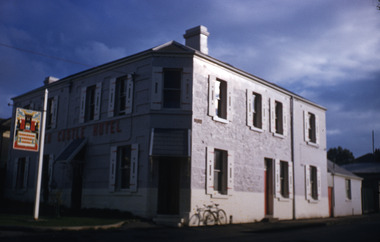
Slide, Robin Boyd
... Culloden Castle Hotel, 226 Latrobe Terrace, Geelong West, Victoria, Australia...Victoria slide File No / Title Colour slide in a mount. Culloden Castle Hotel, 226 Latrobe Terrace, Geelong West, Victoria, Australia Slide Robin Boyd ...Colour slide in a mount. Culloden Castle Hotel, 226 Latrobe Terrace, Geelong West, Victoria, AustraliaFile No / Titlevictoria, slide -
 Flagstaff Hill Maritime Museum and Village
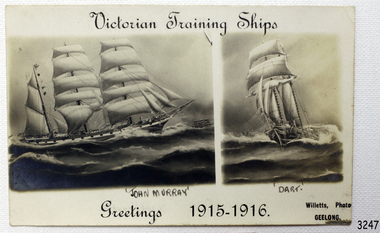
Postcard - Ships, Willets Photo, Victorian Training Ships, 1915
... Geelong, Victoria, Australia ...The photographic postcard was made in 1915-1916 by Willets Photography in Geelong. It is one of a series called 'Victorian Training Ships and it featured the sailing ships John Murry and the Dart'. The John Murry was commissioned by the Victorian Government for the training of juvenile offenders from 1910-1918 and anchored just off Williamstown, Victoria. The ship was previously named Loch Ryan. The Dart was named such in 1882, and in 1904 the New South Wales Government purchased her for use as a training ship. ln 1912 the Victorian Government bought her for use as a tender, to support the John Murry training ship until she was again sold in 1919 to the owner of a shipping and trading agency. The postcard is significant for its association with sailing ships and with training ships. It is also significant for its representation of two training ships used for rehabilitation. This form of treatment became controversial so the project didn't last for many years. None-the-less, it is part of our Victorian history.Black and white postcard picturing two sailing ships plus printed and handwritten text. The ships are the John Murry and the Dart. The postcard is in the series 'Victorian Training Ships'. Made by Willets of Geelong. Printed on front "Victorian Training Ships", "Greetings 1915-1916" and "Willets PHOTO / GEELONG" Written in ink below ships "John Murry" & "Dart". flagstaff hill, warrnambool, willets photo geelong, greeting card, 1915-1916, postcard, victorian training ships, sailing ships, john murry, dart, maritime museum, maritime village, maritine photograph, training ships, juvenile reformation, loch ryan, willis photography, geelong photographer, williamstown -
 Federation University Historical Collection
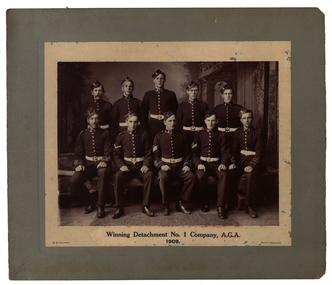
Photograph - black and white, G.C. Wilmot, Winning Detachment No. 1 Company, Geelong Australian Garrison Artillery, 1909, 1909
... Geelong, Victoria, Australia ...They have cannons on their epilets so they are artillery.Mounted black and white photo of 10 men in uniform. They are members of the Geelong Australian Garrison Artillery. Verso: Geelong, May 25th 1909 Capt. Spud Sir Please accept this photo from men who regard it an honour to serve under you. I remain Yours obediently Sergt J.C. Miles armed forces, a.g.a., volunteer forces, military, g.c. wilmot, miles, j.c. miles, captain spud, artillery, geelong australian garrison artillery, australian garrison artillery -
 Federation University Historical Collection
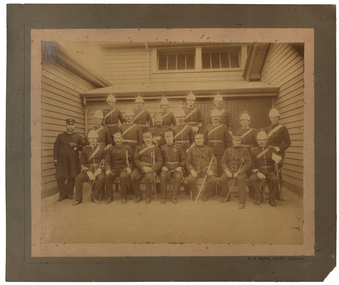
Photograph - Black and White, W.H. Watts, Volunteer Military Force, Fort Queenscliff, c1909
... Geelong, Victoria, Australia ...Mounted photograph of 20 men in uniform posing in front of a weatherboard building (probably at Fort Queenscliff)volunteer forces, military, armed forces, geelong, w.h. watts, fort queenscliff -
 Federation University Historical Collection
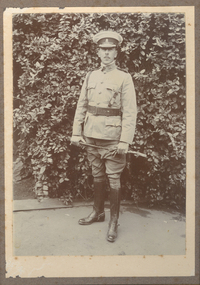
Photograph - Photograph - Black and White, Member of the Geelong Volunteer Rifle Corps, c1910
... Geelong, Victoria, Australia ...Uniformed male - a member of the Geelong Volunteer Rifle Corpsgeelong volunteer rifle corps, volunteer rifle corps, rifle corps, geelong, armed forces, military, volunteer rifles -
 Flagstaff Hill Maritime Museum and Village
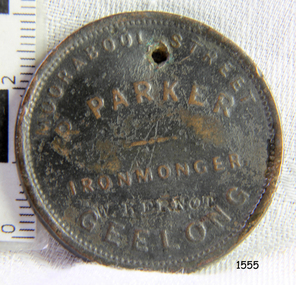
Medal - Token, Richard Parker, ironmonger, Mid-to-late 19th century
... Moorabool Street, Geelong, Victoria, Australia...Victoria. He had a general store in Elizabeth Street, then Collins Street, Melbourne for five years before moving to Geelong in 1844. He soon established several branches of his ironmonger business in towns around Victoria. He encouraged trade by providing customers with the small change of penny tokens in exchange for their more valuable and less convenient silver coins. The token carried a surcharge and was overstamped with the mane of W. Kernot. William Charles Kernot was a chemist at Chillwell, Geelong. The token is of historical significance, representing a form of currency used in Australia's ...This copper penny token was issued in Geelong by ironmonger R. Parker. Richard Parker was an early settler in Victoria. He had a general store in Elizabeth Street, then Collins Street, Melbourne for five years before moving to Geelong in 1844. He soon established several branches of his ironmonger business in towns around Victoria. He encouraged trade by providing customers with the small change of penny tokens in exchange for their more valuable and less convenient silver coins. The token carried a surcharge and was overstamped with the mane of W. Kernot. William Charles Kernot was a chemist at Chillwell, Geelong. The token is of historical significance, representing a form of currency used in Australia's colonial era before Australia had official currency.Token coin; a round copper one penny token. Obverse had promotional text and a sketch and was overstamped with a name. Reverse had the image of a woman holding up a set of balance scales in one hand and a cornucopia in the other, standing beside the sea, with a three-masted sailing ship in the background, There is a formed hole in the metal; on the obverse, it is on the top of the design, on the reverse it is on the bottom of the design. It advertises R. Parker, Ironmonger, Moorabool Street, Geelong, overstamped with the name W. Kernot.Embossed on the obverse: "R. PARKER / IRONMONGER. / MOORABOOL STREET / GEELONG" "W. KERNOT" Embossed on reverse: "AUSTRALIA"warrnambool, shipwreck coast, flagstaff hill, flagstaff hill maritime museum, flagstaff hill maritime village, medallion, coin, token, promotional medallion, one penny, r parker, ironmonger, moorabool street geelong, w. kernot, richard parker, currency, australian currency -
 Flagstaff Hill Maritime Museum and Village
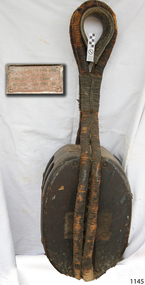
Equipment - Block (sailing), Burrows, Ship Candler, c. 1869
... Corio Bay, Geelong, Victoria, Australia ...The Lightning was an American-built sailing ship and it is believed the rope block was part of the ship’s rigging or included as cargo. The plaque on the block mentions that the item was, “as supplied by Burrows Ship Chandlers” in 1869. The plaque could also mean that the rope block was supplied by the firm Burrows, Ship Chandler and Shipping Stock, as a replacement block for the Lightning. The American vessel named “Lightning” was a 3-masted, fully rigged extreme clipper ship. She was commissioned by James Baines, of the Black Ball Line in Liverpool, England, during the time of the Australian Gold Rush for the trade of passengers and cargo between England and Australia. Her load listed on early consignments included livestock and animals, including rabbits sent to Thomas Austin of Barwon Park, Winchelsea, Victoria, where the challenging association between Australia's agriculture and the imported rabbits started. The Lightning was built in 1854 by shipbuilder Donald McKay, in East Boston, USA. She was described as spacious and comfortable and regarded as one of the smartest ships of the time. The vessel set many speed records for her voyages and became one of the most famous of racing clippers and one of the fastest ever launched. In 1854, with Captain 'Bully' Forbes and Mate 'Bully' Bragg, Lightning made the return trip from Melbourne to Liverpool in only 64 days, 3 hours and 10 minutes; a record. Captain Enright became the new Master of LIGHTNING soon after this record was established and was regarded as one of the finest mariners in the Australian trade. One of Captain Enright's innovations was to publish a ship's paper called "The Lightning Gazette". What is of additional historic interest is that captain "Bully Forbes" had left the Lightning to captain the ill-fated Schomberg. In 1857, for a very brief time under Capt. Byrne the Lightning was used as a troopship, taking British officers and soldiers, stores and ammunition, to fight in India. In 1859 she then returned to her normal route between Liverpool and Melbourne, apart from 1867 when she made a special trip between Melbourne and Port Chalmers in New Zealand. In 1869 the Lightning was sold to Thomas Harrison of Liverpool, and continued to sail for the Black Ball Line. Master of Lightning, Captain Henry Jones, sailed her to Geelong in October 1869, and whilst docked, he had her loaded with a cargo of wool, copper, wire, tallow and other goods. At about 1 am on 31st October 1869, whilst still docked and fully laden, a fire was noticed on the vessel. Efforts to extinguish the fire were unsuccessful, so she was towed to the "Lightning Shoals" in Corio Bay, where she eventually sank, losing all cargo but no lives. The Lightning is listed on the Victorian Heritage Register (Ref S 415). The vessel is historically significant for being one of the fastest wooden ships ever built. it was notable as the first clipper built in the USA for British owners and as a shipping disaster in Geelong's history. The Lightning spent its whole career carrying cargo and immigrants from England to Australia. Its documented voyages give us a snapshot into shipping history, not only of Australia in the mid-19th century but how the world's commercial transport functioned o promote trade and emigration during this time.Large ship's block, wood, with two wooden sheaves and fibre straps, eye and thimble. The metal plaque attached to the block has an inscription. The block was used on the ship "Lightning".Plaque inscription: "BLOCK OFF THE LIGHTNING / AS SUPPLIED BY / BURROWS SHIPS CHANDLERS / & SHIPPING STOCK CORIO BAY / 1863" (or 1869)flagstaff hill, warrnambool, shipwrecked coast, flagstaff hill maritime museum, maritime museum, shipwreck coast, flagstaff hill maritime village, great ocean road, sailing ship lightning, extreme clipper ship, american clipper ship, record breaking clipper ship, james baines, black ball line, donald mckay shipbuilder, captain ‘bully’ forbes, australian immigration, liverpool to melbourne migration, captain enright, captain byrne, captain henry jones, corio bay geelong, lightning shoals geelong, rabbits introduced to australia, burrows and bascombe, burrows, ship chandler, corio bay, burrow's ship chandlers and shipping stock, -
 Mission to Seafarers Victoria
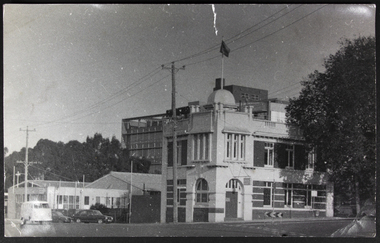
Photograph - Photograph, Black and white, circa 1960s
... Western Beach Road, Geelong, Victoria, Australia ...The Geelong Rest located at 3 Moorabool Street was created in 1895. The building depicted in the photograph ( taken from the Western Beach Road) is known as the King Edward VII Sailors' Rest building; it was designed by architect Percy Everett and replaced the older building in 1912. In 1901, it became the Geelong branch of the Mission to Seamen. The building is still standing on the waterfront in Geelong and has a commercial use.Medium b & w photograph depicting the front facade of the Sailors' Rest in Geelong.geelong, sailors' rest, seafarer, king edward vii sailors' rest building, 1912, percy everett, kombi -
 The Beechworth Burke Museum
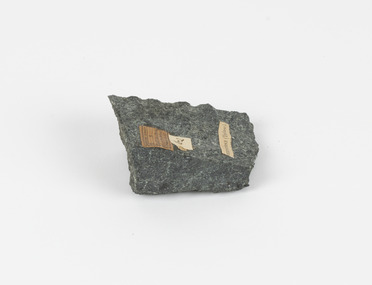
Geological specimen - Greenstone / Gabbro, Unknown
... Ceres , West of Geelong, Victoria, Australia...Victoria. Collecting geological specimens was an important part of mapping and understanding the scientific makeup of the earth. Many of these specimens were sent to research and collecting organisations across Australia, including the Burke Museum, to educate and encourage further study. Greenstone metamorphosed igneous rock Gabbro chlorite actinolite epidote metamorphsis rock cycle various types of rocks sedimentary high heat high pressure mineral-rich fluid metamorphosis foliated metamorphic non-foliated metamorphic convergent plate boundary greenish colour minerals Greenstone/Gabbro/from Ceres west/of Geelong. ...This specimen was recovered from Ceres West of Geelong, Victoria. Greenstone is the name for any metamorphosed basic igneous rock (in the case of this specimen, Gabbro) that gains its greenish colour to the presence of the minerals chlorite, actinolite, or epidote, hence the term 'green' and 'stone'. Greenstone is often formed through metamorphsis along a convergent plate boundary. In the rock cycle (the series of processes that creates the various types of rocks) there are identified three different types of rocks, which are the sedimentary, the igneous and the metamorphic. Metamorphic rocks started out as sedimentary, igneous or earlier metamorphic rocks but changed from their original condition under the effect of high heat, high pressure or hot, mineral-rich fluid. However, if pressure or heat is too high, then the rock will melt, resulting in the formation of an igneous rock. The name used to describe these types of rocks reflects this specific inherent trait of change, since the word “metamorphic” derives from the Greek word “metamorphosis”, meaning “change of form or structure”. Metamorphic rocks form in the Earth`s crust but can be also found on the surface, due to elevation of the Earth`s surface. They are divided into two categories: the foliated metamorphic and the non-foliated metamorphic rocks. Gabbro is a highly useful mineral that is often polished to create cemetery markers and kitchen benches. It is notable for its qualities of durability, being able to withstand extreme elements and wear. Whilst not rare, Gabbro is of great utility and has been highly desirable for its qualities. This specimen is part of a larger collection of geological and mineral specimens collected from around Australia (and some parts of the world) and donated to the Burke Museum between 1868-1880. A large percentage of these specimens were collected in Victoria as part of the Geological Survey of Victoria that begun in 1852 (in response to the Gold Rush) to study and map the geology of Victoria. Collecting geological specimens was an important part of mapping and understanding the scientific makeup of the earth. Many of these specimens were sent to research and collecting organisations across Australia, including the Burke Museum, to educate and encourage further study.Greenstone is a solid hand-sized metamorphic mineral of a green colour. Greenstone is the name for any metamorphosed basic igneous rock (in the case of this specimen, Gabbro) that gains its greenish colour to the presence of the minerals chlorite, actinolite, or epidote, hence the term 'green' and 'stone'. Gabbro is a medium to coarse grained rocks that consist primarily of plagioclase feldspar and pyroxene. Greenstone is often formed through metamorphsis along a convergent plate boundary. Gabbro forms due to cooling and crystallization of magma underneath Earth's surface. Greenstone/Gabbro/from Ceres west/of Geelong. Has old Geological Survey label/and probably collected by/Richard Daintree in 1861/C.Willam 15/4/21/ Other label: 62 /greenstone, metamorphosed, igneous rock, gabbro, chlorite, actinolite, epidote, metamorphsis, rock cycle, various types of rocks, sedimentary, high heat, high pressure, mineral-rich fluid, metamorphosis, foliated metamorphic, non-foliated metamorphic, convergent plate boundary, greenish colour, minerals -
 Marysville & District Historical Society
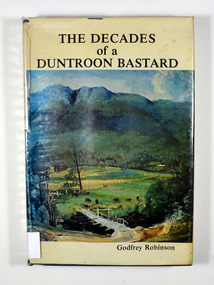
Book, The Decades of a Duntroon Bastard, 1980
... 41 Shackleton Street, Belmont, Geelong, Victoria, Australia ...A biography of Godfrey Robinson of his time serving in the Australian, British and Indian Armies; of his time in the British Raj, the Burma war and colonial Africa and of his time as a farmer in Taggery, VictoriaHardback. Front cover is of a painting of a farm at the base of the Cathedral Range in Victoria. Back cover has a black and white photograph of the author and a blurb on the book.This is copy No. 118/142 of the prepublication issue. Signature of the author Stamp of the Marysville & District / Historical Society Inc / P.O. Box 22 / Marysville 3779duntroon, australian army, british army, indian army, british raj, burma war, colonial africa, taggerty -
 Federation University Historical Collection
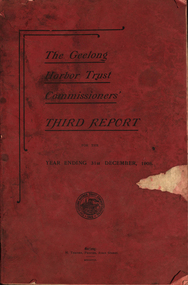
Book - Annual Report, H Thacker, The Geelong Harbor Trust Commissioners' Third Report for the year ending 31st December 1908, 1909
... Ryrie Street, Geelong, Victoria, Australia ...In 1908 the Geelong Harbor Trust commissioners were George Frederick Holden, Edward Harewood Lascelles and James Hill. The officers were Walter S. Crowle (Secretary), A.C. McKenzie (Engineer), Captain G.A. Molland (Harbor Master), E.R. Hitch, (Assistant Harbor Master, Portarlington.)Red soft covered foolscap report of 101 pages. Includes two photographic reproductions of teh New Cargo Shed on Yarra Pier, and Twin S.S. "G.F. Holden" (formerly the 'Pelican' (built in 1898 by Fleming & Ferguson, Paisley, England, for the Western Australian Government).Seal of the Geelong Harbour Trust Commissionersgeelong, harbour trust, commissioners, report, finance, properties, dredging, portarlington, barwon heads, ocean grove, shipping, engineer's report, assets, liabilities, harbor trust, geelong harbor trust, grain shipping berthage, corio quay, cool stores, dock accomodation, floating plant, hopetoun channel, moorabool pier shed, sparrovale irrigation farm, thomas gibson-carmichael, yarra pier cargo -
 Federation University Historical Collection
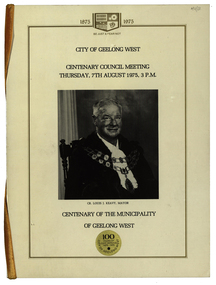
Booklet, City of Geelong West: Centenary Council Meeting and Dinner, 1975
... Geelong, Victoria, Australia ...The Geelong West Coat of Arms is divided into four sections representing Transport, Industry, Shipping and Agriculture. For Transport (top left) a steam train typified the Geelong-Melbourne railway. Top right showed a factory, bottom left was a sailing clipper and bottom right had bales of wool. The modern adaptation of the official Coat of Arms is used in the booklet.1 Booklet pages are edged with gold with banner at top. Yellow ribbon at spine. Photographs of councillors and Governor of Victoria .2 Thick paper with red writinggeelong west, coat of arms, transport, industry, agriculture, louis keavy, mayor, centenary, governor of victoria, sir henry winneke, government gazette -
 Federation University Historical Collection
Book, G Mercer & Co. Pty Ltd, The Guthrie Corriedale Stud: Brief history and Performances
... The Guthrie Stud has its headquarters at "Coolangatta" Homestead, six miles from Geelong, Victoria. The first sheep were brought to Australia c1882. This book is a celebration of just on 70 years of breeding the corriedale by the Guthrie family....Geelong, Victoria, Australia...The Guthrie Stud has its headquarters at "Coolangatta" Homestead, six miles from Geelong, Victoria. The first sheep were brought to Australia c1882. This book is a celebration of just on 70 years of breeding the corriedale by the Guthrie family. guthrie corriedale sheep stud coolangatta homestead breeding fleece Blue paper cover. ...Corriedale sheep have been an established breed for many years. The Guthrie Stud has its headquarters at "Coolangatta" Homestead, six miles from Geelong, Victoria. The first sheep were brought to Australia c1882. This book is a celebration of just on 70 years of breeding the corriedale by the Guthrie family.Blue paper cover. Seventy-two pages stapled togetherguthrie, corriedale, sheep, stud, coolangatta homestead, breeding, fleece -
Federation University Historical Collection
Booklet - Booklet - Prospectus, Henwood & Dandey, The Geelong Junior Technical College, Gordon Technical School, Prospectus , 1913, 1913
... Geelong, Victoria, Australia ...Used in Ballarat School of Mines. "The Junior Technical School is provided for the purpose of supplying the universally recognised requirement for a satisfactory Technical Education system, namely, continuity of study between the primary stage of education and the subsequent period of study at a Technical School." The Geelong Gordon Technical College obtained information from Melbourne Junior Technical School that was in its second year of operations. Due to limited space at the College, provision will be for only 50 students. Staff will comprise a Head Master, who will teach English, Civics (History) and Geography. A Mathematical and Science Master who will also have the assistance of the Gordon College Science Master. The Art Master from the Gordon College will take Modelling, Geometry and Drawing. The Crafts Master will take Sheet Metal and Woodwork. The person will be chosen from recently trained teachers by the Education Department.Brown cover with red, green and blue print A.W. Steane written on the front cover.geelong, junior technical college, gordon technical college, prospectus, a.a billson, f. tate, donald clark, a. rutter, andrew anderson, p. mccormack, melbourne junior technical school, 50 students, head master, english, civics, geography, mathematics, science, art master, modelling, geometry, drawing, crafts master, sheetmetal, woodwork -
 Lara RSL Sub Branch
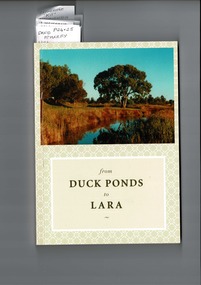
from Duck Ponds to Lara, Booklet from Duck Ponds to Lara, 2004
... Lara Geelong, Victoria., Australia ...Lara - Duck Ponds history and input by local population. Insight into the History of a small community.Local knowledge of Lara's History, some items are not well known, Excellant referamce.Soft back booklet a collection of of memories "From Duck Ponds to Lara." Published by the Lara Heritage Festival Inc 2004. Edited by Mary Budd, Caroline Delaney, and John Grainger. Contributions of short stories to the project have come from local residents. Booklet also came with a fold-up heritage map of Lara printed on both sides. The booklet is tagged for the names of contributors who are members of Lara R. S. L. Front of the Booklet is half covered by a photograph of Lara Creek and environes. Booklet also came with a fold-up heritage map of Lara printed on both sides.duck ponds, lara -
 Lara RSL Sub Branch
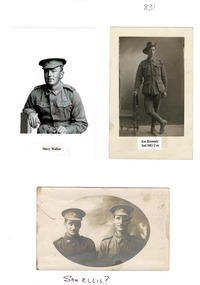
Photographs
... Geelong, Victoria., AUSTRALIA. ...3 photos mounted on A4 paperHarry Walker Joe Bromley 2nd MG Coy Sam Ellisphotographs, world war one, army, lara r.s.l. infantry, ww1. -
 Lara RSL Sub Branch
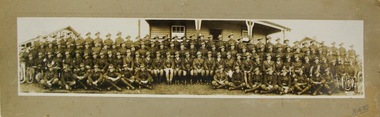
Photograph Elcho Farm, 1934
... Lara Geelong, Geelong, Victoria , Australia ...The 8th Battalion was an infantry battalion of the Australian Army. Initially raised in 1914 for the First Australian Imperial Force during the First World War the battalion was completely recruited from Victoria and formed part of the 2nd Brigade, 1st Division. During the war it fought at Gallipoli and in France and Belgium on the Western Front. It was disbanded in 1919, before being re-raised as a Militia battalion in 1921.Rectangular Black and White Photograph mounted on Grey CardboardFront H. WaL? George Crawford Elcho Farm Lara 1936-1937elcho farm lara 1936 1937 photo george crawford -
 Lara RSL Sub Branch
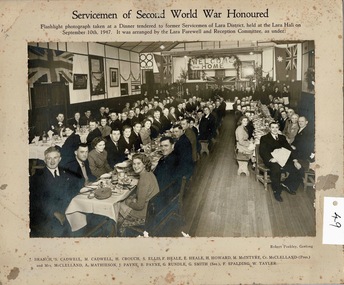
Photograph, Dinner for 2nd World War veterans - Lara District - September 10th 1947, SEPTEMBER 1947
... Geelong, Victoria , Australia. ...49.1 Names & images of 18 Returned Servicemen from W W 2. of the Lara District 49.2 Names & images of 18 Returned Servicemen from W W 2. of the Lara District presented to J & J McIntyre and Miss F McIntyre with compliments of the Lara Reception CommitteeLocal to Lara district , a visual record of persons in their home environment again . Also second photo 49.2 under glass 49.1 Oblong/Landscape....Black&White photograph on aged white cardboard....WELCOME HOME banner....Australian & British Flags prominent. 49.2 Photo mounted behind glass presented to the McIntyre FamilyFlashlight photograph September 10 1947. second world war servicemen lara mcintyre 1947 rsl j branch mcclelland -
 Lara RSL Sub Branch
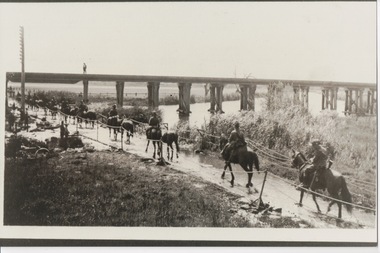
Photograph, Set 4 photographs. and others for Torquay Light Horse camp, 1940
... References: Australian Light Horse Association www.lighthorse.org.au National Australia Archives Australian War Memorial Surf Coast Shire WW1 memorials www.togethertheyserved.com The Light horse- a Cavalry under Canvas Light Horse, Training Camp, Torquay, WW2 Late in 1939 it was decided to set up a Lighthorse training camp in Torquay to train both men and horses for the battles of the Second World War. Horses, men and equipment came on special trains from all over Victoria and NSW, and as you would expect horseman came from areas such as Omeo and Sale, the Wimmera and the Western District. They arrived at the Geelong...Geelong, Victoria, Australia....References: Australian Light Horse Association www.lighthorse.org.au National Australia Archives Australian War Memorial Surf Coast Shire WW1 memorials www.togethertheyserved.com The Light horse- a Cavalry under Canvas Light Horse, Training Camp, Torquay, WW2 Late in 1939 it was decided to set up a Lighthorse training camp in Torquay to train both men and horses for the battles of the Second World War. Horses, men and equipment came on special trains from all over Victoria and NSW, and as you would expect horseman came from areas such as Omeo and Sale, the Wimmera and the Western District. They arrived at the Geelong ...These images capture for all time Light Horsemen travelling through Geelong on their way to camp at Torquay for the last Group meeting in Australia . information following - details obtained from .........https://torquayhistory.com/light-horse-brigade/ On Australia Day, 1997, Sir John Young unveiled this plaque on Point Danger, Torquay. Torquay history, Light Horse Training Camp, WW2 Plaque at Pt. Danger Note----- (See images to view plaque) The plaque identifies a significant event in Torquay’s history and the sentiments of ‘change’ for the Light Horse Brigade – from horses to machines. In 1940 the four Light Horse Regiments (4th, 8th, 13th and 20th), some 5000 Light Horse and 2000 horses camped and trained at Torquay. Three other regiments, formerly mounted on horses, were also at Torquay ‘mounted’ on privately owned trucks and cars. Division troops included Artillery, Engineers, Signals, Field Ambulance and other branches of the Army necessary to enable a Division to function. It wasn’t just the sheer numbers of men coming to this little town that made the event significant, it was also the fact that the men of the Light Horse were dramatic, almost glamorous figures and it is easy to see their exploits as some splendid adventure. Horses have played a special role in the story of Australia. They were the only means of transport across this huge country, so it was necessary for everyone to have the ability to ride a horse. When war broke out in 1899 between Britain and the Boers of South Africa (“Boer” was Dutch for “farmer”) Australia sent troops to fight. At first Britain was wary of using untried, unprofessional colonial cavalrymen but soon saw that the slouch-hatted Australian “bushmen” were a match for the fast-moving and unconventional mounted commandos of the Boers. The Australians proved themselves to be expert rough-riding horsemen and good shots. Bush life had hardened them to go for long periods with little food and water. They also showed remarkable ability to find their way in a strange country and use its features for cover, in both attack and defence. By 1914, when Australia joined the war against Germany, there were 23 Light Horse regiments of militia volunteers. Many men from these units joined the Light Horse regiments of the Australian Imperial Force (AIF). Men were given remounts (if not using their own horses) – army horses bought by Commonwealth purchasing officers from graziers and breeders. These were called “walers” because they were a New South Wales stockhorse type – strong, great-hearted animals with the strains of the thoroughbred and semi-draught to give them speed, strength and stamina. On 1st November, 1914, Australia’s First Infantry Division and the first four Light Horse regiments sailed for England in a fleet of transport ships. The first of the Light Horse arrived at Gallipoli in May without their horses. Back with their horses after Gallipoli, they were formidable combatants across the Sinai and Palestine. Some British commanders observed that the light horseman moved with a “lazy, slouching gait, like that of a sleepy tiger” but described how the promise of battle “changes that careless gait, into a live athletic swing that takes him over the ground much quicker than other troops”. They had Light Horse, Torquay, training campdeveloped a reputation as formidable infantrymen. The Turks called them “the White Ghurkas” – a reference to their deadly skill with the bayonet. The Arabs called them “The Kings of the Feathers”. The plume had originally been a battle honour of the Queensland Mounted Infantry for their work in the shearer’s strike of 1891. During WW1 it was adopted by almost all the Light Horse Regiments. It was the proud badge of the light horseman. The most famous of their battles was the attack on Beersheba- the charge of the 4th Light Horse Brigade. Mounted infantrymen and their superb walers had carried out one of the most successful cavalry charges in history – against what seemed impossible odds. They surprised the Turks by charging cavalry-style, when they would normally have ridden close to an objective then dismounted to fight. The fall of Beersheba swung the battle tide against the Turks in Palestine; and changed the history of the Middle East. While 19 men from the Surf Coast Shire served with the 4th Light Horse over the course of WW1, only four were involved in the charge of Beersheba- John GAYLARD, Philip QUINN.(Winchelsea); Wallace FINDLAY (Anglesea); Harry TRIGG (Bambra). After the war, Light Horse units played a key role in the Australian Government’s compulsory military training programme. The Citizen Military Forces (C.M.F.) thrived on the glamour of the wartime Light Horse tradition, ignoring the possibility that motor vehicles would soon replace the horses. When training was no longer compulsory, the C.M.F. regiments declined and horses became more of a luxury during the 1930s depression years of poverty and unemployment. Some regiments were motorised. Then, in 1939, Australia joined Britain in another world war. Training was increased for the militia at both home bases and regional training camps. The camp at Torquay in 1940, commanded by Major General Rankin, was at Divisional strength. By the end of the camp some felt that the Division was ready for active service. Gradually, over the next four years, the Australian Light Horse units were mounted on wheels and tracks and the horses were retired. Six men enlisted at the Torquay camp and another 57 men and women enlisted at Torquay for service in WW2. Those who served in the Militia provided valuable Officers and NCOs and men for the armed services during the war. Each infantry division of the 2nd AIF had a Light Horse regiment attached to it. But the day of the Australian mounted soldier hadn’t quite passed. During World War II, Australia’s 6th Cavalry Regiment formed a mounted unit they called “The Kelly Gang” which did valuable scouting work. In New Guinea, a mounted Light Horse Troop did patrol duty and helped carry supplies. Some fully equipped walers were flown into Borneo for reconnaissance in rugged mountain country. But by the end of the war, in 1945, the horse had disappeared from the Australian Army. References: Australian Light Horse Association www.lighthorse.org.au National Australia Archives Australian War Memorial Surf Coast Shire WW1 memorials www.togethertheyserved.com The Light horse- a Cavalry under Canvas Light Horse, Training Camp, Torquay, WW2 Late in 1939 it was decided to set up a Lighthorse training camp in Torquay to train both men and horses for the battles of the Second World War. Horses, men and equipment came on special trains from all over Victoria and NSW, and as you would expect horseman came from areas such as Omeo and Sale, the Wimmera and the Western District. They arrived at the Geelong racecourse for watering in the Barwon River and then were ridden across the ford at the breakwater and began their 11 mile trek to Torquay. Light Horse, Training Camp, Torquay, WW2 Tent city By the end of January 1940 the camp at Torquay accommodated some 5000 men and 2500 horses of the Second Cavalry Division. The rows of horses, tents and huts near Blackgate Road were quite a sight. While the cavalrymen engaged in exercises on the land and on the beaches, many of the troops took over the Torquay School for special training of men and officers. Mr Bob Pettit local farmer and Councillor for the Barrabool Shire, wrote about the Light horse in the Surf Coast Community News in 1985 saying “They used to travel about the district riding four abreast in one long convoy. To my annoyance they went through my property and shut all the gates behind them. I had certain gates open to let stock in to the water holes and it would take me three -quarters of an hour to follow the horsemen up and put all the gates right again” he continued “the men from the Light Horse were here when the fire went through in March 1940. He recalled an incident when early one morning, as some one blew the bugle, a soldier putting a white sheet on the line frightened the horses. They panicked and ran off in all directions. Six went over the cliff near Bird Rock, five were never found, and the rest were gathered up after nearly a fortnight in the bush around Addiscott and Anglesea" Light Horse, Training Camp, Torquay, WW2, Geelong Parade Geelong parade The training camp culminated in a parade through the streets of Geelong on March 12th 1940. The salute was given at the Town Hall and the troops continued on a route to the You Yang’s for a training exercise. Note-----(see media section for photograph) The Camp was abandoned in mid 1940 as it was deemed unsuitable for training during winter and the cost of a permanent camp could not be justified if it could not be used all year. Historic.......Rare,,,Interpretive.Sepia photographs.set of four ....post card size ....Horses &LighthorsemenNo 1, Lighthorsemen Regiment Geelong 1940......No 2 Light Horse at Breakwater Geelong 1938 to 1940....No 3 Light Horse at Breakwater Geelong 1938 to 1940.....No 4 Light Horse crossing Breakwater camped at Geelong Showgrounds. These markings are on reverse of photographs.light horsemengeelong 1940., world war 2 -
 Lara RSL Sub Branch
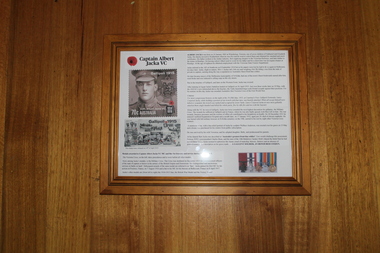
Captain Albert Jacka VC Biography, 2017
... No1 Investigator Avenue, Costa House Lara, Geelong, Victoria., Australia ...Tells the story of one Australias finest soldiers and what they had to endure during the war.Glass covered picture frame showing Albert Jacka with a short run down on his life.Picture of Albert Jacka with his medals and biography of his life.albert jacka, world war one, lara r.s.l., vc winners, ww1 -
 Lara RSL Sub Branch
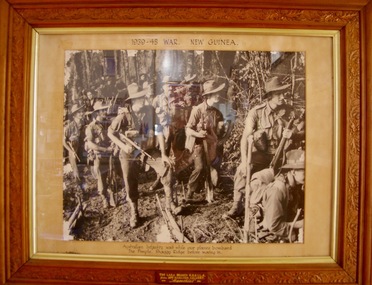
Photograph, Australian infantry in New Guinea 1939/45 war
... 37 Malop Street, Geelong, Victoria., Australia ...The Battle of the Shaggy Ridge was part of the Markham and Ramu Valley – Finisterre Range campaign, consisting of a number of actions fought by Australian and Japanese troops in Papua New Guinea in World War II. Following the Allied capture of Lae and Nadzab, the Australian 9th Division had been committed to a quick follow up action on the Huon Peninsula in an effort to cut off the withdrawing Japanese. Once the situation on the Huon Peninsula stabilised in late 1943, the 7th Division had pushed into the Markham and Ramu Valleys towards the Finisterre Range with a view to pushing north towards the coast around Bogadjim, where they would meet up with Allied forces advancing around the coast from the Huon Peninsula, before advancing towards Madang.In late December 1943, the Australian offensive to take Shaggy Ridge began, focused on an attack on The Pimple.[13] The Pimple was one of three rocky outcrops, held by the Japanese on the ridge line.Framed Photograph of Australian infantry waiting while our planes" bombard the Pimple,"Shaggy Ridge before moving in. Australian infantry waiting while our planes" bombard the Pimple,"Shaggy Ridge before moving in. THE LARA BRANCH R.S.S.I.L.A. FROM MRS HAMILTON CALVERT =MEMORIES=ww2, papua new guinea, world war 2, lara r.s.l., photographs, australian infantry, shaggy ridge -
 Federation University Historical Collection
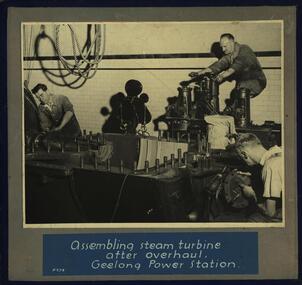
Photograph - Photograph - Black and White, Assembling Steam Turbine After Overhaul, Geelong Power Station
... Geelong, Victoria, Australia ...geelong power station, steam turbine, engineers, electricity -
 Flagstaff Hill Maritime Museum and Village
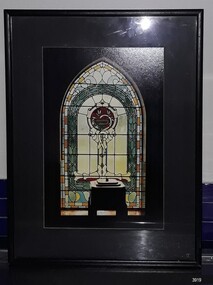
Card - Commemorative, Julian Aird, 'Illumination', Early 21st Century
... 162 Malop Street, Geelong, Victoria, Australia...Geelong. Details of title, and photographer are handwritten on the back and and printed label gives the contact details of the framer. 'Illumination' Card Commemorative Australia Victoria ...The photograph was created by Geelong artist Julian Aird and framed by a business in Geelong. The window in the photograph is of the 1928 stained glass window and the baptism fold in the St Nicholas' Seamen's Chapel at Flagstaff Hill Maritime Village, which were installed at Flagstaff Hill's for the Chapel's opening in 1981. About the Window - The window in this photograph, once known as the Dr Connell Memorial Window, was a feature of an external wall adjacent to the Women’s and Children’s Wards of Warrnambool Hospital. Honorary Doctors had played a significant role in the operation of the hospital between the years 1900 to 1939. One of these doctors was Dr. Connell, who passed away in 1928. The green glass memorial nameplate has an inscription that dedicates the window to Dr. Connell. The inscription reads: "A tribute to Egbert John Connell M.B.B.S. who for 30 years rendered devoted and valuable service to this institution. Obiit April 4th 1928, A.D." The photograph's significance lies in the subject of the stained glass window, and its connection with the history of the local Warrnambool Base Hospital, dating to Dr Connell's work there in the early 20th century.This photograph captures the light shining through an arched, stained glass window behind a baptismal font. Rectangular framed photograph, portrait view, behind glass, with black frame and matt. A cord for hanging it is attached at the black, and there is a black, round felt pad on each lower rear corner. The photograph by Julian Aird is titled 'Illumination' and was framed in Geelong. Details of title, and photographer are handwritten on the back and and printed label gives the contact details of the framer. Written by hand in black pen " 'ILLUMINATION' / MARITIME MUSEUM WARRNAMBOOL", "JULIAN AIRD / TEL/FAX. 03 52890457" " Printed on adhesive label "EASTERN VIEW / PICTURE FRAMERS" "Proprietors Steven & Annemarie Hocking / 162 Malop Street, Geelong, Vic, 3220 / Ph. (03) 5229 5935" Logo on label in centre of oval with text [2 tall water birds facing each other with a water fountain between them]flagstaff hill maritime museum & village, maritime museum, maritime village, great ocean road, shipwreck coast, ulian aird, illumination, photograph, dr. connell, stained glass window, baptism font, gbert john connell, st nicholas seamen's church, warrnambool hospital, dr connell memorial window, eastern view picture framers, steven & annemarie hocking -
 City of Moorabbin Historical Society (Operating the Box Cottage Museum)
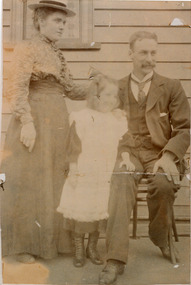
Photograph, Black & White, Adelaide Bleazby, Frank Box, Daisy c1900, c1900
... Geelong, Victoria, Australia ...Frank Box was descendant of the Box family who migrated from Sussex England c 1850 and established market gardens in the area of Henry Dendy's Special Survey 1841 Brighton', Parish of Moorabbin, County of Bourke. Frank married Adelaide Bleazby in 1873 and they are shown here with their daughter, Daisy , at Kilgour Street Geelong Victoria c1900The Box family were pioneer settlers in the Parish of Moorabbin, County of Bourke c 1850 in the area of Henry Dendy's 'Special Survey Brighton 1841'. They established market gardens and raised their children.Faded Black & White photograph of Adelaide Bleazby, Frank Box and daughter Daisy at Geelong c1900Back handwritten information unsignedbox george, box william, box elizabeth, box francis, box cottage museum ormond, city of moorabbin historical society, bleazby adelaide 1873, box frank smith j l; smith mary ann, stanley helen, smith vic, chaff cutter, horse drawn carts, toll gates brighton, motor cars 1900, steam engines, early settlers, bentleigh, mckinnon, parish of moorabbin, city of moorabbin, county of bourke, moorabbin roads board, shire of moorabbin, henry dendy's special survey 1841, were j.b.; bent thomas, o'shannassy john, king richard, charman stephen, highett william, ormond francis, maynard dennis, market gardeners, vineyards, orchards -
 Geelong RSL Sub Branch
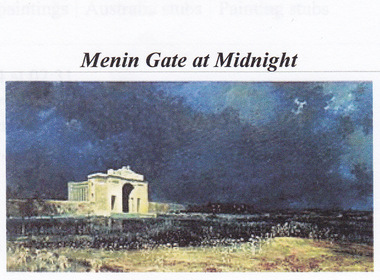
Print, Menin Gate at Midnight, 20th Century
... 129 Packington Street, Geelong, Victoria, Australia ...Minin Gate at Midnight is a painting by Australian artist Will Longstaff. Longstaff completed the painting in 1927 and the original is now located at the Australian War Memorial. The painting depicts ghostly soldiers marching across a field in front of the Menin Gate War Memorial.Longstaff painted the work after attending the unveiling of the Menin Gate Memorial, at Ypres, on 24 July 1927. The memorial commemorates the men of the British Empire, including Australia, who died during the 1st World War around the town of Ypres. A print of the Menin Gate at Midnight, oblong in shape, framed in a timber frame, a cardboard matte surrounds the print.Careys Picture Framing Gallery, Professional Framing, Shop 13 Packington Arcade, 129 Packington Street, Geelong West. A brass plaque is also attached to the Print.menin gate, longstaff, ww1, australian war memorial
