
Showing 58 items matching "georges australia limited."
-
![The Store on the Hill / [by] Keith Dunstan](/media/collectors/550653872162f11fb04854aa/items/5ece688df36c2704c4f2baf4/item-media/5ece691cf36c2704c4f2bbb0/item-fit-380x285.jpg?cb=6) Kew Historical Society Inc
Kew Historical Society IncBook, Macmillan, The Store on the Hill, 1979
... georges australia limited....History of Georges Department Store in Collins Street, Melbourne Reference copy relevant to the KHS fashion collection georges australia limited. department stores -- victoria -- melbourne -- history. ...Melbourne : Macmillan, 1979 200 p. : ill., facs., portrs. ; 29 cm. non-fictiongeorges australia limited., department stores -- victoria -- melbourne -- history. -
 Flagstaff Hill Maritime Museum and Village
Domestic object - Sewing Machine, Early 20th century
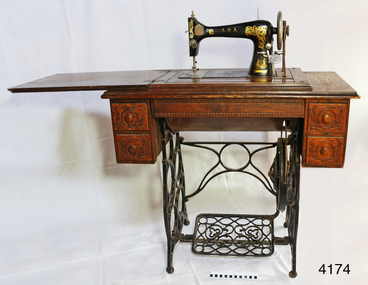
... Ward Brothers (George and Samuel) registered a company (Australian Sewing Machines Limited Pty Ltd) with the head office address in Errol St, North Melbourne, and Prahan. ...Ward Brothers (George and Samuel) registered a company (Australian Sewing Machines Limited Pty Ltd) with the head office address in Errol St, North Melbourne, and Prahan. ...Ward Brothers (George and Samuel) registered a company (Australian Sewing Machines Limited Pty Ltd) with the head office address in Errol St, North Melbourne, and Prahan. The earliest newspaper advertisement for this company was in 1897. Around this time the Ward Brothers first imported sewing machines from England and Wertheim placed their decal on them and mounted them in their own Australian made cabinets. David Ward later imported machines from Beisolt & Locke in Germany and registered name A.N.A. (All Native Australian), his shop was in Collingwood Melbourne. Some of these machines had Ward Brothers decals on them as well. The three brothers sold under the same name as Ward Brothers. The early Ward Brothers logo had a map of Australia with a picture of all three brothers on it. In 1911 all three of the Ward Brothers decided to share a stall in the yearly Melbourne exhibition. The A.N.A was the machine that got rave reviews. It was at this time that the Australian Sewing Machine Company Pty Ltd decided to add the A.N.A logo to their logo to cash in on the new found celebrity status that the A.N.A has gained. To cut a long story short. David Ward took his brothers to court to prevent this from happening. This was a long drawn out affair that took quite a few years. The settlement was decided out of court and nothing was disclosed of the deal that was made. David seemed to have left the scene, then the remaining Ward Brothers and A.N.A. combined and then became “Wardana”. There are many Ward Brothers sewing machines in displays, they originated from Japan, England, America, and Germany. It seems that where ever they got the best deal for sewing machines or parts is the direction they went. This is where the Bendigo sewing machine company came into the picture. All imported sewing machines into Australia drew a government tax. Bendigo Cording's Traction Company was given proposed two-pound tariff protection that gave the company a significant price advantage for its machines. As a result, the Ward Brothers purchased a huge number of Bendigo shares to get cheaper machines for their sewing machine cabinets. Ward Brothers then placed one of their company officials on the Board of “Bendigo Sewing Machines Limited” and the rest is history. Ward Brothers had shops Australian wide and in most of the major country towns. History for “Bendigo Sewing Machines Limited” Cordings Traction Company owners (H. Keck MLC, W. Wallace, and W. Ewing) operated their business out of the former W. Webb & Co. building in Queen St. Bendigo. Around 1923-1924 they decided to switch from traction engines to manufacturing sewing machines. The actual date is not known but that year's financial report made note of both Cordings and Bendigo Sewing Machines Limited. The switch was made with the government of the day agreeing to a tariff of two pounds per head for every machine head made completely in Australia. The change from traction engines to sewing machines went well. Government representatives visited the factory in Bendigo to inspect and ensure that the sewing machines were Australian made as a result they agreed on granting the two-pound tariff to the company. After the first 12 months, they built 30, the following 12 months the company had produced 1500 machines probably due to the involvement of the Ward brothers. However, the government proposed a new condition to the tariff agreement which was that the company must produce 20% of Australia's requirements for sewing machines. In 1924 after having had produced 1500 machines resulting in reaching their financial limit for tariff support. According to the government, the requirement was 15,000 machines for the next year had to be produced to qualify for the tariff. The company had already reached its production limit and unfortunately folded. There were several attempts to regain government assistance to save this new industry but it was to no avail. Even a promise to open another factory in Sydney was offered but unfortunately wasn't accepted. An item fabricated in Australia from a majority of imported parts from either Germany, America or England giving a snapshot into the early manufacturing industries that were operating at the time of Federation. Sewing machine, treadle, in timber cabinet. Branded Ward Bros, A.N.A., Australian Sewing Machine Coy. Decorative carved timber cabinet, hinged, fold-out laminated timber top and five drawers; two small on each side with handles and one long, shallow, between side drawers without handle. Thread is on bobbin in a rocket shuttle (both in good condition) plus spare empty shuttle (rusty). Brass ‘Half Yard’ ruler inlaid across front, measuring scale in inches and centimetres. Two metal shuttle cover plates (or throat plate / slide plate); front one is impressed with a gauge for needle and thread. Gold trim and decals on flatbed and machine front and back, serial number under shuttle cover, brand on decals and on round metal plate on back of machine. Front right of machine has a bobbin winder. Treadle belt shows signs of wear and laminate on timber machine cover is peeling slightly.Decal coat of arms on right front of machine: kangaroo on left, man with broad-brim hat, holding pick-axe on right, in centre, top “SEWING MACHINE / THE / A. N. A.” then below it, the rising sun, then below that is state of Victoria shield with the Southern Cross constellation. Wheat sheaves around edge on left and flowering plant on right. Gold ribbon banner at bottom with script “WARD BROS.“ Decal of map of Australia on flatbed of machine. States and capital cities are marked and named (no northern territory), portrait of two men. In centre of map are interwoven letters “A. N. A.” and written in script “WARD BROS.” Decal across front of machine body has large, decorated gold lettering “A. N. A.” Decal across the top of machine “THE AUSTRALIAN SEWING MACHINE COY. PTY. Ltd.” Steel shuttle cover at front has an impressed gage listing cotton and needle sizes and number of stitches. Brass disc on back of machine “A. N. A.” in centre. Brass ruler across front of machine has carved or pressed words in the timber. In centre “INCHES” above ruler and “CENTIMETRES” below ruler, and on right above ruler is “HALF YARD” Decal across back of machine’s body “A.N. A. / MADE IN U.S.A.” Stamped into metal under shuttle cover is “219415” (2 and 5 are partially there, first 1 could instead be a 7) flagstaff hill, warrnambool, shipwrecked coast, flagstaff hill maritime museum, maritime museum, shipwreck coast, flagstaff hill maritime village, great ocean road, ward bros., australian sewing machine co., a.n.a., treadle sewing machine, rocket shuttle sewing machine, home industry, clothing, wardana, australian sewing machine company, all native australian, dressmaking, clothing manufacturer -
 Flagstaff Hill Maritime Museum and Village
Document - Timetable, Orient Steam Navigation Company, Orient Steam Navigation Company's Line for the year 1895, ca. 14-09-1894
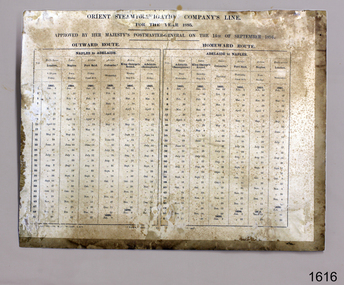
... Flagstaff Hill Flagstaff Hill Maritime Museum and Village Warrnambool Maritime Museum Maritime Village Great Ocean Road Shipwreck Coast orient steam navigation company limited Orient Line Steamship line 1895 travel steamship London Naples Port Said Colombo King George's Sound Adelaide (Semaphore) migration early steamships world travel London to Australia London to Adelaide travel late 19th century travel "ORIENT STEAM NAVIGATION COMPANY'S LINE / FOR THE YEAR 1895 / APPROVED BY HER MAJESTY'S POSTMASTER-GENERAL ON THE 14TH OF SEPTEMBER 1894 " "OUTWARD ROUTE" "HOMEWARD ROUTE" "NAPLES TO ADELAIDE " ADELAIDE TO NAPLES" Orient Steam Navigation Company's timetable for steamship voyages outward bound from London to Adelaide, and inward bound back to London, for 1895. ...This timetable was found by Dave Maxwell behind an old photograph. David's family came to Warrnambool in 1838.The timetable is an example of travel in the late 19th century. It shows the frequency of voyages between London and Adelaide and the time taken to make the journeys by steamship in 1895. Orient Steam Navigation Company's timetable for steamship voyages outward bound from London to Adelaide, and inward bound back to London, for 1895. The document has black print on cream-coloured paper and is mounted onto a card backing. The timetable lists voyage n from January 1885 to January 1886, with details of month, date and times. The itinerary begins from London to Naples, Port Said, Colombo, King George's Sound and finally to Adelaide (Semaphore), taking 35 days for the journey. The steamship then returns to London. The timetable was approved by Her Majesty's Postmaster-General on the 14th September 1894. There are indecipherable inscriptions below the timetable."ORIENT STEAM NAVIGATION COMPANY'S LINE / FOR THE YEAR 1895 / APPROVED BY HER MAJESTY'S POSTMASTER-GENERAL ON THE 14TH OF SEPTEMBER 1894 " "OUTWARD ROUTE" "HOMEWARD ROUTE" "NAPLES TO ADELAIDE " ADELAIDE TO NAPLES"flagstaff hill, flagstaff hill maritime museum and village, warrnambool, maritime museum, maritime village, great ocean road, shipwreck coast, orient steam navigation company limited, orient line, steamship line, 1895 travel, steamship, london, naples, port said, colombo, king george's sound, adelaide (semaphore), migration, early steamships, world travel, london to australia, london to adelaide, travel, late 19th century travel -
 The Beechworth Burke Museum
Photograph, 1999
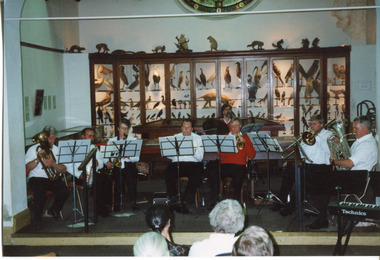
... Australia. It refers to a friendly society of men united by an enthusiasm for singing. The Beechworth Brass Band was formed by Mr. H. Vandenberg in 1887. The Beechworth Liedertafel was established 14 March 1894 at the London Tavern, Camp Street, Beechworth, by Mr. A.A. Billson, and a visiting conductor, Mr. H. Fielder. German clubs, complete with marching bands, athletics associations and Liedertafel choirs, were centres of social activity attracting wide audiences not limited to members of their own ethnicity. Alfred Arthur Billson was the youngest son of Mr. George...Australia. It refers to a friendly society of men united by an enthusiasm for singing. The Beechworth Brass Band was formed by Mr. H. Vandenberg in 1887. The Beechworth Liedertafel was established 14 March 1894 at the London Tavern, Camp Street, Beechworth, by Mr. A.A. Billson, and a visiting conductor, Mr. H. Fielder. German clubs, complete with marching bands, athletics associations and Liedertafel choirs, were centres of social activity attracting wide audiences not limited to members of their own ethnicity. Alfred Arthur Billson was the youngest son of Mr. George ...This photograph depicts members of the Beechworth Band at a 'Liedertafel' concert in the main hall at the Burke Museum in 1999. The concert was associated with an exhibition titled, 'From the Liedertafel to the Skating Rink: Entertainment in Beechworth 1852 - early 1900s', which celebrated the rich and diverse entertainments that were a part of Beechworth life in the nineteenth and early twentieth centuries. Marching bands, choirs, circus acts, theatrical performances, races, and seasonal activities, such as Mr. Spiller's roller skating rink, founded in the late 1860s, were among the attractions on offer. 'Liedertafel' is a tradition that accompanied German settlers to Australia. It refers to a friendly society of men united by an enthusiasm for singing. The Beechworth Brass Band was formed by Mr. H. Vandenberg in 1887. The Beechworth Liedertafel was established 14 March 1894 at the London Tavern, Camp Street, Beechworth, by Mr. A.A. Billson, and a visiting conductor, Mr. H. Fielder. German clubs, complete with marching bands, athletics associations and Liedertafel choirs, were centres of social activity attracting wide audiences not limited to members of their own ethnicity. Alfred Arthur Billson was the youngest son of Mr. George Billson, who served as Beechworth’s mayor between 1869-1871. In 1872, George purchased the Oven’s Brewery in Last Street, which became Billson’s Brewery, one of the oldest continuing beverage manufacturers in Australia. An active member of Beechworth’s cultural, business and political life around the turn of the century, A.A. Billson served on Beechworth Shire Council from 1884 to 1893, and from 1895 to 1910, with three terms as president (1888–89, 1899–1901, 1908–09). He founded the Beechworth Progress Association in 1891 and produced an ‘Illustrated Guide to Beechworth and Vicinity’ to develop tourism potential. This photograph of the Beechworth Band playing at the Burke Museum is historically significant for the information it conveys about an exhibition at the Burke Museum between September and November 1999. The use of the contemporary Beechworth Band in a 'Liedertafel' performance provides insight into curatorial approaches at the turn of the twenty-first century and improves our understanding of how exhibitions use objects in the Burke Museum's Collection to tell stories about the past in the present. The image is historically and socially significant for attesting to the enduring appeal of local musical associations, which were a popular means of entertainment that fostered social connections among settlers from diverse ethnic backgrounds. Rectangular colour photograph printed on matte photographic paper. Reverse: 7029 / Label: 7029 / Source / Burke Museum / Beechworth / Band / 1999/2000 /liedertafel, beechworth band, burke museum, from the liedertafel to the skating rink, entertainment in beechworth 1852 - early 1900s, gold rush, immigration, beechworth's german heritage, london tavern beechworth, beechworth's first brick tavern, spiller's skating rink, vandenberg's beechworth brass band, protestantism, teetotallism, skating carnivals, beechworth german association, yma's, beechworth skating rink, progress societies, billson's brewery, german-australians, beechworth progess association, lodges, freemasonry, colonial australia -
 Lara RSL Sub Branch
Group of Maps World War One, Group of Maps World War One - Dardanelles and Anzac Gallipoli Maps Circ 1915, Circ 1916
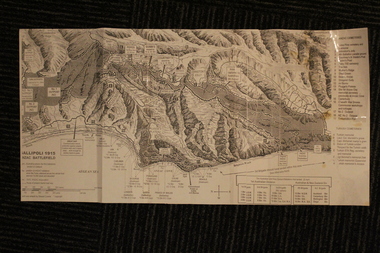
... Limited , Wellington N.Z. 1919 5. Panorama of two coast views of ANZAC area. Australian War Memorial, 6. Map of ANZAC positions of World War One, Gallipoli 1915. Published by H.E.C. Roberinson, George...Limited , Wellington N.Z. 1919 5. Panorama of two coast views of ANZAC area. Australian War Memorial, 6. Map of ANZAC positions of World War One, Gallipoli 1915. Published by H.E.C. Roberinson, George ...Gallipoli 1915 Maps and Naval plan of Operations World War One ANZACRare examples that explain both ANZAC and Naval Operations during World War One Gallipoli & Dardanelles Passage .!. Black and White Photocopy of Gallipoli 1915 ANZAC Battlefield - detailed positions of troops and Cemeteries. 2.The Allied Failure to Force The Dardanelles Passage 18 March 1915 - detailed line of Attack Naval Organisation, Mine layout, Plan of Attack (and copy).. 3. Map of Turkey and surrounding area written in Turkish and German Languages. C0olor version main roads and distances. (and copy).. 4. Map of ANZAC Trench Diagram. World War One.Color. (and copy). 5.Panorama of Chunuk Blair from 3 miles south of Nibrunesi Point, 3 November 1915 and Anzac from 1 mile N. E. of Ari Burnu, 21 November 1915. Black & White 6. Color Map of ANZAC positions with topographical Details, notes. 1. Artwork and copyright by Srewart Cownie, Gallipoli 1915 ANZAC Battlefield with Landings and later evacuation marked. 2. Details of Naval actions taken in the Dardanelles Passage 18 March 1918. 3. Local area Map or Turkey. Shows roads network and townships. 4. ANZAC Trench Diagram, copyright Whitcombe & Tombs Limited , Wellington N.Z. 1919 5. Panorama of two coast views of ANZAC area. Australian War Memorial, 6. Map of ANZAC positions of World War One, Gallipoli 1915. Published by H.E.C. Roberinson, George Street, Sydney N.S.W.18 April 1916maps operational of anzac and naval opations during 1915 etc, dardanelles naval opations -
 Federation University Historical Collection
Letter, Ballarat School of Mines, 1908, 1908
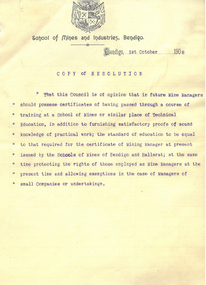
... Macartney * Letter from Thomas Williams * Letterhead from Australian Institute of Mining Engineers regarding excursion to Toongabbie and Walhalla - Signed D.L. Stirling * Assay from George Brearley of Lyndhurst via Scottsdale * Letterhead of Berry United Deep Leads Limited, Ulina * Embossed leather classes for coachwork from S. ...Macartney * Letter from Thomas Williams * Letterhead from Australian Institute of Mining Engineers regarding excursion to Toongabbie and Walhalla - Signed D.L. Stirling * Assay from George Brearley of Lyndhurst via Scottsdale * Letterhead of Berry United Deep Leads Limited, Ulina * Embossed leather classes for coachwork from S. ...October inwards correspondence for the Ballarat School of Mines. * School of Mines and Industries, Bendigo (certification of Mine Managers) * Telegram - examination papers * Commonwealth telegram - Ballarat School of Mines battery availability for crushing ten tons. * Letterhead from the Roneo Co., Melbourne * J. Donald of Wallace St, Toorak * Letterhead from York Chambers, 49 Queen Street, Melbourne - signed J. Kaufmann * Letterhead from Cochran & Co - re Cocnran boilers * Letterhead of Thames School of Mines, New Zealand * Letter re James Chambers missing school from his father James Chambers Snr of Talbot * Education Department Circular * letter signed by F.W. Calaby * F.W. Silberberg & Co re crucibles * Letterhead of New Black Horse Mining Company - signed E. Howell * Australasian Institute of Mining Engineers, 57-59 Swanston Street, Melbourne - signed D.L. Stirling * Letterhead of John F. Paterson * Letterhead of the Welcome Stranger Dredging Company, Dunolly - W.J. Parker manager * Letterhead of Nevett and Nevett Barristers and Solicitors, Lydiard Street, Ballaarat * John Barker, H. Barbour * Telegram re Brearley Lyndhurst * Letterhead of the Commonwealth Minerals Co - John F. Paterson, Legal Manager * Query re courses at the Ballarat School of Mines - A. O'Mara * Stone to be crushed, Egerton from J.H. Davidson * Letterhead from 'Terascoa' Port Kembla signed by W.S. Macartney * Letter from Thomas Williams * Letterhead from Australian Institute of Mining Engineers regarding excursion to Toongabbie and Walhalla - Signed D.L. Stirling * Assay from George Brearley of Lyndhurst via Scottsdale * Letterhead of Berry United Deep Leads Limited, Ulina * Embossed leather classes for coachwork from S. Mee of Clunes * The Lord Nelson North Gold Mning Company No Liability signed by Edward H. Shackell * Correspondence from May Consolidated Gold Mining Company, Transvaal signed by Jason Hawthorne * Letterhead of the Northern Assurance Company, 448 Collins St, Melbourne * Letter fom James Lidgett of "Braelands" Myrniong * Gordon sides asking for a reference * Letterhead of Fraser & Chalmers Ltd, Manufacturersw of mining machinery, steam engines, boilers and machinery for systematic milling, smelting and concentration of ores, signed by W.R. Caithness * Letterhead of the Board of Examiners for Engine-Drivers, signed by R. Birrell * Letter concerning outstanding amount due to theBallarat East School of Design, signed by Edward Reid, Manager * Letterhead of the Ballarat Public Library concerning an outstanding amount in the School of Design Account. * Letterhead of the A. Gallenkamp and Co. regarding their new catalogue * Letterhead from the Creswick Advertiser, Albert Street, Creswick * Handwritten letter from John Brittain inviting Ballarat School of Mines students to join him at the telescope weather permitting * Letterhead of Victorian Railways, signed by E.B. Jones * Letterhead of the Ballarat East Town Clerk's Office * Letterhead of Elliott, Maclean and Co. Handwritten letter re Dressmaking from J.H. Wrightrand, south africa, kalgoorlie, school of mines and industries, bendigo, certification of mine managers, bendigo school of mines, telegram, ballarat school of mines battery, roneo co., melbourne, j. donald, york chambers, cochran & co, thames school of mines, new zealand, james chamberseducation department circular, f.w. calaby, * f.w. silberberg & co, crucibles, new black horse mining company, e. howell, * australasian institute of mining engineers, john f. paterson, welcome stranger dredging company, dunolly, w.j. parker, nevett and nevett, john barker, h. barbour, brearley lyndhurst, commonwealth minerals co, a. o'mara, j.h. davidson, 'terascoa' port kembla, w.s. macartney, thomas williams, australasian institute of mining engineers, excursion, toongabbie, walhalla, d.l. stirling, george brearley, lyndhurst via scottsdale, berry united deep leads limited, ulina, embossed leather classes for coachwork, s. mee, clunes, the lord nelson north gold mning company no liability, edward h. shackell, may consolidated gold mining company, transvaal, jason hawthorne, northern assurance company, james lidgett, "braelands" myrniong, gordon sides, fraser & chalmers ltd, mining machinery, w.r. caithness, examiners, ballarat east school of design, edward reid, ballarat public library, school of design, a. gallenkamp and co., creswick advertiser, john brittain, telescope, victorian railways, e.b. jones, ballarat east town clerk's office, elliott, maclean and co., dressmaking, j.h. wright, ausimm, berry united, school of mines and industries bendigo, lyndhurst tasmania, may consolidated gold co germiston transvaal, transvaal, germiston, roneo, thames school of mines, schools of mines, welcome stranger dredging co, cowley copper development syndicate ltd, department of mines, maryborough school, pharmacy board of victoria, tongalla survey camp, ballarat fine art gallery association, central microscopical -
 Flagstaff Hill Maritime Museum and Village
Currency - Guinea Coin, The Royal Mint, 1793 George III Spade Guinea, 1793
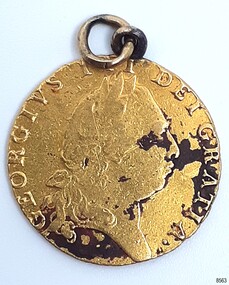
... It was the first coin mentioned in the announcement of Governor King of New South Wales his Australian Proclamation of a limited variety and denomination of coins accepted for use in the Australian Colony. The historic and decorative George...The Gold Guinea is part of Australia’s history; it was the first coin in the list of coins for use in the Australian Colonies, mentioned by Governor King of New South Wales in his Australian Proclamation speech of 1800. The George III Spade Guinea was included in the Limited Edition Sherwood 12 Coin Collection of Notable Coinage of Australia. ...The coin was discovered by Julie Wilkins, a Victorian scuba diver who had already experienced more than 500 dives in Australia and overseas. She was holidaying in Peterborough, Victoria, and looking forward to discovering more about the famous Loch Ard ship, wrecked in June 1878 at Mutton Bird Island. The fast Glasgow-built clipper ship was only five years old when the tragedy occurred. There were 54 people on board the vessel and only two survived Julie's holiday photograph of Boat Bay reminds her of her most memorable dive. Submerged in the calm, flat sea, she was carefully scanning around the remains of the old wreck when, to her amazement, a gold coin and a small gold cross suddenly came up towards her. She excitedly cupped them in her hands, then stowed the treasures safely in her wetsuit and continued her dive. She soon discovered a group of brass carriage clock parts and some bottles of champagne. It was a day full of surprises. The items were easily recognisable, without any build-up of encrustations or concretion. Julie secretly enjoyed her treasures for twenty-four years then packed them up for the early morning train trip to Warrnambool. After a short walk to Flagstaff Hill Maritime Museum and Village, her photograph was taken as she handed over her precious find. She told her story to a local newspaper reporter, lunched a café in town then took the late afternoon train home. Her generous donation is now part of a vast collection of Loch Ard shipwreck artefacts, including the gold watch and the Minton Majolica model peacock. The coin is a British 1793 George III Gold Spade Guinea. It was already 83 years old when the Loch Ard had set sail. The loop and ring have been added, perhaps as a pendant, pocket watch accessory or similar purpose. It may have been worn for ‘good luck’ on the long journey to Australia, where ships had to carefully navigate the treacherous Bass’s Strait before arriving at their destination of Melbourne. Sadly, many met their fate on that short stretch of ocean aptly named the Shipwreck Coast. The coin is very recognisable even though it was exposed to the wrecking of the ship, its consequent movement, and the sea's turbulence. Its bent, scratched, buckled, split, dinted and worn condition is part of its story. The red-brown-black discolouration is similar to that found on other gold coins, sometimes called the ‘corrosion phenomena’. Studies suggest the possible cause is contaminants in the minting process reacting to the coins’ environment. The GEORGE III GOLD SPADE GUINEA: - The British Guinea was introduced in 1663 and was circulated until 1814. It was made of 22 carat gold, was 25 to 26 cm in diameter and weighed 8.35 grams. It had a value of 21 British shillings. The guinea coin ceased circulation after 1816 and was replaced by the one-pound note. However, the term ‘guinea’ continued to represent 21 shillings. King George (1738-1820) had six gold guinea designs minted during his reign from 1760 and 1820. Each of the six had different obverse portraits, all facing the right. There were three different reverse sides. The Spade Guinea was the fifth issue of the coin, introduced in 1787 and produced until 1799. The reverse shows a royal crown over a flat-topped shield with the Royal Arms of Great Britain, used in Scotland between 1714 and 1800. The shield images are, from left to right, top to bottom, the Arms of England and Scotland, the Arms of France, the Arms of Ireland, and the Arms of the House of Hanover. The Gold Guinea is also part of Australia’s history. It was the first coin mentioned in the announcement of Governor King of New South Wales his Australian Proclamation of a limited variety and denomination of coins accepted for use in the Australian Colony. The historic and decorative George III Spade Guinea has been reproduced for special collections of coins. However, replicas and imitations have also been made as souvenirs for tourists, as gaming tokens and chips for gamblers, and as ‘fake’ coins for profit. These coins differ in many ways; they may be only half the weight of the genuine coin. Often have a small stamp on the obverse with “COPY” or the manufacturer’s name or initials. Some have scalloped edges, some have dates that are different to the original dates of issue, and some even have text in Latin that translates as something very different to the original coin.The King George III Guinea was only produced from 1663 to 1814 and was the first English coin to be mechanically minted. The coin is the fifth edition of the King George III Guinea, the Spade Guinea, was only produced between 1787 and 1799. It is the only edition with this portrait of King George and the only one with the Royal Coat of Arms of Great Britain in Scotland on the reverse side. This edition was also the last guinea in circulation, because the sixth edition was reserved as the Military guinea. This edition of the Guinea is unique; This coin is the only guinea in our collection. It was minted in 1793, so it is now over 230 years old. The Gold Guinea is part of Australia’s history; it was the first coin in the list of coins for use in the Australian Colonies, mentioned by Governor King of New South Wales in his Australian Proclamation speech of 1800. The George III Spade Guinea was included in the Limited Edition Sherwood 12 Coin Collection of Notable Coinage of Australia. This coin is the only known guinea coin recovered from the wreck of the Loch Ard. It was already 85 years old when the ship was wrecked.Gold coin; British. 1793, King George III of the United Kingdom of Great Britain and Ireland (1760-1820), Spade Guinea. Yellow gold coin with gold metal loop mount and a gold ring through the loop. The design is the fifth issue of the George III Gold Guinea. The obverse relief is a portrait of George III facing right. Reverse relief is a crown above the Coats of Arms (1801-1816) of flat top spade-shaped shield divided into four quadrants that depict crowned lions, fleur de lies, a harp. These images are identified as, from left to right, top to bottom, England and Scotland, France, Ireland and Hanover. Inscriptions are minted around the rims of each side. The coin is dated 1793. Its surface has dark areas on both sides and the reed edge and surfaces are well worn. The loop mount is bent and the ring is buckled. The coin was recovered from the wreck of the ship Loch Ard.Obverse text; 'GEORGIVS III DEI GRATIA' (translates to George the Third, by the Grace of God) Obverse relief; (King George III bust, facing right, laurel wreath on head) Reverse text; 'M.B.E.ET.H.REX.F. D.B.ET.L.D. S.R.I.A.T.ET.E' '1793' (translates to: King of Great Britain, France and Ireland, Defender of the Faith, Duke of Brunswick and Lüneburg, Arch-Treasurer and Elector of the Holy Roman Empire) Reverse relief; a spade-shaped image i.e. (Crown with fleer de lies, above Shield with crowned lions in different postures, a harp, and other details)flagstaff hill maritime museum and village, warrnambool, great ocean road, shipwreck coast, royal mint, british coin, currency, guinea, military guinea, australian currency, british guinea, gold coin, spade guinea, king george iii, george iii, fifth portrait, arms of england and scotland, arms of france, arms of ireland, arms of the house of hanover, coins, gold coins, gold medallion, georgian era, 1793, numismatics, contamination phenomena, gold corrosion, good luck, lucky charm, pendant, lucky coin, trade, loch ard, wreck of the loch ard, 1878, mutton bird island, peterborough, scuba diver, 1980s, guinea coin, gold guinea, shipwreck artefact, relic, julie wilkins -
 City of Moorabbin Historical Society (Operating the Box Cottage Museum)
Manufactured Glass, 'Yeasta-Cola' with box, mid 20thC
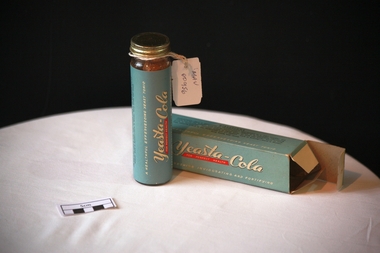
... Excellent for Growing CHILDREN / Contains………/ Manufactured in Australia / Sale Distributors / WORLD AGENCIES PTY. LIMITED 224 GEORGE STREET, SYDNEY, AUSTRALIA / DIRECTIONS / …………...Excellent for Growing CHILDREN / Contains………/ Manufactured in Australia / Sale Distributors / WORLD AGENCIES PTY. LIMITED 224 GEORGE STREET, SYDNEY, AUSTRALIA / DIRECTIONS / ………… A clear glass cylindrical jar with a metal screw top containing dried yeast powder. ...The mark YEASTA-COLA was officially filed as a trademark by World Agencies Pty Ltd SYDNEY, NSW 2000 on 16 Jan 1946.A clear glass cylindrical jar with a metal screw top containing dried yeast powder. Cardboard boxA HEALTHFUL EFFERVESCENT YEAST TONIC / YEASTA-COLA / FOR PERFECT HEALTH / REFRESHING, INVIGORATING AND FORTIFYING / Beneficial In cases of Impure Blood…. / General Debility, Malnutrition. Excellent for Growing CHILDREN / Contains………/ Manufactured in Australia / Sale Distributors / WORLD AGENCIES PTY. LIMITED 224 GEORGE STREET, SYDNEY, AUSTRALIA / DIRECTIONS / …………pharmacy, medicines, yeasta-cola, hospitals, nursing, containers, moorabbin, bentleigh, cheltenham, melbourne, world agencies pty ltd sydney -
 City of Moorabbin Historical Society (Operating the Box Cottage Museum)
Clothing - Clothing, lady's nylon stockings 'Prestige Wonderfoot'', mid 20thC
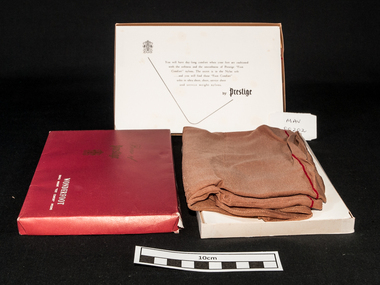
... Limited was formed in 1922 by George Foletta to manufacture fine silken hosiery. The company had acquired the Atlas Knitting and Spinning Mills Pty Ltd which had been established in 1920 and produced "Prestige hosiery" from 1921. Prestige Limited merged with Holeproof Hosiery Company (Australia...Limited was formed in 1922 by George Foletta to manufacture fine silken hosiery. The company had acquired the Atlas Knitting and Spinning Mills Pty Ltd which had been established in 1920 and produced "Prestige hosiery" from 1921. Prestige Limited merged with Holeproof Hosiery Company (Australia ...Prestige Limited was formed in 1922 by George Foletta to manufacture fine silken hosiery. The company had acquired the Atlas Knitting and Spinning Mills Pty Ltd which had been established in 1920 and produced "Prestige hosiery" from 1921. Prestige Limited merged with Holeproof Hosiery Company (Australia) Pty Ltd in 1964. Both were taken over by Pacific Dunlop in 1968. The Prestige name was dropped in 1978/79. George Gotardo Foletta (1892-1973), hosiery and knitwear manufacturer, was born on 30 January 1892 at Northcote, Melbourne, eldest son of Victorian-born parents Henry Gotardo Foletta, a stonemason of Swiss extraction, and his wife Gertrude, née Bright. Henry repaired the depression-ravaged fortunes of his family by starting a successful fancy goods commission-agency.....George persuaded the demoralized board to restructure around a quality-first marketing policy. By 1924, when George A. Bond & Co. Ltd ( Sydney) was liquidated, Prestige was back in the black. About this time the company became the first Australian knitter to make fully-fashioned silk stockings, outselling the best imported brands and giving Prestige dominance of the local hosiery market. With the arrival of British-trained Leslie Gough in 1926, Prestige entered its period of greatest expansion. By 1933 it was spinning its own silk yarn, had diversified into lingerie and commenced business in New Zealand; three years later it was spinning imported rayon filament into hosiery yarn.A pair of unworn lady's brown nylon 'service weight' stockings made by 'Prestige' Pty Ltd. in the original boxBox Lid: House of / Prestige / ‘monogram’ / WONDERSOFT / SERVICE WEIGHT “FOOT COMFORT’ NYLONS. Box inside lid : ‘monogram’ / You will have day long comfort when your feet are cushioned / with the softness and the smoothness of ‘Prestige “Foot Comfort” nylons. The secret is in the Nylon soles / …and you will find these “ Foot Comfort” / soles in ultra sheer, sheer, service sheer / and service weight nylons. / by Prestigeclothing, stockings, nylons, prestige hosiery pty ltd, melbourne, bentleigh, cheltenham moorabbin -
 Bendigo Military Museum
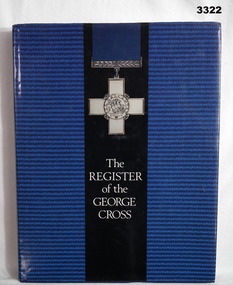
Book - BOOK, GEORGE CROSS, The Register of the George Cross, 1985
... George Cross On front fly leaf handwritten inscription & two RSL stamps: "M R Birks 3 Timbertop Avenue Carlingford NSW, 2118 Australia" Handwritten in black ink on front fly leaf: "To Ray Birks from Leon Goldsworthy" Hard cover, dark blue buckram. Gold print front & spine. Dust cover dark blue striped background with the George Cross with ribbon over black band in foreground. Rear view of George Cross on back section of dust cover. 151 pages, cut, plain, white. Illustrated, black & white photos, portraits of recipients. The Register of the George Cross Book BOOK, GEORGE CROSS Redwood Burn Limited ...Hard cover, dark blue buckram. Gold print front & spine. Dust cover dark blue striped background with the George Cross with ribbon over black band in foreground. Rear view of George Cross on back section of dust cover. 151 pages, cut, plain, white. Illustrated, black & white photos, portraits of recipients.On front fly leaf handwritten inscription & two RSL stamps: "M R Birks 3 Timbertop Avenue Carlingford NSW, 2118 Australia" Handwritten in black ink on front fly leaf: "To Ray Birks from Leon Goldsworthy" books - reference, military history - army, george cross -
 Kiewa Valley Historical Society
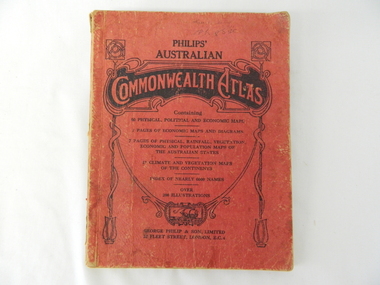
Atlas Australian Commonwealth, Philips' Australian Commonwealth Atlas, 1944
... On front cover "Philips' Australian COMMONWEALTH ATLAS" and underneath "Containing" underneath "60 PHYSICAL, POLITICAL AND ECONOMIC MAPS". Publisher George Philip & Son, Limited 32 Fleet Street, London E.C. 4. ...The great communication facilities of the late 1900s and beyond, was still only science fiction. 1940s school curriculum rural education 1940s atlas australian atlas On front cover "Philips' Australian COMMONWEALTH ATLAS" and underneath "Containing" underneath "60 PHYSICAL, POLITICAL AND ECONOMIC MAPS". Publisher George Philip & Son, Limited 32 Fleet Street, London E.C. 4. ...This atlas, printed in 1944, details not only the geographic and political boundaries of the world as it was at that time but also the snap shot of life of the time. This snap shot in time covers the major Australian cities, the major farming, grazing, industrial and sporting/recreational activities. Also there are snap shots of similar activities from other global areas. The period also covered World War II, detailed by a photo of "shell making", munitions, required by Australian soldiers. The great political and territorial changes made as a result of World War II can be clearly identified for example , Israel (the Jewish homeland). The various prewar colonies of major European nations.This atlas was used by children of a Kiewa Valley family and shows the value and the general educational exposure that these children had at this time. The rural setting and within the backdrop of a world war did not severely alter the life style of children in this region. The "news reels" shown in cinemas of cities and larger towns were the only visual realisations of major events of global significance available to these children. The information provided by this atlas allowed students to glimpse at what the "outside world" was. The majority of these students would possibly never see these regions for themselves. The great communication facilities of the late 1900s and beyond, was still only science fiction.This atlas has a thick (350 g/m) red cardboard cover with bold black lettering and shading. The cover is set out within a shield like frame. The shield is held up by two square markings, each with a four part circular pattern and a cord entwining two pendulum structures ending with a bowl figure at the bottom. There is a semi circular form enclosing a printed book contents list. The inside cover has the atlas title and contents and the publisher details. The atlas contain 56 pages of world and Australian maps, vegetation and rainfall maps. Within this atlas there are 27 double sided pages of black and white photographs depicting life styles, buildings, landscapes and prominent and significant to Australia males from 1652 to 1944. The pages are of approximately 200 g/m and have the yellow aged appearance.On front cover "Philips' Australian COMMONWEALTH ATLAS" and underneath "Containing" underneath "60 PHYSICAL, POLITICAL AND ECONOMIC MAPS". Publisher George Philip & Son, Limited 32 Fleet Street, London E.C. 4. Inside cover are: written, in freehand and in ink the following names and dates; "J.Muller Form V 1945", "L L Muller Form IV 1946", "N.J. Muller Form I + II + III 1948 +49 + 50" and "D Muller Form I 1949". also handwritten and in pencil is "Peter Leslie". On the last page is a small freehand sketch of Australia in biro.1940s school curriculum, rural education, 1940s atlas, australian atlas -
 Bendigo Military Museum
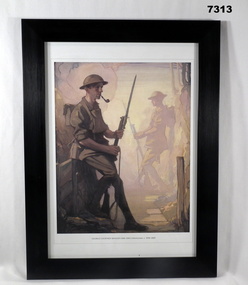
Print - PRINT, FRAMED WW1, Reader's Digest (Australia) Pty Limited, 2015
... GEORGE BENSON " Enlisted in the Australian Imperial Force in September 1914 with the 3rd Field Artillery Brigade". "Commissioned as an official artist in April 1918". Framed print. Print - colour print on paper. Copy of an original oil painting on canvas. Depicts a soldier leaning against a wall structure with a second soldier in more muted tones in the background within an earth trench. Frame - Black plastic framing with glass front and MDF board backing with adhered black paper. Print PRINT, FRAMED WW1 Reader's Digest (Australia) Pty Limited ...From information book - "Reader's Digest/ Gallipoli/ 25th April 1915 - 9th January 1916/ Centenary Commemorative Prints". Collection of 20 prints. Refer Cat No. 7300.Framed print. Print - colour print on paper. Copy of an original oil painting on canvas. Depicts a soldier leaning against a wall structure with a second soldier in more muted tones in the background within an earth trench. Frame - Black plastic framing with glass front and MDF board backing with adhered black paper.Details below print - in black ink. "GEORGE COURTNEY BENSON (1886-1960) Infantryman c 1919-1920". GEORGE BENSON " Enlisted in the Australian Imperial Force in September 1914 with the 3rd Field Artillery Brigade". "Commissioned as an official artist in April 1918".framed accessories, prints, ww1, gallipoli, centenary -
 Bendigo Military Museum
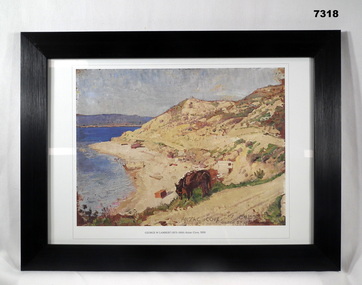
Print - PRINT, FRAMED WW1, Reader's Digest (Australia) Pty Limited, 2015
... GEORGE W LAMBERT, unable to enlist in the Australian Imperial Force in London, joined Voluntary Training Corps". Appointed an official Australia War Artist, Australian Imperial Force 1917. Framed print. Print - colour print on paper. Copy of an oil painting with pencil on wood. Depicts a cove with sea, sand and hills. Ruined buildings and structures visible on the beach. Horse eating grass in the foreground. Frame - Black plastic framing with glass front and MDF board backing with adhered black paper. Print PRINT, FRAMED WW1 Reader's Digest (Australia) Pty Limited ...From Information book; "Reader's Digest/ Gallipoli/ 25th April 1915 - 9th January 1916/ Centenary Commemorative Prints". Collection of 20 prints. Refer Cat No. 7300.Framed print. Print - colour print on paper. Copy of an oil painting with pencil on wood. Depicts a cove with sea, sand and hills. Ruined buildings and structures visible on the beach. Horse eating grass in the foreground. Frame - Black plastic framing with glass front and MDF board backing with adhered black paper.Details below print - in black ink; " GEORGE W LAMBERT (1873-1930) Anzac Cove, 1919" “GEORGE W LAMBERT, unable to enlist in the Australian Imperial Force in London, joined Voluntary Training Corps". Appointed an official Australia War Artist, Australian Imperial Force 1917. framed accessories, prints, ww1, gallipoli, centenary -
 Geoffrey Kaye Museum of Anaesthetic History
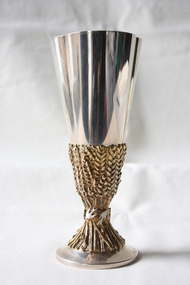
Decorative object - Goblet, Desmond Clen-Murphy, 1975
... George's Hospital, London and during this event was elected to Honorary Fellowship of the Faculty of Anaesthestists, Royal Australasian College of Surgeons. The Burnell-Jose Visiting Professorship commenced in Adelaide in 1975 in honor of Mary Burnell, the first woman Dean of the Faculty from 1966 to 1967 and the first woman President of the Australian Society of Anaesthetists in 1955. Very few women had assumed major anesthesia roles in the world during this period. The Goblet's provenance is supported by an original booklet, which certifies its origin from Chichester Cathedral (1075), Sussex, England. In 1975, a limited...George's Hospital, London and during this event was elected to Honorary Fellowship of the Faculty of Anaesthestists, Royal Australasian College of Surgeons. The Burnell-Jose Visiting Professorship commenced in Adelaide in 1975 in honor of Mary Burnell, the first woman Dean of the Faculty from 1966 to 1967 and the first woman President of the Australian Society of Anaesthetists in 1955. Very few women had assumed major anesthesia roles in the world during this period. The Goblet's provenance is supported by an original booklet, which certifies its origin from Chichester Cathedral (1075), Sussex, England. In 1975, a limited ...Dr. Dai Davies presented this Goblet as a gift to the Faculty as the first appointed Burnell-Jose visiting Professor, Postgraduate Committee in Medicine, S.A. May - June 1976. At the time, Dr Davies was the Consultant Anaesthetist St George's Hospital, London and during this event was elected to Honorary Fellowship of the Faculty of Anaesthestists, Royal Australasian College of Surgeons. The Burnell-Jose Visiting Professorship commenced in Adelaide in 1975 in honor of Mary Burnell, the first woman Dean of the Faculty from 1966 to 1967 and the first woman President of the Australian Society of Anaesthetists in 1955. Very few women had assumed major anesthesia roles in the world during this period. The Goblet's provenance is supported by an original booklet, which certifies its origin from Chichester Cathedral (1075), Sussex, England. In 1975, a limited edition of 600 goblets were commissioned by the Dean and Chapter of Chichester Cathedral, Reverend Walter Hussey, to commemorate the ninth century of the Foundation. This Goblet is number 46 of the edition and the booklet is signed by Walter Hussey. The Goblet is historically associated with Chichester Cathedral and Walter Hussey, who was a great patron of the arts during the 1970's.Solid silver, with pure gold overlaying the modeled stem and interior of the cup. Trefoil shaped goblet cup with tapering profile. The stem is supported by a sheaf of wheat and bird design. The goblet came in its own case with a booklet of authenticity. [central base] NUMBER / 46 / OF A LIMITED EDITION / OF 600 MADE BY ORDER OF / THE DEAN AND CHAPTER / TO COMMEMORATE / THE NINTH CENTENARY OF / THE FOUNDATION OF / CHICHESTER CATHEDRAL / IN 1075 / AURUM / DCM [and hallmarks of the Worshipful Company of Goldsmiths] •[around base] D.M. DAVIES / ADELAIDE 1976dr davies, dai, burnell, mary, chichester cathedral, burnell-jose visiting professor, murphy, desmond-clen, hussey, walter, ninth century of the foundation of chichester cathedral -
 Bendigo Historical Society Inc.
Book - LONG GULLY HISTORY GROUP COLLECTION: 150 YEARS OF GOLD
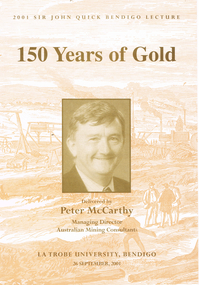
... Australia... Bendigo Mines Limited... Nell Gwynne... Carshalton Shaft... Napoleon Shaft... George...BENDIGO History long gully history group The Long Gully History Group - 150 Years of Gold Peter McCarthy Australian Mining Consultants La Trobe University Bendigo Robertson Hyetts Sir John Quick Quick Hyett and Rymer Quick and Hyett National Library of Australia Charles Joseph La Trobe James Gumm Hargreaves Melbourne Argus Henry Frenchham The Times Gibbons James Esmond Dr Barker Thomas Hiscock Alfred Clarke Geelong Advertiser Wat Tyler Dunlop and Regan Commissioner Doveton Sub Commissioner Armstrong Captain Dana Argus Armstrong Stewart Gibson Margaret Kennedy Convict's Prevention Act Micky O'Halloran Throckmorton Anti-Gold-License Association G E Thomson Dr Jones 'Captain' Edward Brown Eureka Rebellion Sir John Quick Mark Twain Australian Federation Mining Exchanges Alfred Deakin The Amalgamated Miner's Association Robert Clark Britian's National Miners' Association Silicosis Tuberculosis Walter Summons Bendigo Amalgamated Mines Great War Gold Mines of Australia Bendigo Mines Limited Nell Gwynne Carshalton Shaft Napoleon Shaft George Lansell Fortuna Villa The Four Deborah Mines World War Two Central Deborah North Deborah William Kelly The Edwards Works Newstead Dredge Jim Crow Dredge Adelong Dredge Calder Freeway Bendigo Mining NL Randolph Bedford CRA Ltd Sovereign Hill Ballarat Historical Park Association RMIT Melbourne University Macquarie University Australasian Institute of Mining and Metallurgy Institution of Engineers Australia Mineral Industry Consultants Association Joint Ore Reserves Committee CEO Institute Anthea McCarthy Michele Matthews Sir John Quick Committee City of Greater Bendigo The Hon Justice Michael Kirby Mr Don Blackmore Murray Darling Basin Commission Dr Janet McCalman Australian Research Council Dr John White Visy Industries Dr Al Luloff Mrs Delys Sargeant The Rt Hon Ninian Stephen Book titled 150 Years of Gold delivered by Peter McCarthy, Managing Director Australian Mining Consultants at La Trobe University, Bendigo on 26 September, 2001, the 2001 Sir John Quick Bendigo Lecture. ...Book titled 150 Years of Gold delivered by Peter McCarthy, Managing Director Australian Mining Consultants at La Trobe University, Bendigo on 26 September, 2001, the 2001 Sir John Quick Bendigo Lecture. Book cover, inside and out has a beige copy of a wood engraving of Hustlers Reef, Sandhurst with a tan tone photo of Peter McCarthy on the centre front. Mining is mentioned from the late 1840s to the present day. In the back is a career history of Peter McCarthy and a short life story of Sir John Quick. Also in the back is a list of past lectures from 1994 to 2000.bendigo, history, long gully history group, the long gully history group - 150 years of gold, peter mccarthy, australian mining consultants, la trobe university bendigo, robertson hyetts, sir john quick, quick hyett and rymer, quick and hyett, national library of australia, charles joseph la trobe, james gumm, hargreaves, melbourne argus, henry frenchham, the times, gibbons, james esmond, dr barker, thomas hiscock, alfred clarke, geelong advertiser, wat tyler, dunlop and regan, commissioner doveton, sub commissioner armstrong, captain dana, argus, armstrong, stewart gibson, margaret kennedy, convict's prevention act, micky o'halloran, throckmorton, anti-gold-license association, g e thomson, dr jones, 'captain' edward brown, eureka rebellion, sir john quick, mark twain, australian federation, mining exchanges, alfred deakin, the amalgamated miner's association, robert clark, britian's national miners' association, silicosis, tuberculosis, walter summons, bendigo amalgamated mines, great war, gold mines of australia, bendigo mines limited, nell gwynne, carshalton shaft, napoleon shaft, george lansell, fortuna villa, the four deborah mines, world war two, central deborah, north deborah, william kelly, the edwards works, newstead dredge, jim crow dredge, adelong dredge, calder freeway, bendigo mining nl, randolph bedford, cra ltd, sovereign hill, ballarat historical park association, rmit, melbourne university, macquarie university, australasian institute of mining and metallurgy, institution of engineers australia, mineral industry consultants association, joint ore reserves committee, ceo institute, anthea mccarthy, michele matthews, sir john quick committee, city of greater bendigo, the hon justice michael kirby, mr don blackmore, murray darling basin commission, dr janet mccalman, australian research council, dr john white, visy industries, dr al luloff, mrs delys sargeant, the rt hon ninian stephen -
 Bendigo Historical Society Inc.
Document - CZECH PHILHARMONIC ORCHESTRA
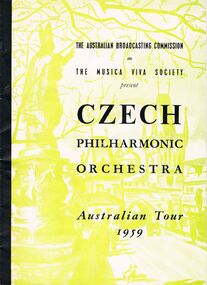
... Australian Broadcasting Commission. Chairman: Sir Richard Boyer, K.B.E., M.A. Vice-Chairman: E R Dawes, ESQ., C.M.G. Sir John Medley, KT., D.C.L., M.A. The Hon. Dame Enid Lyons, G.B.E. Mrs. G L Byth, O.B.E., B.A. A G Lowndes, M.Sc. H B Halvorsen, F.C.A., F.C.I.S. General Manager: Charles Moses, C.B.E. Manager for Victoria: Ewart Chapple. Concert Manager for Victoria: Ray Humphrey. Advertisements: AWA - Amalgamated Wireless (Australasia) Limited. Stereophonic Radiolagram. Philips Electrical Industries Pty Ltd. Fontana - Karel Ancerl recordings. The Ace of Clubs, 12'' LP Beethoven etc. Alfred Nott Pty. Ltd. H S Harvey, E Goetz, Opticians. Georges...Australian Broadcasting Commission. Chairman: Sir Richard Boyer, K.B.E., M.A. Vice-Chairman: E R Dawes, ESQ., C.M.G. Sir John Medley, KT., D.C.L., M.A. The Hon. Dame Enid Lyons, G.B.E. Mrs. G L Byth, O.B.E., B.A. A G Lowndes, M.Sc. H B Halvorsen, F.C.A., F.C.I.S. General Manager: Charles Moses, C.B.E. Manager for Victoria: Ewart Chapple. Concert Manager for Victoria: Ray Humphrey. Advertisements: AWA - Amalgamated Wireless (Australasia) Limited. Stereophonic Radiolagram. Philips Electrical Industries Pty Ltd. Fontana - Karel Ancerl recordings. The Ace of Clubs, 12'' LP Beethoven etc. Alfred Nott Pty. Ltd. H S Harvey, E Goetz, Opticians. Georges ...Czech Philharmonic Orchestra, Melbourne Town Hall. Australian Tour 1959. The first overseas symphony orchestra to visit this country. The Czech Philharmonic is one of the world's leading orchestras. It has s 60-year-old history which is backed by the rich musical traditions of its country. The Australian Broadcasting Commission in conjunction with the Musica Viva Society of Australia proudly presents the Czech Philharmonic Orchestra. Conductor: Ladislav Slovak Concertmaster: Bretislav Ludvik. Saturday, October 3, Monday, October 5. Czech Philharmonic Orchestra, article giving history of Orchestra from 1896 in Prague, photo of orchestra included. Ladislav Slovak, small article describing his work history, includes photograph. Programme. Analytical Notes. Musica Viva Society of Australia. Registered Office: 26 Paling's Building, Ash St., Sydney. President: Hon. Mr. Justice B P Macfarlan, Hon. Secretary: C J Berg, Hon. Treasurer: J B Elder, Manager: Regina Ridge. Victoria Branch: Registered Office: 5th Floor, 300 Lt. Collins St., Melbourne, C.1. President: F G Nicholls, Hon. Secretary: I G Spira, Hon. Treasurer: A Teague. Australian Broadcasting Commission. Chairman: Sir Richard Boyer, K.B.E., M.A. Vice-Chairman: E R Dawes, ESQ., C.M.G. Sir John Medley, KT., D.C.L., M.A. The Hon. Dame Enid Lyons, G.B.E. Mrs. G L Byth, O.B.E., B.A. A G Lowndes, M.Sc. H B Halvorsen, F.C.A., F.C.I.S. General Manager: Charles Moses, C.B.E. Manager for Victoria: Ewart Chapple. Concert Manager for Victoria: Ray Humphrey. Advertisements: AWA - Amalgamated Wireless (Australasia) Limited. Stereophonic Radiolagram. Philips Electrical Industries Pty Ltd. Fontana - Karel Ancerl recordings. The Ace of Clubs, 12'' LP Beethoven etc. Alfred Nott Pty. Ltd. H S Harvey, E Goetz, Opticians. Georges, shoes. Ernest Hiller, tailored suits. Philips Magnalux Television. TAA the nation's jet line. Cyclax, make-up and beauty preparations. Grutzner & Cartly Pty. Ltd. Furs. BNS Nylon - British Nylon Spinners (Australia) Pty. Ltd. Carinia Records - Czech Philharmonic Orchestra with World Famous Soloists now for the first time in Australia on High Fidelity Recordings. Suttons Pty. Ltd. 'The House of Music', you are cordially invited to inspect the fine Petrof pianos. RCA Records - recordings of Jan Peerce. Scala Record Import Co. Czech recordings. Boosey & Hawks (Australia) Pty. Ltd., Music and Books on Music. GMH - General Motors - Holden's Limited. Country Club Tailored by Buckwalter - Quiet Tone Sports Shirts. Allan's, Fine Pianos.entertainment, music, classical -
 Bendigo Historical Society Inc.
Booklet - Griffith Collection: 'BACKGROUND TO BEECHWORTH' THIRD EDITION, 1967
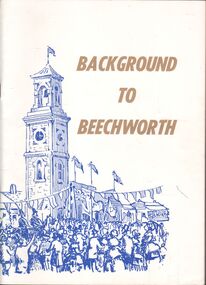
... George Smythe after his birthplace of Beechworth, Leicestershire in England. Beechworth gold Progress Association History Front cover: 'BACKGROUND TO BEECHWORTH' Back Cover: 'BEECHWORTH, VIC (FIRST SETTLED IN 1852)' '27 HISTORIC BUILDINGS' 'CLASSIFIED BY THE NATIONAL TRUST OF AUSTRALIA (VIC)' Title Page: 'Background to Beechworth From 1852' 'THIRD EDITION' 'Compiled by Rot C. Harvey, Beechworth' 'First Published in March 1952; Reprinted June, 1964 for the Beechworth Centenary Publicity Committee' 'Printed by THE BORDER MORNING MAIL (Vic) Pty. Limited ...The area around the town of Beechworth was settled by Europeans in the 1830s with much of the area being sheep runs. Gold was discovered in Spring Creek in 1852 and went on to become one of the richest goldfields in the area. The area known as May Day Hills goldfield area was surveyed, and the township of Beechworth was declared in 1853. The town was named by George Smythe after his birthplace of Beechworth, Leicestershire in England.Booklet with light cardboard cover white coloured with brown and blue printing. Front cover has picture of town of Beechworth. Cream coloured pages inside with black printing.Front cover: 'BACKGROUND TO BEECHWORTH' Back Cover: 'BEECHWORTH, VIC (FIRST SETTLED IN 1852)' '27 HISTORIC BUILDINGS' 'CLASSIFIED BY THE NATIONAL TRUST OF AUSTRALIA (VIC)' Title Page: 'Background to Beechworth From 1852' 'THIRD EDITION' 'Compiled by Rot C. Harvey, Beechworth' 'First Published in March 1952; Reprinted June, 1964 for the Beechworth Centenary Publicity Committee' 'Printed by THE BORDER MORNING MAIL (Vic) Pty. Limited' 'Published by Beechworth Progress Association, September, 1967'beechworth, gold, progress association, history -
 Bendigo Historical Society Inc.
Document - CONNELLY, TATCHELL, DUNLOP COLLECTION: DOCUMENT
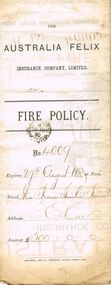
... Australia Felix Insurance Company Limited... Hon William Bates... Alderman O'Grady... John Danks... C J Ham... George...BUSINESS Legal connelly & tatchell Connelly & Tatchell Collection - Document Fire Policy No 4009 Frances Amelia Farrall The Australia Felix Insurance Company Limited Hon William Bates Alderman O'Grady John Danks C J Ham George Shaw George A Terry Horace Pewrkins H E Wade Messrs Davies & Strongman Australian & European Bank Limited The Australia Felix Insurance Company, Limited Fire Policy No. 4009 in the name of Miss Frances Amelia Farrall of Elmore, from 29 August 1879 to 29 August 1880. ...The Australia Felix Insurance Company, Limited Fire Policy No. 4009 in the name of Miss Frances Amelia Farrall of Elmore, from 29 August 1879 to 29 August 1880. Terms and conditions printed on the back. Printed in red and black with emblem Advance Australia printed above a wreath. Insurance company impression stamp in the bottom right corner. Receipt attached.business, legal, connelly & tatchell, connelly & tatchell collection - document, fire policy no 4009, frances amelia farrall, the australia felix insurance company limited, hon william bates, alderman o'grady, john danks, c j ham, george shaw, george a terry, horace pewrkins, h e wade, messrs davies & strongman, australian & european bank limited -
 Bendigo Historical Society Inc.
Document - LONG GULLY HISTORY GROUP COLLECTION: EDWARD CLARENCE DYASON
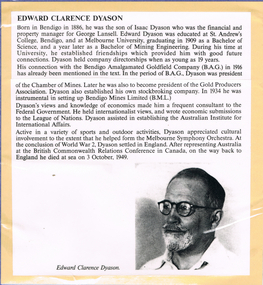
... George Lansell. After World Was 2, he settled in England. He represented Australia at the British Commonwealth Relations Conference in Canada, on the way back to England he died at sea on 3 October 1949. BENDIGO History long gully history group The Long Gully History Group - Edward Clarence Dyason Isaac Dyason George Lansell St Andrew's College Bendigo Melbourne University Bendigo Amalgamated Goldfield Company (B. A. G.) Chamber of Mines Gold Producers Association Bendigo Mines Limited ...Edward Clarence Dyason was born in Bendigo in 1886, the son of Isaac Dyason who was the financial and property manager for George Lansell. After World Was 2, he settled in England. He represented Australia at the British Commonwealth Relations Conference in Canada, on the way back to England he died at sea on 3 October 1949. Printed obituary with black and white photo of Edward Clarence Dyason. Printed article mounted on yellow card which is mounted on purple card and laminated.bendigo, history, long gully history group, the long gully history group - edward clarence dyason, isaac dyason, george lansell, st andrew's college bendigo, melbourne university, bendigo amalgamated goldfield company (b. a. g.), chamber of mines, gold producers association, bendigo mines limited (b.m.l.), league of nations, australian institute for international affairs, melbourne symphony orchestra, british commonwealth relations conference -
 Bendigo Historical Society Inc.
Document - LONG GULLY HISTORY GROUP COLLECTION: NEIGHBOURHOOD WATCH
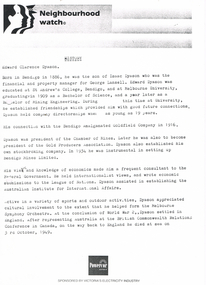
... George Lansell... St Andrew's College... Melbourne University... Bendigo Amalgamated Goldfield Company... Chamber of Mines... Gold Producers Association... Bendigo Mines Limited... League of Nations... Australian Institute for International Affairs... Melbourne Syphony Orchestra... World War II... British Commonwealth Relations Conference... Powercor Australia...BHS Collection BENDIGO History long gully history group The Long Gully History Group - Neighbourhood Watch Edward Clarence Dyason Isaac Dyason George Lansell St Andrew's College Melbourne University Bendigo Amalgamated Goldfield Company Chamber of Mines Gold Producers Association Bendigo Mines Limited League of Nations Australian Institute for International Affairs Melbourne Syphony Orchestra World War II British Commonwealth Relations Conference Powercor Australia City of Greater Bendigo Eaglehawk heritage Society Cornish Association Long Gully School Department of Main Roads St Laurence Court Charles Fay La Trobe History Department Cheryl Wallis Three pages, the first titled Neighbourhood Watch. ...BHS CollectionThree pages, the first titled Neighbourhood Watch. The second, dated 2/6/97, mentions a phone call to the City of Greater Bendigo about speaking to Marco in the Planning Department. The third, dated 30/5/97, also mentions Eaglehawk Heritage Society, Cornish Miners, Cornish Association, Long Gully School, Department of Main Roads, St laurence Court, Charles Fay, La Trobe History Department. It has Cheryl Wallis signature at the bottom of page.bendigo, history, long gully history group, the long gully history group - neighbourhood watch, edward clarence dyason, isaac dyason, george lansell, st andrew's college, melbourne university, bendigo amalgamated goldfield company, chamber of mines, gold producers association, bendigo mines limited, league of nations, australian institute for international affairs, melbourne syphony orchestra, world war ii, british commonwealth relations conference, powercor australia, city of greater bendigo, eaglehawk heritage society, cornish association, long gully school, department of main roads, st laurence court, charles fay, la trobe history department, cheryl wallis -
 Warrnambool and District Historical Society Inc.
Certificate, Duke of Cornwall
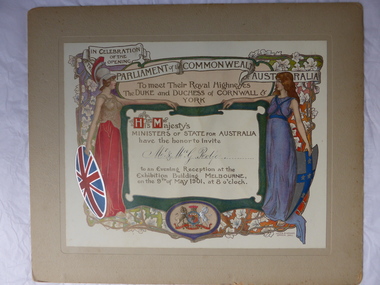
... Australia in January 1901. The certificate was sent to the invitees after the event as a souvenir of the occasion. The certificate was designed by the artists Julian and Howard Ashton and lithographed and issued by Sands and McDougall Limited of Melbourne. This particular certificate was sent to George...Australia in January 1901. The certificate was sent to the invitees after the event as a souvenir of the occasion. The certificate was designed by the artists Julian and Howard Ashton and lithographed and issued by Sands and McDougall Limited of Melbourne. This particular certificate was sent to George ...This certificate is an invitation to the Evening Reception in Melbourne in 1901, an event which was part of the celebrations in Melbourne to commemorate the Federation of the six colonies into the six States of Australia in January 1901. The certificate was sent to the invitees after the event as a souvenir of the occasion. The certificate was designed by the artists Julian and Howard Ashton and lithographed and issued by Sands and McDougall Limited of Melbourne. This particular certificate was sent to George Rolfe and his wife Annie. George Rolfe (1836-1919), a tea merchant from Melbourne, began buying blocks of land near the mouth of the Hopkins River in the 1870s. By the early 1880s he had acquired 50 acres of land in the town and several nearby farming properties. He used the buildings on the land at the mouth of the River Hopkins as holiday accommodation and called this property Lyndoch. Rolfe improved this property adding stables, jetty, boathouse, bone and chaff sheds, reservoir and windmill and extensive gardens. Rolfe spent most of his later life at Lyndoch. Today the property is the site of an Aged Care Facility. This certificate is of considerable importance for two reasons: 1. It is an attractive and valuable memento of a signal event in Australia’s history – the Federation of the States in 1901. 2. The certificate was an invitation to Mr and Mrs George Rolfe. Rolfe was a prominent person in Warrnambool in the late 19th and early 20th centuries. This is a multi-coloured certificate mounted on a piece of grey cardboard. The certificate is highly embossed and has a figure of Britannia in a red dress and a mailed vest holding a shield with the Union Jack emblem. Britannia is extending her hand to a figure of a younger woman representing Australia. This figure is dressed in blue and holds a shield which has a blue cross with white stars. The borders have vines and vine leaves and the Royal Crest is at the base of the certificate. The names of the invitees are handwritten in black ink. ‘In Celebration of the Opening of the Parliament of the Commonwealth of Australia, To Meet Their Royal Highnesses, the Duke and Duchess of Cornwall and York, His Majesty’s Ministers of State for Australia have the honor to invite Mr & Mrs G. Rolfe to an Evening Reception at the Exhibition Building, Melbourne on the 9th of May 1901, at 8 0’clock’. george rolfe of lyndoch, warrnambool, federation of australia, history of warrnambool, george rolfe -
 Bendigo Historical Society Inc.
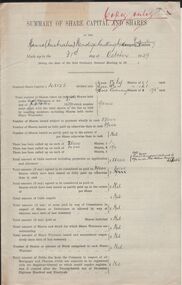
Document - HANRO COLLECTION: SUMMARY OF SHARE CAPITAL AND SHARES - OCTOBER 1929
... HANRO Clothing Share Register Hanro Collection - Summary of Share Capital and Shares Harry Francis Longstaff William Hall Russell Charles Handschin Consortium Hanro Caterine Hunter Favaloro Bros George Victor Lansell Edith Lansell William Wright William John Stephens Audrey Edith Lansell Marie Gwendoline Lansell Patricia Hope Lansell Alexander Lewis Goldie Lillie Goudie McGregor Herbert Keck Smalley Balmer & Cook William Bowman H Neill Ronald Alexander Rankin John Jepson Stanistreet Eugene Bloch William Crowley Mabel Gittins Mary Anderson Kenneth Smalley John Raeburn Balmer William Reddish Cook Favaloro Domeric Katie Bloch Evelyn Adrienne Neill Elizabeth Neill Alice Handschin Caroline Goldie Francesca Black Marie Maranta Ernest Gossweiller E F Granger Summary of Share Capital and Shares of the Hanro (Australia) Bendigo Knitting Mills Company Proprietary Limited made up to the 31st day of October 1929 which have the names, addresses and occupations of the shareholders. ...Summary of Share Capital and Shares of the Hanro (Australia) Bendigo Knitting Mills Company Proprietary Limited made up to the 31st day of October 1929 which have the names, addresses and occupations of the shareholders.hanro, clothing, share register, hanro collection - summary of share capital and shares, harry francis longstaff, william hall russell, charles handschin, consortium hanro, caterine hunter, favaloro bros, george victor lansell, edith lansell, william wright, william john stephens, audrey edith lansell, marie gwendoline lansell, patricia hope lansell, alexander lewis goldie, lillie goudie mcgregor, herbert keck, smalley balmer & cook, william bowman h neill, ronald alexander rankin, john jepson stanistreet, eugene bloch, william crowley, mabel gittins, mary anderson, kenneth smalley, john raeburn balmer, william reddish cook, favaloro domeric, katie bloch, evelyn adrienne neill, elizabeth neill, alice handschin, caroline goldie, francesca black, marie maranta, ernest gossweiller, e f granger -
 Bendigo Historical Society Inc.
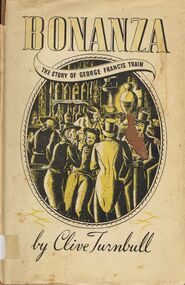
Book - ALEC H CHISHOLM COLLECTION: BOOK ''BONANZA'' BY CLIVE TURNBULL
... ALEC H CHISHOLM COLLECTION. 47 page hardback book telling the story of George Francis Train (an eccentric American millionaire). Australian Heritage Books, edition limited to 500 copies. ...ALEC H CHISHOLM COLLECTION. 47 page hardback book telling the story of George Francis Train (an eccentric American millionaire). Australian Heritage Books, edition limited to 500 copies. ...Book. ALEC H CHISHOLM COLLECTION. 47 page hardback book telling the story of George Francis Train (an eccentric American millionaire). Australian Heritage Books, edition limited to 500 copies. Published in 1946 by the Hawthorn Press, Melbourne. Designed and printed by John Gartner at the Hawthorn Press. Catalogue sticker '2160 TUR' on spine.Clive Turnbulllbooks, collections, biography, alec h chisholm collection, clive turnbull, george francis train, biography -
 Bendigo Historical Society Inc.
Document - MCCOLL, RANKIN AND STANISTREET COLLECTION: EAST CLARENCE GOLD MINING CO NL, 1932 - 1946
... George 5th and a crown above his head addressed to Mrs. C. Russell of 7 Willowbank Road N7, Melbourne. War Damage Commission receipts. Correspondence from The English Scottish & Australian Bank Limited regarding Treasury Bonds. ...George 5th and a crown above his head addressed to Mrs. C. Russell of 7 Willowbank Road N7, Melbourne. War Damage Commission receipts. Correspondence from The English Scottish & Australian Bank Limited regarding Treasury Bonds. ...Document. Envelope contains: - Insurance Policies, Receipts Hire agreement for Steam driven air compressor and site map and specifications. Tender for new compressor, treasure Bonds and Lease Agreements. Envelope with a 2 pence red postage stamp with the profile of King George 5th and a crown above his head addressed to Mrs. C. Russell of 7 Willowbank Road N7, Melbourne. War Damage Commission receipts. Correspondence from The English Scottish & Australian Bank Limited regarding Treasury Bonds. Receipt for Boiler Test, Certificate of inspection of Boiler.McColl, Rankin & Stanistreetorganization, business, gold mining - legal, mccoll, rankin & stanistreet, east clarence gmc nl, gold mining, insurance policies, treasury bonds -
 Alfred Hospital Nurses League - Nursing History Collection
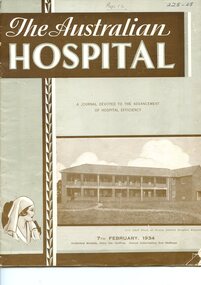
Journal - Illustrated Journal, Hospitals Commission of NSW, The Australian Hospital, 1934
... George Hospital, Kogarah) Issue date below this photograph and then the words 'Published Monthly, Price One Shilling, Annual Subscription Ten Shillings'. There is a vertical margin to the bottom left of which is a sketch of a nurse wearing a veil. There is a brown border across the bottom of front cover. The Australian Hospital Journal Illustrated Journal Hospitals Commission of NSW Jackson & O'Sullivan Limited ...Articles and advertisements relating to hospitals. Item of particular interest [on page 12]is the one titled 'Move for nurses post graduate education' by Sir James Barrett. The president of the provisional committee for this was Grace Wilson, Alfred Hospital Matron.Stapled journal.Front cover has a grey background. Title is printed in white on a brown banner on front cover, rest of print in brown. The words 'A JOURNAL DEVOTED TO THE ADVANCEMENT/OF HOSPITAL EFFICIENCY' appear above a brown and white photograph of a two story building (New Adult Block, St George Hospital, Kogarah) Issue date below this photograph and then the words 'Published Monthly, Price One Shilling, Annual Subscription Ten Shillings'. There is a vertical margin to the bottom left of which is a sketch of a nurse wearing a veil. There is a brown border across the bottom of front cover.non-fictionArticles and advertisements relating to hospitals. Item of particular interest [on page 12]is the one titled 'Move for nurses post graduate education' by Sir James Barrett. The president of the provisional committee for this was Grace Wilson, Alfred Hospital Matron.hospitals - nsw, post graduate nursing education -
 Glen Eira Historical Society
Article - ELSTERNWICK CLASSIC CINEMA
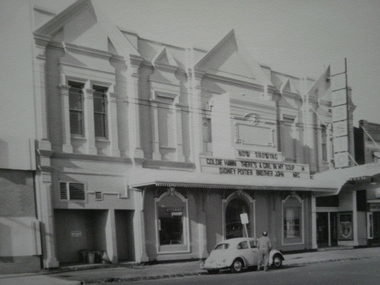
... Australia... National Trust Register... Elsternwick Theatre... Pausacker Ian... Classic Cinema... entertainment... cinemas... theatres... Victorian style... Elsternwick Public Hall... Skating Rink Company Limited... Selwyn Street... Victorian Permanent Building Society... Community Centres... Films... shows and exhibitions... film projectors... Amalgamate Picture Company Ltd.... Richardson Frank G.... architecture... stairs... Associated Theatres Limited... Ballantyne and Hared... balconies... architectural features... entrances... Depression 1929-1939... Astor... dancehalls... Esquire Theatre... Prentice George...Elsternwick Classic Cinema Gordon Street Elsternwick Dorchester Dance Hall National Trust of Australia National Trust Register Elsternwick Theatre Pausacker Ian Classic Cinema entertainment cinemas theatres Victorian style Elsternwick Public Hall Skating Rink Company Limited Selwyn Street Victorian Permanent Building Society Community Centres Films shows and exhibitions film projectors Amalgamate Picture Company Ltd. Richardson Frank G. architecture stairs Associated Theatres Limited Ballantyne and Hared balconies architectural features entrances Depression 1929-1939 Astor dancehalls Esquire Theatre Prentice George ...This file contains 4 items relating to the Elsternwick Classic Cinema: 1/1 original black and white photograph of the Elsternwick Classic Cinema, 9 Gordon Street Elsternwick. Date and photographer unknown. 2/ 2 photocopied photos of the Elsternwick Classic Theatre in its various stages of operation. One photo is of it as the Dorchester Dance Hall between 1938 and 1946 and the other is of the Classic Cinema in 1994. Photographers unknown. 3/National Trust of Australia (Victoria) Classification Report on Elsternwick Theatre with attached cover letter addressed to the Manager of the Planning Section, City of Glen Eira Council, from Ian Pausacker from the National Trust dated 04/10/2000. The report includes a statement of significance, history, description, context and floor plans of the theatre. 4/1 newspaper article written by Alex Njoo from the Caulfield/Port Philip Leader, 31/01/2012, congratulating the Tamir family on their conservation of the Elsternwick Classic Cinema. Includes a colour photo of the Tamirs, photographer unknown.elsternwick classic cinema, gordon street, elsternwick, dorchester dance hall, national trust of australia, national trust register, elsternwick theatre, pausacker ian, classic cinema, entertainment, cinemas, theatres, victorian style, elsternwick public hall, skating rink company limited, selwyn street, victorian permanent building society, community centres, films, shows and exhibitions, film projectors, amalgamate picture company ltd., richardson frank g., architecture, stairs, associated theatres limited, ballantyne and hared, balconies, architectural features, entrances, depression 1929-1939, astor, dancehalls, esquire theatre, prentice george, plottel joseph, architects, cowper murphy and associates, sharon cinema, tamir eddie, readings, free classical style, plans, business people, njoo alex, tamir family -
 Warrnambool and District Historical Society Inc.
Book - Biography of George Mackenzie, Kevin O'Reilly, George Mackenzie of Pella, 2019
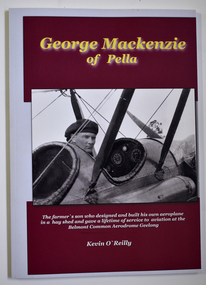
... George Mackenzie from Pella near Rainbow in Victoria. He was a pioneer aviator who designed and built his own aeroplane at Pella in 1920 and contributed to Australian aviation heritage through his involvement with the Pratt aviation company, Brown and Dureau Limited and Corio Air Engineers, all based at the Belmont Common Aerodrome in Geelong. ...George Mackenzie from Pella near Rainbow in Victoria. He was a pioneer aviator who designed and built his own aeroplane at Pella in 1920 and contributed to Australian aviation heritage through his involvement with the Pratt aviation company, Brown and Dureau Limited and Corio Air Engineers, all based at the Belmont Common Aerodrome in Geelong. ...Biographical details of George Mackenzie, a pioneer aviator in VictoriaThis is a book of 68 pages with a white cover with two black and white photographs set in a red background. The printing on the cover is yellow and white. The pages contain black and white photographs and printed text.non-fictionBiographical details of George Mackenzie, a pioneer aviator in Victoriageorge mackenzie pioneer aviator, belmont common aerodrome geelong, pratt aviation company geelong -
 Bendigo Historical Society Inc.
Administrative record - Abbott Collection: 32 invoices from Jan to Dec 1918, from a range of businesses; addressed to J.H. Abbott & Co
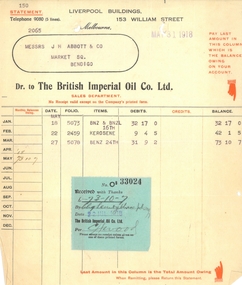
... George Russell, 454-460 Flinders Str Melbourne. - 3 invoices & receipts Ullathorne Hartridge Co. Ltd. invoice The Dunlop Rubber Co. of AUS. Ltd. - 3 invoices & receipts The Dalgety Company Limited - 2 receipted invoices Guthridge & Co. invoice The Royal Agricultural Society of Victoria correspondence Eliza Tinsley, steel merchants Melbourne - invoice The Australian Explosives and Chemical Company Limited invoice & receipt The Gair Manufacturing Co. - 2 invoices & receipt C. ...George Russell, 454-460 Flinders Str Melbourne. - 3 invoices & receipts Ullathorne Hartridge Co. Ltd. invoice The Dunlop Rubber Co. of AUS. Ltd. - 3 invoices & receipts The Dalgety Company Limited - 2 receipted invoices Guthridge & Co. invoice The Royal Agricultural Society of Victoria correspondence Eliza Tinsley, steel merchants Melbourne - invoice The Australian Explosives and Chemical Company Limited invoice & receipt The Gair Manufacturing Co. - 2 invoices & receipt C. ...32 invoices from Jan to Dec 1918, from a range of businesses; addressed to J.H. Abbott & Co. Abbott Collection: 32 invoices from Jan to Dec 1918, from a range of businesses; addressed to J.H. Abbott & Co. J.H. Abbott & Co. Bendigo invoice The State Assurance Co Ltd (of Liverpool) - 2 renewal receipts The British imperial Oil Co. Ltd. - 2 invoices & receipts The Lion Rolling Mills - 4 invoices & receipts McPhersons Pty. Ltd. - 2 invoices & receipts Miller & Co. Pty. Ltd. - 2 invoices & receipts George Russell, 454-460 Flinders Str Melbourne. - 3 invoices & receipts Ullathorne Hartridge Co. Ltd. invoice The Dunlop Rubber Co. of AUS. Ltd. - 3 invoices & receipts The Dalgety Company Limited - 2 receipted invoices Guthridge & Co. invoice The Royal Agricultural Society of Victoria correspondence Eliza Tinsley, steel merchants Melbourne - invoice The Australian Explosives and Chemical Company Limited invoice & receipt The Gair Manufacturing Co. - 2 invoices & receipt C. S. Green & Son, 368-370 Post Office Place, Melbourne, hardware merchants' invoice Barnet Glass Rubber Co. Ltd. - receipted invoice C. Harper, saddle & harness Manufacturer & Importer, Bath Corner, Charing Cross, Bendigo - invoiceabbott, invoices -
 Bendigo Historical Society Inc.
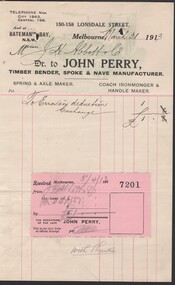
Administrative record - Abbott Collection: 1913 invoices & correspondence - correspondence from 61 individual companies addressed to J.H. Abbott & Co
... Australia) Limited, Glaasgow - 6 letters I The Federal Manure Co., The Australian Explosives and Chemical Coy. Ltd., Melbourne - 8 letters J Ullathorne, Hartridge Co. Ltd., Melbourne - 2 letters & 2 invoices K Richard Linton, Melbourne - 1 letter & 1 invoice L George Russell Prop. ...Australia) Limited, Glaasgow - 6 letters I The Federal Manure Co., The Australian Explosives and Chemical Coy. Ltd., Melbourne - 8 letters J Ullathorne, Hartridge Co. Ltd., Melbourne - 2 letters & 2 invoices K Richard Linton, Melbourne - 1 letter & 1 invoice L George Russell Prop. ...A wide range of invoices and business letters from 1913 from 66 companies (predominantly Melbourne based companies) addressed to J.H. Abbott 1913 Company correspondence from 61 companies/organisations addressed to Mr. J.H. Abbott: A John Perry, Timber Bender, Spoke & Nave manufacturers - 6 letters and invoices B James Miller & Co, Rope, Twine & Mat Manufacturers - 2 invoices C Dalgety Company Limited, general merchandise - 6 invoices D Gibbs, Bright & Co., Melbourne - 2 letters E Thomas McPherson & Son (McPhersons Pty. Ltd.), Iron & Machinery Merchants - 2 correspondence & 1 invoice F Bickford, Smith & Co., manufacturers of Safety Fuse, Melbourne - 3 letters G Hopkins Bros & Odlum, Machine Belting Manufacturers, Melbourne, H Stewart & Lloyds (Australia) Limited, Glaasgow - 6 letters I The Federal Manure Co., The Australian Explosives and Chemical Coy. Ltd., Melbourne - 8 letters J Ullathorne, Hartridge Co. Ltd., Melbourne - 2 letters & 2 invoices K Richard Linton, Melbourne - 1 letter & 1 invoice L George Russell Prop. Ltd., Iron & Steel Merchants, General Hardware Importers, Melbourne - 1 invoice & 8 letters M J. Kitchen & Sons Ltd., Candle & Soap Manufacturers Glycerine Refiners & Tallow Brokers, Melbourne - 10 letters N G. G. Crespin & Son, Melbourne - 4 letters O Noyes Bros. (Melbourne) Propy. Ltd. - 3 letters P The Eagle & Globe Steel Co., Melbourne - 4 letters & 1 memorandum Q C.S. Green & Son, 368 & 370 Post Office Place, Melbourne - 1 invoice & 1 memorandum R Michaelis, Hallenstein & Co. Proprietary Limited., 382-384 Lonsdale Street, Melbourne - 4 business letters S R.W. Cameron & Co.,34 Queen Street, Melbourne (agent for The Texas Co.) - 2 business letters T Joyce Bros. Ltd., 475 - 481 Flinders Lane (West), Melbourne - 2 business letters U Keep Bros. & Wood, importers of Carriage Materials, 100 Franklin Street, Melbourne - 2 business letters V Lycett Agency Manufacturing Co., P.O. Box 643 G.P.O., Melbourne - 3 business letters W Currie and Richards, Galvanised Iron Merchants, Importers and Spouting Manufacturers, 3 locations Melbourne - 2 business letters X James Outen, Saddlery Goods and Patent Horse and Cow Rugs, 184-186 Queen Street, Melbourne - 2 business letters Y Standard Oil Company of New York, Branch office Australasia, Melbourne - 5 business letters Z Jas. Henty & Co., Manufacturers of Soap, Starch, Candles, Soda Crystals, etc., 95 & 97 William Street, Melbourne - 7 business letters AA John Sanderson & Co., Mercghandise Department 111 William Street, Melbourne - 9 business letters AB Gargoyle Oil Company Pty. Ltd., 90 & 92 William Street, Melbourne - 3 business letters AC Dunlop Rubber Co. of Australasia Ltd.,108 Flinders Street, Melbourne - 3 business letters AD Perry's Australian Fuse manufacturing Company, manufacturers of Safety Fuses for Mining and Other Purposes, Ballarat Road, Footscray - 6 business letters AE Morris & Meeks, Little Collins Street, Melbourne - 4 business letters AF Brown & Dureau Ltd., Mercantile Brokers, Commission and Manufacturers'' Agents, Import and Export, 9 Queen Street, Melbourne - 6 business letters AG Michaelis, Hallenstein & Co. Proprietary Limited, Tanners, Curriers, Leather & Grindery Merchants, Saddlers' Ironmongers, Manufacturers of Glue, Doe Hair & Neatsfoot Oil, 385-384 Lonsdale Street, Melbourne - 2 letters AH Marwald, Son & Lemon, Indenting Agents and Importers, 201-3 William Street Melbourne (Sydney Brisbane, London, Wellington NZ, Fremantle) - 2 business letters AI 32 individual suppliers' invoices and business letters from companies in Bendigo, Melbourne and London (covering a wide range of supplies - glass, rubber, oils, hides, accountants, harvesters, etc.)company invoices and business correspondence -
![Booklet - Who's who at Massey-Ferguson (Australia) limited, Sunshine [1958], McKay Massey Harris, H.V](/media/collectors/5164c1772162ef0c64d700f2/items/69dc57946a5a9c1cb356dc1d/item-media/69dc61006a5a9c1cb356f7af/item-fit-380x285.jpg?cb=6) Sunshine and District Historical Society Incorporated
Sunshine and District Historical Society IncorporatedBooklet - Who's who at Massey-Ferguson (Australia) limited, Sunshine [1958], McKay Massey Harris, H.V
... Australia)|(2) J.K (Ken) Gaunt, Chief Engineer|(3) R. V (Dick) Muspratt, Staff Co-ordinator|(4) W. A. (Bill) Moeser, General Factory Manager|(5) L. H (Larry) Pomeroy, General Marketing Manager|(6) G.M. (Godfrey) Taylor, Secretary - Treasurer|(7) C. A. (Colin) Watts, Comptroller|(8) J. M (John) Vance, General Planning Manager|(9) G. R. (George) Johnson, General Sales Manager|(10) B. F..D (Brian ) Harrod, Staff Assistant, Marketing|(11) D. B. (Ben) Kerville, Publicity Manager Who's who at Massey-Ferguson (Australia) limited ...massey ferguson, sunshine harvester works
