
Showing 71 items matching "grain mills"
-
 Wodonga & District Historical Society Inc
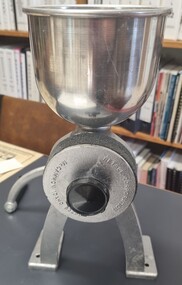
Domestic object - Grain Mill
... Grain Mill...Grain Mill......Grain mills...Grain mills such as this were used widely throughout the Wodonga district in the late 20th Century and have had a resurgence in many areas....A grain mill made from metal with two grinding stones. ...Grain Mill Domestic object Grain Mill ...Flour has been produced for centuries by grinding a variety of grains to make flour. In the early years of the Retsel Corporation established 1962, their designers carried out research which convinced them that grinding of flour between slow turning stones produced a better quality of flour. They continue to market grain mills similar to this item. The black knob on the side allows for the distance between the stones to be adjusted so that flour of varying coarseness can be milled. Grain mills such as this were used widely throughout the Wodonga district in the late 20th Century and have had a resurgence in many areas.This item is significant because it is representative of domestic appliances used in the Wodonga district.A grain mill made from metal with two grinding stones. The small black knob on the side enables the distance between stones to be adjusted. Each foot has holes to allow the mill to be screwed to a bench for added stability. The long handle is used to turned to drive the machine. The large funnel is set into a hole on the top of the mill to hold grain. Another bowl would be placed underneath the outlet at the bottom to catch the flour.On handle and circular disc: RETSEL CORPORATION McCAMMON IDAHO 83250domestic appliances, grain mills -
 Stawell Historical Society Inc
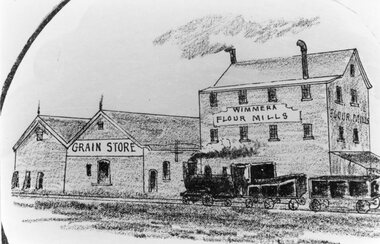
Drawing, Wimmera Flour Mills and Grain Store in Taylor Street c1890 -- Sketch
... Wimmera Flour Mills and Grain Store in Taylor Street c1890 -- Sketch...Wimmera Flour Mills and Grain Store Taylor Street From Sketch series Circa 1890...Wimmera Flour Mills and Grain Store Taylor Street From Sketch series Circa 1890 Stawell Businesses Wimmera Flour Mills and Grain Store in Taylor Street c1890 -- Sketch Drawing ...Wimmera Flour Mills and Grain Store Taylor Street From Sketch series Circa 1890stawell businesses -
 Mont De Lancey
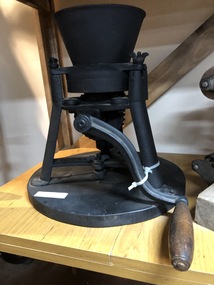
Grain Mill, J A Berrill & Son, Circa 1900's - 1910's
... Grain Mill...Cast iron grain mill with hand-cranked wooden handle, on a cast iron base....Grain Mill J A Berrill & Son ...Cast iron grain mill with hand-cranked wooden handle, on a cast iron base.Watervilemill equipment -
 Whitehorse Historical Society Inc.
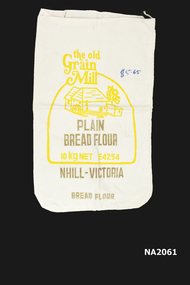
Domestic object - Flour Bag
... The Old Grain Mill|Plain Bread Flour| 10 KG net E4254|Nhill, Victoria...DOMESTIC ITEMS Food Storage & Preservation The Old Grain Mill|Plain Bread Flour| 10 KG net E4254|Nhill, Victoria White flour bag. ...White flour bag.The Old Grain Mill|Plain Bread Flour| 10 KG net E4254|Nhill, Victoriadomestic items, food storage & preservation -
 Whitehorse Historical Society Inc.
Domestic object - Flour Bag
... The Old Grain Mill|Plain Bread Flour|10 KG Net E4254|Nhill, Victoria|Bread Flour...DOMESTIC ITEMS Food Storage & Preservation The Old Grain Mill|Plain Bread Flour|10 KG Net E4254|Nhill, Victoria|Bread Flour White flour bag. ...White flour bag.The Old Grain Mill|Plain Bread Flour|10 KG Net E4254|Nhill, Victoria|Bread Flourdomestic items, food storage & preservation -
 Bendigo Historical Society Inc.
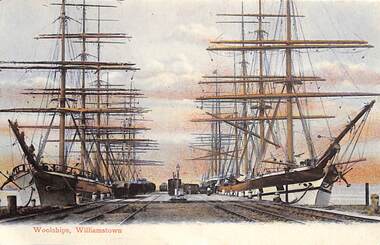
Postcard - Woolships, Williamstown, 1914
... The Noske Bros. were pioneer flour millers who built a grain milling empire across Victoria and South Australia....The Noske Bros. were pioneer flour millers who built a grain milling empire across Victoria and South Australia. ...The Noske Bros. were pioneer flour millers who built a grain milling empire across Victoria and South Australia.Mabel Moorehead Collection: Coloured advertising postcard with an image of two sailing ships with sails furled, docked on either side of a pier. Two parallel railway tracks run along the pier. On the reverse is printed advice from Noske Bros, to Mr J. E. Moorehead, Riversdale Rd. Surrey Hills advising him of the despatch of bags of pollard, bran and wheat. Dated 13.11.1914, out of Melbourne.Woolships, Williamstownnoske bros., sailing ships, williamstown pier, moorhead -
 The Beechworth Burke Museum
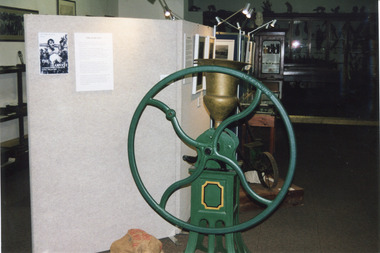
Photograph, Estimate 1999
... ...grain mill...This photograph was taken in 1999 at 'The Harvest' exhibition at the Burke Museum for members of Baking Industry Victoria. The grain mill, manufactured by B.M. Purshouse in Wolverhampton, England, was of special interest....This photograph was taken in 1999 at 'The Harvest' exhibition at the Burke Museum for members of Baking Industry Victoria. The grain mill, manufactured by B.M. Purshouse in Wolverhampton, England, was of special interest. ...This photograph was taken in 1999 at 'The Harvest' exhibition at the Burke Museum for members of Baking Industry Victoria. The grain mill, manufactured by B.M. Purshouse in Wolverhampton, England, was of special interest.This photograph is of primary social significance to the Beechworth community because it depicts a 19th-century grain mill, manufactured by B.M. Purshouse in Wolverhampton, England, which was probably used at flour mills in the Ovens District, such as that at Tarrawingee, which opened in 1866. The purchase of agricultural machinery such as the grain mill accompanied the expansion of agriculture, including grain growing, in the Ovens District following the gold mining prosperity of the 1850s. This photograph may be of interest to researchers who wish to observe an image of the Purshouse grain mill.Colour rectangular photograph printed on matte AGFA photographic paper.Obverse: THE HARVEST / THE HARVEST Reverse: 2854beechworth, burke museum, promoting settlement, living in country towns, making regional centres, preserving traditions and commemorating, farming and agriculture, exhibitions, burke museum exhibitions, building local economies, transforming land, victorian agricultural history, marketing and promoting agricultural products, the harvest exhibition, harvests, victorian gold rush towns, grain mill, bm purshouse, crops and grain, baking industry victoria -
 Bendigo Historical Society Inc.
Document - BENDIGO SALEYARDS COLLECTION: THE BENDIGO SALEYARDS ECONOMIC VIABILITY STUDY
... Grain Co... Eaglehawk Chaff Mills...Kate Millard Loddon Campaspe Planning Authority Street Ryan and Associates Bendigo City Council Strathfieldsaye Shire Council Department of Industry Technology & Resources National Library of Australia Meldrum Burows & Partners Core Wilson Sayer Town Planning Appeals Panel CES Victorian Farmers and Graziers Association Stock Agents Association Department of Agriculture Department of Industry Technology & Resources Department of Conservation Forests and Land Cr Jock Comini RCA Depot Wellsford Rifle Range Bendigo Airport Bendigo Field Naturalists Club Mr David Kennedy Mr John Brumby Mr John Radford Neil O'Keefe Bendigo East Progress Association Bendigo East Traders Trades Hall Council Mr Tom Uren Mr Frank Wilkes Mr Bruce Reid Mr K I M Wright Mr E T Ebery Bendigo Pastoral Council of the VFGA Victorian Meatworks Association Bendigo Stock & Station Agents Association Rutlands Transport Mr Don Pickles Country Abattoirs & Wholesalers Association Association of Victoria Meat and Allied Trade Federation of Australia Bendigo Saleyards Advisory Committee Bendigo Residents & Ratepayers Association A H & N Graham Mrs P Unmack Australian Bureau of Statistics Mr Lloyd Houlden Cr C Rodda Mr Jolly Mr Tony Milanese Dr Robert Carter University of Melbourne Bendigo College of TAFE T Matthews A S & R D Rutland John Kerr J Talbot G L O'Sullivan Penney & Lang Pty Ltd Graeme Pickering Pickhall J W & Sons R A Plant W K Schmidt T J Vick K & J Wignall A E Wright G Chapman A J Gillies P G & M M Harris Ian R Hollingsworth B Kennedy S Letcher S & D K Letcher P M Llewellyn L G Mason Boyer R T Connally M F Kennedy & Mortlock Nevins J P R W Johnstone W J Keith B D Kelly Notman R Pitts A J & C A Pitts Mervyn L & Co Rowe W O Warren K M Associated Stock & Station Agents Dalgety Farmers Ltd Elders DSM Estates Ellis Nuttall & Co Gallagher G D Hamilton Real Estate McGregor Ralph H & Co McKean W & Co Miller Turner Livestock Co Vains E M & Co Victorian Producers Hill M J & Co Bennetts Meats Comell Bros Davis B & D Hardwick G F & V C Penney & Lang P/L Tendercut Meats Northern Seed Supply Co Bendigo Fertilizers Agri Business Pty Ltd Agrilink Consulting Group Pty Ltd Acil Aust Pty Ltd McGowan & Associates Chapman W C Talbot E J McCulloch W & Sons Pty Ltd K V Equipment Commercial Egg Producers Assoc Co-op Monsanto Aust Ltd Balmer Bryan R Barry I J Bath L Clarke B J Treacy K M Turner J M Bendigo Mower Serv Pty Ltd Everlast Concrete Tank tyLtd Wicks Bros canvas Goods Don McArthur Bendigo Communications Transcom Emdell Pty Ltd Epsom Pharmaceutical Supplies Sandhurst Fencing Pty Ltd Arnolds Gates & Fencing R Furniss Carne Neville AWA & UNICLA AJM Refrigeration bendigo Concrete Sawing Service Hamilton R J Hearpes T W J E Brown Campey DR A R Fyffe J J Kangaroo Flat Vet Clinic Ottrey K E Bendigo Sprinkler Installations Milnes Irrigation Onga Pumpshop Barastoc Products Bush's Produce Stores Epsom Produce K M M Pty Ltd Bendigo Grain Co Eaglehawk Chaff Mills Grain Elevators Board Dept Bonneys Pest Control Knights Pest Control Brown Wk & L d Bendigo Sewerage Authority Bendigo Water Board ACI Computer Services Leham Donald A E Hueffer & Associates Wolmoke Planners P Langley Mr Ken Strachan Mr Evan Jones Mr Peter Byrnes Mr Wayne Street Street Ryan & Associates 140 Loose pages titled The Bendigo Saleyards Economic Viability Study. ...140 Loose pages titled The Bendigo Saleyards Economic Viability Study. Report written by Kate Millard on behalf of the Bendigo Development Committee Inc. Contents include: Chapter 1 - Background Information, Chapter 1 - Present Operations at the Saleyards, Chapter 3 - Economic Factors, Chapter 4 - Environmental Factors, Chapter 5 - Selling Techniques, Chapter 6 - Employment Study, Management and Sundry Issues, Chapter 7 - Survey of Farmers and Saleyard Users in the 'Catchment Area', and Chapter 8 - Recommendations of the Report. Includes diagrams and maps. Recommendations printed on dark yellow paper.bendigo, council, cattle markets, bendigo saleyards collection - the bendigo saleyards economic viability study, bendigo development committee inc., kate millard, loddon campaspe planning authority, street, ryan and associates, bendigo city council, strathfieldsaye shire council, department of industry technology & resources, national library of australia, meldrum burows & partners, core wilson sayer, town planning appeals panel, ces, victorian farmers and graziers association, stock agents association, department of agriculture, department of industry technology & resources, department of conservation forests and land, cr jock comini, rca depot, wellsford rifle range, bendigo airport, bendigo field naturalists club, mr david kennedy, mr john brumby, mr john radford, neil o'keefe, bendigo east progress association, bendigo east traders, trades hall council, mr tom uren, mr frank wilkes, mr bruce reid, mr k i m wright, mr e t ebery, bendigo pastoral council of the vfga, victorian meatworks association, bendigo stock & station agents association, rutlands transport, mr don pickles, country abattoirs & wholesalers association association of victoria, meat and allied trade federation of australia, bendigo saleyards advisory committee, bendigo residents & ratepayers association, a h & n graham, mrs p unmack australian bureau of statistics, mr lloyd houlden, cr c rodda, mr jolly, mr tony milanese, dr robert carter, university of melbourne, bendigo college of tafe, t matthews, a s & r d rutland, john kerr, j talbot, g l o'sullivan, penney & lang pty ltd, graeme pickering, pickhall j w & sons, r a plant, w k schmidt, t j vick, k & j wignall, a e wright, g chapman, a j gillies, p g & m m harris, ian r hollingsworth, b kennedy, s letcher, s & d k letcher, p m llewellyn, l g mason, boyer r t, connally m f, kennedy & mortlock, nevins j p, r w johnstone, w j keith, b d kelly, notman r, pitts a j & c a, pitts mervyn l & co, rowe w o, warren k m, associated stock & station agents, dalgety farmers ltd, elders dsm estates, ellis nuttall & co, gallagher g d, hamilton real estate, mcgregor ralph h & co, mckean w & co, miller turner livestock co, vains e m & co, victorian producers, hill m j & co, bennetts meats, comell bros, davis b & d, hardwick g f & v c, penney & lang p/l, tendercut meats, northern seed supply co, bendigo fertilizers, agri business pty ltd, agrilink consulting group pty ltd, acil aust pty ltd, mcgowan & associates, chapman w c, talbot e j, mcculloch w & sons pty ltd, k v equipment, commercial egg producers assoc co-op, monsanto aust ltd, balmer bryan r, barry i j, bath l, clarke b j, treacy k m, turner j m, bendigo mower serv pty ltd, everlast concrete tank tyltd, wicks bros, canvas goods, don mcarthur, bendigo communications, transcom, emdell pty ltd, epsom pharmaceutical supplies, sandhurst fencing pty ltd, arnolds gates & fencing, r furniss, carne neville, awa & unicla, ajm refrigeration, bendigo concrete sawing service, hamilton r j, hearpes t w, j e brown, campey dr a r, fyffe j j, kangaroo flat vet clinic, ottrey k e, bendigo sprinkler installations, milnes irrigation, onga pumpshop, barastoc products, bush's produce stores, epsom produce, k m m pty ltd, bendigo grain co, eaglehawk chaff mills, grain elevators board dept, bonneys pest control, knights pest control, brown wk & l d, bendigo sewerage authority, bendigo water board, aci computer services, leham donald, a e hueffer & associates, wolmoke planners, p langley, mr ken strachan, mr evan jones, mr peter byrnes, mr wayne street, street ryan & associates -
 The Beechworth Burke Museum
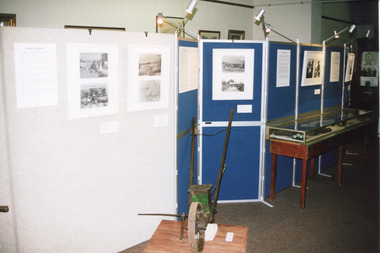
Photograph, 1999
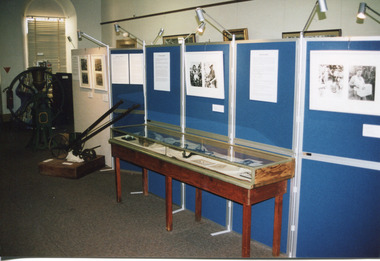
... ...Grain Mill...In the foreground is believed to be an old seed distributor. The grain mill made by B. M. Purshouse in Wolverhampton, United Kingdom, was of special interest during the exhibition. ...In the foreground is believed to be an old seed distributor. The grain mill made by B. M. Purshouse in Wolverhampton, United Kingdom, was of special interest during the exhibition. ...Taken in 1999, the photograph depicts a section of “The Harvest” exhibition held at the Burke Museum between May 1st and June 20th 1999 as part of the Baking Industry Victoria. In the foreground is believed to be an old seed distributor. The grain mill made by B. M. Purshouse in Wolverhampton, United Kingdom, was of special interest during the exhibition. This photograph is of historical and research significance, connecting with various themes such as farming, adapting to diverse environments, and the promotion of settlement in Victoria. The photograph is an example of an exhibition held at the Burke Museum in 1999, demonstrating the communal interest of Beechworth in their farming history. The photograph contains a strong interpretive capacity as it demonstrates the importance of farming to Beechworth and Beechworth's history, revealing the enduring connection between the local community and the surrounding land. The historical and research value of the photograph is further enhanced by the depiction of historical farming machinery, providing a means for future generations to view historical machines used in farming. Colour rectangular photograph printed on photographic paper.Reverse: 2857burke museum, the harvest, exhibition, baking industry, grain mill, b. m. purshouse, beechworth, baking industry victoria, seed, seed distributor -
 The Beechworth Burke Museum
Photograph, 1999
... ...Grain Mill...In the foreground is depicted a seed distributor. The grain mill, which can be seen in the background, was made by B. ...In the foreground is depicted a seed distributor. The grain mill, which can be seen in the background, was made by B. ...Taken in 1999, the photograph depicts a section of “The Harvest” exhibition held at the Burke Museum between May 1st and June 20th 1999 as part of the Baking Industry Victoria. In the foreground is depicted a seed distributor. The grain mill, which can be seen in the background, was made by B. M. Purshouse in Wolverhampton, United Kingdom, and was of special interest during the exhibition. This photograph is of historical and research significance, connecting with various themes such as farming, adapting to diverse environments, and the promotion of settlement in Victoria. The photograph is an example of an exhibition held at the Burke Museum in 1999, demonstrating the communal interest of Beechworth in their farming history. The photograph contains a strong interpretive capacity as it demonstrates the importance of farming to Beechworth and Beechworth's history, revealing the enduring connection between the local community and the surrounding land. The historical and research value of the photograph is further enhanced by the depiction of historical farming machinery, providing a means for future generations to view historical machines used in farming.Colour rectangular photograph printed on photographic paper.Reverse: 2855burke museum, the harvest, baking industry, baking industry victoria, seed distributor, grain mill, b. m. purshouse, beechworth, exhibition -
 Bendigo Historical Society Inc.
Document - INVOICE COLLECTION: GOLDEN EAGLE
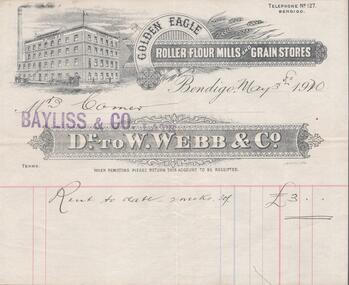
... Golden Eagle rolled flour mills and grain stores. Invoice dated Bendigo May 3rd, 1920 for 3 pounds. ...BENDIGO Business golden eagle Golden Eagle rolled flour mills and grain stores. Invoice dated Bendigo May 3rd, 1920 for 3 pounds. ...Golden Eagle rolled flour mills and grain stores. Invoice dated Bendigo May 3rd, 1920 for 3 pounds. Stamped in the middle Bayliss 7 co. Late.bendigo, business, golden eagle -
 Stawell Historical Society Inc
Photograph, Set of 5 Business promotional drawings for Newspaper Suppliment
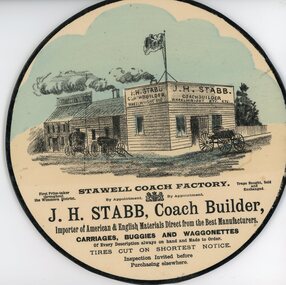
... See No 1156-A -3 The Wimmera Flour Mill Grain Store. See No 1178 -4 George Kay & Company / Wayman Kay. ...See No 1156-A -3 The Wimmera Flour Mill Grain Store. See No 1178 -4 George Kay & Company / Wayman Kay. ...-1 J.H. Stabb Coach Builder. See No 1167 -2 Times Office - Stawell Times & Wimmera Advertiser. See No 1156-A -3 The Wimmera Flour Mill Grain Store. See No 1178 -4 George Kay & Company / Wayman Kay. See No 1151-A -5 Ralph Dalkin Auctioneer Stock & General Commission Agent. See No 1180Five Drawings of businesses with details on backing boardDetails on bottom of drawingsadvertising -
 City of Moorabbin Historical Society (Operating the Box Cottage Museum)
Photograph, Black & White, J.L.Smith Hay & Grain Store c1916 Bentleigh, 1916
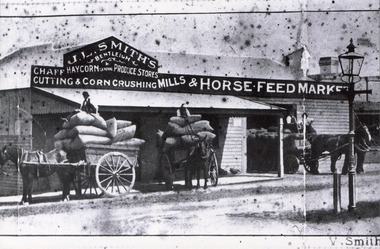
... mill powered by 10hp steam engine. The business prospered 1909 following the death of Tommy Bent, J/L Smith was nominated for Councillor of the Shire of Moorabbin. WW1 1914 - 18 both John and Mary Ann supported local War Relief Auxiliaries and their son Vic served as a Signaler in AIF. As Motor transport was increasing 1926 J L Smith built a small Garage on the opposite corner (Woolworths Supermarket 2005) , employed a good mechanic ( Reg Hunt ) and developed another successful business. The Grain...Black & White photograph of J L Smith Hay & Grain Store and Crushing Mill Jasper Rd / Centre Rd Bentleigh 1916. ...Smith Black & White photograph of J L Smith Hay & Grain Store and Crushing Mill Jasper Rd / Centre Rd Bentleigh 1916. ...John Logan Smith 1860-1932 , the son of Irish immigrants James and Marianne Smith was born at their home near the 'Toll Gates' on Point Nepean Road and Dendy Street. East Brighton. At that time the area had many orchards that were later replaced by market gardens. J.L.Smith at first rented a cottage 'Law Muir Den' & Shed from Mr Box and commenced business as a wood merchant - sawing logs into shorter pieces using one horse to power the saw. He purchased the property, added to the buildings , began trading in fuel and fodder as well and installed a chaff cutting mill powered by 10hp steam engine. The business prospered 1909 following the death of Tommy Bent, J/L Smith was nominated for Councillor of the Shire of Moorabbin. WW1 1914 - 18 both John and Mary Ann supported local War Relief Auxiliaries and their son Vic served as a Signaler in AIF. As Motor transport was increasing 1926 J L Smith built a small Garage on the opposite corner (Woolworths Supermarket 2005) , employed a good mechanic ( Reg Hunt ) and developed another successful business. The Grain Store was managed by family until 1930. In 1932 JL Smith assisted a man whose car had broken down, pushing it to the garage and sadly suffered a heart attack and died. He is buried in Cheltenham Cemetery J.L.Smith was an early settler in East Brighton now Bentleigh and established successful Wood cutting, Grain & Chaff cutting and Motor garage businesses in Centre Road . He was elected Councillor of the Shire of Moorabbin and, with Mary Ann, his family were involved with local Church, Red Cross, and other community organizations.Black & White photograph of J L Smith Hay & Grain Store and Crushing Mill Jasper Rd / Centre Rd Bentleigh 1916. A veranda has been added to the store, new signage attached and a Gas light and hitching post are in foreground. 3 Horse drawn carts loaded with grain bags and drivers sitting on top of loadV. Smithgas street light, hitching posts, smith vic, photography, smith j l; smith mary ann, stanley helen, smith vic, smith harry redvers, chaff cutter, horse drawn carts, toll gates brighton, motor cars 1900, steam engines, early settlers, bentleigh, parish of moorabbin, city of moorabbin, county of bourke, moorabbin roads board, shire of moorabbin, henry dendy's special survey 1841, were j.b.; bent thomas, o'shannassy john, king richard, charman s, highett william, ormond francis, maynard dennis, market gardeners, vineyards, orchards -
 Stawell Historical Society Inc
Photograph, Wimmera Flour Mill during Demolition -- Coloured
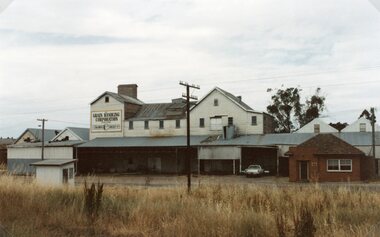
... Mill as a subsidiary company. Later years it sold clipped and graded seed, oats, stockfeed for poultry, pigs and dairy cattle and all types of crushed grain. ...139-6 a-d & e Coloured photographs showing various views of the Wimmera Flour Mill or Grain Handling Corporation building in progress of being demolished. ...Mill stood facing Frayne Street. In 2007 during our "Collection Review" the four smaller colour photos, which were donated by Mr. Mick Walsh, 52 Patrick St Stawell were very similar to the bigger photo in the file 139.6e. stawell industry Grain Handing Corporation 139-6 a-d & e Coloured photographs showing various views of the Wimmera Flour Mill or Grain Handling Corporation building in progress of being demolished. ...Various colour photos of Wimmera Flour Mill at time it was being demolished. Note roof being dismantled. Rail line in foreground. Willaim Frayne founded the Wimmera Flour Mill on a site in Taylor Street (beside the railway line) Stawell 1876. When Willian Frayne dies 1899 his son George took over the mill. The mill continued to be a propriety company until early 1966, when it was sold to the Victorian Mill Owners. The sale was forced because of the lack of export markets. A factor which affected most country mills. The Victorian Oat Growers Pool took over on July 1st, 1967. Trading under the name of Wimmera Flower Mill as a subsidiary company. Later years it sold clipped and graded seed, oats, stockfeed for poultry, pigs and dairy cattle and all types of crushed grain. The original Frayne homestead still stands behind where the Mill stood facing Frayne Street. In 2007 during our "Collection Review" the four smaller colour photos, which were donated by Mr. Mick Walsh, 52 Patrick St Stawell were very similar to the bigger photo in the file 139.6e.139-6 a-d & e Coloured photographs showing various views of the Wimmera Flour Mill or Grain Handling Corporation building in progress of being demolished. There is a red brick building with a tiled roof in these coloured photos. The rail line is shown in foreground of 139-6 e. Our records on the data base show 139-6e to be a black & white photo but the same photo in the office folder is an enlarged colour photograph. Grain Handing Corporation stawell industry -
 Bendigo Historical Society Inc.
Photograph - HARRY BIGGS COLLECTION: TOMLINS SIMMIE & COY FLOUR MILLS
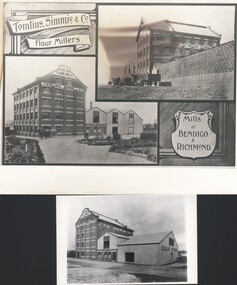
... (d) Mills at Bendigo and Richmond sign. 4, The Mill and Grain Store....(d) Mills at Bendigo and Richmond sign. 4, The Mill and Grain Store. Photograph HARRY BIGGS COLLECTION: TOMLINS SIMMIE & COY FLOUR MILLS ...Five photos of the Tomlins Simmie and Co. Flour Mills plus negatives of the same, 1, The mill with a steam train in the foreground with two drivers and two workers standing on the steps (also one small photo of this). 2, The Mill. 3, One card with four photos on it relating to the mill (a) Sign - Tomlins Simmie and Co. flour millers (b) The mill itself with a horse and cart in the foreground. (c) A side on photo of the previous. (d) Mills at Bendigo and Richmond sign. 4, The Mill and Grain Store.buildings, commercial, flour mill, tomlins simmie and coy. flour mills -
 Royal Australasian College of Surgeons Museum and Archives
Photograph (item) - BK Rank scrubs up at the Heidelberg Military Hospital
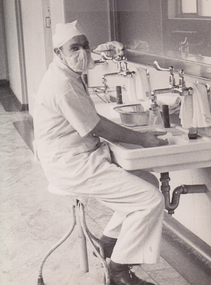
... He was born on 14 January 1911 in Heidelberg, Victoria, where his father, Wreghitt Rank, owned a grain store and mill. His mother was Bessie née Smith. ...He was born on 14 January 1911 in Heidelberg, Victoria, where his father, Wreghitt Rank, owned a grain store and mill. His mother was Bessie née Smith. ...Benjamin Rank was considered by many to be the father of plastic surgery in Australia. He was born on 14 January 1911 in Heidelberg, Victoria, where his father, Wreghitt Rank, owned a grain store and mill. His mother was Bessie née Smith. He was educated at Scotch College, Melbourne, and Ormond College, University of Melbourne, graduating with many honours and prizes. He did a two-year residency in the Royal Melbourne Hospital before going to London to specialise in surgery. There he did junior posts at St James' Hospital, Balham, but soon became fascinated by the new specialty of plastic surgery and was appointed assistant plastic surgeon at Hill End (Bart's EMS unit). Joining the Royal Australasian Army Medical Corps in 1940, he commanded their plastic surgical unit in Egypt. In 1942, he returned to Australia to set up a plastic and maxillofacial unit at Heidelberg Military Hospital. Among the patients treated there was one Flight Lieutenant John Gorton, who went on to become Prime Minister of Australia. In 1946 he was the first honorary plastic surgeon at the Royal Melbourne Hospital. He spent much time overseas and was instrumental in setting up the specialty of plastic surgery in India, for which he set up 'Interplast' - a charity supported by the Rotary Clubs to offer training and expertise to Asian and Pacific nations. He was the Sims Commonwealth Travelling Professor of the College in 1958, Moynihan lecturer in 1972, President of the British Association of Plastic Surgeons in 1965 and President of the Royal Australasian College of Surgeons from 1966 to 1968. He made important contributions to the study of Marjolin's ulcer, radiation carcinoma, and the transition from benign to malignant melanoma. He also made a major contribution to hand surgery, and his textbook Surgery of repair as applied to hand injuries (Livingstone, 1953) ran to four editions. He wrote extensively, including an autobiography, and was a talented painter. He was a tireless campaigner for no-fault motor accident insurance and was President of the St John Ambulance Association. He married Barbara Lyle Facy in 1938. They had one son Andrew, and three daughters, Helen, Julie and Mary (one of whom became a nurse). He died on 26 January 2002. Reference; https:livesonline.rcseng.ac.uk surgeon, sir benjamin rank, heidelberg military hospital, plastic surgery, royal melbourne hospital -
 Eltham District Historical Society Inc
Photograph - Digital Photograph, Alan King, Sweeney's Cottage, Sweeneys Lane, Eltham, 30 January 2008
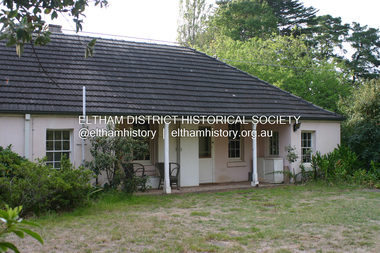
... He was on the first school board and supplied the first grain for Eltham’s mill. Sweeney profited during the gold rush, not by gold digging, but by providing supplies for nearby fields and others as far away as Beechworth.3 Thomas Sweeney died in 1867 and was buried at the Eltham Cemetery, leaving two sons, five daughters, and 300 acres (121.4ha), as well as Culla Hill. ...He was on the first school board and supplied the first grain for Eltham’s mill. Sweeney profited during the gold rush, not by gold digging, but by providing supplies for nearby fields and others as far away as Beechworth.3 Thomas Sweeney died in 1867 and was buried at the Eltham Cemetery, leaving two sons, five daughters, and 300 acres (121.4ha), as well as Culla Hill. ...Part of the original cottage named Culla Hill built by Thomas Sweeney (a former convict) remains as a small section of today’s house. Covered under Heritage Overlay, Nillumbik Planning Scheme National Estate National Trust of Australia (Victoria) Local Sifgnificance Published: Nillumbik Now and Then / Marguerite Marshall 2008; photographs Alan King with Marguerite Marshall.; p19 Thomas Sweeney, a former convict who became a respected citizen, once lived on a property at what is now the corner of Sweeneys Lane and Culla Hill, Eltham. As Sweeney was one of the district’s first settlers, the property is registered by the National Trust. Thomas Sweeney was born in 1802, son of impoverished tenant farmers in Tipperary County, Ireland. He became a ploughman, then at 21 he was sentenced to hang for setting on fire the house of Patrick Guyder at Gullshill. It is said the arson was due to a dispute over undelivered guns to a social justice guerilla group, the White Boys, of which Sweeney was a member. But the sentence was commuted to life transportation to Australia in 1823.1 Apparently in Sydney he became a servant to James Chandler at Botany. Soon James Chandler leased his farm and became a catechist on the Hawkesbury River, so Sweeney was reassigned to a former convict, John Brown, at Liverpool. Later Sweeney was assigned to George Brown of Lake Illawarra. In 1831, Sweeney was granted a ticket-of-leave and bought a boat to carry goods between Illawarra district and Sydney Town. He married his first wife who had come to Australia as a free woman. However she drowned after bearing him a daughter. In 1838, one month after he had received a conditional pardon, Sweeney married a blacksmith’s daughter, Margaret Meehan, newly arrived from Ireland. They then moved to Port Phillip and squatted on the south side of the Yarra River, about seven miles (11km) from Melbourne. Around 1842, Sweeney bought 110 acres (44.5ha) in the parish of Nillumbik for £110. He built a slab hut 12 x 10 feet (3.6m x 3m) and then his homestead, Culla Hill, a typical Tipperary style cottage, now known as Sweeney’s Cottage. It was here that many generations of Sweeneys lived for almost 100 years. Culla Hill became a social centre for the district and the Catholic community used it as a church. Sweeney was apparently on good terms with a tribe of Aborigines living on the river nearby, who helped him build his house.2 Sweeney proved himself a civic-minded leader. In 1844, he led a call for a bridge over the Plenty River. He was on the first school board and supplied the first grain for Eltham’s mill. Sweeney profited during the gold rush, not by gold digging, but by providing supplies for nearby fields and others as far away as Beechworth.3 Thomas Sweeney died in 1867 and was buried at the Eltham Cemetery, leaving two sons, five daughters, and 300 acres (121.4ha), as well as Culla Hill. Culla Hill – by then reduced to 75 acres (30ha) – was sold out of the family in 1939, then renamed Sweeneys. The present Sweeneys Lane, running diagonally through the original holding, was the track to the house. Part of the original cottage remains as a small section of today’s house. The dining-family room fronted by a veranda is original, and although there have been some changes, the cedar door and most of the small 12-paned wooden-framed windows are original. The walls are made of the original hand-made brick. After buying the property in 1952 Mr and Mrs Burston demolished a dilapidated slab hut, a three-roomed detached kitchen and cellar, as materials needed to restore them were very difficult to obtain so soon after the war.4 However the barn remains almost in its original condition. It is believed to have been built from stone quarried on the property. Now roofed with iron sheets it was probably originally thatched. The sandstone barn has a peaked roof supported by the original saplings and a doorway large enough to accommodate a fully loaded wagon.This collection of almost 130 photos about places and people within the Shire of Nillumbik, an urban and rural municipality in Melbourne's north, contributes to an understanding of the history of the Shire. Published in 2008 immediately prior to the Black Saturday bushfires of February 7, 2009, it documents sites that were impacted, and in some cases destroyed by the fires. It includes photographs taken especially for the publication, creating a unique time capsule representing the Shire in the early 21st century. It remains the most recent comprehenesive publication devoted to the Shire's history connecting local residents to the past. nillumbik now and then (marshall-king) collection, culla hill, eltham, sweeney's cottage, sweeneys lane, thomas sweeney -
 Eltham District Historical Society Inc
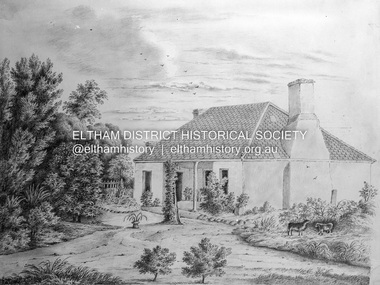
Negative - Photograph, Charles Bertie, Sketch; Sweeney's Cottage, Culla Hill, Eltham (n.d.), c.1905
... The first wheat crop in the district was planted by Sweeney who also supplied the first grain for a mill that later was built at Eltham. ...The first wheat crop in the district was planted by Sweeney who also supplied the first grain for a mill that later was built at Eltham. ...In the early 1900s, Mary Sweeney commissioned artist Charles Bertie to paint the main house at Culla Hill. He charged her 5 shillings for the picture and 18 pence for the frame She took this painting with her when she married Michael Carrucan in 1910 and it hung in the Dalton Street farmhouse for many years. At a later time (1960s), the Burstons (the then owners of Culla Hill) had a card printed from the painting. The original sketch was photographed in 1970 for reproduction in the Shire history publication Pioneers & Painters (1971). The very fragile original was kept in the Council strongroom and suffered significant damage to its edges over the years, no doubt it has also yellowed. A comparison of the original as digitised (2022) with the negative taken 50 years earlier also reveals that the left 20% of the sketch has been cut off, probably due to damage. In June 1842 Thomas Sweeney applied to the Superintendent, C.J. La Trobe, asking permission to purchase a portion of the recently surveyed ‘Parish of Nillumbik'. His request was allowed and handed to the sub-treasurer and Land Board. He paid £110 for 110 acres and called the land 'Culla Hill'. He first built a temporary house, a slab hut 12 feet by 10 feet, in which he lived with his wife, an Irish girl whom he had married in 1838. (His first wife had been drowned at Port Jackson.) Some time later he built a permanent residence on the model of a Tipperary farmhouse. It was a rectangular building of hand-made bricks and stone quarried from the Western Hill with a recessed verandah in front, and bore a slate roof. The out-buildings consisted of a detached kitchen, stable and a barn. It was in this house that succeeding generations of Sweeneys were reared. The original slab hut became a washhouse and survived till recent years. 'Culla Hill' became a social centre for the district, church services being held there on various occasions. The first wheat crop in the district was planted by Sweeney who also supplied the first grain for a mill that later was built at Eltham. He took an active interest in the development of the district. At this time travelling people--many of them runaway sailors or convicts--often passed the settlement, and some of them stayed and worked with Sweeney. A tribe of aborigines living on the river below 'Culla Hill' were apparently on good terms with Sweeney, for it is said that they helped him with the building of his house. Very little is known about the aborigines who originally lived in the Eltham district. There must have been many of them; their stone axes, grinding stones, and anvil stones have been found in the gullies around Research and canoe trees and artifacts were found on the Kangaroo Ground hills. Early settlers remembered a tribe that camped on the site of the present railway bridge at Eltham. They held corroborees there and visited settlers for hand-outs of 'flour and bacca’. There was an aboriginal reserve on the Yarra, upstream from Eltham, but most of those who had collected there later went to live on the Pound Reserve at Warrandyte, where the last aborigines in the area finally ended their days. The Pound Reserve, of 1,103 acres, was established at Pound Bend in 1841. The chief protector, George Robinson, and his four assistants, were given instructions to care for the aged and sick, to provide blankets and rations for all who lived there, to train the able-bodied men in agriculture and other trades and to find them jobs. The Yarra blacks, who later came under the protection of William Thomas, have been described as a 'fine race, well made and above the average height'. Thomas Sweeney died on 6 September 1867 and was buried in the Eltham Cemetery. To his wife Margaret and his son John, he left the entire property of 'Culla Hill'. To his other son Patrick, he left 150 acres, including a small two-roomed wooden cottage. He had five daughters: Kate and Margaret (twins) who were born in 1842, Ellen 1846, Annie 1848 and Johanna 1851. John Sweeney farmed 'Culla Hill' until his death in 1909. He had ten children; one of them, Mary, became Mrs M. Carrucan whose son, Mr John Carrucan, still lives at Eltham. 'Culla Hill' passed out of the Sweeneys possession in 1939 and was renamed by its new owners, 'Sweeneys', in memory of its pioneers. - Pioneers & Painters: One Hundred Years of Eltham and its Shire, Alan Marshall 1971, pp10-12 Original colour sketch artwork 4 x 5 inch black and white negative of original colour sketchculla hill, art, charles bertie, drawing, mary carrucan (nee sweeney), sketches, sweeney's cottage -
 Flagstaff Hill Maritime Museum and Village
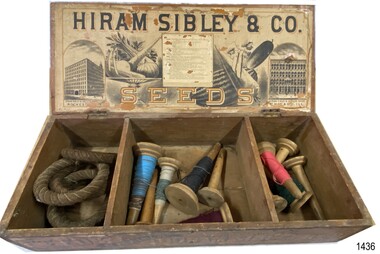
Container - Box for seeds, ca. 1880s
... mills, and became involved in farming and seed supply. In this area he used his skills to engineer seeds that were stronger and develop plants that produced more seeds. The production of seeds became his main business. He bought land cheaply and improved to soil so that he could produce seed and grain...mills, and became involved in farming and seed supply. In this area he used his skills to engineer seeds that were stronger and develop plants that produced more seeds. The production of seeds became his main business. He bought land cheaply and improved to soil so that he could produce seed and grain ...This seed box was made for Hiram Sibley for his seed house business. He sold seeds priced by the weight or the space they took up e.g. bushel. This box allowed for seeds to be divided by type, size or even date. The box was strong and easy to cart and store. It was also a handy item to 'recycle' as a storage container for other items. The Sibley seed box is a desirable collectors' item. A large variety of sizes and shapes are still available today in various stages of condition. Hiram Sibley developed seeds that were strong and the plants that grew from these seeds produced many seeds. Varieties of Sibley seeds and plants are still advertised for sale in modern times. HIRAM SIBLEY (1807-1888) - Hiram Sibley was born in America. He had a natural mechanical ability and became skilled in many trades. He and his partner Don Watson opened a sawmill then a machine shop and foundry. He became involved with Alfred Vale and Samuel Morse and their work on the telegraph. Eventually he became the first president of the Western Union Telegraph Company. Later, after leaving Western Union in the early 1860s, Sibley bought and sold railroads, manufactured sold, ran timber mills, and became involved in farming and seed supply. In this area he used his skills to engineer seeds that were stronger and develop plants that produced more seeds. The production of seeds became his main business. He bought land cheaply and improved to soil so that he could produce seed and grain, and graze herds of cattle. He became the owner of 14 large farms. Hiram Sibley earned the reputation "as the most extensive farmer and seedsman in this country". The business of Hiram Sibley & Co. was conducted his warehouse in Rochester and his seed house in Chicago. One department of the business sold farming equipment, another department imported ornamental plants from overseas countries Sibley went on to invest a large amount of money in a bank, and to be financially involved in the community by making large donations to public services such as a library and a school of music. At one point he was the richest man in Monroe county.This box is significant for its historic connection with Hiram Sibley, who is famous for many reasons, among which is his very profitable business of seed engineering to improve the production of crops. This box also represents the value of containers used for selling products in the 1880s, being re-used for other useful purposes. The box is an example of goods imported for use in Australia. The text and images of the box are an example of 1880s advertisingBox, wooden, with two brass hinges joining lid to base. Base has two wooden partitions, divided into three unequal sized compartments. Lid's underside has label with drawings of buildings and produce, text with maker's name and description of vegetables. Front edge of box has stencilled text and diagrams. Outside lid, and the other three sides, have no inscriptions. Made by Hiram Sibley & Co., USA. (Box is currently used to store quoits 1436.2 and cones of cotton thread 1436.3.)Marked "HIRAM SIBLEY & CO / SEEDS", "WAREHOUSE - "ROCHESTER N.Y. ", "SEED HOUSE - CHICARGO, ILL.", "SEEDS BY WEIGHT & MEASURE", "PUT UP BY / HIRAM SIBLEY & CO. / ROCHESTER, N.Y. AND CHICARGO, ILL."flagstaff hill, warrnambool, maritime village, maritime museum, flagstaff hill maritime museum & village, hiram sibley & co, rochester n.y., seeds, wooden seed box, seed box, seedsmen, arable farming, chicargo illinois, seed house, seed engineering, seed distribution, seeds by weight and measure -
 The Beechworth Burke Museum
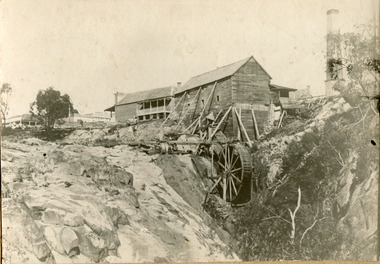
Photograph, 1859
... ...Grain Mill...milling flour at some point between 1860 and 1862. At this time, the Oven’s district was almost self-sufficient, producing considerable quantities of grain, dairy, fodder and meat. ...The mill race and wheel are also clearly depicted, which may shed light onto how mill wheels of this era and place were constructed Chevalier Louis Chevalier Newtown Mill Grain Mill sawmill flour mill 1850s Beechworth Beechworth Council Farming and agriculture Victorian agricultural history Spring Creek buildings industry forestry Wood Timber Reverse: 3146 / 1997.2654 / Louis Chevalier's Flour Mill on / the Newtown Falls before the / Bridge / Est 1853 / this photo 1859 / 84-229-1 / Burke Museum Beechworth / Page 41 / 81 % / (Illegible) / (Illegible) 14 / Black and white rectangular photograph printed on matte photographic paper mounted on board Photograph Photograph ...Louis Chevalier, brother of popular artist Nicholas Chevalier, opened a sawmill in Beechworth near Spring Creek in Newtown in 1853. This facilitated a boom in building in the town, as materials were much more available than they had been previously. A second sawmill was opened in the town in 1856. Louis Chevalier served on the Beechworth Council as a representative of Newtown between 1858 and 1860. As this photograph is taken in 1859, the mill would have been operating as a sawmill at the time this photograph was taken. Louis Chevalier’s mill stopped sawing wood and began milling flour at some point between 1860 and 1862. At this time, the Oven’s district was almost self-sufficient, producing considerable quantities of grain, dairy, fodder and meat. Unfortunately, the region experienced poor agricultural yields in the 1880s and 1890s, which lead to the closure of the Beechworth Flour Mills in the 1880s. This photograph depicts the first sawmill in Beechworth, which was responsible for making the materials available for other early buildings in the town. The mill race and wheel are also clearly depicted, which may shed light onto how mill wheels of this era and place were constructedBlack and white rectangular photograph printed on matte photographic paper mounted on boardReverse: 3146 / 1997.2654 / Louis Chevalier's Flour Mill on / the Newtown Falls before the / Bridge / Est 1853 / this photo 1859 / 84-229-1 / Burke Museum Beechworth / Page 41 / 81 % / (Illegible) / (Illegible) 14 / chevalier, louis chevalier, newtown, mill, grain mill, sawmill, flour mill, 1850s beechworth, beechworth council, farming and agriculture, victorian agricultural history, spring creek, buildings, industry, forestry, wood, timber -
 Federation University Historical Collection
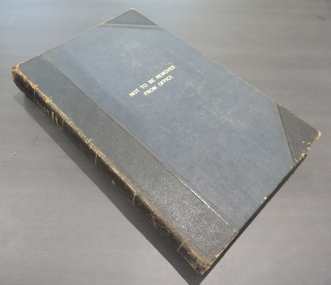
Books, H.E. Daw Government Printer, Ballarat School of Mines and Industries Departmental Papers, 1914-1950, 1914-1950
... Art (Drawing in Light and Shade from a Cast of Ornament or Lower Nature), Art (Drawing Ornament from the Cast), Art (Drawing from Models or Objects), Art (Drawing fro Dressmakers' and Milliners' Fashions), Art (Drawing With the Brush), Art (Drawing from a Flat Example); Art (Modelled Design), Art (General Design), Art (Embossed Leatherwork), Art (Practical Plane Geometry), Art (Practical Solid Geometry), Art (Geometrical Drawing), Carpentry and Joinery, Art (Human Anatomy), Art (Historic Ornament), Art (House Decoration), Art (LEttering), Signwriting, Art (Light Metalwork), Art (Modelling), Art (Modelling the Human Figure from a Life), Art (Stencilling); Art (Wood Carving) Refrigeration, Teaching, Boilermaking, Blacksmithing, Carpentry and Joinery, Coachbuilding and Carriage Drafting, Electric Wiring, Electrical Fitting, Graining and Marbling, Instrument Making , Machine Shop Practice, Metal Founding, Milling and Gear Cutting, Motor Mechanics, Painting and Decorating, Sheet Metalwork, Toolmaking, Printing, Pattern Making, Plumbing and gasfitting, ...Used at the Ballarat School of Mines and the Ballarat Technical Art School This collection of examinations is significant because of its completeness with the full range of examinations between 1914 and 1950. examinations ballarat school of mines ballarat technical art school trades education department victoria agriculture algebra architecture arithmetic applied mechanics assaying biology botany boilermaking building design blacksmithing bricklaying carpentry and joinery coachbuilding cabinet making civil engineering commercial, chemistry engineering drawing economics english electrical technology electricity and magnetism electric wiring electric welding electrical fitting electrical trades food analysis geology geological mapping graphics geometry heat engines heat treatment hydraulics hand railing instrument making millinery milling and gearouting machine shop practice metal founding mining metallurgy mineralogy mathematics motor mechanics mine surveying mining mechanics petrology physics painting and decorating pattern making plastering plumbing and gasfitting printing refrigeration spelling science shorthand surveying signwriting sheet metalwork toolmaking ladies tailoring trigonometry typewriting welding. dressmaking needlework decorative needlework architecture, building design and construction art (composition in form and colour) art (casting clay models) art (drapery) art (drawing the human figure from casts) art (drawing the antique from memory) art (drawing from memory) art (drawing plant forms from nature art (drawing plant forms from memory) art (drawing from models and objects) (drawing from a flat example) art (drawing in light and shade from a cast of ornament or lower nature) art (drawing ornament from the cast) art (drawing from models or objects) art (drawing for dressmakers' and milliners' fashions) art (drawing with the brush) art (drawing from a flat example) art (modelled design) art (general design) art (embossed leatherwork) art (practical plane geometry) art (practical solid geometry) art (geometrical drawing) art (human anatomy) art (historic ornament) art (house decoration) art (lettering) art (light metalwork) art (modelling) art (modelling the human figure from a life art (stencilling) art (wood carving) teaching coachbuilding and carriage drafting graining and marbling milling and gear cutting commercial geography exams examination book Large leather bound books, with leather spine, containing all examinations held at the Ballarat School of Mines (including the Ballarat Technical Art School and Ballarat Junior Technical School). ...Used at the Ballarat School of Mines and the Ballarat Technical Art SchoolThis collection of examinations is significant because of its completeness with the full range of examinations between 1914 and 1950.Large leather bound books, with leather spine, containing all examinations held at the Ballarat School of Mines (including the Ballarat Technical Art School and Ballarat Junior Technical School). The examination papers were supplied and printed by the Education Department, Victoria. Examinations include: Agriculture, Algebra, Architecture, Arithmetic, Applied Mechanics, Assaying, Biology, Botany, Boilermaking, Building Design, Blacksmithing, Bricklaying, Carpentry and Joinery, Coachbuilding, Cabinet Making, Civil Engineering, Cabinet Making, Commercial, Chemistry, Engineering Drawing, Economics, English, Electrical technology, Electricity and Magnetism, Electric Wiring, Electric Welding, Electrical Fitting, Electrical Trades, Food Analysis, Geology, Geological Mapping, Graphics, Geometry, Heat Engines, Heat Treatment, Hydraulics, Hand Railing, Instrument Making, Millinery, Milling and Gearouting, Machine Shop Practice. Metal Founding, Mining, Metallurgy, Mineralogy, Mathematics, Motor Mechanics, Mine Surveying, Mining Mechanics, Petrology, Physics, Painting and Decorating, Pattern Making, Plastering, Plumbing and Gasfitting, Printing, Refrigeration, Spelling, Science , Shorthand, Surveying. Signwriting. Sheet Metalwork, Toolmaking, Ladies Tailoring, Trigonometry, Typewriting, Welding, Commercial Geography. Millinery, Dressmaking, Needlework, Decorative Needlework, Architecture, Building Design and Construction, Art (Composition in Form and Colour), Art (Casting Clay MOdels) Art (Drapery), Art (Drawing the Human Figure From Casts), Art (Drawing the Antique from Memory), Art (Drawing from Memory); Art (Drawing Plant Forms from Nature, Art (Drawing Plant Forms From Memory), Art (Drawing from Models and Objects), (Drawing From a Flat Example). Art (Drawing in Light and Shade from a Cast of Ornament or Lower Nature), Art (Drawing Ornament from the Cast), Art (Drawing from Models or Objects), Art (Drawing fro Dressmakers' and Milliners' Fashions), Art (Drawing With the Brush), Art (Drawing from a Flat Example); Art (Modelled Design), Art (General Design), Art (Embossed Leatherwork), Art (Practical Plane Geometry), Art (Practical Solid Geometry), Art (Geometrical Drawing), Carpentry and Joinery, Art (Human Anatomy), Art (Historic Ornament), Art (House Decoration), Art (LEttering), Signwriting, Art (Light Metalwork), Art (Modelling), Art (Modelling the Human Figure from a Life), Art (Stencilling); Art (Wood Carving) Refrigeration, Teaching, Boilermaking, Blacksmithing, Carpentry and Joinery, Coachbuilding and Carriage Drafting, Electric Wiring, Electrical Fitting, Graining and Marbling, Instrument Making , Machine Shop Practice, Metal Founding, Milling and Gear Cutting, Motor Mechanics, Painting and Decorating, Sheet Metalwork, Toolmaking, Printing, Pattern Making, Plumbing and gasfitting, examinations, ballarat school of mines, ballarat technical art school, trades, education department victoria, agriculture, algebra, architecture, arithmetic, applied mechanics, assaying, biology, botany, boilermaking, building design, blacksmithing, bricklaying, carpentry and joinery, coachbuilding, cabinet making, civil engineering, commercial, chemistry, engineering drawing, economics, english, electrical technology, electricity and magnetism, electric wiring, electric welding, electrical fitting, electrical trades, food analysis, geology, geological mapping, graphics, geometry, heat engines, heat treatment, hydraulics, hand railing, instrument making, millinery, milling and gearouting, machine shop practice, metal founding, mining, metallurgy, mineralogy, mathematics, motor mechanics, mine surveying, mining mechanics, petrology, physics, painting and decorating, pattern making, plastering, plumbing and gasfitting, printing, refrigeration, spelling, science, shorthand, surveying, signwriting, sheet metalwork, toolmaking, ladies tailoring, trigonometry, typewriting, welding., dressmaking, needlework, decorative needlework, architecture, building design and construction, art (composition in form and colour), art (casting clay models), art (drapery), art (drawing the human figure from casts), art (drawing the antique from memory), art (drawing from memory), art (drawing plant forms from nature, art (drawing plant forms from memory), art (drawing from models and objects), (drawing from a flat example), art (drawing in light and shade from a cast of ornament or lower nature), art (drawing ornament from the cast), art (drawing from models or objects), art (drawing for dressmakers' and milliners' fashions), art (drawing with the brush), art (drawing from a flat example), art (modelled design), art (general design), art (embossed leatherwork), art (practical plane geometry), art (practical solid geometry), art (geometrical drawing), art (human anatomy), art (historic ornament), art (house decoration), art (lettering), art (light metalwork), art (modelling), art (modelling the human figure from a life, art (stencilling), art (wood carving), teaching, coachbuilding and carriage drafting, graining and marbling, milling and gear cutting, commercial geography, exams, examination book -
 Flagstaff Hill Maritime Museum and Village
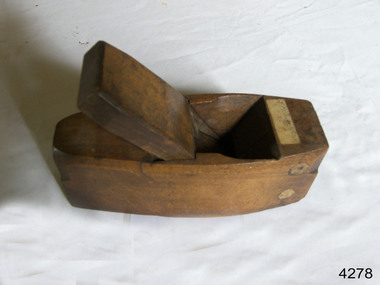
Tool - Smoothing Plane, Mid to Late 19th Century
... grain, enabling the plane to better adjust to changes in humidity. John Moseley & Son: Records indicate that before 1834, the firm is listed at number 16 New Street, London and according to an 1862 advertisement the shop had been established in New Street since 1730, The Sun insurance records from the time show that John Moseley was the possessor of a horse mill in the yard of his premises, which means that some kind of manufacturing was taking place, as the mill would have provided power to run a saw or perhaps a grinding wheel so the probability is that he did not just sell tools, he made them as well. ...grain, enabling the plane to better adjust to changes in humidity. John Moseley & Son: Records indicate that before 1834, the firm is listed at number 16 New Street, London and according to an 1862 advertisement the shop had been established in New Street since 1730, The Sun insurance records from the time show that John Moseley was the possessor of a horse mill in the yard of his premises, which means that some kind of manufacturing was taking place, as the mill would have provided power to run a saw or perhaps a grinding wheel so the probability is that he did not just sell tools, he made them as well. ...A smoothing plane is typically used after the work piece has been flattened and trued by the other bench planes, such as the jack, fore, and joiner planes. Smoothing planes can also be used to remove marks left by woodworking machinery. When used effectively alongside other bench planes, the smoothing plane should only need a handful of passes removing shavings as fine as 0.002 inches (0.051 mm) or less. The work piece is then ready to be finished, or can be further refined with a card scraper or sandpaper. The smoothing plane is usually held with both hands, and used in a similar manner to the other bench planes. Though designed for smoothing, a smoothing plane can be used as an 'all-round' bench tool and for rougher work depending on how it is set up. Being smaller than other bench planes, the smoothing plane is better able to work on smaller work pieces and around obstructions. Since the 1700s wooden smoothing planes have predominantly been 'coffin shaped' wider in the middle and slightly rounded making them more maneuverable. It has also been claimed that the coffin design exposes more end grain, enabling the plane to better adjust to changes in humidity. John Moseley & Son: Records indicate that before 1834, the firm is listed at number 16 New Street, London and according to an 1862 advertisement the shop had been established in New Street since 1730, The Sun insurance records from the time show that John Moseley was the possessor of a horse mill in the yard of his premises, which means that some kind of manufacturing was taking place, as the mill would have provided power to run a saw or perhaps a grinding wheel so the probability is that he did not just sell tools, he made them as well. John Moseley died in 1828 and his will he names his four sons: John, Thomas, William and Richard. To complicate matters he also had brothers with the same first names; brothers Richard (of Piccadilly) and William (of Peckham Rye) are named as two of the executors. Brother Thomas is not mentioned in this will, but became a minister and was one of the executors of brother Richard’s estate when he died in 1856. From John’s will, we also learn that, although the shop was in New Street, he resided in Lympstone, Devon. The family must have had a house in that county for quite some time as both sons Richard and William are baptised in Devon, although John and Thomas were baptised in London. In the 1841 and 1851 census records, we just find William in New Street, but in 1861 both William and Richard are listed there as toolmakers. That Richard was staying overnight at New Street was probably just accidental as in 1851 and 1871, we find him with his wife Jane and children in Clapham and Lambeth respectively. In 1851 Richard is listed as “assistant clerk cutlery warehouse” and in 1871 as “retired plane maker and cutler”. Although the actual place of work is not stated, one may assume he worked in the family business. 1862 is a year full of changes for the firm. In that year, William had a new property built at 27 Bedford Street. In the catalogue for the 1862 International Exhibition, 54 Broad Street (later 54-55 Broad Street) is listed for the first time, which may very well coincide with the split of the business into a retail and a wholesale branch. Around the same time, they must have moved from New Street to 17 & 18 King Street because their manufacturing premises had been pulled down to form the New Street from Cranbourne Street to King Street. In January 1865, William died and Richard continued the business. In 1867, the partnership he had with his son Walker and Thomas Elis Hooker, is dissolved. Richard continued tool making at King Street and Bedford Street. Richard retired somewhere between 1867 and 1871, but the business continued. The business is taken over by W M Marples & Sons and tools continued to be made in London until 1904 when manufacturing relocated to Sheffield. A vintage tool made by a well documented company, this item was made commercially for firms and individuals that worked in wood and needed a tool that could produce a smooth finish to timber. The tool was used when timber items needed to have a smooth finish these types of planes were used in conjunction with profiled planes that provided a decorative finish. A significant tool from the mid to late 19th century that today is quite rare and sought after by collectors. It gives us a snapshot of how furniture and other decorative finishes were created on timber by the use of hand tools. Tools that were themselves hand made shows the craftsmanship used during this time not only to make a tool such as the subject item but also the craftsmanship needed to produce a decorative finish that was needed to be made for any timber item. Smoothing Plane coffin design Maker J Moseley & Son London & 2 1/4"flagstaff hill, warrnambool, shipwrecked-coast, flagstaff-hill, flagstaff-hill-maritime-museum, maritime-museum, shipwreck-coast, flagstaff-hill-maritime-village, plane moulding, moulding plane, plane, j heath, moseley -
 City of Moorabbin Historical Society (Operating the Box Cottage Museum)
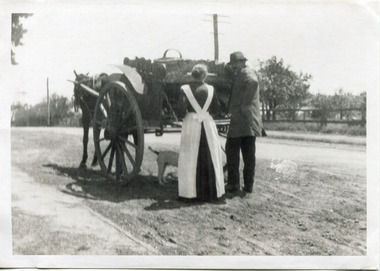
Photograph - Photograph, Black & White Mrs J.L.Smith & Butcher, 1915
... mill powered by 10hp steam engine. The business prospered 1909 following the death of Tommy Bent, J/L Smith was nominated for Councillor of the Shire of Moorabbin. WW1 1914 - 18 both John and Mary Ann supported local War Relief Auxiliaries and their son Vic served as a Signaler in AIF. As Motor transport was increasing 1926 J L Smith built a small Garage on the opposite corner (Woolworths Supermarket 2005) , employed a good mechanic ( Reg Hunt ) and developed another successful business. The Grain...mill powered by 10hp steam engine. The business prospered 1909 following the death of Tommy Bent, J/L Smith was nominated for Councillor of the Shire of Moorabbin. WW1 1914 - 18 both John and Mary Ann supported local War Relief Auxiliaries and their son Vic served as a Signaler in AIF. As Motor transport was increasing 1926 J L Smith built a small Garage on the opposite corner (Woolworths Supermarket 2005) , employed a good mechanic ( Reg Hunt ) and developed another successful business. The Grain ...The Butcher Mr Bill Ellin delivering meat to Mrs J.L.Smith in front of the house Law Muir Den 510 Centre Rd Bentleigh c 1915. Groceries, Ice, Milk, Bread, Eggs, Poultry were delivered to housewives by the traders in horse drawn carts, Also Hawkers and Pedlars plied their wares by visiting the cottages. John Logan Smith 1860-1932 , the son of Irish immigrants James and Marianne Smith was born at their home near the 'Toll Gates' on Point Nepean Road and Dendy Street. East Brighton. At that time the area had many orchards that were later replaced by market gardens. J.L.Smith at first rented a cottage 'Law Muir Den' & Shed from Mr Box and commenced business as a wood merchant - sawing logs into shorter pieces using one horse to power the saw. He purchased the property, added to the buildings , began trading in fuel and fodder as well and installed a chaff cutting mill powered by 10hp steam engine. The business prospered 1909 following the death of Tommy Bent, J/L Smith was nominated for Councillor of the Shire of Moorabbin. WW1 1914 - 18 both John and Mary Ann supported local War Relief Auxiliaries and their son Vic served as a Signaler in AIF. As Motor transport was increasing 1926 J L Smith built a small Garage on the opposite corner (Woolworths Supermarket 2005) , employed a good mechanic ( Reg Hunt ) and developed another successful business. The Grain Store was managed by family until 1930. In 1932 JL Smith assisted a man whose car had broken down, pushing it to the garage and sadly suffered a heart attack and died. He is buried in Cheltenham Cemetery. J.L.Smith was an early settler in East Brighton now Bentleigh and established successful Wood cutting, Grain & Chaff cutting and Motor garage businesses in Centre Road . He was elected Councillor of the Shire of Moorabbin and, with Mary Ann, his family were involved with local Church, Red Cross, and other community organizations.A Black and white photograph c 1915 showing the Butcher delivering meat to Mrs J.L Smith Bentleighsmith j l, smith mary ann, stanley helen, smith vic, smith harry redvers, chaff cutter, horse drawn carts, toll gates brighton, motor cars 1900, steam engines, early settlers, bentleigh, parish of moorabbin, city of moorabbin, county of bourke, moorabbin roads board, shire of moorabbin, henry dendy's special survey 1841, bent thomas, charman s, highett william, ormond francis, market gardeners, vineyards, orchards, william ellin, butcher -
 City of Moorabbin Historical Society (Operating the Box Cottage Museum)
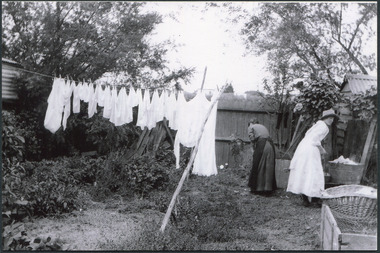
Photograph - Washing Day at 'Law Muir Den' Mrs J L Smith c1910, c1910
... mill powered by 10hp steam engine. The business prospered As Motor transport was increasing 1926 J L Smith built a small Garage on the opposite corner (Woolworths Supermarket 2005) , employed a good mechanic ( Reg Hunt ) and developed another successful business. J.L.Smith was an early settler in East Brighton now Bentleigh and established successful Wood cutting, Grain ...Mrs J.L.Smith and Ada Smith in the backyard of the house Law Muir Den 510 Centre Rd Bentleigh c 1910. . The early settler women usually devoted a whole day to washing as it was very labourious. A fire was lit in a stone pit and a large tub of water boiled. Soap that had been made, usually in the previous Autumn, from fat drippings and caustic soda, was flaked into the tub to form suds. The clothes were moved around in the tub with a long wooden paddle that was also used to lift the clothes out of the tub into another tub of cold rinsing water..Stains were removed by scrubbing soap on the cloth against a scrubbing board. Clothes were wrung by hand or a mechanical wringer and hung on the clothes line to dry. Mary Ann Smith was married John Logan Smith 1860-1932 who at first rented a cottage 'Law Muir Den' & Shed from Mr Box and commenced business as a wood merchant - sawing logs into shorter pieces using one horse to power the saw. He purchased the property, added to the buildings , began trading in fuel and fodder as well and installed a chaff cutting mill powered by 10hp steam engine. The business prospered As Motor transport was increasing 1926 J L Smith built a small Garage on the opposite corner (Woolworths Supermarket 2005) , employed a good mechanic ( Reg Hunt ) and developed another successful business. J.L.Smith was an early settler in East Brighton now Bentleigh and established successful Wood cutting, Grain & Chaff cutting and Motor garage businesses in Centre Road . He was elected Councillor of the Shire of Moorabbin and, with Mary Ann, his family were involved with local Church, Red Cross, and other community organizations.Photograph, Black & White, showing 2 women washing clothes in a large tub, set over a fire in a stone pit, in the back yard. Clothes are hanging from a rope line strung between 2 trees and held up with a wooden 'prop' -
 City of Moorabbin Historical Society (Operating the Box Cottage Museum)
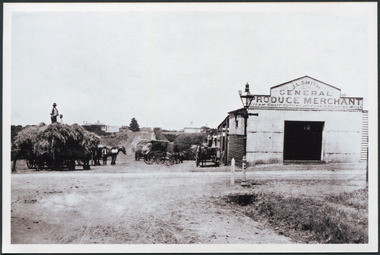
Photograph, Black & White J. L. Smith Hay & Grain Store Bentleigh c1910, c1910
... mill powered by 10hp steam engine. The business prospered 1909 following the death of Tommy Bent, J/L Smith was nominated for Councillor of the Shire of Moorabbin. WW1 1914 - 18 both John and Mary Ann supported local War Relief Auxiliaries and their son Vic served as a Signaler in AIF. As Motor transport was increasing 1926 J L Smith built a small Garage on the opposite corner (Woolworths Supermarket 2005) , employed a good mechanic ( Reg Hunt ) and developed another successful business. The Grain...mill powered by 10hp steam engine. The business prospered 1909 following the death of Tommy Bent, J/L Smith was nominated for Councillor of the Shire of Moorabbin. WW1 1914 - 18 both John and Mary Ann supported local War Relief Auxiliaries and their son Vic served as a Signaler in AIF. As Motor transport was increasing 1926 J L Smith built a small Garage on the opposite corner (Woolworths Supermarket 2005) , employed a good mechanic ( Reg Hunt ) and developed another successful business. The Grain ...John Logan Smith 1860-1932 , the son of Irish immigrants James and Marianne Smith was born at their home near the 'Toll Gates' on Point Nepean Road and Dendy Street. East Brighton. At that time the area had many orchards that were later replaced by market gardens. J.L.Smith at first rented a cottage 'Law Muir Den' & Shed from Mr Box and commenced business as a wood merchant - sawing logs into shorter pieces using one horse to power the saw. He purchased the property, added to the buildings , began trading in fuel and fodder as well and installed a chaff cutting mill powered by 10hp steam engine. The business prospered 1909 following the death of Tommy Bent, J/L Smith was nominated for Councillor of the Shire of Moorabbin. WW1 1914 - 18 both John and Mary Ann supported local War Relief Auxiliaries and their son Vic served as a Signaler in AIF. As Motor transport was increasing 1926 J L Smith built a small Garage on the opposite corner (Woolworths Supermarket 2005) , employed a good mechanic ( Reg Hunt ) and developed another successful business. The Grain Store was managed by family until 1930. In 1932 JL Smith assisted a man whose car had broken down, pushing it to the garage and sadly suffered a heart attack and died. He is buried in Cheltenham Cemetery. J.L.Smith was an early settler in East Brighton now Bentleigh and established successful Wood cutting, Grain & Chaff cutting and Motor garage businesses in Centre Road . He was elected Councillor of the Shire of Moorabbin and, with Mary Ann, his family were involved with local Church, Red Cross, and other community organizations.Black & white photograph of the Hay & Grain Store of John Logan Smith 1860-1932 on the corner of Jasper Rd and Centre Rd Bentleigh ( East Brighton) c1910. A Horse drawn cart loaded with hay and another outside the first building used by J L Smith -
 City of Moorabbin Historical Society (Operating the Box Cottage Museum)
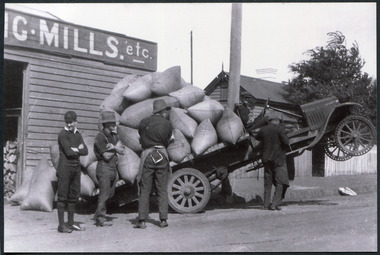
Photograph, Black & White, J L Smith, H Higgins Overloaded Ford Truck at Chaff & Grain Store and Mill Bentleigh c1926, c1926
... Photograph, Black & White, J L Smith, H Higgins Overloaded Ford Truck at Chaff & Grain Store and Mill Bentleigh c1926...They are outside J L Smith Chaff & Grain Store Centre Rd Bentleigh c 1926 Photograph, Black & White, J L Smith, H Higgins Overloaded Ford Truck at Chaff & Grain Store and Mill Bentleigh c1926 ...J.L.Smith was an early settler in East Brighton now Bentleigh and established successful Wood cutting, Grain & Chaff cutting and Motor garage businesses in Centre Road . He was elected Councillor of the Shire of Moorabbin and, with Mary Ann, his family were involved with local Church, Red Cross, and other community organizations. Herbert John Higgins ran a dairy farm with 40 cows on some acres fronting Jasper Rd ( Higgins Rd today ) he grew corn crops to feed his herd and also bought grain from J L Smith.Herbert Higgins , Dairy farmer, along with the Allnutt, and Long families were members of the Methodist Church Bentleigh from 1880s and involved in community organizations, J.L.Smith was an early settler in East Brighton now Bentleigh and established successful Wood cutting, Grain & Chaff cutting and Motor garage businesses in Centre Road . He was elected Councillor of the Shire of Moorabbin and, with Mary Ann, his family were involved with local Church, Red Cross, and other community organizations.Black & White photograph showing an upended Ford truck that has been overloaded with bags of grain with Herb Higgins and 2 men and a boy. They are outside J L Smith Chaff & Grain Store Centre Rd Bentleigh c 1926 higgins,herbert, dairy farmer, allnutt victoria (queenie), smith j l; smith mary ann, stanley helen, smith vic, smith harry redvers, chaff cutter, horse drawn carts, toll gates brighton, motor cars 1900, steam engines, early settlers, bentleigh, parish of moorabbin, city of moorabbin, county of bourke, moorabbin roads board, shire of moorabbin, henry dendy's special survey 1841, were j.b.; bent thomas, o'shannassy john, king richard, charman s, highett william, ormond francis, maynard dennis, market gardeners, vineyards, orchards, methodist church bentleigh, milk, -
 City of Moorabbin Historical Society (Operating the Box Cottage Museum)
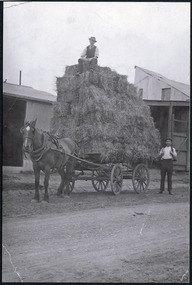
Photographs, x 2 ,Black & White, F Smith Horse drawn cart loaded, Baled Straw, Grain, c1920
... mill powered by 10hp steam engine. The business prospered 1909 following the death of Tommy Bent, J/L Smith was nominated for Councillor of the Shire of Moorabbin. WW1 1914 - 18 both John and Mary Ann supported local War Relief Auxiliaries and their son Vic served as a Signaler in AIF. As Motor transport was increasing 1926 J L Smith built a small Garage on the opposite corner (Woolworths Supermarket 2005) , employed a good mechanic ( Reg Hunt ) and developed another successful business. The Grain...mill powered by 10hp steam engine. The business prospered 1909 following the death of Tommy Bent, J/L Smith was nominated for Councillor of the Shire of Moorabbin. WW1 1914 - 18 both John and Mary Ann supported local War Relief Auxiliaries and their son Vic served as a Signaler in AIF. As Motor transport was increasing 1926 J L Smith built a small Garage on the opposite corner (Woolworths Supermarket 2005) , employed a good mechanic ( Reg Hunt ) and developed another successful business. The Grain ...John Logan Smith 1860-1932 , the son of Irish immigrants James and Marianne Smith was born at their home near the 'Toll Gates' on Point Nepean Road and Dendy Street. East Brighton. At that time the area had many orchards that were later replaced by market gardens. J.L.Smith at first rented a cottage 'Law Muir Den' & Shed from Mr Box and commenced business as a wood merchant - sawing logs into shorter pieces using one horse to power the saw. He purchased the property, added to the buildings , began trading in fuel and fodder as well and installed a chaff cutting mill powered by 10hp steam engine. The business prospered 1909 following the death of Tommy Bent, J/L Smith was nominated for Councillor of the Shire of Moorabbin. WW1 1914 - 18 both John and Mary Ann supported local War Relief Auxiliaries and their son Vic served as a Signaler in AIF. As Motor transport was increasing 1926 J L Smith built a small Garage on the opposite corner (Woolworths Supermarket 2005) , employed a good mechanic ( Reg Hunt ) and developed another successful business. The Grain Store was managed by family until 1930. In 1932 J L Smith assisted a man whose car had broken down, pushing it to the garage and sadly suffered a heart attack and died. He is buried in Cheltenham Cemetery. J.L.Smith was an early settler in East Brighton now Bentleigh and established successful Wood cutting, Grain & Chaff cutting and Motor garage businesses in Centre Road . He was elected Councillor of the Shire of Moorabbin and, with Mary Ann, his family were involved with local Church, Red Cross, and other community organizations.2 x Black & White photographs showing horse drawn carts loaded with (a) Hay and (b) bags of grain outside J.L.Smith Grain & Chaff Store Centre Rd Bentleigh c1920smith frank, smith arch, smith tom, smith j l; smith mary ann, stanley helen, smith vic, smith harry redvers, chaff cutter, horse drawn carts, toll gates brighton, motor cars 1900, steam engines, early settlers, bentleigh, parish of moorabbin, city of moorabbin, county of bourke, moorabbin roads board, shire of moorabbin, henry dendy's special survey 1841, were j.b.; bent thomas, o'shannassy john, king richard, charman s, highett william, ormond francis, maynard dennis, market gardeners, vineyards, orchards -
 Mortlake and District Historical Society
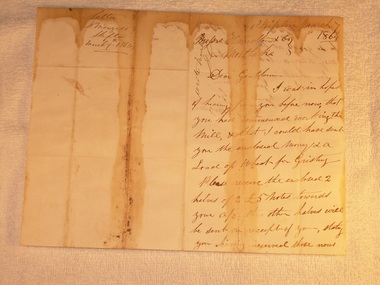
Letter for payment of account Mortlake Mill, March 7 1864
... mortlake mill grain wheat hamilton geddes aikman laang dixie menzies skipton...Despite the apparent difficulties of conducting business in the 1850's, it is notable that commerce thrived at that time in country districts, as an examination of Mill accounts and records show. mortlake mill grain wheat hamilton geddes aikman laang dixie menzies skipton Skipton March 7 1864 [to] Messrs. ...This letter was sent by a customer D. Menzies at Skipton to the Mortlake Mill, detailing an unusual payment method for the processing of his wheat into flour. David Menzies was a Scots farmer who lived in Skipton c. 1860's on a bend in the Mount Emu Creek. He helped establish the local school and a lane in the township bears his name. The letter illustrates the nature of commerce and the difficulties of communication and life generally in the country at the time. The bluestone Mortlake Mill built in 1856, has been a prominent landmark in Mortlake for over 150 years. It played a significant role in the commercial life of the town and was initially a wind-mill to process district grain for sale. The goldrush at Ararat 100 km. away led to a temporarily increased population and demand for foodstuffs. In 1857 the Mill was sold to Aikman, Hamilton and Geddes who converted it to steampower and later built the prominent chimney, which is on the Heritage Register as part of the National Estate. D. Menzies at Skipton lived at least 85 km away - his wheat which urgently needed milling, faced a slow and arduous journey by bullock dray. After the demise of the Ararat goldfields and the decline in population (as well as the district soils proving unsuitable for sustained wheat cultivation), the operation of the Mill declined too and the proprietors increased their involvement in other activities - supply of building materials, timber felling and sawmills. Despite the apparent difficulties of conducting business in the 1850's, it is notable that commerce thrived at that time in country districts, as an examination of Mill accounts and records show.Handwritten letter dated 1864 (water-stained)Skipton March 7 1864 [to] Messrs. Hamilton & Co. Mortlake. Dear Gentlemen, I was in hope of hearing from you before now that you had commenced working the Mill, & that I could have sent you the enclosed money [for a] load of wheat for Gristing. Please receive the enclosed 2 halves of 2 [two] 5 [pound sign] notes forwarded to your account. the other halves will be sent on receipt of your stating you having received those notes sent. As I am out of flour be so good as say how soon I may send a load of wheat. In haste I am Gentlemen Yours truly D. Menziesmortlake mill grain wheat hamilton geddes aikman laang dixie menzies skipton -
 Warrnambool and District Historical Society Inc.
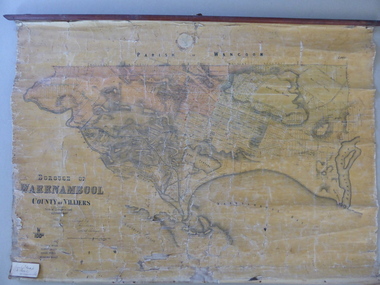
Mao, Borough of Warrnambool, County of Villiers, 1873
... The Marfells were well-known in Warrnambool as grain merchants and managers of the Warrnambool Co-Operative Milling Company. ...The Marfells were well-known in Warrnambool as grain merchants and managers of the Warrnambool Co-Operative Milling Company. ...This is an early map of the Borough of Warrnambool (1872/3) showing the central town area of Warrnambool and the surrounding district. Reserves, public buildings and some businesses are marked. The map was photolithographed by John Noone, a Melbourne artist and photographer who claimed in 1858 to have the oldest-existing photographic studio in Melbourne. Photolithography was a process first developed in Melbourne. For several years Noone was the official photographer for the Victorian Crown Lands Office and for the Victorian Public Library and Museum. The map has the stamp of the seller of the map – Charles Hider, the well-known stationer and bookseller in Timor Street, Warrnambool. The owner of the map, Henry George Marfell, (1883-1962) was the son of John and Mary Ann Marfell. The Marfells were well-known in Warrnambool as grain merchants and managers of the Warrnambool Co-Operative Milling Company. It is surmised from the writing on the Marfell label that this map was at some stage given by Henry Marfell to the old Warrnambool MuseumThis map of early Warrnambool is of considerable significance, firstly because its original state and early date (1873) make it of antiquarian and historical interest. Also the connection with the names, Charles Hider and Henry Marfell and the old Museum gives it added provenance and interest.This is a wax paper map mounted on cloth. At the top it is attached by nails to a piece of wood and at the top it has a cloth ring for hanging the map. The map is in black shadings on a yellow background. The map is badly creased and coming away from the cloth at the edges and at other various points. There is some red or pink marking or staining on the township area of the map (originally the sold lands on this map were coloured in brown and the reserves, buildings, etc in pink). On the left hand corner there is a piece of paper glued on with some handwriting in ink (Marfell). There is also the stamp of the seller of the map – Charles Hider, stationer and bookseller, of Timor Street Warrnambool‘Early Map of W’bool, H.G. Marfell’ history of warrnambool, charles hider, henry marfell -
 Bendigo Historical Society Inc.
Administrative record - Commercial Egg Producers' Association of Victoria (CEPA) Central Council Correspondence, 1982
... grain supply. Concern about imported wheat: The author is worried that imported wheat is only suitable for feed mills. 8504.38ac This letter from K. ...grain supply. Concern about imported wheat: The author is worried that imported wheat is only suitable for feed mills. 8504.38ac This letter from K. ...The Commercial Egg Producers' Association of Victoria was active by the 1930s, engaging in industry management and lobbying.The Commercial Egg Producer's Association (CEPA) had branches in Bendigo, South Bendigo, Eaglehawk, Wedderburn, Murrabit and Euroa.CEPA Commercial Egg Producer's Association (Bendigo Region) correspondence, for the year 1982. This item includes the following documents: 8504.38a This document is a formal request from K. & L. Thomas Hatchery to the Secretary of C.E.P.A., seeking an opportunity to address egg industry representatives about concerns related to replacement laying stock. 8504.38b This agreement outlines the relationship between Crystal Egg Company and local egg producers regarding egg supply, grading, and service charges:Crystal Egg Company's Role:Acts as agent for the Victorian Egg Marketing Board, handling receipt, grading, selling, and disposal of eggs. 8504.38c This document outlines a research proposal focused on optimizing the production cycle of laying hens to maximize profitability and improve egg quality. 8504.38d This document outlines a preliminary proposal for a project focused on enhancing the nutritional value of triticale for poultry feed in Australia. 8504.38e This document presents a preliminary research proposal focused on the effects of dietary trace elements—specifically chromium, magnesium, iron, and zinc—on egg albumen quality and storage characteristics in laying hens. 8504.38f Crystal Egg Company letter to the Commercial Egg Producers Association of Victoria which highlight the company's efforts to implement new working hours, accommodate producer needs, and foster industry collaboration. 8504.38g Agenda Items for a meeting 8504.38h The document details an investigation into Bartter's Enterprises' sale and distribution of shell eggs in Victoria, prompted by concerns that their sales were significantly exceeding authorized volumes. Concern Over Excess Sales:Bartter's Enterprises was reportedly selling more shell eggs and pulp in Victoria than the offset load of approximately 27,000 dozens per week permitted by the Egg Marketing Board. 8504.38i Poultry Newsletter - nine pages No 24 Sept 1982 8504.38j This document is a letter from the Victorian Egg Marketing Board to the Commercial Egg Producers' Association, dated August 17, 1982. Request for Feedback on Financial StatementsThe Board has been asked by producer organizations to present its income and expenditure statements in a clearer, more understandable format.The goal is to enable publication of these statements in the association's newsletter, keeping producers informed about both egg production/disposal statistics and the Board's financial position. 8504.38k Victorian Egg Board Reminder to Producers June 1982. This document serves as a formal reminder and invitation for Victorian egg producers to participate in the annual competition, highlighting its importance for industry standards and consumer promotion. 8504.38l The document is an official notice from the Victorian Egg Marketing Board, dated August 13, 1982. Immediate Suspension of Producer Agent ContractsThe Board will not issue any new producer agent contracts from this date forward. 8504.38m The Victorian Egg Marketing Board invites the Commercial Egg Producers' Association of Victoria to a meeting.The meeting is scheduled for Thursday, 23rd September 1982 at 2:30 p.m. at the Board's premises in Keysborough. 8504.38n The document is a formal letter from the Victorian Egg Marketing Board to the Commercial Egg Producers Association of Victoria, outling a Media Training Initiative: The Council of Egg Marketing Authorities of Australia has appointed Professional Public Relations Pty. Ltd. to conduct media training as part of an animal welfare workshop in Hobart, scheduled for April 1983 8504.38o This document is a formal letter from the Minister of Agriculture, Eric Kent, addressed to Mr. K. Fitzgibbon, Secretary of the Central Council of the Commercial Egg Producers' Association of Victoria. Notification of Appointments:The letter informs Mr. Fitzgibbon that, as of June 22, 1982, the Governor in Council has made various appointments to the Victorian Egg Marketing Board. 8504.38p This document is a formal letter from the Minister of Agriculture to the Secretary of the Central Council of the Commercial Egg Producers' Association of Victoria, addressing wheat stock management during drought conditions. 8504.38q This document is a formal letter from the Minister of Agriculture addressing concerns about hen quota transfers in Victoria 8504.38r This document is a formal letter from John Bourchier, Member for Bendigo, addressed to Mr. K. Fitzgibbon, Secretary of the Commercial Egg Producers of Victoria. The letter acknowledges receipt of concerns raised by the Commercial Egg Producers regarding wheat imports and the possibility of importing corn from America. 8504.38s This document is a formal letter from David Kennedy, a Member of the Legislative Assembly for Bendigo, addressed to Mr. K. Fitzgibbon, Secretary of the Association of Victoria Commercial Egg Producers. Acknowledgement: David Kennedy thanks Mr. Fitzgibbon for sending a copy of a letter addressed to the Minister of Agriculture regarding farm grading and packing of eggs. 8504.38t Thank you Letter from David Kennedy MLA 8504.38u The document is a formal letter from the Commercial Egg Producers' Association of Victoria's Central Council. The letter is sent to the Industrial Relations Board in response to prior communication regarding Dennis Oakes.Resolution: At a recent conference held at City Hall, Bendigo on June 18, 1982, the Central Council resolved to seek official recognition with the Industrial Relations Board. 8504.38v Recognition of Associations - The Commercial Egg Producers Association of Victoria was officially recognized by the Industrial Relations Commission of Victoria under the Industrial Relations Act 1979.Recognition covers persons employed in farm work related to egg production and poultry breeding for trade or sale. 8504.38w News Review newsletter from the Victorian Egg Producer. Points highlight recent leadership changes, operational challenges, and strategic adjustments in quota and packaging policies within the Victorian egg industry. 8504.38x The Association is formally requesting the Department of Agriculture to retain a Poultry Officer at the Diagnostic Centre in Epsom. This is to ensure continued support for poultry farms in North Central Victoria, which remain numerous and require ongoing service. 8504.38y This document is a formal letter sent by K. Fitzgibbon, Secretary, to Mr. Alan Harrison, General Manager of the Victorian Egg Marketing Board. Notification of Spokesperson:Mr. Peter Farley of the Poultry Advisory Council is designated as the spokesperson on animal welfare issues. 8504.38z This document is a formal letter from the association addressed to a Member of Parliament, Mr. J. Bourchier. Expression of Gratitude. The association thanks Mr. Bourchier for his efforts supporting their members and the egg industry. 8504.38aa Letter sent by the egg producers' association to the Victorian Egg Marketing Board:Request for Experimental ReportThe association asks for a copy of the report on a recent experimental trial involving brown eggs in the Gippsland area. 8504.38ab This document is a letter addressed to the Australian Wheat Board expressing concerns about wheat importation and local grain supply. Concern about imported wheat: The author is worried that imported wheat is only suitable for feed mills. 8504.38ac This letter from K. Fitzgibbon to Mr. David Kennedy outlines several key issues for consideration ahead of the CEPA local agriculture conference: 8504.38ad The document is a letter from CEPA to MP J. W. Bourchier, highlighting three concerns. 8504.38ae This letter expresses concern from the association regarding the transfer of hen quotas out of North and Country Victoria. 8504.38af Notice of The Half-Yearly Conference is scheduled for Friday, 3rd December 1982 at 1:00 p.m. in Bendigo. 8504.38ag This document is a formal letter from CEPA to the Minister of Agriculture, Mr. Eric Kent. The letter is signed by K. Fitzgibbon, Secretary, and reflects the Association's concern for industry stability and desire for ongoing communication with the government. 8504.38ah The Victorian Egg Marketing Board is formally notified that four representatives from the Commercial Egg Producers' Association of Victoria will attend the upcoming industry meeting scheduled for 23 September 1982. 8504.38ai This document is a formal letter from the Commercial Egg Producers' Association of Victoria to the Minister of Agriculture, highlighting urgent concerns about local grain storage for pig and poultry producers near Bendigo due to drought conditions. 8504.38aj The document is a letter from the Commercial Egg Producers Association to the Minister of Agriculture, outlining key concerns and recommendations regarding the egg industry in Victoria: 8504.38ak The Commercial Egg Producers' Association of Victoria is renewing its affiliation with the Federal Council of Poultry Farmers' Associations of Australia for the 1982-83 period.A cheque for $300.00 is enclosed as the affiliation fee. 8504.38al This document is a formal letter from the secretary of CEPA to the manager of Crystal Egg Co. The association's executive met on July 27, 1982 and decided to request a written proposal from Crystal Industries regarding the future of the egg grading floor in Bendigo. 8504.38am The Commercial Egg Producers' Association of Victoria (Central Council) held a conference at City Hall, Bendigo on June 18, 1982.During the conference, the Association resolved to seek formal recognition with the Industrial Relations Board.Mr. J. D. Oakes was appointed as the Association's representative for any future negotiations with the Board.The letter communicates this decision to Mr. A. Dowling of the Industrial Relations Board, confirming Mr. Oakes's role and the Association's intent. 8504.38an This document is an application submitted by the Commercial Egg Producers Association of Victoria seeking official recognition as an association under the Industrial Relations Act 1979. 8504.38ao The document is a formal notification sent to the Victorian Trades Hall Council regarding the Commercial Egg Producers' Association of Victoria's application for recognition under the Industrial Relations Act 1979. 8504.38ap This document is a formal notification from the Secretary of the Australian Workers Union regarding the Commercial Egg Producers Association of Victoria's application for recognition under the Industrial Relations Act. 8504.38aq This document is a formal notification to the Victorian Hatcherymen's Society regarding the Commercial Egg Producers' Association of Victoria:The Commercial Egg Producers' Association of Victoria has applied for recognition as an Association under the Industrial Relations Act 1979 with the Industrial Relations Commission of Victoria.Mr. J. D. Oakes has been appointed as the Association's representative for this application. 8504.38ar This document is a formal notification to the Secretary of the Victorian Farmers Graziers Employers Association regarding an application for recognition by the Commercial Egg Producers Association of Victoria. 8504.38as This document is a formal notification sent to the Victorian Employers' Federation regarding the Commercial Egg Producers' Association of Victoria's application for recognition under the Industrial Relations Act 1979. 8504.38at The document is a formal letter to the Victorian Egg Marketing Board's secretary addressing industry concerns raised by an association. 8504.38au This document is a formal request from K. Fitzgibbon, Secretary, to the Director General of the Department of Agriculture. 8504.38av This document is a formal letter from CEPA to the Minister of Agriculture, advocating for changes to the Victorian Egg Marketing Board. 8504.38aw Mr. David Kennedy is being formally invited to attend the CEPA's Annual Conference, scheduled for Friday, 18th June, 1982 at 1 p.m. at Bendigo City Hall. 8504.38ax The document is a notice regarding the upcoming annual meeting of the Egg Producers' Association of Victoria's Central Council. The annual meeting will be held at City Hall, Bendigo, on Friday, 18th June 1982 at 1:00 p.m. 8504.38ay The document is a formal letter from CEPA addressed to the General Manager of the Victorian Egg Marketing Board. The association expresses concern that it was not invited to a deputation meeting with the Victorian Egg Marketing Board. 8504.38az This document is a formal letter from the Commercial Egg Producers Association, dated April 30, 1982, addressed to the Minister of Agriculture, Eric Kent. Request for Meeting:The Association is seeking a deputation (meeting) with the Minister at a convenient time and place. 8504.38aaa The document nominates candidates for the Producer Member position on the Victorian Egg Marketing Board, submitted by an association to the Minister of Agriculture. 8504.38aab To Consumer Affairs Council. Criticism of Government Reports. The Association believes the Committee of Inquiry's reports on egg marketing were biased and reflected the opinion of Mr. McArthur rather than the evidence presented.They claim the reports were shaped to fit the Minister for Agriculture's preferences, taking four months to find committee members who would deliver the desired outcome. 8504.38aac CEPA Central Council Half Yearly Conference Minutes Dec 1982 8504.38aad CEPA Central Council Annual Conference Minutes June 1982 8504.38aae Certificate of Recognition under the Industrial Relations Act 1979 8504.38aaf Handwritten latter to CEPA Secretary Joan Heard thankyou for "my apointment to the Egg Marketing Board" from Don Foster 8504.38aag Business paper for the CEPA Annual Conference Dec 1982egg producer's information, correspondence, cepa, commercial egg producers' association
