
Showing 69 items matching "great war nurses"
-
 St Vincent's Hospital Melbourne Archives
Document (item) - Gippsland Heritage Journal excerpt of article of Gippsland's Great War Nurses 1917
... Gippsland Heritage Journal excerpt of article of Gippsland's Great War Nurses 1917.......Gippsland Great War Nurses...Photocopy of Gippsland Journal Article No 16, "Gippsland Great War Nurses".... War Nurses Dorothy Morrison St Vincent's Hospital Nurse Training. Photocopy of Gippsland Journal Article No 16, "Gippsland Great War Nurses". ...Journal entry on page twenty and twenty-one, details Gippsland Nurses' Service in WW1 including Mary Freetag who changed her name from Freitag to Freetag to avoid comment on the Germanic origin of her name. The Article includes a photograph of Mary in her War Service Nursing Uniform in 1917. It states that Mary had to resign her appointment in 1919 "on account of marriage". mary freitag, mary freetag, world war 1 nurses, gippsland great war nurses, dorothy morrison, st vincent's hospital nurse training. -
 Returned Nurses RSL Sub-branch
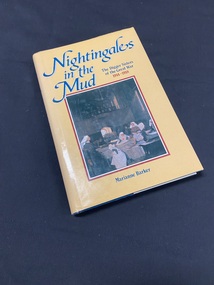
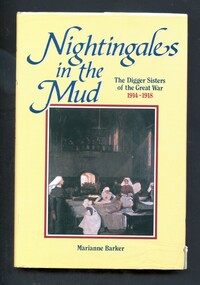
Book - Hardcover book, Marianne Barker, Nightingales in the mud : the Digger Sisters of the Great War 1914-1918, 1989
... ...Great War Nurses...History of Nursing World War One 1914-1918 WW1 WWI Nurses Australia Great War Nurses 'Draws on many first-hand and previously unpublished accounts of the work of Australian nurses in the Great War to tell an extraordinary story of courage and companionship under conditions of great hardship - in the mud of Flanders, among the cholera cases in India, on the hospital ships during the Gallipoli campaign, on Afghanistan border, in Vladivostok, in mosquito infested Macedonia, and in the Sinai Desert. - from inside dustjacket. ...'Draws on many first-hand and previously unpublished accounts of the work of Australian nurses in the Great War to tell an extraordinary story of courage and companionship under conditions of great hardship - in the mud of Flanders, among the cholera cases in India, on the hospital ships during the Gallipoli campaign, on Afghanistan border, in Vladivostok, in mosquito infested Macedonia, and in the Sinai Desert. - from inside dustjacket. Contents note: pt. 1. The Middle East -- 1. Enlistment -- 2. Egypt -- 3. Hospital ships -- 4. Lemnos -- 5. Malta -- 6. Palestine -- 7. Mesopotamia -- 8. India -- 9. Serbia and Salonika -- pt. 2. The Western Front -- 10. The Australian base hospitals in France -- 11. The casualty clearing stations -- 12. Transport in France -- 13. Home hospitals in England -- 14. Repatriation -- Epilogue -- Appendix: Roll of Nurses. - from Trove record.Blue hardcover book with a yellow dustjacket. The title is printed down the spine in blue text. The front cover shows an image of an oil painting of nurses tending the beds of the wounded, it is surrounded by a dark red border. Above the image the title is printed in blue, with 1914-1918 printed in smaller red print.non-fiction'Draws on many first-hand and previously unpublished accounts of the work of Australian nurses in the Great War to tell an extraordinary story of courage and companionship under conditions of great hardship - in the mud of Flanders, among the cholera cases in India, on the hospital ships during the Gallipoli campaign, on Afghanistan border, in Vladivostok, in mosquito infested Macedonia, and in the Sinai Desert. - from inside dustjacket. Contents note: pt. 1. The Middle East -- 1. Enlistment -- 2. Egypt -- 3. Hospital ships -- 4. Lemnos -- 5. Malta -- 6. Palestine -- 7. Mesopotamia -- 8. India -- 9. Serbia and Salonika -- pt. 2. The Western Front -- 10. The Australian base hospitals in France -- 11. The casualty clearing stations -- 12. Transport in France -- 13. Home hospitals in England -- 14. Repatriation -- Epilogue -- Appendix: Roll of Nurses. - from Trove record.history of nursing, world war one 1914-1918, ww1, wwi, nurses australia, great war nurses -
 Returned Nurses RSL Sub-branch
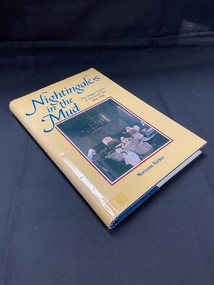
Book - Hardcover book, Marianne Barker, Nightingale in the mud : the Digger Sisters of the Great War 1914-1918, 1989
... ...Great War Nurses...History of Nursing World War One 1914-1918 WW1 WWI Nurses Australia Great War Nurses 'Draws on many first-hand and previously unpublished accounts of the work of Australian nurses in the Great War to tell an extraordinary story of courage and companionship under conditions of great hardship - in the mud of Flanders, among the cholera cases in India, on the hospital ships during the Gallipoli campaign, on Afghanistan border, in Vladivostok, in mosquito infested Macedonia, and in the Sinai Desert. - from inside dustjacket. ...'Draws on many first-hand and previously unpublished accounts of the work of Australian nurses in the Great War to tell an extraordinary story of courage and companionship under conditions of great hardship - in the mud of Flanders, among the cholera cases in India, on the hospital ships during the Gallipoli campaign, on Afghanistan border, in Vladivostok, in mosquito infested Macedonia, and in the Sinai Desert. - from inside dustjacket. Contents note: pt. 1. The Middle East -- 1. Enlistment -- 2. Egypt -- 3. Hospital ships -- 4. Lemnos -- 5. Malta -- 6. Palestine -- 7. Mesopotamia -- 8. India -- 9. Serbia and Salonika -- pt. 2. The Western Front -- 10. The Australian base hospitals in France -- 11. The casualty clearing stations -- 12. Transport in France -- 13. Home hospitals in England -- 14. Repatriation -- Epilogue -- Appendix: Roll of Nurses. - from Trove record.Blue hardcover book with a yellow dustjacket. The title is printed down the spine in blue text. The front cover shows an image of an oil painting of nurses tending the beds of the wounded, it is surrounded by a dark red border. Above the image the title is printed in blue, with 1914-1918 printed in smaller red print.non-fiction'Draws on many first-hand and previously unpublished accounts of the work of Australian nurses in the Great War to tell an extraordinary story of courage and companionship under conditions of great hardship - in the mud of Flanders, among the cholera cases in India, on the hospital ships during the Gallipoli campaign, on Afghanistan border, in Vladivostok, in mosquito infested Macedonia, and in the Sinai Desert. - from inside dustjacket. Contents note: pt. 1. The Middle East -- 1. Enlistment -- 2. Egypt -- 3. Hospital ships -- 4. Lemnos -- 5. Malta -- 6. Palestine -- 7. Mesopotamia -- 8. India -- 9. Serbia and Salonika -- pt. 2. The Western Front -- 10. The Australian base hospitals in France -- 11. The casualty clearing stations -- 12. Transport in France -- 13. Home hospitals in England -- 14. Repatriation -- Epilogue -- Appendix: Roll of Nurses. - from Trove record.history of nursing, world war one 1914-1918, ww1, wwi, nurses australia, great war nurses -
Lakes Entrance Historical Society
Book, Gippsland Heritage Journal - issue 19, 1996
... No 19 of series showcasing aspects of Gippsland Victoria history. this issue has articles on Wonthaggi, Wattle Bark Industry, Bargwanaths, career and wreck of the Shah, Serbs migrants in Latrobe Valley, Briagolong, Aboriginals, Great War Nurses, roadside...No 19 of series showcasing aspects of Gippsland Victoria history. this issue has articles on Wonthaggi, Wattle Bark Industry, Bargwanaths, career and wreck of the Shah, Serbs migrants in Latrobe Valley, Briagolong, Aboriginals, Great War Nurses, roadside Aboriginals Township Ships and Shipping Gippsland Heritage Journal - issue 19 Book ...No 19 of series showcasing aspects of Gippsland Victoria history. this issue has articles on Wonthaggi, Wattle Bark Industry, Bargwanaths, career and wreck of the Shah, Serbs migrants in Latrobe Valley, Briagolong, Aboriginals, Great War Nurses, roadsideaboriginals, township, ships and shipping -
 Greensborough Historical Society
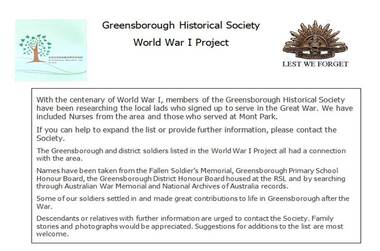
Folder of articles, Greensborough Historical Society et al, World War 1 Project, 1914-1918
... With the centenary of World War 1, members of the Greensborough Historical Society researched the local lads who signed up to serve in the Great War. We have included Nurses from the area and those who served at Mont Park. ...With the centenary of World War 1, members of the Greensborough Historical Society researched the local lads who signed up to serve in the Great War. We have included Nurses from the area and those who served at Mont Park. ...With the centenary of World War 1, members of the Greensborough Historical Society researched the local lads who signed up to serve in the Great War. We have included Nurses from the area and those who served at Mont Park. The Greensborough and district soldiers listed in the World War I Project all had a connection with the area. Names have been taken from the Fallen Soldier’s Memorial, Greensborough Primary School Honour Board, the Greensborough District Honour Board housed at the RSL and by searching through Australian War Memorial and National Archives of Australia records. Some of our soldiers settled in and made great contributions to life in Greensborough after the War. Articles are also available on the GHS website. Descendants or relatives with further information are urged to contact the Society. Family stories and photographs would be appreciated. Suggestions for additions to the list are most welcome. Red plastic binder containing over 150 articles, printed text and images. Each article is filed in plastic pocket.world war 1 project, greensborough historical society -
 Federation University Historical Collection
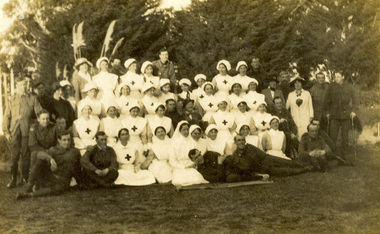
Photograph, VADs, a Nurse, and Soldiers at Highton, c1917
... Great Britain, and the first detachment of thirty official Australian VADs to serve overseas left Australia in September 1916.(http://www.awm.gov.au/encyclopedia/vad/, accessed 13 August 2014) chatham family archive chatham holmes world war world war 1 world war i world war one highton red cross vad voluntary aid detachment nurse nursing Verso: 'group of nurses and some of the men at Highton - taken at an afternoon we had. ...The primary role of a Voluntary Aid Detachment (VAD) member was that of nursing orderly in hospitals, carrying out menial but essential tasks - scrubbing floors, sweeping, dusting and cleaning bathrooms and other areas, dealing with bedpans, and washing patients. They were not employed in military hospitals, except as ward and pantry maids; rather, they worked in Red Cross convalescent and rest homes, canteens, and on troop trains. At the start of the First World War, Australian VADs were restricted from travelling overseas by the Defence Council. As a result, many chose to travel on their own initiative and join British detachments, often in Australian Hospitals. It is reported that the 1st Australian Auxiliary Hospital included in their nursing staff some 120 VADs, chiefly Australians in the British service, employed through the Australian Red Cross Society. This policy was changed in 1916 after a request from Great Britain, and the first detachment of thirty official Australian VADs to serve overseas left Australia in September 1916.(http://www.awm.gov.au/encyclopedia/vad/, accessed 13 August 2014)A group of VADs, a nurse, and some men from the Australian Imperial Forces. Verso: 'group of nurses and some of the men at Highton - taken at an afternoon we had. Can you find me [Harold Holmes] it is not very clear. The 2nd in uniform from the right hand side.chatham family archive, chatham, holmes, world war, world war 1, world war i, world war one, highton, red cross, vad, voluntary aid detachment, nurse, nursing -
The Beechworth Burke Museum
Audio - Oral History, Jennifer Williams, Mrs Vanessa McDonald, 9 November 2000
... great grandfather, a Dutchman who adopted the name Charles Collins, arrived in 1851-1852. Mrs. McDonald spent her childhood in the isolated hamlet of Stanley, in the area known as 'Little Scotland', where she recalls helping her mother to raise younger siblings, picking apples and walnuts on the family farm, and roaming the hills for wildflowers. As a young woman Mrs. McDonald attended religious and social gatherings in the local community. In 1940 she went to Melbourne to work as a mothercraft nurse during the Second World War...great grandfather, a Dutchman who adopted the name Charles Collins, arrived in 1851-1852. Mrs. McDonald spent her childhood in the isolated hamlet of Stanley, in the area known as 'Little Scotland', where she recalls helping her mother to raise younger siblings, picking apples and walnuts on the family farm, and roaming the hills for wildflowers. As a young woman Mrs. McDonald attended religious and social gatherings in the local community. In 1940 she went to Melbourne to work as a mothercraft nurse during the Second World War ...Mrs. Vanessa McDonald was born in Beechworth in 1917. Christened, Agnes Bertha Collins, Vanessa changed her name in 1960. Mrs. McDonald's family's connection with gold mining in the district reach back to the first of Beechworth's gold rushes, when her great grandfather, a Dutchman who adopted the name Charles Collins, arrived in 1851-1852. Mrs. McDonald spent her childhood in the isolated hamlet of Stanley, in the area known as 'Little Scotland', where she recalls helping her mother to raise younger siblings, picking apples and walnuts on the family farm, and roaming the hills for wildflowers. As a young woman Mrs. McDonald attended religious and social gatherings in the local community. In 1940 she went to Melbourne to work as a mothercraft nurse during the Second World War. She met her husband at a Beechworth football match and was married at the Stanley Methodist Church in 1941. The gold diggings known as the 'Nine Mile' became the hamlet of Stanley, after the British Prime Minister, Lord Stanley, in 1858. By the late 1850s, Stanley boasted schools, an athenaeum, a church, a weekly newspaper and several hotels and other civic infrastructure to cater for a growing population. The area attracted large numbers of Chinese miners, whose presence was frequently resisted. Like other early Victorian mining settlements, Stanley was a hotbed of political and racial tensions during the gold rush. One side of the Nine Mile Creek was known as 'Little Scotland’, the other, 'Little Ireland'. A number of Christian denominations built congregations and churches in Stanley, including the Church of England, Methodist Church, the Catholic Church, and Presbyterian Church. Stanley became part of the United Shire of Beechworth in 1871. By 1880 timber was being cut and two sawmills were established by 1887. River-dredged gold mining consumed vast amounts of timber from the forests in the area, and in 1931 the first of several softwood plantations began. This oral history recording was part of a project conducted by Jennifer Williams in the year 2000 to capture the everyday life and struggles in Beechworth during the twentieth century. This project involved recording seventy oral histories on cassette tapes of local Beechworth residents which were then published in a book titled: 'Listen to what they say: voices of twentieth century Beechworth'. These cassette tapes were digitised in July 2021 with funds made available by the Friends of the Burke.Following the decline in the mining and associated industries during the early-mid-twentieth century, the Beechworth district experienced a period of general economic decline. On the east side of the Dingle Range, Mrs. McDonald's father, William Henry Collins, felled timber and the family were pioneer apple orchardists. The establishment of apple orchards in Stanley reflects changes to how land was used and contributes to our understanding of the historical development of rural communities following the gold rush. Mrs. McDonald's recollections are significant for understanding family and social life in a small rural town in years leading up to the Great Depression and prior to the Second World War. This oral history recording may be compared with other oral histories and items in the Burke Museum's collection. This oral history account is socially and historically significant as it is a part of a broader collection of interviews conducted by Jennifer Williams which were published in the book 'Listen to what they say: voices of twentieth-century Beechworth.' While the township of Beechworth is known for its history as a gold rush town, these accounts provide a unique insight into the day-to-day life of the town's residents during the 20th century, many of which will have now been lost if they had not been preserved.This is a digital copy of a recording that was originally captured on a cassette tape. The cassette tape is black with a horizontal white strip and is currently stored in a clear flat plastic rectangular container. It holds up 40 minutes of recordings on each side.Mrs Vanessa McDonald /listen to what they say, beechworth, oral history, burke museum, emigration, gold rush immigration, victorian gold rush, mining families, apple orchard, forestry, forest plantation, little scotland, stanley, twentieth century history, regional australia, rural australia, farming, harvest festival, great depression, dingle range, the nine mile, australian wildflowers, high country wildflowers, mothercraft nurse, rural and regional women, social history, collins, mrs. vanessa mcdonald, building community life, shaping cultural and creative life, fruit growers, family history, changes to land use in regional victoria -
 Mission to Seafarers Victoria
Photograph, French sailors at zoo - Madame Lion & Miss Godfrey, 1917
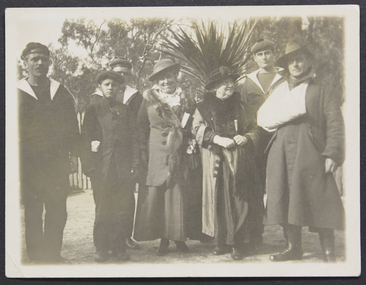
... Great Depression, the sisters had to sell Oberwyl and moved to Adelaide. They returned to France during WWI to nurse wounded soldiers. And returned to Adelaide in 1916 after Marie contracted an infection. She was the South Australia representative of the "Société d’assistance maternelle et infantile". After the end of the war...Great Depression, the sisters had to sell Oberwyl and moved to Adelaide. They returned to France during WWI to nurse wounded soldiers. And returned to Adelaide in 1916 after Marie contracted an infection. She was the South Australia representative of the "Société d’assistance maternelle et infantile". After the end of the war ...Marie Lion migrated with her sister, Berthe Mouchette and her husband in 1885. Berthe established an art school in the city. After the death of her husband the sisters purchased a school, Oberwyl, in St Kilda in 1885. The school was later one of the LHLG schools. Berthe was the founder of the Alliance Française of Melbourne in 1890. With the Great Depression, the sisters had to sell Oberwyl and moved to Adelaide. They returned to France during WWI to nurse wounded soldiers. And returned to Adelaide in 1916 after Marie contracted an infection. She was the South Australia representative of the "Société d’assistance maternelle et infantile". After the end of the war a number of French villages were ‘adopted’ by cities in Australia. Dernancourt, a small village in the Somme was adopted by Adelaide, and Mme Mouchette and Mme Lion worked to raise funds to help in the rebuilding of the almost completely destroyed town.The picture shows the link with the French community. Ethel and her sister Frederica Godfrey could speak French and were well acquainted with the members of this community: Charlotte Crivelli for example. Frederica was secretary of the Alliance Française of Melbourne in the early 1900, in 1917 she also became Honorary Secretary of the French Red Cross, funded by Charlotte Crivelli.Portait of two ladies standing in the middle with 3 soldiers from the French Navy, a wounded digger and a young man.French sailors at zoo / Madame Leon (Lion is the correct spelling) & Miss Godfreylion, marie (1855–1922), mouchette, berthe (1846–1928) nee lion, alliance française of melbourne, société d’assistance maternelle et infantile, france, french, zoo, french red cross, crivelli, charlotte (1863–1956), anzac, french navy, oberwyl, ethel augusta godfrey 1861-1935, frederica godfrey -
 Bendigo Military Museum
Photograph - BENDIGO INTERIM HONOR ROLL
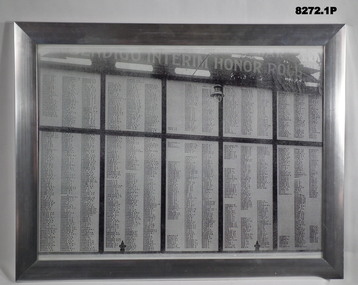
... Nurses. The Honor Roll was unveiled on 25th April 1926 by Mr R. A. Rankin President of the Fathers Association. .2) As can be seen there is an extra panel on the LH side, it is unclear if there was one also at the RH end. This photo believed to be about 1924/25. This was a digital image held by the Museum which stated "0023 (Bendigo War Mem) at 2,400 dpi.jpg". Refer Cat No 8010. Interim honor roll brsl smirsl .1) "Bendigo Interim Honor Roll" .2) "The Great ...The actual Interim Roll was erected in the Gardens on the RH side when facing the Soldiers Memorial Institute building Pall Mall Bendigo (now Bendigo Military Museum) .1)This photo was believed to be taken about 1918/19. The idea of some form of Honor roll began as far back as 1915. As time went by the target was 2,000 names. Eventually when the completed Bronze rolls were placed on the front Loggia walls of the Soldiers Memorial there were 2,972 names which include 42 Nurses. The Honor Roll was unveiled on 25th April 1926 by Mr R. A. Rankin President of the Fathers Association. .2) As can be seen there is an extra panel on the LH side, it is unclear if there was one also at the RH end. This photo believed to be about 1924/25. This was a digital image held by the Museum which stated "0023 (Bendigo War Mem) at 2,400 dpi.jpg". Refer Cat No 8010..1) Honor Roll, copy of original photo, framed grey plastic frame. The roll itself shows 5 columns of names in alphabetical groups, there are spaces between to add additional names, there is a light hanging in front of one column. .2) Photograph, B & W, showing the Soldiers Memorial Institute Building with the Interim Honor Roll in the Gardens. This image has an extra panel on the LH side..1) "Bendigo Interim Honor Roll" .2) "The Great World War, Bendigo Interim Honor Roll"interim, honor roll, brsl, smirsl -
4th/19th Prince of Wales's Light Horse Regiment Unit History Room
Princess Mary Gift Tin, 1914
... The wounded on leave or in hospital, nurses, and the widows or parents of those killed were also entitled to the gift. Prisoners of war at the time had theirs reserved until they were repatriated. Great...The wounded on leave or in hospital, nurses, and the widows or parents of those killed were also entitled to the gift. Prisoners of war at the time had theirs reserved until they were repatriated. Great ...In November 1914, an advertisement was placed in the national press inviting monetary contributions to a 'Sailors & Soldiers Christmas Fund' which had been created by Princess Mary, the seventeen year old daughter of King George V and Queen Mary. The purpose was to provide everyone wearing the King's uniform and serving overseas on Christmas Day 1914 with a 'gift from the nation'. The response was truly overwhelming, and it was decided to spend the money on an embossed brass box, based on a design by Messrs Adshead and Ramsey. The contents varied considerably; officers and men on active service afloat or at the front received a box containing a combination of pipe, lighter, 1 oz of tobacco and twenty cigarettes in distinctive yellow monogrammed wrappers. Non-smokers and boys received a bullet pencil and a packet of sweets instead. Indian troops often got sweets and spices, and nurses were treated to chocolate. Many of these items were despatched separately from the tins themselves, as once the standard issue of tobacco and cigarettes was placed in the tin there was little room for much else apart from the greeting card All boxes, irrespective of recipient, contained a Christmas card and a picture of the Princess. Those which were not distributed until after Christmas were sent out with a card wishing the recipient a 'victorious new year'. The wounded on leave or in hospital, nurses, and the widows or parents of those killed were also entitled to the gift. Prisoners of war at the time had theirs reserved until they were repatriated. Great efforts were made to distribute the gifts in time for Christmas, and huge demands were made on an already stretched postal service. More than 355,000 were successfully delivered by the deadline. As time pressed on, a shortage of brass meant that many entitled personnel did not receive their gift until as late as the summer of 1916, and in January 1919 it was reported that 'considerable' numbers had still not been distributed. Orders for brass strip were placed with the USA, who were not yet involved in the war, and a large consignment was lost with the ship 'Lusitania'. As so much brass was being consumed in the production of weapons and munitions, the quality of the boxes which were manufactured late on was poor, being of a plated inferior alloy, when compared with the earlier pure brass examples. When the fund finally closed in 1920, almost £200,000 had been donated for the provision of more than two and a half million boxes with contents. The 'tin' is approximately 5" long by 3¼" wide by 1¼" deep with a double-skinned, hinged, lid. The surface of the lid depicts the head of Princess Mary in the centre, surrounded by a laurel wreath and flanked on either side by the 'M' monogram. At the top, a decorative cartouche contains the words 'Imperium Britannicum' with a sword and scabbard either side. On the lower edge, another cartouche contains the words 'Christmas 1914', which is flanked by the bows of battleships forging through a heavy sea. In the corners, small roundels house the names of the Allies: Belgium, Japan, Montenegro and Servia; France and Russia are at the edges, each superimposed on three furled flags or standards. -
 Bendigo Military Museum
Poster - POSTER, FRAMED WW1, Osboldstone & Co Pty Ltd, Post WW1
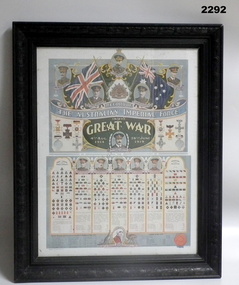
... GREAT WAR/ 4TH AUG/ 1914/ 28TH JUNE/ 1919" Original Poster. Poster - colour print on paper. Top depicts British and Australian Flags with portraits of "H.M.KING GEORGE V" and four AIF Generals. Middle section - Honours and Decorations awarded to Members of the AIF with portrait of one AIF Major General. Lower Section - Portraits of five AIF Major Generals above seven columns of Unit Colour Patches of AIF Divisions, Corps, Troops and miscellaneous. Below - portrait of a Nurse ...Original Poster. Poster - colour print on paper. Top depicts British and Australian Flags with portraits of "H.M.KING GEORGE V" and four AIF Generals. Middle section - Honours and Decorations awarded to Members of the AIF with portrait of one AIF Major General. Lower Section - Portraits of five AIF Major Generals above seven columns of Unit Colour Patches of AIF Divisions, Corps, Troops and miscellaneous. Below - portrait of a Nurse within Kangaroo/emu emblem. Frame - timber with black/brown finish and decorative moulding. Glass front and brown paper backing over timber backing board.Heading on Poster - "RECORD OF/ THE AUSTRALIAN IMPERIAL FORCE/ IN THE/ GREAT WAR/ 4TH AUG/ 1914/ 28TH JUNE/ 1919" poster, framed accessories, ww1, aif -
 Monbulk RSL Sub Branch
Book, Harper Press, Shots from the front : the British soldier 1914-18, 2008
... World War 1914 -1918 - Pictorial works great britain - army - military life Leading military historian Richard Holmes has selected over 200 rare and unusual photographs to illustrate the wide range of the British Army's experience in the First World War - on all fronts, from Mesopotamia (Iraq) and Gallipoli to the Flanders trenches." "The book's topics include the preparations for war and the mobilisation of 1914; the 'roses of no-man's land' - the contribution made by nurses ...Leading military historian Richard Holmes has selected over 200 rare and unusual photographs to illustrate the wide range of the British Army's experience in the First World War - on all fronts, from Mesopotamia (Iraq) and Gallipoli to the Flanders trenches." "The book's topics include the preparations for war and the mobilisation of 1914; the 'roses of no-man's land' - the contribution made by nurses; 'blighty ones and other ones' - the wounded and their treatment; 'brother lead and sister steel' - soldiers and their weapons; scenes from the battlefield and the campaigns where Tommies fought; the armistice and its aftermath.Ill, p.240.non-fictionLeading military historian Richard Holmes has selected over 200 rare and unusual photographs to illustrate the wide range of the British Army's experience in the First World War - on all fronts, from Mesopotamia (Iraq) and Gallipoli to the Flanders trenches." "The book's topics include the preparations for war and the mobilisation of 1914; the 'roses of no-man's land' - the contribution made by nurses; 'blighty ones and other ones' - the wounded and their treatment; 'brother lead and sister steel' - soldiers and their weapons; scenes from the battlefield and the campaigns where Tommies fought; the armistice and its aftermath.world war 1914 -1918 - pictorial works, great britain - army - military life -
 Victorian Interpretive Projects Inc.
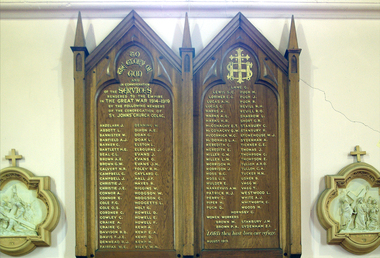
Photograph - colour, Clare Gervasoni, World War One Honour Board at St John's Anglican Church, Colac, 2015, 23/08/2015
... The sanctuary panels will be placed on each side of the altar, and will become the permanent Honor Roll by having the names of the soldiers and nurses who enlisted from the congregation inscribed thereon.The whole scheme when completed will be a noble monument to the loyalty, response to duty, and self-sacrifice of the members of the church who enlisted, and will in years to come remind the worshippers of the response of the young members of the congregation to the call of our Empire in her great need. (Camperdown Chronicle, 20 March 1919) Location St John's Colac colac World War ..."It has been decided by the managing body of St. John's Church of England to erect a war memorial to commemorate the thirty brave men of the congregation who have given their lives at the front, and the 98 men whom they expect to welcome home again. The memorial will cost from £250 to £300 to complete in its entirety, and active steps have been taken to raise the amount amongst the members and adherents of the church. ... The sanctuary panels will be placed on each side of the altar, and will become the permanent Honor Roll by having the names of the soldiers and nurses who enlisted from the congregation inscribed thereon.The whole scheme when completed will be a noble monument to the loyalty, response to duty, and self-sacrifice of the members of the church who enlisted, and will in years to come remind the worshippers of the response of the young members of the congregation to the call of our Empire in her great need. (Camperdown Chronicle, 20 March 1919) LocationPhotograph of a timber World War One Honour Board at St John's Anglican Church, Colac. Plaster 'Station of the Cross' on either side of the honour board are by Mattei brothers. st john's colac, colac, world war one, world war one honour board, mattei brothers -
 Bendigo Historical Society Inc.
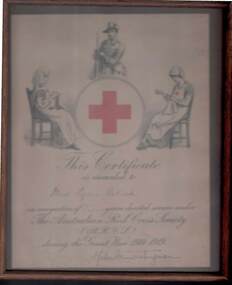
Document - LYDIA CHANCELLOR COLLECTION: AUSTRALIAN RED CROSS CERTIFICATE
... Great War 1914 1919.' C 1920 The certificate which is signed by Lady Helen Munro Ferguson, has a picture of a red cross in a circle with a seated nurse on the left who is knitting, a soldier in the centre above the circle and a nurse who is seated sewing on the right....Great War 1914 1919.' C 1920 The certificate which is signed by Lady Helen Munro Ferguson, has a picture of a red cross in a circle with a seated nurse on the left who is knitting, a soldier in the centre above the circle and a nurse who is seated sewing on the right. ...An Australian Red Cross Certificate in a brown glassed frame. It was presented to Miss Lydia Pethard in 'recognition of five years service under the Australian Red Cross Society (A.R.C.S.) during the Great War 1914 1919.' C 1920 The certificate which is signed by Lady Helen Munro Ferguson, has a picture of a red cross in a circle with a seated nurse on the left who is knitting, a soldier in the centre above the circle and a nurse who is seated sewing on the right.document, certificate, australian red cross, lydia chancellor, collection, civic momentoes, plaque, war, w.w. ii., certificate, community, clubs and associations, voluntary work, document -
 Otway Districts Historical Society
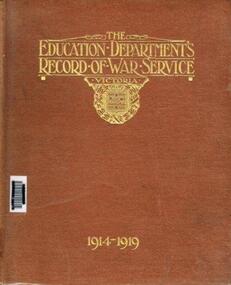
Book, Government Printer, The Education Department's Record of War Service, Victoria, 1914-1919, c.1921
... Nurse, one an Inspector of Schools, while the remaining 24 belonged to the clerical division employed by the Education Department. 146 died. But it was not only teachers who contributed to the war effort. Children and parents gave 400,000 articles of comfort sent abroad, contributed as a rough estimate 460 tons of supplies to hospitals at home, made contributions of £50,000 to The Young Workers' Patriotic Guild, and £217,419 for the war savings effort in the schools, and £422, 470 in general school subscriptions. great war wwi victoria education department victoria teachers enlistments honors decorations war service records first world war world war one This book, published to keep before teachers and children expamples of service and sacrifice in a great cause, is presented to the Hordern Vale School. ...From the beginning of World War 1 in August, 1914, until it ended in November, 1918, teachers from across Victoria enlisted for the Australian Imperial Force and embarked for overseas. Anzac, the Sinai Desert, the vast fields of France, and in Palestine the Education Department soldier-teachers toiled manfully thoughout. Of the 752 enlistments 724 were teachers, two were School Medical Officers, one was a School Nurse, one an Inspector of Schools, while the remaining 24 belonged to the clerical division employed by the Education Department. 146 died. But it was not only teachers who contributed to the war effort. Children and parents gave 400,000 articles of comfort sent abroad, contributed as a rough estimate 460 tons of supplies to hospitals at home, made contributions of £50,000 to The Young Workers' Patriotic Guild, and £217,419 for the war savings effort in the schools, and £422, 470 in general school subscriptions.Hardcover book, bound with brown cloth cover and gold embossed title containing 306 pages, black and white photographs and illustrations and text. This book, published to keep before teachers and children expamples of service and sacrifice in a great cause, is presented to the Hordern Vale School. It should be kept in an honoured place as a souirce of guidance and inspiration for successive generations.great war, wwi, victoria, education department victoria, teachers, enlistments, honors, decorations, war service records, first world war, world war one -
 Alfred Hospital Nurses League - Nursing History Collection
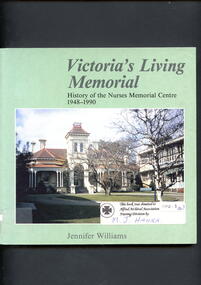
Book - Illustrated book, Jennifer Williams, Victoria's living memorial: history of the Nurses Memorial Centre 1948-1990, 1991
... Nurses Memorial Centre first suggested that a history of the Centre be written. The council of the NMC took up this idea and provided the funding for this book. Of significance to the AHNL as it is a history of a place of great importance to nurses. Nurses Memorial Centre-History Nursing -Victoria-History This is a history of the Nurses Memorial Centre, including the fund-raising efforts of Vivian Bullwinkel and Betty Jeffrey who visited every hospital in Victoria with more than twenty beds, recounting their war time experiences. ...This is a history of the Nurses Memorial Centre, including the fund-raising efforts of Vivian Bullwinkel and Betty Jeffrey who visited every hospital in Victoria with more than twenty beds, recounting their war time experiences. The nurses Memorial Centre is a living memorial to the heroism and sacrifice of the 76 Australian nurses who died during World War Two and to those who survived years in prisoner-of-war camps during that time.Illustrated book with light green cover. On the front cover, in addition to the title and author's name printed in dark grey and black ink, is a coloured photograph of the original Nurses Memorial Centre at 431 St Kilda Rd Melbourne. Title and authors name also printed on the spine. On the back cover are comments about the Centre by Vivian Statham (Bullwinkel) and Betty Jeffrey.non-fictionThis is a history of the Nurses Memorial Centre, including the fund-raising efforts of Vivian Bullwinkel and Betty Jeffrey who visited every hospital in Victoria with more than twenty beds, recounting their war time experiences. The nurses Memorial Centre is a living memorial to the heroism and sacrifice of the 76 Australian nurses who died during World War Two and to those who survived years in prisoner-of-war camps during that time.nurses memorial centre-history, nursing -victoria-history -
 Alfred Hospital Nurses League - Nursing History Collection
Book - Illustrated book, Marianne Baker 1944, Nightingales in the mud: the digger sisters of the Great War 1914-1918, 1989
... Appendix includes list of Australian Nurses who served in World War One Of significance to the AHNL, as Alfred graduates were among those who served World War 1914-1918 - Medical Care Military Nursing Nurses Australian nurses This book draws on many first-hand and previously unpublished accounts of the work of Australian nurses in World War one, to tell the story of courage and companionship under conditions of great hardship - in the mud of Flanders, among the cholera cases in India, on the hospital ships during the Gallipoli campaign, on the Afghanistan border, in Vladivostok, in mosquito infested Macedonia and in the Sinai Desert. ...This book draws on many first-hand and previously unpublished accounts of the work of Australian nurses in World War one, to tell the story of courage and companionship under conditions of great hardship - in the mud of Flanders, among the cholera cases in India, on the hospital ships during the Gallipoli campaign, on the Afghanistan border, in Vladivostok, in mosquito infested Macedonia and in the Sinai Desert.Illustrated book with dust jacket. Book has a dark blue cover, abbreviated title, author's surname and publisher's name embossed in gold on spine. Front of dust jacket has a reproduction of the painting "Arrival of first Australian wounded from Gallipoli at Wandsworth Hospital, London" by George Coates, in a red/brown and white border. Rest of dustjacket is yellow brown in colour. Full title is printed in blue and red /brown above painting, author's full name is printed in blue below painting. Abbreviated title, author's surname and publishers name are printed in blue on the spinenon-fictionThis book draws on many first-hand and previously unpublished accounts of the work of Australian nurses in World War one, to tell the story of courage and companionship under conditions of great hardship - in the mud of Flanders, among the cholera cases in India, on the hospital ships during the Gallipoli campaign, on the Afghanistan border, in Vladivostok, in mosquito infested Macedonia and in the Sinai Desert.world war 1914-1918 - medical care, military nursing, nurses, australian nurses -
 Alfred Hospital Nurses League - Nursing History Collection
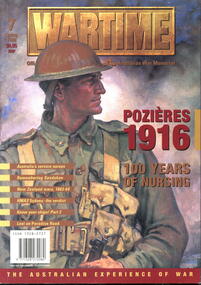
Magazine - Illustrated magazine, Philip J Turner & Rex Curtis-Griffiths, Wartime: Number 7 Spring 1997, 1999
... War Two POW) Ann Mackinnon (served with the 2/6th Australian General Hospital), RAAF medevac nurses in Vietnam, nurses in Rwanda, and a review of the film Paradise Road. At lower right of first page is a printed black and white donation sticker: black Maltese cross in circle, "This book was donated to Alfred Archival Association Nursing Division by' Pat Adams (handwritten in black ink) previous catalogue number is also written on this label. Illustrated magazine. The front cover has a copy of a painting by Hilda Rix-Nicholas: Australian soldier of the Great ...The Australian experience of war: the magazine contains other war related articles, the ones referring to nursing experiences are Florence Nightingale, Fanny Hines (died of pneumonia in the Boer War), Catherine Tully (awarded the 1914 Star with clasp) other World War One Experiences, Jessie Simmons (World War Two POW) Ann Mackinnon (served with the 2/6th Australian General Hospital), RAAF medevac nurses in Vietnam, nurses in Rwanda, and a review of the film Paradise Road.Illustrated magazine. The front cover has a copy of a painting by Hilda Rix-Nicholas: Australian soldier of the Great War. The man is wearing a metal helmet and combat uniform. Title and list of contents are printed are printed in gold and red brown on front cover also. non-fictionThe Australian experience of war: the magazine contains other war related articles, the ones referring to nursing experiences are Florence Nightingale, Fanny Hines (died of pneumonia in the Boer War), Catherine Tully (awarded the 1914 Star with clasp) other World War One Experiences, Jessie Simmons (World War Two POW) Ann Mackinnon (served with the 2/6th Australian General Hospital), RAAF medevac nurses in Vietnam, nurses in Rwanda, and a review of the film Paradise Road.military nursing-australia-history, world war 1914-1918, world war 1939-1945, vietnam war, world war 1939-1945 prisoners of war, rwanda, nurses, nursing -
 Alfred Hospital Nurses League - Nursing History Collection
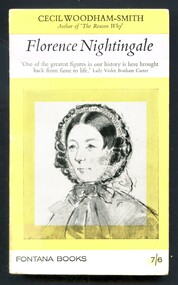
Book, Cecil Woodham-Smith 1896-1977, Florence Nightingale, 1969
... Florence Nightingale Nurses-Great Britain-Biography Crimean War Biography of Florence Nightingale, from her early life and training to her ground breaking work during the Crimean War and her lifelong advocacy for healthcare reform. ...Biography of Florence Nightingale, from her early life and training to her ground breaking work during the Crimean War and her lifelong advocacy for healthcare reform.Book has a yellow white and purple cover with black print. A black and white illustration of a woman wearing a bonnet with a bow (from a watercolour of Florence Nightingale painted by J. Barrett in 1956) on the front cover, this is surrounded by a yellow frame. Below this border the publishers name is printed in black on a white background. At the top of the front cover authors name is printed on a yellow background, below this the title is printed on a purple background, and below this, on a white background a comment is printed re Florence Nightingale. Title, author's name and printers mark are also printed on the spine. On the back cover title and publisher's names are printed along with two reviews of the book.non-fictionBiography of Florence Nightingale, from her early life and training to her ground breaking work during the Crimean War and her lifelong advocacy for healthcare reform.florence nightingale, nurses-great britain-biography, crimean war -
 Alfred Hospital Nurses League - Nursing History Collection
Book - Illustrated book, Cecil Woodham-Smith 1896-1977, Florence Nightingale 1820-1910, 1950
... War...Nurses-Great Britain-History...Florence Nightingale Crimena War Nurses-Great Britain-History Nursing-History Biography of Florence Nightingale At the top of the front end-page the name 'Winifred Young' is written in blue ink, above this the previous catalogue number is written in pencil. ...Biography of Florence NightingaleHardcover book with white dust jacket. Cover page has title 'Florence Nightingale' in (yellow ink) 'by' Cecil Woodham Smith (white ink) author's name (black ink) and publisher's name (white ink) are also printed on the spine of the dustjacket. There is also a white rectangular sticker, on which the previous catalogue number is printed, on the dustjacket spine. On the back of the dustjacket is printed Lord Ellesmere's tribute to Florence Nightingale, House of Lords, May 5, 1856. non-fictionBiography of Florence Nightingaleflorence nightingale, crimena war, nurses-great britain-history, nursing-history -
 Alfred Hospital Nurses League - Nursing History Collection
Book - Illustrated book, Thornton Butterworth Limited, Florence Nightingale 1820-1856: a study of her life down to the end of the Crimean War, 1931
... Nurses-biography Nursing-History Crimean War 1853-1856-medical care This book focuses on the early life and work of Florence Nightingale, particularly her contribution to healthcare and nursing, up to her involvement in the Crimean War. The book also explores Nightingale's experiences in the Crimean War, where she helped establish a hospital and improved sanitation, leading to better care for the soldiers. The book also delves into the impact of her work and its influence on civilian hospital reforms in Great ...This book focuses on the early life and work of Florence Nightingale, particularly her contribution to healthcare and nursing, up to her involvement in the Crimean War. The book also explores Nightingale's experiences in the Crimean War, where she helped establish a hospital and improved sanitation, leading to better care for the soldiers. The book also delves into the impact of her work and its influence on civilian hospital reforms in Great Britain.Illustrated book has been covered with adhesive dark blue plastic. Handwritten in silver on the spine are the words 'Hist of N I' and the number 9.non-fictionThis book focuses on the early life and work of Florence Nightingale, particularly her contribution to healthcare and nursing, up to her involvement in the Crimean War. The book also explores Nightingale's experiences in the Crimean War, where she helped establish a hospital and improved sanitation, leading to better care for the soldiers. The book also delves into the impact of her work and its influence on civilian hospital reforms in Great Britain.florence nightingale, military nursing-history, nurses-biography, nursing-history, crimean war 1853-1856-medical care -
 Alfred Hospital Nurses League - Nursing History Collection
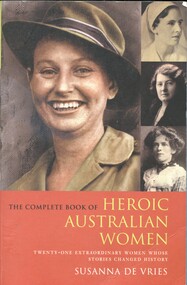
Book - Illustrated Book, Susanna De Vries 1935, The complete book of heroic Australian women, 2010
... Previously published as two separate books :- Great pioneer women of the outback & Great Australian women in war. Of significance to the AHNL as it profiles several nurses, including Bett Jeffrey AH graduate Women-Biography Women-Australian-Biography Providing inspiration for contemporary women, this book profiles 21 individuals who faced different tests - harshness of the Australian outback, but when encountering adversity, even death, each proved her mettle, showing what it takes to be a truly heroic Australian. ...Providing inspiration for contemporary women, this book profiles 21 individuals who faced different tests - harshness of the Australian outback, but when encountering adversity, even death, each proved her mettle, showing what it takes to be a truly heroic Australian. The 21 women are :- Georgiana Molloy, Frances ('Fanny') Bussell, Elizabeth ('Bessie') Bussell, Charlotte Cookworthy Bussell, Emma Mary Withnell, Atlanta Hope Bradshaw, Jeannie Gunn OBE, Evelyn Maunsell, Catherine Langloh Parker, Myrtle Rose White, Olive May Kelso King, Dr Agnes Elizabeth Lloyd Bennett, Dr Lilian Violet Cooper, Sister Alice Elizabeth Kitchen, Joice NanKivell Loch, Sister Sylvia Muir, Sister Vivian Bullwinkel, Sister Joyce Tweddell, Sister Betty Jeffrey, Mavis Parkinson, and Sister Frances May Hayman.Illustrated book, with brown and green cover. On the front cover is one large and three small photographs Of women (the large photograph is of Vivian Bullwinkel, top right - Joyce Tweedle, centre -Myrtle Rose White, bottom right - Jeannie Gunn). Below these photos title (black, green and white ink) and author's name (white ink) are printed. Three of these photos are also on the spine (Vivian Bullwinkel, Joyce Tweedle & Jessie Gunn) above the phots the book title is printed in black and brown ink, and below the author's name, publisher's name and logo are printed in white ink. On the back cover is a summary of the book and a photograph of a woman (Myrtle Rose White. non-fictionProviding inspiration for contemporary women, this book profiles 21 individuals who faced different tests - harshness of the Australian outback, but when encountering adversity, even death, each proved her mettle, showing what it takes to be a truly heroic Australian. The 21 women are :- Georgiana Molloy, Frances ('Fanny') Bussell, Elizabeth ('Bessie') Bussell, Charlotte Cookworthy Bussell, Emma Mary Withnell, Atlanta Hope Bradshaw, Jeannie Gunn OBE, Evelyn Maunsell, Catherine Langloh Parker, Myrtle Rose White, Olive May Kelso King, Dr Agnes Elizabeth Lloyd Bennett, Dr Lilian Violet Cooper, Sister Alice Elizabeth Kitchen, Joice NanKivell Loch, Sister Sylvia Muir, Sister Vivian Bullwinkel, Sister Joyce Tweddell, Sister Betty Jeffrey, Mavis Parkinson, and Sister Frances May Hayman.women-biography, women-australian-biography -
 Alfred Hospital Nurses League - Nursing History Collection
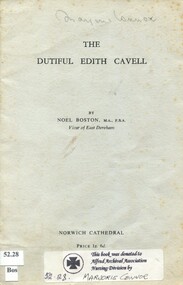
Booklet, Noel Boston 1910-1966, The dutiful Edith Cavell, 1955
... Edith Cavell's execution sparked international outrage and solidified her image as a martyr and heoine particularly in Great Britain, her grave is in in the grounds of Norwich Cathedral Of significance to the AHNL as it is the story of a significant nurse Edith Cavell World War 1914-1918 Edith Cavell, birn 1865, trained at the London Hospital, in 1906 she asked to oversee a surgical and medical home in Brussles, Belgium. ...Edith Cavell, birn 1865, trained at the London Hospital, in 1906 she asked to oversee a surgical and medical home in Brussles, Belgium. After the German occupation of Belgium, she became involved in an underground group formed to help British, French, and Belgian soldiers reach the Netherlands, a neutral country. The soldiers were sheltered at the Berkendael Institute, which had become a Red Cross hospital, and were provided with money and guides by Philippe Baucq, a Belgian. About 200 men had been aided when, in August 1915, Cavell and several others were arrested. The group was brought before a court-martial on October 7, 1915. On October 9, Cavell, after making a full confession, was sentenced to death. Three days later she and Baucq were shot, despite the efforts of the U.S. and Spanish ministers to secure a reprieve. The group was brought before a court-martial on October 7, 1915. On October 9, Cavell, after making a full confession, was sentenced to death. Three days later she and Baucq were shot, despite the efforts of the U.S. and Spanish ministers to secure a reprieve. Though legally justified, her execution on a charge that did not includeStapled booklet with grey cover and black print. Title, authors name, 'Norwich Cathedral' and price printed on front covernon-fictionEdith Cavell, birn 1865, trained at the London Hospital, in 1906 she asked to oversee a surgical and medical home in Brussles, Belgium. After the German occupation of Belgium, she became involved in an underground group formed to help British, French, and Belgian soldiers reach the Netherlands, a neutral country. The soldiers were sheltered at the Berkendael Institute, which had become a Red Cross hospital, and were provided with money and guides by Philippe Baucq, a Belgian. About 200 men had been aided when, in August 1915, Cavell and several others were arrested. The group was brought before a court-martial on October 7, 1915. On October 9, Cavell, after making a full confession, was sentenced to death. Three days later she and Baucq were shot, despite the efforts of the U.S. and Spanish ministers to secure a reprieve. The group was brought before a court-martial on October 7, 1915. On October 9, Cavell, after making a full confession, was sentenced to death. Three days later she and Baucq were shot, despite the efforts of the U.S. and Spanish ministers to secure a reprieve. Though legally justified, her execution on a charge that did not includeedith cavell, world war 1914-1918 -
 Alfred Hospital Nurses League - Nursing History Collection
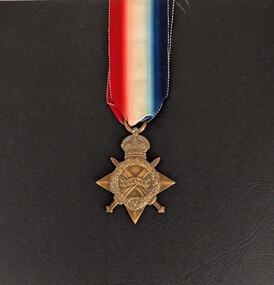
Medal - War War I medal, Royal Mint, 1914-1915 Star (Leah Rosenthal), ca.1918
... Great War between 5 August 1914 and 31 December 1915, provided they had not already received the 1914 Star. The period of eligibility was prior to the Military Service Act 1916, which introduced conscription in Britain. Recipients also received the British War Medal and the Victory Medal. Leah Rosenthal volunteered with Queen Alexandra's Imperial Nursing Service Reserve, serving in France, and also was awarded the Associate Royal Red Cross Of significance to the AHNL as the recipient was an Alfred Hospital Graduate Alfred Hospital World War 1914-1918 Nurses Leah Rosenthal Queen Alexandra's Imperial Military Nursing Service Reserve The medal, based on the design of the earlier 1914 Star, is a four-pointed star of bright bronze, ensigned with a crown. ...The 1914–15 Star was instituted in December 1918 and was awarded to all who served in the British and Imperial forces against the Central European Powers in any theatre of the Great War between 5 August 1914 and 31 December 1915, provided they had not already received the 1914 Star. The period of eligibility was prior to the Military Service Act 1916, which introduced conscription in Britain. Recipients also received the British War Medal and the Victory Medal. Leah Rosenthal volunteered with Queen Alexandra's Imperial Nursing Service Reserve, serving in France, and also was awarded the Associate Royal Red CrossOf significance to the AHNL as the recipient was an Alfred Hospital GraduateThe medal, based on the design of the earlier 1914 Star, is a four-pointed star of bright bronze, ensigned with a crown. The medal and suspension assembly was struck in one piece. The obverse has two crossed gladii (swords) with their blades upwards, the points and grips of which form what might appear to be four additional points to the star. The swords are overlaid by a wreath of oak leaves, with the Royal Cypher of King George V at the base of the wreath and an overlaying central scroll inscribed "1914–15". The reverse is plain and is impressed with the recipient's details [LIEUT. /J. ROSENTHAL. RANC] The attached ribbon has the red, white and blue colours of the flag of the United Kingdom in shaded and watered bands. The medal has been mounted on card together with recipient's British War Medal and Victory Medalalfred hospital, world war 1914-1918, nurses, leah rosenthal, queen alexandra's imperial military nursing service reserve -
 Alfred Hospital Nurses League - Nursing History Collection
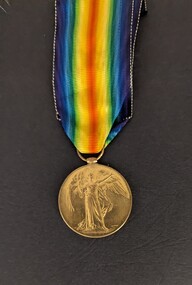
Medal - World War 1 medal, Royal Mint, Victory Medal (Leah Rosenthal), [ca.1919]
... This medal was awarded to Leah Rosenthal (Alfred Hospital trained nurse)who served with Queen Alexandra's Nursing Service Reserve in France during World War 1 Of significance to the AHNL as the recipient had trained at the Alfred Hospital, graduating in 1904 World War 1 Military Medals World War 1 Victory Medal Leah Rosenthal Queen Alexandra's Imperial Military Nursing Service Reserve The reverse side bears the inscription "THE GREAT /WAR FOR/CIVILISATION/1914-1919" within a laurel wreath Round bronze medal with attached ring and ribbon. ...This medal was awarded to Leah Rosenthal (Alfred Hospital trained nurse)who served with Queen Alexandra's Nursing Service Reserve in France during World War 1Of significance to the AHNL as the recipient had trained at the Alfred Hospital, graduating in 1904Round bronze medal with attached ring and ribbon. The front of the medal displays a full-length winged figure (Victory) holding a palm leaf in her right hand. The ribbon has vertical stripes of red yellow, green,blue and violet from centre outwards. Has been mounted on a card along with the recipients 1914-1915 Military Star and British War MedalThe reverse side bears the inscription "THE GREAT /WAR FOR/CIVILISATION/1914-1919" within a laurel wreathworld war 1, military medals, world war 1 victory medal, leah rosenthal, queen alexandra's imperial military nursing service reserve -
Eltham District Historical Society Inc
Document - Folder, Morrison: Sir William Irvine, Beatrice Wanliss Morrison
... War Memorial Committee which built the Baby Health Centre, the Children's Library and the Pre-School Centre in Eltham. The family were interlinked with other local people. Contents Document by Beatrice W Morrison, 8 May no year given but pre 1989: life of Sir William Hill Irvine, his daughter Beatrice Wanliss Morrison and her husband James Morrison, and memories of Eltham and residents. Document summarising life of Beatrice Wanliss Morrison, undated but post 1989. Letter from Beatrice Williams to Eltham Shire, 29 September 1985: endorsing the idea of a nature corridor through Eltham Shire to the Great Dividing Range, noting she nursed...War Memorial Committee which built the Baby Health Centre, the Children's Library and the Pre-School Centre in Eltham. The family were interlinked with other local people. Contents Document by Beatrice W Morrison, 8 May no year given but pre 1989: life of Sir William Hill Irvine, his daughter Beatrice Wanliss Morrison and her husband James Morrison, and memories of Eltham and residents. Document summarising life of Beatrice Wanliss Morrison, undated but post 1989. Letter from Beatrice Williams to Eltham Shire, 29 September 1985: endorsing the idea of a nature corridor through Eltham Shire to the Great Dividing Range, noting she nursed ...William Hill Irvine came from Northern Ireland around 1879 and lived in Heidelberg. He became a barrister and Member for Flinders Electorate, serving at various times as Attorney-General, Chief Justice, Premier and Lieutenant-Governor of Victoria. His daughter Beatrice married James Morrison and lived in Eltham. Irvine's other children were William and Agnes. William became Crown Prosecutor. Agnes married Ian Hayward and moved to Adelaide. Beatrice worked with the War Service Committee, raising money for the Red Cross and became chairman of the War Memorial Committee which built the Baby Health Centre, the Children's Library and the Pre-School Centre in Eltham. The family were interlinked with other local people. Contents Document by Beatrice W Morrison, 8 May no year given but pre 1989: life of Sir William Hill Irvine, his daughter Beatrice Wanliss Morrison and her husband James Morrison, and memories of Eltham and residents. Document summarising life of Beatrice Wanliss Morrison, undated but post 1989. Letter from Beatrice Williams to Eltham Shire, 29 September 1985: endorsing the idea of a nature corridor through Eltham Shire to the Great Dividing Range, noting she nursed the Morrison family before WWII. Letter from Health Shire to Beatrice Williams, 9 October 1985: acknowledging letter. Newspaper death notice, The Age, 19 March 2008: William Irvine Askin Morrison. Newspaper clippings, A4 photocopies, etcwilliam hill irvine, james morrison, agnes hayward nee morrison, war service committee eltham, red cross, baby health centre eltham, children's library eltham, pre-school centre eltham, somerville morrison, archie morrison, virginia morison, michael irvine, ian hayward, bill hayward, killeavy eltham, mccoll family eltham, logan family eltham, dry creek eltham, jack mccoll, burke and wills, orford family, andersons family, mount pleasant road eltham, reynolds road eltham, eddy anderson, reynolds family, sweeney family, sweeney's lane eltham, burston family, carrucan family, beatrice wanliss morrison nee irvine, beatrice williams, thomas watson haymes, william irvine askin morrison -
 Bendigo Military Museum
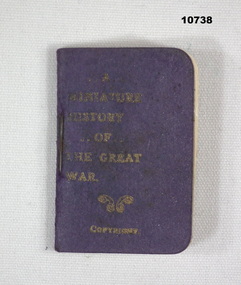
Book - MINIATURE BOOK, WW1, F. Edwards, "Miniature History of the Great War", Post WW1
... Nurse Edith Cavell, Marshall Fochard, P.M. Lloyd- George, WW1 British casualties listed. Part of the Bennetts collection. See Cat No. 9726P for details of service for "Alva Marie Bennetts" (VFX128835). Bennetts Collection Alva Bennetts WW1 Miniature Book Purple coloured card covered book. 32 pages with cut edges and rounded corners. Text in black type. Black and white photographs on various pages. Title on front cover in gold coloured lettering. Publisher details on back cover in gold coloured lettering. Pages attached to cover via a metal staple. "Miniature History of the Great War ...Book features main events of WW1 in addition to short biographies of significant personnel including; Sir Douglas Haig, Nurse Edith Cavell, Marshall Fochard, P.M. Lloyd- George, WW1 British casualties listed. Part of the Bennetts collection. See Cat No. 9726P for details of service for "Alva Marie Bennetts" (VFX128835).Purple coloured card covered book. 32 pages with cut edges and rounded corners. Text in black type. Black and white photographs on various pages. Title on front cover in gold coloured lettering. Publisher details on back cover in gold coloured lettering. Pages attached to cover via a metal staple.bennetts collection, alva bennetts, ww1, miniature book -
 Wangaratta RSL Sub Branch
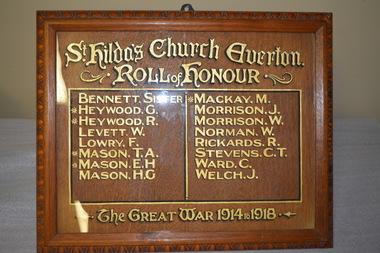
Honour Board - Framed Roll of Honour, St. Hilda's Church, Everton
... St Hilda's Church Everton Honour Roll contains 16 names of members including Nurse BENNETT, from the Everton Community in Victoria who served in WW1 everton 1914-1918 roll of honour "St Hilda's Church Everton' "Roll of Honour" "The Great War 1914 to 1918" Sister Bennett/Heywood G/Heywood R/Levett W/Lowry F/Mason T.A/Mason E.H/Mason H.G/MacKay M/Morrison J/Morrison W/Norman W/Rickards R/Steens C.T/Ward C/Welch J. ...St Hilda's Church Everton, WW1 Roll of Honour - contains 16 names of members of the Everton Community in Victoria who served during the First World War including Nursing Sister Alma Louisa BENNETT (1890-1922) who trained at Melbourne General Hospital. She moved to Western Australia and continued nursing until the advent of World War 1. She immediately sought to enlist but was not granted her request until 1916 and was eventually sent for nursing duties in India. Her arrival coincided with the first convey of wounded after the fall of Kut in Mesopotamia. She was immediately given charge of a ward at Victoria Hospital. The following year she was appointed Matron of the hospital ship "Herefordshire" which transported sick and wounded soldiers from the mouth of the Tigris River to Bombay. Her next appointment was to the 34th Welsh Hospital at Deolali 150 miles from Bombay. The hospital was huge and she took charge as Matron. After 17 months at Deolali BENNETT was awarded the Royal Red Cross Medal First Class one of the highest distinctions in the British Nursing Service. When peace was declared she travelled to England where she continued to nurse in an Army Hospital. During her stay she was invited to Buckingham Palace where she was presented with Red Cross Medal by King George V. BENNETT returned to Victoria and was invited to join the nursing staff at Melbourne's Epworth Hospital with prospects of becoming Matron. Ill health intervened and she died in September 1922. Item said to be made by the family of Gilbert and Richard Heywood both KIA and listed on honour roll.St Hilda's Church Everton Honour Roll contains 16 names of members including Nurse BENNETT, from the Everton Community in Victoria who served in WW1 Carved timber frame and mounting with 16 names in gold coloured paint listed in two columns."St Hilda's Church Everton' "Roll of Honour" "The Great War 1914 to 1918" Sister Bennett/Heywood G/Heywood R/Levett W/Lowry F/Mason T.A/Mason E.H/Mason H.G/MacKay M/Morrison J/Morrison W/Norman W/Rickards R/Steens C.T/Ward C/Welch J.everton, 1914-1918, roll of honour -
 Wangaratta RSL Sub Branch
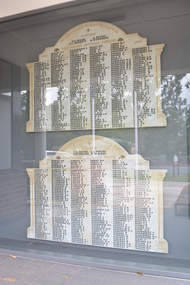
Honour Board - Honour Board -Wangaratta and District Victory Roll
... Wangaratta and District Victory Roll - listing names of local men and women who volunteered to serve during the Great War 1914-1918 A permanent memorial to honour those who volunteered to serve and die for their country during the Great War. wangaratta and district victory roll ww1 World War One 1914-1919 Nurses Wangaratta and District Victory Roll Nurses Australian Imperial Forces 1914-1918 Marble Victory Roll irregular shape, with carved side columns outlined in gold paint. ...Wangaratta and District Victory Roll - listing names of local men and women who volunteered to serve during the Great War 1914-1918 A permanent memorial to honour those who volunteered to serve and die for their country during the Great War.Marble Victory Roll irregular shape, with carved side columns outlined in gold paint. Six columns of names in black.Wangaratta and District Victory Roll Nurses Australian Imperial Forces 1914-1918wangaratta and district victory roll, ww1, world war one, 1914-1919, nurses -
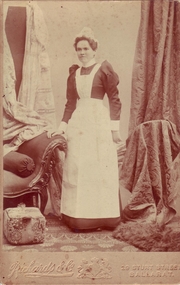 Clunes Museum
Photograph, RICHARDS & CO. ART STUDIO
... War 1914-1918 when the town was without a doctor. Her experience and knowledge was a great asset to Clunes. Retired about 1921 SEPIA PHOTOGRAPH OF MATRON ADA JOHNSON IN HER NURSES UNIFORM - STARCHED COLLAR AND CUFFS. ...SEPIA PHOTOGRAPH OF MATRON ADA JOHNSON IN HER NURSES UNIFORM - STARCHED COLLAR AND CUFFS. WEARING A CAP. HER HAND ON SOFA, EMBOSSED CURTAINS DRAPED AROUND.On reverse hand written in blue biro; Mrs Ada Johnson, matron of Clunes Hospital for quite a few years and during 1st World War 1914-1918 when the town was without a doctor. Her experience and knowledge was a great asset to Clunes. Retired about 1921photographs, hospital [old], matron ada johnson
