
Showing 97 items matching "griffith, w."
-
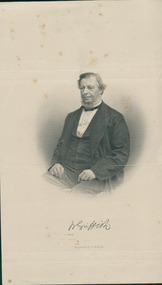 Uniting Church Archives - Synod of Victoria
Print
... Griffith, W....W. Griffith....Matte, black and white, ¾ engraving of studio portrait of W. Griffith....W. Griffith. Griffith, W. Matte, black and white, ¾ engraving of studio portrait of W. ...W. Griffith.Matte, black and white, ¾ engraving of studio portrait of W. Griffith.griffith, w. -
 Ballarat Clarendon College
Book, Various
... Presented to the school library in 1944 by Mr W Griffiths identity unconfirmed. ...Book plates inside cover: Book plate on flyleaf: Literature / Crest / Ballarat College / Library / Presented by / Mr W Griffiths 1944......Presented to the school library in 1944 by Mr W Griffiths identity unconfirmed. Example of ongoing commmunity support of the school. ...Presented to the school library in 1944 by Mr W Griffiths identity unconfirmed. Example of ongoing commmunity support of the school. The Weatherly Library was opened in 1936 and its collection significantly established by donation or bequest of old collegians and members of the college community and associates.Four books/ The Andes and the Amazon - dark blue cloth bound book with gold lettering and illustration on cover and gold lettering on spine. Life of Gladstone 3 vols - red cloth binding with gold lettering on spine. Book plates inside cover: Book plate on flyleaf: Literature / Crest / Ballarat College / Library / Presented by / Mr W Griffiths 1944... -
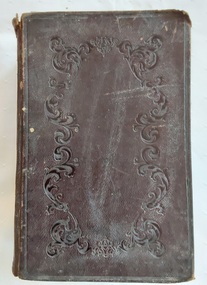 Mont De Lancey
Book, British and Foreign Bible Society, The Holy Bible containing the Old and New Testaments, 1847
... The owner, Benjamin Griffiths gave this bible to J W Griffiths Jnr. on Oct 3rd 1884....Three small slips of paper used as bookmarks have written in grey pencil at the top of each: 'Judges V1- 25' 'Acts 27 - 27 - 44' 'Acts 28 - 11-3' Inside the back cover written in copperplate faded black ink is: 'Benjamin Griffiths Oct 3rd 1884 given to J W Griffiths Jnr'...The owner, Benjamin Griffiths gave this bible to J W Griffiths Jnr. on Oct 3rd 1884. ...The Holy Bible containing the Old and New testaments: Translated out of the original tongues and with the former translations diligently compared and revised, By His Majesty's Special Command. Appointed to be read in churches.A damaged thick black hardcover Holy Bible with an embossed large pattern on the front and back cover. The end paper at the front has come away from the spine which has five raised bands and Holy Bible written in gold lettering. There are marks and foxing inside and on the edges of the gilt edges pages. The text is large. Inside are three slips of paper used as bookmarks and have written in grey pencil verses in Judges and Acts.non-fictionThe Holy Bible containing the Old and New testaments: Translated out of the original tongues and with the former translations diligently compared and revised, By His Majesty's Special Command. Appointed to be read in churches. holy bible, religion, christianity, gibson collection -
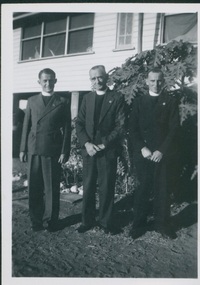 Uniting Church Archives - Synod of Victoria
Photograph, C. 1949
... Gloss, black and white photograph of Rev. Henry Griffiths, Rev. W. J. Turner and one other minister outside a building....Gloss, black and white photograph of Rev. Henry Griffiths, Rev. W. J. Turner and one other minister outside a building. ...See entry for F53-1Gloss, black and white photograph of Rev. Henry Griffiths, Rev. W. J. Turner and one other minister outside a building.northern territory, inland mission, methodist, griffiths, henry, turner, w.j. -
Ballarat Clarendon College
Book
... Books donated to the Ballarat College Library by Dr W R and Mrs Griffiths, Dr W R Griffiths and John Garland Griffiths. ...Books donated to the Ballarat College Library by Dr W R and Mrs Griffiths, Dr W R Griffiths and John Garland Griffiths. ...Books donated to the Ballarat College Library by Dr W R and Mrs Griffiths, Dr W R Griffiths and John Garland Griffiths. These are all members of the one family. John Garland griffiths entered ballarat College in 1938. [Family Links] Son of Mr W R & Dr Mary Skewes | [Family Links] Brother of Bruce, Margaret & David | [General] Previously at Winton College to Gr 4. Two books were donated in 1941 and a third in 1957. Three books of varying title and sizew-r-griffiths, dr-mary-skewes, john-garland-griffiths, ballarat-college, weatherly-library, 1941, 1957 -
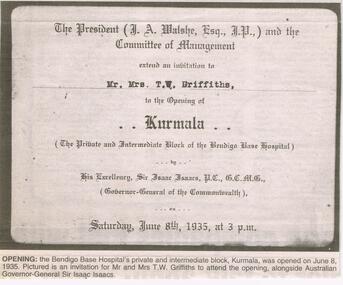 Bendigo Historical Society Inc.
Newspaper - JENNY FOLEY COLLECTION: OPENING
... Pictured is an invitation to Mr. and Mrs. T. W. Griffiths to attend the opening, alongside Australian Governor-General Sir Isaac Isaacs. ...Pictured is an invitation to Mr. and Mrs. T. W. Griffiths to attend the opening, alongside Australian Governor-General Sir Isaac Isaacs. ...BHS CollectionBendigo Advertiser '' The way we were'' from 2002. Opening: the Bendigo Base Hospital's private and intermediate block, Kurmala, was opened on June 8, 1935. Pictured is an invitation to Mr. and Mrs. T. W. Griffiths to attend the opening, alongside Australian Governor-General Sir Isaac Isaacs. The clip is in a folder.newspaper, bendigo advertiser, the way we were -
Ringwood and District Historical Society
Book, Ringwood District Philatelic Society Members Attendance Book 1952 to 1970, 1950s
... +Additional Keywords: L-R: / Wenn, Mrs / Unknown / McCaskill, J / Griffiths, S / K W / Miles, P / Duerdoth, P / McEwan, Mrs E....+Additional Keywords: L-R: / Wenn, Mrs / Unknown / McCaskill, J / Griffiths, S / K W / Miles, P / Duerdoth, P / McEwan, Mrs E. ...Donated by the Ringwood Philatelic SocietyGreen covered book with cream spine 202 pp., containing members and visitors attendance at meetings from 6-Jun-1952 (The inaugural meeting) 7o 6-Aug-1970. Picture in front of members 7-Aug-1953. +Additional Keywords: L-R: / Wenn, Mrs / Unknown / McCaskill, J / Griffiths, S / K W / Miles, P / Duerdoth, P / McEwan, Mrs E.Members Attendance Book (on front cover) -
 Hymettus Cottage & Garden Ballarat
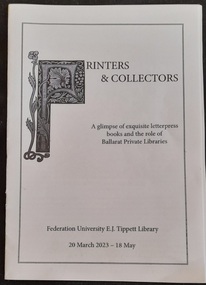
Work on paper - Exhibition Catalogue, Printers and Collectors
... An exhibition of the art of letterpress printing and graphics featuring Australian fine press and ex-patriate work as well as keynote items from William Morris's Kelmscott Press and Australia's John Kirtley's Mountainside Press to more recent products featuring Ballarat and Eureka that have been collected by Ballarat collectors such as W. R. Griffiths, R. A. Crouch and others. ...An exhibition of the art of letterpress printing and graphics featuring Australian fine press and ex-patriate work as well as keynote items from William Morris's Kelmscott Press and Australia's John Kirtley's Mountainside Press to more recent products featuring Ballarat and Eureka that have been collected by Ballarat collectors such as W. R. Griffiths, R. A. Crouch and others. School of Mines Ballarat SMB Ballarat Exhibition Books Book Collection Private Library Federation University E.J.Tippett Library Book Collectors A catalogue of the exhibition of Private Press & Fine Press books at Federation University's E. ...A catalogue of the exhibition of Private Press & Fine Press books at Federation University's E. J. Tippett Library, SMB Ballarat 20 March 2023 - 18 May 2023. The exhibition was opened by John Arnold and featured books from Ballarat private collections.non-fictionA catalogue of the exhibition of Private Press & Fine Press books at Federation University's E. J. Tippett Library, SMB Ballarat 20 March 2023 - 18 May 2023. The exhibition was opened by John Arnold and featured books from Ballarat private collections.school of mines ballarat, smb, ballarat, exhibition, books, book collection, private library, federation university, e.j.tippett library, book collectors -
 Linton Mechanics Institute and Free Library Collection
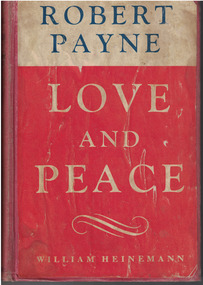
Book - Novel, Payne, Robert, Love and Peace by Robert Payne, 1945
... Book plate pasted to rear cover, indicating prior ownership: 'Griffiths Booksellers and Stationers Geelong.' Stamps inside book: 'This belongs to W. ...Book plate pasted to rear cover, indicating prior ownership: 'Griffiths Booksellers and Stationers Geelong.' Stamps inside book: 'This belongs to W. ...Chinese culture and history novel. The first in a series of novels describing the life of a Chinese family from 1908 to present day.Hardcover book which is the first of a series describing the life of a Chinese family from 1908 to the present day (1945). 206 pages. Book plate pasted to rear cover, indicating prior ownership: 'Griffiths Booksellers and Stationers Geelong.' Stamps inside book: 'This belongs to W. J. Griffiths Circulating Library'.fictionChinese culture and history novel. The first in a series of novels describing the life of a Chinese family from 1908 to present day.robert payne, chinese culture, chinese history, fiction -
 Bendigo Historical Society Inc.
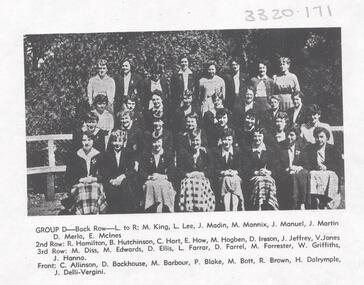
Photograph - LA TROBE UNIVERSITY BENDIGO COLLECTION: BENDIGO TEACHERS' COLLEGE STUDENTS
... M. Forrester, W. Griffiths, J. Hanna, C. Allinson, D. Backhouse, M. ...M. Forrester, W. Griffiths, J. Hanna, C. Allinson, D. Backhouse, M. ...A black and white photograph of 1955 Bendigo Teachers' College Group D students. They are - M. King, L. Lee, J. Madin, M.Mannix, J. Manuel, J. Martin, D. Merlo, E. McInes, R. Hamilton, B. Hutchinson, C. Hart, E. How, M. Hogben, D. Ireson, J. Jeffrey, V. Jones, M. Diss, M. Edwards, D. Ellis, L. Farrar, D. Farrel. M. Forrester, W. Griffiths, J. Hanna, C. Allinson, D. Backhouse, M. Barbour, P. Blake, M. Bott, R. Brown, H. Dalrymple, J. Delli-Vergini. See 3320.100bendigo, education, bendigo teachers' college students, la trobe university bendigo collection, collection, bendigo, education, bendigo teachers' college, students, photo, photos, photograph, photographs, history, tertiary education, teacher training -
 Melbourne Legacy
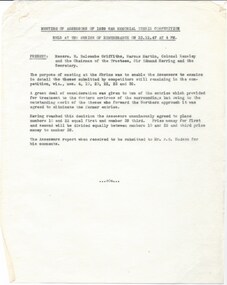
Document, Meeting of the Assessors of 1939 War Memorial Thesis Competition held at the Shrine of Remembrance on 23.12.47 at 4 pm, 1947
... The notes of a meeting of the Assessors show that Mr W. Balcombe Griffiths, Mr Marcus Martin, Colonel Kemsley and Sir Edmund Herring (Chairman of the Shrine Trustees) were present when the winning design was chosen. ...The notes of a meeting of the Assessors show that Mr W. Balcombe Griffiths, Mr Marcus Martin, Colonel Kemsley and Sir Edmund Herring (Chairman of the Shrine Trustees) were present when the winning design was chosen. ...After the second world war there was a decision made to create a memorial for the 1939-45 War at the Shrine. A competition was held and 53 entries assessed. The first prize was shared between two submissions and the third prize money was also awarded. These two documents show that Legatee Kemsley was one of the Assessors who decided the basis of design for the memorial. The notes of a meeting of the Assessors show that Mr W. Balcombe Griffiths, Mr Marcus Martin, Colonel Kemsley and Sir Edmund Herring (Chairman of the Shrine Trustees) were present when the winning design was chosen. The design was later completed as the Forecourt in the shape of a paved cross, built in 1953, and the Cenotaph surmounted by a statuary group and the Eternal Flame. The memorial was dedicated and the flame set alight by Her Majesty Queen Elizabeth II on February 28 1954.A record of the decisions made by the committee that chose the design of the memorial for the 1939-45 war that was built as the Forecourt, the Cenotaph and the Eternal Flame at the Shrine of Remembrance. Legatee Kemsley was on the committee. White quarto paper with black type x 3 pages, two pages are a report to the Shrine Trustees on the competition for the design of the 1939 War Memorial and the third page is notes on a meeting of the Assessors of the competition.01187.2-3 Handwritten in pencil 'Shrine'. Title is: "Report of Assessors appointed to examine and award prizes from theses received in connection with the 1939 War Memorial Competition Conducted by the Shrine of Remembrance Trustees"memorial, cenotaph -
 Mission to Seafarers Victoria
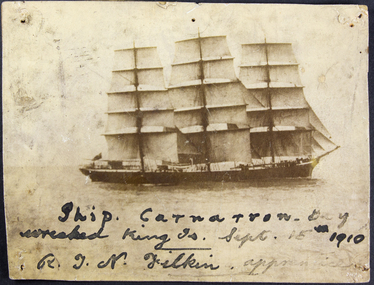
Photograph, George Schutze, Ship Carnarvon Bay wrecked King Island 15 September 1910 - R.J.N Filkin apprentice, c. 1910
... One of them with Captain W. Griffith and 17 men was rescued by the SS Taracoola and brought back to Melbourne. ...One of them with Captain W. Griffith and 17 men was rescued by the SS Taracoola and brought back to Melbourne. ...The ship Carnarvon Bay bound from Liverpool to Sydney with a general cargo struck rocks off Stokes Point on the coast of King Island on Thursday 15 September 1910. On the day the crew used two lifeboats but were separated. One of them with Captain W. Griffith and 17 men was rescued by the SS Taracoola and brought back to Melbourne. Apprentice, R.J.N Filkin was amongst them (his name is listed on the Argus article relating the event (Monday 19 September 1910). In the article called "Welcome Shelter" it seems it was the first sea voyage for the young Filkin. The other boat with 15 men was lost for several hours. There was no casualties but the 3000 ton cargo was lost. The seamen were received at the Sailors Home then welcomed at the Mission by Reverend Haire as shown on a photograph publish in the Punch (22 September 1910). Reverend Gurney Goldsmith was in England at the time. The crew was invited to an evening of entertainment organised by artist Violet Teague at the Masonic Hall on the 19th of September. According to the article "Welcome Shelter" she was painting the "tableaux" at the Mission when the seamen were present, interviewed by the journalist. This evening organised by the Ladies Harbour Lights Guild was planned to raise funds for the Mission.Sepia photograph depicting the ship Carnarvon Bay at sea with a written inscription in black ink.Ship Carnarvon Bay wrecked King Island 15 September 1910 - R.J.N Filkin apprenticeshipwreck, apprentice, king island, carnarvon bay, captain griffith, violet teague, masonic hall, ss taracoola, crews and ships -
 Bendigo Historical Society Inc.
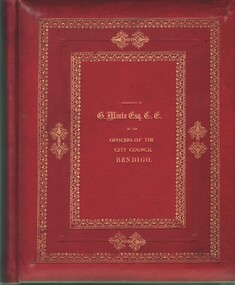
Photograph - ALBUM PRESENTED TO GEORGE MINTO, June 20, 1899
... List of men photographed (from front of album: G Minto Esq, W Honeybone, O Hopper, J R Richardson, A M Lloyd, B Hyett, F Richards, Dr J Mc I Eadie, T H Teage, G S Read, J J Smith, S G Gadd, J A Roper, W Griffiths, J Reed, Sergt. Kilfedder, G Baxter, T R J Brown, B W Button, S Montgomery, A Moog, A J Tregear, W Speechley. ...List of men photographed (from front of album: G Minto Esq, W Honeybone, O Hopper, J R Richardson, A M Lloyd, B Hyett, F Richards, Dr J Mc I Eadie, T H Teage, G S Read, J J Smith, S G Gadd, J A Roper, W Griffiths, J Reed, Sergt. Kilfedder, G Baxter, T R J Brown, B W Button, S Montgomery, A Moog, A J Tregear, W Speechley. ...Red photograph album with gold trims. Gold lettering on front - 'presented to G Minto Esq. C.E. (certified engineer), by the Officers of the Bendigo City Council as a token of their sincere regard for one who has proved himself a valuable Municipal Officer; more particularly in respect to the position of City Surveyor which he has honourably and worthily filled for thirteen years, and in acknowledgement of the courteous and gentlemanly assistance he has universally extended to the Officers and with their best wishes for the future health and happiness of himself and Mrs Minto'. In blue ink below 'Town Hall Bendigo, June 20th, 1899', '?Honeybone, Town Clerk', 'C.G. Darvall. List of men photographed (from front of album: G Minto Esq, W Honeybone, O Hopper, J R Richardson, A M Lloyd, B Hyett, F Richards, Dr J Mc I Eadie, T H Teage, G S Read, J J Smith, S G Gadd, J A Roper, W Griffiths, J Reed, Sergt. Kilfedder, G Baxter, T R J Brown, B W Button, S Montgomery, A Moog, A J Tregear, W Speechley. On last page is a photo of the Bendigo Conservatory.person, individual, g minto -
 Wangaratta High School
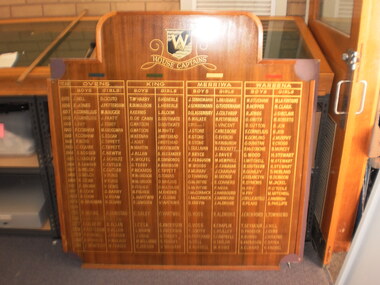
WHS Sporting Honour Board, 1955-1981
... W) J. DELLICASTELLI, J. PARRISH 1973 (O) N. BRAUMAN, R. SLOAN (K) R. LUMSDEN, V. WATKINS (M) D. GRIFFITH...W) J. DELLICASTELLI, J. PARRISH 1973 (O) N. BRAUMAN, R. SLOAN (K) R. LUMSDEN, V. WATKINS (M) D. GRIFFITH ...Brown wooden honour board with gold text in the shape of a rectangle with a protrusion at the top to accommodate for a large WHS logo and a title reading HOUSE CAPTAINS. Along the top of the main body or text is a row of painted metal plates in the school house colours above the names of the houses.HOUSE CAPTAINS 1955 (O) J. BELL, D. CICUTO (K) T. McHARRY S. HEBERLE (M) J. SONNEMANN, L. BRISBANE (W) W. STUDHAM, M, LA FONTAINE 1956 (O) E. JONES, J. PETTERSON (K) T.McHARRY, S. HEBERLE (M) J. SONNEMANN, L. BRISBANE (W) B. HOPPER, N. CLARK 1957 (O) A. CORNELIUS, M. MAUGER (K) A. KERRIS, L. BLOOM (M) D. GLASSENBURY, J. COLTHRUP, (W) R. JONES, J. SINCLAIR 1958 (O) A. CORNELIUS, J. PRATT (K) D. DE CHAN, D, SOUTHGATE ((M) B. WALKER, M. PETHYBRIDGE (W) G. SMITH, W. ROBERTS 1959 (O) L. FRY, J. EDDEY (K) G. WATSON, M. WHITE (M) P. BRUCE & G. McINTOSH, I. VINCENT (W) B. SUTTON, B. JOB 1960 (O) F. COBHAM, M. GROSSMAN (K) G. WATSON, M. WHITE (M) J. STONE, C. KNEEBONE (W) E. CORNELIUS, B. JOB 1961 (O) F. COBHAM, E. EDGAR (K) M. KEENAN, J WHITEHEAD (M) R. STONE, E. EVERON (W) R. GOWLING, J. MURPHY 1962 (O) R. BOYD, C. TIPPETT, (K) J. KOST, J. WHITEHEAD (M) R. STONE, N. KINIBURGH (W) G. DUNSTAN, V. CROSS 1963 (O) C. SQUIRE, C. TIPPETT (K) N. MARTIN, V. ROSENGREN (M) L. SULLIVAN, B. CROCKET (W) R. McCONSHIE, B. MUNCEY 1964 (O) G. ROSSER, C. NEWTH (K) J. ALLEN, R. ALEXANDER (M) P. BRYCE, J. DAVEY (W) G. WOOD, H. STEWART 1965 (O) L. WADLEY, J. SCHULTZ (K) K. WOLFEL, R. SIMMONDS (M) R. FERGUSON, M. HEMPHILL (W) I. MITCHELL, M. STEWART 1966 (O) D. SANGER, C. CUTLER (K) G. TERRY, A. ROBINSON (M) W. WOODS, J. CANAVAN (W) R. SOUTHERN, H. STEWART 1967 (O) G. WELCH, C. CUTLER (K) P. RICKARDS, C. TIPPETT (M) K. MURRAY, J. CANAVAN (W) R. GUMLEY, S. WORLAND 1968 (O) G. WELCH, V. FURS (K) W. McGREGOR, S. TOBIAS (M) D. TIMMINS, M. GEORGE (W) J. STOLARCZYK, B. DOBSON 1969 (O) R. STONE, V. FURS (K) W. Mc GREGOR, D. BAYLISS (M) G. McINTYRE, E. CONNORS (W) R. SYMONS, M. JACKEL 1970 (O) K. BROWN, V. DEWS (K) B. FISHER, D. BULTHUIS (M) G. McINTYRE, P. MEEK (W) H. FRY, P. O'TOOLE 1971 (O) B. COOK, S. BARRY (K) B. FISHER, M. RHODES (M) I. McCORMICK, J. HARBOUND (W) H. FRY, M. MITCHELL 1972 (O) B. COOK, V. RYAN (K) L. HARTWIG, F. CLUGG (M) I. McCORMICK, J. HARBOURD (W) J. DELLICASTELLI, J. PARRISH 1973 (O) N. BRAUMAN, R. SLOAN (K) R. LUMSDEN, V. WATKINS (M) D. GRIFFITH, J. ALDERIDGE (W) S. PEAKE, S. PHILLIPS 1974 1975 (O) R. MOORE, A. DUSTIN (K) C. DALEY, G. HARTWIG (M) G. VOSS, R. ALDERIDGE (W) J. CROXFORD, L. TOWNSEND 1976 1977(O) A. GILBERT, B. ALLEN (K) I. CESA, S. ANDERSON (M) G. VOSS, K. CHAPLIN (W) T. SEYMOUR, J. HILL 1978 (O) P. PATTERSON, B. ALLEN (K) l. MABIN, S. ANDERSON (M) T. SMITH, I. HULLEY (W) D. PROSSER, J. GIBB 1979 (O) P. RUNDELL, J. FRAZER (K) J. DOIG, S. TOOHEY (M) G. PRITCHARD, S. CAMPBELL (W) R. BURNS, J. HISKINS 1980 (O) B. SCHULTZ, A. McILROY (K) M. WILLIAMS, S. TOOHEY (M) G. DELL, H. TAYLOR (W) B. ANDERSON, C. SPINK 1981 (O) J. MONCRIEF. M. FRAZER, (K) P. JORDAN, V. WHINRAY (M) R. RUSSELL, M. HUME (W) A. ELWARD, H. KNOBEL -
 Flagstaff Hill Maritime Museum and Village
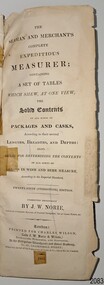
Book - Reference, navigation, J. W. Norie (author and editor), The Seaman and Merchants Complete Expeditious Measurer, 1853
... W. Roberts registered, followed by John Balston & Thomas Ross. In 1856, it was registered by Thomas Lamb & E. Keays, in 1857 by William Howes & Charles Holland, in 1865 by Charles Holland & John Balfour, and in 1866 registered in Melbourne by mariners John Balfour & David Griffiths. ...W. Roberts registered, followed by John Balston & Thomas Ross. In 1856, it was registered by Thomas Lamb & E. Keays, in 1857 by William Howes & Charles Holland, in 1865 by Charles Holland & John Balfour, and in 1866 registered in Melbourne by mariners John Balfour & David Griffiths. ...The book was published at the same address as London’s Navigation Waterhouse and Naval Academy. It is likely to be one of the textbooks used in educating seafarers, both naval and merchant. It is the twenty-fifth edition, showing that it was in great demand in the early to mid-19th century. Sea merchants could have used this as a reference for working out freight costs for their cargo. Customs Officers could have referred to it as well to calculate fees and taxes. The book’s owner had inscribed in pen and ink "Rose Anna, Schooner, Melbourne, March 25th 1857". At that time, the registered owners were Thomas Lamb & E. Keays, who were freighting cargo between Melbourne and Geelong. Schooner, ROSE ANNA: - The schooner Rose Anna was built in 1844 at Fremantle, W.A., by H. Edwards for Capt. William Heard. The 2-masted wooden vessel was carvel-built. Captain Heard registered Rose Anna at Fremantle in 1845 and in the same year, registered it at Port Adelaide. in 1852, Rose Anna was crushed and sunk at Port Adelaide by the Selma and raised. In 1852, the schooner was lengthened by William Hardy. In 1853, William Burton and W. Roberts registered Rose Anna at Melbourne. In 1855, W. Roberts registered, followed by John Balston & Thomas Ross. In 1856, it was registered by Thomas Lamb & E. Keays, in 1857 by William Howes & Charles Holland, in 1865 by Charles Holland & John Balfour, and in 1866 registered in Melbourne by mariners John Balfour & David Griffiths. In the 1940s, Rose Anna traded between Hobart, Melbourne, Adelaide, Sydney, Circular Head, Port Fairy, and Port Albert. In the 1950s and 1960s, it traded between Geelong Heads and Hobsons Bay, Melbourne, in lime, wool, general cargo and ballast. In 1857, when Rose Anna’s registered owners were Thomas Lamb & E. Keays, an advertisement was placed in The Age on March 9th, announcing that the Rose Anna was taking freight from Melbourne to Geelong. Later in the year, in October, the registered owners were William Howes & Charles Holland. They were still trading with Geelong, as on October 7th, The Age announced that Rose Anna arrived in Geelong from Melbourne on October 5th. On October 6th, 1866, Rose Anna went ashore while loading wheat at Sandridge, Port Phillip Bay, in severe gales and heavy seas and became a total wreck. The book is significant for its association with reference information to instruct sea merchant traders and naval officers. The publication is in its twenty-fifth edition, indicating the importance of such an instructional book. The book of tables and calculations shows the evolution of such reference texts, going from handwritten notes, to printed tables like these, and forward to slide rules, calculators, and to modern time computers. it demonstrates the importance of accuracy in calculating weights and measures at sea and for the purposes of fess, charges and taxes. The book is important to the history of the schooner Rose Anna, which is listed as a significant vessel on the Victorian Heritage Register, S582, as it has an inscription with the ship's name, date, and destination. Book, tall and narrow, with index tabs on the side edges of the pages. FULL Title: The Seaman and Merchants Complete Expeditious Measurer: The Seaman and Merchants Complete Expeditious Measure; containing a set of tables which show, at one view, the solid contents of all kinds of packags and casks, according to their several lengths, breadths and depths: also, rules for determining the contents of all sorts of casks in wine and beer measure, according to the Imperial Standard. Twenty-Fifth (Stereotype) Edition. Author: Mr J W Norie (John William Norie) Date: 1853 Publisher: Charles Wilson (late J.W. Norrie & Wilson), Bookseller, Publisher and Stationer, At the Navigation Waterhouse and Naval Academy, No. 157, Leadenhall Street, where may be had all the publications of Steel & Co. Late at No. 70, Cornhill. Printer: Bateman and Dennis, 95 Leadenhall Street, London, England, 1853 The book has handwritten, pen and ink inscriptions. It refers to the Schooner, Rose Anna, Melbourne, March 25th 1857.Handwritten in script with pen and ink: "Rose Anna / Schooner / Melbourne, / March 25th 1857"flagstaff hill, warrnambool, shipwrecked-coast, flagstaff-hill, flagstaff-hill-maritime-museum, maritime-museum, shipwreck-coast, flagstaff-hill-maritime-village, the seaman and merchants complete expeditious measurer, book, sea merchants, cargo, calculations, measurements, sea trade, maritime book, sea transportation, cargo rate calculations, naval academy, navy education, navigation, navigation instruction, navigation waterhouse and naval academy, twenty-fifth edition, 19th century, 1853, 1857, customs, freight, ullage, rose anna, schooner, 2-masted, march 25th 1857, melbourne, 25 march 1857, thomas lamb & e. keays, geelong, 1844, h. edwards, fremantle, carvel-built, port adelaide, selma, william hardy, william burton and w. roberts, john balston & thomas ross., charles holland & john balfour, john balfour & david griffiths, hobart, sydney, circular head, port fairy, port albert, hobsons bay, sandridge, port phillip bay -
 Mission to Seafarers Victoria
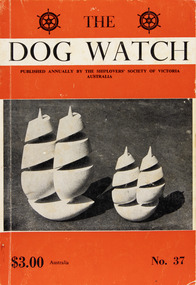
Journal (item) - Periodicals-Annual, Shiplovers' Society of Victoria, The Annual Dog Watch
... W. J. Cowling - 23 "Old Man River" - I. Harris - 32 Present State and Prospects of the Port Phillip District of New South Wales - Charles Griffiths - 37 Hoboes of the Sea - Captain F. ...W. J. Cowling - 23 "Old Man River" - I. Harris - 32 Present State and Prospects of the Port Phillip District of New South Wales - Charles Griffiths - 37 Hoboes of the Sea - Captain F. ...This journal provides the reader with glimpses of the adventures and hardships of a seaman's life. Many of the stories are of sailing ships.Contributes to our knowledge of the importance of shipping and places on record those stories of the sea which would otherwise be lost.Contents Foreword - Senator G. S. Davidson- 5 Editorial - C. E. Bonwick 11 1980 The Goldon Jubilee Part 1 - - 16 " " Part 2 - - 18 " " Part 3 - - 19 Days in Sail - Captain W. J. Cowling - 23 "Old Man River" - I. Harris - 32 Present State and Prospects of the Port Phillip District of New South Wales - Charles Griffiths - 37 Hoboes of the Sea - Captain F. Klebingat - 42 The Stateships Story - N. S. Smith - 46 "Down at Wallaroo" - D. M. Fyfe - 54 Characters - R. N. Thiele - 58 The Lauriston from Newcastle to Tal Tal - R. W. Rudd - 64 From Information for Pylgrymes Unto the Holy Lande 1498 - - 68 s.s. "Port Campbell" First Voyage - I. L. Barton - 70 Maritime Inspection in Finland - Captain Eino Koivistoinen - 81 Wool from Genoa - J. M. MacKenzie - 86 "Polly Woodside" -- The Man Who Made it Happen - Captain G. Heyen, M.B.E. - 91 To Trinidad by "Kilmaurs" - Alexander Cameron - 102 "Oodle" - K. Bull - 109 Ship Talk - Guy H. Jennery - 110 A Glimpse of Ships and Men - W. P. Shemmeld - 113 Book Reviews - 120sailing ships, steamships, shipping, seafaring life, shiplovers' society of victoria, dog watch -
Federation University Historical Collection
Book - Register, Ballarat School of Mines and Industries, Ballarat, Register of members, directors, managers and secretaries of the School of Mines and Industries Ballarat, 1971
... griffith beanland...rex hollioake...morgan bevan john...arthur nicholson...william james child north...hugh arthur patterson...keith price...james victor robertson...james smail...w...It shows projects that were being undertaken at the institution at the time and gives us an historical perspective on project costs and the type of work being done register of members register of directors register of managers and secretaries william anderson matthew griffith beanland rex hollioake morgan bevan john arthur nicholson william james child north hugh arthur patterson keith price james victor robertson james smail w. gordon smith albet edward stohr g. kingsley sutton edgar john trevella tippett kenneth crago webb robert dobell kenneth neerhut e.j barker n.a crouch r. elsworthy k.j flecknoe l.f.j hillman r. knowles b.c muir r.j selkirk f.r uhe l.c yandell g.h beanland p.r shiells j. bell p. kisler s.a mendelson j. chambers r.b christie i.c clarke j. short t.a wiseman l. wallis r. mcfarlane l.j obrien l. murphy j.f mckay Book with red spine and blue crocodile print cover and large label on the front with lined pages inside. ...School of Mines is a predecessor of Federation UniversityThis register lists the members, directors, mangers and secretaries of School of Mines in the 1970's and 80's giving us an understanding of the operations of the School of Mines in that era and of the people involved with the institution at that time. It shows projects that were being undertaken at the institution at the time and gives us an historical perspective on project costs and the type of work being doneBook with red spine and blue crocodile print cover and large label on the front with lined pages inside.register of members, register of directors, register of managers and secretaries, william anderson, matthew griffith beanland, rex hollioake, morgan bevan john, arthur nicholson, william james child north, hugh arthur patterson, keith price, james victor robertson, james smail, w. gordon smith, albet edward stohr, g. kingsley sutton, edgar john trevella tippett, kenneth crago webb, robert dobell, kenneth neerhut, e.j barker, n.a crouch, r. elsworthy, k.j flecknoe, l.f.j hillman, r. knowles, b.c muir, r.j selkirk, f.r uhe, l.c yandell, g.h beanland, p.r shiells, j. bell, p. kisler, s.a mendelson, j. chambers, r.b christie, i.c clarke, j. short, t.a wiseman, l. wallis, r. mcfarlane, l.j obrien, l. murphy, j.f mckay -
 Federation University Historical Collection
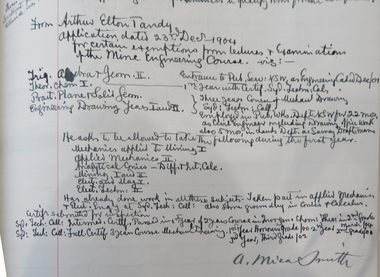
Book - Examiners Minute Book, Ballarat School of Mines Examiners Minute Book, 1896-1926, 1896-1926
... ballarat school of mines examinations exams ballarat school of mines examiners alfred mica smith thomas hart arthur tandy glyn evans university of melbourne robert allan w. playford associateship mine managers certificate norman mclean gordon kiely franceis c. hall grant taulor william kingston frank w. retallack victor e. millington john adam e. sleeman anderson maurice copland charles fenner j.k. sim p.o. buchanan l. vernon leslie de j. grud f.w. gibbs r.c. valentine heseltine noel brelaz l.h. vernon r.s. dale c. schache s. mayo guido brelaz l.g. leroux e.a. brophy e.h. schache reginald callister leslie coulter richard gaston walker s.h. mayo norman buley harry b. cooke arthur elton tandy j. sutherland mine mangers certificate board of examiners carl scache louis h. vernon c.h. beanland j.h. griffiths j.h. crittendenw.j.b. rankine w. reis professor dawbarn frederick martell tutorial board charles burbury s.b. vial dav is robert d.m.deane a.j. hill john harvey britannia united gold mine cecil eeles r.j. allan w. meldrum cliffor w. nash harry leggo john a. blayneyfrederick r. nettle l.p. seal norman mcleod robert w. ditchburn h.s. edgar j.h. crittenden victor nicol leonard p. seal f.c. futter frederick p. paul godfrey stephen hart arthur cryte d.a. runting ferdnand g. krause edgar mcconnon samuel lindsay wilfred avery paul v. barnard charles w. whyte melville gray ralph nevett hugh ellison smith wiliam c. kingston w.e. figgis john rae george kirkpatrick reginald robin alan d. galloway g.o. ramsay david wl bonar rhomas ramsay thomas k. sim ernest h. fraser john worthington george cornell loyal h. finch guy l. ditchburne guy o. ramsay e. mowbray boyer reginald a. raberts c.c. corrie f. retallick henry manchester charles purdy j.m. sutherland g.e. baragwanath f.e. prout h.a. lazarus r. young Brown hard covered book with read leather spine. ...Brown hard covered book with read leather spine. Lists names of examiners (such as Professor Alfred Mica Smith, Gilbert Dawbarn, Thomas Hart, index of letters received for the consideration of the Board of Examinersballarat school of mines, examinations, exams, ballarat school of mines examiners, alfred mica smith, thomas hart, arthur tandy, glyn evans, university of melbourne, robert allan, w. playford, associateship, mine managers certificate, norman mclean, gordon kiely, franceis c. hall, grant taulor, william kingston, frank w. retallack, victor e. millington, john adam, e. sleeman anderson, maurice copland, charles fenner, j.k. sim, p.o. buchanan, l. vernon, leslie de j. grud, f.w. gibbs, r.c. valentine, heseltine, noel brelaz, l.h. vernon, r.s. dale, c. schache, s. mayo, guido brelaz, l.g. leroux, e.a. brophy, e.h. schache, reginald callister, leslie coulter, richard gaston walker, s.h. mayo, norman buley, harry b. cooke, arthur elton tandy, j. sutherland, mine mangers certificate, board of examiners, carl scache, louis h. vernon, c.h. beanland, j.h. griffiths, j.h. crittendenw.j.b. rankine, w. reis, professor dawbarn, frederick martell, tutorial board, charles burbury, s.b. vial, dav is robert, d.m.deane, a.j. hill, john harvey, britannia united gold mine, cecil eeles, r.j. allan, w. meldrum, cliffor w. nash, harry leggo, john a. blayneyfrederick r. nettle, l.p. seal, norman mcleod, robert w. ditchburn, h.s. edgar, j.h. crittenden, victor nicol, leonard p. seal, f.c. futter, frederick p. paul, godfrey stephen hart, arthur cryte, d.a. runting, ferdnand g. krause, edgar mcconnon, samuel lindsay, wilfred avery, paul v. barnard, charles w. whyte, melville gray, ralph nevett, hugh ellison smith, wiliam c. kingston, w.e. figgis, john rae, george kirkpatrick, reginald robin, alan d. galloway, g.o. ramsay, david wl bonar, rhomas ramsay, thomas k. sim, ernest h. fraser, john worthington, george cornell, loyal h. finch, guy l. ditchburne, guy o. ramsay, e. mowbray boyer, reginald a. raberts, c.c. corrie, f. retallick, henry manchester, charles purdy, j.m. sutherland, g.e. baragwanath, f.e. prout, h.a. lazarus, r. young -
 Federation University Historical Collection
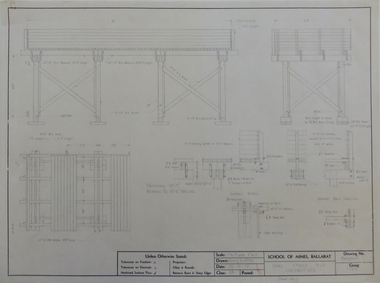
Plan - Engineering drawings, 'Coal Stage for Locomotive', 1975, 1972
... William Gerard Griffiths was a student at the Ballarat Institute of Education when he completed this drawing. civil engineering technical drawing w. g.griffiths ballarat institute of advanced education alumni railway Pencil on paper student's technical drawing 'Coal stage for locomotive' 'Coal Stage for Locomotive', 1975 Plan Engineering drawings ...William Gerard Griffiths was a student at the Ballarat Institute of Education when he completed this drawing.Pencil on paper student's technical drawing 'Coal stage for locomotive' civil engineering, technical drawing, w. g.griffiths, ballarat institute of advanced education, alumni, railway -
 Federation University Historical Collection
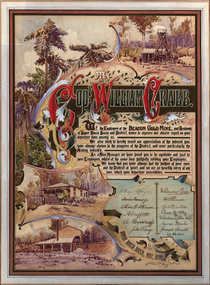
Painting - Illumination, john Sands Limited, Illuminated Address Presented to William Crabb of the Beacon Gold Mine, 1899, 05/1899
... griffith...a. moncrieff...john parry...n. daery-porter...h. skinner...c. strather...trever w...Griffith, A. Moncrieff, John Parry, N. Danvers Power, H Skinner, G. Strathen, Trevor W. ...Griffith, A. Moncrieff, John Parry, N. Danvers Power, H Skinner, G. Strathen, Trevor W. ...William Crabb was later a well respected manager of the Victoria United GMC, Ballarat after leaving the Bucca Bucca region in Queensland.Digital copy of an illumination presented to William Crabb, mine manager at Beacon Gold Mine, Bucca Bucca. We also wish to record our appreciation of the interest you have always shown in the progress of the District, and more particularly the Mining industry. As a Mine Manager, we have found you to be equitable and just to your Employees, whilst at the same time faithfully serving our Employers. We know that you have always had the welfare of your men and the District at heart, and we are as heartily sorry at our loss, which your departure necessitates." (signed) William S Bryce James Demming Thos. G. Fraser, A. Griffith, A. Moncrieff, John Parry, N. Danvers Power, H Skinner, G. Strathen, Trevor W. Alley, William Peter J.P., James Marles, Joseph Smith and 45 others.illumination, william crabb, victoria united gold mine, beacon gold mine, upper bucca bucca, william s. boyce, james dennings, thomas f. fraser, a. griffith, a. moncrieff, john parry, n. daery-porter, h. skinner, c. strather, trever w. alley, william peter, james marles, joseph smith -
 Flagstaff Hill Maritime Museum and Village
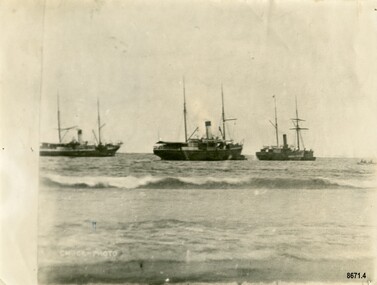
Photograph - Steamers - Julia Percy, Dawn and Coorong, Chuck Photo Ballarat, Circa 1885
... Griffith Jones, S.S. Dawn, The Hon. Mr Clark desires that the thanks of the Government should be conveyed to you for the prompt, persevering and seamanlike qualities displayed by you, your officers and crew in saving the number of lives you did on the occasion referred to. The Hon. The Commissioner has also been pleased to award you a souvenir in commemoration of the occasion, and a sum of 65 pounds to be awarded to your officers and crew according to annexed scale. I am, &c, W...Griffith Jones, S.S. Dawn, The Hon. Mr Clark desires that the thanks of the Government should be conveyed to you for the prompt, persevering and seamanlike qualities displayed by you, your officers and crew in saving the number of lives you did on the occasion referred to. The Hon. The Commissioner has also been pleased to award you a souvenir in commemoration of the occasion, and a sum of 65 pounds to be awarded to your officers and crew according to annexed scale. I am, &c, W ...This photograph was one of ten photographs donated to Flagstaff Hill Maritime Museum and Village by Fred Trewartha. Frederick John Fox Trewartha (Fred) was a well-known Warrnambool businessman. He was born in Beeac near Geelong in 1920 and came to Warrnambool with his family as a very young child. He was apprenticed to his father John, as a saddler and later opened his own shop on Raglan Parade. He then moved into working with tarpaulins and canvases for the trucking industry. Fred was keenly interested in photography (and was a member of the Warrnambool Cine Club), yachting and boat building. He kept his yacht moored at Port Fairy for many years and participated in sailing events locally and interstate. He also built boats with his sons. He had the opportunity to meet many older sailors and it's thought this photo (and others in the set) may have been given to him by one of these men. Fred Trewartha died in 2016 in Warrnambool. Shipping was the cheapest and most practical means of carrying produce and goods during the period 1840-1890. Regular domestic steamer services commenced in the Warrnambool district in the late 1850’s and by 1870 the passenger trade was booming. Four coastal traders made regular stops at Warrnambool in the 1880's - S. S. Julia Percy, S. S. Dawn, S. S. Nelson and S. S. Casino. The S.S. Julia Percy (later named Leeuwin) was an iron passenger-cargo steam ship built in 1876. At one point in time the Julia Percy would sail from Warrnambool to Melbourne every Friday and return from Melbourne to Warrnambool every Tuesday. The cost of a return ticket for a Saloon Fare was £1.0.0. The Julia Percy was built in Glasgow by Thomas Wingate & Company, Whiteinch, in 1876 for the Warrnambool Steam Packet Company, which commissioned it for trade in Victoria’s western district. It was first registered in Warrnambool, Victoria in 1876. Two steamships, the Julia Percy and the Nelson, collided on 25th December 1881. The Julia Percy was at that time owned by its first owners, the Warrnambool Steam Packet Company, and she sailed under the command of Captain Chapman. It had left Melbourne the evening of 24th December, with about 150 passengers, sailing in fine weather through Port Phillip Heads around 9pm. It was headed for Warrnambool, Belfast (now named Port Fairy) and Portland. The Julia Percy was off Apollo Bay when Captain Chapman was woken by the ship’s whistle after midnight, the steamer Nelson being on a collision course with the Julia Percy. The Nelson struck Julia Percy midship. Boats were lowered from the ship (apart from a damaged lifeboat) and about 30-40 of the passengers boarded the Nelson. The engine room and the forehold were checked and found clear of water. The company manager, Mr. Evans, had been on the Nelson, so he boarded and inspected the Julia Percy and the decision was made to continue on to Warrnambool with the passengers as there appeared to be no immediate danger. However, Captain Thomas Smith said the Nelson was taking on water, so Julia Percy followed it for about an hour towards Melbourne on standby in case of need. Then Julia Percy turned around towards Warrnambool again. Shortly afterwards the Nelson turned to follow her, the ships stopped and passengers were returned to Julia Percy, and three from Julia Percy boarded the Nelson. Both ships proceeded on their way. Julia Percy passed Cape Otway light afterwards, signaling that there had been a collision. It was discovered later that one of the passengers was missing, then thought to have boarded the Nelson but later thought to have fallen into the sea and drowned while trying to jump from Julia Percy to Nelson. There had been 3 tickets purchased under the same name of that passenger “Cutler”; a father, son and friend named Wordsworth, which had caused quite some confusion. No further mishap occurred to either ship and both the Julia Percy and the Nelson reached their destinations safely. An enquiry was instigated by the Victoria Steam Navigation Board regarding the cause of the accident between the two steamships, in connection with the death of Cutler who was supposed to have lost his life by the collision. The enquiry resulted in Captain Thomas Smith having his master's certificate suspended for six months. The Julia Percy changed hands several times. Its next owner was the Western Steam Navigation Co (1887), managed by Mr. T.H. Osborne (the company’s office was on the corner of Timor and Liebig Streets - its north-western wall is now part of the current Warrnambool Regional Art Gallery.) The Melbourne Steamship Co became the next owners (1890), followed by William Howard Smith and Sons (1901) for use in Queensland coastal trades and then it was bought by George Turnbull in 1903 and used for local mail contract in Western Australia. The Julia Percy was sold to the Melbourne Steamship Company Ltd. (1906) and re-named the “Leeuwin” but continued in her Western Australian coastal run. It was converted into a coal hulk in Melbourne in 1910 as a result of damaged caused when it was driven against the jetty at Dongara during a gale. The ship was eventually dismantled and scuttled off Port Phillip Heads on 28 December 1934. The steamship "Dawn" was a 522-ton coastal trader built in 1876 and the vessel operated around the Victorian west coast from 1877 until 1898 for the Portland & Belfast Steam Navigation Co. sailing between Melbourne and Portland, via Warrnambool. The vessel was then owned in October 1885 by the renamed company, Belfast & Koroit Steam Navigation Co., until March 1896 when its ownership moved to W Howard Smith & Sons Ltd. This Melbourne company used the ship to service most ports around Australia. Captain F. Chapman took over from Captain Jones and served on the SS Dawn from 1898 until 1900 when he took command of the SS Casino. On September 4th 1880, the three masted clipper ship, "Eric the Red" struck Otway Reef, near Cape Otway. The S. S. Dawn, under the command of Captain Jones, was returning to Warrnambool from Melbourne, its sailing time different to its usual schedule. The provedore of the Dawn, Benjamin Lear, heard cries of distress coming through the portholes of the saloon. He gave the alarm and the engines were stopped. Cries could be heard clearly, coming from the land. Captain Jones sent out crew in two boats, and fired off rockets and blue lights to illuminate the area. They picked up the three survivors who were in the long boat from "Eric the Red". Two men were picked up out of the water, one being the owner’s son who was clinging to floating kerosene boxes. At daylight the Dawn then rescued the 18 men from the floating portion of the deckhouse, which had drifted about 4 miles from where they’d struck the reef. Shortly after the rescue the deckhouse drifted onto breakers and was thrown onto rocks at Point Franklin, about 2 miles east of Cape Otway. Captain Jones had signalled to Cape Otway lighthouse the number of the Eric the Red and later signalled that there was a wreck at Otway Reef but there was no response from the lighthouse. The captain and crew of the Dawn spent several more hours searching unsuccessfully for more survivors, even going back as far as Apollo Bay. On board the Dawn the exhausted men received care and attention to their needs and wants, including much needed clothing. Four men (three crew and one passenger) died. A week after the shipwreck, the Australian Government had also conveyed its thanks to the Captain and crew of the S.S. Dawn - “Captain Griffith Jones, S.S. Dawn, The Hon. Mr Clark desires that the thanks of the Government should be conveyed to you for the prompt, persevering and seamanlike qualities displayed by you, your officers and crew in saving the number of lives you did on the occasion referred to. The Hon. The Commissioner has also been pleased to award you a souvenir in commemoration of the occasion, and a sum of 65 pounds to be awarded to your officers and crew according to annexed scale. I am, &c, W Collins Rees, for and in the absence of the Chief Harbour Master.” The Awards are as follows: - Crew of DAWN'S lifeboat-Chief Officer, Mr G. Peat, 15 pounds; boat's crew-G. Sterge, A.B., 5 pounds; T. Hammond, A.B., 5 pounds; J. Black, A.B., 5 pounds; H. Edwards, A.B., 5 pounds. Dinghy's Crew-Second Officer, Mr Christie, 10 pounds; boat's crew -F. Lafer, A.B., 5 pounds; W. Johnstone, A.B., 5 pounds; Mr Lear, provedore, 5 pounds; Mr Dove, purser, 5 pounds. Captain Jones receives a piece of plate. (from “Wreck of the ship Eric the Red” by Jack Loney). Medals of Bravery were awarded to the Captain and crew of the S.S. Dawn by the President of the United States, through the Consul-general (Mr Oliver M. Spencer), in July 1881 “ … in recognition of their humane efforts in rescuing the 23 survivors of the American built wooden sailing ship, the Eric the Red, on 4th September 1880.” The men were also presented with substantial monetary rewards and gifts. The city of Warrnambool’s care of the survivors was also mentioned by the President at the presentation, saying that “the city hosted and supported the crew ‘most graciously’. The Medal of Bravery awarded to Nelson Johnson is in the collection at Flagstaff Hill Maritime Museum and Village in Warrnambool. Prior to 1882, and the arrival of the S. S. Casino, the "Dawn" was the only steamer to be able to navigate up the Moyne River at Port Fairy and unload at the wharf. The other regular steamers had to anchor in the bay instead. In February 1891 (as reported in The Age newspaper) the "Dawn" became the first vessel to berth alongside the newly completed Warrnambool Breakwater. The occasion was celebrated with a number of prominent townspeople assembling on board to "participate of a glass of wine". In 1895 the owners of the S.S. Dawn, the Portland and Belfast Steam Navigation Co., wound up and sold out to the Belfast Company who took over the Dawn for one year before selling it to Howard Smith. It took over the Melbourne to Warrnambool run in 1906 when the S. S. Flinders was sold. The S. S. Dawn was condemned and sunk in Suva in 1928. The State Library of Victoria has a lithograph in its collection depicting the steamer Dawn and the shipwrecked men, titled. "Wreck of the ship Eric the Red, Cape Otway: rescue of the crew by the Dawn". The third ship depicted in the photograph was thought to be the S. S. Coorong but there was a question mark next to its name. The photograph was thought to have been taken in 1885 and it's possible the S.S. Coorong was working in Clarence River, N. S. W. by this time. The steamer "Coorong" was built in 1862 by J. G. Lawrie of Glasgow. It was an "iron screw" steamer of 304 tons. It had many owners including Joseph Darwent of Adelaide (1863 - 1871), McMeckan Blackwood and Company, Melbourne (1871 - 1877), Mount Gambier Steamship Company Ltd. (1877 - 1881). William Whineham, Port Adelaide (1882), John See and Company, Sydney (1884 - 1892) and the North Coast Steam Navigation Company Ltd, Sydney (1892 - 1910). In 1911 it was hulked in Sydney Harbour and in 1921 it was being used as a coal hulk at Sydney. It had been originally imported into South Australia for the Port Augusta trade (primarily transporting goods needed by the early settlers) however the owners recognized that it had too much space for that purpose, so it was moved to work on the Adelaide to Melbourne line. Its passenger accommodation was enlarged and it enjoyed a "first class reputation" and by 1874 had made 313 voyages between Melbourne and Adelaide. Its captains included Captain McLean, Captain Ashton and Captain Dowell. In 1867, when 25 miles west of Cape Otway, while travelling from Adelaide to Melbourne, it came across the crew of the schooner "Black Watch" who had abandoned ship after it began quickly taking on water. The crew (six men) were able to get away in a small boat with a compass, chart and few candles. They were "excessively cold from exposure to the weather" when the S. S. Coorong picked them up. In 1877 the Coorong ran aground when entering the Outer Harbour at Adelaide (but was not damaged) and in 1882 it was stranded (for a short time) near Curdies Inlet (Victoria) with some slight damage to its bottom plates. Note - A ship with the same name "Coorong" (a coal carrying barque) was often on the Newcastle / Wollongong to Adelaide route also stopped several times in Warrnambool in the mid 1880's. The photograph has the label "Chuck Photos" printed on the front. Thomas Foster Chuck (born 1826 in London) was a photographer and entrepreneur who arrived in Victoria in 1861. The following year he produced and toured a "Grand Moving Diarama" of dramatic painted scenes from the Burke and Wills expedition. By 1866 he had established a photography studio in Daylesford and later he returned to Melbourne where he opened a studio in the Royal Arcade. In 1874 a collection of Chuck's photographs won a gold medal at the Annual International Exhibition in London. Throughout the 1870's he took over 700 individual photographs of prominent citizens for his historical photographic montage titled "Historical Pictures of the Explorers and Early Colonists of Victoria" which is now in the collection of the National Library of Australia. By 1888 he had sold his Melbourne studio and had established a studio in Ballarat (with his son Thomas Henry Chuck). In 1886 they produced an album titled "Warrnambool and District 1886, Western Hotel - J. Fox proprietor" containing over sixty large photographs of local coastal scenes and seascapes, for the use of patrons of the Western Hotel. This photo (of the three steamers in Lady Bay) was taken at this time and is in the album. Thomas Chuck died on December 7th, 1898, in Albert Park, Melbourne and his son Thomas Henry continued to operate the photography studio in Ballarat into the 1920's.This photograph is a significant record of several of the well-known coastal traders (S. S. Julia Percy, S. S. Dawn and possibly S. S. Coorong) that sailed along the southwest coast of Victoria for many years - transporting goods and passengers between Melbourne and Warrnambool in the 1880's. They are also significant in the role they played in the history of Warrnambool and the other coastal ports they visited as well as being examples of the dangers and hazards associated with navigating the waters along the southern coast of Australia. It is also a good example of a photograph taken by a well-known and significant photographer of that era.Black and white photograph of three steam ships anchored in Lady Bay, Warrnambool. They each have a funnel and two masts and are side on to the beach. A small rowboat with a crew can be seen on the far right. The words "CHUCK-PHOTO" are on the bottom left of the photograph. On the back of the photograph is the name and telephone number of the donor (handwritten in black ball point pen) and the names of the three steamships and date written in uppercase letters in dark blue ink. There is a four-figure number stamped in the centre of the back.Front - "CHUCK-PHOTO" Back - Name of donor and telephone number "6944" "JULIA PERCY, DAWN & KOORONG(?) IN LADY BAY 1885"flagstaff hill maritime museum and village, warrnambool, great ocean road, fred trewartha, s. s. julia percy, s. s. dawn, s. s. nelson, s. s. casino, leeuwin, steamer, steamship, coastal trader, warrnambool steam packet company, captain chapman, victorian steam navigation board, western steam navigation company, melbourne steamship company, william howard smith and sons, portland and belfast steam navigation company, w howard smith and sons ltd, eric the red, captain jones, medal of bravery, rescue, moyne river, warrnambool breakwater, lady bay, s. s. coorong, mount gambier steamship company, black watch, thomas foster chuck, chuck photos, chuck photography -
 Flagstaff Hill Maritime Museum and Village
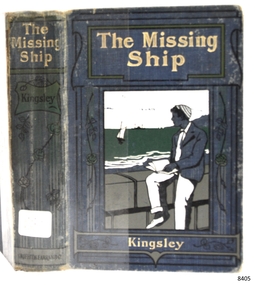
Book, The Missing Ship or The Log of The "OUZEL" GALLERY
... The Missing Ship or The Log of The "OUZEL" GALLERY Author: W H G Kingston Publisher: Griffith Farran Browne & Co LTD ...The flyleaf has a stamp that reads " withdrawn from circulation Warrnambool Public Library" The Missing Ship or The Log of The "OUZEL" GALLERY Author: W H G Kingston Publisher: Griffith Farran Browne & Co LTD The Missing Ship or The Log of The "OUZEL" GALLERY Book ...This book was part of a large group of books referred to as the Pattison Collection, which belonged to the Warrnambool Public Library, part of the Warrnambool Mechanics’ Institute. About RALPH ERIC PATTISON and the ‘PATTISON COLLECTION’ The ‘Pattison Collection’ is a collection of books and records that was originally owned by the Warrnambool Mechanics’ Institute, founded in Warrnambool in 1853. By 1886 the Warrnambool Mechanics’ Institute (WMI) had grown to have a Library, Museum and Fine Arts Gallery, with a collection of “… choice productions of art and valuable specimens in almost every branch and many wonderful national curiosities, are now to be seen there, including historic relics of the town and district.” It later included a School of Design. Although it was very well patronised, the WMI was led to ask the City Council to take it over in 1911 due to a lack of financial support. In 1935 Ralph Pattison was appointed as City Librarian to establish and organise the Warrnambool Public Library as it was then called. Ralph Eric Pattison was born in Rockhampton, Queensland, in 1891. He married Maude Swan from Warrnambool in 1920 and they set up a home in Warrnambool. In 1935 when Pattison accepted the position as City Librarian for the Warrnambool City Council his huge challenge was to make a functional library within two rooms of the Mechanics’ Institute. He tirelessly cleaned, cleared and sorted a disarrayed collection of old books, jars of preserved specimens and other items reserved for exhibition in the city’s museum. He developed and updated the library with a wide variety of books for all tastes, including reference books for students; a difficult task to fulfil during the years following the Depression. He converted all of the lower areas of the building into a library, reference room and reading room for members and the public. The books were sorted and stored using a cataloguing and card index system that he had developed himself. He also prepared the upper floor of the building and established the Art Gallery and later the Museum, a place to exhibit the many old relics that had been stored for years for this purpose. One of the treasures he found was a beautiful ancient clock, which he repaired, restored and enjoyed using in his office during the years of his service there. Ralph Pattison was described as “a meticulous gentleman whose punctuality, floorless courtesy and distinctive neat dress were hallmarks of his character, and ‘his’ clock controlled his daily routine and his opening and closing of the library’s large heavy doors to the minute.” Pattison took leave from 1942 to 1945 to serve in the Royal Australian Navy, Volunteer Reserve as Lieutenant. A few years later he converted one of the Museum’s rooms into a Children’s Library, stocking it with suitable books for the younger generation. This was an instant success. In the 1950’s he had the honour of being appointed to the Victorian Library Board and received more inspiration from the monthly conferences in Melbourne. He was sadly retired in 1959 after over 23 years of service, due to the fact that he had gone over the working age of council officers. However, he continued to take a very keen interest in the continual development of the Library until his death in 1969. THE NEW WARRNAMBOOL LIBRARY When the WMI building was pulled down in 1963 a new civic building was erected on the site and the new Warrnambool Library, on behalf of the City Council, took over all the holdings of the WMI. At this time some of the items were separated and identified as the ‘Pattison Collection’, named after Pattison. Eventually, the components of the WMI were distributed from the Warrnambool Library to various places, including the Art Gallery, Historical Society and Flagstaff Hill. Later some were even distributed to other regional branches of Corangamite Regional Library and passed to and fro. It is difficult now to trace just where all of the items have ended up. The books at Flagstaff Hill Maritime Village generally display stamps and markings from Pattison as well as a variety of other institutions including the Mechanics’ Institute itself. The Pattison Collection, along with other items at Flagstaff Hill Maritime Village, was originally part of the Warrnambool Mechanics' Institute’s collection. The Warrnambool Mechanics’ Institute Collection is primarily significant in its totality, rather than for the individual objects it contains. Its contents are highly representative of the development of Mechanics' Institute libraries across Australia, particularly Victoria. A diversity of publications and themes has been amassed, and these provide clues to our understanding of the nature of and changes in the reading habits of Victorians from the 1850s to the middle of the 20th century. The collection also highlights the Warrnambool community’s commitment to the Mechanics’ Institute, reading, literacy and learning in the regions, and proves that access to knowledge was not impeded by distance. These items help to provide a more complete picture of our community’s ideals and aspirations. The Warrnambool Mechanics Institute book collection has historical and social significance for its strong association with the Mechanics Institute movement and the important role it played in the intellectual, cultural and social development of people throughout the latter part of the nineteenth century and the early twentieth century. The collection of books is a rare example of an early lending library and its significance is enhanced by the survival of an original collection of many volumes. The Warrnambool Mechanics' Institute’s publication collection is of both local and state significance. The Missing Ship or The Log of The "OUZEL" GALLERY Author: W H G Kingston Publisher: Griffith Farran Browne & Co LTD The label on the spine cover with typed text R.A.823.912 KIN Pastedown front endpaper has a sticker from Warrnambool Public Library. The front loose endpaper has a stamp from Warrnambool Public Library. The front loose endpaper has a stamp from Corangamite Regional Library Service. The flyleaf has a stamp that reads " withdrawn from circulation Warrnambool Public Library"flagstaff hil, warrnambool, flagstaff hill maritime museum, maritime museum, shipwreck coast, flagstaff hill maritime village, great ocean road, book, pattison collection, warrnambool library, warrnambool mechanics’ institute, ralph eric pattison, corangamite regional library service, warrnambool city librarian, mechanics’ institute library, victorian library board, warrnambool books and records, warrnambool children’s library, the missing ship or, the log of the "ouzel" gallery, the missing ship, w h g kingston -
 Flagstaff Hill Maritime Museum and Village
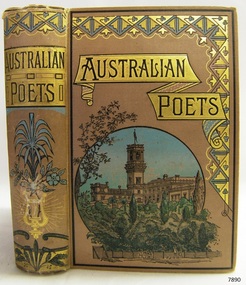
Book, Australian Poets
... Australian Poets 1788 - 1888 Being a selection of peoms upon all subjects written in Australia and New Zealand during the first century of the British colonization Edited by Douglas B W Sladen Publisher: Griffith, Farran, Okeden & Welsh Date: 1888...The Warrnambool Mechanics' Institute Library book collection is deemed to be of great importance because it is one of the few collections in an almost intact state, and many of the books are now very rare and of great value. warrnambool shipwrecked-coast flagstaff-hill flagstaff-hill-maritime-museum maritime-museum shipwreck-coast flagstaff-hill-maritime-village shipwrecked-artefact great ocean road book warrnambool library warrnambool mechanics’ institute mechanics’ institute library victorian library board warrnambool books and records warrnambool children’s library warrnambool public library Australian Poets Douglas B W Sladen Label on spine cover with typed text RS 899.1 SLA Pastedown front endpaper has sticker from Warrnambool Mechanics Institute and Free Library Front loose endpaper has a stamp from Warrnambool Mechanics Institute Australian Poets 1788 - 1888 Being a selection of peoms upon all subjects written in Australia and New Zealand during the first century of the British colonization Edited by Douglas B W Sladen Publisher: Griffith, Farran, Okeden & Welsh Date: 1888 Australian Poets Book ...Warrnambool's Mechanics' Institute (or Institution as it was sometimes called) was one of the earliest in Victoria. On 17th October 1853 a meeting was held where it was resolved to request the Lieutenant Governor of the Colony to grant land for the erection of a Mechanics' Institutes building. A committee was formed at the meeting and Richard Osburne chaired the first meeting of this committee. The land on the North West corner of Banyan and Merri Streets was granted but there were no funds to erect the building. The Formal Rights of the Warrnambool Mechanics' Institute's encompassed its aims and these were officially adopted in1859; "This Institution has for its object the diffusion of literary, scientific, and other useful knowledge amongst its members, excluding all controversial subjects, religious or political. These objects are sought to be obtained by means of a circulating library, a reading room, the establishment of classes, debates, and the occasional delivery of lectures on natural and experimental philosophy, mechanics, astronomy, chemistry, natural history, literature, and the useful and ornamental arts, particularly those which have a more immediate reference to the colony." The Warrnambool Mechanics' Institute opened its first reading room in November1884 in the National School building at the corner of Banyan and Timor Streets. The Institute was funded by member subscription, payable on a quarterly, half yearly or yearly basis. Samuel Hannaford, the Manager of the Warrnambool Bank of Australasia, was the first Honorary Secretary of the Mechanics' Institutes, and an early President and Vice-President. He also gave several of the early lectures in the Reading Room. Another early Secretary, Librarian and lecturer was Marmaduke Fisher, the teacher at the National School. Lecture topics included The Poets and Poetry of Ireland', 'The Birth and Development of the Earth', 'The Vertebrae - with Remarks on the pleasures resulting from the study of Natural History' and 'Architecture'. In 1856 the Reading Room was moved to James Hider's shop in Timor Street, and by 1864 it was located in the bookshop of Davies and Read. In the 1860's the Mechanics' Institute struggled as membership waned but in 1866, after a series of fund raising efforts, the committee was able to purchase land in Liebig Street, on a site then called Market Square, between the weighbridge and the fire station. A Mechanics' Institute building was opened at this site in August 1871. The following year four more rooms were added to the main Reading Room and in 1873 the Artisan School of Design was incorporated into the Institute. The same year Joseph Archibald established a Museum; however it deteriorated when he was transferred to Bendigo in 1877. In 1880, with Archibald's return to Warrnambool, the Museum was re-established, and in 1885 a new building was built at the back of the Institute to accommodate the re-created School of Design, the Art Gallery and the Museum. In 1887 the Museum section was moved to the former court house in Timor Street (for some time the walls of the building formed part of the TAFE cafeteria but all is now demolished)). In 1911 the Museum was transferred back to the original building and the management of the Mechanics' Institute was handed over to the Warrnambool City Council. The Museum and Art Gallery became one and housed many fine works of art, and the Library continued to grow. The building was well patronised, with records showing that at the beginning of the 20th century there were between 500 and 800 visitors. During World War One the monthly figures were in the thousands, with 3,400 people visiting in January 1915. The Museum was a much loved Institution in Warrnambool until the contents of the Museum and Art Gallery were removed to make room for the Warrnambool City Council Engineers' Department. The contents were stored but many of the items were scattered or lost. When the original building was demolished the site became occupied by the Civic Centre, which included the new City Library. (The library was temporarily located in the old Palais building in Koroit Street.) In the process of reorganisation the Collection was distributed amongst the community groups: -The new City Library took some of the historic books and some important documents, historic photographs and newspapers. -The Art Gallery kept the 19th Century art collection and some of the artefacts from the museum. -The Historic Society has some items -The State Museum has some items -Some items were destroyed -Flagstaff Hill Maritime Village has old newspapers, Government Gazettes, most of the Mechanics' Institute Library, ledgers and documents connected to the Mechanics' Institute Library, some framed and unframed art works and some photographs. The Warrnambool Mechanics' Institute Library book collection is deemed to be of great importance because it is one of the few collections in an almost intact state, and many of the books are now very rare and of great value. Australian Poets 1788 - 1888 Being a selection of peoms upon all subjects written in Australia and New Zealand during the first century of the British colonization Edited by Douglas B W Sladen Publisher: Griffith, Farran, Okeden & Welsh Date: 1888Label on spine cover with typed text RS 899.1 SLA Pastedown front endpaper has sticker from Warrnambool Mechanics Institute and Free Library Front loose endpaper has a stamp from Warrnambool Mechanics Institutewarrnambool, shipwrecked-coast, flagstaff-hill, flagstaff-hill-maritime-museum, maritime-museum, shipwreck-coast, flagstaff-hill-maritime-village, shipwrecked-artefact, great ocean road, book, warrnambool library, warrnambool mechanics’ institute, mechanics’ institute library, victorian library board, warrnambool books and records, warrnambool children’s library, warrnambool public library, australian poets, douglas b w sladen -
 Flagstaff Hill Maritime Museum and Village
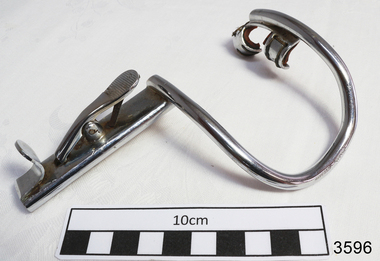
Equipment - Mouth Gag, Early 20th Century
... Griffith Davis, M.D.(1867-1934), who modified it further for use in tonsillectomies. In 1912, a description of Dr. Davis’ gag was published by the prominent surgeon, Harvey W. ...Griffith Davis, M.D.(1867-1934), who modified it further for use in tonsillectomies. In 1912, a description of Dr. Davis’ gag was published by the prominent surgeon, Harvey W. ...For inhalation anesthesia, a gag may be used to keep a patient’s mouth open. In 1910, Edward C. Sewall, M.D. (1875-1957), published a description of a mouth gag which he designed, stating that it was a modification of the earlier Hartman gag. Dr. Sewall’s gag caught the eye of anesthesiologist S. Griffith Davis, M.D.(1867-1934), who modified it further for use in tonsillectomies. In 1912, a description of Dr. Davis’ gag was published by the prominent surgeon, Harvey W. Cushing, M.D. (1869-1939.) During a visit to the United States in 1921, the English anesthesiologist Henry E. G. Boyle (1875-1941) was impressed by the Davis gag, and bought one. He published two descriptions of it the following year, and again in the 1923 edition of his influential textbook. It became better known as the Boyle, or Boyle-Davis, gag. Today the gag popularized by Boyle continues to be made by many equipment manufacturers. It consists of a frame that incorporates a handle, together with a selection of tongue depressors, called blades, in various sizes. The paddle of depressor would hold the patient’s tongue and lower jaw, while the two, rubber-lined extensions at the top of the frame supported the patient’s upper teeth. From the 1920s through the 1990s, there have been at least 20 further modifications of the Davis gag. https://www.woodlibrarymuseum.org/museum/davis-gag/ This mouth gag was donated to Flagstaff Hill Maritime Village by the family of Doctor William Roy Angus, Surgeon and Oculist. It is part of the “W.R. Angus Collection” that includes historical medical equipment, surgical instruments and material once belonging to Dr Edward Ryan and Dr Thomas Francis Ryan, (both of Nhill, Victoria) as well as Dr Angus’ own belongings. The Collection’s history spans the medical practices of the two Doctors Ryan, from 1885-1926 plus that of Dr Angus, up until 1969. ABOUT THE “W.R.ANGUS COLLECTION” Doctor William Roy Angus M.B., B.S., Adel., 1923, F.R.C.S. Edin.,1928 (also known as Dr Roy Angus) was born in Murrumbeena, Victoria in 1901 and lived until 1970. He qualified as a doctor in 1923 at University of Adelaide, was Resident Medical Officer at the Royal Adelaide Hospital in 1924 and for a period was house surgeon to Sir (then Mr.) Henry Simpson Newland. Dr Angus was briefly an Assistant to Dr Riddell of Kapunda, then commenced private practice at Curramulka, Yorke Peninsula, SA, where he was physician, surgeon and chemist. In 1926, he was appointed as new Medical Assistant to Dr Thomas Francis Ryan (T.F. Ryan, or Tom), in Nhill, Victoria, where his experiences included radiology and pharmacy. In 1927 he was Acting House Surgeon in Dr Tom Ryan’s absence. Dr Angus had become engaged to Gladys Forsyth and they decided he would take time to further his studies overseas in the UK in 1927. He studied at London University College Hospital and at Edinburgh Royal Infirmary and in 1928, was awarded FRCS (Fellow from the Royal College of Surgeons), Edinburgh. He worked his passage back to Australia as a Ship’s Surgeon on the on the Australian Commonwealth Line’s T.S.S. Largs Bay. Dr Angus married Gladys in 1929, in Ballarat. (They went on to have one son (Graham 1932, born in SA) and two daughters (Helen (died 12/07/1996) and Berenice (Berry), both born at Mira, Nhill ) Dr Angus was a ‘flying doctor’ for the A.I.M. (Australian Inland Ministry) Aerial Medical Service in 1928 . The organisation began in South Australia through the Presbyterian Church in that year, with its first station being in the remote town of Oodnadatta, where Dr Angus was stationed. He was locum tenens there on North-South Railway at 21 Mile Camp. He took up this ‘flying doctor’ position in response to a call from Dr John Flynn; the organisation was later known as the Flying Doctor Service, then the Royal Flying Doctor Service. A lot of his work during this time involved dental surgery also. Between 1928-1932 he was surgeon at the Curramulka Hospital, Yorke Peninsula, South Australia. In 1933 Dr Angus returned to Nhill where he’d previously worked as Medical Assistant and purchased a share of the Nelson Street practice and Mira hospital from Dr Les Middleton one of the Middleton Brothers, the current owners of what was once Dr Tom Ryan’s practice. Dr L Middleton was House Surgeon to the Nhill Hospital 1926-1933, when he resigned. [Dr Tom Ryan’s practice had originally belonged to his older brother Dr Edward Ryan, who came to Nhill in 1885. Dr Edward saw patients at his rooms, firstly in Victoria Street and in 1886 in Nelson Street, until 1901. The Nelson Street practice also had a 2 bed ward, called Mira Private Hospital ). Dr Edward Ryan was House Surgeon at the Nhill Hospital 1884-1902 . He also had occasions where he successfully performed veterinary surgery for the local farmers too. Dr Tom Ryan then purchased the practice from his brother in 1901. Both Dr Edward and Dr Tom Ryan work as surgeons included eye surgery. Dr Tom Ryan performed many of his operations in the Mira private hospital on his premises. He too was House Surgeon at the Nhill Hospital 1902-1926. Dr Tom Ryan had one of the only two pieces of radiology equipment in Victoria during his practicing years – The Royal Melbourne Hospital had the other one. Over the years Dr Tom Ryan gradually set up what was effectively a training school for country general-practitioner-surgeons. Each patient was carefully examined, including using the X-ray machine, and any surgery was discussed and planned with Dr Ryan’s assistants several days in advance. Dr Angus gained experience in using the X-ray machine there during his time as assistant to Dr Ryan. Dr Tom Ryan moved from Nhill in 1926. He became a Fellow of the Royal Australasian College of Surgeons in 1927, soon after its formation, a rare accolade for a doctor outside any of the major cities. He remained a bachelor and died suddenly on 7th Dec 1955, aged 91, at his home in Ararat. Scholarships and prizes are still awarded to medical students in the honour of Dr T.F. Ryan and his father, Dr Michael Ryan, and brother, John Patrick Ryan. ] When Dr Angus bought into the Nelson Street premises in Nhill he was also appointed as the Nhill Hospital’s Honorary House Surgeon 1933-1938. His practitioner’s plate from his Nhill surgery states “HOURS Daily, except Tuesdays, Fridays and Saturday afternoons, 9-10am, 2-4pm, 7-8pm. Sundays by appointment”. This plate is now mounted on the doorway to the Port Medical Office at Flagstaff Hill Maritime Village, Warrnambool. Dr Edward Ryan and Dr Tom Ryan had an extensive collection of historical medical equipment and materials spanning 1884-1926 and when Dr Angus took up practice in their old premises he obtained this collection, a large part of which is now on display at the Port Medical Office at Flagstaff Hill Maritime Village in Warrnambool. During his time in Nhill Dr Angus was involved in the merging of the Mira Hospital and Nhill Public Hospital into one public hospital and the property titles passed on to Nhill Hospital in 1939. In 1939 Dr Angus and his family moved to Warrnambool where he purchased “Birchwood,” the 1852 home and medical practice of Dr John Hunter Henderson, at 214 Koroit Street. (This property was sold in1965 to the State Government and is now the site of the Warrnambool Police Station. ). The Angus family was able to afford gardeners, cooks and maids; their home was a popular place for visiting dignitaries to stay whilst visiting Warrnambool. Dr Angus had his own silk worm farm at home in a Mulberry tree. His young daughter used his centrifuge for spinning the silk. Dr Angus was appointed on a part-time basis as Port Medical Officer (Health Officer) in Warrnambool and held this position until the 1940’s when the government no longer required the service of a Port Medical Officer in Warrnambool; he was thus Warrnambool’s last serving Port Medical Officer. (The duties of a Port Medical Officer were outlined by the Colonial Secretary on 21st June, 1839 under the terms of the Quarantine Act. Masters of immigrant ships arriving in port reported incidents of diseases, illness and death and the Port Medical Officer made a decision on whether the ship required Quarantine and for how long, in this way preventing contagious illness from spreading from new immigrants to the residents already in the colony.) Dr Angus was a member of the Australian Medical Association, for 35 years and surgeon at the Warrnambool Base Hospital 1939-1942, He served as a Surgeon Captain during WWII1942-45, in Ballarat, Victoria, and in Bonegilla, N.S.W., completing his service just before the end of the war due to suffering from a heart attack. During his convalescence he carved an intricate and ‘most artistic’ chess set from the material that dentures were made from. He then studied ophthalmology at the Royal Melbourne Eye and Ear Hospital and created cosmetically superior artificial eyes by pioneering using the intrascleral cartilage. Angus received accolades from the Ophthalmological Society of Australasia for this work. He returned to Warrnambool to commence practice as an ophthalmologist, pioneering in artificial eye improvements. He was Honorary Consultant Ophthalmologist to Warrnambool Base Hospital for 31 years. He made monthly visits to Portland as a visiting surgeon, to perform eye surgery. He represented the Victorian South-West subdivision of the Australian Medical Association as its secretary between 1949 and 1956 and as chairman from 1956 to 1958. In 1968 Dr Angus was elected member of Spain’s Barraquer Institute of Barcelona after his research work in Intrasclearal cartilage grafting, becoming one of the few Australian ophthalmologists to receive this honour, and in the following year presented his final paper on Living Intrasclearal Cartilage Implants at the Inaugural Meeting of the Australian College of Ophthalmologists in Melbourne In his personal life Dr Angus was a Presbyterian and treated Sunday as a Sabbath, a day of rest. He would visit 3 or 4 country patients on a Sunday, taking his children along ‘for the ride’ and to visit with him. Sunday evenings he would play the pianola and sing Scottish songs to his family. One of Dr Angus’ patients was Margaret MacKenzie, author of a book on local shipwrecks that she’d seen as an eye witness from the late 1880’s in Peterborough, Victoria. In the early 1950’s Dr Angus, painted a picture of a shipwreck for the cover jacket of Margaret’s book, Shipwrecks and More Shipwrecks. She was blind in later life and her daughter wrote the actual book for her. Dr Angus and his wife Gladys were very involved in Warrnambool’s society with a strong interest in civic affairs. Their interests included organisations such as Red Cross, Rostrum, Warrnambool and District Historical Society (founding members), Wine and Food Society, Steering Committee for Tertiary Education in Warrnambool, Local National Trust, Good Neighbour Council, Housing Commission Advisory Board, United Services Institute, Legion of Ex-Servicemen, Olympic Pool Committee, Food for Britain Organisation, Warrnambool Hospital, Anti-Cancer Council, Boys’ Club, Charitable Council, National Fitness Council and Air Raid Precautions Group. He was also a member of the Steam Preservation Society and derived much pleasure from a steam traction engine on his farm. He had an interest in people and the community He and his wife Gladys were both involved in the creation of Flagstaff Hill, including the layout of the gardens. After his death (28th March 1970) his family requested his practitioner’s plate, medical instruments and some personal belongings be displayed in the Port Medical Office surgery at Flagstaff Hill Maritime Village, and be called the “W. R. Angus Collection”. The W.R. Angus Collection is significant for still being located at the site it is connected with, Doctor Angus being the last Port Medical Officer in Warrnambool. The collection of medical instruments and other equipment is culturally significant, being an historical example of medicine from late 19th to mid-20th century. Dr Angus assisted Dr Tom Ryan, a pioneer in the use of X-rays and in ocular surgery. Stainless Steel, Boyle Davis, mouth gag to prevent the mouth from closing during operative procedures of the mouth or throat. (W.R. Angus Collection). flagstaff hill, warrnambool, shipwrecked coast, flagstaff hill maritime museum, maritime museum, shipwreck coast, flagstaff hill maritime village, great ocean road, dr w r angus, dr ryan, medical equipment, surgical instrument, warrnambool base hospital, nhill base hospital, mira hospital, flying doctor, medical treatment, mouth gag, boyle davis, oral surgery, tonsillectomy -
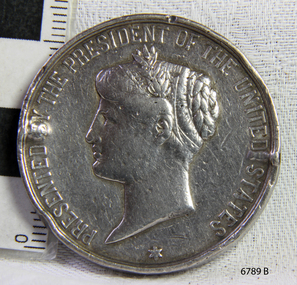 Flagstaff Hill Maritime Museum and Village
Award - Medal, Nelson Johnson, November 1880
... Griffith Jones, S.S. Dawn, The Hon. Mr Clark desires that the thanks of the Government should be conveyed to you for the prompt, persevering and seamanlike qualities displayed by you, your officers and crew in saving the number of lives you did on the occasion referred to. The hon. The Commissioner has also been pleased to award you a souvenir in commemoration of the occasion, and a sum of 65 pounds to be awarded to your officers and crew according to annexed scale. I am, &c, W...Griffith Jones, S.S. Dawn, The Hon. Mr Clark desires that the thanks of the Government should be conveyed to you for the prompt, persevering and seamanlike qualities displayed by you, your officers and crew in saving the number of lives you did on the occasion referred to. The hon. The Commissioner has also been pleased to award you a souvenir in commemoration of the occasion, and a sum of 65 pounds to be awarded to your officers and crew according to annexed scale. I am, &c, W ...This medal for bravery, for rescue of the crew from the shipwreck “Eric the Red” on 4th September 1880, was awarded to one of the crew of the steamer S.S. Dawn by the President of the United States in July 1881. The medal is engraved with the name “Nelson Johnson” (the anglicised version of his Swedish name Neils Frederick Yohnson). It was donated to Flagstaff Hill Maritime Village in 2013 by Nelson’s granddaughter. Nelson had migrated from Sweden to Sydney in 1879. The next year in 1880, aged 24, he was a seaman on the steamship Dawn and involved in the rescue of the survivors of the Eric the Red. Nelson Johnson was a crew member of the S.S. Dawn and was one of the rescue team in the dinghy in the early morning of September 4th 1880. Medals were awarded to the Captain and crew of the S.S. Dawn by the President of the United States, through the Consul-general (Mr Oliver M. Spencer), in July 1881 “ … in recognition of their humane efforts in rescuing the 23 survivors of the American built wooden sailing ship, the Eric the Red, on 4th September 1880.” The men were also presented with substantial monetary rewards and gifts. The city of Warrnambool’s care of the survivors was also mentioned by the President at the presentation, saying that “the city hosted and supported the crew ‘most graciously’. Previously, a week after the shipwreck, the Australian Government had also conveyed its thanks to the Captain and crew of the S.S. Dawn “Captain Griffith Jones, S.S. Dawn, The Hon. Mr Clark desires that the thanks of the Government should be conveyed to you for the prompt, persevering and seamanlike qualities displayed by you, your officers and crew in saving the number of lives you did on the occasion referred to. The hon. The Commissioner has also been pleased to award you a souvenir in commemoration of the occasion, and a sum of 65 pounds to be awarded to your officers and crew according to annexed scale. I am, &c, W Collins Rees, for and in the absence of the Chief Harbour Master.” The Awards are as follows: - Crew of DAWN'S lifeboat-Chief Officer, Mr G. Peat, 15 pounds; boat's crew-G. Sterge, A.B., 5 pounds; T. Hammond, A.B., 5 pounds; J. Black, A.B., 5 pounds; H. Edwards, A.B., 5 pounds. Dinghy's Crew-Second Officer, Mr Christie, 10 pounds; boat's crew -F. Lafer, A.B., 5 pounds; W. Johnstone, A.B., 5 pounds; Mr Lear, provedore, 5 pounds; Mr Dove, purser, 5 pounds. Captain Jones receives a piece of plate. (from “Wreck of the ship Eric the Red” by Jack Loney) The medal’s history, according to the Editor of ‘E-Sylum’ (the newsletter of The Numismatic Bibliomania Society “… appears to be an example of an 1880 State Department medal, catalogued as LS-3 (page 322 of R. W. Julian's book, Medals of the United States Mint: The First Century 1792-1892). The reverse is mostly blank for engraving, surrounded by a thin wreath. It was designed by George Morgan, chief engraver for the Philadelphia Mint, and struck in gold, silver and bronze. The one pictured here (in The Standard newspaper, 2nd July 2013) appears to be silver.” The following is an account of the events which led to the awarding of this medal. The American ship Eric the Red was a wooden, three-masted clipper ship. She had 1,580 tons register and was the largest full-rigged ship built at Bath, Maine, USA in 1871. She was built and registered by Arthur Sewall, later to become the partnership E. & A. Sewall, the 51st ship built by this company. The annually-published List of Merchant Vessels of the U.S. shows Bath was still the home port of Eric the Red in 1880. The vessel was named after the Viking discoverer, Eric ‘the Red-haired’ Thorvaldsson, who was the first European to reach the shores of North America (in 980AD). The ship Eric the Red at first traded in coal between America and Britain, and later traded in guano nitrates from South America. In 1879 she was re-metalled and was in first-class condition. On 10th June 1880 (some records say 12th June) Eric the Red departed New York for Melbourne and then Sydney. She had been commissioned by American trade representatives to carry a special cargo of 500 exhibits (1400 tons) – about a quarter to a third of America’s total exhibits - for the U.S.A. pavilion at Melbourne’s first International Exhibition. The exhibits included furniture, ironmongery, wines, chemicals, dental and surgical instruments, paper, cages, bronze lamp trimmings, axles, stamped ware, astronomical and time globes, samples of corn and the choicest of leaf tobacco. Other general cargo included merchandise such as cases of kerosene and turpentine, brooms, Bristol's Sarsaparilla, Wheeler and Wilson sewing machines, Wheeler’s thresher machine, axe handles and tools, cases of silver plate, toys, pianos and organs, carriages and Yankee notions. The Eric the Red left New York under the command of Captain Zaccheus Allen (or some records say Captain Jacques Allen) and 24 other crew including the owner’s son third mate Ned Sewall. There were also 2 saloon passengers on board. The ship had been sailing for an uneventful 85 days and the voyage was almost at its end. As Eric the Red approached Cape Otway there was a moderate north-west wind and a hazy and overcast atmosphere. On 4th September 1880 at about 1:30 am Captain Allen sighted the Cape Otway light and was keeping the ship 5-6 miles offshore to stay clear of the hazardous Otway Reef. However, he had badly misjudged his position. The ship hit the Otway Reef about 2 miles out to sea, southwest of the Cape Otway light station. Captain Allen ordered the wheel to be put ‘hard up’ thinking that she might float off the reef. The sea knocked the helmsman away from the wheel, broke the wheel ropes and carried away the rudder. The lifeboats were swamped, the mizzenmast fell, with all of its riggings, then the mainmast also fell and the ship broke in two. Some said that the passenger Vaughan, who was travelling for his health and not very strong, was washed overboard and never seen again. The ship started breaking up. The forward house came adrift with three of the crew on it as well as a longboat, which the men succeeded in launching and keeping afloat by continually bailing with their sea boots. The captain, the third mate (the owner’s son) and others clung to the mizzenmast in the sea. Then the owner’s son was washed away off the mast. Within 10 minutes the rest of the ship was in pieces, completely wrecked, with cargo and wreckage floating in the sea. The captain encouraged the second mate to swim with him to the deckhouse where there were other crew but the second mate wouldn’t go with him. Eventually, the Captain made it to the deckhouse and the men pulled him up. At about 4:30 am the group of men on the deckhouse saw the lights of a steamer and called for help. At the same time, they noticed the second mate and the other man had drifted nearby, still on the spur, and pulled them both onto the wreck. The coastal steamer SS Dawn was returning to Warrnambool from Melbourne, and its sailing time was different to its usual schedule. She was built in 1876 and bought by the Portland and Belfast Steam Navigation Co. in 1877. At the time of this journey, she was commanded by Captain Jones and was sailing between Melbourne and Portland via Warrnambool. The provedore the Dawn, Benjamin Lear, heard cries of distress coming through the portholes of the saloon. He gave the alarm and the engines were stopped. Cries could be heard clearly, coming from the land. Captain Jones sent out crew in two boats and fired off rockets and blue lights to illuminate the area. They picked up the three survivors who were in the long boat from Eric the Red. Two men were picked up out of the water, one being the owner’s son who was clinging to floating kerosene boxes. At daylight, the Dawn then rescued the 18 men from the floating portion of the deckhouse, which had drifted about 4 miles from where they’d struck the reef. Shortly after the rescue the deckhouse drifted onto breakers and was thrown onto rocks at Point Franklin, about 2 miles east of Cape Otway. Captain Jones had signalled to Cape Otway lighthouse the number of the Eric the Red and later signalled that there was a wreck at Otway Reef but there was no response from the lighthouse. The captain and crew of the Dawn spent several more hours searching unsuccessfully for more survivors, even going back as far as Apollo Bay. On board the Dawn the exhausted men received care and attention to their needs and wants, including much-needed clothing. Captain Allen was amongst the 23 battered and injured men who were rescued and later taken to Warrnambool for care. Warrnambool’s mayor and town clerk offered them all hospitality, the three badly injured men going to the hospital for care and others to the Olive Branch Hotel, then on to Melbourne. Captain Allen’s leg injury prevented him from going ashore so he and three other men travelled on the Dawn to Portland. They were met by the mayor who also treated them all with great kindness. Captain Allen took the train back to Melbourne then returned to America. Those saved were Captain Zaccheus Allen (or Jacques Allen), J. Darcy chief mate, James F. Lawrence second mate, Ned Sewall third mate and owner’s son, John French the cook, C. Nelson sail maker, Clarence W. New passenger, and able seamen Dickenson, J. Black, Denis White, C. Herbert, C. Thompson, A. Brooks, D. Wilson, J. Ellis, Q. Thompson, C. Newman, W. Paul, J. Davis, M. Horenleng, J. Ogduff, T. W. Drew, R. Richardson. Four men had lost their lives; three of them were crew (Gus Dahlgreen ship’s carpenter, H. Ackman steward, who drowned in his cabin, and George Silver seaman) and one a passenger (J. B. Vaughan). The body of one of them had been found washed up at Cape Otway and was later buried in the lighthouse cemetery; another body was seen on an inaccessible ledge. Twelve months later the second mate James F. Lawrence, from Nova Scotia passed away in the Warrnambool district; an obituary was displayed in the local paper. Neither the ship nor its cargo was insured. The ship was worth about £15,000 and the cargo was reportedly worth £40,000; only about £2,000 worth had been recovered. Cargo and wreckage washed up at Apollo Bay, Peterborough, Port Campbell, Western Port and according to some reports, even as far away as the beaches of New Zealand. The day after the wreck the government steamship Pharos was sent from Queenscliff to clear the shipping lanes of debris that could be a danger to ships. The large midship deckhouse of the ship was found floating in a calm sea near Henty Reef. Items such as an American chair, a ladder and a nest of boxes were all on top of the deckhouse. As it was so large and could cause danger to passing ships, Captain Payne had the deckhouse towed towards the shore just beyond Apollo Bay. Between Apollo Bay and Blanket Bay, the captain and crew of Pharos collected Wheeler and Wilson sewing machines, nests of boxes, bottles of Bristol’s sarsaparilla, pieces of common American chairs, axe handles, a Wheelers’ Patent thresher and a sailor’s trunk with the words “A. James” on the front. A ship’s flag-board bearing the words “Eric the Red” was found on the deckhouse; finally, those on board the Pharos had the name of the wrecked vessel. During this operation, Pharos came across the government steamer Victoria and also a steamer S.S. Otway, both of which were picking up flotsam and wreckage. A whole side of the hull and three large pieces of the other side of the hull, with some of the copper sheathing stripped off, had floated onto Point Franklin. Some of the vessels' yards and portions of her masts were on shore. The pieces of canvas attached to the yards and masts confirmed that the vessel had been under sail. The beach there was piled with debris several feet high. There were many cases of Diamond Oil kerosene, labelled R. W. Cameron and Company, New York. There were also many large planks of red pine, portions of a small white boat and a large, well-used oar. Other items found ashore included sewing machines (some consigned to ‘Long and Co.”) and notions, axe and scythe handles, hay forks, wooden pegs, rolls of wire (some branded “T.S” and Co, Melbourne”), kegs of nails branded “A.T. and Co.” from the factory of A. Field and Son, Taunton, Massachusetts, croquet balls and mallets, buggy fittings, rat traps, perfumery, cutlery and Douay Bibles, clocks, bicycles, chairs, a fly wheel, a cooking stove, timber, boxes, pianos, organs and a ladder. (Wooden clothes pegs drifted in for many years). There seemed to be no personal luggage or clothing. The Pharos encountered a long line, about one and a half miles, of f locating wreckage about 10 miles off land, southeast of Cape Otway, and in some places about 40 feet wide. It seemed that more than half of it was from Eric the Red. The ship’s crew rescued 3 cases that were for the Melbourne Exhibition and other items from amongst the debris. There were also chairs, doors, musical instruments, washing boards, nests of trunks and flycatchers floating in the sea. Most of the goods were saturated and smelt of kerosene. A section of the hull lies buried in the sand at Parker River Beach. An anchor with a chain is embedded in the rocks east of Point Franklin and a second anchor, thought to be from Eric the Red, is on display at the Cape Otway light station. (There is a photograph of a life belt on the verandah of Rivernook Guest House in Princetown with the words “ERIC THE RED / BOSTON”. This is rather a mystery as the ship was registered in Bath, Maine, USA.) Parts of the ship are on display at Bimbi Park Caravan Park and at Apollo Bay Museum. Flagstaff Hill Maritime Village also has part of the helm (steering wheel), a carved wooden sword (said to be the only remaining portion of the ship’s figurehead; further research is currently being carried out), a door, a metal rod, samples of wood and this medal awarded for the rescue of the crew. Much of the wreckage was recovered by the local residents before police and other authorities arrived at the scene. Looters went to great effort to salvage goods, being lowered down the high cliff faces to areas with little or no beach to collect items from the wreckage, their mates above watching out for dangerous waves. A Tasmanian newspaper reports on a court case in Stawell, Victoria, noting a man who was caught 2 months later selling tobacco from the wreckage of Eric the Red. Some of the silverware is still treasured by descendants of Mr Mackenzie who was given these items by officials for his help in securing the cargo. The gifts included silver coffee and teapots, half a dozen silver serviette rings and two sewing machines. A Mr G.W. Black has in his possession a medal and a purse that was awarded to his father, another Dawn crew member who was part of the rescue team. The medal is similarly inscribed and named “To John Black ….” (from “Shipwrecks” by Margaret E. Mackenzie, 3rd edition, published 1964). The wreck and cargo were sold to a Melbourne man who salvaged a quantity of high-quality tobacco and dental and surgical instruments. Timbers from the ship were salvaged and used in the construction of houses and shed around Apollo Bay, including a guest house, Milford House (since burnt down in bushfires), which had furniture, fittings and timber on the dining room floor from the ship. A 39.7-foot-long trading ketch, the Apollo, was also built from its timbers by Mr Burgess in 1883 and subsequently used in Tasmanian waters. It was the first attempt at shipbuilding in Apollo Bay. In 1881 a red light was installed about 300 feet above sea level at the base of the Cape Otway lighthouse to warn ships when they were too close to shore; It would not be visible unless a ship came within 3 miles from it. This has proved to be an effective warning. Nelson Johnson married Elizabeth Howard in 1881 and they had 10 children, the father of the medal’s donor being the youngest. They lived in 13 Tichbourne Place, South Melbourne, Victoria. Nelson died in 1922 in Fitzroy Victoria, age 66. In 1895 the owners of the S.S. Dawn, the Portland and Belfast Steam Navigation Co., wound up and sold out to the Belfast Company who took over the Dawn for one year before selling her to Howard Smith. She was condemned and sunk in Suva in 1928. The State Library of Victoria has a lithograph in its collection depicting the steamer Dawn and the shipwrecked men, titled. "Wreck of the ship Eric the Red, Cape Otway: rescue of the crew by the Dawn". The medal for bravery is associated with the ship the “The Eric the Red which is historically significant as one of Victoria's major 19th century shipwrecks. (Heritage Victoria Eric the Red; HV ID 239) The wreck led to the provision of an additional warning light placed below the Cape Otway lighthouse to alert mariners to the location of Otway Reef. The site is archaeologically significant for its remains of a large and varied cargo and ship's fittings being scattered over a wide area. The site is recreationally and aesthetically significant as it is one of the few sites along this coast where tourists can visit identifiable remains of a large wooden shipwreck, and for its location set against the background of Cape Otway, Bass Strait, and the Cape Otway lighthouse.“ (Victorian Heritage Database Registration Number S239, Official Number 8745 USA) This medal was awarded to Nelson Johnson by the U.S. President for bravery in the rescue of the Eric the Red crew. The obverse of the round, solid silver medal has an inscription around the rim. In the centre of the medal is the head of Liberty to the left, hair in a bun, with a sprig of leaves in the top left of a band around her head. There is a 6-pointed star below the portrait, between the start and end of the inscription. There are two raised areas on the rim, horizontally opposite each other, from the edge to just below the lettering and coinciding with the holes drilled in the edge. Slightly right of the top is a round indentation in the rim. The reverse has a wreath of leaves as a border, joined at the bottom by a ribbon bow. In the centre of the medal is an inscription, decorated with 3-pronged design and dots. The edge is plain with 2 small, rough and uneven holes horizontally opposite to each other, as though they had been used for mounting the medal at some stage. The medal has a matte finish on both sides and is slightly pitted and scratched.“PRESENTED BY THE PRESIDENT OF THE UNITED STATES” around the perimeter of the obverse of the medal. “TO / Nelson Johnson, / seaman of the British, / str “Dawn”, for bravery, / at risk of life, / in / rescuing the crew of / the American Ship / “Eric the Red.” “M” on obverse, truncation of the portraitwarrnambool, flagstaff hill, flagstaff hill maritime village, maritime museum, shipwreck coast, great ocean road, shipwreck artefact, eric the red, zaccheus allen, sewall, 1880, melbourne exhibition, cape otway, otway reef, victorian shipwreck, medal, nelson johnson, neils frederick yohnson, s.s. dawn, george morgan, hero -
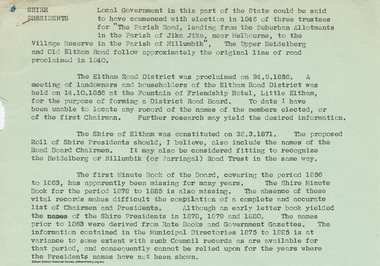 Eltham District Historical Society Inc
Document - Appendix, M.B. Watson, Shire Secretary, List of Former Road Board Chairmen and Shire Presidents (1856-1966), 28 Nov 1966
... Griffith...F.V. Squire...F.W. Nankervis...G. Love...G. Robertson...H. Dendy...H. Hewitt...H. Stooke...L.T. Wilmot...J. Cox...J. Murray...J. Barr...J. Bell...J. Fitch...J. Herbert...J. Lawrey...J. Mealy...J. Pape...J. Ryan...J. Smedley...J.B. Shallard...J.L. Beale...L. C. Docksey...R. McAdam...R.A. Bell...R.C. White...R.R. Woolcott...Rutter...S.S. Addison...S.W. Scott...T. Armstrong...T. Irvine...W...Griffith F.V. Squire F.W. Nankervis G. Love G. Robertson H. Dendy H. Hewitt H. Stooke L.T. Wilmot J. Cox J. Murray J. Barr J. Bell J. Fitch J. Herbert J. Lawrey J. Mealy J. Pape J. Ryan J. Smedley J.B. Shallard J.L. Beale L. C. Docksey R. McAdam R.A. Bell R.C. White R.R. Woolcott Rutter S.S. Addison S.W. Scott T. Armstrong T. Irvine W ...Appendix to Shire Secretary’s Report, 28 November 1966 SHIRE PRESIDENTS Local Government in this part of the State could be said to have commenced with election in 1846 of three trustees for "The Parish Road, leading from the Suburban Allotments in the Parish of Jika Jika, near Melbourne, to the Village Reserve in the Parish of Nillumbik". The Upper Heidelberg and Old Eltham Road follow approximately the original line of road proclaimed in 1840. The Eltham Road District was proclaimed on 24.9.1856. A meeting of landowners and householders of the Eltham Road District was held on 14.10.1856 at the Fountain of Friendship Hotel, Little Eltham, for the purpose of forming a District Road Board. To date I have been unable to locate any record of the names of the members elected, or of the first Chairman. Further research may yield the desired information. The Shire of Eltham was constituted on 28.3.1871. The proposed Roll of Shire Presidents should, I believe, also include the Road Board Chairmen. It may also be considered fitting to recognise the Heidelberg or Nillumbik (or Warringal) Road Trust in the same way. The first Minute Book of the Board, covering the period 1856 to 1863, has apparently been missing for many years. The Shire Minute Book for the period 1878 to 1885 is also missing. The absence of these vital records makes difficult the compilation of a complete and accurate list of Chairmen and Presidents. Although an early letter book yielded the names of the Shire Presidents in 1878, 1879 and 1800. The names prior to 1863 were derived from Rate Books and Government Gazettes. The information contained in the Municipal Directories 1875 to 1885 is at variance to some extent with such Council records as are available for that period, and consequently cannot be relied upon for the years where the Presidents names have not been shown. shire of eltham archives, series listing, a. armstrong, a. beale, a. brinkkotter, a. donaldson, a.h. price, a.j. braid, c.h. bath, c.m.a. pelling (mrs.), c.t. bell, d.c. o'beirne, e.d. butler, e.h. cameron, e.j. andrew, e.p. harmer, f.e. griffith, f.v. squire, f.w. nankervis, g. love, g. robertson, h. dendy, h. hewitt, h. stooke, l.t. wilmot, j. cox, j. murray, j. barr, j. bell, j. fitch, j. herbert, j. lawrey, j. mealy, j. pape, j. ryan, j. smedley, j.b. shallard, j.l. beale, l. c. docksey, r. mcadam, r.a. bell, r.c. white, r.r. woolcott, rutter, s.s. addison, s.w. scott, t. armstrong, t. irvine, w. horris, w. hubbard, w. lorimer, w. morris, w. taylor, w.c. farrell, w.f. ford, w.g. gray, w.h. bradbury, w.j. taylor, w.v. houghton -
Glen Eira Historical Society
Document - Elsternwick Congregational Church – Caulfield Union Church
... Griffith Mrs.... Bryant Samuel Rev.... Christiansen W...Griffith Mrs. Bryant Samuel Rev. Christiansen W. Rev Slatter J.C. ...Souvenir programme of the Elsternwick Congregational Church Welcome Home Social for their members, who served in World War 1, held on 05/05/1919 at the church. Includes a photograph of church exterior. A programme for the Combined Welcome Social for the new pastor Rev. J.S. Griffiths held on 09/12/1919. The twenty-seventh annual report of Elsternwick Congregational Church for year ending 30/06/1921. Pamphlet for jubilee celebration for Elsternwick Congregational Church in August 1944. Includes programme of events and brief history of the church. Programme for fifty-first church anniversary and social held on 12/08/1945 and 15/08/1945. Undated church letterhead sheet of paper. Includes exterior photograph of the church. Four church newsletters from March 1973, March 1975, February 1977 and May 1977. Three black and white photographs, undated and photographer unknown, of church exterior, Pilots’ Club and Sunday School children.elsternwick congregational church, world war 1914-1918, butters r.w., elliot t., hale w.r., christiansen a.l.a., thoms f.e., emmerson j.h., angwin h.h., white s.j., anderson g., wragge l.g., adams g.h., smith e.j., thoms s.e., anderson j., wragge t.w.e, emmerson e., cleghorn h., lindsay g.j., fullagar w.k., barker j.n., snowball g.f., clarke r., wragge s., joynes a., lewis r., griffith j. shaw rev., griffith mrs., bryant samuel rev., christiansen w. rev, slatter j.c., robertson w., clarke w., forward f.a. rev., orrong road, king street, curral road, hoddle street, elizabeth street, robertson r.j., pedler b.r., hoare j.g., lewis g.n., tytherleigh r. j., watts v., message h.t., barlow c.w., northey j.d. rev., krohn f.w. rev, swan e.f.w. rev., riddles f.j. rev., elsternwick, caulfield north, hatley l., hatley l. mrs., parkside street, langdon bob rev., bendelack i., sandham court, mcloghlin j.r., prahran grove, smitham nancy, religious groups, sunday schools, congregational church, newsletters, st. john’s uniting church elsternwick, strickland a. mrs., watts w.c. mrs., mcivor miss, watts t. mr., watts t. mrs., watts r. miss, anderson a. mr., white miss, white c. miss, white p. miss, gladman f.e. mr., glandman f.e. mrs., slatter h.t. mr., slatter h.t. mrs., boldner a. mr., boldner a. mrs., smith s.a. mrs., strickland a. mr., owen w. mr., owen w. mrs., woodward t. mr., gregson j.b. mr., shippey f.l. mr., turner c. mr., turner c. mrs., blanch j.w. mr., blanch j.w. mrs., pye h. mr., pye h. mrs., haynes m.j. mrs., burgess e. mr., burgess e. mrs., watts h. g. miss, burgess a.s. mr., burgess a.s. mrs., watts m. miss, thoms w. mr., thoms h. mr., thompson j.m. mrs., thompson miss, grover e. miss, slatter h.h. mr., slatter r. miss, anderson a. miss, thoms e.m. mrs., newson m. mrs, legge mrs., legge f. miss, legge b. miss, young mrs., young miss, copland o. rev., copland o. mrs., steed mr., steed mrs. -
Glen Eira Historical Society
Document - Craigellachie
... Craigellachie Lynedoch Avenue St Kilda East Lewis Debra Gill J Lyall W Young William Smith W Sydney Pearson William Orrong Road Inkerman Street Caulfield Italianate style Architectural styles Sawers John McCulloch David Crawford Minnie Crawford Robert Thomson Emma Thomson Percy Elliot Sibley C Saint Pearl Roche James Yorston James Griffiths William Francis Newton Francis Marie Cocks Norman Heisler Geraldine Freeman Julie Freeman Richard Cast iron work Stained glass Bibliography Plans Architectural drawings Architectural features Document Craigellachie ...A documentary and physical investigation into the history and development of Craigellachie, located at 2B Lynedoch Avenue, St Kilda East, by Debra Lewis. Includes an examination of the house’s condition as at 2002, photocopies of photographs and plans of the house illustrating key architectural features and changes to the house. Includes a handwritten letter dated 08/02/2002 from Debra Lewis regarding the donation of the copy of her research paper.craigellachie, lynedoch avenue, st kilda east, lewis debra, gill j, lyall w, young william, smith w sydney, pearson william, orrong road, inkerman street, caulfield, italianate style, architectural styles, sawers john, mcculloch david, crawford minnie, crawford robert, thomson emma, thomson percy, elliot sibley c, saint pearl, roche james, yorston james, griffiths william, francis newton, francis marie, cocks norman, heisler geraldine, freeman julie, freeman richard, cast iron work, stained glass, bibliography, plans, architectural drawings, architectural features -
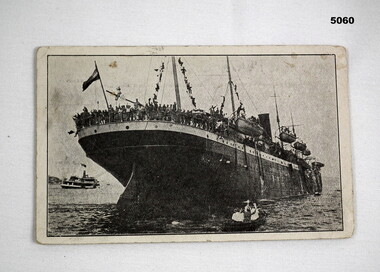 Bendigo Military Museum
Postcard - POSTCARD 38th BN, C. June 1916
... Names on the list as written; JLK Myers KIA, AE Madill, WH Myers, JD McNeil, MJ Nihill KIA, A Walker, JC Nihill, EJ Anson, JJ Scott KIA, SC Smith, TA McDonald KIA, JFD Walker, SA Parker, J Smith, FA McMurtree KIA, FJ Griffiths, CR Wright, WC Marshall, E Tracey KIA, AA Elliot, RE Marshall DOD, DT Ure. Photographs 38th BN B Coy Runic Photo post card B&W of the Troopship “Runic” showing troops lined up on the deck. ...The card is written by Leonard James Kennedy Myers No 593 to his Mother on one half of the card, the other is signed by the 22 men. He signs of as “Jim” , refer cat No 5062.2P for his details. Names on the list as written; JLK Myers KIA, AE Madill, WH Myers, JD McNeil, MJ Nihill KIA, A Walker, JC Nihill, EJ Anson, JJ Scott KIA, SC Smith, TA McDonald KIA, JFD Walker, SA Parker, J Smith, FA McMurtree KIA, FJ Griffiths, CR Wright, WC Marshall, E Tracey KIA, AA Elliot, RE Marshall DOD, DT Ure.Photo post card B&W of the Troopship “Runic” showing troops lined up on the deck. A short letter on the back and signed by 22 men of B Coy 38th Bnphotographs, 38th bn, b coy, runic -
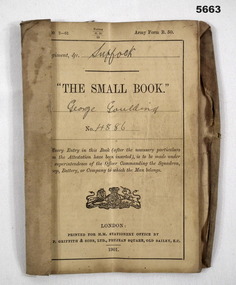 Bendigo Military Museum
Booklet - BOOK, SOLDIERS PAY, SUFFOLK REGIMENT UK 1901, British Army, 1901
... Booklet BOOK, SOLDIERS PAY, SUFFOLK REGIMENT UK 1901. British Army W P Griffiths & Sons ...Page 4 has handwritten description of soldier and enlistment details - George Goulding. Enlisted at St. Georges Barracks, London. County of Middlesex. 31 December 1897, age 18 yrs, 10 mths. He joined Suffolk Regiment for 7 years. He was born in Whitechapel, London. Height 5'5-1/2 ", Dark hair, tattoo on left forearm. He served in various places abroad. Malta, Dolpa, Sth Africa, Southampton.This is a small booklet titled "The Small Book" British Army form B.50. The soldier's name is George Goulding No. 4886. The Regiment is Suffolk. In the centre of the cover are the instructions for use, beneath that is the crest of Great Britain. The rear cover is khaki coloured buckram. Inside are 24 pages. These have Goulding's description - Navy regulations and details of Goulding's Service.british suffolk regiment, south african war, boer war, soldier
