
Showing 228 items matching "ground to air"
-
 Bendigo Military Museum
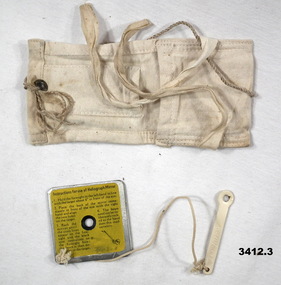
Equipment - HELIOGRAPH MIRROR, Department of Defence, possibly WW2 era
... ...ground to air...Emergency signaling mirror - Ground to Air .1) Bright polished steel. Cross hairs engraved on reflective surface. ...heliograph mirror ground to air .1) On rear yellow sticker / black print: "Instructions for use of Heliograph Mirror & illustration" .2) Site stamped one side: "27H / 2107" .3) Faded stencil on flap: "Heliograph" Emergency signaling mirror - Ground to Air .1) Bright polished steel. ...Emergency signaling mirror - Ground to Air .1) Bright polished steel. Cross hairs engraved on reflective surface. Rear face has instructions for use, yellow sticker with black print. .2) Sight. Long piece with viewing hole at end, painted white. .3) White cotton container with tie straps..1) On rear yellow sticker / black print: "Instructions for use of Heliograph Mirror & illustration" .2) Site stamped one side: "27H / 2107" .3) Faded stencil on flap: "Heliograph" heliograph, mirror, ground to air -
 Moorabbin Air Museum
Book - Aircraft radar systems, Introduction to Airborne Radar
... Return from the ground...Air...Aircraft radar systems Overview of airborne radar Essential groudwork Primary design considerations Detection & ranging Extracting doppler information Return from the ground Air-to air operation High resolution ground mapping Future developments Technical history of airborne radar, circa 1983 Introduction to Airborne Radar Book Aircraft radar systems ...Technical history of airborne radar, circa 1983non-fictionTechnical history of airborne radar, circa 1983overview of airborne radar, essential groudwork, primary design considerations, detection & ranging, extracting doppler information, return from the ground, air-to air operation, high resolution ground mapping, future developments -
 Lara RSL Sub Branch
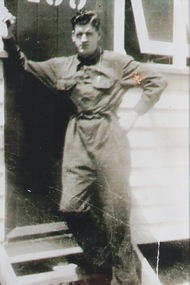
Photograph, Colin Arthur Goldberg, A37084
... From there he went to the ground and air radio school in Ballarat. After his training Colin was placed in the RAAF reserve. ...Colin is standing on the steps of hut number 199 at Ground and Air Radio School RAAF Ballarat ...From there he went to the ground and air radio school in Ballarat. After his training Colin was placed in the RAAF reserve. ...Colin A Goldberg b 13 November 1932 - D 2February 2013. Colin attended several primary schools in Victoria leaving school aged 13 years. Working hard at various jobs Colin studied at RMIT qualifying as builder /carpenter in 1961. Colin was called up for National Service on 30 July, 1951. He was allotted to the RAAF, and underwent recruit training at Laverton. From there he went to the ground and air radio school in Ballarat. After his training Colin was placed in the RAAF reserve. Colin was on the list for Korea for 9 years although did not serve. Colin said of his training: "My National Service Training showed me purpose & a discipline that turned my life somewhat around for the good & for all time". Colin first joined the family of R S L at WARRAGUL in 1992 transferring to Lara in 1996. Elizabeth, Colin's wife, says that he was probably working with members of the RSL and that talk at work about the branch made him think that it was a good place to connect and make friends, and this was part of the reason why they continued at Lara. Colin. And wife Elizabeth came to live in Lara in 1994 there being a warm welcome for us both by the members of Lara RSL in 1996. Colin & Elizabeth found friendship & a whole wide window to the consequence of warfare. Indeed history written through the suffering of so many . Colin & Elizabeth were married for 57 years when Colin died. Colin and Elizabeth had two daughters, three grandchildren, and three great grandchildren however he never met them. Personal Story A willingness to put oneself in readiness for the call to arm oneself in the defence of family and Nation .Sepia image of Telegraphist A37084 Colin A Goldberg Cream Mount Black Frame. Colin is standing on the steps of hut number 199 at Ground and Air Radio School RAAF Ballarat A37084 Telegraphist Colin Arthu Goldberg. 1st National Service Intake. RAAF. 1932-2013.sepia photograph, korea, 1951, laverton, ballarat, raaf reserves -
 National Vietnam Veterans Museum (NVVM)
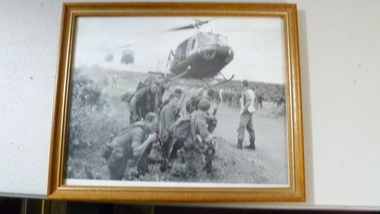
Photograph
... Black and white framed photo of Troop movement Iroquois helicopter ground to air. Soldiers on ground with three helicopters in air. ...Photograph Peter Stainthorpe Black and white framed photo of Troop movement Iroquois helicopter ground to air. Soldiers on ground with three helicopters in air. ...Black and white framed photo of Troop movement Iroquois helicopter ground to air. Soldiers on ground with three helicopters in air. Courtesy of Australian War Memorialphotograph, peter stainthorpe -
 Vision Australia
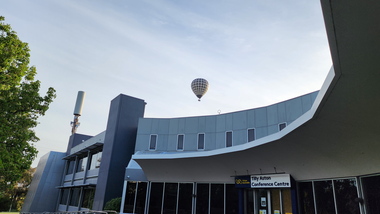
Photograph (item) - Image, Jason Morgan, Kooyong balloon photos, 18/10/2022
... Photograph taken by a staff member of the rear view of the Kooyong building, facing the blind cricket ground, of hot air balloon descending one morning to the sports grounds behind. ...Photograph taken by a staff member of the rear view of the Kooyong building, facing the blind cricket ground, of hot air balloon descending one morning to the sports grounds behind. ...Photograph taken by a staff member of the rear view of the Kooyong building, facing the blind cricket ground, of hot air balloon descending one morning to the sports grounds behind. vision australia, buildings -
 National Vietnam Veterans Museum (NVVM)
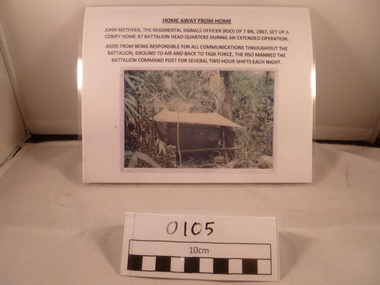
Photograph, Home Away From Home
... Aside from being responsible for all communications throughout the Battalion, ground to air and back to task force, the RSO manned the Battalion Command post for several two hour shifts each night....Aside from being responsible for all communications throughout the Battalion, ground to air and back to task force, the RSO manned the Battalion Command post for several two hour shifts each night. ...This item is one of many that have been donated by John David Methven. Lt John Methven 37604 served with the Royal Australian Infantry Corps. He served with the 7th Batalion with The Royal Australian regiment from April 67 to April 1968.A reprint colour photograph of s small shed surrounded by bamboos. The picture and texts are on a white paper and laminated. Written above the photograph. HOME AWAY FROM HOME John Methven, the Regimental Signals Officer (RSO) of 7Bn, 1967, set up a comfy home at Battalion Headquarters during an extended operation. Aside from being responsible for all communications throughout the Battalion, ground to air and back to task force, the RSO manned the Battalion Command post for several two hour shifts each night.John Methven, The Regimental Signals Officer (RSO) of 7BN, 1967 set up a comfy home at Battalion Head Quarters during an extended operation.photograph, 7th battalion, 7 rar, john methven, rso, regimental signals officer, battalion headquarters -
 Bendigo Military Museum
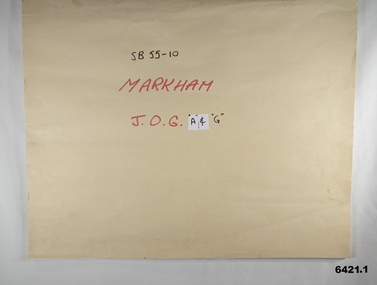
Map - SB55-10 Markham Joint Operations Graphics Air and Ground print separations, Royal Australian Survey Corps, Bendigo, Dec 1981
... SB55-10 Markham Joint Operations Graphics Air and Ground print separations...SB55-10 Markham Joint Operations Graphics Air and Ground print separations...The collection is a complete set of individual color prints of each colour used on the final printed maps for each map Joint Operations Graphic (JOG) JOG Ground and JOG Air versions. This map series was produced in two versions to help coordinate military Ground Operations and Air Operations. ...The collection is a complete set of individual color prints of each colour used on the final printed maps for each map Joint Operations Graphic (JOG) JOG Ground and JOG Air versions. This map series was produced in two versions to help coordinate military Ground Operations and Air Operations. ...This set of map prints was assembled as a training aid. The collection is a complete set of individual color prints of each colour used on the final printed maps for each map Joint Operations Graphic (JOG) JOG Ground and JOG Air versions. This map series was produced in two versions to help coordinate military Ground Operations and Air Operations. The ground users required that heights and measurements were in Metres, whilst air users required height information in Feet for altimeters. The Air Version also contained more Aeronautical information including safe flying height information called Maximum Elevation Figures (MEF). Later printing of JOG incorporated printing in just four colours Cyan, Magenta, Yellow and Black (CMYK). Item 6421.1 is an example of a JOG Ground and item 6421.2 is an example of its matching JOG Air version.1:250,000 SB55-10 Markham JOG A and G colour separations bound together in a manilla card covered folder bound with a timber edge. royal australian survey corps, rasvy, fortuna, army survey regiment, army svy regt, asr -
 Bendigo Military Museum
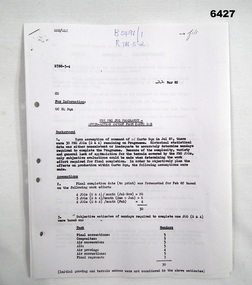
Administrative record - Army Survey Regiment - PNG JOG After Action Report Cartographic Sqn March 1982, DR Bowen, US Major, OC Carto Sqn, 22 Mar 1982
... JOG were produced in two versions JOG Ground in metres and JOG Air in feet. This report estimates the amount of manpower required to complete the last 30 x JOG and JOGA as at 22 March 1982 by Cartographic Squadron....JOG were produced in two versions JOG Ground in metres and JOG Air in feet. This report estimates the amount of manpower required to complete the last 30 x JOG and JOGA as at 22 March 1982 by Cartographic Squadron. ...The Royal Australian Survey Corps produced complete coverage of Papua New Guinea of Joint Operations Graphics (JOG) at 1:250,000 scale. JOG were produced in two versions JOG Ground in metres and JOG Air in feet. This report estimates the amount of manpower required to complete the last 30 x JOG and JOGA as at 22 March 1982 by Cartographic Squadron.A4 typed 4 x page report stapled top LHSroyal australian survey corps, rasvy, fortuna, army survey regiment, army svy regt, asr, png -
 Bendigo Military Museum
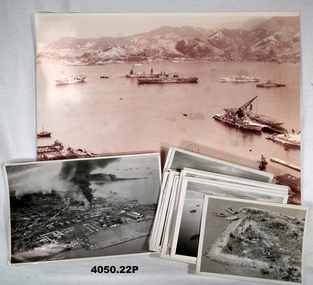
Photograph - PHOTOGRAPHS, KOREA, 1950-1953
... On rear most photos are written on in blue pen. .2) INCHON landings Walmi-Do in background and landing barges - could be one I was driving. .3) Island - Walmi-Do - US landing craft. .4) INCHON landings. .5) US landing craft. .6) INCHON oil tanks and military targets on fire. .7) Grounded coaster after an air attack. .8) Two North Korean supply ships hit by rockets. .9) Korean supply vessels camouflaged. .10) Rocket attack on Korean supply vessel. .11) Sunken coaster that was carrying arms and food. .12) Sunken coaster in harbour. .13) & .14) North Korean armour taken from an observation flight. .15) & .16) Chinese tanks and armour. .17) HMS BELFAST, Fleet Oiler, HMAS WARRAMUNGA .18) Targets from rocket attacks. .19), .20) & .21) "Seafires" coming to land on HMS TRIUMPH. .22) Rearming cannon and rockets on a "Seafire'. ...On rear most photos are written on in blue pen. .2) INCHON landings Walmi-Do in background and landing barges - could be one I was driving. .3) Island - Walmi-Do - US landing craft. .4) INCHON landings. .5) US landing craft. .6) INCHON oil tanks and military targets on fire. .7) Grounded coaster after an air attack. .8) Two North Korean supply ships hit by rockets. .9) Korean supply vessels camouflaged. .10) Rocket attack on Korean supply vessel. .11) Sunken coaster that was carrying arms and food. .12) Sunken coaster in harbour. .13) & .14) North Korean armour taken from an observation flight. .15) & .16) Chinese tanks and armour. .17) HMS BELFAST, Fleet Oiler, HMAS WARRAMUNGA .18) Targets from rocket attacks. .19), .20) & .21) "Seafires" coming to land on HMS TRIUMPH. .22) Rearming cannon and rockets on a "Seafire'. ...The photos are a collection held by T. J. IRELAND C/K853677 P.O. STOKER MECHANIC RN while serving on HMS TRIUMPH, Korea 1950-53. Many are of the landings at INCHON, Sept. 1950. .1) Kure Harbour, Japan 1950. Ships assembling for the landings at INCHON, Korea. Ships across the top, left to right: HMAS SYDNEY, Fleet Oiler, VSS ANTIETAM, Hospital Ship & Japanese Coaster. In the foreground on the right, HMS BELFAST, HMS TRIUMPH, HMS CONSORT. On rear most photos are written on in blue pen. .2) INCHON landings Walmi-Do in background and landing barges - could be one I was driving. .3) Island - Walmi-Do - US landing craft. .4) INCHON landings. .5) US landing craft. .6) INCHON oil tanks and military targets on fire. .7) Grounded coaster after an air attack. .8) Two North Korean supply ships hit by rockets. .9) Korean supply vessels camouflaged. .10) Rocket attack on Korean supply vessel. .11) Sunken coaster that was carrying arms and food. .12) Sunken coaster in harbour. .13) & .14) North Korean armour taken from an observation flight. .15) & .16) Chinese tanks and armour. .17) HMS BELFAST, Fleet Oiler, HMAS WARRAMUNGA .18) Targets from rocket attacks. .19), .20) & .21) "Seafires" coming to land on HMS TRIUMPH. .22) Rearming cannon and rockets on a "Seafire'. Photos not written on, information was supplied by T.J. IRELAND. The "Seafire" was a naval adaption of the Supermarine Spitfire for carrier use..1) Photo, sepia tone, aerial view over a harbour with warships, bomb damage foreground, hills and buildings in the distance. .2) Photo, black & white, aerial view of harbour, city with several fires from shelling. .3) Photo, black & white, aerial view of island with landing craft. .4) Photo, black & white, aerial view over ships and harbour. .5) Photo, black & white, aerial view over four landing craft. .6) Photo, black & white, aerial view over city and fires. .7) Photo, black & white, aerial view over islands, boat .... small island. .8) Photo, black & white, aerial view over harbour with two boats on fire. .9) Photo, black & white, aerial view over structures covered. .10) Photo, black & white, aerial view over ship being attacked. .11) Photo, black & white, aerial view over harbour with sunken ship. .12) Photo, black & white, aerial view showing harbour, fire and sunken ship. .13) Photo, black & white, aerial view, five tanks along a road. .14) Photo, black & white, aerial view, same area as .13) showing a wider area. .15) Photo, black & white, aerial view showing tanks and armour. .16) Photo, black & white, aerial view road with armour, vehicles, people and smoke in distance. .17) Photo, black & white, aerial view showing three ships together. .18) Photo, black & white, aerial view showing a road control with targets either side on fire. .19) Photo, black & white, aerial view with aeroplane coming onto the deck of a carrier. .20) Photo, black & white, aerial view of a fighter plane. .21) Photo, black & white, on deck of a carrier. .22) Photo, black & white, rearming a plane with ammunition on carrier deck. Photos are various sizes.photos, korea, rn, inchon -
 Bendigo Military Museum
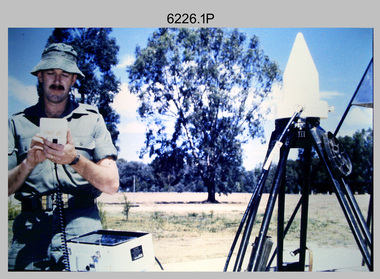
Photograph - Demonstration of TI4100 GPS Receiver, Royal Australian Survey Corps, c1988
... The equipment was deployed to establish the baseline for a GPS controlled air camera and photogrammetric system to significantly reduce the requirement for ground survey to accurately control air photography for topographic mapping. ...The equipment was deployed to establish the baseline for a GPS controlled air camera and photogrammetric system to significantly reduce the requirement for ground survey to accurately control air photography for topographic mapping. ...This is a set of four photographs of WO2 Graham Ragless from the Royal Australian Survey Corps demonstrating the operation of Global Positioning System equipment in c1988. The photos were probably taken at the School of Military Survey (SMS), Bonegilla, VIC. Texas Instruments TI4100 portable Global Positioning System (GPS) geodetic receivers were introduced from 1986–1988. The GPS receivers and Ferranti FILS3 helicopter and vehicle mounted Inertial Positioning System (IPS) replaced the TRANSIT satellite receivers. The equipment was deployed to establish the baseline for a GPS controlled air camera and photogrammetric system to significantly reduce the requirement for ground survey to accurately control air photography for topographic mapping. Personnel from the four field survey squadrons at this time were trained at the SMS to operate the TI4100 receivers. Field survey operations using GPS and IPS equipment followed in the late 1980s. This technology is described in more detail in the RA Svy booklet titled An Introduction to Topographic Mapping. See record ID - 6010. WO2 Graham Ragless progressed to the rank of WO1 and was appointed as RSM of the Army Survey Regiment from 1990 to 1992. Refer to item 6186.2P for more photographs of WO2 Graham Ragless demonstrating the TI4100.This is a set of four photographs of a technician from the Royal Australian Survey Corps demonstrating the operation of Global Positioning System equipment in c1988. Colour photos are on 35mm slide film and were scanned at 96 dpi. .1) to .4) - Photo, colour, c1988, WO2 Graham Ragless demonstrating the operation of a TI4100 GPS receiverThere are no annotations.royal australian survey corps, rasvy, army survey regiment, army svy regt, fortuna, asr, surveying -
 Bendigo Military Museum
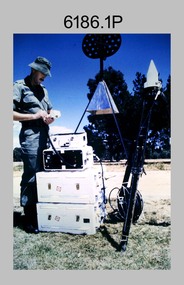
Photograph - Demonstration of TI4100 GPS Receiver, Royal Australian Survey Corps, c1988
... The equipment was deployed to establish the baseline for a GPS controlled air camera and photogrammetric system to significantly reduce the requirement for ground survey to accurately control air photography for topographic mapping. ...The equipment was deployed to establish the baseline for a GPS controlled air camera and photogrammetric system to significantly reduce the requirement for ground survey to accurately control air photography for topographic mapping. ...This is a set of two photographs of WO2 Graham Ragless from the Royal Australian Survey Corps demonstrating the operation of Global Positioning System equipment in c1988. The photos were probably taken at the School of Military Survey (SMS), Bonegilla, VIC. Texas Instruments TI4100 portable Global Positioning System (GPS) geodetic receivers were introduced from 1986–1988. The GPS receivers and Ferranti FILS3 helicopter and vehicle mounted Inertial Positioning System (IPS) replaced the TRANSIT satellite receivers. The equipment was deployed to establish the baseline for a GPS controlled air camera and photogrammetric system to significantly reduce the requirement for ground survey to accurately control air photography for topographic mapping. Personnel from the four field survey squadrons at this time were trained at the SMS to operate the TI4100 receivers. Field survey operations using GPS and IPS equipment followed in the late 1980s. This technology is described in more detail in the RA Svy booklet titled An Introduction to Topographic Mapping. See record ID - 6010. WO2 Graham Ragless progressed to the rank of WO1 and was appointed as RSM of the Army Survey Regiment from 1990 to 1992. Refer to item 6226.4P for more photographs of WO2 Graham Ragless demonstrating the TI4100.This is a set of two photographs of a technician from the Royal Australian Survey Corps demonstrating the operation of Global Positioning System equipment in c1988. Colour photos are on 35mm slide film and were scanned at 96 dpi. .1) and .2) - Photo, colour, c1988, WO2 Graham Ragless demonstrating the operation of a TI4100 GPS receiverThere are no annotations.royal australian survey corps, rasvy, army survey regiment, army svy regt, fortuna, asr, surveying -
 Federation University Historical Collection
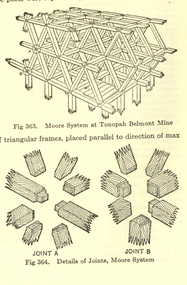
Book, Mining Engineers Handbook Volume 1 & 2, 1941
... Maroon hardcovered books. .1) Volume 1 - Chapters include Mineralogy, Geology and Mineral Deposits, Earth Excavation, Explosives, Rock Excavation, Tunneling, Shaft Sinking in Rock, Shaft sinking in Unstable and Waterbearing Ground, Boring, Underground Transport, Mine Ventilation. .2) Volume 2 - Chapers include Compressed Air Practice, Electric Power for mine Service, Surveying,Underground Surveying, Mine Geologic Maps and models, Cost of mining, Mining Laws, Ore sampling, Assaying, Aerial Tramways and Cableways, Gold Amalgamation and Cyanidation, etc....Robert Peele was Professor Emeritus of mining Engineering at the School of Mines, Columbia University. charles bacon mining engineering mining engineering university of nevada mackay school of mines explosives timbering Inside front cover "Charles Bacon" Maroon hardcovered books. .1) Volume 1 - Chapters include Mineralogy, Geology and Mineral Deposits, Earth Excavation, Explosives, Rock Excavation, Tunneling, Shaft Sinking in Rock, Shaft sinking in Unstable and Waterbearing Ground, Boring, Underground Transport, Mine Ventilation. .2) Volume 2 - Chapers include Compressed Air Practice, Electric Power for mine Service, Surveying,Underground Surveying, Mine Geologic Maps and models, Cost of mining, Mining Laws, Ore sampling, Assaying, Aerial Tramways and Cableways, Gold Amalgamation and Cyanidation, etc. ...The book was used by Charles Bacon who studied at the University of Nevada in the late 1930s/early 1940s. Bacon worked at Bunker Hill Mines and Kellogg Idaho, before arriving in Australian in 1951. He worked for CN Myers, a company involved with paper converting. CN Myers was a family business (on Charles Bacon's maternal line). Robert Peele was Professor Emeritus of mining Engineering at the School of Mines, Columbia University.Maroon hardcovered books. .1) Volume 1 - Chapters include Mineralogy, Geology and Mineral Deposits, Earth Excavation, Explosives, Rock Excavation, Tunneling, Shaft Sinking in Rock, Shaft sinking in Unstable and Waterbearing Ground, Boring, Underground Transport, Mine Ventilation. .2) Volume 2 - Chapers include Compressed Air Practice, Electric Power for mine Service, Surveying,Underground Surveying, Mine Geologic Maps and models, Cost of mining, Mining Laws, Ore sampling, Assaying, Aerial Tramways and Cableways, Gold Amalgamation and Cyanidation, etc.Inside front cover "Charles Bacon"charles bacon, mining engineering, mining, engineering, university of nevada, mackay school of mines, explosives, timbering -
 Federation University Historical Collection
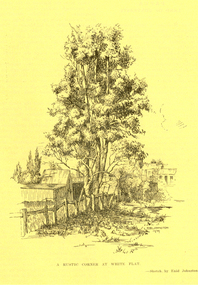
Work on paper - Artwork - sketch, A Rustic Corner at White Flat by Enid Johnston, 1939
... air'. ballarat technical art school ballarat school of mines art johnston enid johnston white flat E. Gribble Max Coward Enid Johnston r. mcHutchison violet D'Angri marian peirce f.p. manning w. rowe kookaburras caricatures Graham Hopwood geoege Crawley Assaying Room Don Refshauge Ballarat Technical Art School Linda Baily nornie gude Line drawing with a tree as the central focal point. I post and rail fence runs from the left to the centre and a number of miners cottage are in the mid and back ground ...Enid Johnston was an student at the Ballarat School of Mines Technical Art School. The work depicted was reproduced in the Ballarat School of Mines Students' Magazine, 1939. White Flat is in close proximity to the Ballarat School of Mines so would have been a favoured site for drawing 'en plein air'.Line drawing with a tree as the central focal point. I post and rail fence runs from the left to the centre and a number of miners cottage are in the mid and back ground. ballarat technical art school, ballarat school of mines, art, johnston, enid johnston, white flat, e. gribble, max coward, enid johnston, r. mchutchison, violet d'angri, marian peirce, f.p. manning, w. rowe, kookaburras, caricatures, graham hopwood, geoege crawley, assaying room, don refshauge, ballarat technical art school, linda baily, nornie gude -
Frankston RSL Sub Branch
Drift Recorder, W & G, A M Drift Recorder MKII, 1930 - 1939
... Thus, in order to score a hit, the bomber had to fly a ground track that ran upwind of the target." "Air resistance acting on a bomb after release caused it to lag behind the drop point and hit somewhere behind the bomber. ...Thus, in order to score a hit, the bomber had to fly a ground track that ran upwind of the target." "Air resistance acting on a bomb after release caused it to lag behind the drop point and hit somewhere behind the bomber. ...Purpose built mechanical calculation machine for determining the drift of aircraft when operating in crosswind conditions. This device has an eyepiece and a prismatic periscope for viewing a distant feature being tracked. This device has calibrated rotary scales for height, speed (in KNOTS and MPH), and an adjustment to preset the 'crab angle' of the aircaft for cross wind compensation. The device can be opened for cleaning or maintenance purposes. Refer to the following extracts for information about bomb drift: "Crosswinds brought into the bombing problem a new factor, "drift" In order to fly a given ground track in a crosswind, an aircraft had to "crab" into the wind; the angle formed between the aircraft's true heading and its ground track was called the "drift angle" In a crosswind, the bomb would impact directly behind the aircraft and along its longitudinal axis at the moment of release. But this meant that the bomb would strike the ground at some point downwind of the aircraft's ground track. Thus, in order to score a hit, the bomber had to fly a ground track that ran upwind of the target." "Air resistance acting on a bomb after release caused it to lag behind the drop point and hit somewhere behind the bomber. The distance from a point beneath the aircraft at the instant of bomb impact to the point of bomb impact was called "trail." Trail increased as the bomber's airspeed increased or as its altitude increased. Furthermore, since different bombs encountered different resistance in the air, trail was also a factor of bomb shape."A. M. Drift Recorder MKII REF. No 6B/190 No 2668/41 X/ 3606 3E4H28 -
 Nhill Aviation Heritage Centre
Equipment - Radio Receiver BC-639A, 1940-1949
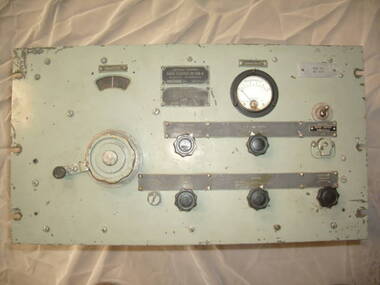
... The BC-639A is a ground based AM VHF receiver covering the nominal frequency range of 100 -156 m/cs. The set was built for the U.S. Army Air...The BC-639A is a ground based AM VHF receiver covering the nominal frequency range of 100 -156 m/cs. The set was built for the U.S. Army Air...The BC-639A is a ground based AM VHF receiver covering the nominal frequency range of 100 -156 m/cs. The set was built for the U.S. Army Air ...The BC-639A is a ground based AM VHF receiver covering the nominal frequency range of 100 -156 m/cs. The set was built for the U.S. Army Air Force in WW2 as part of a communication system to communicate with aircraft. A system of similar intent was built in Australia during WW2 by Radio Corporation of Victoria (ASTOR), with the addition of FM facilities. This system used the ARl7 receiver and ATl7 transmitter. Many of the sets had been modified after the war by the then Dept of Civil Aviation for use as monitoring receivers.This type was used at the AeradioThe BC-639A is a ground based AM VHF receiver covering the nominal frequency range of 100 -156 m/cs. The set was built for the U.S. Army Air Force in WW2 as part of a communication system to communicate with aircraft. Dark grey US Military colourradio receiver, bc 639, bc 639a, 639, aeradio -
 Nhill Aviation Heritage Centre
Booklet - R.A.F Signal Manual Part V, Ground Signal Codes (Provisional)
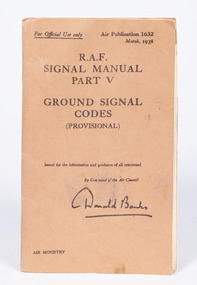
... Air Ministry Orange cardboard cover with 40 buff coloured pages. Ground Signal Codes (Provisional) Booklet R.A.F Signal Manual Part V. ...Signal codes used by Royal Air Force. This booklet was authorised by Sir Donald Banks, Secretary of the British Air Ministry . He was responsible for setting up the Empire Air Training Scheme . He travelled to Australia and New Zealand to discuss the manufacture of aircraft in those countries such as Wirraways and Beaufighters.Orange cardboard cover with 40 buff coloured pages.For official use only. Air Publication 1632, March 1938. Issued for the information and guidance of all concerned. By command of the Air Council (signed) Donald Banks. Air Ministry -
 Lara RSL Sub Branch
Book - Bible, Royal Australian air Force Pocket Bible, fourth edition 1976
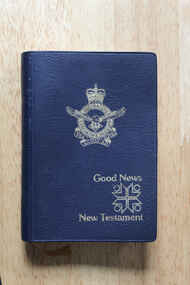
... Good News Testament English Version religion bible Royal Australian Air Force Bible RAAF Ground Defence - Australia - New Guinea - South West Pacific Areas 1939- 1940 -1945 Royal Australian air Force Pocket Bible Book Bible ...Good News Testament English VersionRAAF Ground Defence - Australia - New Guinea - South West Pacific Areas 1939- 1940 -1945Royal Australian Air Force Biblereligion, bible -
 Lara RSL Sub Branch
Book, Australia in the War of 1939-1945 - Air Power Over Europe 1944-1945 Volume 4. AIR. Author John Herington, First Published 1963
... air force 1944-1945...wwii...453 squadron...646 squadron...spitfire...ground...Historical record of the Air power over Europe 1944-1945 invasion of italy long range missiles oil normandy coastal command ardennes offensive battle of the bulge evaders prisoners rhine air force 1944-1945 wwii 453 squadron 646 squadron spitfire ground crew no.3 squadron 461 squadron 466 squadron 455 squadron Australian War Memorial Australia in the War of 1939-1945 - Air Power Over Europe 1944-1945. ...A continuation and conclusion of the story of Australian airmen who served in or beside the RAAF in the struggle against Germany and Italy. In general it covers a period when both in the Mediterranean and in Northern Europe Air superiority, the vital pre-requisite of successful air assault, had already been gained over the enemy. The emphasis is largely engagements or in the strategic bombing campaigns to the total achievement of allied air power in land and sea campaigns.Historical record of the Air power over Europe 1944-1945Australia in the War of 1939-1945 - Air Power Over Europe 1944-1945. AIR Maps, Illustrations, charts, photographsAustralian War Memorialinvasion of italy, long range missiles, oil, normandy, coastal command, ardennes offensive, battle of the bulge, evaders, prisoners, rhine, air force 1944-1945, wwii, 453 squadron, 646 squadron, spitfire, ground crew, no.3 squadron, 461 squadron, 466 squadron, 455 squadron -
 Shepparton RSL Sub Branch
Goggles
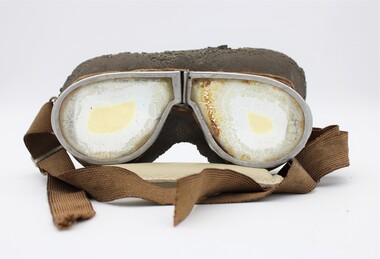
... Unlike other examples, this set does not have fur lined interior suggesting that it may have been used by ground crew rather than those at altititude. flying royal australian air force raaf flying corps goggle eyemask aviation equipment pilot first world war second world war Goggles constructed of various materials: rubber edging, metal frames, plastic lens, canvas sides and elastic strap attached via metal buckles. ...Flying goggles possibly used by a member of the Flying Corps in the First or Second World War. Unlike other examples, this set does not have fur lined interior suggesting that it may have been used by ground crew rather than those at altititude.Goggles constructed of various materials: rubber edging, metal frames, plastic lens, canvas sides and elastic strap attached via metal buckles. Rubber hand stitched to convas sides. Lens cracked and yellowed in centre.flying, royal australian air force, raaf, flying corps, goggle, eyemask, aviation, equipment, pilot, first world war, second world war -
 Flagstaff Hill Maritime Museum and Village
Booklet - Book and World Chart for Emergency Navigation, George Grady Press, The Raft Book, 1943
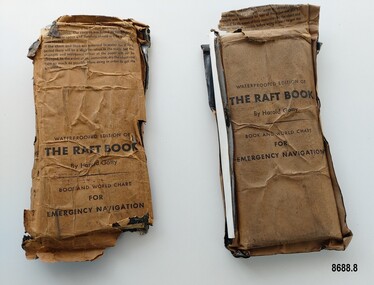
... Two early inventions of his were his air sextant and a ground speed and drift indicator which formed the basis of the automatic pilot which later came to be standard equipment on most aircraft. ...Two early inventions of his were his air sextant and a ground speed and drift indicator which formed the basis of the automatic pilot which later came to be standard equipment on most aircraft. ...Harold Gatty was born on January 5th, 1903 in Campbell Town, Tasmania. He was a navigator and aviation pioneer. He began his career learning navigation at the age of 14 as a midshipman at the Royal Australian Naval College but withdrew after three years and became an apprenticed ship's officer with the Patrick Steamship Company of Sydney. After W. W. 1 he joined the Australian Merchant Navy where he learned the constellations while standing night watch and became an expert in celestial navigation while serving on many ships sailing between Australia and California. In 1927 he moved to California and opened a navigation school and also a laboratory repairing navigational equipment. At this time he became very interested in air navigation and was aware of the limitations of existing methods and instruments for aerial navigation. He began researching ways of improving aerial navigation. Two early inventions of his were his air sextant and a ground speed and drift indicator which formed the basis of the automatic pilot which later came to be standard equipment on most aircraft. He worked with several record breaking pilots including Ann Morrow Lindbergh (who went on to serve as a navigator for her husband Charles Lindbergh), helped Wiley Post break the world record circumnavigating the Earth, invented a new method of "dead reckoning" that revolutionised the ability to fly safely through cloudy conditions without drifting off course and famously navigated a small plane (whilst trying to cross the Pacific) over 1900 km through fog (with no radio) and using only his dead reckoning techniques, back to their starting point in Japan after they developed fuel problems. In 1932 Gatty received the Distinguished Flying Cross from President Hoover. In 1934 Gatty formed the South Seas Commercial Company with Donald Douglas with the aim to deliver air services to the islands of the South Pacific. The Company was sold to Pan Am but he continued to work for them. In 1935 he went on a sailing expedition investigating several small islands in the South Pacific and was briefly marooned on Baker Island. He was able to use his extensive knowledge of seabird habits to save the crew. He was also very interested in the ability of the Polynesians to navigate using the stars. During the Second World War Gatty was given the honorary rank of Group Captain in the Royal Australian Air Force (RAAF) and worked for the U. S. Army Air Forces (USAAF) in the South Pacific. In 1943 he moved to Washington where he developed a survival book (The Raft Book) specifically for boat crews or air crews flying over the Pacific to help them survive and navigate their life rafts in remote areas of the ocean. The original book was 152 pages long however a condensed version was made which consisted of a 64 page booklet, combined map and star chart and calendar strip enclosed in a waterproof slipcase, to be placed in life rafts for emergency use. The booklet included navigational advice and ideas such as ocean currents, estimation of distance, using a compass, measurement of angles, recognising and steering by the stars, land indications from sea birds, migration of sea birds and insects, sounds from the land, the scent of the land and ocean currents and the colour of the sea etc. After W.W.2 Gatty moved to Fiji and formed Fiji Airways (which later became Air Pacific). Harold Gatty died in August 1957.The two copies of "The Raft Book" are significant as they are a written summary of the many methods of sea navigation (both modern and historical) that existed in the 1940's. They are also a record of Harold Gatty, who played a significant role in the development of modern day aerial navigation using his understanding of different sea navigational techniques.Two rectangular brown packets with waterproof coverings (oiled paper) titled "The Raft Book" by Harold Gatty. Each packet contains a folded 64 page paper booklet with detailed instructions for navigating a small craft in open seas, a folded chart (with a map of the world and oceans, well known constellations, latitude and longitude charts, Greenwich time and a scale for string lengths and Harp scale) and a long folded paper calendar strip.Front of package - "WATERPROOFED EDITION OF/ THE RAFT BOOK / By Harold Gatty / BOOK AND WORLD CHART / FOR / EMERGENCY NAVIGATION / To open envelope tear along above line. If the envelope is used again fold the flap to keep contents dry. 1. This envelope contains a book, chart and tape for emergency navigation. The contents are folded to take up the least possible space and therefore should not be removed until needed. 2. if the chart and tape are immersed in water for a long period, there will be a slight variation in the scale but the strength and resistence to tear of the paper will not be changed. In the event of long immersion, dry the chart and tape as much as possible before using in order to in order to get the greatest accuracy in scale. Front of booklet - THE RAFT BOOK / LORE OF THE SEA AND SKY /By Harold Gatty IMPORTANT FOR YOUR SECURITY/Upon abandoning ship you may have to be your own navigator. Take the following pre/cautions for your own safety:/ Carry a good type of pocket watch / keep it wound and have it running on Greenwich (England) / Time, which you can get from the navigating officer. / Keep track of the date at Greenwich; and on a 24-hour basis, / know whether the time is, say, 6 hours (6 A.M.) showing on / your watch, or 18 hours (6P.M.) Greenwich. / PROECT YOUR WATCH. GET A RUBBER SACK FOR IT (OBTAIN FROM PHARMACIST) AND KEEP IT DRY / KEEP A PENCIL IN YOUR POCKET/ POSITION OF SHIP WHEN ABANDONED PRINTED IN UNITED STATES OF AMERICA GEORGE GRADY PRESS, NEW YORK/COPYRIGHT, 1943, BY HAROLD AND FENNA GATTYflagstaff hill maritime museum and village, shipwreck coast, warrnambool, the raft book, harold gatty, book and world chart for emergency navigation, ww 2, ww ii, navigation, air navigation, aerial navigation, lindbergh, wiley post, dead reckoning, south seas commercial company, u.s. army airforce, usaaf, survival book, life rafts, sea navigation, emergency navigation, fiji airways, harp scale -
 Flagstaff Hill Maritime Museum and Village
Container - Glass Jar, Nestle, 1920s
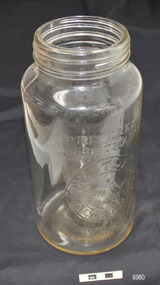
... There are air bubbles in the glass, and the base has been ground flat. The outside of the mouth is threaded. ...There are air bubbles in the glass, and the base has been ground flat. The outside of the mouth is threaded. ...This glass jar once contained Australian-made Nestle’s Malted Milk. The jar carries the company’s familiar logo. This jar would have originally had a screw-top metal lid. The large jar may have been used in a canteen, hospitality business or hospital due to its capacity. The jar was owned by Dr W.R. Angus, surgeon and oculist, who lived in Warrnambool with his wife and growing family for over thirty years. It may have been purchased from the Nestle factory in nearby Dennington. The jar was donated by his family and is part of the W.R Angus Collection. Nestles Malted Milk powder is usually added to either hot or cold milk as a nutritious drink supplement. The powder is a combination of evaporated whole milk powder, malted barley and wheat flour. Nestle began in 1867 and its products were available in Australia since the 1880s. Australia had become Nestle’s second-largest export market by 1906 and by 1908 Nestle had set up business in Australia. The Nestle factory in Dennington, Warrnambool, opened in 1911 and was the world’s largest condensed milk plant. For over 100 years the factory produced dried milk powder from the produce of local dairy farmers. It was a major employer for the district until an announcement was made on May 2019 by its recent owner Fonterra that it was closing its Dennington site for financial reasons. This Nestle Malted Milk jar is connected to the history of Warrnambool, as it was owned by the daughter of Dr W. R. Angus and his wife Gladys. It is part of the W.R. Angus Collection, which is notable for still being located at the site connected to Doctor Angus, Warrnambool’s last Port Medical Officer. It is also connected through its manufacturer Nestle. which had a branch in Warrnambool from 1911 to 2019, overlapping the time when the Angus family resided there, from 1939 to the 1970s. The jar is also significant as an example of the early-20th-century food found in local households and businesses, and could have been purchased from the local Nestle factory.Round tall clear glass jar with a wide mouth, short neck and straight sides on a cylindrical body. The jar has been blow-moulded in two pieces with a side seam running from the base to the top of the lip. There are air bubbles in the glass, and the base has been ground flat. The outside of the mouth is threaded. Inscriptions are moulded on one side and there is a round logo with text around an image of a mother bird with three young birds in a nest. The jar once contained Nestles Malted Milk and was made in Australia around the 1920s. The jar is part of the W.R. Angus Collection.Inscription: “PREPARED / IN AUSTRALIA” and “TRADE MARK / REGISTERED” Logo; “NESTLES MALTED MILK” around image [bird feeding young in next]flagstaff hill, warrnambool, maritime village, maritime museum, shipwreck coast, great ocean road, nestle, malted milk, glass jar, nestle jar, nestle malted milk, dennington, nestle australia, w.r. angus collection -
 Flagstaff Hill Maritime Museum and Village
Equipment - Stevenson Screen, Thomas Stevenson, ca. 1910
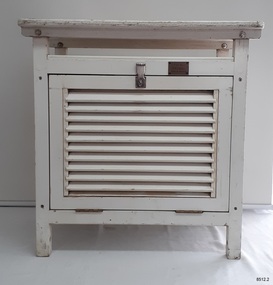
... air space between them and was thickly painted with a white coating that reflected the sun’s rays. This design was modified in 1884 by Edward Mawley of the Royal Meteorological Society. Standards were set for the locations of the screens and instruments, including their distance above ground level and the direction the door faced....air space between them and was thickly painted with a white coating that reflected the sun’s rays. This design was modified in 1884 by Edward Mawley of the Royal Meteorological Society. Standards were set for the locations of the screens and instruments, including their distance above ground level and the direction the door faced. ...Stevenson screens were first introduced in Australia in the 1880s and were widely installed by 1910. The screens have been used to shelter and protect thermometers and other meteorological instruments from rain and direct heat while the holes and double-louvre walls allowed air to flow around them. Sometimes other meteorological instruments were included in the weather stations, so there were different Stevenson Screen sizes. This authentic, original Stevenson screen was previously owned by the Australian Bureau of Meteorology and was used for many years for weather readings at the Cape Otway Light Station in southwest Victoria. The Lighthouse Keepers recorded the readings for minimum and maximum temperatures at 9 a.m. every day from January 1865 until April 1994. The equipment was sheltered in a Stevenson Screen from 1902 until April 15 1994, when the mercury thermometer was replaced by a platinum resistance probe within an Automatic Weather Station (AWS). This Stevenson screen is one of the two screens that then became redundant. The other Stevenson screen was kept to display to visitors. Lightkeepers were no longer required at the Cape Otway Light station either, due to the automated system. The meteorological instruments donated with the screen were used for measuring temperature and humidity. They are mounted on a metal bracket that fits across the screw holes on the screen’s internal frame. The glass-covered Relative Humidity (RH) sensor was made by the renowned precision instrument maker, Rotronic AG of Switzerland, which was founded in 1965. The firm made its first electronic temperature and humidity instrument in 1967. Meteorological records have been collected in Australia from the 1800s. The records were collated, published and used as a basis for weather forecasts. Many sectors, such as maritime and agriculture industries, have relied on these figures for making important decisions. The quality and placement of the meteorological instruments used to measure temperature and humidity are of utmost importance for accuracy. In early colonial times, there were no national standards for meteorological instruments that would allow for accurate figures and comparisons. Once the Bureau of Meteorology was established (around 1908 to 1910) the department installed Stevenson screens throughout Australia, many at lighthouses and light stations, and the measuring instruments were standardised. The Stevenson Screen was named after its inventor, Scottish Civil Engineer Thomas Stevenson (1818-1887) who was also the father of Robert Louis Stevenson, author. Stevenson developed the small thermometer screen around 1867. It had double-louvred walls around the sides and a top of two asbestos sheets with an air space between them and was thickly painted with a white coating that reflected the sun’s rays. This design was modified in 1884 by Edward Mawley of the Royal Meteorological Society. Standards were set for the locations of the screens and instruments, including their distance above ground level and the direction the door faced.Stevenson screens played a significant part in providing a standardised shelter for all meteorological instruments used by the Australian Bureau of Meteorology from about 1910 until 1994. The readings from the instruments gave the meteorological statistics on which weather forecasts throughout Australia were based. This Stevenson screen was used locally at Cape Otway, along the Great Ocean Road in southwest Victoria, so contributed towards our local forecasts and weather warnings.Stevenson screen, original, from the Australian Bureau of Meteorology’s weather station at the Cape Otway Lighthouse. The screen is a white wooden cupboard with a slanted cover raised above the top. The top has ten drilled ventilation holes, and the sides and door are made of downward-slanting double louvres. Two brass hinges join the door to the lower edge of the screen and a metal fitting at the top edge allows for a padlock closure. The screen is supported on four short legs, each with a hole drilled from side to side for fitting to a frame. Inside the screen are two wooden frames fitted with hooks and screws. The floor has three boards; one across the back and one across the front at the same level, and a board wider than the space between these boards is fitted higher, overlapping them slightly. Inside the screen, a pair of electronic instruments with short electric cables is mounted on a metal bracket with drilled holes in it. One of the instruments is a Relative Humidity (RH) probe. It is 26 cm long and is a glass tube with a filter on one end and an electrical connection on the other. It has inscriptions on its label, showing that was made by Rotronic AG, Switzerland. The other instrument is a Resistance Temperature Device (RTD) thermometer. It is 22.5 cm long and has a narrow metal probe joined to a hexagonal metal fitting. A brass plate on the front of the screen has impressed inscriptions. The screen is Serial Number 01/C0032, Catalogue Number 235862.Stamped into brass plate "CAT. NO. / 253862 / SERIAL NO. 01/C0032" On instrument’s electrical fitting; “CD2” [within oval ‘+’ above S] “Serie693 op65 / 220/380V~16A” On instrument’s glass; “rotronic ag” “SWISS MADE” “CE / CH-8303 / Bassersdorf” Symbol for [BARCODE] “ART NO MP 101A_T4-W4W” “POWER 4.8.30VDC“ “OP. RANGE: 0-100%RH/-40+60° C” “OUT H 0-100% 0-1V” “OUT T -40+60°C -0.4..+0.6V” “SERIE NO 19522 009”flagstaff hill maritime museum and village, warrnambool, maritime museum, maritime village, great ocean road, shipwreck coast, cotton region shelter, instrument shelter, thermometer shelter, thermoscreen, thermometer screen, measuring instruments, meteorological instrument, weather recording, weather station, lighthouse equipment, light station equipment, stevenson screen, marine instruments, mercury thermometer, platinum resistance probe, aws, automatic weather station, rotronic ag, swiss made, meteorological device, weather forecast, weather prediction, weather records, meteorological forecast, meteorological record, australian bureau of meteorology, bureau of meteorology, bureau, bom, relative humidity, rh, relative humidity probe, resistance temperature device, rtd, thermometer, temperature, humidity, cape otway, cape otway lighthouse, cape otway light station, rotronic, switzerland, swiss instrument, thomas stevenson, double-louvered walls, edward mawley, royal meteorological society, 01/c0032, serial number, cat. no. 235862, serial no. 01/c00323 -
 Orbost & District Historical Society
knitted jumper, 1938-1940
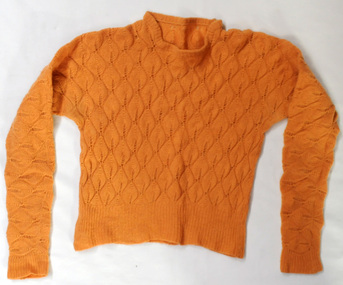
... air raids. However, pre-existing structures such as underground stations (tube or subway stations), tunnels, cellars in houses or basements in larger establishments, and railway arches, above ground, were suitable for safeguarding people during air raids. ...air raids. However, pre-existing structures such as underground stations (tube or subway stations), tunnels, cellars in houses or basements in larger establishments, and railway arches, above ground, were suitable for safeguarding people during air raids. ...This was knitted by Marjorie Burton during WW11 in England. She used to knit while in an air raid shelter escaping the bombing with her young daughter. Air raid shelters were built specifically to serve as protection against enemy air raids. However, pre-existing structures such as underground stations (tube or subway stations), tunnels, cellars in houses or basements in larger establishments, and railway arches, above ground, were suitable for safeguarding people during air raids. This item is an example of a handcrafted item and reflects the handcraft skills of women necessary during WW11 when clothing became scarce. Clothes rationing began on June 1, 1941, two years after food rationing started. Clothes rationing ended on 15 March 1949.A hand-knitted orange/tan woolen jumper. It is a lady's long-sleeved jumper.handcraft knitting ww11 -
 Montmorency–Eltham RSL Sub Branch
Weapon - Bomb, Aerial Practice
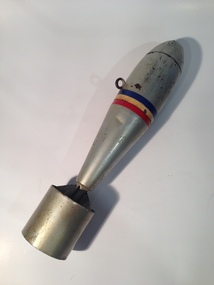
... The 11 Pound Practice Bomb was used in Australia to train air crews both during and after WW2. When the bomb hit the ground it produced a smoke cloud so that the aircrew could see where their bomb had landed. ...The 11 Pound Practice Bomb was used in Australia to train air crews both during and after WW2. When the bomb hit the ground it produced a smoke cloud so that the aircrew could see where their bomb had landed. ...The 11 Pound Practice Bomb was used in Australia to train air crews both during and after WW2. When the bomb hit the ground it produced a smoke cloud so that the aircrew could see where their bomb had landed. There was only a small explosive charge in them. Cylindrical, finned steel bomb weighing approx. 11lb painted silver with three stripes (blue, yellow, red) painted around the mid-section. One attachment point/loop. Cast iron nose. None. -
 Australian Commando Association - Victoria
Book, The Private War of the Spotters: A history of the New Guinea Air Warning Wireless Company, February 1942-April 1945
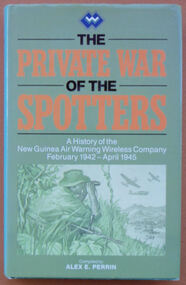
... On 3 February 1942 the company issued its first air warning in Papua, when spotters at Tufi saw Japanese aircraft about to attack Port Moresby for the first time. The following month the company was responsible for the first Japanese killed in action in Papua by Australian ground forces, when spotters from Gona engaged the crew of a downed Japanese bomber. ...The history of the New Guinea Air Warning Wireless Company. This reprinted version contains a map of the dispositions of Spotting Stations August 1943, additional MID awards listed and some additions to the nominal roll. The New Guinea Air Warning Wireless Company was formed in Port Moresby in late January 1942 and was granted “Separate Independent Establishment” status in October 1943. The company’s “founding father” was Major Don Small, who had witnessed Japanese air raids on Rabaul and realised that having lacked an effective early-warning system around New Britain meant that the defenders were taken by surprise. At the time, gaps had also appeared in the coast-watching communications network because the territory administration ordered the withdrawal of civilian wireless operators when Japan entered the war. The first influx of men into the company consisted largely of volunteers from the 39th Infantry Battalion, which was stationed at Port Moresby. Initial training was rudimentary, hasty, and was sometimes even carried out on en route to a new station. The first party of company personnel, or “spotters”, left Port Moresby as early as 1 February 1942, bound for the strategically important Samarai area, at the tip of Papua. In the first month of the company’s existence 16 spotter stations were established on the coast of Papua and in the mountains around Port Moresby. At the end of 1942 there were 61 operational stations being run by 180 men. The company’s high-water mark was in late 1944, by which time over 150 stations had been set up in Papua and New Guinea behind enemy lines. On 3 February 1942 the company issued its first air warning in Papua, when spotters at Tufi saw Japanese aircraft about to attack Port Moresby for the first time. The following month the company was responsible for the first Japanese killed in action in Papua by Australian ground forces, when spotters from Gona engaged the crew of a downed Japanese bomber. And in July 1942 the station at Buna signalled Port Moresby with news of the Japanese landings in Papua, marking the beginning of the Kokoda campaign. The dangers involved in the company’s work had also been made clear by this time. In July 1942 a party of spotters attempting to set up a station at Misima Island, off Milne Bay, was intercepted by a Japanese destroyer, resulting in the company’s first operational losses. Anticipating the direction of the campaign as a whole, the company’s focus moved north and north-west over the three years of its existence. In May 1942 a network was set up in the Wau area in association with the activities of Kanga Force. As part of the Wau network, spotter Ross Kirkwood audaciously constructed an observation post overlooking the Japanese airstrip at Salamaua. Kirkwood’s position was photographed by Damian Parer on the understanding that the pictures would not be published. They nevertheless appeared in a Sydney newspaper. The day after the publication of the photographs the observation post was attacked by the Japanese and Kirkwood was lucky to escape. In June 1944 the company’s headquarters were moved to Nadzab. By that time, spotter stations existed behind Japanese lines, as far north as Hollandia, and the company began to train Americans to perform similar work in the Philippines. In early 1945 the company moved to Balcombe, Victoria, where its members were posted to other units of the Australian Corps of Signals.gray plasticnon-fictionThe history of the New Guinea Air Warning Wireless Company. This reprinted version contains a map of the dispositions of Spotting Stations August 1943, additional MID awards listed and some additions to the nominal roll. The New Guinea Air Warning Wireless Company was formed in Port Moresby in late January 1942 and was granted “Separate Independent Establishment” status in October 1943. The company’s “founding father” was Major Don Small, who had witnessed Japanese air raids on Rabaul and realised that having lacked an effective early-warning system around New Britain meant that the defenders were taken by surprise. At the time, gaps had also appeared in the coast-watching communications network because the territory administration ordered the withdrawal of civilian wireless operators when Japan entered the war. The first influx of men into the company consisted largely of volunteers from the 39th Infantry Battalion, which was stationed at Port Moresby. Initial training was rudimentary, hasty, and was sometimes even carried out on en route to a new station. The first party of company personnel, or “spotters”, left Port Moresby as early as 1 February 1942, bound for the strategically important Samarai area, at the tip of Papua. In the first month of the company’s existence 16 spotter stations were established on the coast of Papua and in the mountains around Port Moresby. At the end of 1942 there were 61 operational stations being run by 180 men. The company’s high-water mark was in late 1944, by which time over 150 stations had been set up in Papua and New Guinea behind enemy lines. On 3 February 1942 the company issued its first air warning in Papua, when spotters at Tufi saw Japanese aircraft about to attack Port Moresby for the first time. The following month the company was responsible for the first Japanese killed in action in Papua by Australian ground forces, when spotters from Gona engaged the crew of a downed Japanese bomber. And in July 1942 the station at Buna signalled Port Moresby with news of the Japanese landings in Papua, marking the beginning of the Kokoda campaign. The dangers involved in the company’s work had also been made clear by this time. In July 1942 a party of spotters attempting to set up a station at Misima Island, off Milne Bay, was intercepted by a Japanese destroyer, resulting in the company’s first operational losses. Anticipating the direction of the campaign as a whole, the company’s focus moved north and north-west over the three years of its existence. In May 1942 a network was set up in the Wau area in association with the activities of Kanga Force. As part of the Wau network, spotter Ross Kirkwood audaciously constructed an observation post overlooking the Japanese airstrip at Salamaua. Kirkwood’s position was photographed by Damian Parer on the understanding that the pictures would not be published. They nevertheless appeared in a Sydney newspaper. The day after the publication of the photographs the observation post was attacked by the Japanese and Kirkwood was lucky to escape. In June 1944 the company’s headquarters were moved to Nadzab. By that time, spotter stations existed behind Japanese lines, as far north as Hollandia, and the company began to train Americans to perform similar work in the Philippines. In early 1945 the company moved to Balcombe, Victoria, where its members were posted to other units of the Australian Corps of Signals.world war ii, special operations, new guinea, new guinea air warning wireless company -
Australian Commando Association - Victoria
Equipment - Ground / Air emergency code
... Ground / Air emergency code...Equipment Ground / Air emergency code ... -
 Flagstaff Hill Maritime Museum and Village
Book, The Old Bus
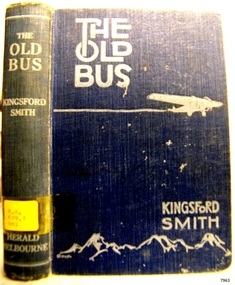
... air service in Australia. Sadly on 1st April 1929 he was forced to land, having lost radio contact with the ground and having run into bad weather over north – west Australia. ...air service in Australia. Sadly on 1st April 1929 he was forced to land, having lost radio contact with the ground and having run into bad weather over north – west Australia. ...Sir Charles Edward Kingsford Smith is a famous Australian, well known in civil aviation history for his courageous endeavours in flight. He broken many flight records for long distance and time travelled and he was also a war hero in World War 1. He has been referred to as being “known to millions of Australians as “Smithy” … he was one of Australia’s true twentieth-century legends”. In honour of his place amongst the world’s famous pioneers his image is featured on Australia’s $20 note, Sydney airport is named after him, there is a memorial to Kingsford Smith, Taylor and Ulm at the Anderson Park, also in Sydney and his plane “Southern Cross” is on view at Brisbane Airport. Kingsford Smith wrote ‘The Old Bus’ (1932) and he and Ulm were co-authors of ‘Story of 'Southern Cross' Trans-Pacific Flight’ (1928). His also wrote a book about his own life ‘My Flying Life’ which was published after his death in 1937. and the story of his life was filmed in Australia in 1946. A BRIEF HISTORY OF SIR CHARLES EDWARD KINGSFORD SMITH (1897 – 1935) … Kingsford Smith was born 9th February 1897 in Brisbane, Queensland, Australia. His parents were William Charles Smith and Catherine Mary, nee Kingsford. His mother’s maiden name of “Kingsford” was added to the family name when they spent time in Canada from around 1903 to 1907, after which they returned to Sydney, Australia. In 1915 Kingsford Smith enlisted in Australian Imperial Force. He served in 4th Signal Troop, 2nd Division Signal Company at Gallipoli Peninsular as a ‘sapper’ or combat engineer and later in Egypt and in France as a dispatch rider. In 1916 Kingsford Smith was transferred to the Australian Flying Corps as a sergeant. He was discharged after training in England and commissioned as a second lieutenant in the Royal Flying Corps. He was appointed fling officer and soon joined the 23rd Squadron in France. He brought down four machines in his first month there and also did invaluable work attacking enemy targets. He was wounded and shot down and later awarded the Military Cross ‘for conspicuous gallantry and devotion to duty’. He was promoted to lieutenant in 1918 and served as a Flying Instructor with the R.F.C. Kingsford Smith was not allowed to participate in the 1919 England to Australia air race because of assumed lack of navigational experience. He and his pilot friend Cyril Maddocks formed a business and flew joy-flights in both England and America. In America he did some stunt flying with a Flying Circus. Kingsford Smith returned to Australia in 1921 and found employment as a pilot. He soon realised the value of air transport in such a vast country. He formed a partnership with pilot Keith Anderson in 1924 and they purchased two Bristol Tourer biplanes. Their business broadened to include Charles Ulm and became the Interstate Flying services in Sydney. Together they performed important ‘demonstration’ flights including a flight around Australia in 10 days and 5 hours using very limited navigational equipment. Kingsford Smith immediately started to search for support to do a trans-Pacific flight. This support came from the New South Wales government, Sidney Myer and G. Allan Hancock, an American oil magnate. On 31st May 1928 Kingsford Smith, Charles Ulm and two American crewmen, Harry Lyan and Jim Warner, took off from Oakland, California and flew to Brisbane via Hawaii and Suva. This historic flight took 83 hours and 38 minutes. Their Fokker plane had three engines and was named the “Southern Cross”. This amazing achievement resulted in huge financial subscriptions. Kingsford Smith was awarded the Air Force Cross and appointed as honorary squadron leader, Royal Australian Air Force. Kingsford Smith flew his Southern Cross plane from Point Cook in Victoria to Perth nonstop. Then in September – October 1928, with Charles Ulm and an Australian crew, he piloted the Southern Cross from Sidney to Christchurch New Zealand. This flight showed that was possible for regular passenger and mail services across the Tasman Sea. Kingsford Smith flew his plane to England to an order for four aircraft, planning to use them for an inter-capital air service in Australia. Sadly on 1st April 1929 he was forced to land, having lost radio contact with the ground and having run into bad weather over north – west Australia. Keith Anderson and Robert Hitchcock both perished before the search party reached them. Once official enquiries were completed the flight to England continued in June and was completed in record time of 12 days and 18 hours. In January 1930 Kingsford Smith piloted the “Southern Cloud”, one of the new Avro Ten planes, on the first flight of his airline, the Australian National Airways, from Sydney to Melbourne. The “Southern Cross” was overhauled in Holland by the Fokker Aircraft Co. and in June 1930 Kingsford Smith achieved an east-west crossing of the Atlantic from Ireland to Newfoundland in 31.5 hours. Kingsford Smith returned to England and took delivery of an Avro Avian biplane that he named the “Southern Cross Junior” and flew solo from England to Darwin, Australia. This record breaking flight took less than 10 days. He beat four other planes that had left England before him and he was 5.5 days faster than Hinkler. Sadly Kingsford Smith’s “Southern Cloud” was lost during a flight from Sydney to Melbourne in 1931 with no surviving crew or passengers; in 1958 the wreckage was discovered in the Snowy Mountains. Later that year Kingsford Smith flew his “Southern Cloud” from Australia to Timor, collecting mail from a damaged Imperial Airways plane in Timor. Other flights followed. Kingsford Smith was knighted in 1932 for his services in Aviation. He returned to selling joy flights then established the Kingsford Smith Air Service, a flying training school in Sydney. In 1933 Kingsford Smith flew the amazing record flight in “Miss Southern Cross” – a Percival Gull - from London to Wyndham in Western Australia in just over ten days. The Australian Commonwealth then gave Kingsford Smith a large grant and he was also appointed as aviation consultant to Vacuum Oil Co. Another flying record was made when Kingsford Smith and Sir P.G. Taylor flow “Lady Southern Cross” from Brisbane to San Francisco in order to sell her there; the west-east-trans-Pacific flight made aviation history. They returned to Australia to make an attempt at the trans-Tasman flight but their attempt failed due to engine failure; they managed to get back to Sydney safely, minus most of their cargo. Kingsford Smith had his unsold “Lady Southern Cross” shipped back to England, from where he and J. T. Pethybridge in the “Lady Southern Cross” attempted another record breaking flight from England The Old Bus Author: Charles Kingsford Smith Publisher: Distibuted by Herald Feature Service Date; 1932Label on spine cover with typed text RA 629.1309 KIN flagstaff hill, warrnambool, shipwrecked coast, flagstaff hill maritime museum, maritime museum, shipwreck coast, flagstaff hill maritime village, great ocean road, the old bus, charles kingsford smith -
 Rye RSL Sub Branch
Dinner Gong
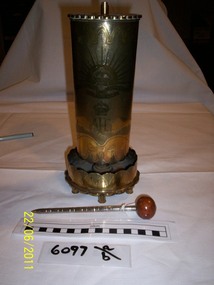
... Air Force. It relates to the embrionic stages of a part of the now Australian Defence Force. A commemorative Dinner Gong construted from Artillery Shell Casings of various sizes. The largest cut short at the bottom, mounted on rifle or machine gun casings cut short as 'feet'. A slightly smaller diameter inverted as the 'gong' with decorative engravings depicting, a Rising Sun emblem on a decorated back ground ...Hand theatre made "trench art", utilising used artillery brass shell casings, of various calibres, hand made with such "tools" as were available at the time. They have been decoratively trimmed at the mouth of each with a "scalloped" pattern, the shallowest casing mounted on small arms casings as "feet" and the large casing inverted engraved and embossed with a depiction of the Australian Commonwealth Military Forces "Rising Sun" badge.This "Dinner Gong" and "Striker" are significant Historically and Socially, as it is believed to be the only example of a dinner gong and striker made in theatre as contemporary "trench art" by serving members of this group. Around the top of the main part of the Gong are stamped the initials of the Australian members of the Royal Flying Corps at the time, it is of possible National historical significance, as they were such a small group at best, and a highly vulnerable group, quite likely to not survive the conflict. This group and their desendants went on to be a part of the formation of the Australian Flying Corps, the beginings of the Royal Australian Air Force. It relates to the embrionic stages of a part of the now Australian Defence Force.A commemorative Dinner Gong construted from Artillery Shell Casings of various sizes. The largest cut short at the bottom, mounted on rifle or machine gun casings cut short as 'feet'. A slightly smaller diameter inverted as the 'gong' with decorative engravings depicting, a Rising Sun emblem on a decorated back ground, 'AFC' (Australian Flying Corps) crowned wings, on the same decorated back ground. The open ends of these larger casings is 'scalloped' and decorated beautifully, while the closed ends have a 'pie crust effect around the flanged edge. There is a biforcated mount at the top to hold the 'striker' made from white metal ballastered rod with a wooden eliptical knob. On the top around the striker mount are stamped the initials of those believed to be the first Australian Aviators in the then AFC. -
 Sorrento/Portsea RSL Sub Branch
Photograph, F4E at RAAF Darwin, October 1972
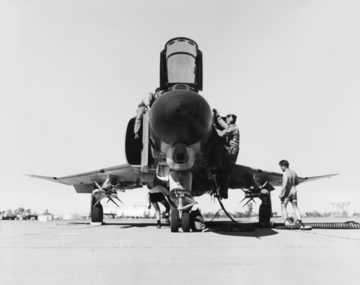
... The F4E depicted was tasked to 'cold soak" Sidewinder and Sparrow missiles in the troposphere at 53,000 feetabove Darwin in a joint exercise for the RAAF and the United States Navy in 1972.The aircraft is being readied for flight by the aircrew and ground crew at RAAF Darwin. f4e raaf missle peace time darwin vietnam noelryan F4E at start up RAAF Darwin tarmac.Armed with Sidewinder and Sparrow missiles. Photograph taken from the aircraft nose showing raised cockpit canopies,groundcrew and aircrew readying the airrcraft for flight. Note air ...The F4E depicted was tasked to 'cold soak" Sidewinder and Sparrow missiles in the troposphere at 53,000 feetabove Darwin in a joint exercise for the RAAF and the United States Navy in 1972.The aircraft is being readied for flight by the aircrew and ground crew at RAAF Darwin.F4E at start up RAAF Darwin tarmac.Armed with Sidewinder and Sparrow missiles. Photograph taken from the aircraft nose showing raised cockpit canopies,groundcrew and aircrew readying the airrcraft for flight. Note air start is connected Aircraft Serial No. A69-217.f4e, raaf, missle, peace time, darwin, vietnam, noelryan -
 The Beechworth Burke Museum
Animal specimen - White-Throated Needletail, Trustees of the Australian Museum, 1860-1880
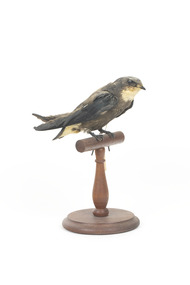
... These birds do not like to sit on the ground, spending spend most of their time in the air. This specimen is part of a collection of almost 200 animal specimens that were originally acquired as skins from various institutions across Australia, including the Australian Museum in Sydney and the National Museum of Victoria (known as Museums Victoria since 1983), as well as individuals such as amateur anthropologist Reynell Eveleigh Johns between 1860-1880. ...These birds do not like to sit on the ground, spending spend most of their time in the air. This specimen is part of a collection of almost 200 animal specimens that were originally acquired as skins from various institutions across Australia, including the Australian Museum in Sydney and the National Museum of Victoria (known as Museums Victoria since 1983), as well as individuals such as amateur anthropologist Reynell Eveleigh Johns between 1860-1880. ...The white-throated Needletail is a migratory bird, breeding in Central Asia and southern Siberia, and wintering south in the Indian Subcontinent, Southeast Asia and Australia. This large swift is often mistaken in flight for a small predatory bird, but its long curved wings and white markings help to identify it. Needle-tailed Swifts get their name from the spined end of their tail, which is not forked as it is in the more common Swifts of the genus Apus. They build their nests in rock crevices in cliffs or hollow trees. These birds do not like to sit on the ground, spending spend most of their time in the air. This specimen is part of a collection of almost 200 animal specimens that were originally acquired as skins from various institutions across Australia, including the Australian Museum in Sydney and the National Museum of Victoria (known as Museums Victoria since 1983), as well as individuals such as amateur anthropologist Reynell Eveleigh Johns between 1860-1880. These skins were then mounted by members of the Burke Museum Committee and put-on display in the formal space of the Museum’s original exhibition hall where they continue to be on display. This display of taxidermy mounts initially served to instruct visitors to the Burke Museum of the natural world around them, today it serves as an insight into the collecting habits of the 19th century.This specimen is part of a significant and rare taxidermy mount collection in the Burke Museum. This collection is scientifically and culturally important for reminding us of how science continues to shape our understanding of the modern world. They demonstrate a capacity to hold evidence of how Australia’s fauna history existed in the past and are potentially important for future environmental research. This collection continues to be on display in the Museum and has become a key part to interpreting the collecting habits of the 19th century. This white-throated Needletail is predominantly grey-brown in colour. The throat and under tail of he bird are dusky-white. This specimen has a white spot on the lower rim of each of its wings. The eyes are made from glass and the specimen has been styalised standing on a wooden mount.Label: 3a/ Spine-tailed Swift / See catalogue page 7.stormbird, taxidermy mount, taxidermy, animalia, burke museum, beechworth, australian museum, skin, reynell eveleigh johns, bird, quail, migratory bird, white-throated needletail, needle-tailed swift, spine-tailed swift, hirundapus caudacutus
