
Showing 19 items matching "gun manufacturer"
-
 Flagstaff Hill Maritime Museum and Village
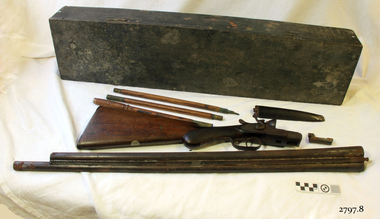
Weapon - Shotgun, Double Barrel, ISAAC HOLLIS & SONS, ca. 1904
... ...gun manufacturer...The partnership saw Hollis & Sheath become licensed manufacturers of percussion breech-loading guns, positioning the company as a notable presence in the industry. ...Isaac Hollis Frederick Hollis Isaac Brentnall Sheath Isaac Sheath William Tranter gun manufacturer pistol manufacturer gun and pistol maker Birmingham Military supplies ENTERPRISE 1904 "I. ...The proof marks on the barrels (a crown and letters BV) denote that the shotgun design was made from the year 1904, and that it was nitro-proof tested in Birmingham, England. David Melville Carrison (1895 to 1960) of Port MacDonnell was the previous owner of this Isaac Hollis & Sons double-barrel shotgun. His grandfather, Adam Kerrison Carrison (1833-1903), was an early settler who worked as a fisherman in that once-bustling seaport. His uncle John was a a horse-breaker, a boat hand, and a member of the lifeboat crew, receiving a medal for his part in saving the crew of a French barque. Currently, no connection has been made between the gun, its owner, and the note with the word “Enterprise”: a New Zealand-built, two-masted schooner that was wrecked in Lady Bay, Warrnambool, in 1950. Gun makers, ISAAC HOLLIS & SONS: The Hollis Brothers were first recorded as operating from 11 Weaman Row in 1840, although evidence suggests the business may have commenced before then. Over time, the firm became known as Isaac Hollis & Sons, with claims of its establishment dating back to 1814. This earlier date is supported by records of Richard and William Hollis trading in Bath Street, Birmingham, between 1814 and 1818, which raises the possibility that Isaac and Frederick Hollis were their descendants. The principal brothers involved in the business were Isaac Hollis, born in 1815, and Frederick Hollis, whose birth date remains unknown. Frederick’s life was cut short when he died on 20 December 1839. According to the 1841 census, Isaac Hollis resided in Weaman Row and was listed as a 25-year-old gun and pistol maker. He was married to Emma, who was born in 1821, and together they had two children: Isaac, born in 1837, and Henry, born in 1839. Following Frederick’s death, Isaac continued to operate under the name Hollis Brothers until 1845, after which he renamed the business Hollis Brothers & Co. This entity remained active up to 1848. In 1844, Isaac Hollis entered a brief partnership with William Tranter at 10 & 11 Weaman Row, likely to fulfil a specific contract or to supply parts. This partnership continued until 1849. In 1848, Isaac Hollis formed a partnership with Isaac Brentnall Sheath, establishing the firm of Hollis & Sheath and expanding their operations into 10 Weaman Row. The partnership saw Hollis & Sheath become licensed manufacturers of percussion breech-loading guns, positioning the company as a notable presence in the industry. In 1861, Sheath left the partnership and emigrated to New Zealand, where he conducted several enterprises and was elected as a provincial councillor. He died in Christchurch on 19th May 1897. In 1861, after Isaac Sheath left, the business name became Isaac Hollis & Sons. By approximately 1870, Isaac Hollis and Henry Hollis had assumed responsibility for the daily management of the firm, with Isaac overseeing the overall management and marketing of the company's products, and Henry managing the manufacturing processes. During this period, the company became known for producing large volumes of affordable trade guns and sporting guns, catering to customers in South Africa and the British colonies. In 1870, Isaac Hollis & Sons opened a retail location at 44a Cannon Street in London, and in 1871, it operated at 83 Cheapside Street. Isaac Hollis Jnr passed away in October 1875 in Birmingham at the age of 37, having never married. In 1876/1877, Henry Hollis registered a limited liability company under the name Isaac Hollis & Sons Ltd. However, by 1879, trading resumed under the name Isaac Hollis & Sons, and the London shop moved to 6 Great Winchester Street. From 1932 to 1933, the business operated in London as Hollis, Bentley & Playfair. The final closure of Hollis, Bentley & Playfair occurred in Birmingham in 1953. The shotgun was manufactured by Isaac Hollis & Sons, a firm with a strong reputation for producing firearms. This early 1900s example represents a standard pattern that was produced in large quantities for everyday use. This double-barrel shotgun is 12-gauge, complete with a cleaning rod and a wooden storage box. The firearm has been altered from its original configuration: the right barrel has been cut shorter, resulting in sharp edges at the muzzle, and a metal extension has been fitted to the stock. The cleaning rod consists of three separate segments that screw together for use. The shotgun is housed in a black-painted wooden case with a hinged lid showing inscriptions for the maker and Serial Number. Maker was I. HOLLIS & SONS, Serial Number SN 84245. David Melville Carrison of Port MacDonnell was the previous owner. A handwritten note that had the word 'Enterprise' was with the gun. "I. HOLLIS & SONS". SN on stock “84245”. Badge on both sides “Crown [symbol] / BV”. “Crown [symbol] / NP”, “12G inside Diamond [symbol]”, “NITRO PROOF”, “STEEL 84245” Paper note included with gun, written in felt tip pen “ENTERPRISE”. flagstaff hill, maritime museum, maritime village, warrnambool, great ocean road, shipwreck coast, firearm, gun, double-barrel, shotgun, cleaning rod, gunsmith, smithed, 12 gauge, sn 84245, serial number 84245, david melville carrison, early 1900s, richard and william hillis, herbert & co., herbert & co. london, hollis & sons, isaac hollis & sons, isaac hillis & sons ltd., hollis bentley & playfair., isaac hollis, frederick hollis, isaac brentnall sheath, isaac sheath, william tranter, gun manufacturer, pistol manufacturer, gun and pistol maker, birmingham, military supplies, enterprise, 1904 -
 Flagstaff Hill Maritime Museum and Village
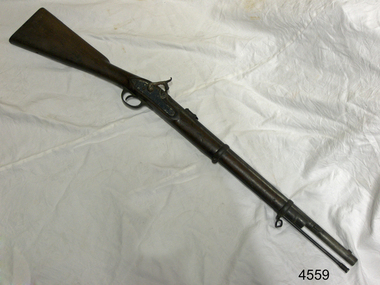
Weapon - Gun, ISAAC HOLLIS & SONS, Mid 19th Century
... ...gun manufacturer...The partnership saw Hollis & Sheath become licensed manufacturers of percussion breech-loading guns, positioning the company as a notable presence in the industry. ...Isaac Hollis Frederick Hollis Isaac Brentnall Sheath Isaac Sheath William Tranter gun manufacturer pistol manufacturer gun and pistol maker Birmingham J Aston Armourer Hythe Hythe Armoury Military supplies Stamped on stock "SOLD 95", " ISAAC HOLLIS & SONS" "GUN & PISTOL MANUFACTURES" "BIRMINGHAM" "J ASTON ARMOURER HYTHE" "MANUFACTURED EXPRESSLY FOR HEBBERT & CO LONDON". ...The Hollis Brothers were first recorded as operating from 11 Weaman Row in 1840, although evidence suggests that the business may have commenced prior to this date. Over time, the firm evolved and became known as Isaac Hollis & Sons, with claims of its establishment dating back to 1814. This earlier date is supported by records of Richard and William Hollis trading in Bath Street, Birmingham, between 1814 and 1818, which raises the possibility that Isaac and Frederick Hollis were their descendants. The principal brothers involved in the business were Isaac Hollis, born in 1815, and Frederick Hollis, whose birth date remains unknown. Frederick’s life was cut short when he died on 20 December 1839. According to the 1841 census, Isaac Hollis resided in Weaman Row and was listed as a 25-year-old gun and pistol maker. He was married to Emma, who was born in 1821, and together they had two children: Isaac, born in 1837, and Henry, born in 1839. Following Frederick’s death, Isaac continued to operate under the name Hollis Brothers until 1845, after which he renamed the business Hollis Brothers & Co. This entity remained active up to 1848. In 1844, Isaac Hollis entered a brief partnership with William Tranter at 10 & 11 Weaman Row, likely to fulfil a specific contract or to supply particular parts. This partnership continued until 1849. In 1848, Isaac Hollis formed a partnership with Isaac Brentnall Sheath, establishing the firm of Hollis & Sheath and expanding their operations into 10 Weaman Row. The partnership saw Hollis & Sheath become licensed manufacturers of percussion breech-loading guns, positioning the company as a notable presence in the industry. In 1861, Sheath left the partnership and emigrated to New Zealand, where he conducted several enterprises and was elected as a provincial councillor. He died in Christchurch on 19th May 1897. Following the departure of Isaac Sheath in 1861, the business underwent a name change to Isaac Hollis & Sons. By approximately 1870, Isaac Hollis and Henry Hollis had assumed responsibility for the daily management of the firm, with Isaac overseeing the overall management and marketing of the company's products, while Henry managed the manufacturing processes. During this period, the company became known for producing large volumes of affordable trade guns and sporting guns, catering to customers in South Africa and the British colonies. In 1870, Isaac Hollis & Sons opened a retail location at 44a Cannon Street in London, subsequently relocating to 83 Cheapside in 1871. Isaac Hollis Jnr passed away in October 1875 in Birmingham at the age of 37, having never married. In 1876/1877, Henry Hollis registered a limited liability company under the name Isaac Hollis & Sons Ltd. However, by 1879, trading resumed under the name Isaac Hollis & Sons, and the London shop moved to 6 Great Winchester Street. From 1932 to 1933, the business operated in London as Hollis, Bentley & Playfair. The final closure of Hollis, Bentley & Playfair occurred in Birmingham in 1953. This firearm serves as an exemplary representation of the type of weapon distributed to the colony’s military forces in 1861. It was specifically manufactured by Isaac Hollis & Sons, a prominent gunmaker of the period, to meet the requirements of military use. Distribution was facilitated through Hebbert & Sons, an established military supplier based in London. Before it arrived in Tasmania, Australia, around 1861, the firearm was likely issued from the Hythe Armoury, which functioned as a British military training facility. Probably, the gun was originally allocated to British troops or police before being transferred for use in the colony. Gun: Percussion Carbine, .577 Cal. Colonial Tasmanian issue Artillery carbine, Pattern 1861. Muzzle-loading "Cap and Ball" musket. Wood stock and ramrod. Inscriptions are on the stock and breech. Gun was made for Herbert & Co., London, by Isaac Hollis & Sons, Birmingham.Stamped on stock "SOLD 95", " ISAAC HOLLIS & SONS" "GUN & PISTOL MANUFACTURES" "BIRMINGHAM" "J ASTON ARMOURER HYTHE" "MANUFACTURED EXPRESSLY FOR HEBBERT & CO LONDON". Stamped on breech "25", and "25C ---05"flagstaff hill, maritime museum, maritime village, warrnambool, great ocean road, shipwreck coast, firearm, gun, percussion, carbine, .577 cal, colonial tasmanian issue, artillery carbine, military gun, pattern 1861, muzzle-loading, muzzle-loading musket, cap and ball, musket, wood stock, 1861, percussion breech-loading guns, richard and william hillis, herbert & co., herbert & co. london, hollis & sons, isaac hollis & sons, isaac hillis & sons ltd., hollis bentley & playfair., isaac hollis, frederick hollis, isaac brentnall sheath, isaac sheath, william tranter, gun manufacturer, pistol manufacturer, gun and pistol maker, birmingham, j aston armourer, hythe, hythe armoury, military supplies -
 Flagstaff Hill Maritime Museum and Village
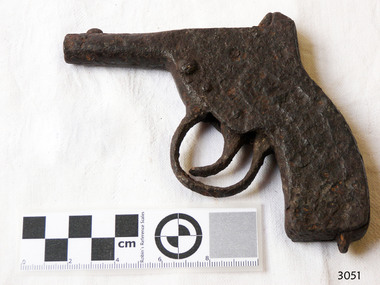
Toy Gun, 1911
... Eventually all of the famous cap gun manufacturers either sold out to other toy companies or started manufacturing other types of toys. ...Eventually all of the famous cap gun manufacturers either sold out to other toy companies or started manufacturing other types of toys. ...This cap gun was found by a local Warrnambool resident in about 1971. Cap guns first appeared following the end of the American Civil War in the mid-1860s, when firearms companies experimented with toy guns to stay in business. Cap guns became especially popular when the heroes of cinema and television rode through the West ridding the territories of villains. Many cap guns were named after or endorsed by leading matinee idols like Roy Rogers, Gene Autry, Hopalong Cassidy, The Lone Ranger, Tonto, Dale Evans, Marshal Matt Dillon, or any of countless others. Cap guns became popular after the second world war and children all over the world emulated their heroes and collected and played with these toy guns. Eventually all of the famous cap gun manufacturers either sold out to other toy companies or started manufacturing other types of toys. Before it was deemed dangerous or politically incorrect for young children to point pistols at each other and fire at will, cap guns were a staple of toy chests. The item demonstrates how society has changed its attitudes and now regard these types of toys as morally unacceptable as they tend to promote violent attitudes towards others. The item demonstrates significantly how our societies social attitudes have changed since world war two from general societal acceptance of such toys to one of distaste.Toy gun; cap gun. Cast iron toy pistol with metal trigger. Name "National" in raised embossing in the casting on the handle on both sides of the gun. Made in 1911."National" flagstaff hill, warrnambool, shipwrecked-coast, flagstaff-hill, flagstaff-hill-maritime-museum, maritime-museum, shipwreck-coast, flagstaff-hill-maritime-village, toys, cap gun, national fireworks distrubuting company, toy guns, toy pistol -
 Bendigo Military Museum
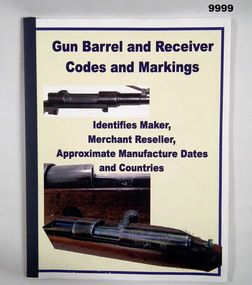
Book - MANUAL, WEAPONS, Cornell Publications, "GUN BARREL AND RECEIVER CODES AND MARKINGS", Unknown
... "Reprinted by CORNELL PUBLICATIONS/ NOT AFFILIATED WITH ANY GUN/ OR ARMS MANUFACTURER/ www.cornellpubs.com/ [email protected]/ [email protected]/ all rights reserved/ Thousands of Gun Catalogs & manuals/ From 1835-1980"..."Reprinted by CORNELL PUBLICATIONS/ NOT AFFILIATED WITH ANY GUN/ OR ARMS MANUFACTURER/ www.cornellpubs.com/ [email protected]/ [email protected]/ all rights reserved/ Thousands of Gun Catalogs & manuals/ From 1835-1980" Soft cover book. ...From the front cover. "Gun Barrel and Receiver Codes and Markings/ Identifier Maker/ Merchant Reseller. Approximate Manufacture Dates/ and Countries".Soft cover book. Cover - heavy gauge paper with plastic tape spine binding. Dark blue print on front. Illustrated - two colour photographs of weapons. Back - publication details. No page numbers - cut, plain, white colour. Information listed A to Z.Publication details. "Reprinted by CORNELL PUBLICATIONS/ NOT AFFILIATED WITH ANY GUN/ OR ARMS MANUFACTURER/ www.cornellpubs.com/ [email protected]/ [email protected]/ all rights reserved/ Thousands of Gun Catalogs & manuals/ From 1835-1980"publication, book, manual, weapons -
 Flagstaff Hill Maritime Museum and Village
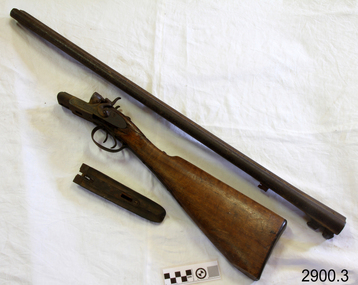
Weapon - Shotgun, Early 20th Century
... Philip Webley was recorded in the 1851 census as a 38-year-old gun and pistol implement manufacturer living at 84 Weaman Street with his wife Caroline they had four sons and one daughter Thomas William, Emma, and Philip Jnr, and two other sons, James, and Henry and Philip's cousin, also lived with the family probably as a nurse, Sarah Haywood. ...Philip Webley was recorded in the 1851 census as a 38-year-old gun and pistol implement manufacturer living at 84 Weaman Street with his wife Caroline they had four sons and one daughter Thomas William, Emma, and Philip Jnr, and two other sons, James, and Henry and Philip's cousin, also lived with the family probably as a nurse, Sarah Haywood. ...Philip Webley was born in 1813, he was the younger brother of James Webley who was born in 1807. Both were born in Birmingham. Towards the end of the 1800s, the firm claimed establishment in 1790, this must have been the date James and Philip's father or grandfather originally established a bullet or gun implement making business. It was not, as is often stated, the date William Davis established his business. Philip Webley was apprenticed in 1827 to Benjamin Watson. James Webley also seems to have been apprenticed but to who is not known. In 1834 James and Philip established their partnership as percussioners, lock filers and gun makers at 7 Weaman Street,Birmingham which was William Davis' old premises Davis, a gun implement maker, mould and toolmaker, died in 1831 and his wife Sarah inherited the business at 84 Weaman Street which she ran with her daughter, Caroline. On 5 January 1838 Philip Webley married Caroline. Philip was recorded at 84 Weaman Street from 1838 as a gun percussioner, lock filer and gun maker and this is when the partnership was last recorded, but the brothers apparently continued to co-operate until 1845 when Philip reportedly sold his interest to James and used the money to purchase Sarah Davis' business. Even then, they worked together particularly about the design and manufacture of percussion revolvers. Philip Webley was recorded in the 1851 census as a 38-year-old gun and pistol implement manufacturer living at 84 Weaman Street with his wife Caroline they had four sons and one daughter Thomas William, Emma, and Philip Jnr, and two other sons, James, and Henry and Philip's cousin, also lived with the family probably as a nurse, Sarah Haywood. On 4 February 1853 Philip Webley registered patent No. 335 for a hinged revolver and on 14 September 1853 he registered patent No. 2127 for improvement for the first muzzle-loading percussion cap and ball revolver which became known as the "Longspur". In 1859 Philips son Thomas William, aged 21, was made a partner in the firm, which then changed its name to P Webley & Son and described itself as "Gun and Pistol Makers and Patent Revolving Pistol Makers", probably exploiting Philip Webley's patent No. 305 of February 1853 for a revolver frame and lock, and its improvement under patent No. 2127 of September 1853. Thomas later went on to managed the shotgun side of the business. From about 1863 up to the First World War, the firm made rook rifles for Holland & Holland. From the 1890s they supplied magazine rifles. In 1863 and 1864 the firm's address was given as 83-84 Weaman Street, but from late 1864 to 1875 their address was 84 Weaman Street. By 1874 the firm had a showroom in London at an unknown address. In 1875 the firm expanded into 82-84 and 88-89 Weaman Street. The shotgun is not in very good condition is unusable as a firearm and is not very significant historically or valuable, although made by a well known and respected manufacturer of firearms there are many better examples of shotguns made by P Webley and Son in collections and for sale. This particular example is of a standard pattern for utilitarian use of which many were made. Pin fire double barrel cartridge loading shotgun, the stock is of varnished walnut, the shotgun is in a wooden box, box has hinged lid and dovetail joints. Raised inscription on butt has an image of "dog carrying a bird in his mouth" and another image of a "anchor and chain". Inscribed to both sides of the locks "P Webley and Son", Maker's mark and proof marks for black powder shotguns on undersides of both barrels. Proof marks used are for Birmingham. flagstaff hill, warrnambool, shipwrecked-coast, flagstaff-hill, flagstaff-hill-maritime-museum, maritime-museum, shipwreck-coast, flagstaff-hill-maritime-village, shotgun double barrel, double barrel, bird dog and bird, anchor and chain, webley & scott, pin fire, cartridge, philip webley -
 Flagstaff Hill Maritime Museum and Village
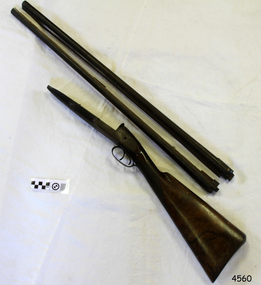
Weapon - Double Barrel Shotgun, Mid to late 19th Century
... Philip Webley was recorded in the 1851 census as a 38-year-old gun and pistol implement manufacturer living at 84 Weaman Street with his wife Caroline they had four sons and one daughter Thomas William, Emma, and Philip Jnr, and two other sons, James, and Henry and Philip's cousin, also lived with the family probably as a nurse, Sarah Haywood. ...Philip Webley was recorded in the 1851 census as a 38-year-old gun and pistol implement manufacturer living at 84 Weaman Street with his wife Caroline they had four sons and one daughter Thomas William, Emma, and Philip Jnr, and two other sons, James, and Henry and Philip's cousin, also lived with the family probably as a nurse, Sarah Haywood. ...Philip Webley was born in 1813, he was the younger brother of James Webley who was born in 1807. Both were born in Birmingham. Towards the end of the 1800s, the firm claimed establishment in 1790, this must have been the date James and Philip's father or grandfather originally established a bullet or gun implement making business. It was not, as is often stated, the date William Davis established his business. Philip Webley was apprenticed in 1827 to Benjamin Watson. James Webley also seems to have been apprenticed but to who is not known. In 1834 James and Philip established their partnership as percussioners, lock filers and gun makers at 7 Weaman Street,Birmingham which was William Davis' old premises Davis, a gun implement maker, mould and toolmaker, died in 1831 and his wife Sarah inherited the business at 84 Weaman Street which she ran with her daughter, Caroline. On 5 January 1838 Philip Webley married Caroline. Philip was recorded at 84 Weaman Street from 1838 as a gun percussioner, lock filer and gun maker and this is when the partnership was last recorded, but the brothers apparently continued to co-operate until 1845 when Philip reportedly sold his interest to James and used the money to purchase Sarah Davis' business. Even then, they worked together particularly about the design and manufacture of percussion revolvers. Philip Webley was recorded in the 1851 census as a 38-year-old gun and pistol implement manufacturer living at 84 Weaman Street with his wife Caroline they had four sons and one daughter Thomas William, Emma, and Philip Jnr, and two other sons, James, and Henry and Philip's cousin, also lived with the family probably as a nurse, Sarah Haywood. On 4 February 1853 Philip Webley registered patent No. 335 for a hinged revolver and on 14 September 1853 he registered patent No. 2127 for improvement for the first muzzle-loading percussion cap and ball revolver which became known as the "Longspur". In 1859 Philips son Thomas William, aged 21, was made a partner in the firm, which then changed its name to P Webley & Son and described itself as "Gun and Pistol Makers and Patent Revolving Pistol Makers", probably exploiting Philip Webley's patent No. 305 of February 1853 for a revolver frame and lock, and its improvement under patent No. 2127 of September 1853. Thomas later went on to managed the shotgun side of the business. From about 1863 up to the First World War, the firm made rook rifles for Holland & Holland. From the 1890s they supplied magazine rifles. In 1863 and 1864 the firm's address was given as 83-84 Weaman Street, but from late 1864 to 1875 their address was 84 Weaman Street. By 1874 the firm had a showroom in London at an unknown address. In 1875 the firm expanded into 82-84 and 88-89 Weaman Street. The item is an early muzzle loading sporting shotgun not in very good condition and is unusable as a firearm and not very significant historically or valuable, although made by a well known and respected manufacturer of firearms there are many better examples of shotguns made by P Webley and Son in collections and for sale. This particular example is of a standard pattern for utilitarian use of which many were made. Shotgun, black powder, muzzle Loading, double barrel, percussion cap. P Webley & Son maker on left and right lock and P Webley & Son James St London on top of barrel. Barrel split in two. Has 14 stamped under each barrel with Birmingham proof marks for black powder shotguns. on undersides of both barrels. Proof marks used are early metal parts have decorative engravings of a gun dog flushing a birdwarrnambool, shipwrecked-coast, flagstaff-hill, flagstaff-hill-maritime-museum, shipwreck-coast, flagstaff-hill-maritime-village, gun, shotgun, double-barrel shotgun, firearm, muzzel loading shotgun, philip webley, black powder, percussion cap, hunting weapon, birmingham gun manufactures, w & c scott & son -
 Flagstaff Hill Maritime Museum and Village
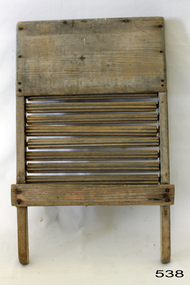
Domestic object - Washboard, 1900-1920s
... gun stocks. Throughout the 1920s, the Mother Hubbard Washboard factory was busy, but production ceased after 1935, once the electric washing machine became popular. An unusual washboard with horizontal fluted rollers, different to the patented Hubbard Brothers washboards with vertical fluted rollers. It makes the item rare and possibly made in Australia in the early 1900s. The washboard gives insight into how various companies tried to improve or get around other manufacturers ...This washboard with horizontal fulted rollers appears to be a variation on the patented Hubbard Roller Washboard system, which had rollers with vertical flutes. The rollers appear to be maple wood, which indicates an American manufacturer. The Mother Hubbard Roller Washboard was very popular in America in the early 1900s. The patented design, sold door-to-door, featured threaded maple rollers that rolled in opposite directions. It required only a light touch from the launderer, as the rollers did the work. It was awarded the Good Housekeeping Seal of Approval. The first roller washboard was made by the Hubbard brothers in Dover, Illinois, where they were born. As sales increased, they moved their large sawmill to Lamoille in 1904 for better shipping facilities. In 1916, they moved their sawmill to Mendota, Illinois. In addition to the washboards, the plant specialised in sawing walnut logs and forming them into roughs for gun stocks. Throughout the 1920s, the Mother Hubbard Washboard factory was busy, but production ceased after 1935, once the electric washing machine became popular. An unusual washboard with horizontal fluted rollers, different to the patented Hubbard Brothers washboards with vertical fluted rollers. It makes the item rare and possibly made in Australia in the early 1900s. The washboard gives insight into how various companies tried to improve or get around other manufacturers' patented designs. The washboard is also significant in the evolution of household laundry equipment designed to reduce labour. Washboard: a rectangular wooden frame with two legs enclosing horizontal, rotating rollers with flutes. flagstaff hill, flagstaff hill maritime museum and village, warrnambool, maritime museum, maritime village, great ocean road, shipwreck coast, washboard, laundry, clothes washing, clothes cleaning, washing, household item, washing equipment, laundering equipment, laundering, roller washboard, hubbard brothers, domestic laundry, mother hubbard washboard, rollers with horizontal flutes -
 Frankston RSL Sub Branch
Munition, Trench Art
... No. 1 Mark II Manufacturer VSM 3/11 Trench art vase made from a used artillery case (or cartridge) from a Quick Firing 18 Pounder field gun. ...Trench art vase made from a used artillery case (or cartridge) from a Quick Firing 18 Pounder field gun. This example is the No. 1 Mark ll type and was manufactured in March 1911. The QF 18 PDR was the main artillery armament of the British and Commonwealth forces during World War 1.No. 1 Mark II Manufacturer VSM 3/11 -
 Montmorency–Eltham RSL Sub Branch
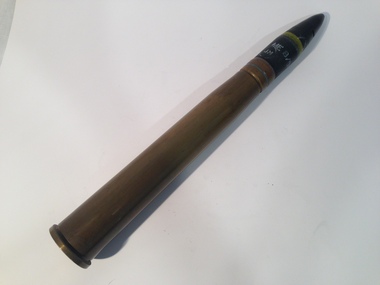
Weapon - 40mm L60 Bofors Anti-Aircraft Round
... The Bofors gun (which fired this round) was designed in the 1930s by AB Bofors, a Swedish arms manufacturer. ...The Bofors gun (which fired this round) was designed in the 1930s by AB Bofors, a Swedish arms manufacturer. ...The Bofors gun (which fired this round) was designed in the 1930s by AB Bofors, a Swedish arms manufacturer. It proved to be one of the most successful light anti-aircraft guns used during World War II. Apart from being used by most of the Allied forces, captured guns were used by the Germans and Japanese. The Bofors had a rate of fire between 80 - 100 rounds per minute when hand-loaded via 4-round clips. Effective maximum range was approx. 3,800m. On land, the guns were mounted singly on numerous types of chassis whilst Naval guns were either single or dual mountings. A few countries still use the Bofors Gun to this day.Brass case with iron/steel projectile -
 Flagstaff Hill Maritime Museum and Village
Container - Medical container, Late 19th century or early 20th century
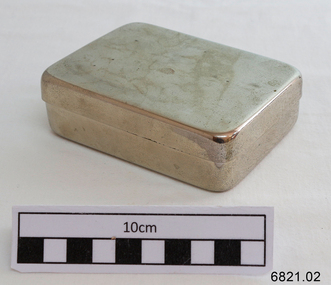
... In 1912 Brearley was given a task by a small arms manufacturer who wished to prolong the life of their gun barrels which were eroding away too quickly. ...In 1912 Brearley was given a task by a small arms manufacturer who wished to prolong the life of their gun barrels which were eroding away too quickly. ...THE DISCOVERY OF STAINLESS STEEL Harry Brearley Since the dawn of man colonies have raced against each other to uncover new technologies, to be the first to stamp their names on a discovery, and although we’ve evolved over millions of years, the urge to be the first remains at the very core of our nature. This sense of passion and pride can lead some of the more unscrupulous humans to claim others discoveries as their own. Of course many breakthroughs are genuinely made in tandem, or are simultaneously occurring, but unless you can categorically prove that you were the pioneer of these incredible findings, then the other party involved will always dispute the fact. And so we come to stainless steel. The first point to note is that ‘inventor’ is a very ambiguous term. Is this the first person to think, to document, to patent, or to produce? The second point is that stainless steel wasn’t truly defined until 1911, so are we to cast aside those chromium-iron alloys that don’t quite meet the minimum requirement of 10.5% chromium? It seems like anyone and everyone has a different claim to being labelled the ‘inventor’ of stainless steel; from Britain, Germany, France, Poland, the U.S.A., and even Sweden. The cogs were set in motion by Englishmen Stoddart and Faraday circa 1820 and Frenchman Pierre Berthier in 1821. These scientists, among others, noted that iron-chromium alloys were more resistant to attack by certain acids, but tests were only carried out on low chromium content alloys. Attempts to produce higher chromium alloys failed primarily because of scientists not understanding the importance of low carbon content. In 1872 another pair of Englishmen, Woods and Clark, filed for patent of an acid and weather resistant iron alloy containing 30-35% chromium and 2% tungsten, effectively the first ever patent on what would now be considered a stainless steel. However, the real development came in 1875 when a Frenchman named Brustlein detailed the importance of low carbon content in successfully making stainless steel. Brustlein pointed out that in order to create an alloy with a high percentage of chromium, the carbon content must remain below around 0.15%. Thus ensued two decades of stagnation for the development of stainless steel, and while many scientists attempted to create a low carbon stainless steel, none succeeded. Hans Goldschmidt It wasn’t until 1895, when Hans Goldschmidt of Germany developed the aluminothermic reduction process for producing carbon-free chromium, that development of stainless steels became a reality. In 1904 French Scientist Leon Guillet undertook extensive research on many iron-chromium alloys. Guillet’s work included studies on the composition of what would now be known as 410, 420, 442, 446 and 440-C. In 1906 Guillet went on to analyse iron-nickel-chrome alloys, which would now be considered the basics of the 300 series. However, while noting the chemical composition of his alloys, Guillet failed to acknowledge the potential corrosion resistance of his materials. Albert Portevin In 1909 Englishman Giesen published an in-depth work regarding chromium-nickel steels, while the French national, Portevin, studied what is now regarded as 430 stainless steel. However, it wasn’t until 1911 that the importance of a minimum chromium content was discovered by Germans P. Monnartz and W. Borchers. Monnartz and Borchers discovered the correlation between chromium content and corrosion resistance, stating that there was a significant boost in corrosion resistance when at least 10.5% chromium was present. The pair also published detailed works on the effects of molybdenum on corrosion resistance. It is at this point we introduce Harry Brearley, born in Sheffield, England in 1871, he was appointed lead researcher at Brown Firth Laboratories in 1908. In 1912 Brearley was given a task by a small arms manufacturer who wished to prolong the life of their gun barrels which were eroding away too quickly. Brearley set out to create an erosion resistant steel, not a corrosion resistant one, and began experimenting with steel alloys containing chromium. During these experiments Brearley made several variations of his alloys, ranging from 6% to 15% chromium with differing levels of carbon. On the 13th August 1913 Brearley created a steel with 12.8% chromium and 0.24% carbon, argued to be the first ever stainless steel. The circumstances in which Brearley discovered stainless steel are covered in myth; some enchanted tales of Brearley recite him tossing his steel into the rubbish, only to notice later that the steel hadn’t rusted to the extent of its counterparts, much like Alexander Fleming’s experience 15 years later. Other more plausible, (but less attractive), accounts claim it was necessary for Brearley to etch his steels with nitric acid and examine them under a microscope in order to analyse their potential resistance to chemical attack. Brearley found that his new steel resisted these chemical attacks and proceeded to test the sample with other agents, including lemon juice and vinegar. Brearley was astounded to find that his alloys were still highly resistant, and immediately recognised the potential for his steel within the cutlery industry. The Half Moon Brearley struggled to win the support of his employers, instead choosing to produce his new steel at local cutler R. F. Mosley. He found difficulty producing knife blades in the new steel that did not rust or stain and turned to his old school friend, Ernest Stuart, Cutlery Manager at Mosley’s Portland Works, for help. Within 3 weeks, Stuart had perfected the hardening process for knives. Brearley had initially decided to name his invention ‘Rustless Steel’, but Stuart, dubbed it ‘Stainless Steel’ after testing the material in a vinegar solution, and the name stuck. And that’s how Harry Brearley discovered stainless steel…. well, not quite… During the 5 year period between 1908 and Brearley’s discovery in 1913 many other scientists and metallurgists have potential claims to Brearley’s title. In 1908 the Germans entered the fray, the Krupp Iron Works in Germany produced a chrome-nickel steel for the hull of the Germania yacht. The Half Moon, as the yacht is now known, has a rich history and currently lies on the seabed off the east coast of Florida. Whether the steel contains the minimum 10.5% chromium content remains inconclusive. Employees of the Krupp works, Eduard Maurer and Benno Strauss, also worked from 1912-1914 on developing austenitic steels using <1% carbon, <20% nickel and 15-40% chromium. Not happy with Europe hogging the glory, the USA got in on the act. Firstly, Elwood Haynes, after becoming disenchanted at his rusty razor, set out to create a corrosion resistant steel, which he supposedly succeeded in doing during 1911. Two other Americans, Becket and Dantsizen, worked on ferritic stainless steels, containing 14-16% chromium and 0.07-0.15% carbon, in the years 1911-1914. Elwood Haynes During 1912 Max Mauermann of Poland is rumoured to have created the first stainless steel, which he later presented to the public during the Adria exhibition in Vienna, 1913. Finally, a recently discovered article, which was published in a Swedish hunting and fishing magazine in 1913, discusses a steel used for gun barrels, (sound familiar?), which seems to resemble stainless steel. Although this is purely speculation, the Swedes have still made an audacious claim that they were in fact responsible for the first practical application for stainless steel. That concludes the shambolic discovery of stainless steel! Although there is much mystery and speculation behind the discovery of this wonderful material, there is no question that without the combined effort of all the above scientists and metallurgists, (and all the many more that were not mentioned), we would not have such a rich and versatile metal at our fingertips. https://bssa.org.uk/bssa_articles/the-discovery-of-stainless-steel/#:~:text=On%20the%2013th%20August%201913,the%20first%20ever%20stainless%20steel. This stainless steel container was donated to Flagstaff Hill Maritime Village by the family of Doctor William Roy Angus, Surgeon and Oculist. It is part of the “W.R. Angus Collection” that includes historical medical equipment, surgical instruments and material once belonging to Dr Edward Ryan and Dr Thomas Francis Ryan, (both of Nhill, Victoria) as well as Dr Angus’ own belongings. The Collection’s history spans the medical practices of the two Doctors Ryan, from 1885-1926 plus that of Dr Angus, up until 1969. ABOUT THE “W.R.ANGUS COLLECTION” Doctor William Roy Angus M.B., B.S., Adel., 1923, F.R.C.S. Edin.,1928 (also known as Dr Roy Angus) was born in Murrumbeena, Victoria in 1901 and lived until 1970. He qualified as a doctor in 1923 at University of Adelaide, was Resident Medical Officer at the Royal Adelaide Hospital in 1924 and for a period was house surgeon to Sir (then Mr.) Henry Simpson Newland. Dr Angus was briefly an Assistant to Dr Riddell of Kapunda, then commenced private practice at Curramulka, Yorke Peninsula, SA, where he was physician, surgeon and chemist. In 1926, he was appointed as new Medical Assistant to Dr Thomas Francis Ryan (T.F. Ryan, or Tom), in Nhill, Victoria, where his experiences included radiology and pharmacy. In 1927 he was Acting House Surgeon in Dr Tom Ryan’s absence. Dr Angus had become engaged to Gladys Forsyth and they decided he would take time to further his studies overseas in the UK in 1927. He studied at London University College Hospital and at Edinburgh Royal Infirmary and in 1928, was awarded FRCS (Fellow from the Royal College of Surgeons), Edinburgh. He worked his passage back to Australia as a Ship’s Surgeon on the on the Australian Commonwealth Line’s T.S.S. Largs Bay. Dr Angus married Gladys in 1929, in Ballarat. (They went on to have one son (Graham 1932, born in SA) and two daughters (Helen (died 12/07/1996) and Berenice (Berry), both born at Mira, Nhill ) Dr Angus was a ‘flying doctor’ for the A.I.M. (Australian Inland Ministry) Aerial Medical Service in 1928 . The organisation began in South Australia through the Presbyterian Church in that year, with its first station being in the remote town of Oodnadatta, where Dr Angus was stationed. He was locum tenens there on North-South Railway at 21 Mile Camp. He took up this ‘flying doctor’ position in response to a call from Dr John Flynn; the organisation was later known as the Flying Doctor Service, then the Royal Flying Doctor Service. A lot of his work during this time involved dental surgery also. Between 1928-1932 he was surgeon at the Curramulka Hospital, Yorke Peninsula, South Australia. In 1933 Dr Angus returned to Nhill where he’d previously worked as Medical Assistant and purchased a share of the Nelson Street practice and Mira hospital from Dr Les Middleton one of the Middleton Brothers, the current owners of what was once Dr Tom Ryan’s practice. Dr L Middleton was House Surgeon to the Nhill Hospital 1926-1933, when he resigned. [Dr Tom Ryan’s practice had originally belonged to his older brother Dr Edward Ryan, who came to Nhill in 1885. Dr Edward saw patients at his rooms, firstly in Victoria Street and in 1886 in Nelson Street, until 1901. The Nelson Street practice also had a 2 bed ward, called Mira Private Hospital ). Dr Edward Ryan was House Surgeon at the Nhill Hospital 1884-1902 . He also had occasions where he successfully performed veterinary surgery for the local farmers too. Dr Tom Ryan then purchased the practice from his brother in 1901. Both Dr Edward and Dr Tom Ryan work as surgeons included eye surgery. Dr Tom Ryan performed many of his operations in the Mira private hospital on his premises. He too was House Surgeon at the Nhill Hospital 1902-1926. Dr Tom Ryan had one of the only two pieces of radiology equipment in Victoria during his practicing years – The Royal Melbourne Hospital had the other one. Over the years Dr Tom Ryan gradually set up what was effectively a training school for country general-practitioner-surgeons. Each patient was carefully examined, including using the X-ray machine, and any surgery was discussed and planned with Dr Ryan’s assistants several days in advance. Dr Angus gained experience in using the X-ray machine there during his time as assistant to Dr Ryan. Dr Tom Ryan moved from Nhill in 1926. He became a Fellow of the Royal Australasian College of Surgeons in 1927, soon after its formation, a rare accolade for a doctor outside any of the major cities. He remained a bachelor and died suddenly on 7th Dec 1955, aged 91, at his home in Ararat. Scholarships and prizes are still awarded to medical students in the honour of Dr T.F. Ryan and his father, Dr Michael Ryan, and brother, John Patrick Ryan. ] When Dr Angus bought into the Nelson Street premises in Nhill he was also appointed as the Nhill Hospital’s Honorary House Surgeon 1933-1938. His practitioner’s plate from his Nhill surgery states “HOURS Daily, except Tuesdays, Fridays and Saturday afternoons, 9-10am, 2-4pm, 7-8pm. Sundays by appointment”. This plate is now mounted on the doorway to the Port Medical Office at Flagstaff Hill Maritime Village, Warrnambool. Dr Edward Ryan and Dr Tom Ryan had an extensive collection of historical medical equipment and materials spanning 1884-1926 and when Dr Angus took up practice in their old premises he obtained this collection, a large part of which is now on display at the Port Medical Office at Flagstaff Hill Maritime Village in Warrnambool. During his time in Nhill Dr Angus was involved in the merging of the Mira Hospital and Nhill Public Hospital into one public hospital and the property titles passed on to Nhill Hospital in 1939. In 1939 Dr Angus and his family moved to Warrnambool where he purchased “Birchwood,” the 1852 home and medical practice of Dr John Hunter Henderson, at 214 Koroit Street. (This property was sold in1965 to the State Government and is now the site of the Warrnambool Police Station. ). The Angus family was able to afford gardeners, cooks and maids; their home was a popular place for visiting dignitaries to stay whilst visiting Warrnambool. Dr Angus had his own silk worm farm at home in a Mulberry tree. His young daughter used his centrifuge for spinning the silk. Dr Angus was appointed on a part-time basis as Port Medical Officer (Health Officer) in Warrnambool and held this position until the 1940’s when the government no longer required the service of a Port Medical Officer in Warrnambool; he was thus Warrnambool’s last serving Port Medical Officer. (The duties of a Port Medical Officer were outlined by the Colonial Secretary on 21st June, 1839 under the terms of the Quarantine Act. Masters of immigrant ships arriving in port reported incidents of diseases, illness and death and the Port Medical Officer made a decision on whether the ship required Quarantine and for how long, in this way preventing contagious illness from spreading from new immigrants to the residents already in the colony.) Dr Angus was a member of the Australian Medical Association, for 35 years and surgeon at the Warrnambool Base Hospital 1939-1942, He served as a Surgeon Captain during WWII1942-45, in Ballarat, Victoria, and in Bonegilla, N.S.W., completing his service just before the end of the war due to suffering from a heart attack. During his convalescence he carved an intricate and ‘most artistic’ chess set from the material that dentures were made from. He then studied ophthalmology at the Royal Melbourne Eye and Ear Hospital and created cosmetically superior artificial eyes by pioneering using the intrascleral cartilage. Angus received accolades from the Ophthalmological Society of Australasia for this work. He returned to Warrnambool to commence practice as an ophthalmologist, pioneering in artificial eye improvements. He was Honorary Consultant Ophthalmologist to Warrnambool Base Hospital for 31 years. He made monthly visits to Portland as a visiting surgeon, to perform eye surgery. He represented the Victorian South-West subdivision of the Australian Medical Association as its secretary between 1949 and 1956 and as chairman from 1956 to 1958. In 1968 Dr Angus was elected member of Spain’s Barraquer Institute of Barcelona after his research work in Intrasclearal cartilage grafting, becoming one of the few Australian ophthalmologists to receive this honour, and in the following year presented his final paper on Living Intrasclearal Cartilage Implants at the Inaugural Meeting of the Australian College of Ophthalmologists in Melbourne In his personal life Dr Angus was a Presbyterian and treated Sunday as a Sabbath, a day of rest. He would visit 3 or 4 country patients on a Sunday, taking his children along ‘for the ride’ and to visit with him. Sunday evenings he would play the pianola and sing Scottish songs to his family. One of Dr Angus’ patients was Margaret MacKenzie, author of a book on local shipwrecks that she’d seen as an eye witness from the late 1880’s in Peterborough, Victoria. In the early 1950’s Dr Angus, painted a picture of a shipwreck for the cover jacket of Margaret’s book, Shipwrecks and More Shipwrecks. She was blind in later life and her daughter wrote the actual book for her. Dr Angus and his wife Gladys were very involved in Warrnambool’s society with a strong interest in civic affairs. Their interests included organisations such as Red Cross, Rostrum, Warrnambool and District Historical Society (founding members), Wine and Food Society, Steering Committee for Tertiary Education in Warrnambool, Local National Trust, Good Neighbour Council, Housing Commission Advisory Board, United Services Institute, Legion of Ex-Servicemen, Olympic Pool Committee, Food for Britain Organisation, Warrnambool Hospital, Anti-Cancer Council, Boys’ Club, Charitable Council, National Fitness Council and Air Raid Precautions Group. He was also a member of the Steam Preservation Society and derived much pleasure from a steam traction engine on his farm. He had an interest in people and the community He and his wife Gladys were both involved in the creation of Flagstaff Hill, including the layout of the gardens. After his death (28th March 1970) his family requested his practitioner’s plate, medical instruments and some personal belongings be displayed in the Port Medical Office surgery at Flagstaff Hill Maritime Village, and be called the “W. R. Angus Collection”. The W.R. Angus Collection is significant for still being located at the site it is connected with, Doctor Angus being the last Port Medical Officer in Warrnambool. The collection of medical instruments and other equipment is culturally significant, being an historical example of medicine from late 19th to mid-20th century. Dr Angus assisted Dr Tom Ryan, a pioneer in the use of X-rays and in ocular surgery. Medical box; rectangular stainless steel base and separate lid, from the W.R. Angus Collection.warrnambool, flagstaff hill maritime museum, great ocean road, dr w r angus, dr ryan, surgical instrument, t.s.s. largs bay, warrnambool base hospital, nhill base hospital, mira hospital, flying doctor, medical treatment, stainless steel medical container, medical container, stainless steel -
 Flagstaff Hill Maritime Museum and Village
Weapon - Pistol, 1873-1884
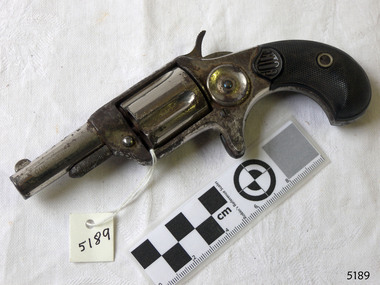
... manufacturers moved away from percussion muzzle-loading firearms to those that would accept cartridges. That incorporated the bullet, propellant and primer all within a brass cylinder allowing the projectile to be loaded directly into a pistols cylinder, or a rifle magazine. flagstaff hill warrnambool shipwrecked-coast flagstaff-hill flagstaff-hill-maritime-museum maritime-museum shipwreck-coast flagstaff-hill-maritime-village revolver colt colt new line revolver cartridge casing cartridge new line revolver pistol matalic cartridge firearm rollin white New Line hand gun single shot Inscriptions on side of barrel and top "No 18842", "Colt New .32" . ...Rollin White was an American gunsmith who invented a single shot bored-through revolver cylinder that allowed paper cartridges to be loaded from the rear of a revolver's cylinder. Wen his patent expired the Colt's Patent Fire Arms Manufacturing Company started working on its own metallic cartridge revolvers. Thus, after having introduced its first rear-loading pistols in 1871 the (Colt House/Cloverleaf revolver) and the 1872 (Colt Open Top revolver), in 1873 Colt launched the Colt Peacemaker along with a new line of pocket revolvers, sorted in five different calibers (.22, .30, .32, .38, .41 cal). Since it was an entirely new line of revolvers this model was called the Colt New Line. Circa 1884-1886 (the .32 cal was only made during 1873-1884). Submerged by the company's competitors' cheaper imitations and refusing to introduce a lower quality among its own firearms to match its competitors, the Colt company dropped the line and ceased production.The Colt New Line was one of the first metallic cartridge rear-loading revolvers manufactured by Colt. It demonstrates the evolution of firearm production and development of firearms as manufacturers moved away from percussion muzzle-loading firearms to those that would accept cartridges. That incorporated the bullet, propellant and primer all within a brass cylinder allowing the projectile to be loaded directly into a pistols cylinder, or a rifle magazine. Pistol or handgun, Colt New Line revolver, single action five shot spur trigger. The rimfire revolver is .32 calibre. It has a black handle. There maker's name is impressed into the textured handle and the name and model is impressed onto the barrel. Made by Colt.Inscriptions on side of barrel and top "No 18842", "Colt New .32" . On top "Colt's FT.F.AMFG.CC Hartford.Ct.USA"flagstaff hill, warrnambool, shipwrecked-coast, flagstaff-hill, flagstaff-hill-maritime-museum, maritime-museum, shipwreck-coast, flagstaff-hill-maritime-village, revolver, colt, colt new line revolver, cartridge casing, cartridge, new line revolver, pistol, matalic cartridge, firearm, rollin white, new line, hand gun, single shot -
 Bendigo Military Museum
Book - GERMAN WEAPONS, Heckler & Koch, HECKLER & KOCH GMBH
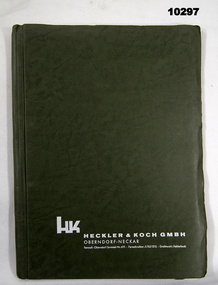
... Manufacturer. This book appears to be of a marketing nature during German Membership of NATO in the 1960's. Part of the William (Bill) Thomason Collection. Refer Cat No. 4136P. Collection of William (Bill) Thomason Book German Weapons On front inscribed "HK HECKLER & KOCH GMBH". Green folder containing pictures, descriptions and specifications of various Heckler & Koch (HK) Weapon Systems. Covering their range of rifles and machine guns ...HK is a major German Arms Manufacturer. This book appears to be of a marketing nature during German Membership of NATO in the 1960's. Part of the William (Bill) Thomason Collection. Refer Cat No. 4136P.Green folder containing pictures, descriptions and specifications of various Heckler & Koch (HK) Weapon Systems. Covering their range of rifles and machine guns which includes detailed pictures of parts of each weapon and are relating to post WW2 period during NATO. Folder is bound and stapled with writing on front in white. Some inside pages are folded over.On front inscribed "HK HECKLER & KOCH GMBH".collection of william (bill) thomason, book, german weapons -
 Waverley RSL Sub Branch
Shell 40 Cal
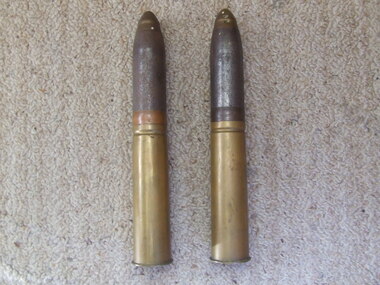
... The Bofors 40 mm gun, often referred to simply as the Bofors gun, is an anti-aircraft/multi-purpose autocannon designed in the 1930s by the Swedish arms manufacturer AB Bofors. ...The Bofors 40 mm gun, often referred to simply as the Bofors gun, is an anti-aircraft/multi-purpose autocannon designed in the 1930s by the Swedish arms manufacturer AB Bofors. ...The Bofors 40 mm gun, often referred to simply as the Bofors gun, is an anti-aircraft/multi-purpose autocannon designed in the 1930s by the Swedish arms manufacturer AB Bofors. It was one of the most popular medium-weight anti-aircraft systems during World War II, used by most of the western Allies as well as by the Axis powers. The shells were manufactured according to a British design after it was discovered that the Swedish shells had much too sensitive a contact fuse, "which functioned on impact with rain drops". Although the shells could nominally reach out to 11,000 yards (10,000 meters), almost all the shells manufactured had self-destroying tracers that detonated the rounds at a range of 4000-5000 yards (3700-4600 meters.) This helped prevent friendly fire incidents or other collateral damage. In addition to the TNT bursting charge, the shell contained a pellet of powdered magnesium and aluminum as an incendiary. Production of ammunition peaked at 12 million rounds per month in the winter of 1944. Ammunition type Contact fused HE/incendiary fixed shell. AP shells were also available. Projectile weight 1.985 lb 0.80 kg Velocity 2890 feet/s 881 m/s Maximum elevation 90 degrees Range 11,000 yards 10,000 meters Altitude 22,800 feet 6950 meters Rate of fire 120 rounds per minuteCollected by Norman Hall D.J Hall 17455 RAN2 shells (complete) for a Bofors 40mm Anti Aircraft Gun used by the R.A.N.See Imagesbofors 40 mm, anti aircraft gun, shell, r.a.n. bofors gun, world war ii, wwii, norman hall -
 Kiewa Valley Historical Society
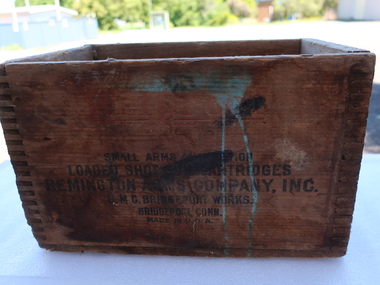
Ammunition Box - Remington America
... Manufacturer of fire arms and ammunition. Founded in 1816. It was one of the oldest gun makers in the US. ...Manufacturer of fire arms and ammunition. Founded in 1816. It was one of the oldest gun makers in the US. ...Manufacturer of fire arms and ammunition. Founded in 1816. It was one of the oldest gun makers in the US. Used by hunters, farmers and recreational shooters in the Kiewa Valley.Wooden cubic shaped box with black print on each side including the makers name, Remington Arms Co. Inc. of Bridgeport, Conn., USAIn black print on each side. Varying quality of legible words.remington arms, ammunition box, hunters -
 4th/19th Prince of Wales's Light Horse Regiment Unit History Room
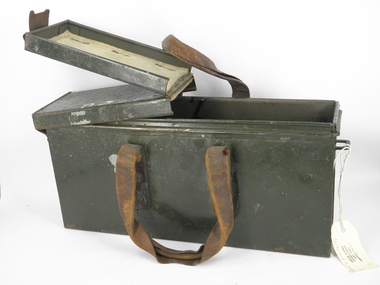
Ammunition Box, 1944
... gun. This object probably held belted ammunition. ammunition box Manufacturer's stamp at each end.: " R P L" over "S" over "1944" On one end in white paint "2" On top in white paint : "W.C.C.U" - and "2" Sheet metal ammunition box, probably for .303 inch belted ammunition. ...Box is marked "W.C.C.U" - perhaps Wesley College Cadet Unit. In earlier times, school cadet units were allowed to learn safe handling of weapons including the Vickers machine gun. This object probably held belted ammunition.Sheet metal ammunition box, probably for .303 inch belted ammunition. Double hinged lid, Leather handles. Painted green Manufacturer's stamp at each end.: " R P L" over "S" over "1944" On one end in white paint "2" On top in white paint : "W.C.C.U" - and "2" ammunition box -
 National Vietnam Veterans Museum (NVVM)
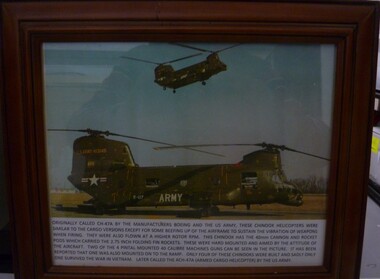
Photograph - A Framed Coloured Photograph of CH 47A Chinook Helicopters, CH 47A Chinook Helicopter
... manufacturers Boeing and the US Army, these Chinook helicopters were similar to the cargo version except for some beefing up of the airframe to sustain the vibration of weapons when firing. There were also flown at a higher rotor RPM. This Chinook has the 40mm cannon and rocket pods which carried the 2.75 inch folding rockets. These were hard mounted and aimed by the attitude of the aircraft. Two of the 4 pintal mounted 40 calibre machine guns...manufacturers Boeing and the US Army, these Chinook helicopters were similar to the cargo version except for some beefing up of the airframe to sustain the vibration of weapons when firing. There were also flown at a higher rotor RPM. This Chinook has the 40mm cannon and rocket pods which carried the 2.75 inch folding rockets. These were hard mounted and aimed by the attitude of the aircraft. Two of the 4 pintal mounted 40 calibre machine guns ...This item was donated by Pte Edwin Stanley Tricker (3797633) who was a National Serviceman with the Royal Australian Infantry Corps. He served in Vietnam with 1 Australian Reinforcement Unit from May 1970 to June 1970 and Headquarters, 1st Australian Task Force from June 1970 to August 1971. Originally called CH-47A by the manufacturers Boeing and the US Army, these Chinook helicopters were similar to the cargo version except for some beefing up of the airframe to sustain the vibration of weapons when firing. There were also flown at a higher rotor RPM. This Chinook has the 40mm cannon and rocket pods which carried the 2.75 inch folding rockets. These were hard mounted and aimed by the attitude of the aircraft. Two of the 4 pintal mounted 40 calibre machine guns can be seen in the picture. It has been reported that one was also mounted on the ramp. Only four of these chinooks were built and sadly only one survived the war in Vietnam. Later called the ACH-47A (Armed Caro Helicopter) by the US Army.Framed coloured photograph of two CH471 helicopters. One helicopter is parked on the ground. The other one is airborne. Description of the CH47A is written below the photo.U.S. Army logo, Army. tail number "US Army 413145". B.117.ch47a, chinook, united states army, helicopter - chinook, pte edwin stanley tricker, 3797633, australian national serviceman, royal australian infantry corps, 1 australian reinforcement unit, headquarters, 1st australian task force -
 Wangaratta RSL Sub Branch
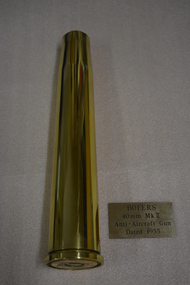
Memorabilia - Brass Shell Casing
... The Bofors 40 mm gun, often referred to simply as the Bofors gun, is an anti-aircraft autocannon designed in the 1930s by the Swedish arms manufacturer AB Bofors. ...The Bofors 40 mm gun, often referred to simply as the Bofors gun, is an anti-aircraft autocannon designed in the 1930s by the Swedish arms manufacturer AB Bofors. ...The Bofors 40 mm gun, often referred to simply as the Bofors gun, is an anti-aircraft autocannon designed in the 1930s by the Swedish arms manufacturer AB Bofors. It was one of the most popular medium-weight anti-aircraft systems during World War II, used by most of the western Allies as well as some captured systems being used by the Axis powers. A small number of these weapons remain in service to this day, and saw action as late as the Persian Gulf War.Brass shell casing 40 mm. and gold coloured plaque with black writing.40mm. MK4. LOT 428 MF A^N 1955. Plaque: Bofers 40mm Mk II Anti-Aircraft Gun Dated 1955.anti-aircraft gun, shell casing, brass, wwii, world war 2, bofers -
 Surrey Hills Historical Society Collection
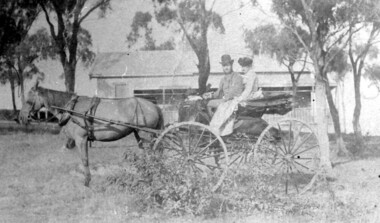
Photograph, 'Hillsboro' or "Hillsborough' - 6a Thistle Street, Surrey Hills, pre-1890
... Chandler, a window blind manufacturer, in response to an ‘insulting note’ left at Sweetnam’s house. Sweetnam was fined two guineas and 31 shillings. Sweetnam was also President of the Camberwell Gun Club from around 1890 – 91. ...Chandler, a window blind manufacturer, in response to an ‘insulting note’ left at Sweetnam’s house. Sweetnam was fined two guineas and 31 shillings. Sweetnam was also President of the Camberwell Gun Club from around 1890 – 91. ...The photo was found behind a mantelpiece in the house at 6A Thistle Street while it was being renovated. It is thought to be of the first owner, Mrs Rachel Sweetnam (nee Lewis) and her husband, Thomas Edward Sweetnam. They were married on 24 September 1884 at St John's Church, Camberwell. REF: THE ARGUS 4 Oct 1884 Thomas second eldest surviving son of Matthew Sweetnam married to Rachel (Ray) third eldest daughter of Captain T.D. Lewis, Culm Haven, Camberwell. Thomas was active in land sales and variously described as a land agent, real estate agent and auctioneer. The property - Hillsboro or Hillsborough - was originally a house on a farm of 10 acres owned by her. It became 6A Thistle Street. According to the Alan Holt property register Rachel Sweetnam owned the property prior to 1890 and a family tree on Ancestry.com has that it was owned by her in c1886. It is likely that it was an investment rather than a family residence. Thomas Sweetnam was President of the Boroondara Shire 1888/89 and a councillor from 1886-1891. During his time as Shire councillor in 1887 he was charged with assaulting Charles A. Chandler, a window blind manufacturer, in response to an ‘insulting note’ left at Sweetnam’s house. Sweetnam was fined two guineas and 31 shillings. Sweetnam was also President of the Camberwell Gun Club from around 1890 – 91. In 1893 he relocated to Ferntree Gully, where he contested for the municipality’s North Riding council seat. Multiple references can be found on Trove. Note that the gentleman in this photo does bear a resemblance to Thomas Sweetman, President of Boroondara Shire in 1888-1889 found in the City of Boroondara Library Service mayoral portrait collection. No known photo of Rachel Sweetnam. Other property owners or residents are: 1890 Selina Gaylor 1900 Stephen Pullen 1910 William Murray (draftsman) 1920 George C Hughes 1930 Arthur Leslie Austin (tram driver) 1980 Mrs Lillian Evelyn Austin Sold in 1983 for $87,000. The house is still extant (January 2025). Note that we also have material / photos regarding George Hughes and family.This photo is one of the earliest photos of residences of Surrey Hills.Black and white photo of a woman and man in a buggy behind which is a simple house with a verandah at one end, surrounded by eucalypt trees.hillsboro, house names, thistle street, horse-drawn vehicle, clothing and dress, hillsborough, rachel sweetnam, rachel lewis, thomas sweetnam, selina gaylor, stephen pullen, william murray, george hughes, arthur austin, lillian austin -
 Tennis Australia
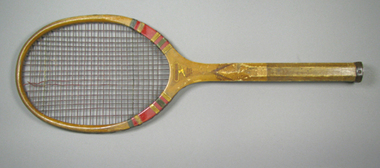
Racquet, Circa 1925
... Manufacturer name and slogan: 'AS GOOD AS THE GUN' printed as decal across throat on reverse. ...Manufacturer name and slogan: 'AS GOOD AS THE GUN' printed as decal across throat on reverse. ...A Winchester 'Precision' tennis racquet with composite concave throat. String whipping and plastic reinforcements around shoulders. Octagonal handle with leather end wrap. Model name imprinted as decal across throat on obverse. Manufacturer name and slogan: 'AS GOOD AS THE GUN' printed as decal across throat on reverse. Materials: Wood, Lacquer, Metal, Glue, Gut, Ink, String, Leather, Plastictennis
