
Showing 156 items matching "hand and machine stitching"
-
 National Wool Museum
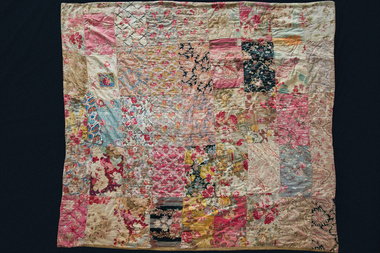
Quilt, Floral chintz quilt
... Quilt made from pink patchwork curtain cloth, machine stitched and patched at a later date by hand. ...Quilt made from pink patchwork curtain cloth, machine stitched and patched at a later date by hand....Quilt made from pink patchwork curtain cloth, machine stitched and patched at a later date by hand. ...Quilt made from pink patchwork curtain cloth, machine stitched and patched at a later date by hand. Part of the Wagga collection.Quilt made from pink patchwork curtain cloth, machine stitched and patched at a later date by hand.quilting history, patchwork history, running stitch group, running stitch collection, quilting - history, patchwork - history -
 Kiewa Valley Historical Society
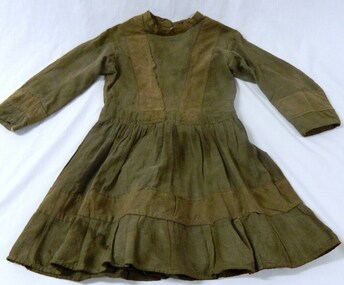
Dress, Hand made, c.1900
... It is hand and machine stitched. This style of dress would have been worn for special occasions, eg going to church or special outings....Home made, with manual machine stitches and some hand sewing. The dress has a high round neck and long sleeves. ...Home made, with manual machine stitches and some hand sewing. The dress has a high round neck and long sleeves. ...This dress is hand made possibly by a mother for her daughters. It is hand and machine stitched. This style of dress would have been worn for special occasions, eg going to church or special outings.This item is very significant for the following reasons. Historic and social - it shows what little girls wore during the early 1900's of the Kiewa Valley. It also shows fashion of the times and how these styles of dresses were made. All of which is valuable for research on these topics. There are only two of these dresses in the collection of the KVSH, and therefore would be very rare. The condition is good enough to display, therefore it has good interpretive capacity.Brown Cotton Dress. Top and sleeves are lined in calico. Home made, with manual machine stitches and some hand sewing. The dress has a high round neck and long sleeves. There is a band around the waist to which a gathered skirt it attached with hand stitching. Two different shades of brown are used on this dress. Back opens with 8 hooks. Water stains on dresschild, homemade, dress, girl, kiewa-valley -
 Bendigo Military Museum
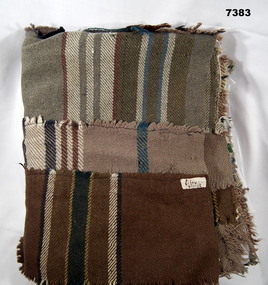
Textile - BLANKET, WOOL, WAGGA, Unknown
... Blanket - wool, machine stitched patches of brown toned wool blankets. ...Blanket - wool, machine stitched patches of brown toned wool blankets. ...Derych Victor Lawes VX22625 enlisted 30 May 1940, age 25 years 3 mths. Embarked 14 Sept 1940 for Middle East. Rose through the ranks to S/Sgt Weapons Instructor Palestine. Disembarked Aust 29.4.1942. From 19.1.1945 Acting WO1 at HQ Small Arms School Bonegilla. Discharged 18 Dec 1945. Blanket - wool, machine stitched patches of brown toned wool blankets. Yellow numbers have been stitched by hand (no reason given for the numbers.)White label - handwritten in biro on white tape ""D. LAWES 473092"on one corner. Yellow wool handstitched numbers in various positions on the blanket. "8926, 10830, 10752, 107, 6". craft, blanket, wagga blanket, d lawes -
 Bendigo Historical Society Inc.
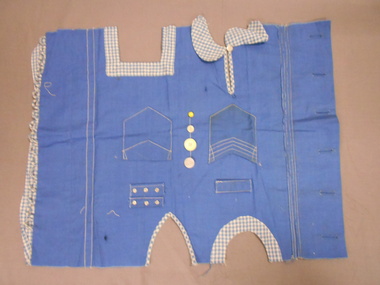
Textile - EMILY NANKIVELL COLLECTION: SCHOOL NEEDLEWORK SAMPLER, 1930's
... Seams: Plain flat seam, machine stitched-part neatened by hand, and part neatened by machine. ...Seams: Plain flat seam, machine stitched-part neatened by hand, and part neatened by machine. ...A school sampler from the 1930's, demonstrating a mastery of numerable sewing skills: Buttonholes- both bound;6 bound buttonholes. Button loop fastening 17 rouleau loops. Seams: Plain flat seam, machine stitched-part neatened by hand, and part neatened by machine. An overlapped flat seam-machine stitched. Fasteners: Press-studs (3) Buttons (4) shanked and f;flat. Metal hook-and-eyes (3), one eye hand stitched, all attached in buttonhole stitch. Pockets: (2) Machine stitched. Collar: (1) Rounded ''Peter Pan"" collar, with bound placket opening, one pearl button, and hand stitched loop. Facings (3). One square, one round, one Vshaped. Pintucks: 4 machine stitched pintucks.textiles, domestic, school needlework sampler 1930's -
 Kiewa Valley Historical Society
Apron, Hand Made, late 19th century to early 20th century
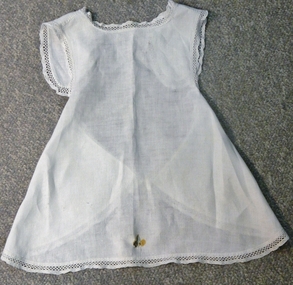
... It is hand and machine stitched. This style of aprons / pinafore is attached to the two brown dresses that are also in the collection. ...The apron is manual machine stitched Apron Hand Made ...This item is hand made possible by a mother for her daughters. It is hand and machine stitched. This style of aprons / pinafore is attached to the two brown dresses that are also in the collection. This item is very significant for the following reasons. Historic and social - it shows what little girls wore during the early 1900's of the Kiewa Valley. It also shows fashion of the times and how these styles of aprons were made. All which is valuable for research on these topics. There are only a few of these aprons in the collection of the KVSH, and therefore would be very rare. The condition is good enough to display, therefore it has good interpretive capacity.Girls apron or pinafore. White linen with crocheted lace around the edge which is continuous around the skirt, sleeve and neck. The shoulders flaps appears that they should be pinned to the dress beneath, and pinned together at the back of the waist. The apron is manual machine stitchedclothing, girls, children, pinafore, apron, kiewa-valley, alpine-shire -
 Embroiderers Guild, Victoria
Footwear - Ladakh India Childs Slippers
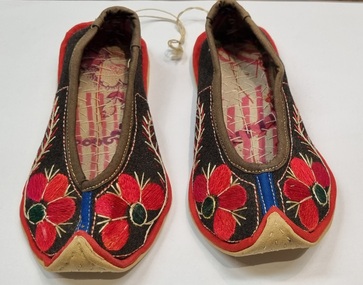
... Machine and hand stitched childs slippers. ...Flowers Baby shoes Machine and hand stitched childs slippers. Footwear Ladakh India Childs Slippers ...From Ladakh, Northern India, obtained by donor from a Nepalese Buddhist family in 1980's. Traditional Ladakhi children's slippers, known as Pabu, are wool-felted, often decorated with vibrant colors, and designed for warmth in cold climates.Machine and hand stitched childs slippers. flowers, baby shoes -
 Bendigo Historical Society Inc.
Clothing - MAGGIE BARBER COLLECTION: BLACK ELBOW LENGTH 'CHAMOIS' FEEL GLOVES
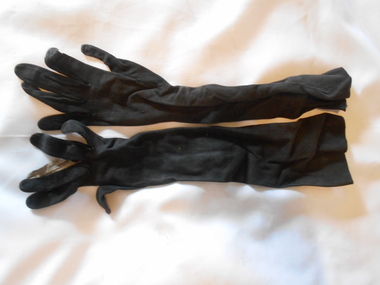
... Twelve rows of machine stitching on the back of the hand fan out to give a pintucked effect....Twelve rows of machine stitching on the back of the hand fan out to give a pintucked effect. ...Clothing. Black kid leather gloves, brushed to give a "chamois" feel. Twelve rows of machine stitching on the back of the hand fan out to give a pintucked effect.costume accessories, female, black elbow length kid leather gloves -
 Bendigo Historical Society Inc.
Clothing - MAGGIE BARBER COLLECTION: DARK CREAM SHORT/WRIST LENGTH LEATHER GLOVES, Early 1900's
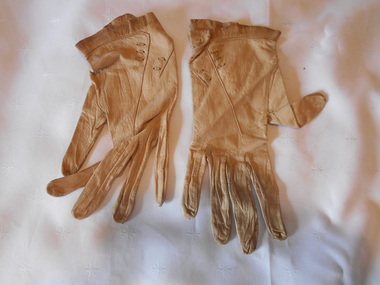
... Wrist length, dark cream, machine stitched leather gloves. Machine stitching-two rows, gives the effect of pin-tucks, are sewn in a diagonal direction from the outer wrist, across the back of the hand. ...Wrist length, dark cream, machine stitched leather gloves. Machine stitching-two rows, gives the effect of pin-tucks, are sewn in a diagonal direction from the outer wrist, across the back of the hand. ...Clothing. Wrist length, dark cream, machine stitched leather gloves. Machine stitching-two rows, gives the effect of pin-tucks, are sewn in a diagonal direction from the outer wrist, across the back of the hand. The shorter outer stitching, 4 cm long has two 6mm long leather stitches, at right angle to the machine stitching. The second diagonal stitching runs around the top of the glove, and 9.5 cms across the back of the hand. It is offset with three 6 mm stitches at right angles. There is a 3 cm long, bound slit at the outer side top of the gloves.costume accessories, female, dark cream wrist length leather gloves -
 Embroiderers Guild, Victoria
Domestic Object - 19 th C Black Satin Hostess Tea Apron, 19 th C
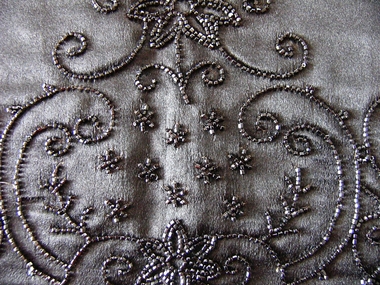
... Half apron with ties. Hand beaded, machine stitched construction...Half apron with ties. Hand beaded, machine stitched construction Domestic Object 19 th C Black Satin Hostess Tea Apron ...Part of a collection of pieces which belonged to the donor's grand parents.Black satin afternoon tea apron decorated with jet beads in a stylised pattern. Lined with black cotton satin. Half apron with ties. Hand beaded, machine stitched constructionbeadwork, beading, aprons, 1900-20 -
 Embroiderers Guild, Victoria
Artwork, other - Picture, Rhonda Johnston, 'Coconut Ice', 2019
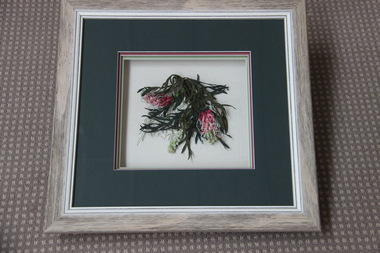
... Grevillea "Coconut Ice" wall art constructed as a 3D. Machine and hand sewn botanical art, framed. The dark leaves are machine stitched. ...Rhonda Johnston (Wangaratta branch) Machine Embroidery Grevillea "Coconut Ice" wall art constructed as a 3D. Machine and hand sewn botanical art, framed. The dark leaves are machine stitched. ...Rhonda Johnston (Wangaratta branch)Grevillea "Coconut Ice" wall art constructed as a 3D. Machine and hand sewn botanical art, framed. The dark leaves are machine stitched. The flowers are pink and green at different stages. machine embroidery -
 Flagstaff Hill Maritime Museum and Village
Textile - Pillowcase Pair
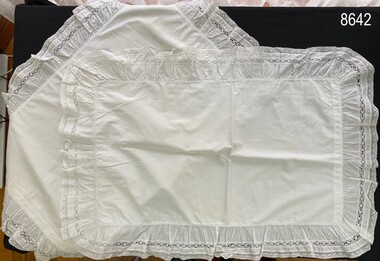
... A combination of material and hand crocheted lace forms the edging of each pillowcase....A combination of material and hand crocheted lace forms the edging of each pillowcase. ...An example of a pair of pillowcases from the early 1900s. The item is of significance socially as an example of decorative domestic objects in the early 1900s.Pair of pillowcases made from soft white cotton and machine stitched. Cotton ties are sewn into the back of each pillowcase. A combination of material and hand crocheted lace forms the edging of each pillowcase.flagstaff hill maritime museum and village, great ocean road, shipwreck coast, pillowcase, decorative lace edging, domestic object, pair of pillowcases, cotton, crochet lace, warrnambool, textile -
 Orbost & District Historical Society
christening robe, C 1900
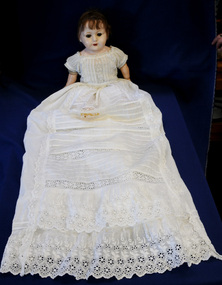
... A high waisted, short-sleeved long white broderie anglaise christening robe made of fine cotton. It is hand made edged with machine stitched cut work lace. ...This gown reflects the style of christening robes in the early 20th century. christening-robe clothing-childhood A high waisted, short-sleeved long white broderie anglaise christening robe made of fine cotton. It is hand made edged with machine stitched cut work lace. ...Christening gowns are traditional outfits made just for baby’s baptism. They are almost always white and can be very ornate, highly decorated garments. Usually, the christening gown is quite long – much longer than the baby being christened, particularly when it is worn by a young or very small baby. Many families keep a “family” christening gown that has been passed down through various family members and is used for the baptism ceremony. This christening robe was probably used by the Cameron family.The christening gown was a late 18th century innovation usually made of white lawn, muslin or net, longer than the baby and fancier than a day gown. The design was a more moderate version of contemporary adult fashion. Most 19th century christening gowns featured lace. All, until the end of the century, had low necklines and short sleeves. This gown reflects the style of christening robes in the early 20th century. A high waisted, short-sleeved long white broderie anglaise christening robe made of fine cotton. It is hand made edged with machine stitched cut work lace. The bodice is pin tucked.christening-robe clothing-childhood -
 Federation University Historical Collection
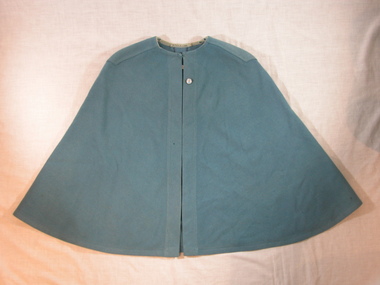
Costume, Ball & Welch Ltd, Nurses cape, 1) 1945-65?, .2) 1975-1988
... Around the neckline is stitched cotton bias binding which is hemmed by hand. Hook and eye fastening. .2) Badge pinned to left hand front ...Around the neckline is stitched cotton bias binding which is hemmed by hand. Hook and eye fastening. .2) Badge pinned to left hand front Nurses cape Costume Costume Ball & Welch Ltd ....1) These capes were worn by student nurses when going on and off duty, when called to see the Matron or senior nurse (but never worn on duty). They were made of unlined woollen fabric and were wrist length and worn by Alfred Hospital student nurses until 1992.This nurses cape was made before 1970 as Ball & Welch Ltd was bought out in 1970. .2) RANF was between 1971-1988. In October 1975 the Royal Victorian College of Nurses amalgamated with the RANF Employees' Section and became the new Royal Australian Nursing Federation. .1) Machine stitched light blue pure wool cape with stitched down shoulder epaulettes. Around the neckline is stitched cotton bias binding which is hemmed by hand. Hook and eye fastening. .2) Badge pinned to left hand front Badge - Student Nurse Unit R.A.N.F.nursing, alfred hospital, student nurse cape, woollen cape, royal australian nursing federation, ranf, badge, ball and welch, costume, textiles -
 Bendigo Military Museum
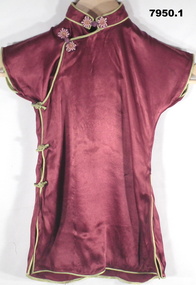
Clothing - TOP & PANTS, MANDARIN STYLE, c.WW2
... long wide legs to pants. Hand and machine stitched. ...Hand and machine stitched. Clothing TOP & PANTS, MANDARIN STYLE ...This outfit was sent home to A.E. Tranter's daughter Brenda Refer to Cat 7944. Item in the collection of "Arthur E. Tranter". V50166 - VX52843 2/29th BN P.O.W.1. Top - dark red colour cotton satin fabric with light gold cover piping to garment edges. Handmade. Top has a mandarin collar, side to front opening and no sleeves. Knots and loops are used to close garment. Decorative ribbon fabric flowers at collar and neckline. Colours - pale pink, dark pink and yellow. Garment has been hand and machine stitched. 2. Pants - fabric as above. long wide legs to pants. Hand and machine stitched. clothing, ww2, arthur e tranter -
 Embroiderers Guild, Victoria
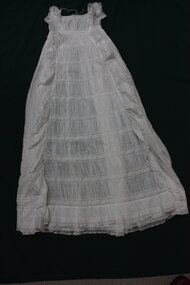
Clothing - Christening Gown, Late 19th C
... Lace attached with hand whipping and there is hand faggoting around the neck. ...Lace attached with hand whipping and there is hand faggoting around the neck. ...Cotton voile with machine made insertion and lace. Insertion alternates with gathered panels across front. Lace attached with hand whipping and there is hand faggoting around the neck. The wings, sleeves and hemline all have several rows of fine machine stitched pintucks.embroidery, england, christening gown, garments -
 National Wool Museum
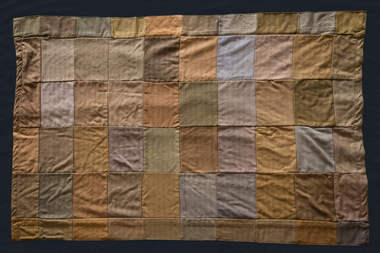
Textile - Quilt, Lucy Anderson, 1960-1965
... The pieces are machine stitched together. It has an off-white backing which is machined and hand sewn into place....The pieces are machine stitched together. It has an off-white backing which is machined and hand sewn into place. ...The samples are examples of products made at the Returned Sailors and Soldiers Mill in Geelong but discontinued before 1960. They were used to show shops what materials were available. The samples were given to Mr Robert Anderson, an apprentice fitter and turner at the mill between 1960-1965. His mother, Mrs Lucy Anderson, sewed the samples into quilts in the early 1960s. This is one quilt of three.A brown quilt made from woven samples of woollen striped fabric in browns and olive greens. The pieces are machine stitched together. It has an off-white backing which is machined and hand sewn into place.handicrafts, returned soldiers and sailors mill, wagga, anderson, mr robert anderson, mrs lucy, geelong, victoria -
 Melbourne Legacy
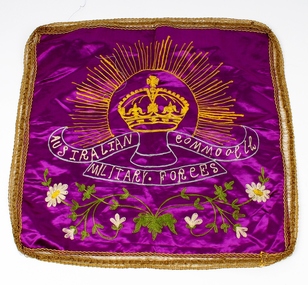
Souvenir - Souvenir Scarf, Australian Commoolth (sic) Military Forces
... Purple scarf, possibly silk, hand stitched with military forces symbol, text and floral motifs. ...Gold braid trim possibly machine stitched at a later date. See similar items 00182, 00183. ...A silk scarf souvenir from Egypt. It was embroidered with military symbols. The date is unknown. The connection with Legacy is not known. The founders of Legacy were all returned servicemen who returned from overseas service in World War One so would be familiar with similar sentimental souvenirs that were purchased in Egypt and sent home to loved ones.A record of a type of souvenir made to commemorate the Australia Commonwealth Forces. Founding Legatees would have been familiar with Egyptian souvenirs from World War 1.Purple scarf, possibly silk, hand stitched with military forces symbol, text and floral motifs. Gold braid trim possibly machine stitched at a later date. See similar items 00182, 00183.Embroidered with 'Australian Commoolth (sic) Military Forces'.souvenir, world war one -
 Orbost & District Historical Society
dress
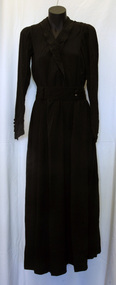
... Long black silk dress with long sleeves. It is hand-made - machine stitched. There is black beading around the neck and collar. ...From 1902-1920 he was the Assembly member for East Gippsland. costum -female Cameron Long black silk dress with long sleeves. It is hand-made - machine stitched. There is black beading around the neck and collar. ...This dress is from the estate of James Cameron who was one of the first Snowy River councillors for the Tambo Shire. He selected land at Lochiel in 1892. From 1902-1920 he was the Assembly member for East Gippsland.Long black silk dress with long sleeves. It is hand-made - machine stitched. There is black beading around the neck and collar. The belt is also beaded. There are small black buttons on the belt and sleeves. It has a black underskirt.costum -female cameron -
 Embroiderers Guild, Victoria
Artwork, other - Picture, Linda Worthington, Baby Tawny Frogmouth Owl, 2010
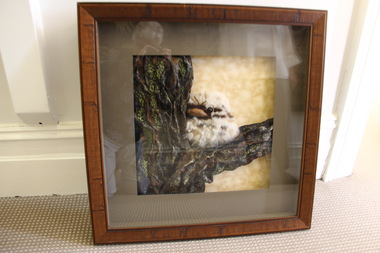
... Threads of wool fibres, black sheer, free machine stitched and hand stitched. Recessed frame. ...Threads of wool fibres, black sheer, free machine stitched and hand stitched. Recessed frame. ...Designed and made by Linda Worthington for the Guild's Wool Exhibition 2010, and sold to the donor Joan Lefroy.Baby owl, couched brushed wool, some emu feathers. Glass eye. Owl is on tree, of constructed fabric. Threads of wool fibres, black sheer, free machine stitched and hand stitched. Recessed frame. embroidery, picture, owl, wool, emu fathers, exhibition 2010 -
 Flagstaff Hill Maritime Museum and Village
Headwear - Lady's boudoir cap, Early 1900s
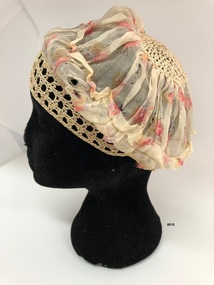
... A cream crocheted border and top insert are attached using hand stitching. The small ruffle is machine stitched. ...A cream crocheted border and top insert are attached using hand stitching. The small ruffle is machine stitched. ...Simple night caps had been worn by women in the 1800s for practical purposes such as to keep warm at night. In the early 1900s silk boudoir caps became popular to protect hairstyles while sleeping. It was also thought to maintain or even improve the condition of the hair. This boudoir cap was amongst the belongings of the donor's Great Aunts who were both dressmakers at the original Terang & District Co-Op which was established in 1908.Socially this item is significant as an example of women's headwear from the early 1900s. Historically this item holds significance as a possession of the donor’s Great Aunts who worked as dressmakers at the original Terang & District Co-Op established in 1908.The boudoir cap is constructed of cream silk with a pale floral pattern. A cream crocheted border and top insert are attached using hand stitching. The small ruffle is machine stitched. The silk fabric is fragile and has perished in some places.flagstaff hill, warrnambool, maritime village, maritime museum, flagstaff hill maritime museum & village, shipwreck coast, great ocean road, boudoir cap, nightcap, female headwear, sleepwear, vintage women's clothing, terang & district co-op -
 National Wool Museum
Quilt, Bow Wow Bowerbird
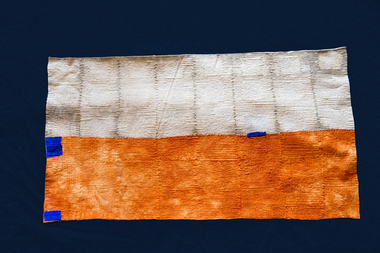
... Machine stitched, hand sewn, and applique, the quilt has long pockets and panels added to the back....Machine stitched, hand sewn, and applique, the quilt has long pockets and panels added to the back. ...Winner of Expressions 2004 Wool Quilt prize. The stitch as a measure of time is explored in this quilt. It is from a series i have been working on about my local environment. Shaped by time and the elements, Bow Wow Gorge us visited by more than 150 bird species.Quilt is a combination of silk, wool, baft, linen, and rayon thread. Two halves of the quilt have been hand sewn together and are a rusty red and grey in colour with small blue patches using plant dyes. Machine stitched, hand sewn, and applique, the quilt has long pockets and panels added to the back.Bow Wow Bowerbird 2004 Pamela Fitzsimonhandicrafts quilting textile, national wool museum, fitzsimons, ms pamela, geelong, victoria, handicrafts, quilting, textile -
 Bendigo Historical Society Inc.
Clothing - Wedding skirt, full length and lined, 1850s
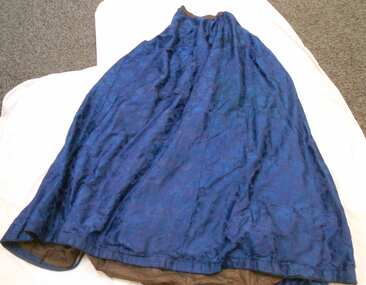
... Deep blue silk brocade, full length, machine stitched, some hand stitching, brown lining, waistband and hook and eye fastenings. ...Deep blue silk brocade, full length, machine stitched, some hand stitching, brown lining, waistband and hook and eye fastenings. ...Jane Thornton married William Dixon in Northumberland in the 1850s. William Dixon was a pitman who was recruited in England to manage a mine at Eaglehawk. He arrived in about 1857 without his family. His wife Jane and three children arrived on the "Great Britain" in 1863. Two more children were born at Eaglehawk. William died on 28 March 1876. Jane died on 18 April 1884.Jane Thornton Collection: Wedding skirt. Deep blue silk brocade, full length, machine stitched, some hand stitching, brown lining, waistband and hook and eye fastenings. Worn by Jane Thornton for her marriage to William Dixon in Northumberland in the early 1850s.women's apparel, wedding skirt -
 National Wool Museum
Quilt
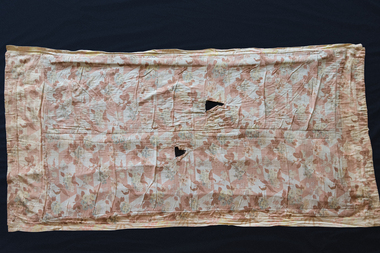
... Quilt, covered in a brown and floral patterned cotton fabric, machine and hand stitched with black knitted insert....History of quilt unknown. quilting history running stitch group running stitch collection quilting - history Quilt, covered in a brown and floral patterned cotton fabric, machine and hand stitched with black knitted insert. ...History of quilt unknown.Quilt, covered in a brown and floral patterned cotton fabric, machine and hand stitched with black knitted insert.quilting history, running stitch group, running stitch collection, quilting - history -
 Federation University Historical Collection
Ballarat Teachers' College Ceremonial Collar, Unknown
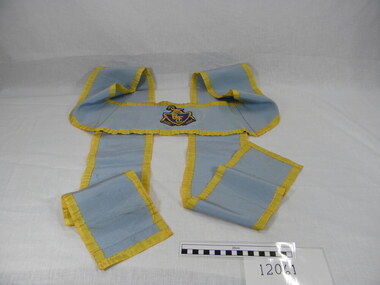
... Two mitred seams, one at each shoulder, hand sewn and two seams machine stitched on straight part of sash. ...Two mitred seams, one at each shoulder, hand sewn and two seams machine stitched on straight part of sash. ...Worn by the principal of Ballarat Teachers' College over black academic gown at formal assemblies. Ellwood was the Principal of the Ballarat Teachers' College. Ballarat Teachers’ College was opened on 04 May 1926, at S.S. 33 Dana Street, with an enrolment of 61 students. Its original staff consisted of the Principal, Mr W.H. Ellwood, M.A., M.Ed. (Chairman of the Teachers’ Tribunal from its inception in 1946 until 1954), Miss A. Bouchier, B.A., and Mr A.B. Jones, BA., (lecturers). In 1927 Miss P.A. Hamano joined the staff. In 1927 the college moved to the old Ballarat East Town Hall (remodelled for their use) in Barkly Street. During 1927 the numbers in the College were augmented by 26 Manual Arts students, who had formerly received their training at Ballarat High School. Manual Art students continued till 1930 when, on grounds of economy, their training was concentrated at Melbourne Teachers’ College. During the four succeeding years, approximately 60 students annually entered the primary course. Inclusive of Manual Arts students, and private fee-paying students, exactly 400 trainees passed through the College in its brief span of life (1926-1931). Five per cent of each year’s students were granted an extension of their studentship to enable them to proceed to Melbourne Teachers’ College, and to take the first year’s course for a University degree. With the advent of the economic depression of the ‘thirties, Ballarat Teachers' College closed its doors in December, 1931. Fourteen years were to pass before the College opened again on February 2nd, 1946. The college re-commenced at SS Dana Street, under the guidance of Mr W.F. Lord, M.C., M.M., B.A., Dip. Ed., (acting, later Principal 1946-1950) and a staff consisting of Miss E.B. Hughes, B.A., Dip. Ed., Mr C.B. Bryan, B.A., B. Com., Dip. Ed., Miss Monica H. Miller, L.Mus.A., and Miss G. Kentish, Dip. Phys. Ed. The opening ceremony was performed by the Minister of Education at that time, the Hon. F. Field, M.L.A., accompanied by the Hon. T.T. Hollway, M.L.A., and the then Director of Education, Mr J.A. Seitz. It was originally intended to cater for women students only but, at the last moment, men resident in Ballarat were also accepted. A co-educational college was thus set up instead, and it has continued as such. 1951 saw the introduction of the two-year course, successful students being presented with the Trained Primary Teacher’s Certificate at the final College Assembly each year. In December 1955, College held its first Graduation Ceremony, with its own Graduation Hymn, the words of which were written by Miss C.M. (Mavis) Canty of the staff. Lord remained as principal until 1951 when he transferred to establish a teachers' college at Toorak. Tom William Turner was Lord's successor. A highlight of his term was the construction of new college buildings at Gillies Street with the students commencing their lessons there in February 1958. Turner retired in 1970, having overseen a period of substantial growth in the institution. In that year alone more than one hundred and forty students completed their primary teaching qualification to meet a severe shortage of teachers. Doug Watson commenced as principal in 1971. In 1973 Ballarat Teachers' College became the State College of Victoria at Ballarat. Three years later Ballarat College of Advanced Education was formed and the teacher education students moved to the Mount Helen Campus. In 1990 Ballarat College of Advanced Education became Ballarat University College, an affiliated college with the University of Melbourne. The University of Ballarat was formed in January 1994.Light blue grosgrain sash, bound in yellow taffeta, sewn by machine. Two mitred seams, one at each shoulder, hand sewn and two seams machine stitched on straight part of sash. A BTC insignia is placed in the centre back. The insignia is stitched in yellow, royal blue and dark blue cotton. This sash is hand sewn at the end of one side length, in order to shorten it. Extra Muros (Beyond the Wall) on insignia BTC (Ballarat Teachers' college)education, teaching, assembly, btc, ballarat teachers college, university of ballarat, regalia, ceremony, graduation, stoll, balalrat teachers' college -
 Kiewa Valley Historical Society
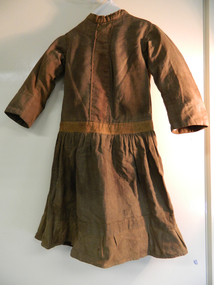
Dress
... One pocket on left side 6cm from waist band.Decorative strip at bottom of dress with a pleated hand and machine stitched frill....One pocket on left side 6cm from waist band.Decorative strip at bottom of dress with a pleated hand and machine stitched frill. Dress unknown ...made locally circa 1910. Due to relative long distance to haberdashery stores majority of children's garments were hand made by a local talented seamstress or mother/relativeHistorical significant to the period circa 1900 to circa 1950 when fashion was dictated by long lasting durability, local manufacture, earthy colours and ease of mobility. Photos in the KVHS collection show girls from Tawonga Primary School in a dress that could be this dress which is dated 1910. Dress brown cotton with long sleeves. Dress top and sleeves lined. Back of dress is open with metal hooks for fastening. Hand stitched eyelets and decorative strip down centre front bodice and around hips. Gathered skirt is joined at hip. One pocket on left side 6cm from waist band.Decorative strip at bottom of dress with a pleated hand and machine stitched frill.no inscriptions or markings suggesting locally made.dress, clothing, girl's dress, home made -
 Warrnambool and District Historical Society Inc.
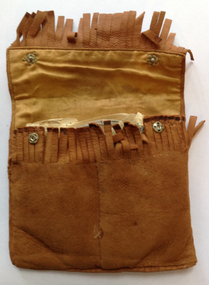
Leisure object - Pouch, Leather packets & Cello string, Early 20th century
... There is some machine stitching and some hand stitching (repairs)The wallet is lined with cream-coloured silk and the back of the wallet has an etching of an emu. ...There is some machine stitching and some hand stitching (repairs)The wallet is lined with cream-coloured silk and the back of the wallet has an etching of an emu. ...These cello strings belonged to Edith Jacobs (nee Larwill) who was prominent in music circles in Queensland before her marriage to Henry Jacobs, a Warrnanbool Estate Agent and Auctioneer during the 1940s and 50s. Edith Jacobs featured in many concerts and musical entertainments in Warrnambool during the middle years of the 20th century. Her son, Frank Jacobs was a prominent businessman in Warrnambool in the 70s, 80s and 90s and the wallet was either made by him or for him. These items are of some significance as they belonged to Edith Jacobs, a musician who was prominent in the Warrnambool musical scene in Warrnambool in the 1940s and 50s.This is a light brown leather wallet, hand made with two fringed areas, one on the top covering. There is some machine stitching and some hand stitching (repairs)The wallet is lined with cream-coloured silk and the back of the wallet has an etching of an emu. The opening has two press studs for closing the cover. There are also three paper packets containing cello strings. Two of the strings are loose in the packets. Label stitched on – ‘Frank H. Jacobs’ Etching of emu Strings – ‘Calizi Tru-tested Strings, Cello, G or 3rd, Wound on selected gut, Made in England, J. E D. & S Ltd.’ ‘Conservatoire, Cello, A gut, Reliable and Durable, No. 1620, J.E.D.& S. Ltd’ edith jacobs (larwill), cello, cello strings, warrnambool -
 Kilmore Historical Society
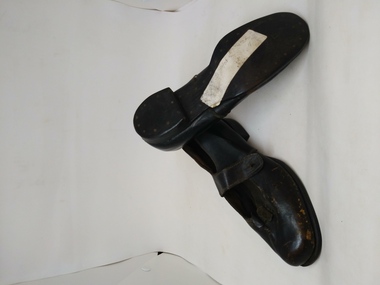
Clothing - Leather shoe, Pair leather dress shoes
... Hand made black leather shoes with leather bow at instep. ...Size 11 stamped on sole Hand made black leather shoes with leather bow at instep. ...Hand made black leather shoes with leather bow at instep. Short strap with button hole. Black bakelite button on metal ring rivetted to shoe. Size 11 stamped on sole. Leather sole and heel nailed to shoe. Fine machine stitching on top edges of shoe and down to sole from instep.Size 11 stamped on sole -
 Whitehorse Historical Society Inc.
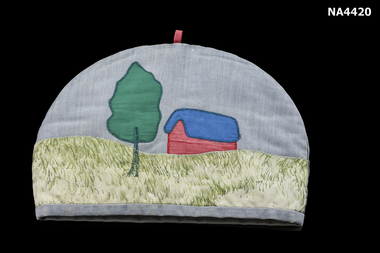
Domestic object - Tea Cosy, 1960s
... There is a scene appliqued on the front of a tree in green cotton fabric with a machine stitched hunk on the left hand side. There is a house appliqued on the right hand side. ...There is a scene appliqued on the front of a tree in green cotton fabric with a machine stitched hunk on the left hand side. There is a house appliqued on the right hand side. ...The cosy was made as a present.Tea cosy in a half circle shape. There is a scene appliqued on the front of a tree in green cotton fabric with a machine stitched hunk on the left hand side. There is a house appliqued on the right hand side. The roof of the house is deep blue cotton fabric and the house is in red cotton fabric. The foreground is of a cotton material with a cream background with 'grass' pattern on it in shades of green. The background is in blue fabric with a small red loop on the top.domestic items, table setting, manchester, table linen -
 Bendigo Historical Society Inc.
Textile - Lingerie Garment Bags
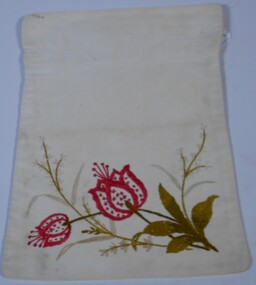
... Two handmade embroidered laundry bags. 6575.1 Red flowers with green leaves and white foliage embroidered on a cream cotton front, back of bag is undecorated. Hand and machine stitching evident. 6575.2 Gold flowers, green leaves and some white foliage. ...Two handmade embroidered laundry bags. 6575.1 Red flowers with green leaves and white foliage embroidered on a cream cotton front, back of bag is undecorated. Hand and machine stitching evident. 6575.2 Gold flowers, green leaves and some white foliage. ...Donor believes items were completed by her great aunts Lydia, Rosa, Olivia and Isabelle Pollard when the sisters were young girls. They were completed in Country Durham, England. The items have been passed down through the family by the girls' mother or aunt.Two handmade embroidered laundry bags. 6575.1 Red flowers with green leaves and white foliage embroidered on a cream cotton front, back of bag is undecorated. Hand and machine stitching evident. 6575.2 Gold flowers, green leaves and some white foliage. Four rings attached with gold and cream stitching on top of bag for hanging.A L 4 embroidered in top left hand corner of 6575.1 in yellow thread. A L embroidered at top L H corner of 6575.2 in red thread.late victorian needlework, handmade embroidery, lingerie bag, garment bags, cleary -
 Brighton Historical Society
Skirt, late-nineteenth century & 1950s
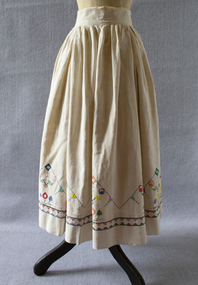
... The skirt is machine stitched....The fabric widths have been whipped together by hand probably at the time the cloth was woven in the late-nineteenth century. ...This skirt belonged to Olga Black, a long-time Brighton resident. The linen used for the skirt were woven by Olga's great-grandmother Efstathia in the late-nineteenth century with flax grown on the island of Ithaca. In the 1950s, Olga made the fabric into a skirt, embellishing it with hand embroidery. Olga Maria Black was born in Melbourne in 1930, the daughter of Ithacan migrants Constantine and Toula Mavrokefalos. Constantine first emigrated to Australia in 1902, returning to Greece circa 1912-13 to serve his home country in the Balkan Wars. Toula's family had left Ithaca for Romania when she was only six months old, but she happened to be visiting the island at the very time that Constantine arrived, fresh from the war. Within three weeks they were married, and when Constantine returned to Melbourne in 1914 his new bride came with him. Constantine had trained as an accountant, but his qualifications were not recognised in Australia. Changing his surname to the Anglicised "Black", he started off working in his older brother Dionysios's cafés before going into business on his own. In 1917 he opened the Paris Residential Café at 54-56 Swanston Street, which offered both dining and accommodation. The business saw some years of success, but did not survive the Great Depression. Constantine died in 1944. Olga's mother Toula learned to sew as a child, while growing up in the Romanian village of Brila. She developed her skills making lace and embroidering items for her trousseau. Some of the linen she embroidered had been woven from flax on Ithaca by her own grandmother, Efstathia. During the Depression, when money was scarce, Toula embroidered at home, doing work for a factory in Flinders Lane. Using a cotton reel, a threepence and a sixpence she created and embroidered designs on hundreds of blouses. Olga spent her preschool days sitting at the table where her mother worked. Toula would involve Olga by allowing her to help choose the colour combinations. Toula lived with Olga in Brighton until her death in 1976. Olga inherited her mother's sewing skills. She re-invented some of Toula’s trousseau nightdresses and skilfully altered other clothing, making dresses which she wore around Brighton for many years.Ankle-length full cream linen skirt with multi-coloured cross stitch embroidery featuring mountains, birds and trees. Fullness is pleated into wide waist band. Left side opening. The fabric widths have been whipped together by hand probably at the time the cloth was woven in the late-nineteenth century. The skirt is machine stitched.skirt, linen, hand woven, embroidery, ithaca, migration, greek diaspora, olga black
