
Showing 274 items matching "hand truck"
-
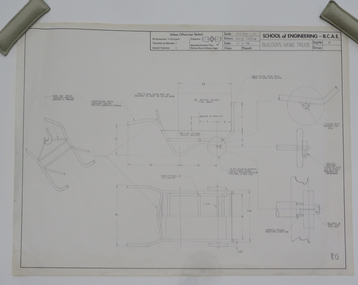 Federation University Historical Collection
Plan - Student's Technical Drawing, Engineering drawing 'Builder's Hand Truck', 1976
... Engineering drawing 'Builder's Hand Truck'...ballarat school of mines technical drawing darryl collins engineering Pencil on paper student's technical drawing Engineering drawing 'Builder's Hand Truck' Plan Student's Technical Drawing ...Pencil on paper student's technical drawing ballarat school of mines, technical drawing, darryl collins, engineering -
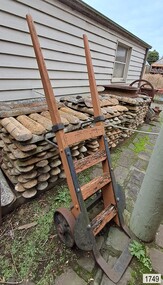 Flagstaff Hill Maritime Museum and Village
Functional object - Hand Trolley, Melbourne Steamship Company (MSS Co), Late 19th to mid-20th century
... ...hand truck...More recently, as well as the continued use of this simple style of trolley, the design has been improved to include specialised trolleys that fold, climb stairs, move pianos and even easily turn corners on their spinning, pivoting wheels. warrnambool flagstaff-hill flagstaff-hill-maritime-museum maritime-museum shipwreck-coast flagstaff-hill-maritime-village Hand Trolley Sack Truck Trolley Luggage Trolley hand truck trundler sack barrow bag barrow leverage marine technology cargo handling docks wharft shipping trade vintage antique hand card rolling cart station trolley dolly stack truck box cart two-wheeler material handling equipment shipping trade MSS Co MSSC Melbourne Steamship Company interstate shipping Hugh R. ...This hand trolley was originally marked M.S.S. Co., and likely to have once belonged to the Melbourne Steamship Company, often referred to by those initials. Flagstaff Hill’s collection has several other objects connected to the M.S.S. Co. The firm was established in 1873 under the name Hugh R. Reid and Company, renamed Melbourne Steamship Company Ltd in 1895, and became Melbourne’s foremost interstate shipping line. Warrnambool was one of the ports of call at least between 1922 and 1956; for example, on September 27 1934, the ship Coolana left Warrnambool on its way to Stanley, Burnie and Devonport, then on to Sydney and Newcastle, while other of its vessels were visiting Fremantle, Port Lincoln, Whyalla, Adelaide, and Melbourne. The firm remained in business until around 1960. A hand trolley can be loaded with heavy and bulky objects such as luggage, and stacks of boxes such as produce, cargo and equipment. It uses the principles of wheels and leverage, like a wheelbarrow, and can easily be wheeled from one place to another. Hand trolleys are still used by farmers, railway workers, shipping companies, porters, airports, hospitals, warehouses, logistical firms, furniture removalists, factory labourers and even in private homes when heavy loads need to be moved. Hand trolleys were first used in the 18th century in industries where children were used to move heavy loads. By using a hand trolley, the young labourers could move the piles of objects with the same efficiency as the adult workers. This hand trolley is significant for its likely connection to the Melbourne Steamship Company, or MSSCo, Melbourne’s foremost shipping line for interstate trade in the late nineteenth and early-to- mid twentieth century, representing many aspects of early trade within maritime Australia; Warrnambool was one of the ports visited by the company’s ships. The design of the hand trolley is an example of equipment used since the 18th century to move heavy loads at docks and shipyards. It is associated with the maritime industries of shipping, transportation, travel, and trade, as well as the colonial primary production sectors of farming, markets, and produce. The design represents an early step in the evolution of the simple hand trolley. More recently, as well as the continued use of this simple style of trolley, the design has been improved to include specialised trolleys that fold, climb stairs, move pianos and even easily turn corners on their spinning, pivoting wheels. Hand trolley: an L-shaped handcart with handles and supporting legs at one end, wheels at the other, and a ledge or platform to hold the load. This hand trolley has orange wooden slats and handles, two metal wheels, and a black metal frame with semi-circular side flanges. An inscription is stamped on one side.Stamped: "M.S.S.CO."warrnambool, flagstaff-hill, flagstaff-hill-maritime-museum, maritime-museum, shipwreck-coast, flagstaff-hill-maritime-village, hand trolley, sack truck, trolley, luggage trolley, hand truck, trundler, sack barrow, bag barrow, leverage, marine technology, cargo handling, docks, wharft, shipping, trade, vintage, antique, hand card, rolling cart, station trolley, dolly, stack truck, box cart, two-wheeler, material handling equipment, shipping trade, mss co, mssc, melbourne steamship company, interstate shipping, hugh r. reid and company -
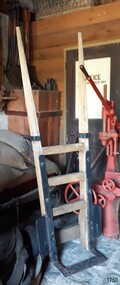 Flagstaff Hill Maritime Museum and Village
Equipment - Hand Trolley
... ...hand truck...Flagstaff Hill Warrnambool Shipwreck Coast Maritime Museum Flagstaff Hill Maritime Museum and Village vintage antique hand trolley hand card hand truck rolling cart luggage trolley station trolley dolly stack truck sack truck trundler box cart sack barrow bag barrow two-wheeler leverage material handling equipment marine technology cargo handling docks shipping trade Hand trolley: an L-shaped hand-operated trolley with handles and supporting legs at one end, wheels at the other, and a ledge or platform to hold the load. ...A hand trolley can be loaded with heavy and bulky objects such as luggage, and stacks of boxes such as produce, cargo and equipment. It uses the principles of wheels and leverage, like a wheelbarrow, and can easily be wheeled from one place to another. Hand trolleys are still used by farmers, railway workers, shipping companies, porters, airports, hospitals, warehouses, logistical firms, furniture removalists, factory labourers and even in private homes when heavy loads need to be moved. Hand trolleys were first used in the 18th century in industries where children were used to move heavy loads. By using a hand trolley, the young labourers could move the piles of objects with the same efficiency as the adult workers. The design of the hand trolley is an example of equipment used since the 18th century to move heavy loads at the docks and shipyards. It is associated with the maritime industries of shipping, transportation, travel and trade as well as the colonial primary production sectors of farming, markets and produce. The design represents an early step in the evolution of the simple hand trolley. More recently, as well as the continued use of this simple style of trolley, the design has been improved to include specialised trolleys that fold, climb stairs, move pianos and even easily turn corners on their spinning, pivoting wheels. Hand trolley: an L-shaped hand-operated trolley with handles and supporting legs at one end, wheels at the other, and a ledge or platform to hold the load. This hand trolley has orange wooden slats and handles, two metal wheels, and a black metal frame with curved corners on its rectangular side flanges.flagstaff hill, warrnambool, shipwreck coast, maritime museum, flagstaff hill maritime museum and village, vintage, antique, hand trolley, hand card, hand truck, rolling cart, luggage trolley, station trolley, dolly, stack truck, sack truck, trundler, box cart, sack barrow, bag barrow, two-wheeler, leverage, material handling equipment, marine technology, cargo handling, docks, shipping trade -
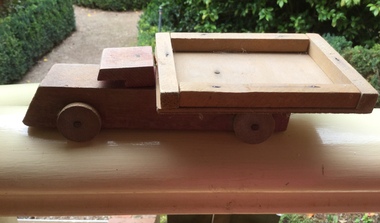 Mont De Lancey
Leisure object - Toy Truck, Unknown
... A brown painted wooden hand made toy truck with four wheels and a tray for loads....toys toy trucks Leisure Objects A brown painted wooden hand made toy truck with four wheels and a tray for loads. ...A brown painted wooden hand made toy truck with four wheels and a tray for loads.toys, toy trucks, leisure objects -
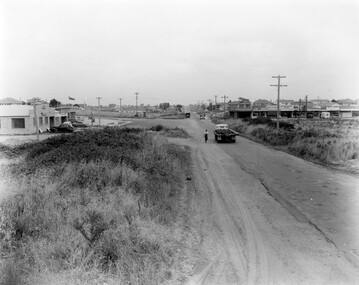 City of Kingston
Photograph - Black and white, 1957
... A service station is visible on the left hand side, a truck is travelling along the road and shops are under construction on the right hand side....A service station is visible on the left hand side, a truck is travelling along the road and shops are under construction on the right hand side. ...This image shows the increasing urbanisation of the formerly rural area of Moorabbin.Black and white photograph of the intersection of South Road and Chesterville Road, Moorabbin. A service station is visible on the left hand side, a truck is travelling along the road and shops are under construction on the right hand side.Handwritten in blue ink on reverse: 57-523B Handwritten in red ink on reverse: 100%moorabbin, shopping strip, paddocks, roads, cars -
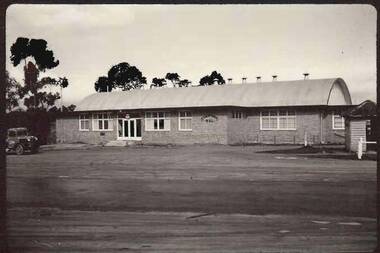 Bendigo Historical Society Inc.
Photograph - RSL HALL: EAGLEHAWK, C 1957
... Black and white phot of brick buildings with curved roof line. Cabin of truck left hand corner. 'RSL Hall' on rear of photo ( in pencil )...Leo Hughes ( Aylene Kirkwood 17.7. 2000 ) Black and white phot of brick buildings with curved roof line. Cabin of truck left hand corner. 'RSL Hall' on rear of photo ( in pencil ) Photograph RSL HALL: EAGLEHAWK ...Black and white phot of brick buildings with curved roof line. Cabin of truck left hand corner. 'RSL Hall' on rear of photo ( in pencil )? Leo Hughes ( Aylene Kirkwood 17.7. 2000 )organization, club/society, rsl -
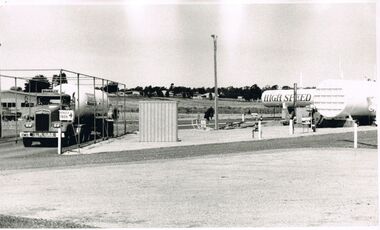 Bendigo Historical Society Inc.
Photograph - CASTLEMAINE GAS COMPANY COLLECTION: PHOTO GAS DEPOT
... On Left hand side Brambles gas Truck. A small shed and on the left hand side to gas tanks. ...On Left hand side Brambles gas Truck. A small shed and on the left hand side to gas tanks. ...T.L.P.G. Plan. On Left hand side Brambles gas Truck. A small shed and on the left hand side to gas tanks. Several houses can be seen in background. Date Unknown.organisation, industry, gas and fuel -
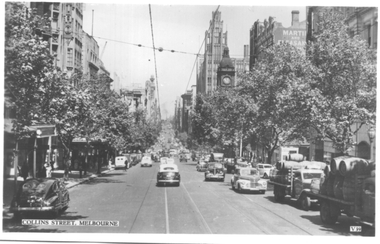 Melbourne Tram Museum
Postcard, Valentine's, "Collins Street Melbourne", late 1930s
... On the right hand side are two trucks carrying large barrels. In the view is the Town Hall and the Manchester Unity building....On the right hand side are two trucks carrying large barrels. In the view is the Town Hall and the Manchester Unity building. ...Valentine's postcard titled "Collins Street Melbourne", Number V39, looking west from Russell Street with some trams in the far distance. On the right hand side are two trucks carrying large barrels. In the view is the Town Hall and the Manchester Unity building.Yields information about Collins Street during the late 1930s.Postcard - printed, unused, Valentine Seriestrams, tramways, collins st -
 Department of Energy, Environment and Climate Action
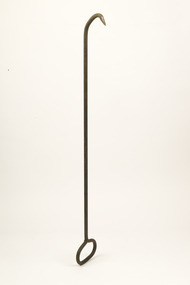
Pulpwood billet hook
... Billets were first stacked endwise to drain the sap and lighten the load before they were loaded by hand onto flat bed trucks for transport to the mills. ...Billets were first stacked endwise to drain the sap and lighten the load before they were loaded by hand onto flat bed trucks for transport to the mills. ...Pulpwood was often split by hand or with black powder splitting guns into more manageable sizes and cut into 8 foot lengths (or billets). Billets were first stacked endwise to drain the sap and lighten the load before they were loaded by hand onto flat bed trucks for transport to the mills. This long length metal hook was used to pull and manoeuvre the pulpwood billets onto the truck. The advent of excavators in logging operations in the 1970s led to the loading and carting pulpwood in long tree lengths.Long steel tool with handle on one end and hook on the other. -
 City of Kingston
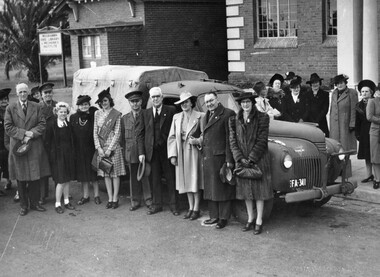
Photograph - Black and white, c.1943
... This photograph shows members of the community outside the Moorabbin Council Offices, handing over a brand-new utility truck for use by the Australian Comforts Fund, in support of the war effort. ...The photograph was taken outside Moorabbin Council offices to illustrate the handing over of utility truck for use by Australian Comforts Fund. ...The photograph was taken outside Moorabbin Council offices to illustrate the handing over of utility truck for use by Australian Comforts Fund. ...This photograph shows members of the community outside the Moorabbin Council Offices, handing over a brand-new utility truck for use by the Australian Comforts Fund, in support of the war effort. It was purchased with funds raised by contestants in Moorabbin's 'Popular Girl Quest'. Contestants received a vote for each penny they collected. The winner was Gladys Mariott, pictured centre wearing a sash, who raised £528 10s, earning her 126,800 votes. In total, the contestants raised more than a thousand pounds, which enabled the purchasing of the new utility truck.Members of the Moorabbin community were keen to play their part in supporting the war effort. A black and white photograph of a group of men and women standing in front of and behind a utility vehicle with the license plate FA 341. There are two buildings in the background, one of which has a sign out the front that reads "Moorabbin Free Library & Mechanics Institute". The photograph was taken outside Moorabbin Council offices to illustrate the handing over of utility truck for use by Australian Comforts Fund. Money for the truck was raised by the 'Popular Girl Quest' won by Gladys Marriott (centre wearing sash)Handwritten in red ink: A 600 / 72% Handwritten in black ink: CHAP 6. / WITH SUB-STORY / Spy base -- / OR general pix / in Chap 6 / referring to warworld war ii, australian comforts fund, popular girl quest, fundraising, war efforts, vehicles -
 Ballarat Tramway Museum
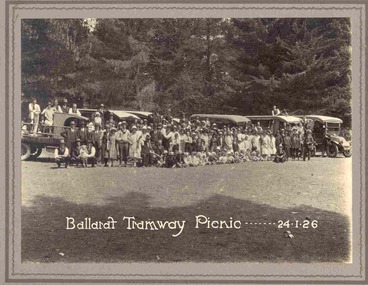
Photograph - Black and White photograph/s - mounted, Hornly's Ballarat, 24/01/1926 12:00:00 AM
... Photograph is of the workers and families standing in front of seven buses or trucks, possibly at Moorabool Reservoir. On the left hand side is a truck with a ladder on the side, sign written to show it belongs to the Electric Supply Co. of Victoria. ...Photograph is of the workers and families standing in front of seven buses or trucks, possibly at Moorabool Reservoir. On the left hand side is a truck with a ladder on the side, sign written to show it belongs to the Electric Supply Co. of Victoria. ...Block mounted photograph of the ESCo Employees Tramway Picnic 24.1.1926. Photograph is of the workers and families standing in front of seven buses or trucks, possibly at Moorabool Reservoir. On the left hand side is a truck with a ladder on the side, sign written to show it belongs to the Electric Supply Co. of Victoria. The black and white photograph has been mounted on to a heavy cardboard grey coloured with dark grey bands around the photograph and the edge of the mounting. The bottom right hand corner has been indented with the studio's name "Hornly's Studio Ballarat".trams, tramways, esco, hornly's, picnics, employees -
 Sunshine and District Historical Society Incorporated
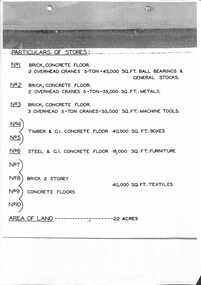
Album - A.D.I. Stores And Transport WWII, 1939-45
... Stores & Transport WW2 - Material Handing Iton Stillage, Iton Elevating Truck & Hand Truck & Gravity Rollers. 617.093 - A.D.I. ...Stores & Transport WW2 - Material Handing Iton Stillage, Iton Elevating Truck & Hand Truck & Gravity Rollers. 617.093 - A.D.I. ...617.001 - A.D.I. Stores & Transport WW2 - Maribyrnong Particular Of Stores. 617.002 - A.D.I. Stores & Transport WW2 - Maribyrnong Main Entrance & Administrative Offices. 617.003 - A.D.I. Stores & Transport WW2 - Maribyrnong No 1 Store & No 2 Store. 617.004 - A.D.I. Stores & Transport WW2 - Maribyrnong No 3 Store & Textiles Stores No 7, 8, 9 & 10. 617.005 - A.D.I. Stores & Transport WW2 - Maribyrnong Furniture Store & No 3 Store. 617.006 - A.D.I. Stores & Transport WW2 - Maribyrnong 25 Pdr Shell Steel Bar Plates & Ball Bearings. 617.007 - A.D.I. Stores & Transport WW2 - Maribyrnong Electric Cable & Tin Plate & Terne Plate. 617.008 - A.D.I. Stores & Transport WW2 - Maribyrnong Treating Tin Plate Stock & Brass Rod. 617.009 - A.D.I. Stores & Transport WW2 - Maribyrnong Non-Ferrous Rod & Coper Tubing. 617.010 - A.D.I. Stores & Transport WW2 - Maribyrnong No 2 Store Tool Steel Section. 617.011 - A.D.I. Stores & Transport WW2 - Maribyrnong No 2 Store Tool Steel Section. 617.012 - A.D.I. Stores & Transport WW2 - Maribyrnong No 2 Store Steel Section & No 3 Store Machine Tool Section. 617.013 - A.D.I. Stores & Transport WW2 - Maribyrnong No 3 Store Machine Tool Section. 617.014 - A.D.I. Stores & Transport WW2 - Maribyrnong No 3 Store Machine Tool Section. 617.015 - A.D.I. Stores & Transport WW2 - Maribyrnong Box Stores. 617.016 - A.D.I. Stores & Transport WW2 - Maribyrnong Box Stores. 617.017 - A.D.I. Stores & Transport WW2 - Maribyrnong Box Stores. 617.018 - A.D.I. Stores & Transport WW2 - Maribyrnong Domestic Maintenace Store. 617.019 - A.D.I. Stores & Transport WW2 - Maribyrnong Domestic Maintenence Store. 617.020 - A.D.I. Stores & Transport WW2 - Maribyrnong Textile Store. 617.021 - A.D.I. Stores & Transport WW2 - Maribyrnong Textile Store & Protective Clothing. 617.022 - A.D.I. Stores & Transport WW2 - Maribyrnong Cream Serge Cartridge Bags For Naval Guns. 617.023 - A.D.I. Stores & Transport WW2 - Tottenham Particular Of Stores. 617.024 - A.D.I. Stores & Transport WW2 - Tottenham Stores. 617.025 - A.D.I. Stores & Transport WW2 - Tottenham Entrance & Guard Room At Gate. 617.026 - A.D.I. Stores & Transport WW2 - Tottenham Rail Siding With Crane & Weightbridge Near Entrance. 617.027 - A.D.I. Stores & Transport WW2 - Tottenham Brass Cartridge Storage Area & Smoke Floats. 617.028 - A.D.I. Stores & Transport WW2 - Tottenham Ammunition Boxes & Shell Storage Area. 617.029 - A.D.I. Stores & Transport WW2 - Tottenham Aircraft Bomb Parachutes & Small Arms Ammunition. 617.030 - A.D.I. Stores & Transport WW2 - Tottenham Stoarge Area & Boxes. 617.031 - A.D.I. Stores & Transport WW2 - Tottenham Storage Unit Piling. 617.032 - A.D.I. Stores & Transport WW2 - Tottenham Paper Stores & Stores For Empty Storage Boxes. 617.033 - A.D.I. Stores & Transport WW2 - Tottenham Paper Stores & Stores For Empty Storage Boxes & Copper Stacking Compound. 617.034 - A.D.I. Stores & Transport WW2 - Tottenham Railway Siding & Railway Platform. 617.035 - A.D.I. Stores & Transport WW2 - Tottenham Store. 617.036 - A.D.I. Stores & Transport WW2 - Derrimut Particulars Of Buildings. 617.037 - A.D.I. Stores & Transport WW2 - Derrimut Main Entrance & Guard House & Aerial View Of Magazines. 617.038 - A.D.I. Stores & Transport WW2 - Derrimut Loading Shed & Battery Train. 617.039 - A.D.I. Stores & Transport WW2 - Derrimut Magazine Loading & Train Returning From Distant Magazines. 617.040 - A.D.I. Stores & Transport WW2 - Derrimut Electric Locomotive Battery Charging Plant. 617.041 - A.D.I. Stores & Transport WW2 - Ravenhall Explosive Siding. 617.042 - A.D.I. Stores & Transport WW2 - Ravenhall Entrance & Explosive Rail Siding & Mess Hutt. 617.043 - A.D.I. Stores & Transport WW2 - Ravenhall Railway Siding At Deer Park. 617.044 - A.D.I. Stores & Transport WW2 - Longlea Explosive Area. 617.045 - A.D.I. Stores & Transport WW2 - Longlea Main Office & Foreman's Cottage. 617.046 - A.D.I. Stores & Transport WW2 - Longlea Peace Officer's Quarters & Explosive Area Loading Shed. 617.047 - A.D.I. Stores & Transport WW2 - Longlea Repacking House & 50 Ton Magazine. 617.048 - A.D.I. Stores & Transport WW2 - Longlea Main Storage & Fire Fighting Static Pool. 617.049 - A.D.I. Stores & Transport WW2 - Longlea Fire Pump Trailer. 617.050 - A.D.I. Stores & Transport WW2 - Longlea Fire Spotting Tower. 617.051 - A.D.I. Stores & Transport WW2 - Longlea Fire Breaks & Explosive Area Fire Fighting Equipment. 617.052 - A.D.I. Stores & Transport WW2 - Footscray Magazines. 617.053 - A.D.I. Stores & Transport WW2 - Footscray Explosive Magazines & Ammunition Factory Entrance (Jacks Magazine). 617.054 - A.D.I. Stores & Transport WW2 - Footscray Explosive Store & Magazine Access Tunnels Through Mound. 617.055 - A.D.I. Stores & Transport WW2 - Footscray Mounded Magazine. 617.056 - A.D.I. Stores & Transport WW2 - Hire Stores Sites. 617.057 - A.D.I. Stores & Transport WW2 - Hire Stores Sites Olympic Park Chemical Drums & Victoria Street Melbourne Radio & Signal Store. 617.058 - A.D.I. Stores & Transport WW2 - Hire Stores Sites Victoria Street Melbourne Unit Piling & Electrical Equipment. 617.059 - A.D.I. Stores & Transport WW2 - Hire Stores Sites Victoria Street Melbourne Radio & Signals Packing & Testing. 617.060 - A.D.I. Stores & Transport WW2 - Hire Stores Sites Victoria Street Melbourne Dispatched Section & Radio & Union Street North Melbourne Signal Store. 617.061 - A.D.I. Stores & Transport WW2 - Hire Stores Sites Errol Street North Melbourne Unit Piling & Electrical Equipment. 617.062 - A.D.I. Stores & Transport WW2 - Hire Stores Sites Errol Street North Melbourne Checking & Packing Store. 617.063 - A.D.I. Stores & Transport WW2 - Hire Stores Sites Casino Dance Hall Brunswick Valves Storage Store. 617.064 - A.D.I. Stores & Transport WW2 - Hire Stores Sites Casino Dance Hall Brunswick Valves Storage Store & Haymarket Parkville Copper Storage. 617.065 - A.D.I. Stores & Transport WW2 - Hire Stores Sites Deer Park Toluol Tanks & Acetone Tanks. 617.066 - A.D.I. Stores & Transport WW2 - Hire Stores Sites Deer Park Acetone Drum Stock Shelters & Albion Drum Stocks. 617.067 - A.D.I. Stores & Transport WW2 - Hire Stores Sites Lonsdale Street Melbourne Food Service Store & Repairing Frigidaire. 617.068 - A.D.I. Stores & Transport WW2 - Hire Stores Sites Lonsdale Street Melbourne Unit Pile & Stocks For Food Service Store. 617.069 - A.D.I. Stores & Transport WW2 - Hire Stores Sites Lonsdale Street Melbourne Food Service Store. 617.070 - A.D.I. Stores & Transport WW2 - Hire Stores Sites Albion Barblock Wire Coils & Crockery. 617.071 - A.D.I. Stores & Transport WW2 - Hire Stores Sites Bendigo & Ballarat Chemical Stock Stores. 617.072 - A.D.I. Stores & Transport WW2 - Hire Stores Sites Ballarat Skating Link Kexachlorethane Storage & Ballarat Motor Garage Di-Nitro-Toluol Storage. 617.073 - A.D.I. Stores & Transport WW2 - Hire Stores Sites Rae Hill School Bendigo Amorphous Phosphorus Storage & Williamstown Racecourse Grandstand. 617.074 - A.D.I. Stores & Transport WW2 - Hire Stores Sites Williamstown Racecourse Rear Of Grandstand Chemical Stocks & Racecourse Stables Chemcial Storage. 617.075 - A.D.I. Stores & Transport WW2 - Hire Stores Sites Williamstown Racecourse Tote Chemical Storage & White Phosphorus Storage Area. 617.076 - A.D.I. Stores & Transport WW2 - Hire Stores Sites Williamstown Racecourse Scratching Board Chemical Stoage Area. 617.077 - A.D.I. Stores & Transport WW2 - Braybrook Transport Depot. 617.078 - A.D.I. Stores & Transport WW2 - Braybrook Transport Depot Entrance, Guard Room & Control Room & Petrol & Oil Filling Station. 617.079 - A.D.I. Stores & Transport WW2 - Braybrook Transport Depot Offices & Repair Shops & Light Vehicle Repair Shop. 617.080 - A.D.I. Stores & Transport WW2 - Braybrook Transport Depot Semi-Trailers Loaded For Shipment & Semi-Trailers Loaded With Tallow. 617.081 - A.D.I. Stores & Transport WW2 - Braybrook Transport Depot Parking Area & Stick-Up Area For Load Vehicles. 617.082 - A.D.I. Stores & Transport WW2 - Braybrook Transport Depot Section Of Fleet & Special Explosive Trucks. 617.083 - A.D.I. Stores & Transport WW2 - Braybrook Transport Depot Section Of Fleet & Buses. 617.084 - A.D.I. Stores & Transport WW2 - Melbourne Western Market Transport Section & Maribyrnong Passenger Car Pool. 617.085 - A.D.I. Stores & Transport WW2 - Melbourne Western Market City Parcel Delivery Service & Horse Vehicles. 617.086 - A.D.I. Stores & Transport WW2 - Horse Vehicles & Maribyrnong Horse Vehicles Leaving Stables. 617.087 - A.D.I. Stores & Transport WW2 - Maribyrnong Horse Off To Work & Types Of Horses. 617.088 - A.D.I. Stores & Transport WW2 - Maribyrnong Foal & Off To Grass For Weekend. 617.089 - A.D.I. Stores & Transport WW2 - Maribyrnong Blacksmith & Horseshoeing. 617.090 - A.D.I. Stores & Transport WW2 - Maribyrnong Shrinking Tyre & Carpenter's Work Shop. 617.091 - A.D.I. Stores & Transport WW2 - Material Handing. 617.092 - A.D.I. Stores & Transport WW2 - Material Handing Iton Stillage, Iton Elevating Truck & Hand Truck & Gravity Rollers. 617.093 - A.D.I. Stores & Transport WW2 - Material Handing Fordson Tractor & Lister Tow Motor & Trailers. 617.094 - A.D.I. Stores & Transport WW2 - Material Handing Mechical Drum Loader. 617.095 - A.D.I. Stores & Transport WW2 - Material Handing Electric Stacker. 617.096 - A.D.I. Stores & Transport WW2 - Material Handing Tottenham 5 Ton Mobile Crane. 617.097 - A.D.I. Stores & Transport WW2 - Material Handing 3 Ton Crane. 617.098 - A.D.I. Stores & Transport WW2 - Material Handing Fowler Iton Tractor Crane & 2 Ton Gibson Battle Crane. 617.099 - A.D.I. Stores & Transport WW2 - Material Handing 3 Ton Ransome Rapier Crane. 617.100 - A.D.I. Stores & Transport WW2 - Material Handing Coles 3 Ton Mobile Crane. 617.101 - A.D.I. Stores & Transport WW2 - Material Handing Fowler Iton Crane & 2 Ton Gibson Batle Crane. 617.102 - A.D.I. Stores & Transport WW2 - Material Handing Material Handing Coles 3 Ton Mobile Crane. 617.103 - A.D.I. Stores & Transport WW2 - Material Handing Lawton 3000 Lbs Hydraulic Fork Truck. 617.104 - A.D.I. Stores & Transport WW2 - Material Handing Special Explosive Truck. 617.105 - A.D.I. Stores & Transport WW2 - Material Handing Road Transport Of Explosive. 617.106 - A.D.I. Stores & Transport WW2 - Material Handing 80 Ton Transport Bogie. 617.107 - A.D.I. Stores & Transport WW2 - Material Handing Special Explosive Truck. 617.108 - A.D.I. Stores & Transport WW2 - Horse Vehicles & Maribyrnong Horse Vehicles Leaving Stables. 617.109 - A.D.I. Stores & Transport WW2 - Horse Vehicles. 617.110 - A.D.I. Stores & Transport WW2 - Semi-Trailers Loaded With Tallow For Shipment. 617.111 - A.D.I. Stores & Transport WW2 - Williamstown Racecourse White Phosphorus Storage Area. 617.112 - A.D.I. Stores & Transport WW2 - Albion Barblock Wire Coils. 617.113 - A.D.I. Stores & Transport WW2 - Rae Hill School Bendigo Amorphous Phosphorus Storage. 617.114 - A.D.I. Stores & Transport WW2 - Albion Drum Stocks. 617.115 - A.D.I. Stores & Transport WW2 - Deer Park Acetone Tanks. 617.116 - A.D.I. Stores & Transport WW2 - Footscray Explosive Store (Jacks Magazine). 617.117 - A.D.I. Stores & Transport WW2 - Derrimut Aerial View Of Magazines. 617.118 - A.D.I. Stores & Transport WW2 - Tottenham Railway Siding. 617.119 - A.D.I. Stores & Transport WW2 - Tottenham Weightbridge Near Entrance. 617.120 - A.D.I. Stores & Transport WW2 - Tottenham Rail Siding With Crane. 617.121 - A.D.I. Stores & Transport WW2 - Tottenham Entrance. 617.122 - A.D.I. Stores & Transport WW2 - Maribyrnong No 2 Store Steel Section. 617.123 - A.D.I. Stores & Transport WW2 - Maribyrnong Treating Tin Plate Stock. 617.124 - A.D.I. Stores & Transport WW2 - Maribyrnong Treating Tin Plate Stock.world war 1939 - 1945 -
 Federation University Historical Collection
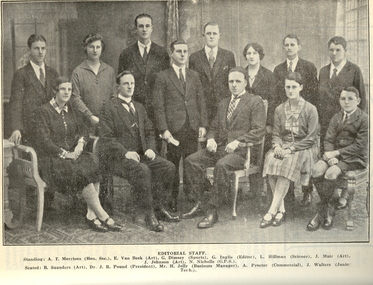
Booklet - Magazines, Ballarat School of Mines Magazine, 1924-1930, 1924-1930
... Trucks, Mrs Stones, Millers The Clothiers, T.G. Skewes, Wattle TEa Rooms, H.B. Selby, Middleton and Morris, C.P.A. Taylor, Thornton Studios, Fred Irwin, Isaac Abraham, Ballarat Radio Listening-In, Baxter and Stubbs 1927 * Chemists Trip to Melbourne (Mount Lyell Chemical Works, Footscray, Yarraville * Literary Society * Mr J.N. Rowell 1928 * Prohibition in U.S.A. by Ed A. Brophy * Dr. J.W. Mellor and His Work at Stoke, England by Reginald C. Callister * The Science of Chemistry by C.A. Schache * Trip to Yallourn (Brown Coal Deposits, Steam Plant at Yallourn, Switchgear and Transformers, Briquette Factory * Walhalla Past and Present by G.E.B. * The Hand...Trucks, Mrs Stones, Millers The Clothiers, T.G. Skewes, Wattle TEa Rooms, H.B. Selby, Middleton and Morris, C.P.A. Taylor, Thornton Studios, Fred Irwin, Isaac Abraham, Ballarat Radio Listening-In, Baxter and Stubbs 1927 * Chemists Trip to Melbourne (Mount Lyell Chemical Works, Footscray, Yarraville * Literary Society * Mr J.N. Rowell 1928 * Prohibition in U.S.A. by Ed A. Brophy * Dr. J.W. Mellor and His Work at Stoke, England by Reginald C. Callister * The Science of Chemistry by C.A. Schache * Trip to Yallourn (Brown Coal Deposits, Steam Plant at Yallourn, Switchgear and Transformers, Briquette Factory * Walhalla Past and Present by G.E.B. * The Hand ...The Ballarat School of Mines is a predecessor institution of Federation University Australia. Bound copies of the Ballarat School or Mines Students' Magazine. 1924 * Dr J.R. Pound * Noel Hay Obituary * The History of Chemistry * Literary Society * Herald B. Herbert * Chemistry in Modern Life by Val G. Anderson * Chemistry in Literature by J.R. Pound * School Literary Society * Ladies in Pharmacy * Musings on Modern Literature - Mainly Drama (W.G. C.) * Trip to Newcastle * Appreciation of the Masterpieces of Art * The Antique Room * Dressmaking * Pottery * Sloyd * The Mystery of the Atom *Inorganic Evolution by R.S. Russell * Photography * First Aid Club 1926 * The Trip to Morwell * Chemical Excursions (Yallourn) * Eastern Life and Customs by Rex Warrillow * Organic Evolution by Edwin A. Brophy * Chemistry in the Kitchen * Obituary for Professor Alfred Mica Smith * The Historical Development of Patterns i Silk Fabrics * Pottery * Literary Society * Early Evidence of Metallurgy in Britain * Brief Description of the Magnet Silver Mine, Tasmania * The manufacture of Leather Photographs * SMB Athletics Team, winners of the Herald Shield (M. Timmings, L. Evans, F. Sheahan, R. Collins, A. Murfett, W. Hughes, L. Hillman * SMB Football Team * Ballarat Technical Art School Tennis Four * SMB Girls' Basketball Team * SMB GIrls Hockey Team * Ballarat Junior Technical School Scholarship and Studentship Winners * On Punctuation Advertisements: Sunshine Biscuits, Harris Powell and Sandford, W. Gribble & Co., Gilbert Motors, T.J. Haymes The Wallpaper King, C. Marks and Co., Wilson's Tailors and Mercers, George S. Grant, Miss A. Corin Art Worker, Tunbridges, Felton, Grimwade & Co., Hasten and Ewins, Ballarat Wireless Stores, Fred A. Reed, Suttons, E. Hall-Jones, Stansfield and Smith, Ballarat Gas Company, Richards and Co Studio, F.H. Drew, Adam Scott, R.A. Hudson, Huttons, J.A. Holland, A.E. White, F. Barrow Monumental Sculptor, R. Young, H.A. Evans, Alexandria Tea Rooms, W. Cornell Chemist, Black Cat Tea Rooms, J.A. Reynolds, A.M. Palmer, Morris Cars and Trucks, Mrs Stones, Millers The Clothiers, T.G. Skewes, Wattle TEa Rooms, H.B. Selby, Middleton and Morris, C.P.A. Taylor, Thornton Studios, Fred Irwin, Isaac Abraham, Ballarat Radio Listening-In, Baxter and Stubbs 1927 * Chemists Trip to Melbourne (Mount Lyell Chemical Works, Footscray, Yarraville * Literary Society * Mr J.N. Rowell 1928 * Prohibition in U.S.A. by Ed A. Brophy * Dr. J.W. Mellor and His Work at Stoke, England by Reginald C. Callister * The Science of Chemistry by C.A. Schache * Trip to Yallourn (Brown Coal Deposits, Steam Plant at Yallourn, Switchgear and Transformers, Briquette Factory * Walhalla Past and Present by G.E.B. * The Hand Loom * Precious Stones 1929 * The Old Brewery * The History of Chemistry by J.R. Pound * Occurrence of Mineral Oil in Gippsland * Experiences with Malayan Chinese by R. Warrillow * Organise Colors (Dyestuff Pigments) in Rubber Goods 1930 * News from Chine by Henry Kum Yuen * L'Art Moderne * The Story of Clay by T.H. Trengrove * A Glimpse of England * The Beginnings of Arithmeticballarat school of mines, pottery, ceramics, reginald callister, metallurgy, chemistry, j. pound, alfred mica smith, herald shield, harold herbert, lindsay hillman, john rowell, j.r. pound, noel hay, drawing from antique, yallourn excusion, walhalla, sunshine biscuits, harris powell and sandford, w. gribble & co., gilbert motors, t.j. haymes, the wallpaper king, c. marks and co., wilson's tailors and mercers, george s. grant, miss a. corin art worker, tunbridges, felton, grimwade & co., hasten and ewins, ballarat wireless stores, fred a. reed, suttons, e. hall-jones, stansfield and smith, ballarat gas company, richards and co studio, r.a. hudson, huttons, j.a. holland, a.e. white, f. barrow monumental sculptor, r. young, h.a. evans, alexandria tea rooms, w. cornell chemist, black cat tea rooms, j.a. reynolds, a.m. palmer, morris cars and trucks, mrs stones, millers the clothiers, t.g. skewes, wattle tea rooms, h.b. selby, middleton and morris, c.p.a. taylor, thornton studios, fred irwin, isaac abraham, ballarat radio listening-in, baxter and stubbs, mount lyell chemical works, footscray, c.a. schache, yallourn briquette factory, t.h. trengrove, history of chemistry, excursions, morwell, morwell excursion, women in pharmacy, mt lyall, excursion, slloyd, drawing from the antique, james pound, yallourn, yallourn excursion, ballarat arch of victory, mt macedon, f.h. drew, adam scott, university women -
 Gippsland Vehicle Collection
Vulcan Truck, 1922 Vulcan Tray Truck
... This truck is significant as it is representative of the early type of hand cranked (no starter motor) Vulcan trucks used in the Maffra district, particularly in the dairying industry. ...Manufactured by The Vulcan Motor and Engineering Company at Southport Lancashire, England. It's early history is unknown. It was resurected from an old disused brick kiln in Penrith, N. S.W. where it was in a rusty disused state. Restoration was completed about 1990., and included replacing many missing items, icluding having a reproduction 'Blacksmith' radiator mascot.This truck is significant as it is representative of the early type of hand cranked (no starter motor) Vulcan trucks used in the Maffra district, particularly in the dairying industry. Allthough commonly used in the period, it is fairly rare, as not many have survived. It has cast iron wheels, with solid rubber tyres, at a time when most vehicles were using pneumatic tyres.vulcan, vulcan truck, vintage truck, old truck -
 Federation University Historical Collection
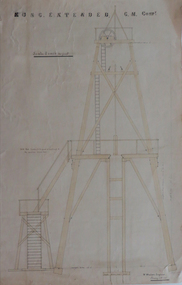
Plans, Plan of Truck Road for Kong Extended G. M. Company, 1887
... 3 hand drawn plans, 2 with orange and blue shading, of a truck road .1) hand drawn poppet head and road, timber specifications and iron bolts .2) hand drawn plan of poppet head .3) elevation and plan of mine workings ...plans kong extended gold mining company w. watson poppet head truck road 3 hand drawn plans, 2 with orange and blue shading, of a truck road .1) hand drawn poppet head and road, timber specifications and iron bolts .2) hand drawn plan of poppet head .3) elevation and plan of mine workings Plan of Truck Road for Kong Extended G. ...3 hand drawn plans, 2 with orange and blue shading, of a truck road .1) hand drawn poppet head and road, timber specifications and iron bolts .2) hand drawn plan of poppet head .3) elevation and plan of mine workings plans, kong extended gold mining company, w. watson, poppet head, truck road -
 Flagstaff Hill Maritime Museum and Village
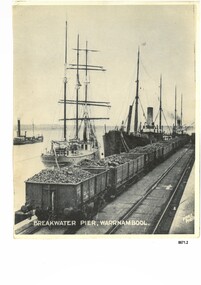
Photograph - Vessels at Breakwater Pier, Warrnambool, Foyle Photographic Studio, circa 1906
... trucks on rails are on the Breakwater. There are three ships (one sailing ship and two steamers) moored at the pier. In the left side of the picture is another ship. The name of the photographer is printed in the lower right corner. On the back of the photograph are the handwritten names of the moored ships written in blue pen. It also has the handwritten name, town and telephone number of the donor. In the bottom right hand...trucks on rails are on the Breakwater. There are three ships (one sailing ship and two steamers) moored at the pier. In the left side of the picture is another ship. The name of the photographer is printed in the lower right corner. On the back of the photograph are the handwritten names of the moored ships written in blue pen. It also has the handwritten name, town and telephone number of the donor. In the bottom right hand ...This photograph was one of ten photographs donated to Flagstaff Hill Maritime Museum and Village by Fred Trewartha. Frederick John Fox Trewartha (Fred) was a well-known Warrnambool businessman. He was born in Beeac near Geelong in 1920 and came to Warrnambool with his family as a very young child. He was apprenticed to his father John, as a saddler and later opened his own shop on Raglan Parade. He then moved into working with tarpaulins and canvases for the trucking industry. Fred was keenly interested in photography (and was a member of the Warrnambool Cine Club), yachting and boat building. He kept his yacht moored at Port Fairy for many years and participated in sailing events locally and interstate. He also built boats with his sons. He had the opportunity to meet many older sailors and it's thought this photo (and others in the set) may have been given to him by one of these men. Fred Trewartha died in 2016 in Warrnambool. The three identifiable ships in this picture are the "Speculant", the "S. S. Barrabool" and the "S. S. Flinders" - coastal trading vessels that regularly came and went from Warrnambool. The steamer on the left hasn't been identified. The barquentine SPECULANT was a steel, three-masted sailing ship built in 1895 in Inverkeithing, Scotland, registered in Warrnambool, Victoria and wrecked at Cape Paton, Victoria, 10th February 1911. The SPECULANT had been involved in the timber trade between the United Kingdom and Russia, until sold to its Warrnambool owners and timber merchants Messrs. P.J. McGennan & Co. (Peter John McGennan) in 1902 for 3000 pounds and had her sailed to Warrnambool as her new port. Peter John McGennan was born in 1844 and worked as a builder and cooper in Holyhead, Anglesea, Wales. He immigrated to Australia in 1869 as a free settler and arrived in Warrnambool in 1871 and undertook management of a property in Grassmere for Mr. Palmer. Peter met his wife Emily in South Melbourne and they married in 1873. They had ten children including Harry who lived to 1965, and Andrew who lived until 1958. (The other children were their four brothers - John who was killed in the Dardenalles aged 35, Frederick who died aged 8, Peter who died aged 28, Frank who died aged 5 weeks - and four sisters - Beatrice who died age 89, Edith who died aged 49, Blanche who died aged 89 and Eveline who died aged 48.) In 1874 Peter starting a boating establishment on the Hopkins River. In 1875 he opened up a Coopers business in Kepler Street next to what was Bateman, Smith and Co., moving to Liebig Street, next to the Victoria Hotel, in 1877. In 1882 he then moved to Lava Street (which in later years was the site of Chandlers Hardware Store). He was associated with the establishment of the Butter Factory at Allansford. He started making Butter Boxes to his own design and cheese batts for the Butter Factory. In 1896 established a Box Factory in Davis Street Merrivale, employing 24 people at its peak, (it was burnt down in 1923); and in Pertobe Road from 1912 (now the Army Barracks building). Peter was a Borough Councillor for Albert Ward from 1885 to 1891, he commenced the Foreshore Trust (including the camping grounds along Pertobe Road), and he was an inaugural Director of the Woollen Mill in Harris Street, buying an extensive share-holding in 1908 from the share trader Edward Vidler. They lobbied the Town Hall to have a formal ‘Cutting’ for the waters of the Merri River to be redirected from its natural opening south of Dennington, to its existing opening near Viaduct Road, in order to have the scourings from the wool at the Woollen Mill discharged into the sea. He sold Butter Boxes around the state, and had to ship them to Melbourne by rail. Peter’s purchase of the SPECULANT in 1902 enabled him to back-load white pine from Kaipara, New Zealand to Warrnambool to make his butter boxes then, to gain profitability, buy and ship potatoes and other primary produce bound to Melbourne. (McGennan & Co. had also owned the LA BELLA, which had traded in timber as well, until she was tragically wrecked with the loss of seven lives, after missing the entrance channel to Warrnambool harbour in 1905. It appears that the SPECULANT was bought to replace the LA BELLA.) In 1911 the SPECULANT had been attempting to depart Warrnambool for almost the entire month of January to undergo docking and overhaul in Melbourne. A month of east and south-easterly winds had forced her to remain sheltered in Lady Bay, Warrnambool apart from one morning of northerlies, when an attempt was made to round Cape Otway; she had to return to shelter in Portland after failing to make any headway. With only 140 tons of sand ballast aboard, the ship would not have been easy to handle. Captain Jacobsen and his crew of nine, mainly Swedes, decided to make for Melbourne, leaving Portland Harbour on 5th February 1911. By the 9th they had reached Cape Otway, where they encountered a moonless night, constant heavy rain, and a heavy sea with a south-easterly wind blowing. After safely rounding Cape Otway the course was changed to east, then north-east to take the vessel to a point six miles off Cape Patton, following the orders of Captain Jacobsen, who told the crew to be very careful with the steering, as the wind and sea was running to leeward. The patent log (used to measure speed) had been out of order for the last four months as no-one in Warrnambool was able to fix it: it was intended to have it repaired in Melbourne. In the meantime the crew measured the vessel's speed by looking over the side and estimating wind strength. This compounded the difficulties of imprecise positioning, as the strong cross wind and sea were acting on the lightly laden vessel to steadily drive it towards the shore. At 3.30am on Friday 10 February 1911 Captain Jacobsen and the first mate were looking over the side of the vessel when they heard the sound of breakers and suddenly struck the rocks. The crew immediately knew they had no chance of getting the SPECULANT off, and attempted to rescue themselves by launching the lifeboat, which was instantly smashed to pieces. One of the crew then volunteered to take a line ashore, and the rest of the crew were all able to drag themselves to shore, some suffering hand lacerations from the rocks. Once ashore they began to walk along the coast towards Lorne, believing it was the nearest settlement. Realising their mistake as dawn broke they returned westwards to Cape Patton, and found a farm belonging to Mr C. Ramsden, who took them in and gave them a change of clothes and food. After resting for a day and returning to the wreck to salvage some of their personal possessions, at 10am on Saturday they set out for Apollo Bay, a voyage that took six hours, sometimes wading through flooded creeks up to their necks. The Age described the wreck as "listed to starboard. All the cabin is gutted and the ballast gone. There is a big rock right through the bottom of her, and there is not the slightest hope of getting her off". A Board of Marine inquiry found that Captain Jacobson was guilty of careless navigation by not taking steps to accurately verify the position of the vessel with respect to Cape Otway when the light was visible and by not setting a safe and proper course with respect to the wind and sea. It suspended his certificate for 6 months and ordered him to pay costs. The location of the wreck site was marked for a long time by two anchors on the shoreline, until in 1970 the larger of the two anchors was recovered by the Underwater Explorers' Club and mounted on the foreshore at Apollo Bay. The bell from the wreck was also donated to the Apollo Bay Surf Lifesaving Club but is recorded to have been stolen. Rusting remains of the wreck can still be found on the shoreline on the southern side of, and directly below Cape Patton. Parts of the SPECULANT site have been buried by rubble from construction and maintenance works to the Great Ocean Road, as well as by naturally occurring landslides. Peter J McGennan passed away in 1920. The Gates in the western wall of the Anglican Church in Henna Street/Koroit St are dedicated to him for his time of community work, which is matched with other prominent Warrnambool citizens; Fletcher Jones, John Younger, J.D.E (Tag) Walter, and Edward Vidler. After Peter J McGennan's death Harry, Andrew and Edith continued to operate the family business until July 11th 1923 when the company was wound up. (Andrew lived in Ryot Street Warrnambool, near Lava Street.) Harry McGennan (Peter and Emily’s son) owned the Criterion Hotel in Kepler Street Warrnambool (now demolished). His son Sid and wife Dot lived in 28 Howard Street (corner of Nelson Street) and Sid managed the Criterion until it was decided by the family to sell, and for he remained Manager for the new owners until he retired. Harry commenced the Foreshore Trust in Warrnambool around 1950. The McGennan Carpark in Pertobe Road is named after Harry and there are Memorial-Stone Gates in his memory. (The Gates were once the original entrance to the carpark but are now the exit.). The Patent Log (also called a Taffrail log) from the SPECULANT, mentioned above, and a number of photographs, are now part of the Collection at Flagstaff Hill Maritime Village.. The S. S. Flinders was built by A. J. Inglis, Ltd, Pointhouse, Glasgow in 1878 for the "Tasmanian Steam Navigation Company', Hobart which merged with the "Union Steamship Company" of New Zealand and it was later sold to the firm "McIlwraith, McEacham and Company". It was built of iron and was 1000 tons and 227 feet, 1 inch long. It was described as "splendidly fitted up for the carriage of passengers and her cargo space was also very large". In the saloon about 130 passengers could be accommodated while the second class had sufficient room for one hundred passengers. In 1890, the S. S. Flinders would leave Melbourne on Mondays and Thursdays at 5 pm and reach Warrnambool the following morning at 8 am. On the return it would leave Warrnambool on Wednesdays and Saturdays at 5 pm and reach Melbourne the following morning. In 1896, the Weekly Times described the "steamer Flinders (otherwise known as "the Warrnambool mailboat") as "as good a sample of a seagoing steamer as there is trading on the Victorian Coast at the present time". In April 1896 newspaper reports noted the S. S. Flinders took 2915 bags of potatoes from Warrnambool to Melbourne (the largest shipment of that season) as well as 50 tons of tinned rabbits from the Hamilton Preserving Factory. It was also noted that particularly during the Christmas period, there were excessive demands for berths from holiday makers wanting to enjoy a holiday in Warrnambool. In May 1903, the S. S. Flinders narrowly escaped destruction when an explosion and subsequent fire occurred during the passage from Melbourne to Warrnambool. A drum (which apparently contained carbide of calcium) exploded and blew off a hatch cover. As the steamer got to within a mile or two of Warrnambool, smoke was seen coming out of the hold and (unknown to the passengers) flames had taken hold. The crew quickly got to work - closing down all the hatches and pumping water into the hold through a hole in the saloon floor. There were 30 or 40 cases of kerosene on board. The Flinders continued on to Warrnambool and berthed at the Breakwater. The passengers all went ashore - many unaware of the danger they had been in. A telephone message was sent to the local Fire Brigade Station however the fire was extinguished before the firemen and their equipment arrived. After the hold was checked, the Flinders was certified as seaworthy and left for Portland. The Flinders continued to transport Western District produce as well as passengers from Warrnambool to Melbourne until 1906 when (due to a decrease in shipping trade during the Winter and the availability of train services) the Flinders was replaced by the smaller steamer "Dawn" and in 1907 when it was sold to the "Adelaide Steamship Company" for use in the Western Australia coastal trade, it was replaced by the "S. S. Barrabool". The S. S. Barrabool was a coastal steamer built by "Palmer Shipbuilding and Iron Company Limited" in Jarrow, Durham in 1874. It was bought by "Howard Smith Ltd" who was a pioneer in the coal trade between Melbourne and Newcastle. Howards Smith's early fleet contained ships named after local hills and mountains -"You Yangs", "Macedon", "Dandenongs" and "Barrabool". Later they extended their fleet to include ships that were well known in Warrnambool including the "Dawn" and the "Edina". The S. S. Barrabool had a chequered start and was nicknamed the "Great Australian Ram" because of the numerous accidents it was involved in. Between 1875 and 1883 it collided with three other vessels - sinking the "Queensland" on August 3rd, 1876, near Wilson's Promontory and sinking the "Bonnie Dundee" on 10th March 1879 off Lake Macquarie, New South Wales (with the loss of five lives). In August 1884 the Barrabool collided with the steamer "Birksgate" in Port Jackson causing considerable damage to "Birksgate". However in a newspaper article published in the "Truth" in March 1899 the S. S. Barrabool was described as "one of the fine old type of vessels" and "still a stout a craft as ever". The article was describing the practice of a "two-mate" system on board many ships (the Barrabool being one) whereby the company only employs two men (a first and second mate who must alternate watches of four hours each) rather than three mates who work four hours on and eight hours off. It was suggested that ships employing the "two-mate" system may find their insurance policies "null and void" should an accident occur. However the writer did note that the Barrabool was "officered by a captain and first and second mates .. whom it would be impossible to find more capable officers amongst the maritime fleet of the colonies". Between 1900 and 1909 the Barrabool was making regular trips along the east coast of Australia, carrying coal to Hobsons Bay (Melbourne) from Newcastle, Bellambi and Sydney. In 1907 it was brought in as a temporary replacement on the Melbourne to Warrnambool route for the S.S. Flinders. In 1912 the S. S. Barrabool ran aground off the Fitzroy River in Queensland and was found to be uneconomic to repair. It was brought back to Sydney and converted into a hulk. In August 1952 it was towed 17 miles off Sydney and scuttled. “Foyle” written on the photograph is the name of Foyle’s Photographic studio - originally owned by James Charles Foyle. He owned “Foyle’s Photo Card Studios” in Liebig St, Warrnambool, which operated between 1889 – 1919 At the time of the photograph the studio was owned by both Charles and Lilian Foyle (sometimes known as Lillian or Lily), either of whom could have taken this photograph. They also worked together at a later date on the photographs, sketches and paintings of the famous and historical Pioneers’ Honour Board.This photograph is a significant record of three of the well-known coastal traders (the "Speculant", the "S. S. Barrabool" and the "S. S. Flinders") that sailed along the southwest coast of Victoria for many years - transporting goods and passengers between Melbourne and Warrnambool.A black and white photograph titled "Breakwater Pier, Warrnambool". A line of coal trucks on rails are on the Breakwater. There are three ships (one sailing ship and two steamers) moored at the pier. In the left side of the picture is another ship. The name of the photographer is printed in the lower right corner. On the back of the photograph are the handwritten names of the moored ships written in blue pen. It also has the handwritten name, town and telephone number of the donor. In the bottom right hand corner is an upside down stamped number in black ink.Front of photograph - "BREAKWATER PIER, WARRNAMBOOL." "FOYLE PHOTO" Back of photograph - "Sailing Ship" "Speculant sail ship" "Barrabool coal ship" "Flinders Passenger ship" Name of donor W'Bool (and telephone number) "K-7148 M" (stamped upside down)flagstaff hill maritime museum and village, warrnambool, great ocean road, shipwreck coast, speculant, barque speculant, p. j. mcgennan, peter john mcgennan, speculant wreck, captain jacobsen, s. s. flinders, steamer flinders, a. j. inglis ltd, tasmanian steam navigation company, mcilwraith mceacham and company, warrnambool mailboat, coastal steamer, s. s. barrabool, howard smith ltd, two-mate system, coal ship, dawn, edina, lady bay, breakwater, warrnambool breakwater, foyle, foyle photographic studio warrnambool -
 City of Moorabbin Historical Society (Operating the Box Cottage Museum)
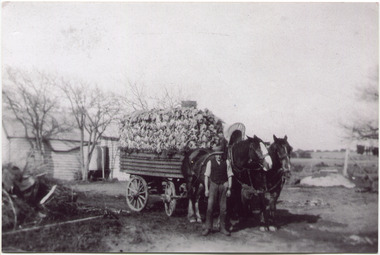
Photograph, Black & White, V Peterson East Boundary Rd East Bentleigh loaded wagon c1900, original c1900
... The early settlers like the Petersons , in the Parish of Moorabbin County of Bourke after Henry Dendy's Special Survey Brighton 1841, established market gardens, fruit & flower gardens, poultry & dairy farms, vineyards as well as shop businesses, blacksmiths, chemists, nursing homes and schools & Churches. wagons, vulcan trucks, draught horses,, peterson vic, marriott dick, cabbage crops, vegetable crops, poliomyelitis epidemics 20thc , elster creek, plateways moorabbin shire, smith j l; smith mary ann, stanley helen, smith vic, smith harry redvers, chaff cutter, horse drawn carts, toll gates brighton, motor cars 1900, steam engines, early settlers, bentleigh, mckinnon, parish of moorabbin, city of moorabbin, county of bourke, moorabbin roads board, shire of moorabbin, henry dendy's special survey 1841, were j.b.; bent thomas, o'shannassy john, king richard, charman stephen, highett william, ormond francis, maynard dennis, market gardeners, vineyards, orchards Back Hand written information Black & White photograph showing Vic Peterson beside the horse drawn wagon loaded with 35dozen ( 12x 35) cabbages setting off to market c 1900 Original re-digitised by H Stanley 2005 Photograph, Black & White, V Peterson East Boundary Rd East Bentleigh loaded wagon c1900 Vic Peterson family ...The Peterson family were early settlers in Moorabbin Shire and established a market garden in East Boundary Road East Bentleigh. Vic Peterson and family loaded the crop - cabbages - onto the horse drawn wagon and set off to the Melbourne market using the Plateways that ran along Centre Road and Nepean Highway. The early settlers like the Petersons , in the Parish of Moorabbin County of Bourke after Henry Dendy's Special Survey Brighton 1841, established market gardens, fruit & flower gardens, poultry & dairy farms, vineyards as well as shop businesses, blacksmiths, chemists, nursing homes and schools & Churches.Black & White photograph showing Vic Peterson beside the horse drawn wagon loaded with 35dozen ( 12x 35) cabbages setting off to market c 1900 Original re-digitised by H Stanley 2005Back Hand written informationwagons, vulcan trucks, draught horses,, peterson vic, marriott dick, cabbage crops, vegetable crops, poliomyelitis epidemics 20thc , elster creek, plateways moorabbin shire, smith j l; smith mary ann, stanley helen, smith vic, smith harry redvers, chaff cutter, horse drawn carts, toll gates brighton, motor cars 1900, steam engines, early settlers, bentleigh, mckinnon, parish of moorabbin, city of moorabbin, county of bourke, moorabbin roads board, shire of moorabbin, henry dendy's special survey 1841, were j.b.; bent thomas, o'shannassy john, king richard, charman stephen, highett william, ormond francis, maynard dennis, market gardeners, vineyards, orchards -
Glenelg Shire Council Cultural Collection
Photograph - Photograph - Cape Grant Quarry, n.d
... One truck laden with large rocks exiting quarry, 3 other empty trucks lined up on right hand side. Photo taken looking towards sea....One truck laden with large rocks exiting quarry, 3 other empty trucks lined up on right hand side. Photo taken looking towards sea. ...Port of Portland Authority ArchivesBack: Quarry\, June 8th - top left, pencilport of portland archives, cape grant quarry -
Glenelg Shire Council Cultural Collection
Photograph - Photograph - Harman 3/4 Yard Shovel, 1952
... truck coming round the corner. A man is on left of low-loader. Cannon in background. Two holes punched in left-hand border....truck coming round the corner. A man is on left of low-loader. Cannon in background. Two holes punched in left-hand border. ...Port of Portland Authority ArchivesFront: 'HARMAN 3/4 YARD SHOVEL DELIVERED 30.10.52' - typed Back: 11/1 - top left, pen. Purple PHT stamp 11/1 22 30.2.52port of portland archives -
Glenelg Shire Council Cultural Collection
Photograph - Photograph - Early Shipping: Ocean / Railway Pier, Early Shipping: Ocean/Railway Pier, n.d
... Port of Portland Authority Archives Port of Portland Front: Front- M.E Andrews, Portland,-Printed right hand side bottom Back- Purple stamp-'Portland Harbor Trust Commissioners' 5-blue biro Black and white photo. Truck ...Port of Portland Authority ArchivesFront: Front- M.E Andrews, Portland,-Printed right hand side bottom Back- Purple stamp-'Portland Harbor Trust Commissioners' 5-blue biroport of portland -
 Glenelg Shire Council Cultural Collection
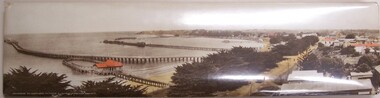
Photograph - Photograph - Portland Panorama, n.d
... Truck loaded with wool bales. Power poles. Red roofs on Baths, Court House, Richmond Hotel, Bank of Australasia Hand coloured....Truck loaded with wool bales. Power poles. Red roofs on Baths, Court House, Richmond Hotel, Bank of Australasia Hand coloured. ...Plastic coated mounted on metal/fold out stand. View of Harbour taken from "All Saints" steeple. Contains - Baths, Ocean Pier, Long Pier, Fishermans Wharf. Bentinck Street. Unseated - Truck loaded with wool bales. Power poles. Red roofs on Baths, Court House, Richmond Hotel, Bank of Australasia Hand coloured.Front: Panorama of Portland, Victoria (length of Ocean Pier 2880 ft).harbour, photography -
Glenelg Shire Council Cultural Collection
Photograph - Photograph - silo construction Portland harbour, n.d
... hand side. Black and white photograph showing silos on left of photo. Foreground is piles of filling, tip truck unloading, workmen to left of tipper. ...Port of Portland Authority ArchivesBack: Filling for new road alignment June 4 in pencil top left hand side.port of portland archives, silos -
 Orbost & District Historical Society
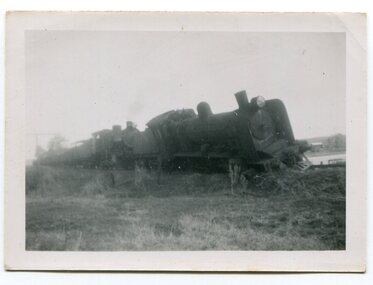
black and white photographs, 1950s
... on back of 3082.8 - hand-written in blue pen :"The floods worked the line from under the trucks in a couple of hours"...This is a pictorial record of a significant event in the history of Orbost. floods-Orbost Orbost-Railway-Station rescue Courtney-Dudley-Charles-Seymour on back of 3082.8 - hand-written in blue pen :"The floods worked the line from under the trucks in a couple of hours" Nine small black / white photographs of a derailed train at a railway station. ...Dudley Charles Seymour Courtney , with a fellow worker, was trapped on the Orbost Raailwaay Station roof until rescued by an army duck. These photographs were his. He worked on the railway in Orbost from 1942 - 1952 approximately. During the 1952 flood nearly half of Orbost rail way station is washed away. The stationmaster and four members of his staff were rescued by police using army ducks.This is a pictorial record of a significant event in the history of Orbost.Nine small black / white photographs of a derailed train at a railway station. Derailed trucks and floodwaters can be seen. The photographs have a narrow white frame. Some are portrait and others landscape.on back of 3082.8 - hand-written in blue pen :"The floods worked the line from under the trucks in a couple of hours"floods-orbost orbost-railway-station rescue courtney-dudley-charles-seymour -
 Phillip Island and District Historical Society Inc.
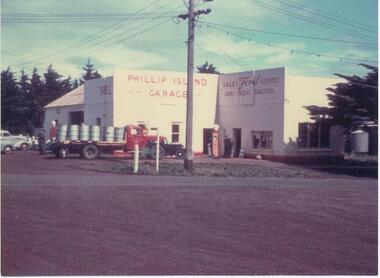
Photographs, Fuji Film, Gullifers Garage, 1950's & 60's
... Trucks Tractors" Phone (8). Shell bowsers. 350-10: Colour photograph of the De La Haye Bros. Self Service store in Thompson Avenue, Cowes on the left hand side. ...Trucks Tractors" Phone (8). Shell bowsers. 350-10: Colour photograph of the De La Haye Bros. Self Service store in Thompson Avenue, Cowes on the left hand side. ...Two of a collection of photographs donated by Bernie De Le Haye.350-09: Colour photograph of Phillip Island Garage. Cnr Thompson Avenue and Chapel Street - now where Gullivers Restaurant is located (2017). Loaded truck and people outside the building. Printed on the front: "Sales Ford Service" "Cars Trucks Tractors" Phone (8). Shell bowsers. 350-10: Colour photograph of the De La Haye Bros. Self Service store in Thompson Avenue, Cowes on the left hand side. Three people and two cars in front.As on the buildings.phillip island garage, de le haye bros self service cowes, bernie de la haye, gullifer family -
 Cheese World Museum
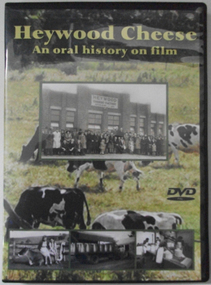
DVD, Heywood Cheese; an oral history on film
... truck drivers. We hear their stories of the long hours and hard work without penalty rates, travelling unsealed roads and mixed with their humour of the bygone days is an important acknowledgement of that era. [blurb on back cover] This oral history provides significant material relating to the dairy industry in south west Victoria during the mid 20th century. The interviews give first-hand ...For many years the Heywood Cheese Factory was an important part of life for Heywood and district farming and a vital place of employment for up to 40 men and 10 women. The factory opened in 1939 as a subsidiary of the Portland Butter Factory before becoming a world renowned cheese making enterprise. It was felt important to document its history from the surviving factory workers, including dairy suppliers and milk truck drivers. We hear their stories of the long hours and hard work without penalty rates, travelling unsealed roads and mixed with their humour of the bygone days is an important acknowledgement of that era. [blurb on back cover]This oral history provides significant material relating to the dairy industry in south west Victoria during the mid 20th century. The interviews give first-hand recollections of the interviewees involvement in the industry from a point of view of factory workers, milk pick-up drivers and farmers.Full colour DVD cover has photograph of Heywood Cheese factory and photographs of girls with calves, milk cans on a truck and workers in the cheese room, superimposed on a photograph of dairy cows grazing in a paddock. The DVD has the photograph of the cows grazing in the paddock.Heywood Cheese/An oral history on film (front) For many years Heywood Cheese Factory was ... [see historical information] Edited by Garry Kerr for the Heywood Pioneer Wagon Shed/ Museum History Group who wish to gratefully acknowledge the/ support of the Victorian Government and Public Records Office/ Victoria for making this project possible. Duration: 70 minutesallansford, heywood, cheese factories, cheese manufacturing, dairying, cheese -
 Bendigo Military Museum
Photograph - Headquarters Squadron Staff and Activities, Army Survey Regiment, Fortuna, Bendigo, c1990
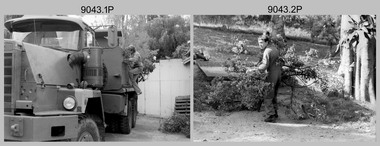
... They are part of the Army Survey Regiment’s Collection. .1) - Photo, black & white, c1990, Neil Morgan loads up branches and clippings onto a Mack truck. .2) - Photo, black & white, c1990, RQMS CAPT Noel ‘Nesty’ Coulthard gets his hands dirty collecting branches and clippings. .3) - Photo, black & white, c1990, Unidentified staff from Headquarters Squadron. .4) - Photo, black & white, c1990, Unidentified staff member from Headquarters Squadron. .5) - Photo, black & white, c1990, Unidentified contractor performs maintenance outside Lithographic Squadron .6) - Photo, black & white, c1990, Unidentified staff from Headquarters Squadron. ...They are part of the Army Survey Regiment’s Collection. .1) - Photo, black & white, c1990, Neil Morgan loads up branches and clippings onto a Mack truck. .2) - Photo, black & white, c1990, RQMS CAPT Noel ‘Nesty’ Coulthard gets his hands dirty collecting branches and clippings. .3) - Photo, black & white, c1990, Unidentified staff from Headquarters Squadron. .4) - Photo, black & white, c1990, Unidentified staff member from Headquarters Squadron. .5) - Photo, black & white, c1990, Unidentified contractor performs maintenance outside Lithographic Squadron .6) - Photo, black & white, c1990, Unidentified staff from Headquarters Squadron. ...This collection of six photos of Headquarters Squadron staff and activities was taken at the Army Survey Regiment, Fortuna, Bendigo, circa 1990. The photos were taken in the Q-store/Transport buildings and Fortuna’s grounds. Although these photos are not annotated some staff are positively identified. This is a set of six photographs of Headquarters Squadron staff and activities at the Army Survey Regiment, Fortuna, Bendigo, circa 1990. The photographs are on 35mm negative film and scanned at 96 dpi. They are part of the Army Survey Regiment’s Collection. .1) - Photo, black & white, c1990, Neil Morgan loads up branches and clippings onto a Mack truck. .2) - Photo, black & white, c1990, RQMS CAPT Noel ‘Nesty’ Coulthard gets his hands dirty collecting branches and clippings. .3) - Photo, black & white, c1990, Unidentified staff from Headquarters Squadron. .4) - Photo, black & white, c1990, Unidentified staff member from Headquarters Squadron. .5) - Photo, black & white, c1990, Unidentified contractor performs maintenance outside Lithographic Squadron .6) - Photo, black & white, c1990, Unidentified staff from Headquarters Squadron. .1P to .6P – There are no annotationsroyal australian survey corps, rasvy, fortuna, army survey regiment -
 Bendigo Military Museum
Administrative record - Royal Australian Survey Corps - Central Command Operation Order C/1/61 Northern Territory 1961, DAD Svy, HQ Central Command , Keswick Barracks, SA, 1961
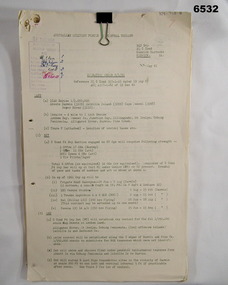
... The Operation Order details the tasks for the 6 x Officers (or equivalent) and 34 x OR's (or equivalent) and the support that was allocated including Frigate HMAS Gasgoyne, LSM landing craft, Trucks amphibian (DUKW), Helicopter and Cessna aircraft. Royal Australian Survey Corps RASvy Fortuna Army Survey Regiment Army Svy Regt Hand written File Number in top RH Corner "101-310-4". ...This is a Central Command Operation Order for the Royal Australian Survey Corps to conduct a Survey Operation in Northern Territory in 1961. The task is to acquire Survey Control for the production of maps coving the following 1:250 000 map areas of Alligator River, Mt Evelyn, Coburg Peninsula, (including the offshore Islands, Melville Island and Bathurst Island. The Operation Order details the tasks for the 6 x Officers (or equivalent) and 34 x OR's (or equivalent) and the support that was allocated including Frigate HMAS Gasgoyne, LSM landing craft, Trucks amphibian (DUKW), Helicopter and Cessna aircraft.A 11 x page foolscap size paper report and 1 x foldout map Annex held together with a paper clip. Two hole punched.Hand written File Number in top RH Corner "101-310-4". Distribution stamp in top LH Corner. Hand written No7 in Top RH Corner.royal australian survey corps, rasvy, fortuna, army survey regiment, army svy regt -
 Eltham District Historical Society Inc
Newspaper clipping, Supermarket next on old site, Diamond Valley Mirror, Wed. Feb 17, 1965, p5, 1965
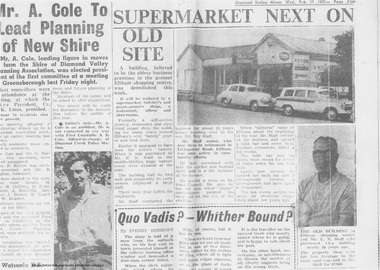
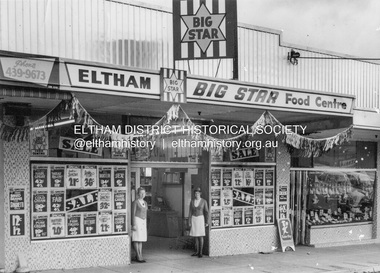
... handing over the reins to his son, Ray Staff. When his son Ray took over, the milk bar and tea rooms were closed for several years but the milk bar and was later re-opened and subsequently became a greengrocers and later again, a restaurant. The tea rooms section was converted to an electrical repair shop about 1955. Electoral Roll records for 1967 record Raymond Charles Staff at 929 Main Road, Eltham, grocer, and in 1968 at Lot 4, Hillcrest Avenue, Eltham, taxi truck...handing over the reins to his son, Ray Staff. When his son Ray took over, the milk bar and tea rooms were closed for several years but the milk bar and was later re-opened and subsequently became a greengrocers and later again, a restaurant. The tea rooms section was converted to an electrical repair shop about 1955. Electoral Roll records for 1967 record Raymond Charles Staff at 929 Main Road, Eltham, grocer, and in 1968 at Lot 4, Hillcrest Avenue, Eltham, taxi truck ...In February 1965, Staffs Railway Store, the oldest business premises in the Eltham shopping district was demolished. Formerly a self-service grocery, restaurant and electrical repair shop, the building for many years housed Eltham’s only ‘family’ grocer and feed store. Earlier it had appeared to have been the town’s bakery. The building had been purchased in late March 1939 by Mr Eric N. Staff. At the time of E.N. Staff’s purchase there were huge bakers’ ovens located at the rear and the building also had a well and four toilets for employees. When the ‘pictures’ came to Eltham with the opening of the Eltham Public Hall across the road in 1941, Mr E.N. Staff extended the business and opened a milk bar and sweet shop. Further extensions re-established the tea rooms of days gone by. Mr E.N. Staff conducted business for about 15 years before handing over the reins to his son, Ray Staff. When his son Ray took over, the milk bar and tea rooms were closed for several years but the milk bar and was later re-opened and subsequently became a greengrocers and later again, a restaurant. The tea rooms section was converted to an electrical repair shop about 1955. Electoral Roll records for 1967 record Raymond Charles Staff at 929 Main Road, Eltham, grocer, and in 1968 at Lot 4, Hillcrest Avenue, Eltham, taxi truck operator. So it would appear that Ray continued to run the business for approximately two years after the original store was demolished and a new supermarket was built. Today, 929 Main Road is the Nongkhai Thai Restaurant and is precisely where the original Staffs store stood. Even though the facade has been modified at eye level with new larger windows, the upper facade is identical to that of the new Eltham Big Star Food Centre of 1965/66. But how did the original building, the oldest premises in the 1965 era shopping centre come about? On August 12th, 1902 at the Eltham Courthouse, appearing before T. Smallman, Esq,. Police Magistrate, and Messrs. W. Duncan and W.J. Taylor, Justices of the Peace is Luther Haley, baker. Wilfred Henry Johnston, by his agent Stanley Ernest Elder had applied for a warrant of ejectment under the Landlord and Tenant Act 1890 against Luther Haley from the bakery premises at the corner of Main Road and York Street. From the evidence presented we learn that Mrs Burgoyne of Eltham had purchased the property some months earlier from Mr Johnston, which consisted of a store and bakery establishment at Eltham occupied by Mr. Luther Haley, and whose lease expired some little time back, and up to the present time, Mr. Haley was not prepared to leave. He informed the court that he is unable to secure at Eltham a suitable house in which to carry on his business, but was building a place near the railway station which he expected to be done in about three weeks time, and he is then prepared to give up possession of the premises he now occupies. Mr Smallman informed the defendant, Luther Haley, that he will have to quit the premises in three weeks from the present date, and that a warrant of ejectment would be issued. However he also informed Mr Haley that he would order the warrant to lie in the office for three weeks from that date. The premises under construction referred to by Luther Haley in court were situated on the western side of Main Road, near the railway station slightly opposite present-day Arthur Street. It was opened around September 1902 as a General Store, Bakery and Tea Rooms. This was the original building in the present-day shopping precinct. At the time the only thing nearby was the railway station. Luther Haley’s business appeared to prosper and he would have catered to not only the locals abut also day visitors by train on Sundays coming up from Melbourne, offering fresh baked produce, tea rooms and summer drinks. The fields across Main Road running between present day Arthur Street and Luck Street were known as Haley’s Paddock and at times were used for community festivities and picnics. A newspaper report on the annual State schools picnic held at Haley’s Paddock on March 11, 1904 described it as “quite close to the railway station, and is quite capable of holding comfortably 10,000 people. With its ample shade and hilly surroundings, it is an ideal place for any gathering.” Luther Haley successfully ran his general store, bakery and tea rooms until 1917 when he and his family departed the district and moved to Westgarth Street in Northcote where he changed careers and became a publisher. It was then taken over by Hannah Lloyd and became known as Lloyd’s Railway General Store from 1917 to 1920. From then it had a succession of owners, one as short as two months until March 31, 1939 when the Grocery Business formerly carried on by Mr. T.K. White of Eltham for the previous eight years was purchased by Mr Eric N. Staff of Research and became known as E.N. Staff’s Railway Store. The ownership timeline for the store is as follows: Luther Haley Sep 1902-1917 Hannah Lloyd 1917-c.Feb 1920 Messrs J.R. & N.E. Lee 1920-Sep 1922 A. & E. Copeland Sep 1922-Sep 1925 Mr Price Sep 1925-Nov 1925 Mr Warren Nov 1925?-Nov 1926 A.W.J. Edwards Nov 1926-1931 T.K. White 1931-Mar 1939 Eric Staff Apr 1939-c.1954 Ray Staff c.1954-Feb 1965 then demolished Ray Staff Eltham Big Star Food Centre c.1965-1967 Digital file only from scan of copy on loan to EDHSa. copeland, a.w.j. edwards, big star food centre, e. copeland, eltham, eric staff, general store, hannah lloyd, j.r. lee, lloyd's general store, luther haley, main road, n.e. lee, price, ray staff, staffs general store, supermarket, t.k. white -
 Eltham District Historical Society Inc
Photograph, Eltham Big Star Food Centre, Main Road, Eltham, c.1966
... handing over the reins to his son, Ray Staff. When his son Ray took over, the milk bar and tea rooms were closed for several years but the milk bar and was later re-opened and subsequently became a greengrocers and later again, a restaurant. The tea rooms section was converted to an electrical repair shop about 1955. Electoral Roll records for 1967 record Raymond Charles Staff at 929 Main Road, Eltham, grocer, and in 1968 at Lot 4, Hillcrest Avenue, Eltham, taxi truck...handing over the reins to his son, Ray Staff. When his son Ray took over, the milk bar and tea rooms were closed for several years but the milk bar and was later re-opened and subsequently became a greengrocers and later again, a restaurant. The tea rooms section was converted to an electrical repair shop about 1955. Electoral Roll records for 1967 record Raymond Charles Staff at 929 Main Road, Eltham, grocer, and in 1968 at Lot 4, Hillcrest Avenue, Eltham, taxi truck ...In February 1965, Staffs Railway Store, the oldest business premises in the Eltham shopping district was demolished. Formerly a self-service grocery, restaurant and electrical repair shop, the building for many years housed Eltham’s only ‘family’ grocer and feed store. Earlier it had appeared to have been the town’s bakery. The building had been purchased in late March 1939 by Mr Eric N. Staff. At the time of E.N. Staff’s purchase there were huge bakers’ ovens located at the rear and the building also had a well and four toilets for employees. When the ‘pictures’ came to Eltham with the opening of the Eltham Public Hall across the road in 1941, Mr E.N. Staff extended the business and opened a milk bar and sweet shop. Further extensions re-established the tea rooms of days gone by. Mr E.N. Staff conducted business for about 15 years before handing over the reins to his son, Ray Staff. When his son Ray took over, the milk bar and tea rooms were closed for several years but the milk bar and was later re-opened and subsequently became a greengrocers and later again, a restaurant. The tea rooms section was converted to an electrical repair shop about 1955. Electoral Roll records for 1967 record Raymond Charles Staff at 929 Main Road, Eltham, grocer, and in 1968 at Lot 4, Hillcrest Avenue, Eltham, taxi truck operator. So it would appear that Ray continued to run the business for approximately two years after the original store was demolished and a new supermarket was built. Today, 929 Main Road is the Nongkhai Thai Restaurant and is precisely where the original Staffs store stood. Even though the facade has been modified at eye level with new larger windows, the upper facade is identical to that of the new Eltham Big Star Food Centre of 1965/66. But how did the original building, the oldest premises in the 1965 era shopping centre come about? On August 12th, 1902 at the Eltham Courthouse, appearing before T. Smallman, Esq,. Police Magistrate, and Messrs. W. Duncan and W.J. Taylor, Justices of the Peace is Luther Haley, baker. Wilfred Henry Johnston, by his agent Stanley Ernest Elder had applied for a warrant of ejectment under the Landlord and Tenant Act 1890 against Luther Haley from the bakery premises at the corner of Main Road and York Street. From the evidence presented we learn that Mrs Burgoyne of Eltham had purchased the property some months earlier from Mr Johnston, which consisted of a store and bakery establishment at Eltham occupied by Mr. Luther Haley, and whose lease expired some little time back, and up to the present time, Mr. Haley was not prepared to leave. He informed the court that he is unable to secure at Eltham a suitable house in which to carry on his business, but was building a place near the railway station which he expected to be done in about three weeks time, and he is then prepared to give up possession of the premises he now occupies. Mr Smallman informed the defendant, Luther Haley, that he will have to quit the premises in three weeks from the present date, and that a warrant of ejectment would be issued. However he also informed Mr Haley that he would order the warrant to lie in the office for three weeks from that date. The premises under construction referred to by Luther Haley in court were situated on the western side of Main Road, near the railway station slightly opposite present-day Arthur Street. It was opened around September 1902 as a General Store, Bakery and Tea Rooms. This was the original building in the present-day shopping precinct. At the time the only thing nearby was the railway station. Luther Haley’s business appeared to prosper and he would have catered to not only the locals abut also day visitors by train on Sundays coming up from Melbourne, offering fresh baked produce, tea rooms and summer drinks. The fields across Main Road running between present day Arthur Street and Luck Street were known as Haley’s Paddock and at times were used for community festivities and picnics. A newspaper report on the annual State schools picnic held at Haley’s Paddock on March 11, 1904 described it as “quite close to the railway station, and is quite capable of holding comfortably 10,000 people. With its ample shade and hilly surroundings, it is an ideal place for any gathering.” Luther Haley successfully ran his general store, bakery and tea rooms until 1917 when he and his family departed the district and moved to Westgarth Street in Northcote where he changed careers and became a publisher. It was then taken over by Hannah Lloyd and became known as Lloyd’s Railway General Store from 1917 to 1920. From then it had a succession of owners, one as short as two months until March 31, 1939 when the Grocery Business formerly carried on by Mr. T.K. White of Eltham for the previous eight years was purchased by Mr Eric N. Staff of Research and became known as E.N. Staff’s Railway Store. The ownership timeline for the store is as follows: Luther Haley Sep 1902-1917 Hannah Lloyd 1917-c.Feb 1920 Messrs J.R. & N.E. Lee 1920-Sep 1922 A. & E. Copeland Sep 1922-Sep 1925 Mr Price Sep 1925-Nov 1925 Mr Warren Nov 1925?-Nov 1926 A.W.J. Edwards Nov 1926-1931 T.K. White 1931-Mar 1939 Eric Staff Apr 1939-c.1954 Ray Staff c.1954-Feb 1965 then demolished Ray Staff Eltham Big Star Food Centre c.1965-1967 Research and copy: Peter Pidgeon (EDHS) Digital file only from scan of copy on loan to EDHSa. copeland, a.w.j. edwards, big star food centre, e. copeland, eltham, eric staff, general store, hannah lloyd, j.r. lee, lloyd's general store, luther haley, main road, n.e. lee, price, ray staff, staffs general store, supermarket, t.k. white -
 Kiewa Valley Historical Society
Folder - C. Roper, Tawonga, Kiewa Valley Historical Society
... Thick cream cardboard folded and hand sewn at the spine with 2 small photos glued onto the cover. 9 pages with newspaper articles glued on are sewn inside the cover. Includes: Newspaper clippings on: Historical societies including the Kiewa Valley Historical Society and its history, members roll etc. Also the Halford truck...Clare Roper; Kiewa Valley; Halford truck; Kiewa Valley Historical Society Thick cream cardboard folded and hand sewn at the spine with 2 small photos glued onto the cover. 9 pages with newspaper articles glued on are sewn inside the cover. ...Clare Roper was a resident of the Kiewa Valley and belonged to the Kiewa Valley Historical Society.Clare Roper collected and collated items of historical interest for the Kiewa Valley Historical Society.Thick cream cardboard folded and hand sewn at the spine with 2 small photos glued onto the cover. 9 pages with newspaper articles glued on are sewn inside the cover. Includes: Newspaper clippings on: Historical societies including the Kiewa Valley Historical Society and its history, members roll etc. Also the Halford truckclare roper; kiewa valley; halford truck; kiewa valley historical society
