
Showing 173 items matching "handling of weapons"
-
 National Vietnam Veterans Museum (NVVM)
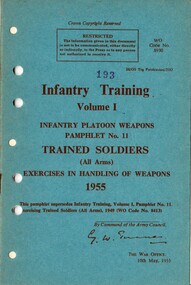
Booklet, Australian Army, Infantry Training Volume 1, Infantry Platoon Weapons Pamphlet No.11, Trained Soldiers (All Arms) Exercises in Handling of Weapons 1955 (Copy 1)
... Infantry Training Volume 1, Infantry Platoon Weapons Pamphlet No.11, Trained Soldiers (All Arms) Exercises in Handling of Weapons 1955 (Copy 1)......Handling of Weapons...Australia - Armed Forces - Service manuals Drill Manual Infantry Training Infantry Platoon Weapons Handling of Weapons A blue colour cover with red details. there are seven punch holes down the left hand side. ...A blue colour cover with red details. there are seven punch holes down the left hand side.australia - armed forces - service manuals, drill manual, infantry training, infantry platoon weapons, handling of weapons -
 National Vietnam Veterans Museum (NVVM)
Booklet, Australian Army: Infantry training, Vol. 1: Infantry platoon weapons pamphlet No. 11, trained soldiers (all arms): exercises in handling of weapons, 1955, 1955
... Australian Army: Infantry training, Vol. 1: Infantry platoon weapons pamphlet No. 11, trained soldiers (all arms): exercises in handling of weapons, 1955...Australia - Armed Forces - Service manuals Australian Army: Infantry training, Vol. 1: Infantry platoon weapons pamphlet No. 11, trained soldiers (all arms): exercises in handling of weapons, 1955 Booklet Booklet Australian Army ...australia - armed forces - service manuals -
 4th/19th Prince of Wales's Light Horse Regiment Unit History Room
Ammunition Box, 1944
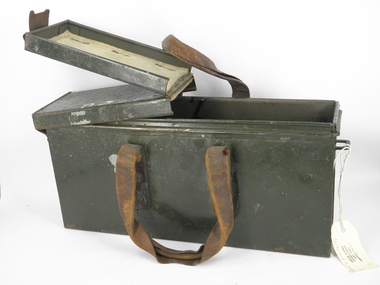
... In earlier times, school cadet units were allowed to learn safe handling of weapons including the Vickers machine gun. ...In earlier times, school cadet units were allowed to learn safe handling of weapons including the Vickers machine gun. ...Box is marked "W.C.C.U" - perhaps Wesley College Cadet Unit. In earlier times, school cadet units were allowed to learn safe handling of weapons including the Vickers machine gun. This object probably held belted ammunition.Sheet metal ammunition box, probably for .303 inch belted ammunition. Double hinged lid, Leather handles. Painted green Manufacturer's stamp at each end.: " R P L" over "S" over "1944" On one end in white paint "2" On top in white paint : "W.C.C.U" - and "2" ammunition box -
4th/19th Prince of Wales's Light Horse Regiment Unit History Room
Booklet, B & M Ltd, Infantry Training Vol 1 Infantry Platoon Weapons Pam 11 Trained Soldiers Exercises in Handling Weapons, 1955
... A soft covered booklet with suggestions for sub-unit commanders in ways of exercising their trained soldiers in the handling of infantry weapons...Infantry weapons training WO Code No 8930 Adhesive label: "Sgt P W A Fernleigh" A soft covered booklet with suggestions for sub-unit commanders in ways of exercising their trained soldiers in the handling of infantry weapons Infantry Training Vol 1 Infantry Platoon Weapons Pam 11 Trained Soldiers Exercises in Handling Weapons Booklet B & M Ltd ...A soft covered booklet with suggestions for sub-unit commanders in ways of exercising their trained soldiers in the handling of infantry weaponsWO Code No 8930 Adhesive label: "Sgt P W A Fernleigh"infantry weapons training -
4th/19th Prince of Wales's Light Horse Regiment Unit History Room
Booklet (3 copies), Infantry Training Vol 1 Infantry Platoon Weapons Pam 14 66mm Light Anti-tank weapon M72, 1966
... A soft covered booklet providing information to train soldiers to handle and fire the weapon. On copy has Amdt No 1...M72 "66 mm anti tank weapon" 7610-66-024-4120 A soft covered booklet providing information to train soldiers to handle and fire the weapon. ...A soft covered booklet providing information to train soldiers to handle and fire the weapon. On copy has Amdt No 17610-66-024-4120m72 "66 mm anti tank weapon" -
4th/19th Prince of Wales's Light Horse Regiment Unit History Room
Booklet (2 copies), Manual of Land Warfare Part 2 Infantry Training Vol 4 Pam 5: 7.62 mm Self Loading Rifle L1A1 & Automatic Rifle 7.62 mm L2A1, 1983
... A soft covered booklet aimed at providing the soldier with the necessary information for him to develop the confidence and knowledge to efficiently handle and maintain these weapons....Rifle SLR 7.62 automatic rifle DSN 7610-66-107-1254 A soft covered booklet aimed at providing the soldier with the necessary information for him to develop the confidence and knowledge to efficiently handle and maintain these weapons. Manual of Land Warfare Part 2 Infantry Training Vol 4 Pam 5: 7.62 mm Self Loading Rifle L1A1 & Automatic Rifle 7.62 mm L2A1 Booklet (2 copies) ...A soft covered booklet aimed at providing the soldier with the necessary information for him to develop the confidence and knowledge to efficiently handle and maintain these weapons.DSN 7610-66-107-1254rifle slr 7.62, automatic rifle -
 Bendigo Military Museum
Manual - INFANTRY TRAINING, The War Office, 1955, 1967, 1970
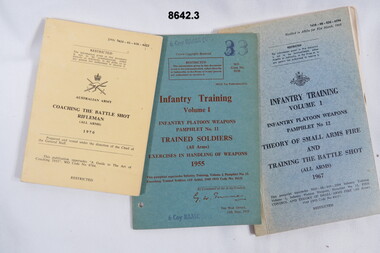
... This card is designed to assist coaches on the rifle range in their duties to ensure that the firer handles and fires his weapon correctly. (x4 booklets)....This card is designed to assist coaches on the rifle range in their duties to ensure that the firer handles and fires his weapon correctly. (x4 booklets). ...1. The aim of this manual is to suggest to sub-unit commanders way of exercising their trained men in the handling of infantry weapons. 2. To understand and apply the theory of the group and small arms fire, it is essential to have thorough knowledge of (a) The definitions (b) The factors affecting sighting and Elementary theory (rifle). 3. This card is designed to assist coaches on the rifle range in their duties to ensure that the firer handles and fires his weapon correctly. (x4 booklets).1. 6 COY RAASC (CoT) 33, 2. Amendment No.1 enclosed. 3. 6 TPT COLM.passchendaele barracks trust, pbt 81 82, manual, infantry, training -
 Bendigo Military Museum
Manual - SMALL ARMS TRAINING, Australian Defence Force, 1937, 1942, 1943, 1944
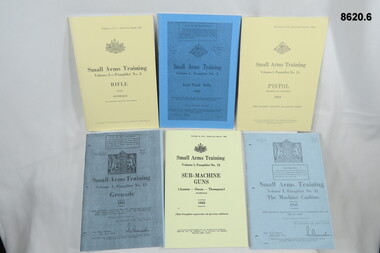
... Six small arms training pamphlets designed to teach all ranks the most efficient way of handling their weapons in order to suppress the enemy. 1. ...Passchendaele Barracks Trust PBT 8 9 10 11 12 13 Manuals Training Pamphlets Six small arms training pamphlets designed to teach all ranks the most efficient way of handling their weapons in order to suppress the enemy. 1. ...Six small arms training pamphlets designed to teach all ranks the most efficient way of handling their weapons in order to suppress the enemy. 1. Volume 1, Pamphlet No. 5 Anti-Tank Rifle 1937. 2. Volume 1, Pamphlet No. 13 Grenade 1942. 3. Volume 1, Pamphlet No. 11 Pistol 1943 4. Volume 1, Pamphlet No. 3 Rifle 1943, 5. Volume 1, Pamphlet No. 15 Sub-Machine Guns 1943, 6. Volume 1, Pamphlet No. 21 The Machine Carbine 1944.passchendaele barracks trust, pbt 8 9 10 11 12 13, manuals, training pamphlets -
 National Vietnam Veterans Museum (NVVM)
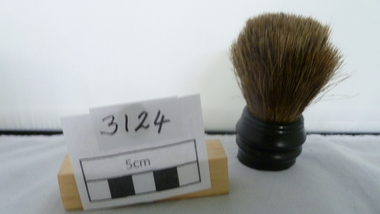
Equipment - Equipment, Army, Shaving Brush
... Bristle brush, black-handled shaving brush used to clean debris from weapons. Handle has been cut dowm....Shaving Brush SAS Bristle brush, black-handled shaving brush used to clean debris from weapons. Handle has been cut dowm. ...Bristle brush, black-handled shaving brush used to clean debris from weapons. Handle has been cut dowm.shaving brush, sas -
4th/19th Prince of Wales's Light Horse Regiment Unit History Room
Booklet (4 copies), Infantry Training Vol 1 Infantry Platoon Weapons Pam 3B The 7.62 Self Loading Rifle and Bayonet and 7.62 Automatic Rifle, 1971
... A soft covered booklet providing instructors with the necessary information to develop in soldiers the confidence to handle and maintain these weapons. One booklet has amdt No 1, two have amdts 1 and 2 and one has amdts 1,2 and 3...Rifle 7.62 SLR Automatic Rifle 7.63 DSN 7610-66-043-7060 A soft covered booklet providing instructors with the necessary information to develop in soldiers the confidence to handle and maintain these weapons. One booklet has amdt No 1, two have amdts 1 and 2 and one has amdts 1,2 and 3 Infantry Training Vol 1 Infantry Platoon Weapons Pam 3B The 7.62 Self Loading Rifle and Bayonet and 7.62 Automatic Rifle Booklet (4 copies) ...A soft covered booklet providing instructors with the necessary information to develop in soldiers the confidence to handle and maintain these weapons. One booklet has amdt No 1, two have amdts 1 and 2 and one has amdts 1,2 and 3DSN 7610-66-043-7060rifle 7.62 slr, automatic rifle 7.63 -
 Flagstaff Hill Maritime Museum and Village
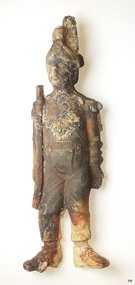
Leisure object - Toy Soldier, circa 1878
... The toy soldier is unpainted, but the style of uniform, and the weapons carried (a musket and a basket-handled cutlass), indicate it is a representation of the Napoleonic Wars period from the beginning of the nineteenth century. ...The toy soldier is unpainted, but the style of uniform, and the weapons carried (a musket and a basket-handled cutlass), indicate it is a representation of the Napoleonic Wars period from the beginning of the nineteenth century. ...The toy soldier is a relic from the shipwreck of the LOCH ARD in 1878. It has a companion piece in the Flagstaff Hill collection. The toy soldier is unpainted, but the style of uniform, and the weapons carried (a musket and a basket-handled cutlass), indicate it is a representation of the Napoleonic Wars period from the beginning of the nineteenth century. Mass-produced toy soldiers made of cast metal (lead or tin) became popular during the 1800s. Heyde of Germany manufactured silhouette-shaped flat toy soldiers early in the century. Mignot of France released three-dimensional solid figures and later around 1893 W. Britain, a toy company became known for its die-cast lead toy soldiers. These innovations were designed to make sets of toy soldiers more affordable for middle and lower-class children, extending the market beyond the intricately made and hand-crafted replicas that were the preserve of the rich in the eighteenth century. Wooden military figures, specially carved and unpainted ones, were therefore not particularly common at the time when the Loch Ard foundered on Victoria’s southwest coast. Mignot was the first to sell unpainted soldiers, leaving their customers to fill in the colours according to their own patriotic preferences. It is, therefore, possible the two figures in the Flagstaff Hill collection were part of a new set intended for sale, rather than part of a passenger’s existing collection. Loch Ard History: The Loch Ard got its name from ”Loch Ard” a loch that lies to the west of Aberfoyle, and the east of Loch Lomond. It means "high lake" in Scottish Gaelic. The vessel belonged to the famous Loch Line which sailed many vessels from England to Australia. The Loch Ard was built in Glasgow by Barclay, Curle & Co. in 1873, the vessel was a three-masted square-rigged iron sailing ship that measured 79.87 meters in length, 11.58 m in width, and 7 m in depth with a gross tonnage of 1693 tons with a mainmast that measured a massive 45.7 m in height. Loch Ard made three trips to Australia and one trip to Calcutta before its fateful voyage. Loch Ard left England on March 2, 1878, under the command of 29-year-old Captain Gibbs, who was newly married. The ship was bound for Melbourne with a crew of 37, plus 17 passengers. The general cargo reflected the affluence of Melbourne at the time. Onboard were straw hats, umbrellas, perfumes, clay pipes, pianos, clocks, confectionery, linen and candles, as well as a heavier load of railway irons, cement, lead and copper. There were other items included that were intended for display in the Melbourne International Exhibition of 1880. The voyage to Port Phillip was long but uneventful. Then at 3 am on June 1, 1878, Captain Gibbs was expecting to see land. But the Loch Ard was running into a fog which greatly reduced visibility. Captain Gibbs was becoming anxious as there was no sign of land or the Cape Otway lighthouse. At 4 am the fog lifted and a lookout aloft announced that he could see breakers. The sheer cliffs of Victoria's west coast came into view, and Captain Gibbs realised that the ship was much closer to them than expected. He ordered as much sail to be set as time would permit and then attempted to steer the vessel out to sea. On coming head-on into the wind, the ship lost momentum, the sails fell limp and Loch Ard's bow swung back towards land. Gibbs then ordered the anchors to be released in an attempt to hold their position. The anchors sank some 50 fathoms - but did not hold. By this time the ship was among the breakers and the tall cliffs of Mutton Bird Island rose behind. Just half a mile from the coast, the ship's bow was suddenly pulled around by the anchor. The captain tried to tack out to sea, but the ship struck a reef at the base of Mutton Bird Island, near Port Campbell. Waves subsequently broke over the ship and the top deck became loosened from the hull. The masts and rigging came crashing down knocking passengers and crew overboard. When a lifeboat was finally launched, it crashed into the side of Loch Ard and capsized. Tom Pearce, who had launched the boat, managed to cling to its overturned hull and shelter beneath it. He drifted out to sea and then on the flood tide came into what is now known as Lochard Gorge. He swam to shore, bruised and dazed, and found a cave in which to shelter. Some of the crew stayed below deck to shelter from the falling rigging but drowned when the ship slipped off the reef into deeper water. Eva Carmichael a passenger had raced onto the deck to find out what was happening only to be confronted by towering cliffs looming above the stricken ship. In all the chaos, Captain Gibbs grabbed Eva and said, "If you are saved Eva, let my dear wife know that I died like a sailor". That was the last Eva Carmichael saw of the captain. She was swept off the ship by a huge wave. Eva saw Tom Pearce on a small rocky beach and yelled to attract his attention. He dived in and swam to the exhausted woman and dragged her to shore. He took her to the cave and broke the open case of brandy which had washed up on the beach. He opened a bottle to revive the unconscious woman. A few hours later Tom scaled a cliff in search of help. He followed hoof prints and came by chance upon two men from nearby Glenample Station three and a half miles away. In a complete state of exhaustion, he told the men of the tragedy. Tom then returned to the gorge while the two men rode back to the station to get help. By the time they reached Loch Ard Gorge, it was cold and dark. The two shipwreck survivors were taken to Glenample Station to recover. Eva stayed at the station for six weeks before returning to Ireland by steamship. In Melbourne, Tom Pearce received a hero's welcome. He was presented with the first gold medal of the Royal Humane Society of Victoria and a £1000 cheque from the Victorian Government. Concerts were performed to honour the young man's bravery and to raise money for those who lost family in the disaster. Of the 54 crew members and passengers on board, only two survived: the apprentice, Tom Pearce and the young woman passenger, Eva Carmichael, who lost her family in the tragedy. Ten days after the Lochard tragedy, salvage rights to the wreck were sold at auction for £2,120. Cargo valued at £3,000 was salvaged and placed on the beach, but most washed back into the sea when another storm developed. The wreck of Lochard still lies at the base of Mutton Bird Island. Much of the cargo has now been salvaged and some items were washed up into Lochard Gorge. Cargo and artefacts have also been illegally salvaged over many years before protective legislation was introduced in March 1982. One of the most unlikely pieces of cargo to have survived the shipwreck was a Minton majolica peacock- one of only nine in the world. The peacock was destined for the Melbourne 1880 International Exhibition. It had been well packed, which gave it adequate protection during the violent storm. Today the Minton peacock can be seen at the Flagstaff Hill Maritime Museum in Warrnambool. From Australia's most dramatic shipwreck, it has now become Australia's most valuable shipwreck artifact and is one of very few 'objects' on the Victorian State Heritage Register.The toy soldier represents a 19th-century child's interest in military history. The item is one of two toy soldiers recovered from the Loch Ard in Flagstaff Hill's collection. The shipwreck of the Loch Ard is of significance for Victoria and is registered on the Victorian Heritage Register ( S 417). Flagstaff Hill has a varied collection of artefacts from Loch Ard and its collection is significant for being one of the largest accumulations of artefacts from this notable Victorian shipwreck of which the subject items are a small part. The collections of objects give us a snapshot of how we can interpret the story of this tragic event. The collection is also archaeologically significant as it represents aspects of Victoria's shipping history, allowing us to interpret Victoria's social and historical themes. Through is associated with the worst and best-known shipwreck in Victoria's history.An unpainted, cream-coloured toy soldier, recovered from the Loch Ard. The figure wears a Napoleonic Wars-era uniform, a plumed helmet, a short jacket with tails, bib-front trousers with button closure, straps crossed at the front and back, and epaulettes. The figure is in marching posture with one foot extended forward, and is bearing a musket at the slope-arms position, with a sabre or cutlass slung behind. It is unable to stand on its own. There are reddish-brown and orange-brown stains on the head and body. The body has seams along both sides that are uneven at the lower leg. There is a hole in the back and the inside is hollow. The material has a rough texture.flagstaff hill, warrnambool, flagstaff hill maritime museum, shipwreck coast, flagstaff hill maritime village, great ocean road, loch ard, toy soldier, napoleonic uniforms, military toy, moulded soldier -
 Federation University Historical Collection
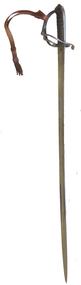
Weapon - Object, Sword, 1877
... Engraved into handle "Ballarat Troop P.W.V.V.L.H Officers Trophy FIRST PRIZE WON BY Trooper Whyte AT SWORD Competition 8th March 1877" Silver coloured sword and scabbard with leather hand grip within the hilt. The sword was awarded to Trooper Whyte of the Prince of Wales Victorian Volunteer Light Horse (Ballarat) in 1877. Sword, 1877 Weapon ...In 1862, the units of the Mounted Volunteer Corps in Victoria were formed into a single regiment known as the Victorian Volunteer Light Horse. This title changed again in 1863, to the Prince of Wales Victorian Volunteer Light Horse ( Hussars ). In 1870 a uniform was adopted that was based on the British 19th Hussars. Troops were based at various times at Geelong, Ballarat, Kyneton, Bendigo, Castlemaine and Dandenong, as well as metropolitan Melbourne. In 1885, most of the Cavalry were incorporated into a newly formed Victorian Mounted Rifles. (http://www.awm.gov.au/collection/REL/18070.001) "It is notified in the Gazette that Lieutenant Laurence Whyte, Ballarat troop Prince of Wales Light Horse, has been appointed captain, seniority to date from January 31. " (The Argus, 17 February 1883) "An official inspection of the P.W.L.H. took place in the Royal Park last evening by the colonel-commandant, assisted by Colonel Rede; Captain Medealf in command of the, troop. After bring exercised in field movements, a sword competition took place, toe first prize bring awarded to Trooper L. Whyte ; the "second to Sergeant Blight; the third, to Trooper Jenkins; and the fourth, to Trooper Orr, of Creswick. Major Sleep officiated as timekeeper. The colonel commandant complimented Captain Med-calf upon the efficiency of the troop, and officers and men afterwards dined together at Craig's hotel. (Ballarat Courier, 09 March 1877.)Silver coloured sword and scabbard with leather hand grip within the hilt. The sword was awarded to Trooper Whyte of the Prince of Wales Victorian Volunteer Light Horse (Ballarat) in 1877.. Engraved into handle "Ballarat Troop P.W.V.V.L.H Officers Trophy FIRST PRIZE WON BY Trooper Whyte AT SWORD Competition 8th March 1877" volunteer forces, sword, trooper whyte, prince of wales victorian volunteer light horse (ballarat), l. whyte, laurence whyte -
 Flagstaff Hill Maritime Museum and Village
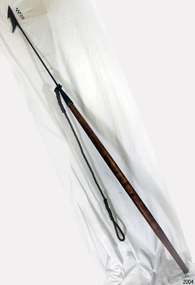
Weapon - Harpoon
... Handle is tapered at throwing end and where spear meets handle. Weapon Harpoon ...Harpoon, Toggle Headed Harpoon, wooden handle and Toggle spear-head, which opened to a perpendicular angle after entering whale. Spear fitted into handle and bound with twine. Handle is tapered at throwing end and where spear meets handle.flagstaff hill, warrnambool, shipwrecked-coast, shipwreck-coast, harpoon, toggle headed harpoon, whaling, whaling harpoon -
 Flagstaff Hill Maritime Museum and Village
Weapon - Harpoon
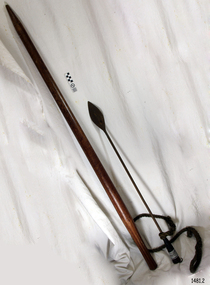
... Handle is tapered at throwing end and where handle joins metal spear. Weapon Harpoon ...Harpoon wooden handle, known as a Hand Lance or Killing Iron. Used to kill the whale after it was harpooned. Spliced piece of rope wound around spear head. Handle is tapered at throwing end and where handle joins metal spear.flagstaff hill, warrnambool, shipwrecked-coast, flagstaff-hill, flagstaff-hill-maritime-museum, maritime-museum, shipwreck-coast, flagstaff-hill-maritime-village, whaling, harpoon, fishing industry -
 Flagstaff Hill Maritime Museum and Village
Weapon - Harpoon
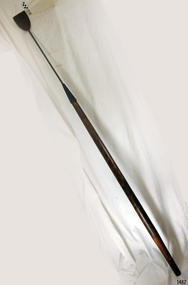
... flagstaff hill warrnambool shipwrecked-coast flagstaff-hill flagstaff-hill-maritime-museum maritime-museum shipwreck-coast flagstaff-hill-maritime-village Harpoon Blubber Spade whaling whaling harpoon Harpoon, Blubber Spade, used to cut blubber from whale carcass, Handle is tapered at both ends. Weapon Harpoon ...Harpoon, Blubber Spade, used to cut blubber from whale carcass, Handle is tapered at both ends. flagstaff hill, warrnambool, shipwrecked-coast, flagstaff-hill, flagstaff-hill-maritime-museum, maritime-museum, shipwreck-coast, flagstaff-hill-maritime-village, harpoon, blubber spade, whaling, whaling harpoon -
 Bunjil Park Aboriginal Education & Cultural Centre
Axehead, 40,000 B.P
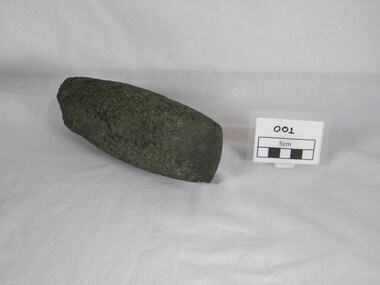
... weapon making Scarring at one end of the axehead where it has been split from larger piece of granite. Green stone granite axehead highly sharpened and beautifully fashioned at one end with rough hewn markings over the body of the object. Axe has a "waist" mid section where handle ...Green stone granite axehead highly sharpened and beautifully fashioned at one end with rough hewn markings over the body of the object. Axe has a "waist" mid section where handle would have been attached. Also evidence of extensive wear from use. This axehead was quarried at one of only two green stone granite sights in Australia both in Victoria. Scarring at one end of the axehead where it has been split from larger piece of granite.defence, food, preparation, green stone granite, axehead, mt camel, jaara jaara people, jaara, waisted, quarries, tree cutting, weapon making -
 Lakes Entrance RSL Sub Branch
Bayonet, 1880
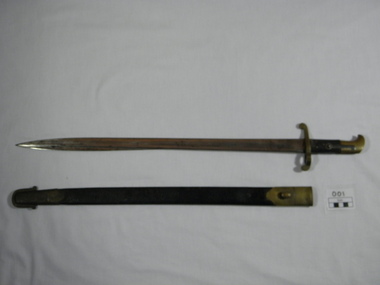
... The Lancaster bayonet was also issued as a side arm in New South Wales in the 1880;s to the Medical Corps. military army steel soldiers brass weapon bayonet crimea war armaments leather rifle Volunteer Lancaster Sword Bayonet-A2. Australian bayonet 1880. Bayonet made of steel with brass hilt and pommel and leather handle. ...The Lancaster bayonet was also issued as a side arm in New South Wales in the 1880;s to the Medical Corps.Volunteer Lancaster Sword Bayonet-A2. Australian bayonet 1880. Bayonet made of steel with brass hilt and pommel and leather handle. Scabbard leather with brass locket and chape.military, army, steel, soldiers, brass, weapon, bayonet, crimea war, armaments, leather, rifle -
 Lara RSL Sub Branch
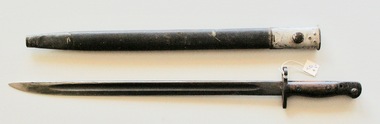
Lithgow 1907 Bayonet and scabbard, Lithgow 1907 Bayonet and scabbard no serial number discerable
... handle leather scabbard Scabbard on the reverse marking stating MANGROVITE 43. Wooden Hilt has no visible markings. Hilt of the bayonet one side is stamped Lithcow 3 '21 over a crest of a six pointed star and a shield which encapules 1907 /1. The pommel also contains a button locking release from the rifle slide mount. The bayonet was designed at the Lithgow Small Arms factory in Australia starting around 1913, just prior to WWI. The Lithgow 1907 Bayonet would become Australia’s staple weapon ...WW1 example of Australian ManufacturingWW1 example of Australian manufacturingThe bayonet was designed at the Lithgow Small Arms factory in Australia starting around 1913, just prior to WWI. The Lithgow 1907 Bayonet would become Australia’s staple weapon along with it’s counter part, the Enfield No1 Mark III rifle. The wood on the hilts is often referred to as furniture and then starting around 1916 Queensland Mapleread moreScabbard on the reverse marking stating MANGROVITE 43. Wooden Hilt has no visible markings. Hilt of the bayonet one side is stamped Lithcow 3 '21 over a crest of a six pointed star and a shield which encapules 1907 /1. The pommel also contains a button locking release from the rifle slide mount.wooden handle, leather scabbard -
 Lara RSL Sub Branch
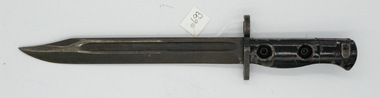
Weapons, Bayonet SLR Rifle, Manufactured from 1958
... handle. The L1A2 bayonet was produced by Australia and Canada (where it was designated C1). The Australian bayonet is devoid of markings. Bayonet SLR Rifle Weapons ...Adopted in 1957, production of the L1A2 bayonet began at Lithgow in 1958. The bayonet is of all metal construction and, in a departure from previous Lithgow production, is devoid of any markings.This Bayonet is an original as would have been used by a member of the AMF.All metal Black SLR Bayonet, Handle is rivetted on to Blade, there are no markings of any kind in the bayonet or handle. The L1A2 bayonet was produced by Australia and Canada (where it was designated C1). The Australian bayonet is devoid of markings.No markings bayonet, steel, black, 1958 -
Glenelg Shire Council Cultural Collection
Weapon - Whaling Spade Lance, n.d
... Whaling implement flat blade pointed one end and handle sleeve on the other end. Weapon Whaling Spade Lance ...Part of collection purchased from Brendan Kurtze by the City of Portland in 199...?Spade Lance - Iron, painted black gloss, no handle. Whaling implement flat blade pointed one end and handle sleeve on the other end.Front: - Back: -whaling, maritime history, maritime industry -
Glenelg Shire Council Cultural Collection
Weapon - Harpoon, n.d
... whaling whale hunting maritime harpoon Front: - Back: - Whaling implement, iron, painted black gloss, no handle. Weapon Harpoon ...Part of the collection purchased from Brendan Kurtze by the City of Portland in 199..?Whaling implement, iron, painted black gloss, no handle.Front: - Back: -whaling, whale hunting, maritime, harpoon -
Glenelg Shire Council Cultural Collection
Weapon - Whaling Harpoons, n.d
... handles. Metal harpoon heads have been re-plated at some stage Weapon Whaling Harpoons ...Original owner - one of the Henty brothers, bought by Margaret's grandfather, Matthew Edward Mabbitt, lighthouse keeper at a Henty clearing sale about 1900Two matching harpoons with wooden handles. Metal harpoon heads have been re-plated at some stageBack: 'Mcmillan' on back of both harpoon heads - first two letters unclearwhaling, maritime industry, hunting, henty -
Glenelg Shire Council Cultural Collection
Weapon - Harpoon, n.d
... Painted gloss black, original head and a part of the shaft, reconstructed shaft and handle sleeve. No handle. Weapon Harpoon ...Part of the collection purchased from Brendan Kurtze by the City of Portland in 199..?Whaling implement, iron/steel. Painted gloss black, original head and a part of the shaft, reconstructed shaft and handle sleeve. No handle.Front: - Back: -whaling, whale hunting, maritime -
Glenelg Shire Council Cultural Collection
Weapon - Grain Spear, n.d
... Iron, painted black gloss, no handle. 3 flat blades on one end of shaft and handle sleeve on the other. Grain Spear Weapon Grain Spear ...Part of collection purchased by the City of Portland in 1990s from Brendon Kurtze (Kurtze's Museum Portland). “Grains with Five Prongs. GRAIN. An iron instrument with four or more barbed points, and a line attached to it, used at sea for striking and taking fish.” -Whitney, 1911Grain spear used to harpoon dolphins. Iron, painted black gloss, no handle. 3 flat blades on one end of shaft and handle sleeve on the other.fishing -
Glenelg Shire Council Cultural Collection
Weapon - Harpoon, n.d
... handle. Completed replica obvious after removing paint. Gordon Stokes 22 September 1998. Harpoon Weapon Harpoon ...Part of the collection purchased from Brendan Kurtze by the City of Portland in 1990sHarpoon, whaling implement, iron, painted gloss black, perhaps original head only, reconstructed shaft and handle sleeve, no handle. Completed replica obvious after removing paint. Gordon Stokes 22 September 1998.harpoon, whaling, maritime -
Glenelg Shire Council Cultural Collection
Weapon - Harpoon, n.d
... Whaling implement, iron, painted gloss black, no handle. Harpoon Weapon Harpoon ...Part of collection purchased from Brendan Kurtze by the City of Portland in 199..?Whaling implement, iron, painted gloss black, no handle. -
Glenelg Shire Council Cultural Collection
Weapon - Whaling Lance, n.d
... A weld near the handle perhaps indicates that this may not be the original configuration. Weapon Whaling Lance ...Part of the collection purchased from Brendan Kurtze by the City of Portland in 199..?Whaling and whales have played an important part in Portland's history. The whaling industry was established in Portland in the 1830s by William Dutton. During a brief 10 year period, whales were almost hunted to extinction and the industry slowed down and wound up in the 1840sWhaling implement, iron, painted gloss black, shaft with screw on one end and turned back handle on the other. A weld near the handle perhaps indicates that this may not be the original configuration.Front: - Back: -whaling, whale hunting, maritime -
 Learmonth and District Historical Society Inc.
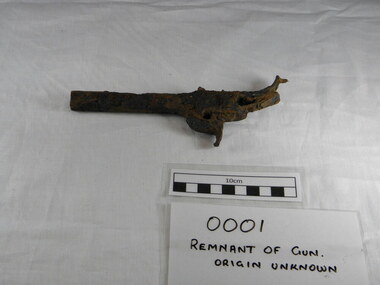
pistol, Weapon, 1860 (estimated); Nil
... gun revolver pistol weapon handgun learmonth Nil rusty remains of small pistol,minus handle. Weapon pistol ...rusty remains of small pistol,minus handle.Nilgun, revolver, pistol, weapon, handgun, learmonth -
 Orbost & District Historical Society
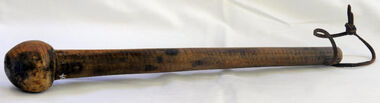
knobkerrie, Early - mid 19th century
... The name is Afrikaans and comes from 'Knop', meaning knot or ball and 'Kierie', meaning cane. knobkerrie club weapon hunting A short brown wooden knobkerrie club which has a thin handle and spherical club on one end. ...A knobkerrie is a form of club used mainly in Southern and Eastern Africa. The large knob at one end can be used for throwing at animals in hunting or for clubbing an enemy's head. It would have been carved from a branch thick enough for the knob, with the rest being whittled down to create the shaft. The name is Afrikaans and comes from 'Knop', meaning knot or ball and 'Kierie', meaning cane. A short brown wooden knobkerrie club which has a thin handle and spherical club on one end. It has a leather thong threaded through a hole at the end of the handle. knobkerrie club weapon hunting -
 Orbost & District Historical Society
lil-lil
... This lil lil club is an example of a wooden weapon used by the Indigenous people of Eastern Australia. hunting fishing challenge-stick aboriginal A handmade wooden lil-lil club with a long handle and axehead shaped club at one end. ...The lil-lil is a type of club which was made and used only in eastern Australia. It was a dangerous weapon when used in battle.The necessary tools and equipment for hunting, fishing and warfare were some of the very few items that Aboriginals carried with them from place to place. Most were used for a multiplicity of purposes. Because many were made from raw natural materials, such as wood, generally only partial remains are found today. This lil lil club is an example of a wooden weapon used by the Indigenous people of Eastern Australia.A handmade wooden lil-lil club with a long handle and axehead shaped club at one end. Intricately carved with a turtle on one side of the club head and a wild dog on the other.hunting fishing challenge-stick aboriginal
