
Showing 37 items matching "hanging lamp"
-
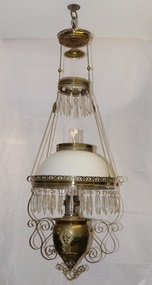 Woods' Farming and Heritage Museum
Hanging Lamp
... Hanging Lamp...Hanging Lamp. Kerosene Lamp. Hanging kerosene lamp. ...It is believed they may have bought it after moving into this house about 1909 Belonged to the Grandparents of the Museum owners. Hanging Lamp. Kerosene Lamp. Hanging kerosene lamp. ...Belonged to the Alison, John & Michael Woods' mothers parents, John & Eliza James. They lived in Napier Street Creswick. It is believed they may have bought it after moving into this house about 1909Belonged to the Grandparents of the Museum owners.Decorative brass kerosene lantern, suspended from ceiling by brass chains with a frosted glass hood and glass crystal skirt. Nilhanging lamp. kerosene lamp. hanging kerosene lamp. hanging brass lamp. brass hanging lamp. -
 Stanley Athenaeum & Public Room
Functional object - Lamp, Aladdin Hanging Lamp in parts
... Aladdin Hanging Lamp in parts...Patented design 1920-1950 Lamp hanger nickel plated with 2xframes to hold shade, 1xextension fitting to fit to ceiling, 1xbrass burner with new wick. Aladdin Hanging Lamp in parts Functional object Lamp ...Lamp hanger nickel plated with 2xframes to hold shade, 1xextension fitting to fit to ceiling, 1xbrass burner with new wick.no marking. Patented design 1920-1950 -
 Stanley Athenaeum & Public Room
Functional object - Lamp, Aladdin Hanging Lamp in parts
... Aladdin Hanging Lamp in parts...Patented design 1920-1950 Lamp hanger nickel plated with 2xframes to hold shade, 1xextension fitting to fit to ceiling, 1xbrass burner with new wick. Aladdin Hanging Lamp in parts Functional object Lamp ...Lamp hanger nickel plated with 2xframes to hold shade, 1xextension fitting to fit to ceiling, 1xbrass burner with new wick.no marking. Patented design 1920-1950 -
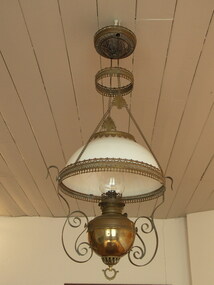 Friends of Westgarthtown
Domestic object - Lamp, Miller, Miller, c. 1890s
... ...hanging lamp...Original Miller hanging lamp, made of brass and opaque white glass. ...Original Miller hanging lamp, made of brass and opaque white glass. ...Purchased by Christian Ziebell on one of his two visits back to Germany.This object is of primary significance. Christian Ziebell brought it back from Germany on his return visit to Germany in 1856. It always hung where it is now and it is retractable to different heights. It hung on the lowest chain length over the table and was only raised when the family had festive events such as dances when Dorothea would accompany them on the piano. Great care had to be exercised when the lamp was raised because if it went up too high, and therefore became too close to the wooden ceiling, it could cause a fire. Francis Adams – son of Sylvia Adams (Ziebell) restored the lamp in the 1990’s. This Miller-style hanging oil lamp is a rare and culturally layered object that connects American industrial manufacture with German domestic life and early migrant history in Victoria. Produced by Bradley & Hubbard (B&H) in the United States in the 1890s, the lamp displays characteristic features of the firm’s Rayo line, including a brass body, opaque white glass shade, quality burner mechanism, and a chain-operated raising and lowering system. The inscriptions “B&H Valpirfor” and patent dates 1894-1895 confirm its authenticity as an American-made B&H Rayo lamp. This lamp was likely purchased in Mecklenburg, Germany, reflecting the export of modern lighting technologies into rural German households in the late 19th century. The lamp’s significance is further enhanced by its believed association with the Ziebell family. It is understood that a family member brought the lamp to Melbourne on a subsequent return journey to Germany after the family had established themselves at Westgarthtown. As a result, the lamp embodies themes of migration, technological adaptation, and the lived domestic environment of the Ziebell family across two continents. Its high level of intactness, combined provenance and dual- history contribute to its importance as a culturally rich artefact within the Ziebell’s Farmhouse collection. Original Miller hanging lamp, made of brass and opaque white glass. Lamp has chain-operated raising and lowering mechanism. Decorative brass trimming around widest edge of glass lampshade. Contains tubular wick.B & H Valpirfor written on lowering mechanism on top of the lamp. Rayo 24.98, PAT'D. NOV. 20.94, FEB 28.95, written on top of oil compartment.lighting, kerosene & oil, oil lamp, hanging lamp, original. -
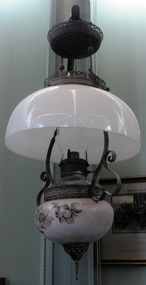 Orbost & District Historical Society
lamp, c. 1892
... illumination-lamp hanging-lamp kerosene-lamp...It has a large white glass cover above the wick burner and below is a white bowl decorated with flowers. The hanging lamp is American and, from the design and pattern of the brass work, it was made by Edward Miller & Co. ...This is an example of a domestic lighting device in use before the widespread connection of electricity to houses in Orbost. illumination-lamp hanging-lamp kerosene-lamp A large lamp which hangs from a bracket. ...A large lamp used used to light a room by showing light from above. Used in the Orbost district late 19th to early 20th century prior to electricity connection. Generally, lamps like this had a matching decorations on the shade and vase. It would have been almost impossible to find an exact match if the shade was broken so the next best thing was to replace it with a plain white one. The majority of the removable slip fonts were made to the same dimensions so it was not uncommon for an original font to be replaced with a different brand if it became unusable. This is an example of a domestic lighting device in use before the widespread connection of electricity to houses in Orbost.A large lamp which hangs from a bracket. It has a large white glass cover above the wick burner and below is a white bowl decorated with flowers. The hanging lamp is American and, from the design and pattern of the brass work, it was made by Edward Miller & Co. Both the shade and vase (font holder) are glass. It is most likely that the shade has been replaced at some stage. (ref. oillampantiques.com) illumination-lamp hanging-lamp kerosene-lamp -
 Flagstaff Hill Maritime Museum and Village
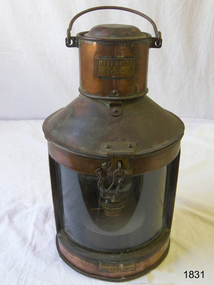
Equipment - Marine Kerosene Lamp, W T George & Co, 1941 +
... Bracket at back for hanging lamp. ...Bracket at back for hanging lamp. Equipment Marine Kerosene Lamp UK Midlands Birmingham W T George & Co William Harvie & Co ...WT George & Co of Sherlock Street Birmingham were makers of ships lanterns under the trade name “Meteorite”. In 1941 Thomas George writer assumes a relative of WT George was granted a patent number GB546575 relating to improvements to his lamps. After this date a plate was affixed with this number. What's confusing with the companies records is that they show that in Birmingham three companies are listed making lamps together and the writer is assuming under a partnership agreement. First in 1983 W T George & Co with William Harvie & Co went into liquidation with G Bocock & Co, together, then in 1992 George Bocock and Harvie Ltd were in liquidation. Although these companies seem to have different addresses in Birmingham they were linked together given they were all liquidated at the same time for two of them. They all appear to have been partners in some way making marine lamps under the William Harvie banner. William Harvie & Co. Ltd advertised as being electric light and power engineers, and patent ship lamp manufacturers, as early as 1901-1902, as listed in the Post Office annual Glasgow Directory 1901-1902.An item made by a company that was an innovator of significant improvements in the manufacture of marine signal and navigation lamps during the late 19th and 20th centuries. Lamps made by this manufacturer are now sought after collector's items that are of significant value. Lamp, round ship's copper lamp with clear glass, handle at top, fitted with hinged and catch section at top to service lamp. Bracket at back for hanging lamp. Stamped "Meteorite 110560" Bottom stamped "Patent no GB546575 and others pending".warrnambool, flagstaff-hill, flagstaff-hill-maritime-museum, maritime-museum, shipwreck-coast, flagstaff-hill-maritime-village, lamp, round ship's lamp, kerosene marine lamp, w t george & co, william harvie & co, george bocock & co -
 Flagstaff Hill Maritime Museum and Village
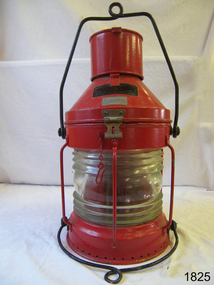
Equipment - Navigation Lamp, William Harvie & Co, First half of the 20th century
... Bracket at back for hanging lamp item painted red with black handles....Bracket at back for hanging lamp item painted red with black handles. ...William Harvie was granted a patent in 1868 for improvements in the manufacture of lamps, lanterns and lenses for ships navigation and signal lamps 1868. Production began at 222 Broomielaw street Glasgow Scotland. Another patent was issued in 1873 for additional improvements to the companies lamps. Records show that in1873 William Harvie was in partnership with Malcolm Graham & Co, grease manufacturers and rosin distillers at 50 Anderson Street Gallowgate Glasgow. It appears around this time the business was transferred to George Moffat of 128 Garthland Drive Dennistoun Glasgow to continue under the same name (William Harvie & Co at premises situated at 100 East John St Gallowgate Glasgow. It is unclear but at some point W T George & Co were one in the same with William Harvie & Co. W T George made lamps with the trade name “Meteorite” and after gaining a patent for improvements to his lamps in 1941 the patent numbers were affixed to his lamps. In the Scottish Post Office annual Glasgow Directory 1900-1902 William Haveie & Co. Ltd is listed with two addresses; 222 Broomielaw and 24 McAlpine Streets, Glasgow. In the early 20th century the business moved to Birmingham until 1983 when the company went into voluntary liquidation after a meeting was held at Newhall Street Birmingham on the 10th January 1983 for WT George and William Harvie. This meeting was for the purposes regarding the insolvency of a company as set out in Sec 294 & 295 of the companies Act 1948 as a result Harvie & Co cease production of their products.An item made by a company that was an innovator of significant improvements in the manufacture of marine signal and navigation lamps during the late 19th and 20th centuries. Lamps made by this manufacturer are now sought after collector's items that are of significant value. Navigation lamp, round ship's lamp with clear glass and a red filter, handle at top, fitted with hinged and catch section at top to service lamp. Bracket at back for hanging lamp item painted red with black handles.Black nameplate is unreadable. Front reference plate reads " Meteorite" then "Meteorite No. 92276" warrnambool, flagstaff-hill, flagstaff-hill-maritime-museum, maritime-museum, shipwreck-coast, flagstaff-hill-maritime-village, lamp, meteorite, william harvie, navigation lamp, kerosene lamp, signal lamp, marine equipment, marine navigation, w t george & co, george bocock & co, william harvie & co. ltd. -
 Bendigo Historical Society Inc.
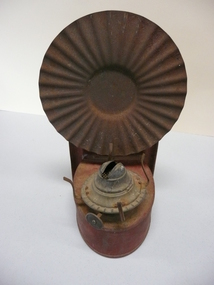
Domestic Object - SMALL KEROSENE LAMP
... Small tin plate wall hanging kerosene lamp with Eagle burner & circular reflector, painted dark red, missing chimeny....LIGHTING Kerosine & oil kerosene Eagle wick winder reads made in USA P&A MFG Co Small tin plate wall hanging kerosene lamp with Eagle burner & circular reflector, painted dark red, missing chimeny. ...Small tin plate wall hanging kerosene lamp with Eagle burner & circular reflector, painted dark red, missing chimeny.Eagle wick winder reads made in USA P&A MFG Colighting, kerosine & oil, kerosene -
 Bendigo Historical Society Inc.
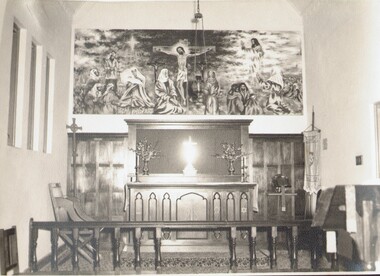
Photograph - ST MARYS, CHURCH OF ENGLAND, c1961
... Alter rail in front. Hanging lamp. Large hand painted mural by A Moller above altar, mainly crucifixion scene....Alter rail in front. Hanging lamp. Large hand painted mural by A Moller above altar, mainly crucifixion scene. ...Black and white photograph: St. Mary's Church of England. Church altar, cross in centre, cross on left hand side, cross and banner on right hand side, 2 vases with flowers, 2 candlesticks. Alter rail in front. Hanging lamp. Large hand painted mural by A Moller above altar, mainly crucifixion scene.Herald Sunbuildings, church, st marys, copyright not for reproduction. herald sun photograph supplied by feature service the herald & weekly times ltd. melbourne australia -
 Rutherglen Historical Society
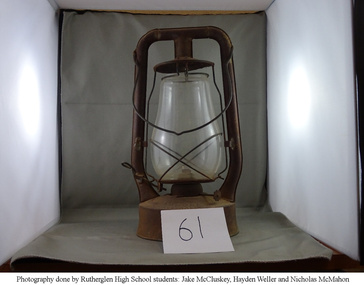
Functional object - Lantern, Lanora
... Hanging kerosene hurricane lamp, glass intact. Manufactured. ..."Dietz" Hanging kerosene hurricane lamp, glass intact. Manufactured. ...Commonly used out of doors before electric torchs. Often used by campers.Hanging kerosene hurricane lamp, glass intact. Manufactured. Tin base and frame."Lanora Australia" on base and metal lid. "Dietz"lanora australia -
 Tarnagulla History Archive
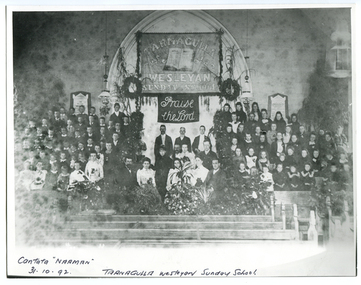
Photograph depicting the Tarnagulla Wesleyan Methodist Choir celebrating the Sunday School Anniversary, 1892, 1892
... The two elaborate hanging lamps can also be seen....The two elaborate hanging lamps can also be seen. tarnagulla churches church methodist wesleyan religion faith buildings children sunday school Written in pen on front: 'Cantata "Naaman" 31.10.92 Tarnagulla Wesleyan Sunday School'. ...Murray Comrie Collection. This photograph is a reasonable copy created from an older original. Tarnagulla was famous from the early days for its philharmonic choirs, often under the auspices of the Wesleyan Church and frequently in conjunction with the other churches. This photograph illustrates part of the interior of the Wesleyan Church, and the large choir is performing a classical cantata for the Wesleyan Sunday School celebrations. The older gentleman near the centre of the photograph is Wesleyan Sunday School stalwart and Tarnagulla Town Clerk, HC Bristol. The two memorial plaques on the rear wall are for Tarnagulla pioneers David Hatt (left) and Jonathan Falder. The two elaborate hanging lamps can also be seen.Black and white photograph depicting the Sunday School Choir of the Wesleyan Methodist Church in Tarnagulla. Written in pen on front: 'Cantata "Naaman" 31.10.92 Tarnagulla Wesleyan Sunday School'. Written in pen on reverse 'Church opened 9.4.1865 by Rev. Hill of Castlemaine. Orig photo with Mr. A. M. Renshaw'.tarnagulla, churches, church, methodist, wesleyan, religion, faith, buildings, children, sunday school -
 Flagstaff Hill Maritime Museum and Village
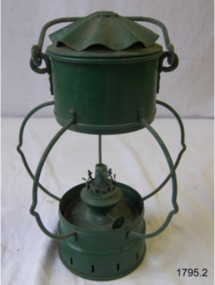
Functional object - Lamp, Kosmos Brenner, First half of the 20th century
... A very popular burner in Germany and still manufactured today in France it has been used in all sizes of lamps from small hand lamps up to large table and hanging lamps....A very popular burner in Germany and still manufactured today in France it has been used in all sizes of lamps from small hand lamps up to large table and hanging lamps. The subject item at this time cannot be associated with an historical event, person or place, provenance is unknown, item is believed to have been produced in the first half of the 20th century. ...The Kosmos burner is probably the most popular burner used in European lamps. A patent for the design was first lodged in the UK in 1865 by Wild & Wessel from Berlin. In 1875 they began using the trade mark 'Kosmos' on winder knobs. The mark was taken over in 1899 by Brokelman, Jager & Co. who changed it to 'Kosmos Brenner', (literally 'Kosmos burner'), they continued to manufacture right up to the 1970's when the factory closed and most tooling was destroyed. A very popular burner in Germany and still manufactured today in France it has been used in all sizes of lamps from small hand lamps up to large table and hanging lamps.The subject item at this time cannot be associated with an historical event, person or place, provenance is unknown, item is believed to have been produced in the first half of the 20th century. Many different lamp manufactures used Kosmos Burners in their lamps up until the 1970s, therefore exact provenance and age is difficult to determine.Lamp, copper, handle on top and one beneath attached to a reservoir made of copper. No glass and painted green.Marked "Kosmos Brenner" to winder flagstaff hill, warrnambool, flagstaff-hill-maritime-museum, maritime-museum, shipwreck-coast, flagstaff-hill-maritime-village, lamp, kosmos burner, kerosene lamp, lighting -
 Bendigo Historical Society Inc.
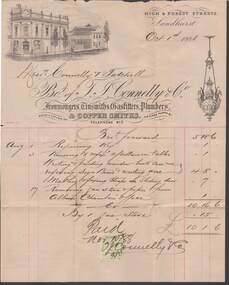
Document - CONNELLY, TATCHELL, DUNLOP COLLECTION: ACCOUNT T.J. CONNELLY & CO
... Letterhead contains image of building corner of Forest/High Street, Bendigo and ornate hanging lamp fitting.The top of the corner building has signs -T J Connelly Established 1853 .Green one penny stamp at the foot of the document...Letterhead contains image of building corner of Forest/High Street, Bendigo and ornate hanging lamp fitting.The top of the corner building has signs -T J Connelly Established 1853 .Green one penny stamp at the foot of the document Document CONNELLY, TATCHELL, DUNLOP COLLECTION: ACCOUNT T.J. ...Account for 5/18/6 dated Oct 1st. 1888 from T.J. Connelly & co., Ironmongers, tinsmiths, gasfitters, plumbers and copper smiths. For various work done for Connelly, Tatchell & Dunlop, including repair of safe, fitting locks and various hardware items. Letterhead contains image of building corner of Forest/High Street, Bendigo and ornate hanging lamp fitting.The top of the corner building has signs -T J Connelly Established 1853 .Green one penny stamp at the foot of the document -
Emerald Museum & Nobelius Heritage Park
Photograph - Dining Room - Westland - 50th wedding anniversary celebration, Unknown photographer, 1890s
... We can see the Australian and the English flag draped next to framed pictures, as well as a hanging kerosene lamp in the background....We can see the Australian and the English flag draped next to framed pictures, as well as a hanging kerosene lamp in the background. Photograph Dining Room - Westland - 50th wedding anniversary celebration Unknown photographer ...This record holds strong historic significance as the event at which this record was taken is of significance due to the prominent family name of Westland which is now a street name in Emerald. It gives insight into events and functions of that period of time. There is strong research potential with this record due to the time period the photograph was taken and the significance of the event.Black and white rectangular photograph printed on matte photographic paper. This black and white photograph consists of the dining room of the Westlands 50th wedding anniversary celebration circa. 1896. In the image, we see set tables holding bouquets of flowers and dinnerware. We can see the Australian and the English flag draped next to framed pictures, as well as a hanging kerosene lamp in the background.australian history, 1890s, event, emerald & district collection -
 Linton and District Historical Society Inc
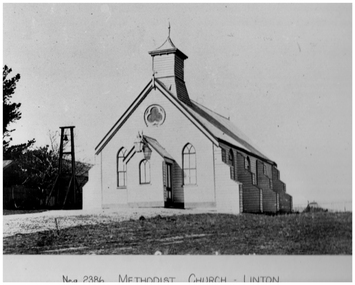
Photograph, Methodist Church, Linton, Timber Construction, Opened 1861
... Bell tower on left of picture. Large lamp hanging from entrance porch....Bell tower on left of picture. Large lamp hanging from entrance porch. Methodist Church, Linton, Timber Construction, Opened 1861 Photograph ...Methodist Church meetings and services are known to have been held in tents on the Lintons diggings from the late 1850s. A small wooden church was built in in 1858-59 in Sussex Street, Linton (near where Shepherd's store was located). Sunday School meetings began there in November 1859. By 1860 the church building was considered too small. The land was sold to Mr. Brewer, and the building was removed to a site in Grantley Street and enlarged. Shortly after this, it was decided to build a new church, also of timber construction, which was opened in 1861. This building (pictured) was still in use at the time of the Methodist Church Jubilee in 1910, however around 1905 a fund was established to build a new brick church which was opened in 1913. This brick building was sold and became a private residence about 1979.Black and white photograph which has been printed as a post card. The photograph shows a timber church which has a kind of turret, and side buttresses. Bell tower on left of picture. Large lamp hanging from entrance porch.methodist church linton, postcards -
 Numurkah & District Historical Society
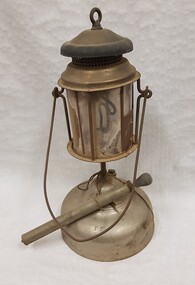
Kerosene Lamp
... On top of the lamp is a perforated metal cylinder for venting the fumes. on top of that is a metal circle for hanging the lamp. ...On top of the lamp is a perforated metal cylinder for venting the fumes. on top of that is a metal circle for hanging the lamp. ...Lamp made from metal/tin. Cylinder base to store the kerosene, with pump attachment to pump kerosene up to the lamp area. The lamp is attached to the base via a metal tube. the lamp is cylindrical with clear plastic lenses. On top of the lamp is a perforated metal cylinder for venting the fumes. on top of that is a metal circle for hanging the lamp. This is also a long screw which can be undone to access the lamp area. The whole lantern has a thick metal wire loop handle.lamp, lantern, kerosene, light -
 Bendigo Historical Society Inc.
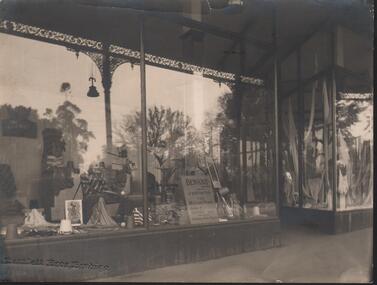
Photograph - HANRO COLLECTION: PHOTO OF SHOP FRONT DISPLAY WINDOW
... The reflections in the windows is of the veranda with a lamp hanging from underneath and trees. On the back is the circular *Royal Historical Society of Victoria Bendigo Branch in blue ink. ...The reflections in the windows is of the veranda with a lamp hanging from underneath and trees. On the back is the circular *Royal Historical Society of Victoria Bendigo Branch in blue ink. ...See Item 11000.189Photo of shop Front Display Window: A black and white photo of large open windows with a central door. In the window on the left side wall is a display sign with *Hanro* A stand along display sign with a golfer swinging a club and two golf balls near by. Casual wear and shirts are displayed around with spools of thread. A Chair with cardigans is also displayed. Some plants are in the window and in the front is a sign with *Benknit Sports Wear for men and women, Product of Hanro (Aust) Bendigo Knitting Mills Pty Ltd. In the right window is a display of lingerie with yards of material draped through out the window. At the bottom of the photo is the imprint of the photographer *Bartlett Bros, Bendigo. A small tear at the top middle. The reflections in the windows is of the veranda with a lamp hanging from underneath and trees. On the back is the circular *Royal Historical Society of Victoria Bendigo Branch in blue ink. At the right top side in black ink in *MP368*. Box 116ABartlett Bros, Bendigo.photograph, streetscape, window display, hanro. -
 Melton City Libraries
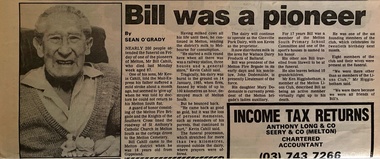
Newspaper, Bill was a pioneer, 1989
... They’d work shifts at night on the second shift at night time they would have an old hurricane lamp hanging above from the ceiling just over the chaff cutter, you could hardly see yourself, or see the anything. ...They’d work shifts at night on the second shift at night time they would have an old hurricane lamp hanging above from the ceiling just over the chaff cutter, you could hardly see yourself, or see the anything. ...Bill Cahill in conversation at Victoria Hall Melton South July 1974 Chaff Mills Melton’s hey day, as I call it in the days when more hay was grown in Melton and Rockbank than, I’d say in any where in Victoria. We had two chaff mills. If I can remember rightly I’m sure of this, that in one month the amount of hay and chaff that went from Melton to Melbourne was about 1800 tons, that’s hay and chaff. There was a lot of hay went from the Melton Railway Station. I have often seen whole train load going down the Schutt and Barrie, that’s Bonnie’s father’s mill at West Footscray. The mills in those days employed up to from 18- 20 men in each, that was before electricity when the mills were run on steam then, there was no power. At times those chaff mills they got a lot of shipping orders, to the Philipines and other Asian countries. They’d work shifts at night on the second shift at night time they would have an old hurricane lamp hanging above from the ceiling just over the chaff cutter, you could hardly see yourself, or see the anything. Well they worked through the whole night they might have an order come in for perhaps 100tons up 500 tons of chaff to go a boat would be in and be waiting to be loaded in Melbourne and they’d have to go and work two shifts. Then they brought in casual labour to help them through and get the order cut and get it down by rail to ship board to send it away. Talking about the hay I’ve seen wagons of hay in the farmers carting to both mills and also hay going down to West Footscray. There would be a quarter of a mile without exaggeration wagons and teams would be waiting to get into the mill, they would come down at the weighbridge at about 3-4- o’clock, 2 o’clock waiting for the bridge to open to weigh their loads, the ones that would be running late would be there at the weighbridge about half past 7 - 8 o’clock. They would be lucky to get away by night before getting their load off. A funny episode I remember well was a farmer from up, Alan Hurley you would remember him, Sam McCorkell he would put on his load in the afternoon or evening leave it up the yard, and would leave Toolern Vale about 12 or 1 o’clock in the morning and he would get down to the weighbridge and when it was breaking day he would bring half of his fowl yard down with him. The fowls would hop up on top of the load and have a ride down and when it came daylight they’d hop off and away they’d go, and I suppose everybody had some of McCorkells poultry. [laughter from the audience] That always tickled my fancy and everybody would be laughing about the fowls getting off his load of hay. I reckon that was about one of the funniest things I’ve ever heard of. The Victoria Hall, where we are tonight was originally known as the Exford Hall. I believe Bonnie’s father was the original builder and owner of the chaff mills here round the corner which is known as Wards today. Later on I understand that his father had a chaff mill here were this hall is, then Dixon Bros were just a bit on the other side. I believe Bonnie’s father sold it to Dixon Bros, and they shifted this part of the mill here and took it over and joined it up. That’s the history of the early chaff mills. Is that right Bonnie? You might like to correct, I’m about right am I? Bonnie answers yes. The original audio tape was recorded on the reel to reel tape recorder by Bon Barrie using his own tape recorder. Transferred to CD by Tom Wood using computer technology capable of adjusting the recording to a legible speed for reproduction to compact disk. Bill Cahill article featured in the The Mail Expresslocal identities -
 City of Melbourne Libraries
Photograph, Bull, Hugh Jones, 1897-1993, Lord Mayor's Dinner, Melbourne Town Hall
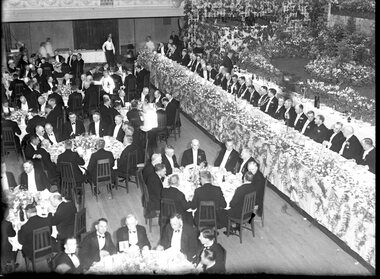
... Rosy flowers were issued up every pillar, and great golden lamps, hanging from the door, were seated in greenery and trails of sweet peas. ...Rosy flowers were issued up every pillar, and great golden lamps, hanging from the door, were seated in greenery and trails of sweet peas. ...Photographer notations on slide: "General View Of Lord Mayor's Dinner At Town Hall Nov 1936 B112" Published: The Age, Tuesday 10 November 1936, page 13 Published title: LORD MAYOR'S BANQUET Published caption: The brilliant scene inside the Melbourne Town Hall last night during the Lord Mayor’s banquet. Trove article identifier: http://nla.gov.au/nla.news-article205939431 Description: 700 guests (all men) are seated around numerous tables in the Melbourne Town Hall for the Lord Mayor's dinner in November 1936. Before the stage is a top table of 35 men, all dressed smartly in black dinner suits, with either a black or white bow tie. Many are wearing their medals. The Lord Mayor has on his Mayoral chains, and to his right is the Governor of Victoria, Lord Huntingfield. The stage is heavily decorated with fresh flowers. Research by project volunteer, Louise McKenzie: This image takes up one quarter of the photographic space on page 13 of The Age on 10 November 1936, reflecting the importance of the event and also the sheer dramatics of the image: 700 guests (all men), a top table of 35, and all dressed smartly in black dinner suits, with either a black or white bow tie. Many are wearing their medals. The Lord Mayor has on his Mayoral chains, and to his right is the Governor of Victoria, Lord Huntingfield. Further to his right is a man with an impressive sash across his chest. It is a very animated, and rather informal, moment. Banks of fresh flowers smother the stage, which is decorated in the manner of a terrace at an English stately home. Tables are laden with food, drink and decorations, and the wait staff (men and women) are also formally dressed, in the manner of Downton Abbey. It is spectacular, dramatic, and luxurious, and perpetuates the proud descriptor of “Marvellous Melbourne” as conferred by London Journalist George Augustus Sala when he visited the city in 1885. During its 1880s boom, Melbourne was the second-largest city in the British Empire, after London, and reputedly the richest city in the world. At times the expression was used with some irony, but "...in Victoria’s centenary year, 1934, with the city mired in another depression, a publisher bravely entitled a book of souvenir photographs Marvellous Melbourne, claiming that the subject ‘still finds apt expression in the happy one-time sobriquet’.” This photo seems to reflect an ongoing pride in Melbourne and a desire for it to live up to its descriptor and celebrate its post-centenary era in style. So it is no surprise to find that on page 11 of The Age on the same day, a second photo is to be found – a cropped view of one table – along with a very detailed description of the night, its purpose, and a surprise announcement. But, who was the Lord Mayor in whose honour the dinner was held? In 1934, the Lord Mayor of Melbourne was Cr. Alexander George Wales, (born Richmond, 11 October 1885, died Elsterwick, 31 May 1962). His father was a contractor and quarry-owner, but was blinded in an industrial accident in 1899. Consequently Alexander, then aged 14, left Brunswick State School to become a railway labourer working at a quarry, and in 1903 joined the Commonwealth public service as a clerk and began studying at night school, determined to improve himself. In 1907 he was appointed secretary of the Albion Quarrying Co. (in which the family had an interest), then its managing director and chairman. As the Australian Dictionary of Biography notes, he was instrumental in expanding the company’s interests, "...becoming director of the Hardware Co. of Australia Pty Ltd, the Twentieth Century Building and Investment Society, the Albion Sand Co. and the Geelong Brick Co.”. His public career began in 1914 when he was elected to the Brunswick council. He was mayor 1917-18, and in 1925 progressed to the Melbourne City Council where he remained for 29 years, being a member of most council committees. He served three successive terms as lord mayor (1934-37), was Chairman of the council’s decorations committee for Melbourne’s centenary, president of the Metropolitan Fire Brigades Board (1936), and Chairman of the Public Works Committee (1937-39). In 1936 he was elected to the Legislative Council with United Australia Party support, but later resigned over possible State government contract tender irregularities. Wales received "the customary reward” of a knighthood and was invested at Buckingham Palace by King George VI whose coronation he attended in 1937. He was an early director of what is now Ampol, and helped the development of the petroleum industry in Australia after visiting the USA in 1943 and 1946. He was impressed by that country’s wartime shipbuilding efforts and supported closer ties with the USA. “While president (1947-48) of the Melbourne Chamber of Commerce, Wales was a vocal critic of the Federal Labor Government, ...a staunch anti-socialist ... and a focus for conservative opposition to the Curtin and Chifley governments...” He is described as “a natural leader in business and civic politics,... a powerful force in the Melbourne City Council... opposing democratic reforms such as the creation of a Greater Melbourne Council and the abolition of plural voting, but advocat[ing] the redevelopment of city-owned property like the Eastern and Western markets...” So, this Lord Mayor’s dinner marks the third successive term in office for Governor Cr. A G Wales. The room is filled with powerful and influential men, and provided a platform for the Premier of Victoria, Albert Dunstan (1882-1950, United Country party) to announce that if the City Council would bear half the cost the State Government would build a bridge at Punt Road “at once”. He announced that the Government proposed to have the bridge built by the Country Roads Board, and allow the City Council to pay its share on convenient terms, and further, it would investigate the shared provision of more Yarra bridges. The proposal for the Punt Road Bridge was met with applause as the Yarra River constituted a serious traffic barrier. On 12 November 1936, two days after the Lord Mayor’s dinner, The Age published an article, “Building without a Plan”. It questions the appropriateness of the next Yarra bridge being the one at Punt Road, and encourages a “proper procedure” to look at the provision of additional Yarra bridges as a whole. But in fact this topic had been canvassed back in August when Melbourne City Council’s public works committee had recommended the replacement of the footbridge at Punt Road with a bridge, and if the Country Roads Board would declare this portion of Punt Road, including the river crossing, a State Highway, this could give the Board authority to construct the bridge and allocate the cost. Hence the reference at the dinner to a shared expense. Still an integral part of traffic management today, the Hoddle Bridge carries Punt Road over the Yarra River between Richmond and South Yarra in Melbourne. It is a five-lane road bridge with narrow footpaths on either side. It is of continuous reinforced concrete T-beam construction with five segmental arched spans, supported on transverse piers, and linked by concrete cross-beams. “The piers terminate in a series of tapered concrete pillars with Art Deco-styled steamlined decoration. Each pillar supports a Victorian-style lamp. The infill railings are geometric-patterned painted metal. Construction began in late 1937, and it was opened by Premier Albert Dunstan on 22 December 1938. It replaced an earlier footbridge, which in turn had replaced a punt service. The bridge (originally referred to as Punt Road Bridge) was named after Robert Hoddle, who planned central Melbourne’s Hoddle Grid, the grid of streets which form Melbourne’s central business district. Hoddle arrived in Australia from the UK in 1823 and went on to carry out surveys in NSW and Queensland before arriving in Melbourne in 1837. He designed layouts for both Melbourne and Williamstown, and later Geelong and other Victorian country areas. He was keen that major streets be at least 30 metres wide. ”With remarkable foresight he provided for wide boulevards from the city to the suburbs, but the subdivisions of early speculators in inner suburbs created the bottle-necks of today. After the separation of the colony in 1851, he became Victoria’s first surveyor-general... and advocated the provision of three-chain (60 m) roads and the widening of all existing main roads from one (20 m) to three chains." However, he was met with constant opposition and in 1853, was eased out of office. As a small and interesting aside: Hoddle was appointed auctioneer for the first sale of crown land in Melbourne on 1 June 1837. His commission was 57 pounds 12s 7d. and he bought two allotments for himself at a cost of 54 pounds. After he died his second wife married Richard Buckhurst Buxton, a member of the family which in 1860s Melbourne established the Australian property dynasty of Buxton Real Estate, Becton, MAB Corporation etc. Returning to the dinner and The Age article of 10 November 1836: Another topic of the after-dinner speeches was a reference to the upcoming Armistice Day. “The Minister of Customs (Mr White) said the proximity of Armistice day reminded us that eighteen years ago we had high hopes of prolonged peace.” The term “Armistice Day” was coined after WWI: “At 11 am on 11 November 1918, the guns on the Western Front fell silent after more than four years of continuous warfare. The Germans called for an armistice (suspension of fighting) in order to secure a peace settlement. They accepted the allied terms on unconditional surrender. Therefore on the 11th hour of the 11th day of the 11th month, a minute’s silence is observed and dedicated to those soldiers who died fighting to protect the nation. Originally known as Armistice Day, it was renamed Remembrance Day after World War Two to commemorate those who were killed in both World Wars. Today it refers to the loss of Australian lives from all wars and conflicts, accompanied by the words, "We will remember them, Lest we forget"." There was comment at the dinner about the need to remain firm in supporting the “democratic government in the British Empire to avoid a “plunge into savagery”. There was a grave responsibility on the British people to keep democracy alive, and that could not be done without adequate defence forces... Many weak governments in non-British countries had been swept aside by strong-fisted dictators, who now were the real threat to peace”. With the benefit of hindsight these were very pertinent comments and tragically prophetic. The Melbourne Shrine of Remembrance had only been dedicated two years earlier, at a ceremony attended by the Duke of Gloucester, son of King George V. Over 300,000 citizens attended: one third of the population of Melbourne. It became the location for the Anzac Day Dawn Service. Originally the march travelled from the Shrine into the city, however, in 1936, this was reversed, and the Shrine became the termination point for Anzac Day Marches. Also significant in 1936, was the installation of a statue in the west forecourt of the Shrine: “The Man with the Donkey” (aka 'Private John Simpson and his Little Donkey'). The work is said to represent the “valour and compassion of the Australian soldier”. Its full citation, according to the City of Melbourne City Collection is: West Side of Base: "The / Man with his Donkey / Gallipoli, April 25 to May 19 / in Commemoration / of the valour and compassion / of the Australian Soldier" AFTER LANDING AT GALLIPOLI, SIMPSON, WITH HIS LITTLE DONKEY, WORKED ALONE, DAY AND NIGHT TAKING WATER TO THE FRONT LINE AND CARRYING THE WOUNDED BACK TO THE DRESSING STATIONS. HE AND HIS DONKEY WERE KILLED BY A SHRAPNEL SHELL ON THE 19TH MAY, 1915. SIMPSON WAS MENTIONED IN DISPATCHES BY SIR IAN HAMILTON, COMMANDER-IN-CHIEF OF THE MEDITERRANEAN EXPEDITIONARY FORCE. / Erected by Public Subscription under auspices of the / Red Cross Society. East Side of Base: Private John Simpson." Their summary in background states: "A bronze figure of Simpson and his donkey with a wounded man on the donkey's back on a granite pedestal. Private John Simpson Kirkpatrick’s intrepid and short-lived exploits during the Gallipoli campaign have made him a popular figure of World War One. He has been mythologised to represent the lauded values of the digger, and he symbolises all those who went into battle unarmed. Born in England in 1892, he came to Australia in 1910. He enlisted to make his way back to England, but as a member of the 3rd Field Ambulance AIA was sent to Gallipoli. After just three weeks of bearing wounded soldiers across Shrapnel Gully on the back of his donkey, Simpson was killed by shrapnel fire. Simpson’s story became a powerful propaganda tool for enlistment in Australia, but following the war he was quickly forgotten. With the Shrine of Remembrance nearing completion in 1933, the memory of Simpson was rekindled to commemorate all who gave their lives to help others during the war. One plaque reads: ‘The / Man with his donkey / Gallipoli … / In commemoration / of the valour and compassion / of the Australian soldier’. In 1935, Wallace Anderson’s design for the memorial was selected though a competition organised by the Australian Red Cross. Anderson had served during the war and worked at the Australian War Memorial after his return. His Man with the Donkey was cast in Italy, and after some debate was sited near the shrine. Unveiled 20th June, 1936." The sculptor, Victorian-born William Wallace Anderson (1888-1975), served in France during WWI and afterwards produced a number of bronze war memorials and memorial portraits, predominantly in Victoria. “His most famous work is that of Simpson and his Donkey (1935), which he completed after winning a competition conducted by the Victorian Division of the Australian Red Cross. Anderson’s fee was 350 pounds; the cast, made by the Chiurazzi Foundry, Naples, Italy, cost 40 pounds. The work... has become well known as a symbol of the Anzac tradition.” A debate as to the siting of the statue arose from a strong view expressed by General Sir John Monash that no representation of individual members of the Australian Defence Force be located on the Shrine itself. Hence its location off to the northwest of the forecourt, in a garden of rosemary. And finally we return to the photo of the grand Lord Mayor’s dinner! An article in The Argus of 4 November 1936 refers to “Brilliant Scene at Lord Mayor’s Ball – Hall Becomes a Garden”. So now it becomes clear why the Town Hall, location of the Lord Mayor’s Dinner on 10 November 1934, only 6 days later, is so lavishly decorated. The floral decorations from the Ball are still in place - an early example of “recycling”, which is gratifying to note at a time of Depression. The reporter has captured the scene with enthusiasm: “Hundreds of tiny rose lights, hidden among pink roses, transformed the Melbourne Town Hall into a magical garden last night, when the Lord Mayor and Lady Mayoress (Councillor A. C. Wales, M.L.C., and Mrs. Wales) entertained about 3,500 guests at a ball. His Excellency the Governor (Lord Huntingfield) and Lady Huntingfield were present, while Rear-Admiral and Mrs. Lane Poole and officers from the visiting squadron were among the special guests. The balconies all round the hall were hidden by a white trellis, covered with pink blossoms and greenery. Rosy flowers were issued up every pillar, and great golden lamps, hanging from the door, were seated in greenery and trails of sweet peas. The organ gallery was converted into a terrace garden with stone steps leading to banks of pink azaleas, pink pelargoniums, masses of calceolarias, and the lovely deep mauve and blue of cinerarias. Slender Japanese maples and poplar trees grew from the higher slopes amid thickets of hostas, while a fascinating illusion was created by the lofty conservatory windows, which formed the background, and which were tinted cerulean blue to simulate the sky seen through glass. Large fern baskets hung from the conservatory roof, and the whole scene was enclosed in trellises of blossom. In the entrance palm green shrubs stood like sentinels round the passed floor, and flowers bloomed in misty golds. The long corridor upstairs leading to the council chamber was lined with an avenue of poplar trees in tubs. In the Lower Town Hall great banks of calceolarias and azaleas decked the upper dais, and each supper table was adorned with a different coloured flower with sprays of roses and Japanese maple laid on the snowy cloths. The adjoining supper-rooms were fragrant with the scent of huge bowls of stock in mauve, purple, and pink, while the white walls were covered with palm leaves and flowers. The roof garden below the clock tower was enclosed as a buffet with rose wreathed walls, and flowers were arranged attractively in the Lady Mayoress's rooms." References: LORD MAYOR'S BANQUET. CENTURY MAKERS AT THE M.C.G. BEFORE THE CHANGE. (1936, November 10). The Age (Melbourne, Vic. : 1854 - 1954), p. 13. Retrieved September 4, 2024, from http://nla.gov.au/nla.news-article205939431 'Portrait of Sir George Wales (Lord Mayor 1934-1937)', City Collection, City of Melbourne, https://citycollection.melbourne.vic.gov.au/portrait-of-sir-george-wales-lord-mayor-1934-37/ Graeme Davison, 'Marvellous Melbourne', eMelbourne, https://www.emelbourne.net.au/biogs/EM00906b.htm THE LORD MAYOR'S BANQUET. (1936, November 10). The Age (Melbourne, Vic. : 1854 - 1954), p. 11. Retrieved September 26, 2024, from http://nla.gov.au/nla.news-article205939643 BRILLIANT SCENE AT LORD MAYOR'S BALL Hall Becomes a Garden (1936, November 4). The Argus (Melbourne, Vic. : 1848 - 1957), p. 14. Retrieved September 26, 2024, from http://nla.gov.au/nla.news-article11932746 'Hoddle Bridge', Wikipedia, https://en.wikipedia.org/wiki/Hoddle_Bridge 'Hoddle Bridge', Victorian Heritage Database Report, Victorian Heritage Council, https://vhd.heritagecouncil.vic.gov.au/places/195689/download-report David Dunstan, 'Wales, Sir Alexander George (1885–1962)', Australian Dictionary of Biography, National Centre of Biography, Australian National University, https://adb.anu.edu.au/biography/wales-sir-alexander-george-8951/text15737, published first in hardcopy 1990, accessed online 26 September 2024. Marjorie J. Tipping, 'Hoddle, Robert (1794–1881)', Australian Dictionary of Biography, National Centre of Biography, Australian National University, https://adb.anu.edu.au/biography/hoddle-robert-2190/text2823, published first in hardcopy 1966, accessed online 26 September 2024. BUILDING WITHOUT A PLAN. (1936, November 12). The Age (Melbourne, Vic. : 1854 - 1954), p. 8. Retrieved September 26, 2024, from http://nla.gov.au/nla.news-article205949762 NEW BRIDGE AT PUNT ROAD (1936, August 12). The Argus (Melbourne, Vic. : 1848 - 1957), p. 10. Retrieved September 26, 2024, from http://nla.gov.au/nla.news-article11902131 'The Shrine of Remembrance', Beaconsfield’s Soldiers: https://beaconsfield.org.au/digitalmemorial/shrine-introduction/ 'Shrine of Remembrance', Wikipedia, https://en.wikipedia.org/wiki/Shrine_of_Remembrance Ken Scarlett, 'Anderson, William Wallace (1888–1975)', Australian Dictionary of Biography, National Centre of Biography, Australian National University, https://adb.anu.edu.au/biography/anderson-william-wallace-9362/text16441, published first in hardcopy 1993, accessed online 26 September 2024. 'Man with the Donkey', City Collection, City of Melbourne, https://citycollection.melbourne.vic.gov.au/man-with-the-donkey-aka-private-john-simpson-and-his-little-donkey/ 'Remembrance Day', Australian Army, https://www.army.gov.au/about-us/history-and-research/traditions/remembrance-day Photographer notations on slide: "General View Of Lord Mayor's Dinner At Town Hall Nov 1936 B112".melbourne town hall, mayors, lord mayors, centenaries, bridges, dinners, clothing and dress, festive decorations, dances and balls, eating and drinking, shrine of remembrance, governors, monuments and memorials, 1930-1939, plants -
 Flagstaff Hill Maritime Museum and Village
Lamp
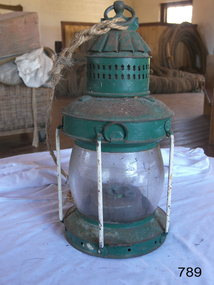
... Kerosene lamp with rings for tying on or hanging from various parts of the ship, complete with burner and fitted glass shade...Flagstaff Hill Warrnambool Shipwrecked-coast Flagstaff-Hill Flagstaff-Hill-Maritime-Museum Maritime-Museum Shipwreck-coast Flagstaff-Hill-Maritime-Village Kerosene lamp with rings for tying on or hanging from various parts of the ship, complete with burner and fitted glass shade Lamp ...Kerosene lamp with rings for tying on or hanging from various parts of the ship, complete with burner and fitted glass shadeflagstaff hill, warrnambool, shipwrecked-coast, flagstaff-hill, flagstaff-hill-maritime-museum, maritime-museum, shipwreck-coast, flagstaff-hill-maritime-village -
Federation University Historical Collection
Object, Miners Safety Lamp
... Metal mining safety lamp with ceramic base and hanging hook...staszic poland mining lamp miners lamp safety lamp mining Metal mining safety lamp with ceramic base and hanging hook Miners Safety Lamp Object ...Metal mining safety lamp with ceramic base and hanging hookstaszic, poland, mining lamp, miners lamp, safety lamp, mining -
Federation University Historical Collection
Tool - Object, J.K. Dey & Sons, Mining Safety Lamp, c1967
... Metal mining safety lamp with copper bas and hanging hook. The Dey Velox GL5 Gas Testing Flame Safety Lamp boasts sharp detection of methane gas; detection of the shortage of oxygen; detection of the presence of Carbon-dioxide, is magnetically unlocked; ncludes a top feed device for testing Methane Gas close to the roof; contains an auto extinguisher. ...Dey & Sons Calcutta Velox Velox G Metal mining safety lamp with copper bas and hanging hook. The Dey Velox GL5 Gas Testing Flame Safety Lamp boasts sharp detection of methane gas; detection of the shortage of oxygen; detection of the presence of Carbon-dioxide, is magnetically unlocked; ncludes a top feed device for testing Methane Gas close to the roof; contains an auto extinguisher. ...The Mining Safety Lamp is used in flammable atmospheres, and consists of a wick lamp with a mesh screen enclosing the flame. It was created for use in coal mines, to reduce the danger of explosions due to the presence of methane and other flammable gases, called firedamp or minedamp. J. K. DEY & SONS was established in 1947 and manufactures Safety Lamps, Torches and Carbide Lamps. In 1967 the Mining Authority of India issued approval of the Velox GL5 Flame Safety Lamp ( Kerosene burning ) self-extinguishing type. At that time J.K. Dey captured the whole mining market of safety lamps in India. (http://www.jkdey.com/history.html, accessed 06/05/2015)Metal mining safety lamp with copper bas and hanging hook. The Dey Velox GL5 Gas Testing Flame Safety Lamp boasts sharp detection of methane gas; detection of the shortage of oxygen; detection of the presence of Carbon-dioxide, is magnetically unlocked; ncludes a top feed device for testing Methane Gas close to the roof; contains an auto extinguisher. J.K. Dey & Sons Calcutta Velox Velox Gmining lamp, safety lamp, miners lamp, calcutta, india, mining -
Glenelg Shire Council Cultural Collection
Functional object - Whale Oil Lamp, n.d
... Gimbaled metal whale oil lamp, spherical cage, ring for hanging at top....whaling Gimbaled metal whale oil lamp, spherical cage, ring for hanging at top. Functional object Whale Oil Lamp ...Gimbaled metal whale oil lamp, spherical cage, ring for hanging at top.whaling -
Glenelg Shire Council Cultural Collection
Equipment - Whale Oil Lamp, n.d
... Antique brass hanging or standing whale oil lamp, Dutch, decorated in the repousse manner, including rural and maritime scenes. ...Antique brass hanging or standing whale oil lamp, Dutch, decorated in the repousse manner, including rural and maritime scenes. ...Antique brass hanging or standing whale oil lamp, Dutch, decorated in the repousse manner, including rural and maritime scenes. Base circular, with flatside to fit against wall. Removable oil well, single spout with wick, decorative hook for wall hanging. Weighted base. -
Glenelg Shire Council Cultural Collection
Functional object - Whale Oil Lamp, n.d
... Brass 3 burner whale oil lamp. Has 3 hanging chains for tools, but one tool is missing. ...Brass 3 burner whale oil lamp. Has 3 hanging chains for tools, but one tool is missing. ...Brass 3 burner whale oil lamp. Has 3 hanging chains for tools, but one tool is missing. Has 2 decorative pierre work reflectors, attached to frame. Round base, turned stand, handle at top. -
Glenelg Shire Council Cultural Collection
Equipment - Whale Oil Lamp, n.d
... Tin wall-mounted whale oil lamp, that also has two feet, making it stable on a flat surface. Asa ? tiger head where the burner exits. Round base, curved stand, hook for hanging. ...Tin wall-mounted whale oil lamp, that also has two feet, making it stable on a flat surface. Asa ? tiger head where the burner exits. Round base, curved stand, hook for hanging. ...Tin wall-mounted whale oil lamp, that also has two feet, making it stable on a flat surface. Asa ? tiger head where the burner exits. Round base, curved stand, hook for hanging. Clear glass chimney. -
Glenelg Shire Council Cultural Collection
Functional object - Brass Lamp, n.d
... Brass whale oil 3 burner lamp, not polished, original patina. 3 brass tools hanging from brass chains attached to the lamp....Brass whale oil 3 burner lamp, not polished, original patina. 3 brass tools hanging from brass chains attached to the lamp. ...Brass whale oil 3 burner lamp, not polished, original patina. 3 brass tools hanging from brass chains attached to the lamp. -
 Flagstaff Hill Maritime Museum and Village
Lamp
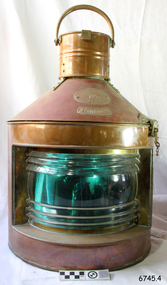
... flagstaff hill warrnambool shipwrecked-coast flagstaff-hill flagstaff-hill-maritime-museum maritime-museum shipwreck-coast flagstaff-hill-maritime-village flagstaff hill warrnambool shipwrecked-coast flagstaff-hill flagstaff-hill-maritime-museum maritime-museum shipwreck-coast flagstaff-hill-maritime-village lamp Starboard side light Starboard side light with fresnal glass lens with removable blue/green filter, oil/kero burner with reflector inside. Made by "Tung Woo Hong Kong No. S1477", rounded front and 2 flat sides, bracket on one side for hanging ...Starboard side light with fresnal glass lens with removable blue/green filter, oil/kero burner with reflector inside. Made by "Tung Woo Hong Kong No. S1477", rounded front and 2 flat sides, bracket on one side for hanging. H 57.5cm x D 35cm.flagstaff hill, warrnambool, shipwrecked-coast, flagstaff-hill, flagstaff-hill-maritime-museum, maritime-museum, shipwreck-coast, flagstaff-hill-maritime-village, flagstaff hill, warrnambool, shipwrecked-coast, flagstaff-hill, flagstaff-hill-maritime-museum, maritime-museum, shipwreck-coast, flagstaff-hill-maritime-village, lamp, starboard side light -
 Ringwood and District Historical Society
Flyer - Catalogue, Public Auction - Brick Residence and Contents of Dwelling, "Wyncliff", Whitehorse Road, Ringwood. 1935
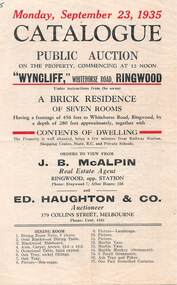
... VERANDAH - 12ft Shelving with doors; 35ft Shelving; Wooden Stand; Axe Stand (wooden); Nine feet Wooden Shop Fittings; Small Filing Cabinet; Three Window Frames & Glass; 38 Pot Plants Fernery; 9 Hanging Baskets Fernery; Electric Shop Sgn Storeroom; 2 Small Electric Shop Signs Storeroom; 2 Garden Sprays; Doll's Pram and Doll; Two Boxes Paint and Slate; Crystal Radio Set; New Canvas Blind & Roller 6ft.; Electric Light Reflectors (two); Two pieces of Painted Baize; Small Vice; Sprinkler; One Gallon Tin of Spray Oil; 2 Packets of "Aresto"; Two Hurricane Lamps; One Pair Spring Balance Scales; Small Pair Spring Balance Scales. ...VERANDAH - 12ft Shelving with doors; 35ft Shelving; Wooden Stand; Axe Stand (wooden); Nine feet Wooden Shop Fittings; Small Filing Cabinet; Three Window Frames & Glass; 38 Pot Plants Fernery; 9 Hanging Baskets Fernery; Electric Shop Sgn Storeroom; 2 Small Electric Shop Signs Storeroom; 2 Garden Sprays; Doll's Pram and Doll; Two Boxes Paint and Slate; Crystal Radio Set; New Canvas Blind & Roller 6ft.; Electric Light Reflectors (two); Two pieces of Painted Baize; Small Vice; Sprinkler; One Gallon Tin of Spray Oil; 2 Packets of "Aresto"; Two Hurricane Lamps; One Pair Spring Balance Scales; Small Pair Spring Balance Scales. ...Double-sided A5 size advertisement for public auction under instructions from the owner on Monday, September 23, 1935 on the property - seven room brick residence with frontage 456 feet by approximately 280 feet and contentents of dwelling fully listed over 4 pages. Agent - J.B. McAlpin, Ringwood, opp. station. Phone Ringwood 7; after houres 236. Auctioneer - ED. Haughton & Co., 379 Collins Street, Melbourne. Phone Central 4101.Contents of Dwelling List - includes: DINING ROOM - Dining Room Suite - 6 pieces; Oval Blackwood Dining Table; Blackwood Sideboard; Axminster Carpet, Occasional Table hand carved; Oak Trays; Seascape, Landscape and other Pictures; 2 Marble Vases; Marble Monkey and 3 other Small Ornaments; Ash Tray and Poker; One Pair Stencilled Curtains. Two Large Vases, 1 with floral design; Salad Bowl and Servers; One Dozen Dessert Knives; Nine Stainless Teaspoons (new); Plated Vases; Plated Jam Dishes; Plated Cream Bowl; Silver Plated Cake Dish; One Pair Plated Shell Butter Dishes; Lino Border. LOUNGE ROOM - 2 Pictures and 1 pair with Circular Frames; Floral Jardinere and Pot Plant; Cabinet Gramophone "Singola"; Records; Player Piano "Cable"; Piano Stool; 31 Rolls; Roll Cabinet; Quantity of Music; Music Case, Leather; Portable Gramophone "Decca"; Floral Design Jardinere; Wicker Occasional Table; 2 Wicker Chairs; Cane Lounge Settee; Blackwood Bookcase; 9 Volumes Universal Encyclopedia; 10 Vols Children's Encyclopedia; Floral Vase; Black and Gold Vase; One pair Plated Vases; Ash Pan; Lino Border (Lounge Room); One Carpet, green 13.6 x 10.6; One Cushion; Hall Stand; Pedestal; Floral Design Jardinere; Painting on Canvas (Landscape); Hall Runner Carpet 25 feet; Hall Lino 29ft 5 in.; Five Door Mats (small). FIRST BEDROOM - Arm Chair (Leather); English Oak Dressing Table; English Oak Wash Stand Marble Top; Toilet Set (Four pieces); Silk Fire Screen; Blackwood Occasional Table; Black and Gold Vase; Pair China Vases; Pair Glass Vases; Single Glass Vase; One Kewpie Lavender Bag; Bedroom Lino 15.6 x 13.6. SECOND BEDROOM - Arm Chair (Leather); Dressing Table; Wash Stand; 3 Piece Toilet Set; One Vase (Pink Cameo Design); Two Ornaments (one round); Bedroom Lino 13.5 x 12.10; 3 Pictures; 2 Pairs Curtains (applique, stenc'ld); Pair Curtain Poles. THIRD BEDROOM - Lino approx 14ft x 10ft; Two Green Mohair Mats; Pair Pictures (White frames); One Picture ("The Mourners"); Picture ("The Wanderer Found"); Small Picture; Wicker Chair. FOURTH BEDROOM - Duchess Chest 5 drawers; Corner Wardrobe and Curtains; One Single Bed & Wire Mattress; Single Bedding; Lino on floor 14ft x 6ft 6in.; Occasional Table; 3 Pictures; Two Door Mats; Hall Runner (Carpet) 21ft. BREAKFAST ROOM - Two Wicker Chairs; Cushion; Brown Cushion; Four Vienna Chairs; Jardinere; Kerb (Wooden). 3 Pictures; Oil Painting (Canvas); 2 Pictures; Lino 14ft x 14ft; Brown Table Cover; Fruit Set; Robur Tea Pot; Plaque; China Biscuit Barrel; Glass Fruit Bowl; Pair Pickle Jars and Stand; Wooden Inkstand; Pair Ash Trays; Two Marble Vases; Glass Vase; Electric Jug and Electric Toaster (practically new); Picture; Cushion; Pair Lace Curtains; Curtain Rod; Three Lace Curtains; Brass Curtain Rods (3); Lino in Vestibule 10ft x 8 ft; Lino in Kitchen 12.6 x8.6; Coal Scuttle; Two Small Tables (1 Baize Cover). STORE ROOM - Briquette Grate; Three Coir Mats (one new); Three Small Door Mats (new); Glass Fire Screen; 2 Alm Pot Stands; Steel Pot Stand; Lady's Bicycle; 2 Electric Radiators (one large); White Cabinet; Stretcher Bed; Large Cot with Wire Mattress; Kerb; Fender and Irons; Lino on floor 12ft x 12ft; Lino in Storeroom 6ft x 6ft; Three Large Window Blinds; Clothes Horse; Dressmaker's Fitting Stand; Dressmaker's Bust; Window Display Bust; Blouse Stand; Small Display Stand; Meat Cover (Metal); Leather Portmantau; Leather Kit Bag; Four Large Wooden Drawers; Picnic Basket; Mattress, Bolster and Pillow; Cot Quilt; One Long-handled Feather Duster; Feather Duster; Wicker Lounge; Cane Soiled Linen Basket; One New Washing Tub; Copper Preserving Pan; Lino in Laundry 8 x 6 approx; Carpet Sweeper; Small Jardinere; 2 Shopping Baskets; Kitchen Safe; Kitchen Table; Three Buckets; 1 Horse Rub patent (prac new); Wooden Pot Plant Stand; Bird Cage and Stand; Pair Steps; Pair Small Steps; Metal Meat Safe; Wooden Safe; Hand worked Table Cover; Pair Poplin Silk Curtains (new); Leather Table Centre. VERANDAH - 12ft Shelving with doors; 35ft Shelving; Wooden Stand; Axe Stand (wooden); Nine feet Wooden Shop Fittings; Small Filing Cabinet; Three Window Frames & Glass; 38 Pot Plants Fernery; 9 Hanging Baskets Fernery; Electric Shop Sgn Storeroom; 2 Small Electric Shop Signs Storeroom; 2 Garden Sprays; Doll's Pram and Doll; Two Boxes Paint and Slate; Crystal Radio Set; New Canvas Blind & Roller 6ft.; Electric Light Reflectors (two); Two pieces of Painted Baize; Small Vice; Sprinkler; One Gallon Tin of Spray Oil; 2 Packets of "Aresto"; Two Hurricane Lamps; One Pair Spring Balance Scales; Small Pair Spring Balance Scales. WASH HOUSE - Pair Heavy Tracers (2); Pair Reins; Back Band; One Tug; Pair Hames; One Pair Neck Bands (2); Four Manger Balls; Pair Knee Pads; Kicking Strap complete; Leather Head Stall; Collar Pad; Knife Board and Tin Polish; Fork Cleaner; Foot Spray Pump. TOOL SHED - One Stewart Horse Clipper; Approx 120ft Ribbed Hose; 100ft ½in Hose; Child's Scooter; Tin Box; Ferret Box; One Tool Box; Tomato Hoe; Sprinkler; Two Large Augers; Large Watering Can; Medium Watering Can; Small Watering Can; Wooden Tool Chest; Rope, Tackle and two Pulleys; Six pieces of Lino; Three Small Canvas Blinds; Lawn Mower 14in.; Lawn Mower 12in.; Grass Catcher; 8 Pieces Garden Tools; Barrow; Quantity of Timber; Quantity of Flower Pots; Quantity of Wire; 4 Egg & 1 Fowl Crates Feed Room; 1 Gallon Demijohn Feed Room; Quantity of Shelving Feed Room; Quantity of Cement, Lime; Six Small Doors; Roll of Perforated Cardboard; Boot Rack; Coat Rack; 3 Automatic Sanitary Disinfectant; Pair Neck Straps and Rope; One Chimney Top & 3 Vent Bks.; Desk; Large Pump; Large Safe; Pair Sliding Door Rollers & Fittings; Two Wooden Doors; Box Sundries; Wooden Frame and Glass; 2 Vienna Chairs; Delivery Cart; Five Boxes Tiles; Quantity Agricultural Pipes; Wooden Bench; Wood Horse; Earthenware Drain Pipe; Wooden Tool Box; New Brass Spray "Rego"; Two Wood Planes. YARD - Pair Hedge Clippers; Box Containing 2 prs Secateurs & Punch; Box Tools seven pieces; Box Sundries; Lawn Weeder and Seed Sower; Box Tools 6 pieces; Two Saws; Bundle Files; Three Braces; Box of 13 pieces Gimlets etc.; Five Spanners; Box Tools 4 pieces; Four Coal Chisels; Box 7 pieces of Tools; Box of 5 pieces of Tools; Box of Docket Books; One Printing set; Large Figure Printing Set; Small Figure Printing set; Price Ticket Box; Air Brush Writing Set Complete; Six Shelves & Brackets, one Hat Rack, in store room; Box of Three Hammers; Two Boot Lasts; Tin of Polishing Oil; Box of Gardening Sundries; 2 Bicycle Pumps Saddle & Clips; One Covered Baking Dish; 200 c.p. Globe (Vestibule); Two "Dimolite" Fittings; Set of Five Canisters; Earthernware Jar; Two shopping Cases; Dinner Set 11 pieces; Box of Sundry Tins; Alm Fish Pan and Drainer; Two Ventilators; Knife Board & 3 Bread Saws; Soap Box and Jewel Case; Three Glass Articles. OFFICE FURNITURE - Steel Safe (Office Safe); Office Table five drawers; Cabinet 8 drawers; Cupboard three shelves; Selves 2ft3in x 1ft6in; Cheque Protector; Remington Typewriter; Typewriter Adjustable Table; Burroughs Bookkeeping Machine and Stand Complete; Small Office Table; Glass Show Case3ft9 x 2ft.; Four Sheets M. Glass; Five Sheets P. Glass; Gent's Overcoat new; Boy's Pullover New; Small Show Case; Duplicator (complete); Webster's Dictionary; Family doctor's Book. Two Dictionaries; Bundle of Three Books; Art Decorating Book; Bundle of Three Books; Bundle of Three Books; Two Books (Children's); (Multiple) Bundles each containing Three Books; Leather Riding Whip; Tort-shell Inkstand & Calendar; Tort-shell Folding Letter Rack; Water Filter; Thermos Flask and Case; Two Waste Paper Baskets. -
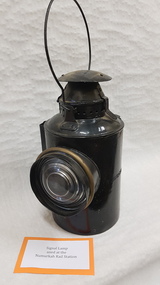 Numurkah & District Historical Society
Railway Signal Lamp
... this signal lamp was used at the Numurkah Railway Station railway, lamp, lantern, kerosene Numurkah (metal embossing) Black-painted tin, cylindrical in shape, with handle. Circular lens at the front with brass-coloured edging. Smaller red lens at the back with white edging. Side slot for hanging ...this signal lamp was used at the Numurkah Railway StationBlack-painted tin, cylindrical in shape, with handle. Circular lens at the front with brass-coloured edging. Smaller red lens at the back with white edging. Side slot for hanging lantern onto post or hook. Round chimney/vent at the topNumurkah (metal embossing)railway, lamp, lantern, kerosene
