
Showing 64 items matching "hard standing"
-
 National Vietnam Veterans Museum (NVVM)
Photograph
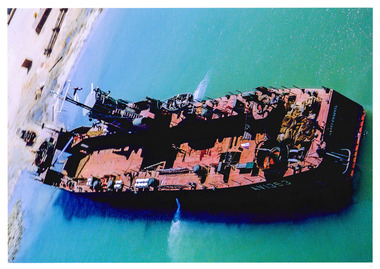
... ...Hard Standing...AV1353 Harry Chauvel 32 Small Ship Sqn R.A.E. At the Hard Standing near Delong Pier in Vung Tau, March 1968. ...AV1353 Harry Chauvel 32 Small Ship Sqn R.A.E. At the Hard Standing near Delong Pier in Vung Tau, March 1968. ...This item commemorates the war in Vietnam ( 1962 - 1973)A coloured photograph: Landing ship Medium. AV1353 Harry Chauvel 32 Small Ship Sqn R.A.E. At the Hard Standing near Delong Pier in Vung Tau, March 1968. Sapper Reg Hamman of Innisfail giving the thumbs up. AV1353av1353, harry chauvel, 32 small ship sqn r.a.e, sapper reg hamman, sapper d graney, vietnam, landing ship medium, hard standing -
 National Vietnam Veterans Museum (NVVM)
Photograph, Canberra Bomber
... Framed colour photograph of Canberra Bomber parked on hard standing....Canberra (Bomber) Photograph Framed colour photograph of Canberra Bomber parked on hard standing. Canberra Bomber. Photograph Photograph ...Framed colour photograph of Canberra Bomber parked on hard standing.canberra (bomber), photograph -
 Wangaratta RSL Sub Branch
Photograph
... Photograph of group of 3 unknown soldiers wearing shorts and hard helmets standing in front of corrugated iron clad building...The Unit was granted the Freedom of the City by the Rural City of Wangaratta in 1990 and one of the first, if not the first, to receive this type of honour. 2/24th battalion wangaratta Photograph of group of 3 unknown soldiers wearing shorts and hard helmets standing in front of corrugated iron clad building Photograph Photograph ...Image relates to the 2/24th Battalion however Iocation and identities of soldiers are unknown.The 2/24th Battalion was an infantry battalion of the Australian Army, which served during World War II .A unit of all-volunteers, it was formed in July 1940 from primarily Victorian volunteers and was known as "Wangaratta's Own" because of the time the battalion spent in the town during its formative period prior to deployment overseas. It served in North Africa in 1941–1942 as part of the 26th Brigade, which was assigned to the 7th Division, before being reassigned to the 9th Division. In early 1943, the battalion returned to Australia and later took part in campaigns against the Japanese in New Guinea in 1943–1944 and Borneo in 1945, before being disbanded in 1946. The 2/24th suffered the highest number of casualties of any 2nd AIF infantry battalion. The Unit was granted the Freedom of the City by the Rural City of Wangaratta in 1990 and one of the first, if not the first, to receive this type of honour.Photograph of group of 3 unknown soldiers wearing shorts and hard helmets standing in front of corrugated iron clad building2/24th battalion, wangaratta -
 Bendigo Historical Society Inc.
Photograph - AUSTIN COLLECTION: PLATMAN JOHN JONES
... Black and white photo of platman John Jones placing skip into shaft. wearing hard hat and light, standing before Code Signals Sign at Central Deborah Gold mine Bendigo...MINING Business Central Deborah Gold Mine Black and white photo of platman John Jones placing skip into shaft. wearing hard hat and light, standing before Code Signals Sign at Central Deborah Gold mine Bendigo Photograph AUSTIN COLLECTION: PLATMAN JOHN JONES ...Black and white photo of platman John Jones placing skip into shaft. wearing hard hat and light, standing before Code Signals Sign at Central Deborah Gold mine Bendigomining, business, central deborah gold mine -
 Bendigo Historical Society Inc.
Photograph - AUSTIN COLLECTION:TWO MEN IN MINE
... Men are wearing mining gear, hard hats and lights, standing in front of a skip. Pictured at Central Deborah Goldmine, Bendigo....Men are wearing mining gear, hard hats and lights, standing in front of a skip. Pictured at Central Deborah Goldmine, Bendigo. ...Black and white photo of two men talking in mine, father and son both named, Clive McNamara. Men are wearing mining gear, hard hats and lights, standing in front of a skip. Pictured at Central Deborah Goldmine, Bendigo.mining, business, central deborah gold mine -
 Bendigo Historical Society Inc.
Photograph - AUSTIN COLLECTION: Williams United Gold Mine, diamond drill, 1987
... Man on right in overalls, boots and hard hat, is standing alongside a ventilation pipeline and holding a tool in his hand. ...Man on right in overalls, boots and hard hat, is standing alongside a ventilation pipeline and holding a tool in his hand. ...Black and white photograph: underground mine photograph, Williams United Gold Mine, Eaglehawk. Two men standing in front of a diamond drill. Man on left hand side, wearing shorts, rubber boots and hard hat, has a large spanner in his hand. Man on right in overalls, boots and hard hat, is standing alongside a ventilation pipeline and holding a tool in his hand. gold mining, underground, williams united gold mine, eaglehawk, western mining gmc, mine drive, diamond drill -
 Bendigo Historical Society Inc.
Photograph - AUSTIN COLLECTION: Operating rock drill, Central Deborah Gold Mine, Possibly 1990's
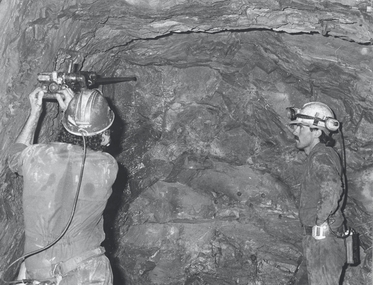
... Two men with hard hats and lights standing in front of underground rock surface at Central Deborah Gold Mine. ...standing dream. Gold Mining Central Deborah Gold Mine rock drill underground Black and white photograph. Two men with hard ...Central Deborah Gold Mine history: At its peak, Central Deborah Gold Mine reached a depth of 412 metres. It has 17 separate levels and 15 kilometres of drives and cross cuts (tunnels). The Central Deborah was very much a hands-on mine and the conditions that the miners worked in would be considered shocking by today's standards – being lowered underground in a cage with only two sides, often working ankle to knee deep in water, filling up to 32 ore trucks a shift by hand which were then pushed a mile or more along rails in the drives, working by carbide lamp, breathing in the fumes and rock dust and communication by bells. Geez, they were ironmen. However, at the time working conditions were considered to be among the best on the goldfields at Central Deborah, after all it was one of the only mines that had hot showers. Following Central Deborah Gold Mine's closure, the Bendigo skyline began to noticeably change. Obvious remnants of mining such as poppet heads, engine rooms, service quarters, battery houses and chimneys were steadily disappearing. After intense lobbying by the local community, the Bendigo City Council purchased the still very much intact Central Deborah Gold Mine in 1970 for a mere $6,000 to ensure that a vital link to Bendigo's historic golden past was maintained. The Bendigo Trust was then formed to oversee the operations of the Central Deborah Gold Mine, which led to the surface of the mine being opened to the public in 1971. Initially the surface was open for just 12 hours a week and as the demand for viewing a part of Bendigo's history increased, so did the opening hours. In 1974 the mine was gazetted as a Public Historical Purposes Reserve and attracted such visitors as H.R.H Prince Charles. By far the greatest shortcoming at this stage was that no one could view the underground workings, as these had become flooded. After what could only be described as a monumental effort by everyone involved, Level 2 of the mine was officially opened to the public by the Premier of Victoria, the Honourable John Cain, on 20 June 1986, which brought to fruition a long standing dream.Black and white photograph. Two men with hard hats and lights standing in front of underground rock surface at Central Deborah Gold Mine. Paul Maker on left hand side of image is operating a small rock drill. John Jeffrey on right hand side is observing the procedure. gold mining, central deborah gold mine, rock drill, underground -
 Bendigo Historical Society Inc.
Newspaper - Kangaroo Flat Gold Mine Collection: Bendigo Mining
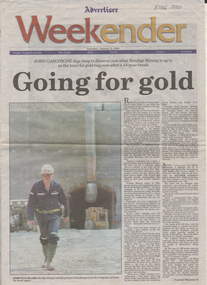
... Second photograph 'Demystifying the project - geologist Doug Buerger, Bendigo Mining's Managing Director, is pictured in overalls and hard hat standing in the box cut, near the tunnel. ...Second photograph 'Demystifying the project - geologist Doug Buerger, Bendigo Mining's Managing Director, is pictured in overalls and hard hat standing in the box cut, near the tunnel. ...Bendigo Advertiser newspaper article in the 'Weekender' supplement, 2nd. January 1999, 'Going for Gold'. Two page article on the operations of Bendigo Mining at the Kangaroo Flat site includes information on the construction of the decline, the use of the jumbo drill, use of dynamite, extraction of mullock and the potential to find gold. Colour photograph on the first page shows Bendigo Mining's Managing Director, Doug Buerger in the 30 metres box cut where the decline begins. On second page: 'Dollars - and jobs', discusses the expectations of the Company in finding gold and the (then) processes involved in treating the ore. Two photographs on page: 'Behind the blind' The Carshalton tenement where the tunnel begins' shows an aerial image of the Kangaroo Flat site. Second photograph 'Demystifying the project - geologist Doug Buerger, Bendigo Mining's Managing Director, is pictured in overalls and hard hat standing in the box cut, near the tunnel. gold mining, bendigo, bendigo mining, box cut, decline, doug buerger, kangaroo flat, explosives, jumbo drill -
 Federation University Historical Collection
Book, Ballarat School of Mines Students' Magazine, 1902-1906, 1902-1906
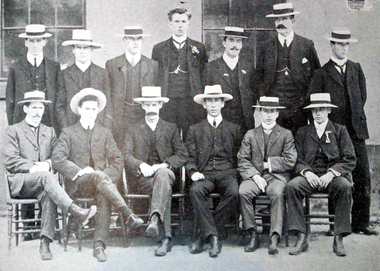
... hard cover and quart bound in calf. 1902 - Retirement of Herbert L. Krause 1905 - Mt Lyall Ore Deposits Images: Ballarat School of Mines Sports Association Committee and Officers, 1905 Standing left to right: W. ...hard cover and quart bound in calf. 1902 - Retirement of Herbert L. Krause 1905 - Mt Lyall Ore Deposits Images: Ballarat School of Mines Sports Association Committee and Officers, 1905 Standing left to right: W. ...The Ballarat School of Mines is a predecessor institution of Federation University Ausgtralia.Five copies of the Ballarat School of Mines Students' Magazine bound in a blue hard cover and quart bound in calf. 1902 - Retirement of Herbert L. Krause 1905 - Mt Lyall Ore Deposits Images: Ballarat School of Mines Sports Association Committee and Officers, 1905 Standing left to right: W. Pearce, T. Williams, S. Hepburn, Seward, W. Figgis, J.R. Reid, P. Elliott Sitting left to right: P.A. Pratt, N. Buley, John Sutherland, H.R Murphy, J. Inglis, R. Nevett 1906 Excursion to Broken Hill, The Artistic Printing Process, Hints on Portraiture, Arizona, Cornish Mining Images Ballarat School of Mines and AusImm at the Central Mine, Broken Hill; At Iron Knob, Brown Boveri Turbo Generator at Block 10, Junction Mine plant or Potter Process, Broken Hill Propriety Mill, Carlyon's Hotel, Sam Jamieson, Electrical Labortory, Ballarat School of Mines Rowing Eight, Sports Committee,ballarat school of mines, magazines, sports committee, thomas williams, mount lyell, w. pearce, t. williams, s. hepburn, seward, w. figgis, j.r. reid, p. elliott, p.a. pratt, n. buley, john sutherland, h.r murphy, j. inglis, r. nevett, herbert l. krause, broken hill, artistic printing process, hints on portraiture, arizona, cornish mining, ausimm at the central mine, broken hill, iron knob, brown boveri turbo generator at block 10, junction mine plant or potter process, broken hill propriety mill, carlyon's hotel, sam jamieson, electrical labortory, ballarat school of mines rowing eight, sports committee,, rowing on lake wendouree, boat shed, h. valentine, l. seward, c. macgennis, d. don, m. gaunt, h. owne, l. nott, s. leathes, j.a. reid, h.r. murphy, alfred mica smith, r. hosking, zeehan, moonta, wallaroo, smelting silver, south africa, south australia excursion, sunnyside woollen mills, tasmanian excursion, swedish iron, mt jukes excurson, western australian gold ore, wynne-grant furnace, bhp sintering slimes, leggo furnace, mine ventilation, mount morgan mine, mount pani ltd, new zealand coal, adelaide school of mines, students' association, at iron knob, ausimm, excursions, visits, south australian excursion -
 Flagstaff Hill Maritime Museum and Village
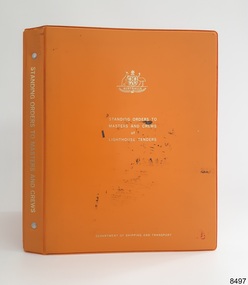
Book - Manual, Standing Orders, Department of Shipping and Transport, Standing Orders to Masters and Crews of Lighthouse Tenders, 1968
... hard covered ring-binder. Gold embossed title on spine and front cover. Contains cream loose-leaf pages with rounded corners. Pages are printed with text, tables and diagrams, and are numbered with serial page and paragraph numbers. There is a Table of Contents and an Index. The cover displays the Coat of Arms of the Commonwealth of Australia. Published by the Commonwealth of Australia in 1968 for the Department of Shipping and Transport, the book contains the Standing...Flagstaff Hill Flagstaff Hill Maritime Museum and Village Warrnambool Maritime Museum Maritime Village Great Ocean Road Shipwreck Coast shipwrecks life saving lifesaving Shiipping and Transport Commonwealth of Australia Standing Orders Lighthouse Crew Lighthouse Tenders Masters and Crews 1968 Coat of Arms [Commonwealth of Australia] "COMMONWEALTH OF AUSTRALIA" "DEPARTMENT OF SHIPPING AND TRANSPORT" "STANDING ORDERS / TO / MASTERS AND CREWS OF LIGHTHOUSE TENDERS" "No 1/1968" "No.2/1968" Book, orange vinyl surface sealed cover on hard covered ring-binder. ...This book is a mid-20th century updated version of a manual with regulations and instructions for lighthouse staff and the supply of equipment and other goods that are necessary. It includes lists such as protective clothing required, fuel, when to raise a flag at half-mast, how communication must be carried out, the testing of equipment, and other similar information. It also contains templates for the Certificates of Service of various ranks such as Master and Mate. Australia no longer has manned lighthouses although some still have caretakers that report on the weather. The last manned lighthouse was in Tasmania and was de-manned in December 1995.The ultimate purpose of the book was to set down instructions that would be used to carry out life saving procedures, and to avoid shipwrecks. It confirms some earlier methods and updates others. The information within the book is similar to the information referred to by the 19th century and early 20th century lighthouse keepers and staff, and others involved in the preservation of life, such as those published by the Department of Ports and Harbours. The book is a valuable resource to those researching the evolving of maritime history from Colonial Australia to the modern day.Book, orange vinyl surface sealed cover on hard covered ring-binder. Gold embossed title on spine and front cover. Contains cream loose-leaf pages with rounded corners. Pages are printed with text, tables and diagrams, and are numbered with serial page and paragraph numbers. There is a Table of Contents and an Index. The cover displays the Coat of Arms of the Commonwealth of Australia. Published by the Commonwealth of Australia in 1968 for the Department of Shipping and Transport, the book contains the Standing Orders to Masters and Crews of Lighthouse Tenders. It has examples for Certificates of Service for various ranks, a list of books and forms, protective clothing, rates for passengers, and a Scheme of Colour Painting for Lighthouse Tenders.Coat of Arms [Commonwealth of Australia] "COMMONWEALTH OF AUSTRALIA" "DEPARTMENT OF SHIPPING AND TRANSPORT" "STANDING ORDERS / TO / MASTERS AND CREWS OF LIGHTHOUSE TENDERS" "No 1/1968" "No.2/1968"flagstaff hill, flagstaff hill maritime museum and village, warrnambool, maritime museum, maritime village, great ocean road, shipwreck coast, shipwrecks, life saving, lifesaving, shiipping and transport, commonwealth of australia, standing orders, lighthouse crew, lighthouse tenders, masters and crews, 1968 -
 Orbost & District Historical Society
black and white photograph, 1962 (exact); 1962 fifty years reunion
... Cumming, Lexie Nixon, Ila Cowell, Arthur Reynolds, Annie Nixon, Dorothy Cameron, Nina Johnston and Pear Napier(nee Cumming -4th L) It is of Historical significance because apparently it is a photo of the earliest "back to/reunion" for Orbost Secondary College.It is of Social Significance because it is a photograph of people who attended Orbost Secondary School. education-orbost orbost-high-school Hand written on back, hard to read and some words crossed out- "Earliest Pupils H.E.S.1912.Arthur-Reynolds Nina-Johnston/D.Napier J.Irvine ? Cumming- Lexie Nixon/Ila Cowell/Annie Nixon/Dorothy Cameron," A black and white photograph of nine ladies and one man standing around a table with a large two- tiered cake on it with candles around the base. black and white photograph ...A photograph of the earliest "Back to"/reunion for Orbost Higher Elementary School/Orbost Secondary College.The photo is of ex pupils who were at the school when it was first opened in 1912.People in the photo are Dorice Napier (1st L), J.Irvine,? Cumming, Lexie Nixon, Ila Cowell, Arthur Reynolds, Annie Nixon, Dorothy Cameron, Nina Johnston and Pear Napier(nee Cumming -4th L)It is of Historical significance because apparently it is a photo of the earliest "back to/reunion" for Orbost Secondary College.It is of Social Significance because it is a photograph of people who attended Orbost Secondary School.A black and white photograph of nine ladies and one man standing around a table with a large two- tiered cake on it with candles around the base.Hand written on back, hard to read and some words crossed out- "Earliest Pupils H.E.S.1912.Arthur-Reynolds Nina-Johnston/D.Napier J.Irvine ? Cumming- Lexie Nixon/Ila Cowell/Annie Nixon/Dorothy Cameron,"education-orbost orbost-high-school -
 Orbost & District Historical Society
Book, Halstead Press, Stand Easy, 1945
... A 208 pp book with a dust jacket which has a picture of a soldier wearing a slouch hat holding a world globe with Australia to the front. a soldier is standing on top of the globe holding a bayonet high. The title, "Stand Easy" is in red print at the bottom right. The hard...This book is a significant contemporary record of the participation of Australian soldiers in World war 11. military World-War-11 book-Stand-Easy inside cover - " To John Gilbert Esq..........from Capt Shannon Tallagoota Orbost Victoria" A 208 pp book with a dust jacket which has a picture of a soldier wearing a slouch hat holding a world globe with Australia to the front. a soldier is standing on top of the globe holding a bayonet high. The title, "Stand Easy" is in red print at the bottom right. The hard ...This book was part of a series of books published for the Australian Military Forces by the Australian War Memorial in Canberra. Contents for the book came from the Australian military forces in early 1945 and the book was ready for printing at the beginning of August, ready for Christmas release. The title signified the ending of the war to the north of Australia.This book is a significant contemporary record of the participation of Australian soldiers in World war 11.A 208 pp book with a dust jacket which has a picture of a soldier wearing a slouch hat holding a world globe with Australia to the front. a soldier is standing on top of the globe holding a bayonet high. The title, "Stand Easy" is in red print at the bottom right. The hard cover of the book inside the dust jacket is green with the wording 'Stand Easy after the defeat of Japan, 1945' in pale green, along with an image of a soldier waving a gun above his head. It contains prose accounts of the war, cartoons, photographs, verse, illustrations and maps.inside cover - " To John Gilbert Esq..........from Capt Shannon Tallagoota Orbost Victoria"military world-war-11 book-stand-easy -
 Glenelg Shire Council Cultural Collection
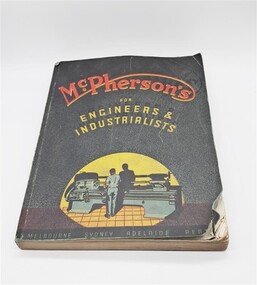
Book - Tool Catalogue, McPherson's Limited, McPherson's FOR ENGINEERS & INDUSTRIALISTS, 1949
... hard to make out surname. Book is covered by green card and printed on the front with the title and a cartoon sketch/picture of a man standing facing away from viewer at a large industrial piece of machinery. ...This book is a catalogue issued for machinery merchants, tool specialists, suppliers of engineers' requisites, manufacturers of pumps, bolts, nuts, rivets, makers of high grade machine tools.Book is covered by green card and printed on the front with the title and a cartoon sketch/picture of a man standing facing away from viewer at a large industrial piece of machinery. Appears to be working. Picture includes an orange tiled floor and yellow wall. The book has 448 pages. Front cover: McPherson's FOR ENGINEERS & INDUSTRIALISTS MELBOURNE SYDNEY ADELAIDE PERTH Back Cover- McPherson's Ltd. 546-566 COLLINS STREET MELBOURNE * Telephone: MY270 * Telegraphic Address: "MERCHANT" MELBOURNEnon-fictionThis book is a catalogue issued for machinery merchants, tool specialists, suppliers of engineers' requisites, manufacturers of pumps, bolts, nuts, rivets, makers of high grade machine tools. -
 Halls Gap & Grampians Historical Society
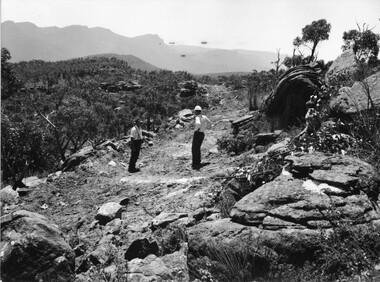
Photograph - B/W
... Photo shows 2 men standing on rough formation of road to Mt William. One man is wearing a hard-hat, the other a felt hat....ACCESS ROUTES Roads ACCESS ROUTES Mt William Road Photo shows 2 men standing on rough formation of road to Mt William. One man is wearing a hard-hat, the other a felt hat. ...Photo shows 2 men standing on rough formation of road to Mt William. One man is wearing a hard-hat, the other a felt hat.access routes, roads, access routes, mt william road -
 Bendigo Military Museum
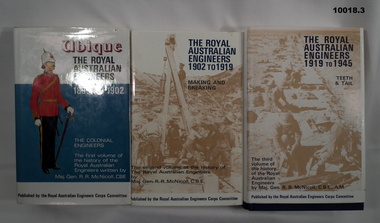
Book - MILITARY HISTORY, ENGINEERS, Ronald McNicoll, "THE ROYAL AUSTRALIAN ENGINEERS" [1] 1835 TO 1902. [2] 1902 TO 1919. [3] 1919 TO 1945.", [1] 1977, [2] 1979, [3] 1982
... hard covers books with dust covers. 1.2.& 3. Hardcover - cardboard, dark blue colour buckram with gold print on spine. Dust covers - paper, black, white, dark blue print on front and spine. Illustrated. 1. Blue and white colour background with soldier in red and navy colour uniform standing...hard covers books with dust covers. 1.2.& 3. Hardcover - cardboard, dark blue colour buckram with gold print on spine. Dust covers - paper, black, white, dark blue print on front and spine. Illustrated. 1. Blue and white colour background with soldier in red and navy colour uniform standing ...Three volumes, hard covers books with dust covers. 1.2.& 3. Hardcover - cardboard, dark blue colour buckram with gold print on spine. Dust covers - paper, black, white, dark blue print on front and spine. Illustrated. 1. Blue and white colour background with soldier in red and navy colour uniform standing with sword in right hand. 2. Cream and sepia colour background with sepia photograph of Watson's Pier, ANZAC Cove June 1915. 3. Cream and sepia colour background, with sepia photograph of sappers disarming weapons. 203, 232, 432 pages - cut, plain off white colour paper. Illustrated - black and white photographs and maps. Endpapers - illustrated 1. Drawing in blue colour. 2. & 3. Maps - black and white colour. publications, books, military history, royal australian engineers -
 Bendigo Military Museum
Book - BOOK, KOREA FICTION, John Hooker, Standing Orders, 1986
... Hard cardboard cover, black buckram, gold print on spine. Dust cover has gold / white print on front, spine & back. Black background & illustrated in colour, painting - Soldiers by Sydney Nolan 1959. 384 pages, cut, plain, beige. Standing ...Fiction - Korean War. Hard cardboard cover, black buckram, gold print on spine. Dust cover has gold / white print on front, spine & back. Black background & illustrated in colour, painting - Soldiers by Sydney Nolan 1959. 384 pages, cut, plain, beige.book, fiction, korea -
 Warrnambool and District Historical Society Inc.
Book, An Anthology of Friendship
... This book connects two prominent members of the Warrnambool community, George Furner Langley long standing headmaster of Warrnambool High School and businessman David Fletcher Jones (1895-1977) george langley David Fletcher Jones warrnambool colonel george langley ‘To friend, George Langley, in appreciation of lots, D. Fletcher Jones, 18/5/40’ This is a hard ...George Furner Langley (1891-1971) was appointed Headmaster at the Warrnambool Agricultural High School on 1 January 1924 just as this school became Warrnambool High School. Even taking into account a leave of absence between 9 February 1930 to 11 March 1931, Langley was the longest serving headmaster at Warrnambool High School, leaving on the 27 May 1940 to take up a position as Head Master at Bendigo High School. This book would appear to be a farewell gift to George Langley from D. Fletcher Jones. Langley served with distinction in World War One and World War Two and went on to become the Principal of Melbourne High School.This book connects two prominent members of the Warrnambool community, George Furner Langley long standing headmaster of Warrnambool High School and businessman David Fletcher Jones (1895-1977) This is a hard cover book of 60 pages. It has a dark blue cover with gold lettering on the front cover and on the spine. The book contains prose extracts and poems on the topic of friendship. The cover is faded and marked, especially on the spine. The inscription on the first page is handwritten in black ink.‘To friend, George Langley, in appreciation of lots, D. Fletcher Jones, 18/5/40’ george langley, david fletcher jones, warrnambool, colonel george langley -
 Bendigo Military Museum
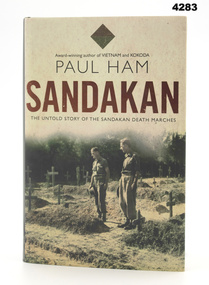
Book - BOOK, WW2, SANDAKAN : The Untold Story Of The Sandakan Death Marches, Published 2012
... Book with dust cover. 1) Cover, hard cover, cardboard with pale green paper-cover, red and black print on spine, end papers dark red colour. 2) Dust cover, paper, red and black print on front and spine, background beige on front, grey grey colour on spine. Illustrated front and spine sepia toned photograph of two soldiers in uniform standing...Their journey became known as the Sandakan Death Marches.” book wwii sandakan prisoners of war Book with dust cover. 1) Cover, hard cover, cardboard with pale green paper-cover, red and black print on spine, end papers dark red colour. 2) Dust cover, paper, red and black print on front and spine, background beige on front, grey grey colour on spine. Illustrated front and spine sepia toned photograph of two soldiers in uniform standing ...“This is the story of the three-year ordeal of the Sandakan prisoners of war. After the fall of Singapore in February 1942. Their journey became known as the Sandakan Death Marches.”Book with dust cover. 1) Cover, hard cover, cardboard with pale green paper-cover, red and black print on spine, end papers dark red colour. 2) Dust cover, paper, red and black print on front and spine, background beige on front, grey grey colour on spine. Illustrated front and spine sepia toned photograph of two soldiers in uniform standing in a graveyard. Colour photograph on back of the “Sandakan Memorial Gates” with garden view behind. 656 pages, cut, plain, off white, illustrated black and white photographs and maps.book, wwii, sandakan, prisoners of war -
 Eltham District Historical Society Inc
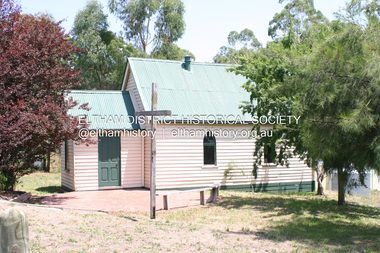
Photograph - Digital Photograph, Alan King, St Andrews Anglican Church, St Andrews, 30 January 2008
... standing, this building is now used as the St Andrews Community Centre and the residence is leased for private use. The original timber-lined room remains alongside the extensions, and is distinctive with its high ceiling and tall small-paned windows. In 1984 a new school was built 500 metres west of the old school. Many residents have contributed much to St Andrews but one family that has done so for several generations is the Harris family. Robert Harris was an active member of the St Andrew’s Anglican Church, and worked hard...standing, this building is now used as the St Andrews Community Centre and the residence is leased for private use. The original timber-lined room remains alongside the extensions, and is distinctive with its high ceiling and tall small-paned windows. In 1984 a new school was built 500 metres west of the old school. Many residents have contributed much to St Andrews but one family that has done so for several generations is the Harris family. Robert Harris was an active member of the St Andrew’s Anglican Church, and worked hard ...Built c.1868, St Andrew’s Anglican Church is Nillumbik Shire’s oldest timber church and is historically, socially, and spiritually significant to the Shire of Nillumbik. The church is historically significant because it may have given its name 'St Andrews' to the town (another suggestion is that the name came from the local hotel), it is also historically significant as one of only four buildings that remain from the Caledonian goldfields era of Queenstown (now St Andrews) and one of only a handful of buildings that survived the 1960s bushfires. The church is historically, socially, and spiritually significant because it has played an important part in community life for more than 150 years; a proposal to move the church in 1984 met with strenuous opposition. Much of the fires on Black Saturday 2009 were the north of the town. The town itself remained intact - as did this heritage building. Covered under Heritage Overlay, Nillumbik Planning Scheme. National Trust of Australia (Victoria) Local significance Published: Nillumbik Now and Then / Marguerite Marshall 2008; photographs Alan King with Marguerite Marshall.; p69 The St Andrews Anglican Church and former St Andrews Primary School, are two reminders of the district’s early days, when it was founded on gold. St Andrews, then called Queenstown, was the earliest goldfield in the Caledonia Diggings.1 It was the Upper Diamond Gold Mining and Administrative Centre, with 3000 miners. Queenstown was also the seat of the Court of Petty Sessions. The church and school then stood close to European and Chinese stores, three hotels, a brewery and a quartz mill.2 In 1861, Queenstown was officially proclaimed a township. From 1865, the name Queenstown was interchangeable with St Andrews, until 1952, when the town was officially named St Andrews. As gold declined from the early 1880s, Queenstown changed dramatically into a settlement of small farms. St Andrew’s Anglican Church, built in 1868, is the Shire’s oldest timber church and possibly gave its name to the township.3 The small timber church was opened on November 1, 1869, by the Dean of Melbourne. Anniversary tea meetings helped raise funds, and in 1889, a three-bedroom parsonage was built alongside. In 1910, the vicar, the Rev Selwyn Chase (and friend of the Scouting Movement’s founder, Baden Powell), established the 1st Queenstown Scout Troop, only two years after Scouting began in Australia. The church was important to the lives of many local residents who were baptised, married and had funeral services there. But by the 1950s the population had decreased and so did the weekly attendances. Around the mid-1960s the church closed, then fell into disrepair. So in the mid 1980s it was sold to the Education Department and was under threat of relocation or demolition. However this caused such opposition from locals,4 that instead, the Anglican church leased it as part of the Panton Hill parish5 and it was reconsecrated in 1987. Queenstown’s first school was held in a tent after transferring from Andersons Creek, Warrandyte.6 From 1858 a church school, Caledonia Diggings, stood west of the main road, a quarter of a mile (0.4km) before Buttermans Track. In 1882 the school was moved from a leased building, owned by headmaster Robert Harris, into a larger building on the corner of the School and the Heidelberg-Kinglake Roads. It had been moved from Smiths Gully and included a teacher’s three-roomed residence.7 In 1887 the school was replaced by the Queenstown State School No 128, although it was also called Caledonia Diggings until 1891. In 1956 it was renamed St Andrews. Still standing, this building is now used as the St Andrews Community Centre and the residence is leased for private use. The original timber-lined room remains alongside the extensions, and is distinctive with its high ceiling and tall small-paned windows. In 1984 a new school was built 500 metres west of the old school. Many residents have contributed much to St Andrews but one family that has done so for several generations is the Harris family. Robert Harris was an active member of the St Andrew’s Anglican Church, and worked hard at improving the town’s amenities until his death in 1887. He was a signatory to the successful 1863 petition to the Chief Commissioner of Police, against the proposed removal of the Court of Petty Sessions and police station at the Caledonia Diggings. The police station stayed in the town until 1917. Harris was Head Teacher of Queenstown State School from 1864 to 1874, then of the Smiths Gully school until it closed in 1882, and he continued teaching at Panton Hill until his death. His son, Robert Charles Harris, was editor and printer of the local newspaper, The Evelyn Observer, from 1873 until 1915. Robert’s son, William Shelley Harris, served in the Boer War and in World War One. In 1928 he became Kinglake National Park’s first park ranger. Robert’s daughter Elizabeth, taught needlework at Queenstown State School, and later ran the post office in Kinglake.This collection of almost 130 photos about places and people within the Shire of Nillumbik, an urban and rural municipality in Melbourne's north, contributes to an understanding of the history of the Shire. Published in 2008 immediately prior to the Black Saturday bushfires of February 7, 2009, it documents sites that were impacted, and in some cases destroyed by the fires. It includes photographs taken especially for the publication, creating a unique time capsule representing the Shire in the early 21st century. It remains the most recent comprehenesive publication devoted to the Shire's history connecting local residents to the past. nillumbik now and then (marshall-king) collection, st andrews, st andrews anglican church -
 Eltham District Historical Society Inc
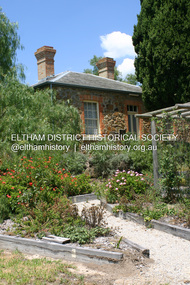
Photograph - Digital Photograph, Alan King, Ellis Cottage, Diamond Creek, 23 January 2008
... .; p79 Ellis Cottage, built by William Ellis, is a memorial to the courage of pioneers in the Diamond Valley area.1 Now a museum and home to the Nillumbik Historical Society, it is a fine example of an early settler’s house in Diamond Creek – and one of the few original buildings standing from the middle of the 19th century. It is a poor man’s cottage – typical of the dwellings of those who had to work hard to wrest a living in this district, because most of the land was not fertile enough for major forms of farming. ....; p79 Ellis Cottage, built by William Ellis, is a memorial to the courage of pioneers in the Diamond Valley area.1 Now a museum and home to the Nillumbik Historical Society, it is a fine example of an early settler’s house in Diamond Creek – and one of the few original buildings standing from the middle of the 19th century. It is a poor man’s cottage – typical of the dwellings of those who had to work hard to wrest a living in this district, because most of the land was not fertile enough for major forms of farming. ...Built by William Ellis in 1865 of local uncut stone about 30cm thick, the cottage is now a museum and home to the Nillumbik Historical Society. Ellis Cottage is historically significant for its association with the Ellis family, who were pioneers of the Diamond Creek district and the benefactors of the notable Nillumbik Cemetery gateway. It illustrates the development of farming in the area. Ellis Cottage is historically and technically significant for its rare use of uncut local stone for building purposes. Covered under Heritage Overlay, Nillumbik Planning Scheme. National Estate Published: Nillumbik Now and Then / Marguerite Marshall 2008; photographs Alan King with Marguerite Marshall.; p79 Ellis Cottage, built by William Ellis, is a memorial to the courage of pioneers in the Diamond Valley area.1 Now a museum and home to the Nillumbik Historical Society, it is a fine example of an early settler’s house in Diamond Creek – and one of the few original buildings standing from the middle of the 19th century. It is a poor man’s cottage – typical of the dwellings of those who had to work hard to wrest a living in this district, because most of the land was not fertile enough for major forms of farming. The pretty stone cottage at 10 Nillumbik Square, built in 1865, is made of local uncut stone about one foot (30 cm) thick. It once stood near the centre of the 147 acres (59.4ha) Ellis bought in 1850. The property extended from Diamond Creek to Reynolds Road and from Perversi Avenue to the Wattle Glen School. It stood in the electoral parish of Nillumbik. The Nillumbik township (later called Diamond Creek) was not created until 1867. In 1912 the property was cut in half by the new railway to Hurstbridge. Ellis paid £147/10/- for the land - about three times what a Victorian farmer would usually earn in a year. Despite the poor quality soil Ellis became a very successful farmer with an orchard, vegetables and a dairy herd. Five years later, in 1855, Ellis bought 70 acres (28.3ha) from neighbour, Hugh Larimour. In 1857 Ellis bought 208 acres (84ha) at Yarra Glen. In 1877 he bought 122 acres (49.3ha) at Diamond Creek and later bought land at Greensborough and Woodstock. Ellis was born in 1815 at Blackawton, a small Devonshire village, and became a tenant farmer. It is not known why Ellis came out to Australia or settled in Diamond Creek. In 1847 he married Margaret Child at the Melbourne Presbyterian Church. Ellis and Child had no children and 18 years after the wedding, while probably living in Kangaroo Ground, Ellis built this small cottage. The simple cottage has a central hall and two rooms on each side. To maximise the small space the ceiling cavity was designed large enough to provide sleeping accommodation accessed via a ladder. Each room was heated by an open fireplace and the one in the kitchen was large enough to roast a sheep. A large cellar under the front room probably stored farm produce. Water came from a well as reticulated water did not arrive at Diamond Creek until 1914. In 1870 Ellis’ 22 year-old nephew Nathaniel joined him from England.2 Until 1890 they developed Ellis Park, praised in The Evelyn Observer, May 30,1890 as a model farm. Ellis had become wealthy, and on his death in 1896 his estate was valued at £9000. In his will he left £100 to construct memorial gates at the Nillumbik Cemetery where he was buried.3 Ellis left the farm to his second wife Louisa. As he had no children, upon her death the farm passed to Nathaniel, but he did not take it up. The farm was sold and leased several times until 1967, when engineer Phillip Lovitt bought the property and carried out major structural works. The Shire of Diamond Valley bought it in the 1980s and in 1989 restored it with the Nillumbik Historical Society. The stone walls of the cottage had been plastered with mud and straw mortar, which were removed as they were riddled with vermin. Doors, windows and a floor were replaced and the original roof of timber shingles had been replaced with slate. The well was too deeply cracked to be restored, so was used for a flower bed. Two mature Italian Cypresses at the entry are also heritage protected as they relate to similar trees planted at Shillinglaw Cottage and other early buildings in Nillumbik Shire.This collection of almost 130 photos about places and people within the Shire of Nillumbik, an urban and rural municipality in Melbourne's north, contributes to an understanding of the history of the Shire. Published in 2008 immediately prior to the Black Saturday bushfires of February 7, 2009, it documents sites that were impacted, and in some cases destroyed by the fires. It includes photographs taken especially for the publication, creating a unique time capsule representing the Shire in the early 21st century. It remains the most recent comprehenesive publication devoted to the Shire's history connecting local residents to the past. nillumbik now and then (marshall-king) collection, ellis cottage, diamond creek, nillumbik historical society, william ellis -
 Eltham District Historical Society Inc
Film - Video (VHS), Jenni Mitchell, Demolition of the Shire of Eltham Offices, 1996
... Scene (2 August 1996) more heavy demolition machinery in operation smashing building up, people standing around southern wing watching, view overlooking Eltham Library of train pulling in to Eltham station. Scene (7 August 1996) more heavy demolition and people wandering around with only hard hat protection, no dust protection, comments from one operator dumping a bin of material stating “wait till there’s a Hungry Jack’s here, you’ll be laughing, fuel, videos, hamburgers. ...Scene (2 August 1996) more heavy demolition machinery in operation smashing building up, people standing around southern wing watching, view overlooking Eltham Library of train pulling in to Eltham station. Scene (7 August 1996) more heavy demolition and people wandering around with only hard hat protection, no dust protection, comments from one operator dumping a bin of material stating “wait till there’s a Hungry Jack’s here, you’ll be laughing, fuel, videos, hamburgers. ...Poor video quality (noise and interference), incomplete and unedited raw footage. A video documenting the demolition of the Shire of Eltham offices at 895 Main Road Eltham under the direction of the Commissioners appointed for the new Shire of Nillumbik and some of the communities activities surrounding the event. The building was demolished exactly 25 years after the southern wing housing Engineering and Planning on the upper level and the Eltham Library on the ground level was opened in celebration of the Shire of Eltham's centenary. Video has lots of distortion and noise, and sections of clips dubbed over. Immediate initial footage of Jenni Mitchell talking about asbestos claims in the Shire Offices (Sigmund Jorgensen standing behind her) advising Council did a review of the building several years previously and had been cleared of health problems. Cuts to group of people standing outside front door of offices but possibly voice dub over not related ? Then the date 27 Jul 1996 on a scene flashes on screen immediately followed by an edited clip intro of title and credits with classical music track. It then opens with Jenni Mitchell driving to the Shire Offices on Saturday 27 July 1996 at 11.00am. Footage of Main Road past Pitt Street, Alistair Knox Park then entering Shire Office driveway which is fenced off and contractor signs hanging up. Scenes at rear of building showing some internal demolition has commenced. View of the Administration wing. More clips of road driving, Alistair Knox Park, Eltham Library and visitor car park for Shire Offices. Cuts to a group of people standing in access to visitor carpark with new Eltham Library in background, one being immediate former Shire of Eltham President, John Graves. Scenes of people looking through chain link fence and security guard checking front door. John Graves being filmed that someone informed him the Shire was offering the building to the Community Health Centre for $2.3 million and that if they had been offered a price of $1.1 for what it apparently was sold for they would have snapped it up. View of truck loaded with brick rubble literally struggling to ascend the hill of Library Place to exit into Main Road. Cuts to a scene looking at Eltham War memorial Hall through the Memorial Gate, then the Shillinglaw trees and large banner sign ‘Delta Demolitions’ hanging on office façade. Views of front door, old library and bluestone wall. Scene (31 Jul 1996) filmed at night of several white crosses with “RIP Community” and “RIP Democracy”. Scene (1 August 1996) again driving along Main Road towards the Shire Offices then scenes of the offices showing substantially more demolition to exterior, groups of people standing on footpath outside watching, Delta heavy demolition machines, woman holding sign “Democracy where have you gone …”, the odd person in full protection gear and breathing apparatus hand carrying materials out to place on rubbish pile in front of people standing on footpath watching (with no protection) and then stamping on it to break it creating dust, security person in hard hat (no other protection) wandering around, many groups standing around watching, news film crew, person standing on roadside edge holding signs facing traffic stating “Pirate Planning” and “ Grant us your ears” also sign on back of parked car “Elthams High Jacks”, another sign “Community Democracy”, views of crosses in Main Road median strip “RIP Community”, groups of people on footpaths and reporters conducting interviews, footage of unknown person standing with Jenni Mitchell and Sigmund Jorgensen advising people have the right to protest, Jenni Mitchell urging people to ask questions of local MP and Council and Sigmund Jorgensen referring to the three historic Shillinglaw trees with demolition machinery operating in background, Jenni Mitchell and others installing more crosses in median strip; demolition machines operating inside and outside the building, more views of onlookers including Sigmund Jorgensen then Police approaching on footpath, workers and machinery continuing to operate, views of the old library being demolished, the former Community Services department, security personnel. Scene (2 August 1996) more heavy demolition machinery in operation smashing building up, people standing around southern wing watching, view overlooking Eltham Library of train pulling in to Eltham station. Scene (7 August 1996) more heavy demolition and people wandering around with only hard hat protection, no dust protection, comments from one operator dumping a bin of material stating “wait till there’s a Hungry Jack’s here, you’ll be laughing, fuel, videos, hamburgers. You’ll be up with the rest of the world soon, you’ll have electricity and everything here, ha ha ha ha”, more heavy machinery demolition and breaking up of materials, view of Hitachi train going by and Administration wing, view inside the front door opening of the staircase leading to upper level, person walking around operating heavy machinery with a hose spraying rubble (no protective gear other than hard hat interspersed with edit cuts of meeting of Commissioners and independent observers on panel as well as members of the community in public gallery. Nillumbik Shire CEO Barry Rochford addressing the meeting., Chief Commissioner Don Cordell directly addressing Jenni Mitchell with respect to permission to take photographs, Barry Rochford continues to address the question asked of Council about the valuation of the former Shire of Eltham Office building/site, public gallery calling out asking why was building demolished, what was the urgency. Scene (14 August 1996) views of southern wing, previous single demolition operator again mocking people filming, operators working in and around building, Shillinglaw trees and largely demolished front, heavy demolition equipment at work, piles of building rubble, hose spraying water over rubble, large trucks arriving for rubble removal and loading of truck. Scene (21 August) more of the same, building virtually down, Shillinglaw trees standing tall and alone, water spraying on rubble and wattle in bloom. Cuts to Council meeting with public onlookers. Barry Rochford walks out, Wayne Phillips addresses meeting explaining one or two people shouting, members of the community challenging Council (Commissioners) about why due process appear to have been subverted. Former Shire President Robert Marshall in public audience, cuts back to Shire office carpark entrance site and sign hung on fence in front of library “Think Again!” and people standing around observing awaiting a protest demonstration erecting a large sign on stilts stating “Shell No!”, people singing a revised version of God Save the Queen (God Save Us All), Sigmund Jorgensen in attendance, Jenni Mitchell, Sigmund Jorgenson and others address the protest crowd, followed by people mingling, music being played then people standing around the cleared site circumference all with arms linked (video very broken up with noise) then chants “Save the Gateway” and “No Shell for Eltham” and more music and singing “Put up a parking lot”. The crowd then proceeds to walk along the footpath of Main Road. Scene (15 Sep 1996) meeting at Montsalvat in Great Hall addressed by Sigmund Jorgensen discussing a recently published list of the Commissioner’s to senior Council Officers of banned Nillumbik people, others encouraging people to view proposed plans for the site and lodge objections. Specific issues regarding asbestos claims are also addressed. Harry Gilham addresses the meeting on the subject of the Eltham War Memorial and Memorial Gardens and how Council believe a roundabout in the vicinity is of greater importance. Views of various artworks on display (for auction) and music performance in the Barn Gallery. Meeting addressed by Sigmund Jorgensen discussing an appeal against Council granting a permit to Dallas Howgate to develop the site and that the Minister has called the matter in to be decided by the governing council. This is followed by an auction of paintings. 0.05 - Jenni Mitchel, Sigmund Jorgensen and Peter Doughtery in background. 0.18 - Jock Kyme in front of building – David Essex, Marg Johnson on his left-hand side. 5.34 - John Graves – ex Shire of Eltham Councillor and President. 9.02 - Unknown person being interviewed. 9.30 - Jenni Mitchell, unknown person, Mark Burns, community activist. 10.04 - Sigmund Jorgenson, Jenni Mitchell. 12.04 - Police members 21.33 - Nillumbik Council offices 7 August 1996 Barry Rochford CEO, Vin Heffernan Commissioner, Don Cordell Chief Commissioner, Kevin Abbott Commissioner, unknown person. 28.00 - Barry Rochford CEO 28.05 - Kahn Frankie - in commissioner’s seat after commissioners and council staff have vacated the council chamber. 28.26 - Wayne Phillips, State Liberal member for Eltham, addressing community in response to questions. 28.36 - Mark Burns, community activist addressing gallery. 28.48 - Ken Hines, ex Shire of Eltham Councillor and President. 29.34 - Ken Hines, ex Shire of Eltham Councillor and President standing, Robert Marshall, ex Shire of Eltham Councillor and President seated in front. 29.41 - Karen Gerhards, community activist. 30.06 - Marg Johnson with loud hailer, next to Jock Kyme, community activist. 31.32 - Marg Johnson with possibly Frank Burgoyne?, Sigmund Jorgensen, Jock Kyme. 35.35 - Harry Gilham at meeting at Montsalvat on 15 September 1996. 35.43 - Sigmund Jorgenson at lectern. 36.42 - Marg Jennings. 37.47 - Mark McDonald, Jim Connor, ex Shire of Eltham Councillor in background. 36.28 - John Cohen, ex Shire of Eltham Councillor and President. 38.56 - Ken Hines, ex Shire of Eltham Councillor and President. 41.11 - Harry Gilham, president of the Eltham District Historical Society. 43.55 - Sigmund Jorgensen in Long Gallery at Montsalvat, at start of the art auction to raise funds for community action. 45.50 - Unknown person conducting art auction. VHS Video cassette (poor quality) Converted to MP4 file format 45:01, 535MBvideo recording, 895 main road, alistair knox park, artworks, auction, barn gallery, barry rochford, community health centre, dallas howgate, delta demolitions, demolition, don cordell, eltham, eltham library, eltham shire office, eltham war memorial, eltham war memorial gate, eltham war memorial hall, great hall, harry gilham, jenni mitchell, john graves, library place, main road, memorial gardens, mervyn hannan, montsalvat, pitt street, protest, robert marshall, roundabout, shell oil, shillinglaw trees, sigmund jorgensen, sign, wayne phillips -
 Bendigo Military Museum
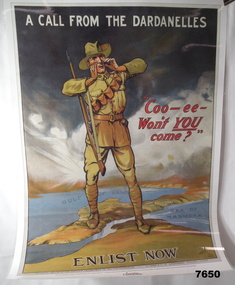
Poster - ENLISTMENT POSTER, St. Leigh & Co. Ltd, Original WW1
... Large hard paper poster. Symbolic image of Australian Soldier standing on a 3D image of the Dardenelles in Turkey. ...WW1 Recruitment Poster On top says "A CALL FROM THE DARDENELLES" On bottom "ENLIST NOW" In middle "COO-EE - WON'T YOU COME" Large hard paper poster. Symbolic image of Australian Soldier standing on a 3D image of the Dardenelles in Turkey. ...A commemorative poster facsimile of an original WW1 Recruitment Poster issued in 1915 by Defence Department - Issued by Australian Geographic.Large hard paper poster. Symbolic image of Australian Soldier standing on a 3D image of the Dardenelles in Turkey. In colour showing map of that part of Turkey. Poster laminated with layer of clear plastic to protect it.On top says "A CALL FROM THE DARDENELLES" On bottom "ENLIST NOW" In middle "COO-EE - WON'T YOU COME"ww1, recruitment poster -
 Kiewa Valley Historical Society
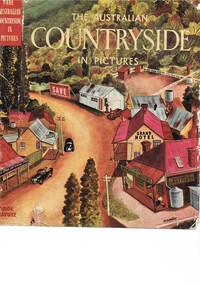
Book - Reference Countryside, The Australian Countryside in Pictures, circa 1950s
... This printed coloured sketched, or painted paper sleeve of the book is freely wrapped over a dark red hard cover. Into the front of the cover is pressed a standing pose of a farmer with long sleeves rolled up over his elbows. ...This unity within the rural environment is something that is attracting more and more families from sometimes alienating city life. country life australian "outback" rural industries life on the land swag-man of the bush On the tittle page is a signature "C Roper" This printed coloured sketched, or painted paper sleeve of the book is freely wrapped over a dark red hard cover. Into the front of the cover is pressed a standing pose of a farmer with long sleeves rolled up over his elbows. ...This book is a "snapshot" in time (1950s) detailing life in Australia covering a time when a "man's word and handshake" were his moral and quasi legal bond, and the now relative defunct saying "smoko" (having a "time out" from work for a cigarette and tea or coffee). The book spans an era where the male was still the "head" of the family even though for a majority of families the women took on the many "male only" roles during the World War II period. This shift in the leadership of the family hierarchy is mentioned, so ever slightly, (not to offend the still predominant macho male image) in both rural and city environments. The effects of the war, and later the push for women's emancipation and equality in both family, social, workplace and political areas of life, since this book was published, is now finally resolved. However there are still some sections of the recent migrate population where this male dominance is causing a few problems.The significance of this book is not only because it was donated by Mrs C. Roper ( from the Roper Family, a pioneer Kiewa Valley and surrounding Region family - originally beef cattle graziers) but also a Kiewa Valley resident and family, experiencing the shift in the social and economical life of post World War II rural Australia. The strong heritage link to this region of many families still residing within its boundaries, is a clear affirmation of the bond that the Kiewa Valley and its Regions have upon family unity. This unity within the rural environment is something that is attracting more and more families from sometimes alienating city life.This printed coloured sketched, or painted paper sleeve of the book is freely wrapped over a dark red hard cover. Into the front of the cover is pressed a standing pose of a farmer with long sleeves rolled up over his elbows. Behind him and to the right are what appears to be three sacks of wheat and next to him is a merino sheep. To the left and down are two dogs one with a fox in its jaws. The book contains 240 pages, 300 illustrations in gravure and 25 pictures in full colour. The inside fly leaf is a colour photograph of a rural scene with dirt road running in the centre and to the left a farm house and a five bay open storage barnOn the tittle page is a signature "C Roper"country life, australian "outback", rural industries, life on the land, swag-man of the bush -
 Bendigo Military Museum
Book, The Corps Committee of the Royal Australian Engineers (Department of Defence), Ubique. The Royal Australian Engineers. 3 Volumes, 1) 1977 .2) 1979 .3)1982
... Dark Blue hard covers with dust jackets Author MajGen RR McNicoll CBE. .1) Ubique the royal Australian Engineers 1835-1902 "the colonial Engineers." Blue and While dust jacket with soldier in red and navy uniform standing with sword in right hand 203 PP .2) The Royal Engineers 1902 - 1919 " Making and Breaking." 232 PP. ...Dark Blue hard covers with dust jackets Author MajGen RR McNicoll CBE. .1) Ubique the royal Australian Engineers 1835-1902 "the colonial Engineers." Blue and While dust jacket with soldier in red and navy uniform standing with sword in right hand 203 PP .2) The Royal Engineers 1902 - 1919 " Making and Breaking." 232 PP. ...Three volumes. Dark Blue hard covers with dust jackets Author MajGen RR McNicoll CBE. .1) Ubique the royal Australian Engineers 1835-1902 "the colonial Engineers." Blue and While dust jacket with soldier in red and navy uniform standing with sword in right hand 203 PP .2) The Royal Engineers 1902 - 1919 " Making and Breaking." 232 PP. Author Maj Gen RR McNicoll CBE, cream and sepia coloured dust jacket photograph of the building of Watson's Rer Anzac Cove June 1915. .3) The Royal Australian Engineers 1919 -1945 "Teeth and Tail." 432 PP Author Maj Gen RR McNicoll CBE AM. Cream and Sepia coloured dust jacket photograph of sappers disarming anti vehicle mines near Derna, Cyremaica 1941..1) .2) .3) Donated by the Batham Family written in ink on title pages,books, military history -
 Bendigo Military Museum
Photograph - PHOTOGRAPH, BCOF, 2018
... Picture of 9 Ex- servicemen in civilian clothes, wearing their service ribbons and standing in front of cenotaph at Corowa. Picture laminated in hard plastic on both sides....Picture of 9 Ex- servicemen in civilian clothes, wearing their service ribbons and standing in front of cenotaph at Corowa. Picture laminated in hard plastic on both sides. ...Photo taken in 2018 when reunion held for BCOF (British Commonwealth Occupation Forces) 1945-52. Shows surviving servicemen in attendance. Items in the collection of Richard William McGILVERY, RAAF. Ref Cat. No 7287P for his service details, photos and awards.Large laminated landscape photo of members of BCOF. Picture of 9 Ex- servicemen in civilian clothes, wearing their service ribbons and standing in front of cenotaph at Corowa. Picture laminated in hard plastic on both sides.bcof, reunion, richard william mcgilvery -
 Kiewa Valley Historical Society
Book - Religion - Prize, The Fairies of Flower Gulley
... White hard covered book with black print of title at top centre. Below is a picture of a fairy girl in pink and a fairy boy standing on a large snail, waving. ...From the Kergunyah Presbyterian Sunday School" White hard covered book with black print of title at top centre. Below is a picture of a fairy girl in pink and a fairy boy standing on a large snail, waving. ...Students attended Sunday School classes at the Kergunyah Presbyterian Church. Sunday school was held in a little 16 foot square wooden building which came from Rocky Valley after it was no longer needed there. Ewen Wallace's father initiated and organised the move. C2011 the building was knocked down because of white ants. The Presbyterian Church will be 125 years old in 2015.Historical: Religious Education: This book was given to students who attended the Sunday School classes at Kergunyah Presbyterian Church. Religion: Presbyterian Church at Kergunyah, in the Kiewa Valley, celebrates its 125th anniversary in 2015 after being handed over to the Uniting Church in the 1970s.White hard covered book with black print of title at top centre. Below is a picture of a fairy girl in pink and a fairy boy standing on a large snail, waving. "An Australian Story Book" "Moorooba Books"Stamped. "Awarded to ... Class .... Teacher ..... From the Kergunyah Presbyterian Sunday School"religion, kergunyah, sunday school, religious education, aboriginal, moorooba., ewen wallace -
 Bendigo Historical Society Inc.
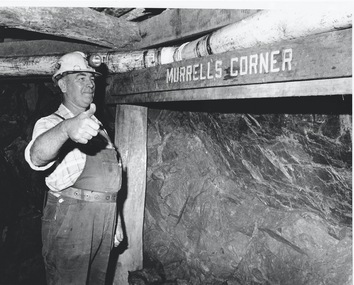
Photograph - AUSTIN COLLECTION: Ray Beer, Central Deborah Gold Mine
... standing alongside wooden sign 'Murrell's Corner'. Sign is placed horizontally on timber supports, side of drive visible in background. Ray is wearing bib and brace overalls and hard...standing alongside wooden sign 'Murrell's Corner'. Sign is placed horizontally on timber supports, side of drive visible in background. Ray is wearing bib and brace overalls and hard ...Ray Beer was an employee of the Central Deborah Gold Mine. February 15th 2009: Bendigo Advertiser: 'MINING stalwart Raymond Beer has died at the age of 74 after a battle with cancer. He leaves behind an extended family and a legacy in Bendigo’s mining history. Ray was mine manager at the Central Deborah Gold Mine - appointed in 1978 - and led the team that made possible the underground project at the second level. He had a vision to allow visitors to go underground and experience Bendigo’s mining heritage first hand. Ray was responsible for developing the new battery, shaft and poppet head to make this a reality. It took persistence and lots of hard work. Friend and work colleague Bill McNamara said Ray was as good as 10 men. His enthusiasm and work ethic were unprecedented. Ray will be sadly missed by his wife, Thelma, six children, 15 grandchildren, seven brothers, three sisters, his extended family, and friends. He will be remembered for his kindness, tenacity and strength of character. In recognition of his contribution to Bendigo’s mining history, after more than 20 years of service at his retirement, a bronze life-sized statue was unveiled in his honour'. Central Deborah Gold Mine history: At its peak, Central Deborah Gold Mine reached a depth of 412 metres. It has 17 separate levels and 15 kilometres of drives and cross cuts (tunnels). The Central Deborah was very much a hands-on mine and the conditions that the miners worked in would be considered shocking by today's standards – being lowered underground in a cage with only two sides, often working ankle to knee deep in water, filling up to 32 ore trucks a shift by hand which were then pushed a mile or more along rails in the drives, working by carbide lamp, breathing in the fumes and rock dust and communication by bells. Geez, they were ironmen. However, at the time working conditions were considered to be among the best on the goldfields at Central Deborah, after all it was one of the only mines that had hot showers. Following Central Deborah Gold Mine's closure, the Bendigo skyline began to noticeably change. Obvious remnants of mining such as poppet heads, engine rooms, service quarters, battery houses and chimneys were steadily disappearing. After intense lobbying by the local community, the Bendigo City Council purchased the still very much intact Central Deborah Gold Mine in 1970 for a mere $6,000 to ensure that a vital link to Bendigo's historic golden past was maintained. The Bendigo Trust was then formed to oversee the operations of the Central Deborah Gold Mine, which led to the surface of the mine being opened to the public in 1971. Initially the surface was open for just 12 hours a week and as the demand for viewing a part of Bendigo's history increased, so did the opening hours. In 1974 the mine was gazetted as a Public Historical Purposes Reserve and attracted such visitors as H.R.H Prince Charles. By far the greatest shortcoming at this stage was that no one could view the underground workings, as these had become flooded. After what could only be described as a monumental effort by everyone involved, Level 2 of the mine was officially opened to the public by the Premier of Victoria, the Honourable John Cain, on 20 June 1986, which brought to fruition a long standing dream.Black and white photograph. Ray Beer, underground at Central Deborah Gold Mine, standing alongside wooden sign 'Murrell's Corner'. Sign is placed horizontally on timber supports, side of drive visible in background. Ray is wearing bib and brace overalls and hard hat with a belt around his waist. He is giving a 'thumbs up' sign. gold mining, central deborah gold mine, ray beer, mine manager -
 Bendigo Historical Society Inc.
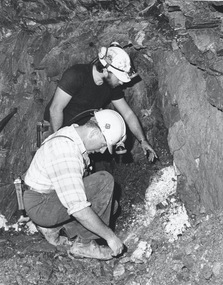
Photograph - AUSTIN COLLECTION: Central Deborah Gold Mine, Possibly 1990's
... standing dream. Gold Mining Central Deborah Gold Mine Ray Beer Mine Manager Black and white photograph. Two men with hard ...Central Deborah Gold Mine history: At its peak, Central Deborah Gold Mine reached a depth of 412 metres. It has 17 separate levels and 15 kilometres of drives and cross cuts (tunnels). The Central Deborah was very much a hands-on mine and the conditions that the miners worked in would be considered shocking by today's standards – being lowered underground in a cage with only two sides, often working ankle to knee deep in water, filling up to 32 ore trucks a shift by hand which were then pushed a mile or more along rails in the drives, working by carbide lamp, breathing in the fumes and rock dust and communication by bells. Geez, they were ironmen. However, at the time working conditions were considered to be among the best on the goldfields at Central Deborah, after all it was one of the only mines that had hot showers. Following Central Deborah Gold Mine's closure, the Bendigo skyline began to noticeably change. Obvious remnants of mining such as poppet heads, engine rooms, service quarters, battery houses and chimneys were steadily disappearing. After intense lobbying by the local community, the Bendigo City Council purchased the still very much intact Central Deborah Gold Mine in 1970 for a mere $6,000 to ensure that a vital link to Bendigo's historic golden past was maintained. The Bendigo Trust was then formed to oversee the operations of the Central Deborah Gold Mine, which led to the surface of the mine being opened to the public in 1971. Initially the surface was open for just 12 hours a week and as the demand for viewing a part of Bendigo's history increased, so did the opening hours. In 1974 the mine was gazetted as a Public Historical Purposes Reserve and attracted such visitors as H.R.H Prince Charles. By far the greatest shortcoming at this stage was that no one could view the underground workings, as these had become flooded. After what could only be described as a monumental effort by everyone involved, Level 2 of the mine was officially opened to the public by the Premier of Victoria, the Honourable John Cain, on 20 June 1986, which brought to fruition a long standing dream.Black and white photograph. Two men with hard hats and lights, inspecting quartz outcrop on wall of drive at Central Deborah Gold Mine.gold mining, central deborah gold mine, ray beer, mine manager -
 Bendigo Historical Society Inc.
Photograph - Austin Collection: mine rescue team underground, 1980's
... Paul Maher, standing on left, wearing overalls and hard hat. ...Paul Maher, standing on left, wearing overalls and hard hat. Photograph Austin Collection: mine rescue team underground ...Black and white photograph: three men underground, involved in mine rescue scenario. Man on right hand side of image is wearing white jacket and pants, carrying a towel and a mine rescue stretcher. Man in centre, dressed in white shirt and pants, is carrying a metal case. Paul Maher, standing on left, wearing overalls and hard hat. mining, mine rescue, stretcher -
 Bendigo Historical Society Inc.
Photograph - Austin Collection: miners underground, 1980's
... Black and white photograph: two men holding shovels, standing near a skip, rock wall behind. Men are wearing hard hats and lights, overalls....Black and white photograph: two men holding shovels, standing near a skip, rock wall behind. Men are wearing hard hats and lights, overalls. ...Black and white photograph: two men holding shovels, standing near a skip, rock wall behind. Men are wearing hard hats and lights, overalls.Written on back of photograph in blue pen: ' Paul Maher, John Jeffrey'.mining, underground miners, 1980's., shovel, skip, bendigo
