
Showing 139 items matching "heart in hand"
-
 St Kilda Historical Society
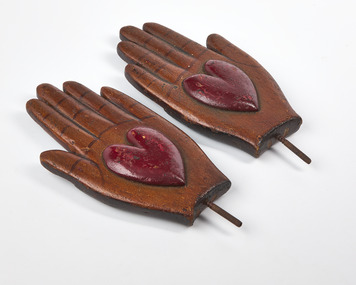
Decorative object - Wooden hands, Hearts in hands
... ...Heart in hand...The Heart in Hand is a symbol used by the Independent Order of Odd Fellows. ...Six wooden hands in flat stretched position, the wood on the outer surface of the hand being of double thickness. Red wooden heart stuck to the palm of the hand. ...The Heart in Hand is a symbol used by the Independent Order of Odd Fellows. ...The Heart in Hand is a symbol used by the Independent Order of Odd Fellows. It refers to the help which an Odd Fellow gives to a brother in need, and the spirit in which help is to be given. Six wooden hands in flat stretched position, the wood on the outer surface of the hand being of double thickness. Red wooden heart stuck to the palm of the hand. Colouring of the outside surface is a dark reddish brown; the inside surface brown ochre with a dark red heart. Metal screw at base of hand.ioof, heart in hand -
 Stawell Historical Society Inc
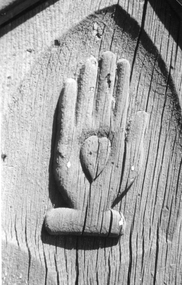
Photograph, Wooden Grave Marker with more Detail
... Wooden Grave Marker with detail of the carved hand with a heart in the middle....A Black and White close up photograph of the wooden grave marker of William Jago August 1860's. Heart carved in hand Ritual belonging to the Lodge 1.O.O.F.....Wooden Grave Marker with a Heart carved into a hand....Wooden Grave Marker with detail of the carved hand with a heart in the middle. stawell cemetery Wooden Grave Marker with a Heart carved into a hand. ...Wooden Grave Marker with detail of the carved hand with a heart in the middle.A Black and White close up photograph of the wooden grave marker of William Jago August 1860's. Heart carved in hand Ritual belonging to the Lodge 1.O.O.F..Wooden Grave Marker with a Heart carved into a hand.stawell cemetery -
 Glenelg Shire Council Cultural Collection
Craft - Doily, n.d
... Doily, rectangular, white cotton, embroidered with blue, yellow, pink and purple hearts and green leaves. Hand crocheted border....doily womens history needlework Doily, rectangular, white cotton, embroidered with blue, yellow, pink and purple hearts and green leaves. Hand crocheted border. Craft Doily ...Doily, rectangular, white cotton, embroidered with blue, yellow, pink and purple hearts and green leaves. Hand crocheted border.doily, womens history, needlework -
Glenelg Shire Council Cultural Collection
Textile - Doily, n.d
... Doily, rectangular, white cotton embroidered with blue, yellow, pink and purple hearts and green leaves. Hand crocheted border...doily handmade needlecraft embroider sew Doily, rectangular, white cotton embroidered with blue, yellow, pink and purple hearts and green leaves. Hand crocheted border Textile Doily ...Doily, rectangular, white cotton embroidered with blue, yellow, pink and purple hearts and green leaves. Hand crocheted borderdoily, handmade, needlecraft, embroider, sew -
 Bendigo Historical Society Inc.
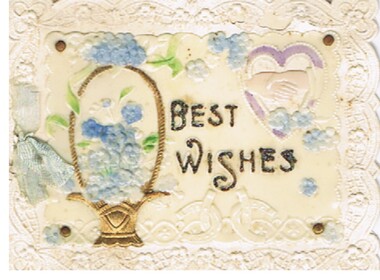
Document - MALONE COLLECTION: GREETING CARD
... In the top right corner is a purple heart with two hands shaking and more blue flowers. ...In the top right corner is a purple heart with two hands shaking and more blue flowers. ...Malone Collection. Greeting card. Small white card with embossed border. White celluloid pinned to card with 4 brass split pins. The celluloid is embossed with a gold basket full of blue flowers. At the top is some blue flowers. In the top right corner is a purple heart with two hands shaking and more blue flowers. At the bottom is more embossing consisting of scrolls, flowers and three intertwined horseshoes. Card and insert are held together with s blue bow. Card given to Miss Malone.Philco Publishing Co. London W. C.person, greeting cards, malone collection, malone collection, greeting card -
 Flagstaff Hill Maritime Museum and Village
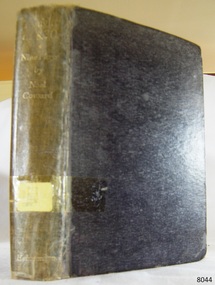
Book, To-Night at 8.30
... To-Night at 830 Play Titles 1)We Were Dancing 2) The Astonished Heart 3) "Red Peppers" 4) Hands Across the Sea 5) Fumed Oak 6) Shadow Play 7) Ways and Means 8) Still Life 9) Family Album Author: Noel Coward Publisher: William Heinemann Ltd Date: 1937...The Warrnambool Mechanics' Institute publication collection is of both local and state significance. warrnambool shipwrecked-coast flagstaff-hill flagstaff-hill-maritime-museum maritime-museum shipwreck-coast flagstaff-hill-maritime-village shipwrecked-artefact book pattison collection warrnambool library warrnambool mechanics’ institute ralph eric pattison corangamite regional library service warrnambool city librarian mechanics’ institute library victorian library board warrnambool books and records warrnambool children’s library great ocean road to-night at 830 noel coward We Were Dancing The Astonished Heart. Red Peppers Hands Across the Sea Fumed Oak Shadow Play Ways and Means Still Life Family Album Label on spine cover with typed text PAT 822 COW Pastedown front endpaper has sticker from Warrnambool Public Library covered by a sticker from Corangamite Regional Library Service Front loose endpaper has a stamp from Corangamite Regional Library Service Fly paper has a stamp from Warrnambool Mechanics Institute To-Night at 830 Play Titles 1)We Were Dancing 2) The Astonished Heart 3) "Red Peppers" 4) Hands Across the Sea 5) Fumed Oak 6) Shadow Play 7) Ways and Means 8) Still Life 9) Family Album Author: Noel Coward Publisher: William Heinemann Ltd Date: 1937 To-Night at 8.30 Book ...This item is from the ‘Pattison Collection’, a collection of books and records that was originally owned by the Warrnambool Mechanics’ Institute, which was founded in Warrnambool in 1853. By 1886 the Warrnambool Mechanics’ Institute (WMI) had grown to have a Library, Museum and Fine Arts Gallery, with a collection of “… choice productions of art, and valuable specimens in almost every branch and many wonderful national curiosities are now to be seen there, including historic relics of the town and district.” It later included a School of Design. Although it was very well patronised, the lack of financial support led the WMI in 1911 to ask the City Council to take it over. In 1935 Ralph Pattison was appointed as City Librarian to establish and organise the Warrnambool Library as it was then called. When the WMI building was pulled down in 1963 a new civic building was erected on the site and the new Warrnambool Library, on behalf of the City Council, took over all the holdings of the WMI. At this time some of the items were separated and identified as the ‘Pattison Collection’, named after Ralph Pattison. Eventually the components of the WMI were distributed from the Warrnambool Library to various places, including the Art Gallery, Historical Society and Flagstaff Hill. Later some were even distributed to other regional branches of Corangamite Regional Library and passed to and fro. It is difficult now to trace just where all of the items have ended up. The books at Flagstaff Hill Maritime Village generally display stamps and markings from Pattison as well as a variety of other institutions including the Mechanics’ Institute itself. RALPH ERIC PATTISON Ralph Eric Pattison was born in Rockhampton, Queensland, in 1891. He married Maude Swan from Warrnambool in 1920 and they set up home in Warrnambool. In 1935 Pattison accepted a position as City Librarian for the Warrnambool City Council. His huge challenge was to make a functional library within two rooms of the Mechanics’ Institute. He tirelessly cleaned, cleared and sorted a disarrayed collection of old books, jars of preserved specimens and other items reserved for exhibition in the city’s museum. He developed and updated the library with a wide variety of books for all tastes, including reference books for students; a difficult task to fulfil during the years following the Depression. He converted all of the lower area of the building into a library, reference room and reading room for members and the public. The books were sorted and stored using a cataloguing and card index system that he had developed himself. He also prepared the upper floor of the building and established the Art Gallery and later the Museum, a place to exhibit the many old relics that had been stored for years for this purpose. One of the treasures he found was a beautiful ancient clock, which he repaired, restored and enjoyed using in his office during the years of his service there. Ralph Pattison was described as “a meticulous gentleman whose punctuality, floorless courtesy and distinctive neat dress were hallmarks of his character, and ‘his’ clock controlled his daily routine, and his opening and closing of the library’s large heavy doors to the minute.” Pattison took leave during 1942 to 1945 to serve in the Royal Australian Navy, Volunteer Reserve as Lieutenant. A few years later he converted one of the Museum’s rooms into a Children’s Library, stocking it with suitable books for the younger generation. This was an instant success. In the 1950’s he had the honour of being appointed to the Victorian Library Board and received more inspiration from the monthly conferences in Melbourne. He was sadly retired in 1959 after over 23 years of service, due to the fact that he had gone over the working age of council officers. However he continued to take a very keen interest in the continual development of the Library until his death in 1969. WARRNAMBOOL PUBLIC LIBRARY The Warrnambool Mechanics’ Institute (WMI) was formed by a voluntary community group in 1863, within six years of Warrnambool’s beginnings, and its Reading Room opened in 1854. The WMI operated until 1963, at which time it was one of the oldest Mechanics’ Institutes in Victoria. Mechanics’ Institutes offered important services to the public including libraries, reading rooms and places to display and store collections of all sorts such as curiosities and local historical relics. In 1886 a Museum and Fine Arts Gallery were added to the WMI and by the beginning of the 20th century there was also a billiards room and a School of Art. By this time all Mechanics’ Institutes in country Victoria had museums attached. Over the years the Warrnambool Mechanics’ Institute Library was also known as the Warrnambool Public Library the Warrnambool Library and the Free Library. Early funding from the government was for the “Free Library”. The inscription in a book “Science of Man” was for the “Warrnambool Public Library”, donated by Joseph Archibald in 1899. Another inscription in the book “Catalogue of Plants Under Cultivation in the Melbourne Botanic Gardens 1 & 2, 1883” was presented to the “Warrnambool Library” and signed by the author W.R. Guilfoyle. In 1903 the Warrnambool Public Library decided to add a Juvenile Department to library and stock it with hundreds of books suitable for youth. In 1905 the Public Library committee decided to update the collection of books and added 100 new novels plus arrangements for the latest novels to be included as soon as they were available in Victoria. In July 1911 the Warrnambool Council took over the management of the Public Library, Art Gallery, Museum and Mechanics’ Institute and planned to double the size of the then-current building. In 1953, when Mr. R. Pattison was Public Librarian, the Warrnambool Public Library’s senior section 10,000 of the 13,000 books were fiction. The children’s section offered an additional 3,400 books. The library had the equivalent of one book per head of population and served around 33 percent of the reading population. The collection of books was made up of around 60 percent reference and 40 percent fiction. The library was lending 400 books per day. In 1963 the Warrnambool City Council allocated the site of the Mechanics’ Institute building, which included the Public Library, Museum and Art Gallery, for the new Municipal Offices and the Collections were dispersed until 1971. The Warrnambool Library took over the Mechanics’ Institute Library’s holdings on behalf of the Warrnambool City Council. Since the closure of the Warrnambool Mechanics’ Institute the exact location and composition of the original WMI books and items has become unclear. Other materials have been added to the collection, including items from Terang MI, Warrnambool Court House and Customs House. Many of the books have been identified as the Pattison Collection, named after the Librarian who catalogued and numbered the books during his time as Warrnambool Public Librarian in the time before the Mechanics’ Institute closed. It seems that when Warrnambool became part of the Corangamite Regional Library some of the books and materials went to its head office in Colac and then back to Warrnambool where they were stored at the Art Gallery for quite some time. Some then went to the Warrnambool Historical Society, some stayed at the Art Gallery and some were moved to Flagstaff Hill Maritime Village. The various stamps and labels on the books held at Flagstaff Hill show the variety of the collection’s distribution and origin. The books in the collection at Flagstaff Hill Maritime Village date from the 1850’s to the late 1950’s and include rare and valuable volumes. Many of the books are part of the “Pattison Collection” after the Warrnambool’s Public Librarian, Mr. R. Pattison. WARRNAMBOOL'S MECHANICS' INSTITUTE Warrnambool's Mechanics' Institute (or Institution as it was sometimes called) was one of the earliest in Victoria. On 17th October 1853 a meeting was held where it was resolved to request the Lieutenant Governor of the Colony to grant land for the erection of a Mechanics' Institutes building. A committee was formed at the meeting and Richard Osburne chaired the first meeting of this committee. The land on the North West corner of Banyan and Merri Streets was granted but there were no funds to erect the building. The Formal Rights of the Warrnambool Mechanics' Institute's encompassed its aims and these were officially adopted in1859; "This Institution has for its object the diffusion of literary, scientific, and other useful knowledge amongst its members, excluding all controversial subjects, religious or political. These objects are sought to be obtained by means of a circulating library, a reading room, the establishment of classes, debates, and the occasional delivery of lectures on natural and experimental philosophy, mechanics, astronomy, chemistry, natural history, literature, and the useful and ornamental arts, particularly those which have a more immediate reference to the colony." The Warrnambool Mechanics' Institute opened its first reading room in November1884 in the National School building at the corner of Banyan and Timor Streets. The Institute was funded by member subscription, payable on a quarterly, half yearly or yearly basis. Samuel Hannaford, the Manager of the Warrnambool Bank of Australasia, was the first Honorary Secretary of the Mechanics' Institutes, and an early President and Vice-President. He also gave several of the early lectures in the Reading Room. Another early Secretary, Librarian and lecturer was Marmaduke Fisher, the teacher at the National School. Lecture topics included The Poets and Poetry of Ireland', 'The Birth and Development of the Earth', 'The Vertebrae - with Remarks on the pleasures resulting from the study of Natural History' and 'Architecture'. In 1856 the Reading Room was moved to James Hider's shop in Timor Street, and by 1864 it was located in the bookshop of Davies and Read. In the 1860's the Mechanics' Institute struggled as membership waned but in 1866, after a series of fund raising efforts, the committee was able to purchase land in Liebig Street, on a site then called Market Square, between the weighbridge and the fire station. A Mechanics' Institute building was opened at this site in August 1871. The following year four more rooms were added to the main Reading Room and in 1873 the Artisan School of Design was incorporated into the Institute. The same year Joseph Archibald established a Museum; however it deteriorated when he was transferred to Bendigo in 1877. In 1880, with Archibald's return to Warrnambool, the Museum was re-established, and in 1885 a new building was built at the back of the Institute to accommodate the re-created School of Design, the Art Gallery and the Museum. In 1887 the Museum section was moved to the former court house in Timor Street (for some time the walls of the building formed part of the TAFE cafeteria but all is now demolished)). In 1911 the Museum was transferred back to the original building and the management of the Mechanics' Institute was handed over to the Warrnambool City Council. The Museum and Art Gallery became one and housed many fine works of art, and the Library continued to grow. The building was well patronised, with records showing that at the beginning of the 20th century there were between 500 and 800 visitors. During World War One the monthly figures were in the thousands, with 3,400 people visiting in January 1915. The Museum was a much loved Institution in Warrnambool until the contents of the Museum and Art Gallery were removed to make room for the Warrnambool City Council Engineers' Department. The contents were stored but many of the items were scattered or lost. When the original building was demolished the site became occupied by the Civic Centre, which included the new City Library. (The library was temporarily located in the old Palais building in Koroit Street.) In the process of reorganisation the Collection was distributed amongst the community groups: -The new City Library took some of the historic books and some important documents, historic photographs and newspapers. -The Art Gallery kept the 19th Century art collection and some of the artefacts from the museum. -The Historic Society has some items -The State Museum has some items -Some items were destroyed -Flagstaff Hill Maritime Village has old newspapers, Government Gazettes, most of the Mechanics' Institute Library, ledgers and documents connected to the Mechanics' Institute Library, some framed and unframed art works and some photographs. The Warrnambool Mechanics' Institute Library book collection is deemed to be of great importance because it is one of the few collections in an almost intact state, and many of the books are now very rare and of great value. The Pattison Collection, along with other items at Flagstaff Hill Maritime Village, was originally part of the Warrnambool Mechanics' Institute’s collection. The Warrnambool Mechanics’ Institute Collection is primarily significant in its totality, rather than for the individual objects it contains. Its contents are highly representative of the development of Mechanics' Institute libraries across Australia, particularly Victoria. A diversity of publications and themes has been amassed, and these provide clues to our understanding of the nature of and changes in the reading habits of Victorians from the 1850s to the middle of the 20th century. The collection also highlights the Warrnambool community’s commitment to the Mechanics’ Institute, reading, literacy and learning in the regions, and proves that access to knowledge was not impeded by distance. These items help to provide a more complete picture of our community’s ideals and aspirations. The Warrnambool Mechanics Institute book collection has historical and social significance for its strong association with the Mechanics Institute movement and the important role it played in the intellectual, cultural and social development of people throughout the latter part of the nineteenth century and the early twentieth century. The collection of books is a rare example of an early lending library and its significance is enhanced by the survival of an original collection of many volumes. The Warrnambool Mechanics' Institute’s publication collection is of both local and state significance. SIGNIFICANCE The Warrnambool Mechanics' Institute Collection is primarily significant in its totality, rather than for the individual objects it contains. Its contents are highly representative of the development of Mechanics' Institute libraries across Australia, particularly Victoria. A diversity of publications and themes has been amassed, and these provide clues to our understanding of the nature of and changes in the reading habits of Victorians from the 1850s to the middle of the 20th century. The collection also highlights the Warrnambool community’s commitment to the Mechanics’ Institute, and to reading, literacy and learning in the regions, and proves that access to knowledge was not impeded by distance. These items help to provide a more complete picture of our community’s ideals and aspirations. As with many Mechanics' Institutes in Australia, the one which operated in Warrnambool was established and overseen for many years by key individuals associated with the development of the city itself. The WMI publication collection is historically significant because of its association with local people, places and the key historical themes in the development of Warrnambool of rural development, industry, farming, education, and community. The collection documents and illustrates the changing interests, focus and tastes of Victorians, especially those in regional cities. Generally the individual items in the collection are not particularly rare, as examples of all probably exist in other public collections in Victoria. It is primarily because there are so very few surviving Mechanics' Institute collections in Victoria, which lends this overall collection its significance. Many items in the WMI Collection have the potential to support further research, both as individual objects and through the collection in its entirety. This material is significant for its ability to assist in the interpretation of the history of the area and adds to the general understanding of the development of the township. Many components of the WMI publication collection complement and reinforce the Flagstaff Hill Maritime Museum Collection, the Warrnambool Art Gallery Collection, and that in the Warrnambool Historical Society, and also contribute to a clearer understanding of the original Warrnambool Mechanics' Institute collections. This will greatly enhance the appreciation of the few surviving Mechanics' Institute collections across Victoria, and also in New South Wales. The similarities and differences between the small number of collections that have survived can provide further insights into how the people of Victoria in general, and Warrnambool in particular, constructed a civic culture of adult learning to foster an informed citizenry. The Warrnambool Mechanics' Institute publication collection is of both local and state significance. To-Night at 830 Play Titles 1)We Were Dancing 2) The Astonished Heart 3) "Red Peppers" 4) Hands Across the Sea 5) Fumed Oak 6) Shadow Play 7) Ways and Means 8) Still Life 9) Family Album Author: Noel Coward Publisher: William Heinemann Ltd Date: 1937Label on spine cover with typed text PAT 822 COW Pastedown front endpaper has sticker from Warrnambool Public Library covered by a sticker from Corangamite Regional Library Service Front loose endpaper has a stamp from Corangamite Regional Library Service Fly paper has a stamp from Warrnambool Mechanics Institute warrnambool, shipwrecked-coast, flagstaff-hill, flagstaff-hill-maritime-museum, maritime-museum, shipwreck-coast, flagstaff-hill-maritime-village, shipwrecked-artefact, book, pattison collection, warrnambool library, warrnambool mechanics’ institute, ralph eric pattison, corangamite regional library service, warrnambool city librarian, mechanics’ institute library, victorian library board, warrnambool books and records, warrnambool children’s library, great ocean road, to-night at 830, noel coward, we were dancing, the astonished heart., red peppers, hands across the sea, fumed oak, shadow play, ways and means, still life, family album -
 Bendigo Historical Society Inc.
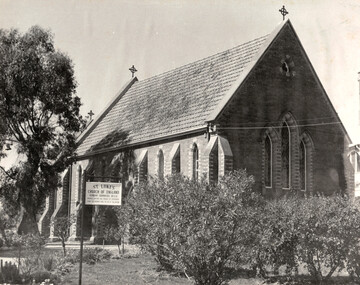
Document - National Trust Collection: Churches of Bendigo and Inglewood, Nov 7th 1965
... It documents the present owner and occupant, including their addresses, the date of initial construction and supporting evidence for that date. 3084.36f Handwritten letter re history of St Johns Presbyterian Church Bendigo, 13th October 1980 - author unknown 3084.36g Typed notes - "Interesting information on the Sacred Heart Cathedral Bendigo", and hand-written notes on St Pauls Cathedral. 3084.36h Two pages of typed notes. ...It documents the present owner and occupant, including their addresses, the date of initial construction and supporting evidence for that date. 3084.36f Handwritten letter re history of St Johns Presbyterian Church Bendigo, 13th October 1980 - author unknown 3084.36g Typed notes - "Interesting information on the Sacred Heart Cathedral Bendigo", and hand-written notes on St Pauls Cathedral. 3084.36h Two pages of typed notes. ...St LUKES ANGLICAN CHURCH BENDIGO In 1852, a party of Cornish miners, refusing to give up and having dug, by hand, down nearly 70 feet ‘got their reward. Suddenly, their picks sank into soft pipe-clay, white, satin-smooth and seemingly depthless. The men began tunnelling. Presently, the roof forming above them showered gold at their feet – the secret of Bendigo’s famous White Hills lay revealed.’ In the ‘wild rush’ that followed, when ‘the White Hills yielded enormously and some pretty piles were made’, a young Anglican priest, John Herbert Gregory, held the first Anglican church service at White Hills in 1853. The Hamlet of White Hills was surveyed and mapped in 1854 and, by 1863, St Luke’s Church in White Hills was opened on ‘an elevated site’ in a generously sized ‘church reserve’. St AUGUSTINE'S CHURCH MYERS FLAT Early diggers to this area were men named Myers and Nicholls, hence the name - Myers Flat and Myers Creek. 1857 saw the discovery of gold in the area and in less than one month 1000 ounces of gold per week resulted. The number of diggers in the Myers Creek or Burnt Gully totalled 4000 to 5000. Myers Creek consisted of several shops and buildings, two hotels, a race course and a lock-up built of logs. On November 6th, 1864, the opening of the new church of St Augustine' took place. The first mass was celebrated by the Reverand Dean Hayes, of St Killian's Sandhurst. The church of gothic design was built by a local contractor, and with bricks made from local clay. The church also has a fire place and is widely known as "The church with the Chimney. For many years it was also a Catholic school. St AUGUSTINE'S CHURCH INGLEWOOD The church features an Early English design from 1864 and Decorated Gothic extensions from 1884.Notable elements include the sanctuary with the Catto Memorial window and interior cusped arcading of the wainscot. Architectural attribution is given to Vahland and Getzschmann for one or both sections. St JOHNS CHURCH (PRESBYTERIAN) BENDIGO The church's architect was W C Vahland VIA, and the builder was N Langstaff. It was built in April 1890, and opened in Feb 1891. The tender price was 2,481 pounds. The church style was gothic, built by the Congregational Church to replace an earlier building built in 1858. St Johns bought the church in 1949 and made additions in 1951. THE SACRED HEART CATHEDRAL BENDIGO Originally designed in 1895 by Reed, Smart and Tappin of Melbourne, the first stage opened in September 1901; the second stage began in January 1954 and was expected to finish in late 1976. Skilled stonemasons were brought from overseas for the completion. The Exterior built from Geelong sandstone and Harcourt granite, matching the original materials for color consistency. The cathedral is designed in the early English Gothic style. It Features a tower and spire weighing several thousand tons, with the spire rising 282 ft. from the floor and topped by a 10 ft. cross.Interior. The original stained glass window, made in Birmingham, England, is above the main entrance on the west side. Marble for the floor was imported from Vincenzo and Via Reggio, Italy; Sicilian Pearl marble is used in the four chapels. Ceilings in the chapels feature Western red cedar and yellow pine timbers.The transept includes Australian blackwood paneling and 12 carved shields representing the apostles. The internal height from floor to ceiling is 80 ft.Artistic Elements. Two large tapestries, specially designed and crafted by Mrs. Carrington, hang in the sanctuary as a symbolic link to Bendigo. ST PAULS BENDIGO The nave was built in 1868 and the tower in 1873. The nave is notable for unusual ceiling with metal and timber overlay members. The tower notable for early brick and bold Gothic influenced design. The church was opened on 12th Nov 1868 and a new chancel sanctuary and Transepts were added on 22 Oct 1927. The architect was Robert A Love. CONGREGATIONAL CHURCHES IN BENDIGO Three main Congregational church buildings existed in Bendigo: at the corner of Forest and Mackenzie Streets (the original site), on Quarry Hill (corner of Russell and Gladstone Streets), and on Calvin Street (later the Lutheran Church). The Calvin Street church was named in honor of John Calvin, a notable figure who lived in the area. In June 1858, 1.5 acres of land were purchased at the Forest and Mackenzie Streets corner for £1200.The first church was built on this site in November 1858 and later enlarged in May 1867 to seat 500 people. A prefabricated parsonage stood nearby until about 1920, serving as a caretaker's cottage for several years. In 1890, foundation stones for a new church designed by W.C. Vahland were laid, featuring a tall tower and two gable crossings (reduced from three to save costs). The new church opened on February 26, 1890, costing £2483. The contractor was N. Longstaff. Some architectural elements, such as the chancel, were added later when St. John's Presbyterian took over the building. Congregational attendance declined, leading to the purchase and alteration of a brick school complex in Olinda Street to serve as their headquarters.The timber church on Russell Street and the Calvin Street property were sold.The valuable Forest Street property was eventually sold to a London sect and later became an investment for the Methodist Church.Historical information on seven denominational churches in Bendigo and Inglewood. This item contains the following items: 3084.36a Black and white photo of St Lukes Bendigo Church of England, Napier Street, White Hills. 3084.36b St Augustine's Church Myers Flat 100 years newsletter 1965. The newsletter's purpose is for a Commemorative afternoon mass in memory of the pioneers of Myers Flat and district.Celebration of the 101st anniversary of the first mass at St. Augustine's Church; on Sunday, November 7th, 1965, at 2:00 PM.Location: St. Augustine's Church, Myers Flat. The invitation is extended to the recipient and their friends. This invitation serves both as a memorial and a community gathering to honour local history. Also included is some hand-written history notes of the church - See the notes in the Historical Section above. 3084.36c This document is a formal letter dated 9th November 1970 from the National Trust of Australia (Victoria) to Bishop Bernard Stewart. St. Augustine's Church in Bendigo has been awarded a "D" classification by the National Trust's expert committee. The church is now officially "recorded" by the National Trust. The letter is addressed to Bishop Bernard Stewart, with copies sent to Father Louis McDonnell (Eaglehawk), A. J. Watts (Town Clerk, Bendigo), and Mrs. R. R. Adams (Secretary, Central Victorian Branch). 3084.36d This document is a formal letter from the National Trust of Australia (Victoria) to Miss L. Doble, Registrar of the Bendigo Church of England Diocese, dated March 20, 1973. St. Augustine's Church of England in Inglewood has been officially placed on the National Trust's Classified List. This classification recognizes the church as essential to Australia's heritage and emphasizes its preservation. The church features an Early English design from 1864 and Decorated Gothic extensions from 1884.Notable elements include the sanctuary with the Catto Memorial window and interior cusped arcading of the wainscot. Architectural attribution is given to Vahland and Getzschmann for one or both sections. The church is about to celebrate the centenary of its consecration on May 13, with the Archbishop expected to attend. 3084.36e This document is a survey form used by the National Trust of Australia (Victoria) to collect detailed information about St Augustine's Church at Myers Flat. It records the original purpose, present use, and current name of the building.Requires a precise address or location description for site visits.It captures special features or points of interest not visible in photographs. It documents the present owner and occupant, including their addresses, the date of initial construction and supporting evidence for that date. 3084.36f Handwritten letter re history of St Johns Presbyterian Church Bendigo, 13th October 1980 - author unknown 3084.36g Typed notes - "Interesting information on the Sacred Heart Cathedral Bendigo", and hand-written notes on St Pauls Cathedral. 3084.36h Two pages of typed notes. Three main Congregational church buildings existed in Bendigo: at the corner of Forest and Mackenzie Streets (the original site), on Quarry Hill (corner of Russell and Gladstone Streets), and on Calvin Street (later the Lutheran Church). 3084.36i Hand-written notes on St Pauls Cathedral.history, church, national trust bendigo collection, sacred heart cathedral bendigo, st augustine's church myers flat, st pauls church bendigo, st johns presbyterian church bendigo, congregational church bendigo -
 Mission to Seafarers Victoria
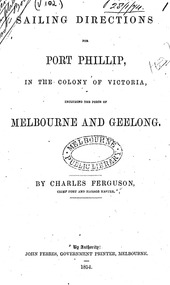
Booklet - Manual, Sailing directions for Port Phillip, in the colony of Victoria including the ports of Melbourne and Geelong, 1854
... I had sincere regard for the man, and just pride in the qualities of his heart, head, and hand. Whatever mistakes may have been made by the Government of the colony in those hard and difficult times (and I am quite ready to admit that there were many, especially if the past is to be judged by the light of the present), I never have hesitated in believing that, in appointing Captain Ferguson to the office he has so long filled, it was the right man in the right place. ...I had sincere regard for the man, and just pride in the qualities of his heart, head, and hand. Whatever mistakes may have been made by the Government of the colony in those hard and difficult times (and I am quite ready to admit that there were many, especially if the past is to be judged by the light of the present), I never have hesitated in believing that, in appointing Captain Ferguson to the office he has so long filled, it was the right man in the right place. ...Captain Charles Ferguson was born in Scotland in 1813. He was the Master of the "Rajah" from 1838 to 1850 on voyages from England to Australia and vice versa. He became the First Chief Harbour Master for the port of Melbourne in 1852 after being the first Harbour Master and Water Police Officer in Geelong for 12 months. On the 5th of April 1841, the Rajah sailed with James Donovan M.D. as Surgeon Superintendent, and the Rajah sailed from Woolwich with 180 female convicts. The Rajah arrived on the 19th of July in Hobart, with 179 females (one died during the voyage) and 10 children. Miss Kezia Elizabeth Hayter was the matron on board. On page 28 of the "Sailing directions for Port Phillip, in the colony of Victoria including the ports of Melbourne and Geelong", a mention is made of the Mariner's Hospital and Floating Church soon to be established. There were discussions to built the hospital in Williamstown but instead the Government decided to build it in Melbourne. The Harbour Master and a commiittee decided to use the water police hulk, Emily, left unsold in 1856, to create a floating church: the Bethel was open in July 1857 with Reverend Kerr Johnston as Chaplain. Latrobe wrote a letter to Captain Cole in 1869, a few months after learning his death : "To Captain George Ward Cole † [from a draft in another’s hand] Clapham House, Lewes, Sussex, January 28th, 1869. My dear Captain Cole, Last mail will have taken out the sad intelligence of the death of our excellent old friend, Captain Ferguson. This will have been a terrible blow to his children and to his friends in the colony, who may have held reason to expect his early return to his home, with a not unreasonable prospect of ultimate restoration to health and activity. In the course of last October I went up to town with one of my children, mainly with the purpose of finding my way to Pinner, where he and Mrs. Ferguson were staying with an intimate friend. I found him in excellent health and spirits, and enjoying the prospect of a speeding resumption of the service to which he had devoted his best days, and upon the furtherance of which his entire energy was still directed. A week or two later Captain and Mrs. Ferguson went to Dover for change of air, and being still under the impression received from the advisers by whom they had been guided during their residence at a hydropathic establishment at Matlock, felt encouraged to plan almost immediate return to the colony by the Jerusalem early in December. However, certain misgivings in the mind of a medical gentleman, then in England, under whose care Captain Ferguson had at one time placed himself in Williamtown, led them to consider it judicious before departure to take the advice of some surgeon of eminence in London. Accordingly they came up to town at the close of November. The first London practitioners they consulted shook their heads, and advised consultation with Sir Wm. Ferguson. The result was that amputation, without loss of time, was pronounced necessary. The rest is soon told. He received the painful intelligence with calmness and full resignation to God's will, and underwent the operation at King's College Hospital with exemplary firmness and Courage on the 28th of November. Perfect success seemingly attended it, and there seemed, humanly speaking, to be every prospect of a prompt cure and early convalescence; everything seemed in his favour. A few days later, however, all was clouded by symptoms of hospital fever (pyoe æm ia). This resisted all control, and finally carried him off on the 27th of December, just one month after the operation. He had lived a Christian life, and his death was the peaceful and resigned death of a Christian. It was a melancholy satisfaction to me to be able to join a few friends in following his remains to their resting place in one of the outlying London cemeteries on the last day of the year. You know Mrs Ferguson well, and will be prepared to hear me say that her whole conduct and demeanour throughout this period of suspense and bitter trial has been worthy of her high character and steadfast principle. Come what will, and happen what may, I have the fullest conviction that neither the widow nor the children will be forsaken, however doubtful and clouded the future may appear, in consequence of the irreparable loss which, they have sustained. And now, dear Captain Cole, it is possible that you may already have heard all this from other sources, but I have dictated it to you under strong impulse, for I feel assured that there is no member of the community in which you live who will more sincerely deplore the loss of Captain Ferguson on private grounds; at the same time that there is no one who, from long acquaintance with his official character and services, will be in a better position to estimate their real value or the loss which the colony has sustained. The circumstances in which Captain Ferguson's family are left not only demands the utmost display of sympathy and interest on the part of friends, but may call for decided and prompt action; therefore I cannot rest satisfied without discharging what I consider my duty, and seeking to strengthen your hands as far as I may in bringing the character of his long services before the existing colonial authorities. Of his private career previous to his entering the service of the Colonial Government in 1851 nothing need be said. Captain Ferguson was appointed as the Harbour Master at Geelong in April, 1851 – a few months before the separation of the colony from New South Wales. He there did excellent service in a variety of ways calculated to advance the interests of the port, and to introduce www.latrobesociety.org.au 27 order, where, from circumstances, but little order had hitherto prevailed. His was the first appointment of this class in that locality. The separation of the colony from New South Wales took place in the month of July following. Shortly after, the late Captain Bunbury resigned the Harbour Mastership of Port Phillip. Captain Ferguson was at once (February, 1852) appointed to succeed him, and from that time performed all duties of Chief Harbour Master of the colony. The previous year (May 1851) the first gold discoveries in New South Wales had taken place, and in the month of August those of our colony followed. At the time of Captain Ferguson’s taking charge of the Port of Melbourne their influence had begun to be fully felt, and in no department more seriously than in that of the Harbour Master. This is no place for statistical details, but they must bear me out in reminding you of a few facts connected with our late friend’s career. At the time of separation that department comprised only 30 individuals of all ranks, and when he took charge the number was much reduced. There were at that time, according to the returns, no fewer than 54 vessels, registering 26,785 tons, in Hobson’s Bay alone. The crews on arrival numbered 1,235 men. Of this number only 463 remained on board, 500 having deserted, and the rest having been discharged by arrangement or pure necessity. For the first six months after Captain Ferguson’s assumption of office as Harbour Master the duties of Police Magistrate and Chief of the Water Police were superadded, and how much labour they involved may be surmised from the fact that from 1st of April to the 31st July, 1852, four months only, no less than 236 marine cases were brought before the bench at Williamstown - sometimes as many as 30 in a day. A year later (March 1853) the returns show that the number of vessels in the harbour in Hobson’s Bay alone were 91, tonnage 43,754; and passing on to the still later returns of May, 1853, two years after Captain Ferguson’s assumption of office, we find from the records that the number of ships in port had increased to 129; tonnage, 63,292; crew on board on arrival, 2872, and at the date of report, 1628; the amount of desertions at that time having, however, proportionally diminished, in consequence of the abatement of the gold fever, caused by the non-success attendant upon the labours of thousands at the goldfields. The above numbers take no account of the large number of vessels and amount of tonnage lying at the wharves at Melbourne or elsewhere. From these figures alone it may be judged what must have been a struggle in which the Chief Harbour Master was engaged from the very outset to secure order, and answer the innumerable calls on every branch of his department, at the same time that there was for many months an almost complete impossibility of securing subordinate agency, such as boatmen, pilots, and police, at any price. But I may bear witness to the untiring diligence, energy, and self-devotion with which Captain Ferguson grappled with the difficulties of his position, and the seemingly insurmountable obstacles which stood in his way. Ashore and afloat he was always ready, showing the same directness of purpose, intelligence, and forgetfulness of self. He shunned no responsibility, and turned his hand from no work, whether within or beyond the ordinary scope of his duty, which the hard necessity of the times forced the Government to bring under his notice. Already in 1852, when the overflowing of our gaol and stockade rendered the adoption of other methods of restraint absolutely necessary, and addition to the existing buildings could not be thought of, it was Captain Ferguson who first suggested the employment of hulks; and it was with his personal assistance and supervision, and under his unflagging energy, that the three first of these – the Success, the President, and the Sacramento – were purchased, fitted up, and made available for the purpose in view, and the rules and regulations for the employment and safety of the men afloat and ashore prescribed and carried out. He carried the same energy into every branch of his department, and his influence was soon apparent. His subordinates of every class became actuated by his spirit. As time moved on, the range of his duties, both ordinary and extraordinary, increased. In the formation of the quarantine station at the heads, in the management if not the erection of lighthouses, sailing directions, port and wharf regulations, buoys, signal stations, www.latrobesociety.org.au 28 steam dredging &c., he was the main and most active agent. The whole pilot establishment and regulations, men, and vessels, were under his charge; and when I left the colony in May, 1854, the entire range of ports outside Port Phillip Heads from Point Lonsdale to Portland, as well as that of Geelong had felt the influence of his intelligent supervision and care. The entire department of Chief Harbour Master, which I have numbered at the period of separation about thirty individuals, then numbered 230. The character of Captain Ferguson’s unbroken service during the fourteen years which have elapsed since I left the colony must be well known to the Government and the people he has served so long and so faithfully. I confine myself to recalling to mind those earlier, and what must have been the hardest and most difficult, period – none can know how difficult but those who were in that fierce struggle for the maintenance of order under so many disadvantages; and on this subject I have spoken advisedly and with reason, for I may truly say he worked under my own eye. I had sincere regard for the man, and just pride in the qualities of his heart, head, and hand. Whatever mistakes may have been made by the Government of the colony in those hard and difficult times (and I am quite ready to admit that there were many, especially if the past is to be judged by the light of the present), I never have hesitated in believing that, in appointing Captain Ferguson to the office he has so long filled, it was the right man in the right place. I shall be heartily rejoiced to find that the Government and inhabitants of the colony admit that this has been the case, and to learn that they have not forgotten the strong claims of one who has served them so long and so faithfully, and who, removed by God’s providence, so to say, in the maturity of his powers, has left a widow and young family behind him. I have done, I leave you to make use of this communication, or any portion of it, which you may think judicious and called for. There may be among Ferguson’s friends those who may not be sorry to be reminded of facts. By-the-bye, I may mention as a proof how completely Captain Ferguson’s mind was engrossed by devotion to his public duty, that while in Dover, only ten days before the operation, he took an opportunity to drag himself up into the lantern of the S. Foreland Lighthouse, and made a most careful scrutiny of the whole apparatus and arrangement, with a view of the adoption of any hint for the perfection of those under his charge in the colony. And now, goodbye. I trust this will find you in good health, and in comparative vigour. Believe me ever, dear Captain Cole, Yours very truly, C. J. La Trobe"The attempt for a floating church was made as early as 1853 following similar examples in London like the Seamen's Hospital. Captain Ferguson was instrumental in the foundation of the Bethel Church.Digital copies of the 37 pages ; 22 cm.1854, hobsons bay, geelong, melbourne, williamstown, sandridge, mariner's hospital, floating church, seamen's hospital, captain charles ferguson (1813-1868), kezia elizabeth hayter (1818-1885), rajah quilt, prison hulks, water police, harbour master, harbor master, gaols -
 Flagstaff Hill Maritime Museum and Village
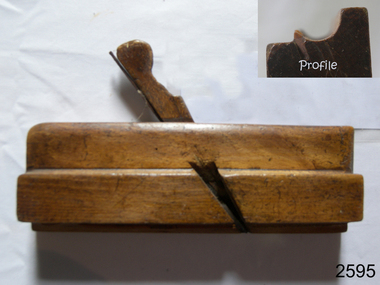
Tool - Moulding wood Plane, John Manners, 1792-1822
... Company History: We know little of John Manners other than his firm was acquired by Alexander Mathieson & Sons in 1822, Mathieson were one of the leading makers of hand tools in Scotland at this time. 1792 was deemed by Mathieson & Sons to be that of its foundation and it was in all likelihood the year in which John Manners had also set up his plane-making workshop on Saracen Lane off the Gallowgate in the heart of Glasgow, not far from the Saracen's Head Inn. ...Company History: We know little of John Manners other than his firm was acquired by Alexander Mathieson & Sons in 1822, Mathieson were one of the leading makers of hand tools in Scotland at this time. 1792 was deemed by Mathieson & Sons to be that of its foundation and it was in all likelihood the year in which John Manners had also set up his plane-making workshop on Saracen Lane off the Gallowgate in the heart of Glasgow, not far from the Saracen's Head Inn. ...A moulding plane is a specialised plane used for making the complex shapes found in wooden mouldings that are used to decorate furniture or other wooden objects. Traditionally, moulding planes were blocks of wear-resistant hardwood, often beech or maple, which were worked to the shape of the intended moulding. The blade or iron was likewise formed to the intended moulding profile and secured in the body of the plane with a wooden wedge. A traditional cabinetmakers shop might have many, perhaps hundreds, of moulding planes for the full range of work to be performed. Large crown mouldings required planes of six or more inches in width, which demanded great strength to push and often had additional peg handles on the sides, allowing the craftsman's apprentice or other workers to pull the plane ahead of the master who guided it. Company History: We know little of John Manners other than his firm was acquired by Alexander Mathieson & Sons in 1822, Mathieson were one of the leading makers of hand tools in Scotland at this time. 1792 was deemed by Mathieson & Sons to be that of its foundation and it was in all likelihood the year in which John Manners had also set up his plane-making workshop on Saracen Lane off the Gallowgate in the heart of Glasgow, not far from the Saracen's Head Inn. Alexander Mathieson (1797–1851) is recorded in 1822 as a plane-maker at 25 Gallowgate, but in the following year at 14 Saracen's Lane, it is presumed having taken over the premises of John Manners. The 1841 national census described Alexander Mathieson as a master plane-maker at 38 Saracen Lane with his son Thomas Adam working as a journeyman plane-maker, from 1822 we hear nothing regards what happened to John Manners.A vintage tool made by a known maker John Manners the item is a significant wood working tool from the late 18th century that today is quite rare. As this maker sold his business to Alexander Mathieson another collectable tool maker in the early 19th century. This item would be sought after by wood working tool collectors and it gives us a snapshot of how cabinet makers went about creating furniture during this time period. Wood Moulding plane Side Bead - Single Box type Stamped Manners (Maker) (also inside stamped GN, & W, M. Nicol also F W. probably owners of item over the years.)flagstaff hill, warrnambool, shipwrecked-coast, flagstaff-hill, flagstaff-hill-maritime-museum, maritime-museum, shipwreck-coast, flagstaff-hill-maritime-village -
![Postcard - photographic, A. Gordon Spittle [and Harry Holmes?] , 1916, 23/03/1916](/media/collectors/4f729f6797f83e0308601707/items/4ffe16342162ef0da4e1a9a6/item-media/4ffe169c2162ef0da4e1a9bc/item-fit-380x285.jpg?cb=6) Federation University Historical Collection
Federation University Historical CollectionPostcard - photographic, A. Gordon Spittle [and Harry Holmes?] , 1916, 23/03/1916
... hearted?' Handwritten verso 'Egypt, March 23rd 1916. Dear Mrs Troup. Your very fine and interesting letter dated Feb 15th came to hand to-day and needless to add was delighted to receive it, and can promise you that I'll answer it at my earliest opportunity. ...Gordon Spittle was the youngest of Three brothers. He grew up in Creswick and attended Creswick Grammar School. Gordon purchased 'Mt Cavern' in 1912. It had 4 years of a 10 year lease to run. His mother and father took delivery of it on 1 April 1916. They lived there and farmed it until Gordon returned from active service in May 1919. S. Gordon Spittle married Violet Holmes and both lived at "Mt Cavern" until their deaths. Gordon died in 1942 aged 51. Violet Holmes-Spittle died in 1949 aged 56. Handwritten lower front 'Do we look down hearted?' Handwritten verso 'Egypt, March 23rd 1916. Dear Mrs Troup. Your very fine and interesting letter dated Feb 15th came to hand to-day and needless to add was delighted to receive it, and can promise you that I'll answer it at my earliest opportunity. We are now having a better time since we came to this part, as we are able to enjoy a little of city life, although we have a good deal more work to do, & which is mostly carting goods to & from the ships & railway stations etc, all of which is interesting & quite a change from our life on the Desert. Hope this card finds you in good health. I will now have to say au revoir for the present with kindest regards to Mr Troup, self and family. From your very sincere friends, A. Gordon Spittle."Two uniformed Australian soldiers pose for a photograph during World War One.chatham family archive, chatham, holmes, world war, world war 1, world war i, world war one, france, spittle, gordon spittle -
 Flagstaff Hill Maritime Museum and Village
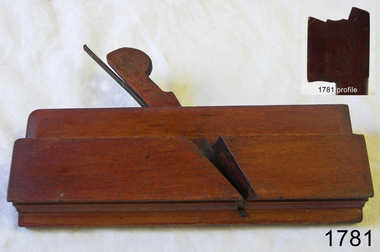
Tool - Complex Wood Plane, Late 19th to Early 20th century
... hand with the growth of the shipbuilding industries on the Firth of Clyde in the nineteenth century and the emergence of Glasgow regarded as the "second city of the Empire". It also reflected the firm's skill in responding to an unprecedented demand for quality tools by shipyards, cooperage's and other industries, both locally and far and wide. The year 1792 was deemed by the firm to be that of its foundation it was in all likelihood the year in which John Manners had set up his plane-making workshop on Saracen Lane off the Gallowgate in the heart...hand with the growth of the shipbuilding industries on the Firth of Clyde in the nineteenth century and the emergence of Glasgow regarded as the "second city of the Empire". It also reflected the firm's skill in responding to an unprecedented demand for quality tools by shipyards, cooperage's and other industries, both locally and far and wide. The year 1792 was deemed by the firm to be that of its foundation it was in all likelihood the year in which John Manners had set up his plane-making workshop on Saracen Lane off the Gallowgate in the heart ...A moulding plane is a specialised plane used for making the complex shapes found in wooden mouldings that are used to decorate furniture or other wooden objects. Traditionally, moulding planes were blocks of wear-resistant hardwood, often beech or maple, which were worked to the shape of the intended moulding. The blade or iron was likewise formed to the intended moulding profile and secured in the body of the plane with a wooden wedge. A traditional cabinetmakers shop might have many, perhaps hundreds, of moulding planes for the full range of work to be performed. Large crown mouldings required planes of six or more inches in width, which demanded great strength to push and often had additional peg handles on the sides, allowing the craftsman's apprentice or other workers to pull the plane ahead of the master who guided it. Company History: The firm of Alexander Mathieson & Sons was one of the leading makers of hand tools in Scotland. Its success went hand in hand with the growth of the shipbuilding industries on the Firth of Clyde in the nineteenth century and the emergence of Glasgow regarded as the "second city of the Empire". It also reflected the firm's skill in responding to an unprecedented demand for quality tools by shipyards, cooperage's and other industries, both locally and far and wide. The year 1792 was deemed by the firm to be that of its foundation it was in all likelihood the year in which John Manners had set up his plane-making workshop on Saracen Lane off the Gallowgate in the heart of Glasgow, not far from the Saracen's Head Inn, where Dr Johnson and James Boswell had stayed on their tour of Scotland in 1773. Alexander Mathieson (1797–1851) is recorded in 1822 as a plane-maker at 25 Gallowgate, but in the following year at 14 Saracen's Lane, presumably having taken over the premises of John Manners. The 1841 national census described Alexander Mathieson as a master plane-maker at 38 Saracen Lane with his son Thomas Adam working as a journeyman plane-maker. In 1849 the firm of James & William Stewart at 65 Nicolson Street, Edinburgh was taken over and Thomas was put in charge of the business, trading under the name Thomas A. Mathieson & Co. as plane and edge-tool makers. Thomas's company acquired the Edinburgh edge-tool makers Charles & Hugh McPherson and took over their premises in Gilmore Street. The Edinburgh directory of 1856/7 the business is recorded as being Alexander Mathieson & Son, plane and edge-tool makers at 48 Nicolson Street and Paul's Work, Gilmore Street. The 1851 census records indicate that Alexander was working as a tool and plane-maker employing eight men. Later that year Alexander died and his son Thomas took over the business. Under the heading of an edge-tool maker in the 1852/3 (Post-Office Glasgow Annual Directory) the firm is now listed as Alexander Mathieson & Son. By the early 1850s, the business had moved to 24 Saracen Lane. The directory for 1857/8 records that the firm had moved again only a few years later to East Campbell Street, also off the Gallowgate, and that through further diversification was also manufacturing coopers' and tinmen's tools. The ten-yearly censuses log the firm's growth and in 1861 Thomas was a tool manufacturer employing 95 men and 30 boys; in 1871 he had 200 men working for him and in 1881 300 men. By 1899 the firm had been incorporated as Alexander Mathieson & Sons Ltd, even though only Alexander's son Thomas appears ever to have joined the firm. A vintage tool made by a well-known firm made for other firms and individuals that worked in wood. The tool was used before routers and spindle moulders came into use after World War ll, a time when to produce a decorative moulding for a piece of furniture or other items this had to be accomplished by hand using one of these types of planes. A significant item from the mid to late 19th century that today is quite rare and sought after by collectors. It gives us a snapshot of how furniture was made predominately by hand and with tools that were themselves hand made shows the craftsmanship used to make such a unique item. Ogee Complex Moulding Plane Alex Mathieson & Son. Stamped W Worrel, (owner) & No 2.flagstaff hill, warrnambool, flagstaff-hill, flagstaff-hill-maritime-museum, maritime-museum, shipwreck-coast, flagstaff-hill-maritime-village, alexander mathieson & sons, complex moulding plane, carpenders tools, cabinet makers tools, wood working tools, wood planes -
 Flagstaff Hill Maritime Museum and Village
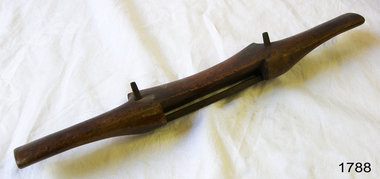
Tool - Spokeshave, Mathieson and Son, 1860 to 1910
... hand with the growth of the shipbuilding industries on the Firth of Clyde in the nineteenth century and the emergence of Glasgow regarded as the "second city of the Empire". It also reflected the firm's skill in responding to an unprecedented demand for quality tools by shipyards, cooperage's and other industries, both locally and far and wide. The year 1792 was deemed by the firm to be that of its foundation it was in all likelihood the year in which John Manners had set up his plane-making workshop on Saracen Lane off the Gallowgate in the heart...hand with the growth of the shipbuilding industries on the Firth of Clyde in the nineteenth century and the emergence of Glasgow regarded as the "second city of the Empire". It also reflected the firm's skill in responding to an unprecedented demand for quality tools by shipyards, cooperage's and other industries, both locally and far and wide. The year 1792 was deemed by the firm to be that of its foundation it was in all likelihood the year in which John Manners had set up his plane-making workshop on Saracen Lane off the Gallowgate in the heart ...A spokeshave is a hand tool used to shape and smooth woods in woodworking jobs such as making cart wheel spokes, chair legs, paddles, bows, and arrows. The tool consists of a blade fixed into the body of the tool, which has a handle for each hand. Historically, a spokeshave was made with a wooden body and metal cutting blade. With industrialization metal bodies displaced wood in mass-produced tools. Being a small tool, spokeshaves are not suited to working large surfaces. The name spokeshave dates back to at least the 16th century, though the early history of the tool is not well documented. The name spokeshave reflects the early use of the tool by wheel wrights. The first spokeshaves were made of wood usually beech with steel blades, before being largely superseded by the development of metal-bodied spokeshaves in the latter half of the 19th century, though many woodworkers still use wooden spokeshaves. Due to their widespread use and versatility vintage wooden spokeshaves remain commonly available and relatively low in price. Spokeshaves consist of a blade or iron secured to the body or stock of the tool, which has two handles – one for each hand. The bottom surface of the tool is called the sole. The blade can be removed for sharpening, and adjusted to vary the depth of the cut. An early design consisted of a metal blade with a pair of tangs to which the wooden handles were attached, as with a draw knife. Unlike a draw knife, but like a plane, spokeshaves typically have a sole plate that fixes the angle of the blade relative to the surface being worked. There are a wide variety of different types of spokeshave, suited to different trades and applications. Company History: The firm of Alexander Mathieson & Sons was one of the leading makers of hand tools in Scotland. Its success went hand in hand with the growth of the shipbuilding industries on the Firth of Clyde in the nineteenth century and the emergence of Glasgow regarded as the "second city of the Empire". It also reflected the firm's skill in responding to an unprecedented demand for quality tools by shipyards, cooperage's and other industries, both locally and far and wide. The year 1792 was deemed by the firm to be that of its foundation it was in all likelihood the year in which John Manners had set up his plane-making workshop on Saracen Lane off the Gallowgate in the heart of Glasgow, not far from the Saracen's Head Inn, where Dr Johnson and James Boswell had stayed on their tour of Scotland in 1773. Alexander Mathieson (1797–1851) is recorded in 1822 as a plane-maker at 25 Gallowgate, but in the following year at 14 Saracen's Lane, presumably having taken over the premises of John Manners. The 1841 national census described Alexander Mathieson as a master plane-maker at 38 Saracen Lane with his son Thomas Adam working as a journeyman plane-maker. In 1849 the firm of James & William Stewart at 65 Nicolson Street, Edinburgh was taken over and Thomas was put in charge of the business, trading under the name Thomas A. Mathieson & Co. as plane and edge-tool makers. Thomas's company acquired the Edinburgh edge-tool makers Charles & Hugh McPherson and took over their premises in Gilmore Street. The Edinburgh directory of 1856/7 the business is recorded as being Alexander Mathieson & Son, plane and edge-tool makers at 48 Nicolson Street and Paul's Work, Gilmore Street. The 1851 census records indicate that Alexander was working as a tool and plane-maker employing eight men. Later that year Alexander died and his son Thomas took over the business. Under the heading of an edge-tool maker in the 1852/3 (Post-Office Glasgow Annual Directory) the firm is now listed as Alexander Mathieson & Son. By the early 1850s, the business had moved to 24 Saracen Lane. The directory for 1857/8 records that the firm had moved again only a few years later to East Campbell Street, also off the Gallowgate, and that through further diversification was also manufacturing coopers' and tin men's tools. The ten-yearly censuses log the firm's growth and in 1861 Thomas was a tool manufacturer employing 95 men and 30 boys; in 1871 he had 200 men working for him and in 1881 300 men. By 1899 the firm had been incorporated as Alexander Mathieson & Sons Ltd, even though only Alexander's son Thomas appears ever to have joined the firm.A vintage tool made by a well-known firm made for other firms and individuals that worked in wood. The tool was used to shape various items mainly in use by wheel wrights. A significant vintage item from the mid to late 19th century that today is quite sought after by collectors. It gives us a snapshot of how trade people predominately worked materials such as wood by hand and with tools that were themselves hand made shows the craftsman's art of the time. Spokeshave with blade 4 inches wide.Mathieson and Son Glasgow. flagstaff hill, warrnambool, shipwrecked-coast, flagstaff-hill, flagstaff-hill-maritime-museum, maritime-museum, shipwreck-coast, flagstaff-hill-maritime-village, spokeshave, mathieson and son, carpentry tools, wheel wright tools -
 Marysville & District Historical Society
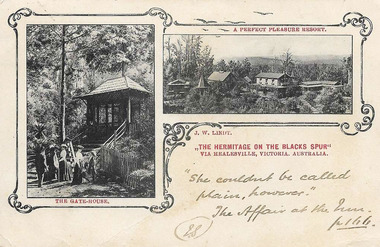
Postcard (Item) - Black and white postcard, John William Lindt, "The Hermitage on the Blacks Spur" via Healesville, Victoria, Australia: A Perfect Pleasure Resort, 1900s
... heart failure during disastrous bushfires on 19 February 1926 at the Hermitage. He was survived by his wife Catherine who continued to run ‘The Hermitage’ guest house before she retired to the city. the hermitage john william lindt narbethong victoria black spur ferdinand von mueller melbourne botanic gardens new guinea catherine lindt collotype "She couldnt be called/ plain, however."/ The affair at the Inn./ IS/ p 1 hh. A digital copy of an early black and white postcard of "The Hermitage" at Narbethong in Victoria. The title is in red under the right hand ...A digital copy of an early black and white postcard of "The Hermitage" at Narbethong in Victoria.A digital copy of an early black and white postcard of "The Hermitage" at Narbethong in Victoria. "The Hermitage" was built by photographer John William Lindt as a home and guesthouse in 1894. John Lindt had previously photographed the mountain scenery of the Black Spur and purchased 71 acres and subseqently built his home and guesthouse from where he continued his career. "The Hermitage had a garden designed by John Lindt's friend, Ferdinand von Mueller, who was at one stage the Director of the Melbourne Botanic Gardens. The garden featured New Guinea tree houses from which John Lindt made frequent panoramas of his property and the surrounding forest of towering mountain ash. Aged 81 Lindt died of heart failure during disastrous bushfires on 19 February 1926 at the Hermitage. He was survived by his wife Catherine who continued to run ‘The Hermitage’ guest house before she retired to the city."She couldnt be called/ plain, however."/ The affair at the Inn./ IS/ p 1 hh.the hermitage, john william lindt, narbethong, victoria, black spur, ferdinand von mueller, melbourne botanic gardens, new guinea, catherine lindt, collotype -
Marysville & District Historical Society
THE TRIANGLE NEWS-VOL 41 NO 16-MAY 2 2014
... marysville victoria australia marysville history centre life members honoured mary & reg kenealy life membership certificates presented new contact details for triangle news what's on when in may 2014 sesonal influenza vaccine the committee of management of the gallipoli park precinct marysville community market creative triangle adventurous cooks triangle community dinner church notices marysville golf report mayor's chair by margaret rose marysville saddletramps inaugural ralph wait memorial ride gallipoli park marysville top end/central tour marysville triangle community men's shed advertisements modern life music school the next wave cabaret dinner show el kanah marysville eat in eat out menu buxton nursery residential and rural real estate marysville triangle real estate lake mountain mountain mayhem alexandra district hospital heart week 2014 cleaner needed for marysville villains pie night murrindindi shire council ceaca marysville midweek netball swimming pools made a splash this season mother's day black spur inn darryl hull entertainer tree changes tempted by shire marysville preschool centre long day care & kindergarten 1000 hands a great success emergence program marysville cultural community 2 mime shows buxton hall trivia night murrindindi early years conference building beyond naming the marysville community centre rooms and stadium THE TRIANGLE NEWS-VOL 41 NO 16-MAY 2 2014 ...marysville, victoria, australia, marysville history centre life members honoured, mary & reg kenealy, life membership certificates presented, new contact details for triangle news, what's on when in may, 2014 sesonal influenza vaccine, the committee of management of the gallipoli park precinct, marysville community market, creative triangle, adventurous cooks, triangle community dinner, church notices, marysville golf report, mayor's chair by margaret rose, marysville saddletramps, inaugural ralph wait memorial ride, gallipoli park marysville, top end/central tour, marysville triangle community men's shed, advertisements, modern life music school, the next wave cabaret dinner show, el kanah marysville, eat in eat out menu, buxton nursery, residential and rural real estate, marysville triangle real estate, lake mountain, mountain mayhem, alexandra district hospital heart week 2014, cleaner needed for marysville villains pie night, murrindindi shire council, ceaca, marysville midweek netball, swimming pools made a splash this season, mother's day black spur inn, darryl hull entertainer, tree changes tempted by shire, marysville preschool centre, long day care & kindergarten, 1000 hands a great success, emergence program, marysville cultural community, 2 mime shows, buxton hall trivia night, murrindindi early years conference, building beyond, naming the marysville community centre rooms and stadium -
 Flagstaff Hill Maritime Museum and Village
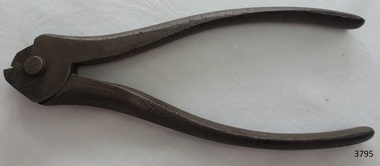
Tool - Pliers, Early 20th Century
... hand tools for all trades, iron and steel stampers, die sinker, and in the process of press working in sheet and metal for various items. The company around this time employed 200 people and the directors of the company in 1914 were W. H. Wynn, H. S. Wynn, W. L. Wynn. In 1929 they were producing tools under the heart...hand tools for all trades, iron and steel stampers, die sinker, and in the process of press working in sheet and metal for various items. The company around this time employed 200 people and the directors of the company in 1914 were W. H. Wynn, H. S. Wynn, W. L. Wynn. In 1929 they were producing tools under the heart ...In 1887 the long established steel toy business of Richard Timmins and Sons of Pershore Street Birmingham was sold to W C Wynn & sons, of Commercial Street Birmingham. They proceeded to extend their works and eventually concentrated on the amalgamation of both businesses under the name of Wynn and Timmins at the one address in Commercial Street. In 1892 they were incorporated as a Limited Company and by 1914 were known as the manufacturers of hand tools for all trades, iron and steel stampers, die sinker, and in the process of press working in sheet and metal for various items. The company around this time employed 200 people and the directors of the company in 1914 were W. H. Wynn, H. S. Wynn, W. L. Wynn. In 1929 they were producing tools under the heart brand until in 1969 the company was taken over by Balfour and Darwins of Sheffield, and the manufacturing facility in Birmingham was closed.An early manufacture of tradesman's tools, from 1900 into the late 1960s the company was a major suppler of tools to various industries and pioneered a number of improvements for individual hand tools for specific industries.Steel snub nosed pliers designed for a specific use unidentified at this time."WYNN & TIMMINS" stamped into the steel handle tools, pliers, metal pliers, wynn & timmins, birmingham manufacturer, tool manufacturer, richard timmins, sheet metal manufactures -
 Flagstaff Hill Maritime Museum and Village
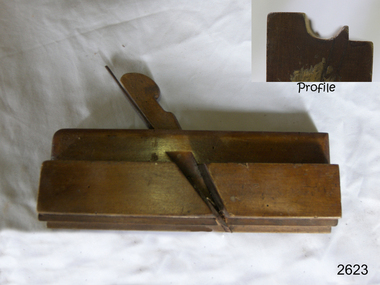
Tool - Moulding wood Plane, Late 19th to Early 20th century
... hand with the growth of the shipbuilding industries on the Firth of Clyde in the nineteenth century and the emergence of Glasgow regarded as the "second city of the Empire". It also reflected the firm's skill in responding to an unprecedented demand for quality tools by shipyards, cooperage's and other industries, both locally and far and wide. The year 1792 was deemed by the firm to be that of its foundation it was in all likelihood the year in which John Manners had set up his plane-making workshop on Saracen Lane off the Gallowgate in the heart...hand with the growth of the shipbuilding industries on the Firth of Clyde in the nineteenth century and the emergence of Glasgow regarded as the "second city of the Empire". It also reflected the firm's skill in responding to an unprecedented demand for quality tools by shipyards, cooperage's and other industries, both locally and far and wide. The year 1792 was deemed by the firm to be that of its foundation it was in all likelihood the year in which John Manners had set up his plane-making workshop on Saracen Lane off the Gallowgate in the heart ...A moulding plane is a specialised plane used for making the complex shapes found in wooden mouldings that are used to decorate furniture or other wooden objects. Traditionally, moulding planes were blocks of wear-resistant hardwood, often beech or maple, which were worked to the shape of the intended moulding. The blade or iron was likewise formed to the intended moulding profile and secured in the body of the plane with a wooden wedge. A traditional cabinetmakers shop might have many, perhaps hundreds, of moulding planes for the full range of work to be performed. Large crown mouldings required planes of six or more inches in width, which demanded great strength to push and often had additional peg handles on the sides, allowing the craftsman's apprentice or other workers to pull the plane ahead of the master who guided it. Company History: The firm of Alexander Mathieson & Sons was one of the leading makers of hand tools in Scotland. Its success went hand in hand with the growth of the shipbuilding industries on the Firth of Clyde in the nineteenth century and the emergence of Glasgow regarded as the "second city of the Empire". It also reflected the firm's skill in responding to an unprecedented demand for quality tools by shipyards, cooperage's and other industries, both locally and far and wide. The year 1792 was deemed by the firm to be that of its foundation it was in all likelihood the year in which John Manners had set up his plane-making workshop on Saracen Lane off the Gallowgate in the heart of Glasgow, not far from the Saracen's Head Inn, where Dr Johnson and James Boswell had stayed on their tour of Scotland in 1773. Alexander Mathieson (1797–1851) is recorded in 1822 as a plane-maker at 25 Gallowgate, but in the following year at 14 Saracen's Lane, presumably having taken over the premises of John Manners. The 1841 national census described Alexander Mathieson as a master plane-maker at 38 Saracen Lane with his son Thomas Adam working as a journeyman plane-maker. In 1849 the firm of James & William Stewart at 65 Nicolson Street, Edinburgh was taken over and Thomas was put in charge of the business, trading under the name Thomas A. Mathieson & Co. as plane and edge-tool makers. Thomas's company acquired the Edinburgh edge-tool makers Charles & Hugh McPherson and took over their premises in Gilmore Street. The Edinburgh directory of 1856/7 the business is recorded as being Alexander Mathieson & Son, plane and edge-tool makers at 48 Nicolson Street and Paul's Work, Gilmore Street. The 1851 census records indicate that Alexander was working as a tool and plane-maker employing eight men. Later that year Alexander died and his son Thomas took over the business. Under the heading of an edge-tool maker in the 1852/3 (Post-Office Glasgow Annual Directory) the firm is now listed as Alexander Mathieson & Son. By the early 1850s, the business had moved to 24 Saracen Lane. The directory for 1857/8 records that the firm had moved again only a few years later to East Campbell Street, also off the Gallowgate, and that through further diversification was also manufacturing coopers' and tinmen's tools. The ten-yearly censuses log the firm's growth and in 1861 Thomas was a tool manufacturer employing 95 men and 30 boys; in 1871 he had 200 men working for him and in 1881 300 men. By 1899 the firm had been incorporated as Alexander Mathieson & Sons Ltd, even though only Alexander's son Thomas appears ever to have joined the firm. A vintage tool made by a well-known firm made for other firms and individuals that worked in wood. The tool was used before routers and spindle moulders came into use after World War ll, a time when to produce a decorative moulding for a piece of furniture or other items this had to be accomplished by hand using one of these types of planes. A significant item from the mid to late 19th century that today is quite rare and sought after by collectors. It gives us a snapshot of how furniture was made predominately by hand and with tools that were themselves hand made shows the craftsmanship used to make such a unique item. Side bead Moulding Plane Alex Mathieson & Son. flagstaff hill, warrnambool, shipwrecked-coast, flagstaff-hill, flagstaff-hill-maritime-museum, maritime-museum, shipwreck-coast, flagstaff-hill-maritime-village -
 Flagstaff Hill Maritime Museum and Village
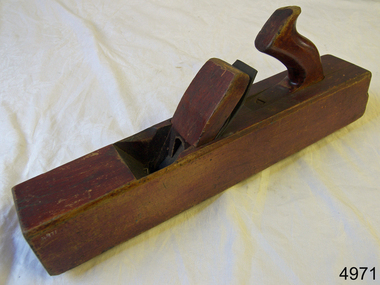
Tool - Wood Smoothing Plane, Late 19th to Early 20th century
... hand with the growth of the shipbuilding industries on the Firth of Clyde in the nineteenth century and the emergence of Glasgow regarded as the "second city of the Empire". It also reflected the firm's skill in responding to an unprecedented demand for quality tools by shipyards, cooperage's and other industries, both locally and far and wide. The year 1792 was deemed by the firm to be that of its foundation it was in all likelihood the year in which John Manners had set up his plane-making workshop on Saracen Lane off the Gallowgate in the heart...hand with the growth of the shipbuilding industries on the Firth of Clyde in the nineteenth century and the emergence of Glasgow regarded as the "second city of the Empire". It also reflected the firm's skill in responding to an unprecedented demand for quality tools by shipyards, cooperage's and other industries, both locally and far and wide. The year 1792 was deemed by the firm to be that of its foundation it was in all likelihood the year in which John Manners had set up his plane-making workshop on Saracen Lane off the Gallowgate in the heart ...A Jack plane is used for smoothing timber that is used in the manufacture of furniture or other wooden objects. Traditionally, smoothing planes were blocks of wear-resistant hardwood, often beech or maple, which were worked to smooth or even out timber. The blade or iron was likewise secured in the body of the plane with a wooden wedge. A traditional cabinetmakers shop might have many, perhaps hundreds, of moulding and smoothing planes for the full range of work to be performed. Company History: The firm of Alexander Mathieson & Sons was one of the leading makers of hand tools in Scotland. Its success went hand in hand with the growth of the shipbuilding industries on the Firth of Clyde in the nineteenth century and the emergence of Glasgow regarded as the "second city of the Empire". It also reflected the firm's skill in responding to an unprecedented demand for quality tools by shipyards, cooperage's and other industries, both locally and far and wide. The year 1792 was deemed by the firm to be that of its foundation it was in all likelihood the year in which John Manners had set up his plane-making workshop on Saracen Lane off the Gallowgate in the heart of Glasgow, not far from the Saracen's Head Inn, where Dr Johnson and James Boswell had stayed on their tour of Scotland in 1773. Alexander Mathieson (1797–1851) is recorded in 1822 as a plane-maker at 25 Gallowgate, but in the following year at 14 Saracen's Lane, presumably having taken over the premises of John Manners. The 1841 national census described Alexander Mathieson as a master plane-maker at 38 Saracen Lane with his son Thomas Adam working as a journeyman plane-maker. In 1849 the firm of James & William Stewart at 65 Nicolson Street, Edinburgh was taken over and Thomas was put in charge of the business, trading under the name Thomas A. Mathieson & Co. as plane and edge-tool makers. Thomas's company acquired the Edinburgh edge-tool makers Charles & Hugh McPherson and took over their premises in Gilmore Street. The Edinburgh directory of 1856/7 the business is recorded as being Alexander Mathieson & Son, plane and edge-tool makers at 48 Nicolson Street and Paul's Work, Gilmore Street. The 1851 census records indicate that Alexander was working as a tool and plane-maker employing eight men. Later that year Alexander died and his son Thomas took over the business. Under the heading of an edge-tool maker in the 1852/3 (Post-Office Glasgow Annual Directory) the firm is now listed as Alexander Mathieson & Son. By the early 1850s, the business had moved to 24 Saracen Lane. The directory for 1857/8 records that the firm had moved again only a few years later to East Campbell Street, also off the Gallowgate, and that through further diversification was also manufacturing coopers' and tinmen's tools. The ten-yearly censuses log the firm's growth and in 1861 Thomas was a tool manufacturer employing 95 men and 30 boys; in 1871 he had 200 men working for him and in 1881 300 men. By 1899 the firm had been incorporated as Alexander Mathieson & Sons Ltd, even though only Alexander's son Thomas appears ever to have joined the firm. A vintage tool made by a well-known firm made for other firms and individuals that worked in wood. The tool was used for the smoothing of a piece of timber that was then used in some form of cabinet manufacture or wood working. A significant item from the mid to late 19th century that today is sought after by collectors. It gives us a snapshot of how furniture was made predominately by hand and with tools that were themselves hand made. Jack Plane; a wooden smoothing plane, made by Alex Mathieson & Son, Glasgow. Plane has inscriptions."Alex Mathieson & Son Glasgow" Stamped "GN" inside with a "W" on endflagstaff hill, warrnambool, shipwrecked-coast, flagstaff-hill, flagstaff-hill-maritime-museum, maritime-museum, shipwreck-coast, flagstaff-hill-maritime-village, jack plane, smoothing plane, woodworking tool, woodwork, cabinet making -
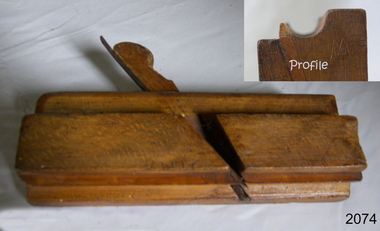 Flagstaff Hill Maritime Museum and Village
Tool - Moulding wood Plane, Late 19th to Early 20th century
... hand with the growth of the shipbuilding industries on the Firth of Clyde in the nineteenth century and the emergence of Glasgow regarded as the "second city of the Empire". It also reflected the firm's skill in responding to an unprecedented demand for quality tools by shipyards, cooperage's and other industries, both locally and far and wide. The year 1792 was deemed by the firm to be that of its foundation it was in all likelihood the year in which John Manners had set up his plane-making workshop on Saracen Lane off the Gallowgate in the heart...hand with the growth of the shipbuilding industries on the Firth of Clyde in the nineteenth century and the emergence of Glasgow regarded as the "second city of the Empire". It also reflected the firm's skill in responding to an unprecedented demand for quality tools by shipyards, cooperage's and other industries, both locally and far and wide. The year 1792 was deemed by the firm to be that of its foundation it was in all likelihood the year in which John Manners had set up his plane-making workshop on Saracen Lane off the Gallowgate in the heart ...A moulding plane is a specialised plane used for making the complex shapes found in wooden mouldings that are used to decorate furniture or other wooden objects. Traditionally, moulding planes were blocks of wear-resistant hardwood, often beech or maple, which were worked to the shape of the intended moulding. The blade or iron was likewise formed to the intended moulding profile and secured in the body of the plane with a wooden wedge. A traditional cabinetmakers shop might have many, perhaps hundreds, of moulding planes for the full range of work to be performed. Large crown mouldings required planes of six or more inches in width, which demanded great strength to push and often had additional peg handles on the sides, allowing the craftsman's apprentice or other workers to pull the plane ahead of the master who guided it. Company History: The firm of Alexander Mathieson & Sons was one of the leading makers of hand tools in Scotland. Its success went hand in hand with the growth of the shipbuilding industries on the Firth of Clyde in the nineteenth century and the emergence of Glasgow regarded as the "second city of the Empire". It also reflected the firm's skill in responding to an unprecedented demand for quality tools by shipyards, cooperage's and other industries, both locally and far and wide. The year 1792 was deemed by the firm to be that of its foundation it was in all likelihood the year in which John Manners had set up his plane-making workshop on Saracen Lane off the Gallowgate in the heart of Glasgow, not far from the Saracen's Head Inn, where Dr Johnson and James Boswell had stayed on their tour of Scotland in 1773. Alexander Mathieson (1797–1851) is recorded in 1822 as a plane-maker at 25 Gallowgate, but in the following year at 14 Saracen's Lane, presumably having taken over the premises of John Manners. The 1841 national census described Alexander Mathieson as a master plane-maker at 38 Saracen Lane with his son Thomas Adam working as a journeyman plane-maker. In 1849 the firm of James & William Stewart at 65 Nicolson Street, Edinburgh was taken over and Thomas was put in charge of the business, trading under the name Thomas A. Mathieson & Co. as plane and edge-tool makers. Thomas's company acquired the Edinburgh edge-tool makers Charles & Hugh McPherson and took over their premises in Gilmore Street. The Edinburgh directory of 1856/7 the business is recorded as being Alexander Mathieson & Son, plane and edge-tool makers at 48 Nicolson Street and Paul's Work, Gilmore Street. The 1851 census records indicate that Alexander was working as a tool and plane-maker employing eight men. Later that year Alexander died and his son Thomas took over the business. Under the heading of an edge-tool maker in the 1852/3 (Post-Office Glasgow Annual Directory) the firm is now listed as Alexander Mathieson & Son. By the early 1850s, the business had moved to 24 Saracen Lane. The directory for 1857/8 records that the firm had moved again only a few years later to East Campbell Street, also off the Gallowgate, and that through further diversification was also manufacturing coopers' and tinmen's tools. The ten-yearly censuses log the firm's growth and in 1861 Thomas was a tool manufacturer employing 95 men and 30 boys; in 1871 he had 200 men working for him and in 1881 300 men. By 1899 the firm had been incorporated as Alexander Mathieson & Sons Ltd, even though only Alexander's son Thomas appears ever to have joined the firm. A vintage tool made by a well-known firm made for other firms and individuals that worked in wood. The tool was used before routers and spindle moulders came into use after World War ll, a time when to produce a decorative moulding for a piece of furniture or other items this had to be accomplished by hand using one of these types of planes. A significant item from the mid to late 19th century that today is quite rare and sought after by collectors. It gives us a snapshot of how furniture was made predominately by hand and with tools that were themselves hand made shows the craftsmanship used to make such a unique item. Moulding Plane side beadStamped Mathieson and Son also ( size "W" & ¾" )also GN (previous owner)flagstaff hill, warrnambool, shipwrecked-coast, flagstaff-hill, flagstaff-hill-maritime-museum, maritime-museum, shipwreck-coast, flagstaff-hill-maritime-village -
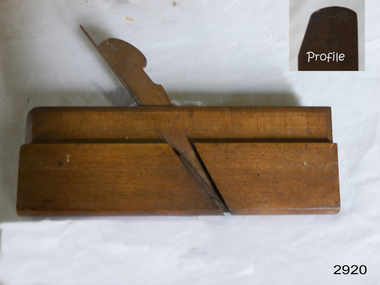 Flagstaff Hill Maritime Museum and Village
Tool - Moulding wood Plane, Late 19th to Early 20th century
... hand with the growth of the shipbuilding industries on the Firth of Clyde in the nineteenth century and the emergence of Glasgow regarded as the "second city of the Empire". It also reflected the firm's skill in responding to an unprecedented demand for quality tools by shipyards, cooperage's and other industries, both locally and far and wide. The year 1792 was deemed by the firm to be that of its foundation it was in all likelihood the year in which John Manners had set up his plane-making workshop on Saracen Lane off the Gallowgate in the heart...hand with the growth of the shipbuilding industries on the Firth of Clyde in the nineteenth century and the emergence of Glasgow regarded as the "second city of the Empire". It also reflected the firm's skill in responding to an unprecedented demand for quality tools by shipyards, cooperage's and other industries, both locally and far and wide. The year 1792 was deemed by the firm to be that of its foundation it was in all likelihood the year in which John Manners had set up his plane-making workshop on Saracen Lane off the Gallowgate in the heart ...A moulding plane is a specialised plane used for making the complex shapes found in wooden mouldings that are used to decorate furniture or other wooden objects. Traditionally, moulding planes were blocks of wear-resistant hardwood, often beech or maple, which were worked to the shape of the intended moulding. The blade or iron was likewise formed to the intended moulding profile and secured in the body of the plane with a wooden wedge. A traditional cabinetmakers shop might have many, perhaps hundreds, of moulding planes for the full range of work to be performed. Large crown mouldings required planes of six or more inches in width, which demanded great strength to push and often had additional peg handles on the sides, allowing the craftsman's apprentice or other workers to pull the plane ahead of the master who guided it. Company History: The firm of Alexander Mathieson & Sons was one of the leading makers of hand tools in Scotland. Its success went hand in hand with the growth of the shipbuilding industries on the Firth of Clyde in the nineteenth century and the emergence of Glasgow regarded as the "second city of the Empire". It also reflected the firm's skill in responding to an unprecedented demand for quality tools by shipyards, cooperage's and other industries, both locally and far and wide. The year 1792 was deemed by the firm to be that of its foundation it was in all likelihood the year in which John Manners had set up his plane-making workshop on Saracen Lane off the Gallowgate in the heart of Glasgow, not far from the Saracen's Head Inn, where Dr Johnson and James Boswell had stayed on their tour of Scotland in 1773. Alexander Mathieson (1797–1851) is recorded in 1822 as a plane-maker at 25 Gallowgate, but in the following year at 14 Saracen's Lane, presumably having taken over the premises of John Manners. The 1841 national census described Alexander Mathieson as a master plane-maker at 38 Saracen Lane with his son Thomas Adam working as a journeyman plane-maker. In 1849 the firm of James & William Stewart at 65 Nicolson Street, Edinburgh was taken over and Thomas was put in charge of the business, trading under the name Thomas A. Mathieson & Co. as plane and edge-tool makers. Thomas's company acquired the Edinburgh edge-tool makers Charles & Hugh McPherson and took over their premises in Gilmore Street. The Edinburgh directory of 1856/7 the business is recorded as being Alexander Mathieson & Son, plane and edge-tool makers at 48 Nicolson Street and Paul's Work, Gilmore Street. The 1851 census records indicate that Alexander was working as a tool and plane-maker employing eight men. Later that year Alexander died and his son Thomas took over the business. Under the heading of an edge-tool maker in the 1852/3 (Post-Office Glasgow Annual Directory) the firm is now listed as Alexander Mathieson & Son. By the early 1850s, the business had moved to 24 Saracen Lane. The directory for 1857/8 records that the firm had moved again only a few years later to East Campbell Street, also off the Gallowgate, and that through further diversification was also manufacturing coopers' and tinmen's tools. The ten-yearly censuses log the firm's growth and in 1861 Thomas was a tool manufacturer employing 95 men and 30 boys; in 1871 he had 200 men working for him and in 1881 300 men. By 1899 the firm had been incorporated as Alexander Mathieson & Sons Ltd, even though only Alexander's son Thomas appears ever to have joined the firm. A vintage tool made by a well-known firm made for other firms and individuals that worked in wood. The tool was used before routers and spindle moulders came into use after World War ll, a time when to produce a decorative moulding for a piece of furniture or other items this had to be accomplished by hand using one of these types of planes. A significant item from the mid to late 19th century that today is quite rare and sought after by collectors. It gives us a snapshot of how furniture was made predominately by hand and with tools that were themselves hand made shows the craftsmanship used to make such a unique item. Round Moulding plane size 12 Alex Mathieson & Son Glasgow makerflagstaff hill, warrnambool, shipwrecked-coast, flagstaff-hill, flagstaff-hill-maritime-museum, maritime-museum, shipwreck-coast, flagstaff-hill-maritime-village -
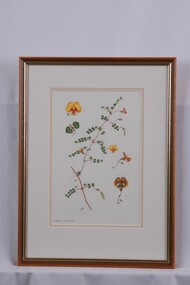 Glenelg Shire Council Cultural Collection
Drawing - Drawing, botanical, Collin Elwyn Woolcock, Bossiaea cordigera (Wiry Bossiaea), n.d
... hand unlike the artist's over an erased pencil title. CEW (signature, lower left of image) (purple pencil) Back: 52 (upper left) (pen) Drawings of a plant stem with detailed views of flowers and leaves. Upper left is a top view of a yellow and red flower, labled "b1". Below this is a study of two heart ...Part of Woolcock Gallery Collection Exhibition, CEMA, 1989.Drawings of a plant stem with detailed views of flowers and leaves. Upper left is a top view of a yellow and red flower, labled "b1". Below this is a study of two heart-shaped, dark green leaves ("c"). In centre is a setm view with many-leafed stems coming from the central stem (approximately 8-10 leaves per stem) ("a"). Three flowers on long thin stalks come from these leafed stems. One bud and two seed pods are also shown sprouting from the stems. On right are two flower views - one side view and one back view. Numbers are in pencil and are also printed on white paper and glued to surface of the paper. The work is mounted in a double matt (off-white on yellow) and framed under glass in a wooden frame with gold paint.Front: Bossiaea cordigea (lower left) (pencil) Written in hand unlike the artist's over an erased pencil title. CEW (signature, lower left of image) (purple pencil) Back: 52 (upper left) (pen)collin woolcock, woolcock collection, woolcock, botanical drawings, botanical -
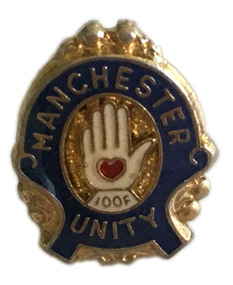 City of Moorabbin Historical Society (Operating the Box Cottage Museum)
Badge - Manchester Unity Lapel Pin, 1810
... The centre has a white hand with a red heart in the middle, around the outside in a blue enamelled banner the words in gold Manchester Unity....The centre has a white hand with a red heart in the middle, around the outside in a blue enamelled banner the words in gold Manchester Unity. ...The Manchester Unity IOOF is a non-political, non-sectarian fraternal order founded in Manchester England in 1810. Its main objective is to protect and care for its members and the communities in which they live. This model spread to Victoria, with Melbourne’s branch founded on 7 December 1840.Gold pin with blue, white and red enamelling. The centre has a white hand with a red heart in the middle, around the outside in a blue enamelled banner the words in gold Manchester Unity.Manchester Unity IOOFmanchester unity, benevolent society -
Glenelg Shire Council Cultural Collection
Pamphlet - Brochure - Fawthrop Lagoon, the jewel in the heart of Portland, n.d
... hand-made paper, dark blue and brown print. History of Fawthrop Lagoon AKA 'the Swamp'. Screen print of birds taking flight from Fawthrop's Lagoon on front cover, illustrations of birds and map of lagoon location on body of programme. Pamphlet Brochure - Fawthrop Lagoon, the jewel in the heart ...Brochure, natural colour, hand-made paper, dark blue and brown print. History of Fawthrop Lagoon AKA 'the Swamp'. Screen print of birds taking flight from Fawthrop's Lagoon on front cover, illustrations of birds and map of lagoon location on body of programme. -
 Orbost & District Historical Society
first day cover, Connell, Lee, June 1987
... The town of Orbost is situated on the Snowy River and the town has always been "the heart of Snowy River country". first-day-cover man-from-snowy-river stamps philately A first day cover for "The Man From Snowy River" stamps. There is a picture of a saddle in the top left-hand ...The Man from Snowy River" is a poem by Australian bush poet Banjo Paterson. It was first published in The Bulletin, an Australian news magazine, on 26th April 1890. The poem tells the story of a horseback pursuit to recapture the colt of a prizewinning racehorse that escaped from its paddock and is living wild with the brumbies (wild horses) of the mountain ranges. Eventually the brumbies descend a seemingly impassably steep slope, at which point the assembled riders give up the pursuit, except the young hero, who spurs his pony down the "terrible descent" to catch the mob.Two characters mentioned in the early part of the poem are featured in previous Paterson poems; "Clancy of the Overflow" and Harrison from "Old Pardon, Son of Reprieve".The town of Orbost is situated on the Snowy River and the town has always been "the heart of Snowy River country".A first day cover for "The Man From Snowy River" stamps. There is a picture of a saddle in the top left-hand corner. There is a strip 5 stamps on the envelope and it has been stamped at Orbost Post Office. This strip has 5 scenes based on the Banjo Patterson legendary poem by the same name. The stamps include: At The Station, Mountain Bend, The Terrible Descent, At Their Heels and Brought Them Back.first-day-cover man-from-snowy-river stamps philately -
 Glenelg Shire Council Cultural Collection
Sculpture - Collaborative sculpture piece 1/16, Rory Carter, October 2025
... Piece #1 hand created ceramic topper, shaped in a cactus like with 2 arms, etched images of fish jellyfish, snails, seaweed, waves a rose and hearts. ...Piece #1 hand created ceramic topper, shaped in a cactus like with 2 arms, etched images of fish jellyfish, snails, seaweed, waves a rose and hearts. ...The collaborative sculpture was created for the Annual Portland Arts Centre Inside Out Exhibition 2025. The ceramics were created during a series of workshops. Participants were able to lean new creative practices in a safe supportive space whist creating original works for the exhibition. The ceramics workshop was led by Angela Ryks and Rory Carter.Sculpture was created to be acquired into the Glenelg Shire Council Cultural Collection.Piece 1/ 16 of a collaborative sculpture created for the Annual Portland Arts Centre Inside Out Exhibition 2026. Piece #1 hand created ceramic topper, shaped in a cactus like with 2 arms, etched images of fish jellyfish, snails, seaweed, waves a rose and hearts. Colours on a white background of red, orange, blue, yellow, green, pink, dark purple, and light purple.all abilities -
 Red Cliffs Military Museum
Booklet, Eric Stephenson, Your Badge, 1945 (estimated)
... hand Front Cover: YOUR BADGE/ colour picture of original RSL Badge./ THE RETURNED SAILORS, SOLDIERS & AIRMEN'S IMPERIAL LEAGUE OF AUSTRALIA/ (NSW BRANCH)/ THE PRICE OF LIBERTY IS/ ETERNAL VIGILANCE/ ANZAC MEMORIAL SYDNEY/ M4313// Inside Cover: THE LEAGUES PLEDGE/ November 1939./ "That this Federal congress - the first to be held since the declaration of war/ publicly states that the whole body of the/ RSS&AILA is heart and sole behind/ the new Australian Expiditionary Force, and/ gladly accepts the new obligations to protect/ the interests of all who shall serve the Empire/ in the present war.// Page 1: A Welcome home/ From your Reception Committee/ The Old and New Diggers.// Page 2& 3: A Message from the State President.// Page 4: Policy of the RSS&AILA.// Pages 5,6,7: R.S.L. ...A booklet of the Returned Sailors, Soldiers and Airmen's Imperial League of Australia NSW Branch. Front cover has the original RSL badge printed above the Price of Liberty is Eternal Vigilance. ANZAC Memorial Sydney M4313Front Cover: YOUR BADGE/ colour picture of original RSL Badge./ THE RETURNED SAILORS, SOLDIERS & AIRMEN'S IMPERIAL LEAGUE OF AUSTRALIA/ (NSW BRANCH)/ THE PRICE OF LIBERTY IS/ ETERNAL VIGILANCE/ ANZAC MEMORIAL SYDNEY/ M4313// Inside Cover: THE LEAGUES PLEDGE/ November 1939./ "That this Federal congress - the first to be held since the declaration of war/ publicly states that the whole body of the/ RSS&AILA is heart and sole behind/ the new Australian Expiditionary Force, and/ gladly accepts the new obligations to protect/ the interests of all who shall serve the Empire/ in the present war.// Page 1: A Welcome home/ From your Reception Committee/ The Old and New Diggers.// Page 2& 3: A Message from the State President.// Page 4: Policy of the RSS&AILA.// Pages 5,6,7: R.S.L. Policy.// Pages 8,9,10 & 11: Record of Service (outlines the services the RSL provides and the Principles on which it was established.// Pages 12, 13, 14, 15, 16 & 17: List of Sub-Branches NSW. Women's Services/ Merchant Navy// Centre Page: Nomination for Membership // Pages 18,19,20,& 21: War Pensions.// Page 22: Did you know.//Page 23: Eligiblity for Membership.// Page 24: If there were no League. // Pages 25, 26: ANZAC Centre. // Page 27: Memorandum (clear page)// Page 28 Personal memoranda (to be filled in) Conclusion.book, anzac, imperial, sailors, soldiers, league, badge, your, returned, airmen, memorial, hand -
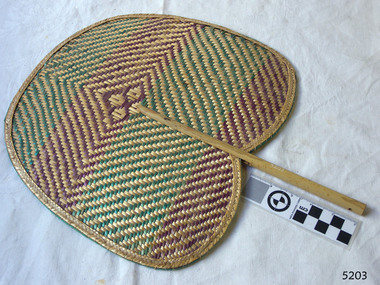 Flagstaff Hill Maritime Museum and Village
Fan
... Hand Fan made from cane, heart shape.. Red and green in colour. ...flagstaff hill warrnambool shipwrecked-coast flagstaff-hill flagstaff-hill-maritime-museum maritime-museum shipwreck-coast flagstaff-hill-maritime-village fan cane fan Hand Fan made from cane, heart shape.. Red and green in colour. ...Hand Fan made from cane, heart shape.. Red and green in colour. flagstaff hill, warrnambool, shipwrecked-coast, flagstaff-hill, flagstaff-hill-maritime-museum, maritime-museum, shipwreck-coast, flagstaff-hill-maritime-village, fan, cane fan -
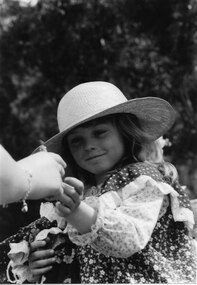 Halls Gap & Grampians Historical Society
Photograph - B/W, Oct-86
... She is handing (or receiving) a flower to a woman, whose arm is the only part visible in the photo. The woman is wearing a bracelet with a heart shaped charm....She is handing (or receiving) a flower to a woman, whose arm is the only part visible in the photo. The woman is wearing a bracelet with a heart shaped charm. ...This is part of a parade held on the main street of Halls Gap in conjunction with the 150th anniversary of Major Mitchell's visit to the area. Thephoto is a close up of a young girl. She is wearing a broad brimmed straw hat and a flowery print dress with lace around the sleeves and a shawl lice cowl edged with lace. She is handing (or receiving) a flower to a woman, whose arm is the only part visible in the photo. The woman is wearing a bracelet with a heart shaped charm.events, parades -
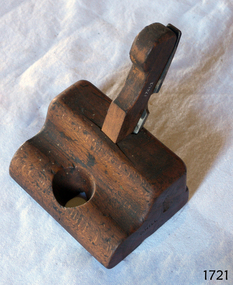 Flagstaff Hill Maritime Museum and Village
Tool - Router Plane, A Mathieson & Son, Mid 19th to early 20th centuries
... hand with the growth of the shipbuilding industries on the Firth of Clyde in the nineteenth century and the emergence of Glasgow regarded as the "second city of the Empire". It also reflected the firm's skill in responding to an unprecedented demand for quality tools by shipyards, cooperage's and other industries, both locally and far and wide. The year 1792 was deemed by the firm to be that of its foundation it was in all likelihood the year in which John Manners had set up his plane-making workshop on Saracen Lane off the Gallowgate in the heart...hand with the growth of the shipbuilding industries on the Firth of Clyde in the nineteenth century and the emergence of Glasgow regarded as the "second city of the Empire". It also reflected the firm's skill in responding to an unprecedented demand for quality tools by shipyards, cooperage's and other industries, both locally and far and wide. The year 1792 was deemed by the firm to be that of its foundation it was in all likelihood the year in which John Manners had set up his plane-making workshop on Saracen Lane off the Gallowgate in the heart ...The subject router is commonly referred to disparagingly as the ‘old woman’s tooth’ or ‘hag’s tooth.’ It is a router that houses a plough plane iron instead of a purpose made shoe-type cutting iron. They work fine but rarely give the type of clean surface required for veneer inlays. These types of tools are adjusted by the same hammer-tap tapping method used generally on wooden-bodied planes on the iron or plane body. These tools are effective and practical when used in general carpentry and joinery. Company History: The firm of Alexander Mathieson & Sons was one of the leading makers of hand tools in Scotland. Its success went hand in hand with the growth of the shipbuilding industries on the Firth of Clyde in the nineteenth century and the emergence of Glasgow regarded as the "second city of the Empire". It also reflected the firm's skill in responding to an unprecedented demand for quality tools by shipyards, cooperage's and other industries, both locally and far and wide. The year 1792 was deemed by the firm to be that of its foundation it was in all likelihood the year in which John Manners had set up his plane-making workshop on Saracen Lane off the Gallowgate in the heart of Glasgow, not far from the Saracen's Head Inn, where Dr Johnson and James Boswell had stayed on their tour of Scotland in 1773. Alexander Mathieson (1797–1851) is recorded in 1822 as a plane-maker at 25 Gallowgate, but in the following year at 14 Saracen's Lane, presumably having taken over the premises of John Manners. The 1841 national census described Alexander Mathieson as a master plane-maker at 38 Saracen Lane with his son Thomas Adam working as a journeyman plane-maker. In 1849 the firm of James & William Stewart at 65 Nicolson Street, Edinburgh was taken over and Thomas was put in charge of the business, trading under the name Thomas A. Mathieson & Co. as plane and edge-tool makers. Thomas's company acquired the Edinburgh edge-tool makers Charles & Hugh McPherson and took over their premises in Gilmore Street. The Edinburgh directory of 1856/7 the business is recorded as being Alexander Mathieson & Son, plane and edge-tool makers at 48 Nicolson Street and Paul's Work, Gilmore Street. The 1851 census records indicate that Alexander was working as a tool and plane-maker employing eight men. Later that year Alexander died and his son Thomas took over the business. Under the heading of an edge-tool maker in the 1852/3 (Post-Office Glasgow Annual Directory) the firm is now listed as Alexander Mathieson & Son. By the early 1850s, the business had moved to 24 Saracen Lane. The directory for 1857/8 records that the firm had moved again only a few years later to East Campbell Street, also off the Gallowgate, and that through further diversification was also manufacturing coopers' and tinmen's tools. The ten-yearly censuses log the firm's growth and in 1861 Thomas was a tool manufacturer employing 95 men and 30 boys; in 1871 he had 200 men working for him and in 1881 300 men. By 1899 the firm had been incorporated as Alexander Mathieson & Sons Ltd, even though only Alexander's son Thomas appears ever to have joined the firm. A vintage tool made by a well-known firm made for other firms and individuals that worked in wood. The tool was used for making timber veneers or smoothing a trench in a piece of timber that was then used in some form of cabinet manufacture or wood working enterprise. A significant item from the mid to late 19th century that today is sought after by collectors. It gives us a snapshot of how furniture was made predominately by hand and with tools that were themselves hand made and required considerable skill in their use. Old Woman's Tooth Router Mathieson. Single iron cut down from a larger plane iron. Has Marked A Mathieson & Son also stamped inscription on side G Hill. (owner)flagstaff hill, warrnambool, flagstaff hill maritime museum, maritime museum, shipwreck coast, flagstaff hill maritime village, great ocean road, plane, old woman's tooth, router, hag's tooth router, cabinet making, woodworking tools, a mathieson & sons, cabinet tool makers -
 Eltham District Historical Society Inc
Book, Nina Kelabora, Welcome : a gift to you, our new neighbours, from the extended Eltham community / produced by Nina Kelabora (graphic designer) and Lara McKinley (principal photographer), December 2016
... Artwork • Logo: Welcome to Eltham • 12 artworks by children of the Eltham Child Care Co-Operative (ECCC) o Me at the Immigration Museum by Ethan B. o Immigration Museum by Edie o Me with my family and lots of hearts by Charlotte o My suitcase like the refugees we learnt about with Bec by Jarvis o Me at the football with my friends by Harley o My suitcase if I had to leave the country by Ellen o Me at the park near the library by Chloe o Books at the library by Addison o Ethan’s grandfather who died in the war and this is him in his grave by Ethan o A nursery by Annabel o The age care home we visit by Ari o This is my mum the Ranger by Mia • Butterfly Effect, Ona Henderson 2016, inscribed “Dedicated to Nina, in appreciation of your butterfly effect for ‘Welcome to Eltham’; reproduced p1 • Ona and Sid gifting her artwork for use by the campaign; reproduced p1 • Duat and Iuk, Mandy Nicholson, Wurundjeri woman; reproduced p3 • These hands welcome you to Australia, Mungo, Warrandyte resident; reproduced p9 • The Library by Rose; reproduced p15 • Welcome to Eltham from Maia; reproduced p19 • Billy, Warrandyte resident; reproduced p20 • Through my window, Janet Boddy; reproduced p23 • Eryn and Lachie, Eltham residents; reproduced p25 • Eva, Eltham resident; reproduced p29 • This is the community hall across from my house by Cinta; reproduced p30 • Welcome, Brenda, Eltham resident; reproduced p34 • Flying over Kerry Crescent, Kerry, Eltham resident; reproduced p38 • A dragon called 'fat' from Joe, 6; reproduced p42 • A rainbow-heart-welcome from Trixie, 8; reproduced p42 • A lovely message from Sarah; reproduced p53 • Monique; reproduced p56 • Tom; reproduced p56 • Josh; reproduced p56 • Chloe; reproduced p56 • Jack; reproduced p57 • Mia; reproduced p57 • Ann Curry, Montmorency resident; reproduced p60 • From Mia: "Keep your head up high and be confident. ...Artwork • Logo: Welcome to Eltham • 12 artworks by children of the Eltham Child Care Co-Operative (ECCC) o Me at the Immigration Museum by Ethan B. o Immigration Museum by Edie o Me with my family and lots of hearts by Charlotte o My suitcase like the refugees we learnt about with Bec by Jarvis o Me at the football with my friends by Harley o My suitcase if I had to leave the country by Ellen o Me at the park near the library by Chloe o Books at the library by Addison o Ethan’s grandfather who died in the war and this is him in his grave by Ethan o A nursery by Annabel o The age care home we visit by Ari o This is my mum the Ranger by Mia • Butterfly Effect, Ona Henderson 2016, inscribed “Dedicated to Nina, in appreciation of your butterfly effect for ‘Welcome to Eltham’; reproduced p1 • Ona and Sid gifting her artwork for use by the campaign; reproduced p1 • Duat and Iuk, Mandy Nicholson, Wurundjeri woman; reproduced p3 • These hands welcome you to Australia, Mungo, Warrandyte resident; reproduced p9 • The Library by Rose; reproduced p15 • Welcome to Eltham from Maia; reproduced p19 • Billy, Warrandyte resident; reproduced p20 • Through my window, Janet Boddy; reproduced p23 • Eryn and Lachie, Eltham residents; reproduced p25 • Eva, Eltham resident; reproduced p29 • This is the community hall across from my house by Cinta; reproduced p30 • Welcome, Brenda, Eltham resident; reproduced p34 • Flying over Kerry Crescent, Kerry, Eltham resident; reproduced p38 • A dragon called 'fat' from Joe, 6; reproduced p42 • A rainbow-heart-welcome from Trixie, 8; reproduced p42 • A lovely message from Sarah; reproduced p53 • Monique; reproduced p56 • Tom; reproduced p56 • Josh; reproduced p56 • Chloe; reproduced p56 • Jack; reproduced p57 • Mia; reproduced p57 • Ann Curry, Montmorency resident; reproduced p60 • From Mia: "Keep your head up high and be confident. ...In 2016 the Welcome to Eltham community project started to welcome Syrian refugees into the community and made Welcome Butterflies to say welcome to them. In addition to the physical book, EDHS also holds several hundred digital images pertaining to the development of the Welcome to Eltham campaign, photographs, artworks and graphic designs, which resulted in the publication of this book. EDHS also holds further material from the period 2016 to 2017 associated with the Welcome to Eltham campaign group. Contents: 1. Welcome Book Welcome Book includes selected page extracts and images as published December 2016 Contents: • Greetings to our Country P2 • Offering P8 • Your neighbours P10 • Rotary P39 • Eltham Baptist Church P44 • Eltham Farmers Market stall holders P48 • The Eltham community P54 • Surrounding communities P60 • Our Lady Help of Christians Primary School P64 • Nillumbik Greens P66 • Our Lady Help of Christians Church Eltham P68 • Catholic Care Eltham P70 • St Vincent’s P71 • Montmorency South Primary School P72 • Victoria Police P73 • Catholic Ladies College P74 • Warrandyte P76 • Eltham Toy Library P78 • Eltham-Montmorency Uniting Church P82 • Gingerbread P84 • Scouts P86 • Eltham businesses P89 • Surrounding communities P96 • The Seed P101 2. Administration 1. Welcome to Eltham Infant Plan, Purpose and Scope (Aug. 2016) 2. Circle of Friends; A draft proposal from Welcome to Eltham, 26 August 2016 3. Welcome to Eltham; a resident support group for refugees settling in Eltham (Sep. 2016) 4. Welcome to Eltham; Purpose and Scope (Sep. 2016) 5. Welcome to Eltham Plan (Sep. 2016); 10 pages typed of tasks broken into four categories, 10 pages 6. Welcome to Eltham Team/Volunteer organisation structure, volunteers’ skills assessment and role assignments, strategies, 11 pages 7. Briefing Document: Refugees being welcomed in Eltham, 2 Oct. 2016; 5 pages 8. Public Engagement Plan, 2 Oct. 2016; 2 pages 9. Welcome to Eltham 2016 Review, Values and Structure, 2017 10. Welcome to Eltham Incorporated Financial Report July 2016 – June 2017; 3 pages 11. Letter: Nina Kelabora and Welcome to Eltham Team to Bolton Street Fruit Market re offer to provide fresh fruit, 30 Jun. 2017 12. Welcome to Eltham Incorporated Annual Report 2016–2017; Oct. 2017; 4 pages 13. Certificate: Jagajaga Community Australia Day Award 2018 to Nina Kelabora, signed Jenny Macklin MP, Federal Member for Jagajaga 14. Certificate: Jagajaga Community Australia Day Award 2018 to Welcome to Eltham, signed Jenny Macklin MP, Federal Member for Jagajaga 15. Letter: Simon Le Plastrier, Principal, Eltham College to Nina Kelabora, 20 April 2018 offering congratulations for the work achieved by Welcome to Eltham group 16. Photo: River pebble covered in spray paint of multiple colours. The rock was used to hold down templates for painting butterflies on the footpaths near Andrew park as a counter to protesters assembling for the ‘Battle for Eltham’ demonstration on 5 November 2016 17. Photo: Welcome to Eltham team member, Gillian Essex 18. Photo: Welcome to Eltham team member, Kirsten Bate 19. Photo: Welcome to Eltham team member, Lara McKinley 20. Photo: Welcome to Eltham team member, Nina Kelabora 21. Photo: Welcome to Eltham team member, Sarah Hooten 22. Incorporation • AGM-minutes-2017 • Certificate of Incorporation • Mission and Values • Ordinary Business of the AGM 2017 • Welcome to Eltham Rules 23. Advocacy • Eltham Butterfly Effect Corflute panel design 5 November 2016 Rally • MemeFest PowerPoint presentation 23 November 2016 • Oxfam PowerPoint presentation 16 June 2017 • Eltham Rotary PowerPoint presentation 1 June 2017 • Welcome to Eltham Gift Card artwork 3. Artwork • Logo: Welcome to Eltham • 12 artworks by children of the Eltham Child Care Co-Operative (ECCC) o Me at the Immigration Museum by Ethan B. o Immigration Museum by Edie o Me with my family and lots of hearts by Charlotte o My suitcase like the refugees we learnt about with Bec by Jarvis o Me at the football with my friends by Harley o My suitcase if I had to leave the country by Ellen o Me at the park near the library by Chloe o Books at the library by Addison o Ethan’s grandfather who died in the war and this is him in his grave by Ethan o A nursery by Annabel o The age care home we visit by Ari o This is my mum the Ranger by Mia • Butterfly Effect, Ona Henderson 2016, inscribed “Dedicated to Nina, in appreciation of your butterfly effect for ‘Welcome to Eltham’; reproduced p1 • Ona and Sid gifting her artwork for use by the campaign; reproduced p1 • Duat and Iuk, Mandy Nicholson, Wurundjeri woman; reproduced p3 • These hands welcome you to Australia, Mungo, Warrandyte resident; reproduced p9 • The Library by Rose; reproduced p15 • Welcome to Eltham from Maia; reproduced p19 • Billy, Warrandyte resident; reproduced p20 • Through my window, Janet Boddy; reproduced p23 • Eryn and Lachie, Eltham residents; reproduced p25 • Eva, Eltham resident; reproduced p29 • This is the community hall across from my house by Cinta; reproduced p30 • Welcome, Brenda, Eltham resident; reproduced p34 • Flying over Kerry Crescent, Kerry, Eltham resident; reproduced p38 • A dragon called 'fat' from Joe, 6; reproduced p42 • A rainbow-heart-welcome from Trixie, 8; reproduced p42 • A lovely message from Sarah; reproduced p53 • Monique; reproduced p56 • Tom; reproduced p56 • Josh; reproduced p56 • Chloe; reproduced p56 • Jack; reproduced p57 • Mia; reproduced p57 • Ann Curry, Montmorency resident; reproduced p60 • From Mia: "Keep your head up high and be confident. I'm sure that you will soon find that Eltham is a very nice place and I hope you can have a happy life."; reproduced p77 • Amy; reproduced p79 • Ben; reproduced p80 • Welcome, Kayla, Warrandyte resident; reproduced p94 • Lucas; reproduced p98 • Ale; reproduced p98 • Grace; reproduced p99 • Hugo; reproduced p99 4. Australian-Syrian Charity • ASC – Certificate of Appreciation; Awarded from Australian-Syrian Charity presented to Welcome to Eltham Group by Rev. Fr. Samir Haddad, ASC president, 30 Sep. 2016 including two images of Father Samir and WTE organiser, Nina Kelabora 5. Butterflies • 148 images of handcrafted butterflies and artwork of butterflies edited for reproduction throughout the Welcome to Eltham book and for use on other placards, gift cards and promotional materials including the original source photographs (232 total) • 128 other images of butterflies submitted or photographed installed at various locations around Eltham • 11 images of metal butterfly artworks created by Linda MacAulay and Tim Read showing the works during creation at Bend of Isles and at initial install at the roundabout on Main Road at Luck Street then at the final install to greet the new arrivals and residents alike at St Vincents Aged Care Services (since demolished). 6. Eltham and Surrounds Residents and Local Businesses • 195 photos (157 published in book) submitted by local residents and businesses with people holding Welcome to Eltham placards including: Eltham Farmer’s Market, Eltham Baptist Church, CatholicCare Eltham, Nillumbik Greens, Hurstbridge Wattle Festival, Our Lady Help of Christians Eltham, Our Lady Help of Christians Primary School, Montmorency South Primary School, Warrandyte Primary School, Bronnie Hattam, Mayor, Nillumbik Shire Council, Vicki Ward, MP for Eltham, Jenny Macklin, Member for Jagajaga, Bend of Isles, Eltham Toy Library, Eltham Library, Eltham-Montmorency Uniting Church, Catholic Ladies College (CLC), First Eltham North Scouts, Warrandyte Primary School, Ona Henderson and many individuals and businesses. 7. Events • Alistair Knox Park, 12 August 2016 • Syrian Community Dinner, 30 September 2016 • Pop up Picnic, Eltham North Adventure Playground, 1 October 2016 • Alistair Knox Park, 7 October 2016 • At Our Lady of Help of Christians, 7 October 2016 • Andrew Park Butterfly Effect v Battle for Eltham, 5 November 2016 • City Rally, 5 November 2016 • Eltham Library Children’s Garden, 12 November 2016 • Eltham Festival, 13 November 2016 • Welcome Book Fundraiser, St Margaret’s Church, 11 December 2016 • Nillumbik International Women’s Day Dinner 9 March 2017 • Bush Dance, 17 June 2017 • Eltham Police Morning Tea, 29 July 2017 8. House warmers • Approximately 40 images of gift care items donated (food, drink, blankets, etc) intended as housewarming hampers 9. Media Media Releases • Eltham elders take to social media to welcome refuges, video goes viral; Wednesday 28 October 2016 • Eltham locals use their bodies to say WELCOME to refugees; 1 October 2016 • Community group welcomes Minister’s decision so refugees can call Eltham home; 5 October 2016 • Locals answer far-right “Battle for Eltham” with butterflies: thousand of them; 5 November 2016 Newspaper articles • Group fosters goodwill; organisation works to assist refugees; Brittany Shanahan; Diamond Valley Leader, Wednesday, August 17, 2016, p3 • Refugees are welcome (Gillian); Care is for the elderly alone (Fred); Plenty of positives in plan (Kirstin); Open your hearts and doors (Alison); Flood of families a worry (Cath), Conversations, Diamond Valley Leader, Wednesday, August 17, 2016, p11 • Support refugee housing; Diamond Valley Leader, Pamela Nash via Facebook, Janet R. Body, Eltham, Glenise Michaelson, Montmorency; Letters (online), 5 October 2016 • Refugees find a haven, and, Groups to fundraise for arrivals; Wednesday, October 12, 2016, p5 • Site for resettlement of refugees on a flood plane (Jacquie Bellchambers); Accommodating young families from a foreign culture in an established western culture retirement home will only lead to both parties feeling …. (Margit Alm); Great news for our community … (Nean Tatnal); Conversations, Diamond Valley Leader, Wednesday, October 12, 2016, p19 • Refugee scrap looms; daughter of Eltham aged-care resident upset as extreme group hijacks debate; Brittany Shanahan. Diamond Valley Leader, Wednesday, October 26, 2016, p1 • Many ready to welcome refugees into community (Megan Anne) and others; Conversations, Diamond Valley Leader, Wednesday, October 26, 2016, p20 • On a wing and a prayer; Chris Vedelago, Tammy Mills and Mark Hawthorne; Sunday Age, November 6, 2016, p3. – It was billed as the “Battle for Eltham”, but in te end the butterflies carried the day. • Rally hits trade; Diamond Valley Leader, Wednesday, November 9, 2016, p1 • Protests bad for business; Brittany Shanahan; Diamond Valley Leader, Wednesday, November 9, 2016, p8 • Police earn praise for keeping protest calm; Re: Battle for Eltham rally (Maree Quinlan) and others; Conversations, Diamond Valley Leader, Wednesday, November 9, 2016, p14 • Butterflies to counter anti-Muslim protest; Bianca Hall and Marissa Calligeros, The Age, November 5, 2016 • Rally created challenges but it’s time to move on; Re: Battle for Eltham rally (Local Area Commander Acting Inspector Danielle Leemon) and others; Conversations, Diamond Valley Leader, Wednesday, November 16, 2016, p19 • Praise for warm welcome (Linda Jajawi) and others also photo “Officers from Eltham police station welcomed newly arrived refugees to the community”; Conversations, Diamond Valley Leader, Wednesday, August 9, 2017, p15 • Refugees welcomed; Diamond Valley Leader, n.d. 2017, p12 • Refugee plan riles; Retirement centre residents voice concerns; Brittany Shanahan, Diamond Valley Leader; n.d. 2016 Facebook Responses • Responses top frequent Facebook comments regarding the housing of refugees in aged care at Eltham 10. Placards and Promotional Flyers • Selection of placard images and Welcome to Eltham Gift Card artwork 11. St Vincents • Two hand drawn sketches showing plan views of proposed front and rear units at St Vincents to be used by refugees 12. Videos • Feisties; several local seniors read online comments made by objectors and offer their own opinions; 00.02.28 • Tour of unit at St Vincents, 31 July 2016; 00.00.44 • Drone view of people creating Welcome sign at Eltham North Adventure Playground, 14 September 2016; 00.00.14 • Launching of the butterflies (campaign); Nina Kelabora releases the first butterfly into the wild; 00.00.24 • Gillian Essex, Welcome to Eltham, discussing counter strategy to protest demonstration (Battle for Eltham) scheduled for later in the day; 5 November 2016; 00.01.45 • Glenise Michaelson, Eltham local for 69 years discussing counter strategy to protest demonstration (Battle for Eltham) scheduled for later in the day; 5 November 2016; 00.01.30 • The Butterfly Effect, counter strategy to protesters 5 November 2016 Battle for Eltham rally; 00.02.24 with ten associated photos of the seniors involved; 31 October 2016 • Butterfly art ninjas 1 (15 secs), 2 (26 secs) and 3 (14 secs), showing the butterflies remaining in existence on the paths around Andrew Park, 16 November 2016 • Butterfly capture and release with Nina Kelabora– butterflies around Andrew Park relocated to the Children’s garden at Eltham Library, 17 November 2016; 00.00.28eltham (vic.), welcome to eltham (vic.), syrian refugees, refugees, social life and customs, butterflies, welcome butterflies, nina kelabora collection -
 Warrnambool and District Historical Society Inc.
Document - "Both" Electrocardiogram printout, 4 Jul 1939
... heart conditions in the 1930's. It is an example of diagnostic recordings used by a Warrnambool doctor in 1939. dr william roy angus both electro-cardiogram dr angus collection Front: BOTH ELECTRO-CARDIOGRAM No. Date July 4th 1939 Rate 130 Name Age Diagnosis The patient name has been blacked out. Dr. Angus is printed in the top right hand ...In 1932, Edward Thomas Both invented the first portable direct reading electro cardiograph. This item is a three lead electrocardiograph tracing conducted on one of Dr Angus' patients in 1939. Dr William Roy Angus (1901-1970) came to Warrnambool in 1939, purchasing the general practice of Dr John Hunter Henderson. He was the last serving Warrnambool Port Medical Officer. A health problem after the war prompted a change from general practice to ophthalmology. Dr. Angus became an important ophthalmologist , pioneering the use of the intrascleral cartilage implant which resulted in cosmetically better artificial eyes. He was an Honorary Consultant Ophthalmologist at Warrnambool Base Hospital for 31 years. He was Secretary of the Victorian South West sub-division of the Australian Medical Association from 1949 to 1956 and Chairman from 1956 to 1958. His obituary in the Medical Journal of Australia (July 1970) stated he was "dedicated and devoted to both his profession and his patients" .This item provides a link to an Australian invention of medical equipment which improved diagnosis and treatment of heart conditions in the 1930's. It is an example of diagnostic recordings used by a Warrnambool doctor in 1939.This is a card record of a three lead "Both" Electrogram. The upper one third has places for the date patient details and diagnosis. There are three electrocardiogram tracings over graph paper in the bottom two thirds of the item. The reverse side has a handwritten in ink interpretation of the tracings.Front: BOTH ELECTRO-CARDIOGRAM No. Date July 4th 1939 Rate 130 Name Age Diagnosis The patient name has been blacked out. Dr. Angus is printed in the top right hand corner. Rear: The P wave in lead 1 is broadened and notched, and has a suggestive "plateau" top. This may indicate a mitral stenosis, auricular hypertrophy. E Bannondr william roy angus, both electro-cardiogram, dr angus collection
