
Showing 214 items matching "historic buildings - victoria - melbourne"
-
 Surrey Hills Historical Society Collection
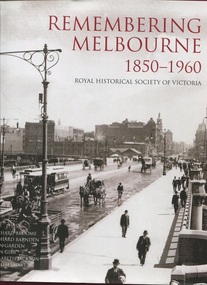
Book, Remembering Melbourne 1850-1960, 2016
... ...historic buildings - victoria - melbourne...More than 30 historians wrote chapters for the book including Sue Barnett, on Surrey Hills. surrey hills (Ms) Sue barnett buildings - victoria - melbourne - history historic buildings - victoria - melbourne melbourne history melbourne (vic) - buildings, structures, etc This book includes more than 700 photos tracing the development and changes over more than a century. ...This book includes more than 700 photos tracing the development and changes over more than a century. More than 30 historians wrote chapters for the book including Sue Barnett, on Surrey Hills.This book includes more than 700 photos tracing the development and changes over more than a century. More than 30 historians wrote chapters for the book including Sue Barnett, on Surrey Hills.surrey hills, (ms) sue barnett, buildings - victoria - melbourne - history, historic buildings - victoria - melbourne, melbourne history, melbourne (vic) - buildings, structures, etc -
 Kew Historical Society Inc
Book, Brian Carroll, Early Melbourne Sketchbook, 1977
... historic buildings -- victoria -- melbourne...Reference books have entered the collection through donation, presentation, collection and purchase. buildings of historical importance -- architectural features -- melbourne historic buildings -- victoria -- melbourne 62p. : ill. ; 19x26cm. ...62p. : ill. ; 19x26cm. non-fictionbuildings of historical importance -- architectural features -- melbourne, historic buildings -- victoria -- melbourne -
Kew Historical Society Inc
Book, Brian Carroll, Melbourne churches & schools sketchbook, 1973
... Historic buildings -- Victoria -- Melbourne...Buildings of historical importance -- Churches --Melbourne Buildings of historical importance -- Schools -- Melbourne Schools -- Victoria -- Melbourne Historic buildings -- Victoria -- Melbourne Melbourne (Vic.) -- Church buildings Adelaide : Rigby, 1973 62p. : ill. ; 23cm. ...Adelaide : Rigby, 1973 62p. : ill. ; 23cm.non-fictionbuildings of historical importance -- churches --melbourne, buildings of historical importance -- schools -- melbourne, schools -- victoria -- melbourne, historic buildings -- victoria -- melbourne, melbourne (vic.) -- church buildings -
 Kew Historical Society Inc
Booklet, Dorothy Rogers, A Tour of Melbourne en Route to Invergowrie conducted by the Royal Historical Society of Victoria, Saturday 29 July 1967, 1967
... historic buildings -- victoria -- melbourne....The volume formed part of the professional library of the historian Dorothy Rogers. historic buildings -- victoria -- melbourne. melbourne (vic.) -- description and travel. melbourne (vic.) -- buildings structures etc. ...[Melbourne : The Society, 1967] 26 p. ; 21 x 17 cm. non-fictionhistoric buildings -- victoria -- melbourne., melbourne (vic.) -- description and travel., melbourne (vic.) -- buildings, structures, etc. -
Kew Historical Society Inc
Book, State of Victoria, Government House Melbourne, 1999
... historic buildings -- victoria....government house (melbourne...Reference books have entered the collection through donation, presentation, collection and purchase. historic buildings -- victoria. government house (melbourne [Melbourne] : State of Victoria, c1999 45 p. : col. ill. ; 30 cm. ...[Melbourne] : State of Victoria, c1999 45 p. : col. ill. ; 30 cm. non-fictionhistoric buildings -- victoria., government house (melbourne -
 Flagstaff Hill Maritime Museum and Village
Photograph - Historical, religious, mid-20th century
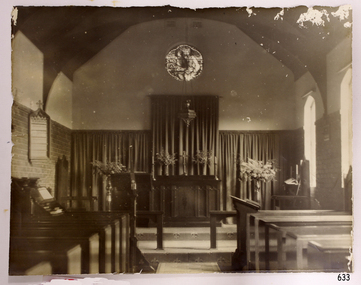
... historic venue for many weddings. This photograph is significant through its association with the St Nicholas' Mission to Seamen Church in Williamstown, Melbourne, established in 1857. The building in the photograph is the former English, Scottish and Australian Bank (ES&A bank), also known as the Mission to Seamen. It is listed on the Victorian Heritage Database for having local historic and aesthetic interest. flagstaff hill warrnambool shipwrecked-coast flagstaff-hill flagstaff-hill-maritime-museum maritime-museum shipwreck-coast flagstaff-hill-maritime-village st nicholas mission to seamen's church williamstown mission to seamen williamstown mission to seamen victoria st nicholas mission to seamen chapel window christ showing the helmsman the way stained glass window st nicholas seamen's church religion religious service sailor's rest ladies harbour light guild Photograph of St Nicholas Seamen's Church, Williamstown. ...This photograph records the interior of St Nicholas Seamen's Church at 139 Nelson Place, Williamstown, Victoria, which was purchased and furnished around 1943. The furniture and furnishings are now part of the St. Nicholas Seamen's Church collection. HISTORY of the Missions to Seamen: - DETAILED HISTORY of the Missions to Seamen: - The Missions to Seamen is an Anglican (Church of England) charity that has served the world’s seafarers since 1856. It was inspired by the work of Rev. John Ashley, who, 20 years earlier, had pioneered a ministry to seafarers in the Bristol Channel in Great Britain. When Ashley retired, others continued the work, founding the Missions to Seamen. It adopted a Flying Angel as its symbol, inspired by a verse from the Bible in Revelation 14. Today, over 200 world ports have Missions to Seamen centres and chaplains. A Missions to Seamen’s Club warmly welcomes sailors of all colours, creeds and races and provides a wide range of facilities. The Missions to Seamen organisation changed its name to the Mission to Seafarers in 2000, continuing to include Missions to Seamen clubs in Victoria’s cities of Melbourne, Portland, Geelong and Hastings. Flagstaff Hill’s St Nicholas’ Seamen’s Church is named after its namesake from Williamstown, Victoria, which began in 1857. Bishop Perry opened the first Sailors’ Church there, known as ‘Bethel’, on an old hulk floating in Hobson’s Bay, Port of Melbourne. In 1860, a Sailors’ Rest started operating from rented premises in Williamstown. In 1878, the Sailors’ Church moved into an old Wesleyan chapel in Ann Street. By the end of that year, they managed to purchase the building, which they had already refurbished. In 1883, they affiliated with the Victorian Seamen’s Mission. A few years later, in 1906, the building had to be demolished because it was no longer safe. While they raised funds for a new building, the Sailors’ Rest temporarily moved to premises in front of Customs House in Nelson Place. Around this time, in 1906, the Ladies Harbour Lights Guild was formed in Australia to support and raise funds for the Mission to Seamen organisation in Melbourne. Two of the most significant ladies of the Guild were founding members Ethel Godfrey and Alice Sibthorpe. During the Mission's time at Siddeley Street, Melbourne, the activities of the Guild raised funds for the Mission to Seamen's Chapel at their new, and still current, premises in Flinders Street, Melbourne, opened in 1917. The Guild continued its important work until the 1960s. In 1908, the Williamstown Mission had enough money to purchase the former Mascotte skating rink on Thompson Street, Williamstown. In August of that year, they were inaugurated into the Victorian Missions to Seamen. They continued at that venue for a few decades. In 1943, the former ES&A Bank building at 139 Nelson Place, Williamstown, was purchased to become the new Mission to Seamen’s Club. On May 6th, 1944, it was officially opened, described as a ‘distinctive little building’. Funds had previously been raised for the building and furnishing of the chapel at the rear. The chapel was named St Nicholas’ Seamen’s Church, after St Nicholas, fourth-century bishop and patron saint of sailors. Services were held on Wednesdays and Sundays. The church was supported by the Williamstown Lightkeepers’ Auxiliary, newly founded by Mrs Ethel Margaret Musther in 1943, as well as the Harbour Lights Guild and the League of Soldiers’ and Sailors’ Friends. The Williamstown Mission to Seamen’s Church operated until 1966, when large international ships no longer used the Port of Williamstown. The Commonwealth Government then leased the premises. In the formative years of Flagstaff Hill Maritime Village, the Advisory Board decided to include a Missions to Seamen Chapel and Recreation Room in its village. The Missions organisation was a significant feature of ports during the late 1800s and early 1900s, the period that the Village represents. They often erected Missions to house social and worshipful activities for seamen. Flagstaff Hill’s curator, Mr Ken Marshman, approached the Melbourne Board of Management of Missions to Seamen regarding the Williamstown branch. Consequently, the Board permitted the furnishings of the Williamstown chapel to be transferred to Flagstaff Hill Maritime Village. A provision of the transfer was that the Victoria Missions to Seamen be recognised, that the items would remain as a collection, and that the chapel would be called St Nicholas Seamen’s Church and conduct Divine services. The donation was approved on 21st May 1979. Flagstaff Hill's St. Nicholas Seamen's Church: - The idea behind Flagstaff Hill’s Missions to Seamen’s Church was partly driven by the offer of Stained Glass Memorial Windows that originated from the Warrnambool and District Base Hospital, which was undergoing multi-storey expansion in the late 1960s and early 1970s. The hospital’s Manager/Secretary was eager to see the historic window installed in a suitable place. The church, or chapel, was designed by a local architectural draftsman in collaboration with the Flagstaff Hill Planning Board and was constructed by Mr Leon Habel. The designers hoped that the church would be used for formal worship such as weddings, funerals, and multi-denominational special services like war commemorations. The design is inspired by the ‘Missions to Seamen’ buildings in Portland and the Port of Melbourne. The furniture and furnishings were placed as accurately as possible according to photographs of the Williamstown St Nicholas Seamen’s Church and with assistance from local clergy. The Recreation Room was furnished and arranged on advice from experienced members of the Missions to Seamen organisation. A framed document in the building recognises the donor of the furnishings, Victoria Missions to Seamen, and includes the names of some original donors and their donated item/s. The building’s design incorporates local features such as Warrnambool sandstone, which was no longer commercially available but was procured from demolished buildings and uniformly cut to use as a veneer over the stronger Mt. Gambier stone. Also, traditional green American roofing slate was used, sourced from the 1908 local shipwreck “Falls of Halladale” by Flagstaff Hill volunteer divers. The bell tower includes a bell believed to be from a local shipwreck. Additional furnishings were acquired locally, along with several items donated by Warrnambool residents. Light fittings in both rooms were assembled to simulate 19th-century gas light fittings. The stained-glass window at the back of the church is a memorial to Dr Connell, a well-respected member of the Warrnambool community. It was originally installed in 1928 in the main building of Warrnambool Hospital. The St Nicholas’ Seamen’s Church at Flagstaff Hill was officially opened by His Worship the Mayor, Cr. John Lindsay, on Sunday, 11th October 1981. The event included a service of thanksgiving conducted by the Warrnambool Ministers Fraternal. Since then, the Chapel has been the historic venue for many weddings. This photograph is significant through its association with the St Nicholas' Mission to Seamen Church in Williamstown, Melbourne, established in 1857. The building in the photograph is the former English, Scottish and Australian Bank (ES&A bank), also known as the Mission to Seamen. It is listed on the Victorian Heritage Database for having local historic and aesthetic interest. Photograph of St Nicholas Seamen's Church, Williamstown. Sepia photograph. The photograph shows the inside of the Chapel of Mission to Seamen, including organ, pews and other furniture and furnishings. There is a circular stained glass window high on the back wall depicting a sailor at the helm of a ship and a man standing behind him and pointing the way - "Christ Showing The Helmsman The Way". A Sanctuary Light is suspended from the ceiling. The Sanctuary chars are visible. This shows the St Nicholas Seamen's Church in Williamstown, the furnishings and furniture of which is now part of the St Nicholas Seamen's Church Collection’.flagstaff hill, warrnambool, shipwrecked-coast, flagstaff-hill, flagstaff-hill-maritime-museum, maritime-museum, shipwreck-coast, flagstaff-hill-maritime-village, st nicholas mission to seamen's church williamstown, mission to seamen williamstown, mission to seamen victoria, st nicholas mission to seamen, chapel window, christ showing the helmsman the way, stained glass window, st nicholas seamen's church, religion, religious service, sailor's rest, ladies harbour light guild -
 Flagstaff Hill Maritime Museum and Village
Certificate - Invitation, Norman Lindsay (Artist), Opening of the Parliament of the Commonwealth by His Royal Highness The Duke of Cornwall and York, ca. 1901
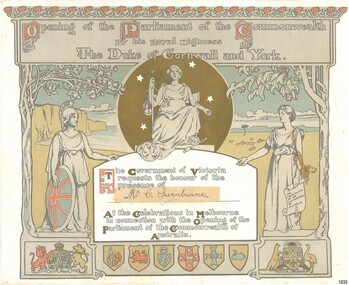
... The Government of Victoria invited 12,000 guests to attend the official celebrations for the Opening of the Federal Parliament by His Royal Highness, the Duke of Cornwall and York (later King George V). The historic occasion was held at noon on May 9th, 1901, at Melbourne's Royal Exhibition Building...The Government of Victoria invited 12,000 guests to attend the official celebrations for the Opening of the Federal Parliament by His Royal Highness, the Duke of Cornwall and York (later King George V). The historic occasion was held at noon on May 9th, 1901, at Melbourne's Royal Exhibition Building ...Australia became a Federation on January 1st, 1901, uniting Australia's six British colonies - New South Wales, Victoria, Queensland, South Australia, Western Australia and Tasmania – into States of the Commonwealth of Australia. The Government of Victoria invited 12,000 guests to attend the official celebrations for the Opening of the Federal Parliament by His Royal Highness, the Duke of Cornwall and York (later King George V). The historic occasion was held at noon on May 9th, 1901, at Melbourne's Royal Exhibition Building, the only building large enough for that number of guests. The guests represented all six states of Australia with varied connections and interests, including politics, business and industry, the arts, religion, education, and public service. In Melbourne, the occasion was followed by two weeks of celebrations. The decorative, elaborate design of the certificate-size invitation represents Australia’s colonial history and its transition to the Federated Commonwealth of Australia. The National Gallery of Australia attributes the artwork of this invitation to Australian artists Norman Lindsay (1879–1969) and John Longstaff (1861–1941) and its printing to Sands & McDougall Limited, Melbourne. The invitation has no date or location details. This invitation has the label “Mr. C Swinburne” added over an original, handwritten name. Perhaps it was a spelling correction, or a late change, with Swinburne attending in the place of another citizen. The book “Our Invited Guests An Official Directory, Melbourne, Victoria, 1901” lists all the guests, but not one has the surname SWINBURNE. There are five Warrnambool listings, eight people in all: - - MoCOBMICK, G. D., Esq., P.M., Warrnambool. - O’DOWD, The Ven. Monsignor, Warrnambool. - OPIE, C. N. T., Esq. (and Lady), Warrnambool. - OSBORNE, Hy. Wm., Esq., Shire Secretary (and Lady), Town Hall, Warrnambool. - STEVENS, Mrs. F. P., Mia Mia, Warrnambool. CHARLES GRANT SWINBURNE (1864-1934): - Charles Grant Swinburne, known as Chas.., was a prominent Warrnambool figure: a member of Toc H., the Progress Association and several other local clubs and societies. He purchased Warrnambool’s Tattersall’s Hotel in 1911 and had a booth at the 1914 Warrnambool Show. In 1891, he married Susan Jane Granter (1867-19 June 1935), daughter of Joseph Granter (1832-1879) and Ann (born Holley). Joseph had arrived in Melbourne on the famous tall ship Marco Polo in February 1856. In 1868, he was a shareholder of the Warrnambool Steam Packet Co., trading along the coast of Victoria. His portrait is among those recognised on the historic Warrnambool Pioneers Board. The invitation is nationally significant for its connection with the first Federal Parliament in May 1901, where the first federal parliamentarians were sworn in, and where the Duke and Duchess of Cornwall and York attended, representing the continued link with Britain. The invitation also unites a local Warrnambool businessman, Mr C Swinburne, with the 12,000 guests representing their towns and states that in 1901 became the Commonwealth of Australia. Swinburn was also married to the daughter of Joseph Granter, an early pioneer recognised on Warrnambool’s Pioneer Board. Invitation: certificate size, colour lithograph on cream card with gilt highlights. The Victorian Government invited Mr C Swinburne to celebrate the Opening of Federal Parliament by HRH the Duke of Cornwall and York, held in Melbourne. The invitation has printed drawings of figures, decorations, heraldic symbols, and gilt accents behind the central figure, on the capital letters of the message, and the Advance Australia Arms. Inscribed with a handwritten label that covers handwritten text. [The event was held at Noon, 9th May 1901, Royal Exhibition Building, Melbourne.] Inscription, handwritten on a label: "Mr. C. Swinburne" Left image: [figure of Britannia holding a blue shield with three crossing red bands, standing below an oak tree] Central image, in front of a gilt circle : [symbolic female royal future with Orbe and Sceptre seated on throne, four stars around her] Right image: [young female figure representing Australia holding a scroll, standing below a flowering gum] "THE CONSTITUTION OF THE COMMONWEALTH OF AUSTRALIA" Bottom left: Combined Arms: "[Duke of Cornwall and York, Prince George Frederick Ernest Albert, Princess Alexandra, his Duchess]" Bottom centre: [six symbols representing the Coat of Arms for each state of Australia] Bottom right: Advance Australia Arms "[Shield with six symbols, between Kangaroo and Emu, and below Rising Sun'] ADVANCE AUSTRALIA"flagstaff hill maritime museum and village, flagstaff hill, maritime museum, maritime village, warrnambool, great ocean road, shipwreck coast, invitation, certificate, mr c swinburne, government of victoria, opening of federal parliament, hrh the duke of cornwall and york, c swinburne, susan jane granter, susan jane swinburne, federal parliament, 1901, australian federation, ceremonies, politics, royal exhibition building, invited guest, britannia, orb, sceptre, advance australia arms, constitution of the commonwealth of australia, norman lindsay, john longstaff, sands & mcdougall, federation, british colonies, commonwealth of australia, charles grant swinburne, chas swinburne, c g swinburne, opening of the federal parliament, duke of cornwall and york, may 9th, tattersall’s hotel, marco polo, warrnambool steam packet co, warrnambool pioneers board, joseph granter, ann granter -
 Glenelg Shire Council Cultural Collection
Painting, a) Johnston & Co. Hamilton b) Johnstone O'Shannessy, Melbourne, Burswood, late 1800s
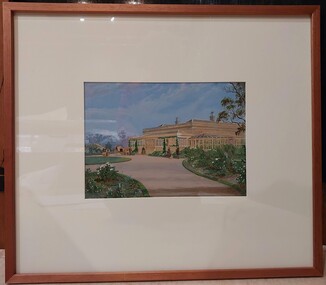
... Melbourne, Victoria, Australia. It was active from 1865 to 1905. Henry James Johnstone was also an artist and studied at Louis Buvelot's school and with Thomas Clark. Homestead Henty historic buildings ...From Victorian Heritage: The single storey mansion house with enclosed glass verandah, Burswood was built in 1853 on a site overlooking the Portland Bay for English born pioneer colonist Edward Henty. John Barrow of Adelaide was the architect for this exceptional Australian regency style residence which he designed as a central block of fine axed basalt ashlar and slate roof (now replaced) with flanking brick wings forming an enclosed rear courtyard. Burswood is the most important early mansion house in western Victoria, being an exceptional Australian regency design by distinguished colonial architect James Barrow. Edward Henty, a member of one of Australia's most remarkable colonial families and the founder of Portland, established the first permanent settlement in Victoria on 19th November 1834, and Burswood is testimony to his success as an early colonist. Henty lived in his mansion for 17 years in a semi-regal state. Burswood has been little altered since completion in 1853. A glasshouse conservatory to the side of the present enclosed verandah was demolished prior to 1895 and the slate roof replaced with iron. Johnstone, O’Shannessy & Co was a leading photographic studio located in Melbourne, Victoria, Australia. It was active from 1865 to 1905. Henry James Johnstone was also an artist and studied at Louis Buvelot's school and with Thomas Clark.Painting of a sandstone coloured building. A grand house with a driveway and well-kept gardens to the front. There is a horse and cart with a man standing to the side of it. There is a female figure exiting the building and another female and a man further along the driveway with a dog. The building has a glass conservatory attached to the side. The sky is blue with several fluffy clouds.Bottom right: Johnstone O'Shannessy & Co Melbourne (in white paint)homestead, henty, historic buildings, colonial, burswood house -
 Greensborough Historical Society
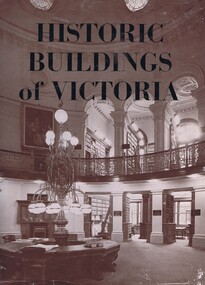
Book, Historic Buildings of Victoria, 1966_
... buildings from around Victoria in 1966. Each entry has a photograph and caption with some history of the building. Arranged by region. The development of architectural style in Victoria. melbourne architecture victoria architecture historic buildings victoria national trust of australia victoria 278 pages, black and white illustrations. ...A listing of National Trust listed buildings from around Victoria in 1966. Each entry has a photograph and caption with some history of the building. Arranged by region.The development of architectural style in Victoria.278 pages, black and white illustrations. Hard cover. Dust jacket has illustration of interior of the Library of the Supreme Courtmelbourne architecture, victoria architecture, historic buildings victoria, national trust of australia, victoria -
 The Beechworth Burke Museum
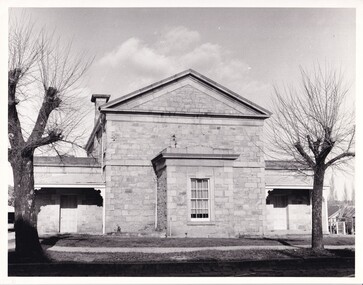
Photograph, c1970
... building was classified in 1959 as part of Group Classification (B2615)with Forests Office, Lands Office, Police Lock-up & Police Station. The Courthouse is a significant site in Australia’s legal history because it was the location of more than 40 trials and hearings for the Kelly Gang and their sympathisers. 1850s Beechworth Beechworth Courthouse Ned Kelly 1800s Beechworth Kelly gang Beechworth Historic Courthouse 1858 kelly trials Daniel Kelly Dan Kelly Edward Kelly Ellen Kelly Elizabeth Scott the first woman hanged in Victoria Colony of Victoria 1863 domestic violence related murder Reverse Ministry of Tourism, Melbourne This a rectangular, black and white photograph, unmounted. ...The Beechworth Historic Courthouse is a living history museum in Victoria, Australia. Built in 1858, it has been in continuous service for 131 years and is currently home to a unique collection of artifacts, including its original furniture and fittings. The Courthouse Law Library is also recognised as being of outstanding national significance with many rare books held in the collection. The courthouse was built in 1858 and is located in the centre of the Beechworth Historic Precinct. It was built from granite with a double height gabled courtroom with the entrance via a central projecting porch. The building was classified in 1959 as part of Group Classification (B2615)with Forests Office, Lands Office, Police Lock-up & Police Station. The Courthouse is a significant site in Australia’s legal history because it was the location of more than 40 trials and hearings for the Kelly Gang and their sympathisers.This a rectangular, black and white photograph, unmounted.Reverse Ministry of Tourism, Melbourne1850s beechworth, beechworth courthouse, ned kelly, 1800s beechworth, kelly gang, beechworth historic courthouse, 1858, kelly trials, daniel kelly, dan kelly, edward kelly, ellen kelly, elizabeth scott, the first woman hanged in victoria, colony of victoria, 1863, domestic violence related murder -
 Eltham District Historical Society Inc
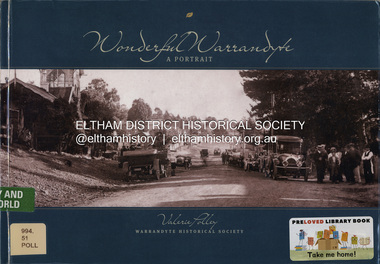
Book, Valerie Polley, Wonderful Warrandyte: A Portrait, 2014
... Melbourne, holds a significant place in Victoria's history as the first recorded goldfield in the State. Its pre-European and early settlement history, its goldmining heritage, the effects of bushfires and floods, the Yarra River, the Warrandyte State Park, its buildings and historic precinct are all featured. ...Melbourne, holds a significant place in Victoria's history as the first recorded goldfield in the State. Its pre-European and early settlement history, its goldmining heritage, the effects of bushfires and floods, the Yarra River, the Warrandyte State Park, its buildings and historic precinct are all featured. ...The township of Warrandyte, on the outer urban fringe of Melbourne, holds a significant place in Victoria's history as the first recorded goldfield in the State. Its pre-European and early settlement history, its goldmining heritage, the effects of bushfires and floods, the Yarra River, the Warrandyte State Park, its buildings and historic precinct are all featured. The artistic era with its many eminent artisans, architects, potters and painters is covered. Details of the historic buildings that still remain are included. This is an informative, beautifully illustrated book that will appeal to a wide audience.gold mining, warrandyte -
Glen Eira Historical Society
Letter - Elsternwick Congregational Church – Caulfield Union Church
... Victoria Government Gazette dated 05/10/1988 advertising the amendment of the register of historic buildings to include the former Union Church building. A twelve page document produced by the Historic Buildings Council Victoria, date unknown, which describes the council’s operations and activities. St. John’s Parish of the Uniting Church E.S. and P. Committee Congregational Church Orrong Road Victorian Music Theatre Pty Ltd King Street Glen Huntly Road Melbourne ...One page of Caulfield Council’s E.S. and P. Committee agenda, item and minutes dated 14/05/1971 concerning permit application from St. John’s Uniting Church for the Victorian Music Theatre Pty Ltd to Conduct singing lessons in the church building. Typed letter dated 08/12/1987 from National Trust to St. John’s Parish noting the Trust’s classification of the church building and the accompanying citation. Typed letter dated 20/07/1988 from the historic buildings council to Caulfield Historical Society concerning the hearing to discuss inclusion of the church building on the register to be held on 24/08/1988. Copy of historic building council’s agenda item undated describing the significance of the former Union Church. Thirteen page assessment of the architectural significance of the former Union Church dated 24/08/1988 by Anne Neale. Includes sketch of the exterior and references. Handwritten notations by Jim O’Loghlin dated 24/08/1988. Photocopy of the page from the Victoria Government Gazette dated 05/10/1988 advertising the amendment of the register of historic buildings to include the former Union Church building. A twelve page document produced by the Historic Buildings Council Victoria, date unknown, which describes the council’s operations and activities.st. john’s parish of the uniting church, e.s. and p. committee, congregational church, orrong road, victorian music theatre pty ltd, king street, glen huntly road, melbourne neon ltd, balaclava road, whiteway neon p.l., n. and d. panagiotou, nepean highway, h.c. sleigh ltd., poath road, carden w. j., warren r.p., talbot avenue, new l. mrs., elsternwick, zoning, st. georges road, architectural features, caulfield union church, towers, de lacy evans george, mcmurtie mcnaughton and stewart, glen eira road, neale anne i., mcloghlin jim, architectural styles, gothic style, caulfield, caulfield historical society, gregson w. rev., st. aloysius caulfield, brick -
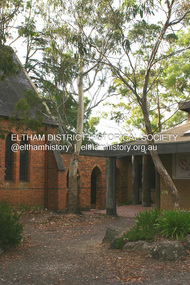 Eltham District Historical Society Inc
Photograph - Digital Photograph, Alan King, St Margaret's Anglican Church, Pitt Street, Eltham, 30 January 2008
... buildings in the district. The church and vicarage are on the Register of the Heritage Council of Victoria and the National Trust of Australia – Victoria. The church is important as an early example of polychrome brickwork by the notable architect Nathaniel Billings. It is also notable for its historic associations with the early settlement of the Shire of Eltham and its connection with Henry Dendy, Brighton’s founder.2 Henry Dendy, who lived in Eltham much longer than at Brighton, chaired the original meeting which planned the church, and he donated the half-acre (0.2ha) site. Dendy had arrived in Melbourne...buildings in the district. The church and vicarage are on the Register of the Heritage Council of Victoria and the National Trust of Australia – Victoria. The church is important as an early example of polychrome brickwork by the notable architect Nathaniel Billings. It is also notable for its historic associations with the early settlement of the Shire of Eltham and its connection with Henry Dendy, Brighton’s founder.2 Henry Dendy, who lived in Eltham much longer than at Brighton, chaired the original meeting which planned the church, and he donated the half-acre (0.2ha) site. Dendy had arrived in Melbourne ...St Margaret’s Church of England was officially opened on December 12, 1861. It is the oldest intact church building in Eltham. At the time it was known as Christ Church until its consecration in 1871, when it was completely free of debt (£1,700 for the church and parsonage) despite the district’s poverty. This was largely due to the free labour and materials, including locally made bricks donated by local artisans and others. The church is historically significant because it is the oldest church in the former Shire of Eltham and has associations with the philanthropist and founder of Brighton, Henry Dendy (who donated the land on which the church is built), the architect Nathaniel Billing and the prominent local builder, George Stebbing. The church is architecturally and aesthetically significant because it is constructed in the Gothic Revival style with several stained-glass windows of various dates and is also a very early use of polychromatic brickwork in Victoria. Billing was one of the first Melbourne architects to employ polychromatic brickwork and an important early architect. The rear wall was intended to be temporary. A major feature of the design is the large buttresses with long, steeply graded upper faces. The overall design is well proportioned with the surface brick patterns relieving an otherwise austere design. The church is spiritually and socially significant because it has been an important place of worship for the people of Eltham for almost 150 years. The land on which the buildings stand was donated by Henry Dendy. Dendy arrived in Melbourne in 1841 after purchasing in England eight square miles at Brighton under the system of "special surveys". After this land passed out of his hands, Dendy moved about Victoria, visited England, then returned to settle in Eltham where he purchased a flour mill. Dendy chaired the meeting held in 1860 “for the purpose of devising such means as may be expedient for the establishment of a Church of England in the township of Eltham”. He became chairman and treasurer of the church committee. Unlike the establishment of many early churches in Victoria where a vicar was appointed to a parish and later a permanent church was constructed, the population at Eltham initiated action to build a church. The nearest church at that time was at Heidelberg and the Eltham settlement was part of the parish of St Johns Heidelberg. Isolation and the tedious, time consuming journey between Heidelberg and Eltham resulted in the Eltham community taking its own action. The original vicarage (Dendy House) at the rear of the church is also an important part of the cultural significance of this place because it is connected to the church and the development of the Eltham area. Together, the church and the vicarage are aesthetically significant because they form a significant streetscape feature. The mud-brick community hall designed by Robert Marshall was added in 1978. In 2014 the original temporary rear wall was removed as part of a modern extension designed by Architects Atelier Wagner and constructed by Conrad Construction and Management. Covered under Heritage Overlay, Nillumbik Planning Scheme. National Trust of Australia (Victoria) State significance Victorian Heritage Published: Nillumbik Now and Then / Marguerite Marshall 2008; photographs Alan King with Marguerite Marshall.; p67 St Margaret’s Anglican Church in Pitt Street, Eltham, which officially opened on December 12, 1861, is the oldest intact church building in Eltham.1 With the nearby courthouse and police station, it was one of the first permanent community buildings in the district. The church and vicarage are on the Register of the Heritage Council of Victoria and the National Trust of Australia – Victoria. The church is important as an early example of polychrome brickwork by the notable architect Nathaniel Billings. It is also notable for its historic associations with the early settlement of the Shire of Eltham and its connection with Henry Dendy, Brighton’s founder.2 Henry Dendy, who lived in Eltham much longer than at Brighton, chaired the original meeting which planned the church, and he donated the half-acre (0.2ha) site. Dendy had arrived in Melbourne in 1841 after buying eight square miles (20.7sq km) at Brighton while in England. After this land passed out of his hands, he eventually settled in Eltham where he bought a flour mill, west from the corner of Main Road and Pitt Street (then called Brewery Lane). The vicarage was named Dendy House after him. The Eltham settlers were unusual in initiating the establishment of a church. Usually in Victoria a vicar was appointed to a parish and then a permanent church was constructed. But then, the nearest church was at Heidelberg, which was a tedious and time-consuming journey. St Margaret’s builder was a local, George Stebbing, who also constructed the former Methodist, later Uniting, Church at John Street and the Shillinglaw Cottage near Eltham’s Central Park. It is believed the first Anglican Bishop of Melbourne, Bishop Perry, dedicated the church. After the ceremony he joined in the festivities at the nearby pub and a bill was sent to the parish for teas taken there by the bishop with other participants. The first vicar was the Reverend Robert Mackie from 1864 to1866. St Margaret’s Church was originally called Christ Church until its consecration in 1871, when it was completely free of debt (£1700 pounds for the church and parsonage) despite the district’s poverty. This was largely due to the free labour and materials, including local bricks, donated by local artisans and others. St Margaret’s Church is in the Gothic Revival tradition with a buttressed nave, paired lancet windows, porch and bell-cote. It was the first polychromatic brick church in Australia, using softly contrasting coloured brickwork.3 Billing was one of the first architects to introduce polychrome brickwork into Melbourne. His original drawings for St Margaret’s survive in a folio of his architectural work. However the church’s brickwork is more subdued than in his drawings. About half the windows – those in clear glass with gold borders – are original. The stained glass windows were made much later, but the one behind the altar is thought to be the oldest in the Diamond Valley. It was to be temporary until the congregation could afford to extend the church. In the early 1960s the original cedar pews were replaced by blonde timber pews and the originals were sold to restaurants and to private individuals. Eminent local sculptor Matcham Skipper created a crucifix for the church. A major addition was made in 1978, when the weatherboard hall was replaced by a mud-brick hall. Made of local material, it was designed by local architect and a former shire president Robert Marshall. The mud-brick hall reflects the style of building in Eltham of the late 1970s and for which Eltham is well-known. Perhaps because its earthy tones blend with the surrounding environment, the hall sits well with the church building. St Margaret’s membership has included economist and ABC chairman, Richard Downing; political commentator, diplomat and academic, William Macmahon Ball; Eltham civic leader, Charles Wingrove; artist, Peter Glass; and Eltham’s first postmaster, Frederick Falkiner.This collection of almost 130 photos about places and people within the Shire of Nillumbik, an urban and rural municipality in Melbourne's north, contributes to an understanding of the history of the Shire. Published in 2008 immediately prior to the Black Saturday bushfires of February 7, 2009, it documents sites that were impacted, and in some cases destroyed by the fires. It includes photographs taken especially for the publication, creating a unique time capsule representing the Shire in the early 21st century. It remains the most recent comprehenesive publication devoted to the Shire's history connecting local residents to the past. nillumbik now and then (marshall-king) collection, eltham, st margaret's anglican church, st margaret's church, st margarets church hall, christ church -
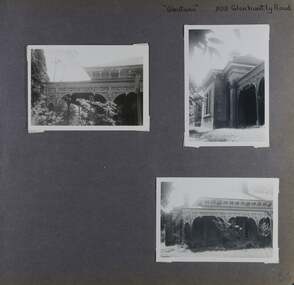 Glen Eira Historical Society
Album - Album page, Glentana, Glen Huntly Road, 805, Circa 1972
... buildings worthy of preservation. The album is related to a Survey the Caulfield Historical Society developed in collaboration with the National Trust of Australia (Victoria) and Caulfield City Council to identify historic buildings within the City of Caulfield that warranted the protection of a National Trust Classification. Principal photographer thought to be Trevor Hart, member of Caulfield Historical Society. Most photographs were taken between 1966-1972 with a small number of photographs being older and from unknown sources. All photographs are black and white except where stated, with 386 photographs over 198 pages. Melbourne...buildings worthy of preservation. The album is related to a Survey the Caulfield Historical Society developed in collaboration with the National Trust of Australia (Victoria) and Caulfield City Council to identify historic buildings within the City of Caulfield that warranted the protection of a National Trust Classification. Principal photographer thought to be Trevor Hart, member of Caulfield Historical Society. Most photographs were taken between 1966-1972 with a small number of photographs being older and from unknown sources. All photographs are black and white except where stated, with 386 photographs over 198 pages. Melbourne ...This photograph is part of the Caulfield Historical Album 1972. This album was created in approximately 1972 as part of a project by the Caulfield Historical Society to assist in identifying buildings worthy of preservation. The album is related to a Survey the Caulfield Historical Society developed in collaboration with the National Trust of Australia (Victoria) and Caulfield City Council to identify historic buildings within the City of Caulfield that warranted the protection of a National Trust Classification. Principal photographer thought to be Trevor Hart, member of Caulfield Historical Society. Most photographs were taken between 1966-1972 with a small number of photographs being older and from unknown sources. All photographs are black and white except where stated, with 386 photographs over 198 pages. Melbourne Mansions database indicates that its architect may have been Charles Webb.Page 66 of Photograph Album with three exterior photographs (two portrait and one landscape) of Glentana, a single storey Victorian residence, focussing on views of its verandah.Hand written: "Glentana" 805 Glenhuntly Road [top right] / 66 [bottom right] trevor hart, brick, polychrome brickwork, cast iron frieze, decorative brackets, italianate, return verandah, glentana, glen huntly road, caulfield, cast iron work, verandahs, glenhuntly road, charles webb, glen tana, house names -
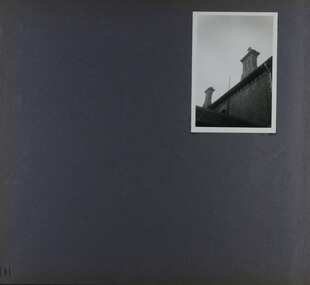 Glen Eira Historical Society
Album - Album page, Rosemont, 112 Kooyong Road, Circa 1972
... Victoria and Caulfield City Council to identify historic buildings within the City of Caulfield that warranted the protection of a National Trust Classification. Photographers Jenny O’Donnell and Trevor Hart, members of Caulfield Historical Society. Some photographs are older and from unknown sources. All photographs are black and white except where stated. From Victorian Heritage Database citation for Rosemont - HO124 112 Kooyong Road Caulfield North https://vhd.heritagecouncil.vic.gov.au/places/35588 Rosemont'' is situated at no.112A Kooyong Road, Caulfield North and was built in 1869 for Godfrey Howitt, physician, president and honorary physician of the Melbourne Benevolent Society, Council member of the University of Melbourne and founding vice president of the Royal Society of Victoria. ...This photograph is part of the Caulfield Historical Album 1972. This album was created as part of a project from approximately 1966-1972 by the Caulfield Historical Society to assist in identifying buildings worthy of preservation. This album is related to a Survey the Caulfield Historical Society developed in collaboration with the National Trust of Australia Victoria and Caulfield City Council to identify historic buildings within the City of Caulfield that warranted the protection of a National Trust Classification. Photographers Jenny O’Donnell and Trevor Hart, members of Caulfield Historical Society. Some photographs are older and from unknown sources. All photographs are black and white except where stated.From Victorian Heritage Database citation for Rosemont - HO124 112 Kooyong Road Caulfield North https://vhd.heritagecouncil.vic.gov.au/places/35588 Rosemont'' is situated at no.112A Kooyong Road, Caulfield North and was built in 1869 for Godfrey Howitt, physician, president and honorary physician of the Melbourne Benevolent Society, Council member of the University of Melbourne and founding vice president of the Royal Society of Victoria. It is historically significant (Criterion A) as an early and substantial villa residence demonstrating Caulfield's early attraction as a residential retreat for Melbourne's elite. This significance is enhanced by the associations of the place with Godfrey Howitt and later James Grice, National Bank chairman and owner of "Stonnington" in Glenferrie Road, Malvern and Thomas King, councillor and successful negotiator for the extension of the electric tramway system to the Municipality.Page 111 of photograph album with 1 photograph (portrait) of Rosemont's roof line.Handwritten: 111 [bottom left]trevor hart, caulfield, john bakewell, francis mcdonnell, gabled slate roofs, rosemont, caulfield north, kooyong road, 1860's, godfrey howitt, james grice, thomas king, decorative brickwork, bay window, garden, mansion, chimneys, victorian architectural style, polychrome bricks, roofs -
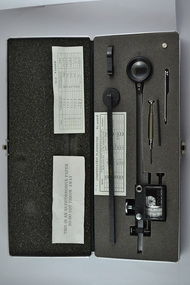 Melbourne Water
Compensating Polar Planimeter, c.1970s
... Melbourne and Metropolitan Board of Works (MMBW). This measuring device is perfectly intact and a rare surviving object of standard Board issued equipment. The kit is significant for its representativeness of the theme of Technology in building Victoria's industries and workforce, which continues to resonate strongly within Melbourne Water today. mmbw melbourne water melbourne metropolitan board of works technology instrument work measure historic water staff The instrument is inside a black metal case with accessories including: Setting bar, screwdriver, Allen key and spare pole point. ...As the Yarra became unsuitable as a source of water, several attempts were made to find alternative sources for the growing population of Melbourne. It was not until 1891 that the efforts to sewer Melbourne came to fruition with the setting up of the Melbourne Metropolitan Board of Works (MMBW), now known as Melbourne Water. From 1891 until 1992, it was the responsibility of the MMBW to safeguard public health by providing a sewerage system and a safe water supply system. In 1992, The MMBW merged with a number of smaller urban water authorities to form Melbourne Water. This item was used by MMBW employees as a measuring device to determine areas or figures on a plane surface having either straight or irregular boundaries. The Compensating Polar Planimeter is of historical significance for its association with the former Melbourne and Metropolitan Board of Works (MMBW). This measuring device is perfectly intact and a rare surviving object of standard Board issued equipment. The kit is significant for its representativeness of the theme of Technology in building Victoria's industries and workforce, which continues to resonate strongly within Melbourne Water today.The instrument is inside a black metal case with accessories including: Setting bar, screwdriver, Allen key and spare pole point. Inside is also the adjustable planimeter. mmbw, melbourne water, melbourne metropolitan board of works, technology, instrument, work, measure, historic, water, staff -
 Bendigo Historical Society Inc.
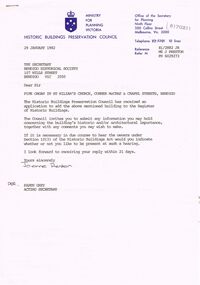
Document - CORRESPONDENCE: THE REGISTRATION (REGISTRATION OF HISTORIC BUILDINGS) OF ORGAN AT ST. KILIAN'S, 29/01/1882
... Ministry for Planning Victoria. 500 Collins Street Melbourne. Correspondence re the registration (Registration of Historic Buildings) of organ at St. ...Correspondence re the registration (Registration of Historic Buildings) of organ at St. Kilian's . A letter dated 29/1/1982 from Ministry for Planning, Victoria to the Secretary Bendigo Historical Society (request for any information held regarding importance); b copy of application from the Organ Historical Trust of Australia to ''Add a Building to the Register of Historic Buildings''. Details of the organ are within the application - builder: August Randebrock, Paderborn, Germany , 1871; statement of significance re the organ - 'It is the only large example of a large (sic) 19th C German organ in Australia, such instruments are rare even in Germany. It is of international importance''.Ministry for Planning Victoria. 500 Collins Street Melbourne.church, history, st. kilian's catholic church, bendi, august randerbrock, paderborn, germany. 19th c german organ. -
 Glen Eira Historical Society
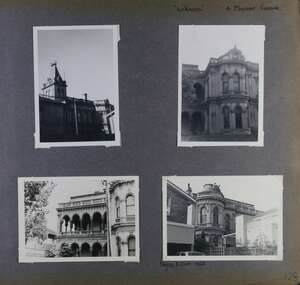
Album - Album page, Labassa, 4 Manor Grove, Circa 1972
... Victoria) and Caulfield City Council to identify historic buildings within the City of Caulfield that warranted the protection of a National Trust Classification. Principal photographer thought to be Trevor Hart, member of Caulfield Historical Society. Most photographs were taken between 1966-1972 with a small number of photographs being older and from unknown sources. All photographs are black and white except where stated, with 386 photographs over 198 pages. HISTORY:-- From Victorian Heritage Database citation for Labassa https://vhd.heritagecouncil.vic.gov.au/places/278 as at (26/10/2020) Labassa, Caulfield is one of Melbourne's...Victoria) and Caulfield City Council to identify historic buildings within the City of Caulfield that warranted the protection of a National Trust Classification. Principal photographer thought to be Trevor Hart, member of Caulfield Historical Society. Most photographs were taken between 1966-1972 with a small number of photographs being older and from unknown sources. All photographs are black and white except where stated, with 386 photographs over 198 pages. HISTORY:-- From Victorian Heritage Database citation for Labassa https://vhd.heritagecouncil.vic.gov.au/places/278 as at (26/10/2020) Labassa, Caulfield is one of Melbourne's ...This photograph is part of the Caulfield Historical Album 1972. This album was created in approximately 1972 as part of a project by the Caulfield Historical Society to assist in identifying buildings worthy of preservation. The album is related to a Survey the Caulfield Historical Society developed in collaboration with the National Trust of Australia (Victoria) and Caulfield City Council to identify historic buildings within the City of Caulfield that warranted the protection of a National Trust Classification. Principal photographer thought to be Trevor Hart, member of Caulfield Historical Society. Most photographs were taken between 1966-1972 with a small number of photographs being older and from unknown sources. All photographs are black and white except where stated, with 386 photographs over 198 pages. HISTORY:-- From Victorian Heritage Database citation for Labassa https://vhd.heritagecouncil.vic.gov.au/places/278 as at (26/10/2020) Labassa, Caulfield is one of Melbourne's most lavishly decorated nineteenth century mansions. It resulted from the extensive remodelling in 1890, of an earlier house, known as Sylliott Hill, which was begun in 1862-3 for lawyer, Richard A. Billing. The land at the corner of Balaclava and Orrong Roads was first acquired in 1854 by William Lyall, transferred to his partner, John Mickle, in 1859, who also acquired the adjoining allotment in Balaclava Road, and the three allotments were conveyed to Billing. His first eight-roomed house was extended significantly in 1873 into a twenty-roomed house by architects Crouch and Wilson, who were possibly also responsible for the first house. This reflected Billing's success as a barrister, and he resided at this property until his death in 1882. In 1883 prominent Melbourne businessman, Alexander William Robertson, leased the Sylliott Hill property from Billing's widow, and in 1885 he purchased the adjoining allotment in Balaclava Road. He purchased the Billing's property in 1887 and renamed the 6.31 hectare property, Ontario. In 1889-90, Robertson commissioned the German born architect, John A. B. Koch, to extensively remodel the house into a thirty-five roomed mansion. The existing house was extended and altered, largely resulting in the nineteenth century mansion as it now appears. After Robertson's death in 1896, the house was tenanted until it was eventually sold to the mining millionaire, John Boyd Watson, in 1904. He renamed the property Labassa and carried out repair and re-decoration work to the house. In the early twentieth century, many large estates were subdivided into smaller allotments as the demand for land grew and it became difficult to maintain such large estates. After Watson's death in 1911, portions of the Labassa estate were offered for sale, with Mrs Watson retaining a 1.73 hectare portion containing the house. In 1913 forty-six allotments were auctioned at Labassa Estate, with the formation of Labassa Grove and Ontario Street to the east of the property. Labassa was first recorded as containing flats in 1923 and in the late 1920s, the owner, Robert Hannon, built a red brick block of flats adjacent to the house. Subdivision continued, until the National Trust of Australia (Victoria) purchased the house in 1980 and subsequently purchased adjoining sites, one to the south-east in 1984 (house demolished in 1988) and to the west in 1988. Labassa as it now stands is substantially as it appeared when Koch completed the work in 1890. The original two storey house was transformed into a French Renaissance style mansion, with the addition of a two level L-shaped arcaded verandah and two prominent terminating bays to the south and the east. The building is of unpainted cement render with dressed bluestone plinths, balustraded parapet and steep, slate covered, flat topped mansard roofs behind. A truncated conical roof is a feature of the south bay and a helmeted head is incorporated in the parapet over the east bay. The main south and east facades incorporate many cast cement details, including sculptures, elaborate cornices, swagged Corinthian columns and caryatid consoles flanking the entrance porch, as well as pink marble panels and imitation marble, or scagliola, on curved surfaces. At the rear of the building is a two storey wing and a single storey cottage, the former being connected to the main house by a tower. This section of the house was constructed in 1873. The estate at its peak included stables (1873), conservatory (probably 1890) and a tennis pavilion (probably 1890). All of these outbuildings survive, with the stables and conservatory being converted for residential use after 1922. Internally a range of decorative treatments remain from the late nineteenth century and the early twentieth century, both from the Robertson and Watson periods of occupancy. These include wallpapers, ceiling decoration, chimney pieces, mouldings, joinery and decorative glass. From Victorian Heritage Database citation for H0135 Labassa 2/2A Manor Grove Caulfield North https://vhd.heritagecouncil.vic.gov.au/places/278 as at (26/10/2020) HOW IS IT SIGNIFICANT? Labassa, Caulfield is of architectural, aesthetic and historical significance to the State of Victoria. WHY IS IT SIGNIFICANT? Labassa, Caulfield is of architectural significance as the most prominent example of a small number of houses built in Australia in the French Renaissance style. It is of further note due to the German interpretation of the style and the use of Hellenistic sources, via Germany. It is exceptional for its lavish treatment externally, including marble, scagliola, caryatids, swagged columns, mansard roofs and ornamental cresting. Labassa is of architectural significance as the most important surviving example of German architect, John Koch's domestic work. He undertook a large variety of work in Melbourne, including a number of houses, however Labassa is the most lavish example of his work. Labassa is of aesthetic significance for its outstanding assemblage of late nineteenth and early twentieth century European style interior decoration, which remain remarkably intact. These include a trompe l'oeil ceiling, painted ceilings, embossed imitation leather and other papers, chimney pieces, ceramic tilework, oak parquetry and stained glass, including a tripartite window by Ferguson and Urie, probably dating from the 1873 period. Labassa is of historical significance as an illustrative example of the wealth acquired by a number of prominent Victorian families in the second half of the 19th century. The early development of the property, Sylliott Hill, was due to the wealth acquired by Richard Billing, barrister and fifth Victorian to be appointed Queen's Counsel in 1878. The significant development in 1890 of Ontario, is illustrative of the wealth of Alexander Robertson, a partner in Cobb and Co., a director of Goldsborough Mort & Co., and a pastoral speculator. John B. Watson, whose father had acquired great wealth from the goldfields of Bendigo and subsequently invested in city and country properties, was the third resident to impact on the house, particularly the interiors. The Labassa estate is of historical significance as an illustrative example of the development that occurred in such suburbs as Caulfield in the 1880s due to the land boom, its proximity to Melbourne and the establishment of the Melbourne to Gippsland railway in 1879. It is also illustrative of an estate which succumbed to the pressures of subdividing in the early twentieth century, as properties became difficult to maintain and demand for land close to the city grew. It was typically divided into flats in the 1920s and was used as such for about sixty years. It is of historical significance for its associations with the remnants of the earlier estate which remain extant. These include the stables, conservatory (H2005) and tennis pavilion which all remain on separate sites. Also significant are the remains of early electrical wiring and fittings. Labassa was one of the first houses in Caulfield to be electrified and some of the original wires remain. [Online Data Upgrade Project 2004]Page 128 of Photograph Album with four photographs (two portrait and two landscape) of Labassa.Handwritten: "Labassa" 4 Manor Grove [top right] / Neg 232 8 Oct 1966 [under bottom right photo] / 128 [bottom right]trevor hart, bracketed eaves, slate roof, bay windows, decorative brackets, caulfield north, labassa, richard a. billing, balaclava road, orrong road, sylliott hill, william lyall, crouch and wilson, alexander william robertson, ontario, 1880's, john a. b. koch, mansion, john boyd watson, labassa grove, french renaissance style, l-shaped arcaded verandah, bluestone plinths, balustraded parapet, flat topped mansard roofs, conical roof, elaborate cornices, corinthian columns, caryatid consoles, marble panels, imitation marble, scagliola, tower, conservatory, stables, tennis pavilion, mouldings, decorative glass, caryatids, swagged columns, ornamental cresting, trompe l'oeil ceiling, embossed imitation leather, oak parquetry, stained glass, tripartite window, triple window, ferguson and urie, 1870's, flats, 1920's, electric wiring, 1860's, verandahs, curved windows, arched windows, italianate, terraces, gargoyles, ornamentation, ornate entrance, la bassa, manor grove, st kilda east, victorian, cast iron work, john koch, richard billing, architects, electrification, john mickle, land subdivision, mrs watson, labassa estate, robert hannon, national trust of australia (victoria), sculpture -
 Glen Eira Historical Society
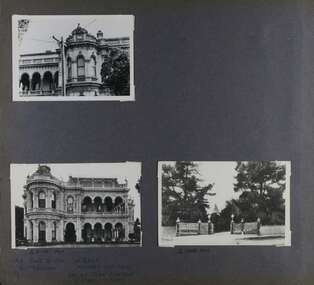
Album - Album page, Labassa, 4 Manor Grove, Circa 1972
... Victoria) and Caulfield City Council to identify historic buildings within the City of Caulfield that warranted the protection of a National Trust Classification. Principal photographer thought to be Trevor Hart, member of Caulfield Historical Society. Most photographs were taken between 1966-1972 with a small number of photographs being older and from unknown sources. All photographs are black and white except where stated, with 386 photographs over 198 pages. HISTORY:-- From Victorian Heritage Database citation for Labassa https://vhd.heritagecouncil.vic.gov.au/places/278 as at (26/10/2020) Labassa, Caulfield is one of Melbourne's...Victoria) and Caulfield City Council to identify historic buildings within the City of Caulfield that warranted the protection of a National Trust Classification. Principal photographer thought to be Trevor Hart, member of Caulfield Historical Society. Most photographs were taken between 1966-1972 with a small number of photographs being older and from unknown sources. All photographs are black and white except where stated, with 386 photographs over 198 pages. HISTORY:-- From Victorian Heritage Database citation for Labassa https://vhd.heritagecouncil.vic.gov.au/places/278 as at (26/10/2020) Labassa, Caulfield is one of Melbourne's ...This photograph is part of the Caulfield Historical Album 1972. This album was created in approximately 1972 as part of a project by the Caulfield Historical Society to assist in identifying buildings worthy of preservation. The album is related to a Survey the Caulfield Historical Society developed in collaboration with the National Trust of Australia (Victoria) and Caulfield City Council to identify historic buildings within the City of Caulfield that warranted the protection of a National Trust Classification. Principal photographer thought to be Trevor Hart, member of Caulfield Historical Society. Most photographs were taken between 1966-1972 with a small number of photographs being older and from unknown sources. All photographs are black and white except where stated, with 386 photographs over 198 pages. HISTORY:-- From Victorian Heritage Database citation for Labassa https://vhd.heritagecouncil.vic.gov.au/places/278 as at (26/10/2020) Labassa, Caulfield is one of Melbourne's most lavishly decorated nineteenth century mansions. It resulted from the extensive remodelling in 1890, of an earlier house, known as Sylliott Hill, which was begun in 1862-3 for lawyer, Richard A. Billing. The land at the corner of Balaclava and Orrong Roads was first acquired in 1854 by William Lyall, transferred to his partner, John Mickle, in 1859, who also acquired the adjoining allotment in Balaclava Road, and the three allotments were conveyed to Billing. His first eight-roomed house was extended significantly in 1873 into a twenty-roomed house by architects Crouch and Wilson, who were possibly also responsible for the first house. This reflected Billing's success as a barrister, and he resided at this property until his death in 1882. In 1883 prominent Melbourne businessman, Alexander William Robertson, leased the Sylliott Hill property from Billing's widow, and in 1885 he purchased the adjoining allotment in Balaclava Road. He purchased the Billing's property in 1887 and renamed the 6.31 hectare property, Ontario. In 1889-90, Robertson commissioned the German born architect, John A. B. Koch, to extensively remodel the house into a thirty-five roomed mansion. The existing house was extended and altered, largely resulting in the nineteenth century mansion as it now appears. After Robertson's death in 1896, the house was tenanted until it was eventually sold to the mining millionaire, John Boyd Watson, in 1904. He renamed the property Labassa and carried out repair and re-decoration work to the house. In the early twentieth century, many large estates were subdivided into smaller allotments as the demand for land grew and it became difficult to maintain such large estates. After Watson's death in 1911, portions of the Labassa estate were offered for sale, with Mrs Watson retaining a 1.73 hectare portion containing the house. In 1913 forty-six allotments were auctioned at Labassa Estate, with the formation of Labassa Grove and Ontario Street to the east of the property. Labassa was first recorded as containing flats in 1923 and in the late 1920s, the owner, Robert Hannon, built a red brick block of flats adjacent to the house. Subdivision continued, until the National Trust of Australia (Victoria) purchased the house in 1980 and subsequently purchased adjoining sites, one to the south-east in 1984 (house demolished in 1988) and to the west in 1988. Labassa as it now stands is substantially as it appeared when Koch completed the work in 1890. The original two storey house was transformed into a French Renaissance style mansion, with the addition of a two level L-shaped arcaded verandah and two prominent terminating bays to the south and the east. The building is of unpainted cement render with dressed bluestone plinths, balustraded parapet and steep, slate covered, flat topped mansard roofs behind. A truncated conical roof is a feature of the south bay and a helmeted head is incorporated in the parapet over the east bay. The main south and east facades incorporate many cast cement details, including sculptures, elaborate cornices, swagged Corinthian columns and caryatid consoles flanking the entrance porch, as well as pink marble panels and imitation marble, or scagliola, on curved surfaces. At the rear of the building is a two storey wing and a single storey cottage, the former being connected to the main house by a tower. This section of the house was constructed in 1873. The estate at its peak included stables (1873), conservatory (probably 1890) and a tennis pavilion (probably 1890). All of these outbuildings survive, with the stables and conservatory being converted for residential use after 1922. Internally a range of decorative treatments remain from the late nineteenth century and the early twentieth century, both from the Robertson and Watson periods of occupancy. These include wallpapers, ceiling decoration, chimney pieces, mouldings, joinery and decorative glass.From Victorian Heritage Database citation for H0135 Labassa 2/2A Manor Grove Caulfield North https://vhd.heritagecouncil.vic.gov.au/places/278 as at (26/10/2020) HOW IS IT SIGNIFICANT? Labassa, Caulfield is of architectural, aesthetic and historical significance to the State of Victoria. WHY IS IT SIGNIFICANT? Labassa, Caulfield is of architectural significance as the most prominent example of a small number of houses built in Australia in the French Renaissance style. It is of further note due to the German interpretation of the style and the use of Hellenistic sources, via Germany. It is exceptional for its lavish treatment externally, including marble, scagliola, caryatids, swagged columns, mansard roofs and ornamental cresting. Labassa is of architectural significance as the most important surviving example of German architect, John Koch's domestic work. He undertook a large variety of work in Melbourne, including a number of houses, however Labassa is the most lavish example of his work. Labassa is of aesthetic significance for its outstanding assemblage of late nineteenth and early twentieth century European style interior decoration, which remain remarkably intact. These include a trompe l'oeil ceiling, painted ceilings, embossed imitation leather and other papers, chimney pieces, ceramic tilework, oak parquetry and stained glass, including a tripartite window by Ferguson and Urie, probably dating from the 1873 period. Labassa is of historical significance as an illustrative example of the wealth acquired by a number of prominent Victorian families in the second half of the 19th century. The early development of the property, Sylliott Hill, was due to the wealth acquired by Richard Billing, barrister and fifth Victorian to be appointed Queen's Counsel in 1878. The significant development in 1890 of Ontario, is illustrative of the wealth of Alexander Robertson, a partner in Cobb and Co., a director of Goldsborough Mort & Co., and a pastoral speculator. John B. Watson, whose father had acquired great wealth from the goldfields of Bendigo and subsequently invested in city and country properties, was the third resident to impact on the house, particularly the interiors. The Labassa estate is of historical significance as an illustrative example of the development that occurred in such suburbs as Caulfield in the 1880s due to the land boom, its proximity to Melbourne and the establishment of the Melbourne to Gippsland railway in 1879. It is also illustrative of an estate which succumbed to the pressures of subdividing in the early twentieth century, as properties became difficult to maintain and demand for land close to the city grew. It was typically divided into flats in the 1920s and was used as such for about sixty years. It is of historical significance for its associations with the remnants of the earlier estate which remain extant. These include the stables, conservatory (H2005) and tennis pavilion which all remain on separate sites. Also significant are the remains of early electrical wiring and fittings. Labassa was one of the first houses in Caulfield to be electrified and some of the original wires remain. [Online Data Upgrade Project 2004]Page 129 of Photograph Album with three landscape photographs of Labassa. One of the photographs is of Labassa's drive and gates.Handwritten: 4 JUNE 1910 / SALE JUNE 28 1910 "LA BASSA' / "AUSTRALASIAN" FORMERLY "ONTARIO"/ RES OF JOHN B WATSON / 15 ACRES 3 ROADS [under bottom left photo] / 4 JUNE 1910 [under bottom right photo] / 129 [bottom left]trevor hart, bracketed eaves, intricate lacework, slate roof, bay windows, decorative brackets, caulfield north, labassa, richard a. billing, balaclava road, orrong road, sylliott hill, william lyall, crouch and wilson, alexander william robertson, ontario, 1880's, john a. b. koch, mansion, john boyd watson, labassa grove, french renaissance style, l-shaped arcaded verandah, bluestone plinths, balustraded parapet, flat topped mansard roofs, conical roof, elaborate cornices, corinthian columns, caryatid consoles, marble panels, imitation marble, scagliola, tower, conservatory, stables, tennis pavilion, mouldings, decorative glass, caryatids, swagged columns, ornamental cresting, trompe l'oeil ceiling, embossed imitation leather, oak parquetry, stained glass, tripartite window, triple window, ferguson and urie, 1870's, flats, 1920's, electric wiring, 1860's, verandahs, curved windows, arched windows, italianate, terraces, gargoyles, ornamentation, ornate entrance, la bassa, manor grove, st kilda east, gates, cast iron work, richard billing, architects, john koch, electrification, victorian style, drives, john mickle, land subdivision, mrs watson, labassa estate, robert hannon, national trust of australia (victoria), sculpture -
 Glen Eira Historical Society
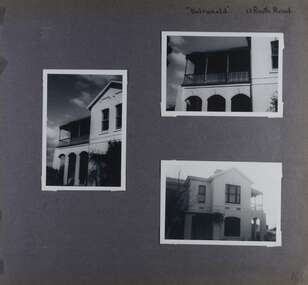
Album - Album page, Balranald, Poath Road, Circa 1972
... Victoria) and Caulfield City Council to identify historic buildings within the City of Caulfield that warranted the protection of a National Trust Classification. Principal photographer thought to be Trevor Hart, member of Caulfield Historical Society. Most photographs were taken between 1966-1972 with a small number of photographs being older and from unknown sources. All photographs are black and white except where stated, with 386 photographs over 198 pages. Originally named Crofthead or The Croft Head, later changed to Balranald according to Melbourne...Victoria) and Caulfield City Council to identify historic buildings within the City of Caulfield that warranted the protection of a National Trust Classification. Principal photographer thought to be Trevor Hart, member of Caulfield Historical Society. Most photographs were taken between 1966-1972 with a small number of photographs being older and from unknown sources. All photographs are black and white except where stated, with 386 photographs over 198 pages. Originally named Crofthead or The Croft Head, later changed to Balranald according to Melbourne ...This photograph is part of the Caulfield Historical Album 1972. This album was created in approximately 1972 as part of a project by the Caulfield Historical Society to assist in identifying buildings worthy of preservation. The album is related to a Survey the Caulfield Historical Society developed in collaboration with the National Trust of Australia (Victoria) and Caulfield City Council to identify historic buildings within the City of Caulfield that warranted the protection of a National Trust Classification. Principal photographer thought to be Trevor Hart, member of Caulfield Historical Society. Most photographs were taken between 1966-1972 with a small number of photographs being older and from unknown sources. All photographs are black and white except where stated, with 386 photographs over 198 pages. Originally named Crofthead or The Croft Head, later changed to Balranald according to Melbourne Mansions database.From Victorian Heritage Database citation for HO136 13 Poath Street MURRUMBEENA https://vhd.heritagecouncil.vic.gov.au/places/35389 as at 30/10/2020 "Croft Head" is situated at no. 13 Poath Road, Murrumbeena, and was built in 1887 for the accountant Edward Tweddell. It is historically and aesthetically significant. It is historically significant (Criterion A) as a substantial and now rare (Criterion B) surviving late Victorian villa residence east of Booran Road within the Municipality and demonstrating the attraction of Melbourne's rural fringe as a residential location rendered accessible by the opening of the railway between South Yarra and Oakleigh in 1879. It is aesthetically significant (Criterion E) as one of the Municipality's finest late Victorian polychrome brick villas, comparing with ''Fresch'' and ''Monkleigh'' both erected in 1899 at nos. 11 and 12 Gladstone Parade, Elsternwick respectively, ''Hartington'' (1888) at 15 Gladstone Parade and ''Hengar'' (1889) at no. 356 Glen Eira Road, Caulfield South. Elements of stylistic significance include the ornamentation of the brickwork in polychrome work with tiled panels, the effect of the banding being especially striking and representative of the period.Page 166 of Photograph Album with three photographs of Balranald on Poath Road.Handwritten: "Balranald" 13 Poath Road [top right] / 166 [bottom right]trevor hart, decorative brackets, chimneys, verandah, porch, poath road, arches, cast iron columns, return verandah, croft head, balranald, victorian villa, restoration, 1880's, edward tweddell, murrumbeena, hughesdale, cast iron frieze, victorian style, cast iron work, rendered brick, house names, polychrome brick, poath street, crofthead, the croft head -
Glen Eira Historical Society
Article - Third Church of Christ, Scientist, Elsternwick
... building after overturning council decision. The fifth article is from Melbourne Bayside Weekly, 28/03/2012. It talks about the history of The Church of Christ, Scientist and about the old church building that still stands. Ripon Grove Gordon Street Contour Consultant Glen Eira Historic Sites Buddhist clubs and associations Elsternwick Glen Huntly Road Church Wait Peter Wright Kristen Kate Ms Sinclair Street Soka Gakkaii Local government Local officials and employees Mc Combie Street David Street Ward Camden Holden Lars. Connellan Rose Connellan Cathlea Connellan Marilyn Third Church of Christ Scientist Elsternwick Heritage Victoria ...5 Articles about the building which used to be Third Church of Christ, Scientist Elsternwick. The first one is an article from leader newspaper dated 27 July 2010 discussing the plan to convert former Christian Science Church and latterly Buddhist organisation into apartments. The second article is from Leader Newspaper dated 10 August 2010, commenting on disruptions that might occur with redevelopment. Third article is from Caulfield Leader, 07/09/2010. The article is on continuing discussion on proposed plans for the building which previously was a historic church. Also mentioned, residence’s concern and complains about the plan. The fourth article from Caulfield/ Port Phillip Leader, 24/05/2011, mainly talks about similar development at 221 -229 Glen Huntly Road. It also touches the subject of 233 – 147 Glen Huntly Road and 12 – 14 Ripon Grove as well. It is written that VCAT allowed the development of 10 storey building after overturning council decision. The fifth article is from Melbourne Bayside Weekly, 28/03/2012. It talks about the history of The Church of Christ, Scientist and about the old church building that still stands.ripon grove, gordon street, contour consultant, glen eira, historic sites, buddhist clubs and associations, elsternwick, glen huntly road, church, wait peter, wright kristen, kate ms, sinclair street, soka gakkaii, local government, local officials and employees, mc combie street, david street, ward camden, holden lars., connellan rose, connellan cathlea, connellan marilyn, third church of christ scientist elsternwick, heritage victoria, victorian civil and administration tribunal, eddy mary baker, clifton andrew, sammon jason, di paolo lucy, robinson andrew, ling jenny, church of christ scientist -
 St James Old Cathedral
Cathedral Building, St James Old Cathedral, 09/11/1839
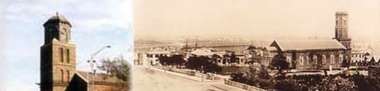
... Victoria. St James Old Cathedral is of the most important historic value to the community of Victoria and to the Australian nation as the first Anglican Church founded within 4 years of the settlement of Melbourne. It represents and conserves the very earliest history of white settlement in Victoria and preserves the church associated history of the Pioneer families of Victoria in its collection of original records and artefacts. National Trust Commemorative plate on outside wall to right of east entry door. Late Neo-Georgian style stone church building ...St James Church, "Church of the Pioneers", was the first Church, first Anglican Church, and is the oldest building in Melbourne. The foundation stone was laid in 1839 by the Superintendent of the District of Bourke, Charles La Trobe, later Governor of the Colony of Victoria. The Church was opened in 1842 and the first Bishop Charles Perry was installed in the Cathedral in 1848 when its status changed to that of Cathedral. Its status changed back to that of a Parish church after 1891 when St Paul's Cathedral in Swanston Street was opened. St James is known as the "Church of the Pioneers" as it served as the place of worship, marriage, baptism and burial of many of the first families in the District of Bourke and the Colony of Victoria. St James Old Cathedral is of the most important historic value to the community of Victoria and to the Australian nation as the first Anglican Church founded within 4 years of the settlement of Melbourne. It represents and conserves the very earliest history of white settlement in Victoria and preserves the church associated history of the Pioneer families of Victoria in its collection of original records and artefacts. Late Neo-Georgian style stone church building with bluestone footings. Octagonal upper one storey bell tower housing eight bells supported by two storey square towers. Body of church has sloping roof and 4 stained glass ornamental windows on each of west and east sides with decorative sanctuary window to the north. Decorative Portico with columns on the north outside elevation. National Trust Commemorative plate on outside wall to right of east entry door. -
 Sunshine and District Historical Society Incorporated
Photograph - Maribyrnong River and Valley
... Victoria's heritage The battle over the bluestone. The Melbourne Meat Preserving Works|Typed report Historic Workplace Humes Site Van Ness Avenue Maribyrnong|Typed letter 1 December 1967 Explosives Factory Maribyrnong|Typed report Racing colours Rose and Black|Newspaper article The Age 28 April 1982 The western maze|Typed Minutes 4 July 1983 Meeting of the Lower Maribyrnong Conservation Group|Typed Constitution of the Lower Maribyrnong Valley Conservation Group|Typed Submission 29 April 1982 To City of Sunshine for Historic buildings preservation council classifications sub committee|Typed Minutes of Lower Maribyrnong Valley Conservation Group 26 August 1982|Typed Application for Membership form Lower Maribyrnong Valley Conservation Group|Typed Submission for a Financial Grant to the Charles Grimes 175th Anniversary Re enactment Committee|Typed Annual General Meeting 5 July 1984 Lower Maribyrnong Valley Conservation Group|Typed letter 30 July 1980 Humes Site|Typed Proposal Bluestone building|Typed Letter from University of Melbourne 11 December 1980 Meat Preserving companys works|Brochure Pipemakers Park|Typed notes Elizabeth McKinnon Mosaic mural artist|Newspaper article Sunshine Advocate 10 November 1993 Heritage site rediscovered|Newspaper article The Age 7 September 1996 Dreamtime in an industrial garden|Newspaper article The Western Times 6 December 1989 The peoples historiian|Typed report The Saltwater River Powder Magazine Jacks Magazine|Typed letter from Henry Laskowski Sunshine City Council Engineer / Planner to Gwen Goedecke Re: Melbourne Metropolitan Planning Scheme Amendment No 157 Maribyrnong Valley 26th November 1981|Newspaper article The Advocate 13th September Council to buy vital river land|Newspaper article The Age 4th September 1978 Tight controls urged over Maribyrnong|Newspaper article The Age 27th April 1988 Metropolitan Region Planning Scheme Amendment RL11|Melbourne Metropolitan Board of Works M.M.B.W. ...Victoria's heritage The battle over the bluestone. The Melbourne Meat Preserving Works|Typed report Historic Workplace Humes Site Van Ness Avenue Maribyrnong|Typed letter 1 December 1967 Explosives Factory Maribyrnong|Typed report Racing colours Rose and Black|Newspaper article The Age 28 April 1982 The western maze|Typed Minutes 4 July 1983 Meeting of the Lower Maribyrnong Conservation Group|Typed Constitution of the Lower Maribyrnong Valley Conservation Group|Typed Submission 29 April 1982 To City of Sunshine for Historic buildings preservation council classifications sub committee|Typed Minutes of Lower Maribyrnong Valley Conservation Group 26 August 1982|Typed Application for Membership form Lower Maribyrnong Valley Conservation Group|Typed Submission for a Financial Grant to the Charles Grimes 175th Anniversary Re enactment Committee|Typed Annual General Meeting 5 July 1984 Lower Maribyrnong Valley Conservation Group|Typed letter 30 July 1980 Humes Site|Typed Proposal Bluestone building|Typed Letter from University of Melbourne 11 December 1980 Meat Preserving companys works|Brochure Pipemakers Park|Typed notes Elizabeth McKinnon Mosaic mural artist|Newspaper article Sunshine Advocate 10 November 1993 Heritage site rediscovered|Newspaper article The Age 7 September 1996 Dreamtime in an industrial garden|Newspaper article The Western Times 6 December 1989 The peoples historiian|Typed report The Saltwater River Powder Magazine Jacks Magazine|Typed letter from Henry Laskowski Sunshine City Council Engineer / Planner to Gwen Goedecke Re: Melbourne Metropolitan Planning Scheme Amendment No 157 Maribyrnong Valley 26th November 1981|Newspaper article The Advocate 13th September Council to buy vital river land|Newspaper article The Age 4th September 1978 Tight controls urged over Maribyrnong|Newspaper article The Age 27th April 1988 Metropolitan Region Planning Scheme Amendment RL11|Melbourne Metropolitan Board of Works M.M.B.W. ...Photocopy of Photograph Maribyrnong Munitions Factory 1938|Newspaper article Brimbank Messenger 29 October 2002 Our bond with the Maltese|Newspaper article The Herald Friday 24 February 1989 Yes Melbourne does have another river|Typed report History of Maribyrnong Steering Committee Reports|Typed notes of Steering Committee History of Maribyrnong Meeting held 7 June 1989|Typed notes 27 April 1989 History of Maribyrnong Steering Committtee Meeting|Typed notes of Steering Committee 5 April 1989|Typed notes of Steering Committee 1 March 1989|Typed notes of Steering Committee 11 January 1989|Typed notes 23 August 1988 Local History|Typed notes of Steering Committee 28 Febuary 1989|Typed report 17 November 1988 A History of Maribyrnong|Extract First Contacts I Primi Contenti|Extract Chapter 2 Maribyrnong on the map|Typed Report Migrant impact The early settlement of Maribyrnong|Photocopy of photographs Your family's photos are Maribyrnong's heritage|Typed report Maribyrnong A pictorial history|Typed report Maribyrnong History Outline|Typed report A History of Maribyrnong General Brief for the Author|Handwritten notes Research for Sunshine Council Project|Letter 18 August 1988 The History Institute|Typed report Copyright|Newspaper article Star 7 December 2004 Council moves to avert disaster|Newspaper article Brimbank Messenger 4 July 2000 Platypus potential|Newspaper article |Advocate 7 July 1993 New river bridge|Letter to Waterways and Parks division Metropolitan Parks 11 April 1985 Potential uses of Bluestone buildings|Typed Memorandum 21 January 1985 History of the Site of the Marie Hill Centre|Typed report The Ford Maribyrnong River|Typed letter from Legislative Council 6 January 1982 regarded rezoning|Extract of Poem The Haunted Castle at Maribyrnong by Martha Coxhead|Handwritten note Evan Crick Hotel dates|Brochure Historic Parkland Van Ness Avenue Sunshine|Typed notes Maribyrnong River Valley Braybrook February 1992|Typed letter 1 June 1983 Humes Site from Melbourne and Metropolitan Board of Works|Typed l etter 31 May 1982 from Historic Buildings Preservation Council re the fomer Melbourne Meat Preserving Company buildings and former Humes Pipes Site Van Ness Avenue Maribyrnong|Flyer 3 February 1803 Charles Grimes 175th Anniversary 5 February 1978|Newspaper articles Melbourne must not forget its other river|Newspaper article Sunshine Advocatge 24 February 1982 Hearing on Humes rezoning|Newspaper article Public Meeting on Future Development Plans for the former Humes site|Huge Banner Development Plan for Maribyrnong River|Newspaper article Advocate 22 February 2000 Greedy developers|Newspaper article Advocate 17 April 1996 River estate plan set for amendment|Newspaper article Advocate 8 February 2000 Bridging concern|Newspaper article Western Times 1 March 2000 Developers plan riles river residents|Newspaper article Advocate 20 February 1974 Maribyrnong a paradise|Newspaper article Messenger 15 February 2000 Plan rushed residents|Newspaper article Advocate 1 June 1983 Get tough policy on Valley|Newspaper article The Herald 11 December 1981 A community is up in arms over a threat to Victoria's heritage The battle over the bluestone. The Melbourne Meat Preserving Works|Typed report Historic Workplace Humes Site Van Ness Avenue Maribyrnong|Typed letter 1 December 1967 Explosives Factory Maribyrnong|Typed report Racing colours Rose and Black|Newspaper article The Age 28 April 1982 The western maze|Typed Minutes 4 July 1983 Meeting of the Lower Maribyrnong Conservation Group|Typed Constitution of the Lower Maribyrnong Valley Conservation Group|Typed Submission 29 April 1982 To City of Sunshine for Historic buildings preservation council classifications sub committee|Typed Minutes of Lower Maribyrnong Valley Conservation Group 26 August 1982|Typed Application for Membership form Lower Maribyrnong Valley Conservation Group|Typed Submission for a Financial Grant to the Charles Grimes 175th Anniversary Re enactment Committee|Typed Annual General Meeting 5 July 1984 Lower Maribyrnong Valley Conservation Group|Typed letter 30 July 1980 Humes Site|Typed Proposal Bluestone building|Typed Letter from University of Melbourne 11 December 1980 Meat Preserving companys works|Brochure Pipemakers Park|Typed notes Elizabeth McKinnon Mosaic mural artist|Newspaper article Sunshine Advocate 10 November 1993 Heritage site rediscovered|Newspaper article The Age 7 September 1996 Dreamtime in an industrial garden|Newspaper article The Western Times 6 December 1989 The peoples historiian|Typed report The Saltwater River Powder Magazine Jacks Magazine|Typed letter from Henry Laskowski Sunshine City Council Engineer / Planner to Gwen Goedecke Re: Melbourne Metropolitan Planning Scheme Amendment No 157 Maribyrnong Valley 26th November 1981|Newspaper article The Advocate 13th September Council to buy vital river land|Newspaper article The Age 4th September 1978 Tight controls urged over Maribyrnong|Newspaper article The Age 27th April 1988 Metropolitan Region Planning Scheme Amendment RL11|Melbourne Metropolitan Board of Works M.M.B.W. Concept plan for Maribyrnong River Development Media Release 25th January 1984|City of Sunshine The Maribyrnong River Ideas for the River Valley|Newspaper Article The Advocate 14 March 1979 River Valley Land Purchasemaribyrnong river, maribyrnong valley -
 Sunshine and District Historical Society Incorporated
Archive - H.V McKay Bulk Store
... Newspaper Article Messenger 8 January 1998 titled Saved by change of heart|Newspaper Article The Advocate 29 July 1998 titled Eyesore or piece of history|Newspaper Article titled Bulk Store is meaningless Shirley A Strossa|Newspaper Article Advocate 22 July 1998 titled Bulk Store dissent|Petition Sunshine Harvester factory Buildings Form|Historic Building Act 1981 Permit 12470 Massey Ferguson Complex|Letter from Melbourne's Living Museum of the West Incorporated 5 January 1995 expressing objection to Mr Ray Tonkin Historic Buildings Council|Newspaper Article Sunshine Advocate 25 January 1995 titlled It's our heritage|Letter to Historic Buildings Council Hearing of Application 14 February 1995|Notes Submission to hearing of Historic Building Council on 14th February 1995|Notice informing public in 1995|Flyer titled Save Our Bulk Store Building|Flyer titled Why was saving the HV McKay Bulk Store|Flyer titled The Bulk Store must be saved|Written submissions on behalf of the applicant 12 April 1995|Newspaper Article Independent 25 April 1995 titled Demolition Bid|Historical Buildings Council 1994 to 1995 Annual Report|Newspaper Article Advocate 26 April 1995 titled Surprise Appeal Woolworths seeks nod to demolish buildings|Submission in the matter of the Historic Building Act 1981 and Burns Bridge Australia on behalf of Fabcot to demolish two brick buildings on the former Massey Ferguson site 12 April 1995|Letter to Historic Building Council 1 May 1995 S&DHS opposes the further application by Burns Bridge Australia for a permit to demolish two Sunshine Harvester Factory Building namely the bulk store and the electrical power house|Letter from Department of Planning and Development to Fabcot Pty Ltd 18 May 1995 regarding Massey Ferguson Complex Devonshire Road Sunshine encloses permit allowing the demoltition of the substation powerhouse building|Newspaper Article Brimbank Independent 23 May 1995 titled Compromise Breatkthrough for harvester site complex|Newspaper Article The Advocate 24 May 1995 titled Harvester building must be retained|Letter to Historic Buildings Council 24 August 1995 raising concerns|Newspaper Article The Times 30 August 1995 titled Woolworths unveils $70m Sunshine plan|Newspaper Article The Advocate 4 June 1997 titled Reaping the benefits|Letter to Heritage Victoria 23 September 1997 oppose Application from Amanda Johns of Minter Ellison for a permit to demolish the building|Letter from Melbourne's Living Museum of the West Incorporated 9 October 1997 expressing concern to S&DHS|Letter to Brimbank City Council 20th October 1997 S&DHS to draw certain matters to your attention|Newspaper Article The Advocate 29 October 1997 titled Renewed bid to Demolish Eyesore|Newspaper Article Brimbank Independent 4 November 1997 titled Fomer council blamed for McKay buildings disrepair The Sunshine factory was the birthplace of the basic award wage in Australia|Newspaper Article Brimbank Messenger 11 November 1997 titled Demolition threat on historic building|Newspaper Article Brimbank Independent 11 November 1997 titled Council waits for Heritage Victoria report before decision on Bulk Store threat|Newspaper Article The Age 13 November 1997 titled Past harvest of labor struggle and victory|Newspaper Article The Advocate 19 November 1997 titled Protecting our history|Letter from Adminstrative Appeals Tribunal 25 November 1997 advising hearing date|Letter to Adminstrative Appeals Tribunal 4 December 1997 Community & S&DHS objections to the demolition|Newspaper Article The Advocate 10 December 1997 titled Cinema Chaos|Newspaper Article The Age 15 December 1997 titled Rallying to maintain a little ray of Sunshine|Newspaper Article The Advocate 17 December 1997 titled Bulk Store Victory|Newspaper Article The Advocate 17 December 1997 titled McKay store fails to rate|Letter to Heritage Victoria from Beauchamp Consulting Engineers recommended repair method for the Former Massey Ferguson Bulk Store|Newspaper Article Brimbank Independent 17 February 1998 titled Bulk Store to be saved|Collection of documents of Gwen Goedecke regarding saving the Bulk Store|Advertising Melbourne's first 20 screen megaplex Village Cinemas|Blank Application to add building to the register of Historic buildings|Typed report from Beauchamp Consulting Engineers for Recommended Repair Method for Bulk Store|Typed report from Speroulla Christodoulou to Trades Hall Council regarding developer Woolworths want to demolish the Bulk Store building including all newspaper articles|Newspaper Article Brimbank Independent 26 January 1999 Funding Rejection for bulk store plans|Typed report The Story of How the Bulk Store was saved|Notice HV McKay Electrical Power House and Bulk Store|Typed report Why was saving the HV McKay Bulk Store so important?...McKays Sunshine Harvester Works Bulk Store Newspaper Article Messenger 8 January 1998 titled Saved by change of heart|Newspaper Article The Advocate 29 July 1998 titled Eyesore or piece of history|Newspaper Article titled Bulk Store is meaningless Shirley A Strossa|Newspaper Article Advocate 22 July 1998 titled Bulk Store dissent|Petition Sunshine Harvester factory Buildings Form|Historic Building Act 1981 Permit 12470 Massey Ferguson Complex|Letter from Melbourne's Living Museum of the West Incorporated 5 January 1995 expressing objection to Mr Ray Tonkin Historic Buildings Council|Newspaper Article Sunshine Advocate 25 January 1995 titlled It's our heritage|Letter to Historic Buildings Council Hearing of Application 14 February 1995|Notes Submission to hearing of Historic Building Council on 14th February 1995|Notice informing public in 1995|Flyer titled Save Our Bulk Store Building|Flyer titled Why was saving the HV McKay Bulk Store|Flyer titled The Bulk Store must be saved|Written submissions on behalf of the applicant 12 April 1995|Newspaper Article Independent 25 April 1995 titled Demolition Bid|Historical Buildings Council 1994 to 1995 Annual Report|Newspaper Article Advocate 26 April 1995 titled Surprise Appeal Woolworths seeks nod to demolish buildings|Submission in the matter of the Historic Building Act 1981 and Burns Bridge Australia on behalf of Fabcot to demolish two brick buildings on the former Massey Ferguson site 12 April 1995|Letter to Historic Building Council 1 May 1995 S&DHS opposes the further application by Burns Bridge Australia for a permit to demolish two Sunshine Harvester Factory Building namely the bulk store and the electrical power house|Letter from Department of Planning and Development to Fabcot Pty Ltd 18 May 1995 regarding Massey Ferguson Complex Devonshire Road Sunshine encloses permit allowing the demoltition of the substation powerhouse building|Newspaper Article Brimbank Independent 23 May 1995 titled Compromise Breatkthrough for harvester site complex|Newspaper Article The Advocate 24 May 1995 titled Harvester building must be retained|Letter to Historic Buildings Council 24 August 1995 raising concerns|Newspaper Article The Times 30 August 1995 titled Woolworths unveils $70m Sunshine plan|Newspaper Article The Advocate 4 June 1997 titled Reaping the benefits|Letter to Heritage Victoria 23 September 1997 oppose Application from Amanda Johns of Minter Ellison for a permit to demolish the building|Letter from Melbourne's Living Museum of the West Incorporated 9 October 1997 expressing concern to S&DHS|Letter to Brimbank City Council 20th October 1997 S&DHS to draw certain matters to your attention|Newspaper Article The Advocate 29 October 1997 titled Renewed bid to Demolish Eyesore|Newspaper Article Brimbank Independent 4 November 1997 titled Fomer council blamed for McKay buildings disrepair The Sunshine factory was the birthplace of the basic award wage in Australia|Newspaper Article Brimbank Messenger 11 November 1997 titled Demolition threat on historic building|Newspaper Article Brimbank Independent 11 November 1997 titled Council waits for Heritage Victoria report before decision on Bulk Store threat|Newspaper Article The Age 13 November 1997 titled Past harvest of labor struggle and victory|Newspaper Article The Advocate 19 November 1997 titled Protecting our history|Letter from Adminstrative Appeals Tribunal 25 November 1997 advising hearing date|Letter to Adminstrative Appeals Tribunal 4 December 1997 Community & S&DHS objections to the demolition|Newspaper Article The Advocate 10 December 1997 titled Cinema Chaos|Newspaper Article The Age 15 December 1997 titled Rallying to maintain a little ray of Sunshine|Newspaper Article The Advocate 17 December 1997 titled Bulk Store Victory|Newspaper Article The Advocate 17 December 1997 titled McKay store fails to rate|Letter to Heritage Victoria from Beauchamp Consulting Engineers recommended repair method for the Former Massey Ferguson Bulk Store|Newspaper Article Brimbank Independent 17 February 1998 titled Bulk Store to be saved|Collection of documents of Gwen Goedecke regarding saving the Bulk Store|Advertising Melbourne's first 20 screen megaplex Village Cinemas|Blank Application to add building to the register of Historic buildings|Typed report from Beauchamp Consulting Engineers for Recommended Repair Method for Bulk Store|Typed report from Speroulla Christodoulou to Trades Hall Council regarding developer Woolworths want to demolish the Bulk Store building including all newspaper articles|Newspaper Article Brimbank Independent 26 January 1999 Funding Rejection for bulk store plans|Typed report The Story of How the Bulk Store was saved|Notice HV McKay Electrical Power House and Bulk Store|Typed report Why was saving the HV McKay Bulk Store so important? ...Newspaper Article Messenger 8 January 1998 titled Saved by change of heart|Newspaper Article The Advocate 29 July 1998 titled Eyesore or piece of history|Newspaper Article titled Bulk Store is meaningless Shirley A Strossa|Newspaper Article Advocate 22 July 1998 titled Bulk Store dissent|Petition Sunshine Harvester factory Buildings Form|Historic Building Act 1981 Permit 12470 Massey Ferguson Complex|Letter from Melbourne's Living Museum of the West Incorporated 5 January 1995 expressing objection to Mr Ray Tonkin Historic Buildings Council|Newspaper Article Sunshine Advocate 25 January 1995 titlled It's our heritage|Letter to Historic Buildings Council Hearing of Application 14 February 1995|Notes Submission to hearing of Historic Building Council on 14th February 1995|Notice informing public in 1995|Flyer titled Save Our Bulk Store Building|Flyer titled Why was saving the HV McKay Bulk Store|Flyer titled The Bulk Store must be saved|Written submissions on behalf of the applicant 12 April 1995|Newspaper Article Independent 25 April 1995 titled Demolition Bid|Historical Buildings Council 1994 to 1995 Annual Report|Newspaper Article Advocate 26 April 1995 titled Surprise Appeal Woolworths seeks nod to demolish buildings|Submission in the matter of the Historic Building Act 1981 and Burns Bridge Australia on behalf of Fabcot to demolish two brick buildings on the former Massey Ferguson site 12 April 1995|Letter to Historic Building Council 1 May 1995 S&DHS opposes the further application by Burns Bridge Australia for a permit to demolish two Sunshine Harvester Factory Building namely the bulk store and the electrical power house|Letter from Department of Planning and Development to Fabcot Pty Ltd 18 May 1995 regarding Massey Ferguson Complex Devonshire Road Sunshine encloses permit allowing the demoltition of the substation powerhouse building|Newspaper Article Brimbank Independent 23 May 1995 titled Compromise Breatkthrough for harvester site complex|Newspaper Article The Advocate 24 May 1995 titled Harvester building must be retained|Letter to Historic Buildings Council 24 August 1995 raising concerns|Newspaper Article The Times 30 August 1995 titled Woolworths unveils $70m Sunshine plan|Newspaper Article The Advocate 4 June 1997 titled Reaping the benefits|Letter to Heritage Victoria 23 September 1997 oppose Application from Amanda Johns of Minter Ellison for a permit to demolish the building|Letter from Melbourne's Living Museum of the West Incorporated 9 October 1997 expressing concern to S&DHS|Letter to Brimbank City Council 20th October 1997 S&DHS to draw certain matters to your attention|Newspaper Article The Advocate 29 October 1997 titled Renewed bid to Demolish Eyesore|Newspaper Article Brimbank Independent 4 November 1997 titled Fomer council blamed for McKay buildings disrepair The Sunshine factory was the birthplace of the basic award wage in Australia|Newspaper Article Brimbank Messenger 11 November 1997 titled Demolition threat on historic building|Newspaper Article Brimbank Independent 11 November 1997 titled Council waits for Heritage Victoria report before decision on Bulk Store threat|Newspaper Article The Age 13 November 1997 titled Past harvest of labor struggle and victory|Newspaper Article The Advocate 19 November 1997 titled Protecting our history|Letter from Adminstrative Appeals Tribunal 25 November 1997 advising hearing date|Letter to Adminstrative Appeals Tribunal 4 December 1997 Community & S&DHS objections to the demolition|Newspaper Article The Advocate 10 December 1997 titled Cinema Chaos|Newspaper Article The Age 15 December 1997 titled Rallying to maintain a little ray of Sunshine|Newspaper Article The Advocate 17 December 1997 titled Bulk Store Victory|Newspaper Article The Advocate 17 December 1997 titled McKay store fails to rate|Letter to Heritage Victoria from Beauchamp Consulting Engineers recommended repair method for the Former Massey Ferguson Bulk Store|Newspaper Article Brimbank Independent 17 February 1998 titled Bulk Store to be saved|Collection of documents of Gwen Goedecke regarding saving the Bulk Store|Advertising Melbourne's first 20 screen megaplex Village Cinemas|Blank Application to add building to the register of Historic buildings|Typed report from Beauchamp Consulting Engineers for Recommended Repair Method for Bulk Store|Typed report from Speroulla Christodoulou to Trades Hall Council regarding developer Woolworths want to demolish the Bulk Store building including all newspaper articles|Newspaper Article Brimbank Independent 26 January 1999 Funding Rejection for bulk store plans|Typed report The Story of How the Bulk Store was saved|Notice HV McKay Electrical Power House and Bulk Store|Typed report Why was saving the HV McKay Bulk Store so important?|Letter to Brimbank City Council suggestion to use the Bulk Store as a youth centre|Letter to Norman Carlton at Sunshine and District Historical Society from Brimbank Council 8 September 2003|Letter from National Trust to Historical Buildings Council dated 5 March 1987|Report for submission in support of the Proposed demolition of Registered Historic Buildings for Former Bulk Store and Former Power Station Prepared for Burns Bridge Australia on behalf of Woolworths Pty Ltd|Letter to Heritage Victoria from Frank Ford dated 23 September 1997 pointing out structural reports and Brimbank Councils position and cultural significance of the Bulk Store Building|Handwritten Notes about Bulk Store 12 December 1997|Handwritten Notes about Bulk Store 15 December 1997|Handwritten Notes about Bulk Store 25 January 1998|Handwritten Notes about Bulk Store 29 January 1998|Various correspondence of City of Sunshine Councillors touring interstate for ideas of shopping mallsh.v. mckays, sunshine harvester works, bulk store -
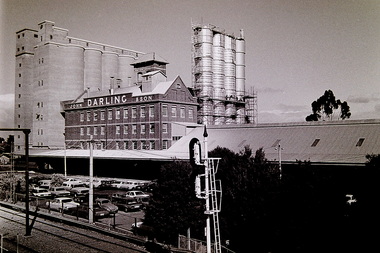 Sunshine and District Historical Society Incorporated
Photograph - John Darling And Sons Flour Mill Sydney Street Albion 1990 Photographs, Ken Irwin, 18th May 1990
... Victoria's State Register of Historic Buildings. In 1990, the mill and silos were getting ready to be put up for sale. John Darling & Son Flour Mill in Albion is one of the most important industrial heritage sites in Melbourne’s west, a rare, largely intact example of a major early‑20th‑century roller flour mill, and a cornerstone of Sunshine’s transformation into a planned “garden industrial suburb.” ...These photographs, taken by The Advocate newspaper in 1990, show the former John Darling & Son Flour Mill, now owned by Goodman Fielder, approximately twelve months after its closure. With the mill’s future uncertain, the site has been added to the Victoria's State Register of Historic Buildings. In 1990, the mill and silos were getting ready to be put up for sale.John Darling & Son Flour Mill in Albion is one of the most important industrial heritage sites in Melbourne’s west, a rare, largely intact example of a major early‑20th‑century roller flour mill, and a cornerstone of Sunshine’s transformation into a planned “garden industrial suburb.” These photographs capture the John Darling & Son Flour Mills when they had the stainless-steel silos which have been subsequently demolished. They also capture the Albion Railway Station and its carpark.John Darling Flour Mills Albion 36.1john darling and sons flour mill, flur mills, albion railway station, sydney street, albion, goodman fielder -
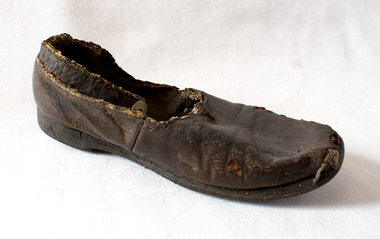 Brighton Historical Society
Shoe, Child's shoe, 19th century
... historic Brighton house St Ninian's, 10 Miller Street, during its demolition in September 1974. One of Brighton's earliest buildings, St Ninian's was built around 1841 for merchant, politician and former British naval officer George Ward Cole (1783-1879) and his family. Ward Cole was a prominent member of Victorian society in the mid-to-late nineteenth century. He served in the Victorian Parliament from 1853-55 and 1859-79. His seaside home in Brighton was a fashionable rendezvous for many important identities who shaped Melbourne’s history. Victoria’s...historic Brighton house St Ninian's, 10 Miller Street, during its demolition in September 1974. One of Brighton's earliest buildings, St Ninian's was built around 1841 for merchant, politician and former British naval officer George Ward Cole (1783-1879) and his family. Ward Cole was a prominent member of Victorian society in the mid-to-late nineteenth century. He served in the Victorian Parliament from 1853-55 and 1859-79. His seaside home in Brighton was a fashionable rendezvous for many important identities who shaped Melbourne’s history. Victoria’s ...This child's shoe was found underneath the floorboards of the historic Brighton house St Ninian's, 10 Miller Street, during its demolition in September 1974. One of Brighton's earliest buildings, St Ninian's was built around 1841 for merchant, politician and former British naval officer George Ward Cole (1783-1879) and his family. Ward Cole was a prominent member of Victorian society in the mid-to-late nineteenth century. He served in the Victorian Parliament from 1853-55 and 1859-79. His seaside home in Brighton was a fashionable rendezvous for many important identities who shaped Melbourne’s history. Victoria’s first royal visitor, Prince Alfred, Duke of Edinburgh, was a guest there in 1867. It is possible the shoe belonged to one of the Ward Cole children. During the demolition of St Ninian's in September 1974 the Brighton Historical Society's then-secretary, Rosalind Landells, snuck onto the work site in the hope of saving some part of the building and its history. She found this shoe under the partially-demolished floor of the house.Brown leather child's shoe with an ankle strap, fastening with a mother-of-pearl button. Heavily deteriorated.Handwritten in pencil on the sole of the shoe: "Found under floor at St Ninians 1974 Sept during demolition".st ninians, george ward cole, children's clothing, 19th century -
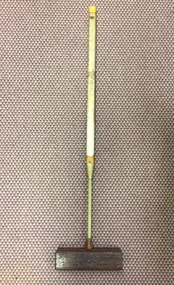 Kew Historical Society Inc
Equipment - Sports Equipment, Auburn Heights Recreation Club, Wooden Croquet Mallet, Twentieth Century
... Victoria: Its origin & progress 1803-1910. Chapman J & C 1999, The history of the Auburn Heights Recreation Club, 1904 to 1908. Reeve S 2012, City of Boroondara: Thematic Environmental History, p.216. The combined collections of the four sporting clubs making up the collection number hundreds of items that are historically significant locally. They are also significant to the sporting history of the greater Melbourne area and to the sports of lawn bowls and tennis in Australia in the 19th and 20th centuries. The collection illuminates two of the Victorian historic themes - 'Building ...Sports Clubs in Kew in the final decades of the 19th century and in the early 20th century were often umbrella organisations with facilities for a number of sports. Typically in Kew, this included teams in lawn bowls, tennis and croquet. The Kew Bowling Club was formed in 1880 while the privately owned Auburn Heights Recreation Club was opened in 1904. The croquet courts at the Kew Recreation Club were opened in 1906, two years after the Club's formation. By 1998, the two Clubs decided to amalgamate at the Auburn Heights site in Barkers Road, forming the Kew Heights Sports Club. The combined club was itself taken over by the Melbourne Cricket Club in 2012 becoming MCC Kew Sports Club. In 2017 MCC Kew closed and its landholding was subsequently sold to Carey Baptist Grammar School. Both the Kew and Auburn Heights Clubs assembled important collections. These historically significant and large collections were donated to the Society in 2020. The collections include manuscripts, pictures, trophies, plans, honour boards etc. References Barnard FGA 1910, 'Sports and Pastimes' in Jubilee History of Kew Victoria: Its origin & progress 1803-1910. Chapman J & C 1999, The history of the Auburn Heights Recreation Club, 1904 to 1908. Reeve S 2012, City of Boroondara: Thematic Environmental History, p.216.The combined collections of the four sporting clubs making up the collection number hundreds of items that are historically significant locally. They are also significant to the sporting history of the greater Melbourne area and to the sports of lawn bowls and tennis in Australia in the 19th and 20th centuries. The collection illuminates two of the Victorian historic themes - 'Building community life' through forming community organisations and 'Shaping cultural and creative life' by participating in sport and recreation.Croquet mallet, Shaft made of a number of separate rectangular sections of pale wood, mostly wrapped with cotton cord and strips of leather. The rectangular head is made of a darker heavier wood and it is banded with a strip of lighter wood.croquet -- mallets, croquet -- equipment, auburn heights croquet club, auburn heights recreation club -
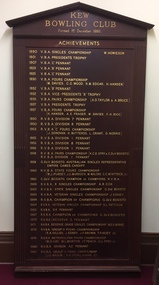 Kew Historical Society Inc
Memorabilia, Kew Bowling Club, Honour Board - Achievements, 1890-1980
... Victoria: Its origin & progress 1803-1910. Nixon NV 1980, The History of the Kew Bowling Club 1880-1980. Reeve S 2012, City of Boroondara: Thematic Environmental History, p.216. The combined collections of the four sporting clubs making up the collection number hundreds of items that are historically significant locally. They are also significant to the sporting history of the greater Melbourne area and to the sports of lawn bowls and tennis in Australia in the 19th and 20th centuries. The collection illuminates two of the Victorian historic themes - 'Building ...Sports Clubs in Kew in the final decades of the 19th century and in the early 20th century were often umbrella organisations with facilities for a number of sports. Typically in Kew, this included teams in lawn bowls, tennis and croquet. The Kew Bowling Club was formed in 1880 while the privately owned Auburn Heights Recreation Club was opened in 1904. By 1998, the two Clubs decided to amalgamate at the Auburn Heights site in Barkers Road, forming the Kew Heights Sports Club. The combined club was itself taken over by the Melbourne Cricket Club in 2012 becoming MCC Kew Sports Club. In 2017 MCC Kew closed and its landholding was subsequently sold to Carey Baptist Grammar School. Both the Kew and Auburn Heights Clubs assembled important collections. These historically significant and large collections were donated to the Society in 2020. The collections include manuscripts, pictures, trophies, plans, honour boards etc. References Barnard FGA 1910, 'Sports and Pastimes' in Jubilee History of Kew Victoria: Its origin & progress 1803-1910. Nixon NV 1980, The History of the Kew Bowling Club 1880-1980. Reeve S 2012, City of Boroondara: Thematic Environmental History, p.216.The combined collections of the four sporting clubs making up the collection number hundreds of items that are historically significant locally. They are also significant to the sporting history of the greater Melbourne area and to the sports of lawn bowls and tennis in Australia in the 19th and 20th centuries. The collection illuminates two of the Victorian historic themes - 'Building community life' through forming community organisations and 'Shaping cultural and creative life' by participating in sport and recreation.Large Honour board listing in gilt lettering the major sporting achievements of the Kew Bowling Club (1880-1998) by year. The item is part of the historic Kew Bowling Club (1880-1898) collection gifted to the Kew Historical Society by MCC Kew Sports Club in 2020. kew bowling club - wellington street - kew (vic), clubs - lawn bowls - kew (vic), honour boards - lawn bowls -
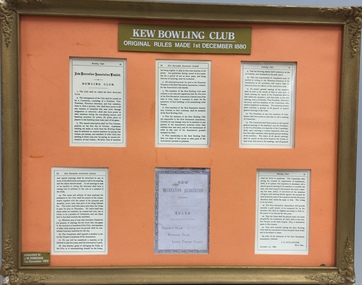 Kew Historical Society Inc
Document, Kew Recreation Association Rules, 1880
... Victoria: Its origin & progress 1803-1910. Nixon NV 1980, The History of the Kew Bowling Club 1880-1980. Reeve S 2012, City of Boroondara: Thematic Environmental History, p.216. The combined collections of the four sporting clubs making up the collection number hundreds of items that are historically significant locally. They are also significant to the sporting history of the greater Melbourne area and to the sports of lawn bowls and tennis in Australia in the 19th and 20th centuries. The collection illuminates two of the Victorian historic themes - 'Building ...Sports Clubs in Kew in the final decades of the 19th century and in the early 20th century were often umbrella organisations with facilities for a number of sports. Typically in Kew, this included teams in lawn bowls, tennis and croquet. The Kew Bowling Club was formed in 1880 while the privately owned Auburn Heights Recreation Club was opened in 1904. By 1998, the two Clubs decided to amalgamate at the Auburn Heights site in Barkers Road, forming the Kew Heights Sports Club. The combined club was itself taken over by the Melbourne Cricket Club in 2012 becoming MCC Kew Sports Club. In 2017 MCC Kew closed and its landholding was subsequently sold to Carey Baptist Grammar School. Both the Kew and Auburn Heights Clubs assembled important collections. These historically significant and large collections were donated to the Society in 2020. The collections include manuscripts, pictures, trophies, plans, honour boards etc. References Barnard FGA 1910, 'Sports and Pastimes' in Jubilee History of Kew Victoria: Its origin & progress 1803-1910. Nixon NV 1980, The History of the Kew Bowling Club 1880-1980. Reeve S 2012, City of Boroondara: Thematic Environmental History, p.216.The combined collections of the four sporting clubs making up the collection number hundreds of items that are historically significant locally. They are also significant to the sporting history of the greater Melbourne area and to the sports of lawn bowls and tennis in Australia in the 19th and 20th centuries. The collection illuminates two of the Victorian historic themes - 'Building community life' through forming community organisations and 'Shaping cultural and creative life' by participating in sport and recreation.Kew Recreation Association [Cricket Club, Bowling Club, Lawn Tennis Court]: Framed copy of original rules promulgated 1 December 1880. The item is part of the historic Kew Bowling Club (1880-1898) collection gifted to the Kew Historical Society by MCC Kew Sports Club in 2020. kew bowling club - wellington street - kew (vic), clubs - lawn bowls - kew (vic), kew recreation association -
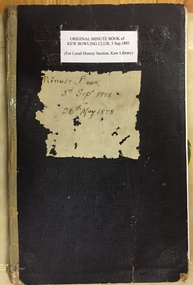 Kew Historical Society Inc
Administrative record - Minute Book, Kew Bowling Club, 1881-1888
... Victoria: Its origin & progress 1803-1910. Nixon NV 1980, The History of the Kew Bowling Club 1880-1980. Reeve S 2012, City of Boroondara: Thematic Environmental History, p.216. The combined collections of the four sporting clubs making up the collection number hundreds of items that are historically significant locally. They are also significant to the sporting history of the greater Melbourne area and to the sports of lawn bowls and tennis in Australia in the 19th and 20th centuries. The collection illuminates two of the Victorian historic themes - 'Building ...Sports Clubs in Kew in the final decades of the 19th century and in the early 20th century were often umbrella organisations with facilities for a number of sports. Typically in Kew, this included teams in lawn bowls, tennis and croquet. The Kew Bowling Club was formed in 1880 while the privately owned Auburn Heights Recreation Club was opened in 1904. By 1998, the two Clubs decided to amalgamate at the Auburn Heights site in Barkers Road, forming the Kew Heights Sports Club. The combined club was itself taken over by the Melbourne Cricket Club in 2012 becoming MCC Kew Sports Club. In 2017 MCC Kew closed and its landholding was subsequently sold to Carey Baptist Grammar School. Both the Kew and Auburn Heights Clubs assembled important collections. These historically significant and large collections were donated to the Society in 2020. The collections include manuscripts, pictures, trophies, plans, honour boards etc. References Barnard FGA 1910, 'Sports and Pastimes' in Jubilee History of Kew Victoria: Its origin & progress 1803-1910. Nixon NV 1980, The History of the Kew Bowling Club 1880-1980. Reeve S 2012, City of Boroondara: Thematic Environmental History, p.216.The combined collections of the four sporting clubs making up the collection number hundreds of items that are historically significant locally. They are also significant to the sporting history of the greater Melbourne area and to the sports of lawn bowls and tennis in Australia in the 19th and 20th centuries. The collection illuminates two of the Victorian historic themes - 'Building community life' through forming community organisations and 'Shaping cultural and creative life' by participating in sport and recreation.First Minute Book of the Kew Bowling Club.kew bowling club - wellington street - kew (vic), clubs - lawn bowls - kew (vic), minute books, kew bowling club minute book
