
Showing 12 items matching "historical world flights"
-
 Moorabbin Air Museum
Book - Australian aviation year books, Australian Aviation Yearbook 1970
... Historical aircraft...Aircraft production...Aircraft register...Airline operators domestic & internatiional...Approved firms...Army aviation...Australian Fleet Air Arm...Aviation associations...Charter operators...Dept of Civil Aviation...50 years of flight...Helicopter operations...Historical world...Australian aviation year books Aerial work operators Aero clubs & flying schools Aerodromes & airfields Aircraft movement & reporting stations Historical aircraft Aircraft production Aircraft register Airline operators domestic & internatiional Approved firms Army aviation Australian Fleet Air Arm Aviation associations Charter operators Dept of Civil Aviation 50 years of flight Helicopter operations Historical world flights History of Australian aviation Overseas aircraft companies RAAF RFDS Overview of Australia aviation for 1970 Australian Aviation Yearbook 1970 Book Australian aviation year books ...Overview of Australia aviation for 1970non-fictionOverview of Australia aviation for 1970aerial work operators, aero clubs & flying schools, aerodromes & airfields, aircraft movement & reporting stations, historical aircraft, aircraft production, aircraft register, airline operators domestic & internatiional, approved firms, army aviation, australian fleet air arm, aviation associations, charter operators, dept of civil aviation, 50 years of flight, helicopter operations, historical world flights, history of australian aviation, overseas aircraft companies, raaf, rfds -
 Warrnambool and District Historical Society Inc.
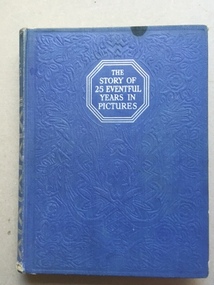
Book, Odhams Press Ltd, The story of 25 Eventful years in Pictures, early 20th century
... It shows many world wide events such as events around World War 1, sports events such as horse racing and cricket, scouting, flights over Mt Everest, fashion, the fall of the tzars in Russia and other world events such as the vote for women. It is mainly a British perspective with a number of items relating to the royal family and British politics of the time. This book has historical ...A collection of photographs of events of the years from 1911 to 1935. It shows many world wide events such as events around World War 1, sports events such as horse racing and cricket, scouting, flights over Mt Everest, fashion, the fall of the tzars in Russia and other world events such as the vote for women. It is mainly a British perspective with a number of items relating to the royal family and British politics of the time.This book has historical and social significance as it records in photographs many events which occurred in a very turbulent period of world history. While it has no direct link to Warrnambool it would have been of general interest to local people.Blue cover with silver print on front cover and spine. Front cover has embossing in a floral pattern.Inside front and back covers the paper is patterned in silver and blue with crowns and flags.512 pages with mainly photographs in sepia colours.the story of 25 eventful years in pictures,, world events -
 Wycheproof & District Historical Society Inc.
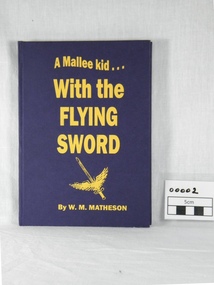
book, W.M. Matheson, A Mallee kid with the Flying Sword, 2004 (exact)
... flights and his accounts of missions and descriptions of different locations are interesting. An autobiographical account of service with the Royal Auxiliary Air Force in World War II. no 601 county of london squadron royal auxiliary air force 1939 war murdoch matheson pilots foggia italy photo italian war map end of the war 1945 The Wycheproof Historical Society/With Best Wishes/Murdoch/409169 F/LT MATHESON WILLIAM MURDOCH A hard covered blue book with gold inscription. ...W.M. Matheson 409169 F/LT who lives at Wycheproof, relates his wartime experiences as a Flying Officer - William "Murdoch" Matheson made 194 operational flights and his accounts of missions and descriptions of different locations are interesting.An autobiographical account of service with the Royal Auxiliary Air Force in World War II. A hard covered blue book with gold inscription. Contents describe the author's overseas service in World War II. Two final chapters are the End of the War and Reflections. The Wycheproof Historical Society/With Best Wishes/Murdoch/409169 F/LT MATHESON WILLIAM MURDOCHno 601 county of london squadron, royal auxiliary air force, 1939 war, murdoch matheson, pilots foggia italy photo, italian war map, end of, the war 1945 -
B-24 Liberator Memorial Restoration Australia Inc
Oral History, My RAAF Experience by Keith R.E. Johnston, 1980's
... This oral history of Keith Johnston is of historical significance because it provides a first hand account of this individual's experiences during World War II as a member of the RAAF who trained at Bradfield Park Sydney and Bundaberg and saw active service during the Pacific conflict flying B-24 Liberator aircraft in New Guinea and Darwin. Oral History RAAF World War II My RAAF Experience by R.E.Johnston, photo of 12 Squadron RAAF badge, Flight ...K. Johnston was in the RAAF from September 1941 until December 1945 and was a B-24 Liberator pilot between 1942 and December 1945. He was attached to Fifth Bomber Command USAF the 12 Squadron RAAF.This oral history of Keith Johnston is of historical significance because it provides a first hand account of this individual's experiences during World War II as a member of the RAAF who trained at Bradfield Park Sydney and Bundaberg and saw active service during the Pacific conflict flying B-24 Liberator aircraft in New Guinea and Darwin.A4 paper printed transcript, stapled in cornerMy RAAF Experience by R.E.Johnston, photo of 12 Squadron RAAF badge, Flight Lieutenant 12 Squadron RAAForal history raaf world war ii -
 Australian Gliding Museum
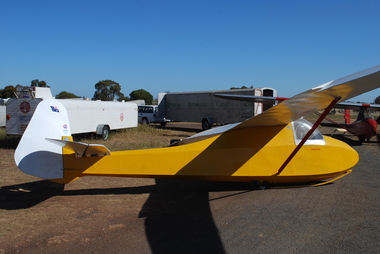
Machine - Glider - Sailplane, 1937
... Flight Group) for most of its long life. When donated to the Australian Gliding Museum in 2016 by Alan Patching it was probably the oldest, continuously airworthy glider in the world. Having regard to the historical...Flight Group) for most of its long life. When donated to the Australian Gliding Museum in 2016 by Alan Patching it was probably the oldest, continuously airworthy glider in the world. Having regard to the historical ...The Golden Eagle is an original design by Geoff Richardson. Geoff commenced gliding in the early days of the sport circa 1933 in Melbourne, flying at Coode Island and Mt Frazer. In 1934, he began construction of a secondary type glider but scrapped it upon realizing that a better design was needed. He conducted further research and came up with a sailplane of similar size and general arrangement to the Grunau Baby but with a “Gull” wing using a Gottingen 535 wing section (the same as for the Grunau Baby). Geoff did all the technical calculations himself and even made up and tested a Casein glue for the construction. Geoff competed construction of his new sailplane (which he called the “Golden Eagle”) in 1937 and it was test flown at Laverton at the western edge of Melbourne in September 1937. On the same day, at Laverton, the Gliding Club of Victoria flew its new Grunau Baby 2 sailplane which it had imported as a finished machine from Edmund Schneider in Germany. The Golden Eagle was found to fly well, having a similar performance to the Grunau Baby. In the 1950s, the Golden Eagle was modified by rebuilding the front of the fuselage to enclose the cockpit with a Perspex canopy. A landing wheel was incorporated behind the skid. Spoilers were added to the wings and a trim tab to the elevators. The Golden Eagle has been flown with the VMFG (Victorian Motorless Flight Group) for most of its long life. When donated to the Australian Gliding Museum in 2016 by Alan Patching it was probably the oldest, continuously airworthy glider in the world. Having regard to the historical significance of the Golden Eagle, the Museum has decided to not to fly it anymore to avoid risk of loss or damage. The exhibit is of great significance for Australian gliding history – the Golden Eagle is a flyable 1930s aircraft in excellent condition that was designed and built by an Australian gliding pioneer. Single seat wood and fabric sailplane finished with white wings, tailplane and rudder and yellow fuselage Registration letters “FC” on fuselage nose port side, Australian flag, Vintage Gliders Australia and VMFG decals on rudder, “Golden Eagle” lettering in red on each side of the fuselage below the canopy, Aboriginal flag decal on port side of fuselage below the canopy. australian gliding, glider, sailplane, golden eagle, richardson, patching, vmfg, victorian motorless flight group -
 Australian Gliding Museum
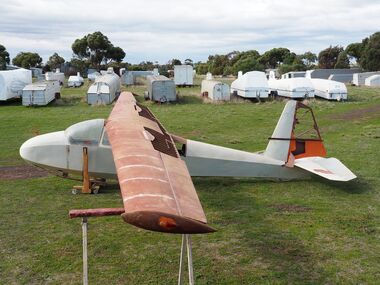
Machine - ES56 Nymph Sailplane
... Flight Group, in October 1956, and registered as VH-GFE on 5 March 1957. How it is Significant? The ES56 Nymph is of historical, aesthetic, scientific and research, and social significance to the Australian gliding community. Why it is Significant? The ES56 is of historical significance as it was designed and built by Edmund and Harry Schneider. The Schneiders immigrated to Australia after the end of the second world ...ES 56 Nymph Following the successful introduction of the ES 52 Kookaburra two-seater in mid-1954, Edmund Schneider Ltd designed a higher performance single seat sailplane of similar construction and with similar handling qualities. It was designated the ES 56 and became known as the ES56 “Nymph”. The ES56 Nymph was a success in that it delivered the anticipated performance and was found to have satisfactory flying characteristics. However, only the prototype (“Nymph -I”) and three production examples (“Nymph-II”) were built. Schneiders made some changes to the design before building the production version. The wing chord at the tip on the prototype measured 650 mm. This was reduced to 500 mm for subsequent builds. The explanation is that provision was made in the original design for the possible lengthening of the tapered wing to 13 metres. However, apparently it was decided to retain the 11.900 metre span which allowed the tip chord to be reduced slightly. Other changes included the installation of scissor type air brakes in the wing instead of simple hinged flap spoilers and the addition of a landing wheel behind the skid on the fuselage. On one of the Nymph-II a dorsal was added on top of the fuselage forward of the vertical fin when repairs were made rectifying damage incurred as a result of an accident at Benalla on 31 March 1963. Even before these ES56 gliders were finished, Edmund Schneider Ltd decided to offer a less expensive single seat design to cater in particular for newly solo pilots, the ES57 Kingfisher. With the Kingfisher, Schneiders reverted to a traditional airfoil (Gott 549) for the wing instead of the laminar flow section that was chosen for the Nymph in the pursuit of performance. As such, the Kingfisher was more appropriately characterised as a single seat version of the Kookaburra in comparison to the Nymph. Schneiders continued for a time to offer the ES56 Nymph as a high-performance sailplane. However, its place in the market was soon overtaken by imported designs with superior performance, such as the Schleicher KA6, which Schneiders also imported and built under license. Nymph-I was test flown in December 1955 and entered by Harry Schneider into the gliding championships held at Waikerie from 5th to 16th of that month. Harry finished 12th in the individual placing out of a field of approximately 24. The capabilities of the Nymph were further demonstrated by Harry Schneider in January 1956 with a Gold C flight of 193 miles from Gawler in South Australia to Walpeup in Victoria. Nymph-I was acquired by the Port Pirie Gliding Club in South Australia. It has been saved and restored and is a regular feature at vintage glider rallies in Victoria and New South Wales. See Museum Newsletter No 35 Winter Edition 2017 pages 3 -6, for that story. The Nymph-II production models were delivered by Edmund Schneider Ltd in October 1956 to the Gliding Club of Victoria, the Victorian Motorless Flight Group and the Royal Australian Navy Gliding Association. The VMFG flew its Nymph in the First National Gliding Championships at Tocumwal, NSW, in December 1956 and all three were flown at the Second National Gliding Championships at Benalla in 29th December 1958 to 8th January 1959, delivering competitive performances based on handicap. Nymph-I Serial Number 17 Original owner – Port Pirie Gliding Club, S.A. Registered VH-GHG on 20 August 1957 Re-registered VH-GHA on 11 October 2016 Currently Raywood, Victoria Believed airworthy Nymph-II Serial Number 20 Original owner – R.A.N. Gliding Association Registered VH-GDX on 20 May 1957 Currently Locksley, Victoria. In storage Nymph-II Serial Number 21 Original owner – Gliding Club of Victoria Registered VH-GHU on 27 August 1957 Currently Bendick Murrell, N.S.W. In storage Nymph-II Serial Number 22 Original owner – Victorian Motorless Flight Group Registered VH-GFE on 5 March 1957 Currently Bacchus Marsh, Victoria Under restoration for display. The Museum’s exhibit is the ES56, serial number 22, registered as VH-GFE. The glider was flown by the VMFG in Victoria until approximately September 1968. GFA records show that it was transferred to Queensland in 1968, and it passed through several owners until the mid-1970s. Information received indicates that it was flown by the Leichardt Soaring Club at Mount Isa in the (late?) 1960s. The history from then is not presently known except to say that it has been kept in dry storage for many years. It is not known when the glider was last flown. What is Significant? The Schneider ES 56 Nymph single seat sailplane, serial number 22, designed and built in 1955-1956, by Edmund Schneider Ltd in Adelaide. It was delivered to its original owner, the Victorian Motorless Flight Group, in October 1956, and registered as VH-GFE on 5 March 1957. How it is Significant? The ES56 Nymph is of historical, aesthetic, scientific and research, and social significance to the Australian gliding community. Why it is Significant? The ES56 is of historical significance as it was designed and built by Edmund and Harry Schneider. The Schneiders immigrated to Australia after the end of the second world war bringing with them considerable expertise in relation to glider design and construction. Over the following decades they maintained a close association with the Gliding Federation of Australia and the gliding clubs and through their glider production made a major contribution to the sport. The ES56 is part of that story. The ES56 in its design and construction exhibits the glider construction technology of the time, which principally consisted of lightweight wooden framework skinned with ply and doped fabric. It exbibits design innovation, notably the use of a laminar flow wing profile in pursuit of better glide performance. Also, considerable attention was given to simplifying the structure in order to keeping cost and the weight low. The ES56 played a useful role at gliding clubs where it was operated, especially the late 1950s and early 1960s and is remembered well by pilots who flew her. The glider is in the course of restoration and provides an insight into the skills and workmanship that were involved in design, building and maintenance of these wooden aircraft. It is of aesthetic and scientific and research significance. Glider airframe of a traditional wood and fabric covered constructionNoneglider, sailplane, edmund schneider, harry schneider, es56, nymph, es57, kingfisher, victorian motorless flight group, gliding club of victoria, ran gliding association, port pirie gliding club, leichardt soaring club. -
 Sunshine and District Historical Society Incorporated
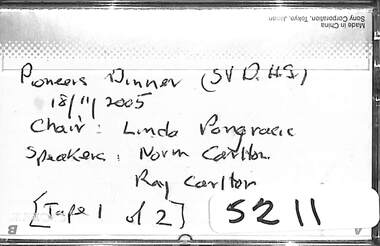
Audio - Sunshine And District Historical Society Pioneers Dinner 2005 Audio Tape 1
... flights. Air Force navigators Norm Carlton Ray Carlton Pioneers Dinner World War 1939 - 1945 Pioneers Dinner (S&DHS) Chair Linda Pongracic Speakers Norm Carlton & Ray Carlton Audio tape This audio tape has been digitised. This audio tape has been transcribed. No editing of the recording has taken place, except where the speaker(s) can be identified. Audio Sunshine And District Historical ...The Sunshine and District Historical Society Pioneers’ Lunch / Dinner is an annual event. It’s a commemorative gathering that honours the early settlers, people, community leaders of Sunshine and the surrounding district, events, achievements, etc. At the Pioneers’ Lunch / Dinner, a toast is a ritual and a dedicated moment to honour the original settlers and their contributions, and a guest speaker talks about an interesting subject. Guest speakers Norm Carlton and Ray Carlton 'Wartime experiences as navigators in the Air Force' During WW11 Air Force navigators used a combination of dead reckoning, celestial navigation and radio navigation to guide aircraft. Navigators underwent intensive training to build their skills and adapt to changing conditions including night and bad weather flights.Pioneers Dinner (S&DHS) Chair Linda Pongracic Speakers Norm Carlton & Ray Carltonair force navigators, norm carlton, ray carlton, pioneers dinner, world war 1939 - 1945 -
 Sunshine and District Historical Society Incorporated
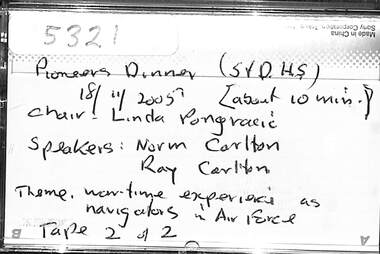
Audio - Sunshine And District Historical Society Pioneers Dinner 2005 Audio Tape 2, Sunshine and District Historical Society Inc, 2005
... flights. Ray Carlton Norm Carlton World War 1939 - 1945 Audio tape This audio tape has been digitised. This audio tape has been transcribed. No editing of the recording has taken place, except where the speaker(s) can be identified. Audio Sunshine And District Historical ...The Sunshine and District Historical Society Pioneers’ Lunch / Dinner is an annual event. It’s a commemorative gathering that honours the early settlers, people, community leaders of Sunshine and the surrounding district, events, achievements, etc. At the Pioneers’ Lunch / Dinner, a toast is a ritual and a dedicated moment to honour the original settlers and their contributions, and a guest speaker talks about an interesting subject. Guest speakers Norm Carlton and Ray Carlton 'Wartime experiences as navigators in the Air Force' During WW11 Air Force navigators used a combination of dead reckoning, celestial navigation and radio navigation to guide aircraft. Navigators underwent intensive training to build their skills and adapt to changing conditions including night and bad weather flights.ray carlton, norm carlton, world war 1939 - 1945 -
Moorabbin Air Museum
Machine - De Havilland DH82A Tiger Moth A17-377 (VH-AQM, "VH-TAA")
... Historical Details: . Description: The Tiger Moth has been called the "greatest biplane trainer of all time" and over the years has initiated thousands of pilots into the world of flight. ...Historical Details: . Description: The Tiger Moth has been called the "greatest biplane trainer of all time" and over the years has initiated thousands of pilots into the world of flight. ...Historical Details: . Description: The Tiger Moth has been called the "greatest biplane trainer of all time" and over the years has initiated thousands of pilots into the world of flight. First flown in 1931 and still flying in large numbers, the Tiger Moth was first produced by the de. Level of Importance: State -
Moorabbin Air Museum
Book - Aviation history, The Aeroplane An Historical Survey
... Aviation history Early ides of flight 1800 - 1903 The Wright brothers & the flight of 1903 Beginnings of aviation in Europe 1900 - 1908 Practical powered flight 1909-1914 World war 1 Between the wars 1919-1939 World war 2 Modern aviation The origins of the kite The origins of the rocket The origins of the parachute The origins of the aero engine The origins of the airscrew Overview of the origins & development of the airplane, circa 1960 The Aeroplane An Historical Survey Book Aviation history ...Overview of the origins & development of the airplane, circa 1960non-fictionOverview of the origins & development of the airplane, circa 1960early ides of flight 1800 - 1903, the wright brothers & the flight of 1903, beginnings of aviation in europe 1900 - 1908, practical powered flight 1909-1914, world war 1, between the wars 1919-1939, world war 2, modern aviation, the origins of the kite, the origins of the rocket, the origins of the parachute, the origins of the aero engine, the origins of the airscrew -
 Wodonga & District Historical Society Inc
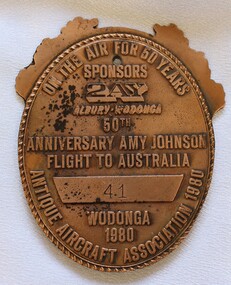
Medal - Antique Aeroplane Association Wodonga Air Show Medallion, 1980
... World Museum in Wodonga, Victoria. The event included a fly-in by members of the Antique Aeroplane Association which attracted 105 vintage planes from all parts of Australia. The show incorporated the Amy Johnson memorial rally to recognise the 50th anniversary of Amy Johnson's flight from England to Australia in 1930. Radio 2AY, the sponsor of the annual air show began broadcasting in 1930. This medallion and 2 other linked medallions were owned by Mr. Clive Cossor. He spent a lot of time at Drage's Historical...World Museum in Wodonga, Victoria. The event included a fly-in by members of the Antique Aeroplane Association which attracted 105 vintage planes from all parts of Australia. The show incorporated the Amy Johnson memorial rally to recognise the 50th anniversary of Amy Johnson's flight from England to Australia in 1930. Radio 2AY, the sponsor of the annual air show began broadcasting in 1930. This medallion and 2 other linked medallions were owned by Mr. Clive Cossor. He spent a lot of time at Drage's Historical ...This medallion was produced to commemorate the Antique Aeroplane Association of Australia's fourth annual air show which was held at Wodonga on June 14 and 15, 1980. It took place at Joe Drage's Air World Museum in Wodonga, Victoria. The event included a fly-in by members of the Antique Aeroplane Association which attracted 105 vintage planes from all parts of Australia. The show incorporated the Amy Johnson memorial rally to recognise the 50th anniversary of Amy Johnson's flight from England to Australia in 1930. Radio 2AY, the sponsor of the annual air show began broadcasting in 1930. This medallion and 2 other linked medallions were owned by Mr. Clive Cossor. He spent a lot of time at Drage's Historical Aircraft Museum and also helped transport gliders. He was also at the Albury racecourse as a teenager to assist in moving the Uiver when it was forced to land in a storm during the MacRobertson Trophy Air Race from London to Melbourne in October 1934.This medallion is significant as it records an important event recognising aviation in Australia and recognises Amy Johnson, the first woman to fly solo from England to Australia.A medallion produced to commemorate the Antique Aeroplane Association of Australia's fourth annual air show held at Wodonga on June 14 and 15, 1980 On the front around the medallion: "ON THE AIR FOR 50 YEARS/ANTIQUE AIRCRAFT ASSOCIATION 1980" . In the centre "SPONSORS/ 3AY/ALBURY-WODONGA/50th/ANNIVERSARY AMY JOHNSON/FLIGHT TO AUSTRALIA/41/WODONGA 1980" On reverse: a depiction of Amy Johnson with wings inscribed "JOHNNIE 1930"aviation history, antique aeroplane association of australia, joe drage airworld, airshow wodonga, amy johnson -
 Flagstaff Hill Maritime Museum and Village
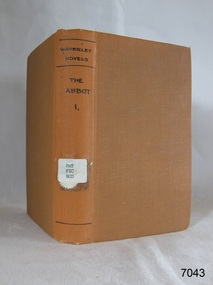
Book - Fictional stories, Sir Walter Scott, Waverley Novels Vol 20 The Abbot- 1 (Sequel to the Monastery), 1837
... flight to England. Like the other novels in the Waverley series it mixes historical events with fictional characters: Roland Græme, the Avenel household, and the mysterious “Abbot” figure are woven into the real struggle between Protestant and Catholic factions in Scotland. A central thread is Roland’s divided loyalties, his attraction to both the Catholic and Protestant worlds ...The subject volume “The Abbot- 1 (Sequel to the Monastery) Vol 20” published by Fisher Son & Co (1837) is part of a collected edition of Sir Walter Scott's works, containing stories from the "Tales of My Landlord" series. "Tales of My Landlord" forms a key subset of Scott's Waverley Novels, presented as fictional tales gathered by characters like Peter Pattieson from the landlord of the Wallace “Inn at Gandercleugh”. The series spans multiple books across four sub-series, including “The Black Dwarf” (1707 setting), “Old Mortality” (1679–1689), “The Heart of Midlothian” (1736), “The Bride of Lammermoor” (1709–1711), “A Legend of Montrose” (1644–1645), “Count Robert of Paris” (1097), and “Castle Dangerous” (1307). Vol 46 in the 1838 Fisher edition reprints later entries like “Count Robert of Paris” or “Castle Dangerous” from the fourth series, as these stories originally appeared in Scott's Magnum Opus collected volume editions, the first from 1816. With the influential 48-volume “Magnum Opus” edition from 1829–1833 by Robert Cadell, serving as the basis for later collected published sets like Fisher's. The Abbot is Walter Scott’s sequel to The Monastery, set in 1567–1568 during the turmoil around Mary, Queen of Scots. The story follows Roland Græme and other characters around Lochleven Castle, where Mary is imprisoned, and builds toward her escape attempt and the political crisis that ends with her defeat and flight to England. Like the other novels in the Waverley series it mixes historical events with fictional characters: Roland Græme, the Avenel household, and the mysterious “Abbot” figure are woven into the real struggle between Protestant and Catholic factions in Scotland. A central thread is Roland’s divided loyalties, his attraction to both the Catholic and Protestant worlds, and his involvement in helping Mary’s cause. The climax comes with Mary’s attempted escape from Lochleven, the fighting that follows, and her eventual loss of power in Scotland.Waverley Novels Vol 20 The Abbot- 1 Vol 20 (Sequel to the Monastery), Light brown hardcover lettering in black text. Author: Sir Walter Scott Publisher: Fisher Son & Co Date: 1837fictionThe subject volume “The Abbot- 1 (Sequel to the Monastery) Vol 20” published by Fisher Son & Co (1837) is part of a collected edition of Sir Walter Scott's works, containing stories from the "Tales of My Landlord" series. "Tales of My Landlord" forms a key subset of Scott's Waverley Novels, presented as fictional tales gathered by characters like Peter Pattieson from the landlord of the Wallace “Inn at Gandercleugh”. The series spans multiple books across four sub-series, including “The Black Dwarf” (1707 setting), “Old Mortality” (1679–1689), “The Heart of Midlothian” (1736), “The Bride of Lammermoor” (1709–1711), “A Legend of Montrose” (1644–1645), “Count Robert of Paris” (1097), and “Castle Dangerous” (1307). Vol 46 in the 1838 Fisher edition reprints later entries like “Count Robert of Paris” or “Castle Dangerous” from the fourth series, as these stories originally appeared in Scott's Magnum Opus collected volume editions, the first from 1816. With the influential 48-volume “Magnum Opus” edition from 1829–1833 by Robert Cadell, serving as the basis for later collected published sets like Fisher's. The Abbot is Walter Scott’s sequel to The Monastery, set in 1567–1568 during the turmoil around Mary, Queen of Scots. The story follows Roland Græme and other characters around Lochleven Castle, where Mary is imprisoned, and builds toward her escape attempt and the political crisis that ends with her defeat and flight to England. Like the other novels in the Waverley series it mixes historical events with fictional characters: Roland Græme, the Avenel household, and the mysterious “Abbot” figure are woven into the real struggle between Protestant and Catholic factions in Scotland. A central thread is Roland’s divided loyalties, his attraction to both the Catholic and Protestant worlds, and his involvement in helping Mary’s cause. The climax comes with Mary’s attempted escape from Lochleven, the fighting that follows, and her eventual loss of power in Scotland. warrnambool, shipwrecked-coast, flagstaff-hill, flagstaff-hill-maritime-museum, maritime-museum, shipwreck-coast, flagstaff-hill-maritime-village, shipwrecked-artefact, book, waverley novels vol 46 tales of my landlord, sir walter scott, pattison collection, warrnambool library, warrnambool mechanics’ institute, ralph eric pattison, corangamite regional library service, warrnambool city librarian, mechanics’ institute library, victorian library board, warrnambool books and records, warrnambool children’s library
