
Showing 34 items matching "hmas melbourne (1)"
-
 Royal Melbourne Yacht Squadron
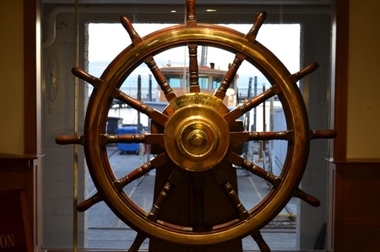
Memorabilia - Wheel of HMAS Sydney, Early 20th Century
... On 1 November 1914, led by the flagship SS Orvieto, a large convoy of 28 Australian and 10 New Zealand transports escorted by the Light Cruisers HMAS Melbourne, HMAS Sydney, HMS Minotaur and the Japanese ship Ibuki, departed King George Sound, Albany Western Australia with a large contingent of Australian and New Zealand troops bound for Egypt, to become the original Anzac’s. ...On 1 November 1914, led by the flagship SS Orvieto, a large convoy of 28 Australian and 10 New Zealand transports escorted by the Light Cruisers HMAS Melbourne, HMAS Sydney, HMS Minotaur and the Japanese ship Ibuki, departed King George Sound, Albany Western Australia with a large contingent of Australian and New Zealand troops bound for Egypt, to become the original Anzac’s. ...THE WHEEL OF HMAS SYDNEY COMMEMORATING AUSTRALIA’S FIRST NAVAL ENGAGEMENT The historic wheel of HMAS Sydney commemorates the Royal Australian Navy’s first ship- to- ship naval engagement. It was purchased early in 1930 and later presented to the Royal St Kilda Yacht Club (now Royal Melbourne Yacht Squadron) by then Commodore Joe White, following HMAS Sydney being broken up at Cockatoo Dock, Sydney. On 1 November 1914, led by the flagship SS Orvieto, a large convoy of 28 Australian and 10 New Zealand transports escorted by the Light Cruisers HMAS Melbourne, HMAS Sydney, HMS Minotaur and the Japanese ship Ibuki, departed King George Sound, Albany Western Australia with a large contingent of Australian and New Zealand troops bound for Egypt, to become the original Anzac’s. As the convoy steamed northwest across the Indian Ocean, leaving Cocos-Keeling Islands well to the westward, Captain Karl von Muller in the German Light Cruiser Emden of 3,600 tons, after having wrought much havoc to allied shipping in the Indian Ocean, ignorant of the convoys presence, had in mind to destroy the Cocos Island Cable Station on Direction Island. In the early hours of the morning of Monday the 9 November, he anchored “Emden” off Direction Island to send a landing party ashore, In the meantime the Cable Station had sent out a Morse Code message ‘Strange ship approaching’, this was followed soon after by a ‘S.O.S.’ These messages were picked up by ships in the convoy and at 7.00 a.m., Captain J.C. Glossop of the 5,400 ton HMAS Sydney was directed to leave the convoy and proceed at full speed for Cocos Islands. Two hours later Cocos Island was on the horizon. Captain von Muller, with the boarding party ashore to destroy the Cable station, steamed out to intercept the intruder. Captain Glossop decided to close in to 9,500 yards ( 8686.8m) before delivering his first salvo. Emden on the other hand, opened fire at 10,500 yards (9601m), its ten, 4.1 inch (104mm) guns firing 38 pound (17.24 kg ) shells, some of which scored near misses. Emden was hit repeatedly by HMAS Sydney’s eight, 6 inch (152.4mm) guns firing 100 pound (45.36kg ) shells. Within two hours Captain von Muller had decided to run the badly damaged Emden aground on North Keeling Island. Captain Glossop then broke off the engagement to speed off to intercept Emden’s collier, “Buresk”, seen lurking in the distance, soon to overtake her. A boarding party from HMAS Sydney was too late to prevent Buresk from being scuttled but able to rescue her crew. Returning to finish off Emden, HMAS Sydney was again met by heavy gunfire. Sydney scored a number of direct hits to Emden and only after having suffered 134 killed and 65 wounded, did Captain von Muller finally decide to lower his Naval Ensign. He was among those captured and was allowed to retain his Naval sword. In the engagements HMAS Sydney only suffered four direct hits, 4 killed and 12 wounded. J.H.(Bert) Ferris Extremely significant as part of Australia's Naval and Military history. Ships wheel, timber, mounted on a timber plinth, wheel of ship first HMAS Sydney. Plaque notifying that wheel donated by Commodore Joe White 1930 ww1, sydney, german, hmas, raider, emden, cocos keeling, islands, hmas sydney, wheel -
 Flagstaff Hill Maritime Museum and Village
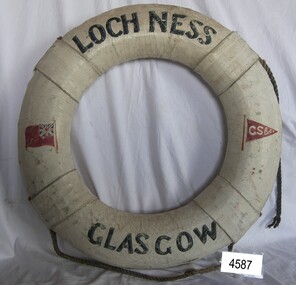
Equipment - Lifebuoy, Loch Ness, 1869-1909
... In 1926 the ship was sunk during gunfire practice by the 1922 built, light cruiser HMAS Melbourne, near Fremantle, Western Australia. ...In 1926 the ship was sunk during gunfire practice by the 1922 built, light cruiser HMAS Melbourne, near Fremantle, Western Australia. ...This lifebuoy bears the name of the ship, its origin, the shipping company and the red ensign. These details mean that the lifebuoy was part of the lifesaving equipment on the sailing ship the Loch Ness, part of the Glasgow Shipping Company’s Loch Line (G.S.C. on the red pennant) and a British-registered ship (the red flag with the Union Jack on it). Lifebuoys were part of the emergency lifesaving equipment carried on vessels in the late 19th and early 20th century. The ring was made of strips of cork wood joined together to make the ring shape then covered in canvas and sealed usually with white paint. Four evenly spaced canvas reinforcing bands would be added for strength and for a place to thread a rope or line. A lifebuoy, or life-preserver, is used as a buoyancy device often thrown to an endangered or distressed person in the water to keep them afloat while they receive help. It is usually connected by a rope to a person in a safe area such a nearby vessel or on shore. Lifebuoys is a made from a buoyant materials such as cork or foam and ae usually covered with canvas for protection and to make it easy to grip. The first use of life saving devices in recent centuries was by the Nordic people, who used light weight wood or cork blocks to keep afloat. Cork lifebuoys were used from the late 19th to early 20th century. Kapok fibre was then used as a filling for buoys but wasn’t entirely successful. Light weight balsa wood was used as a filler after WW1. In 1928 Peter Markus invented and patented the first inflatable life-preserver. By WW2 foam was combined with Kapok. Laws were passed over time that has required aeroplanes and water going-vessels to carry life-preservers on board. The ship LOCH NESS 1869-1922 … The ship Loch Ness, of Glasgow, was the same ship what William Carmichael sailed on to Australia when he laid the commemoration stone on behalf of his sister Eva and himself, dedicated to their parents, brothers and sisters. The family members lost their lives on June 1, 1878, when their ship, the Loch Ard, was wrecked at Mutton Bird Island in south west Victoria. Eva Carmichael was one of the two survivors from that shipwreck, the other 52 tragically lost their lives. The ship Loch Ness was a three-masted sailing ship built in 1869 for the Loch Line owned by the Glasgow Shipping Company. The line transported cargo and passengers from Glasgow, Scotland, to Australian ports. The Loch Ness was sold in 1908 to Stevedore & Shipping Co, Sydney for use as a coal hulk. In 1914 the Australian Government took over the ship for naval defence purposeless. In 1926 the ship was sunk during gunfire practice by the 1922 built, light cruiser HMAS Melbourne, near Fremantle, Western Australia. The lifebuoy is an example of equipment carried on vessels in the late 19th and early 20th century to help preserve life. There were many lives lost in Australia’s colonial period, particularly along the coast of South West Victoria. The lifebuoy is significant for its connection to the ship Loch Ness on which William Carmichael, brother of Eva Carmichael, travelled to lay a memorial to their parents and all of their other siblings who lost their lives in the Loch Ard disaster of 1878 near Peterborough, Victoria. Lifebuoy, round, cork filling inside canvas cover, painted white, with rope attached. Lifebuoy has printed name of vessel Loch Ness, Glasgow. Symbols of red flag with white initials G S Co. There is also a red ensign. "LOCH NESS", "GLASGOW" "G S Co" flagstaff hill, warrnambool, shipwrecked-coast, flagstaff-hill, flagstaff-hill-maritime-museum, maritime-museum, shipwreck-coast, flagstaff-hill-maritime-village, loch ness, loch ard, william carmichael, eva carmichael, lifebuoy, glasgow sailing ship, loch ness of glasgow, life rings, safety ring, life-saving buoy, ring buoy, life preserver, personal floating device, floatation device, safety equipment, g s c, glasgow shipping company, hmas melbourne, cruiser melbourne -
 Stawell Historical Society Inc
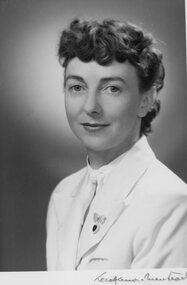
Photograph, Clare Best ne Kinsella and photos of farm
... Initially stationed at HMAS Harman in Canberra then Townsville Naval Radio Station Queensland and finally discharged at HMAS Lonsdale, Port Melbourne.. Clare married Keith Charles Best in 1946 also a Leading Telegraphist of HMAS Harman. ...Initially stationed at HMAS Harman in Canberra then Townsville Naval Radio Station Queensland and finally discharged at HMAS Lonsdale, Port Melbourne.. Clare married Keith Charles Best in 1946 also a Leading Telegraphist of HMAS Harman. ...7250 Clare Kinsella born 1907 c1940 -1 Clare Kinsella in navy Signals uniform c1943 -2 Clare Kinsella in navy Signals uniform c1943 -3 William Jennings Kinsella with stationery engine at farm Maya Park Lubeck -4 Clare Kinsella with dog Pencil at Magdala farm Lubeck -5 Clare Kinsella with dog Pencil at Station Creek Magdala Farm Lubeck -6 Clare Kinsella with dog Pencil at Magdala Farm Lubeck -7 Clare with child at Magdala Farm -8 Clare with pet cocky “Cocky” -9 Horse at farm -10 William Jennings Kinsella at 93 with ham radio Clare Best nee Kinsella Clare was born December 26, 1907 at “Eyrecourt” on the corner of Scallan and Ligar Streets in Stawell. Clare was the second child of William Jennings Kinsella and Sarah Kinsella nee Peardon. In 1910 the family moved to live at ‘Mayo Park” Lubeck. In 1920’s Mayo Park was sold and a new house was built on a farm nearby called “Magdala” after the mine in which Mr Kinsella’s family had been involved. Clare attended Lubeck State Public School with her older brother Tom, younger sister Carmel and youngest brother Bill. In 1941 Clare left the farm to join the Womens Royal Australian Navy. Her WRAN service number was WR/38 and in the 4 years of service had advanced to Leading Telegraphist. Initially stationed at HMAS Harman in Canberra then Townsville Naval Radio Station Queensland and finally discharged at HMAS Lonsdale, Port Melbourne.. Clare married Keith Charles Best in 1946 also a Leading Telegraphist of HMAS Harman. After they were married Keith was drafted up to Darwin while Clare worked at a Roman Catholic Mission on Melville Island where she had many adventures establishing a farm at the Mission. Keith was discharged in 1952 and they both worked establishing a Pineapple Farm/ General Store at Noonamah just out of Darwin. Later they moved to a remote farm on the Daily River but after 10 years and 7 years of constant floods they retired to Harvey Bay Queensland. Clare led an active life and died in 1999, her ashes are in the Jennings/Kinsella Vault in the Stawell Cemetery. B/W Photos -
 Flagstaff Hill Maritime Museum and Village
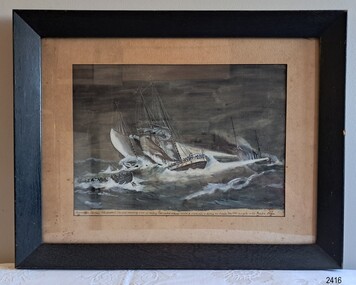
Print - Lithograph, sea rescue, R.N. Duffield, Australian cruiser “MELBOURNE” (Tons 5600) rescuing crew of sinking four-masted schooner “HELEN B. STERLING” of Halifax NS Canada, Tons 1343 in a gale in the Pacific Ocean, 19-11-1924
... ...HMAS Melbourne (1)...Sterling the Sterling American owned schooner Halifax Halifax N S Halifax Nova Scotia Nova Scotia Halifax N S Canada schooner windjammer sailing ship four-masted ship Captain George Harris George Harris Edith Harris Leslie Harris Sterling Shipping Line HMAS Melbourne HMAS Melbourne (1) cruiser HMAS Melbourne the Melbourne Australian Cruiser Captain Henry J Feakes Commander Wilfred Ward Hunt sinking ship shipwreck sea rescue gale cyclone 1922 rescue shipwreck rescue breeches buoy line rescue rescue line lifesaving cutter cutter Melbourne sea boat lifesaving crew 12-oar cutter shipwreck victim R.N. ...This framed lithograph print in watercolour and gouache was produced on November 19th, 1924, by 20th-century marine artist, Mr R.N. Duffield. It depicts the event of a sea rescue that took place two years earlier. The framer was A.L. Frith of Footscray, Melbourne, who actively advertised from 1933 to 1935. The now disbanded Shiplovers' Society of Victoria (1930-2018) donated the print, and it seems likely that this print was framed for that organisation. This graphic image shows the conditions in which the rescue from the wrecked Helen B. Sterling happened. Captain George Harris was master of the American-owned, four-masted windjammer. His wife Edith and their ten-year-old son Leslie were on board, along with a crew of fifteen seamen. The ship set off from Newcastle, NSW, on January 5th, 1922, loaded with a cargo of coal to deliver to the Society Islands and on to San Francisco. Young Leslie later wrote a lively school composition for his teacher about his experiences on board the Helen B Sterling. He tells of a fire that broke out the day after they departed and burned a hole in a beam. Then another troublesome time on the 9th, when a strong gale blew a sail off the ship. Finally, he tells of the highlight of his voyage when, on the 18th January, the ship was right in the path of a strong cyclone, which broke the mainmast. Huge waves crashed over both sides of the deck, meeting in the middle, and the ship began to sink. The rescue from the wreck was an exciting time for the young boy, and even more so when one of his cats survived after being carefully wrapped in a pillowcase and thrown down from the ship for the boy. Reporters later wrote about Leslie’s comments, “... what had grieved him most was the thought that he might never see his two little sisters again”. Captain Harris said in a published statement, “… the gale was the worst he had met in his 12 years’ experience at sea. All went well for the first week. We then encountered a strong blow from the south-east. We tried the gasoline pump, but the engine broke down, and we had to do the pumping by hand. We at once shortened sail, but the sea increased in fury to such an extent that men were washed from the pumps. I was below at 5:30 on Sunday morning [January 22nd, 1922] when the main mast went over the side, … I at once sent out SOS signals, and got word that HMAS Melbourne was coming to our assistance. I had made a mistake with regard to our position, but did not know it until 11:30 o’clock, when I sent out the correct location. This was picked up by the Melbourne and I received the following reply: “We will reach you about 2 am. Keep a good heart. The Melbourne will do all she can.” Our ship was practically awash when we were taken off.” (Ref: the ‘Helen B. Sterling Disaster’, Maitland Weekly Mercury, NSW, 4-2-1922.) Officers from the Royal Australian Navy, Captain Henry J Feakes (later Rear-Admiral) and Commander Wilfrid Ward Hunt, were on board the light cruiser, HMAS Melbourne (1913-1928), when it left Sydney for New Zealand. After the SOS was received, the ship sped at full steam towards the sinking Helen B. Sterling. They found the vessel at about midnight and shone bright search lights on the distressed ship to illuminate the desperate scene. The Melbourne was unable to move close to the schooner, so sixteen seamen, including Commander Hunt, volunteered to man the Melbourne’s lifesaving 12-oared cutter. They rowed the sea boat with great urgency towards the victims of the sinking ship, keen to save lives no matter what the conditions. When the cutter was close to the Sterling, a line was secured between the Sterling and the cutter. The weary, waterlogged and anxious men on board could be rescued, one at a time, in the breeches buoy equipment, which looked like canvas shorts with a lifesaving ring in the waistband. The victims were hauled along the line and pulled aboard by many willing hands. All eighteen crew and passengers were saved, including Captain Harris and his family. The seamen of the Melbourne received a heroes’ welcome when they arrived in New Zealand. The grateful survivors were taken to Auckland, where they received the care and comfort they needed. Melbourne’s Lord Mayor, Cr. Swanston, on behalf of the citizens of Melbourne, formally recognised the heroic rescue efforts of the seamen of the HMAS Melbourne on March 2nd, 1922, at a special presentation. Two large flags, a White Ensign and an Australian “Jack" Flag, were presented to the Captain of HMAS Melbourne, and souvenirs were awarded to the sea boat’s crew and its Commander, Wilfred Ward Hunt. Commander Hunt was also presented with an original watercolour depicting the heroic rescue from the wreck of the Helen B. Sterling, painted just after the event by renowned marine artist Arthur V Gregory (1867-1957), and he received a silver cigarette case bearing the City’s coat of arms and the inscription, "To Commander Ward Hunt from the Citizens of Melbourne as a memento of the rescue of the crew of Helen B. Stirling by H.M.A.S. Melbourne, on 23.1.22". Both the painting and the cigarette case are now treasured items inherited by his grandson; a reminder of “… a very fine naval gentleman who believed in leading by example." R.N. DUFFIELD: - The Lithograph print in our collection by 20th-century English artist R.N. Duffield is dated Nov. 19, 1924. It is very similar to, and possibly created from, the original A V Gregory watercolour presented to Commander Hunt and dated 1922. Mr R.N. Duffield has art works in the Yarmouth Museums, Norfolk Museums Collection; “Orient Liner Otranto …,” and "Convoy of six ships at sea", both painted in watercolour and gouache during the 1940s. Some of his other works, also painted in watercolour and gouache, have been advertised for sale on Internet sites. Some details differ between the original A.V. Gregory and this Lithograph Print: - -the words on the bow on the original watercolour are “Helen B. Sterling, Blain”, which is in Washington, USA, where the Sterling Shipping Company was registered from around 1919; the words on the print are “Helen B. Sterling, Halifax, N S”, for Nova Scotia, Canada, which is the hometown of Sterling Shipping Company founder’s wife, Helen B Sterling. -The watercolour is coloured and has fine details; the print is monochrome - The A V Gregory signed the watercolour in 1922, on the lower left; the print is signed with the Lithographer’s name on the lower right; “R N Duffield, Nov. 19. 1924” ARTHUR VICTOR GREGORY (1867-1957): - A.V. Gregory is a renowned marine artist who worked in watercolour and gouache. He painted actively between 1899 and 1932, creating over 3o0 works. South Melbourne, Victoria, was where he lived and worked. This Lithograph print is significant in that it depicts the rescuing of the passengers and crew of the schooner “Helen B Stirling”. At the time this was a significant event that made most Australian and New Zealand papers because of the involvement of the Australian cruiser “Melbourne”. The image demonstrates the perilous conditions experienced by seafarers. It includes an example of the line and breeches buoy method used to save lives at sea from the 1860s and into the 20th century. It reflects a time in our history when sail and steam ships cruised the world’s seas together, the former trading with a cargo of coal from Newcastle, the latter defending our country in World War I. The print is part of Flagstaff Hill Maritime Museum’s Collection of maritime artworks that depict famous events, vessels and locations, showing the evolution of sea craft, and aiding the interpretation of our maritime history. The Lithograph print is behind glass in a black painted timber frame and mounted under a cream matte. The vivid image depicts a sea rescue in progress. The night scene is illuminated by a light beaming from a steamship, the Cruiser HMAS Melbourne. It reveals figures on the deck of a sinking sailing ship, the schooner Helen B. Sterling, as foaming waves roll across it. The stricken ship has a broken main mast, and a sail has been detached. A small figure is floating in the choppy sea, secured in a breeches buoy that is attached to a rescue line between a lifesaving cutter and the sailing ship. The crewmen in the cutter are ready to haul the shipwrecked victim aboard, while the figures on the foundering ‘Sterling’ watch them. The print’s paper-covered wooden backboard is attached to the frame with small tacks. A metal hanging wire is secured to two dissimilar eyelet screws. Inscriptions include text on the bow of the sinking vessel, a handwritten title below the picture, and a handwritten name in the print’s lower right corner. On the reverse are two oval, black ink stamps and a round cream label with printed text. The hand-painted print was reproduced from a lithograph, signed in the lower right, by R.N. Duffield of England, on November 19th, 1924. A Frith of Footscray, Melbourne framed it. Painted on the ship’s bow: “HELEN B. STERLING / HALIFAX N S” [Nova Scotia, Canada] Handwritten below the print: “AUSTRALIAN CRUISER “MEMBOURNE” (Tons 5600) rescuing crew of sinking four-masted schooner “HELEN B. STERLING” of Halifax NS Canada, Tons 1343 in a gale in the Pacific Ocean.” Handwritten on lower right: “R.N. DUFFIELD / Nov. 19. 1924” (underlined) On paper label: “Phone: / Footscray 398 [some of the text has torn off] / “A. FRITH / PICTURE FRAMER / Manufacturer / 17 Paisley Street / Footscray.“ On both oval stamps: “SHIPLOVERS SOCIETY OF VICTORIA / LIBRARY” flagstaff hill, flagstaff hill maritime museum and village, warrnambool, maritime museum, maritime village, great ocean road, shipwreck coast, lithograph, lithograph print, reproduction print, helen b. sterling, the sterling, american owned schooner, halifax, halifax n s, halifax nova scotia, nova scotia, halifax n s canada, schooner, windjammer, sailing ship, four-masted ship, captain george harris, george harris, edith harris, leslie harris, sterling shipping line, hmas melbourne, hmas melbourne (1), cruiser hmas melbourne, the melbourne, australian cruiser, captain henry j feakes, commander wilfred ward hunt, sinking ship, shipwreck, sea rescue, gale, cyclone, 1922 rescue, shipwreck rescue, breeches buoy, line rescue, rescue line, lifesaving, cutter, cutter melbourne, sea boat, lifesaving crew, 12-oar cutter, shipwreck victim, r.n. duffield, marine artist, nov. 19. 1924, 20th century artist, a frith, footscray picture framer, shiplovers’ society of victoria, shiplovers’ society library, watercolour, a v gregory, arthur victor gregory, melbourne artist, newcastle coal, newcastle nsw, society islands, san fracisco, aukland new zealand, school composition, ship’s cat, sos signal, lord mayor cr. swanston, heroes, cigarette case -
 Mission to Seafarers Victoria
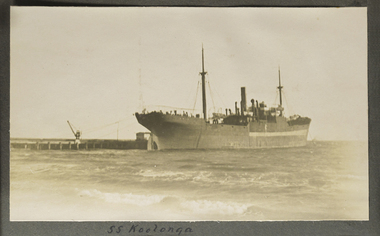
Photograph - Photograph, Sepia, SS Koolonga
... HMAS Koolonga was a cargo ship built by Sunderland Shipbuilding Company, England, in 1914 and bought by McIlwraith, McEacharn Line Pty Ltd, Melbourne and named SS Koolonga. ...HMAS Koolonga was a cargo ship built by Sunderland Shipbuilding Company, England, in 1914 and bought by McIlwraith, McEacharn Line Pty Ltd, Melbourne and named SS Koolonga. She was requisitioned by the Royal Australian Navy on 6 August 1914, as a collier and supply ship and commissioned as HMAS Koolonga. She participated during the Australian Naval and Military Expeditionary Force occupation of German New Guinea until May 1915 when she was later returned to her owners. After being returned, she was employed on cargo trades from Whyalla, South Australia to Newcastle, New South Wales. She was sold in October 1917 through Scott Fell & Company, Newcastle to BHP Shipping and renamed Iron Monarch, before being sold again in 1920 to Interstate Steamships Ltd. This ship linked to record VC 0747. The ship played a role in WW1 small black and white photograph of steamship. steam ships, world war 1, hmas koolonga, fan album, ss koolonga -
 Flagstaff Hill Maritime Museum and Village
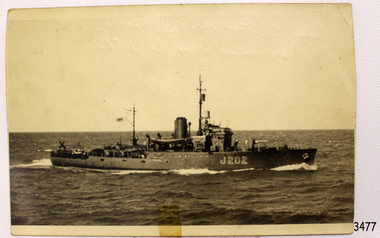
Photograph - Vessel, Steam Ship, H.M.A.S. Warrnambool J202, Between 1941-1947
... Its armament included 1 × 4 inch Mk XIX gun, 1 × 40 mm Bofors AA gun (installed later), 3 × 20 mm Oerlikon guns (1 later removed), machine guns and depth charge chutes and throwers. ...Its armament included 1 × 4 inch Mk XIX gun, 1 × 40 mm Bofors AA gun (installed later), 3 × 20 mm Oerlikon guns (1 later removed), machine guns and depth charge chutes and throwers. ...This photograph is connected to the first HMAS Warrnambool (J202), which was one of 60 Bathurst class corvette vessels built during World War II by Mort's Dock & Engineering Co Ltd of Sydney under the commission of the Royal Australian Navy (RAN). It was the namesake of the City of Warrnambool in Victoria. The armed minesweeper was 57 metres long and could had a complement of 85 personnel. Its armament included 1 × 4 inch Mk XIX gun, 1 × 40 mm Bofors AA gun (installed later), 3 × 20 mm Oerlikon guns (1 later removed), machine guns and depth charge chutes and throwers. It was launched in Sydney in May, 1941. The HMAS Warrnambool began service with patrols off Bass Strait in 1941. In December the ship docked in Warrnambool Harbour and the crew marched in a parade along Timor Street. The ship’s crew received a donation of 110 books from the Warrnambool Patriotic Fund, and a plaque of the City of Warrnambool’s Coat of Arms presented by the Mayor, Cr. John R Astbury. In September 1942 a Dutch East Indies family, Samuel and Annie Jacob and seven of their eight children, was rescued by the HMAS Warrnambool and evacuated to Darwin. The family settled in Melbourne, then in 1944 Samuel tragically died. After the war ended the family was threatened with deportation under Australia’s Immigration Restriction Act 1901 (known also as the White Australia policy). Annie married her landlord, John O’Keefe but was still issued a deportation order in 1949. The family appealed to the High Court and the case became famous for being the first successful legal challenge to the Act. The HMAS Warrnambool was in Darwin during the time it was bombed, attacked by the Japanese while rescuing 73 crew from a merchant vessel that had also been attacked. The ship was involved in several other rescues and carried troops to New Guinea. Other events included escort and patrol duties on Australia's east coast, then at Fremantle and back to Darwin. When the Japanese surrendered on September 11, 1945, at the end of World War II, the ship was at Timor. It performed mine clearance work around the Solomon Islands and New Guinea after the war. On 13th September 1947 the ship was sent to lead a flotilla at the Great Barrier Reef, off the Queensland coast. The mission was to clear the defensive British mines that were laid during1941-43 to protect Australia’s boarders. The HMAS Warrnambool hit a mine near Cockburn Reef, exploded and sank shortly afterwards. One of the 70 or so men on board was killed at the time and thirty-two men were badly injured; three of these also lost their lives. The four deceased were Victorian seamen. The wounded men were transferred by boats to the nearby HMAS Swan II, where the Swan’s and the Warrnambool’s doctors cared for them. The HMAS Swan II took the survivors to Cairns, and from there the men were flown by RAAF to either Brisbane or Sydney hospitals. The HMAS Warrnambool was the only RAN ship to be sunk by a mine, and the four who lost their livers were the last naval casualties from World War II. The ship’s wartime service was recognised by three honours. In May 1948 a number of items were recovered by Navy divers from the wreck of HMAS Warrnambool. The items included the ship’s bell (inscribed HMAS Warrnambool 1941) and the round plaque with the Seal of the Warrnambool City Council. In 1949 the plaque was returned to the Council, and the bell was donated to the Australian War Memorial. Further objects were recovered by the new owners of the wreck, Southern Cross Diving and Salvage, in 1972-75. A memorial plaque, honouring the memories of all those who served on the HMAS Warrnambool until is sunk on September 13 1947, was erected in Warrnambool on September 13, 1995. NOTE: (1)- The second HMAS Warrnambool (FCPB204), also the namesake of the City of Warrnambool, was built in 1980 in Cairns, one of fifteen Fremantle Class Patrol Boats ordered by the RAN. It was just over 41 metres long with a compliment of 22 personnel. It patrolled Australia’s northern waters for illegal fishing vessels. This vessel was decommissioned in 2005. (2)- There was also a steam and sail ship named the S.S. Warrnambool, built in 1892 in London and broken up in 1926. This photograph is significant for its association with Royal Australian Navy and its vessel, HMAS Warrnambool (j202). The HMAS Warrnambool played a nationally significant role in overturning Australia’s Immigration Restriction Act 1901 (colloquially known as the White Australia policy). The ship rescued, and brought to Australia, Samuel and Annie Jacob and their family after they evacuated Dutch East India. The family was threatened with deportation and made the first successful appeal to High Court regarding that Act. The HMAS Warrnambool has - Local significance for being the namesake of the City of Warrnambool - Local significance, having docked in Warrnambool Harbour - Local significance, the crew having paraded in Timor Street, Warrnambool - State significance for its first patrol being in Bass Strait. - National significance, being present in Timor at the Japanese surrender - National significance as part of Australia’s defence force history, being one of only four Bathurst class corvettes lost while in Australian service, the only Bathurst class corvette lost after World War II, the only RAN vessel to be sunk by a mine, and associated with the last four Navy deaths of WWII Black and white photograph of vessel H.M.A.S. Warrnambool J202 on an open sea. The identifying number is painted on the hull. The ship is flying a white ensign. A lifeboat is suspended near the centre of the ship. Figures can be seen on deck. Hand written inscription on the reverse side. On ship's hull "J202" On reverse of photo "From P.O. FRED MATTHEWS. 23378. R.A.N." "MARIBYRNONG MAIDSTON RSL" "H.M.A.S. WARRNAMBOOL" flagstaff hill, warrnambool, shipwrecked-coast, flagstaff-hill, flagstaff-hill-maritime-museum, maritime-museum, shipwreck-coast, flagstaff-hill-maritime-village, photograph, h.m.a.s. warrnambool, maritime village, maritime museum, shipwreck coast, mort's dock & engineering co ltd, hmas warrnambool, hmas warrnambool i, hmas warrnambool j202, hmas swan ii, j202, world war ii, bathurst class corvette, royal australian navy, ran, sydney built ship, bass strait patrol, sea mine patrol, mine sweeper, mine clearance, navy divers, great barrier reef, cockburn reef, southern cross diving and salvage, warrnambool city council, cr j r astbury, mayor j r astbury, warrnambool patriotic fund, seal, coat of arms, ship’s bell, hmas warrnambool 1941, shipwreck by sea mine 1947, sea rescue, life saving, lifesaving, sinking ship, sunk ship, immigration restrictions act 1901, white australia policy, samuel and annie jacob, john o'keere, minesweeper -
 Mission to Seafarers Victoria
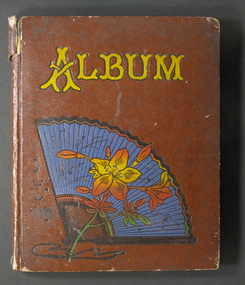
Album (item) - Photographic Album, 1928
... Picnic at Riversdale Hawthorn, 1 January 1928 Ships in Port Melbourne in November: HMAS Australia, HMAS Brisbane, and destroyers Anzac, Success, Swordsman Wharfs, Victoria Dock, Stevedores Picnic in Finhaven, Kew, the Buchan's Property for Cup Day (6 November) Views of Port Melbourne from 1888 building Monday 29 October: return of Archbishop of Melbourne (Dr. ...Picnic at Riversdale Hawthorn, 1 January 1928 Ships in Port Melbourne in November: HMAS Australia, HMAS Brisbane, and destroyers Anzac, Success, Swordsman Wharfs, Victoria Dock, Stevedores Picnic in Finhaven, Kew, the Buchan's Property for Cup Day (6 November) Views of Port Melbourne from 1888 building Monday 29 October: return of Archbishop of Melbourne (Dr. ...This album containing 50 photographs depicts a year at the Mission in 1928: Wedding of the Dora Walker with Harry Simpson on 14 February. Picnic at Riversdale Hawthorn, 1 January 1928 Ships in Port Melbourne in November: HMAS Australia, HMAS Brisbane, and destroyers Anzac, Success, Swordsman Wharfs, Victoria Dock, Stevedores Picnic in Finhaven, Kew, the Buchan's Property for Cup Day (6 November) Views of Port Melbourne from 1888 building Monday 29 October: return of Archbishop of Melbourne (Dr. Harrington Lees), who had spent a 10-month holiday in England with his wife. Arrival on the RMS Maloja Two photographs are missing. Pre Great Depression, 1928 was a difficult year in Melbourne and also for the Mission. Ships were rare on the wharfs meaning seamen were also rare in the missions. However they started the fundraising for the extension of the 1888 Port Melbourne building which was becoming too small. At the end of the year, Reverend Weller announced he was appointed assistant in London. He and his wife Alexina left in January 1929 after five years. They sailed on the Osterley on the 22 January 1929. Embossed yellow font on cover reads: ALBUM fan, strikes, police, reverend john reginald weller (1880-1969), alexina weller (nee caley), freda oxley, hmas australia, hmas brisbane, great depression, unemployment, port melbourne, station pier, sugar cane, queensland, dora simpson nee walker, weddings, cup day, finhaven, kew, the ducketts, mrs john buchan, flinders street extension, gasworks, wharfs, victoria dock, motorboat, southern cross, success, destroyers, football, sports, rms maloja, lhlg, fan album, anzac, swordsman, freda kathleen oxley 1882-1969, annie alexandrina caley (known as alexina) 1885-1934 -
 Mission to Seafarers Victoria
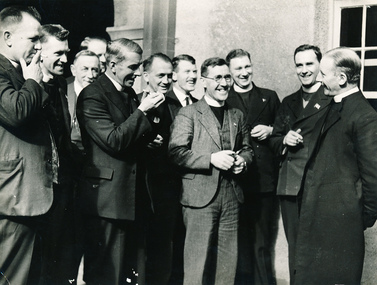
Photograph - Digital copy, Black and white, Herald Weekly Times, September 1936
... Clift (Fremantle) Frank Leslie Oliver served as chaplain at the Mission to Seafarers Melbourne for 30 years from 1930 - 1960, including time served as chaplain with the Royal Australia Navy aboard HMAS Australia. ...This photograph was taken at the Triennial Congress, Melbourne. Frank Leslie Oliver served as chaplain at the Mission to Seafarers Melbourne for 30 years from 1930 - 1960. He is in this photograph, second from right, with a cigarette in his hand. Also in this photograph, at the far right, is the Most Reverend F. Head, Archbishop of Melbourne. The photograph is a record of a historic conference of MTS representatives from Australia and New Zealand. , September 1-3 , 1936: Revd Wm Hoog (Brisbane) Revd W.H. Terry (Port Pirie) Revd H.C Cuthbertson (Adelaide) Revd W.R. Tyler (Melbourne) Mr J.W. Neill (Melbourne) Revd. F. J. Evans (Sydney) Revd Frank L. Oliver ( Melbourne MTS) F W Melbourne (Archbishop F W Head 1929- 1942) Mr J.C. Grahame (Hobart) Rev B.J. Williams ((Wellington NZ) Rev J.C. Clift (Fremantle) Frank Leslie Oliver served as chaplain at the Mission to Seafarers Melbourne for 30 years from 1930 - 1960, including time served as chaplain with the Royal Australia Navy aboard HMAS Australia. He was a live-in chaplain and was supported by his entire family, including wife Moira, for whom a memorial window exists in the chapel. The Chaplains' Conference was held in 1936. Black and white photograph of a group of chaplains outside the Mission to Seafarers building in Flinders Street, Melbourne. Frank Oliver is second from right holding a cigarette in his right hand. Top left in blue ink (written by Padre Oliver): Australian MTS, Chaplains gathered in Triennal Congress, with most Rev.J Head, Abp of Melbourne. Top right corner in black ink: prior to 1939 In black and blue ink some names: Archbishop Head, Dad, Bill Tyler Port Melbourne, Padre Williams Wellington, Pat Neil Layreader Faded stamp in pink ink: Herald Feature Service, Melbourne A sticker with: Ret to B Kent royal australian navy, mission to seafarers, anglican, frank leslie oliver, archbishop head, triennial conference, chaplains, herald newspaper, cigarette, robin kent, beverley kent nee oliver, chaplains conference, padre oliver, new zealand, pat neil, lay reader, bill tyler, port melbourne, reverend william wellington, chaplains group -
 Bendigo Military Museum
Financial record - PAY BOOK NAVY KOREAN ERA, C 1954
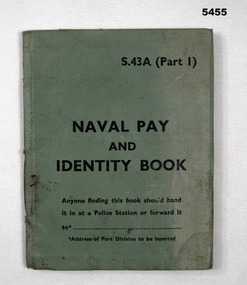
... HMAS Bataan and later HMAS Melbourne. Pay book stamped 1954. DVA File states Bataan Service is from 17.1.1952 - 25.9.1952 in Korea. ...NAVAL PAY AND IDENTITY BOOK ISSUED TO ALL PERSONNEL DETAILING ADMIN AND PAYROLL ISSUES RELATING TO PELL, James Leslie. (Born Bendigo) Stocker mechanic No 35213. HMAS Bataan and later HMAS Melbourne. Pay book stamped 1954. DVA File states Bataan Service is from 17.1.1952 - 25.9.1952 in Korea. Booklet- small, green in colour for cover, 29 pages yellow in colour, Naval stamp on the first inside page. Cover “S43A Part 1 Naval Pay and identity book Anyone finding this book should hand it in at a Police Station or forward to *…………………. *address of Port Division to be inserted.” pay book, identity, book -
 Bendigo Military Museum
Award - MEDAL SET WW2, Post 1945
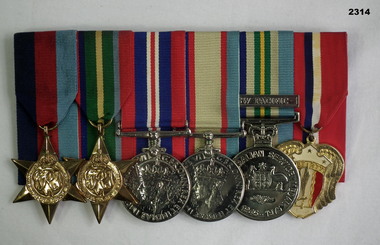
... Warick Niven Johanson No PM4958 (born Echuca, enlisted Port Melbourne) in the RAN on 9.9.42 aged 17 years 9 months. Posted to HMAS Australia February 1943. ...Warick Niven Johanson No PM4958 (born Echuca, enlisted Port Melbourne) in the RAN on 9.9.42 aged 17 years 9 months. Posted to HMAS Australia February 1943. Saw service through the Japanese Kamikaze attacks. At discharge from the RAN on 17.4.46 his rank was Signalman HMAS Lonsdale. Refer 2566P. Medal set, court mounted, set of (6) re W Johanson. 1. 1939-45 Star. 2. Pacific Star. 3. War medal 1939-45. 4. Australian Service Medal 1939 - 45 5. Australian Service Medal 1945-75 with clasp "SW PACIFIC" 6. Phillipines Liberation Medal. "PM4958 W.N.Johanson" medals, naval, history -
 Bendigo Military Museum
Uniform - UNIFORM, RAN, Government clothing factory, C.1939 - 45
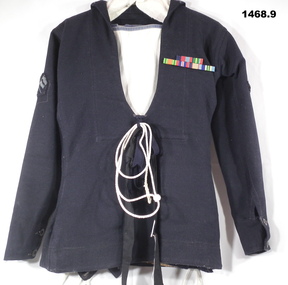
... Uniform issued to Keith Edward Daniel RAN No 25700, (born Bendigo, enlisted Melbourne) 25.2.1942 age 19 years, discharged 13.3.19146 with the rank of Coder at HMAS Lonsdale. uniforms - navy RAN .1) Naval Bib cotton with white & blue trim on neck .2) Tar Flap (blue/white stripe trim) .3) Pants / trousers black .4) Jacket black with service ribbons, service chevrons, right sleeve has crossed flags. .5) White lanyard, rope ..6) Back lanyard polyester .7) Navy hat white and black polyester trim with HMAS .8) .9) Pair of black boots. ...The sleeve patch is “Coder in Communications”. Uniform issued to Keith Edward Daniel RAN No 25700, (born Bendigo, enlisted Melbourne) 25.2.1942 age 19 years, discharged 13.3.19146 with the rank of Coder at HMAS Lonsdale. .1) Naval Bib cotton with white & blue trim on neck .2) Tar Flap (blue/white stripe trim) .3) Pants / trousers black .4) Jacket black with service ribbons, service chevrons, right sleeve has crossed flags. .5) White lanyard, rope ..6) Back lanyard polyester .7) Navy hat white and black polyester trim with HMAS .8) .9) Pair of black boots. uniforms - navy, ran -
 Queenscliffe Maritime Museum
Leisure object - Model MV Duntroon
... Model MV Duntroon Scale model of MV Duntroon Scale 1:48 Leisure object Model MV Duntroon ...The MV Duntroon was a 10,346 ton passenger liner built for the Melbourne Steam Ship Co. by Swan, Hunter & Wigham Richardson's yard, Newcastle-upon-Tyne, in 1935. One of the last purpose-built passenger & general cargo ships for the Australian coastal trade, the Duntroon was also known for its role as a troopship (1942-1949) and for the tragic incident on 20 November 1940 when she hit and sank the small auxiliary minesweeper HMAS Goorangai off Queenscliff with the loss of all 24 of Goorangai crew. This was the first RAN ship to be lost during the Second World War. Scale model of MV Duntroon Scale 1:48 model mv duntroon -
 Queenscliffe Maritime Museum
Domestic object - Crockery
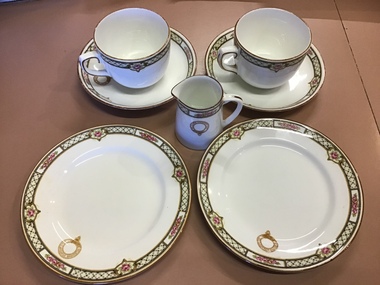
... Melbourne Steam Ship Co. by Swan, Hunter & Wigham Richardson's yard, Newcastle-upon-Tyne, in 1935. One of the last purpose-built passenger & general cargo ships for the Australian coastal trade, the Duntroon was also known for its role as a troopship (1942-1949) and for the tragic incident on 20 November 1940 when she hit and sank the small auxiliary minesweeper HMAS Goorangai off Queenscliff with the loss of all 24 of Goorangai's crew. ...The MV Duntroon was a 10,346 ton passenger liner built for the Melbourne Steam Ship Co. by Swan, Hunter & Wigham Richardson's yard, Newcastle-upon-Tyne, in 1935. One of the last purpose-built passenger & general cargo ships for the Australian coastal trade, the Duntroon was also known for its role as a troopship (1942-1949) and for the tragic incident on 20 November 1940 when she hit and sank the small auxiliary minesweeper HMAS Goorangai off Queenscliff with the loss of all 24 of Goorangai's crew. This was the first RAN ship to be lost during the Second World War. Crockery; 7 pieces from the Melbourne Steamship Co. off the MV Duntroon; 2 tea cups with saucers, 2 side plates, 1 small milk jug, floral border pattern Crest on front: Melbourne Steamship Co. Ltd. On base: C McD Mann and Co. Ltd. Hanley Staff, 101 Leadenhall St. London. Made in England mv duntroon, goorangai, melbourne steamship co ltd -
 Bendigo Military Museum
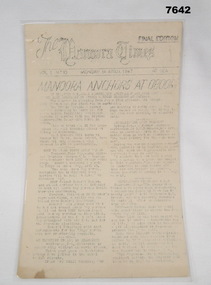
Document - THE MANOORA TIMES FINAL EDITION, c1947
... BCOF HMAS MANOORA Newsletter This is a single sheet of paper (foolscap size) dated No 10 Vol 1 14 April 1947. Text in black both sides. Side 1 - Headline - MANOORA ANCHORS AT 0800 HRS Sub Headlines - NO ELECTRIC TRAINS IN MELBOURNE, AUSTRALIA THE BEST COUNTRY, GENERATIONS TO CHANGE JAPAN. ...Item in the collection re the BCOF Association Collection, refer Cat No 7625. This is a single sheet of paper (foolscap size) dated No 10 Vol 1 14 April 1947. Text in black both sides. Side 1 - Headline - MANOORA ANCHORS AT 0800 HRS Sub Headlines - NO ELECTRIC TRAINS IN MELBOURNE, AUSTRALIA THE BEST COUNTRY, GENERATIONS TO CHANGE JAPAN. Side 2 - HEADLINE - CAPTAIN'S VARIED WAR CAREER Sub Headlines - EARLY JAP TREATY REQUIRED, MELBOURNE MAY BE AN AIR TERMINAL, DISPLAY AIRCRAFT IN TROUBLE, NEW PLANE NAMED COBB, SHIP'S STAFF GOSSIP. bcof, hmas manoora, newsletter -
 Bendigo Military Museum
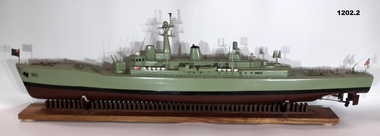
Craft - MODEL & BASE, HMAS SWAN
... Model of HMAS Swan built by Shipwright Charles Axiak. Original ship construction in Melbourne and entered service 1970. ...Model of HMAS Swan built by Shipwright Charles Axiak. Original ship construction in Melbourne and entered service 1970. Was a River Class Destroyer. Model maker worked in British Dockyards during WW2 and emigrated to Australia in 1955. He worked in Williamstown dockyards involved with construction of the Swan, 1. Model of River Class Destroyer. green in colour from water line. Black line and brown at bottom. Small Australian flag at front and naval flag at back. 2. Wooden stand, tailor made to hold the model of the 'Swan'. Brown in colour with long flat board and separate pieces of wood embedded in the base to make the cradle. High points of cradle covered by some white felt to protect boat. Bottom of stand has felt studs. "50" painted at front of boat. ships model, hmas swan -
 Bendigo Military Museum
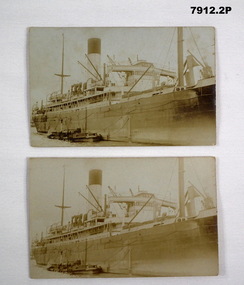
Photograph - PHOTOGRAPH, HMAS ULYSSES, WW1, c.1919
... HMAS ULYSSES 1. Handwritten in indelible pencil on back; “Taken at Cape Town 11/8/19, H.M.A.S. Ulysses left England 23 July 1919, at Port Melbourne, 2 Sept 1919” 1. ..."Robert H. Baron" returned to Australia on the HMAS Ulysses. He left England on 23 July 1919 and arrived at Port Melbourne 2 September 1919. Part of the Robert H Baron (3596) and Cooper Collections. See Catalogue No. 1981P for details of Baron's service. 1. Photograph of a ship berthed in a harbour. Tug boat next to ship on starboard side. Handwritten inscription on back. 2. Duplicate of 1, without inscription on back. 1. Handwritten in indelible pencil on back; “Taken at Cape Town 11/8/19, H.M.A.S. Ulysses left England 23 July 1919, at Port Melbourne, 2 Sept 1919” robert h. baron, cooper collection, hmas ulysses -
 Bendigo Military Museum
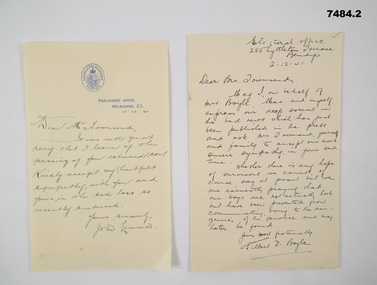
Letter - LETTERS of SYMPATHY, DEC 1941
... HMAS SYDNEY KIA WW2 MERVYN CLIVE TOWNSEND 1. Signed “John Lemmon”, Headed - Parliament House, Melbourne C1, and dated 11/12/41. 2. ...Letters of condolence written to parents of "M.C. Townsend" KIA on sinking of HMAS SYDDNEY on 15/11/41. Refer to Cat No. 2313P for Townsends service. 1. Handwritten letter of Sympathy from John Lemmon, Parliament House, Victoria. Stamp of Legislation Assembly, Victoria on top. 2. Handwritten letter from Electoral office, Bendigo to parents, on folded over white piece of paper. 1. Signed “John Lemmon”, Headed - Parliament House, Melbourne C1, and dated 11/12/41. 2. Signed “Tilbert J. Boyle”, Headed Electoral Office Bendigo and dated 2/12/41. hmas sydney, kia, ww2, mervyn clive townsend -
 Bendigo Military Museum
Card - CARDS, SYMPATHY, circa Dec 1941
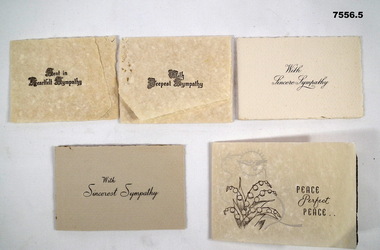
... HMAS SYDNEY HSK KORMORAN WW2 MERVYN CLIVE TOWNSEND 1. From Mr. & Mrs. John Owen, East Melbourne. 2. ...Messages in relation to the death of "Mervyn Clive Townsend" KIA on sinking of the HMAS SYDNEY by the HSK Kormoran on 15 Nov 1941. Refer Cat No. 2313P for Townsends service. Folded white Sympathy cards for Mervyn Townsend. Sizes ranging from 13 x 8 to 10 x 8 cm. 1. Folded three sheets with message in middle. Cover says sent in Heartfelt Sympathy. 2. Folded 3 sheets with message in middle and cover saying "With Deepest Sympathy". 3. Folded 2 sheets with message in middle and cover sheet saying "With Sincere Sympathy". 4. Folded 2 pieces with inside message and cover sheet saying "With Sincerest Sympathy". 5. Double folded sheet with message "Peace, perfect peace and dove flying over a sun and picture of Lilies all in black." 1. From Mr. & Mrs. John Owen, East Melbourne. 2. From Norma D. Young, Bendigo. 3. From Mr. & Mrs. J. L. Horne. 4. From E. Casey & sisters, Murrumbeena. 5. From Mr. & Mrs D.J. Treage, Balwyn. hmas sydney, hsk kormoran, ww2, mervyn clive townsend -
 Bendigo Military Museum
Card - CARDS, SYMPATHY, DEC 1941
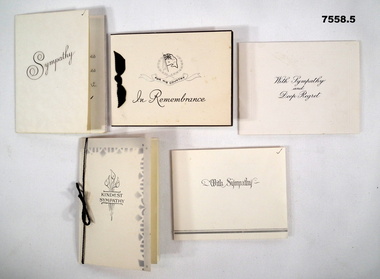
... HMAS SYDNEY HSK KORMORAN WW2 MERVYN CLIVE TOWNSEND 1. From Mr. & Mrs. C.L. Stewart, East Melbourne. 2. ...Sympathy cards for the death of "Mervyn Clive Townsend" KIA on 15/11/41 on the sinking of HMAS SYDNEY by HSK Kormoran. Refer No. 2313P for Townsends service. Small white folded sympathy cards. 1. Double folded sheet with message inside in black writing and "Sympathy" on front. 2. 4 page card tied with black ribbon with flag and wreath on front and "In Remembrance" . 3. Double folded sheet with message on front "With Sympathy and deep regret". 4. Four page card with black ribbon. On front "Kindest Sympathy" over top some flowers. 5. Double folded sheet with "Sympathy". 1. From Mr. & Mrs. C.L. Stewart, East Melbourne. 2. From Rosemary Graham, Wedderburn. 3. From Veda Ashford. 4. From Mr. & Mrs Cowling, Bendigo. 5. From C. M. Crum, Bendigo. hmas sydney, hsk kormoran, ww2, mervyn clive townsend -
 Sunshine and District Historical Society Incorporated
Photograph - Hellenic Prince Ship, Copy 27/01/2014 - (Original Post Card circa 1950)
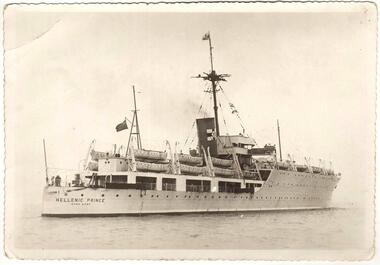
... THE ABOVE INFORMATION WAS COMPILED FROM; (1) http://en.wikipedia.org/wiki/HMAS_Albatross_(1928) (accessed 11/2/2013), (2) An article by Graeme Andrews found at http://www.afloat.com.au/afloat-magazine/2011/july-2011/The_boat_people_of_the _forties_and_fifties#.UuYY6ou4apo (accessed 27/1/14), (3) http://museumvictoria.com.au/collections/items/273166/newsletter-kangaroo-hellenic-prince-5-jan-1951 (accessed 27/1/14), (4) National Archive search starting at; www.naa.gov.au/collection/search/index.aspx (accessed 27/1/14), (5) http://www.flickr.com/photos/41311545@N05/3864781978 (accessed 29/1/14). ...In 1949 the HELLENIC PRINCE with its 3 hospitals, 2 cinemas, and air conditioned accommodation was chartered by the International Refugee Organisation to transport displaced persons from Europe to Australia. Its first trip was to Sydney where it arrived with 1000 passengers on 5 December 1949. On the third trip it left Naples on 23 March 1950, and arrived in Fremantle on 20 April 1950, and in Melbourne on 25 April 1950. The men and women were separated for the voyage with my father sleeping on a hammock in a large room with other men, while my mother, my brother, and I had bunks in a shared cabin. On board were displaced persons ex Bagnoli Camp Italy, some of whom later built their bungalows on the grassy and rocky paddocks near Sunshine Victoria, and began to establish a new life in a new country. A few of the families that arrived on the third trip and purchased land in the Dunkeld Ave - Sandford Ave area of North Sunshine (Birmingham Estate) were Janczak, Kolanowicz, Mroz, Pawlak, Rasztabiga, Skrobalak, Szydlowski, Witkowski, and Zielinski. Some friends settled elsewhere in Sunshine. The family Tabaka went to West Sunshine just over the Derby Rd Bridge, while the family Wojcik went to Ardeer. The ship first started service in 1929 for the Royal Australian Navy as the HMAS ALBATROSS. It had a standard displacement of 4,800 tons and was 443 feet 7 inches (135.2 metres) long, and its top speed during trials reached 22 knots (41 km/hr). It was built at Cockatoo Island Dockyard as Australia's first Aircraft Carrier (seaplanes), but the aircraft that it was designed for were retired just before the ship went into service. A new plane specifically designed to work with the Albatross began operations after the ship was decommissioned in 1933, and placed into reserve in Sydney Harbour. Seaplanes continued to operate from the anchored ship. (Click on the Link 'HMAS Albatross (1)' situated above the Object Registration number to view pictures of the HMAS Albatross on the Navy web site). In 1938 the ship was recommissioned and transferred to the Royal Navy as part payment for the light cruiser Hobart. The ship then did military service for the Royal Navy during World War 2. It did patrol and escort duties in the southern Atlantic, and from mid 1942 in the Indian Ocean. By early 1944 the ship was converted so that it could repair landing craft and other support vessels off Sword and Juno beaches. The ship managed to return 132 craft into service and to save 79 others from total loss. On 11 August 1944 Albatross was torpedoed with the loss of either 50 or 66 personnel, but was able to be towed back to Portsmouth. After repairs she did a short service as a minesweeper depot ship, and following that was placed into reserve on 3 August 1945. In August 1946 the ship was sold for commercial use but the plans to convert it into a luxury liner or a floating cabaret fell through. The ship was again sold on 14 November 1948 to the British-Greek Yannoulatos Group, who renamed it HELLENIC PRINCE in recognition of the birth of Prince Charles and his Greek heritage. After conversion into a passenger ship the Hellenic Prince made several trips to Australia transporting displaced persons, however apparently not all trips were pleasant for the passengers. In the on board newsletter 'Kangaroo' dated 5 January 1951, the ship's master P. C. King expressed his indignation about the behaviour of passengers and made accusations of mutiny. According to some immigrants the conditions were appalling and overcrowded with 1200 passengers. Passengers were supposedly required to work and were paid with Woodbine cigarettes. The drinking water ran out, the freezer broke down, and fresh food that was brought on board went to the crew. Sea sickness was rife because the ship was rarely level due to malfunctioning pumps. (The newsletter 'Kangaroo' can be viewed at the Museum Victoria web site by clicking the Link 'Newsletter - Kangaroo'). In 1953 during the Mau Mau uprising the Hellenic Prince was used to transport troops to Kenya, and in 1954 the ship came to an end in a scrap yard at Hong Kong. THE ABOVE INFORMATION WAS COMPILED FROM; (1) http://en.wikipedia.org/wiki/HMAS_Albatross_(1928) (accessed 11/2/2013), (2) An article by Graeme Andrews found at http://www.afloat.com.au/afloat-magazine/2011/july-2011/The_boat_people_of_the _forties_and_fifties#.UuYY6ou4apo (accessed 27/1/14), (3) http://museumvictoria.com.au/collections/items/273166/newsletter-kangaroo-hellenic-prince-5-jan-1951 (accessed 27/1/14), (4) National Archive search starting at; www.naa.gov.au/collection/search/index.aspx (accessed 27/1/14), (5) http://www.flickr.com/photos/41311545@N05/3864781978 (accessed 29/1/14). Hellenic Prince has a significance to Sunshine Victoria because some of the displaced people from Europe, who arrived in Melbourne on Anzac Day 1950, were among the first people to settle in the grassy and rocky paddock areas of North Sunshine. These settlers established a residential suburban area out of the paddocks. In those early days there were no services and the planned roads were basically just drawings on a map. The ship is also significant because it was named in recognition of the birth of Prince Charles. In the ship's former life as the HMAS Albatross the significance is that it was built in Australia as our country's first Aircraft Carrier (seaplanes). New photograph made from a scanned copy of a circa 1950 Post Card featuring the ship on calm water. Hellenic Prince / Hong Kong hellenic prince, migrant ship, displaced persons, refugees, international refugee organisation, bagnoli camp, hmas albatross, yannoulatos group -
 Geelong Naval and Maritime Museum
Ditty Box, John Kidd's Ditty Box, c.1915-1930
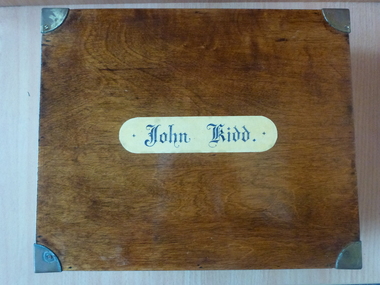
... There is no evidence of him having served on the HMAS Melbourne. Kidd served from 1911-1912 on the HMAS Parramatta, the first ship launched for the Royal Australian Navy (RAN). ...There is a single record with the RAN for a John Kidd, who commenced service in 1909 and left in 1912. Kidd was born in 1885 in Sydney and his mother lived in Queenscliff. He served on the HMAS Parramatta from 1911-1912. There is no evidence of him having served on the HMAS Melbourne. Kidd served from 1911-1912 on the HMAS Parramatta, the first ship launched for the Royal Australian Navy (RAN). A wooden box with mortise and tenon joins, brass fittings, circular handles, silver hinges and a name plate on the front. The box has a lift out section creating compartments. On the inside lid of the box is a postcard of the HMAS Melbourne surrounded by small rope decoration. A number of keepsakes are inside including a fidd for splicing ropes, a Capstan Wills tobacco tin, 3 postcards, a "Bengall Imperial" cut throat razor (T.R. Cadman & Sons, Sheffield England), black and white bakelite buttons with embossed crown and anchor and brass shank (either for war time or junior officers), gold naval buttons with embossed naval anchor and 2 piece shank (from a coat and cuffs), a bullet casing (Webley '45), a petty officers cloth badge (crossed anchors with a Crown), 4 shells, a good conduct badge (black with gold embroidery) and a red/brown vulcanized asbestos fibre fireproof dog- tag with rope attached. "John Kidd" on front of box. "20171" stamped on edge of box. Tobacco tin: "Medium/"Capstan"/Registered/Ready Rubbed Fine Cut Tobacco/-1 oz net weight when packed/W.D. & H.O. Wills/(Australia) Ltd., Sydney. Postcard: Main Street, Samarai. Postcard: Sydney from Lavender Bay Kerry (Copyright) Sydney. Postcard: "Docks showing cathedral, Bristol BL 193. Copyright Lilywhite (1932) Ltd, Sowerby Bridge". Buttons: "AUSTRALIA/Y6-298", "Buttons Ltd B'HAM mark trade" "AUSTRALIA Stokes & Son Melbourne". Bullet casing "WEB WRA 45". Dog-Tag may read "L/Ford" written in ink? ditty box, john kidd, dog-tag, wwi identification tag, lilywhite ltd, w.d & h.o wills, stokes & son melbourne, naval buttons, hmas melbourne -
 Brighton Historical Society
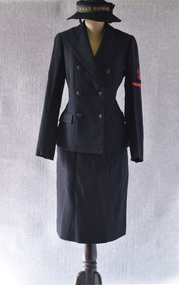
Uniform, WRANS uniform, 1942-1944
... HMAS Magnetic in Townsville. By the time Marion arrived in Townsville in 1944 it was very much a garrison town, inhabited largely by Australian and American servicemen. Whereas in Melbourne ...This uniform belonged to Marion Elaine Caffrey, nee Bullock (1920-1993). Marion was born and lived in Begonia Road, Gardenvale and attended Star of the Sea College with her younger twin sisters, Hilary and Margaret Bullock. Their family had been living in the district since 1892 when their grandfather, James Stewart, settled first at Brighton Beach before building a new home in Gardenia Road, Gardenvale in 1910. On leaving school, Marion took a job with the T&G Insurance Company in Collins Street. However, as the threat of invasion by Japan loomed closer following the bombing of Pearl Harbour and the fall of Singapore, in 1943 she volunteered to join Australia's war effort as part of the Women's Royal Australian Naval Service (WRANS). She initially trained as a coder at HMAS Cerberus, followed by a posting to HMAS Magnetic in Townsville. By the time Marion arrived in Townsville in 1944 it was very much a garrison town, inhabited largely by Australian and American servicemen. Whereas in Melbourne the war in the Pacific may have felt somewhat distant, in Townsville it was very immediate. Though the town was never subjected to the heavy bombardments of Darwin, a series of small air strikes in July 1942 had made the fear of air raids quite real. The naval base HMAS Magnetic was responsible for communications, Port Examination Services and servicing of Allied warships. Marion worked as a coder, encoding outgoing transmissions and decoding incoming ones either manually or using a Typex cipher machine. In 1945, she completed additional training to attain the rank of Leading Coder. Her keenness for the work is evident in a note on her service record: although no WRANS women were ever sent to active warzones, Marion volunteered for overseas service. Marion later recalled her time with the WRANS as one of the happiest and most personally fulfilling times of her life. Like many Australian women, she embraced the opportunity to serve her country and take on roles traditionally reserved for men. She completed her three years' service at HMAS Harman in Canberra where she was de-mobbed in 1946. Afterwards, she secured a job with Metro Goldwyn Mayer, where she worked until her marriage to Hugh Caffrey in 1947. Second World War WRANS uniform consisting of a dark navy blue serge blazer (.1), skirt (.2) and hat (.3). The blazer features six buttons. The left arm features a black patch embroidered with a red anchor wrapped in a length of rope (a fouled anchor) with a single red chevron beneath, denoting the rank of Leading Wran (equivalent to Leading Seaman). The right arm features a black patch embroidered with red crossed flags over the letter 'C'. The pencil skirt is lined and fastens at the side with a button and snap fastenings. The navy felt hat features a round brim and a black ribbon band machine embroidered in gold with the words "H.M.A.S. HARMAN". Maker's label in collar of blazer reads "N491 / 1942 / SIZE [indistinct] / MADE IN AUSTRALIA" The label features a pen inscription, "BULLOCK". Size label in back of skirt: "2". Label inside the hat: "N18 / 1944 Size 20½ / MADE IN AUSTRALIA" 1940s, marion elaine bullock, marion elaine caffrey, second world war, military uniform, wrans, women's royal australian naval service -
Moorabbin Air Museum
Drawing (Item) - HMAS Melbourne Model Ship Plans 1/96th scale
... HMAS Melbourne Model Ship Plans 1/96th scale...Drawing HMAS Melbourne Model Ship Plans 1/96th scale ... -
 Melbourne Legacy
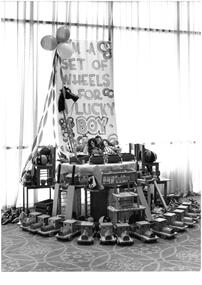
Photograph, Christmas gifts, c1966
... Melbourne Legacy held Christmas parties for junior legatees - the children of deceased servicemen, often hosted by the Governor at Government House. It came from a Legacy envelope marked P7, 1966. It was an early attempt at building an archive. The contents were described in red pen as: 1 Christmas Party / Govt House 2 Toy presentation Dept of Education 3 Residence Christmas party 3 HMAS...Melbourne Legacy held Christmas parties for junior legatees - the children of deceased servicemen, often hosted by the Governor at Government House. It came from a Legacy envelope marked P7, 1966. It was an early attempt at building an archive. The contents were described in red pen as: 1 Christmas Party / Govt House 2 Toy presentation Dept of Education 3 Residence Christmas party 3 HMAS ...Photo of a display of hand made toys (wooden trains, doll cribs, children's chairs, soft balls and dolls made by Victorian school children). Above them is a sign "I'm a set of wheels for a lucky boy". Appears to be gifts at a Christmas party for Junior Legatees. For many years Melbourne Legacy held Christmas parties for junior legatees - the children of deceased servicemen, often hosted by the Governor at Government House. It came from a Legacy envelope marked P7, 1966. It was an early attempt at building an archive. The contents were described in red pen as: 1 Christmas Party / Govt House 2 Toy presentation Dept of Education 3 Residence Christmas party 3 HMAS Cerberus / Operation Float / Operation Firewood (added in blue pen). (these other items will be items 00411 to 00416) A record of the items and events provided to Junior Legatees. Black and white photo of handmade toys. Stored in an envelope marked P7, listing it's contents in red pen and 1966 in pencil. christmas gifts, junior legatee outing -
 Melbourne Legacy
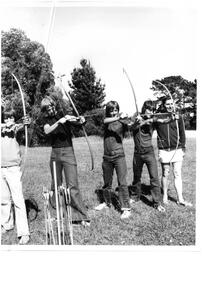
Photograph - Junior legatee outing, Archery, c1966
... Melbourne Legacy provided many activities and opportunities for junior legatees to participate in. It came from a Legacy envelope marked P7, 1966. The contents were described in red pen as: 1 Christmas Party / Govt House 2 Toy presentation Dept of Education 3 Residence Christmas party 3 HMAS Cerberus / Operation Float / Operation Firewood (added in blue pen). ...Melbourne Legacy provided many activities and opportunities for junior legatees to participate in. It came from a Legacy envelope marked P7, 1966. The contents were described in red pen as: 1 Christmas Party / Govt House 2 Toy presentation Dept of Education 3 Residence Christmas party 3 HMAS Cerberus / Operation Float / Operation Firewood (added in blue pen). ...Photograph of 4 teenage boys doing archery with an instructor.It appears to be an outing planned for junior legatees or as part of a camp. Melbourne Legacy provided many activities and opportunities for junior legatees to participate in. It came from a Legacy envelope marked P7, 1966. The contents were described in red pen as: 1 Christmas Party / Govt House 2 Toy presentation Dept of Education 3 Residence Christmas party 3 HMAS Cerberus / Operation Float / Operation Firewood (added in blue pen). (these other items will be items 00411 to 00416) A record of the items and events provided to Junior Legatees. Black and white photo of Junior Legatees doing archery. On reverse: stamped "Copyright The Herald and Weekly Times" in blue ink, and "P7 Legacy" in blue pen. Was stored in an envelope marked P7, listing it's contents in red pen and 1966 in pencil. junior legatee outing, camp, archery -
 Melbourne Legacy
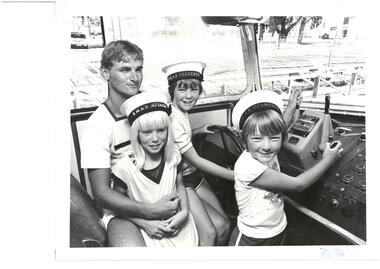
Photograph - Junior legatee outing, HMAS Cerberus
... The contents were described in red pen as: 1 Christmas Party / Govt House 2 Toy presentation Dept of Education 3 Residence Christmas party 3 HMAS Cerberus / Operation Float / Operation Firewood (added in blue pen). ...Photograph of 3 Junior Legatees with a crewman during an outing at HMAS Cerberus, possibly in the 1990s. It came from a Legacy envelope marked P7, 1966. The contents were described in red pen as: 1 Christmas Party / Govt House 2 Toy presentation Dept of Education 3 Residence Christmas party 3 HMAS Cerberus / Operation Float / Operation Firewood (added in blue pen). (these other items will be items 00411 to 00416) A record of the items and events provided to Junior Legatees. Black and white photo of Junior Legatees visiting HMAS Cerberus and a paper label. Stuck on paper label in black type "Junior Legatees from Melbourne Legacy and adjacent Clubs and Groups, look forward to and enjoy an annual visit to HMAS CERBERUS at Westernport. Shown as three Junior Legatees and a crewman from the Patrol Boat HMAS ATTACK during one of the visits". On reverse: "76%, P7 Legacy" in blue pen "Youth Activities (Welfare)" in pencil. Was stored in an envelope marked P7, listing it's contents in red pen and 1966 in pencil. junior legatee outing, operation float -
 Melbourne Legacy
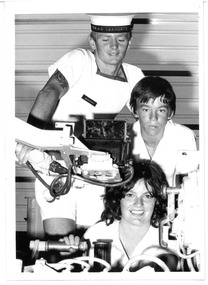
Photograph - Junior legatee outing, HMAS Cerberus, 1981
... HMAS Cerberus. It was published in the 1981 Annual Report with the caption: 'Melbourne Legacy acknowledges with gratitude the wide ranging and willing support of the Defence Services. ...HMAS Cerberus. It was published in the 1981 Annual Report with the caption: 'Melbourne Legacy acknowledges with gratitude the wide ranging and willing support of the Defence Services. ...Photograph of 2 Junior Legatees with a crewman during an outing at HMAS Cerberus. It was published in the 1981 Annual Report with the caption: 'Melbourne Legacy acknowledges with gratitude the wide ranging and willing support of the Defence Services. Shown with Able Seaman Paul Dunleavy during a tour of HMAS Cerberus as Junior Legatees Amanda Stains of Oak Park and Michael Kavanagh of Wodonga.' The photo came from a Legacy envelope marked P7, 1966. The contents were described in red pen as: 1 Christmas Party / Govt House 2 Toy presentation Dept of Education 3 Residence Christmas party 3 HMAS Cerberus / Operation Float / Operation Firewood (added in blue pen). (these other items will be items 00411 to 00416) A record of the items and events provided to Junior Legatees. Black and white photo of Junior Legatees visiting HMAS Cerberus. On reverse: "77%" in blue pen. Was stored in an envelope marked P7, listing it's contents in red pen and 1966 in pencil. junior legatee outing, operation float -
 Melbourne Legacy
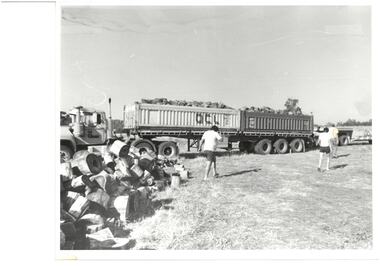
Photograph, Operation Firewood, c1966
... Melbourne by transport firms who provide trucks and drivers without charge. It came from a Legacy envelope marked P7, 1966. The contents were described in red pen as: 1 Christmas Party / Govt House 2 Toy presentation Dept of Education 3 Residence Christmas party 3 HMAS Cerberus / Operation Float / Operation Firewood (added in blue pen). ...Melbourne by transport firms who provide trucks and drivers without charge. It came from a Legacy envelope marked P7, 1966. The contents were described in red pen as: 1 Christmas Party / Govt House 2 Toy presentation Dept of Education 3 Residence Christmas party 3 HMAS Cerberus / Operation Float / Operation Firewood (added in blue pen). ...Photograph of a truck of firewood delivering wood for Operation Firewood, where firewood was delivered to widows. Some 400 tonnes of cut firewood was distributed amongst legacy Widows in the Melbourne Metropolitan Area this year (c1966). The firewood is collected by Cobram/Yarrawonga Group of Melbourne Legacy and transported free of charge to Melbourne by transport firms who provide trucks and drivers without charge. It came from a Legacy envelope marked P7, 1966. The contents were described in red pen as: 1 Christmas Party / Govt House 2 Toy presentation Dept of Education 3 Residence Christmas party 3 HMAS Cerberus / Operation Float / Operation Firewood (added in blue pen). (these other items will be items 00411 to 00416) A record of the work done to support widows. Black and white photo of a truck with a load of firewood and a paper label. Stuck on paper label says "Some 400 tonnes of cut firewood was distributed amongst legacy Widows in the Melbourne Metropolitan Area this year. The firewood is collected by Cobram/Yarrawonga Group of Melbourne Legacy and transported free of charge to Melbourne by transport firms who provide trucks and drivers without charge". Was stored in an envelope marked P7, listing it's contents in red pen and 1966 in pencil. operation firewood, widows -
 Melbourne Legacy
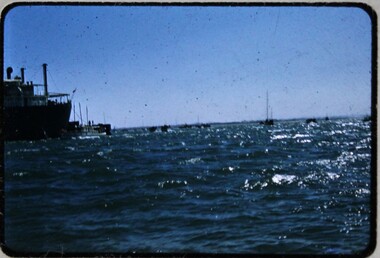
Slide, Operation Float 1957, 1957
... Imprinted in black ink '1' Colour slide of children gathered in a park in a red edged Kodachrome cardboard mount. ...A colour slide of boats on the ocean. It was Operation Float which was an event run by Melbourne Legacy to take Junior legatees on a boat outing. It could have been to naval boats such as HMAS Cerberus or to a Yacht club. It gave the junior legatees the opportunity to see a naval boat in action, spend time on the water or try sailing. In 1957 it appears to be several smaller boats taking small groups of children out on the bay. Was with many other slides taken in the 1950s and 1960s. The slides have been photographed to make digital images and moved to archive quality sleeves. In many cases the original images were not well focussed and the digital image the best available. A record of outings being organised for children. Colour slide of children gathered in a park in a red edged Kodachrome cardboard mount. Printed on reverse in red ink 'Kodachrome Transparency / Processed by Kodak'. Handwritten in blue ink 'Boats against a sparkling sea 8 / 1957'. Imprinted in black ink '1' operation float, junior legatee outings -
 Melbourne Legacy
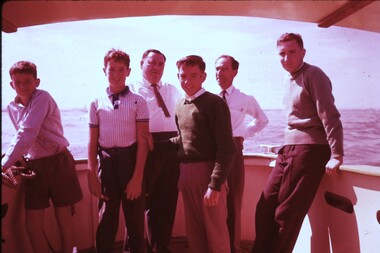
Slide, Operation Float 1961, 1961
... Embossed with slide number '1' in one corner. The other slide has slide number '12' embossed in one corner. ...Two colour slides of children and legatees on board a boat for Operation Float. Operation Float was an event run by Melbourne Legacy to take Junior legatees on an outing. It could have been to naval boats such as HMAS Cerberus or to a Yacht club. It gave the junior legatees the opportunity to see a naval boat in action, spend time on the water or try sailing. Part of a set of slides that are printed on Ektachrome and discoloured to a pink tinge. The year is possibly 1961 as one slide has the date on it. Was with many other slides taken in the 1950s and 1960s. The slides have been photographed to make digital images and moved to archive quality sleeves. In many cases the original images were not well focussed and the digital image the best available. A record of outings being organised for children. Colour slide x 2 of children and legatees on board a boat in Kodak Ektachrome cardboard mount with yellow and blue print. Printed on front 'Made in USA' in blue ink. Embossed with slide number '1' in one corner. The other slide has slide number '12' embossed in one corner. Printed on reverse "Kodak Ektachrome Transparency / Processed by Kodak" in blue ink. operation float, junior legatee outings
