
Showing 196 items matching "home builds"
-
 Moorabbin Air Museum
Book - Experimental aircraft, Incredible Flying Machines An Anthology of Eccentric Aircraft
... ...Home builds...Experimental aircraft Gliding Balloons Dreams/schemes & ideas Multiple winged aircraft Tailless aircraft Canard aircraft Flying saucers Flying cars Gyrocopters VTOL aircraft Pack away aircraft & jet packs Airborne aircraft carriers Extra large aircraft Pedal powered aircraft Home builds Overview of experimental aircraft circa 1980 Incredible Flying Machines An Anthology of Eccentric Aircraft Book Experimental aircraft ...Overview of experimental aircraft circa 1980non-fictionOverview of experimental aircraft circa 1980gliding, balloons, dreams/schemes & ideas, multiple winged aircraft, tailless aircraft, canard aircraft, flying saucers, flying cars, gyrocopters, vtol aircraft, pack away aircraft & jet packs, airborne aircraft carriers, extra large aircraft, pedal powered aircraft, home builds -
 Whitehorse Historical Society Inc.
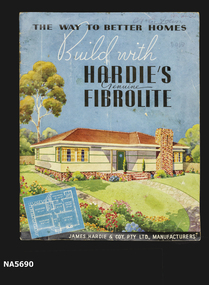
Booklet - Build with Hardie's Fibrolite
... Booklet ' The way to Better Homes - Build with Hardie's Genuine Fibrolite'. ...Building material The Way for Better Homes Booklet ' The way to Better Homes - Build with Hardie's Genuine Fibrolite'. ...Booklet contains information on the use of fibrolite material.Booklet ' The way to Better Homes - Build with Hardie's Genuine Fibrolite'. Booklet contains photos and description of use of fibrolite.The Way for Better Homesbuilding material -
 Old Colonists' Association of Ballarat Inc.
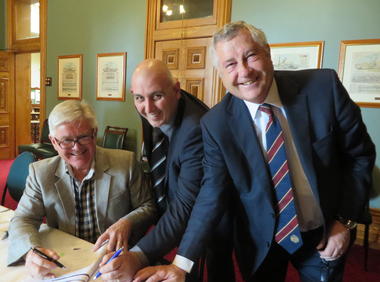
Photograph - Colour, Clare Gervasoni, Old Colonists' Association Inc. Officer Bearers, 2016, 10/11/2016
... Officer Bearers, on the occasion of signing the contract to build additional homes for elderly at Charles Anderson Grove, Ballarat. ...Officer Bearers, on the occasion of signing the contract to build additional homes for elderly at Charles Anderson Grove, Ballarat. ...Photograph of three men, the Old Colonists' Association Inc. Officer Bearers, on the occasion of signing the contract to build additional homes for elderly at Charles Anderson Grove, Ballarat. Left to right: Andrew Tweedie (President), Jamie Sleep (Vice-President) and Andrew Robson (Secretary).old colonists' association ballarat, charles anderson grove, andrew tweedie, jamie sleep, andrew robson -
 Sunshine and District Historical Society Incorporated
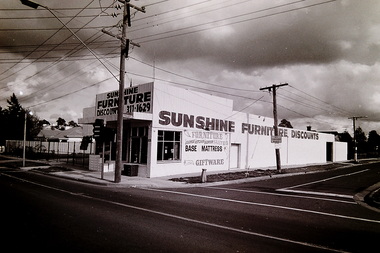
Photograph - Sunshine Furniture Discounts 105 Anderson Road Sunshine 1991 Photographs, Sharon Cavanagh, 15th September 1991
... It wasn’t a boutique showroom, it was a practical, affordable, no‑nonsense place where people bought the furniture they needed to build their homes....It wasn’t a boutique showroom, it was a practical, affordable, no‑nonsense place where people bought the furniture they needed to build their homes. The significance of the store comes from how it supported the nearby community by providing practical, affordable, no‑nonsense furniture. ...Sunshine Furniture Discounts was one of those classic west‑side discount furniture shops that served Sunshine’s working‑class and migrant families from the late 1970s through the 1990s. It wasn’t a boutique showroom, it was a practical, affordable, no‑nonsense place where people bought the furniture they needed to build their homes.The significance of the store comes from how it supported the nearby community by providing practical, affordable, no‑nonsense furniture.Sunshine Furniture Discounts 105 Anderson Road Sunshine 1991 222.2sunshine furniture discounts, anderson road, sunshine -
 Warrnambool and District Historical Society Inc.
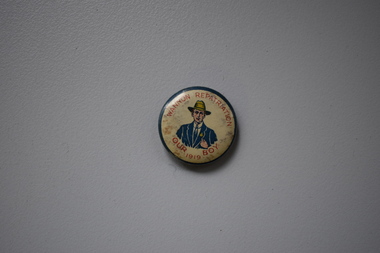
Badge, Wannon Repatriation Our Boy 1919, 1919
... The scheme included assistance to soldiers with loans to set up businesses and build homes. ...The scheme included assistance to soldiers with loans to set up businesses and build homes. This badge is retained as an example of a local effort to assist Australian soldiers returning from active service in World War One. ...This badge has been produced and sold to raise funds to assist Australian soldiers returning from active service in World War One. At the end of the war the Wannon and Corangamite Territorial Repatriation Scheme was set up to assist returning soldiers to adapt to civilian life. It is presumed that similar schemes were established in other electorates in Australia. Wannon is the name of a Federal electorate in the south west of Victoria and includes Warrnambool and the name on the badge may be an abbreviation of the fuller name mentioned above or an offshoot of the above organization. The scheme included assistance to soldiers with loans to set up businesses and build homes. This badge is retained as an example of a local effort to assist Australian soldiers returning from active service in World War One. This is a metal badge with a blue outer rim and an image on a cream background of a young man in a blue jacket and brown hat. The printing is in red. Wannon Repatriation Our Boy 1919world war one, history of warrnambool, badge, wannon and corangamite territorial repatriation scheme -
 Kew Historical Society Inc
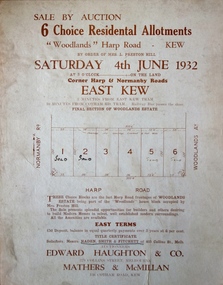
Plan - Subdivision Plan, 6 Choice Residential Allotments: East Kew, 1932
... The emphasis in the promotion of the subdivision was that it provided purchasers with splendid opportunities ‘to build modern homes in select, well established modern surroundings’. ...The emphasis in the promotion of the subdivision was that it provided purchasers with splendid opportunities ‘to build modern homes in select, well established modern surroundings’. ...Prue Sanderson, in her groundbreaking ‘City of Kew Urban Conservation Study : Volume 2 - Development History’ (1988), summarised the periods of urban development and subdivisions of land in Kew. The periods that she identified included 1845-1880, 1880-1893, 1893-1921, 1921-1933, 1933-1943, and Post-War Development. These periods were selected as they represented periods of rapid growth or decline in urban development. An obvious starting point for Sanderson’s groupings involved population growth and the associated economic cycles. These cycles also highlighted urban expansion onto land that was predominantly rural, although in other cases it represented the decline and breakup of large estates. A number of the plans in the Kew Historical Society’s collection can also be found in other collections, such as those of the State Library of Victoria and the Boroondara Library Service. A number are however unique to the collection.Subdivision plans are historically important documents used as evidence of the growth of suburbs in Australia. They frequently provide information about when the land was sold on which a built structure was subsequently constructed as well as evidence relating to surveyors and real estate and financial agents. The numerous subdivision plans in the Kew Historical Society's collection represent working documents, ranging from the initial sketches made in planning a subdivision to printed plans on which auctioneers or agents listed the prices for which individual lots were sold. In a number of cases, the reverse of a subdivision plan in the collection includes a photograph of a house that was also for sale by the agent. These photographs provide significant heritage information relating house design and decoration, fencing and household gardens.The mansion Woodlands in Harp Road, East Kew suffered the death of a thousand cuts. In its case, the cuts were subdivisions. Previous subdivisions of the mansion and its grounds were given titles such as ‘The Eastlawn Estate’ (MAP.0055), whereas at the end, the subdivision called it as it was, naming itself the ‘final section of the Woodlands Estate’ when it was put up for auction in 1932. The emphasis in the promotion of the subdivision was that it provided purchasers with splendid opportunities ‘to build modern homes in select, well established modern surroundings’. As with other subdivisions in the interwar period, transport links were emphasised. The six residential lots cut Woodlands off from Harp Road. When the vendor, Louisa Rachel Preston Hill, was to die at Woodlands in 1937 aged 86 her address was given as Normanby Road.subdivision plans - kew, woodlands estate -
 Eltham District Historical Society Inc
Photograph, 68 Mount Pleasant Road, Eltham, c.1983, 1983
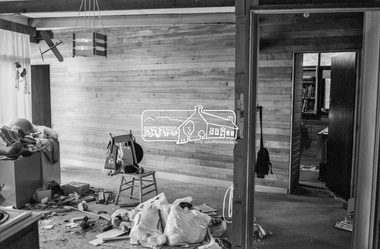
... An early Alistair Knox design and build, this home was purchased by George Coop in 1968. ...An early Alistair Knox design and build, this home was purchased by George Coop in 1968. ...An early Alistair Knox design and build, this home was purchased by George Coop in 1968. Eltham builder, Graham Rose, extended the original Alistair Knox structure over the foundation excavation dug by George. Graham organised the brick walls where required, raised all frame work and laid the steel tray roof. George did all external/internal wall cladding, made all opening windows, sliding and swinging doors, stairs and general interior timber cabinet work. Bedroom wardrobe doors came from scrapped Victorian Railways country coaches. Most of the timbers used in the extension were re-purposed from the Templestowe Cool Store and the Port Melbourne wool, hide & skin store.Digital TIFF file Scan of 35mm Ilford XP1 black and white transparencyalistair knox design, eltham, graham rose, houses, mount pleasant road -
 Eltham District Historical Society Inc
Photograph, 68 Mount Pleasant Road, Eltham, c.1983, 1983
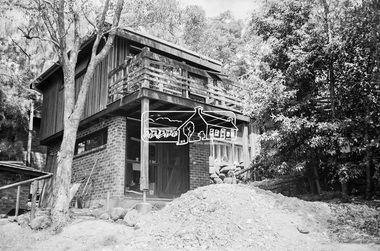
... An early Alistair Knox design and build, this home was purchased by George Coop in 1968. ...An early Alistair Knox design and build, this home was purchased by George Coop in 1968. ...An early Alistair Knox design and build, this home was purchased by George Coop in 1968. Eltham builder, Graham Rose, extended the original Alistair Knox structure over the foundation excavation dug by George. Graham organised the brick walls where required, raised all frame work and laid the steel tray roof. George did all external/internal wall cladding, made all opening windows, sliding and swinging doors, stairs and general interior timber cabinet work. Bedroom wardrobe doors came from scrapped Victorian Railways country coaches. Most of the timbers used in the extension were re-purposed from the Templestowe Cool Store and the Port Melbourne wool, hide & skin store.Digital TIFF file Scan of 35mm Ilford XP1 black and white transparencyalistair knox design, eltham, graham rose, houses, mount pleasant road -
 Eltham District Historical Society Inc
Photograph, 68 Mount Pleasant Road, Eltham, c.1983, 1983
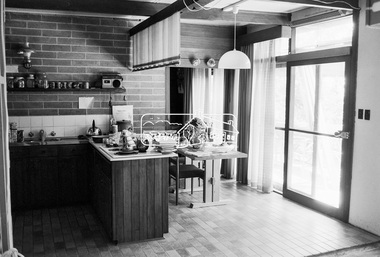
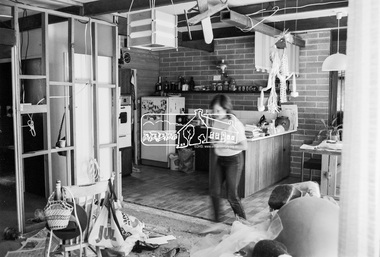
... An early Alistair Knox design and build, this home was purchased by George Coop in 1968. ...An early Alistair Knox design and build, this home was purchased by George Coop in 1968. ...An early Alistair Knox design and build, this home was purchased by George Coop in 1968. Eltham builder, Graham Rose, extended the original Alistair Knox structure over the foundation excavation dug by George. Graham organised the brick walls where required, raised all frame work and laid the steel tray roof. George did all external/internal wall cladding, made all opening windows, sliding and swinging doors, stairs and general interior timber cabinet work. Bedroom wardrobe doors came from scrapped Victorian Railways country coaches. This particular view shows the original Alistair Knox design and materials. The photo was taken where the original external wall was located and knocked down to add the extension.Digital TIFF file Scan of 35mm Ilford XP1 black and white transparencyalistair knox design, eltham, graham rose, houses, mount pleasant road -
 Eltham District Historical Society Inc
Photograph, 68 Mount Pleasant Road, Eltham, c.1983, 1983
... An early Alistair Knox design and build, this home was purchased by George Coop in 1968. ...An early Alistair Knox design and build, this home was purchased by George Coop in 1968. ...An early Alistair Knox design and build, this home was purchased by George Coop in 1968. Eltham builder, Graham Rose, extended the original Alistair Knox structure over the foundation excavation dug by George. Graham organised the brick walls where required, raised all frame work and laid the steel tray roof. George did all external/internal wall cladding, made all opening windows, sliding and swinging doors, stairs and general interior timber cabinet work. Bedroom wardrobe doors came from scrapped Victorian Railways country coaches. Most of the timbers used in the extension were re-purposed from the Templestowe Cool Store and the Port Melbourne wool, hide & skin store.Digital TIFF file Scan of 35mm Ilford XP1 black and white transparencyalistair knox design, eltham, graham rose, houses, mount pleasant road -
 Flagstaff Hill Maritime Museum and Village
Vehicle - Wagon, Circa 1909
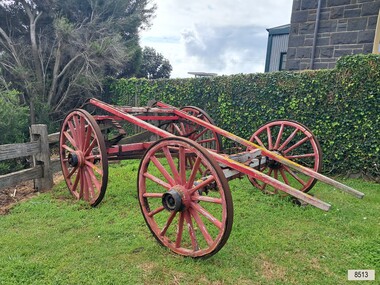
... Having never married, Singh left his estate to his four nephews, enabling them to buy land and build homes; one later installed a memorial plaque in his honour. ...Having never married, Singh left his estate to his four nephews, enabling them to buy land and build homes; one later installed a memorial plaque in his honour. ...This wagon was used in towns across south-west Victoria during the first half of the twentieth century by Pooran Singh, an Indian-born immigrant. Singh arrived in Australia alone in 1899 at the age of 30. The following year, at the Colac Licensing Court in western Victoria, he was one of 78 hawkers granted a Hawker’s Licence. According to the Colac Herald, all but two of the applicants appeared to be Asian. While some hawkers registered horse-drawn carts, Singh was one of nineteen licensed to trade on foot, selling door to door. Applicants were encouraged to contribute to a collection for the Colac Hospital. Over time, Pooran Singh came to own his own wagon—a top-of-the-range light delivery vehicle—and a horse named Prince. His work often took him along rough country roads, and for a period, he worked in the Corryong district of north-eastern Victoria, an area popular with hawkers. In September 1909, near Thowgla, he was thrown from his wagon while attempting to navigate a deep rut and was run over by one of its wheels. Although he suffered bruising to his chest, his injuries were not serious. The following year, he was granted a Hawker’s Licence in Corryong. By 1916, Singh was living and working at Garvoc in western Victoria, where that year, he lost his paper licence on Cooramook Road, and he placed a notice in The Standard. In 1918, at the Warrnambool Petty Sessions Court, he was one of four applicants granted renewal of their hawkers’ licences, and each donated ten shillings to Warrnambool Hospital. Throughout these years, Singh became well known to farmers and their families as he travelled across Victoria’s Western District, living and working from his covered wagon. In his later years, Pooran Singh formed a close friendship with John Jandes Moore and his wife, Vera, of Russells Creek, Warrnambool. They offered him the use of their property as a base for his travels and cared for him during his final illness. John Moore was later appointed one of the two executors of Singh’s will. Pooran Singh died in Warrnambool on 8 June 1947, aged 77. His final wish was to be cremated and for his ashes to be returned to India for immersion in the Ganges. The cremation was arranged by Guyett’s Funerals in Warrnambool. Having never married, Singh left his estate to his four nephews, enabling them to buy land and build homes; one later installed a memorial plaque in his honour. In the late 1980s, Guyett’s Funerals placed his ashes in the niche wall at Warrnambool Cemetery as a memorial, while continuing to hope that family instructions might eventually arrive. Nearly 63 years after his death, renewed enquiries brought public attention to the long and respectful care given to his ashes. As a result, the renowned Indian cricketer Kapil Dev travelled to Warrnambool to collect them and escort them to India, helping to fulfil Singh’s final wish. He was joined by one of Singh’s grand-nephews, Harmel Uppal, who had travelled from England. At a formal ceremony on 25 July 2010 commemorating Singh’s life, the ashes were handed to Dev and Uppal, and local resident Avis Quarrell, who had known Singh as a child, read a poem she had written in his memory. She still owned a shell necklace that Singh had made for her mother. Some Warrnambool locals who had been closely involved also travelled to India, where they joined Uppal’s family from the village of Uppal Bhopa, near Jalandhar. On 31 July 2010, Pooran Singh’s ashes were immersed in the Ganges, fulfilling the wish he had expressed more than six decades earlier. After Pooran Singh’s death, his horse and wagon remained on John Moore’s property. When Prince died, he was buried on the beach at Warrnambool. The wagon remained with the Moore family and was occasionally used as a cubby house. In about 1997, John Moore, the son of John Jandes Moore, donated it to Flagstaff Hill. After restoration, the wagon became an attraction in the village, where volunteer Pat and his Clydesdale horse, Duke, offered visitors rides around Flagstaff Hill’s lake. This wagon is significant for its association with an Indian emigrant who used it to earn an income in Australia. It also reflects the vital role of hawkers, who travelled through rural and regional communities in the late nineteenth and early twentieth centuries, supplying food, goods and news. The wagon is also historically significant as a former Flagstaff Hill attraction, offering visitors the experience of horse-drawn rides around the lake.Wagon: a light delivery vehicle once used as a hawker's wagon. It is a four-wheel, horse-drawn vehicle with iron tyres, brakes, spoked wheels painted red with decorative yellow strips on the hubs, a timber shaft, and springs on the undercarriage. It was once a covered wagon, fitted with green, wooden sideboards, a front seat with leather-padded backrest and mounting steps. The late-19th to early-20th-century wagon was once owned by Pooran Singh, a local Indian hawker. flagstaff hill, warrnambool, maritime village, maritime museum, flagstaff hill maritime museum and village, shipwreck coast, great ocean road, southwest victoria, northwest victoria, western district, colac, colac hospital, colac licensing court, thowgla, corryong, garvoc, cooramook road, warrnambool petty sessions court, warrnambool hospital, russells creek road, ganges, warrnambool cemetery, uppal bhopa, jalandhar, hawker’s licence, covered wagon, wagon, hawker's wagon, horse-drawn cart, hawker's cart, light delivery vehicle, hawker, travelling salesman, travelling hawker, door-to-door sales, rural salesman, rural commerce, prince, duke, clydesdale horse, 1997, pooran singh, indian immigrant, pat, john james moore, vera moore, john and vera moore, john moore, guyatt’s funerals, kapil dev, harmel uppal, avis quarrell -
 Flagstaff Hill Maritime Museum and Village
Decorative object - Bookends, ca. 1930s
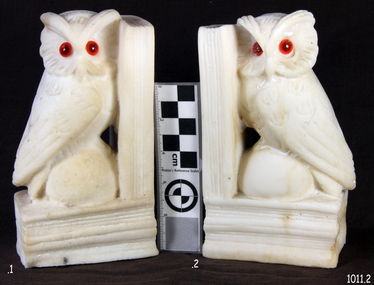
... home. It was included among the limited items brought by many immigrants to Australia. Books became more available and affordable to the public by the end of the nineteenth century and households and businesses were able to build their own libraries. ...The pair of ornamental white resin owl bookends was likely made around the 1930s when epoxy resin became available. Bookends modelled on owls have been a popular ornament for many years, possibly because of the association between owls, books and wisdom. They are used and displayed in places where books are appreciated and valued, such as homes, libraries, educational buildings, business offices, legal institutions and banks. Bookends hold a row of upright books in place by supporting the beginning and end of the row. The books are more likely to keep their integrity when stored vertically. The first patent for a metal bookend was placed by William Stebbins Barnard in 1877. Bookends became useful and decorative items around the middle of the sixteenth century after printed books became available. At that time books were expensive and treasured possessions, treated with much respect. Even in the early nineteenth century, a Bible was often the only book in the home. It was included among the limited items brought by many immigrants to Australia. Books became more available and affordable to the public by the end of the nineteenth century and households and businesses were able to build their own libraries. Bookends were used then, and are still used now, to keep books organised, cared for, and readily accessible. Bookends, a pair of two (2) small white resin owls with clear bright red eyes standing on a stack of books, their bodies facing towards each other, chests on an upright book, heads turned towards the viewer. The ends are left and right-handed.flagstaff hill, flagstaff hill maritime museum and village, warrnambool, maritime museum, maritime village, great ocean road, shipwreck coast, ornament, bookend, bookends, pair of bookends, library, book storage, book display, room decoration, resin ornament, white bookends, owl bookends, owl ornament, white owls, resin owls, book support, bookend patent, william stebbins barnard -
 Flagstaff Hill Maritime Museum and Village
Artwork, other - Wall decoration, late 19th century
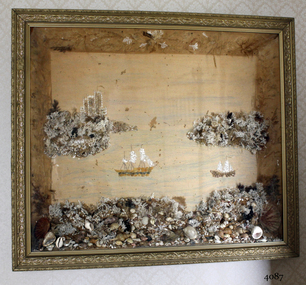
... These items mostly came from the simple home of Vera’s parents-in-law, Henry Giles and his wife Mary Jane (nee Freckleton), whose photos are in the parlour. They married in 1880. Henry Giles was born at Tower Hill in 1858. He was a labourer on the construction of the Breakwater before leaving in 1895 to build...These items mostly came from the simple home of Vera’s parents-in-law, Henry Giles and his wife Mary Jane (nee Freckleton), whose photos are in the parlour. They married in 1880. Henry Giles was born at Tower Hill in 1858. He was a labourer on the construction of the Breakwater before leaving in 1895 to build ...This unusual wall decoration was created by Anna Wilson (nee Henry), daughter of pioneer John Stephenson Henry, who arrived in Australia from Ireland with his children in 1851. Family documents confirm that Anna most probably made the diorama for her sister-in-law, who married a member of the Giles family. The diorama was later given to Vera Giles who was a family friend and possibly related to Anna’s sister-in-law by marriage. The diorama is now part of the Giles Collection. Anna married William Wilson in 1860, who had arrived in Australia from County Tarrane in about 1850, aged 19. In 1869 they moved to their new property called ‘Glenlyall’ in Cooramook, north of Grassmere, Victoria, where he lived for 49 years until his death in 1918. He left behind a family of four sons and a daughter. The Giles Family There are many 19th century items of furniture, linen and crockery donated to Flagstaff Hill Maritime Village by Vera and Aurelin Giles. The items are associated with the Giles Family and are known as the “Giles Collection”. These items mostly came from the simple home of Vera’s parents-in-law, Henry Giles and his wife Mary Jane (nee Freckleton), whose photos are in the parlour. They married in 1880. Henry Giles was born at Tower Hill in 1858. He was a labourer on the construction of the Breakwater before leaving in 1895 to build bridges in N.S.W. for about seven years. Mary Jane was born in 1860 at Cooramook. She attended Mailor’s Flat State School where she was also a student teacher before, as family legend has it, she became a governess at “Injemiara” where her grandfather, Francis Freckleton, once owned land. Henry and Mary’s family of six, some of whom were born at Mailor’s Flat and later children at Wangoom, lived with their parents at Wangoom and Purnim west, where Henry died in 1933 and Mary Jane in 1940. The family of the creator Anna Wilson nee Henry and her husband William Wilson are of significance to the early history of Victoria and the South West of Victoria in particular, being pioneer families who farmed the land, built the towns and cities and contributed to their communities. The Giles family collection has social significance at a local level, because it illustrates the level of material support the Warrnambool community gave to Flagstaff Hill when the Museum was established. Wall decoration, diorama with decorative gild frame and glass front. The 3-dimensional seascape includes sailing boats, land and sea, all made from materials such as shells, coral and seaweed. The work was made by Anna Wilson. It is part of the Giles Collection.Noneflagstaff hill, warrnambool, shipwrecked-coast, flagstaff-hill, flagstaff-hill-maritime-museum, maritime-museum, shipwreck-coast, flagstaff-hill-maritime-village, giles collection, henry giles, tower hill, cooramook, warrnambool breakwater, mailor’s flat, wangoom, 19th century household goods, 19th century decor, 19th century handcraft, handcraft, wall hanging, diorama of a seascape -
 Flagstaff Hill Maritime Museum and Village
Furniture - Wardrobe, Late 19th to early 20th Century
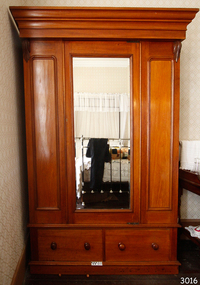
... These items mostly came from the simple home of Vera's parents-in-law, Henry Giles and his wife Mary Jane (nee Freckleton), whose photos are in the parlour. They married in 1880. Henry Giles was born at Tower Hill in 1858. He was a labourer on the construction of the Breakwater before leaving in 1895 to build...These items mostly came from the simple home of Vera's parents-in-law, Henry Giles and his wife Mary Jane (nee Freckleton), whose photos are in the parlour. They married in 1880. Henry Giles was born at Tower Hill in 1858. He was a labourer on the construction of the Breakwater before leaving in 1895 to build ...The original owner of the beautiful wardrobe was William Swinton Jr. (1860-1929) and was later given to a friend of the Giles family. It is part of the Giles Collection. William Swinton Jnr. was a Warrnambool Councilor 1903-20 and Mayor 1917-19, during which time Warrnambool declared a City (1918). William's father, William Swinton Snr. (c.1831-1901) arrived in Warrnambool in 1854 from Edinburgh, Scotland. He established the Swinton store in Timor Street in 1865 where it is still located. William Snr's grand-daughter, Doris Swinton (1904-1986) was one of Australia's most highly decorated nurses of World War 2 and for 16 years matron of the Warrnambool and District Base Hospital. There is a street in Warrnambool named after the Swinton family. The Giles Collection: There are many 19th century items of furniture, linen, and crockery donated to Flagstaff Hill Maritime Village by Vera and Aurelin Giles. The items are associated with the Giles Family and are known as the "Giles Collection". These items mostly came from the simple home of Vera's parents-in-law, Henry Giles and his wife Mary Jane (nee Freckleton), whose photos are in the parlour. They married in 1880. Henry Giles was born at Tower Hill in 1858. He was a labourer on the construction of the Breakwater before leaving in 1895 to build bridges in N.S.W. for about seven years. Mary Jane was born in 1860 at Cooramook. She attended Mailor's Flat State School where she was also a student teacher before, as a family legend has it, she became a governess at "Injemiara" where her grandfather, Francis Freckleton, once owned land. Henry and Mary’s family of six, some of whom were born at Mailor’s Flat and later children at Wangoom, lived with their parents at Wangoom and Purnim west, where Henry died in 1933 and Mary Jane in 1940. The wardrobe is also significant for its association with early Warrnambool history, being owned by William Swinton Jnr. who was a Warrnambool Councilor and Warrnambools first Mayor (1917-19) the son of an early colonial family, arriving in Warrnambool in 1854. The Giles family collection also has social significance at a local level, because it illustrates the level of material support the Warrnambool community gave to Flagstaff Hill when the Maritime Museum was established.Wardrobe, colonial, made of cedar wood. The doors of the wardrobe have a mirrored door between them and there are two large drawers below the doors, each drawer has two round wooden handles. The wardrobe was once owned by a William Swinton Jnr. It is now part of the Giles Collection.Noneflagstaff hill, warrnambool, shipwrecked-coast, maritime-museum, shipwreck-coast, flagstaff-hill-maritime-village, wardrobe, bedroom furniture, domestic furniture, william swinton jnr., warrnambool's first mayor, warrnambool mayor, giles collection, henry giles, tower hill, cooramook, warrnambool breakwater, mailor’s flat, wangoom, 19th century furniture, doris swinton, swinton street warrnambool -
 Flagstaff Hill Maritime Museum and Village
Container - Tin, C. 1910 - 1930
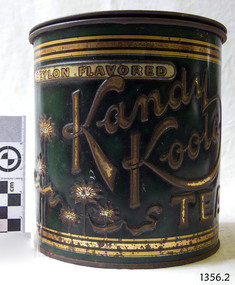
... These items mostly came from the simple home of Vera’s parents-in-law, Henry Giles and his wife Mary Jane (nee Freckleton), whose photos are in the parlour. They married in 1880. Henry Giles was born at Tower Hill in 1858. He was a labourer on the construction of the Breakwater before leaving in 1895 to build...These items mostly came from the simple home of Vera’s parents-in-law, Henry Giles and his wife Mary Jane (nee Freckleton), whose photos are in the parlour. They married in 1880. Henry Giles was born at Tower Hill in 1858. He was a labourer on the construction of the Breakwater before leaving in 1895 to build ...This Kandy Koola Tea tin dates to the early 20th century and was made and sold in Melbourne, Victoria. It once belonged to the Giles family. About Kandy Koola Kandy Koola ran an advertisement in the West Gippsland Gazette on 2 May 1911 promoting its tea as perfect for a picnic. The text reads “Picnicing. All as hungry as hunters – made a fire of small twigs – put on our billy of fresh spring water – and waited. Soon bubble, bubble, bubble and the billy boiled. In goes the pure Kandy-Koola Tea. Tea! Tea is not the word – it tasted like nectar! One cup, two cups, three cups – then had to make a fresh billy full. Lazed away the rest of the day sipping our Kandy Koola and chatting. How good indeed! “All grocers sell Kandy Koola Tea. It is pure leaf, selected and blended with the greatest care and skill. Ask your grocer for Kandy Koola. Sold in three grades, i.e. red, blue and green packets” About the Giles Family There are many 19th century items of furniture, linen and crockery donated to Flagstaff Hill Maritime Village by Vera and Aurelin Giles. The items are associated with the Giles Family and are known as the “Giles Collection”. These items mostly came from the simple home of Vera’s parents-in-law, Henry Giles and his wife Mary Jane (nee Freckleton), whose photos are in the parlour. They married in 1880. Henry Giles was born at Tower Hill in 1858. He was a labourer on the construction of the Breakwater before leaving in 1895 to build bridges in N.S.W. for about seven years. Mary Jane was born in 1860 at Cooramook. She attended Mailor’s Flat State School where she was also a student teacher before, as family legend has it, she became a governess at “Injemiara” where her grandfather, Francis Freckleton, once owned land. Henry and Mary’s family of six, some of whom were born at Mailor’s Flat and later children at Wangoom, lived with their parents at Wangoom and Purnim west, where Henry died in 1933 and Mary Jane in 1940. The Giles family collection has social significance at a local level, because it illustrates the level of material support the Warrnambool community gave to Flagstaff Hill when the Museum was established. The tin and the tea that was in the container are significant for their association with the Australian and Victorian food industry, being blended and packed by John Connell and Co, Proprietary Limited Melbourne.Container; tin, for Kandy Koola Tea, part of the Giles Collection. Round tin, green background, gold band on top and bottom, printed on gold background. Ceylon flavoured tea. Also five gold flowers of various sizes with scalloped band, large golden inscription “Kandy Koola Tea” and “Ceylon Flavoured” and “Blended and packed by John Connell & Co Pty Ltd Melbourne” “Kandy Koola Tea” and “Ceylon Flavoured”and and “Blended and packed by John Connell & Co Pty Ltd Melbourne”. Printed on lower band “MADE AND PRINTED BY WILSON BROS. NORTH MELB.” “1LBS NETT”flagstaff hill, warrnambool, shipwrecked-coast, flagstaff-hill, flagstaff-hill-maritime-museum, maritime-museum, shipwreck-coast, flagstaff-hill-maritime-village, giles family, 19th century domestic items, tea, tea merchant, tea tin, food and beverages, giles collection, henry giles, tower hill, warrnambool breakwater, mailor’s flat, wangoom, 19th century household goods, metalcraft, tinware, kandy koola tea -
 Flagstaff Hill Maritime Museum and Village
Furniture - Linen Chest, First half of the 19th Century
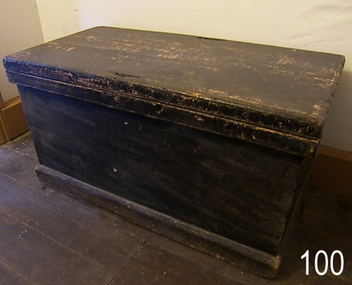
... Many items in the Lighthouse Keeper’s Cottage were donated by Vera and Aurelin Giles and mostly came from the home of Vera’s parents-in-law, Henry Giles and his wife Mary Jane (nee Freckleton) who married in 1880 and whose photos are on display in the parlour. Henry was born at Tower Hill in 1858, and was a labourer on the construction of the Warrnambool Breakwater before leaving in 1895 for around seven years to build bridges in NSW. ...Many items in the Lighthouse Keeper’s Cottage were donated by Vera and Aurelin Giles and mostly came from the home of Vera’s parents-in-law, Henry Giles and his wife Mary Jane (nee Freckleton) who married in 1880 and whose photos are on display in the parlour. Henry was born at Tower Hill in 1858, and was a labourer on the construction of the Warrnambool Breakwater before leaving in 1895 for around seven years to build bridges in NSW. ...This chest came from County Cavan, North Ireland, with Jane Fleming, when she migrated to Australia arriving at Port Fairy in approximately 1863. Jane Flemming was about 6 or 7 years old at the time and later was to become the mother of Mary Jane Giles (nee Flemming). This chest is one of many 19th century items of furniture, linen and crockery donated to Flagstaff Hill Maritime Village by, Vera and Aurelin Giles. The items are associated with Warrnambool and the Giles Family history. Items donated by the family have come to be known as the “Giles Collection”. Many items in the Lighthouse Keeper’s Cottage were donated by Vera and Aurelin Giles and mostly came from the home of Vera’s parents-in-law, Henry Giles and his wife Mary Jane (nee Freckleton) who married in 1880 and whose photos are on display in the parlour. Henry was born at Tower Hill in 1858, and was a labourer on the construction of the Warrnambool Breakwater before leaving in 1895 for around seven years to build bridges in NSW. Mary Jane was born in 1860 at Cooramook and she attended Mailor’s Flat State School and where she eventually was to become a student teacher. After which she became a governess at “Injemiara” where her grandfather, Francis Freckleton, had once owned land. Henry and Mary’s family consisted of six, some of the children were born at Mailor’s Flat and later some children at Wangoom. They lived with their parents at Wangoom and Purnim west, and this is where Henry died in 1933 and Mary Jane in 1940.The chest is of historical significance as an example of an early piece of furniture brought to Australia by Jane Flemming when she migrated to Australia during the mid 19th century. The chest is associated with the Giles family as Jane later was to become the mother Of Mary Jane Giles (nee Flemming). The Giles family collection is of social and historical significance at a local level, because it not only illustrates the level of material support the Warrnambool community gave to Flagstaff Hill during it’s establishment. But the Giles collection also gives us today a snapshot into what domestic life was like in early colonial times prior to Federation. Linen chest wood construction with hinged lid and lock. Hinges are brass. Painted black. ( Giles Collection)Noneflagstaff hill, warrnambool, shipwrecked coast, flagstaff hill maritime museum, shipwreck coast, flagstaff hill maritime village, wooden chest, cabin trunk, giles collection, henry giles, tower hill, cooramook, mailor’s flat, wangoom, 19th century household goods, jane flemming, mary jane giles, linen chest -
 Flagstaff Hill Maritime Museum and Village
Furniture - Double Bed, Late 19th to early 20th centuries
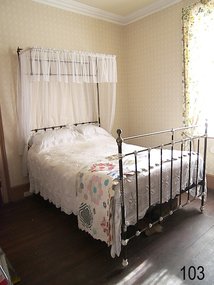
... These items mostly came from the simple home of Vera’s parents-in-law, Henry Giles and his wife Mary Jane (nee Freckleton), whose photos are in the parlour. They married in 1880. Henry Giles was born at Tower Hill in 1858. He was a labourer on the construction of the Breakwater before leaving in 1895 to build...These items mostly came from the simple home of Vera’s parents-in-law, Henry Giles and his wife Mary Jane (nee Freckleton), whose photos are in the parlour. They married in 1880. Henry Giles was born at Tower Hill in 1858. He was a labourer on the construction of the Breakwater before leaving in 1895 to build ...There are many 19th century items of furniture, linen and crockery donated to Flagstaff Hill Maritime Village by Vera and Aurelin Giles. The items are associated with the Giles Family and are known as the “Giles Collection”. These items mostly came from the simple home of Vera’s parents-in-law, Henry Giles and his wife Mary Jane (nee Freckleton), whose photos are in the parlour. They married in 1880. Henry Giles was born at Tower Hill in 1858. He was a labourer on the construction of the Breakwater before leaving in 1895 to build bridges in N.S.W. for about seven years. Mary Jane was born in 1860 at Cooramook. She attended Mailor’s Flat State School where she was also a student teacher before, as family legend has it, she became a governess at “Injemiara” where her grandfather, Francis Freckleton, once owned land. Henry and Mary’s family of six, some of whom were born at Mailor’s Flat and later children at Wangoom, lived with their parents at Wangoom and Purnim west, where Henry died in 1933 and Mary Jane in 1940. The Giles family collection has social significance at a local level, because it illustrates the level of material support the Warrnambool community gave to Flagstaff Hill when the Museum was established.Double Bed metal frame with design on posts and chrome knobs at bed end. Head has canopy that hangs from tall frame. Wood, wire sprung mattress base sits on metal frame.Noneflagstaff hill, warrnambool, shipwrecked coast, flagstaff hill maritime museum, great ocean road, double bed, canopy bed, metal frame bed, giles collection, henry giles, cooramook, mailor’s flat, wangoom, 19th century household goods -
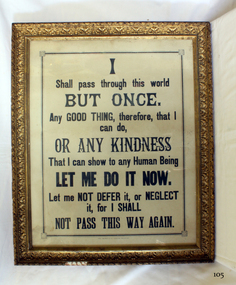 Flagstaff Hill Maritime Museum and Village
Decorative object - Wall Decoration, Late 19th to early 20th centuries
... These items mostly came from the simple home of Vera’s parents-in-law, Henry Giles and his wife Mary Jane (nee Freckleton), whose photos are in the parlour. They married in 1880. Henry Giles was born at Tower Hill in 1858. He was a labourer on the construction of the Breakwater before leaving in 1895 to build...These items mostly came from the simple home of Vera’s parents-in-law, Henry Giles and his wife Mary Jane (nee Freckleton), whose photos are in the parlour. They married in 1880. Henry Giles was born at Tower Hill in 1858. He was a labourer on the construction of the Breakwater before leaving in 1895 to build ...There are many 19th century items of furniture, linen and crockery donated to Flagstaff Hill Maritime Village by Vera and Aurelin Giles. The items are associated with the Giles Family and are known as the “Giles Collection”. These items mostly came from the simple home of Vera’s parents-in-law, Henry Giles and his wife Mary Jane (nee Freckleton), whose photos are in the parlour. They married in 1880. Henry Giles was born at Tower Hill in 1858. He was a labourer on the construction of the Breakwater before leaving in 1895 to build bridges in N.S.W. for about seven years. Mary Jane was born in 1860 at Cooramook. She attended Mailor’s Flat State School where she was also a student teacher before, as family legend has it, she became a governess at “Injemiara” where her grandfather, Francis Freckleton, once owned land. Henry and Mary’s family of six, some of whom were born at Mailor’s Flat and later children at Wangoom, lived with their parents at Wangoom and Purnim west, where Henry died in 1933 and Mary Jane in 1940. The Giles family collection has social significance at a local level, because it illustrates the level of material support the Warrnambool community gave to Flagstaff Hill when the Museum was established.Wall decoration gilded gold ornate frame under glassPrinted proverb+ with Varied type face each line.warrnambool, shipwrecked coast, flagstaff hill maritime museum, wall decoration, print of proverb, scripture decoration, giles collection, henry giles, tower hill, cooramook, warrnambool breakwater, mailor’s flat, wangoom, 19th century household goods -
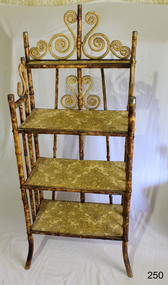 Flagstaff Hill Maritime Museum and Village
Furniture - Shelves, A. Englander & Searle, Late 19th Century (1898)
... Many of the items of furniture, linen and crockery in the Lighthouse Keeper’s Cottage were donated by Vera and Aurelin Giles and mostly came from the simple home of Vera’s parents-in-law, Henry Giles and his wife Mary Jane (nee Freckleton) whose photos are in the parlour. They married in 1880. Henry, born at Tower Hill in 1858, was a labourer on the construction of the Breakwater before leaving in 1895 to build bridges in N.S.W. for about seven years. ...Many of the items of furniture, linen and crockery in the Lighthouse Keeper’s Cottage were donated by Vera and Aurelin Giles and mostly came from the simple home of Vera’s parents-in-law, Henry Giles and his wife Mary Jane (nee Freckleton) whose photos are in the parlour. They married in 1880. Henry, born at Tower Hill in 1858, was a labourer on the construction of the Breakwater before leaving in 1895 to build bridges in N.S.W. for about seven years. ...This music stand set of shelves is one of many 19th century items of furniture, linen and crockery donated to Flagstaff Hill Maritime Village by, Vera and Aurelin Giles. The items are associated with the Giles Family and are known as the “Giles Collection”. Many of the items of furniture, linen and crockery in the Lighthouse Keeper’s Cottage were donated by Vera and Aurelin Giles and mostly came from the simple home of Vera’s parents-in-law, Henry Giles and his wife Mary Jane (nee Freckleton) whose photos are in the parlour. They married in 1880. Henry, born at Tower Hill in 1858, was a labourer on the construction of the Breakwater before leaving in 1895 to build bridges in N.S.W. for about seven years. Mary Jane was born in 1860 at Cooramook. She attended Mailor’s Flat State School where she was also a student teacher before, as family legend has it, she became a governess at “Injemiara” where her grandfather, Francis Freckleton, once owned land. Henry and Mary’s family of six, some of whom were born at Mailor’s Flat and later children at Wangoom, lived with their parents at Wangoom and Purnim west, where Henry died in 1933 and Mary Jane in 1940. THE SHELVES During the years 1869-1935 there were well over 250 registered bamboo furniture producers in Britain. The earliest recorded firm was Hubert Bill of 14 Little Camden St, London N.W., who claimed to have been established in (1869 the first bamboo furniture maker), while Daniel Jacobs & Sons of Hackney Road, London, were still in business in 1915, after 45 years of production. Design, quality, price and methods of construction were fairly consistent throughout the whole period, but it was the imaginative and often eccentric choice of subject matter that marked the differentiation between the various firms. While most produced standard tables, stands and fire-screens, the more adventurous offered for sale items such as Corner shelve units, charcoal barbecue grills and musical tea tables. Shelves were often covered with embossed leather paper designs, at first imported from Japan and then later produced in England. Some firms incorporated the knobbly roots of the bamboo stems into their designs, generally to form feet. Occasionally handles to drawers and cupboards were made with these roots although they were more commonly carved as imitations. Handles were mostly of cheap metal or brass. The ends of the bamboo canes were capped with stamped metal or turned bone, ivory or wooden discs. Methods of construction fell into three categories. First and most common is that of pegging. Bamboo stems being hollow, thick dowels can easily be glued into the joints. Some firms farmed out this work of `plugging' the ends of the canes to part-time workers at home. The second method, that of pinning, was far less satisfactory as bamboo tends to split lengthwise and therefore the jointed pieces eventually disintegrated. The most efficient method was that patented in 1888 (patent No 2383) by the firm of W. F. Needham in Birmingham. It consisted of metal shoes and covers for all joints which were made by wrapping a metal strip around the stems and soldering the overlapping ends. Some joints were further strengthened by a small pin or screw. Needham was by far the largest and most successful manufacturer and their individual and superior method of construction undoubtedly gained them their reputation. A. Englander & Searle of 34 Gt Eastern St and 31 Mare St, Hackney, London, were a firm particularly concerned with methods of construction. Although they seem to have entered the bamboo furniture market at a comparatively late date, about 1898, they produced inexpensive bamboo, aimed particularly at the export trade. The company stated in their catalogue that bamboo furniture “can be exported in one piece or it can be exported in pieces and put together again. The fixing up is much facilitated by a system of marking and numbering. Further, no glue is required for putting together as the screw system only is applied”. This method of construction best fits the Etagere in the Flagstaff collection and it is believed to have been made by A Englander & Searle, exported in a knock down form to Australia, purchased in kit form from a dealer hear and put together by the owner. The Etagere is a significant item as it highlight furniture fashion of the late Victorian era. This item was highly sort after in its time and although mass produced, not many examples remain, so this example is a valuable addition to the Flagstaff collection. It is believed that the construction method used is by a notable and respected maker of bamboo furniture and that its production was aimed at the export market and probably came to Australia in kit form.Bamboo shelves: decorative free standing Etagere comprising three large shelves and one small shelf. Shelves are made of wood used to store either orange or bacon boxes (as there are no knots in the wood, imported from South America and cheap to recycle). Shelves are covered with embossed leather paper. Frame is made from tortoise shell bamboo (brown lacquer applied to simulate tortoise shell appearance). Ends of bamboo canes are covered with metal shoes and fixed with a pin. Other bamboo joints are fixed with round head steel screws. This item is part of the Giles Collection.Noneflagstaff hill, warrnambool, shipwrecked-coast, flagstaff-hill, flagstaff-hill-maritime-museum, maritime-museum, shipwreck-coast, flagstaff-hill-maritime-village, bamboo shelves, bamboo etagere, victorian furniture, furniture, bamboo furniture, embossed leather paper, simulated bamboo, tortise shell, a englander & searle, giles collection, henry giles, tower hill, cooramook, warrnambool breakwater, mailor’s flat, wangoom, 19th century furniture -
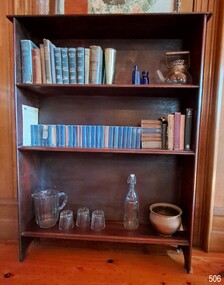 Flagstaff Hill Maritime Museum and Village
Furniture - Bookcase, 1900-1920
... Its classic shape makes it suitable for the home-carpenter to build for domestic use. Flagstaff Hill Maritime Museum and Village Flagstaff Hill Warrnambool Maritime Museum Maritime Village Shipwreck Coast Great Ocean Road bookcase book storage domestic furniture library storage book display bookshelf office furniture Bookcase: a wooden bookcase with three shelf levels enclosed by a back panel, top and sides. ...This bookcase is typical of the homemade domestic furniture of the early 20th century. Its simple design encloses books on three sides, giving some protection from the environment. Its portable size makes it easy to rearrange for different furnishing configurations. The timber material allows for re-painting or staining to suit the decor of the time.The basic design of this bookcase is an example of domestic and office furniture used from the early to mid-20th century. Its classic shape makes it suitable for the home-carpenter to build for domestic use.Bookcase: a wooden bookcase with three shelf levels enclosed by a back panel, top and sides. Its size can accommodate large books. The legs are an extension of the side panels. Finished in a rosewood coloured varnish. flagstaff hill maritime museum and village, flagstaff hill, warrnambool, maritime museum, maritime village, shipwreck coast, great ocean road, bookcase, book storage, domestic furniture, library storage, book display, bookshelf, office furniture -
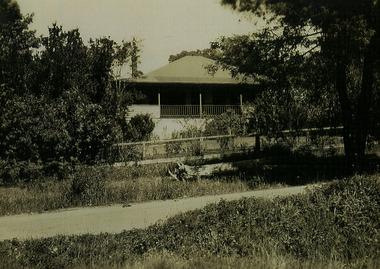 Marysville & District Historical Society
Photograph (Item) - Black and white photograph, Unknown
... home in Marysville in Victoria. Jim Wallace was born in Dumfries in Scotland and emigrated to Australia with his family at age 6. He arrived and settled in Marysville in 1922 and ended up working for the Barton Brothers looking after their touring cars and their garage. He met Marj in 1928 and they married in 1930. Jim and another well-known local, Clarrie Smith, had spoken about showing the 'talkies' in the local hall and then subsequently had local builder, Harold Cuzens, build ...A black and white photograph of the Wallace Family home in Marysville in Victoria.A black and white photograph of the Wallace Family home in Marysville in Victoria. Jim Wallace was born in Dumfries in Scotland and emigrated to Australia with his family at age 6. He arrived and settled in Marysville in 1922 and ended up working for the Barton Brothers looking after their touring cars and their garage. He met Marj in 1928 and they married in 1930. Jim and another well-known local, Clarrie Smith, had spoken about showing the 'talkies' in the local hall and then subsequently had local builder, Harold Cuzens, build the Marysville Theatre in 1932. The Marysville Theatre was located on Murchison Street. The solid concrete building was used as a Theatre from 1932 to 1970. The building was then purchased by The Darmody Family and was used as an Arts and Crafts Centre for two years from 1975. The building was then purchased by Norman and Rosemary Fiske in 1977 and converted into a restaurant called The Pumpernickel. This building, along with most of the town, was destroyed in the 2009 Black Saturday bushfires. The Wallaces departed Marysville in 1980 for a new life in Ringwood, Victoria.Wallace Homemarysville theatre, marysville, victoria, harold cuzens, jim wallace, darmody family, norman fiske, rosemary fiske, the pumpernickel, 2009 black saturday bushfires, marj wallace, marie wallace, jill wallace, barton brothers, clarrie smith -
Lara RSL Sub Branch
United Services Home Drysdale, photographs, photocopies
... Home at Drysdale on Wednesday 2 July 1891. When he arrived in Victoria as commander of the Victorian military forces in 1890, he was appalled to discover that a number of old soldiers and sailors of the Imperial forces were homeless and destitute in Melbourne. Funds were raised to build ...Major-General TULLOCH opened the United Service Home at Drysdale on Wednesday 2 July 1891. When he arrived in Victoria as commander of the Victorian military forces in 1890, he was appalled to discover that a number of old soldiers and sailors of the Imperial forces were homeless and destitute in Melbourne. Funds were raised to build the Home which was to be used for two classes of pensioners: those requiring a little financial assistance [sustenance] and those requiring somewhere to live.crimea war, lara r.s.l. drysdale cemetary, united services home. -
 Flagstaff Hill Maritime Museum and Village
Furniture - Armchair, 1897-1921
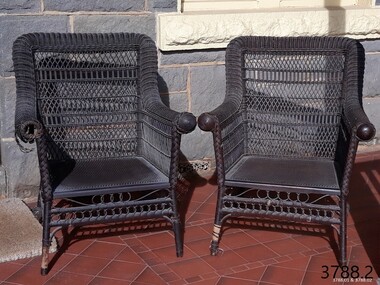
... Many items in the Lighthouse Keeper’s Cottage were donated by Vera and Aurelin Giles and mostly came from the home of Vera’s parents-in-law, Henry Giles and his wife Mary Jane (nee Freckleton), who married in 1880 and whose photos are on display in the parlour. Henry was born at Tower Hill in 1858 and was a labourer on the construction of the Warrnambool Breakwater before leaving in 1895 for around seven years to build bridges in NSW. ...Many items in the Lighthouse Keeper’s Cottage were donated by Vera and Aurelin Giles and mostly came from the home of Vera’s parents-in-law, Henry Giles and his wife Mary Jane (nee Freckleton), who married in 1880 and whose photos are on display in the parlour. Henry was born at Tower Hill in 1858 and was a labourer on the construction of the Warrnambool Breakwater before leaving in 1895 for around seven years to build bridges in NSW. ...These cane chairs are one of many 19th-century items of furniture, linen and crockery donated to Flagstaff Hill Maritime Village by Vera and Aurelin Giles. The items are associated with Warrnambool and the Giles Family history. Items donated by the family have come to be known as the Giles Collection. Many items in the Lighthouse Keeper’s Cottage were donated by Vera and Aurelin Giles and mostly came from the home of Vera’s parents-in-law, Henry Giles and his wife Mary Jane (nee Freckleton), who married in 1880 and whose photos are on display in the parlour. Henry was born at Tower Hill in 1858 and was a labourer on the construction of the Warrnambool Breakwater before leaving in 1895 for around seven years to build bridges in NSW. Mary Jane was born in 1860 at Cooramook, and she attended Mailor’s Flat State School and where she eventually became a student teacher. After which she became a governess at “Injemiara”, where her grandfather, Francis Freckleton, had once owned land. Henry and Mary’s family consisted of six; some of the children were born at Mailor’s Flat, and later, some children were born at Wangoom. They lived with their parents at Wangoom and Purnim west, and this is where Henry died in 1933 and Mary Jane in 1940. Heywood & Wakefield Furniture Co: - The Heywood-Wakefield Company is an American furniture manufacturer established in 1897. It went on to become a major presence in the US. Its older products are considered collectibles and have been featured on television antique programs. The Heywood brothers established themselves in 1826 as furniture makers, and the Wakefield Company began in 1855 as a separate company. Both firms produced wicker and rattan furniture, and as these products became increasingly popular towards the end of the century, they became serious rivals. In 1897, the companies merged as Heywood Brothers & Wakefield Company (this name was changed to Heywood-Wakefield Company in 1921), purchasing Washburn-Heywood Chair Company in 1916, Oregon Chair Company in 1920, and Lloyd Manufacturing Company in 1921. While its wooden furniture plant in Gardner, Massachusetts, closed in 1979, a branch in Menominee, Michigan, continued to manufacture metal outdoor seats, auditorium seats, and school furniture. The Heywood-Wakefield Company Complex in Gardner was added to the National Historic Register in 1983. The South Beach Furniture Company acquired the rights to the name in 1994 and reproduces its wooden furniture. Both founding companies produced wicker and rattan furniture in the late 19th century. The wicker styles drew on the Aesthetic Movement and Japanese influences simpler designs arose in the wake of the Arts and Crafts Movement. The merged entity stayed abreast of wicker furniture trends by hiring designers such as Paul Frankl and Donald Deskey during the 1920s. Its furniture was exhibited at the 1933 Century of Progress exhibition and the 1964 New York World's Fair. During the 1930s and 1940s, Heywood-Wakefield began producing furniture using sleek designs based on French Art Deco.The Giles family collection has social significance at a local level because it illustrates the level of material support the Warrnambool community gave to Flagstaff Hill when the village and museum were established. The wicker furniture is a fine example of late 19th and early 20th century lightweight domestic furniture that is today a very collectible item and quite rare and valuable.Armchair: pair of wicker armchairs, painted dark brown. The open wicker weave pattern of a traditional Asian design extends from the seat up to the armrests and completely over the backrest, plus across the front of the chair below the seat. The seat is very firmly woven and fitted into a timber frame. A reinforcing pattern of wicker work covers the top edges of the armrests and backrest in one piece and folds around to the underside, referred to as rolled serpentine arms and back. The hollow ends of the armrests are filled with a circular knob of wicker work. The back legs are also completed with decorative wicker knobs. The frames are constructed from bamboo. One chair base (3788.1) has been strengthened with metal bracing. The other chair (3788.2) has the remnants of an orange manufacturer’s tag fixed to the base. The chairs were made from 1897 to 1921 by Heywood Brothers & Wakefield Company, USA. These chairs are part of the Giles Collection.Tag, orange with black print: “MANUFA - Heywood B – GARDNE”flagstaff hill, warrnambool, shipwrecked coast, flagstaff hill maritime museum, shipwreck coast, great ocean road, giles collection, giles family, henry and mary jane giles, tower hill, cooramook, warrnambool breakwater, mailor’s flat, wangoom, 19th century furniture, wicker armchairs, rolled serpentine wicker work, cane armchair, classic wicker furniture, victorian style furniture, domestic furniture late 19th century, chair, armchair, woven cane, wicker, rolled serpentine, manufa - heywood b – gardne, heywood brothers & wakefield company, usa -
 Flagstaff Hill Maritime Museum and Village
Decorative object - Wall Decoration, 1850 to 1901
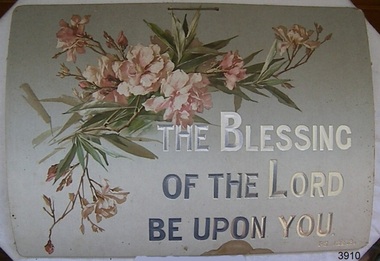
... These items mostly came from the simple home of Vera’s parents-in-law, Henry Giles and his wife Mary Jane (nee Freckleton), whose photos are in the parlour. They married in 1880. Henry Giles was born at Tower Hill in 1858. He was a labourer on the construction of the Breakwater before leaving in 1895 to build...These items mostly came from the simple home of Vera’s parents-in-law, Henry Giles and his wife Mary Jane (nee Freckleton), whose photos are in the parlour. They married in 1880. Henry Giles was born at Tower Hill in 1858. He was a labourer on the construction of the Breakwater before leaving in 1895 to build ...This item is part of the Giles Collection, dating back to the late Victorian era, from the 1880s to the early 1900s, in which Queen Victoria ruled England. The queen’s influence was felt throughout the world, including in the United States and Australia where Victorian values shaped society and style, especially in home décor. This period’s distinct style presents an eclectic mix of highly ornamented furniture, wallpaper, and knick-knacks. Particularly in terms of furniture, and the characteristic floral patterns and rich, contrasting colours, wall hangings that enjoyed the height of their popularity during the Victorian era were of the spiritual type with either embroidered or punched paper religious motto or bible quote. Mottoes were commonly hung high up on the wall or in an area of prominence, to remind the viewer of their important message, such as “He Leadeth Me” and “Honesty, Industry, and Sobriety.” Short and pithy, they embodied the ideals of Victorian society. Technological advances contributed to the boom of religious mottoes whereas before the Industrial Revolution home décor of this sort was handmade and therefore minimal, now consumers could purchase and fill their homes with all sorts of mass-produced ephemera goods similar to the subject item. Many of these mass-produced period pieces still exist today, often in their original frames, ceramic, enamelled or paper formats. Flagstaff maritime museum has many examples of mottoes on display that serve to reflect the period in which values of home, faith, and Christianity were very prominent in everyday Victorian society. The Giles Family There are many 19th century items of furniture, linen and crockery donated to Flagstaff Hill Maritime Village by Vera and Aurelin Giles. The items are associated with the Giles Family and are known as the “Giles Collection”. These items mostly came from the simple home of Vera’s parents-in-law, Henry Giles and his wife Mary Jane (nee Freckleton), whose photos are in the parlour. They married in 1880. Henry Giles was born at Tower Hill in 1858. He was a labourer on the construction of the Breakwater before leaving in 1895 to build bridges in N.S.W. for about seven years. Mary Jane was born in 1860 at Cooramook. She attended Mailor’s Flat State School where she was also a student teacher before, as a family legend has it, she became a governess at “Injemiara” where her grandfather, Francis Freckleton, once owned land. Henry and Mary’s family of six, some of whom were born at Mailor’s Flat and later children at Wangoom, lived with their parents at Wangoom and Purnim west, where Henry died in 1933 and Mary Jane in 1940.The Giles family collection has social significance at a local level, because it illustrates the level of material support the Warrnambool community gave to Flagstaff Hill when the Museum was established. This wall decoration reflects the social values and attitudes of the late Victorian era that was used to promote good Christian and moral values in many households. These items of decoration were very popular at this time and the subject item is significant as it gives a snapshot into the social norms of past generations. Printed card wall hanging with floral design. Religious text on the sign is embossed onto the card and highlighted in silver print. There is a handwritten ink inscription, and a pencil inscription, on the back. A string is attached to two holes on top of the card. Embossed"THE BLESSING / OF THE LORD/ BE UPON YOU." "PS 129.8." In pencil "H/S" In ink "To dear Granny with lots of love / from Dorothy. X X."flagstaff hill, warrnambool, shipwrecked coast, flagstaff hill maritime museum, shipwreck coast, great ocean road, paper wall decoration, religious, home decoration, societal values, victorian moral values, wall hanging, wall decoration, spiritual decoration, bible verse, giles collection -
 Flagstaff Hill Maritime Museum and Village
Currency - Guinea Coin, The Royal Mint, 1793 George III Spade Guinea, 1793
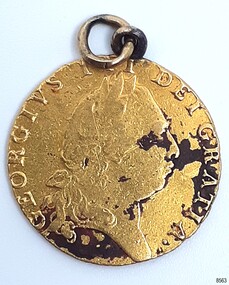
... build-up of encrustations or concretion. Julie secretly enjoyed her treasures for twenty-four years then packed them up for the early morning train trip to Warrnambool. After a short walk to Flagstaff Hill Maritime Museum and Village, her photograph was taken as she handed over her precious find. She told her story to a local newspaper reporter, lunched a café in town then took the late afternoon train home...build-up of encrustations or concretion. Julie secretly enjoyed her treasures for twenty-four years then packed them up for the early morning train trip to Warrnambool. After a short walk to Flagstaff Hill Maritime Museum and Village, her photograph was taken as she handed over her precious find. She told her story to a local newspaper reporter, lunched a café in town then took the late afternoon train home ...The coin was discovered by Julie Wilkins, a Victorian scuba diver who had already experienced more than 500 dives in Australia and overseas. She was holidaying in Peterborough, Victoria, and looking forward to discovering more about the famous Loch Ard ship, wrecked in June 1878 at Mutton Bird Island. The fast Glasgow-built clipper ship was only five years old when the tragedy occurred. There were 54 people on board the vessel and only two survived Julie's holiday photograph of Boat Bay reminds her of her most memorable dive. Submerged in the calm, flat sea, she was carefully scanning around the remains of the old wreck when, to her amazement, a gold coin and a small gold cross suddenly came up towards her. She excitedly cupped them in her hands, then stowed the treasures safely in her wetsuit and continued her dive. She soon discovered a group of brass carriage clock parts and some bottles of champagne. It was a day full of surprises. The items were easily recognisable, without any build-up of encrustations or concretion. Julie secretly enjoyed her treasures for twenty-four years then packed them up for the early morning train trip to Warrnambool. After a short walk to Flagstaff Hill Maritime Museum and Village, her photograph was taken as she handed over her precious find. She told her story to a local newspaper reporter, lunched a café in town then took the late afternoon train home. Her generous donation is now part of a vast collection of Loch Ard shipwreck artefacts, including the gold watch and the Minton Majolica model peacock. The coin is a British 1793 George III Gold Spade Guinea. It was already 83 years old when the Loch Ard had set sail. The loop and ring have been added, perhaps as a pendant, pocket watch accessory or similar purpose. It may have been worn for ‘good luck’ on the long journey to Australia, where ships had to carefully navigate the treacherous Bass’s Strait before arriving at their destination of Melbourne. Sadly, many met their fate on that short stretch of ocean aptly named the Shipwreck Coast. The coin is very recognisable even though it was exposed to the wrecking of the ship, its consequent movement, and the sea's turbulence. Its bent, scratched, buckled, split, dinted and worn condition is part of its story. The red-brown-black discolouration is similar to that found on other gold coins, sometimes called the ‘corrosion phenomena’. Studies suggest the possible cause is contaminants in the minting process reacting to the coins’ environment. The GEORGE III GOLD SPADE GUINEA: - The British Guinea was introduced in 1663 and was circulated until 1814. It was made of 22 carat gold, was 25 to 26 cm in diameter and weighed 8.35 grams. It had a value of 21 British shillings. The guinea coin ceased circulation after 1816 and was replaced by the one-pound note. However, the term ‘guinea’ continued to represent 21 shillings. King George (1738-1820) had six gold guinea designs minted during his reign from 1760 and 1820. Each of the six had different obverse portraits, all facing the right. There were three different reverse sides. The Spade Guinea was the fifth issue of the coin, introduced in 1787 and produced until 1799. The reverse shows a royal crown over a flat-topped shield with the Royal Arms of Great Britain, used in Scotland between 1714 and 1800. The shield images are, from left to right, top to bottom, the Arms of England and Scotland, the Arms of France, the Arms of Ireland, and the Arms of the House of Hanover. The Gold Guinea is also part of Australia’s history. It was the first coin mentioned in the announcement of Governor King of New South Wales his Australian Proclamation of a limited variety and denomination of coins accepted for use in the Australian Colony. The historic and decorative George III Spade Guinea has been reproduced for special collections of coins. However, replicas and imitations have also been made as souvenirs for tourists, as gaming tokens and chips for gamblers, and as ‘fake’ coins for profit. These coins differ in many ways; they may be only half the weight of the genuine coin. Often have a small stamp on the obverse with “COPY” or the manufacturer’s name or initials. Some have scalloped edges, some have dates that are different to the original dates of issue, and some even have text in Latin that translates as something very different to the original coin.The King George III Guinea was only produced from 1663 to 1814 and was the first English coin to be mechanically minted. The coin is the fifth edition of the King George III Guinea, the Spade Guinea, was only produced between 1787 and 1799. It is the only edition with this portrait of King George and the only one with the Royal Coat of Arms of Great Britain in Scotland on the reverse side. This edition was also the last guinea in circulation, because the sixth edition was reserved as the Military guinea. This edition of the Guinea is unique; This coin is the only guinea in our collection. It was minted in 1793, so it is now over 230 years old. The Gold Guinea is part of Australia’s history; it was the first coin in the list of coins for use in the Australian Colonies, mentioned by Governor King of New South Wales in his Australian Proclamation speech of 1800. The George III Spade Guinea was included in the Limited Edition Sherwood 12 Coin Collection of Notable Coinage of Australia. This coin is the only known guinea coin recovered from the wreck of the Loch Ard. It was already 85 years old when the ship was wrecked.Gold coin; British. 1793, King George III of the United Kingdom of Great Britain and Ireland (1760-1820), Spade Guinea. Yellow gold coin with gold metal loop mount and a gold ring through the loop. The design is the fifth issue of the George III Gold Guinea. The obverse relief is a portrait of George III facing right. Reverse relief is a crown above the Coats of Arms (1801-1816) of flat top spade-shaped shield divided into four quadrants that depict crowned lions, fleur de lies, a harp. These images are identified as, from left to right, top to bottom, England and Scotland, France, Ireland and Hanover. Inscriptions are minted around the rims of each side. The coin is dated 1793. Its surface has dark areas on both sides and the reed edge and surfaces are well worn. The loop mount is bent and the ring is buckled. The coin was recovered from the wreck of the ship Loch Ard.Obverse text; 'GEORGIVS III DEI GRATIA' (translates to George the Third, by the Grace of God) Obverse relief; (King George III bust, facing right, laurel wreath on head) Reverse text; 'M.B.E.ET.H.REX.F. D.B.ET.L.D. S.R.I.A.T.ET.E' '1793' (translates to: King of Great Britain, France and Ireland, Defender of the Faith, Duke of Brunswick and Lüneburg, Arch-Treasurer and Elector of the Holy Roman Empire) Reverse relief; a spade-shaped image i.e. (Crown with fleer de lies, above Shield with crowned lions in different postures, a harp, and other details)flagstaff hill maritime museum and village, warrnambool, great ocean road, shipwreck coast, royal mint, british coin, currency, guinea, military guinea, australian currency, british guinea, gold coin, spade guinea, king george iii, george iii, fifth portrait, arms of england and scotland, arms of france, arms of ireland, arms of the house of hanover, coins, gold coins, gold medallion, georgian era, 1793, numismatics, contamination phenomena, gold corrosion, good luck, lucky charm, pendant, lucky coin, trade, loch ard, wreck of the loch ard, 1878, mutton bird island, peterborough, scuba diver, 1980s, guinea coin, gold guinea, shipwreck artefact, relic, julie wilkins -
 Flagstaff Hill Maritime Museum and Village
Accessory - Gold Cross, Bef. 01-06-1878
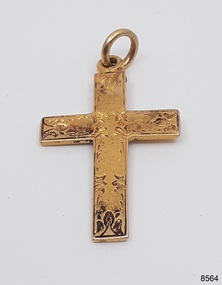
... build-up of encrustations or concretion. Julie secretly enjoyed her treasures for twenty-four years then packed them up for the early morning train trip to Warrnambool. After a short walk to Flagstaff Hill Maritime Museum and Village, her photograph was taken as she handed over her precious find. She told her story to a local newspaper reporter, lunched a café in town then took the late afternoon train home...build-up of encrustations or concretion. Julie secretly enjoyed her treasures for twenty-four years then packed them up for the early morning train trip to Warrnambool. After a short walk to Flagstaff Hill Maritime Museum and Village, her photograph was taken as she handed over her precious find. She told her story to a local newspaper reporter, lunched a café in town then took the late afternoon train home ...The gold cross was discovered by Victorian scuba diver Julie Wilkins, who had already experienced more than 500 dives in Australia and overseas. She was holidaying in Peterborough, Victoria, and looking forward to discovering more about the famous Loch Ard ship, wrecked in June 1878 at Mutton Bird Island. The fast Glasgow-built clipper ship was only five years old when the tragedy occurred. There were 54 people on board the vessel and only two survived Julie's holiday photograph of Boat Bay reminds her of her most memorable dive. Submerged in the calm, flat sea, she was carefully scanning around the remains of the old wreck when, to her amazement, a gold coin and a small gold cross suddenly came up towards her. She excitedly cupped them in her hands, then stowed the treasures safely in her wetsuit and continued her dive. She soon discovered a group of brass carriage clock parts and some bottles of champagne. It was a day full of surprises. The items were easily recognisable, without any build-up of encrustations or concretion. Julie secretly enjoyed her treasures for twenty-four years then packed them up for the early morning train trip to Warrnambool. After a short walk to Flagstaff Hill Maritime Museum and Village, her photograph was taken as she handed over her precious find. She told her story to a local newspaper reporter, lunched a café in town then took the late afternoon train home. Her generous donation is now part of a vast collection of Loch Ard shipwreck artefacts, including the gold watch and the Minton Majolica model peacock. The small decorative cross dates back to on or before 1878, when the Loch Ard had set sail. The loop and ring have been added, perhaps as a pendant, pocket watch accessory or similar purpose. It may have been worn for ‘good luck’ or a ‘blessing’ on the long journey to Australia, where ships had to carefully navigate the treacherous Bass’s Strait before arriving at their destination of Melbourne. Sadly, many met their fate on that short stretch of ocean aptly named the Shipwreck Coast. The cross is very recognisable even though it was exposed to the wrecking of the ship, its consequent movement, and the sea's turbulence. Its scratched, pitted and worn condition, and the damage near the loop, is part of its story. The red-brown-black discolouration is similar to that found on other gold coins, sometimes called the ‘corrosion phenomena’. Studies suggest the possible cause is contaminants in the minting process reacting to the coins’ environment. Three edges of the cross have slightly raised narrow ridges of gold which could have been cause by the gold being cast liquid gold into a mould.This gold cross pendant is significant as a symbol of Christianity, a sign of hope and safety, and a sample of the religious following on board the Loch Ard, although not everyone wears a cross for this reason. This cross is a sample of jewellery owned by people migrating to Australia in the late 19th century. The cross and the guinea recovered together from the wreck of the Loch Ard are made of gold and help interpret the financial status of some of those on board.Gold cross; yellow gold with decorative hand engraved foliage design on the front, fitted loop and ring on top. The simple Latin or Roman variation of the cross, with an elongated vertical arm, has no figure on it and the reverse has no decoration. The right, left and base edges have sections of narrow, long slightly raised ridges. The top edge has remnants of red-black colour. Victorian era cross, ca. 1878. The cross was recovered from the wreck of the ship Loch Ard.Engraved foliage design. Slightly raised long ridges on sides and base edges. flagstaff hill maritime museum and village, warrnambool, great ocean road, shipwreck coast, gold cross, religious cross, religious trinket, religious jewellery, engraved cross, cross pendant, cross with ring, victorian era, 1878, antique cross, crucifix, religious symbol, christian symbol, christian jewellery, contamination phenomena, gold corrosion, good luck, lucky charm, blessing, pendant, loch ard, wreck of the loch ard, mutton bird island, peterborough, scuba diver, 1980s, shipwreck artefact, relic, latin cross, roman cross, pectoral cross, julie wilkins -
 Flagstaff Hill Maritime Museum and Village
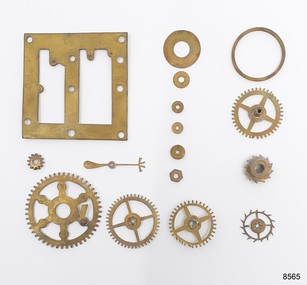
Instrument - Clock Parts, Bef. 01-06-1878
... build-up of encrustations or concretion. Julie secretly enjoyed her treasures for twenty-four years then packed them up for the early morning train trip to Warrnambool. After a short walk to Flagstaff Hill Maritime Museum and Village, her photograph was taken as she handed over her precious find. She told her story to a local newspaper reporter, lunched a café in town then took the late afternoon train home...build-up of encrustations or concretion. Julie secretly enjoyed her treasures for twenty-four years then packed them up for the early morning train trip to Warrnambool. After a short walk to Flagstaff Hill Maritime Museum and Village, her photograph was taken as she handed over her precious find. She told her story to a local newspaper reporter, lunched a café in town then took the late afternoon train home ...The clock parts were discovered in 1980 by Julie Wilkins, a Victorian scuba diver who had already experienced more than 500 dives in Australia and overseas. She was holidaying in Peterborough, Victoria, and looking forward to discovering more about the famous Loch Ard ship, wrecked in June 1878 at Mutton Bird Island. The fast Glasgow-built clipper ship was only five years old when the tragedy occurred. There were 54 people on board the vessel and only two survived Julie's holiday photograph of Boat Bay reminds her of her most memorable dive. Submerged in the calm, flat sea, she was carefully scanning around the remains of the old wreck when, to her amazement, a gold coin and a small gold cross suddenly came up towards her. She excitedly cupped them in her hands and then stowed the treasures safely in her wetsuit and continued her dive. She soon discovered a group of brass carriage clock parts and some bottles of champagne. It was a day full of surprises. The items were easily recognisable, without any build-up of encrustations or concretion. Julie secretly enjoyed her treasures for twenty-four years then packed them up for the early morning train trip to Warrnambool. After a short walk to Flagstaff Hill Maritime Museum and Village, her photograph was taken as she handed over her precious find. She told her story to a local newspaper reporter, lunched a café in town then took the late afternoon train home. Her generous donation is now part of a vast collection of Loch Ard shipwreck artefacts, including the gold watch and the Minton Majolica model peacock. This group of brass clockwork parts is incomplete. The pieces were in the ocean for over 100 years before Julie recovered them from the Loch Ard wreck. Their size would suit the works of a carriage clock, with a mainspring and weight to power the clock movement, a pendulum to measure the clock's speed, arbours, posts, pillars and at least one other plate. They would have been mounted inside a protective case with a small door to easily access the clock face for setting the time and accessing the key's winding hole. The clock cases were usually made from decorative gilt brass with a glass front and a carrying handle. The parts include a weighted second hand with a decorative four-pronged finish at one end, a rounded weight at the other, and a hole for attaching it to the clock face. The gear teeth profiles are ‘cycloidal’, an arch shape with vertical sides, which is common for antique clocks. Modern clockworks have ‘involute’ teeth with sloping sides and a squared-off top. The brass carriage clock parts are an example of a mechanical clock produced in the 1870s. The clock's design is a part of the chain of technological improvements in methods for timekeeping. Its cycloidal gear teeth were the forerunner of the more modern involute gears. The group of clock parts includes a weighted hand or arm for signifying the seconds. This feature was uncommon in portable Victorian-era clocks. The clock parts are also significant for their association with the ill-fated sailing ship Loch Ard, wrecked in 1878. The travelling clock or officer’s clock may have been part of the cargo destined for the 1880 Melbourne Exhibition, or the personal possession of one of the people on board the vessel. Brass clockwork parts from a mechanical clock, sixteen pieces. Parts comprise a plate, large gears or wheels, small pinions or wheels with fine teeth, wheels with cogs, and a weighted second hand. The parts were from a carriage clock ca. 1878. They were recovered from the wreck of the sailing ship Loch Ard.flagstaff hill maritime museum and village, warrnambool, great ocean road, shipwreck coast, loch ard, wreck of the loch ard, 1878, mutton bird island, peterborough, scuba diver, 1980s, shipwreck artefact, relic, clock, mechanical, clock parts, time, timekeeper, horology, chronometry, cogs, time keeping device, scientific instrument, chronometer, john harrison, longitude, carriage clock, coach clock, portable clock, travelling clock, travel clock, traveller’s clock, officer’s clock, weighted second hand, victorian era, cycloidal gear teeth, brass clock, julie wilkins -
 Flagstaff Hill Maritime Museum and Village
Textile - Bedspread, Vera and Aurelia Giles, 1880+
... These items mostly came from the simple home of Vera’s parents-in-law, Henry Giles and his wife Mary Jane (nee Freckleton), whose photos are in the parlour. They married in 1880. Henry Giles was born at Tower Hill in 1858. He was a labourer on the construction of the Breakwater before leaving in 1895 to build...These items mostly came from the simple home of Vera’s parents-in-law, Henry Giles and his wife Mary Jane (nee Freckleton), whose photos are in the parlour. They married in 1880. Henry Giles was born at Tower Hill in 1858. He was a labourer on the construction of the Breakwater before leaving in 1895 to build ...There are many 19th century items of furniture, linen and crockery donated to Flagstaff Hill Maritime Village by Vera and Aurelin Giles. The items are associated with the Giles Family and are known as the “Giles Collection”. These items mostly came from the simple home of Vera’s parents-in-law, Henry Giles and his wife Mary Jane (nee Freckleton), whose photos are in the parlour. They married in 1880. Henry Giles was born at Tower Hill in 1858. He was a labourer on the construction of the Breakwater before leaving in 1895 to build bridges in N.S.W. for about seven years. Mary Jane was born in 1860 at Cooramook. She attended Mailor’s Flat State School where she was also a student teacher before, as family legend has it, she became a governess at “Injemiara” where her grandfather, Francis Freckleton, once owned land. Henry and Mary’s family of six, some of whom were born at Mailor’s Flat and later children at Wangoom, lived with their parents at Wangoom and Purnim west, where Henry died in 1933 and Mary Jane in 1940. The Giles family collection has social significance at a local level, because it illustrates the level of material support the Warrnambool community gave to Flagstaff Hill when the Museum was established.Bedspread, double bed size, white self-embossed floral pattern.warrnambool, flagstaff-hill-maritime-museum, giles collection, henry giles, tower hill, cooramook, mailor’s flat, vera & aurelin giles, bedspread, double bed bedspread, bed linen, quilt, embossed cotton -
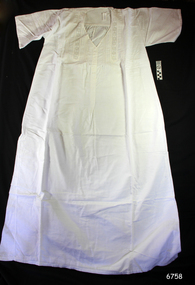 Flagstaff Hill Maritime Museum and Village
Clothing - Nightgown, Vera and Aurelia Giles, 1880-1920
... These items mostly came from the simple home of Vera’s parents-in-law, Henry Giles and his wife Mary Jane (nee Freckleton), whose photos are in the parlour. They married in 1880. Henry Giles was born at Tower Hill in 1858. He was a labourer on the construction of the Breakwater before leaving in 1895 to build...These items mostly came from the simple home of Vera’s parents-in-law, Henry Giles and his wife Mary Jane (nee Freckleton), whose photos are in the parlour. They married in 1880. Henry Giles was born at Tower Hill in 1858. He was a labourer on the construction of the Breakwater before leaving in 1895 to build ...There are many 19th century items of furniture, linen and crockery donated to Flagstaff Hill Maritime Village by Vera and Aurelin Giles. The items are associated with the Giles Family and are known as the “Giles Collection”. These items mostly came from the simple home of Vera’s parents-in-law, Henry Giles and his wife Mary Jane (nee Freckleton), whose photos are in the parlour. They married in 1880. Henry Giles was born at Tower Hill in 1858. He was a labourer on the construction of the Breakwater before leaving in 1895 to build bridges in N.S.W. for about seven years. Mary Jane was born in 1860 at Cooramook. She attended Mailor’s Flat State School where she was also a student teacher before, as family legend has it, she became a governess at “Injemiara” where her grandfather, Francis Freckleton, once owned land. Henry and Mary’s family of six, some of whom were born at Mailor’s Flat and later children at Wangoom, lived with their parents at Wangoom and Purnim west, where Henry died in 1933 and Mary Jane in 1940. The Giles family collection has social significance at a local level, because it illustrates the level of material support the Warrnambool community gave to Flagstaff Hill when the Museum was established.Nightgown, white cotton with Broderie Anglaise yoke. Nonewarrnambool, shipwrecked-coast, flagstaff-hill, flagstaff-hill-maritime-museum, shipwreck-coast, nightie, giles collection, henry giles, tower hill, cooramook, warrnambool breakwater, mailor’s flat, wangoom, 19th century household goods, sleep wear, nightgown, nightdress, night dress, nightwear, sleepwear, clothing, fashion, 19th century, handmade clothing -
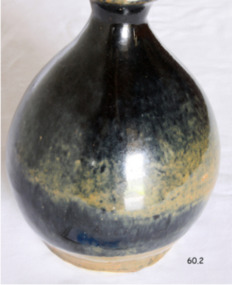 Flagstaff Hill Maritime Museum and Village
Container - Ceramic Bottle (Chinese Style), Minton Potteries, Late 19th century
... Many items in the Lighthouse Keeper’s Cottage were donated by Vera and Aurelin Giles and mostly came from the home of Vera’s parents-in-law, Henry Giles and his wife Mary Jane (nee Freckleton) who married in 1880 and whose photos are on display in the parlour. Henry was born at Tower Hill in 1858, and was a labourer on the construction of the Warrnambool Breakwater before leaving in 1895 for around seven years to build bridges in NSW. ...Many items in the Lighthouse Keeper’s Cottage were donated by Vera and Aurelin Giles and mostly came from the home of Vera’s parents-in-law, Henry Giles and his wife Mary Jane (nee Freckleton) who married in 1880 and whose photos are on display in the parlour. Henry was born at Tower Hill in 1858, and was a labourer on the construction of the Warrnambool Breakwater before leaving in 1895 for around seven years to build bridges in NSW. ...The subject item is believed to be a "Chinese style stoneware liquor bottle used to store "Tiger Whiskey" (rice wine). These Chinese liquor bottles are made of glazed pottery known as brown stoneware and have been made throughout the centuries by many makers until well after American Prohibition. Later varieties from the mid 20th century are commonly found in the USA with the raised lettering "Federal Law Forbids Sale Or Re-use of this bottle" a sure sign of post-1934 manufacture. This example is interesting as it has a British Minton mark of two triangles on the base indicating a date of 1879 and was likely exported to Australia by Minton. These ceramic bottles virtually always have irregularities and flaws which indicate a product has been hastily manufactured, in any event, this is a fine example of a relatively common item that may have been copied by Minton and sold as a decorative domestic item for display or mass produced for storing liquor. Giles Family: The pair of ceramic bottles were given to Vera Giles by Jim Thompson and are just many 19th century items of furniture, linen and crockery donated to Flagstaff Hill Maritime Village by, Vera and Aurelin Giles. The items are associated with Warrnambool and the Giles Family history. Items donated by the family have come to be known as the “Giles Collection”. Many items in the Lighthouse Keeper’s Cottage were donated by Vera and Aurelin Giles and mostly came from the home of Vera’s parents-in-law, Henry Giles and his wife Mary Jane (nee Freckleton) who married in 1880 and whose photos are on display in the parlour. Henry was born at Tower Hill in 1858, and was a labourer on the construction of the Warrnambool Breakwater before leaving in 1895 for around seven years to build bridges in NSW. Mary Jane was born in 1860 at Cooramook and she attended Mailor’s Flat State School and where she eventually was to become a student teacher. After which she became a governess at “Injemiara” where her grandfather, Francis Freckleton, had once owned land. Henry and Mary’s family consisted of six, some of the children were born at Mailor’s Flat and later some children at Wangoom. They lived with their parents at Wangoom and Purnim west, and this is where Henry died in 1933 and Mary Jane in 1940. A significant item of lead-glazed ceramic with the possibility it was made by the Minton potteries in England who were renowned for making quality pottery. The item style is in all probability a copy of a Chinese liquor bottle that was in common use throughout the British colonies and America up until the mid 20th Century. The Giles family collection has social significance at a local level, because it illustrates the level of material support the Warrnambool community gave to Flagstaff Hill when the Museum was established.Chinese liquor bottle one of a pair, lead glazed ceramic, dark brown and blue/black. Part of the Giles Collection.Mark of a double triangle, apex touching, on base, (Minton mark for 1879).flagstaff hill, warrnambool, shipwrecked coast, flagstaff hill maritime museum, shipwreck coast, flagstaff hill maritime village, great ocean road, vase, pottery, ceramic ornament, domestic ware, late 19th - early 20th centuy ornament, giles collection, henry giles, tower hill, cooramook, warrnambool breakwater, mailor’s flat, wangoom, 19th century household goods, light keeper
