
Showing 99 items matching "home dressmaker"
-
 City of Moorabbin Historical Society (Operating the Box Cottage Museum)
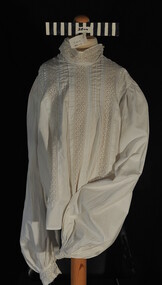
Clothing - Clothing, lady's blouse, c1900
... ...home dressmaker...home dressmaker...Clothing Clothing, lady's blouse home dressmaker ...The pioneer settlers and market gardeners of Moorabbin Shire had to be self reliant and made their own clothing and utensils. This is one of many items that exhibit the skill and craftsmanship of the women in these families. This white, cotton Lady's blouse with pin-tucked front and back is and example of the dressmaking skills of the women of the families of the pioneer settlers and market gardeners in the Moorabbin Shire. Ladies long-sleeved white cotton blouse with high collar. Pin-tucking to front and back, guipure lace inserts on front of bodice. Significant tear at lower edge of the garment.clothing, brighton, moorabbin, pioneers, dendy henry, market gardeners, home dressmaker, craft work -
 City of Moorabbin Historical Society (Operating the Box Cottage Museum)
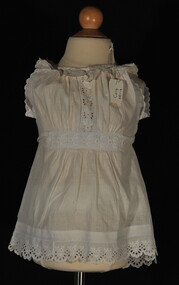
Clothing - Clothing, girl's pinafore, c1900
... home...dressmaker...home dressmaker...Clothing Clothing, girl's pinafore home dressmaker ...This white fine lawn girls pinafore is an example of the dressmaking skills of the wives of the pioneer settlers and market gardeners of the Moorabbin Shire 1900. The pioneer settlers and market gardeners of Moorabbin Shire had to be self reliant and made their own clothing and utensils. This is one of many items that exhibit the skill and craftsmanship of the women in these families.A white, fine lawn girl's sleeveless pinafore. Guipure lace frill around armholes, neck and hem. Guipure lace insert to bodice and feather-stitch embroidery to skirt. Waist ties.moorabbin, brighton, pioneers, early settlers, market gardeners, home, dressmaker, garments, craftwork -
 City of Moorabbin Historical Society (Operating the Box Cottage Museum)
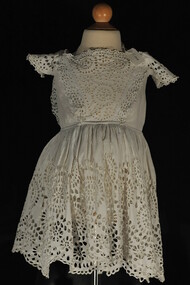
Clothing - Clothing, girl's dress, c1900
... This girl's white cotton dress is typical of the craftsmanship of the home dressmakers among the pioneer settlers and market gardeners of the Moorabbin Shirec 1900...home dressmaker...This girl's white cotton dress is typical of the craftsmanship of the home dressmakers among the pioneer settlers and market gardeners of the Moorabbin Shirec 1900 The pioneer settlers and market gardeners of Moorabbin Shire had to be self reliant and the women made most of the clothing for their families. clothing brighton moorabbin pioneers dendy henry market gardeners dressmakers c1900 girl's dress is made of cotton and is all hand-worked, with cutwork Clothing Clothing, girl's dress home dressmaker ...This girl's white cotton dress is typical of the craftsmanship of the home dressmakers among the pioneer settlers and market gardeners of the Moorabbin Shirec 1900The pioneer settlers and market gardeners of Moorabbin Shire had to be self reliant and the women made most of the clothing for their families.c1900 girl's dress is made of cotton and is all hand-worked, with cutworkclothing, brighton, moorabbin, pioneers, dendy henry, market gardeners, dressmakers -
 City of Moorabbin Historical Society (Operating the Box Cottage Museum)
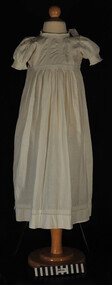
Clothing - Clothing, baby's long dress pin-tucked, c1900
... home dressmaker...This garment is one of the examples of the skills and craftsmanship of these women. clothing brighton moorabbin dressmaking dendy henry market gardeners pioneer settlers craft working A white, cotton, pin-tucked, long Baby's dress c 1900 Clothing Clothing, baby's long dress pin-tucked home dressmaker ...This long, white cotton pin-tucked baby's dress is an example of the clothing the women of pioneer settlers and market gardeners in Moorabbin Shire made for their familiesAfter the 1841 Dendy Special Survey of Brighton, Victoria, allotments of land were rented or sold to pioneer settlers. These settlers had to be self reliant and the women made most of the clothing for their families. This garment is one of the examples of the skills and craftsmanship of these women.A white, cotton, pin-tucked, long Baby's dress c 1900clothing, brighton, moorabbin, dressmaking, dendy henry, market gardeners, pioneer settlers, craft working -
 City of Moorabbin Historical Society (Operating the Box Cottage Museum)
Clothing - Clothing, pinafore crochet work, c1900
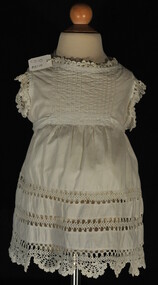
... home dressmaker...Clothing Clothing, pinafore crochet work home dressmaker ...This white, cotton, baby's pinafore with hand crochet work is and example of the dressmaking skills of the women of the families of the pioneer settlers and market gardeners of the Moorabbin Shire.The pioneer settlers and market gardeners of Moorabbin Shire had to be self reliant and made their own clothing and utensils. This is one of many items that exhibit the skill and craftsmanship of the women in these families.A white cotton infant's pinafore, with hand crochet work around armholes, and lower edge of garment. Feather stitch embroidery, and pin-tucking on bodice. Waist ties.clothing, crochet work, moorabbin, bentleigh, early settlers, pioneers, market gardeners, dendy special survey, brighton pioneers -
 City of Moorabbin Historical Society (Operating the Box Cottage Museum)
Clothing - Clothing, lady's half petticoat, c1900
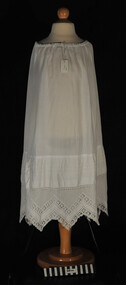
... home dressmaker...Clothing Clothing, lady's half petticoat home dressmaker ...This white, cotton half petticoat with hand crochet work on the hem is an example of the dressmaking skills of the women of the families of the pioneer settlers and market gardeners in the Moorabbin ShireThe pioneer settlers and market gardeners of Moorabbin Shire had to be self reliant and made their own clothing and utensils. This petticoat is one of many items that exhibit the skill and craftsmanship of the women in these familiesA lady's white cotton half petticoat, with deep hand- crochet border at the hem. brighton, moorabbin, pioneers, dress, bentleigh, early settlers, garments -
 City of Moorabbin Historical Society (Operating the Box Cottage Museum)
Clothing - Clothing, boy's first underpants, 1907
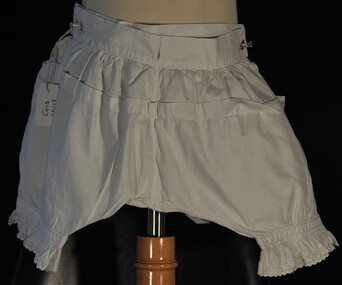
... Magg family home dressmaker...Clothing Clothing, boy's first underpants. Magg family home dressmaker ...These white cotton underpants were made for Mr Geoff Maggs by his mother in 1907 as his first underwear at age 2 years old. The Maggs family were early settlers in the Moorabbin ShireThe pioneer settlers and market gardeners of Moorabbin Shire had to be self reliant and made their own clothing and utensils. This is one of many items that exhibit the skill and craftsmanship of the women in these families. White, cotton underwear for a 2 year old boy. Made at home on a sewing machine with hand feather stitching and factory-made guipure lace on leg-bands. Buttons at waist, and a tuck pleat to let down as child grows.clothing, brighton, moorabbin, pioneers, dendy henry, dressmakers, market gardners, early settlers, maggs geoff -
 City of Moorabbin Historical Society (Operating the Box Cottage Museum)
Clothing - Clothing, blouse short sleeve, c1900
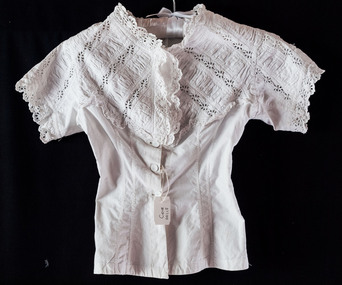
... Maggs family home dressmaker...Clothing Clothing, blouse short sleeve Maggs family home dressmaker ...This white, cotton, short-sleeved blouse with eyelet work for a young woman is an example of the dressmaking skills of the women pioneer settlers and market gardeners of the Moorabbin Shire c 1900.The pioneer settlers and market gardeners of Moorabbin Shire had to be self reliant and made their own clothing and utensils. This is one of many items that exhibit the skill and craftsmanship of the women in these families. A white, cotton, short-sleeved blouse, with eyelet work for a young woman .brighton, moorabbin, pioneers, dendy henry, market gardeners, dressmakers, craft work, maggs geoff -
 City of Moorabbin Historical Society (Operating the Box Cottage Museum)
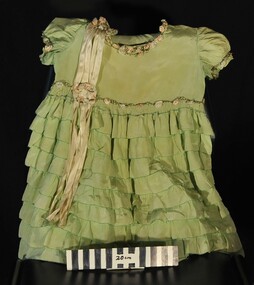
Clothing - Clothing, girl's party dress c 1927, 1927
... home...dressmaker...The family continued to remain very prosperous and successful vegetable growers and are one of many families steeped in the tradition of vegetable growing which significantly contributed to the prosperity of the Moorabbin Shire Brighton Moorabbin Marriott clothing market gardeners home dressmaker needlework dendys special survey A home-sewn pale green silk party dress, worn to a wedding by four year old, Sylvia Marriott c 1927. ...This child's green, silk, party dress was worn by Sylvia Marriott in 1927. The Marriott family were early settlers in the Moorabbin ShireMembers of the Marriott family arrived in Port Phillip in 1857. However it was John and Jane Marriott who in 1876, (after toiling hard since their arrival in1871, for very little gain), first leased, then purchased in 1882, 30 acres with a four-roomed house in East Boundary Road, in the area then called East Brighton. (Now known as East Bentleigh). The land they purchased had previously been a part of the 1841 Dendy Special Survey. Over the following years, John and his four sons with hard work and determination became prosperous vegetable growers and purchased further land in the area. Following John's retirement and subsequent death in 1903, the land was passed to his sons, and then onto the Marriott grandchildren. The family continued to remain very prosperous and successful vegetable growers and are one of many families steeped in the tradition of vegetable growing which significantly contributed to the prosperity of the Moorabbin ShireA home-sewn pale green silk party dress, worn to a wedding by four year old, Sylvia Marriott c 1927. The skirt of the dress has layers of ruffles. It has short cap sleeves. Decorative ribbons are attached at the shoulder continueing to the waist, then hang loosely over the skirt of the dress. Small pink and white ribbon rose buds have been applied at the neckline, waist and the edges of the sleeves .brighton, moorabbin, marriott, clothing, market gardeners, home, dressmaker, needlework, dendys special survey -
 Whitehorse Historical Society Inc.
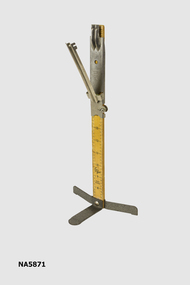
Tool - Easy hem skirt marker, unknown
... - Tool used by home dressmakers...- Tool used by home dressmakers Dressmaking Home sewing Easy Hem Skirt Marker on wooden ruler Easy Hem Skirt Marker in metal marker C 1970's - Tool used to mark skirt hems accurately to chosen height - Wooden ruler in inches with adjustable metal marker for inserting pin into hem fabric - Metal tripod stand Tool Easy hem skirt marker ...- Found in local Op Shop! - Tool used by home dressmakersC 1970's - Tool used to mark skirt hems accurately to chosen height - Wooden ruler in inches with adjustable metal marker for inserting pin into hem fabric - Metal tripod standEasy Hem Skirt Marker on wooden ruler Easy Hem Skirt Marker in metal markerdressmaking, home sewing -
 Whitehorse Historical Society Inc.
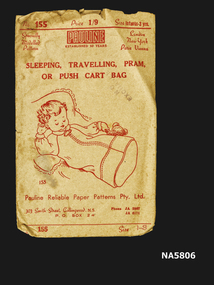
Domestic object - "Pauline" Paper Pattern No. 155, Pauline Reliable Paper Patterns Pty Ltd, C 1950's
... - Example of small pattern production for the home dressmaker - Example of infant clothing of the period...- Example of small pattern production for the home dressmaker - Example of infant clothing of the period Home dressmaking Pqaper pattern Various markings and instructions on reverse C 1950's Pauline's paper pattern No. 155 size 1-3 (age) Paper pattern for infants' sleeping, travelling, pram or pushcart bag Domestic object "Pauline" Paper Pattern No. 155 Pauline Reliable Paper Patterns Pty Ltd ...- Example of small pattern production for the home dressmaker - Example of infant clothing of the periodC 1950's Pauline's paper pattern No. 155 size 1-3 (age) Paper pattern for infants' sleeping, travelling, pram or pushcart bagVarious markings and instructions on reversehome dressmaking, pqaper pattern -
 Whitehorse Historical Society Inc.
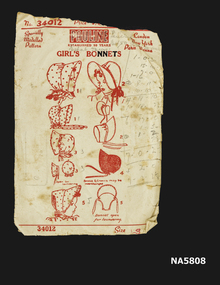
Domestic object - "Pauline" paper pattern, Pauline Reliable Paper Patterns Pty Ltd, C 1950's
... - example of small pattern production for the home dressmaker - example of infant clothing for the period...- example of small pattern production for the home dressmaker - example of infant clothing for the period Home dressmaking Paper pattern Various with detailed instructions & promotional material c 1950's Pauline's paper pattern No. 34012 for girls' bonnets of 5 various styles. ...- example of small pattern production for the home dressmaker - example of infant clothing for the periodc 1950's Pauline's paper pattern No. 34012 for girls' bonnets of 5 various styles. Instructions on rear of envelopeVarious with detailed instructions & promotional materialhome dressmaking, paper pattern -
 Wodonga & District Historical Society Inc
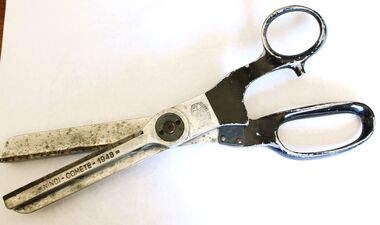
Functional object - Large Pinking Shears, Comete Ninci, 1948
... Pinking shears or scissors were a valuable accessory for any professional or home dressmaker. Pinking shears have serrated edges and they leave trimmed fabric with a decorative edge as well as preventing the fabric from fraying. ...Pinking shears or scissors were a valuable accessory for any professional or home dressmaker. Pinking shears have serrated edges and they leave trimmed fabric with a decorative edge as well as preventing the fabric from fraying. ...Pinking shears or scissors were a valuable accessory for any professional or home dressmaker. Pinking shears have serrated edges and they leave trimmed fabric with a decorative edge as well as preventing the fabric from fraying. The words under the trademark "Marque Depose" mean trademark pending. These pinking shears were owned by Mrs. Betty Sheather of Gordon Street, Wodonga, Victoria. Betty was the daughter of James and Elizabeth Fletcher. Her father had many jobs including carriage cleaner with Victoria Railways at Wodonga and her mother was at House Creek State School No. 2266. Betty worked in Arnold's Store, the store of Costelloe & Smith as well as the Bethanga Park homestead as well as Drummonds at Walwa and the Hotel at Ebden. As a younger woman she lived with the Whan family at Stonleigh which was then a rope factory.Betty was a keen golfer and belonged to a club which played at the Wodonga Racecourse and was a member of the Bandiana Golf Club. These shears were owned by a well-known member of Wodonga and were representative of dressmaking implements used in the mid 1900s.Large vintage Comete Pinking Shears / zigzag scissors produced in Italy from metal alloy.On outer side of blade : NINCI COMETE 1948. Beside central hinge in ring shape: COMETE/ITALY/NINCI/ MARQUE DEPOSE.pinking shears, dressmaking -
 Warrnambool and District Historical Society Inc.
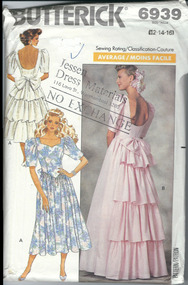
Document, Pattern Ladies dress Butterick, Second half of 20th century
... Paper patterns have been used by dressmakers and home sewers throughout the 20th century and are still used today. ...Paper patterns have been used by dressmakers and home sewers throughout the 20th century and are still used today. ...Paper patterns have been used by dressmakers and home sewers throughout the 20th century and are still used today. The Butterick Company was established in 1863 and was the first to mass-produce sewing patterns. The company was acquired by the CcCall Pattern Company in 2001. Jessen Dress Materials shop was at 116 Lava Street in the 1970s and 80s and Bargain Box Fabrics took over the shop in the 1990sThis pattern envelope is of minor interest as coming from a local Warrnambool shop. It may be useful for display This is a paper envelope containing the instructions and cut-out material for making a woman's dress (day and evening) The envelope contains four loose items. Butterick 6939 Dress Material. No Exchange, Average Moins facilewarrnambool, butterick patterns, jessen dress materials -
 Warrnambool and District Historical Society Inc.
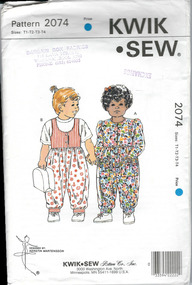
Document, Pattern Bargain Box, Late 20th century
... Paper patterns have been used by dressmakers and home sewers throughout the 20th century and are still used today.The Kwik Sew company has been making patterns since 1967 and is now part of the McCall Pattern Company, a multi-national company based in U.S.A. ...Paper patterns have been used by dressmakers and home sewers throughout the 20th century and are still used today.The Kwik Sew company has been making patterns since 1967 and is now part of the McCall Pattern Company, a multi-national company based in U.S.A. ...Paper patterns have been used by dressmakers and home sewers throughout the 20th century and are still used today.The Kwik Sew company has been making patterns since 1967 and is now part of the McCall Pattern Company, a multi-national company based in U.S.A. Bargain Box Fabrics, situated at 116 Lava Street, Warrnambool, sold patterns and materials in the 1980s and early 1990sThis pattern item is of minor interest as coming from a local Warrnambool shop. It may be useful for display. This is a paper envelope containing the instructions and cut-out material for making a child’s pants and top outfit. The envelope contains six loose items.‘Pattern 2074, Kwik Sew’ Stamp- ‘Bargain Box Fabrics , 11 6 Lava Street, Warrnambool, 3280, Phone, (055) 614055’ bargain box fabrics, kwik sew patterns -
 Flagstaff Hill Maritime Museum and Village
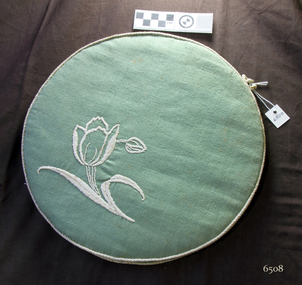
Domestic object - Doily Case, Daisy Dale, before 1922
... Daisy Dale made this doily case before her marriage in 1922; it was a tradition for brides to have a 'glory box' containing linen and embroidered articles to take to their new home. A skilled dressmaker, Daisy began her apprenticeship at two shillings and sixpence per week at Miss A. ...Daisy Dale made this doily case before her marriage in 1922; it was a tradition for brides to have a 'glory box' containing linen and embroidered articles to take to their new home. A skilled dressmaker, Daisy began her apprenticeship at two shillings and sixpence per week at Miss A. ...In the Words of donor, Betty Stone, … “These crocheted and embroidered articles cover a period of three generations- ie. Sarah (nee Chamberlain) Lees, Ann (nee Lees) Dale, and Daisy Elvena (nee Dale) Welsh. All three were accomplished needlewomen; also, both Sarah Lees (born 1844) and her daughter, Ann (b 1865) crocheted a wide variety of articles for use in their homes. A few examples of these items have survived the years.” The purpose of a doily case was to hold embroidered or crocheted doilies or small mats, which were used on plates to serve cakes and similar items. This case was designed and made by Daisy Elvena Dale, born on 27 October 1899, the youngest child of Ellis and Anne (nee Lees) Dale, of Latrigg, Wangoom, Warrnambool. The doilies in the case are a mixed collection sewn by children, which my mother collected over the years. Daisy Dale made this doily case before her marriage in 1922; it was a tradition for brides to have a 'glory box' containing linen and embroidered articles to take to their new home. A skilled dressmaker, Daisy began her apprenticeship at two shillings and sixpence per week at Miss A. E. Emery's dressmaking establishment at 150-152 Liebig Street, Warrnambool. Considered to be the leading house of fashion in Warrnambool, Miss Emery employed about eight young women who worked long hours to sew elaborate gowns for clients, including wives of graziers who would attend the race carnivals and social functions in Warrnambool. (NOTE: For additional information please refer to my book Pioneer and Places- A History of Three Warrnambool Pioneering Families ie. Chamberlain, Dale and Lees families)This item is associated with the Warrnambool pioneer families of Chamberlain, Dale and Lees. These families are listed in the Pioneers' Register for Warrnambool Township and Shire, 1835-1900, published by A.I.G.S. Warrnambool Branch. The item is a fine example of early 20th-century needlework.Doily Case made by Daisy Dale. Two green fabric-covered circles with white cord edge trip. The front has a motif of a tulip flower and bud embroidered on it. The circles are secured shut by a knot and loop. From the 'Chamberlain Dale Lees Collection'.flagstaff hill, warrnambool, shipwrecked coast, flagstaff hill maritime museum, maritime museum, shipwreck coast, flagstaff hill maritime village, great ocean road, chamberlain, dale, lees, stone, betty stone, warrnambool pioneers, daisy dale, wangoom, dressmaker, fashion, 1920's, doily, miss a. e. emery, glory box, embroidery, handmade, needlework, doily case -
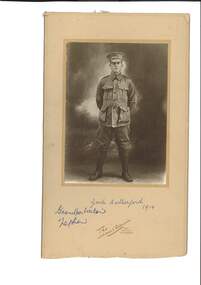 Federation University Historical Collection
Photograph, The Model Studios, Rutherford / Yung family/ Watson Families, 1) c1914; .2)1902; .3 c1890's; .4 c1952;
... Alf Watson was the photographer. .5 Edith (Alice) Watson - artist and dressmaker. Photo taken in the garden of the family home 47 Cromie Street Murtoa, Victoria. ...Alf Watson was the photographer. .5 Edith (Alice) Watson - artist and dressmaker. Photo taken in the garden of the family home 47 Cromie Street Murtoa, Victoria. ...Family photographs from Edith Emma Watson's collection involving Watson, Smith, Yung and extended families. .1 Army photo WW1 of Jack Rutherford 1914. Florence (bYung) and Tom Rutherford. .2 Edith Alice Rutherford's Memorial Card .3 Photo of Edith Alice Rutherford .4 Family photograph taken on the occasion of Clara Emma Yung's 90th birthday in Murtoa. People in photograph: Back row L-R Peg Watson, Jack Watson, Harry Watson, Beryl Cox, Jeff Cox, Lance Yung. Front row :Alice Watson seated on the ground, Edith Watson nursing Alison Watson, Clara Emma Yung, Annie Bolte? nursing Helen Cox, ?, Grace Watson kneeling. Front row L-R: Alice Watson, Edie Watson nursing Alison Watson, Clara Yung, Clara's sister Annie Bolte ? nursing Helen Cox, Jeanette Watson, Grace Watson. Alf Watson was the photographer. .5 Edith (Alice) Watson - artist and dressmaker. Photo taken in the garden of the family home 47 Cromie Street Murtoa, Victoria. Jack Rutherford was born in 1892 at Smythesdale. Killed in action 12/10/1917 in Belgium.Two sepia photos, two black and white photos and one memorial card .1) Jack Rutherford 1914 .2) Black and gold Memorial Card for Edith Alice Rutherford .3) Alice Rutherford. Born 09/1876, died 20/10/1902 in childbirth, aged 26. Alice was the daughter of George Godlip Yung and Anna Christina Weller and a sister to eleven siblings. Her baby son "Little Joe" is buried with her in the Smythesdale Cemetery. .4) Clara Emma Yung 90th Birthday Family Group. .5) Edith Alice Watson.1)Front under photo - Handwritten -'Jack Rutherford 1914'; handwritten - 'Grandpa Watson's nephew {inscription incorrect; should be (Grandma Yung's nephew)}'. Professional stamp - The Model Studios 328 Smith Street Collingwood. .3) Nadar Studio; Coat of Arms ; Photographer' Address .4) Verso: Handwritten - 'Grandma Yung's (Clara Emma's) 80th B'day; Alf took Photo; Chn. Alison (Watson) Jobe, Helen (Cox) Sampson .5) Edith 'Alice' Watson. garden. 47 Cromie St Murtoayung, rutherford, jack rutherford, watson, cox, alice watson, clara emma yung, alison watson, helen sampson, harry watson, john richard watson, family history, german, german australians -
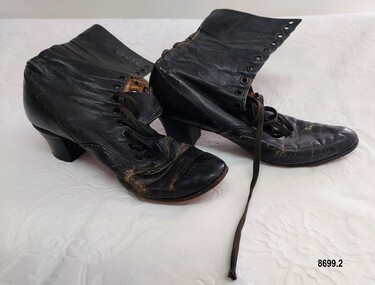 Flagstaff Hill Maritime Museum and Village
Footwear - Leather boots, Adler Boots and Shoes, circa 1920
... They had two daughters – Ethel Evelyn Stephenson (1886 – 1956) and Lillian or Lila (1891 – 1977) who were milliners and dressmakers and who continued to live in the family home after the death of their parents. ...They had two daughters – Ethel Evelyn Stephenson (1886 – 1956) and Lillian or Lila (1891 – 1977) who were milliners and dressmakers and who continued to live in the family home after the death of their parents. ...This item is one of a collection of clothing items that belonged to the Stephenson family who lived at 22 McCracken Street, Kensington, Melbourne. Matthew Stephenson (1861 – 1943) who had grown up on the Bendigo goldfields and shifted to Melbourne in the early 1900’s was a train driver and later, a fireman with the railways. His wife Elizabeth Jane (Betsy) Wigley (1865 – 1953) also grew up on the goldfields around Majorca and Bendigo. They married in 1885 in Bendigo. They had two daughters – Ethel Evelyn Stephenson (1886 – 1956) and Lillian or Lila (1891 – 1977) who were milliners and dressmakers and who continued to live in the family home after the death of their parents. The family are recorded as living at 22 McCracken Street, Kensington, as early as 1914. It is not known who made or owned the clothing that makes up this collection but as it appears to be from the late Victorian and early Edwardian era, the different pieces were probably made and worn by any of the three ladies of the house – Betsy, Ethel and/or Lila. During W.W.2, a local Warrnambool couple (Meryl and Tony Everard) boarded with them – Tony was in the airforce training paratroopers to jump into (and survive) enemy territory and his wife Meryl worked in the Methodist baby Home. The Everards developed a close friendship with the Stephensons and were responsible for clearing out the house (and finding this clothing collection) after Lila died in 1977. Starting in around 1850, women began wearing boots that resembled the ones already worn by men in high society. Victorian women's boots were slightly more feminine in nature, however, than those worn by their male counterparts. The boots first worn by women extended to the middle of the calf so that her ankle would stay properly covered underneath her many skirts. These boots often featured laces or a row of buttons to keep them secure to the foot and ankle. Although usually made from durable materials like rubber and leather, boots that were worn purely for fashion were sometimes made of more elegant materials like patent leather or dyed suede. Edwardian boots were lace up or button up. The most remarkable thing about women's shoes in the 1920's was that they were visible! This led to an increase in demand for new styles every season which made ordering custom fit shoes a thing of the past. New shoes were made in standard sizes, ready to buy from local clothing stores or mail order catalogues. Working women, however, tended to wear sensible, lace up shoes and boots. These boots appear to be of a practical nature, designed for comfort, warmth, and proof against the rain and mud, rather than high fashion. They feature the brand name "adler" printed on the inner sole and have stamped letters and numbers suggesting ready-made sizes.This pair of boots are a significant example of a working woman's footwear dating around the early 20th century.Pair of lady's black leather, lace up boots featuring 3.75 cm heels, 14 pairs of lacing eyelets, a black leather tongue and black shoelaces. The leather soles have tacks on the heels and near the instep. The boots have a black leather inner sole and the inner shaft and upper part of the boots are lined with a durable cotton type fabric. Both boots have ink markings (handwritten and stamped) at the top of the shaft lining and the inner sole of the left hand boot is labelled "adler".Both boots - "0/128 /X" (handwritten) and "6MC200" (stamped). Left boot inner sole - "adler" left boot upper shaft lining - "X/8FH?" (handwritten)flagstaff hill maritime museum and village, great ocean road, shipwreck coast, warrnambool, boots, lady's boots, footwear, leather boots, lace up boots, adler, stephenson family -
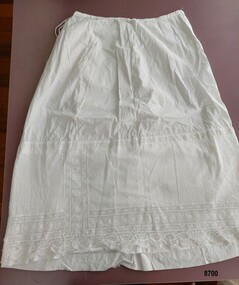 Flagstaff Hill Maritime Museum and Village
Textile - Petticoat, circa 1900
... They had two daughters – Ethel Evelyn Stephenson (1886 – 1956) and Lillian or Lila (1891 – 1977) who were milliners and dressmakers and who continued to live in the family home after the death of their parents. ...They had two daughters – Ethel Evelyn Stephenson (1886 – 1956) and Lillian or Lila (1891 – 1977) who were milliners and dressmakers and who continued to live in the family home after the death of their parents. ...This item is one of a collection of clothing items that belonged to the Stephenson family who lived at 22 McCracken Street, Kensington, Melbourne. Matthew Stephenson (1861 – 1943) who had grown up on the Bendigo goldfields and shifted to Melbourne in the early 1900’s was a train driver and later, a fireman with the railways. His wife Elizabeth Jane (Betsy) Wigley (1865 – 1953) also grew up on the goldfields around Majorca and Bendigo. They married in 1885 in Bendigo. They had two daughters – Ethel Evelyn Stephenson (1886 – 1956) and Lillian or Lila (1891 – 1977) who were milliners and dressmakers and who continued to live in the family home after the death of their parents. The family are recorded as living at 22 McCracken Street, Kensington, as early as 1914. It is not known who made or owned the clothing that makes up this collection but as it appears to be from the late Victorian and early Edwardian era, the different pieces were probably made and worn by any of the three ladies of the house – Betsy, Ethel and/or Lila. During W.W.2, a local Warrnambool couple (Meryl and Tony Everard) boarded with them – Tony was in the airforce training paratroopers to jump into (and survive) enemy territory and his wife Meryl worked in the Methodist baby Home. The Everards developed a close friendship with the Stephensons and were responsible for clearing out the house (and finding this clothing collection) after Lila died in 1977. A petticoat is a lady's undergarment - worn under a skirt or dress. They provided warmth, modesty and shape to the dress. In the middle of the 19th century, petticoats were worn over hoops, bustles or in layers. Petticoats varied according to the style of the outside skirt or dress. Plain petticoats tended to be worn with everyday wear whilst better dresses (party dresses or silk gowns) were worn with petticoats that often had more trim and embellishments. Edwardian petticoats had less volume than Victorian era petticoats and they had a "dust ruffle" or lining under a lace flounce. The "dust ruffle" protected the lace flounce and gave the petticoat more flare at the bottom, greater freedom when walking as well as saving the flounce (which was often made of finer material) from everyday wear and tear. Tucks are another feature of Edwardian petticoats - when the lace at the bottom became worn, it could be cut off and the tucks released. This extended the life of the petticoat. This petticoat features an intricate trim of broderie anglaise. Although broderie anglaise was a lace that could be made by hand, it was very time consuming to make. St Gallen was a city in Switzerland that had become known for producing quality textiles. At the beginning of the 19th century, the first embroidery machines were developed in St Gallen. Factories used embroidery machines but people also had them in their homes. They were able to produce broderie anglaise for export. By the early 20th century, machine made lace, fabric, ribbons etc. were being sold in drapers shops all over England and Wales to women who were making clothes and furnishings for their families. It is highly likely that the lady who made this petticoat brought the lengths of broderie anglaise already made to embellish and personalise her petticoat.This item is an example of the needlework skills of women in the late 19th century - creating pintucks and adding lace to personalise and embellish a practical item of clothing. A lady's fine cotton and lace ankle length petticoat featuring a deep decorative hem made from sheer pinspot fabric and bands of eyelet lace. The top section of the petticoat is made from five sections of fine cotton sewn together with french seams and gathered with pleats and darts into the waistband. The waistband opening has two button holes and one button (the top button is missing) and a front section with a drawstring. The lace hem is lined with the same fine cotton as the top of the petticoat. There are three different lace bands - a narrow one featuring small flowers, a similar wider band with larger flowers and it is finished at the bottom with a broad band of lace with an intricate leaf design.flagstaff hill maritime museum and village, great ocean road, warrnambool, shipwreck coast, petticoat, lady's petticoat, broderie anglaise, decorative petticoat, draw string waist, machine sewn, dressmaker, stephenson family, pintucks, needlework -
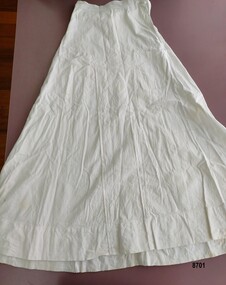 Flagstaff Hill Maritime Museum and Village
Textile - Overskirt, circa 1910
... They had two daughters – Ethel Evelyn Stephenson (1886 – 1956) and Lillian or Lila (1891 – 1977) who were milliners and dressmakers and who continued to live in the family home after the death of their parents. ...They had two daughters – Ethel Evelyn Stephenson (1886 – 1956) and Lillian or Lila (1891 – 1977) who were milliners and dressmakers and who continued to live in the family home after the death of their parents. ...This item is one of a collection of clothing items that belonged to the Stephenson family who lived at 22 McCracken Street, Kensington, Melbourne. Matthew Stephenson (1861 – 1943) who had grown up on the Bendigo goldfields and shifted to Melbourne in the early 1900’s was a train driver and later, a fireman with the railways. His wife Elizabeth Jane (Betsy) Wigley (1865 – 1953) also grew up on the goldfields around Majorca and Bendigo. They married in 1885 in Bendigo. They had two daughters – Ethel Evelyn Stephenson (1886 – 1956) and Lillian or Lila (1891 – 1977) who were milliners and dressmakers and who continued to live in the family home after the death of their parents. The family are recorded as living at 22 McCracken Street, Kensington, as early as 1914. It is not known who made or owned the clothing that makes up this collection but as it appears to be from the late Victorian and early Edwardian era, the different pieces were probably made and worn by any of the three ladies of the house – Betsy, Ethel and/or Lila. During W.W.2, a local Warrnambool couple (Meryl and Tony Everard) boarded with them – Tony was in the airforce training paratroopers to jump into (and survive) enemy territory and his wife Meryl worked in the Methodist baby Home. The Everards developed a close friendship with the Stephensons and were responsible for clearing out the house (and finding this clothing collection) after Lila died in 1977. This overskirt is an outer protective garment made of durable cotton and was probably worn over a lady's skirt or dress to protect it whilst they were working. The pockets are large enough for the wearer to keep small items in and there is a loop at the back that would allow the wearer to hang it on a hook, when she finished her work. This item is an example of clothing worn by working women in the late 19th and early 20th centuryA heavy cotton ankle length overskirt made with two wide gored sections containing inset pockets joined to a middle T shaped front band. It has a waistband of grosgrain ribbon and a side opening with 3 pairs of metal snaps (one pair is missing) and a hook and eye at the top. The waistband also has a taped loop (for hanging) and an unusual double fabric overlay with unattached curved ends.flagstaff hill maritime museum and village, great ocean road, shipwreck coast, warrnambool, overskirt, needlework, sewing, protective garment, stephenson family -
 Flagstaff Hill Maritime Museum and Village
Textile - Petticoat, circa 1910
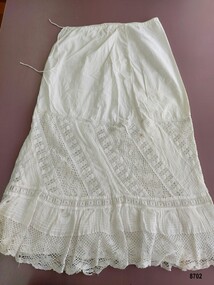
... They had two daughters – Ethel Evelyn Stephenson (1886 – 1956) and Lillian or Lila (1891 – 1977) who were milliners and dressmakers and who continued to live in the family home after the death of their parents. ...They had two daughters – Ethel Evelyn Stephenson (1886 – 1956) and Lillian or Lila (1891 – 1977) who were milliners and dressmakers and who continued to live in the family home after the death of their parents. ...This item is one of a collection of clothing items that belonged to the Stephenson family who lived at 22 McCracken Street, Kensington, Melbourne. Matthew Stephenson (1861 – 1943) who had grown up on the Bendigo goldfields and shifted to Melbourne in the early 1900’s was a train driver and later, a fireman with the railways. His wife Elizabeth Jane (Betsy) Wigley (1865 – 1953) also grew up on the goldfields around Majorca and Bendigo. They married in 1885 in Bendigo. They had two daughters – Ethel Evelyn Stephenson (1886 – 1956) and Lillian or Lila (1891 – 1977) who were milliners and dressmakers and who continued to live in the family home after the death of their parents. The family are recorded as living at 22 McCracken Street, Kensington, as early as 1914. It is not known who made or owned the clothing that makes up this collection but as it appears to be from the late Victorian and early Edwardian era, the different pieces were probably made and worn by any of the three ladies of the house – Betsy, Ethel and/or Lila. During W.W.2, a local Warrnambool couple (Meryl and Tony Everard) boarded with them – Tony was in the airforce training paratroopers to jump into (and survive) enemy territory and his wife Meryl worked in the Methodist baby Home. The Everards developed a close friendship with the Stephensons and were responsible for clearing out the house (and finding this clothing collection) after Lila died in 1977. A petticoat is a lady's undergarment - worn under a skirt or dress. They provided warmth, modesty and shape to the dress. In the middle of the 19th century, petticoats were worn over hoops, bustles or in layers. Petticoats varied according to the style of the outside skirt or dress. Plain petticoats tended to be worn with everyday wear whilst better dresses (party dresses or silk gowns) were worn with petticoats that often had more trim and embellishments. Edwardian petticoats had less volume than Victorian era petticoats and they had a "dust ruffle" or lining under a lace flounce. The "dust ruffle" protected the lace flounce and gave the petticoat more flare at the bottom, greater freedom when walking as well as saving the flounce (which was often made of finer material) from everyday wear and tear. Tucks are another feature of Edwardian petticoats - when the lace at the bottom became worn, it could be cut off and the tucks released. This extended the life of the petticoat. This petticoat features an intricate trim of broderie anglaise. Although broderie anglaise was a lace that could be made by hand, it was very time consuming to make. St Gallen was a city in Switzerland that had become known for producing quality textiles. At the beginning of the 19th century, the first embroidery machines were developed in St Gallen. Factories used embroidery machines but people also had them in their homes. They were able to produce broderie anglaise for export. By the early 20th century, machine made lace, fabric, ribbons etc. were being sold in drapers shops all over England and Wales to women who were making clothes and furnishings for their families. It is highly likely that the lady who made this petticoat brought the lengths of broderie anglaise already made to embellish and personalise her petticoat.This item is an example of the needlework skills of women in the late 19th century - creating pintucks and adding lace to personalise and embellish a practical item of clothing.A lady's ankle length petticoat made in three sections. The top section is made from three rectangles of fine cotton (batiste) joined into a round with narrow french seams and inserted into a simple drawstring waistband with a small opening. The second section is made with rows of alternating strips of fine pin tucked lawn, white cotton cut work embroidery and a wider cotton lace design all joined in a diagonal pattern and lined with fine lawn. The bottom section of the petticoat has a horizontal strip of eyelet lace followed by a wider strip of fine pin tucked lawn and is finished with a deep hem of white cotton crocheted lace fabric and has the same lawn lining as the section above.flagstaff hill maritime museum and village, great ocean road, shipwreck coast, warrnambool, petticoat, lady's petticoat, needlework, sewing, broderie anglaise, stephenson family, drawstring waistband -
 Flagstaff Hill Maritime Museum and Village
Textile - Nightgown, Circa 1900
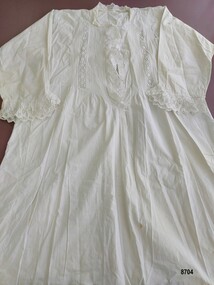
... They had two daughters – Ethel Evelyn Stephenson (1886 – 1956) and Lillian or Lila (1891 – 1977) who were milliners and dressmakers and who continued to live in the family home after the death of their parents. ...They had two daughters – Ethel Evelyn Stephenson (1886 – 1956) and Lillian or Lila (1891 – 1977) who were milliners and dressmakers and who continued to live in the family home after the death of their parents. ...This item is one of a collection of clothing items that belonged to the Stephenson family who lived at 22 McCracken Street, Kensington, Melbourne. Matthew Stephenson (1861 – 1943) who had grown up on the Bendigo goldfields and shifted to Melbourne in the early 1900’s was a train driver and later, a fireman with the railways. His wife Elizabeth Jane (Betsy) Wigley (1865 – 1953) also grew up on the goldfields around Majorca and Bendigo. They married in 1885 in Bendigo. They had two daughters – Ethel Evelyn Stephenson (1886 – 1956) and Lillian or Lila (1891 – 1977) who were milliners and dressmakers and who continued to live in the family home after the death of their parents. The family are recorded as living at 22 McCracken Street, Kensington, as early as 1914. It is not known who made or owned the clothing that makes up this collection but as it appears to be from the late Victorian and early Edwardian era, the different pieces were probably made and worn by any of the three ladies of the house – Betsy, Ethel and/or Lila. During W.W.2, a local Warrnambool couple (Meryl and Tony Everard) boarded with them – Tony was in the airforce training paratroopers to jump into (and survive) enemy territory and his wife Meryl worked in the Methodist baby Home. The Everards developed a close friendship with the Stephensons and were responsible for clearing out the house (and finding this clothing collection) after Lila died in 1977. This nightgown is machine sewn and has an added detailed design of pintucks and broderie anglaise lace to the front yoke and cuffs as a decorative element. The 1800's bought a shift in attitude towards modesty as the Victorian era progressed and by the mid to late 1800's it had become more acceptable ladies to wear simple, modest nightgowns. They tended to have a very loose fit and were usually made of linen, cotton or flannel, which had the advantage of providing warmth and also being easy to wash - a necessity for a garment worn next to the skin. Although the basic design of the nightgown was fairly simple, the wearer was free to add various types of trim e.g. lace, crochet, pintucks, embroidery etc.This item is an example of the needlework skills of women in the late 19th and early 20th century - combining machine stitching with hand embroidery to personalise and embellish a practical item of clothing. A full length lady's cotton nightgown with long sleeves finished with a diagonal pointed cuff of broderie anglaise. The bodice features a front opening placket with 3 buttons and buttonholes and a broderie anglaise cover. On either side of the placket, the bodice has been decorated with rows of vertical pintucks and a broderie anglaise panel insert. There is also a frill of broderie anglaise lace around the neck. The back of the nightgown is gathered onto a yoke.flagstaff hill maritime museum and village, great ocean road, shipwreck coast, warrnambool, nightgown, lady's nightgown, needlework, sewing, broderie anglaise, pintucks, stephenson family -
 Flagstaff Hill Maritime Museum and Village
Textile - Waistcoat, circa 1910
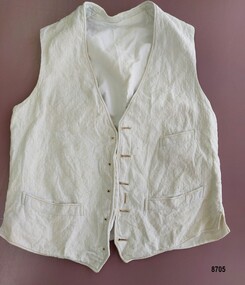
... They had two daughters – Ethel Evelyn Stephenson (1886 – 1956) and Lillian or Lila (1891 – 1977) who were milliners and dressmakers and who continued to live in the family home after the death of their parents. ...They had two daughters – Ethel Evelyn Stephenson (1886 – 1956) and Lillian or Lila (1891 – 1977) who were milliners and dressmakers and who continued to live in the family home after the death of their parents. ...This item is one of a collection of clothing items that belonged to the Stephenson family who lived at 22 McCracken Street, Kensington, Melbourne. Matthew Stephenson (1861 – 1943) who had grown up on the Bendigo goldfields and shifted to Melbourne in the early 1900’s was a train driver and later, a fireman with the railways. His wife Elizabeth Jane (Betsy) Wigley (1865 – 1953) also grew up on the goldfields around Majorca and Bendigo. They married in 1885 in Bendigo. They had two daughters – Ethel Evelyn Stephenson (1886 – 1956) and Lillian or Lila (1891 – 1977) who were milliners and dressmakers and who continued to live in the family home after the death of their parents. The family are recorded as living at 22 McCracken Street, Kensington, as early as 1914. It is not known who made or owned the clothing that makes up this collection but as it appears to be from the late Victorian and early Edwardian era however the vest was probably made by one of the three ladies of the house, for their husband and father, Matthew Stephenson. During W.W.2, a local Warrnambool couple (Meryl and Tony Everard) boarded with them – Tony was in the airforce training paratroopers to jump into (and survive) enemy territory and his wife Meryl worked in the Methodist baby Home. The Everards developed a close friendship with the Stephensons and were responsible for clearing out the house (and finding this clothing collection) after Lila died in 1977. Although by 1916, men's "ready to wear" clothing were widely available, this waistcoat was handmade (possibly by Matthew's wife or daughters). Men's suits in the early part of the twentieth century were predominantly three piece, consisting of a jacket, vest (or waistcoat) and trousers made from matching fabrics. Some men liked to wear a watch attached to their waistcoat with a fob chain. This item is an example of clothing worn by men on special occasions, in the late 19th and early 20th century.A man's waistcoat with cream cotton weave front pieces and cream cotton lining and back. The left front features five machine worked horizontal buttonholes and one vertical buttonhole (for a fob watch) and two inset pockets. The right hand side has five corresponding stud holes and one inset pocket. The studs or buttons are missing. The lining and back of the waistcoat are made from a plain cream cotton fabric. The back also features a cotton strap with a two pronged metal buckle.flagstaff hill maritime museum and village, great ocean road, shipwreck coast, warrnambool, vest, waistcoat, needlework, sewing, stephenson family, man's waistcoat -
 Flagstaff Hill Maritime Museum and Village
Textile - Skirt, circa 1910
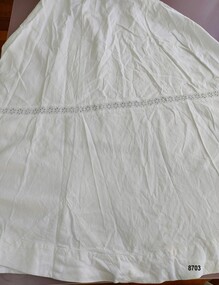
... They had two daughters – Ethel Evelyn Stephenson (1886 – 1956) and Lillian or Lila (1891 – 1977) who were milliners and dressmakers and who continued to live in the family home after the death of their parents. ...They had two daughters – Ethel Evelyn Stephenson (1886 – 1956) and Lillian or Lila (1891 – 1977) who were milliners and dressmakers and who continued to live in the family home after the death of their parents. ...This item is one of a collection of clothing items that belonged to the Stephenson family who lived at 22 McCracken Street, Kensington, Melbourne. Matthew Stephenson (1861 – 1943) who had grown up on the Bendigo goldfields and shifted to Melbourne in the early 1900’s was a train driver and later, a fireman with the railways. His wife Elizabeth Jane (Betsy) Wigley (1865 – 1953) also grew up on the goldfields around Majorca and Bendigo. They married in 1885 in Bendigo. They had two daughters – Ethel Evelyn Stephenson (1886 – 1956) and Lillian or Lila (1891 – 1977) who were milliners and dressmakers and who continued to live in the family home after the death of their parents. The family are recorded as living at 22 McCracken Street, Kensington, as early as 1914. It is not known who made or owned the clothing that makes up this collection but as it appears to be from the late Victorian and early Edwardian era, the different pieces were probably made and worn by any of the three ladies of the house – Betsy, Ethel and/or Lila. During W.W.2, a local Warrnambool couple (Meryl and Tony Everard) boarded with them – Tony was in the airforce training paratroopers to jump into (and survive) enemy territory and his wife Meryl worked in the Methodist baby Home. The Everards developed a close friendship with the Stephensons and were responsible for clearing out the house (and finding this clothing collection) after Lila died in 1977. This skirt features broderie anglaise trim. Although broderie anglaise was a lace that could be made by hand, it was very time consuming to make. St Gallen was a city in Switzerland that had become known for producing quality textiles. At the beginning of the 19th century, the first embroidery machines were developed in St Gallen. Factories used embroidery machines but people also had them in their homes. They were able to produce broderie anglaise for export. By the early 20th century, machine made lace, fabric, ribbons etc. were being sold in drapers shops all over England and Wales to women who were making clothes and furnishings for their families. It is highly likely that the lady who made this skirt brought the lengths of broderie anglaise already made to embellish and personalise her skirt.This item is an example of the needlework skills of women in the late 19th century - creating pintucks and adding lace to personalise and embellish a practical item of clothing. A full length lady's skirt of heavy textured ribbed twill cotton. The top of the skirt is made from five pieces of fabric, sewn together and inserted into a simple waistband. It has an opening with room for 6 hook and eyes (but only the middle three remain). The top section of the skirt is separated from the bottom section by a strip of eyelet embroidery that has been inserted in a horizontal line at the back but becomes slightly diagonal at the front causing the two ends to cross in a decorative X fashion. The bottom of the skirt is the same heavy cotton as the top and one seam features a V shaped insert or patch.flagstaff hill maritime museum and village, great ocean road, shipwreck coast, warrnambool, broderie anglaise, needlework, sewing, stephenson family, skirt, lady's skirt -
 Flagstaff Hill Maritime Museum and Village
Tool - Hem marker stand, 1900s
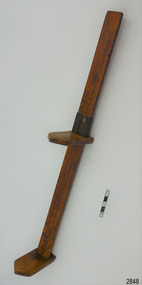
... dressmaker...dressmaking...alterations...tailor...dressmaker's tool...sewing marker...sewing gauge...seamstress...domestic use...dress fitting...curtain hemming...Birmingham...freestanding...chalk hem marker...stand...home...The hem marker would be used by professional dressmakers, seamstresses, and tailors as well as by crafts people at home. The hem marker was made in Birmingham....The hem marker would be used by professional dressmakers, seamstresses, and tailors as well as by crafts people at home. The hem marker was made in Birmingham. ...This hem marker stand is a measuring tool for gauging the height of a hem, such as on a dress or curtain. The adjustable arm slides along the ruler and its snug fit ensures that it stays at the right height. The end of the arm has a metal pin inserted into it to hold a piece of chalk, which would be used to mark the fabric. The hem marker would be used by professional dressmakers, seamstresses, and tailors as well as by crafts people at home. The hem marker was made in Birmingham.The hem marking stand is an example of tools used during the 1900s in the garments and furnishings trades as well as for domestic purposes. Since that time the tool has evolved into a more efficient design that makes home sewing easier.Ham marking stand with a wooden ruler, stand and a sliding adjustable arm on a brass sleeve. The arm has a metal pin on the end. Measurements are marked on both sides, inches on one side and centimetres on the other. Inscriptions are stamped into the wood. Made in Birmingham."- - - - / - - - - - / -BIRMINGHAM" On end of arm "2*4'flagstaff hill, warrnambool, maritime village, maritime museum, shipwreck coast, great ocean road, hem marker, dressmaker, dressmaking, alterations, tailor, dressmaker's tool, sewing marker, sewing gauge, seamstress, domestic use, dress fitting, curtain hemming, birmingham, freestanding, chalk hem marker, stand, home craft -
 City of Moorabbin Historical Society (Operating the Box Cottage Museum)
Domestic object - Haberdashery, pillowslips, c1900
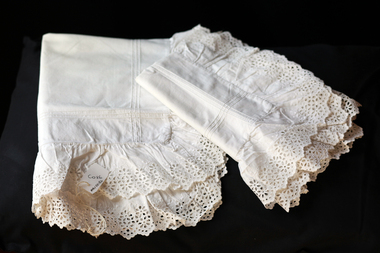
... Early settler women used their dressmaking and craft skills to make clothing and homewares for their homes and families clothing brighton moorabbin linen pioneers haberdashery dendy henry market gardeners dressmakers craft work risstrom lorna A pair of white cotton pillowslips with pin-tucking and broderie frill Domestic object Haberdashery, pillowslips Family of L. ...Early settler women used their dressmaking and craft skills to make clothing and homewares for their homes and familiesA pair of white cotton pillowslips with pin-tucking and broderie frillclothing, brighton, moorabbin, linen, pioneers, haberdashery, dendy henry, market gardeners, dressmakers, craft work, risstrom lorna -
 City of Moorabbin Historical Society (Operating the Box Cottage Museum)
Clothing, white cotton lace blouse, c1960
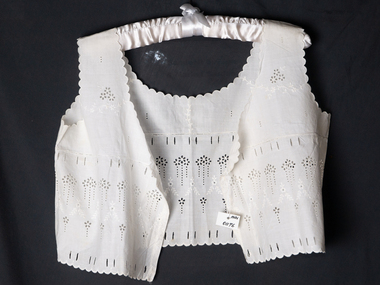
... Manufactured lace became affordable and plentiful so it was used by home dressmakers like Gladys Reed in City of Moorabbin c1960 clothing, manufactured lace, dressmaking, blouses, theatrical props, craftwork, sequins, beading, early settlers, moorabbin shire, mechanics institute cheltenham, ormond choral society, postworld war 11 settlers, housing estates moorabbin 1950, bentleigh, ormond, moorabbin, cheltenham, drama societies, musical society cheltenham, clark judy, reed gladys, reed george A white cotton lace, sleeveless blouse c 1960 with opening front fastened by hooks and eyes Clothing, white cotton lace blouse Mrs Gladys Reed ...Gladys Reed was a member of the Ormond Choral Society c 1950. who performed plays and musicals the City of Moorabbin and she was an accomplished dressmaker and made this blouse for her daughter Judy.Manufactured lace became affordable and plentiful so it was used by home dressmakers like Gladys Reed in City of Moorabbin c1960A white cotton lace, sleeveless blouse c 1960 with opening front fastened by hooks and eyes clothing, manufactured lace, dressmaking, blouses, theatrical props, craftwork, sequins, beading, early settlers, moorabbin shire, mechanics institute cheltenham, ormond choral society, postworld war 11 settlers, housing estates moorabbin 1950, bentleigh, ormond, moorabbin, cheltenham, drama societies, musical society cheltenham, clark judy, reed gladys, reed george -
 City of Moorabbin Historical Society (Operating the Box Cottage Museum)
Craftwork, crochet silk and hooks, c1960
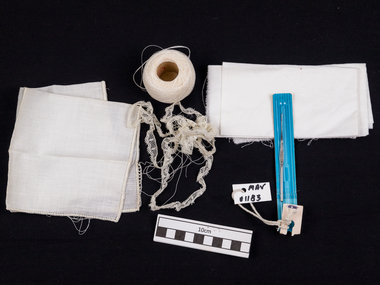
... Craftwork, Crochet, Knitting and Sewing were all popular in post World War 11 Moorabbin as the new settlers established their homes on the previous market garden estates. Gladys Reed was and accomplished dressmaker and was involved in local community activities like the Ormond Choral Society ...Craftwork, Crochet, Knitting and Sewing were all popular in post World War 11 Moorabbin as the new settlers established their homes on the previous market garden estates. Gladys Reed was and accomplished dressmaker and was involved in local community activities like the Ormond Choral Society Craftwork, Crochet, Knitting and Sewing were all popular in post World War 11 Moorabbin as the new settlers established their homes on the previous market garden estates. 2 Crochet Hooks ; a) Made in England / 4 / CROSS FOX b) ARGOBY / 6 / ; packet MILWARD Silk Cotton ; J & P COATES / MERCER CROCHET / 80 A ball of silk thread and 2 steel crochet hooks, 1 completed cotton handkerchief, 2 squares of fine cotton and a small length of lacework Craftwork, crochet silk and hooks J & P Coates Pty Ltd / Milward & Sons Ltd ...Craftwork, Crochet, Knitting and Sewing were all popular in post World War 11 Moorabbin as the new settlers established their homes on the previous market garden estates. Gladys Reed was and accomplished dressmaker and was involved in local community activities like the Ormond Choral Society Craftwork, Crochet, Knitting and Sewing were all popular in post World War 11 Moorabbin as the new settlers established their homes on the previous market garden estates.A ball of silk thread and 2 steel crochet hooks, 1 completed cotton handkerchief, 2 squares of fine cotton and a small length of lacework 2 Crochet Hooks ; a) Made in England / 4 / CROSS FOX b) ARGOBY / 6 / ; packet MILWARD Silk Cotton ; J & P COATES / MERCER CROCHET / 80 -
 Orbost & District Historical Society
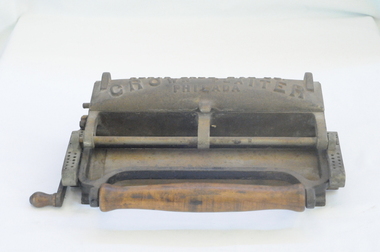
pleating machine, late 19th century - early 20th century
... Dressmakers and classy laundries offering “fancy” ironing services both had plenty of use for a pleating machine. Pleating machines were sold for home use too....Dressmakers and classy laundries offering “fancy” ironing services both had plenty of use for a pleating machine. Pleating machines were sold for home use too. ...Pleated ruffles were a fashionable trimming for ladies’ clothing in the late 19th century - early 20th century. Dressmakers and classy laundries offering “fancy” ironing services both had plenty of use for a pleating machine. Pleating machines were sold for home use too.This item is an example of a machine not commonly used today.Metal and wood pleating machine, still in working order. Handles are carved wood.textile-machinery sewing pleating-machine -
 Orbost & District Historical Society
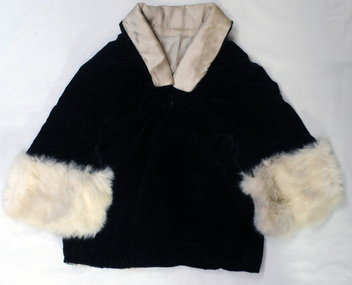
jacket, first half 20th century
... This jacket was made for Marjorie Burton by her mother who was a milliner and an excellent dressmaker who worked from home. She made all of Marjorie's clothes, hats and outfits. as a result, Marjorie was always well-dressed in stylish clothing....This jacket was made for Marjorie Burton by her mother who was a milliner and an excellent dressmaker who worked from home. She made all of Marjorie's clothes, hats and outfits. as a result, Marjorie was always well-dressed in stylish clothing. . ...This jacket was made for Marjorie Burton by her mother who was a milliner and an excellent dressmaker who worked from home. She made all of Marjorie's clothes, hats and outfits. as a result, Marjorie was always well-dressed in stylish clothing.. This item is an example of a handcrafted item and reflects the handcraft skills of women during the first half of the twentieth century.A hand-sewn short-sleeved velvet jacket. It has fur cuffs. It is lined with a cream coloured satin-like material which has been used to make a narrow collar.jacket hand-sewn burton-marjorie needlecraft
