
Showing 17 items matching "homeland stories"
-
 Greensborough Historical Society
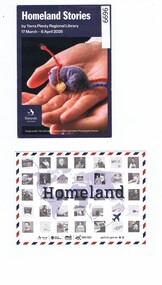
Postcard - Postcards, Yarra Plenty Regional Library, Homeland Stories, 2025
... Homeland Stories......Homeland Stories...Promotional cards regarding Homeland Stories by Yarra Plenty Regional Library 17 March - 6 April 2025...Promotional cards regarding Homeland Stories by Yarra Plenty Regional Library 17 March - 6 April 2025 yarra plenty regional library Homeland Stories immigration 2 cards with coloured images, black print and black and white images Homeland Stories Postcard Postcards Yarra Plenty Regional Library ...Promotional cards regarding Homeland Stories by Yarra Plenty Regional Library 17 March - 6 April 20252 cards with coloured images, black print and black and white imagesyarra plenty regional library, homeland stories, immigration -
 Eltham District Historical Society Inc
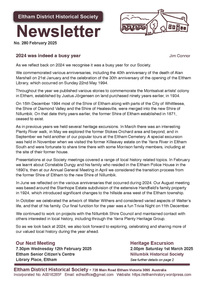
Journal - Newsletter, Newsletter, No. 280 February 2025
... Contents: • 2024 was indeed a busy year by Jim Connor • Our next meeting –7:30pm Wednesday 12th February 2025 – Homeland: Stories from Afar; Liz Pidgeon YPRL • Our next excursion – Saturday 1st March 2025 – Nillumbik Historical Society • Convict Life On The Chain by Ian Bryant • Eltham Water Reserve • My Schooldays at Killeavey by Jenny Ellis • Margot Knox by Alistair Knox • Margot Knox 1931 - 2002 by Gwen Ford • Men’s Sheds by Jim Connor • Little Eltham Heritage Walk brochure • Early Eltham • Hurstbridge Rail Line Electrification by Richard Pinn ...Contents: • 2024 was indeed a busy year by Jim Connor • Our next meeting –7:30pm Wednesday 12th February 2025 – Homeland: Stories from Afar; Liz Pidgeon YPRL • Our next excursion – Saturday 1st March 2025 – Nillumbik Historical Society • Convict Life On The Chain by Ian Bryant • Eltham Water Reserve • My Schooldays at Killeavey by Jenny Ellis • Margot Knox by Alistair Knox • Margot Knox 1931 - 2002 by Gwen Ford • Men’s Sheds by Jim Connor • Little Eltham Heritage Walk brochure • Early Eltham • Hurstbridge Rail Line Electrification by Richard Pinn The Shire of Eltham Historical Society was formed in October 1967. ...Contents: • 2024 was indeed a busy year by Jim Connor • Our next meeting –7:30pm Wednesday 12th February 2025 – Homeland: Stories from Afar; Liz Pidgeon YPRL • Our next excursion – Saturday 1st March 2025 – Nillumbik Historical Society • Convict Life On The Chain by Ian Bryant • Eltham Water Reserve • My Schooldays at Killeavey by Jenny Ellis • Margot Knox by Alistair Knox • Margot Knox 1931 - 2002 by Gwen Ford • Men’s Sheds by Jim Connor • Little Eltham Heritage Walk brochure • Early Eltham • Hurstbridge Rail Line Electrification by Richard Pinn The Shire of Eltham Historical Society was formed in October 1967. The first newsletter of the Society was issued May 1978 and has been published continuously ever since on a bi-monthly basis. With the cessation of the Shire of Eltham in late 1994, the Society's name was revised to Eltham District Historical Society and this name first appeared with issue No. 103, July 1995. The collection of the Society's newsletters provides a valuable resource on the history of the Society's activities, office bearers and committee members, guest speakers and subjects of historical interest pertinent to the former Shire of Eltham and the Eltham District.A4 newsletter distributed to members (Digital and A4 photocopy)newsletter, eltham district historical society -
 Flagstaff Hill Maritime Museum and Village
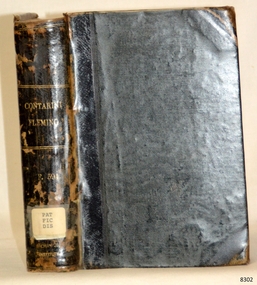
Book - Fictional Novel, Benjamin Disraeli, Contarini Fleming: A Psychological Romance, 1871
... First published in 1833, it tells the story of Iskander, a young prince raised as a Muslim by the Ottoman Turks who secretly remains true to his Christian heritage. When the opportunity arises, he defects, reclaiming his homeland and battling his former captors. ...First published in 1833, it tells the story of Iskander, a young prince raised as a Muslim by the Ottoman Turks who secretly remains true to his Christian heritage. When the opportunity arises, he defects, reclaiming his homeland and battling his former captors. ...This specific book brings together two distinct works written early in the career of one of Victorian Britain's most fascinating political and literary figures. The subject 1871 volume is Volume VII of the first major "Collected Edition" of Disraeli's novels and tales issued by Longmans, Green & Co. The first novel, Contarini Fleming, published in 1832, is an intensely autobiographical, romantic and experimental work. It follows the development of a young man, Contarini Fleming, the son of a Scandinavian nobleman and an Italian mother. The story charts his emotional and artistic growth as he struggles with his identity, travels across Europe and the Levant, and attempts to become a poet. It explores the inner consciousness, imagination and the formation of a creative mind which is why Disraeli subtitled it a "Psychological Romance".Contarini Fleming: A Psychological Romance - and - The Rise of Iskander Author: Benjamin Disraeli (Right Honorable B. Disraeli) Publisher: Longmans Green & Co., London Date: 1871 (new edition) Black cloth hardcover book with embossed gold text on the spine. Inscriptions include stickers, stamps and handwriting. fictionThis specific book brings together two distinct works written early in the career of one of Victorian Britain's most fascinating political and literary figures. The subject 1871 volume is Volume VII of the first major "Collected Edition" of Disraeli's novels and tales issued by Longmans, Green & Co. The first novel, Contarini Fleming, published in 1832, is an intensely autobiographical, romantic and experimental work. It follows the development of a young man, Contarini Fleming, the son of a Scandinavian nobleman and an Italian mother. The story charts his emotional and artistic growth as he struggles with his identity, travels across Europe and the Levant, and attempts to become a poet. It explores the inner consciousness, imagination and the formation of a creative mind which is why Disraeli subtitled it a "Psychological Romance".flagstaff hill, flagstaff hill maritime museum and village, warrnambool, maritime museum, maritime village, great ocean road, shipwreck coast, pattison collection, ralph eric pattison, warrnambool mechanics’ institute, mechanics’ institute library, warrnambool library, free library, corangamite regional library service, longmans green and co. london, benjamin disraeli, queen victoria's friend, longmans green & co, earl of beaconsfield, british politician, british prime minister, contarini fleming, psychological romance, the rise of iskander, right honourable b. disraeli, 1871 -
 Mission to Seafarers Victoria
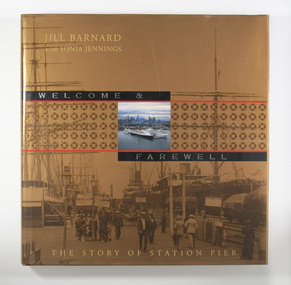
Book, Jill Barnard et al, Welcome and Farewell: The Story of Station Pier, 2004
... homelands and foreign shores, and they who represented us and were never to return to loved ones. We look at the people who worked on the Pier, its custodians and protectors of its heritage value. Finally, the passing visitors and those who came to simply enjoy and reminisce. Illustrated large-format book with 224 pages Welcome and Farewell: The Story ...This book is about those who arrived in the hope of a new life and new opportunities. Those who departed to homelands and foreign shores, and they who represented us and were never to return to loved ones. We look at the people who worked on the Pier, its custodians and protectors of its heritage value. Finally, the passing visitors and those who came to simply enjoy and reminisce.Illustrated large-format book with 224 pagesnon-fictionThis book is about those who arrived in the hope of a new life and new opportunities. Those who departed to homelands and foreign shores, and they who represented us and were never to return to loved ones. We look at the people who worked on the Pier, its custodians and protectors of its heritage value. Finally, the passing visitors and those who came to simply enjoy and reminisce.immigration, station pier, port melbourne, shipping -
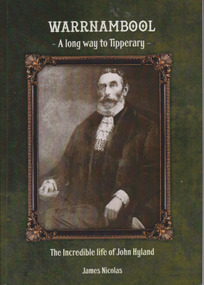 Warrnambool and District Historical Society Inc.
Book, Warrnambool A Long way to Tipperary The incredible life of John Hyland, 2014
... story of one of Warrnambool’s most influential early settlers. It records his public and personal life as well as some of his writings. A second edition of this publication is available which corrects errors in the first edition. warrnambool john hyland james nicholas warrnambool mayors Biography of early Warrnambool settler, John Hyland. Dedicated to all of those who joined the Irish Exodus around the world who loved their homeland ...Biography of early Warrnambool settler, John Hyland.Paperback Background is dark green with sepia photo in bronze coloured frame. Precis on back cover is printed in white lettering. 132 pages.non-fictionBiography of early Warrnambool settler, John Hyland.warrnambool, john hyland, james nicholas, warrnambool mayors -
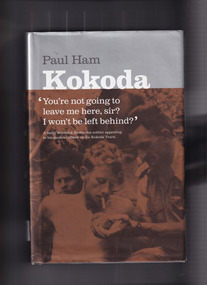 Monbulk RSL Sub Branch
Book, Paul Ham, Kokoda, 2004
... stories of ordinary soldiers in 'the world's worst killing field', and examines the role of commanders in sending ill-equipped, unqualified Australian troops into battles that resulted in near 100 per cent casualty rates. It was a war without mercy, fought back and forth along 90 miles (145 km) of river crossings, steep inclines and precipitous descents, with both sides wracked by hunger and disease, and terrified of falling into enemy hands. Defeat was unthinkable: the Australian soldier was fighting for his homeland ...For the first time ever, the compelling story of the infamous Kokoda Track campaign has been told from both sides of the conflict. In a unique and balanced portrayal, renowned journalist Paul Ham recounts both the Australian and Japanese perspectives of the events on the hellish Papuan jungle trail where thousands fought and died during World War II. Based on extensive research in Australia and Japan, and including previously unpublished documents, Kokoda intimately relates the stories of ordinary soldiers in 'the world's worst killing field', and examines the role of commanders in sending ill-equipped, unqualified Australian troops into battles that resulted in near 100 per cent casualty rates. It was a war without mercy, fought back and forth along 90 miles (145 km) of river crossings, steep inclines and precipitous descents, with both sides wracked by hunger and disease, and terrified of falling into enemy hands. Defeat was unthinkable: the Australian soldier was fighting for his homeland against an unyielding aggressor; the Japanese ordered to fight to the death in a bid to conquer 'Greater East AsiaIndex, bib, ill, p.602.non-fictionFor the first time ever, the compelling story of the infamous Kokoda Track campaign has been told from both sides of the conflict. In a unique and balanced portrayal, renowned journalist Paul Ham recounts both the Australian and Japanese perspectives of the events on the hellish Papuan jungle trail where thousands fought and died during World War II. Based on extensive research in Australia and Japan, and including previously unpublished documents, Kokoda intimately relates the stories of ordinary soldiers in 'the world's worst killing field', and examines the role of commanders in sending ill-equipped, unqualified Australian troops into battles that resulted in near 100 per cent casualty rates. It was a war without mercy, fought back and forth along 90 miles (145 km) of river crossings, steep inclines and precipitous descents, with both sides wracked by hunger and disease, and terrified of falling into enemy hands. Defeat was unthinkable: the Australian soldier was fighting for his homeland against an unyielding aggressor; the Japanese ordered to fight to the death in a bid to conquer 'Greater East Asiaworld war 1939 – 1945 – campaigns – kokoda, world war 1939-1945 - campaigns - south west pacific -
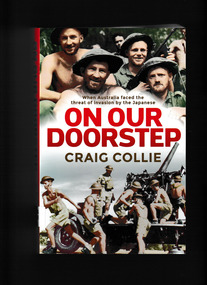 Monbulk RSL Sub Branch
Book, Allen & Unwin, On our doorstep : when Australia faced the threat of invasion by the Japanese, 2020
... homeland, he was also positioning to ensure the United States would be there with us to fend off the approaching enemy. And at home, people pitched in as best they could and in any way to frustrate the invader. They all played their part, torn between 'she'll be right' and near panic. On Our Doorstep is the story ...By March 1942, the Japanese had steamrolled through Malaya, laid siege to Singapore, and bombed Darwin with the same ferocity they had dealt Pearl Harbor. Nothing could stop them. Their next step was inevitable, surely: the invasion and occupation of Australia. Meanwhile, as Australian prime minister John Curtin was battling with Winston Churchill to get troops back from overseas to defend their homeland, he was also positioning to ensure the United States would be there with us to fend off the approaching enemy. And at home, people pitched in as best they could and in any way to frustrate the invader. They all played their part, torn between 'she'll be right' and near panic. On Our Doorstep is the story of how Australia and Australians - the government, the military and the people - prepared to face this calamity, and the events that persuaded them of its probability. In the end, Japan found it had stretched itself beyond the reliability of its supply line, but had it ever intended to invade Australia?Index, bibliography, notes, ill, map, p.404.non-fictionBy March 1942, the Japanese had steamrolled through Malaya, laid siege to Singapore, and bombed Darwin with the same ferocity they had dealt Pearl Harbor. Nothing could stop them. Their next step was inevitable, surely: the invasion and occupation of Australia. Meanwhile, as Australian prime minister John Curtin was battling with Winston Churchill to get troops back from overseas to defend their homeland, he was also positioning to ensure the United States would be there with us to fend off the approaching enemy. And at home, people pitched in as best they could and in any way to frustrate the invader. They all played their part, torn between 'she'll be right' and near panic. On Our Doorstep is the story of how Australia and Australians - the government, the military and the people - prepared to face this calamity, and the events that persuaded them of its probability. In the end, Japan found it had stretched itself beyond the reliability of its supply line, but had it ever intended to invade Australia?world war 1939 – 1945 – campaigns – south west pacific, australia - politics and government - 1939-1945 -
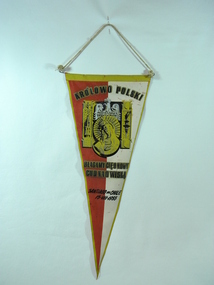 Polish Museum & Archives in Australia
Pennant, La Casa de Banderin, 08/1955
... It is significant in that it tells the story of the aspirations of the Polish Diaspora displaced from it's Homeland in the Kresy Region and scattered throughout the World, including the Americas and Australia. ...In 1955 the Polish Community in Chile wanted to Commemorate the 10th Anniversary of the ending of the 2nd World War but, since it was not a happy occasion, as Poland had been betrayed and placed in the Soviet sphere of influence, they chose to create a Pennant with a plea for the Patron Icon of Eastern Poland - Our Lady of the Sharp/Morning Gate (Matka Boska Ostrobramska/Zaranna) in Vilnius (Wilno) - to give them a new Miracle on the Vistula, in reference to an epic battle which took place on 15th August 1922 on the banks of the Vistula (Wisla) River in which the Polish troops defeated the Soviet Army and turned back the march of Communism to the West. This particular Pennant was purchased by Stanislawa Zamecznik (nee Zakrzewska), while living in Chile after deportation from her birth place in Sianozatki near Bychov (Bychow) to Schweningen in Germany from which they emigrated to South America as Displaced Persons. It was brought to Australia when the Zakrzewski Family emigrated from Chile in 1956, first to Port Augusta and then subsequently to Sydney.It is significant in that it tells the story of the aspirations of the Polish Diaspora displaced from it's Homeland in the Kresy Region and scattered throughout the World, including the Americas and Australia.Pennant of red cloth with screen printing in white, mustard yellow and black hung on copper wire with gold cord Front: Polish inscription "KROLOWO POLSKI / BLAGAMY CIE O NOWY / CUD NAD WISLA / SANTIAGO DE CHILE / 15.VIII.1955" Back: Spanish inscription "LA CASA DE BANDERIN AHUMADA 61"polish pennant polski proporczyk orzel eagle matka boska ostrobramska zaranna our lady of vilnus santiago chile cud nad wisla miracle on the vistula -
 Narre Warren and District Family History Group
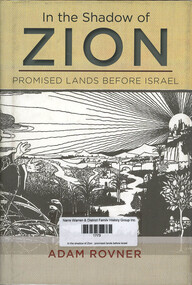
Book, Adam Rovner, In the shadow of Zion : promised lands before Israel, 2014
... Critchley Parker Junior Caroline Isaacson A book about people who explored if parts of Australia could be transformed into a Jewish homeland during World War Two. It includes the story of Critchley Parker Junior, or Upper Beaconsfield, who perished in Port Davey, Tasmania. xvi, 323 p.; 24 cm In the shadow of Zion : promised lands before Israel Book Adam Rovner NYU Press ...A book about people who explored if parts of Australia could be transformed into a Jewish homeland during World War Two. It includes the story of Critchley Parker Junior, or Upper Beaconsfield, who perished in Port Davey, Tasmania.xvi, 323 p.; 24 cmnon-fictionA book about people who explored if parts of Australia could be transformed into a Jewish homeland during World War Two. It includes the story of Critchley Parker Junior, or Upper Beaconsfield, who perished in Port Davey, Tasmania.critchley parker junior, caroline isaacson -
 Embroiderers Guild, Victoria
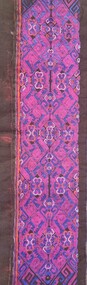
Textile - Embroidered Hmong Dress Panel
... story cloths". These were larger tapestries that documented their lives, their traditions, and their harrowing journey from their homelands to the camps. ...story cloths". These were larger tapestries that documented their lives, their traditions, and their harrowing journey from their homelands to the camps. ...During periods of harsh persecution, Hmong women developed a way to record their history by weaving it directly into their clothing. Called "pajntaub" , which means "flower cloth", and it was traditionally practiced only by the women of the community. Using a variety of complex stitching techniques, they created intricate geometric patterns. These designs were not just for decoration on clothes, collars and baby carriers. At times when their own language was suppressed, these symbols served as a form of communication and cultural documentation, with history hidden in the very pleats of their skirts. This tradition took on a new powerful meaning in the late 1970's after the wars in Southeast Asia. Forced into refugee camps in Thailand, Hmong women began creating "story cloths". These were larger tapestries that documented their lives, their traditions, and their harrowing journey from their homelands to the camps. These story cloths became a way to tell the world what had happened to them . They also became a vital source of income, sometimes selling for just one dollar, which helped families survive in the camps. Hmong Archives; Library of Congress. Hill Tribe clothing panel in fuchsia pinks and royal blue, with white, green, orange highlights. Embroidered in buttonhole stitch and satin stitch filling. Worked on black even weave linen. -
 Embroiderers Guild, Victoria
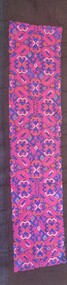
Textile - Embroidered Hmong Dress Panel
... story cloths". These were larger tapestries that documented their lives, their traditions, and their harrowing journey from their homelands to the camps. ...story cloths". These were larger tapestries that documented their lives, their traditions, and their harrowing journey from their homelands to the camps. ...During periods of harsh persecution, Hmong women developed a way to record their history by weaving it directly into their clothing. Called "pajntaub" , which means "flower cloth", and it was traditionally practiced only by the women of the community. Using a variety of complex stitching techniques, they created intricate geometric patterns. These designs were not just for decoration on clothes, collars and baby carriers. At times when their own language was suppressed, these symbols served as a form of communication and cultural documentation, with history hidden in the very pleats of their skirts. This tradition took on a new powerful meaning in the late 1970's after the wars in Southeast Asia. Forced into refugee camps in Thailand, Hmong women began creating "story cloths". These were larger tapestries that documented their lives, their traditions, and their harrowing journey from their homelands to the camps. These story cloths became a way to tell the world what had happened to them . They also became a vital source of income, sometimes selling for just one dollar, which helped families survive in the camps. Hmong Archives; Library of Congress. Hill Tribe clothing panel in fuchsia pinks and royal blue, with white, green, orange highlights. Embroidered in buttonhole stitch and satin stitch filling. Worked on black even weave linen. -
 Embroiderers Guild, Victoria
Textile - Embroidered Hmong Dress Panel
... story cloths". These were larger tapestries that documented their lives, their traditions, and their harrowing journey from their homelands to the camps. ...story cloths". These were larger tapestries that documented their lives, their traditions, and their harrowing journey from their homelands to the camps. ...During periods of harsh persecution, Hmong women developed a way to record their history by weaving it directly into their clothing. Called "pajntaub" , which means "flower cloth", and it was traditionally practiced only by the women of the community. Using a variety of complex stitching techniques, they created intricate geometric patterns. These designs were not just for decoration on clothes, collars and baby carriers. At times when their own language was suppressed, these symbols served as a form of communication and cultural documentation, with history hidden in the very pleats of their skirts. This tradition took on a new powerful meaning in the late 1970's after the wars in Southeast Asia. Forced into refugee camps in Thailand, Hmong women began creating "story cloths". These were larger tapestries that documented their lives, their traditions, and their harrowing journey from their homelands to the camps. These story cloths became a way to tell the world what had happened to them . They also became a vital source of income, sometimes selling for just one dollar, which helped families survive in the camps. Hmong Archives; Library of Congress. Hill Tribe clothing panel in progress in fuchsia pinks and royal blue, with white, green, orange highlights. Embroidered in buttonhole stitch and satin stitch filling. Worked on black even weave linen. -
 Sunshine and District Historical Society Incorporated
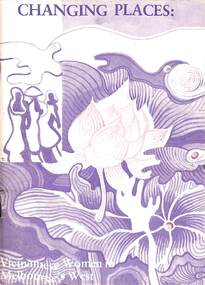
Book - Changing Places Vietnamese Women in Melbourne's West, Melbourne's Living Museum of the West, 1985
... The book tells of personal stories, struggles and adjustments of Vietnamese women after having to flee their homeland....The book tells of personal stories, struggles and adjustments of Vietnamese women after having to flee their homeland. ...This book contains stories of Vietnamese Women in Melbourne's Western SuburbsA soft purple covered book with illustrationsnon-fictionThis book contains stories of Vietnamese Women in Melbourne's Western Suburbsvietnamese, vietnam, women, community history, refugee camps -
 Embroiderers Guild, Victoria
Textile - Embroidered Hmong Dress Panel
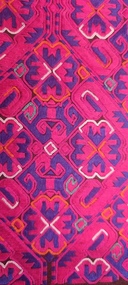
... story cloths". These were larger tapestries that documented their lives, their traditions, and their harrowing journey from their homelands to the camps. ...story cloths". These were larger tapestries that documented their lives, their traditions, and their harrowing journey from their homelands to the camps. ...During periods of harsh persecution, Hmong women developed a way to record their history by weaving it directly into their clothing. Called "pajntaub" , which means "flower cloth", and it was traditionally practiced only by the women of the community. Using a variety of complex stitching techniques, they created intricate geometric patterns. These designs were not just for decoration on clothes, collars and baby carriers. At times when their own language was suppressed, these symbols served as a form of communication and cultural documentation, with history hidden in the very pleats of their skirts. This tradition took on a new powerful meaning in the late 1970's after the wars in Southeast Asia. Forced into refugee camps in Thailand, Hmong women began creating "story cloths". These were larger tapestries that documented their lives, their traditions, and their harrowing journey from their homelands to the camps. These story cloths became a way to tell the world what had happened to them . They also became a vital source of income, sometimes selling for just one dollar, which helped families survive in the camps. Hmong Archives; Library of Congress. Hill Tribe clothing panel in fuchsia pinks and royal blue, with white, green, orange highlights. Embroidered in buttonhole stitch and satin stitch filling. Worked on black even weave linen. -
 Wodonga & District Historical Society Inc
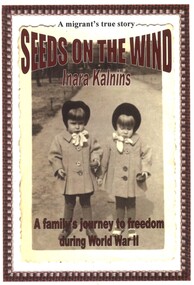
Book - Seeds on the Wind, Inara Kalnins, 2003
... Post World War 11 Migration Refugees - Australia Inara Kalnins This book tells the story of the struggle of the author's family for survival after their way of life was cruelly destroyed by a brutal communist take-over of their homeland. ...This book tells the story of the struggle of the author's family for survival after their way of life was cruelly destroyed by a brutal communist take-over of their homeland. In 1944 they were forced to flee Latvia with no idea of the trauma and tragedy which lay ahead. After spending some time in a refugee camp in Italy, the family arrived in Australia in May 1949 with their first temporary "home" being at Bonegilla Migrant Reception Centre near Wodonga, Victoria. The book documents their early struggles in Australia and their journey to their new life, as well as what happened to the family they had to leave behind.A publication of 225 pages including black and white images and a detailed index.non-fictionThis book tells the story of the struggle of the author's family for survival after their way of life was cruelly destroyed by a brutal communist take-over of their homeland. In 1944 they were forced to flee Latvia with no idea of the trauma and tragedy which lay ahead. After spending some time in a refugee camp in Italy, the family arrived in Australia in May 1949 with their first temporary "home" being at Bonegilla Migrant Reception Centre near Wodonga, Victoria. The book documents their early struggles in Australia and their journey to their new life, as well as what happened to the family they had to leave behind.post world war 11 migration, refugees - australia, inara kalnins -
 Wodonga & District Historical Society Inc
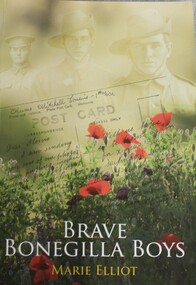
Book - Brave Bonegilla Boys, Marie Elliot, 2004
... homeland and their families to fight for their King, country and freedom. Twelve were never to return, leaving devastated family and friends. Those who did return were often not blessed with a long life after the mental and physical damage they had suffered in the carnage and destruction of a bloody war.. This book explains their stories ...The small community of Bonegilla produced 28 young volunteers, average age 22, eager to leave their homeland and their families to fight for their King, country and freedom. Twelve were never to return, leaving devastated family and friends. Those who did return were often not blessed with a long life after the mental and physical damage they had suffered in the carnage and destruction of a bloody war.. This book explains their stories.non-fictionThe small community of Bonegilla produced 28 young volunteers, average age 22, eager to leave their homeland and their families to fight for their King, country and freedom. Twelve were never to return, leaving devastated family and friends. Those who did return were often not blessed with a long life after the mental and physical damage they had suffered in the carnage and destruction of a bloody war.. This book explains their stories.bonegilla, soldiers bonegilla world war one, bonegilla victoria -
 City of Melbourne Libraries
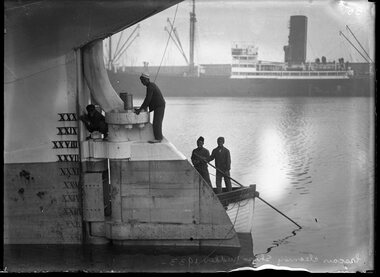
Photograph, Bull, Hugh Jones, 1897-1993, Lascars cleaning ship's rudder
... stories out of the shadows are growing. The Museum of London Docklands features exhibits on their history. Memorials, such as the P&O headstone in Dover for the 22 Lascar crew members of the SS Maloja sunk in 1916 and the careful restoration of the Lascar War Memorial in Kolkata, serve as important reminders of the sacrifices. The journey of the Lascars – from their homelands...stories out of the shadows are growing. The Museum of London Docklands features exhibits on their history. Memorials, such as the P&O headstone in Dover for the 22 Lascar crew members of the SS Maloja sunk in 1916 and the careful restoration of the Lascar War Memorial in Kolkata, serve as important reminders of the sacrifices. The journey of the Lascars – from their homelands ...Published: unknown, however, on 26 June 1935 a similar, but not the exact photo in the McKenzie Collection, was published in The Age: Published title: Shipping Victorian Flour to the East Published Caption: Flour and wheat figure prominently in all cargoes carried by ships trading to Chinese, Japanese and Eastern ports. Victorian millers are eager to extend lids outlet for their produce, and every opportunity is grasped. The pictures show Australian labourers unloading from railway trucks some of the 2300 tons of flour which will go into the hold of the Burns, Philp motor ship Neptuna for shipment to Hong Kong, while Chinese seamen are busy cleaning and painting the rudder post of the ship. Hard by the Neptuna, other ships are taking on flour for the East. Research by Project Volunteer, Louise McKenzie: The image was described by Hugh Bull on the rear of the glass plate as – “Lascars cleaning ships rudder 1933”. Basically, a “lascar” is a seaman. Image No. 032 in the McKenzie Collection shows two lascars perched on the rudder of a ship, with two others standing in a rowboat along side. They are dressed in baggy trousers and jackets and wearing caps. Across a very calm dock area is a single funnel ship with on-deck derricks. The rudder of the ship being cleaned is white, with large black roman numbering denoting the depth at which the ship is sitting, depending on whether it is loaded or empty. Whilst the exact photo in the McKenzie Collection has yet to be located in The Age in 1933, the date when it was taken, there is a photo published in The Age on 25 June 1935 which appears to be one of a series of photos taken on the same day, featuring lascars cleaning a ship’s rudder. It bears a striking resemblance to MCK 032, but it is taken from a slightly different angle. The 1935 published photo is a close up of a ship’s rudder being cleaned, with same style of roman numerals in black on the white of the rudder. One lascar is standing on the rudder, one is standing in a small clinker style rowboat, with its characteristic wooden overlapping hull planks, holding a broom; two more lascars are sitting in the bow and stern of the rowboat. The ship being cleaned is in a dock, as a wharf and warehouses can be seen in the background, the water is very calm, and there are two other ships moored nearby – one across the other side of the dock with a black and white hull and derricks on its deck, and one adjacent, with its mooring lines clearly visible. The lascars are wearing caps, baggy trousers and jackets. Compelling similarities therefore exist between the two images. Whilst it is difficult to positively identify the cultural background of these particular lascars in either photo, the newspaper article dated June 1935 advises they are “Chinese”. This is possibly because the ship they are associated with, the Neptuna, is reported to have sailed from Melbourne on this date, bound for Hong Kong. However, the men are probably from South East Asia. Wikipedia describes the term “Southeast Asia” as covering ” … the people of Southeast Asia from prehistory to the present in two distinct sub-regions: Mainland Southeast Asia (or Indochina) and Maritime Southeast Asia (or Insular Southeast Asia). Mainland Southeast Asia comprises Cambodia, Laos, Myanmar (or Burma), Peninsular Malaysia, Thailand and Vietnam whereas Maritime Southeast Asia comprises Brunei, Cocos (Keeling) Islands, Christmas Island, East Malaysia, East Timor, Indonesia, Philippines and Singapore. Additionally, Wikipedia “Lascars” states that “Lascars were sailors from the Indian subcontinent, South East Asia, the Arab world, British Somaliland and lands east of the Cape of Good Hope, who were employed to work on colonial merchant ships. The practice ran from the 16th century to the mid 20th century”. Indian seamen were used as early as the 16th century by Portuguese explorer Vasgo da Gama in his successful voyage to India, and subsequently by Portuguese ships in the 16th and 17th centuries. “Through the Portuguese and Spanish maritime world empires, some Indian lascars found their way onto English merchant ships, and were among the sailors on the first English East India Company (EIC) ships to sail to India.” In the 17th Century “When the English adopted the term "lascar", they initially used it for all Asian sailors on English-flagged ships, but after 1661 and the Portuguese ceded Bombay to England, the term was used mainly to describe Indian sailors specifically. The term "topaze" was used to describe Indo-Portuguese personnel, especially those from Bombay, Thana, Diu, Dammam and Cochin. The term "sepoy" was used to describe Indian soldiers in European service. The number of lascars employed on EIC East Indiamen was so great that the Parliament of England restricted their employment via the Navigation Acts (in force from 1660 onwards) which required that 75% of the crew onboard English-flagged ships importing goods from Asia be English subjects. The restriction arose due to the high rates of illnesses and death among European sailors on East Indiamen, and their frequent desertions in Asia, which left such ships short of crew for the return voyage. Another reason was the frequent impressment of European sailors from EIC East Indiamen by the Royal Navy in times of war“. The term “impressment” colloquially refers to “the “press gang” …”a type of conscription of people into a military force, especially a naval force, via intimidation and physical coercion, conducted by an organized group (hence “gang”). .. The large size of the British Royal Navy in the Age of Sail meant impressment was most commonly associated with Great Britain.”. (Wikipedia – Impressment). By the 20th century these sailors served on British ships under "lascar agreements", which allowed shipowners more control than was the case in ordinary articles of agreement. The sailors could be transferred from one ship to another and retained in service for up to three years at one time. “Lascars served all over the world in the period leading up to the First World War. Lascars were barred from landing at some ports, such as in British Columbia. At the beginning of World War I, there were 51,616 lascars working on British merchant ships in and around the British Empire. In World War II thousands of lascars served in the war and died on vessels throughout the world, especially those of the British India Steam Navigation Company, P&O and other British shipping companies. The lack of Canadian naval manpower led to the employment of a total of 121 Catholic Goans and 530 Muslim British Indians on the Empress vessels of the Canadian Pacific Railway, such as the Empress of Asia and Empress of Japan. These ships served in the Indian Ocean both as ANZAC convoy ships and in actions at Aden. The ships were placed under the British Admiralty as part of Canada's contribution to the war effort and all of the Indian men were awarded medals by the Admiralty, though none of them were delivered. In the 1950s the use of the term "lascar" declined with the ending of the British Empire. The Indian “Lascar Act” of 1832 was finally repealed in 1963. However, "traditional" Indian deck and Pakistani engine crews continued to be used in Australia until 1986 when the last crew was discharged from the P&O and replaced by a general-purpose crew of Pakistanis. The term lascar has been widely used to engender an element of exoticism in literature eg “Sir Arthur Conan Doyle created a Lascar foil to Sherlock Holmes in "The Man with the Twisted Lip" in 1891. Lascars aboard the ship Patna figure prominently in the early chapters of Joseph Conrad's novel Lord Jim. Frances Hodgson Burnett's novel A Little Princess features a lascar named Ram Dass. Also, Caleb Carr portrays two lascars as bodyguards for a Spanish diplomat near the end of The Angel of Darkness. In Wuthering Heights, it is speculated that Heathcliff, the main character, may be of lascar origin." (Wikipedia – Lascar) And what has become of these “forgotten heroes of the World Wars”? The South Asian Heritage Trust, which seeks to commemorate, mark and celebrate South Asian cultures, stories, and communities, published an article in July 2025 entitled – The Lascars: Seafaring Roots of Modern Britain. It particularly honours the role of the 80,000 lascars who served Britain in WWI, and the over 100,000 who served in the British Merchant Navy in WWII, and concludes: “The hardships faced by Lascars were profound. They were often assigned the most dangerous tasks, lived in substandard conditions aboard ships and, even after their immense contributions to the war efforts, many veterans found it difficult to secure the recognition, pensions and rights afforded to other veterans. Many were employed under ‘Asiatic Articles’, which offered less protection and lower pay than their European counterparts. Yet, their legacy endures. The multicultural fabric of areas like East London owes much to these early seafarers and settlers. The East London Mosque, established in 1910, became an important spiritual and community hub. Today, efforts to bring their stories out of the shadows are growing. The Museum of London Docklands features exhibits on their history. Memorials, such as the P&O headstone in Dover for the 22 Lascar crew members of the SS Maloja sunk in 1916 and the careful restoration of the Lascar War Memorial in Kolkata, serve as important reminders of the sacrifices. The journey of the Lascars – from their homelands, along dangerous wartime shipping routes, to the docklands of Britain – is a story of personal courage and of a rich contribution to Britain’s history and identity.” The ship MV Neptuna, mentioned in the 1935 article, had that year been purchased from a German company by Australian-owned Burns Philp, with Australian Government assistance, and it was instrumental in ensuring the shipment of rice from Vietnam to Papua New Guinea. Rice is still a household staple in PNG. Despite it being introduced into PNG more than 100 years ago, the crop has not been sufficiently integrated into the country’s traditional agricultural production system, and today PNG imports still account for nearly 98% of rice. (Spotlight Magazine Sept. 2016) The 1935 newspaper article states that the Neptuna is involved in moving flour for the East. Australian wheat exports began in 1845, but were not regular until the 1870s. New land clearing methods in Australia allowed large tracts of land to be cleared more efficiently – this included the invention of the iconic ‘stump jump’ plough. With the success of the wheat harvests, flour mills began to spring up around the country. By the 1870s, many large country towns had their own mills, with around 500 mills producing flour across the country. Flour exports were an important part of the wheat industry until around the 1930s. After the Second World War, many of Australia’s export partners (which were mainly in the developing nations of Asia) began setting up their own flour industries and the Australian product was no longer in demand. In 1942 MV Neptuna was being utilised for the war effort, and carrying depth charges and other armaments for Australia, when on 19 February it was sunk in a bombing raid on Darwin, and where part of her hull still lies. References: SHIPPING VICTORIAN FLOUR TO THE EAST. (1935, June 25). The Age (Melbourne, Vic. : 1854 - 1954), p. 11. Retrieved July 23, 2025, from http://nla.gov.au/nla.news-article204357218 Age (Melbourne, Vic. : 1854 - 1954), Tuesday 25 June 1935, page 11 Wikipedia, Clinker (boat building), https://en.wikipedia.org/wiki/Clinker_(boat_building) Wikipedia, Lascar, https://en.wikipedia.org/wiki/Lascar Wikipedia, History of Southeast Asia, https://en.wikipedia.org/wiki/History_of_Southeast_Asia Wikipedia, Impressment, https://en.wikipedia.org/wiki/Impressment NEPTUNA LEAVES FOR CHINA WITH TOURISTS (1935, June 25). The Herald (Melbourne, Vic. : 1861 - 1954), p. 5. Retrieved July 23, 2025, from http://nla.gov.au/nla.news-article244841163 National Research Institute SPOTLIGHT paper Vol 9, Issue 7, https://pngnri.org/images/Publications/Spotlight_No_9_Vol_7_-_201609_-_Sofe__Odhuno_-_Rice_Import_Quota1.pdf South Asian Heritage Trust, The Lascars: Seafaring Roots of Modern Britain, July 11,2025 : Royal British Legion. https://southasianheritage.org.uk/royal-british-legion/the-lascars-seafaring-roots-of-modern-britain/ Photographer notations on slide: "Lascars cleaning ships rudder 1933".lascars, ships, 1930-1939, employment, ethnic communities
