
Showing 52 items matching "horse and buggy on road."
-
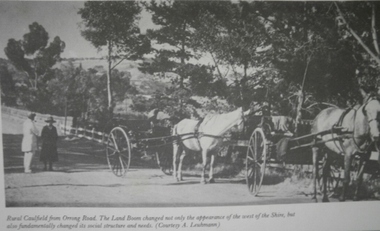 Glen Eira Historical Society
Caulfield Transport
... Photograph of horse drawn buggies in Orrong Road showing rural Caulfield, circa 1857...Caulfield Orrong Road Buggies Horses Photograph of horse drawn buggies in Orrong Road showing rural Caulfield, circa 1857 Caulfield Transport ...Photograph of horse drawn buggies in Orrong Road showing rural Caulfield, circa 1857caulfield, orrong road, buggies, horses -
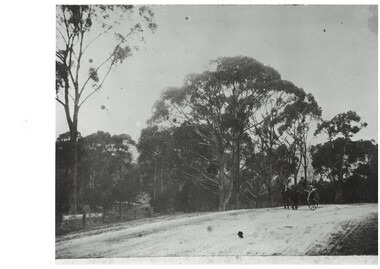 Buninyong & District Historical Society
Photograph - Black and white photograph Geelong Road, Geelong Road North of Buninyong late 19th century
... Tree lined Geelong Road late 19th century featuring a horse drawn buggy and driver..."horse and buggy ascending Geelong Road (Grammar Hill) Railway viaduct visible between trees right...This photograph shows the main road between Ballarat and Geelong in the late 19th century This photograph shows the state of the main Geelong Road in the late 19th century, a typical means of road transport and a glimpse of the railway viaduct servicing Buninyong at the time Geelong Road Transport Railway viaduct "horse and buggy ascending Geelong Road (Grammar Hill) Railway viaduct visible between trees right Tree lined Geelong Road late 19th century featuring a horse drawn buggy and driver Geelong Road North of Buninyong late 19th century Photograph Black and white photograph Geelong Road ...This photograph shows the main road between Ballarat and Geelong in the late 19th centuryThis photograph shows the state of the main Geelong Road in the late 19th century, a typical means of road transport and a glimpse of the railway viaduct servicing Buninyong at the timeTree lined Geelong Road late 19th century featuring a horse drawn buggy and driver"horse and buggy ascending Geelong Road (Grammar Hill) Railway viaduct visible between trees rightgeelong road, transport, railway viaduct -
 Glen Eira Historical Society
Caulfield Properties
... Newspaper photograph of horse drawn buggies in Orrong Road showing rural Caulfield, circa 1857...Caulfield Orrong Road Buggies Horses Newspaper photograph of horse drawn buggies in Orrong Road showing rural Caulfield, circa 1857 Caulfield Properties ...Newspaper photograph of horse drawn buggies in Orrong Road showing rural Caulfield, circa 1857caulfield, orrong road, buggies, horses -
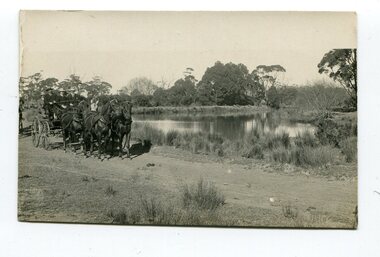 Orbost & District Historical Society
black and white photograph, late 19th - early 20th century
... A black / white photograph of four men in suits seated in a horse - drawn buggy on a dirt road alongside a creek or river. ...A black / white photograph of four men in suits seated in a horse - drawn buggy on a dirt road alongside a creek or river. ...This photograph was taken at the junction of the Snowy and Brodribb Rivers. The Snowy River starts in New South Wales on the slopes of Mt Kosciuszko, Australia’s highest mountain, in New South Wales. It flows into Bass Strait at Marlo in Victoria. The Brodribb River is a tributary of the Snowy which enters the estuary at Marlo. This is a pictorial record of a road in Marlo near Orbost in the late 19th-early 20th centuries. It also depicts the transport used at that time.A black / white photograph of four men in suits seated in a horse - drawn buggy on a dirt road alongside a creek or river. There appears to be another horse - drawn vehicle behind them.on back - "at the Brodribb - Snowy junction. this road was corduroy (packed logs of tea trees?)brodribb-river snowy-river marlo transport-horse-drawn -
 Stawell Historical Society Inc
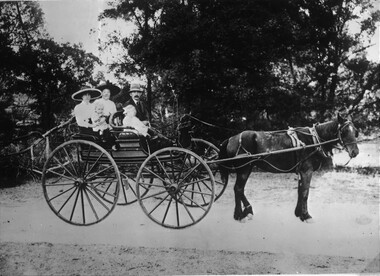
Photograph, Family outing in Horse Drawn Buggy
... Family outing in Horse Drawn Buggy. Photo show details of buggy on dirt road with trees in the background. ...Family outing in Horse Drawn Buggy. Photo show details of buggy on dirt road with trees in the background. ...Family outing in Horse Drawn Buggy. Photo show details of buggy on dirt road with trees in the background. This photograph is of typical transport for the family outing in early 1900's, on to the 1920's.Large black and white photograph and also smaller photo of a double seated buggy drawn by one horse. Sitting in vehicle, two females wearing large hats and two children. Male driving the buggy with hat and mesarch. stawell -
 Charlton Golden Grains Museum Inc
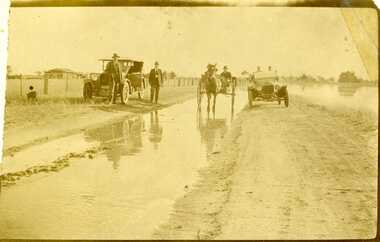
Photograph - 1923 Flood Charlton/St Arnaud Road, 01/05/2008
... Road. L-R car with 2 men standing nearby, horse & buggy in middle of road, another car with 2 people. ...Road. L-R car with 2 men standing nearby, horse & buggy in middle of road, another car with 2 people. ...5 miles out the St Arnaud Road near Roy Baker's old residence.Flood 1923 Charlton/St Arnaud Road. L-R car with 2 men standing nearby, horse & buggy in middle of road, another car with 2 people. Unframed landscape photo with dark border.St Arnaud Road flood near Roy Bakers old residence.1923, floods -
 Phillip Island and District Historical Society Inc.
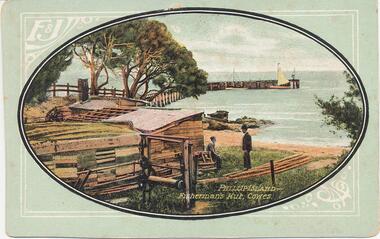
Photograph - Post Cards, Late 1800's
... View of Cowes Jetty taken from a Steamer 6. Wool team and horse and buggy in the background on road to Cowes...road to Cowes. Six colour postcards. 1. The hut was probably Mr Cox's. View to Jetty in background with two yachts moored. 2. View of the Cowes Jetty with Jetty Shed in foreground and the Steamer "Lady Loch" in the distance. 3. Surf breaking over the rocks at Phillip Island Back Beach. 4. Cape Woolamai cliffs and shoreline. 5. View of Cowes Jetty taken from a Steamer 6. Wool team and horse and buggy ...Six Postcards donated by Joyce Suto of MitchamSix colour postcards. 1. The hut was probably Mr Cox's. View to Jetty in background with two yachts moored. 2. View of the Cowes Jetty with Jetty Shed in foreground and the Steamer "Lady Loch" in the distance. 3. Surf breaking over the rocks at Phillip Island Back Beach. 4. Cape Woolamai cliffs and shoreline. 5. View of Cowes Jetty taken from a Steamer 6. Wool team and horse and buggy in the background on road to Cowes1. Phillip Island - Fisherman's Hut, Cowes. 2. Phillip Island - Cowes Jetty. Govt. Steamer "Lady Loch" in distance. 3. Phillip Island. Back Beach. 4. Phillip Island - Cape Woolamai. Home of Mutton Bird. 5. Phillip Island - Cowes from Steamer. 6. Phillip Island - Wool Team on road to Cowes.coastline cape woolamai, cowes jetty, fisherman's beach hut, mr cox beach hut, steamers, steamer lady loch, cowes pier phillip island, joyce suto -
 Glen Eira Historical Society
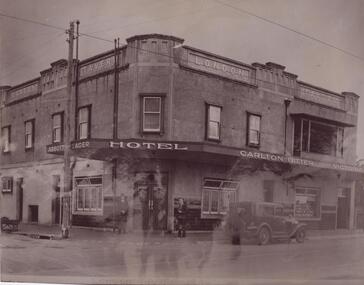
Document - London Tavern
... Shows Boot and Shoe Repair shop at end and two women outside and horse and buggy on road. 3/Photocopy of black and white photograph entitled 'London Tavern 1935' with handwritten note on reverse by unknown author identifying Mrs. ...Shows Boot and Shoe Repair shop at end and two women outside and horse and buggy on road. 3/Photocopy of black and white photograph entitled 'London Tavern 1935' with handwritten note on reverse by unknown author identifying Mrs. ...This file contains eight items: 1/A one page typed summary of the history of the London Tavern by (noted in pencil) author J O'Donnell. Includes information on the licensees of the hotel from 1873-1927 (in duplicate) 2/Photocopy of black and white photo of London Tavern c. 1878. Shows sign 'J. Riordan, London Tavern and Store'. Shows Boot and Shoe Repair shop at end and two women outside and horse and buggy on road. 3/Photocopy of black and white photograph entitled 'London Tavern 1935' with handwritten note on reverse by unknown author identifying Mrs. A.C. Scott as Nominee 1929-1969 and identifying a man in the photograph as John Chas (Jack) Scott on left. Car parked at curb. Original print held in album 'Historical Caulfield to 1972'. 4/Half page written note listing the names of Nominees of the London Tavern from 1873-1895. Author unknown; undated. 5/'now&then' article on London Tavern showing three photos (from our files) and brief history. Melbourne Weekly Bayside 22/02/2012. 6/Black and white photograph of London Tavern, established 1886, currently 414 Hawthorn Road. Foreground includes a large crowd with bicycles noted by an unattributed source to be members of Camden Town Sports Club after a bicycle race c.1888. 7/Handwritten note showing John Guess as the proprietor of the London Tavern in 1867 and 1874. Noet is undated and author unknown. 8/Black and white photograph of the London Tavern with a 1970s style car parked in Sycamore Street. Date and photographer unknownhawthorn road, caulfield, london tavern, woods a.j., camden town sports club, gribble c., hotels, sporting clubs, scott a.c., guess john, guess louisa, evans rowland, riordan john, scott mrs., boot and shoe repair shop, vine beer house, balaclava road, hawthorn road, sycamore street, caulfield south, elsternwick, harley susan, mott h, nichols william h, o'donnell j, rosstown hotel, caulfield club hotel, grocer -
 Royal Australian and New Zealand College of Obstetricians & Gynaecologists (RANZCOG)
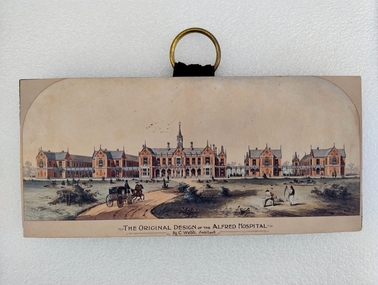
Print - Colour print, Charles Webb, Original design of the Alfred Hospital, c. 1870
... The print depicts a series of five red brick buildings at centre, with a dirt road snaking up from the left foreground to the front of the central building. A man is driving a two-horse buggy along the dirt road towards the buildings. ...The print depicts a series of five red brick buildings at centre, with a dirt road snaking up from the left foreground to the front of the central building. A man is driving a two-horse buggy along the dirt road towards the buildings. ...This 1870 print displays the original design of The Alfred Hospital by Charles Webb. This design was designed in 'accordance with the principles laid down by Florence Nightingale to maximise ventilation and so minimise infection' (Victorian Heritage Database). The Alfred Hospital was founded in 1869 as a result of the work of various Melbourne doctors who fought a long and internecine battle for an additional general hospital. The Alfred Hospital treated their first patient in 1871. Prahran Council donated a parcel of low-lying land for the provision of a hospital. In 1870, the Melbourne architect, Charles Webb, won the competition to design The Alfred Hospital with his revolutionary design. Webb incorporated the "Nightingale" design - principles by designing large light filled pavilions as wards connected by covered corridors or walkways." (Alfred Health)This print includes small colour print mounted on a wood block. The print depicts a series of five red brick buildings at centre, with a dirt road snaking up from the left foreground to the front of the central building. A man is driving a two-horse buggy along the dirt road towards the buildings. The landscape on either side of the road consists of grassland and low vegetation, as well as four shallow circular pits (two on either side) which contain vegetation. There are two figures in the right foreground cutting grass with scythes. A flock of birds is visible in the sky in the central background, above the main hospital building. There is text printed below the image which reads 'THE ORIGINAL DESIGN OF THE ALFRED HOSPITAL/By C.Webb, Arckitect (sic)'. The back of the wooden block to which the print is affixes is painted black, and a circular hook has been attached to the centre back of the block for hanging of the artwork. The hook is gold coloured and attached using two gold-coloured pins and a small strap. There is handwriting at bottom right of the back of the object reads 'ANN TAVELL'.There is text printed below the image which reads 'THE ORIGINAL DESIGN OF THE ALFRED HOSPITAL/By C.Webb, Arckitect (sic)'. There is handwriting at bottom right of the back of the object reads 'ANN TAVELL'. -
 Eltham District Historical Society Inc
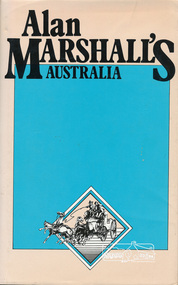
Book, Hyland House, Alan Marshall's Australia, 1981
... No longer do we have time to sit on the sliprail and exchange yarns, to drive buggies down long, quiet dusty roads, or to watch the king-hit merchant operating in some small hotel. ...No longer do we have time to sit on the sliprail and exchange yarns, to drive buggies down long, quiet dusty roads, or to watch the king-hit merchant operating in some small hotel. ...One of a collection of books by local writer Alan Marshall held at EDHS. This one is of "anecdotes and yarns" as described by Marshall before its publication in July 1981 in the Canberra Times. Alan Marshall's Australia, the Australia of "I Can Jump Puddles" has vanished. No longer do we have time to sit on the sliprail and exchange yarns, to drive buggies down long, quiet dusty roads, or to watch the king-hit merchant operating in some small hotel. Even the Cu-nims hold no terrors for a Boeing 427! And yet - Alan Marshall's Australia lives for all those who read this book. Meet Lance Skuthorpe who tethered an old bull in Bourke Street and offered £5 to anyone who could ride it for half a minute and Binjarrpooma, the Arnhem Land terror. Accompany Alan in his horse-drawn caravan or buggy to country sales, pubs and stations and listen with him to great bush eccentrics, lairs and yarn spinners. Go further back and remember Conversation Lollies, the cigarette cards you collected and the school yard games. Can you recall how to test an axe blade, choose a pocket knife, or the penetrating power of Goanna Oil? But this book is more than a nostalgic journey into the past ; it is history for the young and a timely reminder for us all - it is our roots. - Front end papers viii, 165 p. : ill. ; Two copiesISBN 0908090390alan marshall, prose, short stories, ancedotes, australia, tales, yarms -
 Flagstaff Hill Maritime Museum and Village
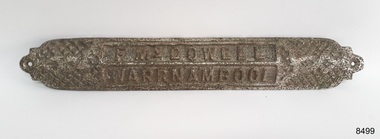
Equipment - Foot Grip, Frank McDowell, Early 20th century
... ...horse cart...buggy making and repair business in Warrnambool's CBD in the early twentieth century. It is an example of the equipment used on horse-drawn vehicles for safety and convenience. flagstaff hill warrnambool flagstaff hill maritime museum maritime museum shipwreck coast flagstaff hill maritime village great ocean road Fred McDowell Frederick McDowell wheelwright gig buggy jinker sulkey spring cart farm wagon 2-wheeled cart horse cart horse cart parts jinker buggy transport vehicle horse drawn horse jinker Bryant & Waterson jinker part jinker foot grip step foot plate horse cart part stafe 2-wheeled carriage "F McDOWELL" "WARRNAMBOOL" Foot grip, iron with silver plate finish. ...This foot grip was made and owned by Frederick William McDowell (Fred) (1880 to 15-6-1967). It would be been joined to the stafe or frame of a jinker and used to step up from the ground and onto the seat. He was a wheelwright by trade. He made and repaired vehicles such gigs, buggies, jinkers, sulkeys, spring carts and farm wagons. His workshop was on the corner of Cramer Street and Raglan Parade in Warrnambool., previously the site of Fotheringhams, and after McDowell's, and still in 2023, occupied by Reece Plumbing Fred's workplace prior to retiring was at Bryant & Waterson's in Kepler Street, opposite the Criterian Hotel, making rubber tyred horse-driven farm wagons.This jinker's foot grip id part of a jinker or two-wheeled carriage. It is a rare item, made by a local wheelwright Frank McDowell who operated his buggy making and repair business in Warrnambool's CBD in the early twentieth century. It is an example of the equipment used on horse-drawn vehicles for safety and convenience.Foot grip, iron with silver plate finish. Rectangular metal plate with textured crossed over diagonal lines on the top surface and inset rectangles with impressed text. the curved and shaped ends have a drilled round hole. the length of the plate is an inverted 'v' shape towards the base. Made by F. McDowell, Warrnambool."F McDOWELL" "WARRNAMBOOL"flagstaff hill, warrnambool, flagstaff hill maritime museum, maritime museum, shipwreck coast, flagstaff hill maritime village, great ocean road, fred mcdowell, frederick mcdowell, wheelwright, gig, buggy, jinker, sulkey, spring cart, farm wagon, 2-wheeled cart, horse cart, horse cart parts, jinker buggy, transport, vehicle, horse drawn, horse jinker, bryant & waterson, jinker part, jinker foot grip, step, foot plate, horse cart part, stafe, 2-wheeled carriage -
 Flagstaff Hill Maritime Museum and Village
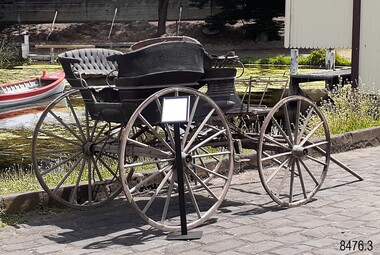
Vehicle - Murweh Carriage, c.1874
... ...horse-drawn vehicle...It can be pulled by one horse, or by two horses if the T-pole is attached. ...This private late-nineteenth-century four-wheeled carriage has been built to transport a family or group of passengers with a coachman in the front seat. It can be pulled by one horse, or by two horses if the T-pole is attached. The button fittings along each side of the carriage indicate that a folding roof or hood was once attached. The frame across the front of the carriagewas likely to have been a ‘dashboard’ with a leather or wood covering to prevent water, mud and other particles from splashing onto the passengers. The rear step between the two side-facing bench seats is adjustable to allow for ladies’ long skirts. These rear seats appear to be removable, in which case the carriage could be converted to a wagon to transport goods and equipment. The carriage could have been illuminated by oil or carbide lamps placed into the lamp holders on the sides. The carriage was kept under cover for many years in an open-front sandstone building that also included living quarters and an area that may have been stable. It was at ‘Murweh’ a Warrnambool property at 203 Liebig Street. The home is now Heritage and National Trust Listed and described as a ‘gentleman’s residence’. It was built by James Wotton Shevill in the 1860s. Shevill was a councillor from 1875 to 1878, serving in 1878 as Mayor of the Borough of Warrnambool. Jeremiah Wade lived at Murweh there from 1879-1880. By 1915 F.B. Whitehead and his family were living there, and by 1930 the address was used by Mr T.J. Rome and his family. Thomas James Rome was still using that address in September 1973 after his 100th birthday. It is believed that one of the property’s owners had been an Obstetrician in Warrnambool. The current owner re-told the story that children used to hide in the back section of the carriage and smoke, hidden from the sight of onlookers. He had heard the story from a previous owner.The well-appointed horse-drawn four-wheeled carriage is likely to have first belonged to a local councillor and past Mayor of the town of Warrnambool, J.W. Shervill, whose 1860s city property was the carriage location for many years. The carriage is a rare local example of a town-based lifestyle befitting a prosperous personality of the late 19th century. It adds to the story of Warrnambool's development as a town influenced by the port, wealth gained from shipping and the home place of prominent local people such as the Councillor and later Mayor. The side-facing rear seating is unusual for a passenger carriage. It has the feature of removable rear bench seats, allowing for the dual purpose of a carriage or wagon.Carriage; the Victorian-era horse-drawn four-wheeled open carriage has a coachman’s bench seat across the front and two side-facing bench seats in the rear. There are steps at the front on each side and a centre adjustable step and the back. It has a hinged shaft, two lamp holders and a separate T-pole. The bench seats have padded backrests upholstered in green leather and each has padded armrests at the ends. A rectangular metal frame, likely to have been a dashboard, is mounted across the front of the carriage. It has two inner vertical bars. The carriage's body is painted dark green with crimson highlights on some of the panelling. Decorative oval panels with hand-painted motifs are mounted along the sides. The side panels of the carriage have metal fastener buttons attached. The iron-rimmed wheels have sixteen wooden spokes and copper cuffs on the outside of the hubs, and the rear wheels are higher than the front wheels. Wooden brake blocks are mounted onto the back wheels and are active by a metal lever at the front right side of the carriage. The undercarriage is fitted with leaf springs on each side, mounted from front to back axles. Included are: (1) The separate T-pole that allows two horses to be harnessed to the carriage (2) Leather horse winkers with metal hardware and oval brass plate on the side of each winkerMotif painted on an oval panel [a musical lyre within a blue floral wreath flanked by scrolls] flagstaff hill maritime museum and village, warrnambool, great ocean road, shipwreck coast, murweh, buggy, cart, carriage, wagon, horse-drawn vehicle, victorian buggy, four-wheeled carriage, coachman’s seat, bench seat, side-facing benches, upholstered seats, victorian decals, heritage vehicle decoration, antique hand painting, hand painted decals, motifs, iron-rimmed wheels, wooden brake blocks, leaf springs, t-pole shaft, rear step, equine carriage, 19th century vehicle, victorian transport, transport, gentleman’s vehicle, james wotton shevill, councillor, mayor, jeremiah wade, f.b. whitehead, thomas james rome, warrnambool obstruction, warrnambool genealogy, warrnambool pioneers, victorian carriage, one horse carriage, two horse carriage, horse drawn carriage -
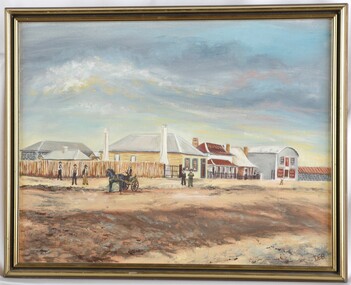 Glenelg Shire Council Cultural Collection
Painting, DEB, Percy Street, n.d
... Several men stand on the edge of the road and one sits in a horse and buggy. Behind the men are several buildings with wooden fences. ...Several men stand on the edge of the road and one sits in a horse and buggy. Behind the men are several buildings with wooden fences. ...CEMA Art Collection Previously located in History HouseThe painting depicts a street scene with several buildings and people. The foreground represents a road and is depicted in shades of brown and yellow. Several men stand on the edge of the road and one sits in a horse and buggy. Behind the men are several buildings with wooden fences. The building in the centre of the work is yellow with a white roof and two white chimneys. The top half of the work is a predominately blue sky with lines of yellow, pink and white. The work has a gold and black frame and exposed canvas.Front: DEB Back: (No inscriptions) -
 Glenelg Shire Council Cultural Collection
Postcard - Postcard - Percy Street Portland, Victoria, n.d
... Row of Norfolk pines either side of road, (unmade); man on bicycle, boy on 3 wheeler, girl standing nearby, horse and buggy; buildings ? ...Row of Norfolk pines either side of road, (unmade); man on bicycle, boy on 3 wheeler, girl standing nearby, horse and buggy; buildings ? ...Black and white photo postcard. Percy St. looking north, taken from middle of road, just north of Julia St. intersection. Row of Norfolk pines either side of road, (unmade); man on bicycle, boy on 3 wheeler, girl standing nearby, horse and buggy; buildings ? shops behind trees. People in period dressFront: 'PERCY ST. PORTLAND LOOKING NORTH 6' - white print, bottom edge of card Back: Handwritten message on back -
Glenelg Shire Council Cultural Collection
Photograph - Sheet of 2 contact prints from glass plate negatives, 1960-1970
... Each Print measuring 11.8 x 16 cm Top: Close up of front of Portland Post Office, corner Bentinck and Cliff Streets. Horse and buggy at right, several people standing in front of Post Office. ...Each Print measuring 11.8 x 16 cm Top: Close up of front of Portland Post Office, corner Bentinck and Cliff Streets. Horse and buggy at right, several people standing in front of Post Office. ...Sheet of 2 contact prints from glass plate negatives. Each Print measuring 11.8 x 16 cm Top: Close up of front of Portland Post Office, corner Bentinck and Cliff Streets. Horse and buggy at right, several people standing in front of Post Office. Bottom: Dutton Way beach looking towards Portland. Road along top of beach, fenced off from beach. Horse tethered to fence. -
Glenelg Shire Council Cultural Collection
Negative - Glass Plate Negative - Bentinck Street south (Cape Nelson Road), c. 1890
... Road) looking north from near Must Street. 'Burswood' obscured by trees on right. Large building on right below horizon line is Drill Hall. Man in horse and buggy...Road) looking north from near Must Street. 'Burswood' obscured by trees on right. Large building on right below horizon line is Drill Hall. Man in horse and buggy ...Glass plate negative. Image shows Bentinck Street south (Cape Nelson Road) looking north from near Must Street. 'Burswood' obscured by trees on right. Large building on right below horizon line is Drill Hall. Man in horse and buggy left foreground. -
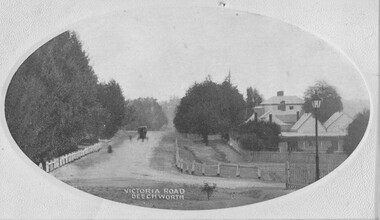 The Beechworth Burke Museum
Photograph, c1910
... Taken in Beechworth c1910, this postcard depicts Victoria Road lined with trees and residential houses. A horse and buggy is also pictured driving towards the camera. ...Taken in Beechworth c1910, this postcard depicts Victoria Road lined with trees and residential houses. A horse and buggy is also pictured driving towards the camera. ...Taken in Beechworth c1910, this postcard depicts Victoria Road lined with trees and residential houses. A horse and buggy is also pictured driving towards the camera. This postcard was manufacture by SEMCO or SEMCO Art Needlework Company, which was a "music, post-card and fine art importers, indentors and publishers" established by Stanley Edward Mullen in c1910, Melbourne. One of the identifying features of the Semco postcards is the text printed on the reverse of the cards which read: “Semco Series, P.O. Box 545, G.P.O. Melbourne.” Black and white postcard within oval frame, grey decorative edge. Obverse: VICTORIA ROAD, BEECHWORTH Reverse: 1997.2839 (crossed-out) A02839 84-137-1 POST CARD Near our state school. BEECHWORTH about 1910 beechworth, victoria road, postcard, 1910, semco -
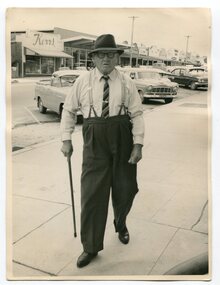 Orbost & District Historical Society
Photograph - Photograph off Albert Trewin
... Road. The Trewin selection at Jarrahmond had many big trees on it and because these looked a bit like Jarrah trees from Western Australia, they names their property Jarrahmond (which became the district location and the name of Jarrahmond School). He cleared the land with bullocks, horses, crosscut saws, burned the stumps, burying some logs which were too big to burn. Then they milked cows, planted maize, had pigs, drove the pigs to Bairnsdale or to Waygara (c. 1915 when the train reached Waygara) on a buggy...Road. The Trewin selection at Jarrahmond had many big trees on it and because these looked a bit like Jarrah trees from Western Australia, they names their property Jarrahmond (which became the district location and the name of Jarrahmond School). He cleared the land with bullocks, horses, crosscut saws, burned the stumps, burying some logs which were too big to burn. Then they milked cows, planted maize, had pigs, drove the pigs to Bairnsdale or to Waygara (c. 1915 when the train reached Waygara) on a buggy ...Albert (Abby) Trewin (b.21.03.1876 d. 01.07.1970) was part of the Trewin family who were early settlers at Jarrahmond near Orbost. Albert was born at Kingston near Ballarat, shifted to Jarrahmond where the house was called "Hillview", located 3 miles from Orbost on the B Road. The Trewin selection at Jarrahmond had many big trees on it and because these looked a bit like Jarrah trees from Western Australia, they names their property Jarrahmond (which became the district location and the name of Jarrahmond School). He cleared the land with bullocks, horses, crosscut saws, burned the stumps, burying some logs which were too big to burn. Then they milked cows, planted maize, had pigs, drove the pigs to Bairnsdale or to Waygara (c. 1915 when the train reached Waygara) on a buggy track through the bush. Pigs went to Dandenong Bacon Factory where they were processed into Dandy Ham. This photograph appears to be c.1950s - 1960s.A photograph of one of Jarrahmond's earliest settlers.B/W photograph of a man walking along a footpath. He is wearing a hat and has a walking stick in his right hand. He is wearing braces, white long-sleeved shirt, striped tie, glasses, polished black shoes. Behind him are vehicles and buildings (shops). jarrahmond, farming -
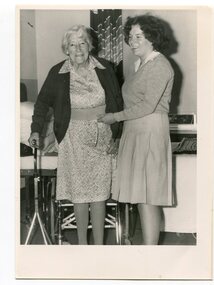 Orbost & District Historical Society
Photograph - photograph - Mrs Hazel Trewin
... Road. The Trewin selection at Jarrahmond had many big trees on it and because these looked a bit like Jarrah trees from Western Australia, they names their property Jarrahmond (which became the district location and the name of Jarrahmond School). He cleared the land with bullocks, horses, crosscut saws, burned the stumps, burying some logs which were too big to burn. Then they milked cows, planted maize, had pigs, drove the pigs to Bairnsdale or to Waygara (c. 1915 when the train reached Waygara) on a buggy...Road. The Trewin selection at Jarrahmond had many big trees on it and because these looked a bit like Jarrah trees from Western Australia, they names their property Jarrahmond (which became the district location and the name of Jarrahmond School). He cleared the land with bullocks, horses, crosscut saws, burned the stumps, burying some logs which were too big to burn. Then they milked cows, planted maize, had pigs, drove the pigs to Bairnsdale or to Waygara (c. 1915 when the train reached Waygara) on a buggy ...The older lady in this photograph is Hazel Trewin, wife of Abby Trewin of Jarrahmond. The Trewins were a foundation settler/farmer family at Jarrahmond and many members of this family still live in this district. (2025). Albert (Abby) Trewin (b.21.03.1876 d. 01.07.1970) was part of the Trewin family who were early settlers at Jarrahmond near Orbost. Albert was born at Kingston near Ballarat, shifted to Jarrahmond where the house was called "Hillview", located 3 miles from Orbost on the B Road. The Trewin selection at Jarrahmond had many big trees on it and because these looked a bit like Jarrah trees from Western Australia, they names their property Jarrahmond (which became the district location and the name of Jarrahmond School). He cleared the land with bullocks, horses, crosscut saws, burned the stumps, burying some logs which were too big to burn. Then they milked cows, planted maize, had pigs, drove the pigs to Bairnsdale or to Waygara (c. 1915 when the train reached Waygara) on a buggy track through the bush. Pigs went to Dandenong Bacon Factory where they were processed into Dandy Ham. This photograph is significant because is of a member of the Trewin family of Jarrahmond.B/W photograph of two women standing. The older woman on the left hand side has her hand on a walking stick, and the other woman appears to be helping her and has her hand outstretched. Behind the two women is a bed an pillows. nonefarming, jarrahmond, trewin family -
 Ringwood and District Historical Society
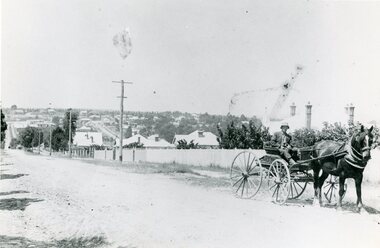
Photograph, Mr Clarence Hams in horse drawn carriage- Warrandyte Road, Ringwood. c1918
... "Written on back of photograph" Mr Clarence Hams in buggy at top of Kennedy's Hill - Warrandyte Road. Black and white photograph Mr Clarence Hams in horse drawn carriage- Warrandyte Road, Ringwood. c1918 Photograph ...Black and white photograph"Written on back of photograph" Mr Clarence Hams in buggy at top of Kennedy's Hill - Warrandyte Road. -
 Flagstaff Hill Maritime Museum and Village
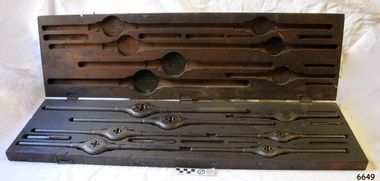
Tool - Taps and Dies set, Wiley and Russell Mfg. Co, C. 1884
... ...horse cart... jinker sulkey spring cart farm wagon 2-wheeled cart horse cart horse cart parts jinker buggy transport vehicle horse drawn horse jinker Bryant & Waterson “Wiley & Russell MFG.CO, Greenfield, Mass, Pat Aug 5 1884.” ...This set of taps and dies tools was owned by Frederick William McDowell (Fred) (1880 to 15-6-1967). He was a wheelwright by trade. He made and repaired vehicles such gigs, buggies, jinkers, sulkeys, spring carts and farm wagons. His workshop was on the corner of Cramer Street and Raglan Parade in Warrnambool., previously the site of Fotheringhams, and after McDowell's, and still in 2023, occupied by Reece Plumbing Fred's workplace prior to retiring was at Bryant & Waterson's in Kepler Street, opposite the Criterian Hotel, making rubber tyred horse-driven farm wagons. This Wiley and Russell hand operated, thread cutting Die and Stock, or Die and Tap, set’s patent carries the description “The taper-headed screws adjust the size; the four side screws hold the cutters firmly in the holder. Marketed as the Wiley & Russell LIGHTNING SCREW PLATE. The taper-headed screws are carried over from the J.J. Grant October 21, 1871 patent (no. 120,266). This patent was improved by Smart's Oct. 21, 1884 patent (no. 306,783).” Dies are used to cut external screw thread, stocks are the tools that hold the dies in place with countersunk adjustable screws, and taps are the tools that make the internal threads. The tools would be used by farriers, blacksmiths, wheelwrights sailing and steam ship engineers for making new, or repairing old, threads in metal. WILEY AND RUSSELL Manufacturing Company The company Wiley and Russell was established in 1872 by Solon Wiley and Charles P Russell, whose uncle founded the J. Russell Cutlery Co. The company began with the purpose of manufacturing thread cutting tools in Green River U.S. This tap and die set is an example of tools used by blacksmiths, farriers, wheelwrights and engineers on sailing and steam ships. It is also an example of early U.S. made engineering tools.Tap, Die, Die Stock set of industrial tools, fitted inside original timber box with three instruction labels attached inside lid. The set is the “Wiley and Russell LIGHTNING SCREW PLATE Pat. Aug. 5, 1884”. The lid has three metal hinges and is secured by two metal hook and eye fittings. This set of Whitworth standard threads has metal die and stocks (seven), and taps (three - the case has provision for four more die). The manufacturer’s details and the sizes of the threads are impressed into the tools. The paper labels have instructions and a diagram for the use and care of the tools. Tools have a protective oil coating. Made by Wiley and Russell Manufacturing Co. of Greenfield, Massachusetts, U.S., c. 1884; the tools were patented in August 1884, U.S. Patent 303,060. “Wiley & Russell MFG.CO, Greenfield, Mass, Pat Aug 5 1884.” “WHIT. STD.”flagstaff hill, warrnambool, shipwrecked coast, flagstaff hill maritime museum, maritime museum, shipwreck coast, flagstaff hill maritime village, great ocean road, tap and die set, 1884 engineering tools, wiley and russell mfg co, lightning tap and die set, tap, die and stock set, screw thread cutting tools, taps and dies, stocks and dies, lightning screw plate, cutters, j.j. grant, patent no. 120266, solon wiley and charles p russell, wiley and russell, j. russell cutlery co, green river u.s, whitworth thread, fred mcdowell, frederick mcdowell, wheelwright, gig, buggy, jinker, sulkey, spring cart, farm wagon, 2-wheeled cart, horse cart, horse cart parts, jinker buggy, transport, vehicle, horse drawn, horse jinker, bryant & waterson -
 Halls Gap & Grampians Historical Society
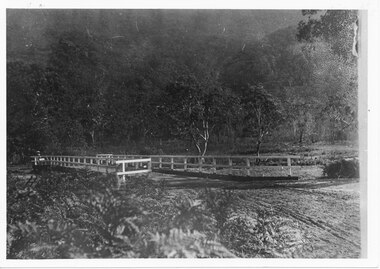
Photograph, C 1911
... The photo shows a dirt road crossing a creek via a wooden bridge. A woman is driving a horse and buggy onto the far end of the bridge. ...The collapsed western end was rebuilt, this time supported by concrete pillars. access routes roads structures bridges The photo shows a dirt road crossing a creek via a wooden bridge. A woman is driving a horse and buggy onto the far end of the bridge. ...This is the second Delley''s Bridge. A new and more substantial bridge was built in 1911, only to be badly damaged in a 1917 flood. The collapsed western end was rebuilt, this time supported by concrete pillars.The photo shows a dirt road crossing a creek via a wooden bridge. A woman is driving a horse and buggy onto the far end of the bridge. There are ferns in the foreground and trees in the background.access routes, roads, structures, bridges -
 Eltham District Historical Society Inc
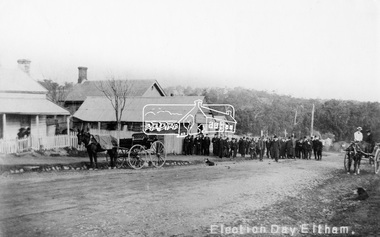
Negative - Photograph, Tom Prior, Election Day, Eltham, 4 June 1907
... Road), Eltham. Group of men standing outside George Knapman’s forge on Election Day (4 June 1907) for the Legislative Council. Voting was conducted in the Eltham Courthouse next door, visible behind the forge. At that time women did not have the right to vote; two women wait on the horse and buggy...Road), Eltham. Group of men standing outside George Knapman’s forge on Election Day (4 June 1907) for the Legislative Council. Voting was conducted in the Eltham Courthouse next door, visible behind the forge. At that time women did not have the right to vote; two women wait on the horse and buggy ...Election Day, Legislative Council Elections, Tuesday, 4 June 1907, Maria Street (Main Road), Eltham. Group of men standing outside George Knapman’s forge on Election Day (4 June 1907) for the Legislative Council. Voting was conducted in the Eltham Courthouse next door, visible behind the forge. At that time women did not have the right to vote; two women wait on the horse and buggy and two others are looking on from the verandah of the house next door. A dog also sits patiently on the road. The Police Station and residence are just visible on the corner of Brougham Street. Reproduced on p62 of 'Pioneers & Painters' Cross Ref: 0629This photo forms part of a collection of photographs gathered by the Shire of Eltham for their centenary project book,"Pioneers and Painters: 100 years of the Shire of Eltham" by Alan Marshall (1971). The collection of over 500 images is held in partnership between Eltham District Historical Society and Yarra Plenty Regional Library (Eltham Library) and is now formally known as the 'The Shire of Eltham Pioneers Photograph Collection.' It is significant in being the first community sourced collection representing the places and people of the Shire's first one hundred years. The Reynolds family were early settlers in Research. The Reynolds/ Prior collection of photographs were taken by Tom Prior, the maternal uncle of Ivy Reynolds, around 1900 and the 60 photos in the album give a fine overview of many of the landmarks of Research and Eltham over 100 years ago. lvy lived in the family home for many years at 106 Thompson Cres Research. Ivy's father, Ernst Richard Reynolds and grandfather, Richard Reynolds, lived at the same address. Ivy's father Richard worked for Mr. Trail on his property in Research. Reynolds Road is named after the family. Mr Tom Prior (wife Eva) worked at the Melbourne zoo. He was very innovative and made his own camera, using the black cloth hood to exclude the light. The photographs are a reminder of the rural nature of Research and Eltham and its rich heritage.Digital image 4 x 5 inch B&W Negshire of eltham pioneers photograph collection, eltham, main road, knapman's forge, election day, elections, eltham courthouse, forge, george knapman, knapmans forge, maria street, pioneers and painters, reynolds prior collection, court house, courthouse, g. knapman, sepp -
 Bendigo Historical Society Inc.
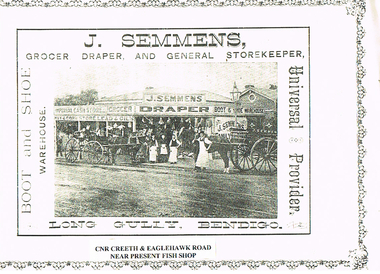
Photograph - LONG GULLY HISTORY GROUP COLLECTION: J SEMMENS GENERAL STORE
... Road near present Fish Shop. The photo shows the store with the name J Semmens Draper, Grocer, Imperial Cash Store, Hay & Corn Store, Lead & Oils, Boot & Shoe Warehouse. In front of the store is a cart with the name on it with an employee standing at the horse's shoulder, three other employees in front of the store and a horse and buggy with someone sitting in the buggy. ...Road near present Fish Shop. The photo shows the store with the name J Semmens Draper, Grocer, Imperial Cash Store, Hay & Corn Store, Lead & Oils, Boot & Shoe Warehouse. In front of the store is a cart with the name on it with an employee standing at the horse's shoulder, three other employees in front of the store and a horse and buggy with someone sitting in the buggy. ...BHS CollectionPhotocopy of a photo of J Semmens General Store, Long Gully, Bendigo. Under the photo is printed on white paper Cnr Creeth & Eaglehawk Road near present Fish Shop. The photo shows the store with the name J Semmens Draper, Grocer, Imperial Cash Store, Hay & Corn Store, Lead & Oils, Boot & Shoe Warehouse. In front of the store is a cart with the name on it with an employee standing at the horse's shoulder, three other employees in front of the store and a horse and buggy with someone sitting in the buggy. Various items are hanging from the edge of the veranda. There is a printed border around three sides of the page.bendigo, history, long gully history group, the long gully history group - j semmens general store -
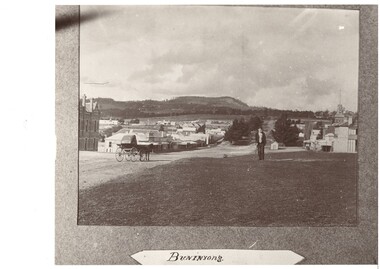 Buninyong & District Historical Society
Photograph - Learmonth Street circa 1890's, View looking up the hill on Learmonth Street, circa 1890's
... ...Horse and buggy on road....The Crown Hotel on left. Horse and buggy on road. Figure on right said to be Rev Thomas Hastie. ...Very significant for the detail and clarity of the image.Very clear image with clear details.early view of learmonth street and mount buninyong., the crown hotel on left., horse and buggy on road., figure on right said to be rev thomas hastie., small building on right identified as the toll booth. -
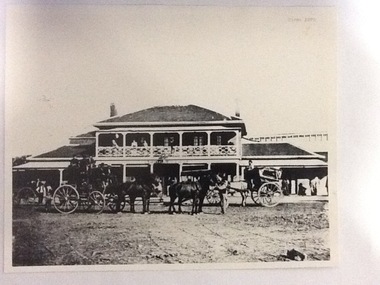 Port of Echuca
Photograph, Approx. 1970's
... buggies. bridge hotel henry hopwood lantern roof st.george's hall 1870s Verso: Bridge Hotel, 1860s? St. George's Hall in background. The Bridge Hotel Echuca - photo taken looking south towards front of building. Four people can be seen on the balcony and several gathered under the verandah. In the foreground are several horse-drawn carriages. The road ...The Bridge Hotel was built by Henry Hopwood to house visitors to the town crossing the Murray River on his punt , which was situated just below the Bridge Hotel on the Murray River. The accommodation was spacious and grand! In the right back corner of the photograph, the 'lantern' roof of the St George's Hall can be seen. The street is level with the front entrance to the Hotel, which is very different to what it is today.The photograph shows hotel activities and accommodation in the late 19th Century. The Bridge Hotel was a very busy place as can be seen with women on the balcony, a stage coach full of people, laden carts and buggies.The Bridge Hotel Echuca - photo taken looking south towards front of building. Four people can be seen on the balcony and several gathered under the verandah. In the foreground are several horse-drawn carriages. The road in front of the hotel is unmade and very wide, with the roof of St.George's Hall seen over the right (western) wing of the hotel. Verso: Bridge Hotel, 1860s? St. George's Hall in background.bridge hotel, henry hopwood, lantern roof, st.george's hall, 1870s -
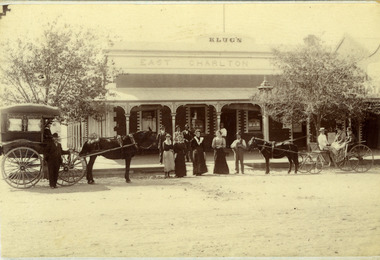 Charlton Golden Grains Museum Inc
Photograph, Clarke Bros Photographers, Klug's East Charlton Hotel c. 1892, c.1892
... Four men standing on footpath, four women and a man holding a dog standing on the road. On the left is a horse and covered buggy with a man standing in front of the buggy. ...Four men standing on footpath, four women and a man holding a dog standing on the road. On the left is a horse and covered buggy with a man standing in front of the buggy. ...East Charlton Hotel High St Charlton c. 1892. Proprietor C. Klug. Established by John Flug who built Charlton's first commercial building in 1875 - a slab and bark inn 100 metres to the rear of this building. Photo taken by Clark Bros, Windsor, MelbourneBlack & white photo, mounted, postcard size. Signage Klug's on top of the building, East Charlton Hotel below that. Four men standing on footpath, four women and a man holding a dog standing on the road. On the left is a horse and covered buggy with a man standing in front of the buggy. There is a boy sitting in the buggy holding the reins. On the right is an open gig with a man and two women in it.c. klug, john flug, clark bros, east charlton hotel, business, industry -
 Churchill Island Heritage Precinct
Photograph - Monochrome
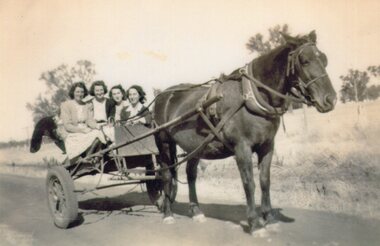
... Churchill Island Women Transport Cart Buggy Jenkins Monochrome image of four women seated in the back of a horse-drawn cart travelling along a dirt road. ...The Churchill Island collection includes an archive of photographs from the late 1800s. The collection is presented in sets and series, of which this image relates to the Jenkins era.Churchill Island has been variously imagined and used to make a permanent settler colonial space since the mid-1800s. The history of the island offers a rich example of the complexity of private settlement in Victoria up until 1976 when it was sold to the Victorian Government.Monochrome image of four women seated in the back of a horse-drawn cart travelling along a dirt road. churchill island, women, transport, cart, buggy, jenkins -
 Williamstown Historical Society Inc
Photograph - Melbourne Road, Cnr Yarra Street, Newport, No.242-244
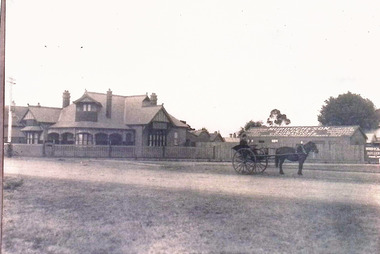
... "Craignair" 242-244 Melbourne Road, Newport - home of Joseph E. Murdoch, pre 1914. He is seated in a horse and buggy in the foreground with the newly constructed house and workshop behind...."Craignair" 242-244 Melbourne Road, Newport - home of Joseph E. Murdoch, pre 1914. He is seated in a horse and buggy in the foreground with the newly constructed house and workshop behind. ..."Craignair" 242-244 Melbourne Road, Newport - home of Joseph E. Murdoch, pre 1914. He is seated in a horse and buggy in the foreground with the newly constructed house and workshop behind.Signage on roof of workshop: Murdoch & Son Builders & Contractors. Guardian Assurance Co. Fire Accident Painters Paperhangers Grainers etc. Tel. 257 Wmn. Plans & Specifications Prepared. Estimates Given.242-244 melbourne road, williamstown, house, craignair, yarra strreet, william murdoch -
Tatura Irrigation & Wartime Camps Museum
Photograph, Heaphy's Whim-Inn Hotel
... Road. Features a variety of patrons outside hotel; two horse-drawn buggies....tatura buildings historic transport horse costume male Heaphy's Whim-Inn Hotel; South West corner of Hogan Street and Dhurringile Road. ...Heaphy's Whim-Inn Hotel; South West corner of Hogan Street and Dhurringile Road. Features a variety of patrons outside hotel; two horse-drawn buggies.tatura, buildings, historic, transport, horse, costume, male
