
Showing 96 items matching "hospitals - nsw"
-
 Alfred Hospital Nurses League - Nursing History Collection
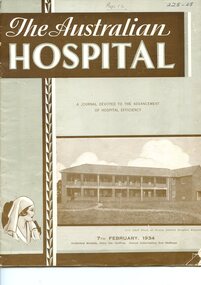
Journal - Illustrated Journal, Hospitals Commission of NSW, The Australian Hospital, 1934
... Hospitals - NSW..."A journal devoted to the advancement of hospital efficiency' was published monthly under the authority of the Hospitals Commission of NSW...Hospitals Commission of NSW...The Australian Hospital Journal Illustrated Journal Hospitals Commission of NSW Jackson & O'Sullivan Limited ...Articles and advertisements relating to hospitals. Item of particular interest [on page 12]is the one titled 'Move for nurses post graduate education' by Sir James Barrett. The president of the provisional committee for this was Grace Wilson, Alfred Hospital Matron.Stapled journal.Front cover has a grey background. Title is printed in white on a brown banner on front cover, rest of print in brown. The words 'A JOURNAL DEVOTED TO THE ADVANCEMENT/OF HOSPITAL EFFICIENCY' appear above a brown and white photograph of a two story building (New Adult Block, St George Hospital, Kogarah) Issue date below this photograph and then the words 'Published Monthly, Price One Shilling, Annual Subscription Ten Shillings'. There is a vertical margin to the bottom left of which is a sketch of a nurse wearing a veil. There is a brown border across the bottom of front cover.non-fictionArticles and advertisements relating to hospitals. Item of particular interest [on page 12]is the one titled 'Move for nurses post graduate education' by Sir James Barrett. The president of the provisional committee for this was Grace Wilson, Alfred Hospital Matron.hospitals - nsw, post graduate nursing education -
 Alfred Hospital Nurses League - Nursing History Collection
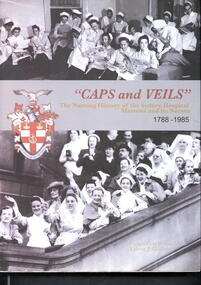
Book - Illustrated book, Valerie Griffiths, "Caps and veils": the nursing history of the Sydney Hospital matrons and its nurses 1788-1985, 2011
... ...Hospitals-NSW-History...Of significance to the AHNL as it is the history of the oldest hospital in Australia Sydney Hospital-History Nurses-NSW-History Nursing-NSW-History Hospitals-NSW-History This book documents the history of nursing at the Sydney Hospital, includes information about the training and status of nurses and how these factors have influenced their uniforms. ...This book documents the history of nursing at the Sydney Hospital, includes information about the training and status of nurses and how these factors have influenced their uniforms. Also listed are all nurses who graduated from the Sydney Hospital.Illustrated book with dustjacket. Book has plain white cover. Dust jacket has grey background, on front cover are two black and white photographs of groups of nurses, coloured print of the Sydney Hospital's coat of arms, title (red, gold and black print) and author's name (gold print). Title and author's name are printed in gold on spine, along with coloured print of Sydney Hospital's coat of arms. On the back cover are black and white photos of the nine Lady Superintendent/Matrons/Directors of Nursing, and a coloured photo of the graduate nurses' badge.non-fictionThis book documents the history of nursing at the Sydney Hospital, includes information about the training and status of nurses and how these factors have influenced their uniforms. Also listed are all nurses who graduated from the Sydney Hospital.sydney hospital-history, nurses-nsw-history, nursing-nsw-history, hospitals-nsw-history -
 Alfred Hospital Nurses League - Nursing History Collection
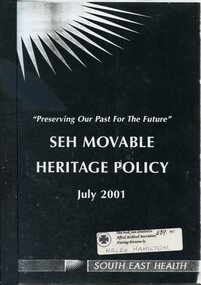
Document - Policy document, SEH movable heritage policy
... ...Hospitals - NSW...NSW. This policy outlines guidellines for the management, preservation an disposal of physical items (movable heritage) of historical significance within the health service's facilitiies Insight into how other hospitals care for 'movable heritage' South East Health NSW Hospitals - NSW Archive management AT bottom right of transparent plastic cover, there is a printed black and white donation sticker: black Maltese cross in circle, 'This book was donated to Alfred Archival Association Nursing Division by' Helen Hamilton [handwritten black ink]. ...South East Health (SEH) was a regional health service in NSW. This policy outlines guidellines for the management, preservation an disposal of physical items (movable heritage) of historical significance within the health service's facilitiiesInsight into how other hospitals care for 'movable heritage'Document bound in plastic presentation folder (Black back cover and spine, ransparent front cover) Front cover has white print on black background, There is a starburst pattern at upper left. Title, date, and SOUTH EAST HEALTH detailed. AT bottom right of transparent plastic cover, there is a printed black and white donation sticker: black Maltese cross in circle, 'This book was donated to Alfred Archival Association Nursing Division by' Helen Hamilton [handwritten black ink]. Previous catalogue number is also handwritten [black ink] on this labelsouth east health nsw, hospitals - nsw, archive management -
 Tatura Irrigation & Wartime Camps Museum
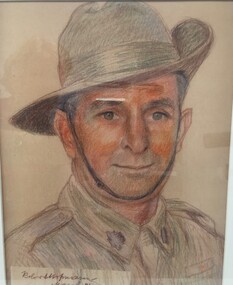
Drawing - Drawing - copy, Cpl. Marcus Wakley, 1941
... Portrait of Cpl Marcus Wakely b. 1890 from Yenda NSW part of the garrison at Hay Internment Camp. Sketched while Hofmann was in Camp Hospital, Hay, NSW. 1941....Portrait of Cpl Marcus Wakely b. 1890 from Yenda NSW part of the garrison at Hay Internment Camp. Sketched while Hofmann was in Camp Hospital, Hay, NSW. 1941. garrison robert hofmann wakley hay Robert Hofmann March 41 Photocopy of a sketch. ...Portrait of Cpl Marcus Wakely b. 1890 from Yenda NSW part of the garrison at Hay Internment Camp. Sketched while Hofmann was in Camp Hospital, Hay, NSW. 1941.Photocopy of a sketch. Portrait of a soldier in uniform.Robert Hofmann March 41garrison, robert hofmann, wakley, hay -
 Geoffrey Kaye Museum of Anaesthetic History
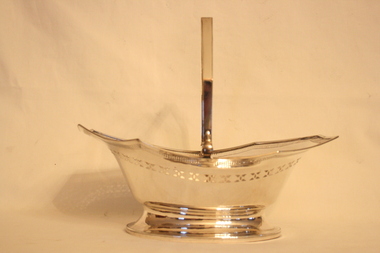
Decorative object - Electroplated Silver Basket, unknown
... This object was donated by Dr Susan Kelly in memory of Dr Loraine Hibbard (1916-2002) Emeritus Consultant, St George Hospital, Kogarah, NSW. The maker and date of this object is unverified due to lack of supporting evidence. ...This object was donated by Dr Susan Kelly in memory of Dr Loraine Hibbard (1916-2002) Emeritus Consultant, St George Hospital, Kogarah, NSW. The maker and date of this object is unverified due to lack of supporting evidence. ...This object was donated by Dr Susan Kelly in memory of Dr Loraine Hibbard (1916-2002) Emeritus Consultant, St George Hospital, Kogarah, NSW. The maker and date of this object is unverified due to lack of supporting evidence. It is unknown as to the significance of the engraved Phoenix. Antique Sheffield electroplated silver, copper basket with swing handle. The bowl of the basket is octagonal with incised geometric and circular pattern along the perimeter. Engraved in the bowl of the basket is an image of a phoenix including a smaller image of a phoenix engraved on the swing handle. The silver has worn in some places in particular around the image of the phoenix in the bowl of the basket.electroplated silver, loraine hibbard, st george hospital, phoenix, susan kelly -
 Melbourne Legacy
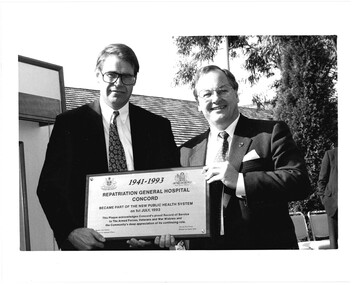
Photograph, Repatriation General Hospital Concord, 1993
... Two photos of the Repatriation General Hospital Concord becoming part of NSW Public Health System. ...Black and white photo x 2 of the Concord Repat hospital becoming part of NSW Public Health System in 1993. ...Sydney Legacy hospitals Black and white photo x 2 of the Concord Repat hospital becoming part of NSW Public Health System in 1993. ...Two photos of the Repatriation General Hospital Concord becoming part of NSW Public Health System. Sydney Legacy may have been involved as they send Melbourne Legacy these two photos and 3 documents. According to the captions on the reverse one photo shows: Federal Minister for Veterans' Affairs Senator John Faulker and State Health Minister Ron Phillips posing at the ceremony. Also Lieutenant Colonel A 'Bushy' Pembroke and Major General W J 'Bill' Watson of the Regular Defence Force Welfare Association and Legacy's Simon Agnew (on right). General Watson and Legatee Agnew are members of the National Treatment Monitoring Committee (NATMOC). A record that Sydney Legacy was involved with veteran patient care.Black and white photo x 2 of the Concord Repat hospital becoming part of NSW Public Health System in 1993. Typed caption pasted to the back of each photo.sydney legacy, hospitals -
 National Vietnam Veterans Museum (NVVM)
Memorabilia, Scrapbook: a Memorabilia of unknown donor
... It contains photos & Article, Clippings regarding the RAAMC Scaphoid fracture brace & medical staff at the medical hospital at Ingleburn, NSW. Also, a large b/w photo of soldiers climbing into a truck which was obtained from the Aust War Memorial....It contains photos & Article, Clippings regarding the RAAMC Scaphoid fracture brace & medical staff at the medical hospital at Ingleburn, NSW. Also, a large b/w photo of soldiers climbing into a truck which was obtained from the Aust War Memorial. ...Red folder titled Srap Book. It contains photos & Article, Clippings regarding the RAAMC Scaphoid fracture brace & medical staff at the medical hospital at Ingleburn, NSW. Also, a large b/w photo of soldiers climbing into a truck which was obtained from the Aust War Memorial. -
 Beechworth RSL Sub-Branch
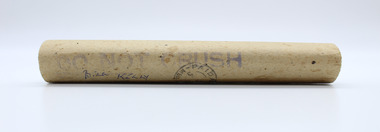
Postage cylinder, c. 1923
... James Thomas' service records indicate that he died on 9 October 1916 in a field hospital, Liverpool, NSW. He was ailed by bronchial pneumonia for 13 days before succumbing to the illness. ...James Thomas' service records indicate that he died on 9 October 1916 in a field hospital, Liverpool, NSW. He was ailed by bronchial pneumonia for 13 days before succumbing to the illness. ...This cylinder was constructed for the postage of two documents (0060.2 and 0060.3), to notify the family of Pte James Thomas Newton (945215) 3rd Battalion, Australian Imperial Force, of his passing. The documents appear to be addressed to M A Newton, though James Thomas Newton's next of kin is listed as David Newton, his father. James Thomas enlisted on 18 July 1916, joining the 3rd battalion, first in "B" Company and . James Thomas' service records indicate that he died on 9 October 1916 in a field hospital, Liverpool, NSW. He was ailed by bronchial pneumonia for 13 days before succumbing to the illness. A telegram suggests that the family were notified on the day of his death and received the cylinder and documents in the post 6 years later. Brown card cylinder which appears to have been formed from a single sheet of card, taped in place. Paper label contains the name of the recipient, several other stamps cover the cylinder. Label reads "M A Newton/Whitfield/Vict.". Round postage stamp reads "PAID - AT - MELBOURNE VIC/ 12 MR23/8". Other stamps include "DO NOT CRUSH" and a handwritten annotation, possibly added later "BILL KELLY."post, postal, postage, death notice, certificate, private james thomas newton, 3rd battalion, australian imperial force, first world war, world was i, world war 1 -
 Beechworth RSL Sub-Branch
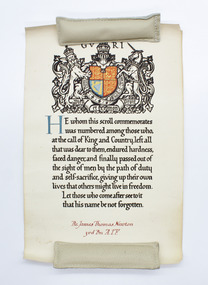
Certificate, c. 1923
... James Thomas' service records indicate that he died on 9 October 1916 in a field hospital, Liverpool, NSW. He was ailed by bronchial pneumonia for 13 days before succumbing to the illness. ...James Thomas' service records indicate that he died on 9 October 1916 in a field hospital, Liverpool, NSW. He was ailed by bronchial pneumonia for 13 days before succumbing to the illness. ...This cylinder was constructed for the postage of two documents (0060.2 and 0060.3), to notify the family of Pte James Thomas Newton (945215) 3rd Battalion, Australian Imperial Force, of his passing. The documents appear to be addressed to M A Newton, though James Thomas Newton's next of kin is listed as David Newton, his father. James Thomas enlisted on 18 July 1916, joining the 3rd battalion, first in "B" Company and . James Thomas' service records indicate that he died on 9 October 1916 in a field hospital, Liverpool, NSW. He was ailed by bronchial pneumonia for 13 days before succumbing to the illness. A telegram suggests that the family were notified on the day of his death and received the cylinder and documents in the post 6 years later. Cream coloured card paper rolled into scroll for transport inside card cylinder (0060.1). Certificate is printed with standard text and British crest above which is a "G V R" indicating the certificate was issued by King George V. Certificate features handwritten calligraphy notation of the recipient's name at the bottom of the text block.Handwritten notation reads "Pte. James Thomas Newton/3rd Bn A.I.F."post, postal, postage, death notice, certificate, private james thomas newton, 3rd battalion, australian imperial force, first world war, world was i, world war 1 -
 Beechworth RSL Sub-Branch
Certificate, c. 1923
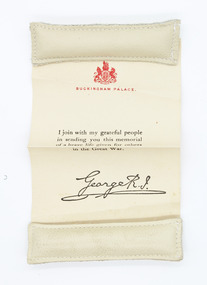
... James Thomas' service records indicate that he died on 9 October 1916 in a field hospital, Liverpool, NSW. He was ailed by bronchial pneumonia for 13 days before succumbing to the illness. ...James Thomas' service records indicate that he died on 9 October 1916 in a field hospital, Liverpool, NSW. He was ailed by bronchial pneumonia for 13 days before succumbing to the illness. ...This cylinder was constructed for the postage of two documents (0060.2 and 0060.3), to notify the family of Pte James Thomas Newton (945215) 3rd Battalion, Australian Imperial Force, of his passing. The documents appear to be addressed to M A Newton, though James Thomas Newton's next of kin is listed as David Newton, his father. James Thomas enlisted on 18 July 1916, joining the 3rd battalion, first in "B" Company and . James Thomas' service records indicate that he died on 9 October 1916 in a field hospital, Liverpool, NSW. He was ailed by bronchial pneumonia for 13 days before succumbing to the illness. A telegram suggests that the family were notified on the day of his death and received the cylinder and documents in the post 6 years later. Cream coloured card paper rolled into scroll for transport inside card cylinder (0060.1). Note bears embossed stamp of the British crest above red printed text "BUCKINGHAM PALACE". A signature from King George V is at the bottom of the text.Handwritten signature "George R. I."post, postal, postage, death notice, certificate, private james thomas newton, 3rd battalion, australian imperial force, first world war, world was i, world war 1 -
 Melbourne Legacy
Document, Repatriation General Hospital Concord, 1993
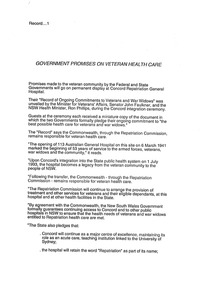
... Information about the Repatriation General Hospital Concord becoming part of NSW Public Health System in 1993. ...The assurance was given by State Health Minister Ron Phillips during a special ceremony to celebrate the hospital's integration into the NSW public health system. ...Information about the Repatriation General Hospital Concord becoming part of NSW Public Health System in 1993. Sydney Legacy may have been involved as they sent Melbourne Legacy two photos and these 3 documents. One document mentions 'Concord Repatriation General Hospital will always remain open to the State's veterans and war widows'. The assurance was given by State Health Minister Ron Phillips during a special ceremony to celebrate the hospital's integration into the NSW public health system.A record that Sydney Legacy was involved with veteran and war widow patient care.White A4 paper with black type x 5 pages of information on the Concord Repatriation Hospital in 1993.sydney legacy, hospitals -
 Flagstaff Hill Maritime Museum and Village
Craft - Ship Model, Mary Campbell, circa 1940
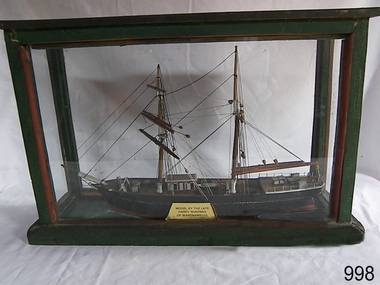
... hospital, then returned to Sydney in the “Wellington”. Captain Robilliard managed to rescue his ship’s compass, but no cargo was saved from the vessel. It had been under-insured, only covered for half its value, due to a lack of funds. Many years later, in 1976, an anchor was caught up in the net of a trawler south of Forster and thought to be from the “Mary Campbell”. It was donated and installed in the Great Lakes Museum, Tuncurry, NSW...hospital, then returned to Sydney in the “Wellington”. Captain Robilliard managed to rescue his ship’s compass, but no cargo was saved from the vessel. It had been under-insured, only covered for half its value, due to a lack of funds. Many years later, in 1976, an anchor was caught up in the net of a trawler south of Forster and thought to be from the “Mary Campbell”. It was donated and installed in the Great Lakes Museum, Tuncurry, NSW ...This ship model is of the sailing brigantine MARY CAMPBELL, which once belonged to Captain James Arthur Robilliard. The model was made by Harry McKenna, a well-known ship model maker and Warrnambool resident. CAPTAIN ROBILLIARD James Arthur Robilliard, sea captain and tent maker, was born in 19th April 1843 in St. Helier, Jersey, Channel Islands. He trained there in his father’s sail loft as a sailmaker. He later became a skipper. His first job was as a sailor in Liverpool, England. In 1875, James Robilliard migrated to Australia as a mate on the “E.M. Young”. Captain Robilliard and his family were amongst the early settlers along the Curdies River in the Heytesbury district. In 1877, he became a Captain. On 14th November 1879, Captain Robilliard married Helen Beckett. James and Helen had ten children: James Arthur (Jnr), Henry William, Nellie Jessie, Alfred Albert, Rubena Nellie, De Jersy Norman, Clifford Beckett, Olive Ida, Frances Ridley Havergal and Nellie Elvie, all born in Victoria. THE MARY CAMPBELL The ship “Mary Campbell” was built by Alexander Newton Jr. She was carvel-planked, of iron bark and blue gum timber. The family shipyard was at Pelican, on the Manning River, NSW, and “Mary Campbell” was first launched by her builder in 1869 as “The Son”. Three months later, she was renamed “Mary Campbell’ by her purchaser J. Campbell in Sydney. She was used to carry equipment for the Sydney Sugar Refinery’s Mill in Southgate, NSW. She then traded for the next 20 years between Australian ports and rivers along the east coast, as well as regular ports in New Zealand. She was “recognised as one of the best carrying little vessels in the timber trade” (Sydney Morning Herald). She had several owners over this time, the last one being Captain James A. Robilliard. On 29th April 1889, “Mary Campbell”, in the charge of her owner, Captain James A Robilliard, was on her way from Clarence River, NSW to Melbourne, Victoria with a cargo of railway girders for the Melbourne Harbour Trust. Captain Robilliard encountered a storm off Port Macquarie. He sailed the vessel south to 25 miles (about 40km) east of Cape Hawke, near Tuncurry and Forster. At 7 pm, he discovered that the cargo had shifted during the stormy seas and the heavy girders had damaged the hull, causing a leak. The pumps were inadequate to stem the fast-flowing leak, and over a meter of water filled the hull during the next 2 hours. Some of the crew began throwing the cargo overboard to lighten the vessel, hoping to keep it afloat until daylight. When the water reached over 2 meters in the hull, they realised their efforts were in vain. At 1:30 am on 30th April 1889, the crew left the vessel. They stood by in the lifeboat until 3 am. The ship was sinking fast, so they left for the shore, looking for a safe place to beach their boat. While still miles off Cape Hawke, all 7 crew members, including the Captain, were rescued by the Government Tug “Rhea” and taken to Port Macquarie hospital, then returned to Sydney in the “Wellington”. Captain Robilliard managed to rescue his ship’s compass, but no cargo was saved from the vessel. It had been under-insured, only covered for half its value, due to a lack of funds. Many years later, in 1976, an anchor was caught up in the net of a trawler south of Forster and thought to be from the “Mary Campbell”. It was donated and installed in the Great Lakes Museum, Tuncurry, NSW. (The same museum also has a half-model of the hull of “Mary Campbell”.) The name of the last ship Captain Robilliard sailed is currently unknown; however, he sailed that ship from the port of Marlborough, Queensland, carting steel railway girders for the Geelong-to-Camperdown line. On one trip, it hit a storm, the cargo shifted, and the ship was wrecked along the NSW coast. After this, Captain Robilliard exchanged sea life for farming in Peterborough. In about 1897, verging on retirement, Capt. Robiilliard superintended the Melbourne Sailors’ Home in Spencer Street, Melbourne, before being asked to leave this position in 1902 for trying to shut down the local hotel! At this time, the Melbourne Sailors’ Home was about to change its location. On 6th May 191,7, Captain James Arthur Robilliard J.P. died at Blackwood Park, in the Cobden district of Brucknell, which is now considered the first official Robilliard family homestead in Australia. He was buried in the Melbourne General Cemetery, Victoria. His wife, Helen, passed away in 1947. The Becket and Robilliard family names continue to be well known in the Western District. Flagstaff Hill Maritime Village also has a ship’s compass in the collection that was owned by Capt. J. Robilliard and used on the ship Mary Campbell.This ship model of the MARY CAMPBELL is of local significance for its association with well well-known Warrnambool resident and ship model maker. The model is also significant for its association with the brigantine MARY CAMPBELL, a trading vessel that brought railway girders to the Melbourne Harbour Trust.Ship model "Mary Campbell": a two-masted vessel with black hull, brown masts and black rigging, displayed in a glass case with a timber frame painted green. Made by Harry McKenna.Painted on the bow in white “MARY CAMPBELL” Gold label with black print attached to display case “MODEL BY THE LATE HARRY McKENNA OF WARRNAMBOOL”flagstaff hill, warrnambool, shipwrecked coast, flagstaff hill maritime museum, maritime museum, shipwreck coast, flagstaff hill maritime village, great ocean road, marine artwork, model making, captain james arthur robilliard, j.a. robilliard, vessel mary campbell, ship mary campbell, melbourne sailors home, vessels, harry mckenna, mary campbell -
 The Beechworth Burke Museum
Photograph - Lantern Slide, c1900
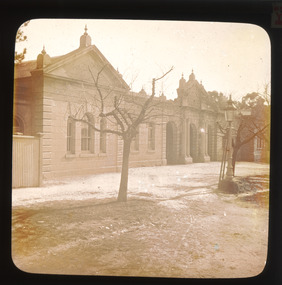
... At the time there was no hospital located between Melbourne and the NSW town of Goulburn and it was recognised that the nature of mining and agricultural work predisposed people to serious injury. ...At the time there was no hospital located between Melbourne and the NSW town of Goulburn and it was recognised that the nature of mining and agricultural work predisposed people to serious injury. ...This lantern slide shows the Ovens District Hospital (also called the Ovens Goldfields Hospital) in Beechworth in approximately 1900. The Hospital was built as part of a community push to develop the infrastructure needed for a permanent town in the 1850s. At the time there was no hospital located between Melbourne and the NSW town of Goulburn and it was recognised that the nature of mining and agricultural work predisposed people to serious injury. The community voted in 1853 to raise funds for a hospital and a voluntary committee elected from people who contributed £2 or more annually determined the organisation's management policies, which aimed to provide care for poor people at rates levied according to the person's means. Ongoing operations of the hospital were primarily supported by Government grants, however. The foundation stone was laid at a site in Church Street at a ceremony held 1st September 1856 which was attended by 2000 people using a locally crafted trowel with a tin ore handle and pure gold blade. The hospital, which was designed by J.H. Dobbyn, cost £2347. The hospital had two wards, a dispensary, apartments for a resident surgeon and the matron, an operating theatre and a board room. Further medical facilities including services to meet the cultural and health needs of the local Chinese community were later added, in addition to a Palladian-style cut-granite face built in 1862-63. It functioned as the region's primary hospital until surpassed by the Wangaratta Hospital in 1910. In the 1940s much of the building materials were salvaged and repurposed, with the exception of the facade which was restored in 1963 by the Beechworth Lions Club and still stands today. The facade featured on the covers of local history volume 'Beechworth: a Titan's Field' by Carole Woods and heritage-focused travel guide the 'Readers Digest Book of Historic Australian Towns'. Lantern slides, sometimes called 'magic lantern' slides, are glass plates on which an image has been secured for the purpose of projection. Glass slides were etched or hand-painted for this purpose from the Eighteenth Century but the process became more popular and accessible to the public with the development of photographic-emulsion slides used with a 'Magic Lantern' device in the mid-Nineteenth Century. Photographic lantern slides comprise a double-negative emulsion layer (forming a positive image) between thin glass plates that are bound together. A number of processes existed to form and bind the emulsion layer to the base plate, including the albumen, wet plate collodion, gelatine dry plate and woodburytype techniques. Lantern slides and magic lantern technologies are seen as foundational precursors to the development of modern photography and film-making techniques.This glass slide is significant because it provides insight into Beechworth's built environment and infrastructure in the early Twentieth Century, around the time of Australia's Federation. It is also an example of an early photographic and film-making technology in use in regional Victoria in the time period.Thin translucent sheet of glass with a round-edged square image printed on the front and framed in a black backing. It is held together by metal strips to secure the edges of the slide.Obverse: Y /burke museum, beechworth, lantern slide, slide, glass slide, plate, burke museum collection, photograph, monochrome, ovens district hospital, indigo shire, north-east victoria, hospital, palladian architecture, granite, community fundraising, community infrastructure, j.h. dobbyn, beechworth lions club, ovens goldfields hospital, chinese community -
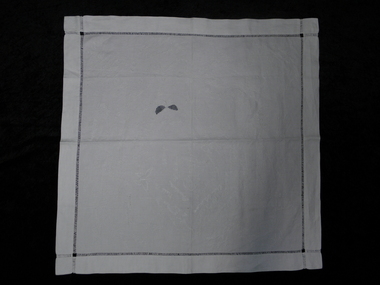 Blacksmith's Cottage and Forge
WW1 Table Cloth, WW1
... NSW, Katoomba, Luna Park St Kilda and Granite Island. The name of the steamship SS Warilda also appears on this cloth. this ship belonged to the Adelaide Steamship Company. It was used to transport soldiers to WW1 and was then converted into a hospital...NSW, Katoomba, Luna Park St Kilda and Granite Island. The name of the steamship SS Warilda also appears on this cloth. this ship belonged to the Adelaide Steamship Company. It was used to transport soldiers to WW1 and was then converted into a hospital ...This signature table cloth was anonymously donated to the Bacchus Marsh Blacksmith Cottage and Forge group in 2013. On the cloth are the hand embroidered names of men who served in WW1 as well as the names of family members, place names and dates of significance. In one corner of the cloth is the outline of a tennis ball, in which 6 names are listed. Research has shown that these names probably belonged to the Rose Park Methodist Tennis Club in Adelaide. Many of the other names listed seem to relate to servicemen and their families who came from South Australia. Also on this cloth are 3 beautifully embroidered butterflies, the profile of a man, a crest containing the letters B and H and the following place names and dates :- Sydney 21.10.12, Melbourne Jan 13, Goolwa, Genolan Caves NSW, Katoomba, Luna Park St Kilda and Granite Island. The name of the steamship SS Warilda also appears on this cloth. this ship belonged to the Adelaide Steamship Company. It was used to transport soldiers to WW1 and was then converted into a hospital ship, ferrying the wounded from France to England. It was hit and sank on the 3rd of August 1918.World War 1 signature table cloth. A square, white, linen table cloth with hand embroidered signatures of people and names of places, dates and objects relating to WW1.The embroidery is all done in white thread.There are also 3 embroidered butterflies, a crest and a man's profile. -
Marysville & District Historical Society
THE TRIANGLE NEWS-VOL 36 NO 25-JULY 10 2009
... hospital...triangle arts...formcraft vic...shire of yarra ranges...lilydale showgrounds...councillor comment...church notices...interstate support...langhorne creek community south australia...marysville art show...blaney nsw...marysville victoria australia narbethong moving on black spur inn mystic mountain ski hire & outdoors marysville central update marysville triangle real estate emergency services teams james fragga the lolly shop reopens community meetings matdg marysville & triangle phoenix workshop marysville golf and bowls club marysville cricket club marysville & district lions club regional arts funding murrindindi shire council positions vacant advertisements mobile vet service horse property owners narbethong distribution & fire relief store closed after school kid's arts programme festival of healthy living fhl royal children's hospital triangle arts formcraft vic shire of yarra ranges lilydale showgrounds councillor comment church notices interstate support langhorne creek community south australia marysville art show blaney nsw donations buxton strength training marysville medical clinic marysville cricket club trophy presentation THE TRIANGLE NEWS-VOL 36 NO 25-JULY 10 2009 ...marysville, victoria, australia, narbethong moving on, black spur inn, mystic mountain ski hire & outdoors, marysville central update, marysville triangle real estate, emergency services teams, james fragga, the lolly shop reopens, community meetings, matdg, marysville & triangle phoenix workshop, marysville golf and bowls club, marysville cricket club, marysville & district lions club, regional arts funding, murrindindi shire council, positions vacant, advertisements, mobile vet service, horse property owners, narbethong distribution & fire relief store closed, after school kid's arts programme, festival of healthy living, fhl, royal children's hospital, triangle arts, formcraft vic, shire of yarra ranges, lilydale showgrounds, councillor comment, church notices, interstate support, langhorne creek community south australia, marysville art show, blaney nsw donations, buxton strength training, marysville medical clinic, marysville cricket club trophy presentation -
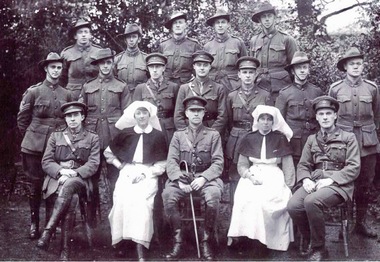 Lara RSL Sub Branch
Photograph - B and W photograph, Kit McNaughton and fellow staff of the plastic Surgery division of the Queen Mary Hospital, Sidcup, Kent, England 1918
... On Back of Photo - WWW.Kit .Mcnaughton Reminiscences from a bloody Imperial War NSW Nurses and Midwives Association Janet Butler - 'Kitty's War' Latrobe University Queen Mary Hospital Sidcup in Kent England Plastic Surgery Hospital 1918...unknown On Back of Photo - WWW.Kit .Mcnaughton Reminiscences from a bloody Imperial War NSW Nurses and Midwives Association Janet Butler - 'Kitty's War' Latrobe University Queen Mary Hospital Sidcup in Kent England Plastic Surgery Hospital 1918 Kit McNaughton and fellow staff of the plastic Surgery division of the Queen Mary Hospital, Sidcup, Kent, England 1918 Also the cover picture of the paperback book, "Kitty's War" by Janet Butler 2013 Kit McNaughton and fellow staff of the plastic Surgery division of the Queen Mary Hospital, Sidcup, Kent, England 1918 Photograph B and W photograph ...Kit McNaughton and fellow staff of the plastic Surgery division of the Queen Mary Hospital, Sidcup, Kent, England 1918 Also the cover picture of the paperback book, "Kitty's War" by Janet Butler 2013On Back of Photo - WWW.Kit .Mcnaughton Reminiscences from a bloody Imperial War NSW Nurses and Midwives Association Janet Butler - 'Kitty's War' Latrobe University Queen Mary Hospital Sidcup in Kent England Plastic Surgery Hospital 1918unknown -
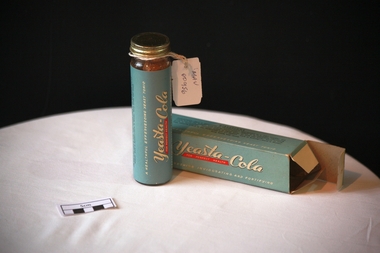 City of Moorabbin Historical Society (Operating the Box Cottage Museum)
Manufactured Glass, 'Yeasta-Cola' with box, mid 20thC
... The mark YEASTA-COLA was officially filed as a trademark by World Agencies Pty Ltd SYDNEY, NSW 2000 on 16 Jan 1946. pharmacy medicines yeasta-cola hospitals nursing containers moorabbin bentleigh cheltenham melbourne world agencies pty ltd sydney A HEALTHFUL EFFERVESCENT YEAST TONIC / YEASTA-COLA / FOR PERFECT HEALTH / REFRESHING, INVIGORATING AND FORTIFYING / Beneficial In cases of Impure Blood…. / General Debility, Malnutrition. ...The mark YEASTA-COLA was officially filed as a trademark by World Agencies Pty Ltd SYDNEY, NSW 2000 on 16 Jan 1946.A clear glass cylindrical jar with a metal screw top containing dried yeast powder. Cardboard boxA HEALTHFUL EFFERVESCENT YEAST TONIC / YEASTA-COLA / FOR PERFECT HEALTH / REFRESHING, INVIGORATING AND FORTIFYING / Beneficial In cases of Impure Blood…. / General Debility, Malnutrition. Excellent for Growing CHILDREN / Contains………/ Manufactured in Australia / Sale Distributors / WORLD AGENCIES PTY. LIMITED 224 GEORGE STREET, SYDNEY, AUSTRALIA / DIRECTIONS / …………pharmacy, medicines, yeasta-cola, hospitals, nursing, containers, moorabbin, bentleigh, cheltenham, melbourne, world agencies pty ltd sydney -
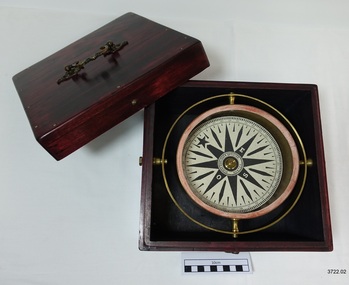 Flagstaff Hill Maritime Museum and Village
Functional object - Compass, mid-19th Century
... Hospital and later returned to Sydney in the vessel "Wellington". No cargo had been saved, and the consignment had been under-insured, only covered for half its value. The name of the last ship Captain Robilliard sailed is currently unknown; however, he sailed that ship from the port of Marlborough, Queensland, carting steel railway girders for the Geelong-to-Camperdown railway line. On this trip, the ship hit a storm, the cargo shifted, and the ship was wrecked along the NSW...Hospital and later returned to Sydney in the vessel "Wellington". No cargo had been saved, and the consignment had been under-insured, only covered for half its value. The name of the last ship Captain Robilliard sailed is currently unknown; however, he sailed that ship from the port of Marlborough, Queensland, carting steel railway girders for the Geelong-to-Camperdown railway line. On this trip, the ship hit a storm, the cargo shifted, and the ship was wrecked along the NSW ...Captain Robilliard: James Arthur Robilliard was a sea captain and tentmaker, born on the 19th April 1843 at Saint Helier, Jersey. He trained there in his father's sail loft as a sailmaker. His first job as a sailor was in Liverpool, England, and in 1875, James Robilliard migrated to Australia as a mate on the "E.M. Young". James Robilliard and his family were amongst the early settlers who arrived along the Curdies River in the Heytesbury district of Western Victoria. In 1877, he became a Captain and would have used his compass from ship to ship. On 28th May 1877, in that same district, a small 3-masted schooner, the "Young Australian", was wrecked. This schooner had been built in 1864 at Jervis Bay, NSW. It had been on her way from Maryborough, Queensland, to Adelaide, under the command of Captain Whitfield, when it lost its mainmast in a heavy gale. It was beached at Curdies Inlet in Peterborough, Victoria. Captain Robilliard was placed in charge of the salvaging operation and recovered a good portion of the cargo. Not long after this incident, a Warrnambool shop owner, David Evans, found employment for James Robilliard with Evan Evans, who produced tents, sails, tarpaulins and similar goods; James already had the necessary skills for this work. Evan Evans was the same sailor rescued from the “Young Australian”. Soon after his rescue, Evan recalled he had a relative in Australia in a town called Warrnambool, and while walking in Timor Street, Warrnambool, he saw a sign over a shop that said “David Evans,” and once the two men met, Evan was warmly welcomed. David then helped his relative establish a tent and tarpaulin-making business there. Evan later transferred his successful business to a shop in Elizabeth St, Melbourne, under the name Evan Evans Pty. Ltd.) James Robilliard was a committed Christian and accredited Lay Preacher with the Methodist Church. He travelled around the local district leading the settlers in worship. On 14th November 1879, Captain Robilliard married Helen Beckett. Alfred and Selina Beckett and their family all attended the church at Brucknell, where Captain Robilliard preached. He was said to have been taken by their young daughter, Helen. James and Helen had ten children: James Arthur (Jnr), Henry William, Nellie Jessie, Alfred Albert, Rubena Nellie, De Jersy Norman, Clifford Beckett, Olive Ida, Frances Ridley Havergal and Nellie Elvie, all born in Victoria. In the 1880s, James Robilliard captained the cutter "Hannah Thompson" into Port Campbell, Victoria. This vessel was the first coastal trader to operate between Melbourne and Port Campbell. At one time, Captain Robilliard had to beach the "Hannah Thompson" for repairs. In 1923, the vessel was blown ashore in a gale and wrecked at Oberon Bay, at Wilson's Promontory. In 1889, the compass was saved by Captain James Arthur Robilliard from his sinking brigantine "Mary Campbell". This vessel was used to carry equipment for the Sydney Sugar Refinery's Mill in Southgate, NSW. The ship had been built in 1869 and traded for the next 20 years between Australian ports and rivers along the east coast, as well as regular ports in New Zealand. It was recognised by the Sydney Morning Herald as one of the best "carrying vessels in the timber trade". It had several owners over this time, the last one being Captain James A. Robilliard. On 29th April 1889, the "Mary Campbell", with Captain James A Robilliard as captain and owner, was on its way from Clarence River, NSW to Melbourne, Victoria with a cargo of railway girders for the Melbourne Harbour Trust. Captain Robilliard encountered a storm off Port Macquarie. He sailed the vessel south to about 40km east of Cape Hawke, near Tuncurry. At around 7 pm, he discovered that the cargo had shifted during the storm and the heavy girders had damaged the hull, causing a leak. The pumps were inadequate to stem the fast-flowing leak, and water soon filled the hull during the next two hours. Some of the crew began throwing the cargo overboard to lighten the vessel, hoping to keep it afloat until daylight. When the water reached over 2 meters in the hull, they realised their efforts were in vain. On the 30th April 1889, the crew left the vessel the ship was sinking fast, so they made for the shore. While still miles off Cape Hawke, all seven crew members, including the Captain, were rescued by the Government Tug "Rhea" and taken to Port Macquarie Hospital and later returned to Sydney in the vessel "Wellington". No cargo had been saved, and the consignment had been under-insured, only covered for half its value. The name of the last ship Captain Robilliard sailed is currently unknown; however, he sailed that ship from the port of Marlborough, Queensland, carting steel railway girders for the Geelong-to-Camperdown railway line. On this trip, the ship hit a storm, the cargo shifted, and the ship was wrecked along the NSW coast. After this, Captain Robilliard retired from the sea and began farming in Peterborough. In about 1897, verging on retirement, Capt. Robilliard superintended the Melbourne Sailors’ Home in Spencer Street, Melbourne, before being asked to leave this position in 1902 for trying to shut down a local hotel. On 6th May 1917, Captain James Arthur Robilliard J.P. died at Blackwood Park, in the Cobden district of Brucknell, the first Robilliard family homestead in Australia. He was buried in the Melbourne General Cemetery, Victoria. His wife Helen, passed away in 1947. This compass, once belonging to Captain James Arthur Robilliard, is of local and state historical significance for its use by the Captain with his vessel, the "Mary Campbell", a trading vessel that was bringing railway girders to the Melbourne Harbour Trust. He also used this compass on the "Hannah Thompson", listed on the Victorian Heritage Register and known as being the first coastal trader to operate between Melbourne and Port Campbell. The compass is also a very fine example of maritime navigational instruments manufactured and used in the mid-19th century. Marine compass, brass, in a wooden box with a separate, fitted lid. The compass card has sixteen points. The four principal points are marked: North with a star-shape, South with an “S”, East with an “E” and West with an “O” (French word OUEST). Each quadrant of the circle is numbered from 0 – 90 degrees. The card is floating in a liquid. The compass gimbal is attached to the sides of the box and to the front and back of the compass’ cylindrical brass frame. The mahogany coloured timber storage case is joined with brass nails. The centre of the lid has a folding decorative brass handle. The lid fits over the base and closes with a brass screw and hook on both front and back. Maker: Dubas Watchmaker Optician, Nantes, France, c 1860-1870. Compass came from the ship “Mary Campbell”, which sank off the NSW coast in 1889, near Forster. The compass, as well as the ship, belonged to Captain James Arthur Robilliard and was donated by his family. “DUBAS MANTES” stamped into the side of the gimbal. “DUBAS HORLOGER OPTICIEN. NANTES.” printed around the centre of the card. flagstaff hill, warrnambool, shipwrecked coast, flagstaff hill maritime museum, maritime museum, shipwreck coast, flagstaff hill maritime village, great ocean road, marine compass, navigation instrument 19th century, marine instruments, dubas mantes, captain james arthur robilliard, j.a. robilliard, helen beckett, ship young australian, ship young australia(n), ship hannah thompson, ship mary campbell, melbourne sailors home, david evans, evan evans, curdies inlet, brucknell church, curdies railway, great lakes museum, dubas horloger opticien. nantes -
 Flagstaff Hill Maritime Museum and Village
Box and glass tube, about 1912
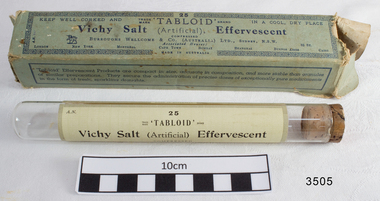
... Dr Angus assisted Dr Tom Ryan, a pioneer in the use of X-rays and in ocular surgery. flagstaff hill warrnambool shipwrecked coast flagstaff hill maritime museum maritime museum shipwreck coast flagstaff hill maritime village great ocean road wellcome & burroughs vichy tabloid wellcome & burroughs dr w r angus dr t f ryan nhill hospital nhill medical treatment dental treatment flagstaff hill warrnambool shipwrecked coast flagstaff hill maritime museum maritime museum shipwreck coast flagstaff hill maritime village great ocean road wellcome & burroughs vichy tabloid wellcome & burroughs dr w r angus dr t f ryan nhill hospital nhill medical treatment dental treatment On label of box “Vichy Salt (Artificial) Effervescent”, 25 compressed tablets, made by Burroughs, Wellcome & Co. Australia Ltd, Sydney, NSW ...Wellcome & Burroughs pharmaceutical company was founded in London in 1880 by American pharmacists. The first overseas branch opened in Sydney, Australia, in 1898 and by 1912 another 7 branches had opened. The box lists all of the 9 branches on it. Vichy Effervescent Salts are an antacid mixture in a tablet form. Wellcome & Burroughs company invented the name “Tabloid” to describe the process of compacting powders in measured doses to form a tablet. The label attached around the glass tube lists the same information as on the box, and also gives directions “One powdered and dissolved in wineglassful (about two ounces) of water represents an equal quantity of Vichy Water (Grand Grille Spring) in all its essential constituents and may be taken when required, as ordered by the physician.” “KEEP WELL CORKED AND IN A COOL DRY PLACE” The mineral spring waters from Vichy, France, have been used through the ages as a natural therapy, including aiding the digestive system. The Vichy tablets are made from chemicals that have similar properties. This box once containing Vichy Effervescent Salts was donated to Flagstaff Hill Maritime Village by the family of Doctor William Roy Angus, Surgeon and Oculist. It is part of the “W.R. Angus Collection” that includes historical medical equipment, surgical instruments and material once belonging to Dr Edward Ryan and Dr Thomas Francis Ryan, (both of Nhill, Victoria) as well as Dr Angus’ own belongings. The Collection’s history spans the medical practices of the two Doctors Ryan, from 1885-1926 plus that of Dr Angus, up until 1969. ABOUT THE “W.R.ANGUS COLLECTION” Doctor William Roy Angus M.B., B.S., Adel., 1923, F.R.C.S. Edin.,1928 (also known as Dr Roy Angus) was born in Murrumbeena, Victoria in 1901 and lived until 1970. He qualified as a doctor in 1923 at University of Adelaide, was Resident Medical Officer at the Royal Adelaide Hospital in 1924 and for a period was house surgeon to Sir (then Mr.) Henry Simpson Newland. Dr Angus was briefly an Assistant to Dr Riddell of Kapunda, then commenced private practice at Curramulka, Yorke Peninsula, SA, where he was physician, surgeon and chemist. In 1926, he was appointed as new Medical Assistant to Dr Thomas Francis Ryan (T.F. Ryan, or Tom), in Nhill, Victoria, where his experiences included radiology and pharmacy. In 1927 he was Acting House Surgeon in Dr Tom Ryan’s absence. Dr Angus had become engaged to Gladys Forsyth and they decided he would take time to further his studies overseas in the UK in 1927. He studied at London University College Hospital and at Edinburgh Royal Infirmary and in 1928, was awarded FRCS (Fellow from the Royal College of Surgeons), Edinburgh. He worked his passage back to Australia as a Ship’s Surgeon on the on the Australian Commonwealth Line’s T.S.S. Largs Bay. Dr Angus married Gladys in 1929, in Ballarat. (They went on to have one son (Graham 1932, born in SA) and two daughters (Helen (died 12/07/1996) and Berenice (Berry), both born at Mira, Nhill ) Dr Angus was a ‘flying doctor’ for the A.I.M. (Australian Inland Ministry) Aerial Medical Service in 1928 . The organisation began in South Australia through the Presbyterian Church in that year, with its first station being in the remote town of Oodnadatta, where Dr Angus was stationed. He was locum tenens there on North-South Railway at 21 Mile Camp. He took up this ‘flying doctor’ position in response to a call from Dr John Flynn; the organisation was later known as the Flying Doctor Service, then the Royal Flying Doctor Service. A lot of his work during this time involved dental surgery also. Between 1928-1932 he was surgeon at the Curramulka Hospital, Yorke Peninsula, South Australia. In 1933 Dr Angus returned to Nhill where he’d previously worked as Medical Assistant and purchased a share of the Nelson Street practice and Mira hospital from Dr Les Middleton one of the Middleton Brothers, the current owners of what was once Dr Tom Ryan’s practice. Dr L Middleton was House Surgeon to the Nhill Hospital 1926-1933, when he resigned. [Dr Tom Ryan’s practice had originally belonged to his older brother Dr Edward Ryan, who came to Nhill in 1885. Dr Edward saw patients at his rooms, firstly in Victoria Street and in 1886 in Nelson Street, until 1901. The Nelson Street practice also had a 2 bed ward, called Mira Private Hospital ). Dr Edward Ryan was House Surgeon at the Nhill Hospital 1884-1902 . He also had occasions where he successfully performed veterinary surgery for the local farmers too. Dr Tom Ryan then purchased the practice from his brother in 1901. Both Dr Edward and Dr Tom Ryan work as surgeons included eye surgery. Dr Tom Ryan performed many of his operations in the Mira private hospital on his premises. He too was House Surgeon at the Nhill Hospital 1902-1926. Dr Tom Ryan had one of the only two pieces of radiology equipment in Victoria during his practicing years – The Royal Melbourne Hospital had the other one. Over the years Dr Tom Ryan gradually set up what was effectively a training school for country general-practitioner-surgeons. Each patient was carefully examined, including using the X-ray machine, and any surgery was discussed and planned with Dr Ryan’s assistants several days in advance. Dr Angus gained experience in using the X-ray machine there during his time as assistant to Dr Ryan. Dr Tom Ryan moved from Nhill in 1926. He became a Fellow of the Royal Australasian College of Surgeons in 1927, soon after its formation, a rare accolade for a doctor outside any of the major cities. He remained a bachelor and died suddenly on 7th Dec 1955, aged 91, at his home in Ararat. Scholarships and prizes are still awarded to medical students in the honour of Dr T.F. Ryan and his father, Dr Michael Ryan, and brother, John Patrick Ryan. ] When Dr Angus bought into the Nelson Street premises in Nhill he was also appointed as the Nhill Hospital’s Honorary House Surgeon 1933-1938. His practitioner’s plate from his Nhill surgery states “HOURS Daily, except Tuesdays, Fridays and Saturday afternoons, 9-10am, 2-4pm, 7-8pm. Sundays by appointment”. This plate is now mounted on the doorway to the Port Medical Office at Flagstaff Hill Maritime Village, Warrnambool. Dr Edward Ryan and Dr Tom Ryan had an extensive collection of historical medical equipment and materials spanning 1884-1926 and when Dr Angus took up practice in their old premises he obtained this collection, a large part of which is now on display at the Port Medical Office at Flagstaff Hill Maritime Village in Warrnambool. During his time in Nhill Dr Angus was involved in the merging of the Mira Hospital and Nhill Public Hospital into one public hospital and the property titles passed on to Nhill Hospital in 1939. In 1939 Dr Angus and his family moved to Warrnambool where he purchased “Birchwood,” the 1852 home and medical practice of Dr John Hunter Henderson, at 214 Koroit Street. (This property was sold in1965 to the State Government and is now the site of the Warrnambool Police Station. ). The Angus family was able to afford gardeners, cooks and maids; their home was a popular place for visiting dignitaries to stay whilst visiting Warrnambool. Dr Angus had his own silk worm farm at home in a Mulberry tree. His young daughter used his centrifuge for spinning the silk. Dr Angus was appointed on a part-time basis as Port Medical Officer (Health Officer) in Warrnambool and held this position until the 1940’s when the government no longer required the service of a Port Medical Officer in Warrnambool; he was thus Warrnambool’s last serving Port Medical Officer. (The duties of a Port Medical Officer were outlined by the Colonial Secretary on 21st June, 1839 under the terms of the Quarantine Act. Masters of immigrant ships arriving in port reported incidents of diseases, illness and death and the Port Medical Officer made a decision on whether the ship required Quarantine and for how long, in this way preventing contagious illness from spreading from new immigrants to the residents already in the colony.) Dr Angus was a member of the Australian Medical Association, for 35 years and surgeon at the Warrnambool Base Hospital 1939-1942, He served as a Surgeon Captain during WWII1942-45, in Ballarat, Victoria, and in Bonegilla, N.S.W., completing his service just before the end of the war due to suffering from a heart attack. During his convalescence he carved an intricate and ‘most artistic’ chess set from the material that dentures were made from. He then studied ophthalmology at the Royal Melbourne Eye and Ear Hospital and created cosmetically superior artificial eyes by pioneering using the intrascleral cartilage. Angus received accolades from the Ophthalmological Society of Australasia for this work. He returned to Warrnambool to commence practice as an ophthalmologist, pioneering in artificial eye improvements. He was Honorary Consultant Ophthalmologist to Warrnambool Base Hospital for 31 years. He made monthly visits to Portland as a visiting surgeon, to perform eye surgery. He represented the Victorian South-West subdivision of the Australian Medical Association as its secretary between 1949 and 1956 and as chairman from 1956 to 1958. In 1968 Dr Angus was elected member of Spain’s Barraquer Institute of Barcelona after his research work in Intrasclearal cartilage grafting, becoming one of the few Australian ophthalmologists to receive this honour, and in the following year presented his final paper on Living Intrasclearal Cartilage Implants at the Inaugural Meeting of the Australian College of Ophthalmologists in Melbourne In his personal life Dr Angus was a Presbyterian and treated Sunday as a Sabbath, a day of rest. He would visit 3 or 4 country patients on a Sunday, taking his children along ‘for the ride’ and to visit with him. Sunday evenings he would play the pianola and sing Scottish songs to his family. One of Dr Angus’ patients was Margaret MacKenzie, author of a book on local shipwrecks that she’d seen as an eye witness from the late 1880’s in Peterborough, Victoria. In the early 1950’s Dr Angus, painted a picture of a shipwreck for the cover jacket of Margaret’s book, Shipwrecks and More Shipwrecks. She was blind in later life and her daughter wrote the actual book for her. Dr Angus and his wife Gladys were very involved in Warrnambool’s society with a strong interest in civic affairs. Their interests included organisations such as Red Cross, Rostrum, Warrnambool and District Historical Society (founding members), Wine and Food Society, Steering Committee for Tertiary Education in Warrnambool, Local National Trust, Good Neighbour Council, Housing Commission Advisory Board, United Services Institute, Legion of Ex-Servicemen, Olympic Pool Committee, Food for Britain Organisation, Warrnambool Hospital, Anti-Cancer Council, Boys’ Club, Charitable Council, National Fitness Council and Air Raid Precautions Group. He was also a member of the Steam Preservation Society and derived much pleasure from a steam traction engine on his farm. He had an interest in people and the community He and his wife Gladys were both involved in the creation of Flagstaff Hill, including the layout of the gardens. After his death (28th March 1970) his family requested his practitioner’s plate, medical instruments and some personal belongings be displayed in the Port Medical Office surgery at Flagstaff Hill Maritime Village, and be called the “W. R. Angus Collection”. The W.R. Angus Collection is significant for still being located at the site it is connected with, Doctor Angus being the last Port Medical Officer in Warrnambool. The collection of medical instruments and other equipment is culturally significant, being an historical example of medicine from late 19th to mid-20th century. Dr Angus assisted Dr Tom Ryan, a pioneer in the use of X-rays and in ocular surgery. A rectangular box of Tabloid brand 'Vichy Salt (Artificial Effervescent), medication from Dr T.F. Ryan's medical practice. Inside is a glass tube with rounded base and a cork stopper. The tube contains a cotton wool swab. Around the tube is a paper label listing the same information as per box label. Box is lined with white corrugated cardboard. (part of the W.R. Angus Collection)On label of box “Vichy Salt (Artificial) Effervescent”, 25 compressed tablets, made by Burroughs, Wellcome & Co. Australia Ltd, Sydney, NSW. “ ” “KEEP WELL CORKED AND IN A COOL DRY PLACE”flagstaff hill, warrnambool, shipwrecked coast, flagstaff hill maritime museum, maritime museum, shipwreck coast, flagstaff hill maritime village, great ocean road, wellcome & burroughs, vichy, tabloid, wellcome & burroughs, dr w r angus, dr t f ryan, nhill hospital, nhill, medical treatment, dental treatment, flagstaff hill, warrnambool, shipwrecked coast, flagstaff hill maritime museum, maritime museum, shipwreck coast, flagstaff hill maritime village, great ocean road, wellcome & burroughs, vichy, tabloid, wellcome & burroughs, dr w r angus, dr t f ryan, nhill hospital, nhill, medical treatment, dental treatment -
 Bendigo Military Museum
Accessory - ENVELOPE WW2, c.1945
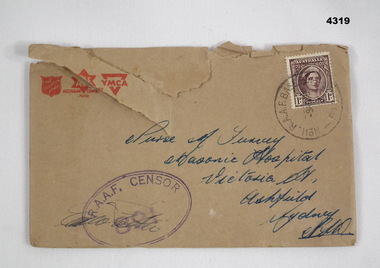
... "Nurse A Turvey Masonic Hospital Victoria St Ashfield Sydney NSW"...Craig NX170489, refer Cat No 4316.4 accessory envelopes ACF YMCA "Nurse A Turvey Masonic Hospital Victoria St Ashfield Sydney NSW" Envelope brown colour with red symbols re the Salvation Army, Australian Comforts Fund and the YMCA, one stamp with an "RAAF Base" stamp over, stamped by the RAAF censor and initialed by the Censor. ...The Raaf stamp date is possibly "9Aug45". Item in the collection re M.J. Craig NX170489, refer Cat No 4316.4Envelope brown colour with red symbols re the Salvation Army, Australian Comforts Fund and the YMCA, one stamp with an "RAAF Base" stamp over, stamped by the RAAF censor and initialed by the Censor. Address hand written in blue ink. "Nurse A Turvey Masonic Hospital Victoria St Ashfield Sydney NSW"accessory, envelopes, acf, ymca -
 Bendigo Military Museum
Award - MEDAL SET WW1 & BADGE, Post 1919
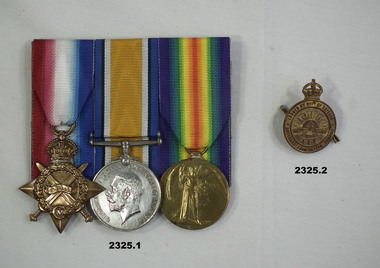
... Embarks for Eygpt 3.2.15, hospital Gallipoli 10.9.15 classed "Enteric", returns to Australia on 20.10.15. He goes AWOL on 24.3.16, classed as a deserter on 17.4.16. He re enlists in NSW...Embarks for Eygpt 3.2.15, hospital Gallipoli 10.9.15 classed "Enteric", returns to Australia on 20.10.15. He goes AWOL on 24.3.16, classed as a deserter on 17.4.16. He re enlists in NSW ...Horace Eli Hambly (born Bendigo, enlisted Bendigo) No 794 enlisted on 7.12.14 in 3rd reinforcements 4th Light Horse Regt age 20 years 10 months. Embarks for Eygpt 3.2.15, hospital Gallipoli 10.9.15 classed "Enteric", returns to Australia on 20.10.15. He goes AWOL on 24.3.16, classed as a deserter on 17.4.16. He re enlists in NSW on 16.7.17 as David Edward Miles No 7856 3rd Aust Tunneling Coy, he then confesses and embarks for England on 21.11.17, hospital with PUO on 27.6.18, discharged from the AIF on 17.7.19. .1) Medals, court mounted, set of (3) re H.E Hambly. 1. 1914-15 Star. 2. War Medal 1914-18 3. Victory Medal 1914 - 1919 .2) "Returned from Active Service Badge". Metal, gold colour, round with crown at top, centre has Rising Sun with AIF under..1) "794 Cpl H.E.Hambly 4 L.H.R A.I.F" .2) "201258"medals, badges, military -
 Bendigo Military Museum
Award - MEDAL SET WW1, Post 1919
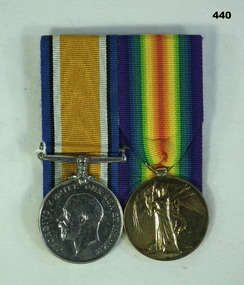
... Francis Harold Freeman (Born Womboota NSW, enlisted Melbourne) No 1914 enlisted 29.2.16 in the 3rd reinforcements to the 46th Batt AIF aged 21 years 2 months. Embarked for England 20.5.16, hospital...Francis Harold Freeman (Born Womboota NSW, enlisted Melbourne) No 1914 enlisted 29.2.16 in the 3rd reinforcements to the 46th Batt AIF aged 21 years 2 months. Embarked for England 20.5.16, hospital ...Francis Harold Freeman (Born Womboota NSW, enlisted Melbourne) No 1914 enlisted 29.2.16 in the 3rd reinforcements to the 46th Batt AIF aged 21 years 2 months. Embarked for England 20.5.16, hospital 13.10.16 with Influenza, allotted No 1914A, hospital 9.2.17 with Umps then Diptheria followed by Debility, marries Amy Eliza Spray 13.10.17, returns to France, hospital 29.10.19 with Influenza, discharged on 29.10.19 from the AIF. A brother No 1915 Thomas Henry 46th Batt KIA 11.6.17.Medals, court mounted, set of (2) Re F.H. Freeman. 1. War Medal 1914-18 2. Victory Medal 1914 - 19."1914A, F. H. Freeman 46th Bn AIF"metalcraft, numismatics - medals- military -
 Waverley RSL Sub Branch
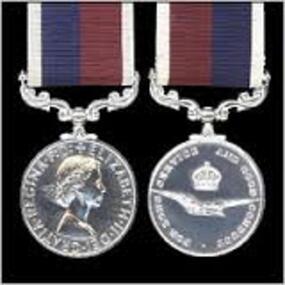
R.A.A.F. Long Service Medal
... hospitals. RAAF Dental Officers were posted to the large dental centres at Ascot Vale (Vic) and Bradfield Park (NSW) when first appointed, where they received military and clinical training, before being deployed to their needed location. ...Awarded to Alan Bowers (A236814) who was a R.A.A.F. dental mechanic who serverd during WWII including service in Darwin, and then continued in the R.A.A.F. for some years after the end of WWII The Royal Australian Air Force (and all Commonwealth Air Forces) Long Service and Good Conduct Medal: Awarded to NCOs and ORs of the RAAF (RAF, RCAF etc) for 15 years service. A cupro-nickel plated medal, the obverse features the sovereign's head, the reverse features the crown and eagle emblem of the RAAF (and RAF). Officers are eligible for the award provided they have served a minimum 12 years in the ranks. The riband is dark blue and maroon with white edges. This medal ceased to be awarded in Australia in 1975 when it was replaced by the National Medal (and sbsequently the DFSM and DLSM) in the Australian system of honours and awards. http://www.heritagemedals.com.au/medals-1/service-long-service/air-force-long-service-and-good-conduct-medal.html History of the RAAF Dental Branch It took six years following the formation of the RAAF in 1921 for the first Dental Clinic to be established at Point Cook, Victoria. On 10th June 1927 Flying Officer James Carl Rosenbrock commenced work as an RAAF Dental Officer for the FlyingTraining School at Point Cook. As personnel numbers were still relatively small, Rosenbrock was also responsible for the dental care of all Victorian RAAF units, which involved treating members at 1AD Laverton, as well as Air Force Headquarters at Victoria Barracks in Melbourne. As Army Dental Officers were currently caring for RAAF personnel at Richmond, NSW, the Senior Dental Officer of the 3rd Military District in Victoria (SDO 3MD) requested through the military board that a similar arrangement be established, where that the newly appointed RAAF Dentist provide part time dental services to the Army units stationed at Queenscliff. This was seen as an effective reciprocal arrangement, with both units having a Dental Officer in attendance for, in total, around 3-4 weeks a year. Rosenbrock continued to serve as the sole RAAF Dental Officer until the middle of 1933, when the Air Board asked for his service to be terminated following ‘behaviour unbecoming of a RAAF officer'. He had borrowed several sums of money, of around 40 Pounds or so, from junior ranks on base (as well as from the Regimental Sergeant Major) and had failed to pay the money back. He was replaced by a fellow Victorian, FLGOFF Norman Henry Andrews, on the 18th Sep 1933, who went on to become our first Director of Dental Services, and was instrumental in establishing the organisations and conditions of the Branch that are still present today. Through a fair amount of persistence and hard work on the part of Norman Andrews, the RAAF Dental Branch began to expand from 1937, with the introduction of 2 additional positions, at RAAF station Richmond, and at the FlyingTraining School at Point Cook. This gave the RAAF 3 uniformed Dental Officers, which was expanded to 5 in the months leading up to WW2. 4 of these Dental Officers were based in Victoria and 1 at Richmond, with the other two RAAF units being cared for by the Army (as in the case of Pearce in WA) or by civilians (as in Darwin). With the sudden increase in RAAF personnel required at the outbreak of WW2, the number of RAAF Dental Officers increased dramatically, from 5 in 1939, 28 in 1940, 64 in 1941, 147 in 1942, 193 in 1943, 219 in 1944, and peaking at 227 in 1945. RAAF Dental Officers were required to work in a variety of locations, both in and out of Australia. Between 1940 and 1942 a massive construction programme occurred, with new dental clinics being established around Australia. Priority was given to aircrew training units in order to get these personnel dentally fit for operational deployment, but Dental Officers could equally find themselves posted to recruit depots, fixed stations, medical clearance stations, mobile dental sections, and RAAF and civilian hospitals. RAAF Dental Officers were posted to the large dental centres at Ascot Vale (Vic) and Bradfield Park (NSW) when first appointed, where they received military and clinical training, before being deployed to their needed location. Mobile Dental Units When Japan entered the war in 1941, the rapid deployment of troops to northern operational areas with less than ideal dental fitness was extremely high. As a result, the RAAF deployed a range of mobile dental units, either alone or with medical sections, to support the increasing number of isolated deployed personnel within Australia and overseas. There were three types of mobile unit used: a. Mobile Dental Unit – relied on using either a semi-trailer to get around or by building a surgery directly on to the truck chassis, and installing hydraulic chairs, units, x-rays, and laboratory equipment. They were able to move around between small units, such as RAAF radar stations, where they could plug into the local power supply and work immediately. b. Transportable Dental Units – used for stops of longer duration, where field equipment was carried in panniers from one unit to another by road or rail and housed in whatever accommodation was available at the destination. They were often carried within Australia on Tiger Moths and Dakota aircraft. c. Itinerant Dental Units – in some areas, the dental equipment was installed at the RAAF unit and the Dental Officer and their staff would travel from unit to unit, using the equipment available at each location. RAAF Dental BadgeAs the war developed in Europe, it soon became obvious that the RAF Dental support was not capable of supporting the increasing numbers of RAAF aircrew that were being sent for service with the RAF, with only enough Dental Officers available to provide one to every 2000 men ( instead of the preferred 1 to 600). As a result, the RAAF provided a mobile dental unit, fitted out in a caravan and pulled by a Ford V8 Coupe, to travel around England in support of RAAF personnel at various squadrons. Some degree of tact was needed to ensure that the RAF did not take this as a comment on the treatment they were providing, but it proved successful in maintaining a satisfactory state of dental fitness in RAAF personnel, and a second mobile unit was soon dispatched. They were also set up with a laboratory on board as well as the surgery, which was a major difference between the RAF and RAAF, as the RAF did not provide dentures for their troops (the RAAF would, providing they had served for 6 years). In 1943 the RAF was no longer able to provide Dental support to Australian troops in the Middle East, which resulted in the need for a transportable dental unit to be deployed from Australia. It functioned in a similar manner to the RAF, by moving from one squadron to another. It served in the Middle East and Africa, from Cairo across North Africa, to Italy, and eventually back to England to treat returned prisoners of war. GPCAPT Norman Andrews The growth and development of the RAAF Dental Branch owes a debt to one man in particular, GPCAPT Norman Andrews. As the second RAAF Dental Officer to enlist on 18 Sep 1933, Andrews became the principal architect of the structure and organisation of the RAAF Dental Branch leading up to and during WW2. Until early 1940, the RAAF Dental Branch was administered by the Director of Medical Services (Air), which placed it under the control of the Army Medical staff. The Army would provide their Inspector of Dental Services for advice whenever needed. In April 1940, the RAAF Medical service separated from the Army, resulting in the control of the RAAF Dental Branch shifting back to the RAAF. Andrews became the first Director of Dental Services, when the position was created in 1943 as recognition of the higher profile the Dental Branch was now playing in the RAAF Medical service. Until this time, Andrews's title had been as the Dental Staff Officer to the RAAF Medical Service. Andrews was responsible for the establishment of the war-time structure of the Dental service, establishing new dental centres at all major bases, creating mobile and transportable dental units, ensuring the continual growth of the Branch, maintaining professional development of staff through the establishment of a professional journal, and by organising renowned lecturers to speak at RAAF bases. He also believed in visiting as many dental units as possible to see for himself what conditions were like and to talk first-hand to staff in remote units. His itinerary during the war years, both in and out of Australia, shows a large number of trips in a variety of modes of transport in order to reach remote areas where units were serving. He was promoted to GPCAPT in July 1944, as the numbers of Dental Officers soon peaked at 227 towards the end of the war (1 GPCAPT, 9 WGCDRs, 60 SQNLDRs, and 157 FLTLTs). After the war, with the reduction in RAAF personnel required in uniform, the Dental Branch also reduced its numbers significantly. By 1947 there were only 18 Dental Officers serving (many part-time), with 1 GPCAPT, 1 WGCDR, 10 SQNLDRs, and 6 FLTLTs, and only 13 by 1950. With the decrease in Branch personnel numbers, the ‘powers to be' saw fit to reduce the Director of Dental Service rank to WGCDR, and as a result Norman Andrews found that in order to continue serving in the RAAF he would have to wear a reduced rank. This appears to have been a contributing factor in his decision to discharge at the relatively early age of 43 and accept an administrative job as Director of the Victorian Government's School Dental Service. Norman Andrews holds the proud honour of being the founder of the RAAF Dental Branch, which during the war was instrumental in educating servicemen of the importance of dental health and maintaining the dental fitness of troops in a variety of areas. Dental Orderlies (Assistants) The dental orderly mustering was first introduced in 1937. Until that time, medical orderlies were assigned to assist the Dental officer with their duties. As early as 1931 it had been noted by both RAAF and Army Dental Officers working in Victoria and Richmond that a lot of the troubles they were having would be solved by appointing a permanent Dental Orderly. Often they would find that the medical orderly they were assigned was a different one each day, and as a result the administration and work in general was very inefficient. By 1937, with the increase in Dental Officers to 3, it was realised that a Dental Orderly mustering needed to be created. Dental Mechanics/Technicians Before WW2, dental laboratory work was provided by civilian laboratories, as most RAAF units were stationed around metropolitan areas. At this time, service personnel were still required to pay for their own dentures, unless they had served for six years or had their dentures damaged during performance of their duties. In July 1940, mainly in response to the development of more remote RAAF dental units and the increasing demand for dental prostheses, the Dental Mechanic mustering was established. Unfortunately there was a very limited pool of civilian dental mechanics to recruit from, and as a result the RAAF set up a training school at Laverton (which was later moved to Ascot Vale) in June 1941 which conducted an intensive 6 month course in Dental mechanics. Dental mechanics were quickly in demand. In all fixed and mobile dental units at least 1 Mechanic was supplied for each Dental Officer, and indeed the RAAF supplied Dental Mechanics throughout all its deployments, something the RAF were unwilling, or unable, to do. Two grades of dental mechanic existed: the Senior Mechanic (with the rank of NCO), who was competent in all phases of laboratory work; and the Junior Mechanic, who could only handle routine work and not more advanced denture work. The progression to Senior required a further trade test in techniques including setting up, clasp-forming, casting and backing teeth. During the course of the War, two special courses were held for Mechanics. The first, directed at senior mechanics so that they could instruct others, was in 1942 when Acrylic Resin was first introduced as a denture base material, as an alternative to the current option of vulcanite. Later, towards the end of the War, a ‘refresher' course was provided for those that had served for the greatest period of time in order to allow them retraining in techniques that they had not practised during their service and which were common in civilian life. This included cast base dentures, crowns and bridges, partial dentures, and retainers. Towards the end of the War, a course was held with WAAAF trainees to train them as Mechanics. However, as the War was soon to end they never had the opportunity to progress within the mustering to become Senior Mechanics. The RAAF Dental Branch has survived 75 years of turbulence, with reviews of its viability occurring regularly every few years from as early as 1937. The Branch continues to provide excellent service to the ADF community and, despite reduced manpower, will continue to play an important role in Air Force Health operations. http://www.defence.gov.au/health/about/docs/RAAFDental.pdf40cm cupro-nickel plated medal, the obverse features the sovereign's head, the reverse features the crown and eagle emblem of the RAAF (and RAF). A23814 BOWERS.A. A. F.r.a.a.f long service medal, r.a.a.f good conduct, r.a.a.f. dental service medal -
 Bendigo Military Museum
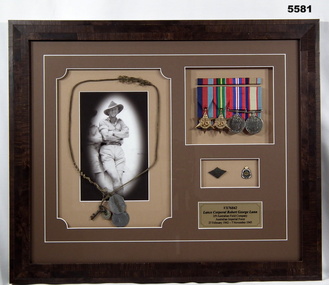
Memorabilia - MONTAGE, FRAMED MEMORABILIA, Post 2000
... Robert George Lunn VX76842 enlisted on 27.2.1942 age 35 years, 5.3 1942 transfer to Engineer Training Echuca, 12.4.1942 transfer to 2nd Field Sqd, 27.6.1942 transfer to No 4 Bomb Disposal Coy, 3.9.1942 transfer to No 2 Bomb Disposal Coy, 18.2.1943 transfer to Engineer Training Centre RAE, 18.8.1943 transfer to 5th Aust Advance Reinforcements Depot Townsville, 11.11.1943 embark for Pt Moresby, 19.11.1943 taken on strength 2/9th Field Coy, 4.6.1944 embark from Lae to Brisbane, 11.8.1944 hospital with Malaria28.8.1944 rejoin unit, 20.9.1944 hospital (unclear), 27.9.1944 rejoin unit, 23.5.1945 embark for Morotai, 7.8.1945 promoted to Cpl, 12.8.1945 fly from Balikpapan to Aust to attend a Junior leaders school Aust Army, 22.8.1945 arrive Vic and attend school, 29.8.1945 attend RAE Training Centre NSW, 31.10.1945 Move to Vic for discharge, 7.11.1945 discharged from the 2nd AIF....Robert George Lunn VX76842 enlisted on 27.2.1942 age 35 years, 5.3 1942 transfer to Engineer Training Echuca, 12.4.1942 transfer to 2nd Field Sqd, 27.6.1942 transfer to No 4 Bomb Disposal Coy, 3.9.1942 transfer to No 2 Bomb Disposal Coy, 18.2.1943 transfer to Engineer Training Centre RAE, 18.8.1943 transfer to 5th Aust Advance Reinforcements Depot Townsville, 11.11.1943 embark for Pt Moresby, 19.11.1943 taken on strength 2/9th Field Coy, 4.6.1944 embark from Lae to Brisbane, 11.8.1944 hospital with Malaria28.8.1944 rejoin unit, 20.9.1944 hospital (unclear), 27.9.1944 rejoin unit, 23.5.1945 embark for Morotai, 7.8.1945 promoted to Cpl, 12.8.1945 fly from Balikpapan to Aust to attend a Junior leaders school Aust Army, 22.8.1945 arrive Vic and attend school, 29.8.1945 attend RAE Training Centre NSW, 31.10.1945 Move to Vic for discharge, 7.11.1945 discharged from the 2nd AIF. ...Robert George Lunn VX76842 enlisted on 27.2.1942 age 35 years, 5.3 1942 transfer to Engineer Training Echuca, 12.4.1942 transfer to 2nd Field Sqd, 27.6.1942 transfer to No 4 Bomb Disposal Coy, 3.9.1942 transfer to No 2 Bomb Disposal Coy, 18.2.1943 transfer to Engineer Training Centre RAE, 18.8.1943 transfer to 5th Aust Advance Reinforcements Depot Townsville, 11.11.1943 embark for Pt Moresby, 19.11.1943 taken on strength 2/9th Field Coy, 4.6.1944 embark from Lae to Brisbane, 11.8.1944 hospital with Malaria28.8.1944 rejoin unit, 20.9.1944 hospital (unclear), 27.9.1944 rejoin unit, 23.5.1945 embark for Morotai, 7.8.1945 promoted to Cpl, 12.8.1945 fly from Balikpapan to Aust to attend a Junior leaders school Aust Army, 22.8.1945 arrive Vic and attend school, 29.8.1945 attend RAE Training Centre NSW, 31.10.1945 Move to Vic for discharge, 7.11.1945 discharged from the 2nd AIF.Wood framed item with photo, ID tags, medals x 4, RAS badge, RSL badge, all items are set in panels within the frame, panel with text at bottom. Medals. 1. 1939 - 45 Star. 2. Pacific Star. 3. British War medal 1939 - 45. 4. Australian Service Medal 1939 - 45."VX76842 Lance Corporal Robert George Lunn, 2/9 Australian Field Company Australian Imperial Force, 27 February 1942 - 7 November 1945"framed, memorabilia, ww2, medals, lunn -
 Bendigo Military Museum
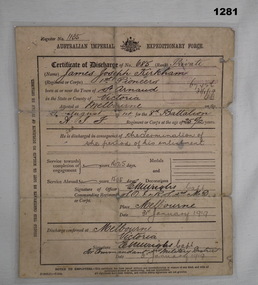
Administrative record - CERTIFICATE OF DISCHARGE WW1, 31/1/1919
... James Joseph Kirkham No 685 (born St Arnaud, enlisted Surrey NSW) in the AIF with F Coy 8th Batt on 21.8.1914 age 25 years. Embarked for Egypt 19.10.1914, embark for Gallipoli 5.4.1915, hospital 19.5.1915 with Influenza then Rhuematism, return to Gallipoli 6.8.1915. ...James Joseph Kirkham No 685 (born St Arnaud, enlisted Surrey NSW) in the AIF with F Coy 8th Batt on 21.8.1914 age 25 years. Embarked for Egypt 19.10.1914, embark for Gallipoli 5.4.1915, hospital 19.5.1915 with Influenza then Rhuematism, return to Gallipoli 6.8.1915. ...James Joseph Kirkham No 685 (born St Arnaud, enlisted Surrey NSW) in the AIF with F Coy 8th Batt on 21.8.1914 age 25 years. Embarked for Egypt 19.10.1914, embark for Gallipoli 5.4.1915, hospital 19.5.1915 with Influenza then Rhuematism, return to Gallipoli 6.8.1915. Embark for France 26.3.1916, hospital 25.4.1917 with Appendicitis, return to unit 10.12.1917, attached to 1st Pioneer Batt 9.3.1918, return to Australia, leave for 1914 personnel 8.10.1918, discharged from the AIF 31.9.19. Refer 1283, 1986P.Certificate of discharge, Register No 1135 for Pte James Joseph Kirkham no 685, 1st Pioneers, 31/1/1919. Details name, rank, regt no, enlistment date, service at home and abroad, reason for discharge and discharge date. Certificate has been laminated.documents - certificates, military history-service records, kirkham -
 Bendigo Military Museum
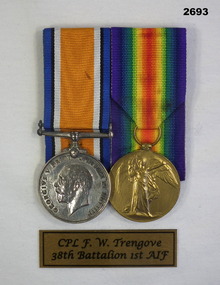
Award - MEDAL SET WW1, post 1919
... NSW, enlisted Bendigo) No 3201 enlisted in the 7th reinforcements 2nd Pioneers on 27.9.1916 age 21 years 5 months. Embarked for England 23.11.1916, embarked for France 5.9.1917, transferred to 38th Batt 17.9.1917, WIA 13.10.1917 Gassed, returned to France 2.4.1918, hospital 15.4.1918 Chest problems, transferred back to 2nd Pioneers 20.6.1918, discharged from the AIF 4.11.1919....NSW, enlisted Bendigo) No 3201 enlisted in the 7th reinforcements 2nd Pioneers on 27.9.1916 age 21 years 5 months. Embarked for England 23.11.1916, embarked for France 5.9.1917, transferred to 38th Batt 17.9.1917, WIA 13.10.1917 Gassed, returned to France 2.4.1918, hospital 15.4.1918 Chest problems, transferred back to 2nd Pioneers 20.6.1918, discharged from the AIF 4.11.1919. medals military history Passchendaele Barracks Trust ”3201 A- L- CPL F W TRENGOVE 38 BN AIF” Medals, court mounted, set of 2, re F W TRENGOVE 1. ...Frank William Trengove (born Hay NSW, enlisted Bendigo) No 3201 enlisted in the 7th reinforcements 2nd Pioneers on 27.9.1916 age 21 years 5 months. Embarked for England 23.11.1916, embarked for France 5.9.1917, transferred to 38th Batt 17.9.1917, WIA 13.10.1917 Gassed, returned to France 2.4.1918, hospital 15.4.1918 Chest problems, transferred back to 2nd Pioneers 20.6.1918, discharged from the AIF 4.11.1919.Medals, court mounted, set of 2, re F W TRENGOVE 1. War Medal 1914-18 2. Victory Medal 19141 - 1919”3201 A- L- CPL F W TRENGOVE 38 BN AIF”medals, military, history, passchendaele barracks trust -
 Bendigo Military Museum
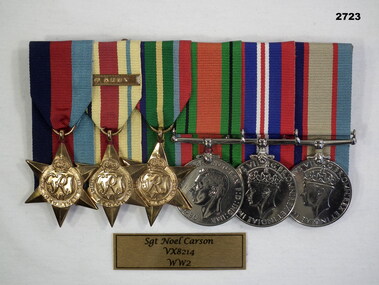
Award - MEDAL SET WW2, Post 1945
... Noel Carson No VX8214 (born Corona NSW, enlisted Caulfield) in 2nd AIF on 14.5.40. At discharge from the AIF he was a Sgt in 2/7th Aust General Hospital. ...Noel Carson No VX8214 (born Corona NSW, enlisted Caulfield) in 2nd AIF on 14.5.40. At discharge from the AIF he was a Sgt in 2/7th Aust General Hospital. medals military history Passchendaele Barracks Trust "VX 8214 N. ...Noel Carson No VX8214 (born Corona NSW, enlisted Caulfield) in 2nd AIF on 14.5.40. At discharge from the AIF he was a Sgt in 2/7th Aust General Hospital. Medal set, court mounted, set of (6) Re N. CARSON. 1. 1939 - 45 2. Africa star with clasp "8th Army" 3. Pacific Star 4. Defence Medal 5. War Medal 1939 - 45 6. Australian Service Medal 1939 - 45"VX 8214 N. CARSON"medals, military, history, passchendaele barracks trust -
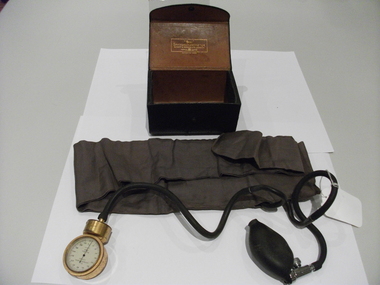 Royal Australian and New Zealand College of Obstetricians & Gynaecologists (RANZCOG)
Sphygmomanometer used by Dr Henry William Devlin, Short & Mason Ltd, 1890s
... hospital, Dublin. He immigrated to Australia and was the first doctor to practice in Parkes NSW. ...Donated by Miss Beatrice May Devlin, items that belonged to her paternal grandfather, Dr Henry William Devlin graduated in Medicine from Dublin, worked at the Rotunda hospital, Dublin. He immigrated to Australia and was the first doctor to practice in Parkes NSW.Sphygmomanometer,"Tyco", manufacturer; Short and Mason Ltd London brand, complete and excellent condition in original case. -
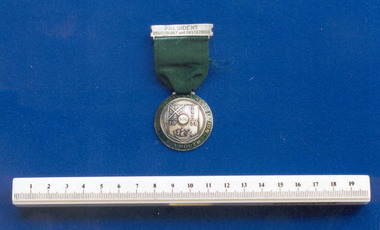 Royal Australian and New Zealand College of Obstetricians & Gynaecologists (RANZCOG)
Medal - British Medical Association President of Gynaecology and Obstetrics medal associated with Professor F.J. Browne, 1938
... Hospital London. Retired and continued postgraduate teaching in London and NSW. ...Hospital London. Retired and continued postgraduate teaching in London and NSW. ...Francis James Browne died in Sydney 1963. He had a long career in obstetrics and gynaecology. Summary of appointments include: General Practice in Wales, Maternity Department of the Edinburgh Royal Infirmary, 1st director of obstetric unit, University College Hospital London. Retired and continued postgraduate teaching in London and NSW. Married to Grace Cuthbert, who was director of Maternal and Baby Welfare in NSW. A collection of objects found amongst Professor FJ Browne's papers were transferred from the Archives to the Museum collections in January 1994.A round metal badge with a green enamelled rim. There is a shield in the centre which is divided into three. In the left hand comer there is a flag, in the right hand comer the medical insignia, and at the bottom of the shield there is a sailing ship. The year 1938 is either side of a central white enamelled plug with the number "106" on it. Attached to the badge is a green grosgrain ribbon, to which is attached an oblong bar with a pin at the back. Inscriptions Around the edge of the badge: "THE BRITISH MEDICAL ASSOCIATION PLYMOUTH"; inscribed on the back of the badge: "BRUFORD, EASTBOURNE AND EXETER"; front lower right hand side ofbadge:"M & W"; front of bar: "PRESIDENT/ GYNAECOLOGY and OBSTETRICS"numismatics, browne fj, rcog -
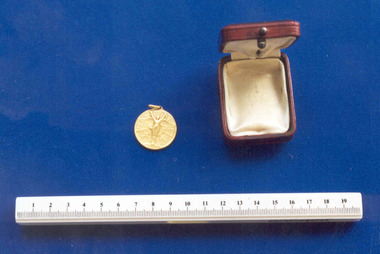 Royal Australian and New Zealand College of Obstetricians & Gynaecologists (RANZCOG)
Medal - French World War I military service medal awarded to FJ Browne, c.1914-1918, A. Mayeur, 1918
... Hospital London. Retired and continued postgraduate teaching in London and NSW. ...This French Service medal was awarded to F.J. Browne for service in the First World War tending to the wounded soldiers evacuated from France on hospital ships. The places inscribed on the medal are all in the Communaupole (Urban Area) of Lens-Liévin in the Pas de Calais where the broad plain and low hills of Artois saw some of the most savage and bloody fighting of World War I.Francis James Browne died in Sydney 1963. He had a long career in obstetrics and gynaecology. Summary of appointments include: General Practice in Wales, Maternity Department of the Edinburgh Royal Infirmary, 1st director of obstetric unit, University College Hospital London. Retired and continued postgraduate teaching in London and NSW. Married to Grace Cuthbert, who was director of Maternal and Baby Welfare in NSW. A collection of objects found amongst Professor FJ Browne's papers were transferred from the Archives to the Museum collection in January 1994. A small round gold medal (.1) with presentation case (.2). The scene on the front of the medal depicts an ancient castle & surrounds with the rising sun in the background, and is inscribed "SUNT LACRYMAE RERUM". On the reverse is a figure of a winged woman against a cross, and the inscription "AUX HEROS", above a list of inscribed place names: "DE GARENCY, VIMY, ABLAIN, AVION, SOUCHEL, LENS, LORETTE, LOOS". The outside of the presentation case is maroon leather. There is a cream velvet mount for the medal and the inside of the lid of the case is lined with cream satin. "A. MAYEUR" is inscribed on both sides of the medal. "SUNT LACRYMAE RERUM", "AUX HEROS", "DE GARENCY, VIMY, ABLAIN, AVION, SOUCHEL, LENS, LORETTE, LOOS", "A.MAYEUR"numismatics, world war i, france, browne fj
