
Showing 9 items matching "hub cap"
-
 Flagstaff Hill Maritime Museum and Village
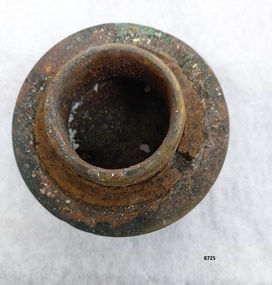
Functional object - Hub Cap Nut, Circa 1870's
... Hub Cap Nut......hub cap...This hub cap nut was recovered from the wreck of the Loch Ard and donated by a friend of the diver. ...A round brass hub cap nut consisting of a flat, octagonal, hollow nut (with concave sides and green verdigis), a 2cm wide flange and a 2 cm deep threaded shank with brown corrosion. ...This hub cap nut was recovered from the wreck of the Loch Ard and donated by a friend of the diver. ...This hub cap nut was recovered from the wreck of the Loch Ard and donated by a friend of the diver. The ship Loch Ard was built on the River Clyde in Scotland in 1873 for the prestigious Loch Line of colonial clipper ships, designed for the Australian run. It sailed from Gravesend, England on 1st March 1878 carrying 37 crew, 17 passengers and a load of cargo. The manifest listed an array of manufactured goods being exported to the Colony of Victoria reflecting the affluence of Melbourne at the time. Included in the cargo manifest were straw hats, umbrellas, perfumes, clay pipes, pianos, clocks, confectionary, linen and candles, as well as one timber carriage, 29 chaff cutters and thirty-four pairs of metal axle components for horse drawn wagons and carriages. It is not known if this brass hub nut cap was part of this cargo manifest or was a fitting on the Loch Ard. There were also items included that were intended for display in the Melbourne International Exhibition in 1880 - a diverse general cargo ranging from luxury items to bulk railway iron. On 1 June 1878, emerging from fog and hearing too late the sound of breakers against the tall limestone cliffs, the vessel struck the southern foot of Mutton Bird Island and sank in 23 metres of water. Of the fifty-four people on board only two survived, one young male crewman, Tom Pearce, and one young female passenger, Eva Carmichael. Ten days after the Loch Ard tragedy, salvage rights to the wreck were sold at auction for £2,120. Cargo valued at £3,000 was salvaged and placed on the beach, but most washed back into the sea when another storm developed. The wreck of Loch Ard still lies at the base of Mutton Bird Island. Much of the cargo has now been salvaged and some was washed up into what is now known as Loch Ard Gorge. Cargo and artefacts have also been illegally salvaged over many years before protective legislation was introduced in 1976. One of the most unlikely pieces of cargo to have survived the shipwreck was a Minton porcelain peacock - one of only seven in the world. The peacock was destined for the Melbourne International Exhibition in 1880. It had been well packed, which gave it adequate protection during the violent storm. Today, the Minton peacock can be seen at the Flagstaff Hill Maritime Museum in Warrnambool. From Australia's most dramatic shipwreck it has now become Australia's most valuable shipwreck artefact and is one of very few 'objects' on the Victorian State Heritage Register.Flagstaff Hill’s collection of artefacts from LOCH ARD is significant for being one of the largest collections of artefacts from this shipwreck in Victoria. It is significant for its association with the shipwreck, which is on the Victorian Heritage Register (VHR S417). The collection is significant because of the relationship between the objects, as together they have a high potential to interpret the story of the LOCH ARD. The LOCH ARD collection is archaeologically significant as the remains of a large international passenger and cargo ship. The LOCH ARD collection is historically significant for representing aspects of Victoria’s shipping history and its potential to interpret sub-theme 1.5 of Victoria’s Framework of Historical Themes (living with natural processes). The collection is also historically significant for its association with the LOCH ARD, which was one of the worst and best known shipwrecks in Victoria’s history.A round brass hub cap nut consisting of a flat, octagonal, hollow nut (with concave sides and green verdigis), a 2cm wide flange and a 2 cm deep threaded shank with brown corrosion. It has a rusty washer corroded onto the flange.flagstaff hill maritime museum and village, warrnambool, great ocean road, shipwreck coast, loch ard, loch ard wreck, loch ard salvage, loch ard artifacts, hub cap nut, hub cap, wagon hub cap -
 Port Melbourne Historical & Preservation Society
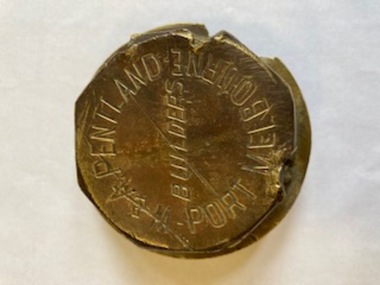
Machine - W & A PENTLAND Wheel Hub, c.1950
... Round brass wheel hub cap from W & A PENTLAND, Port Melbourne...W & A PENTLAND William PENTLAND Industry - Manufacturing W & A Pentland Port Melbourne Builders Round brass wheel hub cap from W & A PENTLAND, Port Melbourne Machine W & A PENTLAND Wheel Hub ...William PENTLAND arrived in Sandrisge in 1864 and set up his own coach building business in 1880.The firm was located between Ingles & Raglan Streets on the east side of Crockford Street. As well as coach building - and later motor body building - the firm were wheelwrights and blacksmiths.Round brass wheel hub cap from W & A PENTLAND, Port MelbourneW & A Pentland Port Melbourne Buildersw & a pentland, william pentland, industry - manufacturing -
 Trafalgar Holden Museum
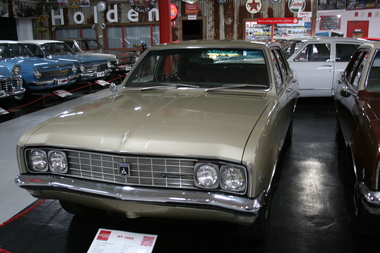
Vehicle - HT Holden Premier
... Florentian gold HT Premier sedan. Chrome hub caps and dress rings, chrome dress strip across boot lid....Florentian gold HT Premier sedan. Chrome hub caps and dress rings, chrome dress strip across boot lid. ...An update on the HK model with many minor upgrades. Cosmetic changes in grille and tail lamp assemblyManufactured by GMH from 1969 through to 1970Florentian gold HT Premier sedan. Chrome hub caps and dress rings, chrome dress strip across boot lid.Holden Lion badge grille centre, premier logo grille Right hand side, Premier signage low on both front quarter panels. Holden lion badge boot centre and Premier Logo boot Right hand side.vehicle, premier, sedan -
 Trafalgar Holden Museum
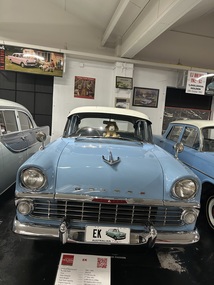
Vehicle - EK Special Holden sedan, 1961
... Blue body sedan with white roof ,sun visor, upright rear vision mirrors added on .Hub caps featured lion emblem. Chrome arrow shape ornament on bonnet....Vehicle Holden 1961 Car Holden Special Registered number 63453-H Blue body sedan with white roof ,sun visor, upright rear vision mirrors added on .Hub caps featured lion emblem. Chrome arrow shape ornament on bonnet. ...The EK was the first model Holden that had the option of automatic transmission. This was the 3 speed hydra-matic that offered performance and economy that was not far short of the manual. This vehicle still used the tried and true 138 cubic inch power plant.This was a local Trafalgar vehicle formerly owned by Graham Cook and family. The interior of this vehicle is totally original while the exterior has undergone a substantial repaint and re-chrome, This was required because the previous owner kept the external spotlessly clean and wore the paint out.Blue body sedan with white roof ,sun visor, upright rear vision mirrors added on .Hub caps featured lion emblem. Chrome arrow shape ornament on bonnet.Holden Special Registered number 63453-Hvehicle, holden, 1961, car -
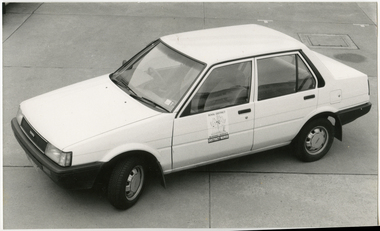 Royal District Nursing Service (now known as Bolton Clarke)
Photograph - Photograph, coloured, c.1985
... A black tyred wheel with solid hub cap is seen under a wheel arch in the body work, at the front and rear of the vehicle....A black tyred wheel with solid hub cap is seen under a wheel arch in the body work, at the front and rear of the vehicle. ...This white Toyota Corolla is one of the fleet of cars driven by Royal District Nursing Service (RDNS) Sisters to visit patients in the community to administer nursing care. 1985 was the centenary of the founding of the Melbourne District Nursing Society; founded in 1885; the Society was given Royal patronage in 1966 and became the Royal District Nursing Service. The Coat of Arms shown on the car was granted by the College of Arms in London in 1970. Royal District Nursing Service (RDNS) has had various modes of transport over the last 130 plus years. At first, from 1885 as Melbourne District Nursing Society (MDNS), their Trained nurses (Nurses) walked the streets and lane ways amid the slums of central Melbourne. As the Society expanded public transport was used, and bicycles were bought by the Society in 1903 and used in inner areas until 1945. During the Spanish flu epidemic, in 1919, MDNS appealed for assistance to procure Motor vehicles so the Nurses could visit an influx of cases. Through trusts, grants and donations four 'Ford T Model' cars were procured which enabled the Nurses to triple their visits. Through constant use the cars were in such a poor state two were sold in 1922 and the others later. In 1922-23 three Peugeot cars were purchased and a woman Chauffeur, 'Miss Sword', was employed who lived in the Home and was also in charge of the garage. MDNS was expanding and a Motor Auxiliary was formed in 1929 to take the Trained nurses (Sisters) to patients, and some Sisters used their own cars; even a motorcycle was used by one Sister in 1933. All these forms of transport were intermingled and in the early 1950s, and now as Melbourne District Nursing Service, seven Ford Prefect cars were bought followed by twelve Ford Anglia cars 1955. Having received Royal patronage; the now Royal District Nursing Service (RDNS) had its own fleet of Holden vehicles by the mid 1960s and the Motor Auxiliary ceased operating in 1971 as by then all staff employed were required to have a driving licence. Seat-belts had been introduced to Victoria in 1959 and District fitted them to their cars from 1962, even though they did not become compulsory until 1970. The Holden vehicles were replaced with grey Holden Torana vehicles. After several years the fleet was changed to white Toyota Corolla vehicles. The Melways Directory of maps was introduced in 1966, which was a boon to the Sisters, though it was a few years before it went beyond Seville, so a large paper map was used by the Sisters visiting patients in the areas passed Seville. By 2009 there were 598 cars in the fleet and the Sisters travelled 9 million 200,000 kilometres – this is equivalent to 12 trips to the moon and back. Coloured photograph of the side on view of a Royal District Nursing Service (RDNS).white Toyota Corolla sedan displaying the RDNS Coat of Arms on the upper centre of the front door. The car is the same width all over and the flat bonnet joins to a sloping large front windscreen. on the side, at the level of the windscreen are two windows, above the metal body work of both doors. The roof runs from the top of the windscreen to the rear of the vehicle where it joins with a short back window which sits above a short boot. Part of the front grill and headlights either side of it are seen, and a bumper bar below this. A black tyred wheel with solid hub cap is seen under a wheel arch in the body work, at the front and rear of the vehicle.melbourne district nursing society, mdns, royal district nursing service, rdns, rdns crest, rdns transport -
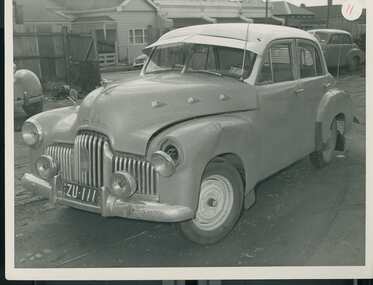 Brunswick Community History Group
Photograph - Holden - registration number Vic ZU-111, damaged in the gas explosion, Sydney Road, 20 Sep 1958
... Damage to front headlight, slight damage to front bumper bar and front passenger side hub cap gone. Also bonnet is sitting up on passenger side - where it was parked. ...Damage to front headlight, slight damage to front bumper bar and front passenger side hub cap gone. Also bonnet is sitting up on passenger side - where it was parked. ...Holden - registration number Vic ZU-111, damaged in the explosion. Damage to front headlight, slight damage to front bumper bar and front passenger side hub cap gone. Also bonnet is sitting up on passenger side - where it was parked. Note venetian blind in rear window. Car appears to be parked in a side street. Gas explosion, Sydney Road, 20 Sep 1958. Next to Hoyts Cinema (Padua), Grand Final Day Collingwood beat Melbourne). Gas main under Sydney road exploded. Fusion. Vol 18 no 4, November 2004. Sydney Road gas pipe explosion (2 photos - 2024-065 and ) / Jim Spall p5. Plus Wendy Harvey's memories of the event on page 4. -
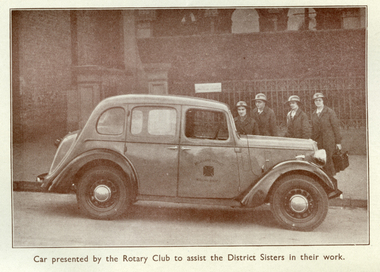 Royal District Nursing Service (now known as Bolton Clarke)
Photograph - Digital image, 07.05.1937
... Rubber tyred wheels with solid hub caps are seen below each wheel arch. On the footpath, behind the bonnet of the car, four Melbourne District Nursing Society (MDNS) Trained nurses (Sisters) are standing. ...Rubber tyred wheels with solid hub caps are seen below each wheel arch. On the footpath, behind the bonnet of the car, four Melbourne District Nursing Society (MDNS) Trained nurses (Sisters) are standing. ...This sepia digital image shows the Austin car which was donated to the Melbourne District Nursing Society (MDNS) in !937 by the Rotary Club of Victoria. It was used by the Matron of the MDNS District Division to visit patients weekly. The photograph is taken outside the MDNS Headquarters at 39 Victoria Parade, Collingwood. The photograph appeared along with an article in The Age Friday May 7, 1937. The photograph appeared in the MDNS Annual Report of 1937. On page 8, mention is made of J.D Johnston Esq, President of the Rotary Club of Victoria, presenting the Austin vehicle to MDNS. Royal District Nursing Service (RDNS) has had various modes of transport over the last 130 plus years. At first, from 1885 as Melbourne District Nursing Society (MDNS), their Trained nurses (Nurses) walked the streets and lane ways amid the slums of central Melbourne. As the Society expanded public transport was used, and bicycles were bought by the Society in 1903 and used in inner areas until 1945. During the Spanish flu epidemic, in 1919, MDNS appealed for assistance to procure Motor vehicles so the Nurses could visit an influx of cases. Through trusts, grants and donations four 'Ford T Model' cars were procured which enabled the Nurses to triple their visits. Through constant use the cars were in such a poor state two were sold in 1922 and the others later. In 1922-23 three Peugeot cars were purchased and a woman Chauffeur, 'Miss Sword', was employed who lived in the Home and was also in charge of the garage. MDNS was expanding and a Motor Auxiliary was formed in 1929 to take the Trained nurses (Sisters) to patients, and some Sisters used their own cars; even a motorcycle was used by one Sister in 1933. All these forms of transport were intermingled and in the early 1950s, and now as Melbourne District Nursing Service, seven Ford Prefect cars were bought followed by twelve Ford Anglia cars 1955. Having received Royal patronage; the now Royal District Nursing Service (RDNS) had its own fleet of Holden vehicles by the mid 1960s and the Motor Auxiliary ceased operating in 1971 as by then all staff employed were required to have a driving licence. Seat-belts had been introduced to Victoria in 1959 and District fitted them to their cars from 1962, even though they did not become compulsory until 1970. The Holden vehicles were replaced with grey Holden Torana vehicles. After several years the fleet was changed to white Toyota Corolla vehicles. The Melways Directory of maps was introduced in 1966, which was a boon to the Sisters, though it was a few years before it went beyond Seville, so a large paper map was used by the Sisters visiting patients in the areas passed Seville. By 2009 there were 598 cars in the fleet and the Sisters travelled 9 million 200,000 kilometres – this is equivalent to 12 trips to the moon and back. In the foreground of this sepia photograph is a side-on view of a four door 1937 style small grey car with a nose shaped bonnet, parked on the road beside the kerb with the headlight facing to the right of the photograph.The bonnet joins onto a straight windscreen which adjoins a slightly curved hood running back along the car. This adjoins a back window which joins onto the sloping rear body of the car with a small protruding boot. Windows are seen above the body work of both facing doors and a smaller sloping window above the body work and rear wheel arch. On the drivers door is a Maltese cross and the words "Melbourne District" written above the Maltese cross and "Nursing Society" below it. In front of this door the body work forms a wheel arch and the headlight is attached between this body work and the bonnet. Rubber tyred wheels with solid hub caps are seen below each wheel arch. On the footpath, behind the bonnet of the car, four Melbourne District Nursing Society (MDNS) Trained nurses (Sisters) are standing. They are wearing dark grey coats over their grey uniforms with white collars, and brimmed grey hats with a Maltese cross on the light coloured headband. The Sister on the right has her left hand gripping the handle on top of her oblong nursing case. A metal spiked fence is behind the Sisters, which runs to the left into one of the two square concrete columns which sit either side of a path. A hedge is behind the fence, and behind this part of a building with three arched windows can be seen. A white plaque is attached to the fence near one of the columns.mdns, melbourne district nursing society, rotary club of victoria, mdns transport, rdns, royal district nursing service, rdns transport -
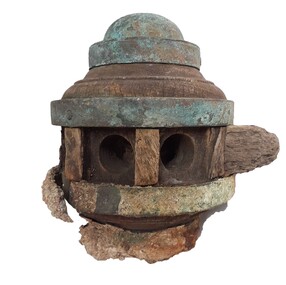 Flagstaff Hill Maritime Museum and Village
Functional object - Ship's Wheel
... Both sides of the wheel have a brass cap over the centre of the hub, covering the wooden hub. ...Both sides of the wheel have a brass cap over the centre of the hub, covering the wooden hub. ...This wooden ship's wheel originally had eight spokes but four are no longer in their sockets. One of the spokes has been shaped. Both sides of the wheel have a brass cap over the centre of the hub, covering the wooden hub. The wood is split and cracked, and parts of it have small holes, a sign of being affected by the sea worm. Thick encrustations are on parts of the wheel, showing that it has been on the sea bed for quite some time. The donor is a Warrnambool resident. Years ago he was cray fishing at King Island, which is in Bass Strait, northwest of Tasmania. His craypot got stuck in a reef so a diver helped him by retrieving the craypot for him. While the diver was underwater he also stumbled across the ship's wheel, which he gave to the donor. The Bass Strait is a very narrow route that was difficult and dangerous to navigate in the early 19th century, before good maps, communications and lighthouses were installed. The area, including King Island, is the graveyard of many ships that almost made it to their destination of Melbourne along Australia's treacherous coastline. Around King Island alone, many ships and lives were lost. There is no information about the history of this ship's wheel. Its condition shows that the item has been under the water for a long time. However, there is no evidence that it came from a shipwreck. It could even have been an old ship that could have been scuttled or destroyed as it was no longer useful. The wheel is significant as a sign of shipping around King Island. It is part of the island's history, and of maritime history. It is an example of an item manufactured by hand.Ship's wheel; segment of a wooden ship's wheel. It once had eight spokes but only portions of four spokes remain. The outer centres of the hub and the reinforcing bands around the hub are brass. The wheel is heavily encrusted in parts. It was recovered from an unknown shipwreck in the waters of King Island.great ocean road, warrnambool, shipwreck artefact, artefact, ship's wheel, ship's wheel segment, portion of a ship's wheel, flagstaff hill, maritime museum, maritime village, flagstaff hill divers, marine technology, navigation, steering wheel, eight spoke wheel, king island, craypot, diver -
 Alfred Hospital Nurses League - Nursing History Collection
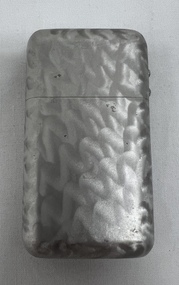
Functional object - Syringe and Needle Kit - Parke Davis & Co, Parke, Davis & Co
... cap 2. a small glass vial containing 6 hypodermic needles 3. 6 vials with cork stoppers containing analgesic tablets 4. 2 perished rubber washers used in the syringe 5. 1 wire stylet to clean needles 6. Screw on needle hub...AUG 25 1885: on plunger, measurement markings Silver coloured metal flip up case containing: 1. a glass and metal syringe with metal cap 2. a small glass vial containing 6 hypodermic needles 3. 6 vials with cork stoppers containing analgesic tablets 4. 2 perished rubber washers used in the syringe 5. 1 wire stylet to clean needles 6. Screw on needle hub ...Most nurses had their own syringe and needle kits before the advent of disposable syringes. They were used by Alfred Hospital visiting trained nurses to administer medication in the patient's home. The analgesic tablets in the glass vials were dissolved in sterile water prior to administration.This item belonged to Louisa Mann, 6th Matron of the Alfred 1912-1928.Silver coloured metal flip up case containing: 1. a glass and metal syringe with metal cap 2. a small glass vial containing 6 hypodermic needles 3. 6 vials with cork stoppers containing analgesic tablets 4. 2 perished rubber washers used in the syringe 5. 1 wire stylet to clean needles 6. Screw on needle hubOn the base of the kit engraved - Parke, Davis & Co. Detroit & New-York Markings on the vials: No 2 Apomorphine Hydrochlorate 1-10 gr - Parke, Davis & Co. Detroit & New York No 3 Atropine Sulphate 1-50 gr - Parke, Davis & Co. Detroit & New York No 5 Cocaine Hydrochlorate 1-4 gr - Parke, Davis & Co. Detroit & New York No 13 Morphine sulphate 1-4 gr - Parke, Davis & Co. Detroit & New York No 16 Morphine sulphate 1-4 gr & Atropine sulphate 1-150 gr - Parke, Davis & Co. Detroit & New York No 72 Strychnine Nitrate 1-40 gr - Parke, Davis & Co. Detroit & New York Glass vial with needles (Patient July 7, '96): 1st line - Aseptic Hypodermic Needles 1/2 Doz. 2nd line - Schimmel's Patent Best Seamless Steel Tubing 3rd line - CAUTION - Do not return a needle once used to the vial. 4th line - Remove needles by a slight tap on vial with a pencil. 5th line - PARKE, DAVIS & CO. GENERAL AGENTS 6th line - DETROIT MICH U.S.A. Syringe inscription - on barrel, Parke Davis &Co PAT. AUG 25 1885: on plunger, measurement markings injection kit
