
Showing 1000 items matching "hundred of people"
-
 Melbourne Tram Museum
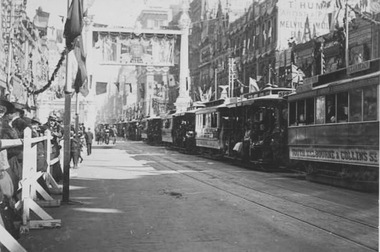
Photograph - Collins St cable tram lineup, c1915
... ...hundred of people...Towards the southern footpath hundred of people in suits and similar attire have gathered behind a long barrier. ...Towards the southern footpath hundred of people in suits and similar attire have gathered behind a long barrier. ...Photograph looks west along Collins St likely from Swanston St with a line of busy cable trams nose-to-tail on the east bound track. While the west bound track is mostly free of trams, in the distance the rear of one tram can be seen along with the backs of half a dozen men and women. Towards the southern footpath hundred of people in suits and similar attire have gathered behind a long barrier. A large banner hangs above Collins St displaying a large cross which may be the Military Cross instituted by King George V in 1914 for acts of bravery in war. The half dozen people walking close to the tracks may be Military Cross recipients or family.Yields information about parades in central MelbourneBlack and white photograph with no markings. collins st, swanston st, cable trams, hundred of people, long barrier, large banner, military cross, king george v -
 Whitehorse Historical Society Inc.
Article, History in stone cottage, 1965
... Since Schwerkolt's Cottage was opened in October 1965 by Governor Sir Rohan Delacombe it has been visited by many hundreds of people. Essential repairs and the furnishing of the cottage has been accomplished through the generosity of various donors....Essential repairs and the furnishing of the cottage has been accomplished through the generosity of various donor Schwerkolt Cottage Satchwell Joan Field Jean Since Schwerkolt's Cottage was opened in October 1965 by Governor Sir Rohan Delacombe it has been visited by many hundreds of people. Since Schwerkolt's Cottage was opened in October 1965 by Governor Sir Rohan Delacombe it has been visited by many hundreds of people. ...Since Schwerkolt's Cottage was opened in October 1965 by Governor Sir Rohan Delacombe it has been visited by many hundreds of people.Since Schwerkolt's Cottage was opened in October 1965 by Governor Sir Rohan Delacombe it has been visited by many hundreds of people. Essential repairs and the furnishing of the cottage has been accomplished through the generosity of various donors.Since Schwerkolt's Cottage was opened in October 1965 by Governor Sir Rohan Delacombe it has been visited by many hundreds of people. schwerkolt cottage, satchwell, joan, field, jean -
Whitehorse Historical Society Inc.
Article, Commissioners meet the public, 1995
... Two hundred people attended a public meeting with Whitehorse Commissioners to discuss a program of community consultation for the municipality....Local Government City of Whitehorse Two hundred people attended a public meeting with Whitehorse Commissioners to discuss a program of community consultation for the municipality. ...Two hundred people attended a public meeting with Whitehorse Commissioners to discuss a program of community consultation for the municipality.Two hundred people attended a public meeting with Whitehorse Commissioners to discuss a program of community consultation for the municipality.Two hundred people attended a public meeting with Whitehorse Commissioners to discuss a program of community consultation for the municipality.local government, city of whitehorse -
 Eltham District Historical Society Inc
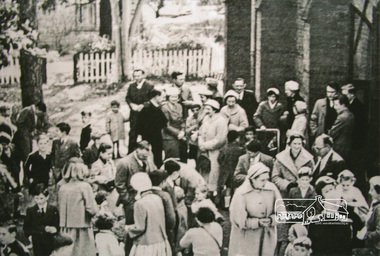
Photograph, Parishoners, St Margaret's Anglican Church, Eltham, c.1960
... "For very nearly one hundred years, people of Eltham have worshiped at St. ..."For very nearly one hundred years, people of Eltham have worshiped at St. ..."For very nearly one hundred years, people of Eltham have worshiped at St. Margaret's usually spending a few pleasant minutes after the service chatting with friends. But the percentage of parishoners who attend church regularly and frequently is pitifully low." c.1960Digital scan of photograph - Original Source Copy: St Margaret's Parish Archives. church of england, churches, eltham, st margarets church -
 Ballarat Heritage Services
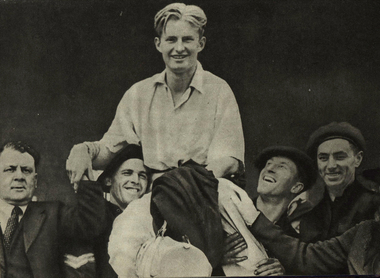
Image, C.J. Melrose, solo flier, 1934, 1934
... Two days later, over one hundred thousand people lined the streets of Melbourne to pay their last respects. ...Two days later, over one hundred thousand people lined the streets of Melbourne to pay their last respects. aeroplane aviation flight pioneer pilot Charles Kingsford Smith P. ...Melrose died in July 1936, at the age of 22, when his new high-wing monoplane "Billing", a Heston Phoenix registration VH-AJM, broke up in turbulence over South Melton, Victoria on a charter flight from Melbourne to Darwin. Two days later, over one hundred thousand people lined the streets of Melbourne to pay their last respects. Black and white photographic image of Charles James Melrose, the only Australian contestant and the only solo flier in the England-Ausralia air race, 1934. He is being chaired by R.A.A.F. men. Two years later Melrose crashed.aeroplane, aviation, flight, pioneer pilot, charles kingsford smith, p. taylor -
 Ringwood and District Historical Society
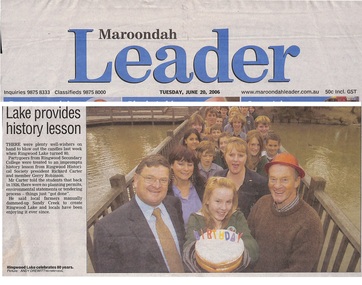
Document - Newspaper clipping and notes, Ringwood Lake 80th Birthday Celebrations - 2006
... "One hundred orchardists and business people turned up with horses and scoops to grub the trees, clear the land and construct the wall - all in one afternoon in 1926."..."One hundred orchardists and business people turned up with horses and scoops to grub the trees, clear the land and construct the wall - all in one afternoon in 1926." ...Newspaper clipping featuring Richard Carter, Gerry Robinson and Ringwood Secondary College students - Maroondah Leader, Tuesday June 20, 2006. Research notes for historical talk and running sheet for program of celebration events on Thursday June 15th 2006 in Ringwood Lake Park, including Miner's Cottage and Poppet Head. "One hundred orchardists and business people turned up with horses and scoops to grub the trees, clear the land and construct the wall - all in one afternoon in 1926." -
 Eltham District Historical Society Inc
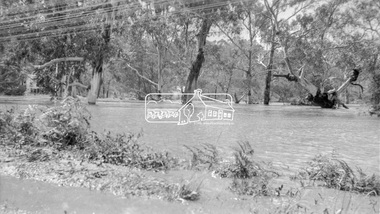
Photograph, Floodwaters, Diamond Creek, Eltham, 1934
... Bridges and houses were swept away with hundreds of people left homeless across the state. ...Bridges and houses were swept away with hundreds of people left homeless across the state. ...The Diamond Creek in flood near the Main Road bridge at Eltham, Victoria. The Yarra also was in flood. In early December 1934 the "Greatest flood in the history of the Yarra" occured, according to The Argus newspaper. Bridges and houses were swept away with hundreds of people left homeless across the state. The historic 1934 flood of the Diamond Creek and Yarra River set the criteria for future planning with respect to flood water rise.This photo forms part of a collection of photographs gathered by the Shire of Eltham for their centenary project book, "Pioneers and Painters: 100 years of the Shire of Eltham" by Alan Marshall (1971). The collection of over 500 images is held in partnership between Eltham District Historical Society and Yarra Plenty Regional Library (Eltham Library) and is now formally known as 'The Shire of Eltham Pioneers Photograph Collection.' It is significant in being the first community sourced collection representing the places and people of the Shire's first one hundred years.Digital image 4 x 5 inch B&W Neg (2 frames on one neg) 9 x 15.5 cm B&W printflooding, eltham, shire of eltham pioneers photograph collection, sepp, diamond creek (river), floods, 1934 flood, diamond creek -
 Eltham District Historical Society Inc
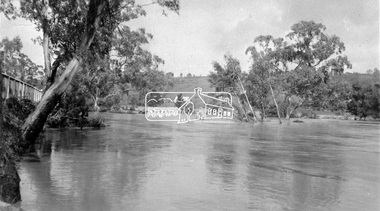
Photograph, Eltham - Floods in 1934
... Bridges and houses were swept away with hundreds of people left homeless across the state. ...Bridges and houses were swept away with hundreds of people left homeless across the state. ...To the left of picture is the Main Road Bridge over the Diamond Creek in Eltham South when the Diamond Creek was in flood. The Yarra also was in flood. In early December 1934 the "Greatest flood in the history of the Yarra" occured, according to The Argus newspaper. Bridges and houses were swept away with hundreds of people left homeless across the state. The historic 1934 flood of the Diamond Creek and Yarra River set the criteria for future planning with respect to flood water rise.This photo forms part of a collection of photographs gathered by the Shire of Eltham for their centenary project book, "Pioneers and Painters: 100 years of the Shire of Eltham" by Alan Marshall (1971). The collection of over 500 images is held in partnership between Eltham District Historical Society and Yarra Plenty Regional Library (Eltham Library) and is now formally known as 'The Shire of Eltham Pioneers Photograph Collection.' It is significant in being the first community sourced collection representing the places and people of the Shire's first one hundred years.Digital image 4 x 5 inch B&W Negsepp, shire of eltham pioneers photograph collection, eltham, diamond creek (river), 1934 flood, diamond creek, floods, main road bridge -
 Eltham District Historical Society Inc
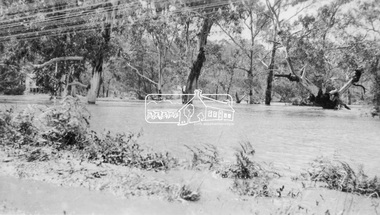
Negative - Photograph, Floodwaters, Diamond Creek, Eltham, 1934
... Bridges and houses were swept away with hundreds of people left homeless across the state. ...Bridges and houses were swept away with hundreds of people left homeless across the state. ...The Diamond Creek in flood near the Main Road bridge at Eltham, Victoria. The Yarra also was in flood. In early December 1934 the "Greatest flood in the history of the Yarra" occured, according to The Argus newspaper. Bridges and houses were swept away with hundreds of people left homeless across the state. The historic 1934 flood of the Diamond Creek and Yarra River set the criteria for future planning with respect to flood water rise. Noted on reverse of print - Copied by Hugh Fisher, 82 Lygon St., BrunswickThis photo forms part of a collection of photographs gathered by the Shire of Eltham for their centenary project book,"Pioneers and Painters: 100 years of the Shire of Eltham" by Alan Marshall (1971). The collection of over 500 images is held in partnership between Eltham District Historical Society and Yarra Plenty Regional Library (Eltham Library) and is now formally known as the 'The Shire of Eltham Pioneers Photograph Collection.' It is significant in being the first community sourced collection representing the places and people of the Shire's first one hundred years.Digital image 4 x 5 inch B&W Neg (2 frames on one neg) Print 9 x 15.5 cmOn reverse of print - "Copied by Hugh Fisher, 82 Lygon St., Brunswick" (for Shire of Eltham)sepp, shire of eltham pioneers photograph collection, eltham, floods, 1934 flood, diamond creek (creek), floodwater -
 Melbourne Legacy
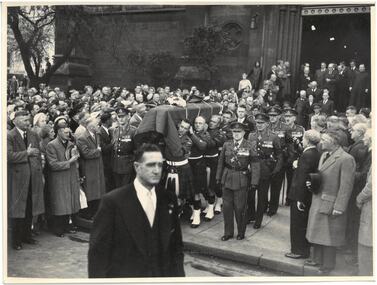
Photograph, Funeral of Legatee Savige, 1954
... This is shown in a photo from a Legacy newsletter from July 1954 as copied here. Hundreds of people lined Flinders Street as the procession passed. ...This is shown in a photo from a Legacy newsletter from July 1954 as copied here. Hundreds of people lined Flinders Street as the procession passed. ...A black and white photo of Stan Savige's funeral from a file about the life of Stan Savige. The funeral was at St Paul's Cathedral on 18 May 1954. Two thousand men marched in the funeral procession to the Boroondara Cemetery, Kew. As the procession moved off, members of Legacy formed up and marched behind. This is shown in a photo from a Legacy newsletter from July 1954 as copied here. Hundreds of people lined Flinders Street as the procession passed. A 15-gun salute marked the funeral of late Lieut.-General Sir Stanley Savige.The funeral indicates the high esteem in which Sir Stanley Savige was held by the Australian public for both his war service, and for founding Legacy.Black and white photo of the funeral of Sir Stanley Savige in 1954.stan savige, funeral -
Unions Ballarat
ACTU National Day of Protest, 15 November 2005, CFMEU Your Rights at Work, 2005
... The ACTU National Day of Protest was held in November 2005 in opposition to the Howard Coalition government's proposed WorkChoices legislation. Hundreds of thousands of people took part in the rallies....The ACTU National Day of Protest was held in November 2005 in opposition to the Howard Coalition government's proposed WorkChoices legislation. Hundreds of thousands of people took part in the rallies. ...The ACTU National Day of Protest was held in November 2005 in opposition to the Howard Coalition government's proposed WorkChoices legislation. Hundreds of thousands of people took part in the rallies.Relevant to workplace rights and trade union activism.DVDbtlc, ballarat trades and labour council, ballarat trades hall, actu, national day of protest, workchoices, howard, john, liberal party australia, industrial relations, unions, activism, rallies, legislation -
 Orbost & District Historical Society
jar, 1993
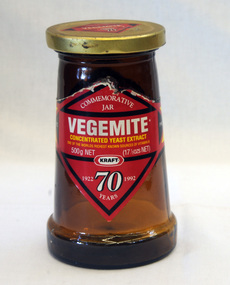
... A competition inviting the Australian public to create a name for the new spread offered a prize of 50 pounds. finalists. Hundreds of people entered and Fred Walker’s daughter selected the winning name: VEGEMITE. ...A competition inviting the Australian public to create a name for the new spread offered a prize of 50 pounds. finalists. Hundreds of people entered and Fred Walker’s daughter selected the winning name: VEGEMITE. ...A young chemist named Dr. Cyril P Callister, hired by the Fred Walker Company, developed a new spread from brewer’s yeast. It was claimed as the richest known sources of natural Vitamin B. Labelled as ‘Pure Vegetable Extract’, it was sold in a two ounce amber glass jar and capped with what was known as a Phoenix seal, to keep the contents fresh. A competition inviting the Australian public to create a name for the new spread offered a prize of 50 pounds. finalists. Hundreds of people entered and Fred Walker’s daughter selected the winning name: VEGEMITE. The name of the winning entrant was never placed on record. VEGEMITE spread was then sold from grocers’ shelves. In April 1984, a 115-gram jar of vegemite became the first product in Australia to be electronically scanned at a checkout A commemorative jar was produced to celebrate the occasion of 70 years - 1922-1997.Vegemite is possibly Australia's most iconic food brand. Since the 1930s it has been a major part of this country's cuisine. Yet unlike other Australian icons the attraction of Vegemite has remained local. A tapered brown glass jar with a gold metal lid. The label o the front is red with yellow, white and black print. there is a similar smaller label on the lid. with black writing.On base: a spiral with 10 in centre circle 13573 underneath the spiral above is letter A with raised dots insidevegemite jar -
 Flagstaff Hill Maritime Museum and Village
Tool - Spirit Level, 1937-1955
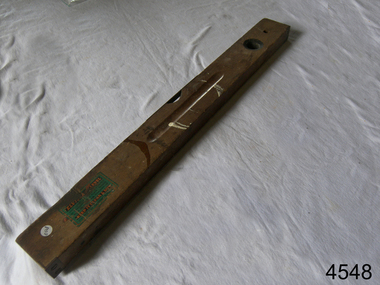
... The Elliot Lucas Ltd Elvicta Cabinet and Tool factory as it was known employed over a hundred people and operated from the company's satellite works in Crickhowell southeastern Powys, Wales, near Abergavenny, in the county of Brecknockshire during the 1950s. ...The Elliot Lucas Ltd Elvicta Cabinet and Tool factory as it was known employed over a hundred people and operated from the company's satellite works in Crickhowell southeastern Powys, Wales, near Abergavenny, in the county of Brecknockshire during the 1950s. ...Initially Elvicta was known as Elliot Lucas (hand tools)Ltd, and was established around 1937 based at 38 Summer Row, Birmingham. Around 1950 the firm relocated to Cannock, Staffordshire and by 1965 had moved again to their Church bridge Works also at Cannock. The Elliot Lucas Ltd Elvicta Cabinet and Tool factory as it was known employed over a hundred people and operated from the company's satellite works in Crickhowell southeastern Powys, Wales, near Abergavenny, in the county of Brecknockshire during the 1950s. The company manufactured a range of specialist pliers, nippers and pincers including the brands Elvicta, Electoy and Elect.A tool that is now regarded today as vintage, is collectable and highlights a time when tools were made by hand and how wood was predominately used to manufacture such items. It gives a snapshot of the time before the use of plastics and other synthetic materials which are now used to produce every day objects and tools such as this spirit level.Elvicta brand wooden spirit level made by Elliott-Lucas Ltd England. Level has two levels one vertical one horizontal . Has 2 brass corner protectors Has 530 marked on plate denotes model No and an original label 610 mm long x 60 mm x 30 mmflagstaff hill, warrnambool, shipwrecked-coast, flagstaff-hill, flagstaff-hill-maritime-museum, maritime-museum, shipwreck-coast, flagstaff-hill-maritime-village -
 Melbourne Legacy
Photograph - Photo, Widows activities, 1996
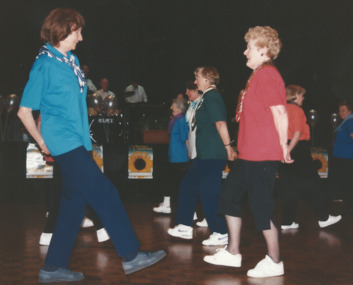
... From an article in The Answer in December 1996, the motto of the week was "Enjoying Life" and over 80 events were held in Victoria. these photos are from "the annual Veterans' Health Week Afternoon Tea Dance. Three hundred people danced in style to the music of the Mellow Tones, filling the dance floor every dance. ...From an article in The Answer in December 1996, the motto of the week was "Enjoying Life" and over 80 events were held in Victoria. these photos are from "the annual Veterans' Health Week Afternoon Tea Dance. Three hundred people danced in style to the music of the Mellow Tones, filling the dance floor every dance. ...These photos were saved with a label saying "Veterans Health week '96" which is an awareness campaign from the Department of Veterans Affairs. From an article in The Answer in December 1996, the motto of the week was "Enjoying Life" and over 80 events were held in Victoria. these photos are from "the annual Veterans' Health Week Afternoon Tea Dance. Three hundred people danced in style to the music of the Mellow Tones, filling the dance floor every dance. During a delicious afternoon tea, Melbourne Legacy Line Dancers demonstrated their fun style of dancing and encouraged everyone to join them."A record of an event for widows and a way of keeping them active and of the relationship with the Department of Veterans' Affairs.Colour photo x 2 of widows line dancing in Veterans Health Week.Handwritten on the back '2' in red pen.widows, activities, answer -
 Eltham District Historical Society Inc
Slide - Photograph, St Andrews Primary School Banner, 1985
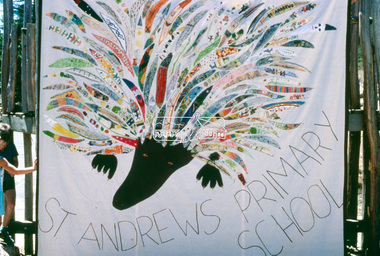
... It involved hundreds and hundreds of people. It changed some people's lives, enlivened others. ...It involved hundreds and hundreds of people. It changed some people's lives, enlivened others. ...St Andrews Primary School was one of thirteen primary schools and one high school to participate in the banner project. A picture of the St Andrews Primary School banner was included in page 10 of The banner habits of the Eltham tribes : Eltham Shire "as we are" Community Banner Project report / by Jacky Talbot. The 'As We Are' Community Banner Project was the first major Community Arts project initiated and co-ordinated through the resources of the Shire of Eltham. It was originally conceived and inspired by a local textile artist, Tracey Naughton, who, together with the Community Services Manager of this local government council, made the idea a very concrete and flourishing reality. The project grew from the original fourteen or so intending participant groups to fifty-seven banners; expressions of those diverse groups' interests and identities. As a first major project it was rightly felt by Tracey Naughton, who became the Shire's first Community Arts Officer in March 1985, that it should be fully documented, so that an appraisal of the extensive growth of this community arts development process could be assessed. Given the time and money available to do this, Jacky Talbot, and her advisors, decided it was appropriate to select fifteen or twenty banners for detailed analysis. This was done by taping interviews with members of the chosen groups. The groups were chosen to cover all ages participating, from the toddlers in the Playhouse to our grand elder citizens in their Nursing Horne, and to cover a wide range of different types of groups - schools, scouts, churches, youth issue based, and the numerous women's groups of various combinations, localities and concerns. ·. Some groups who presented their banners for the culminating highlight of this project - the Exhibition, held at the Eltham Community Centre on October 9th, 1986, had no contact with the Shire or project co-ordinator, but heard about the project through the local news' networks or other participants. The extent of community participation was enormous. It involved hundreds and hundreds of people. It changed some people's lives, enlivened others. As a first step on a new road its success is notable. The 'As We Are' Community Banner Project took place in the Shire of Eltham and neighbouring environs for approximately 12 months, from October 1985.35mm colour positive transparency Mount - Cardbanners, st andrews primary school, banner project, community, emblems, flags, shire of eltham -
Dandenong & District Historical Society
Book, The Lasting Impact of Waverley Riding School
... A riding school which grew to become Australia's premier establishment. The hundreds of people, young to elderly, who rode at Waverley were a privileged group, It was joy, fun and adventure. ...A riding school which grew to become Australia's premier establishment. The hundreds of people, young to elderly, who rode at Waverley were a privileged group, It was joy, fun and adventure. ...non-fiction -
 City of Melbourne Libraries
Photograph, Bull, Hugh Jones, 1897-1993, Fire at Cathedral Hotel, Swanston Street, Melbourne
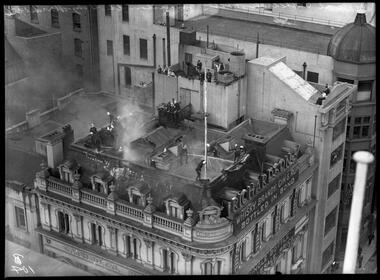
... On street level hundreds of people gathered to watch, but were controlled by police in order to keep them at a safe distance and ensure that tram and motor traffic was not seriously disorganised. ...On street level hundreds of people gathered to watch, but were controlled by police in order to keep them at a safe distance and ensure that tram and motor traffic was not seriously disorganised. ...Fire at the Cathedral Hotel! Bird’s eye view These firemen on the roof of the Cathedral Hotel are very bold in their approach to firefighting! One heroically aims a firehose at the roof while another holds onto the flagpole with one hand as he walks around the narrow edge, three storeys up! Onlookers from adjacent buildings make the most of their front row view, and The Age reported that on street level, hundreds of people gathered to watch, enthralled by “a thrilling spectacle when three firemen walked along the stone coping on the top floor of the building and, despite the clouds of smoke and sheets of flame which shot through the roof they ripped off the hot slate tiles and provided an outlet for the flames”. The Cathedral Hotel was built in 1883 and demolished in 1966 to make way for the City Square. Featured in "Newsworthy: Melbourne in photographs 1933-1936" exhibition at East Melbourne Library, October to December 2023. Exhibition caption by project volunteer, Louise McKenzie. Photographer notations on slide: "Fire at Cathedral Hotel Swanston St City March 1936 B104" Description: View looking down on roof of the Cathedral Hotel showing 16 firefighters battling a fire. There is smoke coming through the roof. Onlookers watch from adjoining buildings, not perturbed by the proximity of the fire. The firemen look bold and impressive in their brass helmets. Research by project volunteer, Louise McKenzie: The Age reported on 4 March 1936 that the fire broke out in rubbish between the roof space and wooden ceiling of the Cathedral Hotel at 4.30 pm. “The Eastern Hill fire brigade was notified by telephone, and an almost simultaneous call was also received at fire brigade headquarters from a street alarm.” These red fire alarm call boxes were typically installed on street corners, and when the knob was turned, a pulsed electric signal corresponding to the box’s number was received at fire headquarters. A large detachment of firemen with full fire-fighting equipment, including two large extension ladders, were quickly on the scene, pouring vast quantities of water into the hotel, causing several hundred pounds of damage to hotel and guest property, but quickly bringing the fire under control. Lengths of hose had to be carried through the front entrance and up several flights of stairs. On street level hundreds of people gathered to watch, but were controlled by police in order to keep them at a safe distance and ensure that tram and motor traffic was not seriously disorganised. The crowd were enthralled by “a thrilling spectacle when three firemen walked along the stone coping on the top floor of the building and, despite the clouds of smoke and sheets of flame which shot through the roof, they ripped off the hot slate tiles and provided an outlet for the flames”. The firemen are noteworthy for their highly polished brass helmets, known as Merryweather helmets, based on those of French sapeurs-pompiers and introduced to the British Metropolitan Fire Brigade in London in 1868. Metal helmets are conductive, a safety issue as the use of electricity became widespread, so a composite cork and rubber helmet was introduced in London from 1936. In Queensland, traditional brass helmets remained in service until 1970. The firemen are very bold in their actions – one heroically aiming a fire hose at the roof of the building, another holding onto the flagpole with one hand as he walks around the narrow top edge of the roof, three storeys up! The onlookers from adjoining buildings are interested in the spectacle, rather than dismayed by the fire. Lettering around the building exterior reads "Cathedral Hotel - Erected 1883". Prominent signage for “Richardson’s whisky, brandy, gin & rum" sits along the edge of the roof. The Cathedral Hotel was located on the corner of Swanston Street and Flinders Lane. It was built in 1883, and its name derived from St Paul’s Cathedral on the south side of Flinders Lane. It was demolished in 1966 as Melbourne City Council wished to create a City Square. Robyn Annear notes that at the time, the development was referred to as “Whelan’s Square” due to the large number of buildings which needed to be demolished to create the Square. Ironically the Hotel had been the victim of a previous fire in 1917, when its then licensee, also named Whelan, was charged with two failed arson attempts. References: No title (1936, March 4). The Age (Melbourne, Vic. : 1854 - 1954), p. 13. Retrieved February 5, 2024, from http://nla.gov.au/nla.news-article205256255 FIRE AT A CITY HOTEL. (1936, March 4). The Age (Melbourne, Vic. : 1854 - 1954), p. 12. Retrieved February 5, 2024, from http://nla.gov.au/nla.news-article205256231 FIRE IN ROOF OF CITY HOTEL (1936, March 4). The Argus (Melbourne, Vic. : 1848 - 1957), p. 8. Retrieved February 5, 2024, from http://nla.gov.au/nla.news-article11018696 Hotel Roof Fire Draws Crowd (1936, March 4). Examiner (Launceston, Tas. : 1900 - 1954), p. 8 (DAILY). Retrieved February 5, 2024, from http://nla.gov.au/nla.news-article52000751 'Flinders Lane Melbourne 1966', Peter Andrew Barrett, Facebook, 12 June 2020, https://www.facebook.com/120943481324886/photos/a.512123662206864/3025002490918956/?type=3 Fire Alarm Call Box, Wikipedia, https://en.wikipedia.org/wiki/Fire_alarm_call_box Research notes, 'A city lost and found', Robyn Annear, https://robynannear.com/docs/whelan-the-wrecker-notes.pdfPhotographer notations on slide: "Fire at Cathedral Hotel Swanston St City March 1936 B104".fires, hotels, 1930-1939 -
 Ballarat and District Irish Association
Image, Rent Day (as it is under coercion) - No Rent, c1864, c1864
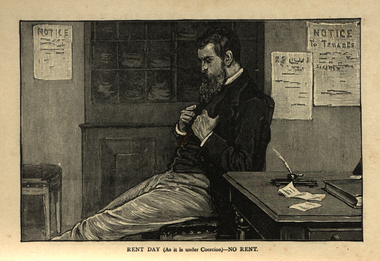
... The Act resulted in the imprisonment of hundreds of people including over twenty MPs. The so-called ''Crimes Act'' (or "Coercion" Act) was condemned by the Catholic hierarchy since it was to become a permanent part of the law and did not have to be renewed annually by parliament, but the Papacy issued the bull Link: "Saepe Nos" in 1888 which was uncritical of the Acts. ...The Act resulted in the imprisonment of hundreds of people including over twenty MPs. The so-called ''Crimes Act'' (or "Coercion" Act) was condemned by the Catholic hierarchy since it was to become a permanent part of the law and did not have to be renewed annually by parliament, but the Papacy issued the bull Link: "Saepe Nos" in 1888 which was uncritical of the Acts. ...Protection of Person and Property Act 1881 The ''Protection of Person and Property Act 1881'' was one of more than 100 Coercion Acts passed by the Parliament of United Kingdom of Great Britain and Ireland between 1801 and 1922, in an attempt to establish law and order in Ireland. The 1881 Act was passed by parliament and introduced by Gladstone. It allowed for persons to be imprisoned without trial. On 13 October 1881, the Act was used to arrest Charles Parnell after his newspaper, the ''United Ireland'', had attacked the Land Act. On Gladstone's return to office in 1880, William Edward Forster was made Chief Secretary for Ireland. He carried the Compensation for Disturbance Bill through the Commons, only to see it thrown out in the Lords. On 24 January 1881, he introduced a new Coercion Bill in the House of Commons, to deal with the growth of the Irish National Land League. Despite a 41-hour long fillibuster in the House by the Irish Parliamentary Party, the bill passed, among its provisions being one enabling the British government in Ireland to arrest without trial persons "reasonably suspected" of crime and conspiracy. However those arrested were often not always suspect, only supportive of the Irish National Land League's movements. Over 100 such acts were passed, some of the more notable of which were "An Act for the more effectual Suppression of Local Disturbances and Dangerous Associations in Ireland", "The Protection of Life and Property in Certain Parts of Ireland Act", and the "Protection of Person and Property Act 1881". An Irish Coercion Bill was proposed by Sir Robert Peel to calm the increasing difficult situation in Ireland as a result of the Great Famine 1844–47. The Bill was blocked and this led, in part, to Peel's retirement as Prime Minister. Later attempts to introduce Irish coercion acts were blocked by the filibustering of Joseph Biggar. As a response to the Plan of Campaign of the mid-1880s the new Chief Secretary for Ireland Arthur Balfour secured a tough Perpetual Crimes Act (1887) (or Coercion Act) aimed at the prevention of boycotting, intimidation, unlawful assembly and the organisation of conspiracies against the payment of agreed rents. The Act resulted in the imprisonment of hundreds of people including over twenty MPs. The so-called ''Crimes Act'' (or "Coercion" Act) was condemned by the Catholic hierarchy since it was to become a permanent part of the law and did not have to be renewed annually by parliament, but the Papacy issued the bull Link: "Saepe Nos" in 1888 which was uncritical of the Acts. Trial by jury was abolished. An influential analysis of the pros and cons of the Act was published in 1888 by W. H. Hurlbert, a Catholic Irish-American author. Many hundreds were imprisoned at times under the Acts, including many prominent politicians and agrarian agitators, Joseph Biggar, Alexander Blane, Michael Davitt, John Dillon, James Gilhooly, Patrick Guiney, Matthew Harris, John Hayden, J. E. Kenny, Andrew Kettle, Denis Kilbride, Pat O'Brien, William O'Brien, James O'Kelly, Charles Stewart Parnell, Douglas Pyne, Willie Redmond, Timothy Sullivan. [http://shelf3d.com/i/Irish%20Coercion%20Act, accessed 13/12/2013]A many sits on a table holding the lapels of his Jacket. ballarat irish, cabin, rent, tenants, quill, biggar, davitt -
 Kew Historical Society Inc
Postcard, R McGeehan, The Effect of Storm. Train Passing Through Flood Waters, South Yarra, 25-1-07, 1907
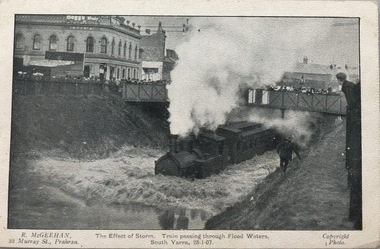
... Here the water remained about four feet deep until nightfall, and throughout the afternoon several hundreds of people including biograph operators and photographers, were gathered around watching each train pass through. ...Here the water remained about four feet deep until nightfall, and throughout the afternoon several hundreds of people including biograph operators and photographers, were gathered around watching each train pass through. ...SHARP DOWNPOUR. ONE INCH IN 45 MINUTES. SOUTHERN SUBURBS DELUGED. TRAIN STOPPED AT SOUTH YARRA. One of the sudden downpours of rain which occasionally fall in Melbourne occurred yesterday afternoon, when nearly an inch of rain fell in the course of three quarters of an hour, and caused a flood for an hour or two in certain localities. During the early part of the day, the sky had been clouded over, but there was nothing to indicate a storm of such intensity as that which followed. At about half-past 1 o'clock residents of South Yarra, South Melbourne, Prahran, and St. Kilda noticed a few drops of rain. Still, it appeared unlikely that there would be anything exceptional, until with startling suddenness at about 10 minutes to 1 o'clock, one of the heaviest downpours within the memory of residents burst upon those suburbs. A strange feature of the storm was that it was practically confined to an area of about three miles square. The city was but little affected, though at a spot as close as the Observatory 86 points of rain were recorded in three-quarters of an hour. Thunder and lightning accompanied the downpour, which was cyclonic in character, the rain driving heavily from all points of the compass as the cyclone passed. It was in South Yarra and Prahran that the rain fell heaviest. Within a few minutes after it commenced, the low-lying portions of Toorak-road and practically the whole length of Chapel-street were under water. The depression at the intersection of Toorak-road and Darling-street speedily filled to the dimensions of a small lake. Several shops were inundated, while the water from the higher levels rushed down like a mountain torrent, and in several in-stances swept through the rear of houses and shops, carrying furniture in a floating mass against the further walls. In one case a footbridge was carried bodily away and dashed to pieces. Darling-street itself Great Davis-street, and other low-lying and flat thoroughfares in the vicinity became flooded from kerb to kerb, while on the other side of the railway-bridge the valley between Kensington-road and River-street became filled for some minutes to a depth of several feet. Meanwhile the waters from South Yarra hill, seeking a lower level, found it in the railway cutting, and the excavations from South Yarra station to Prahran on the one line, and to the Chapel-street bridge on the other, were converted into a couple of canals. At the platforms at South Yarra the water was two feet deep on the permanent way, and towards Hawksburn, at the sudden depression under Chapel-street bridge, it was at one time deep enough to cover a tall man's head. Into this swirling mass of water the 1:50 p.m. train from Oakleigh plunged on its way to Melbourne. The impact caused a mighty fountain of water to rise to a height of about 20 feet above the level of Chapel-street and send clouds of spray in all directions. Under the belief that a terrible explosion had occurred residents braved the rain and rushed to the spot, only to find that the train had been brought to a stand-still in the middle of what seemed to be a river. The water was so high that it had entered the fire-box from below, extinguishing the fires and cutting off the steam supply. In the meantime the officials at the South Yarra station had been preparing for emergencies. Inspectors were on duty at intervals along the line, and the moment the alarm was given an extra engine was backed carefully down and continued on to connect with the stranded train without losing its own power. There was a delay of about ten minutes in the service for an hour or two, but by 5 o'clock all the trains were running on time again, and the water had run off all but the spot beneath the Chapel-street bridge. Here the water remained about four feet deep until nightfall, and throughout the afternoon several hundreds of people including biograph operators and photographers, were gathered around watching each train pass through. Even with the water two feet lower, this was a work attended with considerable difficulty. Each train had to absolutely force its way through the weight of water, almost enveloped by the spray thrown up, and it was only just able to negotiate the "ford" by using every ounce of steam. ... The Argus, 26 January 1907, p19.The item forms part of the Laurie Bennett collection of thirty-six postcards and photographs of Kew and early Melbourne, donated to the Kew Historical Society in 1980. The postcards in the Bennett collection, like other images in the Society's holdings date from the 1890s to the present and comprehensively indicate points-of-view or scenes considered historically, aesthetically or socially significant in the period in which they were produced.Postcard depicting a flood at South Yarra Station in 1907. The title and photographer's name are identified on the front of the postcard. Donated by L. Bennett, 1980flood - south yarra, trains - melbourne, postcards, r mcgeehan - prahran -
 Bendigo Historical Society Inc.
Document - PETER ELLIS COLLECTION: PETER ELLIS EULOGY
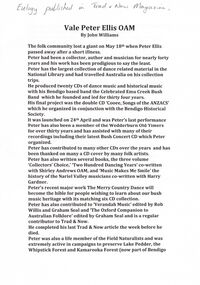
... Peter lived a full life and was a friend to hundreds of people. He was taken far too young and in typical fashion was planning new projects right till the end. ...Peter lived a full life and was a friend to hundreds of people. He was taken far too young and in typical fashion was planning new projects right till the end. ...2 A4 sheets. Handwritten pencil note at top of first page reads: Eulogy published in Trad & Now Magazine. Vale Peter Ellis OAM. By John Williams. The folk community lost a giant on May 18th when Peter Ellis passed away after a short illness. Peter had been a collector, author and musician for nearly forty years and his work has been prodigious to say the least. Peter has the largest collection of dance related material in the National Library and had travelled Australia on his collection trips. He produced twenty CDs of dance music and historical music with his Bendigo based band the Celebrated Emu Creek Bush Band which he founded and led for thirty four years. His final project was the double CD 'Cooee, Songs of the ANZACS' which he organised in conjunction with the Bendigo Historical Society. It was launched on 24th April and was Peter's last performance. Peter has also been a member of the Wedderburn Old Timers for over thirty years and has assisted with many of their recordings including their latest Bush Concert CD which Peter Organised. Peter has contributed to many other CDs over the years and has been thanked on many a CD cover by many folk artists. Peter has also written several books, the three volume 'Collectors' Choice,' 'Two Hundred Dancing Years' co-written with Shirley Andrews OAM, and 'Music Makes Me Smile' the history of the Nariel Valley musicians co-written with Harry Gardner. Peter's recent major work The Merry Country Dance will become the bible for people wishing to learn about our bush music heritage with its matching six CD collection. Peter has also contributed to 'Verandah Music' edited by Rob Willis and Graham Seal and 'The Oxford Companion to Australian Folklore' edited by Graham Seal and is a regular contributor to Trad & Now. He completed his last Trad & Now article the week before he died. Peter was also a life member of the Field Naturalists and was extremely active in campaigns to preserve Lake Pedder, the Whipstick Forest and Kamarooka Forest (now part of Bendigo National Park and preserved forever) One Tree Hill, Jackass Flat Flora Reserve and Saloman's Gully bushlands. Peter has discovered and named plants in the whipstick and enjoyed propagating native plants. He loved his amazing bush block in suburban Bendigo. Peter was also a keen photographer and had photos published in the book 'Wildflowers of Bendigo'. Peter taught dancing and music classes with Continuing Education for many years and encouraged many young musicians over the years. Peter was an accomplished ballroom dancer and had achieved gold medal status in that field. He was one of Australia's finest exponents of the button accordion, concertina, harmonica and tin whistle. Peter also played piano, organ and ukulele as well as the Swanee whistle and bones. Peter was the founder of the Annual Dinki Di Ball held each September in Eaglehawk as a tribute to the old MC's. Peter was happy playing for fund-raisers for any organisation who asked and also enjoyed plying the big gigs such as for the opening of the Melbourne Museum or for State Parliament. He played in the National Folk Festivals in four states and was a regular at the National in Canberra where he gave regular classes, performed with his bands and was a stalwart of the Aussie section of the session bar. He performed at nearly every Maldon Folk Festival and was MC at Nariel Folk Festival dances for many years. Peter was very proud of his OAM and wore the little medal at all of his performances. That honour was rightly given to one who did so much to preserve Australia's dance history. Peter lived a full life and was a friend to hundreds of people. He was taken far too young and in typical fashion was planning new projects right till the end. His passing is a huge loss for us all but one thing is certain. He will never be forgotten.person, individual, peter ellis oam -
 Eltham District Historical Society Inc
Photograph - Digital Photograph, Alan King, Eltham Living and Learning Centre, 26 January 2008
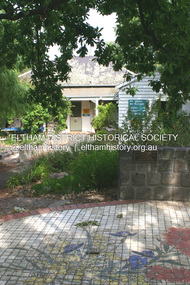
... A former program coordinator, Margaret Johnson, remembers enrolment day in the late 1970s and 1980s, when hundreds of people would queue – and some even camped overnight! ...A former program coordinator, Margaret Johnson, remembers enrolment day in the late 1970s and 1980s, when hundreds of people would queue – and some even camped overnight! ...In 1857, tanner John Pearson purchased three and a half acres of land in Little Eltham, at the western end of Pitt Street, with a 70-foot frontage to Maria Street (Main Road) and stretching down to the Diamond Creek for £100. He contracted Benjamin Oliver Wallis to build house for him. Wallis, a mason by trade who originated from the Cornish village of Newlyn, migrated to Melbourne in 1853 and was shortly engaged by Richard Warren to build the Eltham Hotel, which opened in 1854. When Warren fell into financial difficulty in 1858, Wallis purchased the hotel. That same year, Pearson constructed a tannery below the house with access to the water in the Diamond Creek. When Pearson became bankrupt in 1867, Wallis similarly acquired the house from Pearson’s creditors in 1868 and lived there until his death in 1896. For some of this time the house was in the name of Wallis’s son Richard but following his death in 1888, ownership reverted to his father. It was purchased by retired teacher Richard Gilsenen in 1899. Gilsenen was made acting head teacher at the Eltham State School in 1906 following the sudden death of head teacher John Brown. In the 1950s the house was bought by retired engineer Dr Alfred Fitzpatrick and his wife Claire who made various modifications to house goats and poultry as well as structural modifications to the house. In the early 1970s, Eltham Shire Councillors Frank Maas and Don Maling proposed an extended communities’ activities program be set up and the Commonwealth Grants Commission was approached for financial assistance. In 1974 a $50,000 Commonwealth Grant was received by the Shire Council to acquire the Fitzpatrick property as part of the planning to establish an extended communities’ activities program. The Fitzpatricks moved next door and Claire taught at the new Living and Learning Centre, which began in 1975, one of the first community education centres in Victoria. Covered under Heritage Overlay, Nillumbik Planning Scheme. Published: Nillumbik Now and Then / Marguerite Marshall 2008; photographs Alan King with Marguerite Marshall.; p59 It’s a centre for sharing knowledge and friendship and it stands on the former hub of Eltham’s original township near Pitt Street. The Eltham Living and Learning Centre, with around 2000 participants a year, began in 1975 as one of the first Community Education Centres in Victoria. Classes ranging from macramé to wine making to environmental living have enriched the lives of thousands of people through the generosity of tutors sharing their skills free of charge. The centre’s heart is the brick cottage, built in 1858 by tanner John Pearson. He bought the three and a half acre (1.4ha) allotment fronting Maria Street (now Main Road) and stretching down to the Diamond Creek. The allotment formed part of a 316 acre (127.8ha) subdivision, owned by Josiah Holloway, called Little Eltham, north of the original Eltham Reserve.1 The allotment then passed through the hands of several speculators before it was sold to Pearson for £100 in 1857. Mr Pearson’s children attended the Eltham Primary School from 1864 to 1867. But creditors took possession of the property when his tannery folded in 1867. It was then sold to publican Benjamin Wallis, who owned the Eltham Hotel at the corner of Pitt Street and Main Road. In 1899 the property was bought by Richard Gilsenan, who became acting head teacher of the Eltham Primary State School in 1906. In the 1950s, retired engineer Dr Alfred Fitzpatrick and his wife Claire bought the property, and made structural changes. Claire, a journalist and community campaigner, modified and built pens for goats and poultry, a stable, a garage and planted fruit trees and a vegetable garden. In the early 1970s a young woman called Carina Hack approached Gwen Wesson at the Diamond Valley Learning Centre (Victoria’s first Community Education Centre) about starting a community centre. Following Wesson’s suggestion, Hack spoke to Shire President Alistair Knox ‘one bleak rainy afternoon, sipping hot drinks and discussing life’.2 Eltham Shire Councillors Frank Maas and Don Maling proposed a community activities program and the council received a $50,000 Commonwealth Government Grant for this venture.3 The Fitzpatricks sold their property to the council and moved next door and Claire taught at the new centre, which Hack named. Eltham obviously wanted such a centre as Hack recalls. ‘During the next two months we had about 50 volunteers working day, night and weekends, scrubbing down, plastering and painting walls, replacing floors, repairing fences, recycling furniture, sewing curtains and cushions, donating furniture, toys, equipment, clean-ing and gardening…’4 The first enrolment day saw a queue stretching up the driveway nearly to the gate and the first sessions attracted 270 people a week. Soon the outbuildings were converted into pottery studios and a large workshop. From 1979 the Eltham Art and Craft Market was held in the centre’s grounds and the Friends of the Centre ran it from 1980. A former program coordinator, Margaret Johnson, remembers enrolment day in the late 1970s and 1980s, when hundreds of people would queue – and some even camped overnight! Overnighters were greeted in the morning with fresh tea and toast. Another tradition was The Enrolment Day Cake with Recipe, given to volunteers. ‘One happy Enrolment Day fell on February 14 and let’s just say that St Valentine found some willing participants, paying $2 for a kiss.’5 Meanwhile the participants’ children could play at the Council Eltham Lower Park house in Hohnes Road, later in Susan Street. But the centre has had difficulties too. In 1990 a fire destroyed the stable and the police suspected arson. However the pavilion was built in its place.This collection of almost 130 photos about places and people within the Shire of Nillumbik, an urban and rural municipality in Melbourne's north, contributes to an understanding of the history of the Shire. Published in 2008 immediately prior to the Black Saturday bushfires of February 7, 2009, it documents sites that were impacted, and in some cases destroyed by the fires. It includes photographs taken especially for the publication, creating a unique time capsule representing the Shire in the early 21st century. It remains the most recent comprehenesive publication devoted to the Shire's history connecting local residents to the past. nillumbik now and then (marshall-king) collection, benjamin oliver wallis, claire fitzpatrick, don maling, dr alfred fitzpatrick, eltham living and learning centre, frank maas, john pearson, richard gilsenen, tannery -
 National Wool Museum
Tool - Garment Brush, c.1953-1962
... Brendan Blake: “At the peak of their operation they employed approximately two hundred people, mainly women and girls. A family would often seek to send their daughter to work in this company because they knew they would be looked after and safe. ...Brendan Blake: “At the peak of their operation they employed approximately two hundred people, mainly women and girls. A family would often seek to send their daughter to work in this company because they knew they would be looked after and safe. ...Sample of Kathryn Knitwear Collection. This brush was included with a brushed wool leginette suit (NWM-08916), in order to maintain the fluffy finish of the garment after wear and washing. Kathryn Knitwear, founded by Robert Blake, manufactured high quality children’s knitwear in Melbourne from the 1940s – 1980s. Robert Blake began manufacturing children’s knitwear in his bedroom in Strathmore using a hand powered machine in the late 1940s. The operation moved to Ascot Vale and Essendon, before eventually establishing a factory in Moonee Ponds in the early 1950s. The business continued to expand, necessitating a move to a new factory in Broadmeadows. By 1962, the Broadmeadows factory was producing an average of 20,000 garments per month, which increased to 24,000 by 1964. Robert Blake’s Son, Brendan recalls that “The Kathryn brand was famous around Australia, anywhere children needed to keep warm and dress smartly. It also won a number of wool fashion awards”, including the 1969 Wool Awards, which was held by the Australian Wool Bureau and published in Women’s Weekly. The Kathryn range was designed for durability, comfort and care, without sacrificing style. They used patterning techniques that increase stretchiness, comfort and fit, as well as integrating decorative elements into the fabric to prevent them from being bulky, uncomfortable or tight. Making longevity of style a priority, Brendan Blake remembers that “there was one particular garment that was in the range for at least thirty years”. He also recalls “In the past, when women have found out that I was associated with Kathryn Knitwear, they would often relate to me the story of a garment they had purchased or received as a gift and, when their child had grown out of it, they would hand it on to another child. Several ladies have told me of purchasing garments for their daughters’ glory box, or saving a particular garment after their daughter had grown out of it. Brendan Blake: “At the peak of their operation they employed approximately two hundred people, mainly women and girls. A family would often seek to send their daughter to work in this company because they knew they would be looked after and safe. One lady wrote to me telling me that working at the Moonee Ponds Factory prior to getting married was the happiest time of her life.” In 1963, workers at the Kathryn factory earned £13 per week, which was 8 shillings and 8 pence higher than the minimum weekly wage for female workers in the textile manufacturing industry (£12 11s 4d). By 1970, the Kathryn Knitwear brand expanded from children’s knitwear into womenswear under the brand name ‘Lady Kathryn’, and for boys and men under ‘Robert Blake’. Continuing to diversify their distribution, they also began exporting ‘Kathryn’ garments to New Zealand, the Pacific Islands, and Japan. ‘Kathryn Knitwear’ was well-known for their early adoption of modern materials and techniques that had broad appeal to their customer base. This is shown in their early use of the acrylic fibre ‘Orlon’ in the 50s and 60s and ‘Superwash’ wool in the 1970s. Many of Kathryn Knitwear’s styles, particularly those that were long running staples of the brand, were available in both wool and Orlon to suit the consumer’s preference. Far from the humble origins of one man in his bedroom with a hand-cranked machine; at its closure in 1980, the Broadmeadows factory of ‘Kathryn’ housed more than 100 machines, including 53 sewing machines and 45 knitting machines. Robert Blake was “a passionate advocate for wool and Australian Made” throughout his whole life. A strong thread that ties through the lifespan of Robert Blake and Kathryn Knitwear is a balance between adopting new innovations without sacrificing the core values of durability, comfort, care and style that had made the brand so well known. Their legacy forms an integral part of both Australian social and manufacturing history.Transleucent nylon brush with rows of thin bristles mounted in an offset pattern[Printed on plastic packaging] CARE OF BRUSHED FABRICS To obtain original condition brush garment frequently between wearing and after washing. Follow laundering instructions on swing ticket.brush, garment brush, brushed wool, laundry, garment care, nylon brush, accessory -
 National Wool Museum
Tool - The Austral Unit Calculator, Industrial Consultants, c.1960
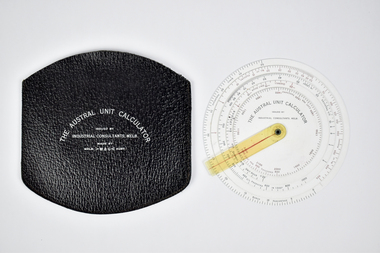
... Brendan Blake: “At the peak of their operation they employed approximately two hundred people, mainly women and girls. A family would often seek to send their daughter to work in this company because they knew they would be looked after and safe. ...Brendan Blake: “At the peak of their operation they employed approximately two hundred people, mainly women and girls. A family would often seek to send their daughter to work in this company because they knew they would be looked after and safe. ...Kathryn Knitwear, founded by Robert Blake, manufactured high quality children’s knitwear in Melbourne from the 1940s – 1980s. Robert Blake began manufacturing children’s knitwear in his bedroom in Strathmore using a hand powered machine in the late 1940s. The operation moved to Ascot Vale and Essendon, before eventually establishing a factory in Moonee Ponds in the early 1950s. The business continued to expand, necessitating a move to a new factory in Broadmeadows. By 1962, the Broadmeadows factory was producing an average of 20,000 garments per month, which increased to 24,000 by 1964. Robert Blake’s Son, Brendan recalls that “The Kathryn brand was famous around Australia, anywhere children needed to keep warm and dress smartly. It also won a number of wool fashion awards”, including the 1969 Wool Awards, which was held by the Australian Wool Bureau and published in Women’s Weekly. The Kathryn range was designed for durability, comfort and care, without sacrificing style. They used patterning techniques that increase stretchiness, comfort and fit, as well as integrating decorative elements into the fabric to prevent them from being bulky, uncomfortable or tight. Making longevity of style a priority, Brendan Blake remembers that “there was one particular garment that was in the range for at least thirty years”. He also recalls “In the past, when women have found out that I was associated with Kathryn Knitwear, they would often relate to me the story of a garment they had purchased or received as a gift and, when their child had grown out of it, they would hand it on to another child. Several ladies have told me of purchasing garments for their daughters’ glory box, or saving a particular garment after their daughter had grown out of it. Brendan Blake: “At the peak of their operation they employed approximately two hundred people, mainly women and girls. A family would often seek to send their daughter to work in this company because they knew they would be looked after and safe. One lady wrote to me telling me that working at the Moonee Ponds Factory prior to getting married was the happiest time of her life.” In 1963, workers at the Kathryn factory earned £13 per week, which was 8 shillings and 8 pence higher than the minimum weekly wage for female workers in the textile manufacturing industry (£12 11s 4d). By 1970, the Kathryn Knitwear brand expanded from children’s knitwear into womenswear under the brand name ‘Lady Kathryn’, and for boys and men under ‘Robert Blake’. Continuing to diversify their distribution, they also began exporting ‘Kathryn’ garments to New Zealand, the Pacific Islands, and Japan. ‘Kathryn Knitwear’ was well-known for their early adoption of modern materials and techniques that had broad appeal to their customer base. This is shown in their early use of the acrylic fibre ‘Orlon’ in the 50s and 60s and ‘Superwash’ wool in the 1970s. Many of Kathryn Knitwear’s styles, particularly those that were long running staples of the brand, were available in both wool and Orlon to suit the consumer’s preference. Far from the humble origins of one man in his bedroom with a hand-cranked machine; at its closure in 1980, the Broadmeadows factory of ‘Kathryn’ housed more than 100 machines, including 53 sewing machines and 45 knitting machines. Robert Blake was “a passionate advocate for wool and Australian Made” throughout his whole life. A strong thread that ties through the lifespan of Robert Blake and Kathryn Knitwear is a balance between adopting new innovations without sacrificing the core values of durability, comfort, care and style that had made the brand so well known. Their legacy forms an integral part of both Australian social and manufacturing history.Measuring instrument with five circular white layers and one long transparent plastic ruler on top. Transparent layer is now yellowed, was likely originally clear. All of the layers connected with a metal rivet at the centre, allowing the discs and line indicator to move in relation to each other. Discs are labelled (inside – outside) Cost per Thousand Overall Unit Hour U/S [units] produced in 1000s No. of persons Bonus Percentage 9017.2 Black leather case with white block letter printing [9017.3 - 9017.5] Inside case are three notes (one printed, two handwritten) that provide instructions for using the calculator[label on obverse of case] THE AUSTRAL UNIT CALCULATOR ISSUED BY INDUSTRIAL CONSULTANTS, MELB MADE BY MELB >W&G< AUST.business, business history, manufacturing history, calculator, textile fibres textile history -
 National Wool Museum
Textile - Fabric Sample, Kathryn Knitwear, 1980
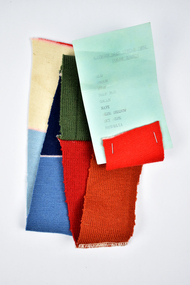
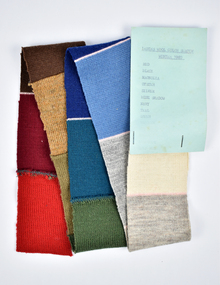
... Brendan Blake: “At the peak of their operation they employed approximately two hundred people, mainly women and girls. A family would often seek to send their daughter to work in this company because they knew they would be looked after and safe. ...Brendan Blake: “At the peak of their operation they employed approximately two hundred people, mainly women and girls. A family would often seek to send their daughter to work in this company because they knew they would be looked after and safe. ...Kathryn Knitwear, founded by Robert Blake, manufactured high quality children’s knitwear in Melbourne from the 1940s – 1980s. Robert Blake began manufacturing children’s knitwear in his bedroom in Strathmore using a hand powered machine in the late 1940s. The operation moved to Ascot Vale and Essendon, before eventually establishing a factory in Moonee Ponds in the early 1950s. The business continued to expand, necessitating a move to a new factory in Broadmeadows. By 1962, the Broadmeadows factory was producing an average of 20,000 garments per month, which increased to 24,000 by 1964. Robert Blake’s Son, Brendan recalls that “The Kathryn brand was famous around Australia, anywhere children needed to keep warm and dress smartly. It also won a number of wool fashion awards”, including the 1969 Wool Awards, which was held by the Australian Wool Bureau and published in Women’s Weekly. The Kathryn range was designed for durability, comfort and care, without sacrificing style. They used patterning techniques that increase stretchiness, comfort and fit, as well as integrating decorative elements into the fabric to prevent them from being bulky, uncomfortable or tight. Making longevity of style a priority, Brendan Blake remembers that “there was one particular garment that was in the range for at least thirty years”. He also recalls “In the past, when women have found out that I was associated with Kathryn Knitwear, they would often relate to me the story of a garment they had purchased or received as a gift and, when their child had grown out of it, they would hand it on to another child. Several ladies have told me of purchasing garments for their daughters’ glory box, or saving a particular garment after their daughter had grown out of it. Brendan Blake: “At the peak of their operation they employed approximately two hundred people, mainly women and girls. A family would often seek to send their daughter to work in this company because they knew they would be looked after and safe. One lady wrote to me telling me that working at the Moonee Ponds Factory prior to getting married was the happiest time of her life.” In 1963, workers at the Kathryn factory earned £13 per week, which was 8 shillings and 8 pence higher than the minimum weekly wage for female workers in the textile manufacturing industry (£12 11s 4d). By 1970, the Kathryn Knitwear brand expanded from children’s knitwear into womenswear under the brand name ‘Lady Kathryn’, and for boys and men under ‘Robert Blake’. Continuing to diversify their distribution, they also began exporting ‘Kathryn’ garments to New Zealand, the Pacific Islands, and Japan. ‘Kathryn Knitwear’ was well-known for their early adoption of modern materials and techniques that had broad appeal to their customer base. This is shown in their early use of the acrylic fibre ‘Orlon’ in the 50s and 60s and ‘Superwash’ wool in the 1970s. Many of Kathryn Knitwear’s styles, particularly those that were long running staples of the brand, were available in both wool and Orlon to suit the consumer’s preference. Far from the humble origins of one man in his bedroom with a hand-cranked machine; at its closure in 1980, the Broadmeadows factory of ‘Kathryn’ housed more than 100 machines, including 53 sewing machines and 45 knitting machines. Robert Blake was “a passionate advocate for wool and Australian Made” throughout his whole life. A strong thread that ties through the lifespan of Robert Blake and Kathryn Knitwear is a balance between adopting new innovations without sacrificing the core values of durability, comfort, care and style that had made the brand so well known. Their legacy forms an integral part of both Australian social and manufacturing history.Strip of knitted fabric samples showing the nine wool colour options for Kathryn knitwear for the winter season of 1980. Label printed in pale blue paper lists season and colour names and is attached to sample strip with two metal staplesKATHRYN WOOL WINTER 1980 COLOUR SWATCH RED BROWN RUST DEEP RED GREEN NAVY BLUE SHADOW SKY BLUE MAGNOLIAfabric sample, textile sample, fabric swatch, textile swatch, fashion textile production, textile manufacturing -
 National Wool Museum
Textile - Fabric Sample, Kathryn Knitwear, 1980
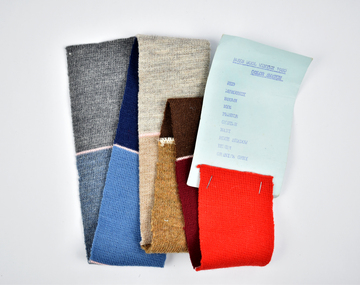
... Brendan Blake: “At the peak of their operation they employed approximately two hundred people, mainly women and girls. A family would often seek to send their daughter to work in this company because they knew they would be looked after and safe. ...Brendan Blake: “At the peak of their operation they employed approximately two hundred people, mainly women and girls. A family would often seek to send their daughter to work in this company because they knew they would be looked after and safe. ...Kathryn Knitwear, founded by Robert Blake, manufactured high quality children’s knitwear in Melbourne from the 1940s – 1980s. Robert Blake began manufacturing children’s knitwear in his bedroom in Strathmore using a hand powered machine in the late 1940s. The operation moved to Ascot Vale and Essendon, before eventually establishing a factory in Moonee Ponds in the early 1950s. The business continued to expand, necessitating a move to a new factory in Broadmeadows. By 1962, the Broadmeadows factory was producing an average of 20,000 garments per month, which increased to 24,000 by 1964. Robert Blake’s Son, Brendan recalls that “The Kathryn brand was famous around Australia, anywhere children needed to keep warm and dress smartly. It also won a number of wool fashion awards”, including the 1969 Wool Awards, which was held by the Australian Wool Bureau and published in Women’s Weekly. The Kathryn range was designed for durability, comfort and care, without sacrificing style. They used patterning techniques that increase stretchiness, comfort and fit, as well as integrating decorative elements into the fabric to prevent them from being bulky, uncomfortable or tight. Making longevity of style a priority, Brendan Blake remembers that “there was one particular garment that was in the range for at least thirty years”. He also recalls “In the past, when women have found out that I was associated with Kathryn Knitwear, they would often relate to me the story of a garment they had purchased or received as a gift and, when their child had grown out of it, they would hand it on to another child. Several ladies have told me of purchasing garments for their daughters’ glory box, or saving a particular garment after their daughter had grown out of it. Brendan Blake: “At the peak of their operation they employed approximately two hundred people, mainly women and girls. A family would often seek to send their daughter to work in this company because they knew they would be looked after and safe. One lady wrote to me telling me that working at the Moonee Ponds Factory prior to getting married was the happiest time of her life.” In 1963, workers at the Kathryn factory earned £13 per week, which was 8 shillings and 8 pence higher than the minimum weekly wage for female workers in the textile manufacturing industry (£12 11s 4d). By 1970, the Kathryn Knitwear brand expanded from children’s knitwear into womenswear under the brand name ‘Lady Kathryn’, and for boys and men under ‘Robert Blake’. Continuing to diversify their distribution, they also began exporting ‘Kathryn’ garments to New Zealand, the Pacific Islands, and Japan. ‘Kathryn Knitwear’ was well-known for their early adoption of modern materials and techniques that had broad appeal to their customer base. This is shown in their early use of the acrylic fibre ‘Orlon’ in the 50s and 60s and ‘Superwash’ wool in the 1970s. Many of Kathryn Knitwear’s styles, particularly those that were long running staples of the brand, were available in both wool and Orlon to suit the consumer’s preference. Far from the humble origins of one man in his bedroom with a hand-cranked machine; at its closure in 1980, the Broadmeadows factory of ‘Kathryn’ housed more than 100 machines, including 53 sewing machines and 45 knitting machines. Robert Blake was “a passionate advocate for wool and Australian Made” throughout his whole life. A strong thread that ties through the lifespan of Robert Blake and Kathryn Knitwear is a balance between adopting new innovations without sacrificing the core values of durability, comfort, care and style that had made the brand so well known. Their legacy forms an integral part of both Australian social and manufacturing history.Strip of knitted fabric samples showing the nine wool colour options for the boys line of Robert Blake/Kathryn knitwear in the winter season of 1980. Label printed in pale blue paper lists season and colour names and is attached to sample strip with two metal staplesBOYS WOOL WINTER 1980 COLOR SWATCH RED BURGUNDY BROWN RYE PEBBLE OYSTER NAVY BLUE SHADOW DENIM GRANITE GREYfabric sample, textile sample, fabric swatch, textile swatch, fashion textile production, textile manufacturing -
 National Wool Museum
Textile - Fabric Sample, Kathryn Knitwear, 1980
... Brendan Blake: “At the peak of their operation they employed approximately two hundred people, mainly women and girls. A family would often seek to send their daughter to work in this company because they knew they would be looked after and safe. ...Brendan Blake: “At the peak of their operation they employed approximately two hundred people, mainly women and girls. A family would often seek to send their daughter to work in this company because they knew they would be looked after and safe. ...Kathryn Knitwear, founded by Robert Blake, manufactured high quality children’s knitwear in Melbourne from the 1940s – 1980s. Robert Blake began manufacturing children’s knitwear in his bedroom in Strathmore using a hand powered machine in the late 1940s. The operation moved to Ascot Vale and Essendon, before eventually establishing a factory in Moonee Ponds in the early 1950s. The business continued to expand, necessitating a move to a new factory in Broadmeadows. By 1962, the Broadmeadows factory was producing an average of 20,000 garments per month, which increased to 24,000 by 1964. Robert Blake’s Son, Brendan recalls that “The Kathryn brand was famous around Australia, anywhere children needed to keep warm and dress smartly. It also won a number of wool fashion awards”, including the 1969 Wool Awards, which was held by the Australian Wool Bureau and published in Women’s Weekly. The Kathryn range was designed for durability, comfort and care, without sacrificing style. They used patterning techniques that increase stretchiness, comfort and fit, as well as integrating decorative elements into the fabric to prevent them from being bulky, uncomfortable or tight. Making longevity of style a priority, Brendan Blake remembers that “there was one particular garment that was in the range for at least thirty years”. He also recalls “In the past, when women have found out that I was associated with Kathryn Knitwear, they would often relate to me the story of a garment they had purchased or received as a gift and, when their child had grown out of it, they would hand it on to another child. Several ladies have told me of purchasing garments for their daughters’ glory box, or saving a particular garment after their daughter had grown out of it. Brendan Blake: “At the peak of their operation they employed approximately two hundred people, mainly women and girls. A family would often seek to send their daughter to work in this company because they knew they would be looked after and safe. One lady wrote to me telling me that working at the Moonee Ponds Factory prior to getting married was the happiest time of her life.” In 1963, workers at the Kathryn factory earned £13 per week, which was 8 shillings and 8 pence higher than the minimum weekly wage for female workers in the textile manufacturing industry (£12 11s 4d). By 1970, the Kathryn Knitwear brand expanded from children’s knitwear into womenswear under the brand name ‘Lady Kathryn’, and for boys and men under ‘Robert Blake’. Continuing to diversify their distribution, they also began exporting ‘Kathryn’ garments to New Zealand, the Pacific Islands, and Japan. ‘Kathryn Knitwear’ was well-known for their early adoption of modern materials and techniques that had broad appeal to their customer base. This is shown in their early use of the acrylic fibre ‘Orlon’ in the 50s and 60s and ‘Superwash’ wool in the 1970s. Many of Kathryn Knitwear’s styles, particularly those that were long running staples of the brand, were available in both wool and Orlon to suit the consumer’s preference. Far from the humble origins of one man in his bedroom with a hand-cranked machine; at its closure in 1980, the Broadmeadows factory of ‘Kathryn’ housed more than 100 machines, including 53 sewing machines and 45 knitting machines. Robert Blake was “a passionate advocate for wool and Australian Made” throughout his whole life. A strong thread that ties through the lifespan of Robert Blake and Kathryn Knitwear is a balance between adopting new innovations without sacrificing the core values of durability, comfort, care and style that had made the brand so well known. Their legacy forms an integral part of both Australian social and manufacturing history.Strip of knitted fabric samples showing the 14 wool colour options for the ladies' line of Kathryn knitwear for the winter season of 1980. Label printed in pale blue paper lists season and colour names and is attached to sample strip with two metal staplesLADIES WOOL COLOR SWATCH WINTER 1980 RED BLACK MAGNOLIA OYSTER SILVER BLUE SHADOW NAVY TEAL GREEN BRACKEN RYE BROWN BURGUNDY DEEP REDfabric sample, textile sample, fabric swatch, textile swatch, fashion textile production, textile manufacturing -
 National Wool Museum
Archive - Notebook, Kathryn Knitwear, 1947-1953
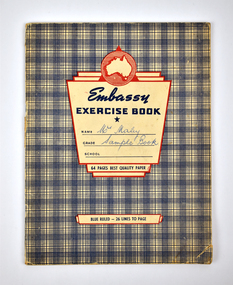
... Brendan Blake: “At the peak of their operation they employed approximately two hundred people, mainly women and girls. A family would often seek to send their daughter to work in this company because they knew they would be looked after and safe. ...Brendan Blake: “At the peak of their operation they employed approximately two hundred people, mainly women and girls. A family would often seek to send their daughter to work in this company because they knew they would be looked after and safe. ...Kathryn Knitwear, founded by Robert Blake, manufactured high quality children’s knitwear in Melbourne from the 1940s – 1980s. Robert Blake began manufacturing children’s knitwear in his bedroom in Strathmore using a hand powered machine in the late 1940s. The operation moved to Ascot Vale and Essendon, before eventually establishing a factory in Moonee Ponds in the early 1950s. The business continued to expand, necessitating a move to a new factory in Broadmeadows. By 1962, the Broadmeadows factory was producing an average of 20,000 garments per month, which increased to 24,000 by 1964. Robert Blake’s Son, Brendan recalls that “The Kathryn brand was famous around Australia, anywhere children needed to keep warm and dress smartly. It also won a number of wool fashion awards”, including the 1969 Wool Awards, which was held by the Australian Wool Bureau and published in Women’s Weekly. The Kathryn range was designed for durability, comfort and care, without sacrificing style. They used patterning techniques that increase stretchiness, comfort and fit, as well as integrating decorative elements into the fabric to prevent them from being bulky, uncomfortable or tight. Making longevity of style a priority, Brendan Blake remembers that “there was one particular garment that was in the range for at least thirty years”. He also recalls “In the past, when women have found out that I was associated with Kathryn Knitwear, they would often relate to me the story of a garment they had purchased or received as a gift and, when their child had grown out of it, they would hand it on to another child. Several ladies have told me of purchasing garments for their daughters’ glory box, or saving a particular garment after their daughter had grown out of it. Brendan Blake: “At the peak of their operation they employed approximately two hundred people, mainly women and girls. A family would often seek to send their daughter to work in this company because they knew they would be looked after and safe. One lady wrote to me telling me that working at the Moonee Ponds Factory prior to getting married was the happiest time of her life.” In 1963, workers at the Kathryn factory earned £13 per week, which was 8 shillings and 8 pence higher than the minimum weekly wage for female workers in the textile manufacturing industry (£12 11s 4d). By 1970, the Kathryn Knitwear brand expanded from children’s knitwear into womenswear under the brand name ‘Lady Kathryn’, and for boys and men under ‘Robert Blake’. Continuing to diversify their distribution, they also began exporting ‘Kathryn’ garments to New Zealand, the Pacific Islands, and Japan. ‘Kathryn Knitwear’ was well-known for their early adoption of modern materials and techniques that had broad appeal to their customer base. This is shown in their early use of the acrylic fibre ‘Orlon’ in the 50s and 60s and ‘Superwash’ wool in the 1970s. Many of Kathryn Knitwear’s styles, particularly those that were long running staples of the brand, were available in both wool and Orlon to suit the consumer’s preference. Far from the humble origins of one man in his bedroom with a hand-cranked machine; at its closure in 1980, the Broadmeadows factory of ‘Kathryn’ housed more than 100 machines, including 53 sewing machines and 45 knitting machines. Robert Blake was “a passionate advocate for wool and Australian Made” throughout his whole life. A strong thread that ties through the lifespan of Robert Blake and Kathryn Knitwear is a balance between adopting new innovations without sacrificing the core values of durability, comfort, care and style that had made the brand so well known. Their legacy forms an integral part of both Australian social and manufacturing history. The ‘Embassy’ brand was a house brand of Coles stores from 1929-1994, and manufactured a wide variety of household goods. The manufacture of this specific style of notebook can be dated to between 1947 and 1953.Notebook with handwritten instructions, formulas and sketches detailing patterns for samples. ‘Embassy’ exercise book cover is printed with a blue checked pattern on a background that was originally likely white, but appears cream due to discolouration. The centre of the front cover has a trapezoidal label that provides space for handwritten labels, and features a map of Australia inside a red circle, as well as the manufacturers branding. The 64 internal pages are printed with blue lines as a writing guide.[Obverse] Embassy EXERCISE BOOK NAME [handwritten] Mrs Maley GRADE [handwritten] Sample Book SCHOOL 64 PAGES BEST QUALITY PAPER BLUE RULED – 26 LINES TO PAGE [sample of internal pages] [left page] Notes: 34” = 3 garments out of 40” Length 32” = 3 “ “ “ 38 “ “ 30” = 28” = Cut together (26” = 4 garments “ “ 33” “ (24 = 4 garments “ “ 33” length Blue 36” Red 36 ½“ Green 36” Royal 35 ½” [right page] Design Esquire (Width 35 ½ - 36) Size 34” Width Yardage Size 32” Width Yardage Sample cotton 90 ribs for 28” Size 28” (sample size) Width cut to 20 ½ (double) Yardage 34 ½“ for 2 garm. Size 26” Width Yardage Size 24” Width Yardagebusiness, business history, manufacturing, knitting machine, fashion textile production, business archives, manufacturing documents, embassy brand, coles -
 National Wool Museum
Archive - Notebook, Kathryn Knitwear, c.1962
... Brendan Blake: “At the peak of their operation they employed approximately two hundred people, mainly women and girls. A family would often seek to send their daughter to work in this company because they knew they would be looked after and safe. ...Brendan Blake: “At the peak of their operation they employed approximately two hundred people, mainly women and girls. A family would often seek to send their daughter to work in this company because they knew they would be looked after and safe. ...Kathryn Knitwear, founded by Robert Blake, manufactured high quality children’s knitwear in Melbourne from the 1940s – 1980s. Robert Blake began manufacturing children’s knitwear in his bedroom in Strathmore using a hand powered machine in the late 1940s. The operation moved to Ascot Vale and Essendon, before eventually establishing a factory in Moonee Ponds in the early 1950s. The business continued to expand, necessitating a move to a new factory in Broadmeadows. By 1962, the Broadmeadows factory was producing an average of 20,000 garments per month, which increased to 24,000 by 1964. Robert Blake’s Son, Brendan recalls that “The Kathryn brand was famous around Australia, anywhere children needed to keep warm and dress smartly. It also won a number of wool fashion awards”, including the 1969 Wool Awards, which was held by the Australian Wool Bureau and published in Women’s Weekly. The Kathryn range was designed for durability, comfort and care, without sacrificing style. They used patterning techniques that increase stretchiness, comfort and fit, as well as integrating decorative elements into the fabric to prevent them from being bulky, uncomfortable or tight. Making longevity of style a priority, Brendan Blake remembers that “there was one particular garment that was in the range for at least thirty years”. He also recalls “In the past, when women have found out that I was associated with Kathryn Knitwear, they would often relate to me the story of a garment they had purchased or received as a gift and, when their child had grown out of it, they would hand it on to another child. Several ladies have told me of purchasing garments for their daughters’ glory box, or saving a particular garment after their daughter had grown out of it. Brendan Blake: “At the peak of their operation they employed approximately two hundred people, mainly women and girls. A family would often seek to send their daughter to work in this company because they knew they would be looked after and safe. One lady wrote to me telling me that working at the Moonee Ponds Factory prior to getting married was the happiest time of her life.” In 1963, workers at the Kathryn factory earned £13 per week, which was 8 shillings and 8 pence higher than the minimum weekly wage for female workers in the textile manufacturing industry (£12 11s 4d). By 1970, the Kathryn Knitwear brand expanded from children’s knitwear into womenswear under the brand name ‘Lady Kathryn’, and for boys and men under ‘Robert Blake’. Continuing to diversify their distribution, they also began exporting ‘Kathryn’ garments to New Zealand, the Pacific Islands, and Japan. ‘Kathryn Knitwear’ was well-known for their early adoption of modern materials and techniques that had broad appeal to their customer base. This is shown in their early use of the acrylic fibre ‘Orlon’ in the 50s and 60s and ‘Superwash’ wool in the 1970s. Many of Kathryn Knitwear’s styles, particularly those that were long running staples of the brand, were available in both wool and Orlon to suit the consumer’s preference. Far from the humble origins of one man in his bedroom with a hand-cranked machine; at its closure in 1980, the Broadmeadows factory of ‘Kathryn’ housed more than 100 machines, including 53 sewing machines and 45 knitting machines. Robert Blake was “a passionate advocate for wool and Australian Made” throughout his whole life. A strong thread that ties through the lifespan of Robert Blake and Kathryn Knitwear is a balance between adopting new innovations without sacrificing the core values of durability, comfort, care and style that had made the brand so well known. Their legacy forms an integral part of both Australian social and manufacturing history.Notebook with handwritten tables and figures recording data about production and sales of Kathryn Knitwear from 1962-1963. ‘VANA’ exercise book cover is printed with a white square check on the diagonal, on a red background. Large blue block letters spelling VANA appear in a white rectangle down the lefthand side. A White rectangle blue lettering provides space for handwritten labels, handwritten inside it is P/L on the top line.The internal pages are printed with blue lines as a writing guide, and contain handwritten notes and tables in red and blue ink.[Obverse] VANA EXERCISE BOOK BLUE 9M/M RULING NAME [handwritten] P/L GRADE SCHOOL SUBJECT DATE APPROVED BY THE EDUCATION DEPARTMENTbusiness, business history, manufacturing, knitting machine, fashion textile production, business archives, manufacturing documents, vana -
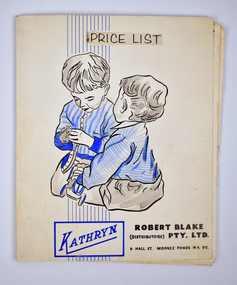 National Wool Museum
Archive - Price List, Kathryn Knitwear, 1972
... Brendan Blake: “At the peak of their operation they employed approximately two hundred people, mainly women and girls. A family would often seek to send their daughter to work in this company because they knew they would be looked after and safe. ...Brendan Blake: “At the peak of their operation they employed approximately two hundred people, mainly women and girls. A family would often seek to send their daughter to work in this company because they knew they would be looked after and safe. ...Kathryn Knitwear, founded by Robert Blake, manufactured high quality children’s knitwear in Melbourne from the 1940s – 1980s. Robert Blake began manufacturing children’s knitwear in his bedroom in Strathmore using a hand powered machine in the late 1940s. The operation moved to Ascot Vale and Essendon, before eventually establishing a factory in Moonee Ponds in the early 1950s. The business continued to expand, necessitating a move to a new factory in Broadmeadows. By 1962, the Broadmeadows factory was producing an average of 20,000 garments per month, which increased to 24,000 by 1964. Robert Blake’s Son, Brendan recalls that “The Kathryn brand was famous around Australia, anywhere children needed to keep warm and dress smartly. It also won a number of wool fashion awards”, including the 1969 Wool Awards, which was held by the Australian Wool Bureau and published in Women’s Weekly. The Kathryn range was designed for durability, comfort and care, without sacrificing style. They used patterning techniques that increase stretchiness, comfort and fit, as well as integrating decorative elements into the fabric to prevent them from being bulky, uncomfortable or tight. Making longevity of style a priority, Brendan Blake remembers that “there was one particular garment that was in the range for at least thirty years”. He also recalls “In the past, when women have found out that I was associated with Kathryn Knitwear, they would often relate to me the story of a garment they had purchased or received as a gift and, when their child had grown out of it, they would hand it on to another child. Several ladies have told me of purchasing garments for their daughters’ glory box, or saving a particular garment after their daughter had grown out of it. Brendan Blake: “At the peak of their operation they employed approximately two hundred people, mainly women and girls. A family would often seek to send their daughter to work in this company because they knew they would be looked after and safe. One lady wrote to me telling me that working at the Moonee Ponds Factory prior to getting married was the happiest time of her life.” In 1963, workers at the Kathryn factory earned £13 per week, which was 8 shillings and 8 pence higher than the minimum weekly wage for female workers in the textile manufacturing industry (£12 11s 4d). By 1970, the Kathryn Knitwear brand expanded from children’s knitwear into womenswear under the brand name ‘Lady Kathryn’, and for boys and men under ‘Robert Blake’. Continuing to diversify their distribution, they also began exporting ‘Kathryn’ garments to New Zealand, the Pacific Islands, and Japan. ‘Kathryn Knitwear’ was well-known for their early adoption of modern materials and techniques that had broad appeal to their customer base. This is shown in their early use of the acrylic fibre ‘Orlon’ in the 50s and 60s and ‘Superwash’ wool in the 1970s. Many of Kathryn Knitwear’s styles, particularly those that were long running staples of the brand, were available in both wool and Orlon to suit the consumer’s preference. Far from the humble origins of one man in his bedroom with a hand-cranked machine; at its closure in 1980, the Broadmeadows factory of ‘Kathryn’ housed more than 100 machines, including 53 sewing machines and 45 knitting machines. Robert Blake was “a passionate advocate for wool and Australian Made” throughout his whole life. A strong thread that ties through the lifespan of Robert Blake and Kathryn Knitwear is a balance between adopting new innovations without sacrificing the core values of durability, comfort, care and style that had made the brand so well known. Their legacy forms an integral part of both Australian social and manufacturing history.8 page booklet containing price list for winter 1972. Hand-drawn illustration on front of booklet depicts two young boys in striped jumpers in shades of blue and brown. Internal pages of booklet contain a table in landscape orientation printed in black ink containing Style number, description, pricing for given sizes, and available colours. It has “Mr Robert” handwritten in blue ink in the top right corner and is annotated in red ink.[Obverse] PRICE LIST KATHRYN ROBERT BLAKE (DISTRIBUTORS) PTY. LTD business, business history, manufacturing, knitting machine, fashion textile production, business archives, manufacturing documents, children's knitwear, children's clothing -
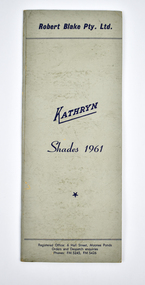 National Wool Museum
Archive - Fabric Sample Booklet, Kathryn Knitwear, 1961
... Brendan Blake: “At the peak of their operation they employed approximately two hundred people, mainly women and girls. A family would often seek to send their daughter to work in this company because they knew they would be looked after and safe. ...Brendan Blake: “At the peak of their operation they employed approximately two hundred people, mainly women and girls. A family would often seek to send their daughter to work in this company because they knew they would be looked after and safe. ...Kathryn Knitwear, founded by Robert Blake, manufactured high quality children’s knitwear in Melbourne from the 1940s – 1980s. Robert Blake began manufacturing children’s knitwear in his bedroom in Strathmore using a hand powered machine in the late 1940s. The operation moved to Ascot Vale and Essendon, before eventually establishing a factory in Moonee Ponds in the early 1950s. The business continued to expand, necessitating a move to a new factory in Broadmeadows. By 1962, the Broadmeadows factory was producing an average of 20,000 garments per month, which increased to 24,000 by 1964. Robert Blake’s Son, Brendan recalls that “The Kathryn brand was famous around Australia, anywhere children needed to keep warm and dress smartly. It also won a number of wool fashion awards”, including the 1969 Wool Awards, which was held by the Australian Wool Bureau and published in Women’s Weekly. The Kathryn range was designed for durability, comfort and care, without sacrificing style. They used patterning techniques that increase stretchiness, comfort and fit, as well as integrating decorative elements into the fabric to prevent them from being bulky, uncomfortable or tight. Making longevity of style a priority, Brendan Blake remembers that “there was one particular garment that was in the range for at least thirty years”. He also recalls “In the past, when women have found out that I was associated with Kathryn Knitwear, they would often relate to me the story of a garment they had purchased or received as a gift and, when their child had grown out of it, they would hand it on to another child. Several ladies have told me of purchasing garments for their daughters’ glory box, or saving a particular garment after their daughter had grown out of it. Brendan Blake: “At the peak of their operation they employed approximately two hundred people, mainly women and girls. A family would often seek to send their daughter to work in this company because they knew they would be looked after and safe. One lady wrote to me telling me that working at the Moonee Ponds Factory prior to getting married was the happiest time of her life.” In 1963, workers at the Kathryn factory earned £13 per week, which was 8 shillings and 8 pence higher than the minimum weekly wage for female workers in the textile manufacturing industry (£12 11s 4d). By 1970, the Kathryn Knitwear brand expanded from children’s knitwear into womenswear under the brand name ‘Lady Kathryn’, and for boys and men under ‘Robert Blake’. Continuing to diversify their distribution, they also began exporting ‘Kathryn’ garments to New Zealand, the Pacific Islands, and Japan. ‘Kathryn Knitwear’ was well-known for their early adoption of modern materials and techniques that had broad appeal to their customer base. This is shown in their early use of the acrylic fibre ‘Orlon’ in the 50s and 60s and ‘Superwash’ wool in the 1970s. Many of Kathryn Knitwear’s styles, particularly those that were long running staples of the brand, were available in both wool and Orlon to suit the consumer’s preference. Far from the humble origins of one man in his bedroom with a hand-cranked machine; at its closure in 1980, the Broadmeadows factory of ‘Kathryn’ housed more than 100 machines, including 53 sewing machines and 45 knitting machines. Robert Blake was “a passionate advocate for wool and Australian Made” throughout his whole life. A strong thread that ties through the lifespan of Robert Blake and Kathryn Knitwear is a balance between adopting new innovations without sacrificing the core values of durability, comfort, care and style that had made the brand so well known. Their legacy forms an integral part of both Australian social and manufacturing history.Kathryn Knitwear Colour swatch booklet from 1961. Booklet has navy text printed on a grey background, and opens to reveal two vertical swatch cards made of white card, one on each side of the fold line. Swatch cards have headings printed in capitals in red ink denoting the fibre and series of the below samples. Each swatch card has 15 samples of yarn wrapped around it, and each shade labelled in black ink in capital letters. There is an additional knitted swatch stapled to the top right corner labelled ‘Arctic White’.[Obverse] Robert Blake Pty. Ltd. KATHRYN Shades 1961 [Internal] KATHRYN Shades 1961 ARCTIC WHITE [Left side] WOOL Standard Shades WHITE PINK LEMON BLUE LIPSTICK EMERALD ROSE PINK AQUA ROYAL RED CELTIC TAN KASHA BROWN GREY [Right side] WOOL Fashion Shades MINT WILD RICE GERANIUM PINK LONDON BLUE TREE FERN ANCIENT GOLD ORLON WHITE PINK LEMON BLUE OATMEAL EUCALYPTUS CABER TAN YACHT BLUE REDfabric sample, textile sample, fabric swatch, textile swatch, fashion textile production, textile manufacturing
