
Showing 147 items matching "hunt family"
-
 Stawell Historical Society Inc
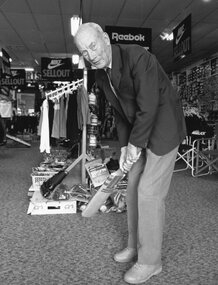
Photograph, Mr Alf Hunt with a cricket bat in Raitts Sports store in Upper Main Street previously, the Hunt family business
... Mr Alf Hunt with a cricket bat in Raitts Sports store in Upper Main Street previously, the Hunt family business ...Alf Hunt with Cricket bat in Raitts Sports store upper Main Street. It was the Hunt family business C Hunt and Son for many years....Alf Hunt with Cricket bat in Raitts Sports store upper Main Street. It was the Hunt family business C Hunt and Son for many years. ...Alf Hunt with Cricket bat in Raitts Sports store upper Main Street. It was the Hunt family business C Hunt and Son for many years.stawell -
 Emerald Museum & Nobelius Heritage Park
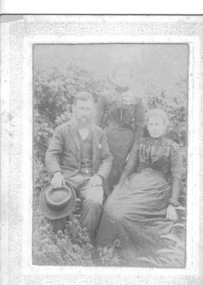
Photograph - Group portrait - Nightingale/Thompson Collection, c 1870 to 1910
... ...hunt family...Possibly Hunt family...Possibly Hunt family From collection of Emma Nightingale (nee Thompson) thompson collection hunt family nightingale None Two women and gentleman seated within garden setting. ...Possibly Hunt familyFrom collection of Emma Nightingale (nee Thompson)Two women and gentleman seated within garden setting. Sepia photograph mounted on white card from the Nightingale Thompson Collection.Nonethompson collection, hunt family, nightingale -
 Emerald Museum & Nobelius Heritage Park
Photograph, Nightingale/Thompson Collection, c 1870 to 1910
... ...Hunt family...Possibly Hunt family ...Possibly Hunt family From collection of Emma Nightingale (nee Thompson) Thompson Collection Hunt family Nightingale None Two women and gentleman seated within garden setting. ...Possibly Hunt family From collection of Emma Nightingale (nee Thompson)Two women and gentleman seated within garden setting. Sepia photograph mounted on white cardNonethompson collection, hunt family, nightingale -
Stawell Historical Society Inc
Photograph - Group Portrait, George and Margaret Hunt in family group portrait
... George and Margaret Hunt in family group portrait...family garden. Elderly couple seated, the rest standing. B/W photograph close up Front is mature gentleman in Grey three-piece suite. Girl in dress with lace collar, wrists. Mature woman with glasses, white dress. Two men in 3 piece suites with fob watches, the left one with a cane. George and Margaret Hunt ...Family portraits in front of tree in family garden. Elderly couple seated, the rest standing.B/W photograph close up Front is mature gentleman in Grey three-piece suite. Girl in dress with lace collar, wrists. Mature woman with glasses, white dress. Two men in 3 piece suites with fob watches, the left one with a cane. -
Emerald Museum & Nobelius Heritage Park
Equipment - Hand Made Brick, Caring for Our Children
... ...hunt family...Found at site of Hunt Family Bakehouse Macclesfield by George Davidovs 30th April 1982...Found at site of Hunt Family Bakehouse Macclesfield by George Davidovs 30th April 1982 Emerald Victoria Australia hunt family Hand made organge coloured brick Caring for Our Children Equipment Hand Made Brick ...Found at site of Hunt Family Bakehouse Macclesfield by George Davidovs 30th April 1982Hand made organge coloured brickemerald, victoria, australia, hunt family -
 Emerald Museum & Nobelius Heritage Park
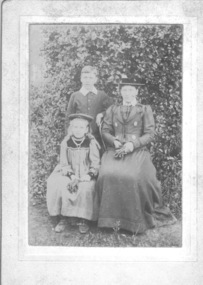
Sepia photograph, Nightingale/Thompson Collection, c 1870 to 1910
... ...Hunt family...Image: seated woman with two children (boy and girl) in garden setting, possibly Hunt family...Image: seated woman with two children (boy and girl) in garden setting, possibly Hunt family Thompson collection Thompson Collection Hunt family Nightingale None Sepia photograph mounted on white card Nightingale/Thompson Collection Sepia photograph ...Image: seated woman with two children (boy and girl) in garden setting, possibly Hunt familyThompson collectionSepia photograph mounted on white cardNonethompson collection, hunt family, nightingale -
 Ringwood and District Historical Society
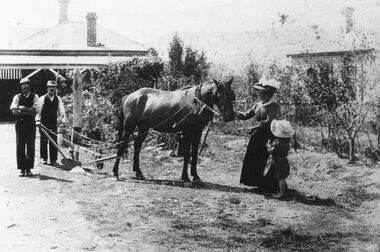
Photograph, Hunt Residence and family - Bedford Road Ringwood. c1910
... Hunt Residence and family - Bedford Road Ringwood. c1910....A lady is holding the horse and is accompanied by a little girl. (2 copies) Hunt Residence and family - Bedford Road Ringwood. c1910. ...Black and white photograph of two men behind a horse and plough. A lady is holding the horse and is accompanied by a little girl. (2 copies)Written on rear of backing sheet: "Rear 8 Bedford Rd. 'Hunt's Orchard' - this now part of Catholic School grounds. Walter hunt (with plough) at rear residence 8 Bedford Rd. Mrs. Hunt holding horse with daughter Laureen (later Mrs. Bob Lynch, Thomas St.). Also Charlie Williams at left. House next door is present (1970) Catholic Convent". -
 Emerald Museum & Nobelius Heritage Park
Sepia photograph, Nightingale/Thompson Collection, c 1870 to 1910
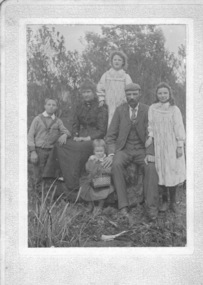
... Thompson Hunt family...Man and woman (possibly married couple; Emma and John Nightingale) surrounded by four children (three girls and one boy) in bush setting Nightingale/Thompson collection Thompson Hunt family Nightingale None Sepia photograph mounted on white card Nightingale/Thompson Collection Sepia photograph ...Man and woman (possibly married couple; Emma and John Nightingale) surrounded by four children (three girls and one boy) in bush setting Nightingale/Thompson collectionSepia photograph mounted on white cardNonethompson hunt family, nightingale -
 Narre Warren and District Family History Group
Book, Nobelius Heritage Park & Emerald Museum, Emerald in focus : a photographic history 1858-1958, 2006
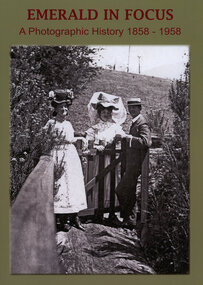
... Hunt...Legg family...Nobelius Nursery Emerald Vic Joseph Bosisto Tivoli Homestead Clematis Vic Nightingale's Nursery Avonsleigh Vic Sarah Watson George Hunt Legg family George Davey Emerald State School Macclesfield Cricket team Emerald Rifle Club Emerald Cricket Club Emerald Football team Emerald Basketball team St Mark's Church Emerald Vic St Joseph Church Emerald Vic Emerald museum Avonsleigh House Banool tearooms Berneray Guest house Brookdale Guest house Cascades Guest house Fernlea Guest house La Belle Guest house Lumeah Guest house Nottingham house The Chalet Guest house The Grange Guest house Woodlands Guest house McKenzie Timber Mill A photographic history of Emerald, Victoria 96 p.; 30 cm Emerald in focus : a photographic history 1858-1958 Book Nobelius Heritage Park & Emerald Museum ...A photographic history of Emerald, Victoria96 p.; 30 cmnon-fictionA photographic history of Emerald, Victoriaemerald (vic.), photographs, this is a reprint of emerald in focus : a photographic history published in 2006. this edition contains minor corrections and revisions for accuracy. contents table and index added. nobelius nursery emerald vic, joseph bosisto, tivoli homestead clematis vic, nightingale's nursery avonsleigh vic, sarah watson, george hunt, legg family, george davey, emerald state school, macclesfield cricket team, emerald rifle club, emerald cricket club, emerald football team, emerald basketball team, st mark's church emerald vic, st joseph church emerald vic, emerald museum, avonsleigh house, banool tearooms, berneray guest house, brookdale guest house, cascades guest house, fernlea guest house, la belle guest house, lumeah guest house, nottingham house, the chalet guest house, the grange guest house, woodlands guest house, mckenzie timber mill -
 Cheese World Museum
Jar, stoneware
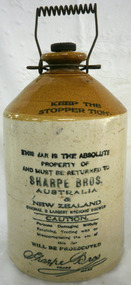
... This jar was used by the Hunt family on their dairy farm at Cudgee....This jar was used by the Hunt family on their dairy farm at Cudgee. Allansford Cudgee Mervyn Hunt Sharpe Bros Stoneware jars dairy farming bottles china ware Stopper: 'Sharpe Bros Australia and New Zealand'. ...This jar was used by the Hunt family on their dairy farm at Cudgee.Stoneware jar with stopper and wire handle. The cream body has instructions for use. From where the bottle slopes to the stopper is glazed brown. The stopper is rubber and the handle coiled wire.Stopper: 'Sharpe Bros Australia and New Zealand'. Body: Keep the Stopper Tight. This Jar is the absolute property and must be returned to Sharpe Bros. Australia & New Zealand Original and Largest Hygenic Brewer CAUTION. Persons Damaging Wilfully Retaining, Trading with or Misappropriating the use of this jar WILL BE PROSECUTED Sharpe Bros Trademarkallansford, cudgee, mervyn hunt, sharpe bros, stoneware jars, dairy farming, bottles, china ware -
 Linton and District Historical Society Inc
Photograph, Mervyn Lloyd Hunt of Linton, competing in rifle shooting competition, 1935
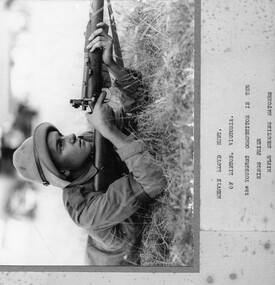
... Mervyn Hunt was a son of Linton Postmaster William George Hunt. The Hunt family moved to Linton in 1926....Mervyn Hunt was a son of Linton Postmaster William George Hunt. The Hunt family moved to Linton in 1926. Mervyn Lloyd Hunt Sports Rifle shooting "Mervyn Lloyd Hunt of Linton, Victoria. ...Mervyn Hunt was a son of Linton Postmaster William George Hunt. The Hunt family moved to Linton in 1926.Black and white photograph of a young man in sports uniform lying on front stretched out on ground holding rifle ready to shoot."Mervyn Lloyd Hunt of Linton, Victoria. The youngest competitor in the Kings Prize rifle shooting matches at Williamstown Rifle Range 2-9 March 1935."mervyn lloyd hunt, sports, rifle shooting -
Federation University Historical Collection
Film, Nanook of the North - silent documentary film, 1922
... The audience sees Nanook, often with his family, hunt a walrus, build an igloo, go about his day, and perform other tasks....The audience sees Nanook, often with his family, hunt a walrus, build an igloo, go about his day, and perform other tasks. ...The documentary follows the lives of an Inuk, Nanook, and his family as they travel, search for food, and trade in the Ungava Peninsula of northern Quebec, Canada. Nanook, his wife Nyla and their family are introduced as fearless heroes who endure rigors no other race could survive. The audience sees Nanook, often with his family, hunt a walrus, build an igloo, go about his day, and perform other tasks.A platic container containing a 16mm film spool of the 1922 silent documentary film Nanook of the Northnanook of the north, william mckenzie, baffin island, belcher islands, arctic -
 Wooragee Landcare Group
Photograph, 27th February 2004
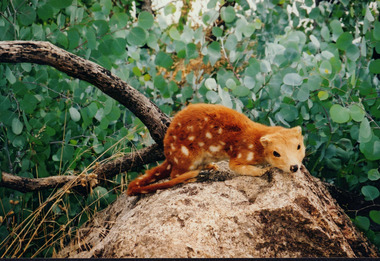
... They are known for sharp teeth that enables them to sustain a diet that involves poultry meat. They hunt for their families. Historically, Quolls are treated as pests and were trapped or poisoned by people who are protecting their chickens....They are known for sharp teeth that enables them to sustain a diet that involves poultry meat. They hunt for their families. Historically, Quolls are treated as pests and were trapped or poisoned by people who are protecting their chickens. ...Photograph of Quoll taxidermy, part of the Quoll presentation at the Wooragee Hall on Friday, 27th February, 2004 as part of an event called Foxy Night Out. Foxy Night Out is part of a land fox control project. This workshop is conducted to help private and public community members to understand foxes and effective fox control techniques, and its impact to agriculture and other animals. Quolls are carnivorous marsupials native to Australia and New Guinea. They grow up to 125cm and weighs up to 5kg. The spotted-tail Quoll is now the largest carnivore on the mainland. Quolls have black to fawn fur, white spots, long and thin tails. Quolls can attack livestock like chickens. They are known for sharp teeth that enables them to sustain a diet that involves poultry meat. They hunt for their families. Historically, Quolls are treated as pests and were trapped or poisoned by people who are protecting their chickens.This photograph contributes to the scientific and historical records on fox control in Victoria. It reflects the effects of foxes and quolls to livelihood, thus, creates a picture of Victorian agriculture, trade, and community activities. Coloured rectangular photograph printed on matte photographic paperReverse: WAN NA / 0ANA2N0 BN2+ 2 1636 / (No. 5) 919foxes, quoll, landcare workshop, taxidermy, ecosystem, fox control project, agriculture, fox, marsupials, carnivore, pests -
 Flagstaff Hill Maritime Museum and Village
Print - Lithograph, sea rescue, R.N. Duffield, Australian cruiser “MELBOURNE” (Tons 5600) rescuing crew of sinking four-masted schooner “HELEN B. STERLING” of Halifax NS Canada, Tons 1343 in a gale in the Pacific Ocean, 19-11-1924
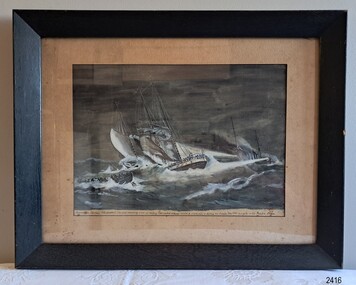
... family. The seamen of the Melbourne received a heroes’ welcome when they arrived in New Zealand. The grateful survivors were taken to Auckland, where they received the care and comfort they needed. Melbourne’s Lord Mayor, Cr. Swanston, on behalf of the citizens of Melbourne, formally recognised the heroic rescue efforts of the seamen of the HMAS Melbourne on March 2nd, 1922, at a special presentation. Two large flags, a White Ensign and an Australian “Jack" Flag, were presented to the Captain of HMAS Melbourne, and souvenirs were awarded to the sea boat’s crew and its Commander, Wilfred Ward Hunt...family. The seamen of the Melbourne received a heroes’ welcome when they arrived in New Zealand. The grateful survivors were taken to Auckland, where they received the care and comfort they needed. Melbourne’s Lord Mayor, Cr. Swanston, on behalf of the citizens of Melbourne, formally recognised the heroic rescue efforts of the seamen of the HMAS Melbourne on March 2nd, 1922, at a special presentation. Two large flags, a White Ensign and an Australian “Jack" Flag, were presented to the Captain of HMAS Melbourne, and souvenirs were awarded to the sea boat’s crew and its Commander, Wilfred Ward Hunt ...This framed lithograph print in watercolour and gouache was produced on November 19th, 1924, by 20th-century marine artist, Mr R.N. Duffield. It depicts the event of a sea rescue that took place two years earlier. The framer was A.L. Frith of Footscray, Melbourne, who actively advertised from 1933 to 1935. The now disbanded Shiplovers' Society of Victoria (1930-2018) donated the print, and it seems likely that this print was framed for that organisation. This graphic image shows the conditions in which the rescue from the wrecked Helen B. Sterling happened. Captain George Harris was master of the American-owned, four-masted windjammer. His wife Edith and their ten-year-old son Leslie were on board, along with a crew of fifteen seamen. The ship set off from Newcastle, NSW, on January 5th, 1922, loaded with a cargo of coal to deliver to the Society Islands and on to San Francisco. Young Leslie later wrote a lively school composition for his teacher about his experiences on board the Helen B Sterling. He tells of a fire that broke out the day after they departed and burned a hole in a beam. Then another troublesome time on the 9th, when a strong gale blew a sail off the ship. Finally, he tells of the highlight of his voyage when, on the 18th January, the ship was right in the path of a strong cyclone, which broke the mainmast. Huge waves crashed over both sides of the deck, meeting in the middle, and the ship began to sink. The rescue from the wreck was an exciting time for the young boy, and even more so when one of his cats survived after being carefully wrapped in a pillowcase and thrown down from the ship for the boy. Reporters later wrote about Leslie’s comments, “... what had grieved him most was the thought that he might never see his two little sisters again”. Captain Harris said in a published statement, “… the gale was the worst he had met in his 12 years’ experience at sea. All went well for the first week. We then encountered a strong blow from the south-east. We tried the gasoline pump, but the engine broke down, and we had to do the pumping by hand. We at once shortened sail, but the sea increased in fury to such an extent that men were washed from the pumps. I was below at 5:30 on Sunday morning [January 22nd, 1922] when the main mast went over the side, … I at once sent out SOS signals, and got word that HMAS Melbourne was coming to our assistance. I had made a mistake with regard to our position, but did not know it until 11:30 o’clock, when I sent out the correct location. This was picked up by the Melbourne and I received the following reply: “We will reach you about 2 am. Keep a good heart. The Melbourne will do all she can.” Our ship was practically awash when we were taken off.” (Ref: the ‘Helen B. Sterling Disaster’, Maitland Weekly Mercury, NSW, 4-2-1922.) Officers from the Royal Australian Navy, Captain Henry J Feakes (later Rear-Admiral) and Commander Wilfrid Ward Hunt, were on board the light cruiser, HMAS Melbourne (1913-1928), when it left Sydney for New Zealand. After the SOS was received, the ship sped at full steam towards the sinking Helen B. Sterling. They found the vessel at about midnight and shone bright search lights on the distressed ship to illuminate the desperate scene. The Melbourne was unable to move close to the schooner, so sixteen seamen, including Commander Hunt, volunteered to man the Melbourne’s lifesaving 12-oared cutter. They rowed the sea boat with great urgency towards the victims of the sinking ship, keen to save lives no matter what the conditions. When the cutter was close to the Sterling, a line was secured between the Sterling and the cutter. The weary, waterlogged and anxious men on board could be rescued, one at a time, in the breeches buoy equipment, which looked like canvas shorts with a lifesaving ring in the waistband. The victims were hauled along the line and pulled aboard by many willing hands. All eighteen crew and passengers were saved, including Captain Harris and his family. The seamen of the Melbourne received a heroes’ welcome when they arrived in New Zealand. The grateful survivors were taken to Auckland, where they received the care and comfort they needed. Melbourne’s Lord Mayor, Cr. Swanston, on behalf of the citizens of Melbourne, formally recognised the heroic rescue efforts of the seamen of the HMAS Melbourne on March 2nd, 1922, at a special presentation. Two large flags, a White Ensign and an Australian “Jack" Flag, were presented to the Captain of HMAS Melbourne, and souvenirs were awarded to the sea boat’s crew and its Commander, Wilfred Ward Hunt. Commander Hunt was also presented with an original watercolour depicting the heroic rescue from the wreck of the Helen B. Sterling, painted just after the event by renowned marine artist Arthur V Gregory (1867-1957), and he received a silver cigarette case bearing the City’s coat of arms and the inscription, "To Commander Ward Hunt from the Citizens of Melbourne as a memento of the rescue of the crew of Helen B. Stirling by H.M.A.S. Melbourne, on 23.1.22". Both the painting and the cigarette case are now treasured items inherited by his grandson; a reminder of “… a very fine naval gentleman who believed in leading by example." R.N. DUFFIELD: - The Lithograph print in our collection by 20th-century English artist R.N. Duffield is dated Nov. 19, 1924. It is very similar to, and possibly created from, the original A V Gregory watercolour presented to Commander Hunt and dated 1922. Mr R.N. Duffield has art works in the Yarmouth Museums, Norfolk Museums Collection; “Orient Liner Otranto …,” and "Convoy of six ships at sea", both painted in watercolour and gouache during the 1940s. Some of his other works, also painted in watercolour and gouache, have been advertised for sale on Internet sites. Some details differ between the original A.V. Gregory and this Lithograph Print: - -the words on the bow on the original watercolour are “Helen B. Sterling, Blain”, which is in Washington, USA, where the Sterling Shipping Company was registered from around 1919; the words on the print are “Helen B. Sterling, Halifax, N S”, for Nova Scotia, Canada, which is the hometown of Sterling Shipping Company founder’s wife, Helen B Sterling. -The watercolour is coloured and has fine details; the print is monochrome - The A V Gregory signed the watercolour in 1922, on the lower left; the print is signed with the Lithographer’s name on the lower right; “R N Duffield, Nov. 19. 1924” ARTHUR VICTOR GREGORY (1867-1957): - A.V. Gregory is a renowned marine artist who worked in watercolour and gouache. He painted actively between 1899 and 1932, creating over 3o0 works. South Melbourne, Victoria, was where he lived and worked. This Lithograph print is significant in that it depicts the rescuing of the passengers and crew of the schooner “Helen B Stirling”. At the time this was a significant event that made most Australian and New Zealand papers because of the involvement of the Australian cruiser “Melbourne”. The image demonstrates the perilous conditions experienced by seafarers. It includes an example of the line and breeches buoy method used to save lives at sea from the 1860s and into the 20th century. It reflects a time in our history when sail and steam ships cruised the world’s seas together, the former trading with a cargo of coal from Newcastle, the latter defending our country in World War I. The print is part of Flagstaff Hill Maritime Museum’s Collection of maritime artworks that depict famous events, vessels and locations, showing the evolution of sea craft, and aiding the interpretation of our maritime history. The Lithograph print is behind glass in a black painted timber frame and mounted under a cream matte. The vivid image depicts a sea rescue in progress. The night scene is illuminated by a light beaming from a steamship, the Cruiser HMAS Melbourne. It reveals figures on the deck of a sinking sailing ship, the schooner Helen B. Sterling, as foaming waves roll across it. The stricken ship has a broken main mast, and a sail has been detached. A small figure is floating in the choppy sea, secured in a breeches buoy that is attached to a rescue line between a lifesaving cutter and the sailing ship. The crewmen in the cutter are ready to haul the shipwrecked victim aboard, while the figures on the foundering ‘Sterling’ watch them. The print’s paper-covered wooden backboard is attached to the frame with small tacks. A metal hanging wire is secured to two dissimilar eyelet screws. Inscriptions include text on the bow of the sinking vessel, a handwritten title below the picture, and a handwritten name in the print’s lower right corner. On the reverse are two oval, black ink stamps and a round cream label with printed text. The hand-painted print was reproduced from a lithograph, signed in the lower right, by R.N. Duffield of England, on November 19th, 1924. A Frith of Footscray, Melbourne framed it. Painted on the ship’s bow: “HELEN B. STERLING / HALIFAX N S” [Nova Scotia, Canada] Handwritten below the print: “AUSTRALIAN CRUISER “MEMBOURNE” (Tons 5600) rescuing crew of sinking four-masted schooner “HELEN B. STERLING” of Halifax NS Canada, Tons 1343 in a gale in the Pacific Ocean.” Handwritten on lower right: “R.N. DUFFIELD / Nov. 19. 1924” (underlined) On paper label: “Phone: / Footscray 398 [some of the text has torn off] / “A. FRITH / PICTURE FRAMER / Manufacturer / 17 Paisley Street / Footscray.“ On both oval stamps: “SHIPLOVERS SOCIETY OF VICTORIA / LIBRARY” flagstaff hill, flagstaff hill maritime museum and village, warrnambool, maritime museum, maritime village, great ocean road, shipwreck coast, lithograph, lithograph print, reproduction print, helen b. sterling, the sterling, american owned schooner, halifax, halifax n s, halifax nova scotia, nova scotia, halifax n s canada, schooner, windjammer, sailing ship, four-masted ship, captain george harris, george harris, edith harris, leslie harris, sterling shipping line, hmas melbourne, hmas melbourne (1), cruiser hmas melbourne, the melbourne, australian cruiser, captain henry j feakes, commander wilfred ward hunt, sinking ship, shipwreck, sea rescue, gale, cyclone, 1922 rescue, shipwreck rescue, breeches buoy, line rescue, rescue line, lifesaving, cutter, cutter melbourne, sea boat, lifesaving crew, 12-oar cutter, shipwreck victim, r.n. duffield, marine artist, nov. 19. 1924, 20th century artist, a frith, footscray picture framer, shiplovers’ society of victoria, shiplovers’ society library, watercolour, a v gregory, arthur victor gregory, melbourne artist, newcastle coal, newcastle nsw, society islands, san fracisco, aukland new zealand, school composition, ship’s cat, sos signal, lord mayor cr. swanston, heroes, cigarette case -
 Mission to Seafarers Victoria
Photograph, Mr and Mrs Gurney Goldsmith, Resting, Easter Monday, Heatherbrae, 12 April 1909
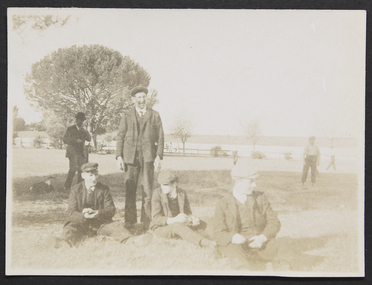
... Huntly. About 90 sailors from ships in the Bay and river were entertained, and a happy time was spent. Tea was provided by ladies connected with the Mission, and cricket, football, and other sports were arranged and carried out with great zest. At the close of the day cheers were given for Mr. and Mrs. Clarke and family...Huntly. About 90 sailors from ships in the Bay and river were entertained, and a happy time was spent. Tea was provided by ladies connected with the Mission, and cricket, football, and other sports were arranged and carried out with great zest. At the close of the day cheers were given for Mr. and Mrs. Clarke and family ...Alfred Edward Clarke was a member of the Stock Exchange. He married a niece of Reverend Kerr Johnston, Margaret Helen Gowan (daughter of John Denovan Gowan, himself brother of Eliza Denovan Gowan) in 1886. His first wife, Caroline Long, died in 1884. One of his daughter, Linda Clarke (later married to John William Begg) was secretary of the Malvern branch of the Ladies' harbour Lights Guild. Article in the Standard (Port Melbourne, Vic. : 1884 - 1914), Saturday 17 April 1909, page 3 "SAILORS ENTERTAINED. Picnic at Glen Huntly. A very enjoyable picnic was held on Monday in connection with the Victoria Mission to Seamen, at Mr. Clarke's grounds, 'Heatherbrae,' Glen Huntly. About 90 sailors from ships in the Bay and river were entertained, and a happy time was spent. Tea was provided by ladies connected with the Mission, and cricket, football, and other sports were arranged and carried out with great zest. At the close of the day cheers were given for Mr. and Mrs. Clarke and family, the Mission workers, and all who had helped to make the outing a success."Small monochrome photograph depicting outdoor scene of a small number of men resting. Photograph somewhat faded, particularly on right side heatherbrae, easter, picnic, lhlg, caulfield, alfred edward clarke 1840-1913, margaret helen gowan 1863-1937, linda begg nee clarke 1877-1954, eliza johnston nee denovan gowan, john denovan gowan -
 The Beechworth Burke Museum
Animal specimen - Green Woodpecker, Trustees of the Australian Museum, 1860-1880
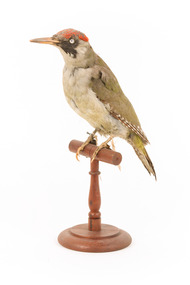
... This fairly large woodpecker of the Picadae family is widely distributed across most parts of Europe and the UK, with some occurrence in Western Asia. Preferring semi-open habitats such as woodlands, heathlands and gardens, the species is unique amongst woodpeckers as it prefers to hunt and feed on the ground for its ant prey. ...This fairly large woodpecker of the Picadae family is widely distributed across most parts of Europe and the UK, with some occurrence in Western Asia. Preferring semi-open habitats such as woodlands, heathlands and gardens, the species is unique amongst woodpeckers as it prefers to hunt and feed on the ground for its ant prey. ...This fairly large woodpecker of the Picadae family is widely distributed across most parts of Europe and the UK, with some occurrence in Western Asia. Preferring semi-open habitats such as woodlands, heathlands and gardens, the species is unique amongst woodpeckers as it prefers to hunt and feed on the ground for its ant prey. This species has a distinctive bright red crown, black moustasche-like stripes, mostly green back plumage and a paler green to yellow breast. This is a female of the species as the male has a red centre to the moustache stripe at the side of the beak. This specimen is a fairly accurate depiction of a Green Woodpecker. This specimen is part of a collection of almost 200 animal specimens that were originally acquired as skins from various institutions across Australia, including the Australian Museum in Sydney and the National Museum of Victoria (known as Museums Victoria since 1983), as well as individuals such as amateur anthropologist Reynell Eveleigh Johns between 1860-1880. These skins were then mounted by members of the Burke Museum Committee and put-on display in the formal space of the Museum’s original exhibition hall where they continue to be on display. This display of taxidermy mounts initially served to instruct visitors to the Burke Museum of the natural world around them, today it serves as an insight into the collecting habits of the 19th century.This specimen is part of a significant and rare taxidermy mount collection in the Burke Museum. This collection is scientifically and culturally important for reminding us of how science continues to shape our understanding of the modern world. They demonstrate a capacity to hold evidence of how Australia’s fauna history existed in the past and are potentially important for future environmental research. This collection continues to be on display in the Museum and has become a key part to interpreting the collecting habits of the 19th century.This Green Woodpecker has a distinctive red crown on its head that appears patchy. It has a black face, a black moustache-like stripe on each side of the beak, pale eyes and long light yellow-orange beak. The back of the bird is green, and its flank and breast is a pale cream-yellow colour. It has slightly visible distinct white-dotted brown feathers folded into its wings. The specimen is mounted on a wooden perch, with a metal tag tied around its right leg and a paper tag around each leg.Swing tag: 1e. / Green Woodpecker / Catalogue page 66 / Metal tag: 4308 /taxidermy mount, taxidermy, burke museum, beechworth, australian museum, reynell eveleigh johns, bird, woodpecker, green woodpecker, eurasian green woodpecker -
 The Beechworth Burke Museum
Animal specimen - Australian Hobby, Trustees of the Australian Museum, 1860-1880
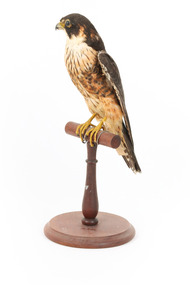
... family, similar in look to the larger sized Peregrine Falcon. This species is widespread and can be found across most of mainland Australia and Tasmania, preferring lightly wooded areas such as timbered wetlands, open wooded farmland, and some urban areas. Their diet consists of small birds, bats, and flying insects, which are caught mid-air. They sometimes hunt...family, similar in look to the larger sized Peregrine Falcon. This species is widespread and can be found across most of mainland Australia and Tasmania, preferring lightly wooded areas such as timbered wetlands, open wooded farmland, and some urban areas. Their diet consists of small birds, bats, and flying insects, which are caught mid-air. They sometimes hunt ...The Australian Hobby is a medium-sized falcon of the Falconidae family, similar in look to the larger sized Peregrine Falcon. This species is widespread and can be found across most of mainland Australia and Tasmania, preferring lightly wooded areas such as timbered wetlands, open wooded farmland, and some urban areas. Their diet consists of small birds, bats, and flying insects, which are caught mid-air. They sometimes hunt cooperatively to catch their prey. This specimen is an accurate depiction of an Australian Hobby. This specimen is part of a collection of almost 200 animal specimens that were originally acquired as skins from various institutions across Australia, including the Australian Museum in Sydney and the National Museum of Victoria (known as Museums Victoria since 1983), as well as individuals such as amateur anthropologist Reynell Eveleigh Johns between 1860-1880. These skins were then mounted by members of the Burke Museum Committee and put-on display in the formal space of the Museum’s original exhibition hall where they continue to be on display. This display of taxidermy mounts initially served to instruct visitors to the Burke Museum of the natural world around them, today it serves as an insight into the collecting habits of the 19th century.This specimen is part of a significant and rare taxidermy mount collection in the Burke Museum. This collection is scientifically and culturally important for reminding us of how science continues to shape our understanding of the modern world. They demonstrate a capacity to hold evidence of how Australia’s fauna history existed in the past and are potentially important for future environmental research. This collection continues to be on display in the Museum and has become a key part to interpreting the collecting habits of the 19th century.This Australian Hobby has a dark brown cap and cream-coloured half-collar. The back feathers of the bird are also a dark brown colour, while the neck is a cream with lighter brown streaks. The flank is a dappled dark brown, rufous-brown and cream, which transitions back into cream with brown streaks near the legs. The underwing feathers appear to be a banded dark brown and cream. The tip of the hooked beak is black which recedes to light blue-grey and then to yellowish near the head join. The legs are also yellow. The specimen is perched on a wooden perch mount with a swing tag tied around its left leg.23. / Australian Hobby / See catalogue, page, 6 / taxidermy mount, taxidermy, burke museum, beechworth, australian museum, skin, reynell eveleigh johns, bird, australian hobby, australian birds, little falcon -
 The Beechworth Burke Museum
Animal specimen - Dollarbird, Trustees of the Australian Museum, 1860-1880
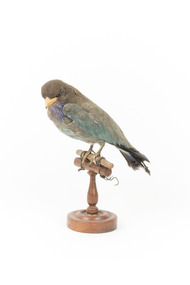
... family found in Australia and can be found in forests and woodland areas. The name of this bird comes from the large white spot on the underside of each wing which resemble silver dollars. They travel to Australia each year to breed from New Guinea and the surrounding area. Their main source of food is insects which they hunt...family found in Australia and can be found in forests and woodland areas. The name of this bird comes from the large white spot on the underside of each wing which resemble silver dollars. They travel to Australia each year to breed from New Guinea and the surrounding area. Their main source of food is insects which they hunt ...The DollarBird is the only member of the Roller family found in Australia and can be found in forests and woodland areas. The name of this bird comes from the large white spot on the underside of each wing which resemble silver dollars. They travel to Australia each year to breed from New Guinea and the surrounding area. Their main source of food is insects which they hunt during flight. They capture these foods while displaying skillful aerial pursuits. They then return to the same perch they were upon when they left to catch their food. This specimen is part of a collection of almost 200 animal specimens that were originally acquired as skins from various institutions across Australia, including the Australian Museum in Sydney and the National Museum of Victoria (known as Museums Victoria since 1983), as well as individuals such as amateur anthropologist Reynell Eveleigh Johns between 1860-1880. These skins were then mounted by members of the Burke Museum Committee and put-on display in the formal space of the Museum’s original exhibition hall where they continue to be on display. This display of taxidermy mounts initially served to instruct visitors to the Burke Museum of the natural world around them, today it serves as an insight into the collecting habits of the 19th century.This specimen is part of a significant and rare taxidermy mount collection in the Burke Museum. This collection is scientifically and culturally important for reminding us of how science continues to shape our understanding of the modern world. They demonstrate a capacity to hold evidence of how Australia’s fauna history existed in the past and are potentially important for future environmental research. This collection continues to be on display in the Museum and has become a key part to interpreting the collecting habits of the 19th century.This juvenile Dollar bird's feet are a faded brown and the bill is a light yellow. The colour of this specimen's head and neck are a cool grey which fades to a patch of bright purple on its upper chest. The back is grey while the underbelly and wings are a light blue-grey. The tail feathers are tipped in black. The specimen is standing on a wooden mount.taxidermy mount, taxidermy, animalia, burke museum, beechworth, australian museum, skin, reynell eveleigh johns, bird, dollar bird -
 Flagstaff Hill Maritime Museum and Village
Vehicle - Vessel, Dinghy, Proudfoot's Boat, c. 1885
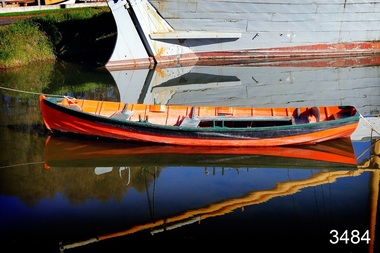
... Later her son Bruce and after that her granddaughter Ena Hunt and her husband took over; it remained in the family until 1979. ...Later her son Bruce and after that her granddaughter Ena Hunt and her husband took over; it remained in the family until 1979. ...This boat or dinghy is one of a few remaining boats made for Proudfoot’s Boathouse, 2 Simpson Street Warrnambool, on the Hopkins River, in about 1885. It was one of many rowing, fishing, sailing and picnic boats that were available to hire. Proudfoot’s Boathouse, a beautiful Victorian Period building, was designed, built and established by Thomas Proudfoot. He applied to build a boat jetty in 1885. He died in 1900 and his wife Catherine took over, running it for many years. Later her son Bruce and after that her granddaughter Ena Hunt and her husband took over; it remained in the family until 1979. Proudfoot’s was a very popular tourist destination for visitors coming from Melbourne to fish and row and enjoy afternoon tea. The buildings, including the ‘U’ shaped jetty and tearooms, were restored and modified in the 1990s by the Warrnambool Sports Club, under the control of the Warrnambool City Council. The dinghy was brought to Flagstaff Hill in about 1992 and restored to its original condition and painted in traditional paint colours of orange with dark green gunnel and black and gold pinstripes. Since that time it has been painted by Flagstaff Hill's boatbuilder.This dinghy, Proudfoot’s Boat, is significant for its association with Proudfoot’s Boathouse, which is listed on the Victorian Heritage Register, VHR H0620. “Proudfoot's Boathouse on the Hopkins River near Warrnambool is an outstanding example of a late-19th century boathouse complex with associated residences and jetties. Thomas Proudfoot first applied for a jetty licence in 1885 with a view to establishing a boating business on the Hopkins River. The early single-storey sections are thought to date from this period. The two storey second stage probably dates from 1893 when additions were constructed. The entire complex was designed and built by Proudfoot himself. The business remained in the Proudfoot family until 1979. The buildings were modified in the 1990s in the process of creating a sporting club on the site. Proudfoot's Boathouse is of architectural, historical and social significance to the State of Victoria. Proudfoot's Boathouse is of architectural significance as perhaps the finest example of a 19th-century boathouse in Victoria. Although recent modifications have reduced the intactness of the buildings, many original features remain. The beautifully ornamented buildings still provide an attractive instance of 19th-century leisure facility architecture. Proudfoot's Boathouse is of historical significance as an example of late-Victorian recreational and tourist facilities. Boathouses were popular 19th-century tourist and recreational attractions, providing refined and healthy activity. This boathouse shows the early realisation of the tourism and leisure potential of seaside towns such as Warrnambool, a potential that has become increasingly important as port uses have ceased and other industries have been subjected to financial pressure. Proudfoot's Boathouse is of social significance because it illustrates the continuity of the attraction of this kind of leisure facility. Although the glory days of the boathouse were in the 19th century, those that survive continue to be well patronised. Proudfoot's Boathouse has been an important recreational facility and attraction for tourists flocking to the Hopkins River, one of the State's most popular boating and fishing resorts, since 1885.” (Statement of Significance is from the Victorian Heritage Register)Wooden vessel or boat, called a dinghy, known as Proudfoot’s Boat. Paint work is orange with dark green gunnel and black stripe. The rowboat is propelled by oars and has two pair of thole set into the gunnel (gunwale) to hold the oars in place and to serve as a fulcrum when rowing. The boat is dated around 1885. flagstaff hill, warrnambool, shipwrecked coast, flagstaff hill maritime museum, maritime museum, shipwreck coast, flagstaff hill maritime village, great ocean road, small marine vessel, dinghy, proudfoot's boat, proudfoot's boathouse, picnic boat, orange and black boat -
 Flagstaff Hill Maritime Museum and Village
Postcard - Historical, Warrnambool, Proudfoot’s Boat House, Hopkins River, Warrnambool, Early 20th century
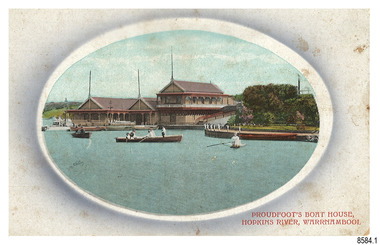
... Later her son Bruce and after that her granddaughter Ena Hunt and her husband took over; it remained in the family until 1979. ...Later her son Bruce and after that her granddaughter Ena Hunt and her husband took over; it remained in the family until 1979. ...The nine postcards in this set were donated together and date to the early 1900s. All but one postcard in this set shows images of Warrnambool, in the Western District of Victoria; the other has a London image. The postcards were all printed in Great Britain according to that country’s postal regulations. All cards have titles on the front printed in red. The majority of the images on the cards are attributed to photographer Joseph Jordan and belong to the Jordan Series. The back of these cards has an outline for a postage stamp, a vertical dividing line and a heading on each side of the line to separate the Correspondence from the Address. Postcards or ‘correspondence cards’ appeared in Britain in 1894. They were plain cards with a space for the message on one side and an address on the other; regulations didn’t allow anything but the address to be written on the ‘address’ side. In 1902 the British regulations then allowed a picture to be printed on the front and the address on the back, so messages had to be written on the picture side. Soon, the regulations changed and the back was divided for a message and the address. Proudfoots Boat House – Proudfoot’s Boathouse is at 2 Simpson Street Warrnambool, on the banks of the Hopkins River. In the 1880s it was a venue for hiring boats for rowing, fishing, sailing and picnics. It was a popular destination for tourists coming from Melbourne for a day or weekend outing. The beautiful historic Victorian period building was designed, built and established by Thomas Proudfoot. He applied to build a boat jetty in 1885. He died in 1900 and his wife Catherine took over, running it for many years. Later her son Bruce and after that her granddaughter Ena Hunt and her husband took over; it remained in the family until 1979. The buildings, including the ‘U’ shaped jetty and tearooms, were restored and modified in the 1990s by the Warrnambool Sports Club, under the control of the Warrnambool City Council. Joseph Jordan - Joseph Jordan was born in 1841 in Leicester England. When he was 16 he joined the 7th Queen's Own Hussars and was sent to India at the outbreak of the mutiny. He took part in the relief of Lucknow and remained in India for eleven years. It was during this time, he became interested in photography. He was posted to New Zealand and later came to Victoria, becoming a sergeant major of the Mounted Rifles. In the mid-1880s he came to the Western district where he was responsible for establishing units of the Mounted Rifles in various country towns such as Dunkeld, Mortlake, Panmure, Bushfield, Koroit etc. He resigned from the army in 1889 and set up a professional photography studio in Liebig Street, Warrnambool. He became very well known in the Western District for family photographs, official photographs of local councillors and groups as well as views of local scenery. In 1891 he photographed the wrecked barque ‘Fiji’ at ‘Wrecks Beach’ near Princetown. His business was taken over by his son Arthur around 1917. Joseph was a keen rifle shot and in 1924 he donated the "Jordan Shield" as a prize to the Victorian Rifle Association. He was made a "Life Honorary Member" of the Warrnambool Returned Soldiers League and in 1933 he was recognised as being the oldest living soldier in Victoria. Joseph died in 1935 aged 95.This card is the only one of the nine cards with the location of Warrnambool added to the name 'Joseph Series'. It is also the only one that has text within the outline for the postage stamp. The font used for the test of the headings is slightly different to the other cards. Joseph Jordan is a significant figure in Warrnambool history as he helped to establish early units of the Mounted Rifles (G Company) in local towns during the late 1880's and later, photographed local scenes, groups and citizens of early Warrnambool. This postcard of Proudfoot's Boathouse is of historical significance for is connection with Proudfood’s Boathouse. Proudfoot’s Boathouse is an example of late-Victorian recreational and tourist facilities. Boathouses were popular 19th-century tourist and recreational attractions, providing refined and healthy activity. This boathouse shows the early realisation of the tourism and leisure potential of seaside towns such as Warrnambool, a potential that has become increasingly important as port uses have ceased and other industries have been subjected to financial pressure. Proudfoot's Boathouse is of social significance because it illustrates the continuity of the attraction of this kind of leisure facility. Although the glory days of boathouses were in the 19th century, those that survive continue to be well patronised. Proudfoot's Boathouse has been an important recreational facility and attraction for tourists flocking to the Hopkins River, one of the State's most popular boating and fishing resorts, since 1885.” (Statement of Significance is from the Victorian Heritage Register)Postcard, one of nine, landscape orientation. Coloured photograph print within an oval border and mauve-toned shading. Cameo Image of figures in three rowing boats on still water beside a building with three gable roofs and decorative verandas. Other boats are moored at the landing in front of the building. The roofs each have a tall pole at the front. There is a park right of the building that also has a landing. In the background is a grassed slope and the sea. Reverse has printed inscriptions and an outline for a postage stamp. There is no correspondence written on the card. The card is one of the Jordan Series by Joseph Jordan, printed in Great Britain in the early 1900s. Front, in red: “PROUDFOOT’S BOAT HOUSE / HOPKINS RIVER, WARRNAMBOOL” Reverse in black: “Jordan Series Warrnambool” “POST CARD” “Printed in Great Britain” “This space may be used for Communication” “The Address to be written here” Within the stamp outline: “3 / BRITISH / MANUFACTURE"flagstaff hill maritime museum, flagstaff hill maritime village, flagstaff hill maritime museum and village, maritime museum, warrnambool, great ocean road, warrnambool and district, warrnambool scenes, local scenes, views of warrnambool, joseph jordan, jordan series, jordan photography, postcard, souvenir, correspondence, cameo postcard, landscape, proudfoots boat house, boat house, proudfoots, hopkins river, boats for hire, row boats, recreation -
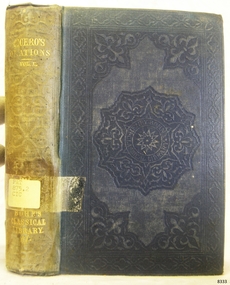 Flagstaff Hill Maritime Museum and Village
Book - Reference Book / Classics, Charles Duke Yonge (Translator), The Orations of Marcus Tullius Cicero Vol 1, 1856
... family without noble political lineage he rose to Rome's highest office, the consulship, purely through his brilliant legal mind and unmatched public speaking skills. His political career was defined by a fierce defense of republican governance against military dictators like Julius Caesar. Ironically, the very speeches contained in this fourth volume, known as the Philippics, sealed his fate. Mark Antony never forgave Cicero for the brutal public insults in these orations. When Antony formed an alliance with Octavian (later Augustus), Cicero was placed on the proscription list, becoming officially condemned, and was eventually hunted...family without noble political lineage he rose to Rome's highest office, the consulship, purely through his brilliant legal mind and unmatched public speaking skills. His political career was defined by a fierce defense of republican governance against military dictators like Julius Caesar. Ironically, the very speeches contained in this fourth volume, known as the Philippics, sealed his fate. Mark Antony never forgave Cicero for the brutal public insults in these orations. When Antony formed an alliance with Octavian (later Augustus), Cicero was placed on the proscription list, becoming officially condemned, and was eventually hunted ...Volume 1 of The Orations of Marcus Tullius Cicero is the beginning in the widely published 4-volume English translation by Charles Duke Yonge for Bohn's Classical Library series and focuses on Cicero's earliest legal masterpieces. The volume captures his meteoric rise from a brilliant young defense attorney to Rome's leading forensic advocate, culminating in his famous take down of a corrupt governor. The core contents in this volume contains several pivotal legal cases, which can be divided into his early legal defenses and his massive prosecution of Verres. Included is Cicero’s very first surviving public speech (delivered in 81 BC). It is a civil partnership dispute regarding property and debt. Notably, Cicero had to argue against Rome's greatest orator of the time, Quintus Hortensius. Key themes in this volume is his fight against corruption and the exposure of provincial extortion and the greed of the Roman senatorial class. He exercised judicial integrity with his struggle to keep Rome's legal courts fair when faced with political bribery and intimidation.The Orations of Marcus Tullius Cicero Vol 1 Translated by C D Yonge Publisher: Henry G Bohn Date: 1856non-fictionVolume 1 of The Orations of Marcus Tullius Cicero is the beginning in the widely published 4-volume English translation by Charles Duke Yonge for Bohn's Classical Library series and focuses on Cicero's earliest legal masterpieces. The volume captures his meteoric rise from a brilliant young defense attorney to Rome's leading forensic advocate, culminating in his famous take down of a corrupt governor. The core contents in this volume contains several pivotal legal cases, which can be divided into his early legal defenses and his massive prosecution of Verres. Included is Cicero’s very first surviving public speech (delivered in 81 BC). It is a civil partnership dispute regarding property and debt. Notably, Cicero had to argue against Rome's greatest orator of the time, Quintus Hortensius. Key themes in this volume is his fight against corruption and the exposure of provincial extortion and the greed of the Roman senatorial class. He exercised judicial integrity with his struggle to keep Rome's legal courts fair when faced with political bribery and intimidation.warrnambool, shipwrecked-coast, flagstaff-hill, flagstaff-hill-maritime-museum, maritime-museum, shipwreck-coast, flagstaff-hill-maritime-village, shipwrecked-artefact, book, pattison collection, warrnambool library, warrnambool mechanics’ institute, ralph eric pattison, corangamite regional library service, warrnambool city librarian, mechanics’ institute library, victorian library board, warrnambool books and records, warrnambool children’s library, great ocean road, the orations of marcus tullius cicero vol 1, the orations of marcus tullius cicero, c d yonge -
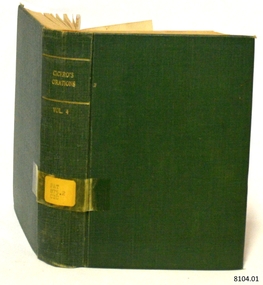 Flagstaff Hill Maritime Museum and Village
Book - Ancient Political Speeches/Reference, Henry George Bohn, The Orations of Marcus Tullius Cicero Vol 4, 1852
... family without noble political lineage he rose to Rome's highest office, the consulship, purely through his brilliant legal mind and unmatched public speaking skills. His political career was defined by a fierce defense of republican governance against military dictators like Julius Caesar. Ironically, the very speeches contained in this fourth volume, known as the Philippics, sealed his fate. Mark Antony never forgave Cicero for the brutal public insults in these orations. When Antony formed an alliance with Octavian (later Augustus), Cicero was placed on the proscription list, becoming officially condemned, and was eventually hunted...family without noble political lineage he rose to Rome's highest office, the consulship, purely through his brilliant legal mind and unmatched public speaking skills. His political career was defined by a fierce defense of republican governance against military dictators like Julius Caesar. Ironically, the very speeches contained in this fourth volume, known as the Philippics, sealed his fate. Mark Antony never forgave Cicero for the brutal public insults in these orations. When Antony formed an alliance with Octavian (later Augustus), Cicero was placed on the proscription list, becoming officially condemned, and was eventually hunted ...The Orations of Marcus Tullius Cicero, Vol. 4 contains some of the most dramatic political speeches in ancient history. Specifically, this volume includes The Philippics, a series of 14 fierce orations delivered by Cicero against Marcus Antonius (Mark Antony) in 44–43 BC, following the assassination of Julius Caesar. Cicero was desperately trying to rally the Roman Senate to defend the failing Republic against Antony’s rise to dictatorial power. Appended to the back of the volume are Cicero’s works on the art of speaking and argument, including The Treatise on Rhetorical Invention, The Orator, Topics, and On Rhetorical Partitions.The Orations of Marcus Tullius Cicero Vol 4 Author: C D Yonge Publisher: Henry G Bohn Date: 1852 Green cloth hard cover with Library label, title & Vol number on spine in gold letteringnon-fictionThe Orations of Marcus Tullius Cicero, Vol. 4 contains some of the most dramatic political speeches in ancient history. Specifically, this volume includes The Philippics, a series of 14 fierce orations delivered by Cicero against Marcus Antonius (Mark Antony) in 44–43 BC, following the assassination of Julius Caesar. Cicero was desperately trying to rally the Roman Senate to defend the failing Republic against Antony’s rise to dictatorial power. Appended to the back of the volume are Cicero’s works on the art of speaking and argument, including The Treatise on Rhetorical Invention, The Orator, Topics, and On Rhetorical Partitions.warrnambool, shipwrecked-coast, flagstaff-hill, flagstaff-hill-maritime-museum, maritime-museum, flagstaff-hill-maritime-village, shipwrecked-artefact, book, a life, guy de maupassant, warrnambool mechanics’ institute, pattison collection, warrnambool library, corangamite regional library service, warrnambool city librarian, mechanics’ institute library, victorian library board, warrnambool books and records, warrnambool children’s library, ralph eric pattison, marcus tullius cicero, c.d. yonge, bohn's classical library, english translations -
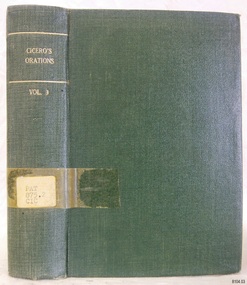 Flagstaff Hill Maritime Museum and Village
Book - Ancient Political Speeches/Reference, Henry George Bohn, The Orations of Marcus Tullius Cicero Vol 3, 1852
... family without noble political lineage he rose to Rome's highest office, the consulship, purely through his brilliant legal mind and unmatched public speaking skills. His political career was defined by a fierce defense of republican governance against military dictators like Julius Caesar. Ironically, the very speeches contained in this fourth volume, known as the Philippics, sealed his fate. Mark Antony never forgave Cicero for the brutal public insults in these orations. When Antony formed an alliance with Octavian (later Augustus), Cicero was placed on the proscription list, becoming officially condemned, and was eventually hunted...family without noble political lineage he rose to Rome's highest office, the consulship, purely through his brilliant legal mind and unmatched public speaking skills. His political career was defined by a fierce defense of republican governance against military dictators like Julius Caesar. Ironically, the very speeches contained in this fourth volume, known as the Philippics, sealed his fate. Mark Antony never forgave Cicero for the brutal public insults in these orations. When Antony formed an alliance with Octavian (later Augustus), Cicero was placed on the proscription list, becoming officially condemned, and was eventually hunted ...The Orations of Marcus Tullius Cicero, Vol. 3 contains some of the most dramatic political speeches in ancient history. Volume 3 of this 1852 edition pivots away from the sweeping state conspiracies found in other volumes and focuses intensely on Cicero's personal political survival and highly dramatic legal defense trials. To understand its contents, you have to look at Cicero's life right before these speeches were given. In 58 BC, Cicero’s bitter enemy, Clodius, passed a law that forced Cicero into exile and destroyed his homes. A year later, Cicero was triumphantly recalled to Rome. Volume 3 is entirely made up of the legal battles and political speeches that followed his return as he fought to reclaim his property, protect his allies, and attack his enemies. If Volume 4 is about Cicero trying to save the dying Roman Republic from Mark Antony, Volume 3 is about Cicero saving his own skin, rebuilding his career, and fighting the corrupt gang politics of 1st-century BC Rome.The Orations of Marcus Tullius Cicero Vol 3 Author: C D Yonge Publisher: Henry G Bohn Date: 1852 Green cloth hard cover with Library label, title & Vol number on spine in gold letteringnon-fictionThe Orations of Marcus Tullius Cicero, Vol. 3 contains some of the most dramatic political speeches in ancient history. Volume 3 of this 1852 edition pivots away from the sweeping state conspiracies found in other volumes and focuses intensely on Cicero's personal political survival and highly dramatic legal defense trials. To understand its contents, you have to look at Cicero's life right before these speeches were given. In 58 BC, Cicero’s bitter enemy, Clodius, passed a law that forced Cicero into exile and destroyed his homes. A year later, Cicero was triumphantly recalled to Rome. Volume 3 is entirely made up of the legal battles and political speeches that followed his return as he fought to reclaim his property, protect his allies, and attack his enemies. If Volume 4 is about Cicero trying to save the dying Roman Republic from Mark Antony, Volume 3 is about Cicero saving his own skin, rebuilding his career, and fighting the corrupt gang politics of 1st-century BC Rome.warrnambool, shipwrecked-coast, flagstaff-hill, flagstaff-hill-maritime-museum, maritime-museum, flagstaff-hill-maritime-village, shipwrecked-artefact, book, a life, guy de maupassant, warrnambool mechanics’ institute, pattison collection, warrnambool library, corangamite regional library service, warrnambool city librarian, mechanics’ institute library, victorian library board, warrnambool books and records, warrnambool children’s library, ralph eric pattison, marcus tullius cicero, c.d. yonge, bohn's classical library, english translations -
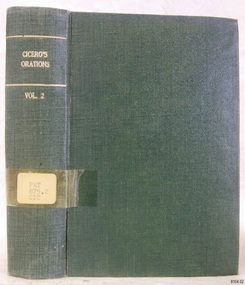 Flagstaff Hill Maritime Museum and Village
Book - Ancient Political Speeches/Reference, Henry George Bohn, The Orations of Marcus Tullius Cicero Vol 2, 1852
... family without noble political lineage he rose to Rome's highest office, the consulship, purely through his brilliant legal mind and unmatched public speaking skills. His political career was defined by a fierce defense of republican governance against military dictators like Julius Caesar. Ironically, the very speeches contained in this fourth volume, known as the Philippics, sealed his fate. Mark Antony never forgave Cicero for the brutal public insults in these orations. When Antony formed an alliance with Octavian (later Augustus), Cicero was placed on the proscription list, becoming officially condemned, and was eventually hunted...family without noble political lineage he rose to Rome's highest office, the consulship, purely through his brilliant legal mind and unmatched public speaking skills. His political career was defined by a fierce defense of republican governance against military dictators like Julius Caesar. Ironically, the very speeches contained in this fourth volume, known as the Philippics, sealed his fate. Mark Antony never forgave Cicero for the brutal public insults in these orations. When Antony formed an alliance with Octavian (later Augustus), Cicero was placed on the proscription list, becoming officially condemned, and was eventually hunted ...Volume 2 of the 1852 Henry G. Bohn edition is arguably the most famous and politically explosive volume in the entire four-part series. While Volume 3 handles his personal survival and Volume 4 addresses his final stand against Mark Antony, Volume 2 captures Cicero at the absolute absolute peak of his political power. This volume contains the speeches from his consulship (the highest office in Rome) in 63 BC, where he single handedly uncovered and dismantled a bloody coup designed to burn down the city of Rome. This volume allows the reader to see Cicero when he was the undisputed "Father of the Fatherland" (Pater Patriae), in this is the volume. It showcases him navigating political bribery, fighting for the cultural value of the arts, and ultimately crushing a domestic terrorist plot against the Roman state.The Orations of Marcus Tullius Cicero Vol 2 Author: C D Yonge Publisher: Henry G Bohn Date: 1852 Green cloth hard cover with Library label, title & Vol number on spine in gold letteringnon-fictionVolume 2 of the 1852 Henry G. Bohn edition is arguably the most famous and politically explosive volume in the entire four-part series. While Volume 3 handles his personal survival and Volume 4 addresses his final stand against Mark Antony, Volume 2 captures Cicero at the absolute absolute peak of his political power. This volume contains the speeches from his consulship (the highest office in Rome) in 63 BC, where he single handedly uncovered and dismantled a bloody coup designed to burn down the city of Rome. This volume allows the reader to see Cicero when he was the undisputed "Father of the Fatherland" (Pater Patriae), in this is the volume. It showcases him navigating political bribery, fighting for the cultural value of the arts, and ultimately crushing a domestic terrorist plot against the Roman state.warrnambool, shipwrecked-coast, flagstaff-hill, flagstaff-hill-maritime-museum, maritime-museum, flagstaff-hill-maritime-village, shipwrecked-artefact, book, a life, guy de maupassant, warrnambool mechanics’ institute, pattison collection, warrnambool library, corangamite regional library service, warrnambool city librarian, mechanics’ institute library, victorian library board, warrnambool books and records, warrnambool children’s library, ralph eric pattison, marcus tullius cicero, c.d. yonge, bohn's classical library, english translations -
 City of Moorabbin Historical Society (Operating the Box Cottage Museum)
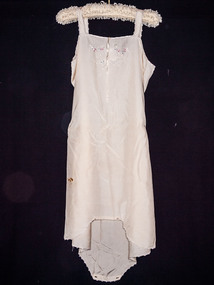
Clothing - Clothing, lady's underwear combination 'teddy', c1900
... Early settlers and market gardeners established their families in Moorabbin Shire and this item shows the skill and craftsmanship of the women of these families clothing crochet brighton moorabbin pioneers dressmaking market gardeners early settlers craftwork lacework moorabbin shire bentleigh mckinnon hunt ailsa dairy farms fruit orchards A lady's white cotton combination underwear with a buttoned crotch and hand worked decoration on bodice Clothing Clothing, lady's underwear combination 'teddy' ...This lady’s white cotton combination petticoat , commonly called a 'teddy', is an example of the dressmaking skills of the women of the early settlers families in Moorabbin Shire in the early 20th C . Early settlers and market gardeners established their families in Moorabbin Shire and this item shows the skill and craftsmanship of the women of these families A lady's white cotton combination underwear with a buttoned crotch and hand worked decoration on bodice clothing, crochet, brighton, moorabbin, pioneers, dressmaking, market gardeners, early settlers, craftwork, lacework, moorabbin shire, bentleigh, mckinnon, hunt ailsa, dairy farms, fruit orchards -
 City of Moorabbin Historical Society (Operating the Box Cottage Museum)
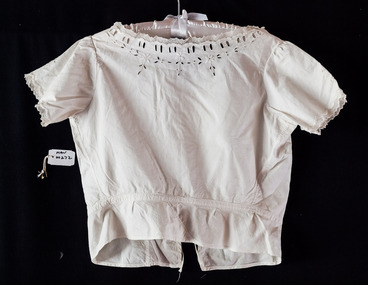
Clothing - Clothing, lady's chemise white cotton cut work c1900, c1910
... This chemise is an example of the dressmaking and needlework skills of the women of the early settlers families in Moorabbin Shire in the early 20th C Early settlers and market gardeners established their families in Moorabbin Shire c1900 and this item shows the skill and craftsmanship of the women of these families clothing crochet brighton moorabbin pioneers dressmaking market gardeners early settlers craftwork lacework moorabbin shire bentleigh mckinnon hunt ailsa dairy farms fruit orchards This lady’s white cotton chemise has short sleeves, and drawstring waist . ...This chemise is an example of the dressmaking and needlework skills of the women of the early settlers families in Moorabbin Shire in the early 20th C Early settlers and market gardeners established their families in Moorabbin Shire c1900 and this item shows the skill and craftsmanship of the women of these families This lady’s white cotton chemise has short sleeves, and drawstring waist . The neckline has cut work and needlework flowers and the cuffs have lace edging. is an example of the dressmaking skills of the women of the early settlers families in Moorabbin Shire in the early 20th C clothing, crochet, brighton, moorabbin, pioneers, dressmaking, market gardeners, early settlers, craftwork, lacework, moorabbin shire, bentleigh, mckinnon, hunt ailsa, dairy farms, fruit orchards -
 City of Moorabbin Historical Society (Operating the Box Cottage Museum)
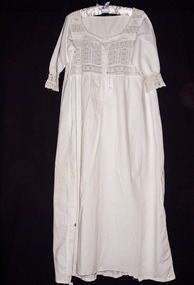
Clothing - Clothing, lady's long cotton nightgown c1900, c1900
... This lady’s cotton nightgown is an example of the dressmaking and lacework skills of the women of the early settlers families in Moorabbin Shire in the early 20th C Early settlers and market gardeners established their families in Moorabbin Shire c1900 and this item shows the skill and craftsmanship of the women of these families clothing crochet brighton moorabbin pioneers dressmaking market gardeners early settlers craftwork lacework moorabbin shire bentleigh mckinnon hunt ailsa dairy farms fruit orchards A lady's long white cotton nightdress with long sleeves , heart shaped neckline,and lace bodice.fastened with mother of pearl button. ...This lady’s cotton nightgown is an example of the dressmaking and lacework skills of the women of the early settlers families in Moorabbin Shire in the early 20th C Early settlers and market gardeners established their families in Moorabbin Shire c1900 and this item shows the skill and craftsmanship of the women of these families A lady's long white cotton nightdress with long sleeves , heart shaped neckline,and lace bodice.fastened with mother of pearl button. The cuffs have wide lace edging and ribbon insert lace midriff.clothing, crochet, brighton, moorabbin, pioneers, dressmaking, market gardeners, early settlers, craftwork, lacework, moorabbin shire, bentleigh, mckinnon, hunt ailsa, dairy farms, fruit orchards -
 City of Moorabbin Historical Society (Operating the Box Cottage Museum)
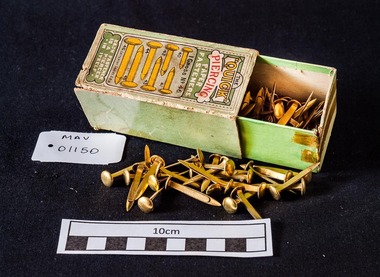
Manufactured objects, metal paper fasteners, c1950
... c1950 The family of Ailsa Hunt used these brass paper piercing fasteners at home and in office to secure sheets of paper.l...c1950 The family of Ailsa Hunt used these brass paper piercing fasteners at home and in office to secure sheets of paper.l These paper fasteners would have been use in most Offices and home during the mid 20th C in City of Moorabbin Box front THE / QUICK / PIERCING / PAPER/ FASTENER / 1 GROSS No. 46 - illustrations of various pin sizes - / EACH FASTENER / IS A PIERCER / IN ITSELF Rectangular green cardboard box with sliding insert that contains many brass piercing paper fasteners size 46 Manufactured objects, metal paper fasteners Unrecorded Manufacturer ...c1950 The family of Ailsa Hunt used these brass paper piercing fasteners at home and in office to secure sheets of paper.lThese paper fasteners would have been use in most Offices and home during the mid 20th C in City of MoorabbinRectangular green cardboard box with sliding insert that contains many brass piercing paper fasteners size 46Box front THE / QUICK / PIERCING / PAPER/ FASTENER / 1 GROSS No. 46 - illustrations of various pin sizes - / EACH FASTENER / IS A PIERCER / IN ITSELF -
 City of Moorabbin Historical Society (Operating the Box Cottage Museum)
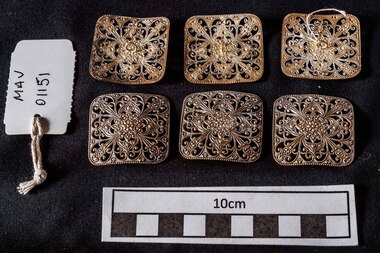
Manufactured Objects, x 6 buttons, white metal filigree, c1900
... These buttons were worn by a lady in the family of Ailsa Hunt in Moorabbin Shire ...These buttons were worn by a lady in the family of Ailsa Hunt in Moorabbin Shire These decorative white metal buttons were a common accessory for early settler women in Moorabbin Shire c1900 detachable silver buttons, footwear, shoes, buckles, clothing, silver, pewter, brass, white metal, victorian fashion, edwardian fashion, market gardeners, early settlers, moorabbin shire, bentleigh, mckinnon, moorabbin, cheltenham, wedding dresses, evening wear, 6x square white metal buttons with filigree design and attachment loop at back Manufactured Objects, x 6 buttons, white metal filigree Unrecorded metal worker ...c1900 These white metal buttons could be attached to a dress or jacket to possibly match or enhance decorative silver, pewter or brass buckles that were attached by ribbons or straps to plain shoes for evening and special occasions . These buttons were worn by a lady in the family of Ailsa Hunt in Moorabbin Shire These decorative white metal buttons were a common accessory for early settler women in Moorabbin Shire c19006x square white metal buttons with filigree design and attachment loop at backdetachable silver buttons, footwear, shoes, buckles, clothing, silver, pewter, brass, white metal, victorian fashion, edwardian fashion, market gardeners, early settlers, moorabbin shire, bentleigh, mckinnon, moorabbin, cheltenham, wedding dresses, evening wear, -
 City of Moorabbin Historical Society (Operating the Box Cottage Museum)
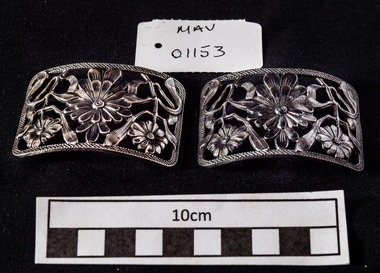
Manufactured Objects, 2x buckles white metal, c1900
... These buckles were worn by the a lady in the family of Ailsa Hunt in Moorabbin Shire...These buckles were worn by the a lady in the family of Ailsa Hunt in Moorabbin Shire These decorative shoe buckles were a common accessory for early settler women in Moorabbin Shire c1900 footwear, shoes, buckles, clothing, silver, pewter, brass, victorian fashion, edwardian fashion, market gardeners, early settlers, moorabbin shire, bentleigh, mckinnon, moorabbin, cheltenham, wedding dresses, evening wear, 2 x rectangular white metal buckles with floral filigree Manufactured Objects, 2x buckles white metal Unrecorded metal worker ...c1900 Decorative silver, pewter or brass buckles were attached by ribbons or straps to plain shoes for evening and special occasions . These buckles were worn by the a lady in the family of Ailsa Hunt in Moorabbin ShireThese decorative shoe buckles were a common accessory for early settler women in Moorabbin Shire c19002 x rectangular white metal buckles with floral filigreefootwear, shoes, buckles, clothing, silver, pewter, brass, victorian fashion, edwardian fashion, market gardeners, early settlers, moorabbin shire, bentleigh, mckinnon, moorabbin, cheltenham, wedding dresses, evening wear,
