
Showing 50 items matching "imperial japanese army"
-
 Bendigo Military Museum
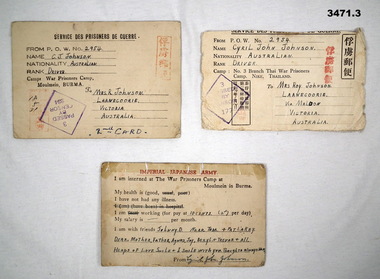
Postcard - CARDS, POW, c.1939 - 1945
... .1) Imperial Japanese Army POW card to Next of Kin. Plain cardboard. ...Imperial Japanese Army...Postcard CARDS, POW Imperial Japanese Army ...The cards relate to Cyril John Johnson VX36298 died as a POW. Refer 3144 for his service history..1) Imperial Japanese Army POW card to Next of Kin. Plain cardboard. Address side has From/Sender Park-Camp at Moulmein, Burma. .2) Imperial Japanese Army POW card to Next of Kin. Plain cardboard. Address side has From/Sender Park-Camp at Moulmein, Burma. .3) Imperial Japanese Army POW card to Next of Kin. Plain cardboard. States he is interned in POW Camp Moulmein, Burma. .1) - .3) Red stamped Japanese characters & stamped passed by censor. .1) Handwritten address side: To Mrs J Johnson Laanecourie Victoria Australia Signed: C J Johnson Handwritten bottom address side: 2nd Card .2) Handwritten address side: To Mrs J Johnson Laanecourie Victoria Australia Signed: Cyril John Johnson POW No 2954 .3) Handwritten address side: To Mrs J Johnson Laanecourie via Maldonpost cards, japanese -
 Bendigo Military Museum
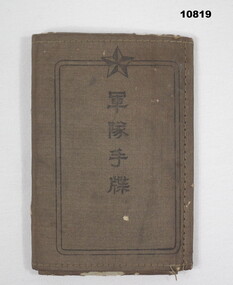
Booklet - IMPERIAL JAPANESE ARMY HANDBOOK, c.1937- 1945
... IMPERIAL JAPANESE ARMY HANDBOOK......Imperial Japanese Army...There is a buckram "pocket" sewn to that flap. Booklet IMPERIAL JAPANESE ARMY HANDBOOK ...Item collected by Gilbert Kerr Mackenzie No NX132907. Refer Cat No 10820.2 for his service details.When folded this is a pocket sized booklet. The cover is brown buckram. The inside of cover is white "Buckram". It has a hem around the edges, single stitching. One side has a tab which fits into a mating strip. This side has a box printed on it within which are two small and four large Japanese characters. The other side has a large box with four large Japanese characters surmounted with a five pointed star. When opened, the inner flaps also slot together. There are numerous pages of Japanese text on paper. Half of the pages are printed in red ink. Half in black ink. Near the rear of the book are some blank pages. There is a buckram "pocket" sewn to that flap.Google translater states it belonged to "Tadao Tanazawa"ww2, handbook, imperial japanese army -
 Dandenong/Cranbourne RSL Sub Branch
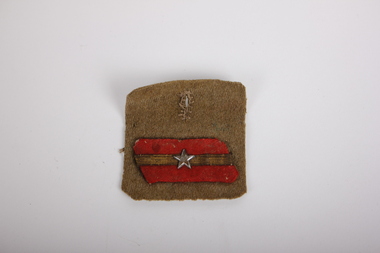
Badge - Collar Rank Insignia (Corporal). Imperial Japanese Army 1938-1945, Unknown
... Collar Rank Insignia (Corporal). Imperial Japanese Army 1938-1945...WWII significance Nil Cloth badge with metal rank insignia Badge Collar Rank Insignia (Corporal). Imperial Japanese Army 1938-1945 ...WWII significanceCloth badge with metal rank insigniaNil -
 Red Cliffs Military Museum
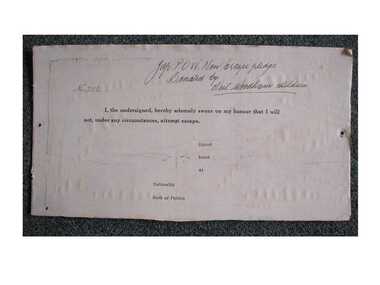
Non Escape Pledge, Imperial Japanese Army, circa 1940's
... Imperial Japanese Army...Non Escape Pledge Imperial Japanese Army ...paper document backed on cardboard of a pledge form for allied POW's not to escape. This is a copy and larger than the original.No T113,. I, the undersigned, hereby solemnly swear on my honour that I will not, under any circumstances, attempt to escape. Signed Dated At Nationality Rank or position -
 Bendigo Military Museum
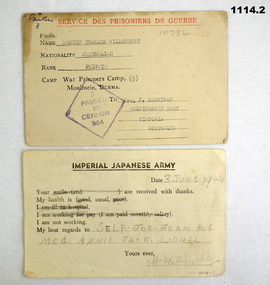
Postcard - POSTCARDS JAPANESE, 1, 3 June 1944, .2 est 1942-45
... Imperial Japanese Army...Postcard POSTCARDS JAPANESE Imperial Japanese Army ...These cards were filled out to give the impression that everything was okay. Merton Charles WILLOUGHBY VX54056, 2nd AIF, POW. Refer Cat No 1115 for his service details.Postcards, Japanese paper material for Austrlian POWs. On the front are the prisoner's details and the recipients. On the rear is a description of the person's health and the date. Card is a yellowish colour with Japanese inscription and a date. Cards are re. MC Willoughby..1 Handwritten in pen "Parker 4" .2 Handwritten in pen "Parker 3"willoughby, pow, postcards -
 Bendigo Military Museum
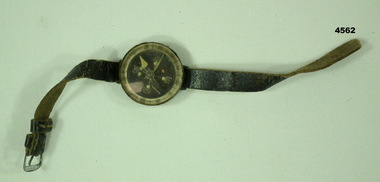
Equipment - COMPASS
... Imperial Japanese Army...Equipment COMPASS Imperial Japanese Army ...This compass was confiscated from a Japanese soldier, when the Japanese surrendered to the British in Hong Kong, September 1945. It was acquired by Squadron Leader Victor James RAF, stationed in Hong Kong and New Territories Refer Cat No 5084P.Small circular compass of 25mm diameter. It has a black dial. A simple double ended arrow indicates bearing, arrow also has glow in the dark material on end. It has a small black leather strap and buckle. The top outer circumference is divided into segments with Japanese symbols.japanese, wwii, raf, hong kong -
 Wangaratta RSL Sub Branch
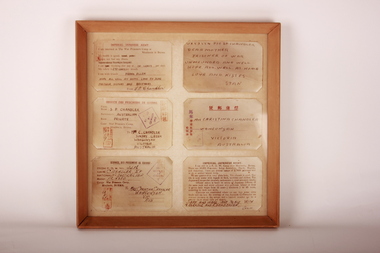
Postcard - Framed POW Postcards, Private S Chandler, c1940
... He was discharged on the 15/1/1946 The post cards were printed by the Imperial Japanese Army for POW's to send home that describes the good climate, food, medicine and clothes. ...Postcards printed by Imperial Japanese Army for POW's to send to families, describing their health and living conditions....Postcards printed by Imperial Japanese Army for POW's to send to families, describing their health and living conditions. ...Six POW postcards sent by Private Stanley Pascoe CHANDLER VX57554 to his mother Christina Chandler in Wahgunyah Victoria. Chandler was born in Wahgunyah and enlisted on the 11/6/1941 at Royal Park in Victoria. Chandler served with the 2/2nd Pioneer Battalion and was reported missing in Java in April 1942 during WW2. He was discharged on the 15/1/1946 The post cards were printed by the Imperial Japanese Army for POW's to send home that describes the good climate, food, medicine and clothes. They also allow room for a brief message. Chandler wrote that he was interred with his friend Frank Allen, received 10 cents per day and has not had any illness. POWs were supposed to be able to communicate with their family at home through the International Red Cross under certain conditions. For example, they were limited to 100 letters. However, in reality it was impossible for them to communicate with family more than once or twice during the duration of imprisonment, and there were camps where the POWs were not allowed to communicate with the world outside the camp at all. The average number of cards which the Japanese allowed to be sent out was from four to five for the whole period of captivity, and only some of these reached their destinations.Timber frame containing six POW postcards mounted on cardboard. Postcards printed by Imperial Japanese Army for POW's to send to families, describing their health and living conditions.Postcards have messages home, "Dear Mother, prisoner of war, unwounded and well. Hope all well at home. Love and kisses Stan".pow, world war 2, burma, wahgunyah victoria, prisoner of war, stanley pascoe chandler -
 Wangaratta RSL Sub Branch
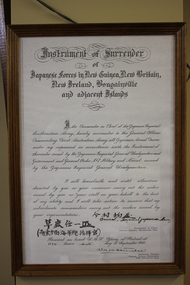
Document - Framed Document, Instrument of Surrender of Japanese Forces, C1945
... ...imperial japanese army...Commander in Chief Japanese Imperial Southeastern Army. Received on board H.M.S. ...Commander in Chief Japanese Imperial Southeastern Army. Received on board H.M.S. ...With the Japanese cities of Hiroshima and Nagasaki destroyed by atomic weapons, the will of the Japanese leadership was tested Emperor Showa of Japan announced his intention to surrender to the Allies unconditionally over public radio on 15 Aug 1945. The date of Japan's formal surrender was 2 Sep 1945, and it took place aboard American battleship Missouri in Tokyo Bay. There were other surrender ceremonies including that on Sept 6 1945. At 0900 hours, sloop HMS Hart picked up Hitoshi Imamura and Jinichi Kusaka at Kabanga Bay, who would sign the surrender documents aboard HMS Glory at 1127 hours which surrendered 139,000 remaining personnel at Rabaul plus all forces in Australian territory in the South Pacific. The surrender of Imperial Japan was announced on August 15 and formally signed on September 2, 1945, bringing the hostilities of World War II to a close. The surrender ceremony at Rabaul, New Britain took place on 6 Sep 1945 aboard the British carrier HMS Glory surrendering 139,000 remaining personnel at Rabaul plus all forces in Australian territory in the South Pacific. Light brown frame with glass, of a black and white photocopy. Script is very ornate and has Japanese lettering at the bottom. Instument of Surrender of Japanese Forces in New Guinea, New Britain, New Ireland, Bougainville and adjacent Islands. I the Commander in Chief of the Japanese Imperial Southeastern Army, hereby surrender to the General Officer Commanding First Australian Army all Japanese Armed Forces under my command in accordance with the Instrument of Surrender issued by the Japanese Imperial General Headquarters and Government and General Order No.1 Military and Naval issued by the Japanese imperial General Headquarters. I will henceforth and until otherwise directed by you or your successor carry out the orders issued by you or your staff on your behalf to the best of my ability and I will take action to ensure that my subordinate commanders carry out the orders issued by your representatives. Commander in Chief Japanese Imperial Southeastern Army. Received on board H.M.S. Glory off Rabaul at 1130 hours sixth day of September 1945. Lieutenant General General Officer Commanding First Australian Army.wwii, world war 2, imperial japanese army, japanese army, surrender, rabaul -
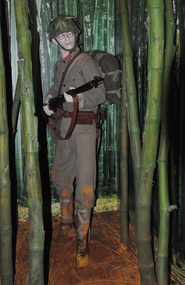 Australian Army Museum of Western Australia
Diorama, 2015
... 1:1 scale diorama showing soldier of Imperial Japanese Army advancing through jungle in Malaya January 1942...A private soldier is shown cautiously advancing down a jungle track outflanking Allied defensive positions fall of singapore, 8th australian division 1:1 scale diorama showing soldier of Imperial Japanese Army advancing through jungle in Malaya January 1942 Diorama ...This diorama is the introductory feature in the World War 2 Gallery - South West Pacific area. A private soldier is shown cautiously advancing down a jungle track outflanking Allied defensive positions1:1 scale diorama showing soldier of Imperial Japanese Army advancing through jungle in Malaya January 1942fall of singapore, 8th australian division -
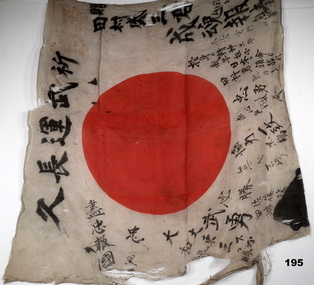 Bendigo Military Museum
Flag - FLAG - IMPERIAL JAPANESE, c.1939-1945
... ...Imperial Japanese Army...Thompson VX62115, 42nd Aust Landing Craft Coy. 2 AIF. Flags Imperial Japanese Army World War 2 Japanese writing - handwritten in black ink. ...The flag was captured by R. Thompson VX62115, 42nd Aust Landing Craft Coy. 2 AIF. Rectangular silk flag grey in colour with a solid red circle in the centre which is 40cm in diameter. The red circle is surrounded by Japanese writing in black ink. A large black ink stain is along one edge. Japanese writing - handwritten in black ink.flags, imperial japanese army, world war 2 -
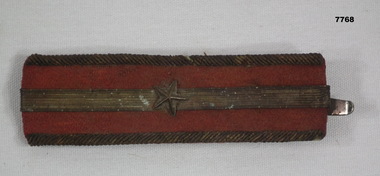 Bendigo Military Museum
Uniform - RANK INSIGNIA, IMPERIAL JAPANESE
... ...Imperial Japanese Army....Imperial Japanese Officer's insignia, WW2. Part of the "Robert H. Baron", No. 3596, and Cooper Collections. See Catalogue No. 1981P for details of Baron's service. Robert H. Baron Cooper Collection Insignia Imperial Japanese Army ...Possibly an Imperial Japanese Officer's insignia, WW2. Part of the "Robert H. Baron", No. 3596, and Cooper Collections. See Catalogue No. 1981P for details of Baron's service.Rectangular Imperial Japanese rank insignia. Edged on two sides with metal braiding. Strip down centre originally gold coloured. Five pointed star in middle of centre strip. Background is red coloured fabric. Silver coloured metal fastener attached to back.robert h. baron, cooper collection, insignia, imperial japanese army. -
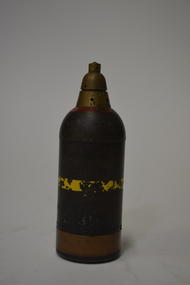 Wangaratta RSL Sub Branch
Weapon - Mortar, c1940
... japan...mortar...mortar shell...imperial japanese army...These shells were accurate, deadly, and added a great deal of firepower to Japanese forces during WWII. ww2 wwii world war two second world war japan mortar mortar shell imperial japanese army Brown metal round in shape with pointed top features original paint with a yellow band on body and a red band at the top. ...Designed specifically for the Japanese, this 50mm mortar shell Type 89 Grenade Discharger was also known as a “Knee Mortar” by Allied forces. These shells were accurate, deadly, and added a great deal of firepower to Japanese forces during WWII.Brown metal round in shape with pointed top features original paint with a yellow band on body and a red band at the top. ww2, wwii, world war two, second world war, japan, mortar, mortar shell, imperial japanese army -
 Moorabbin Air Museum
Book - The Empire Express, Charles L. Scrivner, The Empire Express: The story of the U.S. Navy PV squadron' aerial strikes against the Japanese Kuriles during WWII
... ...Imperial Japanese Army Air Service...WW2 Pacific Theatre Imperial Japanese Army Air Service United States Air force Second World War The book covers the Aeronautical action that occurred between the Japanese and Americans in the northern pacific islands during the second world war. ...The book covers the Aeronautical action that occurred between the Japanese and Americans in the northern pacific islands during the second world war. It focuses on the aircraft and action that occurred between the Kuril Islands and Aleutian IslandsThe front cover is a stylised image of a sea plane over a body of coastal water. The image was created by Paul Matt.non-fictionThe book covers the Aeronautical action that occurred between the Japanese and Americans in the northern pacific islands during the second world war. It focuses on the aircraft and action that occurred between the Kuril Islands and Aleutian Islandsww2, pacific theatre, imperial japanese army air service, united states air force, second world war -
 Ringwood RSL Sub-Branch
Equipment - bayonet and scabbard, Circa WW2
... Imperial Japanese Army...Captured in PNG Imperial Japanese Army Japanese Army bayonet Japanese Arasaka bayonet World War Two WWII WW2 Second World War 8(in a circle), 2 (in a diamond), Japanese Arasaka Bayonet complete with scabbard and leather bayonet frog bayonet and scabbard Equipment bayonet and scabbard ...Captured in PNGJapanese Arasaka Bayonet complete with scabbard and leather bayonet frog8(in a circle), 2 (in a diamond),imperial japanese army, japanese army, bayonet, japanese arasaka bayonet, world war two, wwii, ww2, second world war -
 Dandenong/Cranbourne RSL Sub Branch
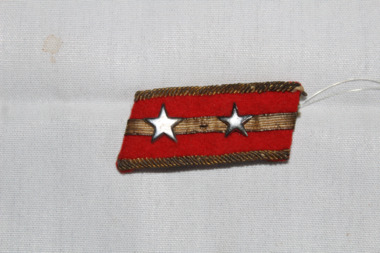
IJA Collar Badge, Circa 1940's
... Imperial Japanese Army Infantry Lieutenant's collar insignia. ...Imperial Japanese Army Infantry Lieutenant's collar insignia. ...Imperial Japanese Army Infantry Lieutenant's collar insignia. Two silver stars on red material and three rows of gold wire braid. -
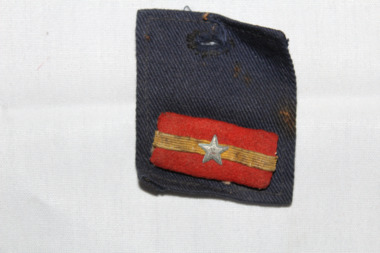 Dandenong/Cranbourne RSL Sub Branch
Memorabilia - IJA Collar Badge, Circa 1940's
... Imperial Japanese Army Infantry Corporal's collar insignia. ...Imperial Japanese Army Infantry Corporal's collar insignia. ...Imperial Japanese Army Infantry Corporal's collar insignia. One silver star on soiled red material and soiled gold braid mounted on a blue cloth patch. -
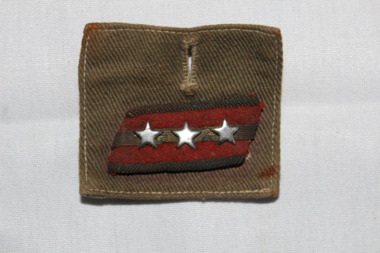 Dandenong/Cranbourne RSL Sub Branch
Memorabilia - IJA Collar Badge, Circa 1940's
... Imperial Japanese Army Infantry Captain's collar insignia. ...Imperial Japanese Army Infantry Captain's collar insignia. ...Imperial Japanese Army Infantry Captain's collar insignia. Three silver stars on soiled red material and three rows of tarnished gold wire braid mounted on a square khaki patch. -
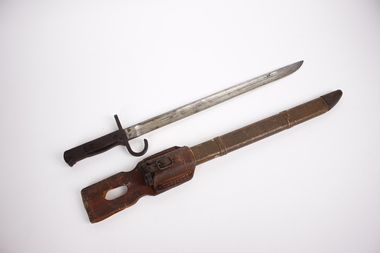 Dandenong/Cranbourne RSL Sub Branch
Weapon - Japanese Bayonet
... The Japanese type 30 bayonet was used by the Imperial Japanese Army during WWII. ...The Japanese type 30 bayonet was used by the Imperial Japanese Army during WWII. japan wwii world war two bayonet weapon war military Bayonet in wooden scabbard with leather holster. ...The Japanese type 30 bayonet was used by the Imperial Japanese Army during WWII. Bayonet in wooden scabbard with leather holster. japan, wwii, world war two, bayonet, weapon, war, military -
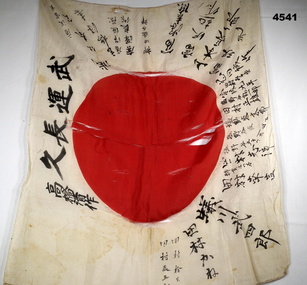 Bendigo Military Museum
Flag - FLAG - IMPERIAL JAPANESE, c. 1935 - 1945
... ...Japanese Imperial Army...Pre service as V245126 from 5.11.1941 - 10.12.1942, transfer to the 2nd AIF No VX120814 1.12.1942 age 20 years, served on Moravian and Borneo from 8.4.1945 0 26.1.1946, discharged from the Army 16.7.1946 as a Pte in 2/32nd BN. Flags Japanese Imperial Army World War 2 Japanese writing - handwritten in black ink. ...This flag was taken on Morotai in 1945 by B. Olsson VX120814 2/32 Battalion, 2nd AIF. Pre service as V245126 from 5.11.1941 - 10.12.1942, transfer to the 2nd AIF No VX120814 1.12.1942 age 20 years, served on Moravian and Borneo from 8.4.1945 0 26.1.1946, discharged from the Army 16.7.1946 as a Pte in 2/32nd BN.Rectangular silk flag white in colour with a solid red circle in the middle which is 40cm in diameter. The red circle is surrounded by Japanese writing in black ink. The flag is edged with black and red stitching. Silk cords are attached to two adjacent corners.Japanese writing - handwritten in black ink.flags, japanese imperial army, world war 2 -
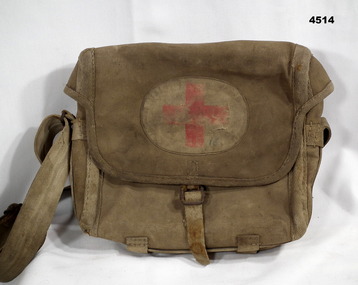 Bendigo Military Museum
Equipment - MEDICAL BAG, C.WW2
... This medical bag is possibly a Japanese Imperial Army WW2 era....This medical bag is possibly a Japanese Imperial Army WW2 era. Equipment medical bags Top flap left side, “7904”, front flap, “16”, front of bag, “16” left corner. ...This medical bag is possibly a Japanese Imperial Army WW2 era.Medical bag, canvas, Kahki colour, adjustable carry strap, rusted fittings, back strap with fittings, front of flap has a Red Cross emblem.Top flap left side, “7904”, front flap, “16”, front of bag, “16” left corner.equipment, medical bags -
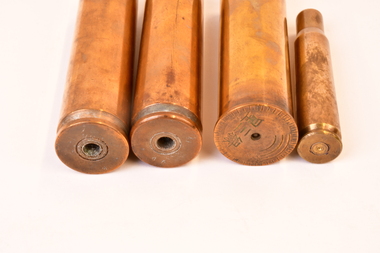 Chiltern Athenaeum Trust
Military Ammunition rounds WW1, circa 1914-1918
... Used by the Japanese Imperial Army for WW1 when they were allies with Britain. ...Used by the Japanese Imperial Army for WW1 when they were allies with Britain. 4 rounds of ammunition WW1 related Military Ammunition rounds WW1 ...WW1 1914-1918 Japanese figures on one of the rounds. Used by Japanese when allies with Britain. WW1 1914-1918 Japanese allies Military Rounds WW14 rounds of ammunition WW1 relatedJapanese markings on one of the bullet rounds. Used by the Japanese Imperial Army for WW1 when they were allies with Britain. ww1, the great war 1914-1918 -
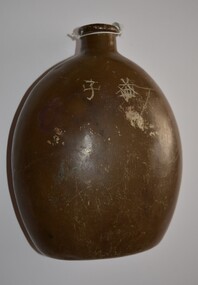 Wangaratta RSL Sub Branch
Souvenir - Japanese Water Canteen, C1930
... In 1930, the Japanese army received a slew of new field and uniform items in an effort to keep the Imperial Japanese army a modern fighting force. ...In 1930, the Japanese army received a slew of new field and uniform items in an effort to keep the Imperial Japanese army a modern fighting force. ...In 1930, the Japanese army received a slew of new field and uniform items in an effort to keep the Imperial Japanese army a modern fighting force. Included in the equipment package was a new canteen known as Sho-5 and holds 1 litre of water. Since the canteen was such an integral part of a Japanese soldiers kit, it is common to find their name written or sewn into the harness, or scratched into the canteens body. Allied troops fighting in the Pacific routinely collected Japanese field gear as combat trophies. The item has no known history but there appears to be a name scratched on the canteen together with a Japanese maker’s stamp impressed on the base. Brown painted aluminium kidney shaped water canteen.ww2, japanese canteen, sho-5 -
 Bendigo Military Museum
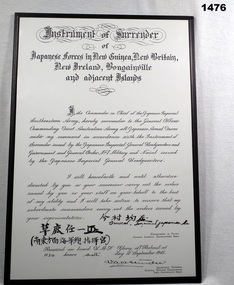
Certificate - CERTIFICATE OF SURRENDER MOUNTED, 6/9/1945
... Signed by Vernon Sturdee, LT General First Australian Army and Commander in Chief Japanese Imperial Southeastern Army (signed in Japanese characters)....documents-certificates japan military history Surrender Signed by Vernon Sturdee, LT General First Australian Army and Commander in Chief Japanese Imperial Southeastern Army (signed in Japanese characters). ...Copy of Instrument of Surrender of Japanese forces in New Guinea, New Britain, New Ireland, Bougainville and Adjacent islands 6th Sept 1945Signed by Vernon Sturdee, LT General First Australian Army and Commander in Chief Japanese Imperial Southeastern Army (signed in Japanese characters).documents-certificates, japan, military history, surrender -
 Bendigo Military Museum
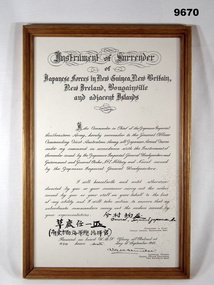
Document - FRAMED, WW2, 1945
... Signed by "COMMANDER IN CHIEF/ JAPANESE IMPERIAL SOUTHEASTERN ARMY LIEUTENANT GENERAL/ GENERAL OFFICER COMMANDING/ FIRST AUSTRALIAN ARMY"....Signed by "COMMANDER IN CHIEF/ JAPANESE IMPERIAL SOUTHEASTERN ARMY LIEUTENANT GENERAL/ GENERAL OFFICER COMMANDING/ FIRST AUSTRALIAN ARMY". ..."Instrument of surrender/ of/ Japanese forces in New Guinea, New Britain/ New Ireland, Bougainville/ and adjacent Islands". Signed by "COMMANDER IN CHIEF/ JAPANESE IMPERIAL SOUTHEASTERN ARMY LIEUTENANT GENERAL/ GENERAL OFFICER COMMANDING/ FIRST AUSTRALIAN ARMY".Document - white colour paper, copy of original document. Black ink print with clear plastic laminate applied. Frame - timber, light brown colour varnish, decorative moulding. No glass front. Backing - timber plywood.framed accessories, document', ww2, japanese surrender -
 Bendigo Military Museum
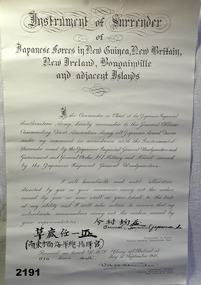
Document - SURRENDER DOCUMENT WW2, 6.9.45 (copy)
... Black writing, signed by Commander Japanese Imperial Army & Gen Sturdee Commanding First Australian Army. ...Black writing, signed by Commander Japanese Imperial Army & Gen Sturdee Commanding First Australian Army. ...This is a copy of the original.On white shiny paper The Instrument of Surrender of Japanese Forces in New Guinea, New Britain, New Ireland, Bouganville & Adjacent Islands. Black writing, signed by Commander Japanese Imperial Army & Gen Sturdee Commanding First Australian Army. Dated 6.9.45 at 11:30 hours.documents - military, surrender, japanese -
 Wangaratta RSL Sub Branch
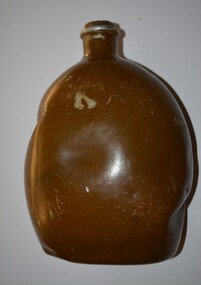
Souvenir - Japanese Water Canteen, C1930
... In 1930, the Japanese army received a slew of new field and uniform items in an effort to keep the Imperial Japanese army a modern fighting force. ...In 1930, the Japanese army received a slew of new field and uniform items in an effort to keep the Imperial Japanese army a modern fighting force. ...In 1930, the Japanese army received a slew of new field and uniform items in an effort to keep the Imperial Japanese army a modern fighting force. Included in the equipment package was a new canteen known as Sho-5 and holds 1 litre of water. Since the canteen was such an integral part of a Japanese soldiers kit, it is common to find their name written or sewn into the harness, or scratched into the canteens body. Allied troops fighting in the Pacific routinely collected Japanese field gear as combat trophies. The item has Japanese maker’s stamp impressed on the base but no known history and was likely souvenired by Capt.Frederick Roy Phillips VX102776/V148225 born 9/12/1907 at Yackandandah. Known as Dr Roy Phillips OAM he was assigned to the 7th Aust CCS/AAMC as a Medical Practitioner. He served with the AMF 6/6/42-25/8/42 and AIF from 26/8/42 until his appointment was terminated on 26/2/1946. In 1945 he was deployed overseas to Milne Bay, New Guinea and Moratai, Borneo with the Plastic Surgery Unit. Following WW2 he was a general medical practitioner in Wangaratta and died on the 4/9/2006. Brown painted aluminium kidney shaped water canteen with stopperJapanese marking impressed on baseww2, japanese canteen, sho-5 -
 Sunshine and District Historical Society Incorporated
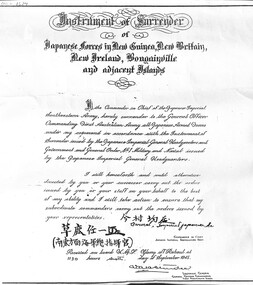
Document - Instrument of Surrender of Japanese Forces in New Guinea, New Britain, New Ireland, Bougainville and adjacent Islands, 6/09/1945 12:00:00 AM
... A photocopy of the Instrument of Surrender by the Japanese forces to the First Australian Army, recieved on board HMS Glory off Rabaul at 1130 hours, on 6th September 1945. The document is typed, and is signed by the Commander-in-Chief of the Japanese Imperial Southeastern Army, and the Lieutenant General, General Officer Commanding of the First Australian Army....World War 1939 - 1945 A photocopy of the Instrument of Surrender by the Japanese forces to the First Australian Army, recieved on board HMS Glory off Rabaul at 1130 hours, on 6th September 1945. The document is typed, and is signed by the Commander-in-Chief of the Japanese Imperial Southeastern Army, and the Lieutenant General, General Officer Commanding of the First Australian Army. ...world war 1939 - 1945 -
 Bendigo Historical Society Inc.
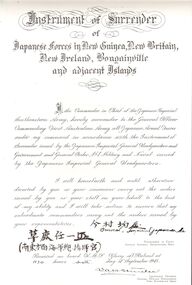
Document - INSTRUMENT OF SURRENDER OF JAPANESE FORCES, 1945
... Signed by the Commander in Chief of the Japanese Imperial Southeastern Army and the Lieutenant General, General Officer Commanding First Australian army. ...Signed by the Commander in Chief of the Japanese Imperial Southeastern Army and the Lieutenant General, General Officer Commanding First Australian army. ...Three photocopies of the Instrument of Surrender of Japanese Forces in New Guinea, New Britain, New Ireland, Bougainville and adjacent islands. Signed by the Commander in Chief of the Japanese Imperial Southeastern Army and the Lieutenant General, General Officer Commanding First Australian army. Received on board H.M.S. Glory off Rabaul at 1130 hours, sixth day of September 1945.document, certificate, instrument of surrender -
 Bendigo Military Museum
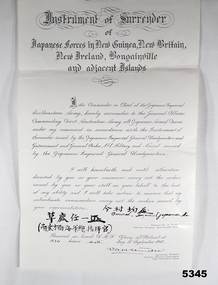
Certificate - INSTRUMENT of SURRENDER
... Signed 6th Sept 1945 by Commander Japanese Imperial South Eastern Army and by Lt. General Commanding First Australian Army....Signed 6th Sept 1945 by Commander Japanese Imperial South Eastern Army and by Lt. General Commanding First Australian Army. ...Certificate of Instrument of Surrender of the Japanese Forces of New Guinea, New Britain, New Ireland, Bougainville and adjacent Islands. Signed 6th Sept 1945 by Commander Japanese Imperial South Eastern Army and by Lt. General Commanding First Australian Army.White hard paper certificate - single page.instrument of surrender, new guinea, vp day -
 Melbourne Legacy
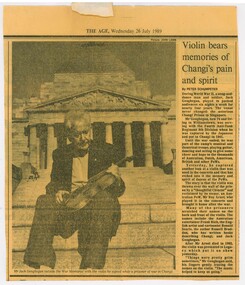
Newspaper - Article, Violin bears memories of Changi's pain and spirit, 1989
... Imperial Force Concert Party, in the Changi POW camp, Singapore from 1942-1945. It is claimed that the violin, in its case was thrown over the wall by a Chinese civilian. Roy Arnel, a South African by birth enlisted on 7 June 1940 at Royal Park, Melbourne and served with 2 AASC Company as a driver. He was captured by the Japanese Imperial Army...Imperial Force Concert Party, in the Changi POW camp, Singapore from 1942-1945. It is claimed that the violin, in its case was thrown over the wall by a Chinese civilian. Roy Arnel, a South African by birth enlisted on 7 June 1940 at Royal Park, Melbourne and served with 2 AASC Company as a driver. He was captured by the Japanese Imperial Army ...A newspaper article with a photo of veteran Jack Geoghegan holding the violin that is part of Melbourne Legacy's collection (see 00080) at The Shrine. Mr Geoghegan was a Prisoner of War in Changi prison. He remembered playing in the concerts that the violin was used in. His signature is one of many, that had signed the violin. Background: This violin was played by VX30301 Dvr Roy Arnel, as a member of the Australian Imperial Force Concert Party, in the Changi POW camp, Singapore from 1942-1945. It is claimed that the violin, in its case was thrown over the wall by a Chinese civilian. Roy Arnel, a South African by birth enlisted on 7 June 1940 at Royal Park, Melbourne and served with 2 AASC Company as a driver. He was captured by the Japanese Imperial Army at the fall of Singapore in February 1942.A record that the violin was of importance to many people during their internment.Newspaper article about the Changi violin published in The Age 26 July 1989.changi violin, pow
