
Showing 146 items matching "in times past"
-
 Clunes Museum
Book, TIMES PAST, 1987 - 1988
... TIMES PAST...FOUR VOLUMES ENTITLED "TIMES PAST" IN DARK BLUE BINDERS, WITH GOLD LETTERING....TIMES PAST...TIMES PAST Book BOOK ...LOOKING AT THE WORLD OF ANTIQUES. EACH PART FOCUSING ON A SINGLE ROOM SETTING FROM A SPECIFIC HISTORICAL PERIOD.FOUR VOLUMES ENTITLED "TIMES PAST" IN DARK BLUE BINDERS, WITH GOLD LETTERING.non-fiction LOOKING AT THE WORLD OF ANTIQUES. EACH PART FOCUSING ON A SINGLE ROOM SETTING FROM A SPECIFIC HISTORICAL PERIOD.local history, book, reference, antiques -
 Narre Warren and District Family History Group
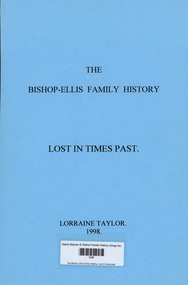
Book, Lorraine Taylor, The Bishop- Ellis Family History. Lost in times past, 1998
... The Bishop- Ellis Family History. Lost in times past....The Bishop- Ellis Family History. Lost in times past. Book Lorraine Taylor ...This story is the history of William Benjamin Ellis and his wife Mary Ann and Woodroffe Bishop.non-fictionThis story is the history of William Benjamin Ellis and his wife Mary Ann and Woodroffe Bishop.william benjamin ellis, woodroffe bishop -
Moorabbin Air Museum
Book - Rockets - technical history, Express to the Stars
... ...In times past...Rockets - technical history Faraway places In times past How a rocket works Rockets in flight Construction of a rocket On & off the pad Instrumentation The firing range Rocket sounding Messengers of destruction The rocket plane Towards the stars Extending man's dominion Theoretical and practical overview of rocketry circa 1962 Express to the Stars Book Rockets - technical history ...Theoretical and practical overview of rocketry circa 1962non-fictionTheoretical and practical overview of rocketry circa 1962faraway places, in times past, how a rocket works, rockets in flight, construction of a rocket, on & off the pad, instrumentation, the firing range, rocket sounding, messengers of destruction, the rocket plane, towards the stars, extending man's dominion -
 Sunbury Family History and Heritage Society Inc.
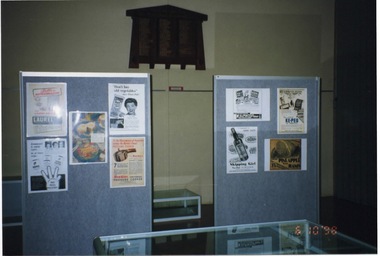
Photograph, October 1998
... ...'Times Past' Exhibition...The display of advertisements were part of a 'Times Past' exhibition mounted in the former George Evans Museum in Sunbury in October 1998. ...A non-digital coloured photograph of a variety of copies of advertisements of domestic items from past times. hey are displayed on two boards in a museum....The display of advertisements were part of a 'Times Past' exhibition mounted in the former George Evans Museum in Sunbury in October 1998. ...The display of advertisements were part of a 'Times Past' exhibition mounted in the former George Evans Museum in Sunbury in October 1998. As the name suggests the exhibition featured a variety of domestic items that were used by many people in past years. IT was mounted by the members of the Sunbury & District Heritage Association. The exhibition was one of many featuring aspects of Sunbury's history that have been mounted in the George Evans Museum.A non-digital coloured photograph of a variety of copies of advertisements of domestic items from past times. hey are displayed on two boards in a museum.exhibitions, 'times past' exhibition, george evans museum, sunbury, sunbury & district heritage association -
 Orbost & District Historical Society
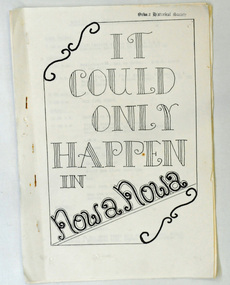
magazine, It Could Only Happen in Nowa Nowa, 1988
... It contains stories of times past. The sheets are stapled and are black print on white....It contains stories of times past. The sheets are stapled and are black print on white. ...This magazine seems to be a single issue produced for use at the Nowa Nowa Back To in 1988.This magazine seems to be a single issue produced for use at the Nowa Nowa Back To in 1988 and records some of the history of Nowa Nowa.A magazine titled "It Could Only Happen In Nowa Nowa". It contains a program for the Back To Nowa Nowa event in 1988. It contains stories of times past. The sheets are stapled and are black print on white.magazine nowa-nowa -
 Bendigo Historical Society Inc.
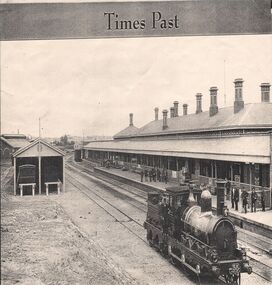
Newspaper - BENDIGO RAILWAY STATION: STEAM TRAIN AT STATION
... On top of cutting 'Times Past' Image shows steam engine at Bendigo Railway Station. ...On top of cutting 'Times Past' Image shows steam engine at Bendigo Railway Station. ...Cutting from newspaper, unknown source. On top of cutting 'Times Past' Image shows steam engine at Bendigo Railway Station. People standing on platform, steam engine in foreground LH side.bendigo, hospital -
 Warrnambool and District Historical Society Inc.
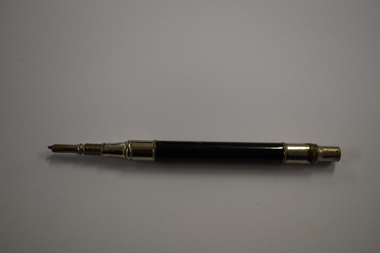
Article - Propelling pencil
... This pencil was a quality item that would have been carried on the person in times past....This pencil was a quality item that would have been carried on the person in times past. This item has no known provenance and is retained for display purposes. ...This pencil was a quality item that would have been carried on the person in times past.This item has no known provenance and is retained for display purposes.The pencil is made of brown composite material set in silver coloured metal. The top section has a propelling mechanism with a writing tip. The end part screws open for refilling the writing tube.warrnambool history, vintage personal item -
 Diamond Valley Vietnam Veterans Sub-Branch
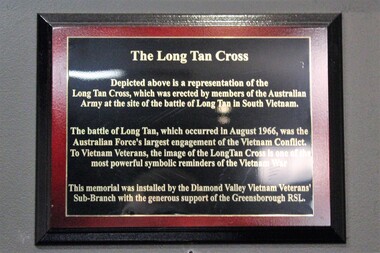
Plaque - Long Tan, circa 2000
... From birth of the Sub Branch, this plaque is what is looked towards in reflection of times past....From birth of the Sub Branch, this plaque is what is looked towards in reflection of times past. The Long Tan Cross is highly significant to all Vietnam Veterans; this plaque is highly significant to members of the Diamond Valley Sub Branch. vietnam vietnam war diamond valley vietnam veterans sub branch Text describing the historic background of the Long Tan Cross. ...From birth of the Sub Branch, this plaque is what is looked towards in reflection of times past.The Long Tan Cross is highly significant to all Vietnam Veterans; this plaque is highly significant to members of the Diamond Valley Sub Branch.Rectangular wooden plaque with black face and gold lettering describing the historical background of the Long Tan Cross.Text describing the historic background of the Long Tan Cross.vietnam, vietnam war, diamond valley vietnam veterans sub branch -
 Warrnambool and District Historical Society Inc.
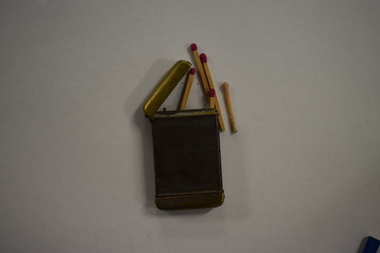
Accessory - Matches Holder, Early 20th Century
... It was a common object carried on the person or found in a home in times past. It was a convenient object to store and light matches during the 19th and early 20th centuries....It was a common object carried on the person or found in a home in times past. It was a convenient object to store and light matches during the 19th and early 20th centuries. ...This item has no known provenance. It was a common object carried on the person or found in a home in times past. It was a convenient object to store and light matches during the 19th and early 20th centuries.This item is of minor interest and is retained for display purposes.A metal container with brass base and lid. The lid is hinged and has a serrated groove on which to strike the matches. It contains four matches. The object is worn. Nilmatch holder, match conainer, warrnambool history, match case -
 Warrnambool and District Historical Society Inc.
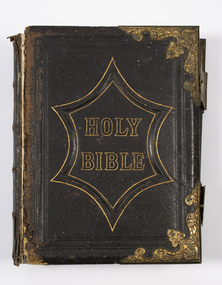
Book - Bible, Rev. John Eadie, United Presbyterian Church, The Illustrated National Family Bible, late 19th century
... It has been a very ornate and expensive one and would have belonged to an affluent family in times past when a Bible was used to record family information and to be the centre of daily family prayers and readings. ...It has been a very ornate and expensive one and would have belonged to an affluent family in times past when a Bible was used to record family information and to be the centre of daily family prayers and readings. ...This is a bible published in the 19th century.19th century BibleThis Bible has a brown leather cover with gold metal scrolls on the corners. There is gold print on the spine and front cover and a gold pattern on the front. The front cover is detached and very tattered. The pages are gilt edged and contain some torn pages, printed text and a Biblical Encyclopedia at the back. There are gold metal hinges with clips on the open edges of the cover to keep the book shut. All the illustrations have been cut out.non-fictionThis is a bible published in the 19th century.19th century Bibleantiquarian family bibles, bible, warrnambool, 19th century bible -
Federation University Historical Collection
Booklet, Ballarat School of Mines Student's Magazine, Fourth Term, 1902, 1902
... Table of contents: Editorial, A new system of sinking shafts, Steam turbines, The Gulf stream myth, Science notes, Western sketches, Science in song, Students' Excursion to Melbourne, Out of the jaws of death, Ballarat scientific and literary society, Signs of the times, Past students, News and notes, Correspondence, Sports....Table of contents: Editorial, A new system of sinking shafts, Steam turbines, The Gulf stream myth, Science notes, Western sketches, Science in song, Students' Excursion to Melbourne, Out of the jaws of death, Ballarat scientific and literary society, Signs of the times, Past students, News and notes, Correspondence, Sports. ballarat school of mines students' magazine w. t. gill sidney smith ohe jay o. e. jager gilbert mcintyre w. davey w. t. atherton e. p. johnson Gulf stream myth Ballarat scientific and literary society Pale brown booklet of 16 pages Ballarat School of Mines Student's Magazine, Fourth Term, 1902 Booklet Berry Anderson & Co. ...Table of contents: Editorial, A new system of sinking shafts, Steam turbines, The Gulf stream myth, Science notes, Western sketches, Science in song, Students' Excursion to Melbourne, Out of the jaws of death, Ballarat scientific and literary society, Signs of the times, Past students, News and notes, Correspondence, Sports.Pale brown booklet of 16 pagesballarat school of mines, students' magazine, w. t. gill, sidney smith, ohe jay, o. e. jager, gilbert mcintyre, w. davey, w. t. atherton, e. p. johnson, gulf stream myth, ballarat scientific and literary society -
 Melbourne Tram Museum
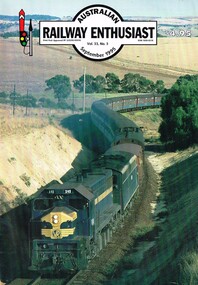
Magazine, William F Scott, "Times Past", Sep. 1995
... "Times Past"...Australian Railway Enthusiast Magazine - September 1995, pager 9 (note dated June 1995 on this page only), featuring photographs of cable trams with the heading "Times Past" with captions by William F. Scott....Trams tramways Cable Trams South Melbourne North Fitzroy Bogie Cable Trailers Sydney Rd tram 472 Australian Railway Enthusiast Magazine - September 1995, pager 9 (note dated June 1995 on this page only), featuring photographs of cable trams with the heading "Times Past" with captions by William F. Scott. ...Australian Railway Enthusiast Magazine - September 1995, pager 9 (note dated June 1995 on this page only), featuring photographs of cable trams with the heading "Times Past" with captions by William F. Scott. - cable car set - bogie trailer - side on view - bogie car 472 in Sydney Road - cable car set at South Melbourne terminus, Victoria St MMTB with the destination of North Fitzroy, c1923 Also has an obituary on Eldon Hogan who died on 6/5/1995.trams, tramways, cable trams, south melbourne, north fitzroy, bogie cable trailers, sydney rd, tram 472 -
 Warrnambool and District Historical Society Inc.
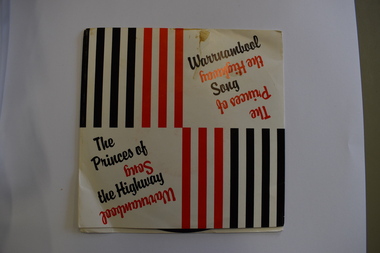
Audio - 45 R.P.M. Record, The Princes of the Highway, 1986
... The first-named is a reference to the fact that Warrnambool is on the Princes Highway and the 'princes' are those who grew and picked potatoes in times past. The lyrics are by a former Warrnambool resident, Camilla Fligelman and the singer is John Stevens. ...The first-named is a reference to the fact that Warrnambool is on the Princes Highway and the 'princes' are those who grew and picked potatoes in times past. The lyrics are by a former Warrnambool resident, Camilla Fligelman and the singer is John Stevens. ...This record features two songs about the city of Warrnambool, 'The Princes of the Highway' and 'Warrnambool Song'. The first-named is a reference to the fact that Warrnambool is on the Princes Highway and the 'princes' are those who grew and picked potatoes in times past. The lyrics are by a former Warrnambool resident, Camilla Fligelman and the singer is John Stevens. Warrnambool is a city in the western district of Victoria servicing an agricultural area, particularly the dairying industry. This record is of interest as one of several recordings made over the years celebrating the city of WarrnamboolThis is a 45 R.P.M. record with a red -coloured centre and black printing. It is enclosed in a thin cardboard envelope which has red and black lines and printing on the front and the lyrics of the two songs on the back.warrnambool songs -
 Warrnambool and District Historical Society Inc.
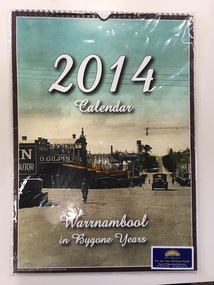
Calendar, Warrnambool in Bygone Years, 2013
... This 2014 calendar was produced in Warrnambool and features reproductions of photographs of Warrnambool in past times. The photographs include the Botanic Gardens, the Breakwater, the War Memorial, Proudfoots Boatsheds, Liebig Street, the old Information Pavilion and the Hopkins River near the mouth. ...This is a 2014 calendar featuring twelve photographs of Warrnambool in past times. The photographs have been coloured or tinted and the front cover has a copy of the photograph featured for the month of March. ...This 2014 calendar was produced in Warrnambool and features reproductions of photographs of Warrnambool in past times. The photographs include the Botanic Gardens, the Breakwater, the War Memorial, Proudfoots Boatsheds, Liebig Street, the old Information Pavilion and the Hopkins River near the mouth. ...This 2014 calendar was produced in Warrnambool and features reproductions of photographs of Warrnambool in past times. The photographs include the Botanic Gardens, the Breakwater, the War Memorial, Proudfoots Boatsheds, Liebig Street, the old Information Pavilion and the Hopkins River near the mouth. The photographs in the calendar come from the collection of the Warrnambool and District Historical Society and were reproduced with the permission of the Society. This calendar is of minor importance but it does demonstrate the popularity of locally-produced yearly calendars and the interest in photographs of times gone. This is a 2014 calendar featuring twelve photographs of Warrnambool in past times. The photographs have been coloured or tinted and the front cover has a copy of the photograph featured for the month of March. The front cover has a brown edging and the inside front cover and the black cover are white. The dates are printed in two colours and vary from month to month. The paper is glossy and the pages have been bound with plastic spiral binding with a tab at the top to append the calendar to a wall. ‘2014 Calendar’ ‘Warrnambool in Bygone Years’ warrnambool photographs of the past, calendar 2014, spectrum print solutions -
 Ballarat Tramway Museum
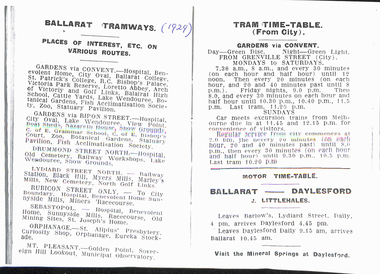
Document - Photocopy, Keith Stodden, 1929 Guide to Ballarat, Dec. 2006
... Gives details of first cars, frequency and times past each hour basis and changes in service frequency. ...Gives details of first cars, frequency and times past each hour basis and changes in service frequency. ...Eleven sheets - photocopy and covering letter - from a 1929 Guide to Ballarat, detailing timetable for trams and buses on various routes. Tram timetables - gives Gardens via Convent, Gardens via Ripon, Drummond St North, Lydiard St North, Rubicon St, Sebastopol, Orphanage, Mount Pleasant and associated return timetables. Gives details of first cars, frequency and times past each hour basis and changes in service frequency. Details colours of the discs that the trams carry to identify them to passengers, day and night. Gives Bus timetables and operator names for: Daylesford (J. Littlehales), Monastery Bus Service (W. Wilson), Ballarat Nth and New Cemetery via Doveton St (H. W. Smith), Victoria Park via Doveton and Eyre St (Robinson), South St bus service to Western oval and racecourse (A. Sproule) and Ballarat to Elmhurst (Sandlants).trams, tramways, timetables, buses, ballarat, esco -
 Warrnambool and District Historical Society Inc.
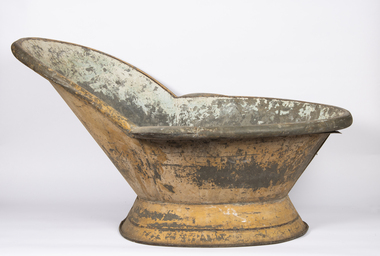
Domestic object - Hip Bath, Late 19th century
... Hip baths, such as this one, were used in past times in households for individuals to bathe. ...Hip baths, such as this one, were used in past times in households for individuals to bathe. ...Hip baths, such as this one, were used in past times in households for individuals to bathe. Generally the bath was placed in front of the fire in the kitchen and filled with hot water from the kitchen stove.This item is retained as an interesting memento of past household customs.This tin hip bath for an adult is in the shape of a cradle. The exterior is painted light brown. It has curved edges around the rim with two protruding curved pieces for the bather's hands to grip when getting out of it. The base is concave. It appears to be have been constructed in pieces. The bath is rusted and stained.hip bath, vintage domestic item, bathing practices in the past -
 Federation University Art Collection
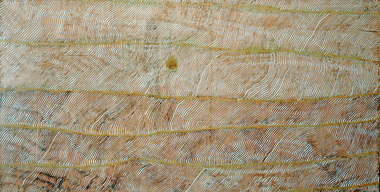
Artwork, other - Engraving & Mixed Media on Luanne, Ross, Ewan, 'The Green Pick, Barton Spring 5' by Ewen Ross, 2009
... Occasionally he refers to stories that occurred from times past but generally these images reflect the current state of this land. ...Occasionally he refers to stories that occurred from times past but generally these images reflect the current state of this land. ...Ewan ROSS Ewen Ross grew in the Wimmera and aims to manifest the changing nature of this landscape in his work. This region is affectionately known as the land of the big sky and it is from this viewpoint looking down and across, which inspires his sense of image making. Occasionally he refers to stories that occurred from times past but generally these images reflect the current state of this land. From 1976 to 1978 Ewan Ross undertook a Diploma of Art (Painting) at Ballarat College of Advanced Education (now Federation University. He was awarded a Graduate Diploma of Education in 1982. He was a Curatorial Assistant at the Art Gallery of Ballarat from 1979 to 1981, and taught Art at Horsham Technical School between 1983 and 1985. From 1986-1897 Ewan Ross taught at the Wimmera Institute of TAFE, and was Lecturer in Painting & Printmaking at the University of Ballarat (nor Federation University from 1998-2005. In 2008 Ewan Ross was a finalist in the Fleurieu Biennale Art Prize. This item is part of the Federation University Art Collection. The Art Collection features over 2000 works and was listed as a 'Ballarat Treasure' in 2007.art, artwork, ewan ross, wimmera -
 National Wool Museum
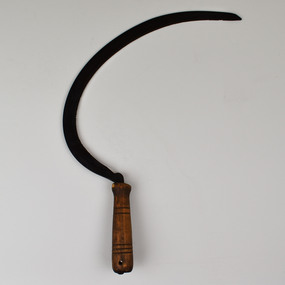
Tool - Sickle, Pre. 1988
... Although modern-day machines are used to harvest cereals, in times past the sickle was used for harvesting these crops. ...Although modern-day machines are used to harvest cereals, in times past the sickle was used for harvesting these crops. ...Feed for sheep farming is crucially important. Whether growing a sheep for breeding, wool or meat, it is vital to ensure that all sheep at whatever stage of life are maintaining or growing in weight. Sheep are often pictured grazing in paddocks; however, the grass available in a paddock is often not enough to maintain a sheep’s weight. In addition, if a sheep eats grass too low in a paddock then corrosion can affect the soil preventing any grass from growing in this location. For these reasons, supplementary feed is introduced to sheep’s diets. In most occasions’ food high in protein such as Lupins is sought. In times such as drought or to makeup a sheep’s roughage; feed such as silage, hay and straw may be required in the feeding of sheep. This is where the sickle is introduced to sheep farming. Although modern-day machines are used to harvest cereals, in times past the sickle was used for harvesting these crops. Once harvested, these crops can be fed to sheep freshly cut or dried. This sickle has been on display for 30 years at the National Wool Museum. It was at the entrance to Gallery One in the “A New Europe” wood hut display case. It was taken off display in 2021 with the “On the Land” redevelopment of this gallery space.Curved Metal serrated blade extending from carved dark wooden handletools of the trade, sheep feed, sheep farming -
 Sunbury Family History and Heritage Society Inc.
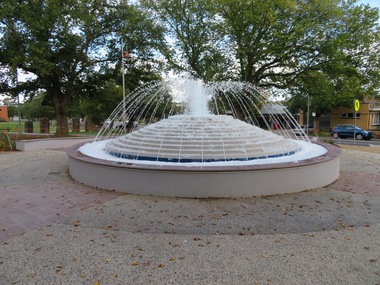
Photograph, Rosa McCall, Fountain, April 2017
... It replaced a former one that had been damaged. In past times a fountain was erected in the middle of the intersection of O'Shanassy, Stawell and Brook Streets but was relocated to a memorial reserve within the Village Green....It replaced a former one that had been damaged. In past times a fountain was erected in the middle of the intersection of O'Shanassy, Stawell and Brook Streets but was relocated to a memorial reserve within the Village Green. ...The fountain was erected at the entrance to the Village Green in Sunbury adjacent to the corner of O'Shanassy and Brook Streets in 2017. It replaced a former one that had been damaged. In past times a fountain was erected in the middle of the intersection of O'Shanassy, Stawell and Brook Streets but was relocated to a memorial reserve within the Village Green.For many years a fountain stood near the present one and has been feature in the Sunbury township. A coloured photograph of an attractive fountain with a circular base in an open parkland.sunbury village green, fountains -
 Warrnambool and District Historical Society Inc.
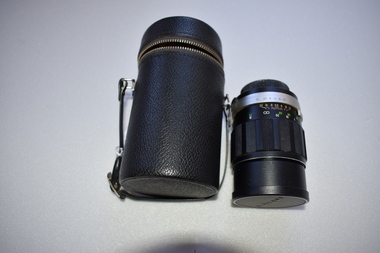
Camera Lens, 1 Soligor Lens. .2 case, C 1960
... Photographs provide a invaluable resource from an historic perspective of past times people and events....Photographs provide a invaluable resource from an historic perspective of past times people and events. This lens has significance as part of the continuum of camera development and use. ...A manual detachable camera lens is used to focus the subject of which the photograph is to be taken . They have adjustments for distance and clarity while more complex ones can be fine tuned to a much greater degree. Photographs provide a invaluable resource from an historic perspective of past times people and events.This lens has significance as part of the continuum of camera development and use. It was owned by a local Warrnambool person who had a keen interest in photography..1 Black plastic and metal detachable camera lens with metal sections and graduated markings around the cylinder . There is a screw cap on one end where the lens is attached to the camera for use and the other end covering the lens itself has the brand name across the middle of cap. .2 Black leather cylindrical case with strap handle attached with silver metal hiinge and metal zipper towards the top section of the case. The lidded section has the brand name imprinted into the surface of the top..1 Lens made in Japan. Graduated scale from 1.5/5 to 20/50 .2 Soligor camera lens, warrnambool, history of warrnambool, soligor lens -
 Warrnambool and District Historical Society Inc.
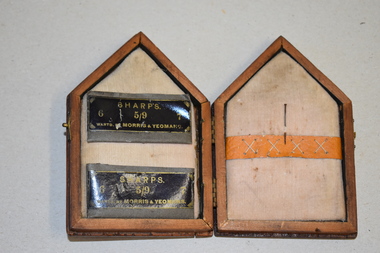
Needle case, Morris & Yeomans Ltd, 1920s
... Today needle cases are still used but less frequently as in past times, depending on the craft skills of the person and the hobbies pursued....Today needle cases are still used but less frequently as in past times, depending on the craft skills of the person and the hobbies pursued. ...This is a needle case produced in a novelty form. Sewing kits and needle cases were essential items for women to have in their houses, to take with them when travelling and to carry in their handbags for emergency repairs. Today needle cases are still used but less frequently as in past times, depending on the craft skills of the person and the hobbies pursued.This item has no known local significance but it is an interesting example of an early 20th century needle case and is retained for display purposes.This is a needle case in a wooden container made in a rectangular shape with a pointed top. The shape is in the form of a church with an affixed metal or paint shape of a church on the front of the container. The front of the container has been polished. The two sides of the container are affixed with two metal hinges and there is a metal clasp on one side. Part of the metal clasp is missing. Inside the container is padded with white/grey cotton material. On one side are two paper grey and black folders which once contained needles and on the other side there is a middle band to hold other needles or pins. This side has one rusty pin.‘Sharps 5/9 6, 7, Wartd. By Morris & Yeomans’household accessories, history of warrnambool -
 Glenelg Shire Council Cultural Collection
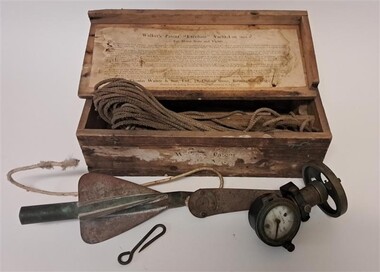
Functional object - Walker's 'Excelsior' Yacht Log Mark II, Thomas Walker, c. 1900
... When navigating a ship it is essential to be able to estimate the boat's speed and distance travelled to determine its position at sea. In times past the only way to measure a ship's speed was to throw a wood log into the water and observe how fast it moved away from the ship. ...When navigating a ship it is essential to be able to estimate the boat's speed and distance travelled to determine its position at sea. In times past the only way to measure a ship's speed was to throw a wood log into the water and observe how fast it moved away from the ship. ...From Scarborough Maritime Heritage Centre: A Yacht Log was a nautical instrument for measuring a vessel's speed and distance travelled. When navigating a ship it is essential to be able to estimate the boat's speed and distance travelled to determine its position at sea. In times past the only way to measure a ship's speed was to throw a wood log into the water and observe how fast it moved away from the ship. In the 16th century, the log was fastened to a rope knotted at set intervals. The log was thrown over the stern (back) of the vessel and a crew member counted the number of knots that were paid out in a set time. From this they could estimate the speed of the vessel through the water. This was known as streaming the log and is also the derivation of the knot as a measurement of nautical speed. In 1878, Thomas Ferdinand Walker (1837–1921), an engineer in Birmingham, patented a mechanical log in which a recording instrument was attached to a rail at the stern of a vessel connected by a long cord with a rotor which was towed behind the ship. The instrument dial recorded the distance travelled. The 'Log' at the Heritage Centre was recovered from a skip in Scarborough and was one of the first artefacts collected by the volunteer group. It is made of brass with a ceramic dial, with the main scale marked from 0 to 100 nautical miles and an inset dial marked from 0 to 10 miles. It has a fixing plate, on which it can turn, with which it would have been attached to the 'taffrail', the rail at the stern of a ship, usually on the starboard side. The Walker’s Excelsior Mark IV instrument was designed for smaller vessels, such as yachts, launches and fishing vessels. Its exact date of manufacture cannot be determined but this design was manufactured in the first half of the 20th century. These mechanical logs have now been superseded by electronic equipment such as GPS navigation instruments.This instrument was made by a significant nautical instrument manufacturer and demonstrates the innovation needed at the time for improved navigation and safety at sea.Timber Box containing an instrument for measuring speed and distance. There is a brass, cased log with a white enamel dial. It also includes a towing cord and cylindrical rotator. The box has paper labelling on the front and also the inside of the lid. The label on the inside of the lid has instructions for use. Although the lid is hinged it has broken off and is separate. The hinges remain attached.Enamel Dial: Walkers Patent Excelsior Yacht Logmaritime, maritime history, tool, navigational tool, navigational instrument, navigation, sailing, walkers, maritime technology, walker & son -
 Flagstaff Hill Maritime Museum and Village
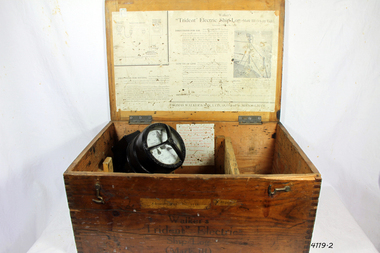
Instrument - Ship Log, Early 20th Century
... In times past the only way to measure a ship’s speed was to throw a wood log into the water and observe how fast it moved away from the ship. ...In times past the only way to measure a ship’s speed was to throw a wood log into the water and observe how fast it moved away from the ship. ...In times past the only way to measure a ship’s speed was to throw a wood log into the water and observe how fast it moved away from the ship. In the 16th century, the log was fastened to a rope knotted at set intervals. The log was thrown over the stern (back) of the vessel and a crew member counted the number of knots that were paid out in a set time. From this, they could estimate the vessel's speed through the water. This was known as streaming the log and is also the derivation of the knot as a measurement of nautical speed. Various manufacturers of nautical equipment had sought over the years to perfect the operation of determining a ship's speed and it wasn't until Thomas Walker and his son Ferdinand developed a mechanical system that eventually made this task became easy for marine navigators. Thomas Walker & Son were internationally renowned in the manufacturing of ship logs the founding father, Thomas Walker (1805–1871), an engineer in Birmingham, patented his mechanical log in 1878 which was a recording instrument that attached to a rail at the stern of a vessel connected by a long cord with a rotor which was towed behind the ship. The instrument dial then recorded the distance travelled. Thomas Walker first went into business to manufacture stoves at 58 Oxford Street Birmingham. Walker’s self-feeding stove was widely lauded at the Paris Exhibition of 1855, winning a prize medal and kickstarting the first of many notable innovations for the Walker family's manufacturing business. However, it wasn’t until working on an earlier ship’s log model invented by his Uncle that Thomas Walker became interested in the further development of this device, used to ascertain a ship’s speed. Walker continued to improve on the common log for the company of Massey & Sons and these improvements were deemed revolutionary. This log became a firm favourite of the West India Association (a British-based organisation promoting ties and trade with the British Caribbean), being the most common log in use for two generations. It took until 1861 for Thomas Walker and his son, Thomas Ferdinand Walker (1831-1921) to patent the first Walker log of many. Together, with the introduction of the A1 Harpoon Log two years later, they established the Walker Log Business as a force to be reckoned with. By his passing in 1871, Thomas Walker Snr had not only founded a family business with considerable staying power but also instilled a tradition of public service. Having sat as a representative on the Birmingham Town Council for 15 years and played an active role in public works, he was soon given the nickname of ‘Blue Brick Walker’. Much like his father, Thomas Ferdinand Walker changed the face of the maritime industry. His patent of 1897, the ‘Cherub’ log, was a notable departure from the past providing a far more accurate reading and replacing the majority of logs of the age. They were the first to produce an electric log (Trident) and the Walker factory was one of the first to introduce the 48-hour work week for employees.The ship log was invented and made by a significant marine instrument maker and innovator of machinery. It demonstrates the huge leap taken to improve navigational accuracy at sea with an instrument that was in use for decades.Ships Log, Walker Trident electric motor, in wooden box with instructions inside box. The motor dial with electric cord is still inside box.Inscription "Admiralty patent number 3332" and "Walker Trident Electric Ship Log (Mark III), 15-25 volt". On top of lid, hand written, is "G TAYLOR"flagstaff hill, warrnambool, shipwrecked-coast, flagstaff-hill, flagstaff-hill-maritime-museum, maritime-museum, shipwreck-coast, flagstaff-hill-maritime-village, ships log, thomas walker & son, electric ships log, marine navigation, thomas ferdinand walker, ship log -
 Flagstaff Hill Maritime Museum and Village
Ship Log, 1900-1920
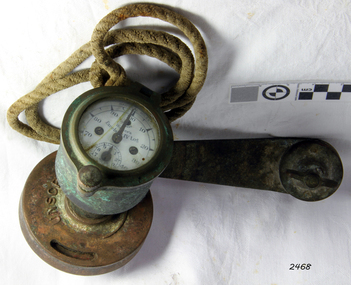
... When navigating a ship it is essential to be able to estimate the boat’s speed and distance travelled to determine its position at sea. In times past the only way to measure a ship’s speed was to throw a wood log into the water and observe how fast it moved away from the ship. ...When navigating a ship it is essential to be able to estimate the boat’s speed and distance travelled to determine its position at sea. In times past the only way to measure a ship’s speed was to throw a wood log into the water and observe how fast it moved away from the ship. ...The Excelsior IV Log is a nautical instrument for measuring a vessel’s speed and distance travelled. When navigating a ship it is essential to be able to estimate the boat’s speed and distance travelled to determine its position at sea. In times past the only way to measure a ship’s speed was to throw a wood log into the water and observe how fast it moved away from the ship. In the 16th century, the log was fastened to a rope knotted at set intervals. The log was thrown over the stern (back) of the vessel and a crew member counted the number of knots that were paid out in a set time. From this, they could estimate the speed of the vessel through the water. This was known as streaming the log and is also the derivation of the knot as a measurement of nautical speed. The Walker’s Excelsior Mark IV instrument was designed for smaller vessels, such as yachts, launches and fishing vessels. Historical: Thomas Walker & Son was internationally renowned in the manufacturing of ships logs, founding father , Thomas Walker (1805–1871), an engineer in Birmingham, patented a mechanical log in 1878 which was a recording instrument that attached to a rail at the stern of a vessel connected by a long cord with a rotor which was towed behind the ship. The instrument dial recorded the distance travelled. Thomas Walker first went into business to manufacture stoves at 58 Oxford Street Birmingham. Walker’s self-feeding stove was widely lauded at the Paris Exhibition of 1855, winning a prize medal and kick starting the first of many notable innovations for the Walker family's manufacturing business. However, it wasn’t until working on an earlier ship’s log model invented by his Uncle that Thomas Walker became interested in the further development of this device, used to ascertain a ship’s speed. Walker continued to improve on the common log for the company of Massey & Sons and these improvements were deemed revolutionary. This log became a firm favourite of the West India Association (British-based organisation promoting ties and trade with the British Caribbean), being the most common log in use for two generations. It took until 1861 for Thomas Walker and his son, Thomas Ferdinand Walker (1831-1921) to patent the first Walker log of many. Together, with the introduction of the A1 Harpoon Log two years later, they established the Walker Log Business as a force to be reckoned with. By the time of his passing in 1871, Thomas Walker Snr had not only founded a family business with considerable staying power but also instilled a tradition of public service. Having sat as a representative on the Birmingham Town Council for 15 years and played an active role in public works, he was soon given the nickname of ‘Blue Brick Walker’. Much like his father, Thomas Ferdinand Walker changed the face of the maritime industry. His patent of 1897, the ‘Cherub’ log, was a notable departure from the past providing a far more accurate reading and replacing the majority of logs of the age. They were the first to produce an electric log and the Walker factory was one of the first to introduce the 48 hour work week for employees. The ship log was invented and made by a significant marine instrument maker and innovator of machinery. It demonstrates the huge leap taken to improve navigational accuracy at sea with an instrument that was in use for decades.Ship's Taff Rail Log, rope attached. Walker's Excelsior IV Log model. Nautical miles dials: units and 10's. "Walker's Excelsior IV Log", "Made in England by Thomas Walker, Birmingham"flagstaff hill, warrnambool, shipwrecked-coast, flagstaff-hill, flagstaff-hill-maritime-museum, maritime-museum, shipwreck-coast, flagstaff-hill-maritime-village, log register, taff rail log, taffrail log, marine navigation, a1 harpoon log, cherub’ log, walker’s excelsior mark iv log, ship’s log instrument, mechanical ship’s log, measure ship’s speed, nautical instrument, navigation instrument, massey & sons, thomas walker, blue brick walker, thomas walker & son, thomas ferdinand walker, 48 hour work week -
 Falls Creek Historical Society
Flyer - Out of the Snow into the Frying Pan, 1995
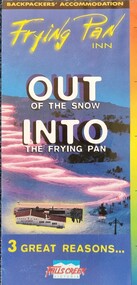
... The Frying Pan has always been the central hub of The Bowl and at different times in the past has been the location of the Old Race Hut and also the Ski School Meeting Point. ...The Frying Pan has always been the central hub of The Bowl and at different times in the past has been the location of the Old Race Hut and also the Ski School Meeting Point. ...With the completion of the Kiewa Hydroelectric Scheme in 1959, Falls Creek began to change from being a construction site into an alpine tourism resort. In 1964 the Frying Pan Inn group consisting of Bill Bridgford, Geoff Henke and L G Morrison acquired a license to construct a restaurant. It opened in time for the 1965 season, but the Frying Pan venue was damaged by fire in 1967. Renovations took until 1973 when the Frying Pan Inn reopened. It is now a popular Apres Ski location in the heart of Falls Creek Village. The Frying Pan has always been the central hub of The Bowl and at different times in the past has been the location of the Old Race Hut and also the Ski School Meeting Point. This flyer promotes three benefits of the Frying Pan Inn - its Backpackers' Accommodation, a great location and its nightlife which included live touring bands, comedy nights and Happy Hour. Accommodation included four or six person shared rooms, with breakfast being available at an additional cost.This item is significant because it documents activities and accommodation at a well-known venue at Falls Creek.A coloured flyer to promote the Frying Pan Inn featuring photographic images, basic information about facilities and accommodation tariffs for the winter of 1995.frying pan inn, falls creek accommodation -
 Halls Gap & Grampians Historical Society
Book - B/W
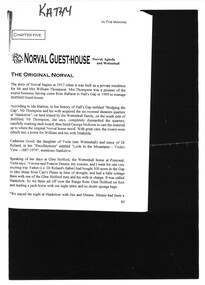
... Anyway, we got there and back safely and were rewarded with a magnificent view" By a strange coincidence, Hankelow, the source of Norval Guest-house in times past (if the name can be applied to the property as a whole, which seems likely) is in fact also the source of our Wettenhall Campsite! ...Anyway, we got there and back safely and were rewarded with a magnificent view" By a strange coincidence, Hankelow, the source of Norval Guest-house in times past (if the name can be applied to the property as a whole, which seems likely) is in fact also the source of our Wettenhall Campsite! ...Norval Guest-House Aginda and Wettenhall The original Norval The story of Norval begins in 1917 when it was built as a private residence for Mr and Mrs William Thompson. Mrs Thompson was a pioneer of the tourist business, having come from Ballarat to Hall's Gap in 1909 to manage Bellfield Guest-house According to Ida Stanton, in her history of Hall's Gap entitled "Bridging the Gap", Mr Thompson and his wife acquired the six roomed shearers quarters at "Hankelow", on land leased by the Wettenhall family, on the south side of Bellfield. Mr Thompson, she says, completely dismantled the quarters, carefully marking each board, then hired George McKeon to cart the material up to where the original Norval house stood. With great care, the rooms were rebuilt into a home for William and his wife Mathilda. Catherine Good, the daughter of Viola (nee Wettenhall) and niece of Dr Roland, in here "Recollections" entitled "Look to the Mountains - Viola's View 1887-1979", mentions Hankelow. Speaking of her days at Glen Holford, the Wettenhall home at Pomonal, Viola says "Verona and Francie Dennis, my cousins, and I went for one very exciting trip. Father (i.e Dr Roland's father) had bought 300 acres in the Gap to take sheep from Carr's Plains in time of drought, and had a little cottage there with one of the Glen Holford men and his wife in charge. It was called Hankelow. So we three set off over the Range from Glen Holford on foot and leading a pack horse with our night attire and no doubt sponge bags. "We stayed the night at Hankelow with Jim and Minnie. Minnie had been a housemaid at Glen Holford. I was very fond of her. It makes one laugh to think of the excitement of "roughing it"! Minnie gave us a lovely dinner with meringues, and cream, I remember, then early morning tea. After breakfast we were driven in the buggy to the foot of the Goat Rock (since renamed Mt Rosea) and off we went - walking in our long skirts and ankle boots. There was no track of any kind, nor blazed trail - we just made for the top. It was rather frightening at times because we couldn't see where the top was an it always seemed to get further and further away. The last mile was so terribly steep, with a lot of lose shale where you went up twelve inches and slipped back six. Now you motor to about a couple of miles from the top and then have a graded path. Anyway, we got there and back safely and were rewarded with a magnificent view" By a strange coincidence, Hankelow, the source of Norval Guest-house in times past (if the name can be applied to the property as a whole, which seems likely) is in fact also the source of our Wettenhall Campsite! Hankelow was named after a property owned by the Wettenhall family in England. In 1917 William and Mathilda retired to their newly built home (Norval) "to escape from the tourist business" However, so many people made requests to stay with them that they found it necessary to add several more rooms and sleepouts to their home. In this way, early in 1921, the guest-house began to take shape. Mr Thompson, a former librarian of the Mechanics Institute in Ballarat, named the house "Norval". The name "Norval" comes from a quotation from the play 'Douglas" by John Home. Written in the mid-16th century the play is set in the Grampian Mountains of Scotland. The story is of a boy who was parted from this mother during his early childhood, and was given to a shepherd who raised him. Some eighteen years later the mother by chance happens to meet here son, and not knowing his true identity, asks his name. He answers, "My name is Norval; and in the Grampian hills my father feeds his flocks." Perhaps it was simply because "Norval" was associated with the "Grampians" that it was chosen by Mr Thompson. He may also have been conscious of feeding "flocks" of tourists in his expanding, guest-house. Norval Guest-house prospered. It was known for its fine cooking and friendly atmosphere - a tradition which has carried through to the modern Norval! It closed between 1940 and 1949 because of the second world war. In 1949 it was decided to almost completely rebuild the house. Most of the old building (Hankelow plus) was demolished and rebuilt to a much larger and more modern plan. And then, on May 1, 1965, it was purchased by the Committee of Management of the Methodist and Presbyterian Conference Centres. At this time the guest-house was owned and operated by Marjorie and Lachland McLennan, Mrs McLennan being the daughter of William and Mathilda Thompson, the pioneers of the establishment. The McLennans had operated the Guest-house since about 1930.Photocopy 2 pages of article from book titled 'In the Making' title of article Norval guest House the original Norvalaccommodation, guesthouses, norval -
 Eltham District Historical Society Inc
Negative - Photograph, Queenstown (St. Andrews); One Tree Hill Mine, c.1925
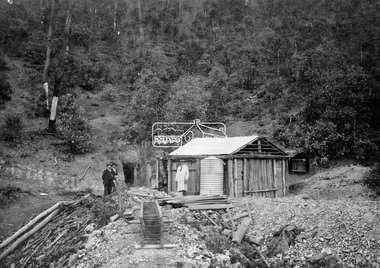
... The site has been worked intermittently until fairly recent times (Christmas Hills Past and Present (Yarra Glen & District Historical Society, 2004) ) Advertiser (Hurstbridge, Vic. : 1922 - 1939), Friday 14 November 1930, page 1 ________________________________________ QIJEENSTOWN Death of Mr. ...The site has been worked intermittently until fairly recent times (Christmas Hills Past and Present (Yarra Glen & District Historical Society, 2004) ) Advertiser (Hurstbridge, Vic. : 1922 - 1939), Friday 14 November 1930, page 1 ________________________________________ QIJEENSTOWN Death of Mr. ...L-R: Mr. O. Müller and Mr. John Nink, owners and Mr Müller's son Photograph reproduced on p36 of 'Pioneers & Painters' Gold was discovered on One Tree Hill in 1854. The site has been worked intermittently until fairly recent times (Christmas Hills Past and Present (Yarra Glen & District Historical Society, 2004) ) Advertiser (Hurstbridge, Vic. : 1922 - 1939), Friday 14 November 1930, page 1 ________________________________________ QIJEENSTOWN Death of Mr. John Nink One of the oldest and highly-respected settlers in the person of Mr. John Nink, aged 61 years, passed to his rest on November 10 at his residence, Peach Grove, Queenstown North; after suffering from what is known as miners' complaint. The late Mr. Nink has lived in the district practically all his life and died at the home formerly occupied by his father; Some years ago he conducted a peach orchard, which was one of the sights of Queenstown. He was recently engaged in mining at One Tree Hill with Mr. Otto Muller. He took an active part in public affairs, and was a trustee of the mechanics' institute, recreation ground and cemetery trust. He had a happy disposition, was very hospitable and always merry, which made for him friends all over the district. He leaves a wife, and was the father of Alice (Mrs. Christian), Charles, Robert, William and Minnie (deceased); and the brother of Joseph: (deceased), Henry, Johanna (Mrs. Tonge), Frederick, Mary (Mrs. Antonie) and Robert. His relatives have the sympathy of a large circle of friends in their sad bereavement. The remains of deceased yere interred in Smith's Gully cemetery on Wednesday, and his popularity was shown by the large cortege, amongst the mourners being ex-Cr. Zerbe !(Doncaster), Messrs. Carlyle. Exton, Harris (Kinglake), Birch (Christmas Hills), P. J. McMahon (shire secretary), Crs. Hewitt and Ryan (North Riding), and Cr. D. Murphy (Whittlesea shire). The funeral service was conducted by the Rev. Father Lande (Diamond Creek), and the funeral arrangements were in the hands of Messrs. Apps and Sons.This photo forms part of a collection of photographs gathered by the Shire of Eltham for their centenary project book,"Pioneers and Painters: 100 years of the Shire of Eltham" by Alan Marshall (1971). The collection of over 500 images is held in partnership between Eltham District Historical Society and Yarra Plenty Regional Library (Eltham Library) and is now formally known as the 'The Shire of Eltham Pioneers Photograph Collection.' It is significant in being the first community sourced collection representing the places and people of the Shire's first one hundred years.Digital image (x2) 4 x 5 inch B&W Neg (x2) B&W Print 20 x 25 cm B&W print 9 x 12.5 cmsepp, shire of eltham pioneers photograph collection, queenstown, john nink, o. muller, one tree hill mine, hut, gold mining, one tree hill, goldmining, pioneers and painters, st. andrews, otto johan muller, otto johann müller -
 Bendigo Historical Society Inc.
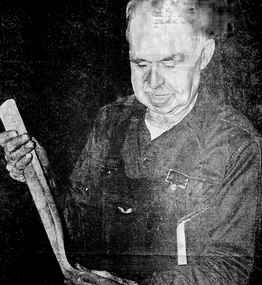
Document - National Trust Collection: Golden City Implements Foundry, Ironbark, Bendigo, 1960-1980s
... The yard was a fascinating graveyard of past times, with old mining and agricultural scrap everywhere mixed up with coke and slag from the smelting sheds at the rear. ...The yard was a fascinating graveyard of past times, with old mining and agricultural scrap everywhere mixed up with coke and slag from the smelting sheds at the rear. ...This foundry had been a landmark in Mt Korong Road for many years. It began with an Osborne and Mitchell. After 1914 when mining declined, it became the Golden City Implement boundary and the name can still be seen painted on on the façade which faces the intersection of Marong Road (Calder highway) and Eaglehawk Road. The interior is a mass of used and un-used machinery scattered amongst modern lathes and more modern apparatus. The yard was a fascinating graveyard of past times, with old mining and agricultural scrap everywhere mixed up with coke and slag from the smelting sheds at the rear. A feature of the foundry was the manufacturer of cast iron lace. This document provides a historical and contemporary overview of the Osborne family's blacksmith and metalworking business in Bendigo, highlighting its longevity, operations, and significance: The business dates back to at least 1855, originally starting as a general store before evolving into a metalworking factory. The original founders were Osborne and Mitchell; Mitchell left early on, and the business changed hands several times before being acquired by Oscar Osborne (not related to the original Osborne founder). Oscar Osborne managed the machine shop and foundry, eventually acquiring it. His sons, Charles and Walter, now run the business with Stan, a descendant of the original founder. The current operators are Charles and Walter Osborne (brothers) and Stan (a descendant of the original founder but not directly related to the brothers). The business is known for its continuity and resilience, surviving as one of the oldest in Bendigo while others have disappeared or are newcomers. The workshop covers about a third of an acre and houses a large array of machinery and tools (nearly 200 between the three operators). The Osbornes pride themselves on traditional skills and methods, many of which are being lost in modern times. They are renowned for repairing a wide range of metal items, especially for antique dealers, and for producing high-quality crowbars and decorative iron lace for both restoration and new construction. Much of their work comes from Adelaide, and they maintain a steady demand for their specialized services. T he foundry and machine shop are considered landmarks in Bendigo, located on Eaglehawk Road opposite the Marong turn-off.The business was deeply embedded in the local community and history, with the Osborne name still prominent in the district.National Trust Survey Data Sheet and article from the Bendigo Advertiser November 4th 1981. Osbornes Ironbark Foundry This items contains the following documents 3084.47a Bendigo advertiser Article 4th November 1981 "Bendigo Firm is Still Going Strong" 3084.47b National Trust Data Survey Sheet July 9th 1977 3084.47c Black and White photo of Charles Osbornehistory, national trust bendigo collection, bendigo, foundary, iron bark bendigo -
 Eltham District Historical Society Inc
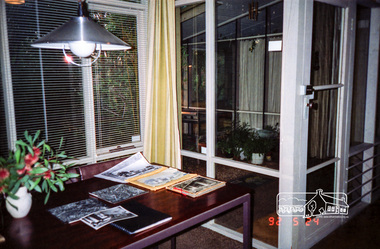
Photograph, Woodburn residence, mudbrick adobe (1949), Eltham Heritage Tour, 24 May 1992, 24/05/1992
... There's an air of past times about the School, the Dairy, the Butcher's (now a milk bar) and the Castlemaine stone face of the Commonwealth Bank. ...There's an air of past times about the School, the Dairy, the Butcher's (now a milk bar) and the Castlemaine stone face of the Commonwealth Bank. ...ELTHAM HERITAGE TOUR The Society excursion on 24th May 1992 was arranged by David Bick, leader of the team carrying out the Shire's heritage study. David selected a number of sites or buildings identified in the study, some of them lesser known components of the Shire's heritage. The tour commenced at the Eltham Shire Office at 10.00 am. Travel was by private car and mini-bus with stops at about twelve locations for commentary by David.It included a short walk in Hurstbridge and lunch at Kinglake. Highlights of the tour included: - 10 am Leave from Shire Offices - 3 Important Trees - A Physical Link to Eltham's First Settlers - Toorak Mansion Gates - A Surviving Farm House - An Intact Circa 1900 Main Street - First Settlers - Gold Miners, and Timber-getters - An Early Hotel - A Pioneering Homestead - Changing Eltham Shire - 20th Century - 4 pm Afternoon Tea and Finish Tour Extract from ELTHAM CULTURAL HERITAGE TOUR (Newsletter No. 85, July 1992, by Bettina Woodburn) "In some respects Eltham is a 'back-water' and it has its own distinctive flavour. On the outskirts the homes date from the 1960's, 70's and 80s with a sprinkling of 'earth homes', mud-brick or pise, rammed dirt. Crossing Main Road into Beddoe Street and Thompson Crescent a very pleasant drive past pines and old fence lines, front lawns unfenced, the occasional ·old farm building, we eventually looked down on a huge circular roof of a 1992 adobe home. Other distinctive places included the Pauline Toner Butterfly Reserve, Gordon Ford's splendid garden at Fulling in Pitt Street, cypress hedges and old houses in Bridge Street and in every direction Eltham's special feature - a totally treed horizon. We were now in the part of the Shire closest to Melbourne - Montmorency - not on the way to anywhere, with no through road going across it, developed in the 1950's and 1960's with conventional gardens, now converted to native plants. The rail looped between Greensborough and Eltham and a shopping street (Were Street) served the area, growing up the hill from the station. It was a typical outer Melbourne suburb with lawns and roses with patches of originality. The shopping precinct still has 1950 characteristics - walls which sloped back, projecting roofs, the original shop fronts are nearly all tiled below the old windows. There's an air of past times about the School, the Dairy, the Butcher's (now a milk bar) and the Castlemaine stone face of the Commonwealth Bank. The final stop for the tour was at the mud-brick Woodburn residence, adobe of 1949 with additions. After War Service, Bill Woodburn had commenced an Architecture course at Melbourne University and after second year in the Christmas vacation, with his wife, Betti, built the two bedroom house - with amazing saving of costs. In the three and a half months they made over 3000 bricks (external walls 18" x 12" x 4", internal walls 12" x 9" x 4"), sifted top soil for mortar and laid them, on concrete foundations and slab floor, made all the structural window frames, door frames and roof members to carry 'super six' asbestos sheets, laboured for the electrician and plumber, did all the glazing and, still without electricity, moved in in March 1949. Rooms have been added, at first with glass walls, later using concrete blocks, to accommodate three daughters and a son. The house not only grew from the earth, but also with the family."Record of the Society's history and activities and highlighting various aspects of the Heritage Study undertaken by David Bick used to create the future heritage overlay for the Shire of Eltham and later Nillumbik Shire.Roll of 35mm colour negative film, 4 stripsKodak Gold 100 5095shire of eltham historical society, activities, heritage tour, woodburn house -
 Flagstaff Hill Maritime Museum and Village
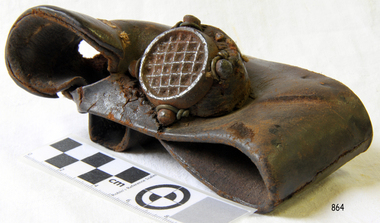
Tool - Roping Palm, Late 19th to early 20th century
... A late nineteenth to early twenty century sewing palm heavy duty used for rope work, its a tool that is still in use today aboard sailing vessels and gives a snapshot into the sailors life aboard the old sailing ships of times past. flagstaff hill warrnambool shipwrecked-coast flagstaff-hill flagstaff-hill-maritime-museum maritime-museum shipwreck-coast flagstaff-hill-maritime-village None Leather roping palm. ...While a sailmaker’s palm is intended for rope work, hand sewing sails and marine canvas work, it can also be used for other extremely thick or heavy-duty sewing applications. You can use a sailmaker’s palm for hand sewing leather, webbing or any sewing assembly that’s thicker than your sewing machine can handle.A late nineteenth to early twenty century sewing palm heavy duty used for rope work, its a tool that is still in use today aboard sailing vessels and gives a snapshot into the sailors life aboard the old sailing ships of times past.Leather roping palm. Left hand- simular to a seaming palm, except for the much heavier indentations in the eye and thicker moulded leather guard to the thumb hole. Rd No 666761.Noneflagstaff hill, warrnambool, shipwrecked-coast, flagstaff-hill, flagstaff-hill-maritime-museum, maritime-museum, shipwreck-coast, flagstaff-hill-maritime-village
