
Showing 87 items matching "independent church"
-
 Melton City Libraries
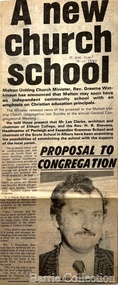
Newspaper, Uniting Church news-clippings, 1967, 1980, 1982,1983, 1990,1998
... ...Independent...Church...Churches Local Identities Newspaper clippings about the Uniting Church, Melton Uniting Church news-clippings Newspaper Barrie Collection Melton-Bacchus Marsh Telegraph Independent Church & Nation The Express ...Newspaper clippings about the Uniting Church, Meltonchurches, local identities -
 Melbourne Tram Museum
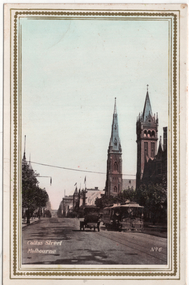
Postcard, H&B, "Collins Street Melbourne No. 6", c1910
... ...Independent church...Colour postcard, H&B series, No. 6 of Collins St Melbourne looking west from near Exhibition St Has the Independent Church, Scots Church and Georges in the view along with the Town Hall. ...Colour postcard, H&B series, No. 6 of Collins St Melbourne looking west from near Exhibition St Has the Independent Church, Scots Church and Georges in the view along with the Town Hall. ...Colour postcard, H&B series, No. 6 of Collins St Melbourne looking west from near Exhibition St Has the Independent Church, Scots Church and Georges in the view along with the Town Hall. Tram has the destination of Spring St. Photo c1910Yields information about the view along Collins St from near Exhibition St.Postcard - colour with divided backIn pencil on rear "28/5/1987"trams, tramways, cable trams, collins st, scots church, independent church -
 Glen Eira Historical Society
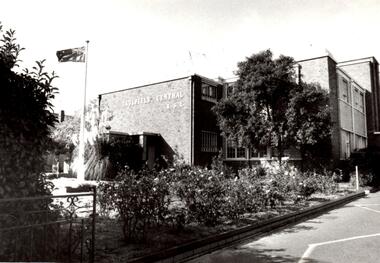
Article - CAULFIELD CENTRAL RSL
... ... Independent Church of Australia...Northcote Avenue Independent Church of Australia Marsden Ian Mr. McCutcheon Mr On reverse, PIC B - 5 - CONTACT - RSL BUILDING - CONTACT 28/4/88 - 100% - HAWTHORN ROAD CAULFIELD Black and white photographic print of Caulfield Central RSL building Article CAULFIELD CENTRAL RSL ...This file contains six items pertaining to the Caulfield Central RSL: 1/A page to which is attached a black-and-white photograph (date, source and photographer unspecified) of the Caulfield Central RSL, outlying garden and Australian flag. Some writing on the rear identifies the subject. 2/A typewritten letter, (1 page) dated 1946 (no date more specific than that specified), from the Chairman & Honorary Treasurer of the Caulfield Central RSL Appeal Committee (name unspecified) to the Mayor of Caulfield (name also unspecified), imploring the latter for a donation of $20,000 dollars for purposes of constructing a Memorial Hall to eulogize servicemen killed during WWII. Some rough working notes on rear side. 3/A flyer, undated (although presumably published in 1950), printed by Peter Isaacson Pty. Ltd., advertising a concert presented by the Ugly Ugly Man (Frank M. Beard) and the Malvern Tramways’ Harmonica Band to be held at Caulfield Town Hall on 06/06/1950 to assist the Welfare Funds of the Caulfield Central RSL and the Sailors, Soldiers and Airmen’s Mothers’ Association. Also contains an advertisement for a drapery business called Tallents. 4/The annual report of the Caulfield Central RSL, for the period 1952 – 1953. Contains announcements of the annual general meeting and annual elections, the President’s report (in which he principally discusses the club’s charity work and sporting activities), the subcommittee staff roster, the sportsmen’s honour roll, the annual accounts (e.g. balance sheet, income & expenditure statement) and the roster of nominees for office in the committee of management election. 5/A typewritten letter, (1 page) dated 26/11/1982, from Max Brian Blair, Treasurer of the Caulfield Central RSL, to Mr. R. Ballantyne, Secretary of the Caulfield Historical Society, thanking him for his donation to the RSL. 6/A photocopy of an article titled ‘RSL pays $30,000 to buy off objector’ (from the Sunday Herald, by Mary-Anne Toy, dated 16/09/1990), about the Caulfield Central RSL paying local resident Mr. Chris White to withdraw his objection to the RSL’s intention to re-allocate its clubrooms, and the consequent response of the relevant authorities.Black and white photographic print of Caulfield Central RSL buildingOn reverse, PIC B - 5 - CONTACT - RSL BUILDING - CONTACT 28/4/88 - 100% - HAWTHORN ROAD CAULFIELDcaulfield, caulfield central returned servicemen league (rsl), ex-service organisations, clubs and associations, returned servicepeople, armed forces, soldiers, aged people, senior citizens centres, mayors, city of caulfield, war memorials, blamey thomas general sir, white t. w. group capt., gullett h. b. major, beaurepaire frank sir m.l.c., kennedy j. a. m.l.c., warner a. g. m.l.c., michaelis archie m.l.a., dennett a. h. lt.-col. m.l.a., don john capt. m.l.a., reid h. squire m.l.a., brooks w. r. cr., packer j. t. cr., parton e. m. cr., prior p. l. cr., morris t. w. cr., sinclair a. j. g. cr., sims h. e. cr., smith h. c. h. cr., smith james e. cr., tyers s. w. cr., webster harold cr., yorston j. s. cr., briggs r. jas., disney j. s., donath h., llewellyn evans, goddard s. a. padre, lynch p. j., nilsen oliver j. cr., pidd padre a. t., robinson norman, reece harold j., wootton harold s., wallace gordon w., nelson harold g., halls, concerts, musical events and activities, fundraising events, bands, musical ensembles, sailors soldiers and airmen’s mothers’ association, ‘the ugly ugly man’, beard frank m., malvern tramways harmonica band the, caulfield town hall, tallents, drapers, glenhuntly road, glen huntly road, elsternwick, peter isaacson pty. ltd melbourne, annual reports, financial documents, fisher s. w., finch f., williams f., salmon j. e., mallyon v. k., woods w., mayne t. v., lanyon r. j., rowney w. p., williams j. d., pepper e., bathurst t., patterson r., nuzum e. j., phillips e. v., turner g., hawthorn road, byrne l. j., eva a. r., bunny c. l., hoy c. a., orken a., hiam s. f., rawson n. l., coleman g. h., cohen a. s., mason j., goode l. p., nelson h. g., crosbie m. r., mcsweeney t., westley g. de v., greeves c. g., festivals and celebrations, community services, social services, service clubs, ladies auxiliary, returned servicewomen’s section, blamey house, social sub-committee, sport, sporting clubs, tennis, golf, billiards, table tennis, lawn bowls, thompson peter, cricket, children’s health bureau, family welfare bureau, buley doug mr., tomlins m. i., lang a. r., kendall h. i., ford c., munro w., gordon h., rowe s., green j. h., o’brien j., ring t., anderson g. j., croft r. m., jones p. j., la cerf g., roper i., lawrence f., eustace r. c., hanley a., moore a., strachan w. d., gilbert w. f., blair m. r., scriven e. g., miller j. l., hosking b. e., cheeseman r. n., summers s., croy l. w., mclatchie s., williams stan, hattersly cliff, day alf, rawson noel, johnson alby, banham bill, kersey b., williams s., jones a., witten f., waters r., dash r., meldrum i., grant j., haggar l., nightingale n., hallett r., somers r., young g., rawson n., croft r., barton m., o’grady w., cooper p., manton j., sutcliffe a., maver a., challender d., hunt a., parrott e., leicester j., westwood a., rae alex, smith harry, forbes jimmy, johnson jack, higgins w., fink s., hall s., ross m., anderson h., fleming j., bottoms a., peek e., stark j., mathews e., gursansky l., morres r., alenson j., holland i., wallace p., craig h., lucas j., smith h., bretel l., berryman p., reid a., swann j., tully f., henderson g., fields w., johnson j., gloster p., tennat j., boyd a., butterworth k., chapman k., curran j., elkington a. b., evans w., mckenzie d. a., nicol a. b., thompson w., wanliss t. w., watson g. j., williams g., yeomans p., mcgowan h., o’connor k., atherton r., batson s. s., bull e., fletcher a., gorman s. c., hall w., jellett l., lesar h., mather r., nelson n., ratford d., rowe p., turner w. j., wehsack f., williams s. c., wilson a., carter w., forbes i., purvis l., datson r., jackson e., wolstencroft w., smith c., mitchell r., harward j., gillespie ray, hill wally, parkinson w. g., greeves colin mr., water stan mr., selleck f. p., luckins l., andrews f., young v. l., king e. j., mccutcheon j. o., grenfell d. j., hurley c., shand a. r., yeates l., hogue h., mather j., wardrop j., lyons a. m., ross a. r., bradley t., walker r. n., cox f. c., mornane j. s., fletcher a. e., mcneil j. g., rose n., lyons l. j., trevorrow g., wright d. e., walker r., maxwell j., hutchinson j. c., mclean r., caulfield historical society, ballantyne r. mr., blair max brian, toy mary-anne, ruxton bruce mr., administrative appeals tribunal, caulfield city council, white chris mr., northcote avenue, independent church of australia, marsden ian mr., mccutcheon mr -
 Uniting Church Archives - Synod of Victoria
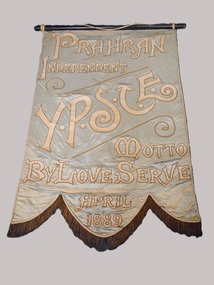
Banner, 1889
... Prahran Independent Church...[Source: https://www.ce.asn.au/about/our-past-australia/] Prahran Independent Church Young People's Society of Christian Endeavour Christian Endeavour "PRAHRAN INDEPENDENT Y.P.S.C.E. ...The Young People's Society of Christian Endeavor was founded in Portland, Maine, USA, in 1881 by Dr Francis Edward Clark, as an interdenominational Christian youth society encouraging them to "work together to know God in Jesus Christ". In the 1880s, CE Societies were established in each Australian state. The first Victorian convention was held in Melbourne in 1890. Rapid growth occurred with 3000 members, representing 65 societies, attending the second convention in 1891, and 205 societies attending the third convention the following year. [Source: https://www.ce.asn.au/about/our-past-australia/]Pale blue silk banner on a canvas backing with appliqued lettering. The letters are of cream felt and the banner has gold cord edges. The lower edge has a gold metal fringe on a scalloped edge. There is cream cord on all outside edges, and it has blue cotton on the back. The banner has a wooden hanging rod across the top."PRAHRAN INDEPENDENT Y.P.S.C.E. MOTTOB BY LOVE SERVE APRIL 1889"prahran independent church, young people's society of christian endeavour, christian endeavour -
 Clunes Museum
Book, BPA PRINT GROUP, VICTORIAN HISTORICAL JOURNAL, 2004
... ON COVER PICTURE OF CHILDERS RAILWAY IN SOUTH GIPPSLAND EMBLEMOF ROYAL HISTORICAL SOCIETY VICTORIA ON REAR COVER: INDEPENDENT CHURCH , COLLINS STREET, MELBOURNE...ON COVER PICTURE OF CHILDERS RAILWAY IN SOUTH GIPPSLAND EMBLEMOF ROYAL HISTORICAL SOCIETY VICTORIA ON REAR COVER: INDEPENDENT CHURCH , COLLINS STREET, MELBOURNE VICTORIAN HISTORICAL JOURNAL Book BOOK BPA PRINT GROUP ...ARTICLES AND IMAGES OF IMPORTANCE BY THE ROYAL VICTORIAN HISTORICAL VICTORIASOFT COVER BOOK. ON COVER PICTURE OF CHILDERS RAILWAY IN SOUTH GIPPSLAND EMBLEMOF ROYAL HISTORICAL SOCIETY VICTORIA ON REAR COVER: INDEPENDENT CHURCH , COLLINS STREET, MELBOURNEnon-fictionARTICLES AND IMAGES OF IMPORTANCE BY THE ROYAL VICTORIAN HISTORICAL VICTORIAroyal historical society victoria, victoria's history -
 Bendigo Historical Society Inc.
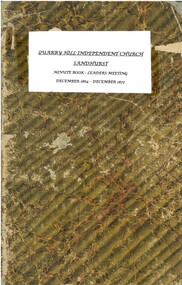
Book - FOREST STREET UNITING CHURCH COLLECTION: MINUTE BOOK, 1864-1872
... Minute Book Quarry Hill Independent Church Sandhurst Minutes Book - Leaders Meeting December 1864 - December 1872 Includes list of members. ...BHS Collection CHURCH History uniting church forest street Minute Book Quarry Hill Independent Church Sandhurst Minutes Book - Leaders Meeting December 1864 - December 1872 Includes list of members. ...BHS CollectionMinute Book Quarry Hill Independent Church Sandhurst Minutes Book - Leaders Meeting December 1864 - December 1872 Includes list of members. Brown cover with marbled pattern. Blue pages. Handwritten minutes.church, history, uniting church forest street -
 Uniting Church Archives - Synod of Victoria
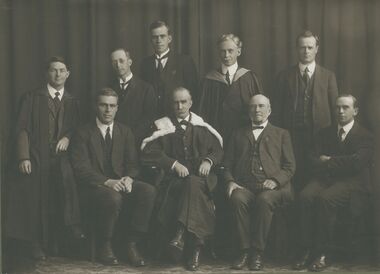
Photograph, Monteath, Congregational College students and staff 1919
... James was the minister of the Collins Street Independent Church....James was the minister of the Collins Street Independent Church. Congregational College Handwritten names on paper cover: "J.E. ...The Rev J. E. James was the minister of the Collins Street Independent Church.Sepia photograph on card mount with a paper protective cover showing nine men, four sitting, dressed formally; three are wearing academic gowns. The group are in front of long curtains. The photograph has a white label on the back.Handwritten names on paper cover: "J.E. James, W. Christiansen, Seaudrett (?) A.S. Devenish, F.A.F. (Forward), L.E. Bradbury, W.J.L. Closs, G. Bell, D.E. Reeves. 1919". Typed on white label: "Congregational College of Victoria Staff and Students 1919"congregational college -
 Uniting Church Archives - Synod of Victoria
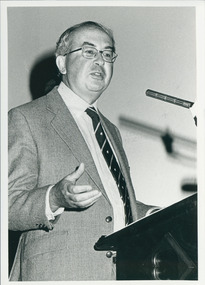
Photograph, Rev Geoffrey English Wainwright theologian, Undated c1990
... Geoffrey Wainwright Professor of Systematic Theology at Duke University spoke at Independent Church on What faces the church....Geoffrey Wainwright Professor of Systematic Theology at Duke University spoke at Independent Church on What faces the church. wainwright, geoffrey english Professor of Systematic Theology, Duke University "Rev. ...Dr. Geoffrey Wainwright Professor of Systematic Theology at Duke University spoke at Independent Church on What faces the church.B & W photograph of Rev Dr Geoffrey Wainwright standing at a lecturn."Rev. Geoffrey English Wainwright theologian c1990 World Wide Photos Ltd 2nd floor 7 Wilmot Street Sydney NSW 2000 Tel 264-7220 E2988-153"wainwright, geoffrey english, professor of systematic theology, duke university -
 Uniting Church Archives - Synod of Victoria
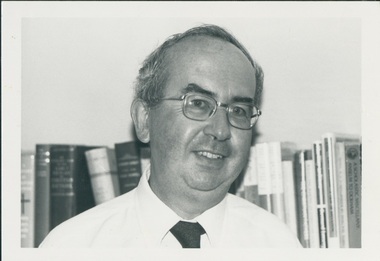
Photograph, 17/04/1985
... Geoffrey Wainwright Professor of Systematic Theology at Duke University spoke at Independent Church on "What faces the church"....Geoffrey Wainwright Professor of Systematic Theology at Duke University spoke at Independent Church on "What faces the church". wainwright, geoffrey english Professor of Systematic Theology, Duke University "Dr. ...Dr. Geoffrey Wainwright Professor of Systematic Theology at Duke University spoke at Independent Church on "What faces the church".B&W head and shoulders photographs of Rev Dr Geoffrey Wainwright. "Dr. Geoffrey Wainwright Dean's Office Duke Divinity School Durham NC 27706"wainwright, geoffrey english, professor of systematic theology, duke university -
 Uniting Church Archives - Synod of Victoria
Photograph, Undated c.1990
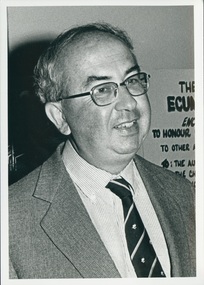
... Geoffrey Wainwright Professor of Systematic Theology at Duke University spoke at Independent Church on "What faces the church"....Geoffrey Wainwright Professor of Systematic Theology at Duke University spoke at Independent Church on "What faces the church". wainwright, geoffrey english Professor of Systematic Theology, Duke University "Rev. ...Dr. Geoffrey Wainwright Professor of Systematic Theology at Duke University spoke at Independent Church on "What faces the church".B & W head and shoulders photograph of Rev Dr Geoffrey Wainwright. "Rev. Geoffrey Wainwright World Wide Photos Ltd 2nd floor 7 WSilmot Street Sydney NSW 2000 Tel 264-7220 E2988-145"wainwright, geoffrey english, professor of systematic theology, duke university -
Glen Eira Historical Society
Document - St. Peter’s Girls’ School
... ... Independent Schools... Anglican Church...Peter’s School Independent Schools Anglican Church St. Peter’s Girls’ Grammar School St. ...Information about St. Peter’s Girls’ School, Murrumbeena. Includes an extract about the school from the History of St. Peter’s Church Murrumbeena 25th Anniversary, covering years 1917-1948. Also includes extracts relating to the school from Feeding Christ’s Sheep: a History of St. Peter’s Murrumbeena with Holy Nativity Hughesdale by Alex Reid. Includes pictures of the school buildings. Paragraphs relating to the school marked in blue pen.twedell florence, hitchcock isabel, ingham a.e. rev., st. aidan’s school, st. aiden’s church of england school for girls, dunoon street murrumbeena, dunoon street public hall, laird-brown miss, le fevre mrs., king copland, kemp w.a., green w.g.a., sr. laura, andrews eileen, de bibra eric, tucker w.h., potter bill rev., chapple l., baddams miss, shelford, shelford girls’ grammar, beard doris, maydom ross, nicholas g., beeforth janet, bannister kerry, combes deborah, harvey paul rev., durance ruth, cope v., crowther mrs., warne margaret, st. aidan’s school, dunoon street murrumbeena, st. peter’s murrumbeena, st. peter’s girls’ school, fulton lorna, de bibra florence, walker miss, cragg elvie, hoggart mrs., booth miss, andrew miss, de bibra margaret, de bibra peggy, chapple e.t., st. peter’s school, independent schools, anglican church, st. peter’s girls’ grammar school, st. peter’s church of england girls’ grammar school, reid alex, religious structures and establishments -
 Canterbury History Group
Photograph - Canterbury Grammar School, c1903
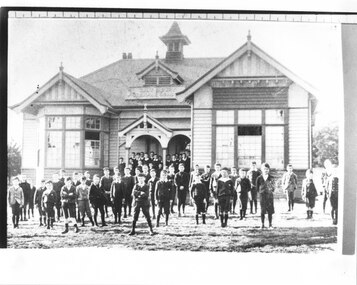
... Church... Independent Schools Students...Canterbury Canterbury Road Alexandra Avenue Canterbury Grammar School Goldings Hall Methodist Church Independent Schools Students Photograph Canterbury Grammar School ...Pupils standing in the front of Canterbury Grammar School, corner of Alexandra Avenue and Canterbury Road. The school began in the Methodist Church Hall , Balwyn Road approx 1902, moved to Goldings Hall , and from1903 - 1913 operated from Alexandra Avenue, Canterbury Road.canterbury, canterbury road, alexandra avenue, canterbury grammar school, goldings hall, methodist church, independent schools students -
 Uniting Church Archives - Synod of Victoria
Programme - Congregational Union of Victoria (Incorporated), Programme of Half-Yearly Assembly, 1957
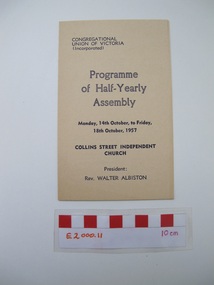
... The Congregational Union of Victoria (Incorporated) held its Half-Yearly Assembly on Monday, 14th October, to Friday 18th October, 1957 at Collins Street Independent Church. The President was Rev. Walter Albiston. ...The Congregational Union of Victoria (Incorporated) held its Half-Yearly Assembly on Monday, 14th October, to Friday 18th October, 1957 at Collins Street Independent Church. The President was Rev. Walter Albiston. ...The Congregational Union of Victoria (Incorporated) held its Half-Yearly Assembly on Monday, 14th October, to Friday 18th October, 1957 at Collins Street Independent Church. The President was Rev. Walter Albiston. A Youth Work Exhibition was held in the Independent Hall from Tuesday 8th, to Friday, 11th October.Small bi-folded programme with black ink.congregational union of victoria (incorporated), rev walter albiston -
 Melbourne Tram Museum
Photograph - Black & White Photograph/s, Tramway Museum Society of Victoria (TMSV), c1975
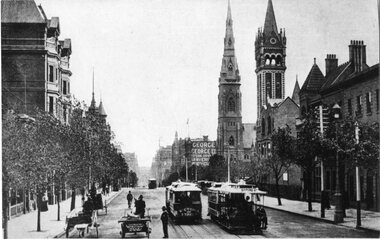
... In the background is George & George (later Georges), the Scots Church and the Independent Church, now St Michael's Uniting Church in the view. ...In the background is George & George (later Georges), the Scots Church and the Independent Church, now St Michael's Uniting Church in the view. ...Black & White Photograph of a postcard made by the TMSV Sales of two cable trams in Collins Street between Russell and Exhibition Streets. One car has the destination of Spring St having come up from either South Melbourne or Port Melbourne and the other (westbound) Victoria Street cable set is bound for Spencer St. In the background is George & George (later Georges), the Scots Church and the Independent Church, now St Michael's Uniting Church in the view. Photo dates from 1890's Two copies held.trams, tramways, collins st, cable trams, spring st, victoria st -
 Uniting Church Archives - Synod of Victoria
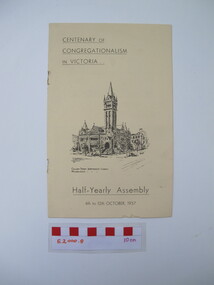
Programme - Congregational Union of Victoria (Incorporated), Half-Yearly Assembly, 1957
... The Congregational Union of Victoria (Incorporated) held its Half-Yearly Assembly from 4th October 12th October, 1937 at Collins Street Independent Church and the Melbourne Town Hall. The Chairman was Rev. ...The Congregational Union of Victoria (Incorporated) held its Half-Yearly Assembly from 4th October 12th October, 1937 at Collins Street Independent Church and the Melbourne Town Hall. The Chairman was Rev. ...The Congregational Union of Victoria (Incorporated) held its Half-Yearly Assembly from 4th October 12th October, 1937 at Collins Street Independent Church and the Melbourne Town Hall. The Chairman was Rev. Walter Albiston. A Youth Work Exhibition was held in the Independent Hall from Tuesday 8th, to Friday, 11th October.Four page booklet with black ink text. There is a line drawing on the front and three illustrations inside. congregational union of victoria (incorporated), rev walter albiston -
 Melbourne Legacy
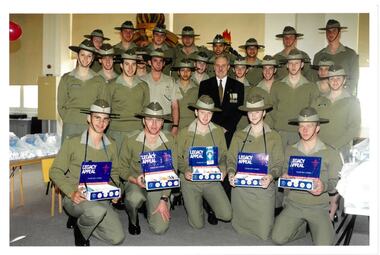
Photograph - Photo, Legacy Appeal 2000, Preparing for Badge Week, 2000
... In that year Legacy Week ran from Sunday 26th August with a Widows Pilgrimage to the Shrine after a service at St Michaels Independent Church in Collins Street....In that year Legacy Week ran from Sunday 26th August with a Widows Pilgrimage to the Shrine after a service at St Michaels Independent Church in Collins Street. A record of fundraising for Legacy week. legacy appeal fundraising badge week army adf personnel Printing on the back "SEP 3853" which is frame number of the negative, the month and film processing number. ... A photo of a group of Army personnel, some holding Legacy Badge trays with the President of Legacy David Kelly in a room of Legacy House. David Kelly was President of Melbourne Legacy in 2000. In that year Legacy Week ran from Sunday 26th August with a Widows Pilgrimage to the Shrine after a service at St Michaels Independent Church in Collins Street.A record of fundraising for Legacy week.Colour photo of army personnel at Legacy House for badge week in 2000.Printing on the back "legacy appeal, fundraising, badge week, army, adf personnel -
 Uniting Church Archives - Synod of Victoria
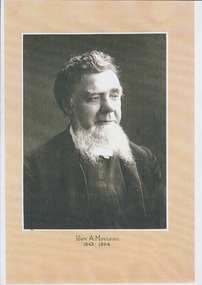
Photograph, Undated c.1864
... Ministry: CMS missionary in Van Dieman's Land 1838 - 1839; Independent Church Collins St. Melbourne 1843 - 1864; Presbyterian supply ministry 1865 - 1869; Presbyterian Church Clunes 1869 - 1872; Honorary Librarian/Professor of Hebrew and Church History, Congregational College Victoria 1880 - 1887. ...Ministry: CMS missionary in Van Dieman's Land 1838 - 1839; Independent Church Collins St. Melbourne 1843 - 1864; Presbyterian supply ministry 1865 - 1869; Presbyterian Church Clunes 1869 - 1872; Honorary Librarian/Professor of Hebrew and Church History, Congregational College Victoria 1880 - 1887. ...Alexander Morison was ordained in Hobart, Tasmania 19/02/1839. Ministry: CMS missionary in Van Dieman's Land 1838 - 1839; Independent Church Collins St. Melbourne 1843 - 1864; Presbyterian supply ministry 1865 - 1869; Presbyterian Church Clunes 1869 - 1872; Honorary Librarian/Professor of Hebrew and Church History, Congregational College Victoria 1880 - 1887. Died 14/04/1887.Photocopy of original B & W head and shoulders portrait of the Rev Alexander Morison.Rev A. Morison 1843 - 1864 -
Old Colonists' Association of Ballarat Inc.
Document, Gerald Jenzen, Henry Hannington
... Henry married Jane Crabb in the Independent Church in Melbourne in 1853. Jane died in Ballarat on the 23 January 1887,. ...Henry married Jane Crabb in the Independent Church in Melbourne in 1853. Jane died in Ballarat on the 23 January 1887,. ...Biography of Henry Hannington who was born in County Tyrone, Northern Ireland on 17 March 1819 and died in Ballarat at his residence in Crompton Street, Soldiers Hill on 1 January 1893 aged 73 years. Henry married Jane Crabb in the Independent Church in Melbourne in 1853. Jane died in Ballarat on the 23 January 1887,. Henry Hannington had various occupations including Shepherd, Miner, Trooper and Bricklayer. He was also listed as a Ballarat Pioneer who was resident in the District before the first Gold Licence was issued on 20 September 1851.Document on the history of early member of the Old Colonists' Association, Henry Haningtonhenry hannington, old colonists' association ballarat, ballarat old colonists' club, jane hannington -
 Federation University Historical Collection
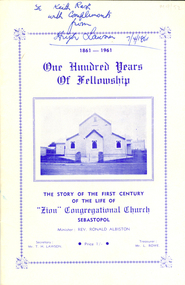
Booklet, Alex. King & sons, Printer, The Story of the First Century of the Life of "Zion" Congregational Church, Sebastopol, 1961, 1961
... Its origins began as 'Zion" Welsh Independent Church in Albert Street, Sebastopol. ...Its origins began as 'Zion" Welsh Independent Church in Albert Street, Sebastopol. ...The former "Zion" Congregational Church was on the corner of Walker Street and Beverin Street in Sebastopol. Its origins began as 'Zion" Welsh Independent Church in Albert Street, Sebastopol. The Uniting Church in Australia was inaugurated in June 1977, at which time the Sebastopol Methodist Church joined with the Zion Congregational Church on Walker Street, Sebastopol and became Sebastopol Uniting Church. The block to the south of the church was purchased in 1982, the occupying house demolished and the area cleared and later sealed for parking. In 1984 the interior of the church was renovated and plans were drawn up for further additions and alterations to the Sunday school, which were carried out in 1989, adding a kitchen and toilet built by Jeff Menhennett & SonsWhite soft covered booklet of 20 pages with blue printing. Written in biro on front cover "To Keith Rash with compliments from Hugh Lawson 7/4/1961"zion congregational church, sebastopol, carmel welsh church, zion hall, hugh lawson, sebastopol unitng church -
 Warrnambool and District Historical Society Inc.
Plate, Warrnambool Congregational Church, Early 20th century
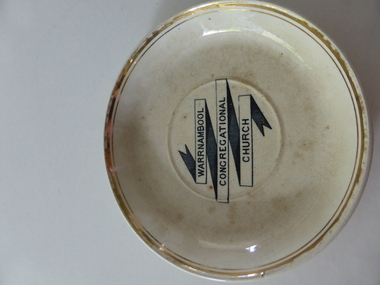
... The Warrnambool Congregational Church was established in 1862 when Robert Winton and Thomas Nayler set up a meeting to discuss the possibility of establishing an Independent Church in Warrnambool. The first minister was William Pentland and the first church was opened in 1864 in Liebig Street. ...The Warrnambool Congregational Church was established in 1862 when Robert Winton and Thomas Nayler set up a meeting to discuss the possibility of establishing an Independent Church in Warrnambool. The first minister was William Pentland and the first church was opened in 1864 in Liebig Street. ...This plate comes from the Congregational Church in Warrnambool. It was probably part of a set of crockery used by church members at social events. The Warrnambool Congregational Church was established in 1862 when Robert Winton and Thomas Nayler set up a meeting to discuss the possibility of establishing an Independent Church in Warrnambool. The first minister was William Pentland and the first church was opened in 1864 in Liebig Street. Samuel Nettleton was a notable early church member, being Superintendent of the Sunday School for 60 years. A new church was opened in Henna Street in 1940. In 1973 the Congregational Church merged with the Methodist Church to form the Uniting Church in 1977. In 1976 the former Congregational Church in Henna Street was sold to the Salvation Army. This plate is of interest as a memento of the former Congregational Church in Warrnambool. In the early to mid 20th century this church was a strong and influential force in the Warrnambool community. This is a cream-coloured dinner plate made of china. The gold bands around the edge of the plate are now almost obliterated. The lettering in the middle of the plate is black and white. The plate has several chips on the edge and is somewhat stainedWarrnambool Congregational Church’warrnambool congregational church -
 Warrnambool and District Historical Society Inc.
Plate, Saucer, Early 20th century
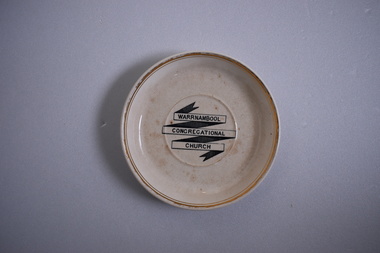
... The Warrnambool Congregational Church was founded in 1862 when Robert Winton and Thomas Nayler conducted a meeting in Warrnambool to consider the possibility of forming a local Independent church. The first minister was William Pentland and the first church was in Liebig Street. ...The Warrnambool Congregational Church was founded in 1862 when Robert Winton and Thomas Nayler conducted a meeting in Warrnambool to consider the possibility of forming a local Independent church. The first minister was William Pentland and the first church was in Liebig Street. ...This saucer came from the Warrnambool Congregational Church and was probably part of a set of crockery used by the church members at social gatherings. The Warrnambool Congregational Church was founded in 1862 when Robert Winton and Thomas Nayler conducted a meeting in Warrnambool to consider the possibility of forming a local Independent church. The first minister was William Pentland and the first church was in Liebig Street. A notable member of the Congregational Church was Samuel Nettleton who was the Superintendent of the Sunday School for 60 years. In 1940 a new church was opened in Henna Street. In 1973 there was a merger of the Congregational Church and the Methodist Church, resulting in the formation of the Uniting Church in 1977. In 1976 the former Congregational Church in Henna Street was sold to the Salvation Army. This saucer is of interest as a memento of the former Congregational Church in Warrnambool. It comes from the early 20th century days when the church would have had a strong following in the city. This is a cream-coloured saucer with double gold edging around the outer rim. The lettering in the middle of the saucer is black and white. The inside of the saucer is much stained. ‘Warrnambool Congregational Church’warrnambool congregational church, history of warrnambool -
 Warrnambool and District Historical Society Inc.
Book, The Blessing of Belief, 1956
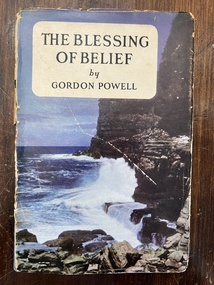
... He was the minister at the Independent Church, Melbourne for many years and served in New Guinea as a chaplain during World War Two. ...He was the minister at the Independent Church, Melbourne for many years and served in New Guinea as a chaplain during World War Two. ...This book was written by the Rev. Gordon Powell in 1956. Gordon Powell (1911-2005), the son of George Powell, a Kepler Street dentist, was born in Warrnambool. A minister, writer and broadcaster, the Rev. Gordon Powell was the best-known Presbyterian minister in Australia in the 20th century. He was the minister at the Independent Church, Melbourne for many years and served in New Guinea as a chaplain during World War Two. When minister at St. Stephen’s Church in Sydney he attracted the largest congregation of any Protestant church in Australia at the time at both his Sunday and Wednesday services. He gave radio talks for many years and was responsible for introducing the world-wide group, Alcoholics Anonymous to Australia.This book is retained as it was written by an influential 20th century Australian Presbyterian Minister, the Rev. Gordon Powell. He was born in Warrnambool. This is a hard cover book of 124 pages. The cover is blue with black lettering on the spine. The dust cover has black and blue printing and a photograph on the front of a coastal scene. The spine of the dust cover is torn. The pages contain printed material in an introduction and eleven chapters.Godfrey 10 Somers Rd. Warrnamboolrev. gordon powell, history of warrnambool, st. stephen’s church -
 Uniting Church Archives - Synod of Victoria
Photograph
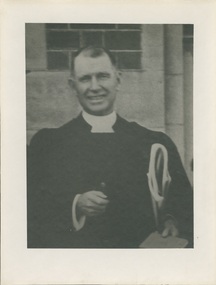
... He married Susan Ison at the Collins St. Independent Church on 11 September 1907. Legge was called to Clunes (1907), Preston (1917), Mildura (1920), Dandenong (1924), and Kew (1926). ...He married Susan Ison at the Collins St. Independent Church on 11 September 1907. Legge was called to Clunes (1907), Preston (1917), Mildura (1920), Dandenong (1924), and Kew (1926). ...James Legge was born of Scots parentage at Dunolly, Victoria on 2 July 1873. He was educated at Scotch College Melbourne, and at the University of Melbourne. He worked as a teacher before starting the Theological course at Ormond College. He completed his theological training in 1902, and was appointed by the Home Mission Committee to the parish of Boort, where at Durham Ox he was ordained and inducted in May 1903. He married Susan Ison at the Collins St. Independent Church on 11 September 1907. Legge was called to Clunes (1907), Preston (1917), Mildura (1920), Dandenong (1924), and Kew (1926). Demitted 1942. Home Mission appointment Mitcham 1946. Died October 21 1951B & W waist length photo enlargement of Rev James Legge B.A. printed on buff card.Rev. James Legge, B.A. 1926 - 1942james legge, presbyterian, minister, scotch college, university of melbourne, ormond college, kew -
 Orbost & District Historical Society
book, The Second Catechism, ? early 19th century
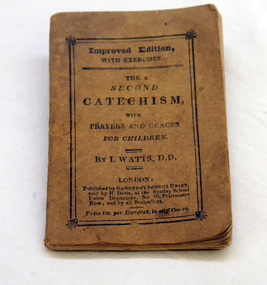
... In 1698, he became assistant minister of the Independent Church, Berry St., London. In 1702, he became pastor. ...In 1698, he became assistant minister of the Independent Church, Berry St., London. In 1702, he became pastor. ...Isaac Watts is most well-known as a Nonconformist hymn-writer. Many of his compositions are still in common use today and his Divine Songs, first published in 1715, is considered the first hymn-book for children. Watts’s non-hymnal writings include catechisms composed for children of various ages: the first set for children under seven years of age and the second set for children from seven to twelve years of age. Isaac Watts was the son of a schoolmaster, and was born in Southampton, July 17, 1674. He is said to have shown remarkable precocity in childhood, beginning the study of Latin, in his fourth year, and writing respectable verses at the age of seven. At the age of sixteen, he went to London to study in the Academy of the Rev. Thomas Rowe, an Independent minister. In 1698, he became assistant minister of the Independent Church, Berry St., London. In 1702, he became pastor. In 1712, he accepted an invitation to visit Sir Thomas Abney, at his residence of Abney Park, and made it his home for the remainder of his life. Watts died November 25, 1748, and was buried at Bunhill Fields. (Ref: hymnary web-site)This item is an example of an early religious text book for children.A small brown covered paperback book. Text on the cover is black - Improved Edition With Excercises ; The Second Catechism ; With Prayers and Graces for Children. There is also a gold paper bookmark.religious-text watts-isaac catechism -
 Uniting Church Archives - Synod of Victoria
Photograph, Rev. Dr. Francis Macnab
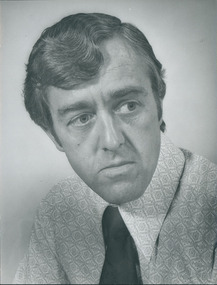
... Macnab was the minister of St Michael's Uniting Church (formerly Collins Street Independent Church) from 1971 to 2016. Macnab was born to J. ...Macnab was the minister of St Michael's Uniting Church (formerly Collins Street Independent Church) from 1971 to 2016. Macnab was born to J. ...Macnab was the minister of St Michael's Uniting Church (formerly Collins Street Independent Church) from 1971 to 2016. Macnab was born to J. D. Macnab and Mary Anne Louisa Hughes on 21 June 1931. Macnab married his wife, Sheila, in 1958. They have three children, two daughters and a son. He was made a member of the Order of Australia for his contributions to psychotherapy and religion. Training and psychological work - Macnab holds a Doctor of Divinity degree from the University of Aberdeen. He has honorary doctorates from the University of Melbourne and RMIT in psychology and applied science. In 1961, Macnab opened the Cairnmillar Institute, a clinical psychological centre, the largest in Australia, which was for some time the largest training body for psychologists and counsellors in the country. He was its Executive Director. Macnab founded and is director of the Australian Foundation for Aftermath Reactions which provides trauma treatment and training. He is a Fellow of the Australian Psychological Society. Following a ministry at Prahran Presbyterian Church from 1961 to 1970, Macnab became minister of the then Collins Street Congregational Church, now known as "St Michael's on Collins", in 1971. The church became a congregation of the Uniting Church in Australia at its inception in 1977.The three head & shoulders photos show Macnab at three different periods in his life."Rev. Dr. Francis Macnab"macnab, francis, st. michael's uc, cairnmillar institute -
 Uniting Church Archives - Synod of Victoria
Photograph, Rev. Dr Francis Macnab
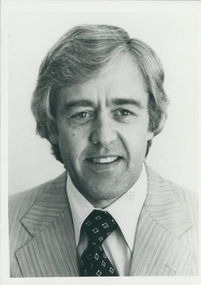
... Macnab was the minister of St Michael's Uniting Church (formerly Collins Street Independent Church) from 1971 to 2016. Macnab was born to J. ...Macnab was the minister of St Michael's Uniting Church (formerly Collins Street Independent Church) from 1971 to 2016. Macnab was born to J. ...Macnab was the minister of St Michael's Uniting Church (formerly Collins Street Independent Church) from 1971 to 2016. Macnab was born to J. D. Macnab and Mary Anne Louisa Hughes on 21 June 1931. Macnab married his wife, Sheila, in 1958. They have three children, two daughters and a son. He was made a member of the Order of Australia for his contributions to psychotherapy and religion. Training and psychological work - Macnab holds a Doctor of Divinity degree from the University of Aberdeen. He has honorary doctorates from the University of Melbourne and RMIT in psychology and applied science. In 1961, Macnab opened the Cairnmillar Institute, a clinical psychological centre, the largest in Australia, which was for some time the largest training body for psychologists and counsellors in the country. He was its Executive Director. Macnab founded and is director of the Australian Foundation for Aftermath Reactions which provides trauma treatment and training. He is a Fellow of the Australian Psychological Society. Following a ministry at Prahran Presbyterian Church from 1961 to 1970, Macnab became minister of the then Collins Street Congregational Church, now known as "St Michael's on Collins", in 1971. The church became a congregation of the Uniting Church in Australia at its inception in 1977.The three head & shoulders photos show Macnab at three different periods in his life."Rev. Dr Francis Macnab"macnab, francis, st. michael's uc, cairnmillar institute -
 Uniting Church Archives - Synod of Victoria
Photograph, Rev. Dr Francis Macnab
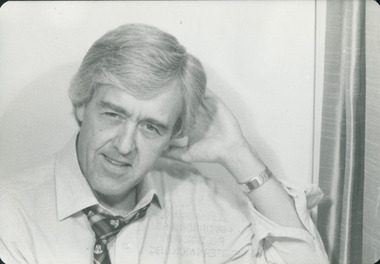
... Macnab was the minister of St Michael's Uniting Church (formerly Collins Street Independent Church) from 1971 to 2016. Macnab was born to J. ...Macnab was the minister of St Michael's Uniting Church (formerly Collins Street Independent Church) from 1971 to 2016. Macnab was born to J. ...Macnab was the minister of St Michael's Uniting Church (formerly Collins Street Independent Church) from 1971 to 2016. Macnab was born to J. D. Macnab and Mary Anne Louisa Hughes on 21 June 1931. Macnab married his wife, Sheila, in 1958. They have three children, two daughters and a son. He was made a member of the Order of Australia for his contributions to psychotherapy and religion. Training and psychological work - Macnab holds a Doctor of Divinity degree from the University of Aberdeen. He has honorary doctorates from the University of Melbourne and RMIT in psychology and applied science. In 1961, Macnab opened the Cairnmillar Institute, a clinical psychological centre, the largest in Australia, which was for some time the largest training body for psychologists and counsellors in the country. He was its Executive Director. Macnab founded and is director of the Australian Foundation for Aftermath Reactions which provides trauma treatment and training. He is a Fellow of the Australian Psychological Society. Following a ministry at Prahran Presbyterian Church from 1961 to 1970, Macnab became minister of the then Collins Street Congregational Church, now known as "St Michael's on Collins", in 1971. The church became a congregation of the Uniting Church in Australia at its inception in 1977.The three head & shoulders photos show Macnab at three different periods in his life."Rev. Dr Francis Macnab"macnab, francis, st. michael's uc, cairnmillar institute -
 St Kilda Historical Society
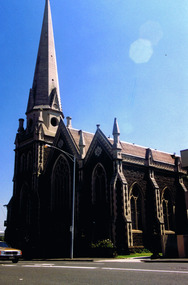
Photograph, St Kilda Presbyterian Church exterior - images collection, c 1970s
... Its first service was inaugurated by the Free Church Synod of Victoria in May 1855, in a building at the corner of High Street and Alma Road. In October 1855 the congregation moved to a wooden building in Inkerman Street, purchased from the Independent (Congregational) Church. ...Its first service was inaugurated by the Free Church Synod of Victoria in May 1855, in a building at the corner of High Street and Alma Road. In October 1855 the congregation moved to a wooden building in Inkerman Street, purchased from the Independent (Congregational) Church. ...The St Kilda Presbyterian Church is now part of the St Kilda & Balaclava Presbyterian Church. Its first service was inaugurated by the Free Church Synod of Victoria in May 1855, in a building at the corner of High Street and Alma Road. In October 1855 the congregation moved to a wooden building in Inkerman Street, purchased from the Independent (Congregational) Church. The present church site was purchased and the first church opened in 1860. The foundation stone for the present church building, the second to be built on the site, was laid by the Governor of Victoria, Sir Henry Brougham Loch, on 27 January 1885. The building was opened on 30 May 1886. Wilson and Beswicke were the architects. Ralph Wilson designed the Methodist church on the corner of Princes and Fitzroy Streets and lived diagonally opposite the Presbyterian church. Charles Beswicke had toured Britain and the Continent in 1886 armed with a camera and returned to Australia with photographs of what he considered the greatest examples of architecture. He was responsible for the town halls in Brighton, Malvern, Hawthorn and Essendon and Wesleyan churches in Camberwell and Dandenong. Thomas Corley was the builder. The lofty spire was ‘a landmark to the mariner’ used by sea captains sailing up Port Phillip Bay. On a prominent position, the highest point in St Kilda, the church attracted wealthy people with legal, merchant and pastoral backgrounds.colour photographst kilda, churches, presbyterian church, balaclava -
 Uniting Church Archives - Synod of Victoria
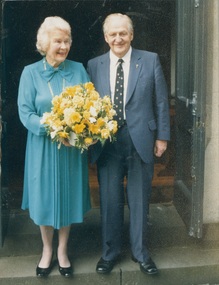
Colour photo, 1986
... At 34, by then the father of four children, he was invited to be minister of the Collins Street Independent Church in the heart of Melbourne, now St Michael's Uniting Church Before being inducted, he undertook a lecture tour of the US, speaking to Rotary clubs in 48 centres, from Michigan to Maryland. ...At 34, by then the father of four children, he was invited to be minister of the Collins Street Independent Church in the heart of Melbourne, now St Michael's Uniting Church Before being inducted, he undertook a lecture tour of the US, speaking to Rotary clubs in 48 centres, from Michigan to Maryland. ...1911–2005: Gordon George Powell, who has died at 94, was for many years the highly influential minister at St Stephen's Presbyterian Church in Sydney and a popular radio broadcaster and author. He began Wednesday services at St Stephen's in Macquarie Street soon after arriving in Sydney from Melbourne in 1952. They grew to become the biggest regular lunch-hour services in the world, with up to 1300 people crowding the church and the hall below. In 1953, with the help of Vernon Turner of the Christian Broadcasting Association, services were broadcast on radio. The broadcasts continued even when Gordon moved back to Melbourne, so for 30 years he maintained a successful weekly radio ministry. While at St Stephen's, he was also involved in the 1959 Billy Graham Crusade in Sydney, attended by 980,000 people over two weeks. Gordon was born in Warrnambool, Victoria, the son of a dentist, George Powell, and his wife, Louisa (nee Clarke). He went to school at Scotch College. He gave up plans to become an electrical engineer after hearing a call to the ministry and studied arts and then theology at the University of Melbourne, where he formed a close friendship with Edward (Weary) Dunlop. Gordon rowed in the Ormond crew, winning the university's inter-college trophy five times. He was a passionate sports lover all his life. He was awarded a scholarship to Trinity College, Glasgow University, in 1935, and for three months stayed with the great Scottish churchman George (later Lord) MacLeod. While on a cycling trip around Scotland, he stopped by the shores of Loch Ness and saw a long neck appear. The monster swam about 300 metres at great speed; Gordon counted three or four humps. Later, when he saw a skeleton of a plesiosaurus at the Victoria and Albert Museum, he recognised it as Nessie. For the rest of his life, he retained an avid interest in the Loch Ness Monster and its attendant scientific debate. While in Scotland, Gordon wrote a weekly article for The Messenger, the official journal of the Presbyterian Church of Victoria. This led to a life as an author of articles and books. He also wrote long letters home to his mother, a habit that later led to his weekly "Dad's Diaries", which were distributed to the wider family. Failing eyesight put an end to his reading and writing two years ago. On returning to Australia in late 1936, he became assistant minister at Toorak, the second-biggest Presbyterian church in Melbourne. There, at last, Gordon married Gwen Gilchrist, whom he had courted for nine years. They moved from the wealthiest church to one of the poorest, at Port Adelaide, which was still in the grip of the Depression. There, he was finally ordained, in May 1938, and the first two of their four children, Rosemary and David, were born. In 1941, Gordon became assistant minister to Scots Church in Melbourne and the following year, after the birth of his third child, Mardi, he reluctantly volunteered as an RAAF chaplain. He was a pacifist but felt bad at not being in uniform. For the following three years, he was stationed in New Guinea and Australia. His war reminiscences were published as Two Steps to Tokyo and sold 6000 copies in 1945 alone. At 34, by then the father of four children, he was invited to be minister of the Collins Street Independent Church in the heart of Melbourne, now St Michael's Uniting Church Before being inducted, he undertook a lecture tour of the US, speaking to Rotary clubs in 48 centres, from Michigan to Maryland. He met, and was impressed by, the liberal theologian Harry Emerson Fosdick, and the US religious leader and author Norman Vincent Peale, who became a close friend and mentor. Back in Australia, Gordon founded and fostered the first Alcoholics Anonymous group in Melbourne. In 1952, he took up what was to become his happiest ministry, at St Stephen's in Sydney. When Queen Elizabeth and Prince Philip toured two years later, Gordon and Gwen were not only invited to lunch with them, but sat beside them. This was a highlight for Gordon, an ardent monarchist. In 1960, Gordon and Gwen embarked on a world tour that included the US, where he was invited to give the opening prayer in the Senate, with vice-president Richard Nixon presiding. After another five years at St Stephen's, Gordon returned to Scots Church in Melbourne. It was a time of bitter debates over church union with the Methodists and Congregationalists. Gordon was in favour, but Scots ultimately voted to stay out and remain Presbyterian. By then in his mid-60s, he and Gwen moved to New York, where Peale was his neighbour. They had six happy years there before retiring to Melbourne. Gordon is survived by Gwen, and children David, Mardi and Jenny (daughter Rosemary died in 1992), 13 grandchildren and 10 great-grandchildren. [From the obituary in the Sydney Morning Herald, 2005, written by Jenny (Powell)] Gwen and Gordon Powell coming out of the Toorak Uniting Church 50 years after they were married there. Gwen and Gordon Powell coming out of the Toorak Uniting Church 50 years after they were married there.gordon powell; gwen powell; port adelaide; toorak presbyterian church; st stephen's presbyterian church sydney; presbyterian minister -
 City of Melbourne Libraries
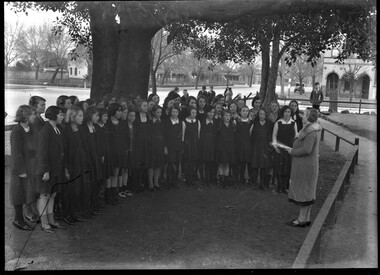
Photograph (item), Bull, Hugh Jones, 1897-1993, Miss Ida Park conducts the North Fitzroy State School Choir
... She also played the organ for services at St Paul’s Independent Church in Delbridge Street, North Fitzroy and later St Luke’s, North Fitzroy. ...She also played the organ for services at St Paul’s Independent Church in Delbridge Street, North Fitzroy and later St Luke’s, North Fitzroy. ...The pupils of Falconer Street Central School No.3918 in North Fitzroy rehearse with conductress Miss Ida Park for their performance at the Temperance Hall, Russell Street Melbourne with proceeds going to the Lord Mayor’s Fund. The house on the right of the photograph is Jubilee House, 126 Michael Street North Fitzroy and is extant. Photographer notations on slide: Choir At Fitzroy State School 1933 B5 While this photograph appears not to have been published, a photograph taken from a different angle of the same event was published in The Age 21 July 1933. SCHOOL CHILDREN SING IN THE OPEN AIR. “A choir of children at North Fitzroy practise their songs for a Pantomime, to be given in the Temperance Hall for the Lord Mayor's Fund on Wednesday next. On the extreme left is the conductress of the Choir (Miss Ida Park).” Reference: http://nla.gov.au/nla.news-article204368572 Research by project volunteer, Fiona Collyer: Children of The Falconer Street Central School Choral Society, trained by conductress Miss Ida Park, along with dance and gymnastics pupils of Misses Dorothy Gibb and Inez Ellis, performed in the “Cinderella” pantomime at the Temperance Hall in Russell Street, Melbourne on 26 July, 1933. The proceeds went to the Lord Mayor’s Fund. Conductress Miss Ida Park (1904- 1952) lived in the North Fitzroy and Clifton Hill area all her life. She was immersed in the music world of Melbourne and was a member of the Musical Society of Victoria. Ida graduated from Melbourne University Conservatorium with a Bachelor of Music degree in 1929 before departing for London where she studied piano and organ at the Royal Academy of Music. Ida returned to Melbourne in 1931, and billed as “The Gifted Young Australian Pianist”, held pianoforte recitals of classical music at Assembly Hall, Collins Street. She also played the organ for services at St Paul’s Independent Church in Delbridge Street, North Fitzroy and later St Luke’s, North Fitzroy. Ida conducted the children of the Falconer Street Central School Choral Society as they competed in the State School Choral Championships and the 85 children of the Fitzroy City Centenary Choir who sang at Melbourne’s Centenary celebrations of 1934/35. In 1945, Ida married Charles Hazeldine, a tenor and returned digger who had served in two world wars. The pair performed together in many concerts over the years. Tragically, both Ida and Charles were badly injured when struck by a car while crossing Queens Parade Clifton Hill in June 1952, with Ida dying from head injuries at St Vincent’s Hospital soon after. She was 48 years old. Charles wrote on Ida’s death notice - “Called home.” The choir were pupils of Falconer Street Central School No. 3918 in North Fitzroy which was built in 1915 to provide upper primary education for grades 5 to 8 for the area. In 1957 it became Fitzroy High School. In 1992, the Kennett Government swept to power, embarking on a program of fiscal austerity and privatisation of government services. 390 government schools were closed, with the land proposed to be sold to developers. 7000 teachers were sacked: 10% of Victoria’s public school teachers. Auxiliary school staff also lost their jobs. Amongst the first to close was Fitzroy High School. Fearful that the land would be sold, hundreds of students, parents, teachers and local residents occupied the building around-the-clock in four hour shifts and overnight for 14 months, sleeping on gym mats in the principal’s office and administrators’ wing. The blockade was lifted when a arrangement was reached to allow Kangan Batman TAFE to use the school from 1993 until 1998. With the election of the Bracks Government in 1999, and construction of new buildings, Fitzroy High School was reopened in 2004 after a 12 year battle. Temperance Hall, at 172 Russell Street, where the children performed “Cinderella”, was built in 1872 by the Melbourne Total Abstinence Society as a venue for lectures, meetings and alcohol-free community concerts and events. From 1934, Temperance Hall was fitted out as a cinema and renamed the Imperial Theatre, showing popular Hollywood films, before closing in 1939 for renovations and reopening as the Savoy Theatre, Melbourne’s first “Continental” talkies cinema. At this time, Australian cinema programming was dominated by American and British films. The lessees, Continental Film Art Theatre began negotiating for theatre properties in Melbourne, Sydney, Adelaide, Brisbane, Perth and Auckland to screen foreign language films, hoping to present the finest productions from France, Germany, Holland and Italy. At the cost of £6000, the theatre was fitted with the latest Mirrophonic sound and projection system and enlarged to seat 800 patrons with luxurious, ultra modern fittings and furnishings in a colour palette of rust and beige. Instead of usherettes, General Manager Peter Dawson, hoping to bring a sophisticated European atmosphere to the theatre, employed attractive, multilingual “Continental hostesses” to assist guests (not patrons) and answer queries relating to the films. Collectively the hostesses spoke English, French, Dutch, German, Russian and Italian. The Age 20 May 1939- “Atmosphere is a very important part of the theatre's scheme. Ushers in the ordinary sense will not be employed; hostesses will look upon patrons as guests. They will be dressed in full evening dress, and the only indication that they are not guests is the little medallion pinned to their evening dress, on which their names are inscribed.” The hostesses were dressed in evening gowns of olive-green velvet, the full skirts embroidered with gold loops, wine velvet bolero jackets and long white kid gloves with silvery tiaras in their hair. For guests worried that they may not understand the plot, the management assured patrons that- “By means of superimposed English translations on the bottom of the screen, the dialogue is perfectly understandable and the whole witty story can be followed with ease.” The Gala opening of the Savoy Theatre, on 31 May 1939 was attended by a “who’s who” of Melbourne Society, the women wearing beautiful gowns, headdresses and furs. Amongst the guests were former premier Sir Stanley Argyle and Lady Argyle, former Lord Mayor Sir Harold Gengoult-Smith and his wife Cynthia, Field Marshall Thomas Blamey and Lady Blamey and Miss Jessie Brookes. The Vice Consul for France, Monsieur Frank Puaux and his wife attended, Madame Puaux dressed in a black satin gown and a musquash fur cape. She was presented with a beautiful bouquet of scarlet carnations and lily of the valley tied with the tricolour of France. In his speech Monsieur Puaux stated that “from the cultural, linguistic and artistic points of view it was excellent that the Australian public should have an opportunity to see foreign film in the original language.” “Letty” writing in Table Talk magazine described the atmosphere of “Continental” gaiety that had permeated Melbourne - “The Letters of Letty”, Table Talk 8 June 1939 “The “foreign influence” is definitely obtruding itself into the even tenor of Melbourne life these days…. but in the pleasantest manner possible! Included in the great number of Continental people who have recently made their homes here, we have stars of the Russian ballet settling in our midst…. and now… we have been presented with our own Continental picture theatre in the attractive shape of The Savoy, which opened its doors on Wednesday night for the exclusive release of foreign films. One could hardly recognise the old Temperance Hall in its adaptation to the smart, comfortable and thoroughly-intriguing Savoy Theatre. Where once this rather draughty old building stood in Russell Street there now greets us an unmistakable “Continental” edifice, living up to its exterior by sustaining within its walls its overseas’ atmosphere. Indeed, one feels as though one has crossed the threshold into a European city, stepping out of the unmistakably Australian street that is Russell into The Savoy lounge to be greeted by polite “messieurs” from the attractive, Continental-looking usherettes and to gaze upon a film as delightfully French in story and presentation as “La Kermesse Heroique.” But successful though “La Kermesse Heroique” proved on its initial presentation inside the theatre, the debut was no more triumphal than that made by the winning and pretty little French lass who had charge of the booking office outside in the foyer. With her attractive accent and Continental flair for making one “feel at home” she was undoubtedly one of the hits of the night-especially with the susceptible males, who spent very much longer in the lounge than is customary, racking their brains for excuses for making conversation with the attractive Parisienne! Those French girls certainly have a way with them!” The opening film, the 1935 French comedy “La Kermesse Heroique”, (The Heroic Sex) starring Francoise Rosay and Jean Murat (film now called “Carnival in Flanders”) was the winner of the Grand Prix du Cinema Francais as the finest picture of 1936 and described in the advertisement as “The Gay French Comedy of Laughter and Romance” The film is set during the 17th century Spanish occupation of Flanders in the Flemish town of Boom at the time of their annual festival. Hearing news of a pending visit to Boom by the commander, the Duke of Olivares and his army, and fearing rape and pillage, the boorish burgomaster feigns his own death, hoping the Spaniards will bypass the grieving town out of respect. The army arrives and the cowardly men of the town flee. The womenfolk decide on a different approach. Lead by the burgomaster’s beautiful wife Cornelia, they set out to to preserve the peace with grace and hospitality only to find the Spaniards attractive and virile, unlike their own husbands. The Sun newspaper described the film as “Mellow as a Stilton cheese, and as ripely suited to adult taste.” Preceding “La Kermesse Heroique” was a Gaumont British newsreel of King George VI and Queen Elizabeth departing for a tour of Canada and the Soviet documentary “Nine Months on a Drifting Ice Floe” During the war “Continental” films became difficult to source, so the Savoy screened Hollywood movies and held fund raisers for the war effort. After World War Two, the Savoy continued to screen “Continental” films, catering to post-war immigrants from Europe and bohemian Melburnians. In 1953, the Savoy had a wildly popular season with queues winding around the block to see Swedish summer romance “One Summer of Happiness” (Hon dansade en sommar) with its nude swimming scenes. The Chief Commonwealth Censor declined to cut the film on the grounds that although it displayed nudity, it was genuinely artistic. According to Wikipedia, film director Fred Schepisi was first exposed to European films such as “Bicycle Thieves”, “Rocco and His Brothers” and “The Wages of Fear” at the Savoy as a teenager, leading to his long career in filmmaking. In 1955, in response to the massive rise in car ownership, the Melbourne City Council recommended that parking stations be built on every block. The Savoy Theatre and adjacent buildings, which included the Golden Fleece Hotel were demolished in 1963 and replaced with Total House, a Brutalist commercial building consisting of a seven storey car park crowned by a four storey office block, shops at street level, and a basement theatre which housed the Lido Theatre Restaurant-Cabaret from 1965. The building was designed by architectural firm Bogle & Banfield Associates and named for the original tenant of the offices, French oil company, Total Oil Products P/L. The Lido Theatre Restaurant was managed by former Tivoli dancer and promoter David Hamilton McIlwraith, presenting dinner and a glamorous cabaret floor show of showgirls, (some topless) to accompany variety acts by local and international actors, singers, comedians and magicians. The interior of the Lido was opulently decorated in deep, lush green with old world gold trim and chandeliers. Handily, patrons could enter and leave via an elevator, straight from the building’s own car park! A four course gourmet dinner with show and dancing cost $8.00 in 1968. The Lido advertised in 1966 that “Every visitor to Melbourne soon discovers the brightest entertainment spot in the Southern Hemisphere with its million dollar decor, dining delights and spectacular stage productions.” Australian Jewish News - 21 April 1967 - “Superb decor and atmosphere, cuisine and service have been readily recognised as the contributing factors to the excellence of stage presentations, staging, costumes, decor and, of course, the actual choice of artists.” The bedazzling ensemble of 40 high-kicking, feathered and sequinned showgirls were advertised as the “Fabulous Lido girls and the controversial Baretop Lido Goddesses” who were described as “Statuesque Beauty as Nature intended” and “…a host of glamorous gals whose favourite shade is flesh pink.” Some of the acts who performed at the Lido were- -Broken Hill’s own - opera singer June Bronhill -1967. -Versatile singer Lovelace Watkins known as “Black Sinatra - 1967. -“Queen of the five-fingered boogie", honky-tonk and rollicking rag-time pianist, Winifred Atwell - 1967. -New Zealand pop duo, Bill and Boyd -1968. -American actress and soprano Kathryn Grayson -1968. -Denise Drysdale in “Say It With Music” -1968. -“Catwoman” Eartha Kitt -1969. -Internationally recognised female impersonator, Sydneysider Tracey Lee, (Maxwell Richie) billed as "controversial impressionist and singing personality from the famous Carousel Nightspot in Paris". -Frances Faye, American comedienne and show-tune singer and pianist-1969. -“Cry Guy” histrionic singer Johnnie Ray -1970. -Risqué revue “Oh Calcutta!” with some segments and the “four letter” words removed-1970. In 1970, under new management, the Lido was renovated with claret and gold wallpaper, midnight blue ceiling and a computerised fountain with fairy lights and relaunched by “The Tigress from Tiger Bay”, Shirley Bassey. The relaunch was short lived however, as later that year the venue became El Toro Espana, a Spanish restaurant and nightclub offering a four course meal for $4.50 while you watched the floorshow. The venue then briefly became the Red Garter Music Hall Theatre from 1972, then in 1974 the site became the 600 seat Total Theatre comprising of a cinema with a stage for live acts. There were also three bars to choose from - the Crush Bar, the Bleachers and the Snake Pit. Total Theatre had the unusual concept of a live music act, or plays, musicals and magicians followed by a film. In 1975 soprano Suzanne Steele featured, followed by the film “The Voyage” starring Sophia Loren and Richard Burton. In 1975, the Total held a rock film festival showing a Jimi Hendrix documentary, “Monterey Pop Festival”, “Pink Floyd in Pompeii” and more. In 1976, 17 year old Chrissy Amphlett, later of rock band Divinyls, played the role of Linda Lips for nine months in the Australian stage production of R-rated “sexual musical”, “Let My People Come” at the Total Theatre. The Total Theatre closed in 1979 and from 1980 to 2014 the venue became Billboard Nightclub, hosting local and international acts, including INXS, Tina Turner and John Farnham, and in 2009, 18 year old Taylor Swift. The venue is now called 170 Russell and presents hundreds of live local and international acts every year. In 2014, after being under threat of demolition, Total House was listed on the Victorian Heritage Register as “a landmark of post-World War II modernist design and…one of the earliest and best expressions of Brutalist architecture in Victoria”. References: RICHARD CROOKS ARRIVES SCHOOL AGAIN VENUE OF ROYAL VISIT (1939, May 31). The Age (Melbourne, Vic. : 1854 - 1954), p. 17. Retrieved November 21, 2025, from http://nla.gov.au/nla.news-article205629696 AMUSEMENTS. (1933, July 27). The Age (Melbourne, Vic. : 1854 - 1954), p. 12. Retrieved September 19, 2025, from http://nla.gov.au/nla.news-article204378853 https://larzra.wordpress.com/origins/ CONTINENTAL HOSTESSES, (1939, May 31). The Sun News-Pictorial (Melbourne, Vic. : 1922 - 1954; 1956), p. 27. Retrieved November 21, 2025, from http://nla.gov.au/nla.news-article278189387 The Letters of Letty (1939, June 8). Table Talk (Melbourne, Vic. : 1885 - 1939), p. 12. Retrieved October 29, 2025, from http://nla.gov.au/nla.news-article149320966 SAVOY THEATRE (1939, June 1). The Age (Melbourne, Vic. : 1854 - 1954), p. 7. Retrieved September 19, 2025, from http://nla.gov.au/nla.news-article205639035 NEW THEATRE OPENED (1939, June 1). The Argus (Melbourne, Vic. : 1848 - 1957), p. 8. Retrieved September 21, 2025, from http://nla.gov.au/nla.news-article12134234 https://en.wikipedia.org/wiki/Total_House Page [?] TOUCH OF SPAIN (1970, December 18). The Australian Jewish News (Melbourne, Vic. : 1935 - 1999), p. 35. Retrieved September 23, 2025, from http://nla.gov.au/nla.news-article262493757 No title (1935, June 11). The Herald (Melbourne, Vic. : 1861 - 1954), p. 27. Retrieved September 29, 2025, from http://nla.gov.au/nla.news-article244840169 Dine, wine, and watch a stage show (1966, November 16). The Australian Women's Weekly (1933 - 1982), p. 6. Retrieved November 9, 2025, from http://nla.gov.au/nla.news-article44025050 http://jonathanbollen.net/2011/02/26/tracey-lee/ LIDO ‘ART’ (1967, April 21). The Australian Jewish News (Melbourne, Vic. : 1935 - 1999), p. 8. Retrieved November 9, 2025, from http://nla.gov.au/nla.news-article263003136 THE FABULOUS LIDO (1965, October 22). The Australian Jewish News (Melbourne, Vic. : 1935 - 1999), p. 17. Retrieved November 9, 2025, from http://nla.gov.au/nla.news-article262983995 No title (1939, May 31). The Argus (Melbourne, Vic. : 1848 - 1957), p. 6. Retrieved November 21, 2025, from http://nla.gov.au/nla.news-article12134144 #NEW THEATRE OPENED (1939, June 1). The Argus (Melbourne, Vic. : 1848 - 1957), p. 8. Retrieved September 29, 2025, from http://nla.gov.au/nla.news-article12134234 https://en.wikipedia.org/wiki/Tracey_Lee_(female_impersonator) https://citycollection.melbourne.vic.gov.au/35b-40h-image-of-a-model-for-the-total-house-offices-and-car-park-on-russell-street/ https://www.theage.com.au/national/victoria/from-the-archives-1990-s-hundreds-of-school-closures-hit-victoria-20190801-p52cwj.html http://jonathanbollen.net/2011/05/29/the-lido-melbourne/Photographer notations on slide: primary schools, schools, music, education, choirs, fitzroy, cars, theatre restaurants, venues, films
