
Showing 15 items matching "indigestion"
-
 Emerald Museum & Nobelius Heritage Park
Container - Tablet Tin, Craig Ross Products
... ...indigestion...This is a tin of antacid tablets, used to relieve symptoms of indigestion. Craig Ross Products was a manufacturer of pharmaceutical products based in Sydney. ...Outer of tin: 36 TABS 36 TABS / INSTANT RELIEF / EATEZE / FOR INDIGESTION / 1'6 / CRAIG ROSS / PRODUCTS / SYDNEY / Paper inside tin: TAKE / EATEZE / TABLETS / FOR RAPID RELIEF FROM / INDIGESTION / RN. ...Emerald Victoria Australia health medicines Craig Ross Products indigestion antacids tablets Outer of tin: 36 TABS 36 TABS / INSTANT RELIEF / EATEZE / FOR INDIGESTION / 1'6 / CRAIG ROSS / PRODUCTS / SYDNEY / Paper inside tin: TAKE / EATEZE / TABLETS / FOR RAPID RELIEF FROM / INDIGESTION / RN. ...This is a tin of antacid tablets, used to relieve symptoms of indigestion. Craig Ross Products was a manufacturer of pharmaceutical products based in Sydney. Their firm dates back to at least 1946 (Registered Firms 1946).This item is historically significant as it provides an insight into how medicines used to be packaged and presented.Red and cream coloured tin with product and maker printed on the lid. Inside contains an instruction sheet and a label with the producer and their address printed. Tin contains pink, circular tablets, some still intact and some that have begun to crumble away.Outer of tin: 36 TABS 36 TABS / INSTANT RELIEF / EATEZE / FOR INDIGESTION / 1'6 / CRAIG ROSS / PRODUCTS / SYDNEY / Paper inside tin: TAKE / EATEZE / TABLETS / FOR RAPID RELIEF FROM / INDIGESTION / RN. HYPERACIDITY (ACID STOMACH), FLAT / DYSPEPSIA / e eaten food that disagrees with you / Paper inside tin: PRODUCED BY / CRAIG ROSS PRODUCTS / 131-7 ELIZABETH ST. REDFERN / SYDNEY - TEL. MX 1263 /emerald, victoria, australia, health, medicines, craig ross products, indigestion, antacids, tablets -
 City of Moorabbin Historical Society (Operating the Box Cottage Museum)
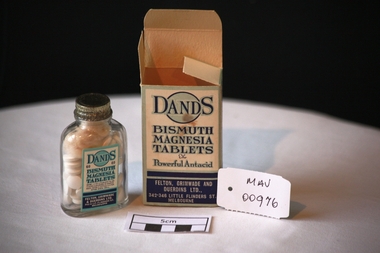
Manufactured Glass, bottle 'Dands' tablets with box, mid 20thC
... Bismuth and Magnesium tablets were used as a medication used to treat temporary discomforts of the stomach and gastrointestinal tract, such as diarrhoea, indigestion, heartburn and nausea. ...Left side: An EFFICACIOUS / REMEDY FOR THE / RELIEF OF / INDIGESTION / FLATULENCE...... Right side:DIRECTIONS / Dose / ...........Left side: An EFFICACIOUS / REMEDY FOR THE / RELIEF OF / INDIGESTION / FLATULENCE...... Right side:DIRECTIONS / Dose / ........ ...Bismuth and Magnesium tablets were used as a medication used to treat temporary discomforts of the stomach and gastrointestinal tract, such as diarrhoea, indigestion, heartburn and nausea. A clear glass bottle, with a metal screw top, containing 60 Bismuth Magnesia tablets. Bottle Front; DANDS / 60 / BISMUTH / MAGNESIA / TABLETS / DOSE - 1TO 3 TABLETS TO BE / TAKEN ( CRUSHED) IF PREFERED / WITH A LITTLE WATER / AFTER EACH MEAL / FELTON, GRIMWADE /& DUERDINS LTD. / 342-6 LIT. FLINDERS ST., / MELBOURNE BOX Front & Back: DANDS / BISMUTH ...... / The / Powerful Antacid / FELTON .......... Left side: An EFFICACIOUS / REMEDY FOR THE / RELIEF OF / INDIGESTION / FLATULENCE...... Right side:DIRECTIONS / Dose / ........pharmacy, medicines, felton, grimwade and duerdins ltd., dands melbourne, early settlers, market gardeners, moorabbin, bentleigh, cheltenham, bismuth, magnesia, antacids -
 Mont De Lancey
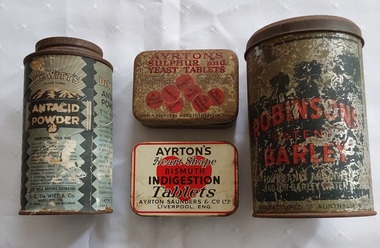
Domestic object - Medicinal Tins, Ayrton Saunder's & Co Ltd, 1900's
... Small Ayrton's heart shape Bismuth Indigestion Tablets tin with the Manufacturer details printed at the bottom of the lift up lid. ...'Ayrton's Heart Shape Bismuth Indigestion Tablets Ayrton Saunders & Co Ltd Liverpool. ...'Ayrton's Heart Shape Bismuth Indigestion Tablets Ayrton Saunders & Co Ltd Liverpool. ...These vintage tins contained medicinal products to help relieve illness symptoms for the family at home in the 1900's. Two were manufactured in Australia and the two Ayrton's products were made in England.Three vintage medicinal tins and cardboard container. 1. Small Ayrton's heart shape Bismuth Indigestion Tablets tin with the Manufacturer details printed at the bottom of the lift up lid. It has a large red heart shape on a white background. Approx. 2ozs. It has a gold base with information for use and recommended dosages. 2. A small badly rusted and worn tin Ayrton's Sulphur and Yeast Tablets with seven red dots showing usage features of these tablets. Manufacturer details are listed at the bottom of the front lift up lid and the back of the tin has further information. 3. A cylindrical green Robinson's Patent Barley tin with a patterned rusted lid. The manufacturer details and usage information are indecipherable due to wear and rust. 4. A cylindrical lidded De Witt's Antacid Powder cardboard container with a rusted tin lid. Manufacturer details and usage are printed on a paper wrapper glued to the cylinder.1. 'Ayrton's Heart Shape Bismuth Indigestion Tablets Ayrton Saunders & Co Ltd Liverpool. England.' 2. 'Ayrton's Sulphur and Yeast Tablets Ayrton, Saunders & Co. Ltd. Liverpool. Eng.' 3. Robinson's Patent Barley' (indecipherable details) On the bottom of the tin Robinson's "Patent" Barley Letters Patent Granted 1923 Now expired Packed March 1951. 4.De Witt's Trademark Antacid Powder 2/6 for Indigestion. Contents 4ozs. Approx. Lasting Action' Inside the Ayrton's Sulphur and Yeast Tablets tin is a sticker with 'M Burgi' handwritten on it in biro.medicinal containers, tins, medication, containers -
Clunes Museum
Booklet - BOOKLET & POSTCARDS, HANDY HINTS
... MOSES INDIAN ROOT OILS TO CURE MANY AILMENTS INCLUDING INFLUENZA, RHEUMATISM & INDIGESTION ALSO LETTERS OF APPRECIATION FROM SATISFIED CUSTOMER...MOSES INDIAN ROOT OILS TO CURE MANY AILMENTS INCLUDING INFLUENZA, RHEUMATISM & INDIGESTION ALSO LETTERS OF APPRECIATION FROM SATISFIED CUSTOMER SMALL BOOKLET ADVERTISING DR. ...SMALL BOOKLET ADVERTISING DR. MOSES INDIAN ROOT OILS TO CURE MANY AILMENTS INCLUDING INFLUENZA, RHEUMATISM & INDIGESTION ALSO LETTERS OF APPRECIATION FROM SATISFIED CUSTOMERSMALL BOOKLET ADVERTISING DR. MOSES INDIAN ROOT OILS TO CURE MANY AILMENTS INCLUDING INFLUENZA, RHEUMATISM & INDIGESTION ALSO LETTERS OF APPRECIATION FROM SATISFIED CUSTOMERnon-fictionSMALL BOOKLET ADVERTISING DR. MOSES INDIAN ROOT OILS TO CURE MANY AILMENTS INCLUDING INFLUENZA, RHEUMATISM & INDIGESTION ALSO LETTERS OF APPRECIATION FROM SATISFIED CUSTOMERlocal history, documents, pamphlet, handy hints -
Clunes Museum
Memorabilia - LABEL
... LABEL USED ON BOTTLES OF HOT PUNCH FOR COUGHS, COLDS AND INDIGESTION, MADE AT EBERHARD CORDIAL FACTORY, CLUNES....LABEL USED ON BOTTLES OF HOT PUNCH FOR COUGHS, COLDS AND INDIGESTION, MADE AT EBERHARD CORDIAL FACTORY, CLUNES. ...LABEL USED ON BOTTLES OF HOT PUNCH FOR COUGHS, COLDS AND INDIGESTION, MADE AT EBERHARD CORDIAL FACTORY, CLUNES.LABEL, BOTTLE SHAPED, BLUE BACKGROUND WITH GREEN, YELLOW AND RED DECORATION, CREAM AND BLACK LETTERING. HOT PUNCHlocal history, commerce, eberhard& co labels -
 Warrnambool and District Historical Society Inc.
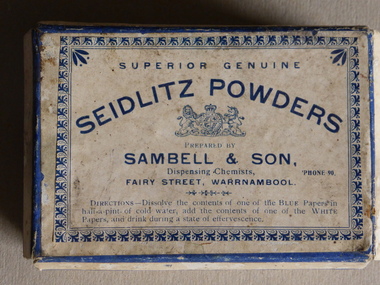
Box, Box of Seidlitz powder, 1920s
... These powders were used for indigestion and constipation with the name coming from the village of Sedlec or Sedlitz which was the source of a bitter mineral water once used for indigestion. ...These powders were used for indigestion and constipation with the name coming from the village of Sedlec or Sedlitz which was the source of a bitter mineral water once used for indigestion. ...This box contained Seidlitz Powders. These powders were used for indigestion and constipation with the name coming from the village of Sedlec or Sedlitz which was the source of a bitter mineral water once used for indigestion. The 19th century product was produced by many chemical factories with nothing to do with the original Sedlitz town. The powders were a mixture of tartaric acid, sodium bicarbonate and potassium sodium tartrate. This box contained powders distributed by the chemist firm of Sambell and Son. John Sambell came to Warrnambool in 1886 and three generations of the Sambell family conducted chemist shops in four different locations in Fairy Street. Sambell and Son were operating at 151 Fairy Street in the late 1910s and in the 1920s. This is an item of interest as it not only shows us the type of box used by chemists t0 package their medicines in the 1920s but also reminds us of the days when Seidlitz Powers were commonly used for indigestion and constipation. It also has a strong link to the Sambell family, chemists in Warrnambool for over 40 years. This is an empty cream-coloured cardboard box with a lid with blue edgings and printed material in blue type and a British crest and an ornamental pattern around the edges of the lid. The sides of the box are torn and the box is discoloured and dirty. Superior Genuine, Seidlitz Powders, prepared by Sambell & Son, Dispensing Chemists, Fairy Street Warrnambool, ‘Phone 90, Directions – Dissolve the contents of one of the BLUE papers in half a pint of cold water, add the contents of one of the WHITE papers, and drink during a state of effervescence’sambell and son, chemists, seidlitz powders, warrnambool -
 Walhalla Museum
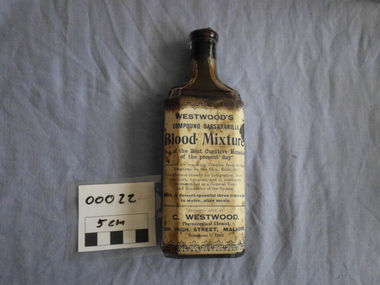
Medicein - Blood Mixture, Melbourne Glass Bottle Works co, 1900 to 1915
... An effectual remedy for Indigestion, Liver Complaint, Languor, and is confidently recommended as a General Tonic and Renovator of the System." ...An effectual remedy for Indigestion, Liver Complaint, Languor, and is confidently recommended as a General Tonic and Renovator of the System." ...Bottle is sealed with a cork and contains a third of a bottle of the Medicine. A paper label is glued to on side of the bottle, the label is in poor condition. the bottle is in good condition WESTWOOD'S compound sarsaparilla Blood Mixture One of the best curative remedies of the present Unrivalled for removing for removing pimples from the face, Eruptions on the skin, boils, &c. An effectual remedy for Indigestion, Liver Complaint, Languor, and is confidently recommended as a General Tonic and Renovator of the System." "DOSE- A dessert-spoonful three times a day in water, after meals." -
 Warrnambool and District Historical Society Inc.
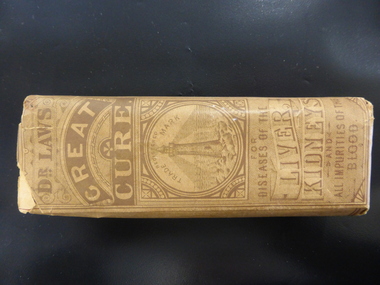
Bottle, Dr Laws, Late 19th century (medicine mixture)
... ‘Great Blood Purifier’ ‘Dr Law’s Great Cure for Diseases of the Liver and Kidney and all Impurities of the Blood’ Dr Law’s Liver Stimulant and Invaluable Remedy for indigestion, dyspepsia, sick headaches, loss of appetite, spasms, jaundice, constipation, sour stomach, heartburn’ ‘Waterbrasch, Liver, Stomach and Kidneys’ ‘Manufactured at Kennedy’s Pharmaceutical Works, Warrnambool, W.D.’ ...Both Dr Law and Richard Kennedy used an image of a lighthouse as a business symbol though the images are not identical. r.f.kennedy, warrnambool chemist dr law of boston patent medicine producer chemists in warrnambool history of warrnambool ‘Great Blood Purifier’ ‘Dr Law’s Great Cure for Diseases of the Liver and Kidney and all Impurities of the Blood’ Dr Law’s Liver Stimulant and Invaluable Remedy for indigestion, dyspepsia, sick headaches, loss of appetite, spasms, jaundice, constipation, sour stomach, heartburn’ ‘Waterbrasch, Liver, Stomach and Kidneys’ ‘Manufactured at Kennedy’s Pharmaceutical Works, Warrnambool, W.D.’ ...This bottle contains the medicine mixture for diseases of the liver and kidney that was patented by Dr Law of Boston. In the late 19th century Dr Law was a prolific and popular producer of patent medicines. The Warrnambool manufacturing chemist, Richard Kennedy, had the sole rights in Warrnambool to prepare and distribute Dr Law’s medicines. Richard Frank Kennedy (1826-1903) was born in England. He came to Warrnambool in the early 1880s and set up a pharmacy business in Timor Street. He was a retail, wholesale and manufacturing chemist. In 1891 he erected a new building and at that time his shop was described and one of the most elegant and best-stocked chemist’s shops in Victoria. Kennedy was active in Warrnambool community affairs and he was a foundation member of the Warrnambool Bowls Club, being its first Vice-President and an early President. His business continued after his death, trading as R.F.Kennedy and Co. This item is of considerable significance as it is the only example we have of a Dr Law patent medicine produced and distributed by the Warrnambool manufacturing chemist, Richard Kennedy. Both Dr Law and Richard Kennedy used an image of a lighthouse as a business symbol though the images are not identical. This is a glass bottle with a cork containing a chemist’s mixture for diseases of the kidney and liver. The bottle is enclosed in a brown paper cover which is lined with what looks to be the instructions for the use of the medicine. (The bottle is unable to be removed from the covering without major damage to the cover). The covering is brown with images of Dr Law and his lighthouse logo and printed material in brown and white colouring with the name of the product and its benefits. The top of the covering is torn and mended with adhesive tape. ‘Great Blood Purifier’ ‘Dr Law’s Great Cure for Diseases of the Liver and Kidney and all Impurities of the Blood’ Dr Law’s Liver Stimulant and Invaluable Remedy for indigestion, dyspepsia, sick headaches, loss of appetite, spasms, jaundice, constipation, sour stomach, heartburn’ ‘Waterbrasch, Liver, Stomach and Kidneys’ ‘Manufactured at Kennedy’s Pharmaceutical Works, Warrnambool, W.D.’ r.f.kennedy,, warrnambool chemist, dr law of boston, patent medicine producer, chemists in warrnambool, history of warrnambool -
 Bendigo Historical Society Inc.
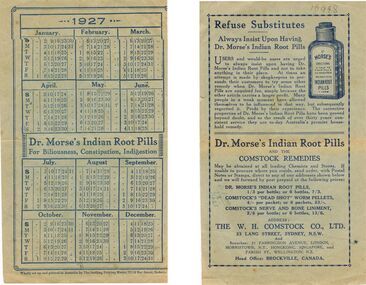
Domestic Object - 1927 CALENDAR, 1927
... 1927 Calendar: On blue paper with blue print within a border of fine blue lines is the 1927 calendar from January till June with a break in between for advertising for * Dr Morse's Indian Root Pills for Biliousness, Constipation, Indigestion. The calendar resumes July till December. ...Wholly set up and printed in Australia by The Snelling Printing Works, 52-54 Bay Street Sydney. 1927 Calendar: On blue paper with blue print within a border of fine blue lines is the 1927 calendar from January till June with a break in between for advertising for * Dr Morse's Indian Root Pills for Biliousness, Constipation, Indigestion. The calendar resumes July till December. ...BHS Collection1927 Calendar: On blue paper with blue print within a border of fine blue lines is the 1927 calendar from January till June with a break in between for advertising for * Dr Morse's Indian Root Pills for Biliousness, Constipation, Indigestion. The calendar resumes July till December. On the back is printed in blue ink within a thin border is * Refuse Substitutes. Always insist upon having Dr. Morse's Indian Root Pills. Plus Dr. Morse's Indian Root Pills and the Comstock remedies. The W.H. Comstock Co., Ltd. 23 Lang Street, Sydney, N.S.W. Box 625Wholly set up and printed in Australia by The Snelling Printing Works, 52-54 Bay Street Sydney.ephemera, mementoes, dr. morse's indian root pills. w.h. comstock co., ltd. -
 Warrnambool and District Historical Society Inc.
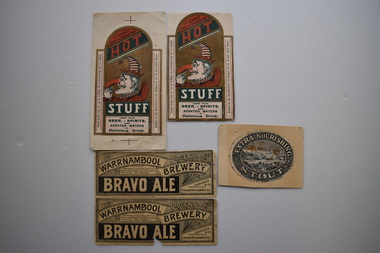
5x Labels, Hodgens, Early 20th century
... Easy of Digestion HODGENS & CO PROPRIETORS WARRNAMBOOL .4,.5 A CERTAIN CURE FOR INDIGESTION HOT STUFF USED WITH BEER SPIRITS AND AERATED WATERS A DELICIOUS DRINK . ...Easy of Digestion HODGENS & CO PROPRIETORS WARRNAMBOOL .4,.5 A CERTAIN CURE FOR INDIGESTION HOT STUFF USED WITH BEER SPIRITS AND AERATED WATERS A DELICIOUS DRINK . ...These labels come from the Brewery of Hodgens & Co. who operated the Warrnambool Brewery west of the corner of Timor and Banyan Streets This brewery was established by Edmund Wheeler as the Western Brewery in 1866. Daniel Hodgens the principal of Hodgens & Co. owned the Warrnambool Brewery from sometime in the 1890s until 1909. (Hodgens died in 1907.) Daniel Hodgens also owned the National Hotel and the Pieter Both Hotel and leased the Union, Princess Royal, Prince of Wales and the Bayview hotels in the late 1890s.These labels are of considerable interest as they are artistically pleasing and are part of an important brewery business in Warrnambool in times past. .1 Oval grey and white label adhered to a piece of cream coloured card. It has a sketch of a lake and hills in the centre which resembles Tower Hill .This is surrounded by a wide border containing text. The label is discoloured .2,.3 Dark cream paper rectangular labels with black and white text. There are decorations of berries and leaves in one corner. The primary texts are contained in two long arcs and a black rectangle. Both labels are torn. .2 has a section missing. .4,.5 Rectangular labels with a curved top and extended side panels. It features,on a gold coloured background, the profile of Punch wearing a crown with a striped red and white stocking attachment. Punch has a long hooked red nose and is raising a flask towards his mouth. Above him in the curved top section are two diagonal red and dark green panels containing text. Underneath Punch are two rectangular wide, dark green and white panels containing text. The extended side panels are at right angles to the central section.There are two crosses on the top and bottom of .5 The section containing these and also a sections beside the side extensions have been removed from .4. .1EXTRA NOURISHING STOUT HODGENS & CO WARRNAMBOOL .2,.3 HODGENS & CO. WARRNAMBOOL BREWERY BRAVO ALE Refreshing, Invigorating and Contstiting (sic.) an Appetising Tonic while slightly Stimulating. Easy of Digestion HODGENS & CO PROPRIETORS WARRNAMBOOL .4,.5 A CERTAIN CURE FOR INDIGESTION HOT STUFF USED WITH BEER SPIRITS AND AERATED WATERS A DELICIOUS DRINK . Bottled for the Manufacturers by Hodgens & Co. at their Spirits Stores. . warrnambool brewery 1885-1909 -
 Warrnambool and District Historical Society Inc.
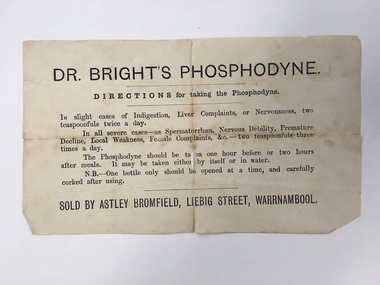
Document, Docket Dr Bright's Phosphodyne, Mid 19th century
... It was a form of medicine also known as ozonic oxygen which was developed and patented in 1869 by Dr Charles Bright, a 19th century Resident Surgeon at St Mary’s Hospital London, The medicine claimed to ease ‘indigestion, liver complaints, nervous debility, female complaints, premature decline, local weakness and spermatorrhea’. ...It was a form of medicine also known as ozonic oxygen which was developed and patented in 1869 by Dr Charles Bright, a 19th century Resident Surgeon at St Mary’s Hospital London, The medicine claimed to ease ‘indigestion, liver complaints, nervous debility, female complaints, premature decline, local weakness and spermatorrhea’. ...This label accompanied a bottle of Dr Bright’s Phosphodyne. It was a form of medicine also known as ozonic oxygen which was developed and patented in 1869 by Dr Charles Bright, a 19th century Resident Surgeon at St Mary’s Hospital London, The medicine claimed to ease ‘indigestion, liver complaints, nervous debility, female complaints, premature decline, local weakness and spermatorrhea’. It was widely sold by chemists throughout Australia in the 19th century and in this case was supplied by the Warrnambool chemist, James Astley Bromfield. He was a significant person in Warrnambool’s history as he produced the 1856 map of the Warrnambool district showing all the original landholders, a seminal resource for historians today. Bromfield had a chemist shop in Warrnambool from 1854 to the late 1880s, initially in Timor Street and then in Liebig Street (number 80 and later number 78). Bromfield was very active in local community affairs. This label is of considerable interest as it shows the use in the 19th century of medicine that today would be labelled ‘quack’. It is of particular interest as it was supplied by James Astley Bromfield’s chemist shop and he is an important early identity in Warrnambool, involved in many activities in the town. He was a Justice of the Peace, a Trustee of the Savings Bank, Chairman of the Western Steam Navigation Company, a Director of the Gasworks and on the committees of the Harbour Committee, the Fire Brigade and the Anglers Protection Society. He was a Warrnambool Councillor (1858-60; 1865-1870) and a Shire Councillor (1875-1883). This is a sheet of paper that accompanied a bottle of Dr Brights’ Phosphodyne medicine. It is buff-coloured with black printed material. It is in two pieces and dog-eared at the edges.warrnambool, dr bright's phosphodyne, james bromfield chemist, warrnambool chemists -
 Coal Creek Community Park & Museum
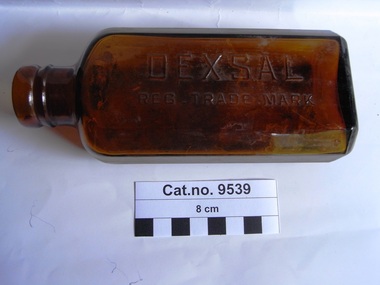
Domestic object - Glass Bottle, c.1934 - c.1975
... Dexsal, containing 34% pure medicinal glucose for nausea . sick headache . mild indigestion . over indulgence . in food or drink . biliousness . acidity . heartburn . periodic upsets. ...Dexsal, containing 34% pure medicinal glucose for nausea . sick headache . mild indigestion . over indulgence . in food or drink . biliousness . acidity . heartburn . periodic upsets. ...TROVE : The Australian Women's Weekly (1933-1982), Wednesday 22 January, 1964, p.32, Advertising. Dexsal, containing 34% pure medicinal glucose for nausea . sick headache . mild indigestion . over indulgence . in food or drink . biliousness . acidity . heartburn . periodic upsets. Directions one or two teaspoons in a tumbler of cold water and drink during effervescence. May be taken as often as desired. Keep tightly capped. Net contents 4 ozs. Reg. VIC 2102, 758. Manufactured by Drug Houses of Australia. For your family - pick the simplest way to settle 'upset tummy' - double-acting DEXSAL The simplest - and safest - because it's formulated wholly and solely to settle upset tummy, nothing else. It contains no pain killer, which can so often set up an excess-acid reaction in the stomach. The lively, sparkling drink of Dexsal dissolved in water is safe. Simply-formulated Dexsal acts in two ways: brings quick, direct relief to upset tummy discomforts or sick feelings and, simultaneously, restores your lost energy. That's because Dexsal contains 34 % medicinal glucose - the energy-builder that quickly restores your natural vitality. Take care of your family, when upset-tummy strikes, with the lively Dexsal drink - the simplest way to settle tummy upsets. (N.B. Children love the fresh tingly-taste of Dexsal) Double-acting Dexsal quickly relieves: . Ordinary indigestion . Sick headache . Heartburn . Nausea . Acidity . Periodic upsets . Biliousness . Over-eating or . Car and travel sickness drinking Safe for alt the family. And especially recommended for expectant mothers. DEXSAL A product of Drug Houses of Australia. Drug Houses of Australia Ltd. (DHA) was established in 1930 after the amalgamation of several proprietary medicine companies, including Felton Grimwade & Co. and Duerdin & Sainsbury Ltd. In 1974 the decision was made, after suffering from enormous financial losses, to break up the company and sell it. Several sections of the company became Felton Grimwade & Bickford Pty Ltd. Timeline of amalgamations 1855 - 1867 Youngman McCann & Co, 1863 - 1930 A. M. Bickford & Sons, 1867 - 1930 Felton Grimwade & Co, - 1930 Taylor-Elliotts Ltd, ? - 1930 Duerdin and Sainsbury Ltd, ? - 1930 Elliott Brothers Limited, - 1930 Rocke Thompsitt, 1863 - 1930 A. M. Bickford & Sons, 1867 - 1930 Felton Grimwade & Co.' 1902 - 1930 Felton Grimwade & Bickford Ltd, 1930 - 1974 Drug Houses of Australia Ltd (DHA), c. 1974 - Felton Grimwade & Bickfords Pty Ltd. Large clear amber glass bottle, rectangular in section with angled corners, wide neck. Embossed text on large side panel, numeral on corner panel near base, monogram, letters and numerals on base.On side panel 'DEXSAL REG. TRADE MARK'. On corner panel near base '4'. On base the letter 'g' or numeral '9' on its side, AGM monogram, 'F397' over '4' , A space then the letter 'M'.dexsal, medicine, drug houses of australia -
 Coal Creek Community Park & Museum
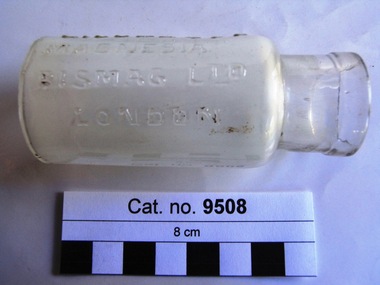
Domestic object - Glass Bottle, Early 1900's
... . : 1865 - 1924) Wednesday 20 October 1920 p 7 Article 'A LITTLE DOCTOR FOR DYSPEPTICS If you want quick relief from the pains and distress of indigestion, dyspepsia, food fermentation and acidity, just take two or three little tablets of Bisurated Magnesia after eating or whenever pain is felt. .... : 1865 - 1924) Wednesday 20 October 1920 p 7 Article 'A LITTLE DOCTOR FOR DYSPEPTICS If you want quick relief from the pains and distress of indigestion, dyspepsia, food fermentation and acidity, just take two or three little tablets of Bisurated Magnesia after eating or whenever pain is felt. ...TROVE : The Ballarat Star (Vic. : 1865 - 1924) Wednesday 20 October 1920 p 7 Article 'A LITTLE DOCTOR FOR DYSPEPTICS If you want quick relief from the pains and distress of indigestion, dyspepsia, food fermentation and acidity, just take two or three little tablets of Bisurated Magnesia after eating or whenever pain is felt. Bisurnted Magnesia tablets are absolutely harmless, and enable the dyspeptic to enjoy a good- old-fashioned meal with out fear of pain or distress to follow. That’s why Bisurated Magnesia is called “The Little Doctor for Dyspeptics.” . Go to the nearest chemist and get a packet of Bisurated Magnesia tablets to-day; he sells them in handy flasks at small cost, and with every one is included a. binding guarantee of satisfaction or refund of money. Thus, unless this “Little Doctor” gives you the benefit you desire, you pay him nothing. Bisurated Magnesia is also obtainable in powder form. Beware of substitutes. Look for the maker’s name—Bismag. Ltd., which appears on every .genuine package'. Advertisement in 'The Illustrated London News' 22 July, 1916, page 117. '96 out of 100 dyspeptics have Acid stomachs'. BISMAG LTD, 212-214 Great Portland St., London W. Round clear glass bottle with wide neck and text embossed on side and base. 'BISATURATED MAGNESIA BISMAG LTD LONDON' on side. 'B' over 'I' on base.bisaturated magnesia, bismag, magnesia -
 City of Moorabbin Historical Society (Operating the Box Cottage Museum)
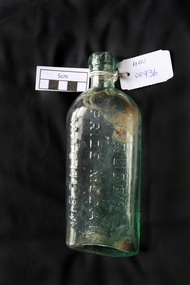
Manufactured Glass, bottle 'Kruse's Magnesia', 20thC
... Improves general well being, corrects magnesium deficiency. Helps relieve indigestion, when due to acidity. ...Improves general well being, corrects magnesium deficiency. Helps relieve indigestion, when due to acidity. In 1878 Kruse established Victoria's first pharmacy training facility - the Melbourne School of Pharmacy, the forerunner of the Victorian College of Pharmacy, Monash University, which remains Victoria's only pharmacy training institute. glass works pharmaceutical glass pharmacy kruse johann august (john) dr weil s . victorian college of pharmacy monash university university of göttingen felton grimwade and company magnesium bicarbonate magnesium oxide KRUSE’S / PRIZE MEDAL / MAGNESIA/ K / FELTON-GRIMWADE & CO. ...Johann August (John) Kruse was instrumental in the development of the pharmaceutical industry and pharmacy training in Victoria. He was a driving force behind the creation of the Pharmaceutical Society of Victoria and was appointed a founding member of the Society's inaugural council in 1857. He manufactured many pharmaceuticals and health products such as mineral waters and 'Kruse's Fluid Magnesia' (1863) which is still in use today. He later went on to produce insecticides and dynamite, then established his own analytical chemistry service. In 1878 Kruse established Victoria's first pharmacy training facility - the Melbourne School of Pharmacy. There pharmacy apprentices were taught chemistry, botany, materia medica and Latin, while country students could study by correspondence. The School was endorsed and monitored by the Pharmacy Board of Victoria to which Kruse was appointed in 1880. Kruse's pharmacy school was the forerunner of the Victorian College of Pharmacy, Monash University, which remains Victoria's only pharmacy training institute. In 1853, shortly after qualifying as pharmacist at the University of Göttingen, Johann August (John) Kruse, moved to London. The medical practitioner Dr S. Weil sent Kruse to Victoria, Australia to manage a new pharmacy and tobacconist's shop which he was having built at 136 Bridge Rd in Richmond. In 1856 Kruse opened a second pharmacy 'John Kruse and Company Chemists and Druggists' at 207 Bourke Street. 1857 the Richmond shop was destroyed by fire, so all pharmaceutical production was moved to the Bourke St premises and later to his new location at 184 Bourke St.. Kruse was forced to sell his business in 1868 to Felton Grimwade and Company and work for them as manager of their chemical works. By the early 1870s he had regained financial independence so left the company to establish his own businesses again. He opened up a pharmacy at 31 Swanston St and in c1874 leased Victoria's premier natural springs, Clifton Springs, on the northern side of the Bellarine Peninsula, where he established a bottling plant. Suspensions of magnesium hydroxide in water, often called Milk of Magnesia, are used as an antacid to neutralize stomach acid, and as a laxative. Milk of magnesia is sold for medical use as chewable tablets, capsules, and as liquids having various added flavours Kruses Fluid Magnesia 300ml Extralife Kruse’s Fluid Magnesia, Magnesium supplement. Rapidly absorbed, easily digested. Improves general well being, corrects magnesium deficiency. Helps relieve indigestion, when due to acidity. In 1878 Kruse established Victoria's first pharmacy training facility - the Melbourne School of Pharmacy, the forerunner of the Victorian College of Pharmacy, Monash University, which remains Victoria's only pharmacy training institute. A glass bottle containing ‘Kruse’s’ Magnesia’ medicineKRUSE’S / PRIZE MEDAL / MAGNESIA/ K / FELTON-GRIMWADE & CO. MELBOURNE Directions for use ......glass works, pharmaceutical glass, pharmacy, kruse johann august (john), dr weil s, ., victorian college of pharmacy, monash university, university of göttingen, felton grimwade and company, magnesium bicarbonate, magnesium oxide -
 City of Melbourne Libraries
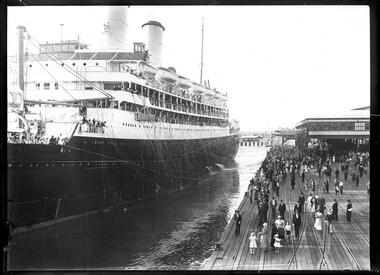
Photograph, Bull, Hugh Jones, 1897-1993, RMS Orford departing from Station Pier, Port Melbourne
... They gave you the creeps and indigestion. This room is gay, bright, sunlit, like a luxurious café overlooking the sea.” ...They gave you the creeps and indigestion. This room is gay, bright, sunlit, like a luxurious café overlooking the sea.” ...Published: 21 March 1934 The Age p11 Published title: CROWDED TOURIST SHIP WILL CARRY TEST AND DAVIS CUP TEAMS. Published caption: Carrying an exceptionally large number of tourists, business men and prominent sporting personalities, R.M.S. Orford sailed for London yesterday. Over two hundred passengers embarked at Melbourne, and on leaving the Australian coast there will be two thousand persons on board. The Australian Test team will join the vessel at Fremantle and the remaining two Davis Cup representatives will embark at Adelaide. A picture of the Orford taken just as she moved out from Station Pier, Port Melbourne, under her own steam. Trove article identifier: http://nla.gov.au/nla.news-article203826897 Description: Passenger ship about to depart Station Pier, Port Melbourne. Research by project volunteer, Fiona Collyer: The RMS Orford was built by Vickers-Armstrong Shipyard Barrow-in-Furness, Cumbria, England and launched in 1927 by Lady Ryrie, the wife of Sir Granville Ryrie, the Australian Ambassador to the UK. The Orford was owned by the Orient Steam Navigation Ltd and was designed for the mail and passenger service between England and Australia. She was 20,000 tons, 658 ft long, 75 ft across and 80 ft high from water-line to deck. She had eight decks, a swimming pool and cost more than £1,000,000. She could travel at 20 knots – 480 miles a day, a 5 week voyage between Australia and England. There were enough lifeboats to accommodate every person on board. Promoted as a ship of comfort, luxury, speed and grace with spacious, beautifully decorated lounges, smoking-rooms and writing rooms, the SMH 23/11/1928 review said “sitting-rooms where the furniture recreates the air of quiet, exquisite, safe luxury; suites where you may retire from other people, and on a sea voyage other people, even the most charming other people, often begin to resemble one’s worst enemies towards the end of several weeks sea voyaging together”. “Travel like a human being. This is what the great liners give you today. The Orford dining room is enormous (it seated 350 people) the walls sweep up to a white, cool roof supported on decorative pillars. Panels of grey scagliola and carved designs remove the bleak, comfortless air which used to cling to dining-rooms of ships. Everything about them was so wretchedly temporary that you could not enter them without wishing that you stayed at home. They gave you the creeps and indigestion. This room is gay, bright, sunlit, like a luxurious café overlooking the sea.” “You really feel in here that you are a human being and not a piece of cargo endowed with sensation.” The Orford had the punkah louvre system of ventilation which forced draughts through every part of the ship, ensuring “No Ship Smells!!” and avoiding - “… a mayonnaise of all the unpleasant odours generated under heaven. From the hot oil of the engines, from those overheated, bottomless pits below the water-line, from new paint and food, from people perspiring at work, from rope and tar and grease and fruit and wet clothes and tobacco, rises a deplorable incense that lingers unsettlingly in the nostril long after one has left the ship. Those dreadful odours will never rise to torture the senses of passengers who feel that all is over with them.” The modern electric kitchen had a roll making machine capable of producing 2000 rolls for the table an hour and a bread and butter machine which cut the bread into slices and spread the butter in one operation. (The Week – Brisbane 30/11/1928) On 13/10/1928, the Orford made its first voyage to Australia with 520 first class and 1100 3rd class passengers. The name of the passengers embarking and disembarking and their reason for visiting were published in newspapers and the number of migrants for the New Settlers Scheme and the Dreadnought Boys Co program to promote and assist the migration of British youths willing to become farm workers in Australia 1911-1939 were noted too. On the 19th March 1932, RMS Orford featured in the “Parade of Ships” celebrating the official opening of the Sydney Harbour Bridge. Only country people were allowed to book a ticket as a guest on board. The Post Office issued commemorative postage stamps showing the Orford sailing under the bridge. In March 1934, the Orford sailed from Australia to London, via Colombo, Aden, Port Said, Naples, Villefranche, Toulon, Parma, Gibraltar and Channel Port. Amongst the 2000 passengers on board was the Davis Cup Tennis team, tennis champions Joan Hartigan and Nell Hopman, the Australian Test cricket team and British champion swimmer Joyce Cooper. Every day tennis player Harry Hopman and an Australian Press Association reporter radioed through reports on their activities, which included – - Test cricket batsman Len Darling having spend 4 days in his cabin after straining his groin when he slipped over while playing ball tennis in his slippers. - Batsman Bill Brown dancing the fox-trot, displaying footwork similar to the grace he showed at the wicket. - Alluding to the seasickness of Don Bradman and Stan McCabe and how they were making up for meals lost on the Great (very choppy) Australian Bight. - Miss Joan Hartigan discarding her bright blue shorts for brighter blue bathers and being first into the pool. - Bowler Bill O’Reilly being tripped by a passenger on the deck and spending the voyage with bandaged wrists with daily updates of his progress in the press. - Wicketkeeper Ben Barnett’s conjuring tricks and constant whirring movie camera. - Results of the quoits, ball tennis and bridge tournaments. A fancy dress ball was held one night and the cricketers dressed as sheiks and sang “The Riff Song” from the pre-code 1929 operetta film “The Desert Song” starring John Bates as the Red Shadow and Myrna Lay as a native dancing girl. Alan Kippax’s beard blew overboard! Joan Hartigan dressed as Burlington Bertie from the music hall song and Nell Hopman a doll in a box wearing a crinkled paper dress. On arrival at Southampton, while they waited for the gangway to be lowered, Bradman entertained the team at the piano playing popular tunes while the cricketers sang. . In 1935, RMS Orford’s third class accommodation was converted to tourist class. Her passenger capacity was now 468 First Class, 515 tourist class and 440 crew. First saloon from Sydney fares cost for single £76, £82, £88 and Third Class fares were £21, £23, £25. Less than a penny a mile. . In 1936, the Orford embarked the exiled Emperor of Ethiopia, Haile Selassie at Gibraltar on his way to the UK. In 1939, she was requisitioned for Australian government service and on 7/1/1940 she conveyed the first Australian troops to Egypt and was then used to carry French troops from Tamatave, Madagascar to Marseilles. On 1/6/1940 RMS Orford was bombed and set on fire at Marseilles by German aircraft. 14 crew were killed, 25 wounded. In 1947, the wreck was re-floated and broken up at Savona. . . References: R.M.S. ORFORD. (1928, November 23). The Sydney Morning Herald (NSW : 1842 - 1954), p. 14. Retrieved September 15, 2023, from http://nla.gov.au/nla.news-article16511535 ARRIVAL OF THE ORFORD (1928, November 30). The Week (Brisbane, Qld. : 1876 - 1934), p. 21. Retrieved September 15, 2023, from http://nla.gov.au/nla.news-article181126802 CROWDED TOURIST SHIP WILL CARRY TEST AND DAVIS CUP TEAMS. (1934, March 21). The Age (Melbourne, Vic. : 1854 - 1954), p. 11. Retrieved October 5, 2023, from http://nla.gov.au/nla.news-article203826897 Photographer notations on slide: "B19".tennis, ships
