
Showing 27 items matching "insect pests"
-
 Creswick Campus Historical Collection - University of Melbourne
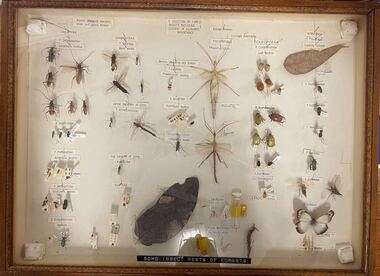
Animal specimen - Student display showing Some Insect Pests of Forests, Some Insect Pests of Forests
... Student display showing Some Insect Pests of Forests...Some Insect Pests of Forests...Wooden cabinet with glass top, a variety of insect specimens mounted with tags Some Insect Pests of Forests Animal specimen Student display showing Some Insect Pests of Forests ...A mounted Insect Collection, collected and produced by a student from the VSFWooden cabinet with glass top, a variety of insect specimens mounted with tagsA Selection of Forest Insects, including Several of Economic Importance. -
 University of Melbourne, Burnley Campus Archives
Photograph - 35mm Colour slides, Kodachrome Transparency, Insect Pests, 1950's-1980's
... Insect Pests......insect pests...insects insect pests Set of 109 colour slides, formerly stored in plastic pockets designed to be held in a filing cabinet - removed and placed in archival standard plastic pockets. ...insects, insect pests -
University of Melbourne, Burnley Campus Archives
Booklet, Department of Agriculture, Insect Pests of Stored Grain, 1938
... Insect Pests of Stored Grain...5 copies of a booklet produced by the Department of Agriculture, Victoria, Australia as part of the Insect Pests Series, Leaflet No. 6 by R. T. M. ...insects pests grain dept of agriculture r t pescott 5 copies of a booklet produced by the Department of Agriculture, Victoria, Australia as part of the Insect Pests Series, Leaflet No. 6 by R. ...insects, pests, grain, dept of agriculture, r t pescott -
 Ringwood and District Historical Society
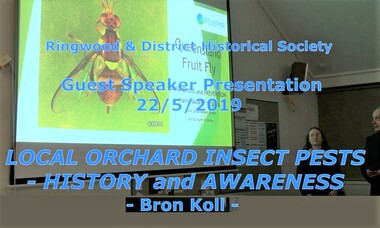
Mixed media - Video, RDHS Guest Speaker Presentation - "Local Orchard Insect Pests" - Bron Koll
... RDHS Guest Speaker Presentation - "Local Orchard Insect Pests" - Bron Koll...In this historical perspective on the first industry of Ringwood, Bron talks about her orchardist roots and highlights the seriousness of looking after crops with the ongoing threat of insect pests in the district, including backyard gardens. ...(Video is available for viewing at Ringwood & District Historical Society Archives by appointment) RDHS Guest Speaker Presentation - "Local Orchard Insect Pests" - Bron Koll Mixed media Video ...Digitised video (3.86GB). Duration: 75 minutes. Recorded May, 2019. (Video is available for viewing at Ringwood & District Historical Society Archives by appointment)Presenter: Bronwyn Koll grew up on her family’s orchard in Wonga Park. In this historical perspective on the first industry of Ringwood, Bron talks about her orchardist roots and highlights the seriousness of looking after crops with the ongoing threat of insect pests in the district, including backyard gardens. -
University of Melbourne, Burnley Campus Archives
Journal, Insect pests - principal insect pests in Victroai; a guide to identification and control, 1970
... Insect pests - principal insect pests in Victroai; a guide to identification and control...See also B10.0489 (same journal issue) Insect pests - principal insect pests in Victroai; a guide to identification and control Journal ...Journal of Agriculture, Vol. 68, Part 7, July 1970, including article by officers of Victorian Plant Research Institute, Burnley. See also B10.0489 (same journal issue)journal of agriculture, victorian plant research institute -
 Wheen Bee Foundation
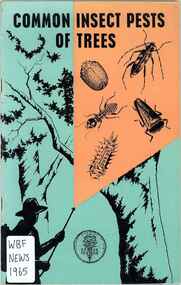
Publication, New South Wales Forestry Commission, Common insect pests of trees (New South Wales Forestry Commission), Sydney, 1965, 1965
... Common insect pests of trees (New South Wales Forestry Commission), Sydney, 1965...Common insect pests of trees (New South Wales Forestry Commission), Sydney, 1965 Publication New South Wales Forestry Commission ... -
University of Melbourne, Burnley Campus Archives
Document, Plant Protection (part 1) Insect Pests and Use of Pesticides, 199-?
... Plant Protection (part 1) Insect Pests and Use of Pesticides...ian smith john brereton plant protection pests pesticides Course notes by Ian Smith & John Brereton Plant Protection (part 1) Insect Pests and Use of Pesticides Document ...Course notes by Ian Smith & John Breretonian smith, john brereton, plant protection, pests, pesticides -
University of Melbourne, Burnley Campus Archives
Booklet - Brochure, Department of Agriculture, Plant diseases and insect pests: Notes by the Biological Branch, 1943-1951
... Plant diseases and insect pests: Notes by the Biological Branch...Refer to paper catalogue Plant diseases and insect pests: Notes by the Biological Branch Booklet Brochure Department of Agriculture ...Brochures reprinted from Journal of the Department of Agriculture as Advisory Pamphlets. Refer to paper cataloguedepartment of agriculture, journal -
 University of Melbourne, Burnley Campus Archives
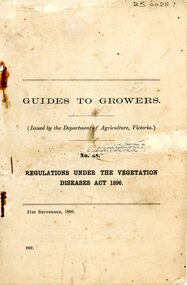
Booklet - Rules and Regulations, D. McAlpine, Guides to Growers: Regulations Under the Vegetation Diseases Act 1896, 1896-1902
... ...insect pests...Guides to Growers: No. 27 Insect pests and Fungi, and Remedies for their supression. 2 copies, one with handwriting on front. 21.09.1896, August 1896. 3. ...Clark was a prominent pastoralist. rules regulations vegetation diseases apple growers insect pests fungi remedies black spot spraying d g clark d mcalpine apples D G Clark G. ...D. G. Clark was a prominent pastoralist.D G Clark G. Clark Richmond Vale, Carrajung Aug 10. 1900rules regulations, vegetation diseases, apple growers, insect pests, fungi, remedies, black spot, spraying, d g clark, d mcalpine, apples -
 Mont De Lancey
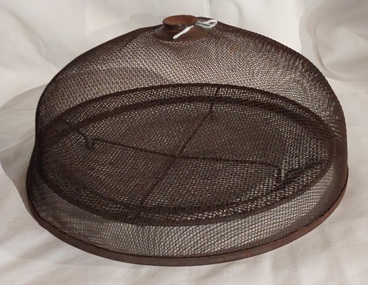
Domestic object - Mesh Food Cover, Unknown
... Wire mesh food covers are primarily used to protect food from insects and pests, especially during outdoor dining or picnics, while also keeping food fresh when dining indoors. ...Wire mesh food covers are primarily used to protect food from insects and pests, especially during outdoor dining or picnics, while also keeping food fresh when dining indoors. ...Wire mesh food covers are primarily used to protect food from insects and pests, especially during outdoor dining or picnics, while also keeping food fresh when dining indoors. A rusted vintage wire mesh domed food cover or cloche with a rounded flat knob or handle at the top. It has a separate wire base with four wire feet which is placed underneath the dome lid to protect the table or surface it is placed upon. Air can surround the food.tableware, food covers, covers -
 Mont De Lancey
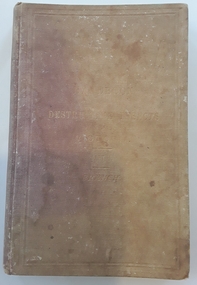
Book, C. French et al, A Handbook of the Destructive Insects of Victoria, with notes on the methods to be adopted to check and extirpate them, 1891
... Insects of Victoria by C. French, F.L.S., F.R.H.S., with gold lettering for title and author. Delicate brown and white floral endpapers. Describes pest...Presented to Thomas Sebire by the Department of Agriculture March 1892 insects pest control entomology victoria A non fiction handbook describing pest insects of Victoria published by the Victorian Department of Agriculture. ...A non fiction handbook describing pest insects of Victoria published by the Victorian Department of Agriculture.Faded purple hardcover book, A Handbook of the Destructive Insects of Victoria by C. French, F.L.S., F.R.H.S., with gold lettering for title and author. Delicate brown and white floral endpapers. Describes pest insects of Victoria. Coloured illustrated plates throughout as well as black and white illustrations.. Has an added yellow flap to title page - With the Compliments of the Secretary for Agriculture. non-fictionA non fiction handbook describing pest insects of Victoria published by the Victorian Department of Agriculture.insects, pest control, entomology victoria -
 Victorian Interpretive Projects Inc.
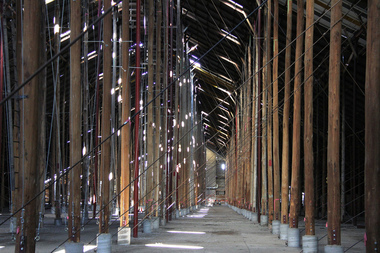
Photograph - digital, LJ Gervasoni, Murtoa Stick Shed 00031, 13/08/2011
... In the following years the Council for Scientific and Industrial Research (later CSIRO) conducted valuable research and experiment on the impacts and control of insect pests at the Murtoa No.1 shed. With these discoveries, and the development of more effective pesticides, use of the No.1 shed and the larger No.2 shed, erected in 1942/43, continued for many years. ...In the following years the Council for Scientific and Industrial Research (later CSIRO) conducted valuable research and experiment on the impacts and control of insect pests at the Murtoa No.1 shed. With these discoveries, and the development of more effective pesticides, use of the No.1 shed and the larger No.2 shed, erected in 1942/43, continued for many years. ...From the Victorian Heritage Register statement of significance H0791 The Marmalake/Murtoa Grain Store, originally the No.1 Murtoa Shed, is located within the Murtoa Grain Terminal, adjacent to the grain elevator tower and railway line. The shed is 280m long, 60m wide and 19m high at the ridge with a capacity of 3.4 million bushels. The hipped corrugated iron roof of the shed is supported on approximately 600 unmilled hardwood poles set in a concrete slab floor and braced with iron tie rods. These poles are the reason for use of the term "stick shed". With its vast gabled interior and the long rows of poles the space has been likened to the nave of a cathedral. An elevator at one end took wheat from railway trucks to ridge level where it was distributed by conveyor along the length of the shed, creating a huge single mound of grain. Braced internal timber bulkheads on either side took the lateral thrust of the wheat, and conveyors at ground level outside the bulkheads took wheat back to the elevator for transport elsewhere. Wheat had been handled in jute bags from the start of the Victorian wheat industry in the mid nineteenth century. Bulk storage had been developed in North America from the early 1900s. NSW began building substantial concrete silos from 1920-21. In Western Australia, farmers' co-operatives, who had to supply their own bulk storage from 1934-5, pioneered the use of low-cost horizontal sheds of timber and corrugated iron for bulk storage. Following its establishment in 1935 the Victorian Grain Elevators Board (GEB) planned a network of 160 concrete silos in country locations, connected by rail to the shipping terminal at Geelong. By the outbreak of the Second World War there was a worldwide glut of wheat, and Australia soon had a massive surplus which it was unable to export. Only 48 silos had been established under the Victorian Silo Scheme so far, and wartime material and labour restrictions prevented progress with this scheme. The storage deficit had become an emergency by 1941 as Britain obtained its imports from North America, rather than over the lengthy and difficult shipping route from Australia. In 1941 the GEB, under chairman and general manager Harold Glowrey, proposed large temporary versions of the horizontal bulk storage sheds already in use in Western Australia. The proposal was approved by the Victorian Wheat and Woolgrowers Association, who considered the use of shed storages as a longer term proposition. After initial resistance from the Australian Wheat Board, some of whose members represented wheat bagging interests, the Commonwealth and Victorian governments agreed to split the costs, and Murtoa was chosen as a suitable site for the first emergency storage. The main contractor, Green Bros, commenced work on the No.1 Murtoa Shed in September 1941, deliveries of bulk wheat began in January 1942, and the store was full by June of the same year. In the following years the Council for Scientific and Industrial Research (later CSIRO) conducted valuable research and experiment on the impacts and control of insect pests at the Murtoa No.1 shed. With these discoveries, and the development of more effective pesticides, use of the No.1 shed and the larger No.2 shed, erected in 1942/43, continued for many years. The No.2 shed was demolished in 1975. By the 1990s, pest resistance to pesticides and requirements for both pest free and insecticide free grain rendered open storage of this type unviable. The No. 1 store was also becoming increasingly expensive to maintain, and its use was phased out from 1989.Image of the Marmalake/Murtoa Grain Store which is of historical, architectural, scientific (technical) and social significance to the State of VictoriaDigital colour image of the interior of the Marmaduke . Murtoa grain storage facility better known as the Stick Shed. The shed was constructed in World War Two to store grain. The supporting columns are trees.marmalake, murtoa grain store, wheat store, stick shed, murtoa -
 Federation University Historical Collection
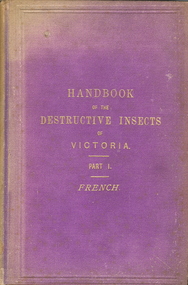
Book, C. French, A Handbook of the Destructive Insects of Victoria, Part One, 1891 (exact)
... Contents inlcude: Introduction to Entimology, classification of insects, quarantine rules, Woolly Aphis, Codlin Moth, Curve-winged Apple moth, Apple-tree borer, Apple-bark Scale, Apple Beetle, Red Spider, Harlequin Fruit Bug, Pear and Cherry Slug, Rutherglen Fly-pest, Cherry borer, Pear Phytoptus. ...Contents inlcude: Introduction to Entimology, classification of insects, quarantine rules, Woolly Aphis, Codlin Moth, Curve-winged Apple moth, Apple-tree borer, Apple-bark Scale, Apple Beetle, Red Spider, Harlequin Fruit Bug, Pear and Cherry Slug, Rutherglen Fly-pest, Cherry borer, Pear Phytoptus. ...Purple hardcovered book153 pages plus 20 figures. Contents inlcude: Introduction to Entimology, classification of insects, quarantine rules, Woolly Aphis, Codlin Moth, Curve-winged Apple moth, Apple-tree borer, Apple-bark Scale, Apple Beetle, Red Spider, Harlequin Fruit Bug, Pear and Cherry Slug, Rutherglen Fly-pest, Cherry borer, Pear Phytoptus. Coloured plates (by C. Brittlebank)of insects and figures (by Hart Vonarx) include the Knowles' Pump, Charnwood Spray, Danks' Lever Spray Pump, Spawn's Climax Spray, Apparatus for Sparying Orange Trees, Strawsonizer, French Portable Hand Spraying Machine, Lowe and Park's Insect Exterminator, Greenhill Codlin Moth Lamp, Wolfskill Fumigator, Tutus Fumigator, Oliver Fumigator, Agitator Spray PumpBookplate - Ballarat School of Mines Ballaarat No 1201. Presented by Secretary for Agriculture, Melbourne, 14th July 1891 insects, pumps, c brittlebank, hart vonarx, c french -
 The Beechworth Burke Museum
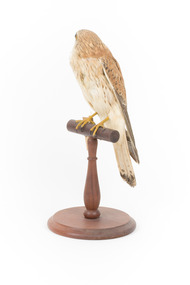
Animal specimen - Nankeen Kestrel, Trustees of the Australian Museum, 1860-1880
... They are drawn to animal pests like mice, insects, small animals, reptiles, and birds. ...They are drawn to animal pests like mice, insects, small animals, reptiles, and birds. ...The Nankeen Kestrel, also known as the Australian Kestrel, is a common native to the open country's grasslands and farmlands, preferring agricultural areas. They are drawn to animal pests like mice, insects, small animals, reptiles, and birds. Due to the shape and ability of their tail feathers, which allows them to hoover over their prey, they do not rely on speed to catch their meal like most falcons in their family group. These birds are among the smallest raptors in the Falcon family, having well-known face characteristics and body shapes. The females of the species are distinguished by their darker patterns and red-brown (rufous) tones, as well as their larger size, whilst the males are more greyish. The yellow markings around the eyes and top of the beak, as well as the noticeable black dipped wings, distinguish each species. This specimen is part of a collection of almost 200 animal specimens that were originally acquired as skins from various institutions across Australia, including the Australian Museum in Sydney and the National Museum of Victoria (known as Museums Victoria since 1983), as well as individuals such as amateur anthropologist Reynell Eveleigh Johns between 1860-1880. These skins were then mounted by members of the Burke Museum Committee and put-on display in the formal space of the Museum’s original exhibition hall where they continue to be on display. This display of taxidermy mounts initially served to instruct visitors to the Burke Museum of the natural world around them, today it serves as an insight into the collecting habits of the 19th century.This specimen is part of a significant and rare taxidermy mount collection in the Burke Museum. This collection is scientifically and culturally important for reminding us of how science continues to shape our understanding of the modern world. They demonstrate a capacity to hold evidence of how Australia’s fauna history existed in the past and are potentially important for future environmental research. This collection continues to be on display in the Museum and has become a key part to interpreting the collecting habits of the 19th century.The Nankeen Kestrel is a small raptor in the Falcon family. It has a stockier appearance, with the upper parts of its body, such as the head and the tops of its wings, being a light red-brown (rufous) colour and the tips of its wings appearing dipped in black. The top of the beak and the eye rings are both yellow, and this bird's falcon appearance shows its inherent dark streak markings visible near the eyes and on the chest. The underparts are pale, with a tail feather that spreads out to help it hover and is ornamented with fine black decorations.20. / Unnamed / Catalogue page 5 / taxidermy mount, taxidermy, animalia, burke museum, beechworth, australian museum, skin, reynell eveleigh johns, bird, nankeen kestrel -
 Orbost & District Historical Society
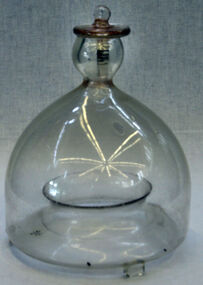
fly catcher, circa 1890
... pest-control glassware Moulded clear glass fly catcher on small glass legs. Glass stopper. A piece of bait is suspended in the centre and the top opening is covered up with a piece of cloth and a fluid such as kerosene or similar is put in the gutter below the outer part of the dome. The flying insect ...Mankind has been bothered by flies ever since time began. This has led to the invention of a number of different fly traps or fly catchers.Glass fly traps were popular during the 19th and early 20th centuries. The flies, being attracted by some sweet liquid or other bait in the bottom, were unable to find their way out. This trap has small glass legs enabling it to be used standing on a flat surface such as a table. Most were suspended by wire handles. This is an example of a common domestic item no longer commonly used today.Moulded clear glass fly catcher on small glass legs. Glass stopper. A piece of bait is suspended in the centre and the top opening is covered up with a piece of cloth and a fluid such as kerosene or similar is put in the gutter below the outer part of the dome. The flying insect is drawn inside by entering the underside opening and then, when trying to leave, flies against the glass and then drops into the catching fluid below.fly-catcher pest-control glassware -
 Greensborough Historical Society
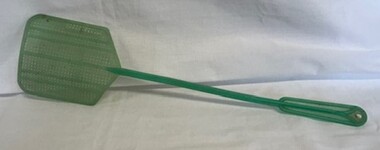
Domestic object - Fly Swat, Green plastic fly swat, 1950c
... Widely used to "swat" flies before the use of insect sprays. household implements flyswats pest control flies Fly swat, green plastic, used Green plastic fly swat Domestic object Fly Swat ...Household item from 1950s or 1960s. Widely used to "swat" flies before the use of insect sprays. Fly swat, green plastic, usedhousehold implements, flyswats, pest control, flies -
 Kiewa Valley Historical Society
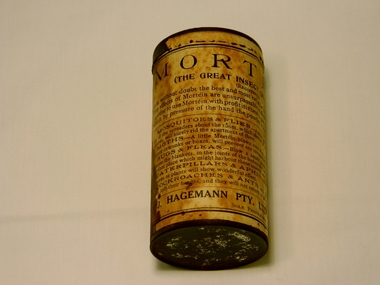
Can Mortein Powder, late 1870s to early 1920s
... insects. The eradication of unwanted invaders into the homestead required either manual extermination or a relevant poison which in low doses would not affect humans. Fly squats were still a good measure of eradication of flying pests...insects. The eradication of unwanted invaders into the homestead required either manual extermination or a relevant poison which in low doses would not affect humans. Fly squats were still a good measure of eradication of flying pests ...The can(product) of powdered Mortein was used throughout Australia and especially in rural regions where environmental conditions of crops, cattle and other livestock resulted in greater amount of "invasions" from insects. The eradication of unwanted invaders into the homestead required either manual extermination or a relevant poison which in low doses would not affect humans. Fly squats were still a good measure of eradication of flying pests however those lurking in cupboards or "hard to get at" locations needed a method, such as the Mortein powder to do the deed. This product and especially this can was used at the fore front of pest eradication. Powders and pellets are still in use 100 years later and the core ingredient is still environmental friendly and meets health conscious modern Australians. The basic product has survived the passage of time and was invented by a German immigrant to Australia in the late 1800s.This can and what it represents to rural households and outhouses, is in some ways immeasurable to the peace, health and tranquility within the household of all the families within the Kiewa Valley. Although small in size the relief of those within the sanctity of the home from annoying pests is enormous. The relief not only physical but also mentally to those residents, from the sometimes grueling and painful rural existence in a "sunburnt" countryside cannot be truly expressed in words. Kiewa Valley residents are part of the sometimes harsh rural environment where the introduction of helpful products such as this powder are noticed and used more prolifically. Any product, especially invented within Australia, which allows for a easier existence is of a great significance.This small cylindrical can contains powder of crushed the chrysanthemum flowers(pyrethrum extract) and has two circles of small circular perforations in the lid (to allow contents to be sprinkled onto other surfaces). It is constructed of mild steel with both ends crimped onto the main cylinder. A paper information label has been adhered to the outside of the cylinder.Printed on the outside label is: 1st line "MORTEIN!" 2nd line "THE GREAT INSECT DESTROYER" underneath "(Registered)" and underneath "It is without doubt the best and most reliable Insect powder in the World" underneath this line "In order to use Mortein with profit it is best to get a Mortein spreader through", next line "which by pressure of the hand the powder is ejected and well diffused." An inflection mark appears over the e in "Mortein" as to signify that the word "mort" is french for (dead) and the "ein" is german for "one". The word "mortein" therefore is diffused and translated into "dead one". A thin line separates the above from the list of insects which the powdered contents will kill together with the suggested application targets. T the bottom of the instructions is printed the manufacturer "J. HAGEMANN PTY. LTD., MELBOURNE," Below is "Sole Proprietors"natural insecticide products, environmentally friendly products, household pest dispensers, australian inventions -
 Kiewa Valley Historical Society
Vaporiser Cresolene, circa late1800's to early 1900's
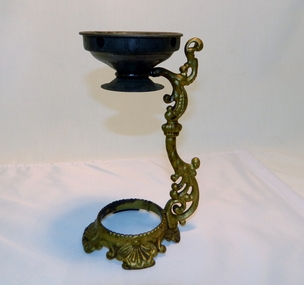
... insects." This advertising is dated before a tightening in the "advertising" legislation of post mid 1900's. However it was a good attraction for rural communities wanting relief of "rural" pests. home based vaporisers first aid home nursing over-the-counter medicines See KVHS 0342 (B) for markings and advertising material printed on the box which contains this item. ...This Cresolene vapouriser is an "American" product when "home" based remedial products were of a high demand due to lack of specialised medical facilities such as a hospital in rural communities. "An apparatus for reducing medicated liquids to a state of vapor suitable for inhalation or application to accessible mucous membrane A device for volatising liquid anesthetics." The only criteria used by Health authorities in the decision to provide a community with hospitals was and still is the size of the population it feeds. The introduction of the SEC Victorian Hydro Electricity Scheme started in the 1940's, was the impetus for health planners to build a hospital in the Kiewa Valley. Rural regions especially those considered semi or fully remote locations had to rely on farm based remedial health "alternative medical treatment". This product is such a remedy.This vapouriser is very significant to a rural area such as the Kiewa Valley as it demonstrates the "home" remedies that were available to rural communities such as the cattle and sheep stations before the Kiewa Valley had a hospital(1949). The influx of workers employed by the SEC Vic. Hydro Electricity Scheme(circa 1940's onward) changed dramatically the need for a hospital and specialised medical treatment. The reliance of "health products" such as this vaporiser were still in high demand especially when on the box of this product was printed "Guaranteed under the Food and Drugs Act, June 30, 1906, Serial no. 436". Also on the packaging is printed "A remedy Whooping Cough also Asthma, Catarrh, Colds Diptheria, Croup, Coughs Hay Fever, Sore Throat, Influenza, Etc." An additional benefit of this product "Is obnoxious to Moths, Flies, Mosquitos, Ants, Cock Roaches, Hen Lice, and other Troublesome insects." This advertising is dated before a tightening in the "advertising" legislation of post mid 1900's. However it was a good attraction for rural communities wanting relief of "rural" pests. This vaporiser stand with its cradle and dish is made from cast iron (stand) and tin (dish). At the bottom of the "dish" is a flame diffusion port with eight heat directional holes. The stand upright is painted gold in colour.See KVHS 0342 (B) for markings and advertising material printed on the box which contains this item.home based vaporisers, first aid, home nursing, over-the-counter medicines -
 Kiewa Valley Historical Society
Box Vaporiser Cresolene
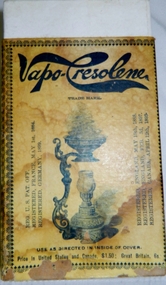
... insects." This advertising is dated before a tightening in the "advertising" legislation of post mid 1900's. However it was a good "purchase" for rural communities wanting relief of "rural" pests. home based vaporisers first aid home nursing over-the-counter medicines Box Vaporiser Cresolene ...This packaging/box containing a home based health product was in use well before the Federal Department of Health legislation tightened up the permissible advertising for "health" products. The strict Occupation and Health Legislation of the later 1900's would not have allowed the grandiose statements printed on this container. It was only later in the 1900's that stricter laws covering medical or quasi medical products came into Australian legislation.This box is very significant (in the time period of pre 1940's), to a semi isolated region as the Kiewa Valley, especially before the valley had a hospital, pre 1949. The reliance of "health products" such as what is stored in this box, were still in high demand, especially when on the box of this product was printed "Guaranteed under the Food and Drugs Act, June 30, 1906, Serial no. 436", a quasi legitimising statement. Also on the packaging is printed "A remedy Whooping Cough also Asthma, Catarrh, Colds Diptheria, Croup, Coughs Hay Fever, Sore Throat, Influenza, Etc." An additional benefit of this product "Is obnoxious to Moths, Flies, Mosquitos, Ants, Cock Roaches, Hen Lice, and other Troublesome insects." This advertising is dated before a tightening in the "advertising" legislation of post mid 1900's. However it was a good "purchase" for rural communities wanting relief of "rural" pests.home based vaporisers, first aid, home nursing, over-the-counter medicines -
 Emerald Museum & Nobelius Heritage Park
Equipment - Shell Tox Insect Sprayer
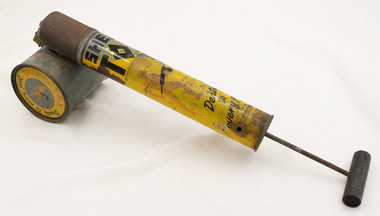
... An insect pump used to kill household pests such as flies, mosquitoes, silverfish and fleas. ...An insect pump used to kill household pests such as flies, mosquitoes, silverfish and fleas. ...An insect pump used to kill household pests such as flies, mosquitoes, silverfish and fleas. An advertisement in the Australian Women's weekly from January 26, 1946 references this particular model as an improvement on the previous pre-war model, as it now contained "the correct amount of DDT". DDT was banned in Australia in 1987. This type of insect sprayer was in common use in Australian households in the mid-20th century.Insect sprayer- consisting of a pump with a cylindrical tank attached and a handle made of woodOn pump: ''SHELL / TOX / Death / to / every pest / A SHELL PRODUCT / MADE IN AUSTRALIA'' On both ends of tank: ''SHELL TOX / Death to every pest''insect sprayer, fumigator -
 Kiewa Valley Historical Society
Book - Gardening - Reference, Handbook of the Destructive Insects of Victoria Part 11 by C. French, Preface dated 1893
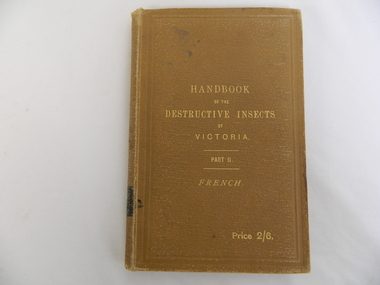
... Bogong school had a reputation for an excellent library especially with regard to nature. education victoria insects fruit and vegetables pests gardening Page 85 circular stamp 'Education Department Victoria' around the outside and in the middle 'Library' Hard covered brown book with gold embossed writing on the cover and spine including the title, author, part 11 and Price 2/6. ...A gardening book useful as a reference for gardeners and horticulturists. Illustrated with detailed coloured pictures.This book was possibly part of a school library in the Kiewa Valley. Bogong school had a reputation for an excellent library especially with regard to nature. Hard covered brown book with gold embossed writing on the cover and spine including the title, author, part 11 and Price 2/6. Spine has black stamp near the base indicating it was in a library. Includes coloured Plates which illustrate the text - showing the insects and plants. Inside the covers the pages are a pale green floral type decoration. Page 85 circular stamp 'Education Department Victoria' around the outside and in the middle 'Library'education, victoria, insects, fruit and vegetables, pests, gardening -
Kew Historical Society Inc
Journal, Kewriosity : November 1991
... Safe disposal of chemicals around the home [Disposal options - Waste type by location] / p8. Insects / Marlowe p9. Bothered by pests? [Improved and cheap pest control for Kew residents] / p9. ...The Horse Tram returns to Kew [Kew Depot Open Day] / p1. Chief Executive's Comment [Kew Junction] / Malcolm Hutchinson p2. Mayor's Comment [Kew Junction Strategy Plan] / Cr Daryl Oldaker p3. Diary Dates for November / p4. Diary Dates for December / p5. The Lioness Club of Kew / p5. Market [Kew Community House] / p5. Invitation to Lawn Bowls [Auburn Heights Bowling Club] / p5. Leader Sports Challenge Camp / p6. New face [Heather Crichton] / p7. New Way Theatre [Company][Kew Cottages] / p7. Safe disposal of chemicals around the home [Disposal options - Waste type by location] / p8. Insects / Marlowe p9. Bothered by pests? [Improved and cheap pest control for Kew residents] / p9. Kewriosity advertising rates / p10. City of Kew Waste Disposal Services for 1991/92 / Malcolm Hutchinson p11. New mum presentation [Nursing Mothers' Association; St George's Hospital] / p12. Kew Auxiliary - Royal Women's Hospital / p12. L.Bear [Library Bear] / p13. Arthritis self help / p14. Mural [by Bill Wood] / p14. Old Trams [request for photos] / p14. Kew Info Youth / p15. Local Artist [Mary McQueen] / p15. Golden putter golf [Studley Park Golf Course] / p15. City of Kew Residential Policies Review Committee [update] / p16. Apology [Kew Community House program] / p16.Kewriosity was a local newsletter combining Kew Council and community news. It was published between November 1983 and June 1994, replacing an earlier Kewriosity [broad] Sheet (1979-84). In producing Kewriosity, Council aimed to provide a range of interesting and informative articles covering its deliberations and decision making, together with items of general interest and importance to the Kew community and information not generally available through daily media outlets.non-fictionThe Horse Tram returns to Kew [Kew Depot Open Day] / p1. Chief Executive's Comment [Kew Junction] / Malcolm Hutchinson p2. Mayor's Comment [Kew Junction Strategy Plan] / Cr Daryl Oldaker p3. Diary Dates for November / p4. Diary Dates for December / p5. The Lioness Club of Kew / p5. Market [Kew Community House] / p5. Invitation to Lawn Bowls [Auburn Heights Bowling Club] / p5. Leader Sports Challenge Camp / p6. New face [Heather Crichton] / p7. New Way Theatre [Company][Kew Cottages] / p7. Safe disposal of chemicals around the home [Disposal options - Waste type by location] / p8. Insects / Marlowe p9. Bothered by pests? [Improved and cheap pest control for Kew residents] / p9. Kewriosity advertising rates / p10. City of Kew Waste Disposal Services for 1991/92 / Malcolm Hutchinson p11. New mum presentation [Nursing Mothers' Association; St George's Hospital] / p12. Kew Auxiliary - Royal Women's Hospital / p12. L.Bear [Library Bear] / p13. Arthritis self help / p14. Mural [by Bill Wood] / p14. Old Trams [request for photos] / p14. Kew Info Youth / p15. Local Artist [Mary McQueen] / p15. Golden putter golf [Studley Park Golf Course] / p15. City of Kew Residential Policies Review Committee [update] / p16. Apology [Kew Community House program] / p16.publications -- city of kew (vic.), kewriosity, council newsletters, community newsletters -
 Mont De Lancey
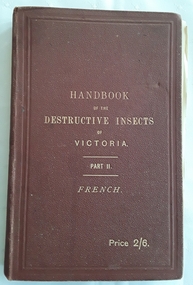
Book, C. French, F.L.S., F.R.H.S, A Handbook of the Destructive Insects of Victoria, with notes on the methods to be adopted to check and extirpate them, 1893
... Used by Thomas Sebire in 1894 agriculture pest control entomology A handbook of the destructive insects of Victoria with notes on the methods to be adopted to check and extirpate them with useful diagrams and illustrations of machines and pumps and the plants. ...A handbook of the destructive insects of Victoria with notes on the methods to be adopted to check and extirpate them with useful diagrams and illustrations of machines and pumps and the plants.A brown hardcover handbook with the title printed in gold lettering on the front cover Handbook of the Destructive Insects of Victoria Part II by C. French, F.L.S., F.R.H.S., Government entomologist with the price 2/6. at the bottom right hand corner. The spine has the title and author printed in gold. T. Sebire March 29th 1894 is written in black ink on the top right of the title and contents pages. There are coloured plates and black and white illustrations, an appendix and drawings of various pumps and equipment required for use. Loose pages, some tears, and tanning is noted. 222p. non-fictionA handbook of the destructive insects of Victoria with notes on the methods to be adopted to check and extirpate them with useful diagrams and illustrations of machines and pumps and the plants.agriculture, pest control, entomology -
 Kilmore Historical Society
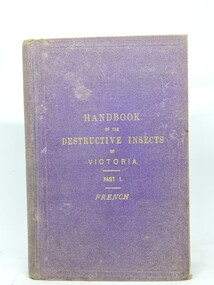
A Handbook of the Destructive Insects of Victoria, A Handbook of the Destructive Insects of Victoria. Part 1, 1891
... Hand book of the destructive pests of Victoria, with notes on the methods to be adopted to check and extirpate them. Prepared by order of the Victorian Department of Agriculture. Insects ...Hand book of the destructive pests of Victoria, with notes on the methods to be adopted to check and extirpate them. Prepared by order of the Victorian Department of Agriculture.Purple cloth-covered hard cover book. 153 pp. including appendices. Indexed. Illustrated. Good condition.Inside flyleaf 'M. Figgins/Kilmore'.insects, victoria, figgins -
 University of Melbourne, Burnley Campus Archives
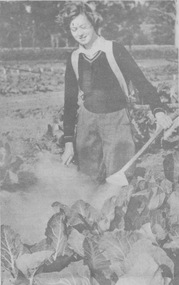
Photograph - Black and white photocopy, The Argus, Joan Fitzgerald, 1953
... pest control...joan fitzgerald...cauliflowers...anti-insect...with caption, "Pest control is an essential part of the training at Burnley School of Horticulture. Here Joan Fitzgerald (1953) sprays a bed of cauliflowers with an anti-insect powder." ...female students careers for girls pest control joan fitzgerald cauliflowers anti-insect powder orchard Photocopy of picture in "The Argus" 16 July, 1953. with caption, "Pest control is an essential part of the training at Burnley School of Horticulture. ...Photocopy of picture in "The Argus" 16 July, 1953. with caption, "Pest control is an essential part of the training at Burnley School of Horticulture. Here Joan Fitzgerald (1953) sprays a bed of cauliflowers with an anti-insect powder." Part of article on Careers for Girls.female students, careers for girls, pest control, joan fitzgerald, cauliflowers, anti-insect powder, orchard -
 University of Melbourne, Burnley Campus Archives
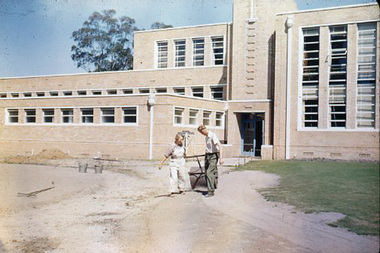
Photograph - Black and white and colour slides, colour negative, Kodachrome, Miscellaneous Horticulture, 1947-1985
... pests machinery excursions tatura library wilsons promontory plants alnus zygocactus schlumbergia feijoa acca sellowiana protea neriifolia banksia isopogon anemonifolius 57 slides and 1 negative. (3) Men standing around a large horticultural machine. (4) "Lawns Housing Com" Aug "66?" (5) "Flemington Racecourse." (6) "Mustard-Cover Crop. 1960." (7) Tree climbing. (8) "Grafting-scions. BHC." (11) "Mildura-Soil Probe Oct 67." (12) Virus tested stock trees & layout Flemings Apr 70." (13) "Best's Winery Mar 75." (15, 16) Best's single student and group. (17) "Ploughing-Diagram to show incomplete cover of trash? Farm Practices." (18) "Spraying Hand Equipment for Insect ...57 slides and 1 negative. (3) Men standing around a large horticultural machine. (4) "Lawns Housing Com" Aug "66?" (5) "Flemington Racecourse." (6) "Mustard-Cover Crop. 1960." (7) Tree climbing. (8) "Grafting-scions. BHC." (11) "Mildura-Soil Probe Oct 67." (12) Virus tested stock trees & layout Flemings Apr 70." (13) "Best's Winery Mar 75." (15, 16) Best's single student and group. (17) "Ploughing-Diagram to show incomplete cover of trash? Farm Practices." (18) "Spraying Hand Equipment for Insect Control in and around Buildings USA Yearbook 1952." (19) "Pasture Harrows." (20) "Mould Board Plough-Tractor." (21) "Disc Harrows-Offset-Tractor." (22) Tyne Cultivator-for Tractor." (23) See B91.258." (24) Burnley College libary. (25) "Irrigation-Delver Tatura 12/59." (26) "Tatura 12/59 Delver Ferguson T." (27-29) "W. Prom." (30) Camp 1957 Wilson's Promontary." (34-36) Photographs of plants in book. (35) Alnus? (37) "Meterosideros excelsa." (38) "Rhipsalidopsis rosea." (39) "Protea neriifolia." (40) Banksias-Species." Insects: (41) "Lacewing larva." (42) "Mites Aug 75." (43) "Yellow Mite, Red Spider (Arachnida)." (44) "Jassid-Life Cycle 9/51." (45) "Grape Fruit Crop (Florida) Destroyed by Fruit Fly. Animals without backbones." (46) "Jassid-Vegetable 9/51." (47) "Field Day 57 (Fruit Fly-Enlarged)." (48) "Field Day 57 (Fruit Fly-Stages)." (49) Insect Life Cycle. (50) "Comatibility (sic) Chart." for Insecticides & Fungicides. (51) "Insecticides-Toxicity." (52) "Life Cycle of the Leather Jacket." (53) "Grasshopper-Head Dissected Mouth Parts." (54) "Types of Antennae." (55) "Spider Mites USA Yearbook 1952." (56) "Cultivator." (57) "Organic Phosphates." (58) Negative Isopogon anemonifolius.administration building, lawns, flemington racecourse, mustard-cover crop, tree climbing, grafting, mildura, soil probe, pests, machinery, excursions, tatura, library, wilsons promontory, plants, alnus, zygocactus, schlumbergia, feijoa, acca sellowiana, protea neriifolia, banksia, isopogon anemonifolius -
 Southern Sherbrooke Historical Society Inc.
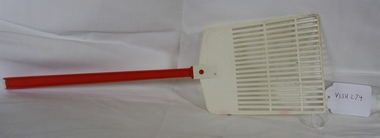
Fly Swat
... Donated to Southern Sherbrooke Historical Society by Susan Haywood-Downard, who is unaware of it's prior history. pest control Red Plastic handle (broken at the end) attached to a flat, white plastic square with holes in it. Designed to kill flies and other insects. ...Donated to Southern Sherbrooke Historical Society by Susan Haywood-Downard, who is unaware of it's prior history.Red Plastic handle (broken at the end) attached to a flat, white plastic square with holes in it. Designed to kill flies and other insects.pest control
