
Showing 221 items matching "jack weller"
-
 Mission to Seafarers Victoria
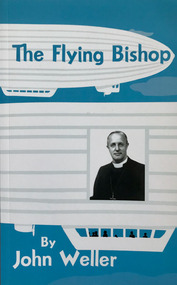
Book, The Flying Bishop
... ...jack weller...After working at the Melbourne's Missions, the Reverend John (Jack) Weller left Australia with his wife Alexina. ...After working at the Melbourne's Missions, the Reverend John (Jack) Weller left Australia with his wife Alexina. ...As recently as the 1940s, there was only one bishop responsible for the work of the Anglican Church in almost the entire South American continent.Clearly, an area this large required somebody truly remarkable to lead the churches in it. The Rt Revd Jack Weller was a remarkable man. Here, his nephew tells the story of his life as a bishop in South America and his later work in England, with extracts from Jack's own diaries and writings giving an insight into the mind of the "Flying Bishop".Small paperback with the title in blue on a white rigid airship . In the centre right of the cover a photographic portrait of Reverend Weller also on a white rigid airship .non-fictionAs recently as the 1940s, there was only one bishop responsible for the work of the Anglican Church in almost the entire South American continent.Clearly, an area this large required somebody truly remarkable to lead the churches in it. The Rt Revd Jack Weller was a remarkable man. Here, his nephew tells the story of his life as a bishop in South America and his later work in England, with extracts from Jack's own diaries and writings giving an insight into the mind of the "Flying Bishop".reverend john reginald weller (1880-1969), jack weller, john weller, mission to seafarers, seamen's mission, melbourne, falklands islands, buenos aires, the andes, south america -
 Canterbury History Group
Article, Scottish connection, 26/04/1988 12:00:00 AM
... This was the home of "Canterbury Jack" (Morris) well known local fuel merchant.....This was the home of "Canterbury Jack" (Morris) well known local fuel merchant.. Scottish connection Article ...Real estate advertisement for the auction of "Glen Morag" 10 Wattle Valley Road Canterbury on Saturday 7 May 1988. This was the home of "Canterbury Jack" (Morris) well known local fuel merchant..canterbury, wattle valley road, morris family, canterbury jack, fuel merchants, towers, glen morag -
![Album (item) - Photographic Album, digital copy, Freda Kathleen Oxley (1882-1969), Album of photographs of a voyage to Australia and visit to the Mission to Seamen, Melbourne [picture] / Freda Oxley, 1925-1928](/media/collectors/4f729f5897f83e0308601603/items/672c59ac552587060c889944/item-media/67a6dc3cd7095b7115fefda2/item-fit-380x285.jpg?cb=6) Mission to Seafarers Victoria
Mission to Seafarers VictoriaAlbum (item) - Photographic Album, digital copy, Freda Kathleen Oxley (1882-1969), Album of photographs of a voyage to Australia and visit to the Mission to Seamen, Melbourne [picture] / Freda Oxley, 1925-1928
... She went out to Melbourne at that time and stayed at the Mission to Seamen with her friends the Revd Jack Weller and Mrs Weller. The Revd Weller later became Bishop of the Falkland Islands.'...She went out to Melbourne at that time and stayed at the Mission to Seamen with her friends the Revd Jack Weller and Mrs Weller. The Revd Weller later became Bishop of the Falkland Islands.' ...This is a copy of an album of photographs held at the National Library of Australia. The album was photographed by Reverend's Weller grand daughter. Freda Oxley was a friend of the Wellers. She was born in Windsor in 1882 where Alexina Weller (nee Caley) was also born in 1885. She travelled on the SS Persic from England and arrived in 1925. She stayed at the Mission for several years, and became a host of the many picnics, making friends with the ladies from the Guild, taking photographs of people and events. Page 1 to 3: Outward Bound - SS Persic - September 26th .... November 12th 1925 Page 4: Interiors of the Mission to Seamen Melbourne Page 5: Mission to Seamen exteriors and wharf Page 6: Wellers with officers during lunch in the Manse Page 7-8: Mission's staff, garden, Wellers Page 8: Freda Oxley, the Wellers, Alexina Weller, Xmas Day 1927, Dora Walker and Rev. Weller Page 9: Gardens: the photographs show the garden's plants in its early years / Botanical Gardens / Nellie Melba's gardens in her estate Coombe: Walter Butler, the architect of the Mission had designed some extensions for Nellie Melba's estate and part of the gardens of the property, so it was likely through they acquaintance that the Mission's reverend and friends were invited. Page 10: Ships in the Yarra River Page 11: Skaregrom and Mitchell ships Page 12-15: Picnics Page 16: Christmas at the Mission, tennis court Page 17: Picnic Page 18: Dora Walker's wedding Page 19: Beach holiday Freda went back to the UK in March 1929 on the Cathay. But she came back to help the Mission as she's listed on the electoral roll in 1931 living there with the Olivers.This album provides valuable photographs of the Mission's interiors, garden, staff, guests and activities during the Wellers stay. It also provides the provenance of the Weller album held in the Mission's collection.The album was donated to the National Library of Australia by Miss Elizabeth Phillips, with her address in England, with a typed note attached that reads: 'These photographs were taken by my aunt Miss Freda Oxley between 1925 and 1928. She went out to Melbourne at that time and stayed at the Mission to Seamen with her friends the Revd Jack Weller and Mrs Weller. The Revd Weller later became Bishop of the Falkland Islands.'freda kathleen oxley 1882-1969, ss persic, gardens, botanical garden, picnics, officers, portsea, sydney, rev. w.m robertson, dora simpson nee walker, wedding, alice sibthorpe tracy, ethel augusta godfrey 1861-1935, royal botanical garden, nellie melba, coombe, zoo, seamen, sailors, walter richmond butler (1864–1949), juan oyarzo, john oyarzo, fern tree gully, kerferd family -
 Geelong Cycling Club
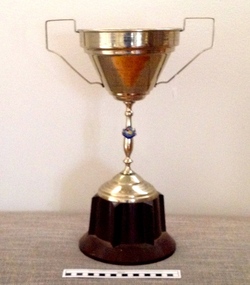
Trophy, 1938
... In 1937 he rode in Europe and England representing Bruce Small for Malvern Star. Jack was well known for his commentary at races at the Geelong velodrome track after the war. ...In 1937 he rode in Europe and England representing Bruce Small for Malvern Star. Jack was well known for his commentary at races at the Geelong velodrome track after the war. ...The winner of the race - Jack Baker was a cycling commentator In the 1920s, in the 1930s he cycled around Australia. In 1937 he rode in Europe and England representing Bruce Small for Malvern Star. Jack was well known for his commentary at races at the Geelong velodrome track after the war. The presentation of this trophy is another indicator of the popularity and importance placed on cycling races in regional areas during the early to mid 20th century.Silver plated cup on bakelite stand with engravings on the cup. The cup has two handles and a city of Geelong badge adhered to the stem."GWCC/1938/33 Mile Road Race/Pres By/F.W. Walker/Won By/J.J. Baker/Hcap Scratch Time 1hr27min12sec"geelong, cycling, club, gwcc, 1938, 33 mile road race, f.w. walker, j.j. baker -
 Ringwood and District Historical Society
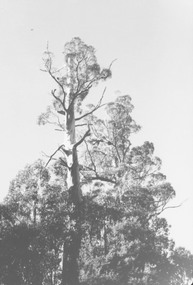
Photograph, Big tree on Jack Lundy Clark's property, Burlock Avenue, Ringwood North
... Jack Lundy was a well-known author in the Ringwood area as well as being associated with Ringwood Methodist Church....Jack Lundy was a well-known author in the Ringwood area as well as being associated with Ringwood Methodist Church. ...Jack Lundy was a well-known author in the Ringwood area as well as being associated with Ringwood Methodist Church.Written on back of photograph, "Big tree. Add two pictures together to show height". on second: "Big tree on Jack Lundy Clark's property, Burlock Avenue" -
 Bendigo Historical Society Inc.
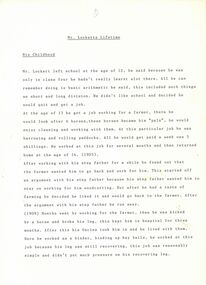
Memorabilia - Jack Lockett Collection: 'Mr Lockett's Lifetime', Unknown
... Jack Lockett became well known for being the oldest man in Australia and died at the age of 111. ...Jack Lockett became well known for being the oldest man in Australia and died at the age of 111. ...Jack Lockett became well known for being the oldest man in Australia and died at the age of 111. He was a World War 1 veteran who served in France and was wounded at least once. He became a farmer after the war and later retired to Bendigo. He was known for his long life and remarkably clear memories of World War 1.An account of the life of World War 1 veteran Jack Lockett. Black type written on cream coloured paper on one side of paper. Seven pages in total.Pages numbered 1 to 7 in blue ink at centre top of each page. Signature of 'Vicki Lockett' on the back of the seventh page.jack lockett, bendigo, world war 1, veteran -
 Bendigo Historical Society Inc.
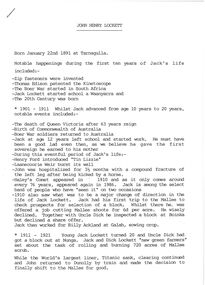
Memorabilia - Jack Lockett Collection: 'John Henry Lockett', Unknown
... Jack Lockett became well known for being the oldest man in Australia and died at the age of 111. ...Jack Lockett became well known for being the oldest man in Australia and died at the age of 111. ...Jack Lockett became well known for being the oldest man in Australia and died at the age of 111. He was a World War 1 veteran who served in France and was wounded at least once. He became a farmer after the war and later retired to Bendigo. He was known for his long life and remarkably clear memories of World War 1. The four-page document highlights the changing face of Australia and the world during the lifetime of Jack Lockett.Cream coloured paper with black type on one side of each page. Total of four pages.jack lockett, bendigo, world war 1, veteran, world events -
 Maldon Vintage Machinery Museum Inc
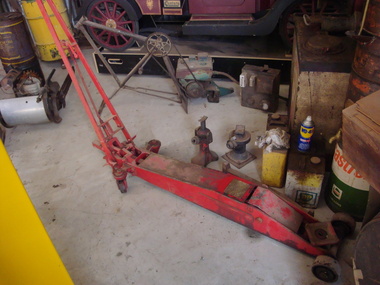
Car Jack, Possibly 1960s
... On a brass plate fixed to top of body "APAC / Service Jack No. 247 / Range 4 5/8" to 19 3/4" / Capacity 5000 lb / Caution: Do not overload / This jack is guaranteed to raised 5000 lb / Overloading renders this guarantee null and void / lubricate jack thoroughly before using / always keep jack clean and well oiled / Manufactured in Australia / APAC Industries Limited. / South Australia"...Tools Automotive Servicing On a brass plate fixed to top of body "APAC / Service Jack No. 247 / Range 4 5/8" to 19 3/4" / Capacity 5000 lb / Caution: Do not overload / This jack is guaranteed to raised 5000 lb / Overloading renders this guarantee null and void / lubricate jack thoroughly before using / always keep jack clean and well oiled / Manufactured in Australia / APAC Industries Limited. / South Australia" Mechanical mobile car jack made by the TREWELLAH company of Trentham for APAC Industries Ltd. ...Mechanical mobile car jack made by the TREWELLAH company of Trentham for APAC Industries Ltd. Known as a "Service Jack" used for servicing cars and light vehicles. Mounted on 4 wheels, two being castors. Painted red. On a brass plate fixed to top of body "APAC / Service Jack No. 247 / Range 4 5/8" to 19 3/4" / Capacity 5000 lb / Caution: Do not overload / This jack is guaranteed to raised 5000 lb / Overloading renders this guarantee null and void / lubricate jack thoroughly before using / always keep jack clean and well oiled / Manufactured in Australia / APAC Industries Limited. / South Australia"tools, automotive, servicing -
 Glen Eira Historical Society
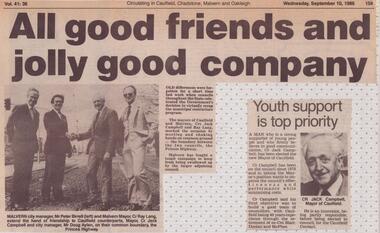
Photograph - Mayor Jack Campbell 1986-87 (1 of 2)
... Newspaper articles relating to activities in Caulfield involving Mayor Jack Campbell as well as photograph of Cr Jack Campbell in the Mayoral robes 1). ...Newspaper articles relating to activities in Caulfield involving Mayor Jack Campbell as well as photograph of Cr Jack Campbell in the Mayoral robes 1). ...Newspaper articles relating to activities in Caulfield involving Mayor Jack Campbell as well as photograph of Cr Jack Campbell in the Mayoral robes 1). Short article and photograph of Malvern and Caulfield council celebrating decision not to merge councils 2). Article on Youth Support as a key item as Mayor 3). Article on Arts Centre and criticism from Cr Don Dunstan 4). Photograph of Cr Jack Campbell in Mayoral robes 5). Article on Elsternwick Post Office demolition Article on the proposed new Arts Centre 6). Media ban on councillors 7). Maysbury Avenue Houses reportcouncillor, mayor, jack campbell, peter birrell, ray lang, doug aylen, don dunstan, elsternwick post office, glen huntly rd, veronika martens, betty snowball, walter kay, lewis sayer, david bloom, arts centre, carol harry, jack ritchie, inkerman rd, geoff leigh, malvern council, maysbury ave, glen huntly rd, supermarket, consulere pty ltd -
Rutherglen Historical Society
Letter, Goff Buchan, 28/02/1918 (Exact)
... But it caused some fun. Well Jack Old Boy, I am in hospital at present with a crook knee caused through that gentle sport called football, but will soon be out. ...But it caused some fun. Well Jack Old Boy, I am in hospital at present with a crook knee caused through that gentle sport called football, but will soon be out. ...Found in a tobacco tin by David Gillespie in a house near the water tower. Not known who Goff Buchan was. Goff Buchan has now been identified. See comment below.Pencil written letter, one page on one side on yellowing lined paper and tobacco tin in which it was found. Tin contained at one time Happy Thoughts TobaccoLetter: "Palestine / 28 Feb 1918 / Alick / Your welcome card just arrived. Pleased to hear you are doing well. That's not a very appropriate card to send to a fellow out on this desert where he never sees a woman. But it caused some fun. Well Jack Old Boy, I am in hospital at present with a crook knee caused through that gentle sport called football, but will soon be out. I didn't get that parcel [Dougie?] sent. I would have liked to have got it too, but never mind, better luck next time. Well, remember me to all the boys. Give my love to all at home. / Your Loving Brother / Goff Buchan"letter from soldier, goff buchan, world war 1, godfrey buchan, 3rd lighthorse, 8th lighthorse, alexander buchan, alick buchan, buchan family, world war i, ww1, wwi -
 Orbost & District Historical Society
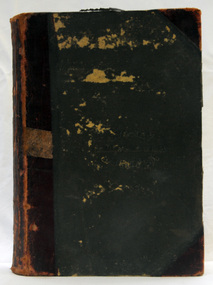
book, Stanley,Paul & Company, The Lady's Realm, November 1910 - April 1911
... It primarily targeted upper-class readers as well as an aspirational middle-class audience, featuring photographs, poems, fiction, and columns by popular authors such as Marie Corelli, Frances Hodgson Burnett, Jack London, and H.G. ...It primarily targeted upper-class readers as well as an aspirational middle-class audience, featuring photographs, poems, fiction, and columns by popular authors such as Marie Corelli, Frances Hodgson Burnett, Jack London, and H.G. ...The Lady's Realm was a illustrated monthly women's magazine published in London in the 19th century, initially edited by W. H. Wilkins. It also published 36 volumes between 1896 and 1914. The Lady's Realm was a British women's magazine published from 1896 until 1914, possibly until 1915. It primarily targeted upper-class readers as well as an aspirational middle-class audience, featuring photographs, poems, fiction, and columns by popular authors such as Marie Corelli, Frances Hodgson Burnett, Jack London, and H.G. Wells. (Wikipedia) Founded in 1833, the Sydney Mechanics' School of Arts is the longest running School of Arts (also known as a "Mechanics' Institute") and the oldest continuous lending library in Australia. These magazines reflect women's interests in the early 20th century. Women’s magazines developed rapidly through the 1800s, reflecting both marketing developments and social changes. As the century progressed, publications aimed at women changed from the middle-class drawing-room journals of the 1830s and 1840s to the cheaper, chattier, more domestic magazines of the 1880s and 1890s. This item oi an example of a publication aimed at a particular social class.A thick hard back book with a dark blue and red fabric cover. It contains short stories by various authors. "SYDNEY MECHANICS SCHOOL OF ARTS 225 PITT STREET" on front cover.literature-lady's-realm short-stories -
 Melbourne Tram Museum
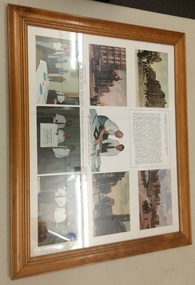
Photograph - Framed Photographs, Department of Transport, "Presentation of an Essay to the Department of Transport Victoria, March 1994", Mar. 1994
... From Top left to bottom right: , Postcard of Swanston St with St Pauls, Note about the presentation and the work undertaken by Jack Cranston, Postcard of Queens Bridge Melbourne, looking north from the south side of the Yarra, Postcard of Flinders St, Photo of Jack Cranston with Minister for Transport, Alan Brown MP, Postcard of Collins St Melbourne, Photo of presentation party - Jack Cranston, Con O'Carroll, Robert Wilson, Graham Jones, Robert Green, John Keating and Alan Brown., Photo of Alan Brown, Jack Cranston and Kim Wells holding the Plans and Sections folder (see Reg Item 583)., Photo of Alan Brown and Jack Cranston....From Top left to bottom right: , Postcard of Swanston St with St Pauls, Note about the presentation and the work undertaken by Jack Cranston, Postcard of Queens Bridge Melbourne, looking north from the south side of the Yarra, Postcard of Flinders St, Photo of Jack Cranston with Minister for Transport, Alan Brown MP, Postcard of Collins St Melbourne, Photo of presentation party - Jack Cranston, Con O'Carroll, Robert Wilson, Graham Jones, Robert Green, John Keating and Alan Brown., Photo of Alan Brown, Jack Cranston and Kim Wells holding the Plans and Sections folder (see Reg Item 583)., Photo of Alan Brown and Jack Cranston. ...Set of 9 postcard, document or images framed with a wooden frame at the time of the "Presentation of an Essay to the Department of Transport Victoria, March 1994". Has a white backing for postcards and photos, approx. 145 x 100. Items have been placed it appears on an under backing. Glazed, craftwood backing secured with staples into the frame. On the rear has a printed label with a red border on white paper with the number "27" in black. From Top left to bottom right: , Postcard of Swanston St with St Pauls, Note about the presentation and the work undertaken by Jack Cranston, Postcard of Queens Bridge Melbourne, looking north from the south side of the Yarra, Postcard of Flinders St, Photo of Jack Cranston with Minister for Transport, Alan Brown MP, Postcard of Collins St Melbourne, Photo of presentation party - Jack Cranston, Con O'Carroll, Robert Wilson, Graham Jones, Robert Green, John Keating and Alan Brown., Photo of Alan Brown, Jack Cranston and Kim Wells holding the Plans and Sections folder (see Reg Item 583)., Photo of Alan Brown and Jack Cranston.trams, tramways, cable trams, horse trams, mto co, melbourne -
 Flagstaff Hill Maritime Museum and Village
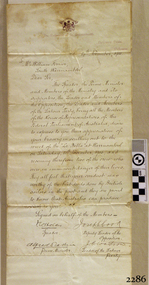
Letter - William Ferrier, 14th November 1905
... A detailed account of the last journey of La Bella can be read in “Leonard Robertson, the Whangaroa & La Bella” written by Jack Churchouse, published in 1982 by Millwood Press Ltd, Wellington, NZ. As well as this letter, Flagstaff Hill’s La Bella Collection includes a photograph of the wrecked La Bella, a brass rail holder and a postcard of William Ferrier with four of the survivors. ...A detailed account of the last journey of La Bella can be read in “Leonard Robertson, the Whangaroa & La Bella” written by Jack Churchouse, published in 1982 by Millwood Press Ltd, Wellington, NZ. As well as this letter, Flagstaff Hill’s La Bella Collection includes a photograph of the wrecked La Bella, a brass rail holder and a postcard of William Ferrier with four of the survivors. ...The letter to William Ferrier of South Warrnambool from the Prime Minister and the Parliament of the Commonwealth recognised the significance of William’s brave and courageous lifesaving act to the people of Australia; “They all feel that your conduct was worthy of the best deeds done by British sailors in the past and they are proud to know that Australia can produce such as you.” The story of that brave rescue follows on below … The ship from which the sailors were rescued was the three-masted, iron and steel barquentine the La Bella, built in Norway in 1893. She was one of two iron and steel ships by Johan Smith, The company was one of the leading shipping families in Tvedestrand, Norway. She was significant to Norwegian shipping, being one of only 27 iron and steel ships ever built in Norway. She was registered in New Zealand and engaged from 1902 in inter-colonial trading of timber in the Pacific, between New Zealand and Australia and was often in Port Phillip Bay, Victoria. On 5th October 1905, the twelve-year-old La Bella left Lyttleton, New Zealand carrying a cargo of timber bound for Warrnambool, Australia. She was manned by a crew of twelve: the Master, (Captain Mylius, previously 1st Mate of La Bella, appointed Captain to La Bella on 6th February 1903) 2 Mates, Cook, six able seamen, one ordinary seaman and a boy. Bad weather en route caused her to shelter at Burnie on Tasmania's North West coast. On November 10th, the 37th day of her journey, La Bella approached Warrnambool. Captain Mylius steered her towards Lady Bay Channel in heavy south-west seas and evening mist. He ordered the helmsman to steer for the light. As the ship came round, a tremendous sea struck her on the port quarter, causing her to breach broadside in a north-westerly direction into breakers. The helm was brought round twice more, but each time heavy seas broke over her, the third time throwing the La Bella on to a submerged reef in Lady Bay now known as La Bella Reef (about 100 yards from the Warrnambool breakwater). The sea was so rough that it even wrenched a one-and-a-half ton anchor from its fastenings and into the sea. As Captain Mylius headed to the steel wheelhouse, intending to send up a rocket flare, a huge sea slammed the steel door into him (resulting in massive bruising front and back) Despite his injuries he still managed to set off a blue light, which he held up in his hands. La Bella’s lifeboats were filled with seawater and broke up on their chocks. The blue light was the first indication to people on the shore that there was a ship in distress. The Harbour Master, Captain Roe (who lived in the Harbour Master’s House opposite Flagstaff Hill), organised a group of volunteers to crew the lifeboat because the trained crew was unavailable; the crewmen were working on a steamer in Port Fairy at the time. He then poured oil onto the water to try and smooth the sea. At around 11 pm three of the crew took shelter in the steel forecastle but the sea crashed into it and broke it up. While the rest of the crew and onlookers watched helplessly in the moonlight the bodies were washed away into the sea, never to be seen again. Some of the crew lashed themselves to the weather rail to keep from being washed away. Watson, the ordinary seaman, became tangled in the rigging lines and was too weak to move, so the 2nd Mate, Robertson, put a line onto him so that he wouldn’t wash off. Around 11 pm three of the crew were unconscious from exhaustion. The situation on La Bella was becoming dangerous. The 2nd Mate moved to the ‘house’ and soon afterwards the ship slipped in the heavy sea. The lashings of the 1st Mate and the ‘boy’ Denham had kept them safe until about 2 am when they were washed overboard; no one was able to help. One by one, the exhausted crew were being washed overboard, too weak to hold on any longer. During the night the La Bella had broken into two and the deckhouse ran out towards the sea. Two more men drowned when trying to reach the lifeboat. By sunrise, the only survivors of the twelve were the Master, 2nd Mate and three seamen. Early in the morning, Captain Roe used the rocket apparatus on shore to try and shoot a line to the ship for a safer rescue but each attempt fell short of the target. Several attempts were made by the lifeboat to rescue the stricken sailors, but the rough conditions made this difficult for the boat to get close enough to the ship and the lifeboat had to return to shore. During a final attempt to reach the ship Captain Mylius ordered his men to jump into the sea. Leonard Robertson, 2nd mate, jumped and swam towards the lifeboat, taking hold of the boat hook offered to him. Oscar Rosenholme managed to reach the boat floating on a piece of timber from the ship’s load and a third survivor, Noake, also made the boat. Along with the lifeboat rescue crew, 25-year-old William Ferrier rowed his small dingy through the heavy seas and managed to rescue the Captain, whom he landed on the breakwater. Ferrier then returned to the ship to attempt a final rescue, losing his oars and rowlocks into the high sea. Using just a spare paddle he skulled towards the La Bella, reaching her stern in time to cut loose the lone surviving sailor, Payne, from the lashing that held him to the ship; the terrified sailor dropped from the ship and into the dingy. Shortly after the last man was rescued, the La Bella was lifted by a huge wave and crashed back down on the reef; she broke up and sank. The ordeal had lasted ten hours. The survivors were taken to the nearby Bay View Hotel and gratefully received warm food and clothing, medical attention and a place to sleep. In the following days, an unidentified body of a young person has washed ashore; it was either Watson or Denham. The body was buried in the Warrnambool cemetery with an appropriate gravestone and inscription. William Ferrier became a national hero as news of the daring rescue spread. In recognition of his bravery in the two daring rescues, he was awarded the Silver Medal for Bravery by the Royal Humane Society and was honoured in the letter from the Prime Minister and the Parliament of the Commonwealth, telegrams and a cheque for £20 from the Governor-General, over £150 subscribed by the public, including Warrnambool and district and readers of The Argus, and a gold medal from the Glenelg Dinghy Club of South Australia. Ferrier’s rescue efforts are one of the most heroic in Victoria’s shipwreck history. (William Ferrier’s son, Frank, received a similar award almost fifty years later when he helped rescue four members of the crew on the yacht Merlan after it ran on to a reef near the Point Lonsdale Lighthouse. ) The wreck of La Bella now lies on her port side in 13 metres of sheltered water inside the reef she struck. The bow section is relatively intact and part of the stern has drifted north-easterly towards the mouth of the Hopkins River. The reef the La Bella struck now bears its name. Those five rescued from the La Bella were Captain George Mylius, Leonard Robertson (2nd Mate, 21 years old), R. Payne, Oscar Rosenholme and Jack Noake. Those seven who lost their lives were Mr Coulson (1st mate), Charles Jackman (cook) Gustave Johnson, Pierre Johann and Robert Gent (all able seamen), Harry Watson (ordinary seaman) and Jack Denham (ship’s boy), Captain Mylius was found guilty of careless navigation; he had sailed into the bay without the services of a pilot. His Master Certificate was suspended for twelve months. Later he was also charged with the manslaughter of one of the crew who had died when the La Bella was wrecked but found not guilty. The event’s adverse publicity and damage to his career took a toll on his health and he died of a heart attack six months after the wreck; he was only thirty-seven. His body was buried in the Melbourne General Cemetery. The La Bella was “the best documented of all sailing ships owned in New Zealand”. Her record books, ship logs, correspondence and supporting papers are still available. At the time of the tragedy, she was owned by Messers David C.Turnbull and Co. of Timaru, New Zealand timber merchants and shipping agents, who had purchased her on 13th December 1901. A detailed account of the last journey of La Bella can be read in “Leonard Robertson, the Whangaroa & La Bella” written by Jack Churchouse, published in 1982 by Millwood Press Ltd, Wellington, NZ. As well as this letter, Flagstaff Hill’s La Bella Collection includes a photograph of the wrecked La Bella, a brass rail holder and a postcard of William Ferrier with four of the survivors. Some 15 – 17 ships are believed to have sunk in Lady Bay, but only two have been discovered on the seafloor; the “La Bella” and the “Edinburgh Castle”. Both wrecks are popular diving sites and are preserved as significant historical marine and marine archaeological sites. This original congratulatory letter sent to William Ferrier by the Prime Minister and Government of Australia demonstrates the importance attached to his efforts for Victoria and to Australia. The letter is part of the La Bella Collection and is significant at both a local and state level. Its connection to the La Bella shipwreck and the rescue of five survivors highlights the dangers of Victoria’s Shipwreck Coast. The letter to William Ferrier from the Australian Government acknowledges the bravery of ordinary Australians who risked their lives to save victims of shipwrecks along the coast. The letter is significant to the history of Warrnambool as it honours William Ferrier, a local fisherman whose descendants continue to live in the area. It highlights the way of life of people who lived in coastal towns in 19th century Victoria and the effects of shipwrecks upon them. The letter connects to the postcard of William Ferrier with four of the five rescued crew, the photograph of the wreck of the La Bella and the artefact from the wreck, the rail holder. This letter is significant because of its association with the sailing ship “La Bella”. The “La Bella” is of local and state and national significance. It is one of the only two shipwrecks discovered in Lady Bay, Warrnambool, out of the 15-17 shipwrecks in the bay. Letter to William Ferrier of South Warrnambool from the Prime Minister and Members of Parliament commending him on his bravery. The printed letterhead includes a coat of arms in the top centre and the official address. The letter is very neatly hand written in black pen and includes 4 signatures of Members of Parliament. The rectangular paper is cream coloured with some yellow/brown discolouring. It has the letterhead on the right hand side of it and the written letter begins below the letterhead. The paper has been folded so that the right side becomes the cover page of the letter. The writing is continued onto the inside right hand page of the folded paper and the writing ends here. There is more recent writing on the bottom right hand corner of the back page. The paper has been officially folded in half a total 3 times and there is heavy discolouration on the sections that form the front and back of the folded letter. There is a 4th fold line that is less pronounced that the other folds and would make the paper the size to fit into a pocket. At several fold creases the paper has worn through. The edges of the paper have minor tears. The printed coat of arms is that of the House of Representatives. Underneath is printed “The Parliament of the Commonwealth, / Parliament House / Melbourne”. The hand written, letter is dated “14th November, 1905” and addressed to “Mr. William Ferrier / South Warrnambool” The letter begins “The Speaker, the Prime Minister and Members of the Ministry and its supporters, the Leader and Members of the Opposition, the Leader and Members of the Labour Party, being all the Members of the House of Representatives of the Federal Parliament of Australia” … It continues “desire to express to you their appreciation of your bravery in skulling out to the wreck of the “La Bella” at Warrnambool on Saturday, 11th November, 1905, and recovering therefrom two of the crew who were in imminent danger of their lives. They all feel that your conduct was worthy of the best deeds done by British sailors in the past and they are proud to know that Australia can produce such as you.” The letter is “Signed on behalf of the Members – Speaker (Frederick Holder ), Deputy Leader of the Opposition (Joseph Cook ), Prime Minister (Alfred Deakin), Leader of the Labour Party ( J.C. Watson)” On the back of the letter is blue ink handwriting “OWNER / G. FERRIER / TO. BE. PHOTOGRAPHED / 27-4-76”la bella, william ferrier, bill ferrier, lady bay, 1905, 10th november 1905, 11th november 1905, parliament of the commonwealth, prime minister, australian government, new zealand, flagstaff hill, warrnambool, shipwrecked coast, flagstaff hill maritime museum, maritime museum, shipwreck coast, flagstaff hill maritime village -
 Flagstaff Hill Maritime Museum and Village
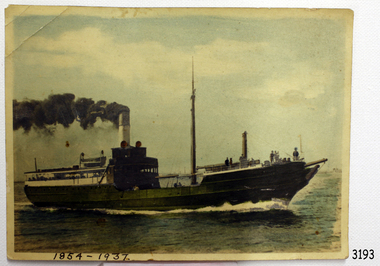
Photograph - Vessel, Steam Ship, Between 1890 - 19-12-1937
... Jack doing? Has [Willie?] commenced training yet, or no! too young, isn’t she? Been a lot of “paper” talk about the “Edina” finishing but nothing official that I’m aware of, but it’s always on the cards I suppose, then I suppose it will be to sea again if I’m not too old. Easy Winter only 3 trips per week, running every day from today until further notice. Trust [Mary?] Is well...Jack doing? Has [Willie?] commenced training yet, or no! too young, isn’t she? Been a lot of “paper” talk about the “Edina” finishing but nothing official that I’m aware of, but it’s always on the cards I suppose, then I suppose it will be to sea again if I’m not too old. Easy Winter only 3 trips per week, running every day from today until further notice. Trust [Mary?] Is well ...This photographic postcard of the SS Edina was taken after the 1890’s due to the style and configuration of the vessel. There is a black and white photograph of the same image also in our Collection (RN 3192). It is most likely that both of the photographs were donated by the same person because the people mentioned in the inscription on the black and white photograph’s reverse side connect with two of the people mentioned in the letter on the reverse of the coloured photograph. * RN 3192; Black & White photograph - inscription: - "Donated by Mrs. Nancy Mason, Bay View. Owned by Mac Fordham, Chief Engineer, 'Edina', then given to Mrs. Mason's father-in-law Arnold Mason (both Engineers W.W. I)" The “Arnie” to whom the letter was addressed is likely to be Arnold Mason, Engineer. The author of the letter, “Mac”, is likely to be Mac Fordham, Chief Engineer of SS Edina. The transcribed letter tells of two men who know each other well and have an interest in the Edina. “Mac” mentions that he may be “too old” to be at sea again; this would also support the idea that the older writer would give his photographs to the perhaps younger “Arnie”. * RN 3193 (this photograph) - Transcription of pen and ink script handwriting = = = = = = = = = = = = 19-12-37 No. 1 Flat, “Goodwood Lodge” 196 Lennox Street, Richmond [Victoria] Dear Arnie , Been meaning to write for long time but you know, it’s just the usual routine of the seamen within Bay trades. Had a good trip back from Sydney. Took our time, spent almost a week coming back, rather monotonous in parts in the hill country, too many darn curves, still was a good trip. How are you all keeping? Suppose you’ve moved back to Drummoyne [erettris?], expect you can let the house in Manly easily enough. Noticed they had a strike at Cockatoo [Cockatoo Island NSW]. don’t suppose they pulled the boys out. How is Jack doing? Has [Willie?] commenced training yet, or no! too young, isn’t she? Been a lot of “paper” talk about the “Edina” finishing but nothing official that I’m aware of, but it’s always on the cards I suppose, then I suppose it will be to sea again if I’m not too old. Easy Winter only 3 trips per week, running every day from today until further notice. Trust [Mary?] Is well & all’s well with you too. Best wishes from us both for Xmas & New Year. Cheerio Mac = = = = = = = = = = = = ABOUT THE SS EDINA The three masted iron screw steamer SS Edina was built in Glasgow, Scotland, in 1854 by Barclay and Curle. She was adorned with the figurehead of ‘fair maid of Judea’. The many years of service made SS Edina famous world-wide as the longest serving screw steamer. (The term screw steamer comes from being driven by a single propeller, sometimes called a screw, driven by a steam engine.) SS Edina’s interesting history includes English Chanel runs, serving in the Crimean Ware carrying ammunition, horses and stores to the Black Sea, and further service in the American Civil War and later, serving in the western district of Victoria as well as in Queensland and carried gold, currency and gold prospectors Australia to New Zealand. SS Edina had the privilege of being an escort vessel to H.R.H. the Duke of Edinburgh during his visit to Australia in 1867. In March 1863 SS Edina arrived in Port Phillip Bay, Melbourne and was bought by Stephen Henty, of Portland fame, to work the cargo and passenger run from Melbourne – Warrnambool – Port Fairy - Portland. After a short time of working the run from Australia to New Zealand, with passengers and cargo that included gold and currency, she returned to her Melbourne - Warrnambool – Port Fairy run, with cargo including bales of wool produced in the western district of Victoria. The Warrnambool Steam Packet Company purchased SS Edina in 1867; she was now commanded by Captain John Thompson and Chief Engineer John Davies. She survived several mishaps at sea, had a complete service and overhaul and several changes of commanders. In 1870 SS Edina was in Lady Bay, Warrnambool, when a gale sprung up and caused a collision with the iron screw steamer SS Dandenong. SS Edina’s figurehead was broken into pieces and it was not ever replaced. SS Edina was re-fitted in 1870 then was used as a coastal trader in Queensland for a period. She was then brought to Melbourne to carry cargo and passengers between Melbourne and Geelong and performed this service 1880-1938. During this time (1917) she was again refitted with a new mast, funnel, bridge and promenade deck, altering her appearance. In 1938, after more collisions, SS Edina was taken out of service. However she was later renamed Dinah and used as a ‘lighter’ (a vessel without engine or superstructure) to be towed and carry wool and general cargo between Melbourne and Geelong. In 1957, after 104 years, the SS Edina was broken up at Footscray, Melbourne. Remains of SS Edina’s hull can be found in the Maribyrnong River, Port Phillip Bay. This photographic postcard with the letter on the revers tell about the SS Edina and are significant for its association with the screw steamer SS Edina. The SS Edina is heritage listed on the Victorian Heritage Database VHR S199. She had endeared herself to the people of Port Phillip Bay as a passenger ferry, part of their history and culture. She played a significant role in the Crimean War, the American Civil War and the gold rush in New Zealand. She also served western Victoria for many years in her cargo and passenger runs. The SS Edina is famous for being the longest serving screw steamer in the world. After spending her first nine years overseas she arrived in Melbourne and her work included running the essential service of transporting cargo and passengers between Melbourne and the western Victoria ports of Warrnambool, Port Fairy and Portland. The SS Edina was purchased in the late 1860’s by local Warrnambool business, the Warrnambool Steam Packet Co. and continued trading from there as part of the local business community. The SS Edina’s original ‘fair maid of Judea’ figurehead was broken to pieces in a collision with another vessel (the SS Dandenong) in a gale off Warrnambool, Victoria, in 1870.Coloured (hand coloured) photographic postcard of SS Edina. Letter on reverse, hand written in pen and ink, from Mac to Arnie, dated 19-12-37 [1937]. The photograph shows the SS Edina moving under steam power, many people on both the bow and stern and a few people in the centre of the vessel. There are buildings on the shore in the background. The ship's configuration is dated post 1890.Hand written in pen on base of front “1854-1957” Hand written on back in blue pen and crossed out “REC 409” Hand written on back in pen ‘EDINA,’ “3173,” “086.2” Hand written letter dated 19-12-37, from Mac to Arnie. Script writing in pen and ink letter on reverse of photograph – see “Context” section for transcription. warrnambool, shipwrecked coast, flagstaff hill, flagstaff hill maritime museum, maritime museum, shipwreck coast, flagstaff hill maritime village, shipwrecked artefact, barclay & curle, figurehead 'fair maid of judea', centenary maritime exhibition 1934, a brief review of steam navigation in victoria, pleasure steamer edina, trade and travel late 19th and early 20th century, trade melbourne to geelong, screw steamer edina, coastal trader edina, lighter dinah, cargo carrying for cremean war, cargo carrying for american civil war, passenger and trade in western district of victoria, export gold and currency and gold diggers to new zealand, export vessel to h r h the duke of edinburgh, melbourne - warrnambool - port fairy - portland cargo run, warrnambool steam packet company, stephen henty, captain john thompson, chief engineer john davies, lady bay warrnambool, lighter edina, shipping victoria, port phillip bay steamers, steamship great britain, edina, vhr s199 victorian heritage database, photographic postcard of ss edina 1854-1957, letter by mac fordham chief engineer ss edina, letter to arnold mason, engineer -
 Federation University Historical Collection
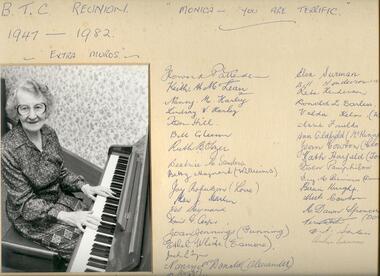
Photograph, Monica Miller photograph, BTC Reunion 1947 - 1982
... well-loved music teacher at the Ballarat Teachers' College. ballarat teachers' college monica miller Lynette Vickery (Lynch) Beth Stutterd (Leslie) Howard Pattender Keith H. M. Lean Nancy M. Harley Lindsay W. Harley Jon Hill Bill Gleeson Ruth B Gozer Beatrice M. Sanders Betty Maynard (Williams) Joy Anderson (Love) Stan J Marlen Wal Maynard David G. Cooper Joan Jennings (Gunning) Etherl White (Esmore) Jack ...Monica was a well-loved music teacher at the Ballarat Teachers' College.Black and white photograph in cream matte board. Monica Miller sits at the piano. Those who attended the BTC Reunion 1947 - 1982 signed the mountballarat teachers' college, monica miller, lynette vickery (lynch), beth stutterd (leslie), howard pattender, keith h. m. lean, nancy m. harley, lindsay w. harley, jon hill, bill gleeson, ruth b gozer, beatrice m. sanders, betty maynard (williams), joy anderson (love), stan j marlen, wal maynard, david g. cooper, joan jennings (gunning), etherl white (esmore), jack ..., nancy mcdonald (alexander), pat watts (knight), lorna davis (welsh), joyce fraser (mathison), hugh fraser, margaret alexander (palmer), maurene canter (merlin), elva surman, bill henderson, reta henderson, ronald l. earless, valda kelm (witney), marie faulds, ann oldfield (mckinnen), jean cowton (clode), kath harfield (tobin), groen pamphilon, inez m bemirs (domascheng), bernie kurght, mick cowton, m. dawn spencer (doney), vern white, n.t. sanders, arther ..., -
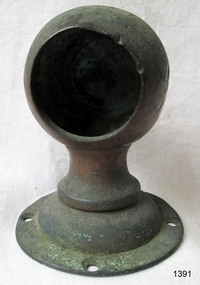 Flagstaff Hill Maritime Museum and Village
Functional object - Rail holder, About 1893, when the ship was made
... Jack Churchouse, published in 1982 by Millwood Press Ltd, Wellington, NZ. Some 15 – 17 ships are believed to have sunk in Lady Bay, but only two have been discovered on the seafloor; the “La Bella” and the “Edinburgh Castle”. Both wrecks are popular diving sites and are preserved as significant historical marine and marine archaeological sites. As well...Jack Churchouse, published in 1982 by Millwood Press Ltd, Wellington, NZ. Some 15 – 17 ships are believed to have sunk in Lady Bay, but only two have been discovered on the seafloor; the “La Bella” and the “Edinburgh Castle”. Both wrecks are popular diving sites and are preserved as significant historical marine and marine archaeological sites. As well ...This brass rail holder fixture would have been used to hold the end of a rail in place. There is no information as to where the fitting or rail would have been placed on the ship; sailing ships had many brass fittings. It was recovered from the wreck of the La Bella, which lies at the bottom of the Warrnambool Harbour. Some 15 ships are believed to have been wrecked in Lady Bay, but only two have been discovered on the sea floor; the La Bella and the Edinburgh Castle. Both wrecks are popular diving sites and are preserved as significant historical marine and marine archaeological sites. The story of the final voyage of the La Bella is summarised as follows … The ship from which the sailors were rescued was the three-masted, iron and steel barquentine the La Bella, built in Norway in 1893. She was one of two iron and steel ships by Johan Smith, the company being one of the leading shipping families in Tvedestrand, Norway. She was significant to Norwegian shipping, being one of only 27 iron and steel ships ever built in Norway. She was registered in New Zealand and engaged from 1902 in inter-colonial trading of timber in the pacific, between New Zealand and Australia and was often in Port Phillip Bay, Victoria. On 5th October, 1905, the twelve year old La Bella left Lyttleton, New Zealand carrying a cargo of timber bound for Warrnambool, Australia . She was manned by a crew of twelve: the Master, (Captain Mylius, previously 1st Mate of La Bella, appointed Captain to La Bella on 6th February 1903) 2 Mates, Cook, six able seamen, one ordinary seaman and a boy. . Bad weather en route caused her to shelter at Burnie on Tasmania's North West coast. On November 10th, the 37th day of her journey, La Bella approached Warrnambool. Captain Mylius steered her towards Lady Bay Channel in heavy south-west seas and evening mist. He ordered the helmsman to steer for the light. As the ship came round, a tremendous sea struck her on the port quarter, causing her to breach broadside in a north-westerly direction into breakers. The helm was brought round twice more, but each time heavy seas broke over her, the third time throwing the La Bella on to a submerged reef in Lady Bay now known as La Bella Reef (about 100 yards from the Warrnambool breakwater). The sea was so rough that it even wrenched a one-and-a-half ton anchor from its fastenings and into the sea. As Captain Mylius headed to the steel wheelhouse, intending to send up a rocket flare, a huge sea slammed the steel door into him (resulting in massive bruising front and back) Despite his injuries he still managed to set off a blue light, which he held up in his hands. La Bella’s lifeboats were filled with sea water and broke up on their chocks. The blue light was the first indication to people on shore that there was a ship in distress. The Harbour Master, Captain Roe (who lived in the Harbour Master’s House opposite Flagstaff Hill), organised a group of volunteers to crew the lifeboat because the trained crew was unavailable; the crewmen were working on a steamer in Port Fairy at the time. He then poured oil onto the water to try and smooth the sea. At around 11pm three of the crew took shelter in the steel forecastle but the sea crashed into it and broke it up. While the rest of the crew and onlookers watched helplessly in the moonlight the bodies were washed away into the sea, never to be seen again. Some of the crew lashed themselves to the weather rail to keep from being washed away. Watson, the ordinary seaman, became tangled in the rigging lines and was too weak to move, so the 2nd Mate, Robertson, put a line onto him so that he wouldn’t wash off. Around 11pm three of the crew were unconscious from exhaustion. The situation on La Bella was becoming dangerous. The 2nd Mate moved to the ‘house’ and soon afterwards the ship slipped in the heavy sea. The lashings of the 1st Mate and the ‘boy’ Denham had kept them safe until about 2am when they were washed overboard; no one was able to help. One by one, the exhausted crew were being washed overboard, too weak to hold on any longer. During the night the La Bella had broken into two and the deckhouse ran out towards the sea. Two more men drowned when trying to reach the lifeboat. By sunrise the only survivors of the twelve were the Master, 2nd Mate and three seamen. Early in the morning Captain Roe used the rocket apparatus on shore to try and shoot a line to the ship for a safer rescue but each attempt fell short of the target. Several attempts were made by the lifeboat to rescue the stricken sailors, but the rough conditions made this difficult for the boat to get close enough to the ship and the lifeboat had to return to shore. During a final attempt to reach the ship Captain Mylius ordered his men to jump into the sea. Leonard Robertson, 2nd mate, jumped and swam towards the lifeboat, taking hold of the boat hook offered to him. Oscar Rosenholme managed to reach the boat floating on a piece of timber from the ship’s load and a third survivor, Noake, also made the boat. Along with the lifeboat rescue crew, 25 year old William Ferrier rowed his small dingy through the heavy seas and managed to rescue the Captain, whom he landed on the breakwater. Ferrier then returned to the ship to attempt a final rescue, losing his oars and rowlocks into the high sea. Using just a spare paddle he skulled towards the La Bella, reaching her stern in time to cut loose the lone surviving sailor, Payne, from the lashing that held him to the ship; the terrified sailor dropped from the ship and into the dingy. Shortly after the last man was rescued, the La Bella was lifted by a huge wave and crashed back down on the reef; she broke up and sank. The ordeal had lasted ten hours. The survivors were taken to the nearby Bay View Hotel and gratefully received warm food and clothing, medical attention and a place to sleep. In the following days an unidentified body of a young person was washed ashore; it was either Watson or Denham. The body was buried in the Warrnambool cemetery with an appropriate gravestone and inscription. William Ferrier became a national hero as news of the daring rescue spread. In recognition of his bravery in the two daring rescues he was awarded the Silver Medal for Bravery by the Royal Humane Society and was honoured in the letter from the Prime Minister and the Parliament of the Commonwealth, telegrams and a cheque for £20 from the Governor General, over £150 subscribed by the public, including Warrnambool and district and readers of The Argus, and a gold medal from the Glenelg Dinghy Club of South Australia. Ferrier’s rescue efforts are one of the most heroic in Victoria’s shipwreck history. (William Ferrier’s son, Frank, received a similar award almost fifty years later, when he helped rescue four members of the crew on the yacht Merlan, after it ran on to a reef near the Point Lonsdale Lighthouse. ) The wreck of La Bella now lies on her port side in 13 metres of sheltered water inside the reef she struck. The bow section is relatively intact and part of the stern has drifted north-easterly towards the mouth of the Hopkins River. The reef the La Bella struck now bears its name. Those five rescued from the La Bella were Captain George Mylius, Leonard Robertson (2nd Mate, 21 years old), R. Payne, Oscar Rosenholme and Jack Noake. Those seven who lost their lives were Mr Coulson (1st mate), Charles Jackman (cook) Gustave Johnson, Pierre Johann and Robert Gent (all able seamen), Harry Watson (ordinary seaman) and Jack Denham (ship’s boy), Captain Mylius was found guilty of careless navigation; he had sailed into the bay without the services of a pilot. His Master Certificate was suspended for twelve months. Later he was also charged with manslaughter of one of the crew who had died when the La Bella was wrecked, but found not guilty. The event’s adverse publicity and damage to his career took a toll on his health and he died of a heart attack six months after the wreck; he was only thirty-seven. His body was buried in the Melbourne General Cemetery. The La Bella was “the best documented of all sailing ships owned in New Zealand”. Her record books, ship logs, correspondence and supporting papers are still available. At the time of the tragedy, she was owned by Messers David C.Turnbull and Co. of Timaru, New Zealand timber merchants and shipping agents, who had purchased her on 13th December 1901. A detailed account of the last journey of La Bella can be read in “Leonard Robertson, the Whangaroa & La Bella” written by Jack Churchouse, published in 1982 by Millwood Press Ltd, Wellington, NZ. Some 15 – 17 ships are believed to have sunk in Lady Bay, but only two have been discovered on the seafloor; the “La Bella” and the “Edinburgh Castle”. Both wrecks are popular diving sites and are preserved as significant historical marine and marine archaeological sites. As well as this letter, Flagstaff Hill’s La Bella Collection includes a photograph of the wrecked La Bella, a brass rail holder and a postcard of William Ferrier with four of the survivors. This original congratulatory letter sent to William Ferrier by the Prime Minister and Government of Australia demonstrates the importance attached to his efforts for Victoria and to Australia. The letter is part of the La Bella Collection and is significant at both a local and state level. Its connection to the La Bella shipwreck and the rescue of five survivors highlights the dangers of Victoria’s Shipwreck Coast. The letter to William Ferrier from the Australian Government acknowledges the bravery of ordinary Australians who risked their lives to save victims of shipwrecks along the coast. The letter is significant to the history of Warrnambool as it honours William Ferrier, a local fisherman whose descendants continue to live in the area. It highlights the way of life of people who lived in coastal towns in 19th century Victoria and the effects of shipwrecks upon them. The letter connects to the postcard of William Ferrier with four of the five rescued crew, the photograph of the wreck of the La Bella and the artefact from the wreck, the rail holder. This item is significant because of its association with the sailing ship “La Bella” . the “La Bella” is of local and state and national significance. It is one of the only two shipwrecks discovered in Lady Bay, Warrnambool, out of the 15-17 shipwrecks in the bay. Brass rail holder from the wreck "La Bella". This rail holder would have been used as a fitting for the end of a rail. It is made up of two parts and looks a little like a goblet in shape. The top is a hollow spherical shape with a circular hole cut out on one side, into which the end of a round rail would fit. There are two gouge marks close to each other on one side of the hole, about one centimetre apart, at 1 and 2 o’clock position. The sphere has a hollow pipe-like stem with a screw thread turned into the outside of the lower section and the bottom of the stem has been flared out after having the base fitted. The base is round and has a mound in the centre. The edge has four evenly spaced fixture holes around its edge. The metal shows signs of pitting and has mild encrustation. The fitting of the base is loose, allowing it to swivel in a complete circle. The top of the sphere is rough and has a dent in it. Underneath the base there is verdigris; some has flaked off and reveals a bright golden colour underneath. rail holder, brass rail holder, la bella, lady bay, norway, 1893, new zealand, captain mylius, william ferrier, flagstaff hill, warrnambool, shipwrecked coast, flagstaff hill maritime museum, maritime museum, shipwreck coast, flagstaff hill maritime village -
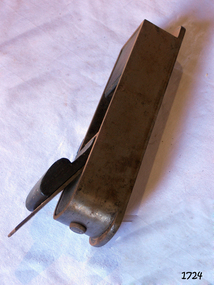 Flagstaff Hill Maritime Museum and Village
Tool - Wood Plane, Late 19th to early 20th century
... A vintage tool made by a well-known company, this item was made commercially for firms and individuals that worked in wood and needed a tool that could remove large amounts of timber. These jack ...A moulding plane is a specialised plane used for making the complex shapes found in wooden mouldings that are used to decorate furniture or other wooden objects. Traditionally, moulding planes were blocks of wear-resistant hardwood, often beech or maple, which were worked to the shape of the intended moulding. The blade or iron was likewise formed to the intended moulding profile and secured in the body of the plane with a wooden wedge. A traditional cabinetmakers' shop might have many, perhaps hundreds, of moulding planes for the full range of work to be performed. Large crown mouldings required planes of six or more inches in width, which demanded great strength to push and often had additional peg handles on the sides, allowing the craftsman's apprentice or other workers to pull the plane ahead of the master who guided it. John Moseley & Son: Records indicate that before 1834, the firm is listed at number 16 New Street, London and according to an 1862 advertisement the shop had been established in New Street since 1730, The Sun insurance records from the time show that John Moseley was the possessor of a horse mill in the yard of his premises, which means that some kind of manufacturing was taking place, as the mill would have provided power to run a saw or perhaps a grinding wheel so the probability is that he did not just sell tools, he made them as well. John Moseley died in 1828 and his will named his four sons: John, Thomas, William and Richard. To complicate matters he also had brothers with the same first names; brothers Richard (of Piccadilly) and William (of Peckham Rye) are named as two of the executors. Brother Thomas is not mentioned in this will, but became a minister and was one of the executors of brother Richard's estate when he died in 1856. From John's will, we also learn that, although the shop was in New Street, he resided in Lympstone, Devon. The family must have had a house in that county for quite some time as both sons Richard and William are baptised in Devon, although John and Thomas were baptised in London. In the 1841 and 1851 census records, we just find William in New Street, but in 1861 both William and Richard are listed there as toolmakers. That Richard was staying overnight at New Street was probably just accidental as in 1851 and 1871, we find him with his wife Jane and children in Clapham and Lambeth respectively. In 1851 Richard is listed as “assistant clerk cutlery warehouse” and in 1871 as “retired plane maker and cutler”. Although the actual place of work is not stated, one may assume he worked in the family business. 1862 is a year full of changes for the firm. In that year, William had a new property built at 27 Bedford Street. In the catalogue for the 1862 International Exhibition, 54 Broad Street (later 54-55 Broad Street) is listed for the first time, which may very well coincide with the split of the business into a retail and a wholesale branch. Around the same time, they must have moved from New Street to 17 & 18 King Street because their manufacturing premises had been pulled down to form the New Street from Cranbourne Street to King Street. In January 1865, William died and Richard continued the business. In 1867, the partnership he had with his son Walker and Thomas Elis Hooker, is dissolved. Richard continued tool-making at King Street and Bedford Street. Richard retired somewhere between 1867 and 1871, but the business continued. The business is taken over by W M Marples & Sons and tools continued to be made in London until 1904 when manufacturing relocated to Sheffield.A vintage tool made by a well-known company, this item was made commercially for firms and individuals that worked in wood and needed a tool that could remove large amounts of timber. These jack or dressing planes came in various shapes and sizes to achieve a flat and even finish to timber surfaces and came in many sizes. A significant tool from the mid to late 19th century that is still in use today with early models sought after by collectors. It gives us a snapshot of how furniture and other finishes were created on timber by the use of cutting-edged hand tools. Tools that were themselves handmade show the craftsmanship used during this time not only to make a tool such as the subject item but also the craftsmanship needed to produce a decorative or even finish that was needed for the finishing of timber items.Jack Plane metal body with rose wood filler.Mosley & Sons London No 2flagstaff hill, warrnambool, flagstaff-hill, flagstaff-hill-maritime-museum, maritime-museum, shipwreck-coast, flagstaff-hill-maritime-village, john moseley & son, jack plane, woodworking tool, carpenders tools, cabinet makers tools -
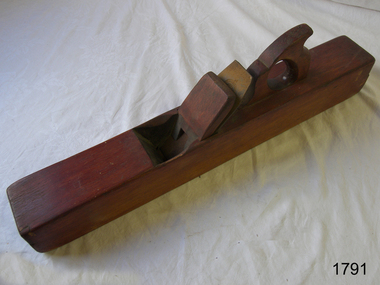 Flagstaff Hill Maritime Museum and Village
Tool - Joiner, Jack or Smoothing Plane, Akin & Son, 1900 to 1966
... well as smoothing timber projects were created by the use of hand tools. Tools that were themselves handmade shows the craftsmanship used during this time not only to make a tool such as the subject item but also the craftsmanship needed to finish timber. flagstaff hill warrnambool shipwrecked-coast flagstaff-hill flagstaff-hill-maritime-museum maritime-museum shipwreck-coast flagstaff-hill-maritime-village jointer plane plane Stamped GN inside W made by Akins and Sons Birmingham UK Jointer or Jack Plane with fishtail handle, Size of iron 2 1/2 inches wide, Tool Joiner, Jack or Smoothing Plane Akin & Son ...The subject item is a smoothing plane traditionally wood planes were blocks of wear resistant hardwood, often beech or maple, which were worked to the shape of the intended moulding or had a flat blade use for achieving a flat and smooth finish to timber. The blade, or iron was likewise formed to the intended moulding profile or for smoothing and secured in the body of the plane with a wooden wedge. A traditional cabinetmakers shop might have many, perhaps hundreds, of moulding and flat bladed planes for a full range of work to be performed. Large crown mouldings required planes of six or more inches in width, which demanded great strength to push and often had additional peg handles on the sides, allowing the craftsman's apprentice or other worker to pull the plane ahead of the master who guided it. The maker Atkin and Sons were a prolific Birmingham plane maker, active from 1863 to 1900 when they became Atkin and Sons Ltd and traded until 1966. Their trademark was actually "BENEFACTUM" which is Latin for "well made."A well-made tool from the early 20th century from a well-known company that ceased trading in Birmingham in 1966, today this tool from this company is quite rare and sought after by collectors. It gives us a snapshot of how furniture and other decorative finishes as well as smoothing timber projects were created by the use of hand tools. Tools that were themselves handmade shows the craftsmanship used during this time not only to make a tool such as the subject item but also the craftsmanship needed to finish timber.Jointer or Jack Plane with fishtail handle, Size of iron 2 1/2 inches wide, Stamped GN inside W made by Akins and Sons Birmingham UKflagstaff hill, warrnambool, shipwrecked-coast, flagstaff-hill, flagstaff-hill-maritime-museum, maritime-museum, shipwreck-coast, flagstaff-hill-maritime-village, jointer plane, plane -
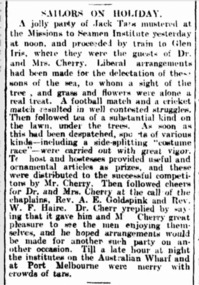 Mission to Seafarers Victoria
Article - Digital copy, Sailors on Holiday, 9 November 1909
... Jack Tars mustered at the Missions to Seamen Institute yesterday at noon, and proceeded by train to Glen Iris, where they were the guests of Dr. and Mrs. Cherry. Liberal arrangements had been made for the delectation of these sons of the sea, to whom a sight of the tree , and grass and flowers were alone a real treat. A football match and a cricket match resulted in well...Jack Tars mustered at the Missions to Seamen Institute yesterday at noon, and proceeded by train to Glen Iris, where they were the guests of Dr. and Mrs. Cherry. Liberal arrangements had been made for the delectation of these sons of the sea, to whom a sight of the tree , and grass and flowers were alone a real treat. A football match and a cricket match resulted in well ...SAILORS ON HOLIDAY. . "A jolly party of Jack Tars mustered at the Missions to Seamen Institute yesterday at noon, and proceeded by train to Glen Iris, where they were the guests of Dr. and Mrs. Cherry. Liberal arrangements had been made for the delectation of these sons of the sea, to whom a sight of the tree , and grass and flowers were alone a real treat. A football match and a cricket match resulted in well contested struggles. Then followed tea of a substantial kind on the lawn, under the trees. As soon as this had been despatched, sports of various kinds— including a side-splitting "costume race"— were carried out with great vigor. The host and hostesses provided useful and ornamental articles as prizes, and these were distributed to the successful competi tors by Mr. Cherry. Then followed cheers for Dr. and Mrs. Cherry at the call of tire chaplains, Rev. A. E. Goldspink and Rev. W. F. Haire. Dr. Cherry replied by say ing that it gave him and M Cherry great pleasure to see the men enjoying them selves, and he hoped arrangements would be made for another such party ou an other occasion. Till a late hour at night the institutes on the Australian Wharf and at Port Melbourne were merry with crowds of tars."The article shows the importance of these outdoor outings for sailors after spending several months at sea.sailors, seamen, lhlg, picnics, sports, dr cherry, glen iris, thomas cherry -
 Marysville & District Historical Society
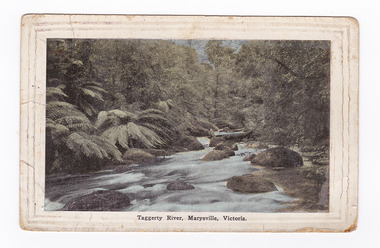
Postcard (item) - Colour tinted postcard, Renwick, Pride & Nuttall, Taggerty River, Marysville, Victoria, 1916
... I hope you/ are keeping well & fit/ & that it wont be long/ before you are on your/ way back to Aust. I/ suppose you have heard/ that Jack is on his/ way home, we are/ looking forward to/ the day when he arrives./ My best wishes to you/ & kind regards/ Sincerely yr/ friend/ Raell Dennis...I hope you/ are keeping well & fit/ & that it wont be long/ before you are on your/ way back to Aust. I/ suppose you have heard/ that Jack is on his/ way home, we are/ looking forward to/ the day when he arrives./ My best wishes to you/ & kind regards/ Sincerely yr/ friend/ Raell Dennis An early colour tinted photograph of the Taggerty River in Marysville in Victoria. ...An early colour tinted photograph of the Taggerty River in Marysville in Victoria.An early colour tinted photograph of the Taggerty River in Marysville in Victoria.Australian Enamellers. Country Series No. 3. Produced in Australia To Ms Marlene./ To wish you/ well; & To assist in/ making you as comfy/ as possible. I hope you/ are keeping well & fit/ & that it wont be long/ before you are on your/ way back to Aust. I/ suppose you have heard/ that Jack is on his/ way home, we are/ looking forward to/ the day when he arrives./ My best wishes to you/ & kind regards/ Sincerely yr/ friend/ Raell Dennistaggerty river, marysville, victoria, postcard, souvenir -
 Federation University Historical Collection
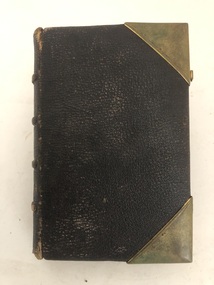
Book, George E. Eyre & William Spottiswoode, Holy Bible belonging to Henry Sutton, c. 1854
... well as many more inventions. Henry was also one of four brothers that ran the Sutton's Music Store after the death of their Father Richard Sutton. Henry Sutton taught Applied Electricity at the Ballarat School of Mines in 1883 to 1886. Holy Bible Bible Henry Sutton King James Bible Mrs H. Sutton Ron Sutton Jack ...c. 1854 Holy Bible owned by a member of Henry Sutton's familyLeather bound Holy Bible c. 1854 owned by a member of the Sutton Family. Brass corners with missing clasp non-fictionc. 1854 Holy Bible owned by a member of Henry Sutton's familyholy bible, bible, henry sutton, king james bible, mrs h. sutton, ron sutton, jack sutton -
Federation University Historical Collection
Book - Book - Scrapbook, Ballarat College of Advanced Education: Scrapbook of newspaper cutting, Book 18; June 1986 to October 1986
... importance of physical well-being...jack...The cuttings cover the period from 28 June 1986 to 27 October 1986. . employment advertisements application for enrolment outline of courses ballarat college of advanced education bcae bcae health education course ymca pool users "short-cut degrees" bcae commercial day christmas in july "vanya' is a modern tale bcae birthday celebrations six faculties children's diets under scrutiny gravity separator for minerals leigh oliver wins art prize ballarat needs training venue swimming widdop to visit u s and u k aquinas to offer nurse training funding system bid to cut traffic chaos uncle vanya production importance of physical well-being jack barker to quit steve moneghetti dorothy crocker and music conservation balance sheet needed bcae open on sunday open day chemistry with a difference durant memorial lecture sharon stewart wins bronze awards for students scott ramsay students draw plan for park teachers visit goldfields mining seminar course to coach coaches bound for the big desert student found boost for country sport art of murals career expo garry's memorable month fees protest Book with yellow cover, front. ...Newspaper cuttings relating to Ballarat College of Advanced Education. These are from various newspapers and include The Age, Ballarat Courier, The Australian, The Herald. The cuttings cover the period from 28 June 1986 to 27 October 1986. . Book with yellow cover, front. Spiral bound.employment advertisements, application for enrolment, outline of courses, ballarat college of advanced education, bcae, bcae health education course, ymca pool users, "short-cut degrees", bcae commercial day, christmas in july, "vanya' is a modern tale, bcae birthday celebrations, six faculties, children's diets under scrutiny, gravity separator for minerals, leigh oliver wins art prize, ballarat needs training venue, swimming, widdop to visit u s and u k, aquinas to offer nurse training, funding system, bid to cut traffic chaos, uncle vanya production, importance of physical well-being, jack barker to quit, steve moneghetti, dorothy crocker and music, conservation balance sheet needed, bcae open on sunday, open day, chemistry with a difference, durant memorial lecture, sharon stewart wins bronze, awards for students, scott ramsay, students draw plan for park, teachers visit goldfields, mining seminar, course to coach coaches, bound for the big desert, student found, boost for country sport, art of murals, career expo, garry's memorable month, fees protest -
 Federation University Historical Collection
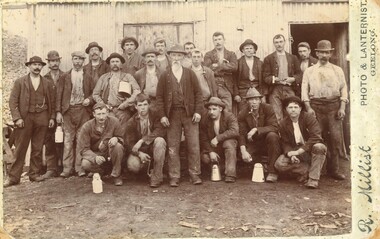
Photograph, R. Millist, Hanlon Consols Mine Rokewood, 1901
... Weller)Yung. They lived at Happy Valley near Linton. and Piggoreet. Yohann was a miner and died in the All Nations Mine collapse at Derwnt Jack's in 1877. ...Weller)Yung. They lived at Happy Valley near Linton. and Piggoreet. Yohann was a miner and died in the All Nations Mine collapse at Derwnt Jack's in 1877. ...The photo depicts one shift of mine hands at Hanlon Consols Mine Rokewod in 1901. ist on the left is George Edgar Yung. George was born in Ararat the son of Yohann Godlip and Christina (b Weller)Yung. They lived at Happy Valley near Linton. and Piggoreet. Yohann was a miner and died in the All Nations Mine collapse at Derwnt Jack's in 1877. Interesting to note in the following information that the Hanlon Consol mamager, William Maughan was also the manager of the Try Again Mine in Piggoreet. He was also on the six man school committee of Piggoreet Common School No. 726. (Is this why George Yung ended up working in Rokewood because of a previous connection at Piggoreet? George married Clara Emma Smith from Happy Valley and worked in a mine at Allendale. They later moved to Yendon) About the Hanlon gold mining company near Rokewood. 1901 - Information Bendigo Prospecting Club, 21/08/2020. Information provided once again by Peter McCarthy. Christopher Hanlon had put down a line of bores south of the Rokewood main street, looking for a continuation of the Break O’Day lead which had been worked for two or three miles with highly payable results, though in a primitive manner. Ground was being paddocked 30 feet deep and made to pay. The bores suggested the sinking would be about 70 feet and a shaft site was selected at the back of Stanbrook’s Hotel. The Hanlon Gold Mining Company was formed in March 1895 and the shaft was bottomed at 68 feet, getting just over an ounce of gold from the shaft bottom. By January 1896, the poppet heads were up, and steam plant was nearly ready. The mine produced 846 oz by September, which was not as good as expected, but they installed a second puddling machine. The mine was profitable for the next three years, with periods of prospecting and the need to install steam pumps in 1897. A second shaft was sunk in 1899, which bottomed at 86 feet on good wash and was sunk on to 109 feet. 1743 oz of gold had been produced in six months to September 1899, but the No1 shaft was let on tribute as the No2 workings were opened and machinery installed the following year. The No1 shaft tributors broke even in 1900 and in 1901 the shaft was shut down, with the No1 shaft machinery sold late in 1902. By September 1901, the mine had produced gold worth £66,124 and the No2 shaft main drive was in 346 feet, with gold being found mainly in crevices in the hard floor. Mining continued, but once the No2 shaft workings met up with the old No1 shaft workings at the end of 1902 there was not much wash remaining. The mine was let on tribute in June 1903 and a drive was put in to test deeper ground. The company was wound up in February 1904 and the plant sold. From what they discovered, the manager concluded that the mine sat at the edge of an ancient coastline and the gold was in a beach deposit. The total gold production from the mine was worth £73,294. J Lee Archer JP, shareholder, was the manager of the Bank of Victoria in Ballarat. Born in Tasmania, he came to Victoria with his parents and first came to Ballarat in 1855 as a junior clerk with the bank. He died in 1902 aged 64. Alexander J. Peacock was a legal manager and a share broker. In 1897 Peacock, born in Creswick, had been elected as one of the Victorian delegates to the Constitutional Convention which wrote the Australian Constitution. He later became a politician, state treasurer and three times state premier of Victoria and was knighted KCGM. He died in 1933 aged 72. William Maughan, director, was an English miner who came to Victoria in the 1850s and became a mine manager, managing the Try Again at Piggoreet, Ryan’s Freehold and the Madam Berry, among others. He died in Williamstown in 1915 aged 85. Sepia photographRhs front of photo: R. Millist Phto & Lanternist Geelong Verso (upside down): ONE SHIFT OF MINE HANDS HANLON CONSOLS MINE ROKEWOOD 1901 Grandfather Yung 1st on left rokewood, hanlon consols mine, shift of mine workers 1901, gold mines, george edgar godlip yung, william maughan -
 Lara RSL Sub Branch
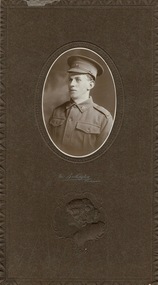
Photograph, Burlington Studios, J.L.McIntyre
... Jack McIntyre) J.L. McIntyre; REG. No. 3591; 58th. BATT. 1st A.I.F Foundation Member Lara R.S.L. 1890 - 1990 well documented history and service record. ...The Burlington Studios were in the Wertheim Buildings, 294 Bourke Street, Melbourne (now the Bourke Street Mall). The photo would have been taken circa 1915. WW1 picture of (Jack McIntyre) J.L. McIntyre; REG. No. 3591; 58th. BATT. 1st A.I.F Foundation Member Lara R.S.L. 1890 - 1990 well documented history and service record.Carboard with wax paper over framed pictureOn front side, half way down are the words The Burlington Melbourne and below this is an embossed picture of a female upper torso. On the rear in pen are the words J.L. J.McIntyre (Jack) 45 Walkers Road Lara. -
 Lara RSL Sub Branch
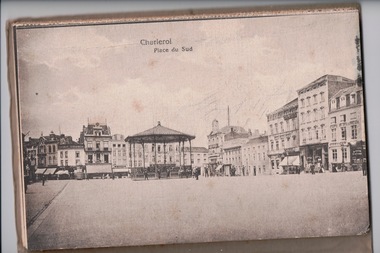
Postcards, France
... Hoping you are all well. With best wishes for a happy new year. Jack. Edition Martinetty Charleroi Front of pack: J. ...Hoping you are all well. With best wishes for a happy new year. Jack. Edition Martinetty Charleroi Front of pack: J. ...John Lachlan McIntyre was born at Beeac, Victoria in December 1890. He enlisted in the 1st AIF in July 1915. John fought on the Western Front, taking part in the battles of Fromelles and the 2nd Battle of the Somme. He was severely wounded at Fromelles and spent 12 months in hospital in England before returning to the front. John returned home in 1919 and was granted a soldier settlement block in Lara in 1937. He was a founding member of Lara RSL and is its longest serving member. John died in 1990. This letter was written by John and sent to his mother in 1918 on his journey through Belgium. The McIntyre family were early pioneers in the Lara district, and the brothers were founding members of the Lara RSL. This letter represents a significant link to the history of the town and sub-branch.A brown envelope addressed to Miss J McIntyre. Within the envelope is a pack of 12 illustrated souvenir post cards. Envelope: O.A.S. Tower of London. Miss J McIntyre. Elcho Lara lake, Australia, Victoria. Rear of postcard pack: London December 27th 18 Dear Mother, I arrived here yesterday. Spent Xmas day travelling across France. The trip took the best part of four days. We are up near Belgium. Had to go into Belgium to get a train. Will write when I get settled. Hoping you are all well. With best wishes for a happy new year. Jack. Edition Martinetty Charleroi Front of pack: J. L. McIntyre Xmas 1918 Souvenir de Charleroi-Belgium 12 cartes postales 12 En Photochrommother, letter, postcard, first world war, wwi, world war one, belgium, lara -
 Lara RSL Sub Branch
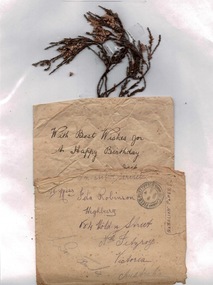
Personal Records, Letter from Jack McIntyre home, 1917
... During his service, Jack McIntyre sent this letter of well wishes to Lola Robinson, who resided in Fitzroy, Victoria....During his service, Jack McIntyre sent this letter of well wishes to Lola Robinson, who resided in Fitzroy, Victoria. ww1 world war one war correspondence Letter: With Best Wishes for / A Happy Birthday / Jack / 1917 Envelope: In Active Service / To Miss Lola Robinson / Highbury / 184 Holden Street / Nth Fitzroy / Victoria / Australia (side): BATTALION PAPER Piece of paper at top: Heather from Scotland / WW 1. ...During his service, Jack McIntyre sent this letter of well wishes to Lola Robinson, who resided in Fitzroy, Victoria.Piece of white paper with three objects taped/glued to it: a small bunch of heather, an envelope, and a letter. There is also a separate piece of paper taped to the top that has typed words. Letter: With Best Wishes for / A Happy Birthday / Jack / 1917 Envelope: In Active Service / To Miss Lola Robinson / Highbury / 184 Holden Street / Nth Fitzroy / Victoria / Australia (side): BATTALION PAPER Piece of paper at top: Heather from Scotland / WW 1.ww1, world war one, war correspondence -
 Lara RSL Sub Branch
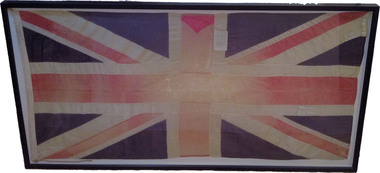
Flag, Australian Flag (Union Jack) 1900
... well as units from the other states. Australians were awarded six Victoria Crosses during the campaign along with many other decorations. In May of 1902 the treaty of Vereeniging was signed officially ending the Boer War. The Boer War is commemorated in many Towns and Cities around Australia. The Lara RSL Sub Branch holds some memorabilia from the Boer War. There is a Union Jack...well as units from the other states. Australians were awarded six Victoria Crosses during the campaign along with many other decorations. In May of 1902 the treaty of Vereeniging was signed officially ending the Boer War. The Boer War is commemorated in many Towns and Cities around Australia. The Lara RSL Sub Branch holds some memorabilia from the Boer War. There is a Union Jack ...There is a Union Jack brought back from South Africa by 1229 Trooper Fredrick James Smith. Between 1899 and 1902, around 16,500 Australians served in South Africa during the Boer War. This was the largest international deployment of troops from the Australian Colonies before Australian Federation. Of the 16,500 men who served in South Africa, 606 were killed in action or died of diseases. The Australian War Memorial records that the fighting conditions in South Africa extremely hard on men and horses. Australians fighting in South Africa were doing so as part of Colony based Regiments such as the Victorian Mounted Rifles, New South Wales Lancers, Queensland Mounted Infantry as well as units from the other states. Australians were awarded six Victoria Crosses during the campaign along with many other decorations. In May of 1902 the treaty of Vereeniging was signed officially ending the Boer War. The Boer War is commemorated in many Towns and Cities around Australia. The Lara RSL Sub Branch holds some memorabilia from the Boer War. There is a Union Jack brought back from South Africa by 1229 Trooper Fredrick James Smith. He was a resident of Lara and was a member of the 5th Victorian Mounted Rifles. It was reported that he carried this flag into battle. The Lara RSL also holds the flag staff of the China, South African and Old Veterans Association. Both these items are of national significance. Both the flag and flag staff were used in marches in Geelong each year until 1916 when Anzac Day commenced. The flag and flag staff were donated to the Lara RSL sub Branch when he joined in 1928. Fredrick James Smith was born at Lara in 1879, the son of Mr/Mrs Smith from Lara. He was a farm hand from Horton Vale, Anakie when he joined F Company of the 5th Victorian Mounted Rifles at the beginning of February 1901. Two weeks later, he left for South Africa on the 15th February. Before leaving, he purchased the flag from W. Libby & Son Geelong. Frederick Left for South Africa on the 15 February 1901 on the Orient. He saw service between March 1901 - March 1902 in east Transvaal and Natal frontier under the British Major General S. Beatson then Pulteney, including the defeat at Wilmansrust where 18 soldiers were killed and 42 wounded (12th June 1901 - heaviest casualties of any Australian contingent,); and the successful intervention at Onverwacht on the 4th January 1902. The 5th Victorian Mounted Rifles suffered: 36 killed or died of wounds, 13 died of disease of a contingent of 46 Officers, 971 Other Ranks and 1099 horses. They returned to Australia on the 26th April 1902 on the Custodian after sailing from Point Natal in South Africa on the 5th April. On his return, Tropper Smith (Saddler Private) joined the South African Soldiers Association of Victoria – Geelong Branch, and after 1928, he joined the Lara RSL. He was buried in Western Cemetery on the 19th June 1968 at the age of 89. Enrolled February 1901 Departed for South Africa on 15 February 1901 Establishment: 46 Officers, 971 Other Ranks with 1099 horses Mobilised at Pretoria: 24 March -- 4 April 1901 Typical company: 1 Captain, 4 Lieutenants, 1 company sergeant-major, 1 company quartermaster-sergeant, 1 sergeant-farrier, 1 sergeant-saddler, 5 sergeants, 6 corporals, 3 shoeing-smiths, 3 saddlers, 1 bugler, 99 privates. Total in company: 126 with 131 horses. Engagements: Rhenoster Kop, Klippan, Kornfontein, Drivelfontein, Wilmansrust, Kambuladraai, H'Lobane, Luchiel's Nek, Loch's Kraal, Vryheid, Onverwacht, Johnston Hoek Killed in action (or died): six Officers, 48 Other Ranks VC Winner: Lieut. L. C. Maygar News article Leader (Melbourne) Saturday 31st May 1902, page 42 - Dear Cinderella. — This is the second time I have written to you. I was very sorry at not seeing my first letter in "The Leader". But I hope to say, that this one will be in. The last time I wrote to you I told you that my brother (Fredrick Smith) went to the Boer War in South Africa, and that he was supposed to be killed in the Wilmansrust disaster. But this time I am going to tell you about his return, and the grand welcome he got from the residents of Lara. Mother, Father, and my Brother, went down to Melbourne, to meet the boat. You can just imagine how rejoiced we all were to see him back again. The railway station was decorated some thing beautiful with flags of all description all the colours you could think of. He has bought a lot of Boer curios home and some Kaffir bracelets. They are such funny looking things. The residents of Lara, also gave my brother a grand social and ball there were over four hundred people present, They presented him with a hand some gold chain, and locket suitably inscribed, and a pair of gold sleeve links, they were magnificent. The ball was very nice. . I had a few dances. I enjoyed myself grand. I think this is all I can tell you this time. I must conclude with love. I remain yours sincerely - BESSIE SMITH. Age 14-years. This flag is of national significance as it was used in the Boer War by Private Fredrick James Smith (SN:1229) of the 5th Victorian Mounted Rifles, F Company in their deployment to South Africa between 1901 and 1902. The flag was taken into the Wilmansrust engagement in which 19 soldiers died and 41 were wounded. On return to Australia, the flag was used in marches by the South Africa, China Old Veterans Association - Geelong. This flag represents a unique part of Australian history from which the movie, Breaker Morant was taken. It is of spiritual significance as the Boer War was where the first Australian received the Imperial Victoria Cross, and the spirit of Anzac was conceived, giving birth in World War 1. The Flag represents the spirit of Australians who fought and died in South Africa.Cotton Union Jack flag approx 221cm wide by 109cm tall with small repair patches and center section cotton deteriorated.Has the word "Lara" inscribed in black on bottom part of the flag heading. Has the flag makers name "W.Libby & Son" on the top part of the flag heading.boer war, union jack flag, south africa, wilmansrust, 5th victorian mounted rifles, f coy, private fredrick james smith, service number 1229, february 1901, april 1902, south africa china old veterans association -
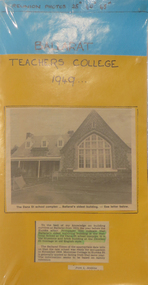 Federation University Historical Collection
Album, Coloured photographs take of reunions of the 1949 Ballarat Teachers' College, 1984, 1999, 2004
... Ballarat Teachers' College was a predecessor of Federation University ballarat teachers' college reunions 25th reunion 40th reunion 45th reunion photographs monica miller rawlings margaret bennetts jack gervasoni peter fryar valda ward david collins maureen godfrey fithall jim lannen john hughes margaret reynolds reunion forty niner rose john bennett frank mountford wal wall margaret collins archie campbell Album of coloured photographs take at the 25th, 40th and 45th reunions of the 1949 Ballarat Teachers' College, as well as as some photographs of some rose blooms that was important to the attendees because it was named the forty niner rose. ...Ballarat Teachers' College was a predecessor of Federation UniversityAlbum of coloured photographs take at the 25th, 40th and 45th reunions of the 1949 Ballarat Teachers' College, as well as as some photographs of some rose blooms that was important to the attendees because it was named the forty niner rose. Some of the photographs are original others are photocopies.ballarat teachers' college, reunions, 25th reunion, 40th reunion, 45th reunion, photographs, monica miller rawlings, margaret bennetts, jack gervasoni, peter fryar, valda ward, david collins, maureen godfrey fithall, jim lannen, john hughes, margaret reynolds, reunion, forty niner rose, john bennett, frank mountford, wal wall, margaret collins, archie campbell -
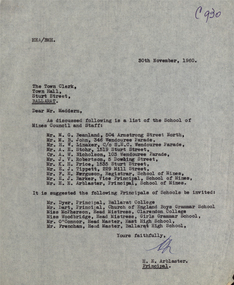 Federation University Historical Collection
Correspondence, Harold E. Arblaster, Ballarat Council Request for Contact Details of Ballarat School of Mines Council and Staff, 1960, 31/11/1960
... Harry Arblaster was the Principal of the Ballarat School of Mines, a predecessor organisation of Federation University Australia. harold e. arblaster maddern m.g. beanland m.b. john h.w. linaker a.e. stohr a.w. nicholson j.v. robertson k.h. price e.j. tippett f.e. ferguson e.j. barker jack barker dyer ballarat college dart ballarat grammar mcpherson clarendon college woodbridge girls grammar school queens college o'connor ballarat east high school frencham ballarat high school Carbon copy of a letter to the Ballarat Town Clerk, Mr Maddern, with names and addresses of Ballarat School of Mines Council and Staff, and well as six Ballarat school principals. ...Harry Arblaster was the Principal of the Ballarat School of Mines, a predecessor organisation of Federation University Australia.Carbon copy of a letter to the Ballarat Town Clerk, Mr Maddern, with names and addresses of Ballarat School of Mines Council and Staff, and well as six Ballarat school principals.harold e. arblaster, maddern, m.g. beanland, m.b. john, h.w. linaker, a.e. stohr, a.w. nicholson, j.v. robertson, k.h. price, e.j. tippett, f.e. ferguson, e.j. barker, jack barker, dyer, ballarat college, dart, ballarat grammar, mcpherson, clarendon college, woodbridge, girls grammar school, queens college, o'connor, ballarat east high school, frencham, ballarat high school -
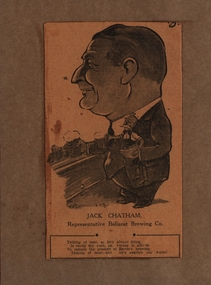 Federation University Historical Collection
Print - Cartoon, Jack Chatham in caricature
... Jack Chatham was a representative of the Ballarat Brewing Company. The cartoon features the well know Ballarat Bertie. ...Jack Chatham was a representative of the Ballarat Brewing Company. The cartoon features the well know Ballarat Bertie. ...Jack Chatham was a representative of the Ballarat Brewing Company. The cartoon features the well know Ballarat Bertie. Ballarat Brewing Company was established in 1910 and they wanted an image to sell the product. Ballarat Bertie was created. Philip Chatham is Jack's son.Newspaper cartoon pasted onto cardboard.jack chatham, ballarat bertie, ballarat brewing company, caricature
