
Showing 94 items matching "john ash"
-
 National Wool Museum
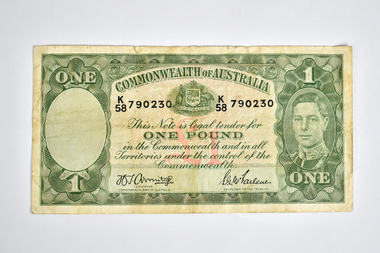
Currency - One Pound Note, John Ash, 1938 - 1948
... ...John Ash...John Ash succeeded Thomas Harrison as the Australian Note Printer in 1927 and oversaw the printing of a new series of banknotes, known as the Ash Series. ...John Ash...Currency One Pound Note John Ash ...John Ash succeeded Thomas Harrison as the Australian Note Printer in 1927 and oversaw the printing of a new series of banknotes, known as the Ash Series. First issued between 1933 and 1934, the new banknotes sought to improve the currency's resistance to counterfeiting. A special watermark was created to increase the security of the new series. Shaped as a medallion, the watermark showed the profile of Edward, the Prince of Wales. A new portrait of the King was also introduced, depicting him frontally rather than in profile as he had appeared in the prior banknotes of the Harrison Series (1923-1925). The back of each denomination contained an individual vignette that reflected a sector of the country's economy. The wool and agricultural industries were represented, as they had been in the first series of the nation's banknotes (1913-1914), and they were joined by manufacturing and commerce. The prominent British sculptor, Paul Montford, contributed to the design of the new series. Recognised for his sculptural works on the exterior of Melbourne's Shrine of Remembrance, Montford was commissioned to produce relief sculptures that formed the basis of the banknotes' vignettes. His sculptures were translated into wash drawings by Frank Manley, the artist and engraver for the Commonwealth Bank's Note Printing Branch. Manley accentuated the sculpture's three-dimensional qualities with deep shadows and touches of illusionism. A sheep in Montford's pastoral scene, for example, stands forward from the frame as if entering the viewer's space to escape branding and Manley preserves this visual conceit in his drawing. Whereas the printing of the previous series of Australian banknotes had been criticised for its poor definition, the sculptural basis of the Ash Series clarified the banknotes' imagery. During a period of record unemployment, the scenes emphasised the strength of the human figure in gestures of labour, evoking classical, heroic qualities in their poses. The sculptural forms suggested stability in the turbulence of the Great Depression and imparted a sense of solidity to paper currency. - museum.rba.gov.auCommonwealth of Australia paper one pound note in green and white tones depicting graphics and text. The obverse has a framed design with a blank portal to the left and King George VI in the right portal. The centre shows the Australian Coat of Arms, serial number, and detail over one pound symbol on a mosaic background, with signatories below. The reverse features a framed pastoral scene with farmers tending sheep, with a blank portal to the right.Obverse: ONE / 1 / 1 / ONE / COMMONWEALTH OF AUSTRALIA / K / 58 / 790230 / K / 58 / 790230 / This Note is legal tender for / ONE POUND / in the Commonwealth and in all / Territories under the control of the / Commonwealth. / [signature] / GOVERNOR / COMMONWEALTH BANK ON AUSTRALIA / [signature] / SECRETARY TO THE TREASURY Reverse: 1 /1 / 1 / 1 / PASTORALcurrency, money, pound note, pastoral scene, industry, commonwealth of australia, paul montford, king george vi, frank manly, john ash -
 National Wool Museum
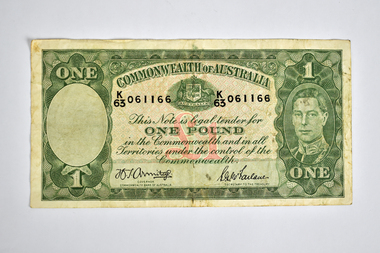
Currency - One Pound Note, John Ash, 1938 - 1948
... ...John Ash...John Ash succeeded Thomas Harrison as the Australian Note Printer in 1927 and oversaw the printing of a new series of banknotes, known as the Ash Series. ...John Ash...Currency One Pound Note John Ash ...John Ash succeeded Thomas Harrison as the Australian Note Printer in 1927 and oversaw the printing of a new series of banknotes, known as the Ash Series. First issued between 1933 and 1934, the new banknotes sought to improve the currency's resistance to counterfeiting. A special watermark was created to increase the security of the new series. Shaped as a medallion, the watermark showed the profile of Edward, the Prince of Wales. A new portrait of the King was also introduced, depicting him frontally rather than in profile as he had appeared in the prior banknotes of the Harrison Series (1923-1925). The back of each denomination contained an individual vignette that reflected a sector of the country's economy. The wool and agricultural industries were represented, as they had been in the first series of the nation's banknotes (1913-1914), and they were joined by manufacturing and commerce. The prominent British sculptor, Paul Montford, contributed to the design of the new series. Recognised for his sculptural works on the exterior of Melbourne's Shrine of Remembrance, Montford was commissioned to produce relief sculptures that formed the basis of the banknotes' vignettes. His sculptures were translated into wash drawings by Frank Manley, the artist and engraver for the Commonwealth Bank's Note Printing Branch. Manley accentuated the sculpture's three-dimensional qualities with deep shadows and touches of illusionism. A sheep in Montford's pastoral scene, for example, stands forward from the frame as if entering the viewer's space to escape branding and Manley preserves this visual conceit in his drawing. Whereas the printing of the previous series of Australian banknotes had been criticised for its poor definition, the sculptural basis of the Ash Series clarified the banknotes' imagery. During a period of record unemployment, the scenes emphasised the strength of the human figure in gestures of labour, evoking classical, heroic qualities in their poses. The sculptural forms suggested stability in the turbulence of the Great Depression and imparted a sense of solidity to paper currency. - museum.rba.gov.auCommonwealth of Australia paper one pound note in green and white tones depicting graphics and text. The obverse has a framed design with a blank portal to the left and King George VI in the right portal. The centre shows the Australian Coat of Arms, serial number, and detail over one pound symbol on a mosaic background, with signatories below. The reverse features a framed pastoral scene with farmers tending sheep, with a blank portal to the right.Obverse: ONE / 1 / 1 / ONE / COMMONWEALTH OF AUSTRALIA / K / 58 / 790230 / K / 58 / 790230 / This Note is legal tender for / ONE POUND / in the Commonwealth and in all / Territories under the control of the / Commonwealth. / [signature] / GOVERNOR / COMMONWEALTH BANK ON AUSTRALIA / [signature] / SECRETARY TO THE TREASURY Reverse: 1 /1 / 1 / 1 / PASTORALcurrency, money, pound note, pastoral scene, industry, commonwealth of australia, paul montford, king george vi, frank manly, john ash -
 Orbost & District Historical Society
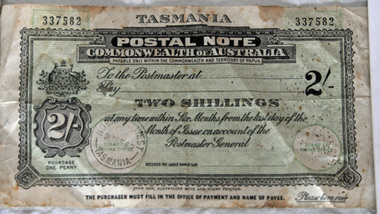
postal note, 1930's-1940's
... John Ash Australian Note and Stamp Printer...The amount is 2/- and it is dated Feb 9 1942 , Number 337582 postal note John Ash Australian Note and Stamp Printer ...This postal note was purchased at Hobart West Post Office but was not cashed in. Postal notes (or postal orders) were introduced as a means of transmitting smaller amounts of currency within a country. They were sanctioned by the Universal Postal Union and upon joining this body, each colony was required to issue them. Money orders were later introduced for larger sums. The post office became responsible for postal notes in 1890. Postal notes were a way of sending money through the post. They were replaced by money orders. Duplicate money orders were issued as replacements.This item is an example of a form of currency which has been superseded by postal and money orders. Postal orders are not legal tender, but a type of promissory note, similar to a cheque.A postal note -black print on green background. The amount is 2/- and it is dated Feb 9 1942 , Number 337582currency postal-note -
 Anglesea and District Historical Society
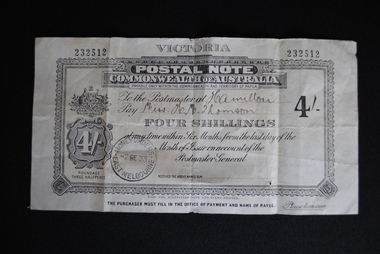
Postal Note, 1933
... John Ash...The purchaser must fill in the office of payment and names of payee. Postal Note John Ash ...Australian Postal Note made out to the Postmaster at Hamilton to pay Miss H.M. Thomson - four shillings, at any time within six months from the last day of the month of issue on account of the Postmaster General. The purchaser must fill in the office of payment and names of payee.232512 VICTORIA / COMMONWEALTH OF AUSTRALIA / To the Postmaster at . . . . . . . Hamilton / Pay .. . . . . . . Miss H.M. Thomson / FOUR SHILLINGS / POUNDAGE / THREE HALF PENCEpostal note, money order, postmaster general -
 Federation University Historical Collection
Certificates, Death Sentence certificates for Ballarat Gaol
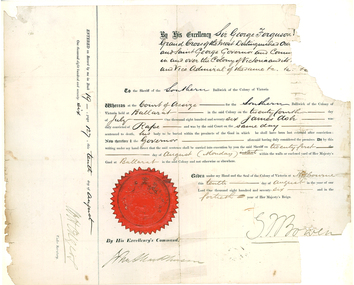
... Moore) * John Wilson, 1891 (carnal knowledge - girl under 10) *James Johnston, 1891 (murder) * James Jones, 1866 (murder) * Joseph Ballan and George Searle, 1868 (murder) James Ash, 1876 (rape) Robert Wallace, 1866 (murder) ...Moore) * John Wilson, 1891 (carnal knowledge - girl under 10) *James Johnston, 1891 (murder) * James Jones, 1866 (murder) * Joseph Ballan and George Searle, 1868 (murder) James Ash, 1876 (rape) Robert Wallace, 1866 (murder) Death Sentence certificates for Ballarat Gaol Certificates ...The certificates related to hangings at the Former Ballarat GaolDeath Sentence Certificate for: * James Ash (Rape), 1876 (George Ferguson - signed S Bowen) * Denis Murphy (murder), 1867 (Robert Wallace-Ballarat Sherriff, Sutton, Maurice Sutton, Moore) * Charles Bushbee alias Charles Baker (intent to murder) (Henry Brougham Loch, H. Moore * John Wilson (carnal knowledge - girl under 10) (John Adrian Loius, H. Moore) * James Jones (murder) - (Robert Wallace Ballarat Sherriff - Charles Darling) * Charles Henry Deutschmann ( Murder 1908) - (Reginald Arthur James Talbot, W.A. Callaway) * Cornelius Bourke (Murder 1891) John Adrian Louis, H. Moore) * John Wilson, 1891 (carnal knowledge - girl under 10) *James Johnston, 1891 (murder) * James Jones, 1866 (murder) * Joseph Ballan and George Searle, 1868 (murder) James Ash, 1876 (rape) Robert Wallace, 1866 (murder) hangings, ballarat gaol, death penalty, james ash, death sentence, george ferguson, ferguson, bowen, henry loch, loch, charles baker, h. moore, moore, bushbee, charles bushbee, james jones, charles darling, robert wallace, arthur talbot, w.a. callaway, callaway, james johnson, joseph ballan, george searle -
 Federation University Historical Collection
Map, Ballarat Goldfield, c1898
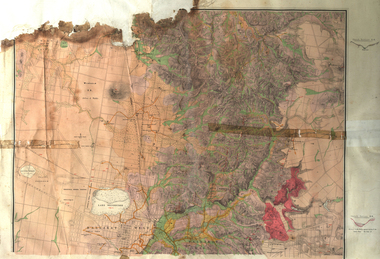
... The Ballarat Industrial School ran from 1869-1879, but the term Ballarat Industrial School Reserve was still in use in 1898 and possibly beyond. ballarat warrenheip lake wendouree ballarat east winters swamp winter swamp wyndholm premptive right cemetery vale park reserve little bendigo kneeshaw co. industrial school reserve kirks dam pincotts dam black hill wombat hill dead horse gully miners rest mt rowan salton and waldie rose hill co great north west no 1 rose's freehold co hand and band co police reserve police paddock mount rowan ballarat industrial school reserve market reserve Winter's swamp Kneeshar Co Monte Cristo line of reef Chinaman's Gully or Black Snake Milkmaid's Gully Ballarat gold field Bakery Hil Lead Old gravel pits lead Golden point lead Eureka Lead Miner's Rest Yarrowee Creek Leigh Creek Black Swamp Lead Yorkshire Reef Nil Desperandum reef Cockatoo Lead HIt or Miss Gully herbert werner frederick de nully Pennyweight Hill Esmond's Lead Ash's Lead Nightingale Lead John Bull Gully Gladstone Reef Whitehorse reef Petticoat Creek Pincott's Dam Frenchman's Gully Tim's Crushing Plant Jenkin's Gully California Gully Drake's Creek Sulton and Waldie Ballarat Undustrial School Ballarat & Mariborough Railway Geological Map of Ballarat with 3 holes in the left hand side. ...This map shows geological features, suggests the last basalt flow, and includes alotments and names of Mining Companies. Although this map has no date on it the Ballarat Industrial School is used for dating purposed. The Ballarat Industrial School ran from 1869-1879, but the term Ballarat Industrial School Reserve was still in use in 1898 and possibly beyond.Geological Map of Ballarat with 3 holes in the left hand side. The map indicates the position of Lake Wendouree, Township of Warrenheip, Ballarat East, Industrial School Reserve, Winters Swamp, Police Paddock, Wyndholm Premptive Right (Salton and Waldie), Black Hill, Vale Park Reserve, Pennyweight Hill, Little Bendigo, Black Swamp Lead, monte Christo Reef, Chinaman's Gully, Miners Rest, Pincotts Dam, Northumberland Gully. It also show the following goldmining companies: City of Ballarat, Kohinor, Hand and Band, Great North West, Northern Junction, Kneeshaw, Rossers Freehold, Silurial.ballarat, warrenheip, lake wendouree, ballarat east, winters swamp, winter swamp, wyndholm premptive right, cemetery, vale park reserve, little bendigo, kneeshaw co., industrial school reserve, kirks dam, pincotts dam, black hill, wombat hill, dead horse gully, miners rest, mt rowan, salton and waldie, rose hill co, great north west no 1, rose's freehold co, hand and band co, police reserve, police paddock, mount rowan, ballarat industrial school reserve, market reserve, winter's swamp, kneeshar co, monte cristo line of reef, chinaman's gully or black snake, milkmaid's gully, ballarat gold field, bakery hil lead, old gravel pits lead, golden point lead, eureka lead, miner's rest, yarrowee creek, leigh creek, black swamp lead, yorkshire reef, nil desperandum reef, cockatoo lead, hit or miss gully, herbert werner frederick de nully, pennyweight hill, esmond's lead, ash's lead, nightingale lead, john bull gully, gladstone reef, whitehorse reef, petticoat creek, pincott's dam, frenchman's gully, tim's crushing plant, jenkin's gully, california gully, drake's creek, sulton and waldie, ballarat undustrial school, ballarat & mariborough railway -
 Marysville & District Historical Society
Photograph (Item) - Black and white photograph, Unknown
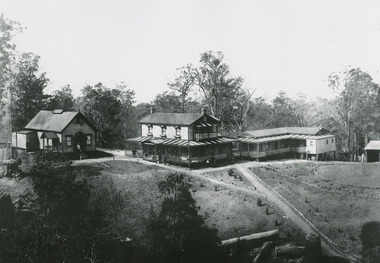
... The garden featured New Guinea tree houses from which John Lindt made frequent panoramas of his property and the surrounding forest of towering mountain ash. ...An early black and white photograph of "The Hermitage" at Narbethong in Victoria.An early black and white photograph of "The Hermitage" at Narbethong in Victoria. "The Hermitage" was built by photographer John William Lindt as a home and guesthouse in 1894. John Lindt had previously photographed the mountain scenery of the Black Spur and purchased 71 acres and subseqently built his home and guesthouse from where he continued his career. "The Hermitage had a garden designed by John Lindt's friend, Ferdinand von Mueller, who was at one stage the Director of the Melbourne Botanic Gardens. The garden featured New Guinea tree houses from which John Lindt made frequent panoramas of his property and the surrounding forest of towering mountain ash. Aged 81 Lindt died of heart failure during disastrous bushfires on 19 February 1926 at the Hermitage. He was survived by his wife Catherine who continued to run ‘The Hermitage’ guest house before she retired to the city.the hermitage, john william lindt, narbethong, victoria, black spur, ferdinand von mueller, melbourne botanic gardens, new guinea, catherine lindt -
 Marysville & District Historical Society
Photograph (Item) - Black and white photograph, John William Lindt, 1890-1910
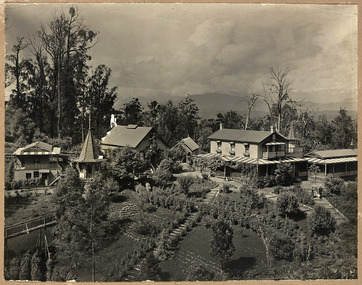
... The garden featured New Guinea tree houses from which John Lindt made frequent panoramas of his property and the surrounding forest of towering mountain ash. ...A digital copy of an early black and white photograph taken of "The Hermitage" in Narbethong in Victoria.A digital copy of an early black and white photograph taken of "The Hermitage" in Narbethong in Victoria. "The Hermitage" was built by photographer John William Lindt as a home and guesthouse in 1894. John Lindt had previously photographed the mountain scenery of the Black Spur and purchased 71 acres and subseqently built his home and guesthouse from where he continued his career. "The Hermitage had a garden designed by John Lindt's friend, Ferdinand von Mueller, who was at one stage the Director of the Melbourne Botanic Gardens. The garden featured New Guinea tree houses from which John Lindt made frequent panoramas of his property and the surrounding forest of towering mountain ash. Aged 81 Lindt died of heart failure during disastrous bushfires on 19 February 1926 at the Hermitage. He was survived by his wife Catherine who continued to run ‘The Hermitage’ guest house before she retired to the city.the hermitage, john william lindt, narbethong, victoria, black spur, ferdinand von mueller, melbourne botanic gardens, new guinea, catherine lindt -
 Marysville & District Historical Society
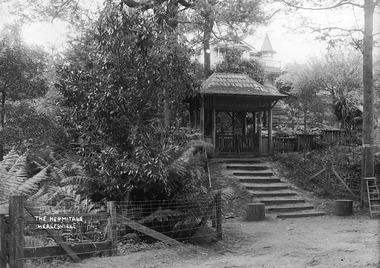
Photograph (Item) - Black and white photograph, John William Lindt, 1910
... The garden featured New Guinea tree houses from which John Lindt made frequent panoramas of his property and the surrounding forest of towering mountain ash. ...A digital copy of an early black and white photograph of the entrance gate to "The Hermitage" at Narbethong in Victoria.A digital copy of an early black and white photograph of the entrance gate to "The Hermitage" at Narbethong in Victoria. "The Hermitage" was built by photographer John William Lindt as a home and guesthouse in 1894. John Lindt had previously photographed the mountain scenery of the Black Spur and purchased 71 acres and subseqently built his home and guesthouse from where he continued his career. "The Hermitage had a garden designed by John Lindt's friend, Ferdinand von Mueller, who was at one stage the Director of the Melbourne Botanic Gardens. The garden featured New Guinea tree houses from which John Lindt made frequent panoramas of his property and the surrounding forest of towering mountain ash. Aged 81 Lindt died of heart failure during disastrous bushfires on 19 February 1926 at the Hermitage. He was survived by his wife Catherine who continued to run ‘The Hermitage’ guest house before she retired to the city. Visitors to the Hermitage alighted from horse-drawn vehicles and later motor coaches to enter the estate through the lich-gate in the background.the hermitage, john william lindt, narbethong, victoria, black spur, ferdinand von mueller, melbourne botanic gardens, new guinea, catherine lindt -
 Marysville & District Historical Society
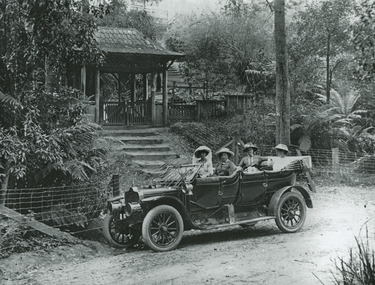
Photograph (Item) - Black and white photograph, John William Lindt, 1912
... The garden featured New Guinea tree houses from which John Lindt made frequent panoramas of his property and the surrounding forest of towering mountain ash. ...An early black and white photograph taken at the entrance to "The Hermitage" in Narbethong in Victoria.An early black and white photograph taken at the entrance to "The Hermitage" in Narbethong in Victoria. "The Hermitage" was built by photographer John William Lindt as a home and guesthouse in 1894. John Lindt had previously photographed the mountain scenery of the Black Spur and purchased 71 acres and subseqently built his home and guesthouse from where he continued his career. "The Hermitage had a garden designed by John Lindt's friend, Ferdinand von Mueller, who was at one stage the Director of the Melbourne Botanic Gardens. The garden featured New Guinea tree houses from which John Lindt made frequent panoramas of his property and the surrounding forest of towering mountain ash. Aged 81 Lindt died of heart failure during disastrous bushfires on 19 February 1926 at the Hermitage. He was survived by his wife Catherine who continued to run ‘The Hermitage’ guest house before she retired to the city.the hermitage, john william lindt, narbethong, victoria, black spur, ferdinand von mueller, melbourne botanic gardens, new guinea, catherine lindt -
 Marysville & District Historical Society
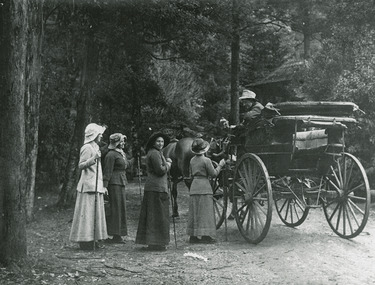
Photograph (Item) - Black and white photograph, John William Lindt, 1910
... The garden featured New Guinea tree houses from which John Lindt made frequent panoramas of his property and the surrounding forest of towering mountain ash. ...An early black and white photograph taken near the entrance gatehouse to "The Hermitage" at Narbethong in Victoria.An early black and white photograph taken near the entrance gatehouse to "The Hermitage" at Narbethong in Victoria. "The Hermitage" was built by photographer John William Lindt as a home and guesthouse in 1894. John Lindt had previously photographed the mountain scenery of the Black Spur and purchased 71 acres and subseqently built his home and guesthouse from where he continued his career. "The Hermitage had a garden designed by John Lindt's friend, Ferdinand von Mueller, who was at one stage the Director of the Melbourne Botanic Gardens. The garden featured New Guinea tree houses from which John Lindt made frequent panoramas of his property and the surrounding forest of towering mountain ash. Aged 81 Lindt died of heart failure during disastrous bushfires on 19 February 1926 at the Hermitage. He was survived by his wife Catherine who continued to run ‘The Hermitage’ guest house before she retired to the city.the hermitage, john william lindt, narbethong, victoria, black spur, ferdinand von mueller, melbourne botanic gardens, new guinea, catherine lindt -
 Marysville & District Historical Society
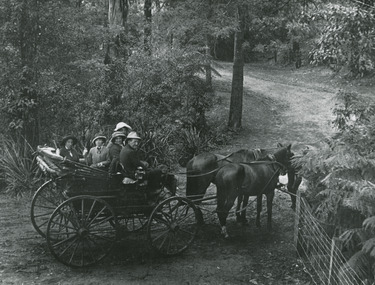
Photograph (Item) - Black and white photograph, John William Lindt, 1910
... The garden featured New Guinea tree houses from which John Lindt made frequent panoramas of his property and the surrounding forest of towering mountain ash. ...An early black and white photograph taken near the entrance gatehouse to "The Hermitage" at Narbethong in Victoria.An early black and white photograph taken near the entrance gatehouse to "The Hermitage" at Narbethong in Victoria. "The Hermitage" was built by photographer John William Lindt as a home and guesthouse in 1894. John Lindt had previously photographed the mountain scenery of the Black Spur and purchased 71 acres and subseqently built his home and guesthouse from where he continued his career. "The Hermitage had a garden designed by John Lindt's friend, Ferdinand von Mueller, who was at one stage the Director of the Melbourne Botanic Gardens. The garden featured New Guinea tree houses from which John Lindt made frequent panoramas of his property and the surrounding forest of towering mountain ash. Aged 81 Lindt died of heart failure during disastrous bushfires on 19 February 1926 at the Hermitage. He was survived by his wife Catherine who continued to run ‘The Hermitage’ guest house before she retired to the city.the hermitage, john william lindt, narbethong, victoria, black spur, ferdinand von mueller, melbourne botanic gardens, new guinea, catherine lindt -
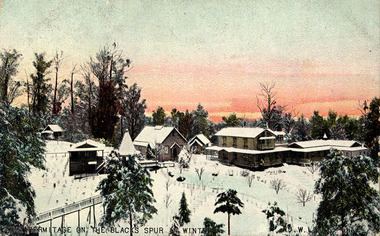 Marysville & District Historical Society
Postcard (Item) - Colour tinted postcard, John William Lindt, The Hermitage on the Black Spur in Winter, 1900s
... The garden featured New Guinea tree houses from which John Lindt made frequent panoramas of his property and the surrounding forest of towering mountain ash. ...A digital copy of an early colour tinted postcard of "The Hermitage" in Narbethong in Victoria.A digital copy of an early colour tinted postcard of "The Hermitage" in Narbethong in Victoria. "The Hermitage" was built by photographer John William Lindt as a home and guesthouse in 1894. John Lindt had previously photographed the mountain scenery of the Black Spur and purchased 71 acres and subseqently built his home and guesthouse from where he continued his career. "The Hermitage had a garden designed by John Lindt's friend, Ferdinand von Mueller, who was at one stage the Director of the Melbourne Botanic Gardens. The garden featured New Guinea tree houses from which John Lindt made frequent panoramas of his property and the surrounding forest of towering mountain ash. Aged 81 Lindt died of heart failure during disastrous bushfires on 19 February 1926 at the Hermitage. He was survived by his wife Catherine who continued to run ‘The Hermitage’ guest house before she retired to the city.the hermitage, john william lindt, narbethong, victoria, black spur, ferdinand von mueller, melbourne botanic gardens, new guinea, catherine lindt, winter -
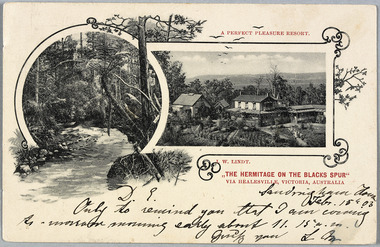 Marysville & District Historical Society
Postcard (Item) - Black and white postcard, John William Lindt, "The Hermitage on the Blacks Spur" via Healesville, Victoria, Australia: A Perfect Pleasure Resort, 1900s
... The garden featured New Guinea tree houses from which John Lindt made frequent panoramas of his property and the surrounding forest of towering mountain ash. ...A digital copy of an early black and white postcard of "The Hermitage" at Narbethong in Victoria.A digital copy of an early black and white postcard of "The Hermitage" at Narbethong in Victoria. "The Hermitage" was built by photographer John William Lindt as a home and guesthouse in 1894. John Lindt had previously photographed the mountain scenery of the Black Spur and purchased 71 acres and subseqently built his home and guesthouse from where he continued his career. "The Hermitage had a garden designed by John Lindt's friend, Ferdinand von Mueller, who was at one stage the Director of the Melbourne Botanic Gardens. The garden featured New Guinea tree houses from which John Lindt made frequent panoramas of his property and the surrounding forest of towering mountain ash. Aged 81 Lindt died of heart failure during disastrous bushfires on 19 February 1926 at the Hermitage. He was survived by his wife Catherine who continued to run ‘The Hermitage’ guest house before she retired to the city.Sandringham South/ Feb. 15th. 03/ D.L./ Only to remind you that I am coming/ As-morrow morning early about 11.15 a.m./ Greetg you L Mthe hermitage, john william lindt, narbethong, victoria, black spur, ferdinand von mueller, melbourne botanic gardens, new guinea, catherine lindt, collotype -
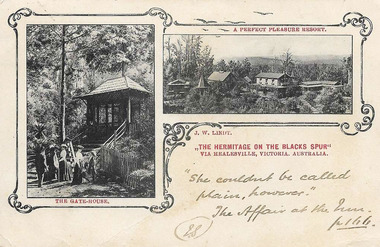 Marysville & District Historical Society
Postcard (Item) - Black and white postcard, John William Lindt, "The Hermitage on the Blacks Spur" via Healesville, Victoria, Australia: A Perfect Pleasure Resort, 1900s
... The garden featured New Guinea tree houses from which John Lindt made frequent panoramas of his property and the surrounding forest of towering mountain ash. ...A digital copy of an early black and white postcard of "The Hermitage" at Narbethong in Victoria.A digital copy of an early black and white postcard of "The Hermitage" at Narbethong in Victoria. "The Hermitage" was built by photographer John William Lindt as a home and guesthouse in 1894. John Lindt had previously photographed the mountain scenery of the Black Spur and purchased 71 acres and subseqently built his home and guesthouse from where he continued his career. "The Hermitage had a garden designed by John Lindt's friend, Ferdinand von Mueller, who was at one stage the Director of the Melbourne Botanic Gardens. The garden featured New Guinea tree houses from which John Lindt made frequent panoramas of his property and the surrounding forest of towering mountain ash. Aged 81 Lindt died of heart failure during disastrous bushfires on 19 February 1926 at the Hermitage. He was survived by his wife Catherine who continued to run ‘The Hermitage’ guest house before she retired to the city."She couldnt be called/ plain, however."/ The affair at the Inn./ IS/ p 1 hh.the hermitage, john william lindt, narbethong, victoria, black spur, ferdinand von mueller, melbourne botanic gardens, new guinea, catherine lindt, collotype -
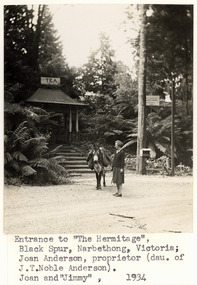 Marysville & District Historical Society
Photograph (Item) - Black and white photograph, Phyllis Bromby, 1934
... The garden featured New Guinea tree houses from which John Lindt made frequent panoramas of his property and the surrounding forest of towering mountain ash. ...A digital copy of a black and white photograph taken at the entrance to "The Hermitage" at Narbethong in Victoria.A digital copy of a black and white photograph taken at the entrance to "The Hermitage" at Narbethong in Victoria. "The Hermitage" was built by photographer John William Lindt as a home and guesthouse in 1894. John Lindt had previously photographed the mountain scenery of the Black Spur and purchased 71 acres and subseqently built his home and guesthouse from where he continued his career. "The Hermitage had a garden designed by John Lindt's friend, Ferdinand von Mueller, who was at one stage the Director of the Melbourne Botanic Gardens. The garden featured New Guinea tree houses from which John Lindt made frequent panoramas of his property and the surrounding forest of towering mountain ash. Aged 81 Lindt died of heart failure during disastrous bushfires on 19 February 1926 at the Hermitage. He was survived by his wife Catherine who continued to run ‘The Hermitage’ guest house before she retired to the city. In the early 1930s, Joan Anderson purchased the property, maintaining it as a guesthouse.Entrance to "The Hermitage",/ Black Spur, Narbethong, Victoria;/ Joan Anderson, proprietor (dau of/ J.T. Noble Anderson)./ Joan and "Jimmy", 1934the hermitage, john william lindt, narbethong, victoria, black spur, ferdinand von mueller, melbourne botanic gardens, new guinea, catherine lindt, joan anderson -
 Marysville & District Historical Society
Photograph (Item) - Black and white photograph, 1900s
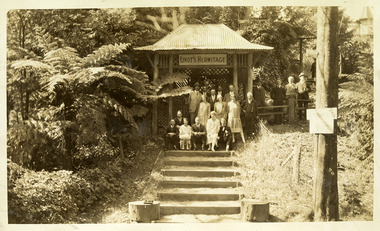
... The garden featured New Guinea tree houses from which John Lindt made frequent panoramas of his property and the surrounding forest of towering mountain ash. ...A digital copy of a black and white photograph taken at the entrance to "The Hermitage" at Narbethong in Victoria.A digital copy of a black and white photograph taken at the entrance to "The Hermitage" at Narbethong in Victoria. "The Hermitage" was built by photographer John William Lindt as a home and guesthouse in 1894. John Lindt had previously photographed the mountain scenery of the Black Spur and purchased 71 acres and subseqently built his home and guesthouse from where he continued his career. "The Hermitage had a garden designed by John Lindt's friend, Ferdinand von Mueller, who was at one stage the Director of the Melbourne Botanic Gardens. The garden featured New Guinea tree houses from which John Lindt made frequent panoramas of his property and the surrounding forest of towering mountain ash. Aged 81 Lindt died of heart failure during disastrous bushfires on 19 February 1926 at the Hermitage. He was survived by his wife Catherine who continued to run ‘The Hermitage’ guest house before she retired to the city.the hermitage, john william lindt, narbethong, victoria, black spur, ferdinand von mueller, melbourne botanic gardens, new guinea, catherine lindt -
 Marysville & District Historical Society
Article (Item) - Advertisement, Broadbent's Official Road Guides Company, Lindt's Hermitage on the Black's Spur, 1940s
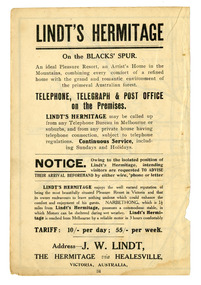
... The garden featured New Guinea tree houses from which John Lindt made frequent panoramas of his property and the surrounding forest of towering mountain ash. ...A page on Lindt's Hermitage at Narbethong from a Broadbent's Official Guide.A page on Lindt's Hermitage at Narbethong from a Broadbent's Official Guide. "The Hermitage" was built by photographer John William Lindt as a home and guesthouse in 1894. John Lindt had previously photographed the mountain scenery of the Black Spur and purchased 71 acres and subseqently built his home and guesthouse from where he continued his career. "The Hermitage had a garden designed by John Lindt's friend, Ferdinand von Mueller, who was at one stage the Director of the Melbourne Botanic Gardens. The garden featured New Guinea tree houses from which John Lindt made frequent panoramas of his property and the surrounding forest of towering mountain ash. Aged 81 Lindt died of heart failure during disastrous bushfires on 19 February 1926 at the Hermitage. He was survived by his wife Catherine who continued to run ‘The Hermitage’ guest house before she retired to the city.the hermitage, john william lindt, narbethong, victoria, black spur, ferdinand von mueller, melbourne botanic gardens, new guinea, catherine lindt -
 Marysville & District Historical Society
Photograph (Item) - Black and white photograph, Unknown
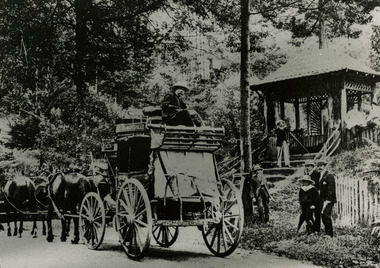
... The garden featured New Guinea tree houses from which John Lindt made frequent panoramas of his property and the surrounding forest of towering mountain ash. ...An early black and white photograph of a Cobb & Co coach at "The Hermitage" at Narbethong in Victoria.An early black and white photograph of a Cobb & Co coach at "The Hermitage" at Narbethong in Victoria. "The Hermitage" was built by photographer John William Lindt as a home and guesthouse in 1894. John Lindt had previously photographed the mountain scenery of the Black Spur and purchased 71 acres and subseqently built his home and guesthouse from where he continued his career. "The Hermitage had a garden designed by John Lindt's friend, Ferdinand von Mueller, who was at one stage the Director of the Melbourne Botanic Gardens. The garden featured New Guinea tree houses from which John Lindt made frequent panoramas of his property and the surrounding forest of towering mountain ash. Aged 81 Lindt died of heart failure during disastrous bushfires on 19 February 1926 at the Hermitage. He was survived by his wife Catherine who continued to run ‘The Hermitage’ guest house before she retired to the city. This postcard was produced by The Rose Stereograph Company as a souvenir of Narbethong in Victoria.the hermitage, john william lindt, narbethong, victoria, black spur, ferdinand von mueller, melbourne botanic gardens, new guinea, catherine lindt, cobb & co -
 Marysville & District Historical Society
Flyer (Item) - Tariff Flyer, Val and John Stafford, "The Hermitage", 1991
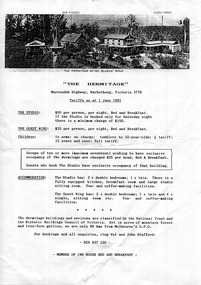
... The garden featured New Guinea tree houses from which John Lindt made frequent panoramas of his property and the surrounding forest of towering mountain ash. ...A tariff flyer for "The Hermitage" at Narbethong in Victoria dated June 1991.A tariff flyer for "The Hermitage" at Narbethong in Victoria dated June 1991. "The Hermitage" was built by photographer John William Lindt as a home and guesthouse in 1894. John Lindt had previously photographed the mountain scenery of the Black Spur and purchased 71 acres and subseqently built his home and guesthouse from where he continued his career. "The Hermitage had a garden designed by John Lindt's friend, Ferdinand von Mueller, who was at one stage the Director of the Melbourne Botanic Gardens. The garden featured New Guinea tree houses from which John Lindt made frequent panoramas of his property and the surrounding forest of towering mountain ash. Aged 81 Lindt died of heart failure during disastrous bushfires on 19 February 1926 at the Hermitage. He was survived by his wife Catherine who continued to run ‘The Hermitage’ guest house before she retired to the city. At the time of the production of this flyer, John and Val Stafford had become the fifth owners of "The Hermitage".the hermitage, john william lindt, narbethong, victoria, black spur, ferdinand von mueller, melbourne botanic gardens, new guinea, catherine lindt, john stafford, val stafford -
 Marysville & District Historical Society
Article (Item) - Magazine article, Are Media Pty Limited, Beyond All Expectations, 1992
... The garden featured New Guinea tree houses from which John Lindt made frequent panoramas of his property and the surrounding forest of towering mountain ash. ...A magazine article taken from the magazine A Country Style in 1992 on "The Hermitage" at Narbethong in Victoria.A magazine article taken from the magazine A Country Style in 1992 on "The Hermitage" at Narbethong in Victoria. "The Hermitage" was built by photographer John William Lindt as a home and guesthouse in 1894. John Lindt had previously photographed the mountain scenery of the Black Spur and purchased 71 acres and subseqently built his home and guesthouse from where he continued his career. "The Hermitage had a garden designed by John Lindt's friend, Ferdinand von Mueller, who was at one stage the Director of the Melbourne Botanic Gardens. The garden featured New Guinea tree houses from which John Lindt made frequent panoramas of his property and the surrounding forest of towering mountain ash. Aged 81 Lindt died of heart failure during disastrous bushfires on 19 February 1926 at the Hermitage. He was survived by his wife Catherine who continued to run ‘The Hermitage’ guest house before she retired to the city. At the time of the publication of this article, John and Val Stafford had become the fifth owners of "The Hermitage".the hermitage, john william lindt, narbethong, victoria, black spur, ferdinand von mueller, melbourne botanic gardens, new guinea, catherine lindt, john stafford, val stafford -
 Marysville & District Historical Society
Photograph (Item) - Colour photograph, Unknown
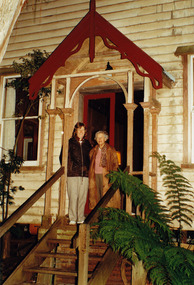
... The garden featured New Guinea tree houses from which John Lindt made frequent panoramas of his property and the surrounding forest of towering mountain ash. ...A colour photograph of a visit by the grand-daughter of Nicholas and Louisa Caire to "The Hermitage" at Narbethong in Victoria.A colour photograph of a visit by the grand-daughter of Nicholas and Louisa Caire to "The Hermitage" at Narbethong in Victoria. "The Hermitage" was built by photographer John William Lindt as a home and guesthouse in 1894. John Lindt had previously photographed the mountain scenery of the Black Spur and purchased 71 acres and subseqently built his home and guesthouse from where he continued his career. "The Hermitage had a garden designed by John Lindt's friend, Ferdinand von Mueller, who was at one stage the Director of the Melbourne Botanic Gardens. The garden featured New Guinea tree houses from which John Lindt made frequent panoramas of his property and the surrounding forest of towering mountain ash. Aged 81 Lindt died of heart failure during disastrous bushfires on 19 February 1926 at the Hermitage. He was survived by his wife Catherine who continued to run ‘The Hermitage’ guest house before she retired to the city. John Lindt, in collaboration with Nicholas John Caire, produced a tourist booklet on the area around "The Hermitage" in 1913.the hermitage, john william lindt, narbethong, victoria, black spur, ferdinand von mueller, melbourne botanic gardens, new guinea, catherine lindt, nicholas john caire -
Marysville & District Historical Society
Postcard (Item) - Colour postcards, John William Lindt, The Hermitage on the Blacks' Spur, 1900s
... The garden featured New Guinea tree houses from which John Lindt made frequent panoramas of his property and the surrounding forest of towering mountain ash. ...A series of historical colour postcards of "The Hermitage" at Narbethong in Victoria taken by John William Lindt.A series of historical colour postcards of "The Hermitage" at Narbethong in Victoria taken by John William Lindt. "The Hermitage" was built by photographer John William Lindt as a home and guesthouse in 1894. John Lindt had previously photographed the mountain scenery of the Black Spur and purchased 71 acres and subseqently built his home and guesthouse from where he continued his career. "The Hermitage had a garden designed by John Lindt's friend, Ferdinand von Mueller, who was at one stage the Director of the Melbourne Botanic Gardens. The garden featured New Guinea tree houses from which John Lindt made frequent panoramas of his property and the surrounding forest of towering mountain ash. Aged 81 Lindt died of heart failure during disastrous bushfires on 19 February 1926 at the Hermitage. He was survived by his wife Catherine who continued to run ‘The Hermitage’ guest house before she retired to the city.the hermitage, john william lindt, narbethong, victoria, black spur, ferdinand von mueller, melbourne botanic gardens, new guinea, catherine lindt, postcard, souvenir -
 Marysville & District Historical Society
Photograph (item) - Black and white photograph, Nicholas John Caire, 1878-1904
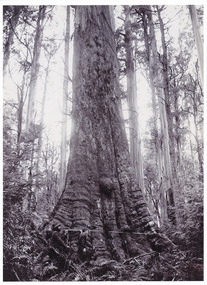
... ash...cambarville...victoria...photograph...cumberland valley...nicholas john...After 1885 Nicholas John Caire gave up his city work and made his home in South Yarra and devoted the rest of his life to outdoor photography, specializing in the bush, the gullies, and the mountains of south-eastern Victoria. big tree mountain ash cambarville victoria photograph cumberland valley nicholas john caire An early black and white photograph of a Cumberland Valley giant tree. ...An early black and white photograph of a Cumberland Valley giant tree.An early black and white photograph of a Cumberland Valley giant tree. This photograph was taken by Nicholas John Caire between 1878 and 1904. Nicholas John Caire was born in 1837 in Guernsey. He arrived in Adelaide about 1860 along with his parents who encouraged his early interest in photography. He opened a studio in Adelaide in 1867 after traveling extensively throughout the Gippsland taking photographs. After marrying in 1870 he moved to Talbot in Victoria until 1876 when he opened a studio in the Royal Arcade in Melbourne. After 1885 Nicholas John Caire gave up his city work and made his home in South Yarra and devoted the rest of his life to outdoor photography, specializing in the bush, the gullies, and the mountains of south-eastern Victoria. big tree, mountain ash, cambarville, victoria, photograph, cumberland valley, nicholas john caire -
 Marysville & District Historical Society
Photograph (Item) - Black and white photograph, Nicholas John Caire, 1878-1904
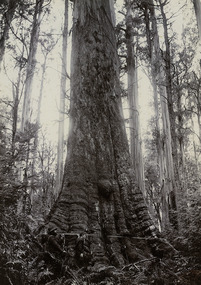
... ash...cambarville...victoria...photograph...cumberland valley...nicholas john...After 1885 Nicholas John Caire gave up his city work and made his home in South Yarra and devoted the rest of his life to outdoor photography, specializing in the bush, the gullies, and the mountains of south-eastern Victoria. big tree mountain ash cambarville victoria photograph cumberland valley nicholas john caire Shows two men measuring around the base of a Cumberland Valley giant tree. ...Shows two men measuring around the base of a Cumberland Valley giant tree. An early black and white photograph of a Cumberland Valley giant tree. This photograph was taken by Nicholas John Caire between 1878 and 1904. Nicholas John Caire was born in 1837 in Guernsey. He arrived in Adelaide about 1860 along with his parents who encouraged his early interest in photography. He opened a studio in Adelaide in 1867 after traveling extensively throughout the Gippsland taking photographs. After marrying in 1870 he moved to Talbot in Victoria until 1876 when he opened a studio in the Royal Arcade in Melbourne. After 1885 Nicholas John Caire gave up his city work and made his home in South Yarra and devoted the rest of his life to outdoor photography, specializing in the bush, the gullies, and the mountains of south-eastern Victoria. big tree, mountain ash, cambarville, victoria, photograph, cumberland valley, nicholas john caire -
Federation University Historical Collection
Postcard, Ash Leib, University of Ballarat Alumni: Alumination, 2012
... ash lieb...Bren Luke...Ronnie McKeegan...Suzanne McRae...Darren Newby...John...University of Ballarat is a predecessor of Federation University Alumni Alumination University of Ballarat Art Gallery of Ballarat Kim Anderson Phil Berry Amy Devereaux Peter Georgakis Tarli Glover Debbie Hill Dianne Jacono Nerina Lascelles ash lieb Bren Luke Ronnie McKeegan Suzanne McRae Darren Newby John O'Loughlin Melissa Peacock Kat Pengelly Travis Price Kiri Smart Emma Stoneman Peter Thomas Shane van den Akker Claire Blake Geoff Wallis Dingo Postcard advertising and exhibition at the Ballarat Art Gallery of works done by University of Ballarat Alumni. ...University of Ballarat is a predecessor of Federation UniversityPostcard advertising and exhibition at the Ballarat Art Gallery of works done by University of Ballarat Alumni. Has an artwork on the front of a small female and a dingo with a red/orange and black background.alumni, alumination, university of ballarat, art gallery of ballarat, kim anderson, phil berry, amy devereaux, peter georgakis, tarli glover, debbie hill, dianne jacono, nerina lascelles, ash lieb, bren luke, ronnie mckeegan, suzanne mcrae, darren newby, john o'loughlin, melissa peacock, kat pengelly, travis price, kiri smart, emma stoneman, peter thomas, shane van den akker, claire blake, geoff wallis, dingo -
 Marysville & District Historical Society
Photograph (item) - Colour photograph, 10-1984
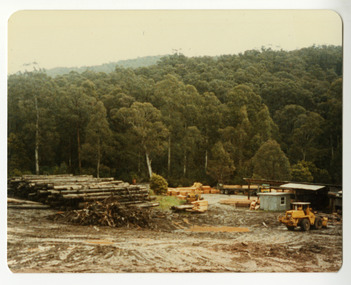
... john sund...sund stenco...sunds bros sawmill...victorian government gazette 1958...mountain ash...John Sund and often referenced locally as Sund Stenco) was a prominent mid-century timber mill located in Marysville, Victoria. It played a central role in the region's booming post-war logging era. The mill was highly active during the 1950s. This era marked a peak for Marysville's timber sector, with over 300 men employed across multiple local mills, sustaining nearly 1,000 residents. According to Victoria Government Gazette records from 1958, the Sund brothers operated commercial goods vehicles to transport Mountain ash...John Sund and often referenced locally as Sund Stenco) was a prominent mid-century timber mill located in Marysville, Victoria. It played a central role in the region's booming post-war logging era. The mill was highly active during the 1950s. This era marked a peak for Marysville's timber sector, with over 300 men employed across multiple local mills, sustaining nearly 1,000 residents. According to Victoria Government Gazette records from 1958, the Sund brothers operated commercial goods vehicles to transport Mountain ash ...A colour photograph taken at Sunds Bros Sawmill in Marysville. Sund's Sawmill (historically operated by Arthur & John Sund and often referenced locally as Sund Stenco) was a prominent mid-century timber mill located in Marysville, Victoria. It played a central role in the region's booming post-war logging era. The mill was highly active during the 1950s. This era marked a peak for Marysville's timber sector, with over 300 men employed across multiple local mills, sustaining nearly 1,000 residents. According to Victoria Government Gazette records from 1958, the Sund brothers operated commercial goods vehicles to transport Mountain ash and other hardwood logs from forest landings in the Mt. Gordon area directly to their mill in Marysville. Sawn timber from the Sund Bros mill was primary distributed to Millard's timber yards at Mt. Evelyn, eventually supplying building blocks across the rapidly growing eastern suburbs of Melbourne.A colour photograph taken at Sunds Bros Sawmill in Marysville.marysville, victoria, australia, arthur sund, john sund, sund stenco, sunds bros sawmill, victorian government gazette 1958, mountain ash, mount gordon, millard's timber yards, mt. evelyn, melbourne, photograph -
Marysville & District Historical Society
Document (item) - Research document, Marysville & District Historical Society Inc, General Timber Facts and Local Sawmill Histories, Unknown
... ash...william iram...fisher's creek...john...A document outlining a few general timber facts and the histories of a few of the sawmills in and around the Marysville district that have been garnered from a variety of sources. marysville victoria australia narbethong cambarville marysville buxton road reverend george edwards cross cut saw peg and rake mountain ash william iram fisher's creek john macdonald robert percival paulson david miller grierson thomas jewry knott's sawmill dom dom james alexander marchbank william rae black spur harry oxley snr don frood lovett A document outlining a few general timber facts and the histories of a few of the sawmills in and around the Marysville district that have been garnered from a variety of sources. ...A document outlining a few general timber facts and the histories of a few of the sawmills in and around the Marysville district that have been garnered from a variety of sources.A document outlining a few general timber facts and the histories of a few of the sawmills in and around the Marysville district that have been garnered from a variety of sources.marysville, victoria, australia, narbethong, cambarville, marysville buxton road, reverend george edwards, cross cut saw, peg and rake, mountain ash, william iram, fisher's creek, john macdonald, robert percival paulson, david miller grierson, thomas jewry, knott's sawmill, dom dom, james alexander marchbank, william rae, black spur, harry oxley snr, don frood lovett -
 Marysville & District Historical Society
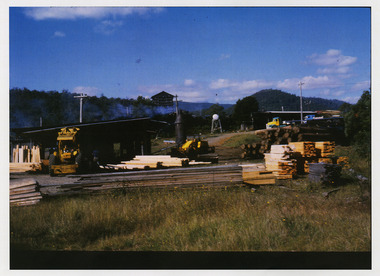
Photograph (item) - Colour photograph, 1970s
... john sund...sund stenco...sunds bros sawmill...victorian government gazette 1958...mountain ash...John Sund and often referenced locally as Sund Stenco) was a prominent mid-century timber mill located in Marysville, Victoria. It played a central role in the region's booming post-war logging era. The mill was highly active during the 1950s. This era marked a peak for Marysville's timber sector, with over 300 men employed across multiple local mills, sustaining nearly 1,000 residents. According to Victoria Government Gazette records from 1958, the Sund brothers operated commercial goods vehicles to transport Mountain ash...John Sund and often referenced locally as Sund Stenco) was a prominent mid-century timber mill located in Marysville, Victoria. It played a central role in the region's booming post-war logging era. The mill was highly active during the 1950s. This era marked a peak for Marysville's timber sector, with over 300 men employed across multiple local mills, sustaining nearly 1,000 residents. According to Victoria Government Gazette records from 1958, the Sund brothers operated commercial goods vehicles to transport Mountain ash ...A copy of a colour photograph taken at Sunds Bros Sawmill located in Marysville. The original photograph was taken in the 1970s. Sund's Sawmill (historically operated by Arthur & John Sund and often referenced locally as Sund Stenco) was a prominent mid-century timber mill located in Marysville, Victoria. It played a central role in the region's booming post-war logging era. The mill was highly active during the 1950s. This era marked a peak for Marysville's timber sector, with over 300 men employed across multiple local mills, sustaining nearly 1,000 residents. According to Victoria Government Gazette records from 1958, the Sund brothers operated commercial goods vehicles to transport Mountain ash and other hardwood logs from forest landings in the Mt. Gordon area directly to their mill in Marysville. Sawn timber from the Sund Bros mill was primary distributed to Millard's timber yards at Mt. Evelyn, eventually supplying building blocks across the rapidly growing eastern suburbs of Melbourne.A copy of a colour photograph taken at Sunds Bros Sawmill located in Marysville. The original photograph was taken in the 1970s.marysville, victoria, australia, arthur sund, john sund, sund stenco, sunds bros sawmill, victorian government gazette 1958, mountain ash, mount gordon, millard's timber yards, mt. evelyn, melbourne, photograph -
 Marysville & District Historical Society
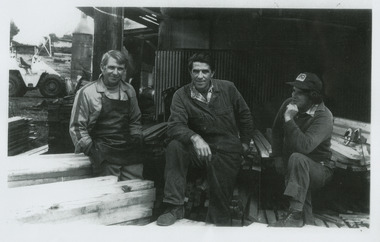
Photograph (item) - Black and white photograph, Unknown
... john sund...sund stenco...sunds bros sawmill...victorian government gazette 1958...mountain ash...John Sund and often referenced locally as Sund Stenco) was a prominent mid-century timber mill located in Marysville, Victoria. It played a central role in the region's booming post-war logging era. The mill was highly active during the 1950s. This era marked a peak for Marysville's timber sector, with over 300 men employed across multiple local mills, sustaining nearly 1,000 residents. According to Victoria Government Gazette records from 1958, the Sund brothers operated commercial goods vehicles to transport Mountain ash...John Sund and often referenced locally as Sund Stenco) was a prominent mid-century timber mill located in Marysville, Victoria. It played a central role in the region's booming post-war logging era. The mill was highly active during the 1950s. This era marked a peak for Marysville's timber sector, with over 300 men employed across multiple local mills, sustaining nearly 1,000 residents. According to Victoria Government Gazette records from 1958, the Sund brothers operated commercial goods vehicles to transport Mountain ash ...A copy of a black and white photograph of Bill, Allan and Len Sund who at one stage operated the Sunds Bros Sawmill in Marysville. Sund's Sawmill (historically operated by Arthur & John Sund and often referenced locally as Sund Stenco) was a prominent mid-century timber mill located in Marysville, Victoria. It played a central role in the region's booming post-war logging era. The mill was highly active during the 1950s. This era marked a peak for Marysville's timber sector, with over 300 men employed across multiple local mills, sustaining nearly 1,000 residents. According to Victoria Government Gazette records from 1958, the Sund brothers operated commercial goods vehicles to transport Mountain ash and other hardwood logs from forest landings in the Mt. Gordon area directly to their mill in Marysville. Sawn timber from the Sund Bros mill was primary distributed to Millard's timber yards at Mt. Evelyn, eventually supplying building blocks across the rapidly growing eastern suburbs of Melbourne.A copy of a black and white photograph of Bill, Allan and Len Sund who at one stage operated the Sunds Bros Sawmill in Marysville.marysville, victoria, australia, arthur sund, john sund, sund stenco, sunds bros sawmill, victorian government gazette 1958, mountain ash, mount gordon, millard's timber yards, mt. evelyn, melbourne, photograph, bill sund, allan sund, len sund
